

Introduction
Psychosis is a term for a number of conditions including schizophrenia. Whilst no two people may be affected in the same way, commonly people report unusual sensory experiences like hearing or seeing things others do not (hallucinations) and/or holding unfounded, distressing beliefs (delusions). Although medication benefits some people some of the time, many continue to report distressing symptoms. To provide more help and more choice for people with psychosis, psychological therapy, and specifically cognitive behavioural therapy for psychosis (CBTp), has been recommended by the National Institute of Clinical Excellence (NICE) since 2002. However, access to this treatment remains limited (particularly in community mental health teams but less so in Early Intervention in Psychosis services) owing to a shortage of trained therapists, and the lengthy nature of the treatment which is between 16 and 24 weekly sessions (Morrison, Reference Morrison2017).
A number of approaches have been considered to address this gap. First, briefer treatments have been trialled with some evidence of their value (Hazell et al., Reference Hazell, Hayward, Cavanagh and Strauss2016). Also, efforts have been made to train a more widely available work force, such as non-specialist staff, to deliver therapy (Garety et al., Reference Garety, Craig, Iredale, Basit, Fornells-Ambrojo, Halkoree, Jolley, Landau, McCrone, Tunnard, Zala and Waller2018). However, CBTp encompasses a wide range of treatment targets (Morrison, Reference Morrison2017) which causes challenges in training and delivery of a complex intervention by a less trained workforce. One solution is to narrow the focus and target specific symptoms of psychosis such as auditory (Clarke et al., Reference Clarke, Jones and Hayward2021) or visual hallucinations (Wilson et al., Reference Wilson, Collerton, Freeston, Christodoulides and Dudley2016) or delusions (Foster et al., Reference Foster, Startup, Potts and Freeman2010). Furthermore, digital technologies have been developed as they can provide help in an engaging and accessible way and help standardise the treatment (Freeman et al., Reference Freeman, Lambe, Kabir, Petit, Rosebrock, Yu, Dudley, Chapman, Morrison, O’Regan, Aynsworth, Jones, Murphy, Powling, Galal, Grabey, Rovira, Martin, Hollis and West2022; Garety et al., Reference Garety, Ward, Emsley, Greenwood, Freeman, Fowler, Kuipers, Bebbington, Rus-Calafell, McGourty, Sacadura, Collett, James and Hardy2021; Yiend et al., Reference Yiend, Lam, Schmidt, Crane, Heslin, Kabir, McGuire, Meek, Mouchlianitis, Peters, Stahl, Trotta and Shergill2022).
There are an increasing number of digitally delivered treatments for hallucinations (Bell et al., Reference Bell, Rossell, Farhall, Hayward, Lim, Fielding-Smith and Thomas2020; Craig et al., Reference Craig, Rus-Calafell, Ward, Leff, Huckvale, Howarth, Emsley and Garety2018). In these research settings, digital therapies provided by expert therapists are safe, efficacious and are well received by service users. However, few have been implemented in the real world or provided by non-expert therapists, which is necessary if we are to meaningfully increase access (Hayward, Reference Hayward2018).
Managing Unusual Sensory Experiences (MUSE) is a brief, digitally delivered therapy targeting the two most common unusual sensory experiences (i.e. auditory and visual hallucinations; Dudley et al., Reference Dudley, Denton, Mathewson, Pervez, Aynsworth, Dodgson and Barclay2023a; Dudley et al., Reference Dudley, Watson, O’Grady, Aynsworth, Dodgson, Common, Day and Fernyhough2023b; McCarthy-Jones et al., Reference McCarthy-Jones, Smailes, Corvin, Gill, Morris, Dinan, Murphy, Anthony O’Neill, Waddington, Schizophrenia Research Bank, Donohoe and Dudley2017). MUSE helps people better understand and manage their USE. It uses engaging technology such as videos and animations, and focuses on causal mechanisms that lead people to hear and see things others do not. This explanation of why people have these experiences is very important. Psychosis is a stigmatised and, for some, a frightening condition, and the question of ‘why me?’, ‘why do I hear things others do not?’ is a real concern. Existing explanations (it is caused by stress, poor sleep) are inadequate, as lots of people do not sleep well, or are stressed yet do not develop hallucinations. So, MUSE attempts to help explain how these issues (sleep, stress, etc.) can affect the psychological processes/mechanisms leading to confusion on the origin of information that leads to hearing/seeing things others do not.
However, education alone is not likely to be helpful in and of itself, as it needs to be linked to changes in behaviour and coping. Hence, the emphasis on explaining why we may hear or see things directly relates to the rationale for the use of linked coping strategies. Consequently, MUSE is compatible with a CBTp approach (Morrison, Reference Morrison2017) in focusing on changing interpretations and behaviours maintaining distress (Clarke et al., Reference Clarke, Jones and Hayward2021; Paulik et al., Reference Paulik, Jones and Hayward2018), but rather than just focus on appraisals of experiences it directly helps provide a more normalising, and credible explanation as to why people have these USE. MUSE can be delivered by a non-specialist workforce following brief training (2–3 days, see Dudley et al., Reference Dudley, Dodgson, Common, O’Grady, Watson, Gibbs, Arnott, Fernyhough, Alderson-Day, Ogundimu, Kharatikoopaei, Patton and Aynsworth2022). Weekly sessions of MUSE are usually delivered over 6–8 meetings. Several small studies involving people with psychosis (Dodgson et al., Reference Dodgson, Alderson-Day, Smailes, Ryles, Mayer, Glen-Davison, Mitrenga and Fernyhough2021a), those with hallucinations in an at-risk mental state (ARMS) service (Dodgson et al., Reference Dodgson, Aynsworth, Mitrenga, Gibbs, Patton, Fernyhough, Dudley, Ewels, Leach, Alderson-Day and Common2021b), and two small feasibility studies with ARMS (Hamilton et al., Reference Hamilton, Arnott, Aynsworth, Barclay, Birkett, Brandon, Dixon, Dudley, Einbeck, Gibbs, Kharatikoopaei, Simpson, Dodgson and Fernyhough2023; Dodgson et al., Reference Dodgson, Singh, Barclay, Birkett, Boyle, Brandon, Dudley, Einbeck, Gibbs, Hamilton, Larry, Simpson and Fernyhough2025) and people with first-episode psychosis (Dudley et al., Reference Dudley, Dodgson, Common, Ogundimu, Liley, O’Grady, Watson, Gibbs, Arnott, Fernyhough, Alderson-Day and Aynsworth2024) have indicated that MUSE is an acceptable and safe treatment when provided by therapists and trained community psychiatric nurses. Consequently, MUSE is increasingly being utilised in local National Health Services (NHS) both for individual and group sessions and is delivered by a wide workforce including psychological therapists, nursing staff, and assistant psychologists (APs). MUSE materials are accessible online (https://web.ntw.nhs.uk/gsh/VH/) and are being downloaded many hundreds of times each month. However, there has been no specific evaluation of its use in real-world settings. The current work addresses this by focusing on practice-based evidence of MUSE being used in routine NHS services.
This use of MUSE in clinical practice is encouraging as despite the potential value of new technology-assisted treatments, non-adoption and non-use are common (Greenhalgh et al., Reference Greenhalgh, Wherton, Papoutsi, Lynch, Hughes, A'Court, Hinder, Fahy, Procter and Shaw2017). Our long-term aim is to increase access to treatment for people experiencing distressing USE by providing digital psychological therapies such as MUSE, delivered by a more widely available workforce. As such, we wanted to establish the impact of delivering this new digitally delivered treatment in routine practice in a real-world setting but also identify factors affecting its future implementation. To do this, we drew on the non-adoption, abandonment, scale-up, spread, and sustainability (NASSS) framework to inform the development of a future implementation strategy.
Method
Participants
Fifty-nine (38 male and 21 female; average age=38.63 years, SD=10.61) service users from Community Treatment Teams (CTT n=31; 53%) and Early Intervention in Psychosis services (EIP n=28; 47%) were referred to receive MUSE. Inclusion criteria included having a diagnosis of psychosis (ICD F20-F29), experiencing distressing USEs for at least 4 weeks and considering these an important issue to work on. Exclusion criteria included primary diagnosis of alcohol or substance dependency, intellectual disability, or severe cognitive dysfunction affecting the ability to provide informed consent, and insufficient command of English to complete the study procedures.
Design
This was a service evaluation comparing pre–post outcomes in participants who had completed MUSE sessions. Routine clinical data were collected at the baseline assessment (pre-MUSE) and at the post-MUSE assessment.
Measures
Hamilton Program for Voices Questionnaire (HPVQ)
The impact and severity of voice hearing was assessed using the Hamilton Program for Voices Questionnaire (HPSVQ; Van Lieshout and Goldberg, Reference Van Lieshout and Goldberg2007). The HPSVQ is a 9-item self-report questionnaire exploring the characteristics and impact of voices specifically over the past week. HPSVQ items are rated on an ordinal 0–4 Likert scale, from least to most severe. The HPSVQ has good construct validity, sensitivity to change and reliability (Van Lieshout and Goldberg, Reference Van Lieshout and Goldberg2007).
The Revised Green et al. Paranoid Thoughts Scale (R-GPTS)
The Revised Green et al. Paranoid Thoughts scale (R-GPTS; Freeman et al., Reference Freeman, Loe, Kingdon, Startup, Molodynski, Rosebrock, Brown, Sheaves, Waite and Bird2021) consists of two scales (8 items and 10 items, respectively) assessing ideas of reference (Part A) and ideas of persecution (Part B). Questions are answered on a 0–4 Likert scale. The scale has been shown to have excellent validity/reliability for measuring paranoia across both clinical and non-clinical groups.
ReQoL Recovering Quality of Life
The Recovering Quality of Life (ReQoL; Keetharuth et al., Reference Keetharuth, Brazier, Connell, Bjorner, Carlton, Buck, Ricketts, McKendrick, Browne, Croudace, Barkham, Blenkiron, Boardman, Everett, Grundy, Hanlon, Hemmingfield, Papadopoulos, Robotham and Slade2018) scale assesses the quality of life (QoL) of individuals with different mental health conditions. Ten questions, each rated using a 5-point nominal scale (0–4), produce a score indicative of QoL. A higher score reflects better QoL, and an increase of 5 points denotes reliable improvement in QoL, whereas a decrease of 10 points denotes a deterioration in QoL (Keetharuth et al., Reference Keetharuth, Rowen, Bjorner and Brazier2021).
Procedure
All participants were receiving their standard care from teams in a single NHS Trust. Care was based on the principles of the Care Programme Approach which consists of a range of interventions, including psychiatric medication, care coordination, social or vocational support, family interventions, out-patient follow-up care, and access to CBTp.
Local teams were informed about the offer of MUSE, they identified eligible participants and gained their verbal permission to be contacted by a member of the MUSE team. In an initial meeting with a qualified clinical psychologist and assistant psychologist (AP), participants received a MUSE information sheet, were asked about their current experiences, viewed a short demonstration of the package and were encouraged to ask questions. If they consented, participants completed a pre-MUSE assessment pack assessing voice distress, paranoia, and quality of life.
The evaluation was registered with the host trust (SER-22-001 (revised)) and began in November 2022 and was completed in August 2024. Following the end of treatment, each participant met again with the AP and clinical psychologist to consider future care needs and provide feedback on the experience of MUSE.
MUSE therapy
Participants were usually seen in their homes or a convenient clinic base, which helped increase access. In each session the participant was supported in working through the MUSE modules using a program downloaded onto an NHS laptop. The program does not require a Wi-Fi connection, making it usable in any setting, and it does not record any personally identifiable information, minimising issues of information governance. Participants were able to have as many (one-hour) sessions of MUSE as they felt were needed. The initial sessions generally focused on engagement, psycho-education about how the mind works and normalising the experience of hallucinations. Subsequent sessions focused on identifying key causal processes and linked coping strategies. Optional sessions were available for understanding and managing visions and sleep. The treatment is divided into modules that help provide a credible explanation for why people hear and see things others do not (How the mind works) and normalising information about the prevalence and experience of hallucinations (What are voices). Then more specific explanations about how processes like arousal (Hypervigilance module), or confusing the source of your thoughts (inner speech module) can lead to specific coping techniques (decreased arousal, paying attention to non-threatening information for hypervigilance, or interrupting the phonological loop for inner speech) being introduced, and practised in session before being used in between sessions. For more information on the content of MUSE see the Supplementary material and Dudley et al. (Reference Dudley, Dodgson, Common, O’Grady, Watson, Gibbs, Arnott, Fernyhough, Alderson-Day, Ogundimu, Kharatikoopaei, Patton and Aynsworth2022).
Training and supervision
Three assistant psychologists (APs) were trained in MUSE therapy over a 3-day period. Supervision sessions occurred weekly using a group supervision format and were facilitated by psychological therapists with clinical experience of using MUSE.
Lived experience involvement
A group of people with lived experience of psychosis, and carers, provided feedback on how best to offer and deliver MUSE. The group had an opportunity to use MUSE and offered feedback on the assessments and participant information sheets. The group met monthly for the duration of the study and was chaired by a person with lived experience of psychosis.
Data analytic strategy
Missing data were not replaced. Data were checked for normality. As the primary purpose of the study was to consider the delivery in the real world, there was a focus on uptake and retention rates, treatment acceptability (assessed through discontinuation rates and feedback) and how participants chose to access and use the MUSE intervention (i.e. number of sessions). In terms of outcomes, the focus was on descriptive statistics rather than tests of (two-sided) statistical significance, and effect sizes were reported based on Cohen’s d. No corrections for multiple comparisons were applied.
Results
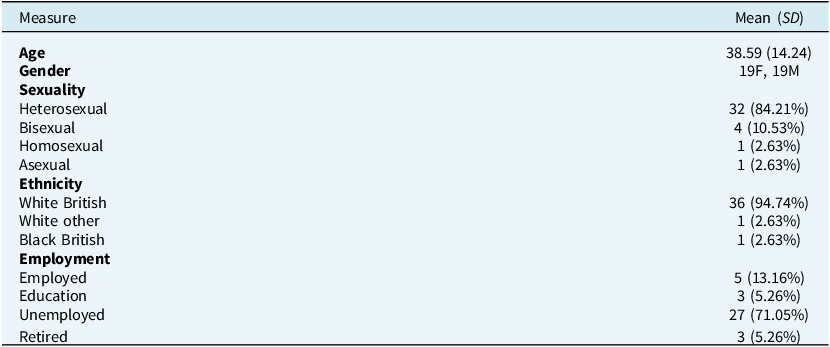
Fifty-nine individuals were referred to the study, with 43 people (73%) consenting and offered MUSE. Of the 59 referred, two declined to participate from referral to screening appointment assessment. Others were excluded owing to not meeting entry criteria or not being contactable. Of the 43 participants who consented, 38 engaged in MUSE sessions indicating it is an acceptable intervention (43/59, 72.9%), with good uptake (38/43, 88.4%). The MUSE participant characteristics are shown in Table 1. Few were in employment, with most being unemployed or unable to work. The participants were nearly all White British, which is not dissimilar to the diversity of the catchment area; 18 (47.37%) had received some form of psychological therapy prior to being referred for MUSE.
Descriptive statistics

Thirty-eight (100%) participants attended at least one session of MUSE with the mean being 8.69 sessions (SD=3.96, range 1–17). In terms of engagement, 89.47% attended four or more sessions which was determined by the PPI group as evidence of a minimal dose of treatment (Dudley et al., Reference Dudley, Dodgson, Common, O’Grady, Watson, Gibbs, Arnott, Fernyhough, Alderson-Day, Ogundimu, Kharatikoopaei, Patton and Aynsworth2022; Dudley et al., Reference Dudley, Dodgson, Common, Ogundimu, Liley, O’Grady, Watson, Gibbs, Arnott, Fernyhough, Alderson-Day and Aynsworth2024). All participants (100%) completed the module on understanding voices; 33 (86.84%) completed modules on How the Mind Works; 24 (63.16%) inner speech; 12 (31.58%) visions; and 12 (31.58%) the module on hypervigilance. The trauma and memory module was completed by 7 (18.42%) and sleep by 5 (13.16%).
Baseline and post-treatment scores on the measures of hallucinations, delusions, and quality of life are reported in Table 2. It is important to note some data were missing at follow-up (i.e. 21% for HPVQ, 29% for REQOL, GPTS-B).
Descriptive statistics

HPVQ, Hamilton Program for Voices Questionnaire; GPTS, The Revised Green et al. Paranoid Thoughts Scale Part A ideas of reference, Part B ideas of persecution; REQoL, Recovering Quality of Life.
Differences between start and end of treatment were considered using within-subjects t-tests. Moderate to large effect size improvements are reported for all the main outcome measures. The reduction in the voice distress was of a similar magnitude to that reported in a randomised controlled trial of MUSE for people with first episode psychosis (Dudley et al., Reference Dudley, Dodgson, Common, Ogundimu, Liley, O’Grady, Watson, Gibbs, Arnott, Fernyhough, Alderson-Day and Aynsworth2024). Given the focus on real-world implementation, consideration was given as to whether there were differences in impact for those referred from CTTs or EIP, which broadly reflects people with a more recent onset of difficult voice hearing, or those with more enduring issues (see Tables S1 and S2 in the Supplementary material). This hints at a possible greater reduction in voice impact and improved quality of life for the EIP group (which is consistent with past research; Dodgson et al., Reference Dodgson, Alderson-Day, Smailes, Ryles, Mayer, Glen-Davison, Mitrenga and Fernyhough2021a; Dodgson et al., Reference Dodgson, Aynsworth, Mitrenga, Gibbs, Patton, Fernyhough, Dudley, Ewels, Leach, Alderson-Day and Common2021b; Dudley et al., Reference Dudley, Dodgson, Common, Ogundimu, Liley, O’Grady, Watson, Gibbs, Arnott, Fernyhough, Alderson-Day and Aynsworth2024) but could of course be accounted for by other important factors like a beneficial response to medication. Of note was the benefit in terms of reduced paranoid thinking for the CTT participants which is consistent with the powerful effects of a therapeutic relationship in helping reduce suspicion and mistrust (Turkington et al., Reference Turkington, Spencer, Lebert and Dudley2017).
Post-treatment interviews
Participants were met after completing treatment to consider their future needs and to discuss their experience of therapy. It was not subject to formal qualitative analysis, but feedback provided at the end of treatment indicated participants found MUSE to be helpful. Overall, MUSE was reported to be fun, engaging, and acceptable when delivered by briefly trained APs. Participants emphasised the interpersonal skills of the APs and their ability to answer questions about MUSE as key skills.
Discussion
Our over-arching aim is to increase access to psychological therapies for distressing hallucinations. To help achieve this we evaluated the use of a digitally delivered treatment provided by a more widely available workforce in routine clinical practice. Uptake (88.4%) and engagement (89.5% attending four or more sessions) rates demonstrated the MUSE treatment was acceptable. Moreover, benefit was reported in relation to voice experiences, as well as in trust and paranoia, and quality of life. This would suggest it is possible to increase access to psychological therapies in a real-world setting with meaningful impact. Of course, the focus on delivering in routine clinical practice, the small sample, incomplete follow-up data, and lack of a comparison group means we are cautious about over-interpreting the findings, but an absence of any benefit from this practice-based evidence would pose a challenge to the value of delivering MUSE in routine practice. Hence, we are cautiously optimistic that MUSE can be delivered in the real world.
This is important to determine as implementation of any new health technology can be difficult owing to the complexities and challenges of data security, service user privacy, inter-operability across multiple information systems and, in mental health settings, a notable lack of capacity of health care professionals (Garety et al., Reference Garety, Craig, Iredale, Basit, Fornells-Ambrojo, Halkoree, Jolley, Landau, McCrone, Tunnard, Zala and Waller2018). To address these and other issues, we considered our approach against the NASSS framework. A full summary is presented in the Supplementary material; however, a brief summary of key points is provided below.
Domain 1: Condition/patient group
People with psychosis commonly report hallucinations, but have limited access to psychological therapies. Although many of the current sample had had previous help, they were willing to engage with a new treatment focusing on hallucinations. Given that nearly half of the participants had previously had therapy it may be important in the future to consider if there are differences in how the message of MUSE (explaining what leads us to see and hear things) is received in those who have or have not previously had therapy. Whilst the sample were not ethnically diverse, it is important to note that the North East has high rates of deprivation and consequently high levels of physical health morbidity which are often barriers to accessing healthcare. Nevertheless, the treatment appeared to be acceptable to our participants and they wanted more sessions than were offered in the previous trials of MUSE (Dudley et al., Reference Dudley, Dodgson, Common, Ogundimu, Liley, O’Grady, Watson, Gibbs, Arnott, Fernyhough, Alderson-Day and Aynsworth2024). In many cases the help provided by the APs was the most frequent and regular contact they had with mental health services.
Domain 2: The technology
In terms of technology, the MUSE approach helps minimises the risk of non-adoption. It is a freestanding technology as the MUSE treatment is downloaded onto an NHS computer and Wi-Fi is not needed. It was dependable, and was designed using off-the-shelf resources. Given the high levels of deprivation in the North East, it is important to note that participants do not need their own computer, data plan or to pay for Wi-Fi, which helps reduce inequalities in access. Similarly, as the treatment can be delivered at home, service users with conditions affecting their mobility or lacking the resources to pay for transport are not disadvantaged. No confidential information is stored on the computer and hence issues of privacy or information governance are not relevant. The treatment is collaboratively delivered with support of the AP, reducing the participant’s need to be competent in using technology. The AP needed minimal training to use the technology effectively, but required training (and subsequent supervision) to provide the clinical knowledge to help illustrate and explain the ideas and interventions and tailor them to the individual.
Domain 3: Value proposition
The package is free to use and runs on NHS laptops helping increase the future sustainability of the approach. MUSE has limited evidence of its value in alleviating the distress or disability associated with hallucinations (Dudley et al., Reference Dudley, Dodgson, Common, Ogundimu, Liley, O’Grady, Watson, Gibbs, Arnott, Fernyhough, Alderson-Day and Aynsworth2024; Dodgson et al., Reference Dodgson, Singh, Barclay, Birkett, Boyle, Brandon, Dudley, Einbeck, Gibbs, Hamilton, Larry, Simpson and Fernyhough2025). However, there was evidence of benefit with the current participants, and the broader issues of deployment of technology-based interventions by a less trained workforce were also addressed in this study, with evidence of feasibility of implementation. This could be a model for the NHS to help increase access to psychological therapies (Greenwood et al., Reference Greenwood, Gurnani, Ward, Vogel, Vella, McGourty, Robertson, Sacadura, Hardy, Rus-Calafell, Collett, Emsley, Freeman, Fowler, Kuipers, Bebbington, Dunn, Michelson and Garety2022; Hardy et al., Reference Hardy, Wojdecka, West, Matthews, Golby, Ward, Lopez, Freeman, Waller, Kuipers, Bebbington, Fowler, Emsley, Dunn and Garety2018).
Domain 4: The adopter system
The MUSE approach seems well matched to delivery by APs, who are keen to develop skills and experience. They are a widely available workforce and have capacity to deliver this work as they are not typically responsible for all aspects of a person’s care which can reduce the capacity for delivery of intervention. They and the recently introduced Mental Health Wellbeing Practitioner roles (NHS England) would be ideally placed to support the provision of such a low-intensity intervention (Hayward et al., Reference Hayward, Berry, Bremner, Cavanagh, Dodgson, Fowler, Gage, Greenwood, Hazell, Bibby-Jones, Robertson, Touray, Dailey and Strauss2023). Also, the APs had the capacity to see participants at home or other convenient locations at a frequency and duration agreed with them, so there are fewer barriers to delivery.
Domain 5: Organisation
Mental health trusts would be well placed to adopt a digital therapy offer, in the form of a low-intensity or stepped care model for the provision of psychological therapies for psychosis. The scarcity of highly trained therapists can lead to delays, and limited capacity can lead to low rates of referral. Having an accessible, helpful treatment could be sufficient for some people. Even if not sufficient in itself, MUSE may help prepare the person for future work and familiarise them with key ideas about hallucinations and provide experience of working in a therapeutic manner with a clinician. This could increase the value and efficiency of higher intensity interventions, which still need to be offered as these are of proven value (Bighelli et al., Reference Bighelli, Salanti, Huhn, Schneider-Thoma, Krause, Reitmeir, Wallis, Schwermann, Pitschel-Walz, Barbui, Furukawa and Leucht2018; Bighelli et al., Reference Bighelli, Rodolico, García-Mieres, Pitschel-Walz, Hansen, Schneider-Thoma, Siafis, Wu, Wang, Salanti, Furukawa, Barbui and Leucht2021). A stepped care model where help is offered quickly and in a targeted, focused manner, by a less trained, and less expensive workforce is of evident value in the Talking Therapies model.
Conclusions
MUSE is an emerging treatment, which will hopefully be able to demonstrate more robust evidence of its value and cost effectiveness. If this were achieved then MUSE like similar brief, targeted, digitally delivered interventions (Craig et al., Reference Craig, Rus-Calafell, Ward, Leff, Huckvale, Howarth, Emsley and Garety2018; Garety et al., Reference Garety, Ward, Emsley, Greenwood, Freeman, Fowler, Kuipers, Bebbington, Rus-Calafell, McGourty, Sacadura, Collett, James and Hardy2021; Freeman et al., Reference Freeman, Lambe, Kabir, Petit, Rosebrock, Yu, Dudley, Chapman, Morrison, O’Regan, Aynsworth, Jones, Murphy, Powling, Galal, Grabey, Rovira, Martin, Hollis and West2022), could play a role in increasing access to help for people distressed by symptoms of psychosis. We have demonstrated that adoption in the real-world is possible, and has potential for wide-scale adoption as the technology is reliable, easy to implement and intervention is acceptable and well matched to the service user’s needs. However, further evidence of its value would be needed before further roll-out could be considered.
Supplementary material
To view supplementary material for this article, please visit https://doi.org/10.1017/S1352465825100969
Data availability statement
Anonymised data will be made available on the basis of written reasonable request. Data not routinely available/the data that has been used is confidential.
Acknowledgements
We would like to thank the participants in the study and acknowledge the contribution of the other collaborators involved in acquiring funding for delivery of the study (Professor Charles Fernyhough, Professor Tracy Finch, Dr Bronia Arnott, Dr Ben Alderson-Day, Lyndsey Tunney, Dr Anna Luce, Dr Louise Prentice, Laura Kingston, Amanda Greaves, Professor Daniel Freeman, Dr Sinead Lambe, Mike Desjadon and Dr Alison Brabban). We would also like to thank Dr Claire Mayer who helped with recruitment as well as the members of the PPI group who met regularly during the duration of this study and provide feedback, guidance and advice on all aspects of the work.
Author contributions
Robert Dudley: Conceptualization (lead), Data curation (equal), Formal analysis (lead), Funding acquisition (lead), Investigation (lead), Methodology (lead), Project administration (lead), Resources (lead), Supervision (equal), Validation (equal), Writing - original draft (lead), Writing - review & editing (lead); Lucy O’Grady: Data curation (lead), Formal analysis (supporting), Investigation (supporting), Methodology (supporting), Project administration (supporting), Validation (supporting), Writing - review & editing (supporting); Nina Cioroboiu: Data curation (supporting), Formal analysis (supporting), Investigation (supporting), Methodology (supporting), Project administration (supporting), Writing - review & editing (supporting); Emily Bates: Data curation (supporting), Formal analysis (supporting), Investigation (supporting), Project administration (supporting), Writing - original draft (supporting), Writing - review & editing (supporting); Christopher Gibbs: Conceptualization (supporting), Funding acquisition (supporting), Investigation (supporting), Methodology (supporting), Project administration (supporting), Writing - original draft (supporting), Writing - review & editing (supporting); Guy Dodgson: Conceptualization (supporting), Funding acquisition (supporting), Investigation (supporting), Methodology (supporting), Resources (equal), Writing - original draft (supporting), Writing - review & editing (supporting); Charlotte Aynsworth: Investigation (equal), Methodology (equal), Project administration (equal), Supervision (lead), Writing - original draft (supporting), Writing - review & editing (supporting).
Financial support
This work was funded by the National Institute for Health and Care Research (NIHR) Applied Research Collaboration (ARC) North East and North Cumbria (NENC) (NIHR200173). R.D. and C.A. were funded by the NIHR Applied Research Collaboration (ARC) North East and North Cumbria personal awards. The views expressed are those of the authors and not necessarily those of the NIHR, or the Department of Health and Social Care. The study sponsor and funder have no role in study design; collection, management, analysis, and interpretation of data; writing of the report; and the decision to submit the report for publication.
Competing interests
R.D. receives payment for workshops in treating hallucinations and R.D., C.A., G.D. and C.G. declare they are involved in running treatment studies investigating psychological therapies for psychosis. All other authors declare no competing interests.
Ethical standards
The work was undertaken as part of a service evaluation and was registered with the host trust. Participants were provided with a participant information sheet, and gave full informed consent for the reporting of their outcome data in a group, anonymised format. Receipt of MUSE was not conditional on providing consent to use the outcome evidence. The authors have abided by the Ethical Principles of Psychologists and Code of Conduct as set out by the BABCP and BPS.



 Open access


Comments
No Comments have been published for this article.