


The Institutional Academic Oligarchy and the University New Public Management Regime
The university is a bureaucratic organization, a characteristic which has long defined academics’ relations with authorities, such as the aristocracy, the state and the church (Bell Reference Bell1973; Hammerstein Reference Hammerstein1996). Accordingly, universities’ dependence on resources provided by such authorities signifies a struggle and compromises between the external and internal government of universities, i.e., academics’ ‘right of self-governance’ (Ridder-Symoens Reference Ridder-Symoens1996: 164), which dates back to the Middle Ages. About 500 years later, the university as a bureaucratic organization is still a relevant research topic, as exemplified by the work of Mintzberg (Reference Mintzberg1980) on the professional bureaucracy, of Blau (Reference Blau1994) on the organization of academic work, the work of Walsh and Lee (Reference Walsh and Lee2015) on research groups, or of Schneijderberg and Steinhardt (Reference Schneijderberg and Steinhardt2019) and Schneijderberg (Reference Schneijderberg2025) on accreditation in higher education.
Bureaucratic organization is also a prominent feature of New Public Management (NPM), which hit the German university sector in the late 1990s. Olsen (Reference Olsen2008) points to NPM being a rediscovery of bureaucracy, after the de-bureaucratization and post-bureaucratic form discussions about markets and networks since the late 1970s (see also Monteiro and Adler Reference Monteiro and Adler2022). Like, for example, the NPM-driven bureaucratic reorganization of the German university system, the German Excellence Initiative also did not just happen to universities. In the establishment, modification and operation of the Excellence Initiative, academics were and are actively involved via the German Science and Humanities Council (Wissenschaftsrat) and the German Research Foundation DFG (Wissenschaftsrat 2010). Traditionally, in Germany, academics participate in states’ university governance, which is referred to as the state–academic social partnership (Sozialpartnerschaft; Schimank Reference Schimank2005). For example, professorial members of the accreditation council, the DFG and the German Rectors’ Conference (Hochschulrektorenkonferenz) belong to a group of academics in office that are of particular relevance in the recurring negotiation of the terms of the state–academic profession social partnership. Pusser (Reference Pusser2008) defined this group as the institutional academic oligarchy.
In addition to personal involvement, the participation options for the institutional academic oligarchy in the state–academic profession partnership negotiations include writing papers. At the beginning of 2025, the NPM-induced rediscovery of bureaucracy, and leadership and administrative expansion in academia were the topics of a discussion paper by the German Academy of Sciences (Leopoldina) titled ‘More autonomy – less regulation. Proposals for the de-bureaucratization of the science system’ (Auer et al. Reference Auer, Barner, Broer, Di Fabio, Engels, Gruss, Haug, Hornig, Kreutz-Gers, Krieg, Krull, Kühl, Stückradt and Voßkuhle2025). The Leopoldina discussion paper is concerned with academic institutions’ and academics’ autonomy being increasingly eroded both by external regulations (e.g., university third-party funding and the German Excellence Initiative) and heavily bureaucratized internal processes (e.g., performance agreements, academic controlling and hiring). Surprisingly, external regulations and internal bureaucratic organization of teaching and learning are not a concern in the Leopoldina discussion paper; for example, accreditation organizations are only mentioned once (restricting options for autonomous action; Auer et al. Reference Auer, Barner, Broer, Di Fabio, Engels, Gruss, Haug, Hornig, Kreutz-Gers, Krieg, Krull, Kühl, Stückradt and Voßkuhle2025: 13).
About 30 years after the introduction of the NPM regime to the German university system, to get to the roots of the Leopoldina critique, this article will discuss the research question: how can bureaucratic organization analysis be a means for understanding administration expansion in (a) the governance of and in autonomous universities, and (b) the governance of the university’s academic functions in Germany?
In this article, and to answer this research question, I will focus on how positions for and roles of higher-education and science professionals (HESPRO; Teichler et al. Reference Teichler, Henke, Schneijderberg, Pasternack, Reinmann and Schneijderberg2025) have been established and expanded in order to show how the NPM regime of bureaucratic organization (a) altered the administration in and of universities and (b) expanded into academic functions. On the one hand, HESPRO positions in development planning, student counselling, support of research funding, knowledge and technology transfer, etc., seem a response to how universities deal with NPM regime demands, and most academic leaders and professors rely on HESPROs’ support in academic self-governance, for organizing teaching and learning, for research management or for applying for third-party funding. On the other hand, HESPROs hold various key positions in the coordination of the NPM regime, which will be discussed with a focus on two cases: professorial hiring, to illustrate university-internal bureaucratization, and public third-party funding competition, to illustrate increasing external regulation. Here, competition is defined as a ‘principle of coordination’ (Boltanski and Thévenot Reference Boltanski and Thévenot2006 [1991]: 196). Before moving on to these empirical cases, the following section elaborates the theoretical concept of bureaucratic organization.
Bureaucratic Organization as a Theoretical Concept with Four Sub-concepts
According to Stinchcombe (Reference Stinchcombe1987 [1968]: 38), the theory-type concept is based on explicit (and, sometimes, implicit) assumptions or hypotheses that specify the conceptualized phenomenon in an abstract manner and that can be analytically refined by means of sub-concepts. In general, the concept must define the forces (e.g., structures, actors and activities) in society in general or in a certain social context more specifically. The forces at work according to Weber’s (Reference Weber1978 [1921]: 956–958) concept of bureaucratic organization are the three official jurisdiction definitions, which I will elaborate as the three sub-concepts official duties, authority relations, and employment of qualified personnel and career paths. A fourth sub-concept, individual agency/enterprise, is constructed to explicate that the regulations of bureaucratic organizations are not per se hard facts or standards, but more like guidelines offering some leeway for office holders and employees within legal and ethical boundaries.
As a concept, bureaucratic organization follows the idea of the legal state (Rechtsstaat), and the definition of regulations in the form of laws and bylaws (Verordnung) as well as administrative rules specifying the goals, the set of regular activities and official duties of any bureaucratic organization (Weber Reference Weber1978 [1921]; see also Monteiro and Adler Reference Monteiro and Adler2022). The ideal-type modern bureaucracy that defines official duties, authority relations and employment of qualified personnel seeks to overcome nepotism, incompetence, corruption, etc., which were salient features of monarchical and feudal administration and non-bureaucratic family businesses.
Conceptually, and following Weber (Reference Weber1978 [1921]), no distinction is made between a public or a private bureaucratic organization. Accordingly, the concept’s elaboration is rather generic and need not focus on (public) universities. Weber (Reference Weber1978 [1921]: 957) only makes a terminological distinction between the state sphere, where the three elements of official duties, authority relations and employment of qualified personnel and career paths ‘constitute bureaucratic agency’, and the private economic sphere, where ‘they constitute a bureaucratic enterprise’. Moreover, the NPM regime of bureaucratic organization in the public, state sphere emulates and adapts bureaucratic organization from the economic sphere, i.e., reproduces to a certain extent ‘organizational models already operating elsewhere’ (Tilly Reference Tilly1999 [1998]: 95).
Weber (Reference Weber1978 [1921]) defines instrumentality and power as two analytic aspects of the bureaucratic organization. Bureaucratic organization is regarded as a formal, rational and efficient mechanism for the achievement of goals and services, and is interrelated with the social structures of the environment. Therefore, universities and other bureaucratic organizations developed
in relation to the differentiation in the social system. Bureaucratic organizations can help in coping with some of the problems arising out of such differentiation, and they perform important functions […] in the provision of resources to different [elite] groups, and in the regulation of various intergroup relations and conflicts. (Eisenstadt Reference Eisenstadt1959: 306)
When discussing the role of elites in Weber’s (Reference Weber1978 [1921]) ideal-type bureaucracy, like Eisenstadt (Reference Eisenstadt1959) and others (e.g., Hall Reference Hall1968; Olsen Reference Olsen2006, Reference Olsen2008), Perrow (Reference Perrow1986: 5) also stressed that ‘[b]ureaucracy is a tool, a social tool, which legitimizes the control of numerous people by the very few’. In the social structure of society, bureaucratic organization has to be considered a social tool based on ‘investments in forms’ (Thévenot Reference Thévenot1984), where investments do not just refer to economic investments, and the term forms is applied to non-individual actors and objects. As a social tool, bureaucratic organization means a ‘generalization of coordination’, which ‘is costly and demands negotiation and material equipment, but the cost may be offset by returns in coordination which depend on the extension of the domain of time and space within which it is accepted’ (Thévenot Reference Thévenot2001: 407).
The investments in forms of bureaucratic organization concern a university system, the university as an organization as well as the organization of academic functions and of the academic profession itself. Looking at accepted forms of coordination and control, an immanent tension in the state–academic social partnership is rooted in the academic profession’s oligarchic, status- and reputation-oriented organization that differs from state bureaucratic organization. In general, a profession is an organization formed by the ideas and norms of a specific professional group. Considering structures of knowledge, beliefs and authority in the academic profession, Clark (Reference Clark1983: 122) defined the authorities as the academic oligarchy grasping ‘the imperialistic thrust of modes of authority […] in the way that personal and collegial forms, rooted in the disciplinary bottom of a system, work their way upward to have an important effect on enterprise and then finally system levels’.
In addition to the immanent tension in the state–academic social partnership, the previous explanations also highlight how bureaucratic organization constructs limitations for specific social groups, which affect their (e)valuation of a situation – ‘(e)valuation’ is a term coined by Lamont (Reference Lamont2012: 204) combining valuation and evaluation. The limiting and enabling features of the bureaucratic organization entail a conceptual challenge. According to Olsen (Reference Olsen2006: 8)
[a]n ideal bureaucratic structure is assumed to contribute to unity and coordination, precision and speed, predictability, obedience and loyalty, impartiality, reduction of friction and of material and personal costs, knowledge of files and an institutionalized memory, and continuity across changes in government.
Nevertheless, it is not possible to conceptualize the bureaucratic sweet spot, the equilibrium between bureaucratic organization supporting the functions and goals, providing guidance in cases of task uncertainty and task interdependence (see also van de Ven et al. Reference Van de Ven, Delbecq and Koenig1976) and hampering the motivation of organizational members, its clientele, as well as failing to provide the organization’s services and products for society. Of course, abuse of office, favouritism, insufficient application of rules and other personal misuses by office holders and bureaucrats provide challenges to bureaucratic organizing.
The conceptual solution for the challenge of approaching the equilibrium of bureaucratic organization (i.e., official duties, authority relations, employment of qualified personnel and career paths and individual agency/enterprise) suggests theorizing (deductive research design) or empirically observing (inductive research design) bureaucratic organization between bureaucratization and de-bureaucratization. Understood as related poles on a continuum,
[i]n the case of bureaucratization, the bureaucratic roles tend to dominate the other roles (both of the incumbents and of those with whom they interact) and to impose on them the bureaucratic criteria, so as to minimize the autonomy and distinctiveness of these other roles and maximize their own power over them. In the case of debureaucratization, the various outside non-bureaucratic roles impinge on the bureaucratic role to an extent which tends to minimize the specificity of the bureaucratic roles and the relative autonomy of the bureaucratic rules in the implementation of goals and in the provision of services. (Eisenstadt Reference Eisenstadt1959: 312–313)
Sub-concept 1: Official Duties
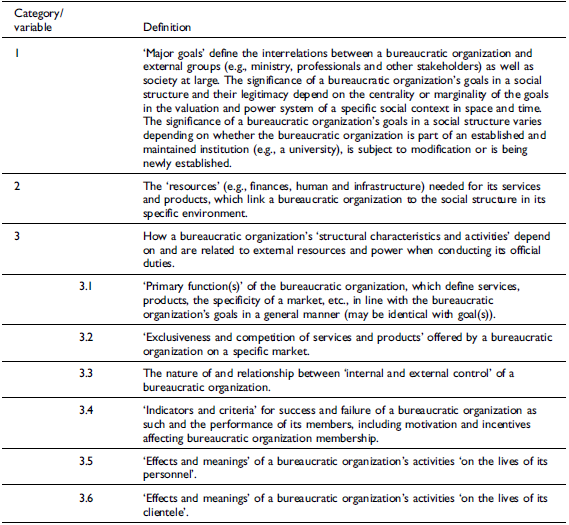
Sub-concept 1, official duties, theorizes that the regular activities and governance structure of a bureaucratic organization are defined in a formal manner. The formal official duties of a bureaucratic organization are investments in forms in the internal structure and in relations with its environment. Official duties are expressed by (a) major goals, (b) the (in)significance of these major goals in the social (including cultural, economic, political, etc.), spatial and temporal context of a society, and (c) the dependencies of a bureaucratic organization ‘on external forces (clients, holders of political power, or other prominent groups)’ (Eisenstadt Reference Eisenstadt1959: 312).
For empirical research, Sub-concept 1, official duties, can be further differentiated according to Eisenstadt’s (Reference Eisenstadt1959: 314–315) more detailed elaboration of Weber’s bureaucratic organization and its interrelations with the environment. Sociologically, the interrelations with the environment construct a link from the systems-/macro-level to the meso-/organizational-level. Inspired by Eisenstadt’s (Reference Eisenstadt1959: 314) tentative use of the quantitative research term ‘variables in the study of bureaucracy’, I amend in Table 1 the qualitative research term category. Each category is an operationalization of the theoretical concept, in Table 1 of Sub-concept 1, official duties, and category labels are highlighted by single quotation marks. Methodologically, to avoid categories becoming overly complex, some were further divided into subcategories. For example, ‘structural characteristics and activities’ (top category 3, Table 1) requires different observations, which are defined by its subcategories. A subcategory of a top category is identified by its two-digit numbering (e.g., 3.1 ‘primary function(s)’).
Categories/variables for researching bureaucratic organization Sub-concept 1, ‘official duties’ (Eisenstadt Reference Eisenstadt1959; author’s arrangement)

Please note that the list in Tables 1–4 is a set of categories/variables constructed for this study, which could be amended in future research depending on the research question and by focusing on the bureaucratic organization under study. The formulation of categories/variables makes it clear that the meaning of the term ‘variable’ is rather broad and variables require further operationalization. For a survey questionnaire, categories/variables need to be broken down into items that provide answers as responses to precise questions.
Sub-concept 2: Legal-authority Regime
Investments in form by a bureaucratic organization according to these categories/variables emphasize the interdependence between the bureaucratic organization and its social setting. Therefore, Sub-concept 1, official duties of bureaucratic organization, is complemented by Sub-concept 2, legal-authority regime. Theoretically, the legal-authority regime focuses on the internal social structure, which should facilitate the technically efficient execution of the defined official duties of a bureaucratic organization (Boltanski and Thévenot Reference Boltanski and Thévenot2006 [1991]: 285–292, 325–335). In general, authority regimes define a hierarchy of positions and roles (the offices and officeholders), appeals procedures and stable and rule-led communication channels based on written documents (the files), assuring that goals are communicated (e.g., from superiors to subordinates) and that these goals are reached or sanctions can be applied.
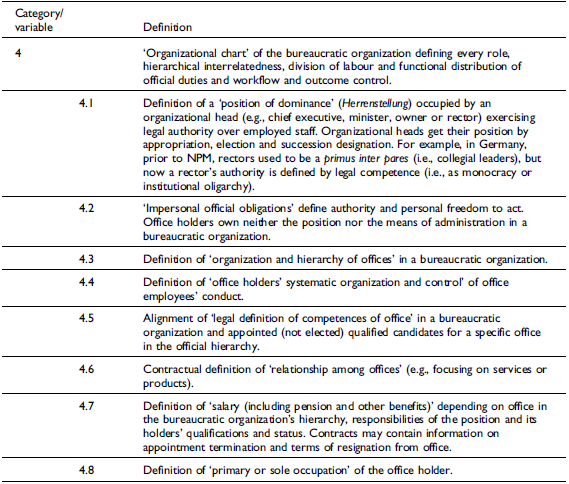
Pugh et al. (Reference Pugh, Hickson, Hinings and Turner1968) named five distinct but interrelated elements of legal-authority regimes: first, specialization in the division of labour within the bureaucratic organization, functional distribution of its official duties (see Sub-concept 1) and numerous positions requiring specialized training; second, standardization of regular events (e.g., decision making and management processes), which contribute to the functions and delivering the services and products of the bureaucratic organization; third, formalization of procedures (e.g., of work and promotion), instructions for employees and communication (e.g., of management decisions and jobs) in written form; fourth, centralization of decision making and management, which defines hierarchical levels of offices, authorization of executive action and jurisdictions of boards or working groups; fifth, configuration of the bureaucratic organization in an all-encompassing organizational chart, which defines every role, hierarchical interrelatedness and workflow and outcome control.
In an empirical study, specialization, standardization, formalization, centralization and configuration should be considered transversal analytical elements of the legal-authority regime. In comparison with Sub-concept 1, official duties, Sub-concept 2 addresses the interdependence between the bureaucratic organization and its social environment, which should also consider control mechanisms, adaptation of goals to changes in the environment and stakeholder groups controlling and/or directing organizational activities. The legal-authority regime in a bureaucratic organization as defined by Weber (Reference Weber1978 [1921]: 220–221) specifies the meso-micro link between the organization and its (impersonal) individual members. A core set of categories/variables for empirical research is presented in Table 2.
Categories/variables for researching bureaucratic organization Sub-concept 2 ‘legal-authority regime’ (Pugh et al. Reference Pugh, Hickson, Hinings and Turner1968; Weber Reference Weber1978 [1921]; author’s arrangement)

Sub-concept 3: Employment of Qualified Personnel and Career Paths
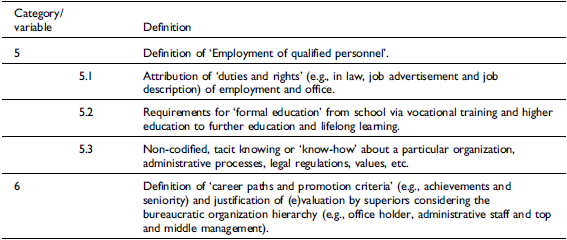
In the concept of bureaucratic organizing, Sub-concept 3 specifies employment of qualified personnel and career paths, which is closely related to Sub-concept 2, legal-authority regime. Sub-concept 3, employment of qualified personnel and career paths, addresses the attribution of corresponding duties and rights as well as requirements in terms of schooling, vocational training, higher education and/or any further education (e.g., codified knowledge, special legal, management and technical learning and know-how) leading to the award of a diploma, degree certificate or other form of certification. Critically addressing certification practices, Weber (Reference Weber1978 [1921]) points particularly to university education to control social mobility in general and entry to elite positions in particular.
For empirical research, studying the ‘employment of qualified personnel’ should include categories/variables reaching from the job definition with reference to ‘official duties’ and position in the ‘authority regime’, across hiring requirements to future career opportunities, as defined in Table 3.
Categories/variables for researching bureaucratic organization Sub-concept 3, ‘employment of qualified personnel and career paths’ (Weber Reference Weber1978 [1921]; author’s arrangement)

Sub-concept 4: Individual Agency/Enterprise
Before elaborating on Sub-concept 4, I would like to reiterate that Weber (Reference Weber1978 [1921]: 957) makes only a terminological distinction between the public, state sphere’s bureaucratic agency and the private, economic sphere’s bureaucratic enterprise. The theoretical indifference between public and private bureaucratic organization is expressed in Sub-concept 4’s label ‘individual agency/enterprise’.
Sub-concept 4, individual agency/enterprise, is constructed to make explicit that the legal rules of the bureaucratic organization are not per se hard facts or standards but guidelines offering some leeway for office holders and employees within legal and ethical boundaries. Legal and ethical boundaries are defined according to the official duties (Sub-concept 1), legal-authority regime (Sub-concept 2) and qualification of personnel (Sub-concept 3). The close correlation between qualification and position in an office or the bureaucratic organization hierarchy and individual agency/enterprise seems not as explicit in Weber’s (Reference Weber1978 [1921]) ideal-type description of a bureaucracy as it should be. Among others (e.g., Buchanan Reference Buchanan1996), Olsen (Reference Olsen2006: 4, italics in original) emphasizes that
Weber saw the bureaucrats’ willingness and capacity to follow rules and orders as depending on a variety of mechanisms. Motivation was a result of material incentives inherent in lifelong careers, as well as socialization and habituation in educational and bureaucratic institutions. The bureaucracy’s capacity to follow formal rules or ethical codes depended on its own qualifications and orientations but also on the leaders’ ability to give direction and the continuous availability of resources.
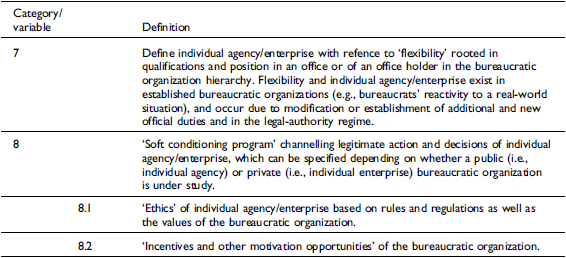
Motivated and capable bureaucrats’ individual agency/enterprise can make a difference in the effectiveness of the execution of official duties (Sub-concept 1) and the provision of services and products according to the functions and goals of the bureaucratic organization. In a bureaucratic organization, the legal-authority regime (Sub-concept 2) defines who is in charge (e.g., office holder). Moreover, individual agency/enterprise affects bureaucratic reliability, fosters a certain flexibility in reaction to new bureaucratic demands and social change and counterbalances legal conformism, rigidity, proliferation of red tape or goal displacement in bureaucratic organization, as Monteiro and Adler (Reference Monteiro and Adler2022) showed in their literature review.
In sum, individual agency/enterprise in a bureaucratic organization is channelled by official duties, the legal-authority regime and incentives and career prospects of qualified personnel. The three definitions of Weber’s (Reference Weber1978 [1921]) official jurisdiction of bureaucratic organization affect individual agency/enterprise in the form of a ‘soft conditioning program’ (Schneijderberg Reference Schneijderberg2025). A soft conditioning program targets reactivity in social behaviour by (a) establishing a long-term codification of procedures in a bureaucratic organization and (b) is geared for an almost industrial, Cartesian connection of the subject with the form by making the bureaucratic organization and its members responsible for its services and products as defined by the official duties (Sub-concept 1). Accordingly, a soft conditioning program aims for bureaucrats’ adaptation by relying on ‘two main components: the invention of procedures that ease day-to-day interaction, and the elaboration of valued social relations around existing divisions’ (Tilly Reference Tilly1999 [1998]: 97). Likewise, Thévenot (Reference Thévenot1984: 10) emphasizes that procedures comprise ‘rules of conduct’ or are ‘machine-tools’ that help bureaucrats and academics ‘to get into the habit’ (Thévenot Reference Thévenot1984: 14) of bureaucratic action.
Such soft conditioning via procedures for taking legitimate action and reaching legitimate decisions means adaptation of the rules, values, (e)valuation criteria and premises as well as the social structure of the environment, members and clientele of the bureaucratic organization. For the state sphere, individual agency is abstractly programmed according to enabling citizens’ equality and basic rights to participate and voice legitimate concerns, claims, etc., in line with rules and regulations and the goal of collective interest (Boltanski and Thévenot Reference Boltanski and Thévenot2006 [1991]: 107–118, 251–261). For the economic sphere, individual enterprise relates to market competitiveness of goods and services, monetary returns for merchants and sellers, and customer or consumer satisfaction (Boltanski and Thévenot Reference Boltanski and Thévenot2006 [1991]: 78–79, 261–269). In case of critique and a need for justification, legitimate actions and decisions resulting from individual agency/enterprise are absorbed by the next higher responsible office (holder) as bureaucrats following the law, rules and administrative regulations are not individually responsible for soft-conditioned decisions they make according to the legal-authority regime (Sub-concept 2; exceptions: corruption, fraud, misconduct, etc.). The theoretical considerations of Sub-concept 4, individual agency/enterprise, funnel into the categories/variables presented in Table 4.
Categories/variables for researching bureaucratic organization Sub-concept 4, ‘individual agency/enterprise’ (Buchanan Reference Buchanan1996, Olsen Reference Olsen2006; Schneijderberg Reference Schneijderberg2025; Weber Reference Weber1978 [1921]; author’s arrangement)

Autonomy and Excellence: Higher-education and Science Professionals as the Reflection of an NPM-regime Bureaucratic University Organization
In the previous section, the concept of a bureaucratic organization and its four sub-concepts were elaborated and specified by defining core categories/variables (C/V) for empirical research. In this section, the categories/variables are used for an essay-style discussion of the roles that higher-education and science professionals (HESPRO; Teichler et al. Reference Teichler, Henke, Schneijderberg, Pasternack, Reinmann and Schneijderberg2025) play in the expansion of university administration – unfortunately, numbers are not available as HESPROs are not a staff category reported by the German Federal Statistical Office. HESPRO positions and tasks are used here to represent the fundamental changes in German academia introduced by the New Public Management (NPM) regime from the mid-1990s onwards. HESPROs did not create these jobs for themselves. The jobs have been created for bureaucratic NPM organizations in a social partnership between the state and the institutional academic oligarchy. Nowadays, neither university leadership and mid-level managers (e.g., deans) nor professors, for example applying for third-party funding in research and teaching, do hardly any work without HESPRO support. To fulfil their demanding support tasks, HESPROs are highly qualified, i.e., the large majority of HEPROs hold a master’s degree and many even a doctoral degree (qualified employment C/V5.2 and C/V5.3), which means that a considerable number of HESPROs possess knowledge about executing the three university functions (official duties C/V1).
In the following theory-led discussion (and as in the previous sentence), the relevant categories/variables are referred to in brackets. However, to understand why HESPROs are a reflection of bureaucratic organization in the German university NPM regime, I have to briefly outline the transformation process starting in the mid-1990s: how the state and the institutional academic oligarchy have transformed universities from organizational units of ministries to NPM-governed, more autonomous bureaucratic organizations.
Bureaucratic Reorganization of the German Higher-education and Science System after the Mid-1990s: Autonomy, Standardization and (E)Valuation
In the introduction to this article, NPM reforms – for example in the German higher-education and science system – were identified as being responsible for the rediscovery of bureaucratic organization. Until the mid-1990s, universities could be considered as organizational units in the bureaucratic organization of their federal state’s ministry for higher education and science. For example, university budgets were fixed, academics and administrative-technical staff were employed as civil servants for life, and university self-governance was left largely to professors. Under the NPM regime, state regulation was supposed to turn into steering from a distance, leadership and middle management in universities were strengthened and stakeholder involvement increased (de Boer et al. Reference de Boer, Enders, Schimank, Soguel and Jaccard2008).
Factually, NPM state regulation changed from direct intervention to more indirect governance by agreements on objectives, performance-based funding of the university’s functions of research, teaching and research- and/or teaching-based knowledge and technology transfer and lump-sum budgeting. Accordingly, NPM invests in the form of the agentic nature of bureaucratic organization governance via an engaging, liberal and market-oriented way of standardization and (e)valuation (Thévenot Reference Thévenot, Mennicken and Salais2022). According to university ‘politics of expectations’ (Bartl et al. Reference Bartl, Papilloud and Terracher-Lipinski2019: 13), standardization is pursued by setting input and output indicators for education (e.g., admitted students, student throughput and graduates) and research (e.g., citations, publications and third-party funding). Indicator-led standardization is legalized in agreements on objectives and enforced during performance (e)valuation of universities by the state, of departments by central university leadership and of professors by their departments (authority regime C/V4.7 and individual agency C/V8.2). Early-career academics in particular, whether they are in tenure-track professorships or not, are in the metric ‘hamster wheels’ (Schneijderberg and Götze Reference Schneijderberg and Götze2024: 325–328) to comply with indicators for succeeding in career (e)valuations or in hiring competitions (qualified employment C/V6).
In the largely public German higher-education system, the Länder (states) are responsible for providing resources (official duties C/V1-3), taking care of infrastructure, quality assurance of teaching and learning and securing the general interest, for example expressed in ‘the equality of citizens as recipients of public services’ (Boltanski and Thévenot Reference Boltanski and Thévenot2006 [1991]: 332). NPM regime governance cascades from the macro/state level via the meso/organization level down to the micro/individual-professor level, where NPM regime bureaucratic organization helps bridge the cleavage between management and regulation of individual academics’ research and teaching.
Moreover, bureaucratic organization of said cleavage also has to respect the traditional social partnership between the state and the academic profession, which is reflected by the special status of most professors as civil servants for life, as well as the protection granted to academic autonomy/freedom in the German Constitution: in Article 5(3)1, the state grants considerable autonomy to individual academics, such as free choice of what topics to conduct research on and what content to teach. Mandating academics to carry out teaching in universities, the state relies on ‘technical arrangements of very different orders whose implementation rests on the possession of specific competencies and whose evaluation appeals to the principle of industrial legitimacy’ (Boltanski and Thévenot Reference Boltanski and Thévenot2006 [1991]: 332).
In the industrial, bureaucratic organization of state official duties delegated to the academic profession, HESPROs play, roughly, a dual role in support of the authority of the academic profession, which has power over the operating core or official duties via the control of their own work and by maintaining ‘collective control of the administrative apparatus of the organization’ (Mintzberg Reference Mintzberg1980: 333). In academics’ professional bureaucratic organization for controlling their work and the surrounding administration, the first HESPRO role is supporting professors in delivering the common goods of teaching, research and knowledge and technology transfer. Figure 1 presents examples of HESPROs working in different positions and units to enhance management capacities (e.g., organizational planning and coordination), to organize studying without delivering the actual teaching and to support research third-party funding and science communication.
Overview on occupations and tasks of higher-education and science professionals (Teichler et al. Reference Teichler, Henke, Schneijderberg, Pasternack, Reinmann and Schneijderberg2025: 753; author’s translation and amendments).

The second major area of HESPRO employment is related to the financing of universities and their functions. The pre-NPM period was a regime of fixed budget categories that maintained relative stability from one budget year to the next, and the finances of all universities were checked by routine administration, which changed with the introduction of the NPM regime. Since 2001, the 16 federate state ministries in charge of the universities in their state negotiate lump sum budgets for basic funding and other funding requirements at regular intervals. The negotiations between ministry and university consider agreed-upon metrics concerning research outputs, student input, throughput and output and all kinds of other indicators. Likewise, university leadership negotiates (a) budgets with each department and, mainly focusing on research, (b) agreements on objectives with professors. HESPROs in different capacities are involved in data collection, supporting academic controlling and data provision, for example also for rankings (Espeland and Sauder Reference Espeland and Sauder2016).
The origins of financial resources (C/V2) highlight universities’ key environment relations (C/V3), most prominently to ministries defining their official duties. For example, federal and state governments fund research based on tenders and contract research. Public tax money is also distributed by the German Research Foundation (DFG), the Excellence Initiative and European sources (e.g., European Science Foundation and Framework Programme). In addition to HESPROs’ expertise on European and German funding schemes and those in third-party funding administration, HESPOs in transfer offices also support private third-party funding related to knowledge and technology transfer.
Routine administration still controls the finances, however, now both on the side of ministries and universities and in universities in central and ‘decentral’ (i.e., departments and institutes) university administration. In addition to multiplying the number of administrative positions, collecting data to satisfy the planning, negotiation, reporting and accountability needs created additional positions for HESPROs. Accordingly, university administration expansion fosters impersonal official obligations (authority regime C/V4.2) being executed by highly qualified personnel (C/V5) and requires certain individual agency/enterprise (C/V7 and C/V8) by HESPROs in support of the institutional academic oligarchy on all university authority levels (C/V4.1).
Although the institutional academic oligarchy is a key beneficiary of HESPRO support and third-party funding, some among them are rather critical about the bureaucratization of university functions related to research, i.e., bureaucracy’s threat to academic autonomy/freedom. In the discussion paper published by Leopoldina, Auer et al. (Reference Auer, Barner, Broer, Di Fabio, Engels, Gruss, Haug, Hornig, Kreutz-Gers, Krieg, Krull, Kühl, Stückradt and Voßkuhle2025) state that the autonomy of scientific institutions is being increasingly eroded, not only by external but also by internal regulations. The Leopoldina paper proposes measures for the de-bureaucratization of the science system in five fields of action (Auer et al. Reference Auer, Barner, Broer, Di Fabio, Engels, Gruss, Haug, Hornig, Kreutz-Gers, Krieg, Krull, Kühl, Stückradt and Voßkuhle2025: 6; all quotes from this source translated from German by the author):
-
(1) Making better use of existing room for manoeuvre;
-
(2) Counteracting tendencies to restrict academic freedom;
-
(3) Reducing reporting and control obligations;
-
(4) Reorganizing competition for third-party funding;
-
(5) Focusing on core functions.
In the next section, I will refer to the discussion paper to highlight the Leopoldina working group’s concerns about how bureaucratic organization of third-party funding led to an erosion of academic autonomy by the environment, in particular the state. In comparison with external bureaucratization threats to academic autonomy, the Leopoldina paper is rather generic about universities’ ‘heavily bureaucratized’ internal processes to ‘comprehensively secure their actions from the outset and prevent possible errors’ (Leopoldina press release). Therefore, I chose regulations in hiring processes for professors as an example for the bureaucratization of the collegium by the collegium.
Third-party Funding and the Excellence Initiative as Examples of External Bureaucratic Organization of Competition
In the Leopoldina discussion paper, Auer et al. (Reference Auer, Barner, Broer, Di Fabio, Engels, Gruss, Haug, Hornig, Kreutz-Gers, Krieg, Krull, Kühl, Stückradt and Voßkuhle2025: 6) address bureaucratic ‘regulations and control networks’ constructed by increasing ‘numbers of employees in the administrative apparatus in both scientific institutions and in ministries and authorities’. In addition to the growth of the HESPRO population on all levels, Leopoldina’s discussion group dealing with third-party funding addresses top category/variable 3 official duties: a bureaucratic organization’s ‘structural characteristics and activities’ depend on and are related to external resources and power. In particular,
-
• Universities’ ability to deliver research services (C/V3.1);
-
• Competitiveness (C/V3.2) on the specific market;
-
• The nature of and relationship between internal and external control of university research (C/V3.3);
-
• Inclusion of indicators and criteria for success and failure (C/V3.4); and
-
• Their effects and meaning for academics as well as HESPROs and other administrative staff (C/V3.5).
In light of the category/variable 3, bureaucratic organization of official duties (sub-concept 1), it is surprising that the institutional academic oligarchy assembled in the Leopoldina working group seems surprised about the NPM regime bureaucratic organization of third-party funding when stating that the competitive process
has unintentionally led to a considerable bureaucratization of the science system. On the one hand, the universities have had to set up a specific structure to support research in order to ensure that the application machinery can be set up. At the decentralized level, personnel capacities must also be made available, which are taken away from the core tasks of research. (Auer et al. Reference Auer, Barner, Broer, Di Fabio, Engels, Gruss, Haug, Hornig, Kreutz-Gers, Krieg, Krull, Kühl, Stückradt and Voßkuhle2025: 15)
Unfortunately, the authors do not present ideas for how to participate in university system-wide competition and third-party funding (e.g., without HESPRO support), but the text continues:
This development can also be observed in the Excellence Initiative. On the one hand, it has led to an overall intensification of cross-faculty cooperation and greater international visibility for many universities; on the other hand, it has restricted the autonomy of individual researchers by forcing them to participate in large-scale projects. […]
Due to its great importance for the competitive allocation of third-party funding, the Excellence Initiative should be evaluated as soon as possible after the end of the current round of tenders in all its effects and also with regard to its bureaucratization effects. (Auer et al. Reference Auer, Barner, Broer, Di Fabio, Engels, Gruss, Haug, Hornig, Kreutz-Gers, Krieg, Krull, Kühl, Stückradt and Voßkuhle2025: 15-16)
In general, for the authors of the Leopoldina paper, neither third-party funding nor competition as a coordination principle involving rivalry and conflict and their (un-)intended effects are a concern as such. However, in light of decreasing basic university funding, Auer et al. (Reference Auer, Barner, Broer, Di Fabio, Engels, Gruss, Haug, Hornig, Kreutz-Gers, Krieg, Krull, Kühl, Stückradt and Voßkuhle2025: 6) criticize, first, the NPM regime’s ‘increase in dependency on third-party funding’, which also applies to the increase in ‘competition for public funding of scientific institutions. In addition, within the third-party funding sector,’ and this is the second critique, ‘there has been a shift from funding by the German Research Foundation DFG to programme-oriented project funding from the ministries’. In Germany, public third-party funding accounts for about 35% of total third-party funding; more tax-financed third-party funding is distributed by the European Union (10%) and by the institutional academic oligarchy via the DFG (31%) (GFSO 2024).
The environmental control of academics’ public third-party funding dependency is mostly not executed by ministries but by
[i]ntermediary project and funding agencies (Projektträger) appointed by ministries as agencies for the implementation of funding programs [which] are, in their current form, driving bureaucratization forward. The large number of Projektträger commissioned by funding bodies to administer funding programs, currently, have different rules for applying for, managing, and accounting for projects. This creates an unmanageable jungle of procedures that is difficult to navigate. In addition, they also compete with each other for ministerial contracts in a way that promotes bureaucracy. (Auer et al. Reference Auer, Barner, Broer, Di Fabio, Engels, Gruss, Haug, Hornig, Kreutz-Gers, Krieg, Krull, Kühl, Stückradt and Voßkuhle2025: 15–16)
In addition to bureaucratic control mechanisms, (public) funding institutions define the topics and terms of funding programmes (e.g., relevance of social goals rooted in societal values), which is criticized in the Leopoldina paper as further limiting academics’ research autonomy:
The demand for a focus on social values has now contributed to the prioritization of secondary objectives at the expense of core scientific tasks. […]. This is reinforced by the fact that funding institutions are increasingly using the legitimizing reference to social values as a control instrument. There is an increase in the number of special positions and representatives who are responsible for implementing current social values in scientific institutions. This results in new regulations, reporting requirements and control structures. (Auer et al. Reference Auer, Barner, Broer, Di Fabio, Engels, Gruss, Haug, Hornig, Kreutz-Gers, Krieg, Krull, Kühl, Stückradt and Voßkuhle2025: 18–19)
For example, special HESPRO positions to represent social values have been established in universities in offices for gender equality, sustainable development, ethics, data security etc. (authority regime C/V4.5 and C/V4.6).
Professorial Hiring Processes as an Example of University-internal Bureaucratic Organization of Competition
Social values, such as fairness, are also a secondary source for the bureaucratic organization and indicator/criteria-led standardization of universities’ professorial hiring processes. Bureaucratic organizing of hiring procedures may also originate in ‘fear-driven error avoidance and risk aversion behavior. In order to protect themselves from accusations of error, further regulations are introduced at the request of the actors [e.g., professors], which are intended to safeguard decisions against the respective higher level’ (Auer et al. Reference Auer, Barner, Broer, Di Fabio, Engels, Gruss, Haug, Hornig, Kreutz-Gers, Krieg, Krull, Kühl, Stückradt and Voßkuhle2025: 7). In German universities, the president/rector is responsible for all staff and also makes the final hiring decisions. The actual hiring process is organized by the respective organizational unit (authority regime C/V4.2 and C/V4.5), mostly administered by a HESPRO, and conducted by an appointed hiring committee. In the hiring committee, professors hold the majority of seats but representatives of non-professorial academic staff and students are also required by law. Without the right to vote, representatives in HESPRO positions from the gender equality/equal opportunity office, the staff association (Personalrat) and, if required, the commissioner for the disabled, are included in the hiring process.
Becoming a (tenured) professor or moving to another professorship is part of academics’ career paths and requires promotion criteria for (e)valuation justification (qualified employment C/V6). Intending to hire the best or most suitable candidate for a professorship (C/V5), many universities today require applicants to present metrics on their third-party funding acquisitions, publications, teaching, etc., in separate documents; it is hard to imagine that such templates originate in the individual agency of HESPROs supporting hiring (C/V8). Examples of hiring indicator/criteria templates (official duties C/V3.4 and C/V3.5) from the TU Berlin and the TU Dortmund are selected to highlight heavily bureaucratized university-internal processes.
The TU Dortmund hiring indicator/criteria document is selected because on nine pages it expresses in great detail the expectations for how to present a CV, proof of formal education (C/V5.2), publications, etc. Supposedly, this is intended to help first-time applicants who do not possess the implicit knowledge of seasoned academics (C/V5.3) and to bureaucratically facilitate the work of the hiring committee. The guiding PDF document emphasizes applicants’ voluntary use of the guide, and following the presentation of a stylized CV, the first, primary information to be provided by the applicants is about third-party funding (Figure 2). The guide for the overview of publications is presented after nine other information requests (e.g., scholarships, prizes/awards and appointments). Joining in with the publication-references-style-requirement fetish, it is suggested that applicants present their publication output in a certain style and assumed (e)valuation ranking (Figure 3). What is not voluntary is that applicants must present a summary of their qualities and quantities in a specific manner in an Excel sheet (Figure 4). The Excel sheet and examples from the nine-page TU Dortmund hiring indicator/criteria document suffice to outline options for the Leopoldina working group’s demand for the de-bureaucratization of science.
TU Dortmund template: third-party funding (TU Dortmund 2022a).

TU Dortmund template: publications (TU Dortmund 2022a).

TU Dortmund Excel sheet template (TU Dortmund 2022b).

In comparison with the mere indicator/criteria for official duties (C/V3.4 and C/V3.5) bureaucratic accounting in the TU Dortmund template (Figure 4), the TU Berlin template is an example of a fairness effort in hiring procedures by focusing on applicants’ academic age. In Figure 5, ‘[a]cademic age is calculated as the period from a master’s degree or equivalent to the year of the appointment procedure for the professorship, minus periods of parenting or care as well as periods spent outside university research institutions.’ In the Excel sheet, applicants’ academic age is used to calculate the average amount of third-party funding per year (Figure 6) – which seems, again, the top-priority information requirement (see line numbers in Figures 5–7) and could work as a soft conditioning program on individual agency (C/V8) – and the quotient of the number of publications (Figure 7). In comparison to the third-party and publication metrics, applicants’ experience in management, transfer and teaching are (e)valuated qualitatively.
TU Berlin template: academic age (TU Berlin 2022).

TU Berlin template: third-party funding (TU Berlin 2022).

TU Berlin template: publications (TU Berlin 2022).

Conclusions
The above presentation of Figures 2–7 is more impressive than 8,000 words to describe academics’ bureaucratic organization of professorial hiring processes. Both the TU Berlin and the TU Dortmund are straightforward examples for the politics of expectation according to indicators and criteria set by the institutional academic oligarchy (C/V3.4 and C/V6); but only the TU Berlin addresses the social value of fairness in performance (e)valuation meeting the bureaucratic requirement of hiring qualified personnel (Sub-concept 3) for official duties (Sub-concept 1). Accordingly, a first answer to the research question ‘how can bureaucratic organization analysis be a means for understanding administration expansion in (a) the governance of and in autonomous universities, and (b) the governance of the university’s academic functions in Germany?’ is that HESPROs as supplementary administrators of (hiring) processes indicate the institutional academic oligarchy’s professional bureaucratic organization and control of the work of academics. The latter works as a soft conditioning program according to academic ethics and university rules (C/V8) on individual agency (Sub-concept 4) according to a liberal and market-oriented means of standardization and (e)valuation without determining the outcome of a hiring procedure. For sure, the bureaucratic organization of professorial hiring processes also aims to avoid lawsuits.
A second answer to the research question addresses the correlation between NPM regime administration expansion and HESPRO positions: the employment of highly qualified professionals to support the core functions and academic self-governance of universities in the legal-authority regime (Sub-concept 2; C/V4) means that the academic profession is trading bureaucratic organizing support at the cost of autonomy in the delivery of their official duties. Of course, the bureaucratic organization situation is complex and does not allow for simple answers. Therefore, a distinction between good HESPRO functions (e.g., those supporting academics in funding applications and excellence competition) and bad HESPRO functions (those supporting social values and the ministry) seems odd. No doubt, some of Leopoldina’s propositions point to opportunities for de-bureaucratization. Theoretically, intermediary project and funding agencies (Projektträger) could be arranged more in the vein of the German Research Foundation (DFG), for example, by reducing reporting requirements. However, numerous HESPROs are also involved at the DFG in organizing tenders, supporting selection processes and controlling funding and reporting under the authority of the institutional academic oligarchy.
Accordingly, some of the de-bureaucratization recommendations in the Leopoldina discussion paper seem plausible, but also seem to miss at least one important point of the NPM regime competition idea. Therefore, the third answer is that in the large and differentiated university system, the bureaucratic organization of competition is a social machine tool of NPM regime governance applied to and by all organizations and actors to coordinate and control the performances of office holders, individual agency and official duties. The NPM regime’s politics of expectation seem to leave only few areas worthy of basic university funding, for example related to teaching and learning, and depending on education indicators (e.g., student in-, through- and output). In comparison with academics’ teaching loads being defined in states’ higher-education laws, academics’ official research duty lacks specification, such as allocation of time, effort or volume. The NPM regime’s regulation of the research market fills this gap, as the example of public third-party funding shows. Competition as the coordination principle connects third-party funding (input indicator) to reputation gain (output indicator, e.g., publications and citations), with or without inclusion of social values, political or academic goals.
Currently, obviously, both state ministries and the institutional academic oligarchy believe in NPM regime competition, i.e., bureaucratic organization of the university sector (e.g., higher education and research inputs and outputs), of awarding status (e.g., the Excellence Initiative and rankings), for reputation gain (e.g., third-party funding), etc. So, the bold, final answer based on the theory-led analysis suggests: less competition in coordination will result in less bureaucratic organization and enable academics to focus on core functions – as demanded in the Leopoldina discussion paper.
Of course, less competition seems a madman’s idea, and such a short article can only address a small area of NPM regime bureaucratic organization of one university system (i.e., Germany), universities and academic work. Accordingly, more theory-led research is needed in the future. In addition to building on the four findings in this article, a valuable line of inquiry could start by addressing the questions ‘are competitive advantages on a market and management capacities rooted in bureaucratic organization (including HESPRO positions as representatives of administration expansion) and, if so, how?’, given that bureaucratic organization is something of which both the state and the institutional academic oligarchy make ample use.
Acknowledgements
I am grateful to Jürgen Enders and Isabel Steinhardt for valuable comments on an earlier version of this article. I am also grateful to the feedback received from the participants on my presentation ‘This must be bureaucratic love – creating jobs for higher education and science professionals’ at the Academia Europaea and Wenner-Gren Foundation HERCulES Symposium, 21–23 May 2025, Stockholm, Sweden.
Funding Statement
This research did not receive any third-party funding.
Competing Interests
The author declares none.
Christian Schneijderberg holds a PhD in Sociology and works as senior researcher at the International Center for Higher Education Research (INCHER), University of Kassel, Germany. His efforts in theory development focus on knowledge organization cultures, conventions theory, and the sociology of (e)valuation. For many years, Christian has studied knowledge organization cultures in higher education and science, for example within the academic profession (e.g., peer review and socialization), universities as organization (e.g., bureaucracy and higher education and science professionals), and the systems level (e.g., accreditation and evaluation). Among his recent publications, mention can be made of The Handbook of Qualitative and Quantitative Content Analysis (with O. Wieczorek and I. Steinhardt; published by Routledge) and University and Academics’ Societal Engagement in Sub-Saharan Africa (with N. C. Zavale; published by Routledge).


 Open access

