

Introduction
Biodesign can advance a more just and equitable world, socially, environmentally, and economically. For example, biotechnology innovation can address global challenges such as climate change (DeLisi et al., Reference DeLisi, Patrinos, MacCracken, Drell, Annas, Arkin, Church, Cook-Deegan, Jacoby, Lidstrom, Melillo, Milo, Paustian, Reilly, Roberts, Segrè, Solomon, Woolf, Wullschleger and Yang2020), global health (Douglas and Stemerding, Reference Douglas and Stemerding2013), and food production (Goold et al., Reference Goold, Wright and Hailstones2018; Wurtzel et al., Reference Wurtzel, Vickers, Hanson, Millar, Cooper, Voss-Fels, Nikel and Erb2019; Roell and Zurbriggen, Reference Roell and Zurbriggen2020). However, current policy discourse about biotechnology innovation is dominated by manufacturing, formal institutions of higher education, and major government entities (El-Chichakli et al., Reference El-Chichakli, von Braun, Lang, Barben and Philp2016). This can overlook the power of local communities and regional development in global biotechnology innovation (Shapira et al., Reference Shapira, Matthews, Cizauskas, Aurand, Friedman, Layton, Maxon, Palmer and Stamford2022). To advance a biotechnology enterprise that is just, equitable, and truly innovative, everyone must be involved.
Local knowledge, culture, and resources are key drivers of biotechnology innovation (Vossoughi et al., Reference Vossoughi, Hooper and Escudé2016). Ancestral biodesign practices, Reimagining cultural practices, such as fermenting foods or gardening, as biotechnology design can empower everyone to see themselves as biodesigners and overcome barriers to engagement in biotechnology design (Chappell et al., Reference Chappell, Perez and Corinne2022). For example, Indigenous and ancestral knowledge can support planetary flourishing (Kimmerer, Reference Kimmerer2002; Meissner, Reference Meissner2022; Watson et al., Reference Watson and Studio2019). Technology design by and for communities, using local resources and knowledge, can improve design circularity and lead to more environmentally sustainable practices (Parsons et al., Reference Parsons, Fisher and Nalau2016; Lam et al., Reference Lam, Zamenopoulos, Kelemen and Hoo Na2017). Centering technology workflows, manufacturing, and deployment all within local communities can sustain local economies and improve regional self-determination (De Silva et al., Reference De Silva, Khan, Vorley and Zeng2020; Jagtap, Reference Jagtap2022a, Reference Jagtap2022b).
Existing support for local and regional biotechnology development rely primarily on institutions of formal education such as schools, colleges, universities, and government-funded institutes. While these formal education and research spaces are beneficial, they also have limitations. Economic inequality influences which schools and universities have access to biodesign programming. Even for schools with resources, implementing biodesign programming is difficult due to the cost of teacher training, fitting within already cramped curricula and class schedules, and building out lab spaces (Lui et al., Reference Lui, Kafai, Walker, Hanna, Hogan and Telhan2019). Similarly, engagement in scientific research, particularly in synthetic biology and bioengineering, are extremely limited (“The next 25 years,” 2021). Few universities offer programs in biotechnology design, and those are often “elite” and largely inaccessible (Mercer, Reference Mercer2015). Reliance on graduate training in biotechnology is a huge barrier to participation. To overcome these limitations, biotechnology design must also include community-based approaches that expand beyond formal settings (Sacchi et al., Reference Sacchi, Lotti and Branduardi2021).
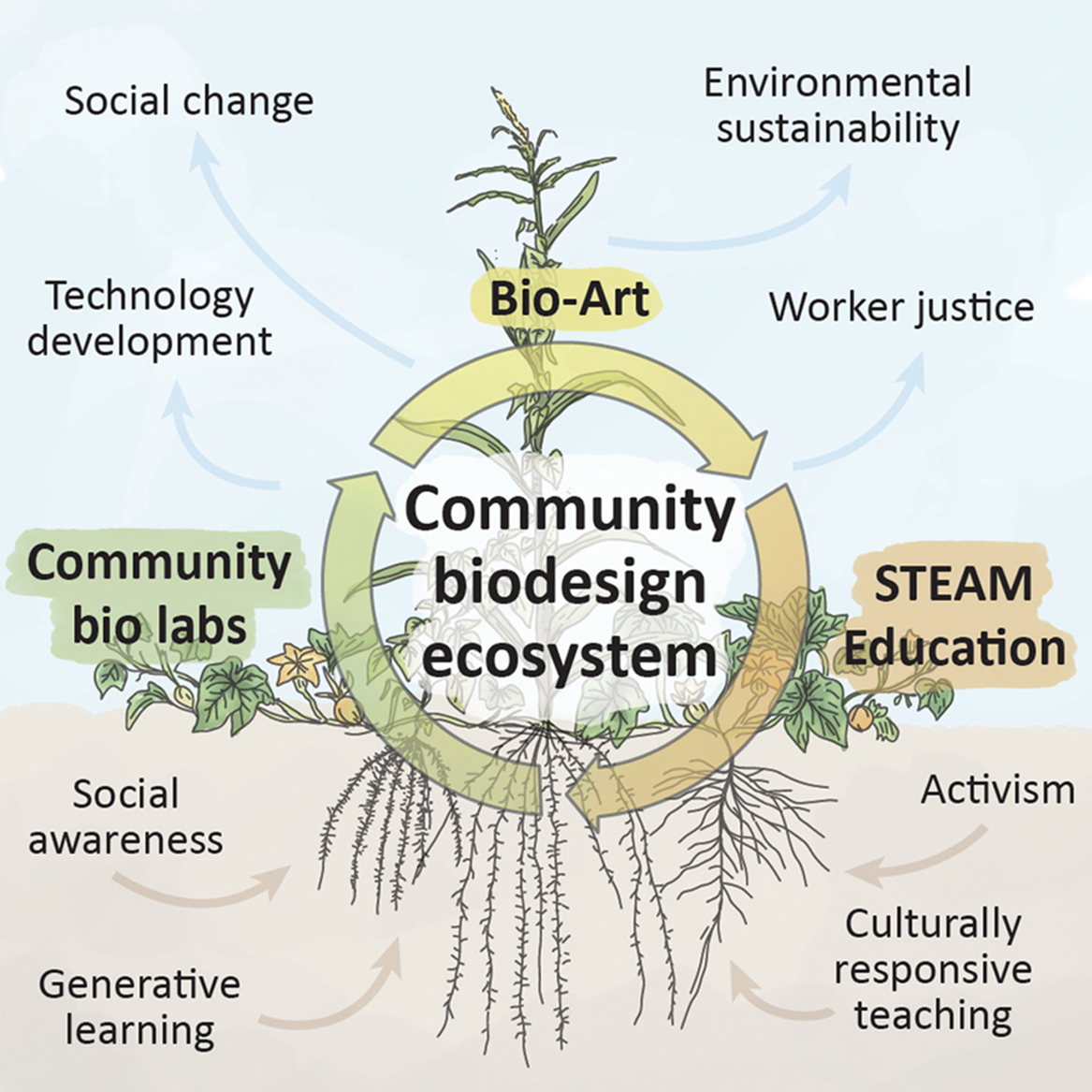
Biodesign spaces can thrive in informal community spaces such as gardens, libraries, art spaces, and even at home. A community-based approach to biodesign education that uses these informal learning spaces can broaden participation in biodesign, foster community building, and serve as unexpected sites of innovation (Schoenberg, Reference Schoenberg2022). Examples of community-based biotechnology design spaces include community biology laboratories, educational programming outside of schools, colleges, and universities, and biodesign integrated into art spaces (Figure 1). These biotechnology design spaces can exist in partnership with formal institutions or exist independently as community organizations, nonprofits, or informal gatherings.
Like la Milpa, a Mesoamerican social and agricultural practice (pictured), the biodesign ecosystem is supported by three sisters: community bio labs, bio-art spaces, and STEAM education. These spaces are nurtured by approaches such as social awareness, activism, generative learning, culturally responsive teaching, and others. Together, the ecosystem supports processes such as social change, environmental sustainability, technology development, and worker justice.
One example of community-organized biotechnology design spaces are community biology laboratories (community bio labs) (Scheifele and Burkett, Reference Scheifele and Burkett2016; de Lange et al., Reference de Lange, Dunn and Peek2022). Community bio labs, which exist across the globe, are typically nonprofits that have a physical lab space used for experimentation and education. For the most part, community bio labs operate independently, are supported by local members, and are driven by local needs and interests (de Lange et al., Reference de Lange, Youngflesh, Ibarra, Perez and Kaplan2021; Jorgensen and Grushkin, Reference Jorgensen and Grushkin2011; Grushkin et al., Reference Grushkin, Kuiken and Millet2013).
Biotechnology design education can also occur outside labs in maker spaces, libraries, community gardens, museums, town centers, farmers markets, art spaces, and more (Barton et al., Reference Barton, Tan and Greenberg2017). These spaces can host educational programs such as after school/summer programming and workshops that focus on biotechnology design (Walker and Kafai, Reference Walker and Kafai2021). Such programs can combine teaching strategies such as culturally relevant pedagogy (Brown, Reference Brown2019) and community co-design (Aksela, Reference Aksela2019; Peurach et al., Reference Peurach, Russell, Cohen-Vogel and Penuel2022) with “on the street” programming to inspire students to become biodesigners (Chappell et al., Reference Chappell, Perez and Corinne2022). Such programming can provide a range of low-floor (not requiring advanced knowledge) and high-ceiling (enabling open-ended learning) activities that engage the broader public and build awareness of biodesign as a potential career path early in students’ academic careers (Balmer and Bulpin, Reference Balmer and Bulpin2013; Roberts et al., Reference Roberts, Jackson, Mohr-Schroeder, Bush, Maiorca, Cavalcanti, Craig Schroeder, Delaney, Putnam and Cremeans2018; Walker, Reference Walker2021).
As a field, bio-art exists at the intersection of biotechnology and design (Bureaud et al., Reference Bureaud, Malina and Whiteley2014; Melkozernov and Sorensen, Reference Melkozernov and Sorensen2021). However, art and design spaces are often overlooked sources of bioengineering innovation by scientists. Artist studios and maker spaces already support creative making and design. Collaborations between artists and bioengineers can start in art spaces such as studios, galleries, and museums (Chappell and Muglia, Reference Chappell and Muglia2023). These art spaces can generate speculative design, serve as technology incubators, and shift cultural awareness toward biodesign (Idema, Reference Idema2012; Romanyuk et al., Reference Romanyuk, Романюк and Pavlov2021).
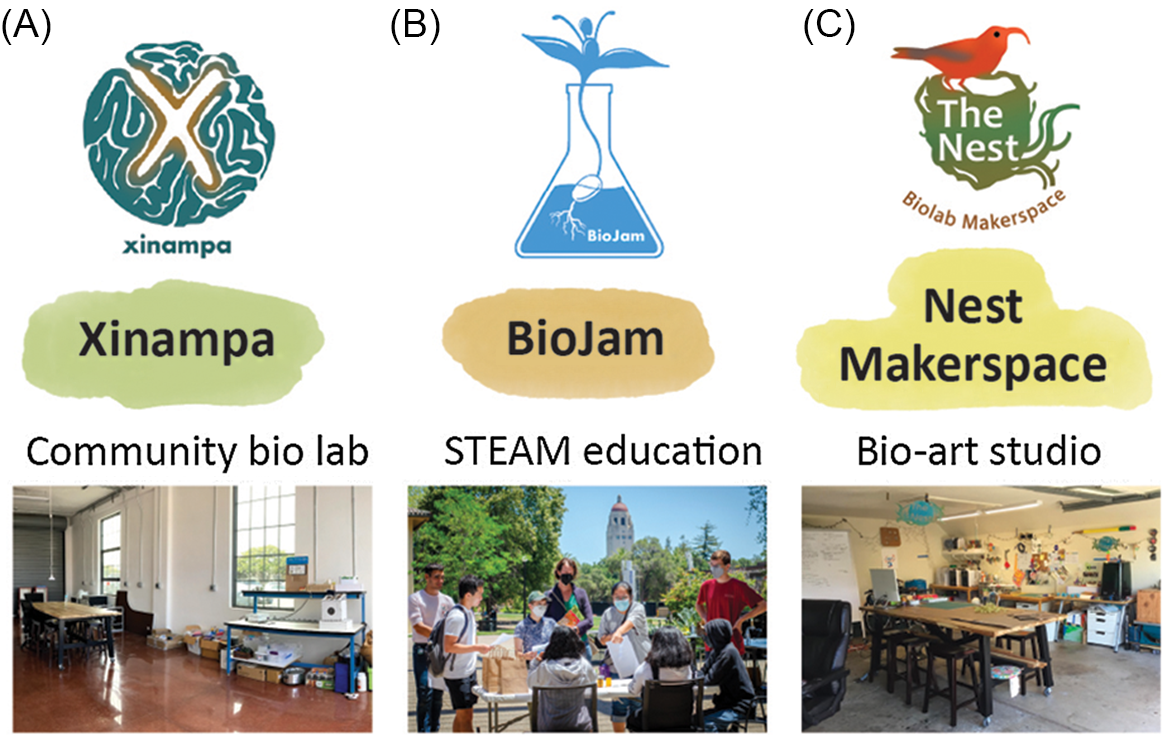
Here, we give three examples of community biodesign spaces focused on the agricultural community of Salinas, California (USA) (Figure 2). After sharing their individual missions, we will describe how the three organizations work together to support a local community biodesign ecosystem, analogous to the so-called, “three sisters,” the corn, bean, and squash of the sociocultural practice practiced throughout the Americas, sometimes referred to as la Milpa (Figures 1 and 3). Finally, we will share practices we learned for growing similar programming and connections (Table 1). By taking this holistic approach, growing local biodesign ecosystems can address systems-level challenges (Farrell et al., Reference Farrell, Penuel, Allen, Anderson, Bohannon, Coburn and Brown2022). Community-based biodesign can increase interest in (and reduce fear of) biology. By promoting public involvement, we can increase engagement by historically underrepresented communities in biodesign and inspire a love of biology broadly.
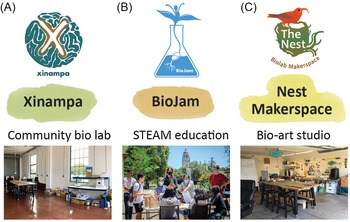
Three case studies of interrelated community biodesign spaces, including (A) Xinampa, a community bio lab, (B) BioJam, a STEAM education program, and (C) the Nest Makerspace, a bio-art studio.
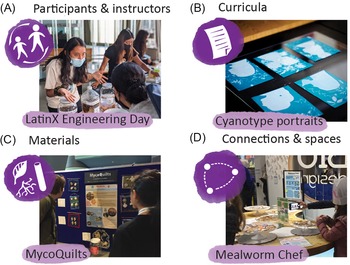
Community biodesign spaces can connect through (A) participants and instructors, (B) curricula, (C) materials, and (D) connections and spaces.

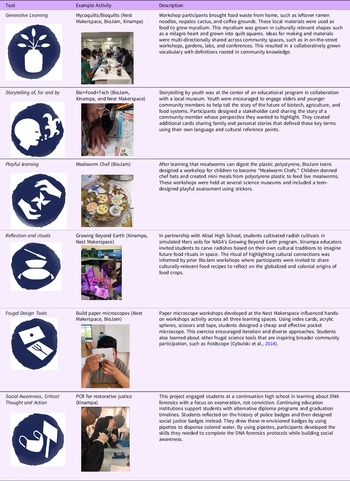
Examples of community biodesign activities for each tool

Community-based biodesign spaces: Three case studies
A community focus in biotechnology design requires a sense of place, generational connections, and trust between organizations, individuals, and actors within the community. Three organizations focused on Salinas, CA (USA) are case studies for local, community-based biotechnology design (Figure 2). We will provide a brief overview of each space, their interrelated missions, and how each collaborates to collectively strengthen the local biodesign ecosystem.
Salinas, located in the Salinas Valley of Monterey County (USA), sits on the unceded lands of the Rumsen, Mutsun, and Ohlone peoples. The Salinas Valley’s Mediterranean climate sustains a significant agricultural industry with deep historical and political significance. Salinas has a population of 162,791 residents, 79% are of Hispanic or Latino heritage, 30% are under the age of 18, only 16% have a bachelor’s degree or higher, and 14% live in poverty, a rate 10% higher than the national average (U.S. Census Bureau QuickFacts, 2020). The Salinas area, known as the “salad bowl of the world,” is widely recognized as a global hub for agricultural technology, despite greater than 34% of Monterey County residents reporting that they cannot afford enough food (County of Monterey, 2019). Despite its proximity to the Bay Area of California, one of the biotechnology hubs of the United States, Salinas residents are largely absent from biodesign conversations, which currently center on elite and often exclusionary spaces such as universities, companies, and art schools.
Xinampa: a community bioscience laboratory in Salinas, California.
Xinampa is a community bio lab that empowers individuals to activate, create, and innovate with biology (Figure 2A). Xinampa’s members are largely from Salinas or have kinship roots in agricultural labor. Xinampa offers workshops in the lab, at local schools, and public events. These workshops are designed to facilitate ways for community members to develop culturally relevant pedagogies, public interest technology and, ultimately, community-based wealth, self-sufficiency, and control of modern technology.
BioJam: a community bioscience educational project anchored in the greater San Francisco Bay Area of California.
BioJam is a summer camp where research scientists and artists collaborate with local high school students, now primarily migrant students from Salinas (Figure 2B). BioJam’s mission is to re-envision the future of bioengineering and biodesign through education. By centering biodesign programming on cultural knowledge and art, the program reframes who is a scientist and what science can be. In addition to serving youth, the program engages Stanford students, artists, and community educators in biodesign education as co-learners and practitioners. Through this program, teens (middle and high school-aged community members) develop and conduct workshops for their communities, sharing what they have learned as experts.
Nest Makerspace: an R&D garage makerspace in Hawai’i, formerly in the Bay Area of California.
The Nest Makerspace is a garage makerspace of artist Corinne Takara that focuses on playful and accessible biomaking explorations (Figure 2C). It has served as the research and development space for curricula created for BioJam Camp and Xinampa, as well as many other organizations. The Nest Makerspace brings decades of art activism, community pop-up street STEM workshops, lesson plans, program development, as well as connections to an international network of community biolabs.
Connecting community biodesign spaces
While each space leads its own set of programming, connections between each group result in deeper engagement and exploration of biodesign concepts. Collaborations can amplify and elevate biodesign explorations at the intersection of art, sustainability, ethics, and civic engagement. Here, we highlight how multiple organizations with different, but interrelated missions can collaborate to advance biotechnology design (Figure 3).
First, each organization worked together by sharing instructors and participants (Figure 3A). Xinampa, BioJam, and Nest Makerspace collaborated to develop biodesign programming for a core group of teens based in Salinas, CA. Teens who first participated in activities in one space, for example, an aquaponics workshop with Xinampa, could enroll in BioJam’s summer camp, or the Biodesign Challenge team with Nest Makerspace. Similarly, facilitators at BioJam were also involved in Nest Makerspace and Xinampa. One collaboration between the three organizations that shared instructors and participants focused on a local science museum in San Francisco, CA. The museum was hosting a Latinx Engineering Day and collaborated with Xinampa to host two biodesign workshops. At this event, BioJam teens led both biodesign workshops and helped revise hands-on activities developed in the Nest Makerspace. The activities invited participants to make root observation tools made from small clear plastic containers using culturally relevant seeds from la Milpa, an Indigenous agricultural co-cultivation practice that includes the “three sisters:” corn, squash, and beans (illustrated in Figure 1). La Milpa is familiar to many Salinas residents; many teens cultivate their own Milpa in their gardens at home or with family members in Mexico. Participants planted these seeds in agar-based hydrogel beads, which can function as a clear soil replacement. These beads, which are familiar to the teens as the toy Orbeez, were saturated with banana, seaweed, and eggshell liquid fertilizers and grown in a clear tic tac container. Over time, teens could observe the roots of la Milpa growing through the clear container and soil. This activity highlighted the ecological benefits of ancestral permaculture techniques and natural fertilizers on plant growth. The root study tools, developed at the Nest Makerspace for a Salinas Biodesign Challenge team in 2021, were adapted by Xinampa for workshops at a local park and a science museum in San Francisco, CA (USA). The seeds of squash, beans, and corn were passed among the organizations to nurture conversations centered on the importance of ancestral knowledge (Milpa and fertilizers) in contemporary root research. These events grew connections with other community organizations as well. Xinampa invited a local theater group in Salinas, Baktun12, to develop and perform a live stage performance about biotechnology called The History of Shaping BIology, which was spoken in a mix of Spanish and English.
Second, curricula were shared and prototyped between BioJam, Xinampa, and Nest Makerspace (Figure 3B). Since curriculum design is an interactive process, projects that start in one space can be shared and prototyped for new groups and audiences across multiple organizations. For example, a cyanotype self portrait activity was designed at the Nest Makerspace for the Xinampa-led Opentrons Lab Automation workshop series. Cyanotypes are a chemical-based photographic technique that requires chemical washes similar to that used to wash lettuce in produce processing facilities. This exercise was meant to use art to highlight chemical use in agriculture. Teen participants combined local plants, their silhouettes, sunlight, and chemicals to create art. Although the original workshop was canceled due to the onset of COVID-19, the project was iterated upon and became part of BioJam Camp. A dual silhouette version was used to explore connections between nature and community. The next year, BioJam incorporated a new element: a poem about teen’s identity and culture.
The efficacy of curricula was evaluated using qualitative assessment tools such as teen-designed sticker surveys. In the BioJam pilot year, participants were asked to assess their perceptions of themselves and of their family/community as science knowledge bearers, as well as their interest in STEM, on a daily basis. Each day, participants placed a unique sticker each day on sheet to represent their self-assessment. Watching the stickers change, students were surprised to see their confidence as science knowledge bearers rise early in the week, fall midweek as they became aware of new domains of science, and then rise again as they began to plan for the workshops they would design and lead about these new domains. In discussions about how they were feeling about the process of their knowledge sharing and gaining, participants grew with the ebb and flow of confidence in these learning spaces. Overall, their interest in STEM rose over the course of the camp and they shared that the culturally focused bio-art components were their favorite parts of the day. These surveys and discussions emphasized the importance of weaving culture and existing knowledge into all segments of the programming and a key insight was that they regained confidence as they started designing community workshops.
Third, shared use of biodesign materials can connect organizations and groups (Figure 3C). Because biomaterials can be challenging to grow, collaborative networks are often formed. These networks, for example, share starter cultures and knowledge about how to grow materials. The use of mycelium as a biomaterial has been a connector between the Nest Makerspace, Xinampa, and BioJam. In the Nest Makerspace, a team of teen biodesigners conducted experiments growing mycelium in a range of feedstocks and geometries. Next, BioJam Camp teens explored new processes for mycelium grown assemblies as quilt squares and presented this work at an academic conference on additive manufacturing. These explorations were co-designed with teens and informed Xinampa’s biomaterials programming. Xinampa now involves local businesses, such as a brewery, which provides feedstock to grow mycelium materials. Focusing on the teens’ existing cultural knowledge anchored all of these journeys. Participants were invited to bring in their own locally sourced feedstocks and to design culturally relevant forms.
Fourth, organizations can share community connections and spaces to expand the impact of programming (Figure 3D). Connections in one organization, when shared with others, can help their programming grow and new relationships form. For example, the Nest Makerspace and BioJam expanded programming about mealworms that spanned community colleges, summer camps, workforce development spaces, and museums. Nest Makerspace originally developed curricula showing how mealworms digest plastics for local community colleges. Later, at BioJam Camp, teens developed a hands-on activity where participants became “mealworm chefs,” donning chef’s hats and preparing tiny pizzas and sushi made of polystyrene for the worms. Teens led these activities at a local science museum in San Jose, CA and workforce development center in Salinas, CA.
Toolbox of approaches
Together, these three spaces have developed educational strategies to engage their local communities. These focus on multidirectional and multigenerational knowledge exchange through culture and ancestral knowledge. We present a summary of some approaches developed through these collaborations, with examples highlighted in Table 1.
Generative learning
Generative learning, a practice of multidirectional sharing and growing vocabulary together, draws in collaborators’ existing cultural knowledge and lived experience (Osborne and Wittrock, Reference Osborne and Wittrock2008; Edwards, Reference Edwards2011; Eglash et al., Reference Eglash, Lachney, Babbitt, Bennett, Reinhardt and Davis2020). One generative learning approach is inviting communities to redefine terms and approaches through their culture, storytelling, and science knowledge (Rosebery et al., Reference Rosebery, Ogonowski, DiSchino and Warren2010; Barajas-López and Bang, Reference Barajas-López and Bang2018). For example, asking participants to bring in materials from their kitchen, a garden, or local surroundings can be a generative learning practice to explore biomaterials. This approach empowers participant’s cultural expertise and place-based knowledge and encourages students to dually serve in an educator role.
Playful learning
Playful learning through exploration and creativity cultivates a sense of control and ownership, helping to reduce anxiety associated with assessment and expectations to perform well. Biodesign is well suited to playful learning. Play builds trusted spaces where judgment is suspended and questions can be asked. Knowledge can be collaboratively grown together. Playful learning invites curiosity, imagination, and iteration in ways that are often absent in formal learning environments, and yet are crucial for bio innovation. Additionally, play frameworks can be malleable in serving participants’ needs for a sense of connection, expression, healing, and escape (Hunter-Doniger, Reference Hunter-Doniger2021).
Reflection and rituals
To compliment building and learning time, we also incorporate time for reflection and rituals. Time for reflection on provenance of cultural heritage, genealogy, and land is often taken at the beginning of meetings. For example, participants can share their personal and cultural histories during an opening conocimiento (Mendez-Negrete, Reference Mendez-Negrete2013; Jaime-Diaz and Méndez-Negrete, Reference Jaime-Diaz, Méndez-Negrete and Hernández-Serrano2021). To close workshops or meetings, we create time to share gratitude and thanks.
Storytelling of, for, and by
Storytelling is a powerful tool for broadening conceptions of STEAM and inviting exploration (Hunter-Doniger et al., Reference Hunter-Doniger, Howard, Harris and Hall2018; Will Wieder, Reference Wieder2006). Empowering participants to share their stories in a biodesign context position them and their culture knowledge as central to the educational process (Tzou et al., Reference Tzou, Suárez, Bell, LaBonte, Starks and Bang2019). Youth participating in Salinas-based programming with Nest Makerspace, Xinampa, and BioJam often have a deep knowledge of agricultural systems. Cultivating spaces where they could share their stories, experiences, and cultural narratives on these topics highlighted them as experts on biodesign to themselves, their peers, families, and other audiences.
Frugal design tools
To improve accessibility to biodesign, we use frugal science tools, scientific tools composed of repurposed common objects (Reardon, Reference Reardon2013; Byagathvalli et al., Reference Byagathvalli, Challita and Bhamla2021). In low-resource settings, sharing make-and-take tools made of low-cost materials can extend learning and play beyond individual workshops or programs. Not only can participants use what they made at home, they can also easily acquire the same materials to share what they learned with friends and family. This encourages scientific discussions at home and helps expand equitable access to biodesign.
Social awareness, critical thought, and action
Focusing programming on social awareness and community activism is essential for transformational change. Biodesign must expand beyond a single workshop or program; participants can continue to engage with their neighbors and family by sharing new skills and co-designing solutions. By contextualizing biodesign concepts into broader social frameworks, such as environmental and racial justice, biodesign programming can empower structural change.
Conclusions and perspectives
In this paper, we have demonstrated the benefits of a biodesign ecosystem that focuses on supporting local communities. Specifically, we have shown how community-based learning spaces can collaborate, resulting in increased interest in biodesign. Through our three case studies, we have shown how our biodesign ecosystem has engaged a diversity of underserved communities to expand culturally relevant biodesign conversations and cultivate new career pathways. We hope that in sharing frameworks from our community biomaking spaces, we can expand our work into new communities.
In order to grow communities empowered to make with biology, we need community-based biomaking ecosystems across the globe. In communities where the nucleating sites and critical mass of people necessary for cultivating a biodesign ecosystem do not exist, existing sites of cultural exchange, such as local parks, block parties, farmers markets, county fairs, spiritual or religious gatherings, and municipal civic events, might serve as places to get started. Key characteristics that communities might look for are multigenerational, culturally vibrant, and emphasize mutual care. For example, after working in the Salinas Valley ecosystem, the Nest Makerspace moved to Hawai’i where it is now growing new biomaking collaborations through conversations with an Indigenous environmental nonprofit, scholars from the University of Hawai’i at Manoa Center for Indigenous Innovation and Health Equity, rural community centers, and a tool lending library. These initial collaborations center on locally important anchoring themes such as clean water or food sovereignty.
Seeding biotechnology conversations in new types of multigenerational spaces can broaden the notion of what biodesign is and who participates in it. This expansion will drive innovation. For example, agricultural communities have cultural knowledge and lived experience that, if amplified in biodesign conversations at the onset, can add perspectives that can translate into more innovative and meaningful biotechnologies. When we elevate the wisdom and perspectives of ancestral cultures, we can form new tools and systems to address climate change and reshape our place on earth. A biodesign ecosystem can be more resilient than a large centralized institution, more creative and innovative, more personal and local. Ecosystems of community biodesign spaces can facilitate the interweaving of knowledge and perspectives across generations, cultures, and species to imagine a sustainable future for all.
Data availability statement
No data was analyzed in the creation of this work.
Acknowledgements
We are grateful to our communities, composed of human and non-human biology. We would like to thank many colleagues, mentors, and friends who have shaped this piece, especially David Kong, Justice Walker, Leon Elcock III, and Drew Endy. We especially appreciate feedback on this manuscript by two anonymous reviewers. CRC acknowledges collaborative support from Nixon Arauz, Megan Palmer, Samantha Zyontz, Sam Weiss Evans, and Peter Pellitier. RCP and COT thank Ana Ibarra, Leo Tejeda, Omar Perez, Steven Rhyans, and Matias Kaplan. RCP thanks MILPA Collective and TechActivist.org for inspiration. COT thanks Melissa Ortiz, Leticia Hernandez, and Emily Takara for collaboration and inspiration. The milpa imagery in Figure 1 was inspired by Ilda, a migrant BioJam teen.
Financial support
This work was supported by a National Science Foundation Graduate Research Fellowship (DGE 1656518) and a Stanford Graduate Fellowship (CRC). Xinampa received funding from the California Endowment, the James Irvine Foundation, the Latino Community Foundation, the Arts Council for Monterey County, the Tanimura Family Foundation, and Digital NEST. The Nest Makerspace received funding from the SV Creates XFactor for the Arts Grant, San Jose Office of Cultural Affairs Public Art Program, the Knight Foundation, a Science Sandbox Biodesign Challenge grant, and funding from the Biodesign Challenge. BioJam has been supported by the Migrant Education Program of California (Region XVI) and the Ethics, Society, and Technology Hub (Stanford University), and individual donors.
Competing interests
We have no competing interests to declare.

 Open access




Comments
Dear Dr. Moniz,
Thank you for the invitation to submit an Impact Paper in your journal, Biotechnology Design.
In response to the invitation, we are pleased to submit a manuscript entitled “Growing biodesign ecosystems: Community exchange spaces advance biotechnology innovation.”
In this manuscript, we present a framework for community-based biotechnology design using three organizations collaborating in Salinas, California (USA) as case studies. First, we describe how the three organizations work together to form a community-based biodesign “ecosystem.” Second, we outline a toolbox of approaches that others can use to cultivate similar ecosystems in their communities. We believe our community-based approach that spans science, art, and education spaces will be of broad interest to your readership.
Thank you for considering our manuscript and look forward to hearing back in due course.
Sincerely,
Corinne Okada Takara, Rolando Cruz Perez, and Callie Chappell