


The Despotism of Custom
Unlike habit, or tradition, with which it is sometimes conflated, custom is neither mechanically repetitive nor unchanging: it combines, as Eric Hobsbawm argues, ‘flexibility in substance and formal adherence to precedent’.1 Habit may be purely individual, rooted idiosyncratically in minds and bodies, and is often rather reflexive than a deliberate or contemplative invoking of a past practice. Nostalgia too, though powerful, does not necessarily have a communal grounding, is often bound up with the sense of a loss of something imagined, and is clearly prompted by that sense of loss, perhaps by a fear of forgetting. With custom, nothing is lost, and there should be no forgetting, which makes it a weighty, often unwieldy, inheritance. Bowler writes of ‘the ever-present modernity of custom’ (p. 171) in a phrase that captures something of custom’s strength and awkwardness: it is ubiquitous as it straddles past and present in a way that doesn’t feel modern, yet is always of the essence of the moment. Custom needs to be negotiated, recognised, respected, and lived with as a determining presence whilst not allowing its reassuring backwards pull to deflect from innovation. Whether as a fixed entity or a marker of gradualist progression, custom is a category that eludes definitions of history as either linear or cyclical. It is in many ways a unique form of historical experience, enacting its past as presence, and displaying within it the markers of its historical persistence and the weight of its past: it embodies the past as an inherent part of the lived experience of the present moment.
For most writers in 1859, custom was part of their habitat, a given, but for John Stuart Mill, it was a corrosive marker of a nation and an individual unable to progress:
The despotism of custom is everywhere the standing hindrance to human advancement, being in unceasing antagonism to that disposition to aim at something better than customary, which is called, according to circumstances, the spirit of liberty, or that of progress or improvement … The progressive principle, however, in either shape, whether as the love of liberty or of improvement, is antagonistic to the sway of Custom, involving at least emancipation from that yoke; and the contest between the two constitutes the chief interest of the history of mankind.
Mill’s views give custom a prominence that its intrinsic nature generally precluded, and help to make it one of the definitive tropes of 1859. They also invite us to investigate custom further, to think about the ways in which it underpins responses to people and events, and helps to determine the peculiar nature of a year extraordinarily rich in its cultural productions and epochal events, but which continuously kept its eyes as much on the past as on the present.
Custom was a concept that had achieved a conservative currency through Edmund Burke’s Reflections on the Revolution in France (1790) and that had resurfaced recently in John Sibree’s 1857 translation of Hegel’s Lectures on the Philosophy of History (1837). According to Hegel, an undue reliance on custom was a pernicious determinant of a culture’s lack of any future. The customary life, ‘the watch wound up and going of itself’, ‘is that which brings on natural death. Custom is activity without opposition, for which there remains only a formal duration; in which the fulness and zest that originally characterised the aim of life are out of the question – a merely external sensuous existence which has ceased to throw itself enthusiastically into its object.’2
For Hegel, the spirit of a people was coterminous with its object, its work, and the example he gives of this is telling: ‘Every Englishman will say: We are the men who navigate the ocean, and have the commerce of the world; to whom the East Indies belong and their riches; who have a parliament, juries, etc.’ (Hegel, p. 77). Whilst engaged in fulfilling the conquering, mercantile spirit of the nation, that nation is ‘moral – virtuous – vigorous – while it is engaged in realizing its grand objects, and defends its work against external violence during the process of giving to its purposes an objective existence’ (Hegel, p. 77), but when those purposes are achieved, when external opposition has been encountered and defeated: ‘the activity displayed by the Spirit of the people in question is no longer needed: it has its desire … the living, substantial soul itself may be said to have ceased its activity. The essential, supreme interest has consequently vanished from its life, for interest is present only where there is opposition’ (Hegel, p. 78). In Britain that spirit was frequently experienced as martial, whether the country was actually at war, or not, as was the case in 1859.
On Liberty is a far more impassioned and deeply influential argument for the rights of the individual that has had a reach far beyond Britain and the nineteenth century. Mill writes:
The object of this Essay is to assert one very simple principle … that the sole end for which mankind are warranted, individually or collectively, in interfering with the liberty of action of any of their number, is self-protection. That the only purpose for which power can be rightfully exercised over any member of a civilised community, against his will, is to prevent harm to others.
Mill was concerned to protect the individual against the legislative coercion of the state and to enable the flourishing of the progressive, potentially eccentric individual, but one of his primary concerns is his recognition that not only government but inherited experiences and identities may be a substantial check on the possibility of the full and proper expression of individual liberty. And further he argues that governments ‘that make themselves the organ of the tendencies and the instincts of masses’ are subject to ‘collective mediocrity’ (pp. 118, 119), hence his fierce argument against what he saw as the corrosive effects of ‘despotic’ custom. Mill’s analysis of the liberty and rights of the individual defines custom as ineluctably confining the individual, as well as the nation, within an economy that negates the possibility of progress. It was a long-standing concern of Mill’s, not least because it appeared to persist no matter what the context: as Mill had written earlier in ‘Vindication of the French Revolution of February 1848’, ‘The great majority of mankind are, as a general rule, tenacious of things existing: habit and custom predominate with them … a people are as tenacious of old customs and ways of thinking in the crisis of a revolution as at any other time’.3 He also argues that whilst custom might have helped to protect nations from despots in previous ages, ‘the great interests of the present age’ are not well served by such a practice (Mill, ‘Letter’, p. 29). Custom might even become a measure of barbarism (p. 30), a charge to which Mill returned in On Liberty.
In order fully to develop the ‘human faculties of perception, judgment, discriminative feeling, mental activity, and even moral preference’, human beings need to evade custom’s thrall, to make choices, for ‘He who does anything because it is the custom, makes no choice’ (Mill, p. 105). And in order to respond to what he calls ‘the tyranny of opinion’, Mill suggests that ‘it is desirable, in order to break through that tyranny, that people should be eccentric’. He goes on: ‘the amount of eccentricity in a society has generally been proportional to the amount of genius, mental vigour, and moral courage, which it contained. That so few now dare to be eccentric, marks the chief danger of the time’ (pp. 120–21). To pursue individual, rather than group, identity was a compelling responsibility, and not one that brought with it any kind of exemplary duty: it was enough simply to be at liberty. One of the spectres behind Mill’s fears here is China, which, despite being a nation of ‘much talent’, had become ‘stationary’ through ‘making a people all alike, all governing their thoughts and conduct by the same maxims and rules’ (pp. 128–29). He goes on: ‘The modern regime of public opinion is, in an unorganized form, what the Chinese educational and political systems are in an organized; and unless individuality shall be able successfully to assert itself against this yoke, Europe, notwithstanding its noble antecedents and its professed Christianity, will tend to become another China’ (pp. 129–30). Mill’s views on China were in line with contemporary prejudices at the time (see Chapter 5).
Disturbed by what they interpreted as a pessimistic take on Britain’s present and its future, early reviewers described Mill’s as a ‘melancholy’ work,4 and even an unchristian one that set its precepts against the teaching of the established church.5 There was also some misunderstanding of On Liberty, with the National Review critic stating that it was ‘written in the sincere foreboding that the strong individualities of the old types of English character are in imminent danger of being swallowed up in those political and social influences which emanate from large masses of men’ (p. 393). Mill is far from arguing that the individuality that he sought to protect and bolster was of an ‘old type of English character’, quite the opposite in fact: he argued for the possibility of new forms of identity and knowledge. But the lure of the past is familiar and difficult to elude: even Henry Thomas Buckle, the reviewer most overtly favourable to Mill’s work, clung to the possibility that in eschewing the ‘grievous and exacting tyranny of custom’ that might lead men to live’ in a ‘dull and monotonous uniformity’ it would be possible to retrieve the ‘vigour and raciness of character, that diversity and fullness of life, and that audacity, both of conception and of execution, which marked the strong men of former times’.6
The other key target in Mill’s work is ‘public opinion’, a term confidently used by newspapers and politicians of the day, and indeed of our own day, to bolster their own strategies and actions by assuming, and thereby hoping to create, a complicit public. In 1859, that there could be a form of ‘public opinion’ might rather have seemed a measure of that sharing of opportunities, means of communication, and education that have come to seem tangible evidence of progress. However, Mill, as Buckle puts it, saw society ‘growing so strong as to destroy individuality; that is, to destroy the very quality to which our civilization, and therefore our social fabric, is primarily owing’ (Buckle, p. 528). This potentially opposes Mill to the great democratic movements of the age, to the spread of education and literacy, but his fear of a rising conformist mentality was greater than his fear of the dangers of ignorance. The Times review noted that ‘if there is one feature more striking than another in the treatment of the subject [of liberty], it is the entire want of sympathy with the convulsive efforts which have lately been making to get up a democratic movement in the country’.7 In Mill’s Thoughts on Parliamentary Reform, which had appeared in January, he had indeed sought to argue for ways in which that danger might be managed and a form of democracy nonetheless be achieved. He developed a system which would apportion votes according to the level of education achieved, from one for the unskilled labourer to five or six for graduates, freely elected members of ‘any learned society’ and members of professions ‘requiring a long, accurate, and systematic mental cultivation’. This could, by countering the numerical dominance of the generally less-educated working and lower classes, forestall precisely the mob rule that the middle and upper classes feared.8 Unlike contemporary politicians, Mill sought to enfranchise individuals rather than to create classes of voters.
Mill is fearful of the unmediated, untrammelled power of the working classes, and the example of France lies behind his unease. Stating his belief that even the granting of a single vote should not happen without proof that the voter could write and do a basic sum, Mill acknowledges that this is:
but a low standard of educational qualification; yet even this would probably have sufficed to save France from her present degradation. The millions of voters who, in opposition to nearly every educated person is the country, made Louis Napoleon President, were chiefly peasants who could neither read nor write, and whose knowledge of public men, even by name, was limited to oral tradition.
Several key themes of the year coalesce in Mill’s views on parliamentary reform: the ever-present spectre of France (where Mill was, however, to spend much of the year, as he tended his wife’s grave in Avignon); the need for the people to be educated about ‘public men’, their shortcomings, as well as their achievements; the long reach of the past; and the burgeoning awareness of public opinion as something of undeniable consequence, which includes the whole population – or at least its male part – but which has to be moulded and monitored. Putting words slightly into Mill’s mouth, The Times declares that ‘Tyranny of the most oppressive description’ would be the result of ‘a large increase of the popular element in the representation’, a reflection which throws light on the complicated nature of the ‘popular’ at this time, and at any time in which public sympathies threaten to counter those of the establishment. At the heart of both of Mill’s 1859 books is the particular iteration of the problematic relationship between society and the individual, and the ways in which custom, chief amongst other historical forms, had to be encountered as part of enabling that relationship to be a mutually productive one.
However, despite seeing custom as the marker of a people sleepwalking blindly on the spot, devoid both of inspiration and aspiration, Mill ends by acknowledging its enduring power, writing that ‘it is important to give the freest scope possible to uncustomary things, in order that it may in time appear which of these are fit to be converted into customs’ (On Liberty, p. 121). And, in a moment of personal distress later in the year, he recognises the emotional force of custom in a painful argument with Elizabeth Gaskell, in whose biography of Charlotte Brontë she had quoted a letter from the novelist which described Harriet Taylor Mill (though without naming her) as ‘a powerful-minded, clear-headed woman, who had a hard, jealous heart, muscles of iron, and nerves of bend leather … a woman who longed for power, and had never felt affection’.9 A furious Mill, still grieving for Harriet, who had died in November 1858, wrote to Gaskell that she had:
disregarded the obligation which custom founded on reason has imposed, of omitting what would be offensive to the feelings and perhaps injurious to the moral reputation of individuals … and the notion you seem to entertain that everything said or written by any one, which could possibly throw light on the character of the sayer or writer, may, justifiably, be published by a biographer, is one which the world, and those who are higher and better than the world, would, I believe, perfectly unite in condemning.10
Gaskell replied, defending herself against Mill’s accusations of lack of care, though she did not apologise, and Mill wrote again, repeating his earlier charge that she had ‘neglected the usual and indispensable duties which custom (founded on reason) has imposed of omitting all that might be offensive to the feelings of individuals’ (July 1859; pp. 629–30). To point out Mill’s failure to follow his own wariness about custom is not, as Mill’s excellent biographer, Richard Reeves, suggests, to ‘nit-pick’ but rather to show that even the fiercest and most unimpeachable principles might be defeated by emotion, and that custom was indeed too tenacious a practice easily to overthrow.11
In two of the most enduring novels of this year, we can see more fully played out the tenacity of the relationship between custom and affect that Mill painfully experiences here, and which On Liberty does not sufficiently acknowledge. We can also see the ways in which custom operates in relation to communities and individuals experiencing crisis. In A Tale of Two Cities and Adam Bede, custom is used respectively as the measure of historical instability and the means by which catastrophe can be survived, and change enabled through recognition of custom’s integral part in social formation. These novels, and especially Adam Bede, along with Mill’s work, provide the linguistic and conceptual basis for tracing custom’s centrality within 1859.
A Tale of Two Cities
The Times’ and Buckle’s views on populism are generated by fears of the French Revolution as exemplifying the greatest evidence of populism turned to utter chaos. The Revolution of 1789 was still a potent social and political memory which inspired novels by Geraldine Jewsbury (Right or Wrong, see ch. 3) and, more famously, by Charles Dickens. In A Tale of Two Cities, Dickens writes a historical novel which examines custom as one of a number of competing historical models. Inspired in part by Carlyle’s The French Revolution: A History (1837), the novel can, and will, also usefully be read alongside the articles appearing with A Tale of Two Cities in the pages of Dickens’s new periodical, All the Year Round, which launched on 30 April. In a year which would end with the revelations of Charles Darwin’s On the Origin of Species, we can already read here of a model of identity as embedded like a fossil, persisting and waiting to be discovered. In the 14 May issue, Dickens included an intriguingly titled article on ‘Rome and Turnips’ by his frequent contributor Henry Morley, which gives an account of ‘fresh diggings’ at ‘Wroxeter, the buried city of Uriconium’.12 The article describes the recent excavations, which have thrown up ‘the entire skeleton of a large Roman town [lying] there underneath the clods’ (p. 54), and speculates about the continuity of identities across the centuries. Imagination fills the gaps that evidence cannot: bones might be those of fleeing fugitives who were caught and massacred, or of inhabitants who, crouching ‘while the flames of the burning city roared and crackled’, ‘were crushed under the falling walls’ (p. 56). This British archaeologist, like those in Amiens, uncovers horizontal layers of history piled upon each other, but the writer and historian imaginatively discover lines of continuity built out of excavated fragments. Digging down, whether it be underground or into the past histories and literatures of civilisations, is impelled by the compulsion to find precedents, similarities, and continuities with the present, which also constitute the workings of custom.
In May’s instalments of A Tale of Two Cities, Dickens himself uses an archaeological model to ‘recall to life’, to dig out, Dr Manette, who had been buried alive in the North Tower of the Bastille for twenty years. Part of the process of his recovery entails his recognising the passage of time since his imprisonment, when, apart from acquiring the skills of a shoemaker, time has stood still for him. On first meeting his daughter, Lucie, he is intrigued by her blond hair, which matches the few strands of her mother’s hair that he had treasured through his imprisonment:
It is the same. How can it be! When was it! How was it! …
No, no, no; you are too young, too blooming. It can’t be. See what the prisoner is. These are not the hands she knew, this is not the face she knew, this is not a voice she ever heard. No, no. She was – and He was – before the slow years of the North Tower – ages ago.13
Past history and present events must be reconciled in order that Dr Manette can be ‘recalled to life’ in any meaningful sense, and eventually they are through the patient affection of his daughter. But some of the secrets of the past still lie buried in the walls of the North Tower and will only resurface later through Citizen Defarge’s excavating them. Like Manette’s shoe-making, which resurfaces in times of stress, the past cannot be buried forever, and in this novel it returns with a bloody ferocity which is prophesied in the spilling of wine in front of the Defarges’ shop:
The wine was red wine, and had stained the ground of the narrow street in the suburb of Saint Antoine, in Paris, where it was spilled. It had stained many hands, too, and many faces, and many naked feet, and many wooden shoes. The hands of the man who sawed the wood, left red marks on the billets; and the forehead of the woman who nursed her baby, was stained with the stain of the old rag she wound about her head again. Those who had been greedy with the staves of the cask, had acquired a tigerish smear about the mouth; and one tall joker so besmirched, his head more out of a long squalid bag of a nightcap than in it, scrawled upon a wall with his finger dipped in muddy wine lees – BLOOD.14
The sombre, repetitive cadences of Dickens’s lines remove the reader from the frenzied urgencies of the scene and conduct a slow-motion sweep across the evidence of suffering and depravity, which etches its details into our imagination. For the historically aware reader, this moment is poised between the excesses of aristocratic France, which have brought the nation to the verge of ruin, and the brink of imminent revolution, which will be led by the people of Saint Antoine. It is also in this instalment of the novel that we first meet Madame Defarge, in whom her family’s past suffering at the hands of aristocrats fuels a long-sustained hatred which matures into action in the Revolution. In her, there is no possibility of her maturing beyond the anguish of her youth; rather, her desire for vengeance explodes into the destruction of herself and others.
The root of that damage lies in the violence of the aristocratic Evrémonde brothers. Their last victim lies dying, unable to say anything but endlessly remembering the members of her family killed by the brothers and counting to twelve, the hour at which her husband died. Time stands still; it cannot progress beyond that moment for her because she dies, but nor can time proceed beyond that moment for France, or Madame Defarge, until that wrong is wiped out. The novel experiments with modes of redemption: it tries the peace of female love and the domesticity that Lucie Manette creates, and the terrible violence of the revolution itself, but neither prevails. For much of the novel, time is stuck at this point in what John Rignall has described as the ‘catastrophic continuum’ of history, and we need to read on to the end of the novel to see whether Dickens can deliver his readers and characters into a new century beyond the traumas of the Revolution.15
Dickens represents the violence and discord of the revolutionary period as one which justifies Hamlet’s perception that ‘the time is out of joint’, though it is Macbeth’s despairing words that Dickens uses to describe Sydney Carton’s sense of the ‘to-morrow’s and to-morrow’s’ of endless lives put to death by the guillotine at a moment when there was,16
no pause, no pity, no peace, no interval of relenting rest, no measurement of time. Though days and nights circled as regularly as when time was young, and the evening and morning were the first day, other count of time there was none. Hold of it was lost in the raging fever of a nation, as it is in the fever of one patient. Now, breaking the unnatural silence of a whole city, the executioner showed the people the head of the king – and now, it seemed almost in the same breath, the head of his fair wife which had had eight weary months of imprisoned widowhood and misery, to turn it grey.
And yet, observing the strange law of contradiction which obtains in all such cases, the time was long, while it flamed by so fast.17
The revolutionaries had tried to re-make time, but in establishing ‘Year One of Liberty’ they have disturbed nature and diseased the passage of time itself: ‘there was no measurement of time’.
Carlyle’s history of the French Revolution is similarly temporally disturbing, with his use of the present tense throughout his work that leaves its victims perpetually and grotesquely acting and re-enacting their struggle. This is his account of Louis XVI’s last moments:
He mounts the scaffold, not without delay; he is in puce coat, breeches of grey, white stockings. He strips off the coat; stands disclosed in a sleeve-waistcoat of white flannel. The Executioners approach to bind him: he spurns, resists; Abbé Edgeworth has to remind him how the Saviour, in whom men trust, submitted to be bound. His hands are tied, his head bare; the fatal moment is come. He advances to the edge of the Scaffold, ‘his face very red,’ and says: ‘Frenchmen, I die innocent: it is from the Scaffold and near appearing before God that I tell you so. I pardon my enemies; I desire that France’ – A General on horseback, Santerre or another, prances out with uplifted hand: ‘Tambours!’ The drums drown the voice. ‘Executioners do your duty!’ The Executioners, desperate lest themselves be murdered (for Santerre and his Armed Ranks will strike, if they do not), seize the hapless Louis: six of them desperate, him singly desperate, struggling there; and bind him to their plank.18
When the execution is over, Carlyle juxtaposes the epic and the everyday, chaos and custom, to disorientating effect: ‘And so, in some half-hour it is done; and the multitude has all departed. Pastrycooks, coffee-sellers, milkmen sing out their trivial quotidian cries: the world wags on, as if this were a common day’ (The French Revolution, II, p. 70).
Part of the terror of Dickens’s revolutionary world resides in the acuities of this temporal confusion, in the way in which the revolutionaries of the Defarges’s wine-shop lose no time in establishing their own new bloody customs and practices: we learn of ‘the customary prison sign of Death’19 and of Madame Defarge, ‘with her work in her hand [having become] accustomed to pass from place to place and from group to group: a Missionary – there were many like her – such as the world will do well never to breed again’.20 The horror of these newly forged customs lies in their sterility, their end-stopped quality which runs quite contrary to the nature of custom’s consensual perpetuity. In the immediate horror of the violence of the early days of the revolution, Dickens has his insurrectionaries mimic both the violence of the aristocrats’ ‘fierce patrician custom[s]’,21 and their previous reliance upon custom as a privilege. Custom has, in its perverse democracies, become a measure of the unnaturalness of a situation where new customs can spring up practically overnight in the historical and teleological crisis that has been created by the Revolution.
England and its customs are not immune from criticism in this text, as the novel’s famous opening establishes, and as Dickens elaborates upon in his parallel between the country and Tellson’s bank:
In this respect the House [Tellson’s] was much on a par with the Country; which did very often disinherit its sons for suggesting improvements in laws and customs that had long been highly objectionable, but were only the more respectable.
The dangerously inert quality of custom can hide and indeed accommodate the vacuity of England, as well as the depravity of the French aristocracy, and has to be countered in some way by the novel’s positive forces, which try to restore custom, and the force of the customary, as both sources and measures of reassuring and communal continuity. The novel seeks to achieve this through the rejuvenation of both Tellson’s Bank and Mr Lorry, whose professional obsession with his customers is diminished by his development of a friendship out of that more formal financial relationship, and more fundamentally through the agency – if we can call it that – of Lucie Manette’s femininity, which rescues Carton from debauchery, her father from madness and isolation, and Mr Lorry himself from the desiccation of the bank. But she rescues them only for a future which is at best questionable: one told through Carton’s unwritten prophecy at the end of the novel, framed by conditionals – ‘If [Carton] had give utterance to his [thoughts], and they were prophetic’22 – and promising principally the decencies of a comfortable death for the novel’s characters, and the re-telling of their stories years hence in the ‘tender’ and ‘faltering’ voice of Lucie’s now aged son. As an envisaging of the future, it is not encouraging, and recalls Mill’s fears of non-progression. Paired with the quietly oppressive security and sobriety of the Manettes’ London home, it produces a text which conjures an uncertain future for its characters. Like Mill, Dickens stresses rather custom’s shortfalls than its productive qualities, and in realising its dramatic potential in a time of revolution he struggles to produce for the reader a form of historical fiction which can go beyond the terms of its own past to speak successfully to the present of 1859. Only, it seems, by looking at the present through the prism of the past can a productive form of contemporaneity be envisaged, and even that is constrained within the present moment, reaching, in Dickens, only tentatively into a more speculative future which is consumed in its commemoration of the past.
Past and Present
Adam Bede is notably more fully and productively indebted to the dynamics of custom. It was published on 1 February. The novel was originally meant to have been published sooner but had been held up by Edward Bulwer Lytton’s tardiness in correcting the proofs of his four-volume novel, What Will He Do With It?, written whilst he was Secretary of State for the Colonies. In a vivid reminder of the material conditions of writers working at the time, this meant that ‘about a ton and a half of the same type [that] was being used for Adam Bede was locked up’.23
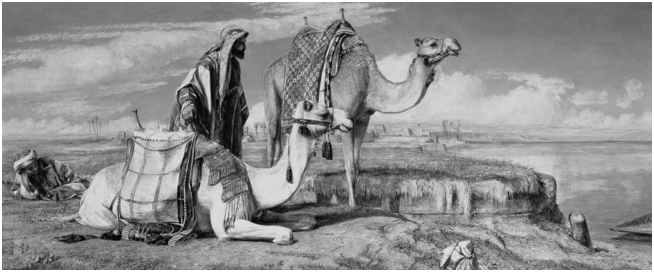
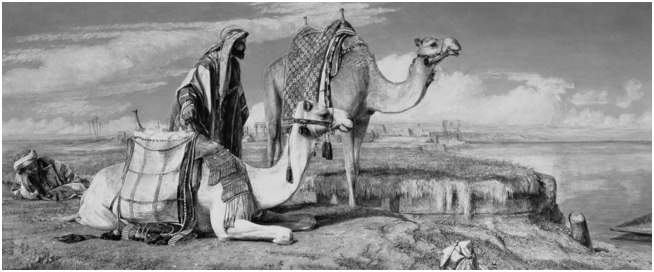
The novel begins: ‘With a single drop of ink for a mirror, the Egyptian sorcerer undertakes to reveal to any chance comer far-reaching visions of the past. This is what I undertake to do for you, reader’.24 As many critics have noted, Eliot is referring here to Edward William Lane’s Manners and Customs of the Modern Egyptians, which ‘contains an extended account of a magician conjuring from a drop of ink’.25 This opening might have the effect, as Molly Youngkin argues, of asking the reader to see beyond the material world,26 and it also prefaces chapter 17’s use of the mirror motif as ‘a frequent figure for the relation between imitation and imitated in the tradition of realism’.27 But for the novel’s original readers, the reference to Egypt might additionally have invoked thoughts of the many painters who were using Egypt as a popular subject for their work, in which images of present-day Egypt wore the picturesque aspects of the country’s past. John Frederick Lewis had recently returned to Britain after ten years of living in Cairo, and one of his paintings, ‘Waiting for the Ferry Boat – Upper Egypt’, was shown in 1859’s Royal Academy summer show (Figure 2.1). Jaded by familiarity, John Ruskin produces an acerbic response:
Well, of course, it is very nice. Housings and camels – palm trees – clouds, and Sheik. But waiting for a ferry-boat is dull work; and are we never to get out of Egypt any more? Not to perceive the existence of any living creatures but Arabs and camels? Is there nothing paintable in England, nor Spain, nor Italy? Or, in the East, if we must live in the East, is no landscape ever visible but a dead level of mud raised two feet above a slow stream.28
Lewis’s vision of Egypt, of two weary men and their camels waiting for a ferry, like Eliot’s image of the Egyptian sorcerer, conjures a picture that, modern though it may be, suggests a civilisation whose habits and clothes had changed little over the centuries. The mere mention of Egypt is enough to invoke ‘far-reaching visions of the past’, but the simultaneity of past and present in Lewis’s painting and in Eliot’s sentence offers a model for the rest of the novel. The reader’s present and the characters’ past are simultaneously recognised in the fabric of Adam Bede as Eliot reveals a story from the turn of the century which carries within its exploration of social mobility through entrepreneurship the roots of the present moment of 1859. Devoid of the resources of the sorcerer, Eliot has to choose an appropriate historical model that is both compatible with the devices of her realism and can act as a vehicle for the present to be born out of the past of Hayslope in 1799. That model is ‘custom’. Unlike A Tale of Two Cities, Adam Bede brings past, present, and future more nearly into alignment, and offers a means both of living in a contingent present and of developing an active relationship with the past, which yet did not preclude progress. It is this characteristic, I would suggest, that ensures its place as the most successful novel of 1859. Eliot teaches both Adam Bede and her readers that the past–present relationship is vital rather than lapidary, and mobile rather than simply commemorative.
John Frederick Lewis, ‘Waiting for the Ferry Boat – Upper Egypt’ (1859).
Like Dickens, Eliot employs a range of historical modes and motifs in her novel. In articulating Hetty and Arthur’s disruptiveness through their tortuous relations with concepts of history, she shows that they are unable to live contentedly in their own moment. Hetty spends much of her time in a state of willed removal from that moment, and its responsibilities. She lives instead in a world of fantasies of the future, untroubled by those memories of the past, which for many of Eliot’s characters are the enabler and guarantee of their empathy and moral responsibility. Hetty’s fantasies:
are but dim ill-defined pictures that her narrow bit of an imagination can make of the future; but of every picture she is the central figure, in fine clothes; Captain Donnithorne is very close to her, putting his arm round her, perhaps kissing her, and everybody else is admiring and envying her – especially Mary Burge, whose new print dress looks very contemptible by the side of Hetty’s resplendent toilette. Does any sweet or sad memory mingle with this dream of the future – any loving thought of her second parents – of the children she had helped to tend – of any youthful companion, any pet animal, any relic of her own childhood even? Not one. There are some plants that have hardly any roots: you may tear them from their native nook of rock or wall, and just lay them over your ornamental flower-pot, and they blossom none the worse. Hetty could have cast all her past life behind her and never cared to be reminded of it again.
Likened to a kitten in the novel, Hetty is dehumanised by her lack of loyalty, and the impoverished imagination that can only project forwards, prompted by the settling of petty scores, and utterly unhampered by thoughts of the past and of duty, which are so often coterminous in Eliot.
Arthur colludes in these fantasies, which on his part are expressed through time-based metaphors derived from the type of classical education he received, and which arguably ought to have divided him from Hetty, but which instead enable their mutual delusions. Where Hetty imagines an unrealistic future, Arthur imagines himself back into a past where he is ‘a rich sultan’, with Adam Bede as his ‘grand-vizier’ (I, p. 110), or into a set of Classical references where to Hetty, ‘quite uneducated – a simple farmer’s girl’, Arthur’s ‘white hand was dazzling as an Olympian god’ (I, pp. 184–85). Classical and Eastern references combine with Hetty’s fantasies of the future to remove the characters from their quotidian lives and enable their devastating kiss in the wood, ‘just the sort of wood most haunted by nymphs’ (I, p. 239), which propels their relationship forward:
Ah, he doesn’t know in the least what he is saying. This is not what he meant to say. His arm is stealing round the waist again; it is tightening its clasp; he is bending his face nearer and nearer to the round cheek; his lips are meeting those pouting child-lips, and for a long moment time has vanished. He may be a shepherd in Arcadia for aught he knows, he may be the first youth kissing the first maiden, he may be Eros himself, sipping the lips of Psyche – it is all one.
Untethered emotionally and temporally from the responsibilities of their present, the chaos of their relationship is unleashed.
Catastrophe and ‘the Sway of Custom’
Adam Bede takes its readers back to an earlier time and invokes a collective set of pastoral memories intended to bind readers together, as Jane Welsh Carlyle famously recognised when she wrote to the author of Adam Bede, whose identity at that time she did not know, that reading the novel ‘was as good as going into the country for one’s health’:
Like a visit to [her childhood home of] Scotland minus the fatigues of the long journey, and the grief of seeing old friends grown old, and Places that knew me knowing me no more! I could fancy in reading it, to be seeing and hearing once again a crystal-clear, musical, Scotch stream, such as I long to lie down beside and – cry at (!) for gladness and sadness; after long stifling sojourn in the South; where there [is] no water but what is stagnant or muddy!
In truth, it is a beautiful most human Book! … I found myself in charity with the whole human race when I laid it down.
That sense of satisfaction seems in many ways a troubling response to a text that, in addition to Adam and Dinah’s happy marriage, also ends with Hetty’s death and Arthur’s emasculation and effective banishment. However, by the end of the novel, though social systems and hierarchies have been reconfigured, and Adam rather than Arthur has become the leading man of his parish, the threatening aspect of those changes has been neutralised, and almost ‘all traces’ of the ‘unhappy conflict’ have been obliterated. It is surely its ability, unlike A Tale of Two Cities, actively to achieve peace and progress out of discord that is one of the key enabling factors of the novel’s success, and the means by which that is achieved can be found in its specific commitment to the form of custom.
The community of Hayslope experiences its past as a daily phenomenon, and its present as inseparable from that past. One instance of this is Arthur’s coming of age, which he believes will be a unique event celebrated with unaccustomed splendour, but which will in fact be attended by the rector’s mother, Mrs Irwine, in the brocade she wore for Arthur’s christening. The rector, Mr Irwine, suggests that in his work:
the custom of baptism [is] more important than its doctrine, and … the religious beliefs the peasant drew from the church where his fathers worshipped and the sacred piece of turf where they lay buried, were but slightly dependent on a clear understanding of the Liturgy or the sermon.
More significant than liturgy is the fact of the reiteration of a common practice, a customary form of behaviour, which enables the community to bind itself together and to know itself. Mrs Poyser’s hospitality is likewise a ‘sacred custom’ with which ‘personal likes and dislikes must not interfere’ (II, p. 60), and thus gains for itself a greater role within the functioning of the community. In speaking of Adam, Eliot writes of how the ‘sound of tools to a clever workman who loves his work, is like the tentative sounds of the orchestra to the violinist who has to bear his part in the overture: the strong fibres begin their accustomed thrill’ (II, p. 270); and Hetty, less propitiously, is trapped by her accustomed physical experiences: having left Hayslope she feels exhausted, for ‘though [she] was accustomed to much movement and exertion in-doors, she was not used to long walks’ (III, p. 10). It is, of course, that long walk that takes her beyond her customary round, and into disaster.
Linguistically too, Hayslope is bound by customary forms: the characters’ aphorisms determine and delimit the village’s aspirations, and in two instances articulate an extra crucial dimension to the ideology of custom: the idea of the customer. Bartle Massey dismisses the idea that the owner of Adam’s carpentry workshop, Jonathan Burge, should be given stewardship of the Squire’s woods by suggesting that it would be as ridiculous as if he were to leave his ‘customers to score their own drink’ (II, p. 130); and Mrs Poyser, in opting not to upbraid Hetty before Adam, justifies her behaviour in this curious, and characteristic, way:
That would not be fair play: every woman was young in her turn, and had her chances of matrimony, which it was a point of honour for other women not to spoil – just as one market-woman who has sold her own eggs must not try to balk another of a customer.
This is an intriguing, not to say disturbing, image of Hetty setting out her stall at the marriage market, and of the forces that might so easily disrupt her chances of success. And in the mention of customers, Bartle Massey and Mrs Poyser articulate how local wisdom is underpinned by the notion of custom in both its financial and time-honoured senses. The wisdom of the market intersects absolutely with that of accepted practice and of community beliefs in an economy both articulated through and underpinned by the multiple understandings of custom.
Seen against this background, Hetty and Arthur’s turning from forms of practised, lived custom to the experience of a moment of Arcadian pastoral in their mimicking the love of Eros and Psyche becomes a form of catastrophe that disrupts time-honoured class, financial, and social structures and customs. In Hetty and Arthur’s relationship, the conditioning forms of custom are absent, because custom as a form is dependent on communal assent; it is publicly and freely acknowledged, whereas their passion is so illicit that it must find its form and voice in ancient literatures, daydreams, and subterfuge. Suzanne Graver writes that the ‘traditional superstition … that works to hallow custom also renders the uncustomary suspect’.29 Arthur’s relations with Hetty not only fall outside historical time but abuses customary expectations of his feudal responsibilities, though he does instead fall into a more degraded form of droit de seigneur. Graver argues that Arthur’s ‘failure to fulfil mutual obligations’ (p. 98), and thereby to fail in his customary responsibility to his community, is what brings Arthur down, and enables Adam to flourish instead.
The end of the novel needs to find its way back to the customs of the countryside and to the restoration of the economy of productive work within the community that customs underpin. This is of course finally achieved, and presumably is what produces the sense of immense satisfaction felt by readers such as Welsh Carlyle. Despite the traumas and upheavals of the last stages of the book, the death of Hetty and Arthur’s baby, the trial scenes, Hetty’s reprieve, and finally her death when returning from transportation in Australia, Welsh Carlyle’s reaction recognises the audience’s willingness, and the novel’s ability, to absorb catastrophe and trauma within the mechanics of custom. The considerable shift in the social framework, Adam’s displacement of Arthur at the end of the text, is quietly achieved. Indeed, one measure of Adam and Dinah’s achievement is the extent to which they have accustomed themselves to this new state of things, how they have carried the observation of the dynamics of custom, its basis in a form of community, and its always retrospective quality, into their new situation. The end of Adam and Dinah’s story looks forward to, but not beyond, Eliot’s own moment, and is enabled to do so because it contains within it the ability also to look back and to recognise the importance of perpetuating custom. More crucially, we might argue that custom, perhaps somewhat perversely, has become the vehicle by which radical change has actually been effected. Eliot wrote to William Blackwood that when she had finished writing Adam Bede, she had ‘arrived at a faith in the past, but not a faith in the future’,30 and her use of the past in her novel becomes the vehicle and guarantor both of the novel’s harmonious ending and of the processes of change that that ending records.
Custom plays an important part in a notable early tribute to Adam Bede by the political establishment: the novel was mentioned in a House of Commons debate, which, as Lewes noted, ‘looks like popularity indeed’ (to Blackwood, 26 March; III, p. 39). Mrs Poyser was cited by the Liberal MP Charles Buxton on 8 March in a debate on the Charles et Georges affair. The Charles et Georges was a French ship which had been detained by the Portuguese just off the coast of Mozambique in 1857. The Portuguese had received a tip-off from the British Consul there that the Charles et Georges, a slave ship, had recently picked up a consignment of slaves from Mozambique, then a Portuguese territory. It was discovered that the slaves had been forcibly removed from their country, and, as the ship was captured in Portuguese waters, its captain was tried by the Portuguese and sentenced to three years’ imprisonment for running slaves. France objected to this, demanded their Captain be released, and asserted that the ship could not have been a slaver because there was a delegate of the French government on board. The Portuguese were willing to take the matter to an independent mediator, despite their being essentially in the right, but the French protested and the British did little to help their Portuguese allies and were perceived to have allowed the French to run roughshod over international treaties and diplomatic practices. The matter was discussed at length in both Houses of Parliament on 8 March, when the Foreign Secretary, Lord Malmesbury, came in for criticism over his lack of backbone when confronted by a belligerently defensive French government.
Mrs Poyser comes into it via Buxton’s suggestion that the Earl of Malmesbury, ‘now that the case could be seen as a whole would wish that his conduct, as the farmer’s wife said, in Adam Bede, could be “hatched over again, and hatched different”’.31 The reference is to Mrs Poyser’s judgement of Mr Craig, the gardener at Donnithorne Hall:
Mr. Craig smiled and winked slowly as he made his last observation, but the subject was not developed farther, for now they had reached the turning in the road where Adam and his companions must say ‘good-bye’. The gardener, too, would have had to turn off in the same direction if he had not accepted Mr. Poyser’s invitation to tea. Mrs. Poyser duly seconded the invitation, for she would have held it a deep disgrace not to make her neighbours welcome to her house: personal likes and dislikes must not interfere with that sacred custom. Moreover, Mr. Craig had always been full of civilities to the family at the Hall Farm, and Mrs. Poyser was scrupulous in declaring that she had ‘nothing to say again’ him, on’y it was a pity he couldna be hatched o’er again, an’ hatched different’.
It is a gentle reproof to the noble lord, rendered in more genteel language than the original. Mr Buxton’s advice was that Malmesbury ought more confidently to have observed an 1856 Protocol, ‘according to which any difference that might arise between two European nations was to be referred to the arbitration of a third’. Buxton suggested that such a protocol might have prevented two-thirds of the European disputes that had developed into wars over the past two hundred years. He goes on:
if it were an acknowledged custom to refer the case to mediation, there would be no slur on either country’s honour in giving way to such a decision. Such a custom was sure some day to prevail among civilized nations, but the first planting it was a delicate task, and required the strong adhesion to the rule of those who had laid it down. Had they owned their allegiance to it on but two or three occasions, it would have become consolidated with the fixed customs of Europe …. it was only needed that France should obey it too to have rendered it binding in all after time.
Here, the rule of custom subsumes within it the perpetuation of peace and, more positively than Hegel, shuns the disruptions of warfare. Mrs Poyser, too, acknowledges the custom of a hospitality that deems Mr Craig must come to the Farm for his tea, despite her lack of personal warmth towards him. But what Mr Buxton adds to Eliot’s apprehension of custom is an acknowledgement of the mechanism whereby the recognition of something as ‘customary’ could effect a change in practice, and an explanation of the way in which, as Mill had recognised, customs might be actively created. Buxton explicitly states that the aegis of custom itself will act as a guarantor of peaceful change, and confirms that, as Dickens showed to less happy effect, customs do not need to be of exhaustively long-standing but can be created out of current needs. What is lacking in Dickens, and for the moment in Europe, is full communal assent to the revolutionaries’ new customs.
Custom is distinguished in Eliot as a historical category that is commonly available and universally participated in. It enables all citizens equally to access the discourse of the historical, ‘to feel themselves to be historical’, and to ‘enact History’, as Georg Lukacs and Carlyle respectively put it.32 In ‘The Natural History of German Life’, Eliot’s 1856 review of Wilhelm Riehl’s book, Die Burgerliche Gesellschaft and Land und Leute, she writes that ‘the fundamental idea of Riehl’s books’ is that of the ‘conception of European society as incarnate history’ (p. 70). In taking up this idea in her subsequent novels, she expands on Riehl’s argument that, as she puts it, ‘to the mind of the peasant, law presents itself as the “custom of the country”, and it is his pride to be versed in all customs. Custom with him holds the place of sentiment, of theory, and in many cases of affection’ (Eliot’s emphasis; p. 61). Rather, Eliot argues implicitly in Adam Bede that custom is fundamental to all human experience and recognises that the pull of custom has a potency for the mid-Victorians, which outstrips all other ways of experiencing the past. It is also, crucially for Eliot, not based in the conflict out of which Hegel drew historical significance and vitality, but in the organic vibrancy and potential of her fictional community.

 Open access