

1 Introduction
It might be thought that we know enough about the risk of nuclear war to appropriately manage that risk. The consequences of unconstrained nuclear attacks, and the counterattacks that would occur until the major nuclear powers exhaust their arsenals, would far exceed any cataclysm humanity has suffered in all of recorded history. The likelihood of such a war must, therefore, be reduced as much as possible. But this rather simplistic logic raises many questions and does not withstand close scrutiny.
Regarding consequences, does unconstrained nuclear war pose an existential risk to humanity? The consequences of existential risks are truly incalculable, including the lives not only of all human beings currently living but also of all those yet to come; involving not only Homo sapiens but all species that may descend from it. At the opposite end of the spectrum of consequences lies the domain of “limited” nuclear wars. Are these also properly considered global catastrophes? After all, while the only nuclear war that has ever occurred devastated Hiroshima and Nagasaki, it was also instrumental in bringing about the end of the Pacific War, thereby saving lives that would have been lost in the planned invasion of Japan. Indeed, some scholars similarly argue that many lives have been saved over the nearly three-fourths of a century since the advent of nuclear weapons because those weapons have prevented the large conventional wars that otherwise would likely have occurred between the major powers. This is perhaps the most significant consequence of the attacks that devastated the two Japanese cities.
Regarding likelihood, how do we know what the likelihood of nuclear war is and the degree to which our national policies affect that likelihood, for better or worse? How much confidence should we place in any assessment of likelihood? What levels of likelihood for the broad spectrum of possible consequences pose unacceptable levels of risk? Even a very low (nondecreasing) annual likelihood of the risk of nuclear war would result in near certainty of catastrophe over the course of enough years.
Most fundamentally and counterintuitively, are we really sure we want to reduce the risk of nuclear war? The successful operation of deterrence, which has been credited – perhaps too generously – with preventing nuclear war during the Cold War and its aftermath, depends on the risk that any nuclear use might escalate to a nuclear holocaust. Many proposals for reducing risk focus on reducing nuclear weapon arsenals and, therefore, the possible consequences of the most extreme nuclear war. Yet, if we reduce the consequences of nuclear war, might we also inadvertently increase its likelihood? It’s not at all clear that would be a desirable trade-off.
This is all to argue that the simplistic logic described above is inadequate, even dangerous. A more nuanced understanding of the risk of nuclear war is imperative. This paper thus attempts to establish a basis for more rigorously addressing the risk of nuclear war. Rather than trying to assess the risk, a daunting objective, its more modest goals include increasing the awareness of the complexities involved in addressing this topic and evaluating alternative measures proposed for managing nuclear risk.
I begin with a clarification of why nuclear war is a global catastrophic risk but not an existential risk. Turning to the issue of risk assessment, I then present a variety of assessments by academics and statesmen of the likelihood component of the risk of nuclear war, followed by an overview of what we do and do not know about the consequences of nuclear war, emphasizing uncertainty in both factors. Then, I discuss the difficulties in determining the effects of risk mitigation policies, focusing on nuclear arms reduction. Finally, I address the question of whether nuclear weapons have indeed saved lives. I conclude with recommendations for national security policy and multidisciplinary research.
2 Why is nuclear war a global catastrophic risk?
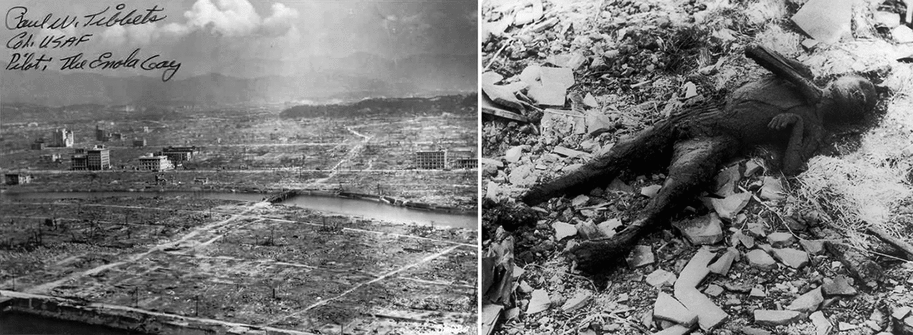
One needs to only view the pictures of Hiroshima and Nagasaki shown in figure 1 and imagine such devastation visited on thousands of cities across warring nations in both hemispheres to recognize that nuclear war is truly a global catastrophic risk. Moreover, many of today’s nuclear weapons are an order of magnitude more destructive than Little Boy and Fat Man, and there are many other significant consequences – prompt radiation, fallout, etc. – not visible in such photographs. Yet, it is also true that not all nuclear wars would be so catastrophic; some, perhaps involving electromagnetic pulse (EMP) attacksFootnote 2 using only a few high-altitude detonations or demonstration strikes of various kinds, could result in few casualties. Others, such as a war between Israel and one of its potential future nuclear neighbors, might be regionally devastating but have limited global impact, at least if we limit our consideration to direct and immediate physical consequences. Nevertheless, smaller nuclear wars need to be included in any analysis of nuclear war as a global catastrophic risk because they increase the likelihood of larger nuclear wars. This is precisely why the nuclear taboo is so precious and crossing the nuclear threshold into uncharted territory is so dangerous (Schelling, Reference Schelling2005; see also Tannenwald, Reference Tannenwald2007).
Images of devastation caused by nuclear war. Left, Hiroshima after the atomic bomb attack of August 6, 1945. Right, an atomic bomb victim in Nagasaki, attacked August 9, 1945. Source: Public domain images via Wikimedia Commons, https://commons.wikimedia.org/wiki/File:Hiroshima_aftermath.jpg and https://commons.wikimedia.org/wiki/File:Nagasaki_-_person_burned.jpg. Note that the image of Hiroshima was signed by Col. Paul Tibbets, pilot of the Enola Gay, the aircraft used to bomb Hiroshima.
While it is clear that nuclear war is a global catastrophic risk, it is also clear that it is not an existential risk. Yet over the course of the nuclear age, a series of mechanisms have been proposed that, it has been erroneously argued, could lead to human extinction. The first concernFootnote 3 arose among physicists on the Manhattan Project during a 1942 seminar at Berkeley some three years before the first test of an atomic weapon. Chaired by Robert Oppenheimer, it was attended by Edward Teller, Hans Bethe, Emil Konopinski, and other theoretical physicists (Rhodes, Reference Rhodes1995). They considered the possibility that detonation of an atomic bomb could ignite a self-sustaining nitrogen fusion reaction that might propagate through earth’s atmosphere, thereby extinguishing all air-breathing life on earth. Konopinski, Cloyd Margin, and Teller eventually published the calculations that led to the conclusion that the nitrogen-nitrogen reaction was virtually impossible from atomic bomb explosions – calculations that had previously been used to justify going forward with Trinity, the first atomic bomb test (Konopinski et al., Reference Konopinski, Margin and Teller1946). Of course, the Trinity test was conducted, as well as over 1000 subsequent atomic and thermonuclear tests, and we are fortunately still here.
After the bomb was used, extinction fear focused on invisible and deadly fallout, unanticipated as a significant consequence of the bombings of Japan that would spread by global air currents to poison the entire planet. Public dread was reinforced by the depressing, but influential, 1957 novel On the Beach by Nevil Shute (Reference Shute1957) and the subsequent 1959 movie version (Kramer, 1959). The story describes survivors in Melbourne, Australia, one of a few remaining human outposts in the Southern Hemisphere, as fallout clouds approached to bring the final blow to humanity.
In the 1970s, after fallout was better understood to be limited in space, time, and magnitude, depletion of the ozone layer, which would cause increased ultraviolet radiation to fry all humans who dared to venture outside, became the extinction mechanism of concern. Again, one popular book, The Fate of the Earth by Jonathan Schell (Reference Schell1982), which described the nuclear destruction of the ozone layer leaving the earth “a republic of insects and grass,” promoted this fear. Schell did at times try to cover all bases, however: “To say that human extinction is a certainty would, of course, be a misrepresentation – just as it would be a misrepresentation to say that extinction can be ruled out” (Schell, Reference Schell1982).
Finally, the current mechanism of concern for extinction is nuclear winter, the phenomenon by which dust and soot created primarily by the burning of cities would rise to the stratosphere and attenuate sunlight such that surface temperatures would decline dramatically, agriculture would fail, and humans and other animals would perish from famine. The public first learned of the possibility of nuclear winter in a Parade article by Sagan (Reference Sagan1983), published a month or so before its scientific counterpart by Turco et al. (Reference Turco, Toon, Ackerman, Pollack and Sagan1983). While some nuclear disarmament advocates promote the idea that nuclear winter is an extinction threat, and the general public is probably confused to the extent it is not disinterested, few scientists seem to consider it an extinction threat.
It is understandable that some of these extinction fears were created by ignorance or uncertainty and treated seriously by worst-case thinking, as seems appropriate for threats of extinction. But nuclear doom mongering also seems to be at play for some of these episodes. For some reason, portions of the public active in nuclear issues, as well as some scientists, appear to think that arguments for nuclear arms reductions or elimination will be more persuasive if nuclear war is believed to threaten extinction, rather than merely the horrific cataclysm that it would be in reality (Martin, Reference Martin1982).Footnote 4
To summarize, nuclear war is a global catastrophic risk. Such wars may cause billions of deaths and unfathomable suffering, as well set civilization back centuries. Smaller nuclear wars pose regional catastrophic risks and also national risks in that the continued functioning of, for example, the United States as a constitutional republic is highly dubious after even a relatively limited nuclear attack. But what nuclear war is not is an existential risk to the human race. There is simply no credible scenario in which humans do not survive to repopulate the earth.
3 Risk assessment
With this foundation, I now turn to assessments of the risk of nuclear war, first addressing likelihood and then consequences.
3.1 Likelihood
Consider the current state of analysis for assessing the likelihood of nuclear war. In 2005, the office of Senator Richard Lugar published The Lugar Survey on Proliferation Threats and Responses (hereinafter, the Lugar survey), which addresses the risk of nuclear use (Lugar, Reference Lugar2005). Among the questions asked in the survey was, “What is the probability (expressed as a percentage) of an attack involving a nuclear explosion occurring somewhere in the world in the next ten years?” The distribution of replies from 79 respondents is shown in figure 2.
The Lugar survey, question 5.
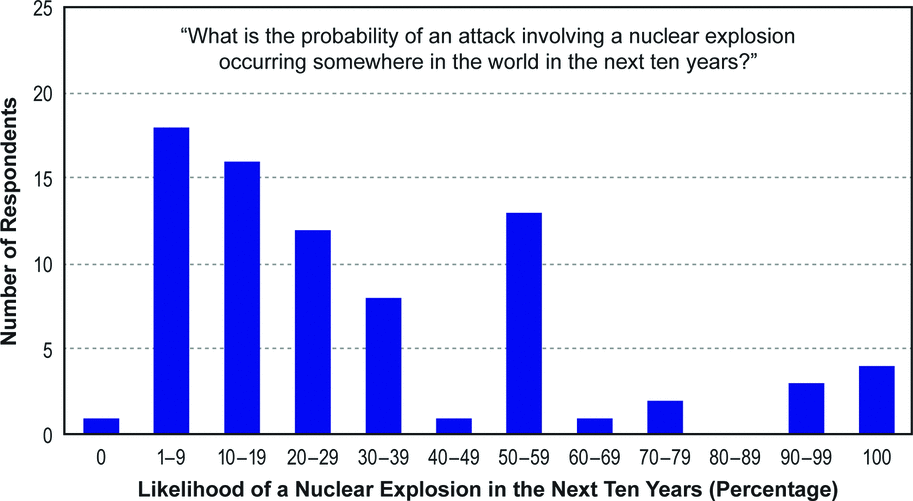
What is most striking about figure 2 is the divergence of opinion. Responses span the full spectrum from 0 to 100%, with the mode occurring at 1–9%, but with only 18 respondents selecting that bin. From a classical statistics perspective, the true probability lies in only one unknown bin. The fact that most experts’ answers missed that value, whichever bin it lies in, means that most experts must necessarily be wrong. There are a number of possible explanations for this. One reason for the wide variation could be the lack of control of biases in the elicitation of the answers. Without bias control, experts can interpret and think differently about how to answer the question, resulting in wide variability. Even if biases are controlled, wide dispersion can still occur because of high uncertainty in the current state of knowledge. In any event, the most significant conclusion to be drawn from figure 2 is that there is no consensus on the answer to the question.
In other respects as well, the Lugar survey did not follow best practices in elicitation and analysis (Meyer & Booker, Reference Meyer and Booker2001; see also Ayyub, Reference Ayyub2001). While each survey respondent was presumably an expert in some aspect of nuclear policy, arguably no single person is truly an expert on all the factors that must be considered when answering broadly phrased questions such as that depicted in figure 2.Footnote 5 Additionally, the survey provides no information about the experts’ assumptions, reasoning, and uncertainties. Such information could, for example, be useful in understanding the apparently anomalous peak at 50–59% and the extremes of 0 and 100%. The cumulative impact of these and other deficiencies is that the survey falls short of what could be achieved by using best practices in expert elicitation.
Another exercise in characterizing the likelihood of nuclear war has been ongoing since 1947, when the Doomsday Clock first appeared on the cover of the Bulletin of Atomic Scientists (2019a). The setting of the clock is intended to represent how close the world is to nuclear war, metaphorically midnight. The clock was originally set at seven minutes to midnight and has been reset periodically every several (1 to 7) years. As shown in figure 3, the time of greatest danger – two minutes to midnight – was set in 1953 after US and Soviet hydrogen bomb tests, while the time of least danger, seventeen minutes to midnight, was set in 1991 after the START Treaty was signed and unilateral initiatives on both sides removed many nuclear weapons from “hair-trigger” alert (Bulletin of the Atomic Scientists, 2019b).
The Doomsday Clock, 1947–2004. The clock indicates then-current perspectives of the Bulletin of the Atomic Scientists on the dangers of nuclear war. Since 2007, dangers associated with climate change and developments in the life sciences have been added. Source: Public domain image via Wikimedia Commons, https://commons.wikimedia.org/wiki/File:Doomsday_Clock_graph.svg.
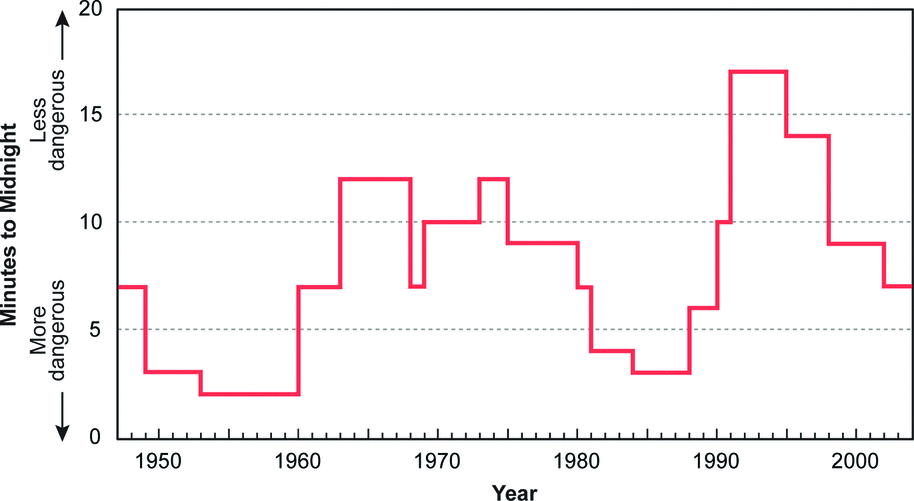
There are multiple problems with taking the clock seriously as an assessment of the likelihood of nuclear war. In setting the clock, there could be motives beyond accurately characterizing the nuclear threat, such as to promote certain policies, especially with respect to arms control treaties, or simply to draw attention to the Bulletin of the Atomic Scientists. The process by which the clock is set is obscure, although brief summaries of the reasons for changing the clock’s setting have been provided (Bulletin of the Atomic Scientists, 2019b). No attempt has been made to define the clock’s scale, which is almost certainly nonlinear. Does ten minutes to midnight indicate half the probability of five minutes to midnight? And finally, the clock is unable to reflect the risks associated with short-duration, high-risk episodes, such as the Cuban missile crisis of 1962 and the coup attempt against Gorbachev in August 1991 (Pry, Reference Pry1999). Ironically, the former occurred during a period of declining risk, according to figure 3, and the latter occurred during the period of least risk.
Notwithstanding these points, the Doomsday Clock does seem to have captured the broad trends in the nuclear threat as it derives from the international political climate. Gaining a better understanding of the processes by which the clock has been set could prove useful in developing more scientific approaches. Unfortunately, the clock’s future utility as an indicator of the risk of nuclear war has been diminished since 2007 by the inclusion of climate change and harmful developments in the life sciences as additional harbingers of doomsday.
Several individuals have also estimated the likelihood of interstate nuclear war or nuclear terrorism. Selected estimates are summarized in Table 1. Most are subjective judgments, such as Kennedy (Sorensen, Reference Sorensen1965), Bundy (Reference Bundy1988), Allison (Reference Allison2004), Perry (Kristof, Reference Kristof2004), Albright (Hegland & Webb, Reference Hegland and Webb2005), and Garwin (Garwin, Reference Garwin2007) without a formal underlying analysis, while others are based on a quantitative analysis, such as Hellman (Reference Hellman2008), Bunn (Reference Bunn2007), and Mueller (Reference Mueller2008).
Individual estimates of the probability of nuclear war.
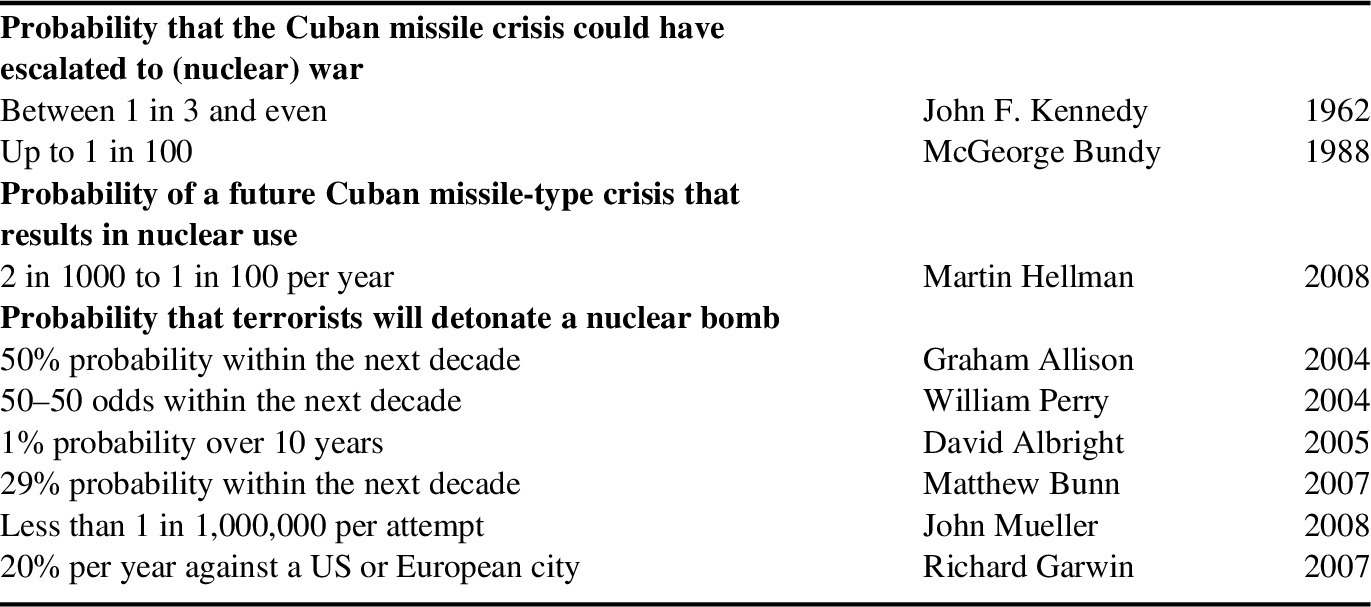
Arguably, the most compelling assessments are those of crisis managers who experienced a nuclear close-call firsthand: President Kennedy and his national security advisor, McGeorge Bundy. Not long after the Cuban missile crisis, Kennedy told Ted Sorenson, special counsel to the president, that during the crisis he believed that the chances that the Soviets would go to war were between one in three and even, while Bundy, reflecting 26 years after the crisis, came to the dramatically lower estimate of up to 1 in 100. Of course, the crisis occurred over a half-century ago, and even with the additional information now available, it is hard to estimate its risks retrospectively. For example, depending on one’s interpretation of the probabilities associated with the incident in which a nuclear-armed Soviet submarine was forced to surface, and the risks one should attach to other “close-call” incidents during the Cuban crisis (Sagan, Reference Sagan1993), one could argue for either Kennedy’s estimate or Bundy’s. Moreover, neither Kennedy nor Bundy knew at the time they made their estimates that the Soviet submarine had come close to launching a nuclear torpedo, but they could have imagined this and other scenarios as part of their risk estimates, so it is unclear whether either of them would have raised or lowered their estimates if they had known at the time of their estimates everything we know now.
Of course, beyond the question of what the actual risk was at the time of the Cuban crisis is the problem of the relevance of that information to the assessment of future risks. More recently, Martin Hellman assessed the risk of a future “Cuban-missile-type” crisis that results in nuclear use as between 2 in 1000 and 1 in 1000 per year. Note that this is only one of two estimates in Table 1 that provide a range of values, a useful approach to addressing uncertainty. Hellman also points to a dearth of analyses of the risk of deterrence failure and proposes that “several prestigious scientific and engineering bodies undertake serious studies to estimate its failure rate.”
Not surprisingly, a number of estimates in the first decade of this century have focused on the probability of nuclear use by terrorist organizations. Of the subjective estimations, Richard Garwin’s estimate of 20% per year against a US or European city is the highest. Assuming that this probability remains constant over the period, it equates to a probability of approximately 90% within a decade. In the middle of the range of subjective estimates are Graham Allison and William Perry, who independently judge this probability to be 50% within a decade. At the low end is David Albright, who estimates it to be less than 1% over 10 years. These subjective assessments span almost the complete range of possibility from near 0 to 90%.
Two nuclear terrorism estimates in Table 1 are based on quantitative analysis. Matthew Bunn estimates 29% within the next decade, and John Mueller estimates less than 1 in 1 million per attempt. This large difference in estimates is not an encouraging indicator that quantitative analysis will facilitate convergence on a consensus estimate, but at least it provides valuable information regarding the basis for each estimate.
In summary, the principal insights I take from the estimates in Table 1 are the same as for the Lugar survey: (1) they differ widely, and (2) they are all of questionable validity because they do differ widely and because they are fundamentally either intuitive or based on simple, perhaps simplistic, analysis. Also, subjective judgments appear to gravitate to either 1 or 50% as an estimate, which suggests that the resolution of human intuition is relatively coarse on this question.
3.2 Consequences
Nuclear risk assessment must consider the entire spectrum of potential consequences of all levels of nuclear war, ranging from a single detonation in a remote area to a large-scale nuclear exchange. These consequences must include all types of harm, including fatalities and injuries to humans, damages to infrastructures and the environment, and harm to militaries, economies, and other social structures. Assessments must consider not only the short-term harms but also harms that extend through time to future generations, likely centuries into the future.
We should also acknowledge, if only for the sake of completeness, that something positive might come out of some nuclear usages. In particular, limited nuclear use might reinforce the nuclear taboo, which is seen as increasingly fragile (Tannenwald, Reference Tannenwald2018). Of course, as Hahn and Scouras (forthcoming) observe, “The greatest challenge to this norm will occur when nuclear weapons are used. There is a presumption that once violated, the norm against use of nuclear weapons cannot endure. But, this presumption is not based on a body of research; it is possible that the response to first use could act to reaffirm the relevance of the norm, so that a single violation would not necessarily irreversibly undermine its existence. In fact, norm theory suggests that the response to the norm violation is pivotal in determining the ultimate impact of the initial violation.” An extension of this thinking holds that norms, in general, cannot endure indefinitely without periodic violations that provide tangible reminders of their value. In any event, this area is highly speculative, and no one seriously advocates limited nuclear use as a mechanism to reinforce the nuclear taboo.
Our knowledge base on nuclear effects is extensive in some areas but meager in others.Footnote 6 It is not an exaggeration to say that, as a whole, it is woefully inadequate to support a comprehensive consequence assessment. There are several reasons for this state of affairs. First, while the United States has conducted over 1000 nuclear tests and spent billions of dollars on nuclear effects research, the great majority of this effort focused on fulfilling Cold War military requirements. In support of nuclear mission planning, the United States sought high-confidence estimates of the effects of nuclear weapons of various designs with different outputs on targets of varying characteristics primarily in the Soviet Union. Post-attack planning for damage assessment and the possible need for subsequent attacks also demanded confidence in determining target damage. These imperatives led to a focus on the nuclear damage mechanisms of air blast, cratering, ground shock, and similar phenomena. As a result, our knowledge base is relatively good on these nuclear effects.
Second, somewhat less attention was paid to those phenomena that were inherently hard to predict or whose effects were delayed. In the former category is fire initiated by the thermal radiation of nuclear explosions. The US Defense Nuclear Agency, now the Defense Threat Reduction Agency, tried hard to model this phenomenon, but only very recently has this effort showed signs of potential payoff. In the latter category is fallout. While fallout modeling was a research focus, and we now have good models of fallout production and propagation, the vagaries of weather, the uncertainties related to population evacuation and shielding, and other variables are impediments to confident prediction of the effects of fallout.
Third, some phenomena were discovered late, and by surprise, in the nuclear test program. For example, an unexpectedly large EMP was observed in the Starfish Prime atmospheric nuclear test in 1962. Further high-altitude testing was prohibited by the 1963 Treaty Banning Nuclear Weapons Tests in the Atmosphere, in Outer Space, and Under Water, which relegated future research to the domain of modeling. Starfish Prime also resulted in the unanticipated gradual destruction of all commercial satellites in low-earth orbit due to pumping the Van Allen radiation belts with electrons.
Fourth, the physical consequences to the infrastructures that sustain societies – power, water, finance, transportation, etc. – has never been a focus of nuclear weapons effects research. However, the Department of Homeland Security has funded the National Infrastructure Simulation and Analysis Center (https://www.sandia.gov/nisac-ssl/), an effort by Sandia National Laboratories, Los Alamos National Laboratory, and Pacific Northwest National Laboratory to model the interdependencies among these infrastructures, albeit with limited success. Nonphysical societal effects (e.g., social, psychological, political, and economic effects) are even more difficult to assess and have never been adequately investigated.
Arguably, the two phenomena most in need of further research are nuclear winter and EMP. Nuclear winter has the potential to pose even greater harm to life on earth than all the more immediate damages due to blast and prompt radiation. A small research community continues to model nuclear winter in various nuclear war scenarios with ever-more sophisticated models. But controversy over the many uncertainties associated with the inputs to these models and the underlying physics, as well as possible antinuclear biases of some of the researchers, have impeded acceptance of nuclear winter predictions. As a result, the Department of Defense simply does not consider nuclear winter in its policy formulation or military planning. In fact, it argues that by making nuclear war even more horrific, nuclear winter is a positive contribution to deterrence. Similarly, the consequences of EMP may be catastrophic, but we simply do not know whether a nuclear attack will bring down the electric grid or otherwise cause great damage to the electronic systems that power our economy, military, and society (Frankel, Scouras, & DeSimone, Reference Frankel, Scouras and DeSimone2015).
As a result of this limited state of knowledge of the consequences of nuclear war, a comprehensive consequences assessment is simply not possible. The best we can do is estimate lower bounds on consequences and recognize that the true consequences of nuclear war may be significantly higher.
4 Risk management
Notwithstanding our limited understanding of both the likelihood and consequences of nuclear war, there is no shortage of ideas about what to do about nuclear risk. The three pillars of US policy are (1) nonproliferation to reduce the threat from ever-increasing numbers of nuclear states, (2) counterterrorism to prevent nonstate organizations from acquiring nuclear materials and weapons, and (3) deterrence to prevent attack from hostile nuclear states. I will briefly address the first two of these, and then discuss in greater depth the role of the nuclear balance and arsenal size in underwriting deterrence strategy. My main point is that there are large uncertainties and a lack of consensus regarding the benefits of alternative policies proposed to manage nuclear risk. I do not address a multitude of other ideas, such as reducing dependency on launch on warning, increasing missile defenses, moving toward a nuclear-free world, and formulating policies that reflect the complex relationships among strategic nuclear weapons, tactical nuclear weapons, and conventional, cyber, and space capabilities. These approaches are also fraught with uncertainties and lack consensus.
4.1 Nonproliferation
It might seem obvious that the fewer the number of nuclear states, the safer we are, and indeed that appears to be the consensus view in the national security community. The main argument is that with fewer nuclear states, there are fewer pathways to nuclear war. This may be true, but it is not the whole story. The United States benefits from both the British and French nuclear arsenals in deterring Russia from nuclear and large conventional attacks in Europe. This is not primarily because of our allies’ arsenals themselves, but because they provide independent decision authorities that Russia must consider when contemplating an attack.
It is not entirely clear why the development and possession of nuclear weapons by Japan or South Korea, for example, would not similarly contribute to international security, especially because further proliferation in northeast Asia is unlikely to be provoked. More generally, Kenneth Waltz has argued that the more states that have nuclear weapons, the safer the world will be from nuclear war (Sagan & Waltz, Reference Sagan and Waltz2012). His argument is consistent with the historical experience that demonstrates that nuclear weapon states have shown great forbearance in engaging in direct combat with each other.
In any event, proliferation is also dangerous because new nuclear states pose special risks that established nuclear states do not. One such risk arises from the fact that they have little or no experience with nuclear diplomacy and crisis management, which could lead to reckless posturing or behavior. We may have witnessed this dynamic in the 2018 war of words between US President Donald Trump and North Korean Supreme Leader Kim Jong Un.
Another source of proliferation risk arises from the reactions – especially threats of preventive war – of established nuclear states to nascent nuclear states. Preventive war was considered – and rejected – by the United States to counter a prospective nuclear Soviet Union and by the Soviet Union to counter a nascent nuclear China. More recently, to counter the prospective threat from “rogue” states, President George W. Bush emphasized the need for preemptive attack options in our deterrence strategy.
4.2 Counterterrorism
After the attacks of September 11, 2001, fear that a terrorist organization would succeed in stealing, building, or buying a nuclear weapon or weapons dominated nuclear concerns. The thought was that such organizations were immune to the logic of deterrence, because they did not present targets of value in the way that states do. Hence, counterterrorism strategy focused on preventing substate actors from acquiring both weapons and nuclear materials. These efforts have been largely successful – so far – although more can and should be done. Terrorist organizations are unlikely to have given up their nuclear ambitions. More recently, we have begun to understand that deterrence still has a role to play against terrorism. But the focus of deterrent threats must be the countries that harbor terrorist organizations, either willfully or through neglect or incompetence.
4.3 Deterrence
Deterrence of a nuclear first strike depends on the fear of a retaliatory strike, which, in turn, depends on the nuclear capabilities of the victim of the first strike. Here I summarize two studies that illustrate the complexity of assessing the relationship between nuclear capabilities and deterrence. These studies address (1) the importance, or irrelevance, of nuclear parity, and (2) how many weapons are enough to underwrite deterrence.
4.3.1 Nuclear parity
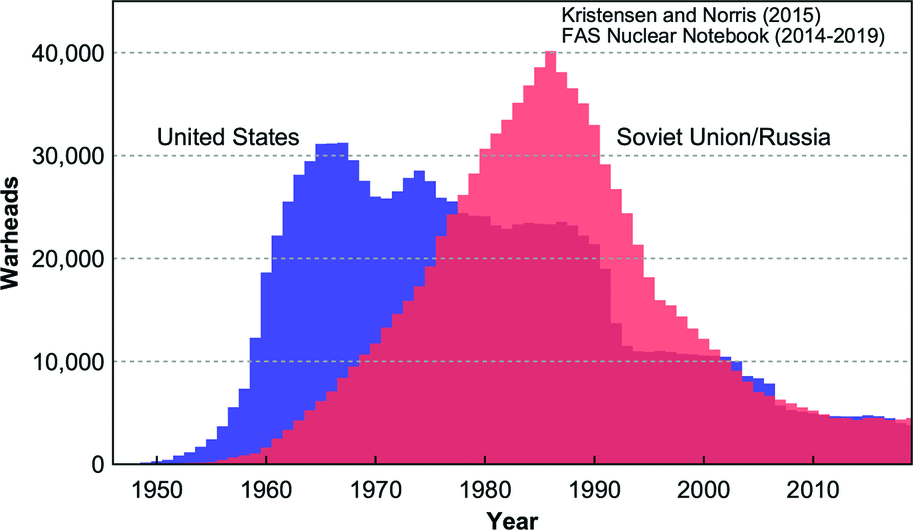
The imperative to achieve nuclear superiority – or, at a minimum, nuclear parity – drove the Cold War arms race to dizzying heights, as illustrated in figure 4 (data through 2010 are from Norris & Kristensen, Reference Norris and Kristensen2010, and data after 2010 are from Kristensen & Korda, Reference Kristensen and Korda2010–2019). Yet, the United States has also voluntarily tolerated a significant imbalance in nuclear weapons during the last decade of the Cold War and the first post-Cold War decade, and China has embraced a minimum deterrence posture. As we look ahead, we must consider the potential for both further negotiated arms reductions and the opposite – abandonment of strategic arms control – as well as continuing growth in the Chinese arsenal and vertical and horizontal nuclear proliferation in other states. Facing this highly entropic future, how should nearly three-quarters of a century of nuclear experience inform US policy with respect to the nuclear balance with Russia and other adversarial nuclear states?
US and Soviet/Russian nuclear arsenals over time.
Because all targeted states would suffer enormously in a nuclear war regardless of the nuclear balance, nuclear crisis management is the default mechanism through which the nuclear balance affects states’ behaviors, and nuclear crisis outcome is the primary measure of the value of nuclear superiority. Scholars and strategists debate the importance of relative nuclear capabilities as well as myriad other factors, including political stakes, resolve, risk tolerance, the conventional military balance, and domestic politics. Multiple factors are often at play in any particular crisis, and there are important relationships among them. The key policy-relevant question for the United States is, Are nuclear-superior states more likely to prevail in nuclear crises?
Perspectives on this question underlie national security policies regarding, inter alia, arms control, triad recapitalization, nonstrategic weapon deployments, nuclear proliferation, nuclear crisis management, and cross-domain and extended deterrence. Over the next decade, these perspectives will be reflected in decisions on implementing the 2018 Nuclear Posture Review, strategic arms control after the New START Treaty, the future (if any) of the INF Treaty or a possible successor treaty, and the fate of the Comprehensive Test Ban Treaty. They will also impact US crisis management strategy vis-à-vis North Korea and nonproliferation policy vis-à-vis Iran.
Recent research has incorporated quantitative analysis into traditionally qualitative investigation. However, there are concerns about the appropriateness of these studies’ statistical methods. One important result of a recent analysis is displayed in figure 5 (Rooker & Scouras, Reference Rooker and Scouras2019). Based on historical data on nuclear crises compiled by Matthew Kroenig (Reference Kroenig2013), the probabilities of winning a nuclear crisis are plotted for both the side with the superior and the side with the inferior nuclear arsenal. Both probabilities are highly uncertain, reflections of the small data set and the importance of variables other than the nuclear balance. Notwithstanding these uncertainties, the probability of winning is significantly lower with an inferior arsenal. These results suggest that (1) even the side with the superior arsenal should not confidently expect to win a nuclear crisis, and (2) if a nuclear state anticipates nuclear crises in its future and wishes to win, it should strive to avoid nuclear inferiority.
Uncertainty in the probability of winning a nuclear crisis.

To summarize, the importance of the nuclear balance vis-à-vis our principal adversary has been the subject of intense but unresolved debate since the Soviet Union acquired nuclear weapons some seven decades ago. Though nuclear superiority has not always swayed crisis resolution, it has mattered in at least some crises. Thus, we cannot ignore the possibility that it will matter in some future crises – perhaps even the next crisis. Given profound uncertainties about the implications of asymmetries in nuclear arsenals, it would seem the most prudent approach is to hedge against the possibility of dire consequences of nuclear inferiority. Nevertheless, the contrary view that the United States would be safe even after unilateral deep cuts in nuclear arsenals cannot be dismissed out of hand.
4.3.2 How much is enough?
Even after we answer the parity question, we still have the related question about how many nuclear weapons we need. Figure 6 shows US nuclear warheads under the New START Treaty (see chapter 2 of Cimbala & Scouras, Reference Cimbala and Scouras2002, for a more detailed discussion of this graphical representation). Five states of these forces are arrayed along the x-axis. The total number of warheads is equivalent to arsenal size. It includes both deployed and nondeployed warheads. Available warheads, which exclude nondeployed warheads, are those that realistically could be used in a nuclear war. But not all available warheads are on alert, ready to be launched within minutes of a presidential order, or are based in a survivable posture to be launched at any time. On day-to-day alert, fewer than half of the available warheads could be launched rapidly or are survivable. Then, we must consider whether the United States launches intercontinental ballistic missiles on tactical warning (LOW) or rides out an attack (ROA). Riding out the attack will further decrease the warhead count. Finally, we must factor in the system reliabilities and probabilities of penetrating Russian defenses. At the end, we are left with the number of warheads that we – and Russia – can reasonably anticipate would detonate in a US retaliatory strike on Russian targets. It is this quantity – arriving warheads – not arsenal size or any of the other intermediate quantities that underwrites deterrence.
Measures of effectiveness for nuclear weapons.
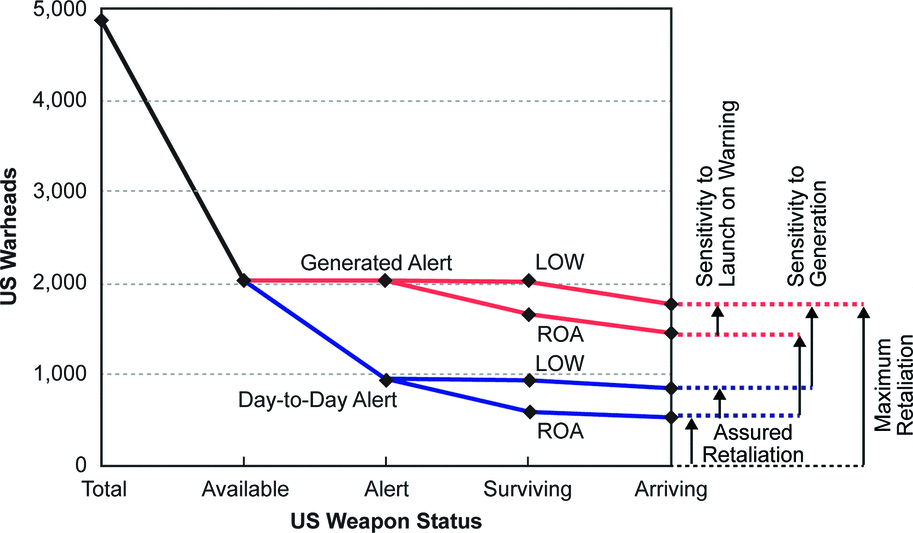
In Figure 6, we see four scenarios with different numbers of arriving weapons. The lowest level is defined as assured retaliation. I argue that our focus should be on this number as the single best measure of our nuclear forces’ contribution to deterrence. Although it might not be the most likely of the four scenarios, it is still probable enough, relative to the others, that we must plan for it. Furthermore, while we may be able to control whether or not we ride out an attack or launch on warning, there is great uncertainty in what we will actually do. Thus, we should not count on launching on warning. And finally, whether we are on generated alert as opposed to day-to-day alert is actually a decision that our attacker will make, because the timing of any attack would be up to them.
So, what level of assured retaliation do we need? In fact, this has been subject to debate throughout the nuclear age. During most of the Cold War, we focused on being able to achieve high damage levels to military, economic, and leadership targets in the Soviet Union. And as our arsenals grew, so did our target lists. The prevailing view was that deterrence required us to be able to utterly destroy the Soviet Union as a functioning entity in a retaliatory strike under the worst plausible circumstance. As a point of reference, to Secretary of Defense Robert S. McNamara, this meant being able to destroy one-third of the Soviet population and one-half of its industry (McNamara, Reference McNamara1967).
Today, other views are gaining traction. At this point, there appear to be two main intellectual camps among deterrence analysts, one cautioning against going to lower levels and the other advocating at least some additional nuclear arms reductions. There are important distinctions within the group that advocates for further reductions. Some call for modest bilateral reductions under a negotiated treaty, although that seems improbable at least for the next several years. Others call for a US minimum deterrence posture, independent of the size of the Russian arsenal. Proponents of minimum deterrence argue that far fewer weapons (arsenals numbering in the hundreds) are sufficient to deter Russia. They point to China, and to a lesser extent the UK and France, all of which have adopted variants of minimum deterrence postures.
4.4 Residual risk and risk acceptance
It is clear that we cannot reduce nuclear risk to zero unless we eliminate all nuclear weapons from the earth, and perhaps not even then. And while President Obama was a strong advocate for “global zero” as a long-term objective, no other nuclear state seems to have seriously embraced this vision.
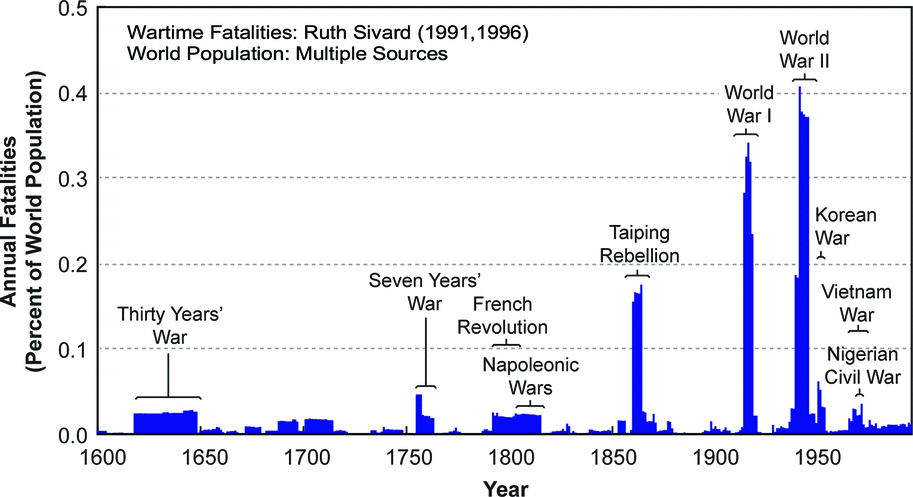
But there is also a possible serious downside to reducing nuclear risk to zero. Citing the absence of great-power wars since 1945, some proponents of nuclear weapons have emphasized their importance in saving lives by reducing the frequency and intensity of conventional wars between great powers. To support their viewpoint, they often point to a singular analysis of wartime fatalities from the year 1600 to the present. While the original graph of the results of this analysis was circulated in the defense community in the mid-1990s, it has evolved over the decades, with the most recent variant (shown in figure 7) appearing in the 2018 Nuclear Posture Review report. It indicates that wartime fatalities have been lower in the nuclear era than during any previous time since 1600, implicitly crediting the advent of nuclear weapons for these saved lives.
Wartime fatalities as a percentage of world population, as appears in the 2018 Nuclear Posture Review report.

Ice et al. (forthcoming) analyzed this graph and found that it is fatally flawed. In particular, it is irreproducible from information provided by the Department of Defense Historical Office, the cited source of data; it uses dubious analytical methods (among them, concatenation of incompatible databases and erroneous normalization by world population); and it presents results in a profoundly misleading manner, primarily due to varying histogram bin widths.
A more rigorous analysis results in the graph in figure 8 (Ice et al., forthcoming). All the cited flaws of the preceding histogram have been rectified. In particular, wartime fatalities are shown on an annual basis, which enables more insight into the aperiodic nature of wartime fatalities and entails less bias. This graph indicates that the incidence of annual wartime fatalities after World War II (as a percentage of world population) is comparable to that of many earlier times. Also, periods of diminished fatalities typically follow major wars; for this reason alone, we cannot conclude with certainty that nuclear weapons are the source of the current relatively quiescent period. Finally, we observe a clear trend in the intensity of major wars. Projecting this trend to the future reminds us what we already know – that nuclear war will be unprecedented in its human toll, potentially exceeding the fatalities of all previous wars combined. There is simply no basis in this analysis to conclude that nuclear weapons will continue to deter either nuclear or large-scale conventional war.
Recalculated annual wartime fatalities as a percentage of world population.
Finally, it is important to understand that statistical analysis – done correctly – can at most show a correlation between the advent of nuclear weapons and a change in wartime fatalities. Proving a causal relationship would require a complex multidisciplinary analysis. Understanding the potential for nuclear weapons to prevent great powers from waging conventional war is a worthy pursuit that deserves a thorough and rigorous analysis. Basing vital national security decisions on irreproducible, misleading, and logically flawed reasoning is a dangerous practice.
5 Final thoughts and recommendations
Nuclear war is a global catastrophic risk that will be with us for the foreseeable future. Unlike most other global catastrophic risks, there is an interplay between consequences and likelihood that forces us to question just how much we should try to reduce either component of risk.
Our understanding of the risk of nuclear war is highly uncertain, both for likelihood and consequences. But steps can be taken to improve this situation. Regarding likelihood assessments, the first important step is to develop a more refined sense of humility about whatever intuition is informing our judgments. We can and should also undertake more disciplined analytic studies. These should be multidisciplinary because no single analytic approach has proven to be satisfactory. We can learn something from historical case studies, expert elicitation, probabilistic risk assessment, complex systems theory, and other disciplines. Regarding consequence assessments, the Defense Threat Reduction Agency needs explicit direction to focus on less understood nuclear effects, particularly EMP and nuclear winter. Even absent further nuclear testing, there are no fundamental barriers to obtaining a better understanding of these important phenomena.
It is also apparent that the optimal strategy for reducing nuclear risk is also uncertain. This suggests a cautionary and balanced approach. Extremes, such as global zero or replacing nuclear deterrence with widely deployed missile defenses, are untested gambles and either politically or technologically prohibitive. Some combination of measured and slowly implemented reductions, while maintaining parity with our largest adversary, seems prudent.
Because the stakes are so high, nuclear deterrence (like liberty) requires eternal vigilance. The good news is that we can afford whatever we decide we need to underwrite nuclear deterrence. As remarked by Secretary of Defense James N. Mattis (Reference Mattis2018), “America can afford survival.” But spending money is the easy part. The challenge is to decide wisely what we need to spend it on.


 Open access



