


1. Introduction
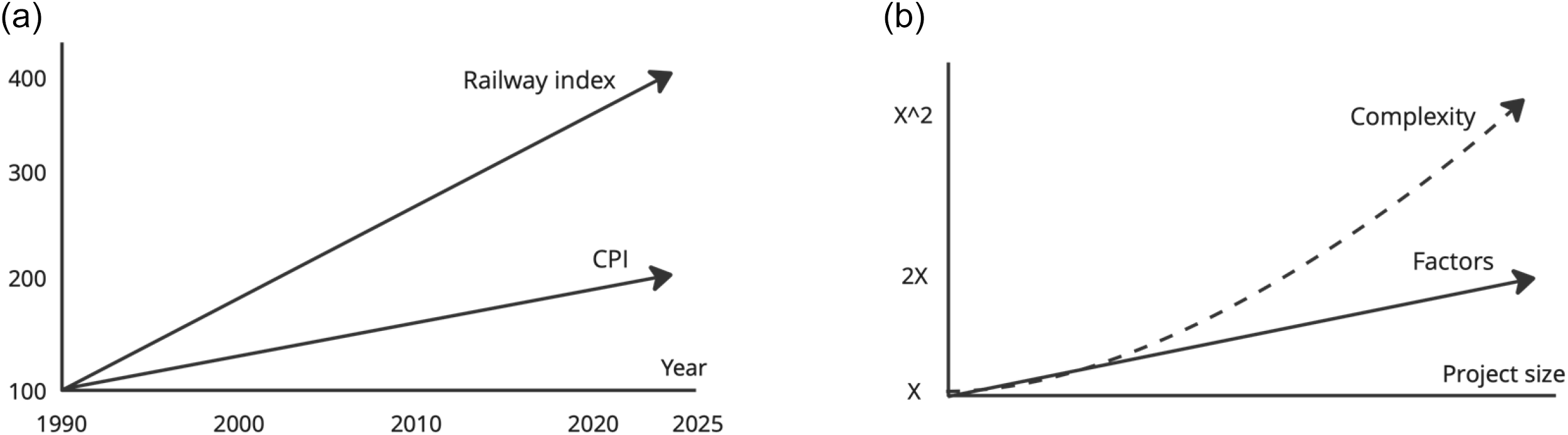
Large infrastructure projects, including roads, airports, railways, tunnels, and bridges, tend to experience significant cost overruns and delays (Reference Abdelalim, Salem, Salem, Al-Adwani and TantawyAbdelalim et al., 2025; Reference Flyvbjerg, Skamris holm and BuhlFlyvbjerg et al., 2003). In Sweden, the cost growth of railways over the past 35 years is nearly twice that of society as a whole (see Figure 1a), and railways are estimated to cost seven times more than they did 50 years ago (Reference BergströmBergström, 2025).
Despite decades of research, cost escalation remains a persistent challenge. Common explanations include planning and scheduling issues, inaccurate estimates, and design inefficiencies (Reference Abdelalim, Salem, Salem, Al-Adwani and TantawyAbdelalim et al., 2025). While some causes of cost overruns, such as optimism bias and strategic underestimation of costs and risks during early design stages, are well documented (Reference Flyvbjerg, Skamris holm and BuhlFlyvbjerg et al., 2003). Less is known about how institutional and organizational project complexity contributes to cost development. Understanding how such complexity arises and interacts in the early stages of design is, therefore, essential for achieving more predictable and sustainable project outcomes. Thus, this paper explores cost escalations through the lens of project complexity, examining how technical, organizational, and environmental factors influence project outcomes.
(a) Schematic illustration of the cost for railway investments compared to the Consumer Price Index (CPI) over 35 years (Statistics Sweden, 2025; Swedish Transport Administration, 2025); (b) Schematic illustration of how project complexity increases disproportionally with the number of interacting factors

Project complexity is growing as the number of factors to coordinate and manage continues to increase, as shown in Figure 1b. These factors can, for example, include technical interdependencies, stakeholder diversity, regulatory constraints, and managerial interfaces, all of which interact in nonlinear ways (Reference Bosch-Rekveldt, Jongkind, Mooi, Bakker and VerbraeckBosch-Rekveldt et al., 2011).
Railway projects have long planning horizons, strict legal frameworks, and involve multiple stakeholders. In Sweden, the early design phase is governed by the Railway Construction Act (1995:1649) and the Environmental Code (1998:808). These laws, along with political changes during the project and various internal and external requirements, create a complex institutional environment that influences costs and coordination throughout the project’s lifespan.
This study aims to explore how complexity emerges in the early stages of large railway projects and to identify the mechanisms through which it contributes to cost and coordination challenges. The paper represents an initial step in a broader research program on how Systems Engineering (SE) can be applied to better manage such complexity in railway projects. To guide this research, two research questions are stated.
RQ 1: How do project complexity factors emerge and evolve in the early design stages of large railway projects?
This question explores how different factors shape complexity during the early design phases of a railway project. Emerge and evolve refers to the gradual development of complexity throughout the project. The Early design stages refer to the phases in which the project scope, alignment, and requirements are defined. Large railway projects are those with budgets of hundreds of millions of euros, spanning decades and involving numerous stakeholders and subsystems.
RQ 2: How do early-stage institutional and organizational complexity factors shape project outcomes such as cost escalation and design inefficiency?
Institutional complexity factors refer to conflicting political, regulatory, and managerial norms, and organizational complexity factors refer to internal structure and coordination challenges within the project. Cost escalation refers to the difference between actual and estimated costs within the project, and Design inefficiency refers to suboptimal design processes, such as misalignment across disciplines or conflicting requirements.
2. Theoretical framework: project complexity and frameworks for project complexity factors
A complex system consists of many interacting elements that behave nonlinearly, meaning that minor changes can lead to disproportionate consequences (Reference Snowden and BooneSnowden & Boone, 2007). In projects, the interacting elements that exhibit nonlinear behaviour can include stakeholders, tasks, disciplines, teams, or resources whose behaviour is difficult to define or predict (Reference Lafhaj, Rebai, AlBalkhy, Hamdi, Mossman and Alves Da CostaLafhaj et al., 2024). This can also be explained as interdependence: the parts of the system are mutually dependent, making it difficult to predict the system’s behaviour by studying each element individually. Furthermore, constraints in a complex system are typically imposed by constantly changing external conditions, and solutions arise from circumstances rather than being imposed; this process is often described as emergence (Reference Snowden and BooneSnowden & Boone, 2007). For infrastructure projects, constraints can include the physical environment, stakeholders, and laws and regulations. These factors, together with other parameters, make it difficult to predict the behaviour, which could constitute project complexity. To conclude, project complexity is the number of interdependent and interacting parts within a project system (Reference BaccariniBaccarini, 1996).
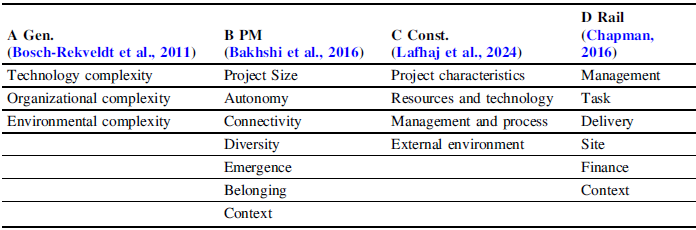
To explore the project complexity factors, project complexity frameworks are explored. Several frameworks for assessing complexity have been identified, but no established, common one has emerged (Reference Bhangale and GuptaBhangale & Gupta, 2025; Reference Bosch-Rekveldt, Jongkind, Mooi, Bakker and VerbraeckBosch-Rekveldt et al., 2011; Reference Lafhaj, Rebai, AlBalkhy, Hamdi, Mossman and Alves Da CostaLafhaj et al., 2024). To find a relevant project complexity framework, a snowballing method (Reference WohlinWohlin, 2014) was applied, starting with 17 different frameworks identified by Reference Bhangale and GuptaBhangale and Gupta (2025). The goal was to identify project complexity frameworks with different focuses: one general framework for all kinds of projects, one framework with a project management focus, one with a construction project focus, and one with a railway project focus. The number of citations and the year published were the criteria for inclusion. 27 frameworks were examined, and four were selected (Table 1).
Complexity frameworks that are included in this study

*Retrieved from Google Scholar 24 September 2025.
The TOE (technological, organizational, environmental) framework for complexity, developed by Reference Bosch-Rekveldt, Jongkind, Mooi, Bakker and VerbraeckBosch-Rekveldt et al. (2011), is commonly used for various types of projects. The framework categorizes complexity into technological, organizational, and environmental dimensions and explicitly links these to project performance. It provides a broad yet well-structured lens for analyzing the causes of complexity in large projects. Reference Bakhshi, Ireland and GorodBakhshi et al. (2016) approach complexity from a project management perspective, emphasizing managerial perception and alignment rather than structural attributes of the project itself. Reference Lafhaj, Rebai, AlBalkhy, Hamdi, Mossman and Alves Da CostaLafhaj et al. (2024) adapt the concept of project complexity to the construction industry, combining organizational and technical dimensions with contextual factors such as site conditions and regulatory environments. Their framework bridges abstract project theory and practical realities of large infrastructure projects. Reference ChapmanChapman (2016) has developed a framework specifically for railway projects. The framework has six main categories, as listed in Table 2, and also describes four meta-categories: project governance, project initiation, assurance processes, and evolving project management maturity.
Project complexity frameworks and the main categories

All the frameworks differ in which categories and complexity factors are included. However, both Reference ChapmanChapman (2016) and Reference Lafhaj, Rebai, AlBalkhy, Hamdi, Mossman and Alves Da CostaLafhaj et al. (2024) share factors similar to those in the TOE framework (Reference Bosch-Rekveldt, Jongkind, Mooi, Bakker and VerbraeckBosch-Rekveldt et al., 2011). Reference Bakhshi, Ireland and GorodBakhshi et al. (2016) shares some similarities but differs more from the others, focusing mainly on managerial perceptions and coordination rather than structural factors.
Environmental complexity, or “context,” is a main category encompassing factors that affect the project from the outside and is commonly included in all frameworks. Reference ChapmanChapman (2016) also defines site and finance as main categories, which are mainly external factors. The factors differ somewhat; for example, the number of stakeholders is described both in the environmental complexity (Reference Bosch-Rekveldt, Jongkind, Mooi, Bakker and VerbraeckBosch-Rekveldt et al., 2011), the project characteristics (Reference Lafhaj, Rebai, AlBalkhy, Hamdi, Mossman and Alves Da CostaLafhaj et al., 2024), and in the project’s size (Reference Bakhshi, Ireland and GorodBakhshi et al., 2016), while political changes or influence are commonly described as a complexity factor in the external environment. The organizational complexity (Reference Bosch-Rekveldt, Jongkind, Mooi, Bakker and VerbraeckBosch-Rekveldt et al., 2011) has similarities to both Reference Lafhaj, Rebai, AlBalkhy, Hamdi, Mossman and Alves Da CostaLafhaj et al. (2024) categories, Resources and technology, and management and process, as well as Reference ChapmanChapman (2016) category Management. Project management is often described as a source of complexity in frameworks. Reference Bakhshi, Ireland and GorodBakhshi et al. (2016) has, however, no category that explicitly mentions project management. The scope, objectives, and goals of the project are common across all frameworks categorized as technology complexity (Reference Bosch-Rekveldt, Jongkind, Mooi, Bakker and VerbraeckBosch-Rekveldt et al., 2011) and project characteristics (Reference Lafhaj, Rebai, AlBalkhy, Hamdi, Mossman and Alves Da CostaLafhaj et al., 2024). Reference ChapmanChapman (2016) mainly describes scope as an early-phase issue in the project initiation meta-category. Reference Bakhshi, Ireland and GorodBakhshi et al. (2016) identifies Interconnectivity in task and Goal alignment in the connectivity category. This is, on the other hand, explained as Dependencies between tasks and goal alignment in the technology complexity category by Reference Bosch-Rekveldt, Jongkind, Mooi, Bakker and VerbraeckBosch-Rekveldt et al. (2011). To summarize, all the frameworks share significant similarities, but the project management framework developed by Reference Bakhshi, Ireland and GorodBakhshi et al. (2016) differs most from the others. All frameworks describe complexity primarily through structural and managerial lenses. However, none explicitly address institutional incentives, requirement governance, or decision-making processes that dominate the early design stages of large railway projects. This gap provides a theoretical motivation for this study.
3. Methodology
To address the research questions, an interview study was conducted to identify factors of complexity (see Figure 2). The study follows an abductive approach, combining inductive identification of complexity factors from empirical data with a deductive interpretation based on existing complexity frameworks (Reference Dubois and GaddeDubois & Gadde, 2002). The complexity frameworks were then used to categorize and interpret the identified factors, and a follow-up contact with the interview participants was conducted to determine which factors contribute most to cost increases.
The main steps conducted in the study

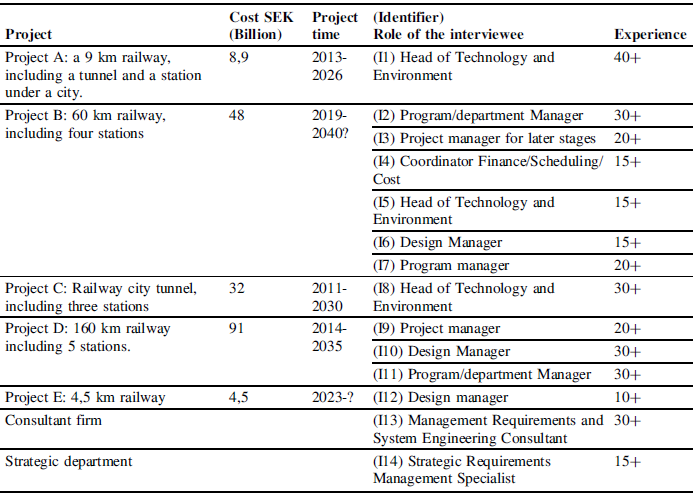
A total of 14 interviews were conducted with project members of large infrastructure projects in Sweden to identify which complexity factors are relevant in large railway projects (Table 3). The semi-structured interviews took place between March and October 2025. The interviews center on three main questions:
-
• “What challenges do you experience as most prominent in large, complex (rail) projects?”,
-
• “What aspects of large railway projects do you consider to be the most complex?” and
-
• “It has been identified that new railway costs twice as much to build today compared to 25 years ago. What do you think are the reasons for that?”
The semi-structured interviews lasted about 1 hour each, were recorded, and transcribed using the Chalmers AI Portal (powered by Microsoft). After the initial interviews, the identified complexity factors were compiled into a consolidated list.
The participants in the interview study and the project they are involved in (Trafikverket, 2021–2025). Costs are expressed in 2021 price levels, except for Project C and Project E, where costs are presented in 2009 and 2019 price levels, respectively

The interview transcripts were analysed manually using an open and inductive approach. Common themes related to project complexity were identified across all interviews and grouped into preliminary categories. These categories were compared deductively against the four established project complexity frameworks to assess theoretical correspondence and identify factors not adequately captured in existing theory. Each identified factor was evaluated against the four frameworks using a 0–2 scale, where 0 indicated the factor was not represented, 1 indicated it was partly represented, and 2 indicated it was clearly represented. This scoring enabled a structured comparison between the empirical findings and existing theory.
To validate and prioritize these findings, the list was sent back to the interview participants, who were asked to select the factors they perceived as most contributing to cost increases in the early phases of railway projects. In this follow-up round, participants selected the three most cost-driving factors, scoring 1-3, with 3 being the most cost-driving. Selections were then aggregated using a simple frequency count to derive a ranked list. 12 of the 14 participants contributed to the follow-up round. This two-step process resembles a modified Delphi approach (Reference Okoli and PawlowskiOkoli & Pawlowski, 2004)., in which expert opinions are first collected qualitatively and then subjected to a structured feedback round to assess convergence and relative importance.
4. Results and analysis: complexity factors in early stages of railway projects
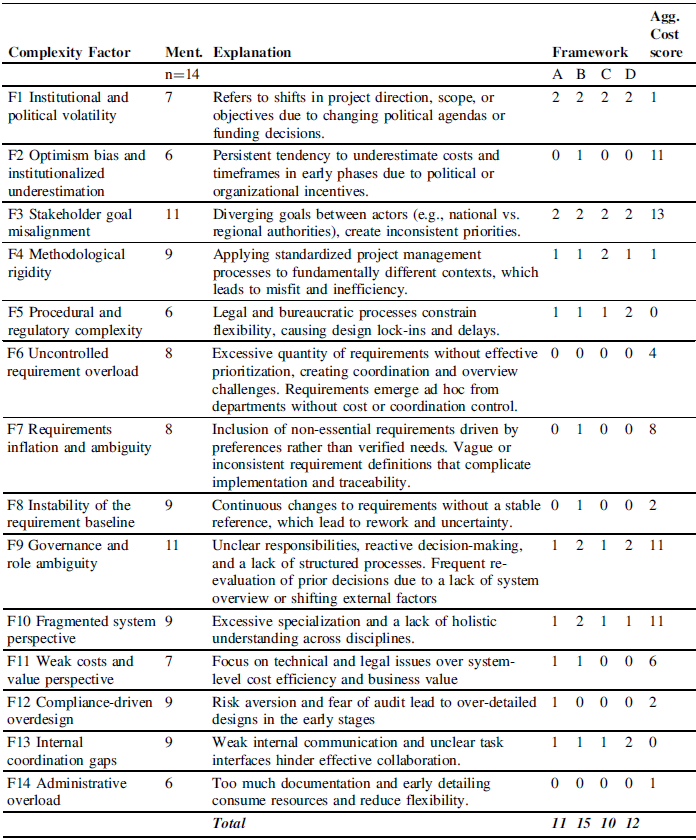
In this section, 14 identified complexity factors are defined, and the extent to which each factor affects costs is examined. The identified factors are shown in Table 4 and are further detailed in Sections 4.1-4.3. Table 4 displays the complexity factors identified in the study, the interview mention frequency, brief explanations, and the extent to which each factor is covered in four selected complexity frameworks: A. General, B. Project management, C. Construction, and D. Rail. For example, factor four, F4 Methodological rigidity, is clearly represented in framework C but only partly represented in frameworks A, B, and D (Table 4). The final column indicates each factor’s aggregated perceived impact on cost, based on participants’ rankings (higher values signify greater cost-driving effects). For example, factor two, F2 Optimism bias and institutionalized underestimation, received an aggregated cost score of 11, as three participants scored it 3 (highest) and two scored it 1 (Table 4).
Comparison between empirically identified complexity factors and their coverage in existing frameworks

Table 4 Long description
A table comparing complexity factors and their impact on costs across different frameworks. The table has 14 rows and 6 columns. The columns are labeled Complexity Factor, Ment., Explanation, Framework A, Framework B, Framework C, Framework D, and Agg. Cost score. The rows list different complexity factors with their mention frequency, explanations, and scores across four frameworks and their aggregated cost impact. Row 1: F1 Institutional and political volatility, 7, Refers to shifts in project direction, scope, or objectives due to changing political agendas or funding decisions., 2, 2, 2, 2, 1. Row 2: F2 Optimism bias and institutionalized underestimation, 6, Persistent tendency to underestimate costs and timeframes in early phases due to political or organizational incentives., 0, 1, 0, 0, 11. Row 3: F3 Stakeholder goal misalignment, 11, Diverging goals between actors (e.g., national vs. regional authorities), create inconsistent priorities., 2, 2, 2, 2, 13. Row 4: F4 Methodological rigidity, 9, Applying standardized project management processes to fundamentally different contexts, which leads to misfit and inefficiency., 1, 1, 2, 1, 11. Row 5: F5 Procedural and regulatory complexity, 6, Legal and bureaucratic processes constrain flexibility, causing design lock-ins and delays., 1, 1, 1, 2, 8. Row 6: F6 Uncontrolled requirement overload, 8, Excessive quantity of requirements without effective prioritization, creating coordination and overview challenges. Requirements emerge ad hoc from departments without cost or coordination control., 0, 0, 0, 0, 4. Row 7: F7 Requirements inflation and ambiguity, 8, Inclusion of non-essential requirements driven by preferences rather than verified needs. Vague or inconsistent requirement definitions that complicate implementation and traceability., 0, 1, 0, 0, 8. Row 8: F8 Instability of the requirement baseline, 9, Continuous changes to requirements without a stable reference, which lead to rework and uncertainty., 0, 1, 0, 0, 2. Row 9: F9 Governance and role ambiguity, 11, Unclear responsibilities, reactive decision-making, and a lack of structured processes. Frequent re-evaluation of prior decisions due to a lack of system overview or shifting external factors., 1, 2, 1, 2, 11. Row 10: F10 Fragmented system perspective, 9, Excessive specialization and a lack of holistic understanding across disciplines., 1, 2, 1, 1, 11. Row 11: F11 Weak costs and value perspective, 7, Focus on technical and legal issues over system-level cost efficiency and business value., 1, 1, 0, 0, 6. Row 12: F12 Compliance-driven overdesign, 9, Risk aversion and fear of audit lead to over-detailed designs in the early stages., 1, 0, 0, 0, 2. Row 13: F13 Internal coordination gaps, 9, Weak internal communication and unclear task interfaces hinder effective collaboration., 1, 1, 1, 2, 0. Row 14: F14 Administrative overload, 6, Too much documentation and early detailing consume resources and reduce flexibility., 0, 0, 0, 0, 1.
4.1. Scope and stakeholders
Five key factors regarding the scope and stakeholders were identified.
-
• F1 Institutional and political volatility. Seven of the 14 participants stressed that the project’s scope depends on high-level political control and policy changes. In other words, the project’s scope changes over time due to political developments.
-
• F2 Optimism bias and institutionalized underestimation. Six of the participants noted that costs and timelines are systematically underestimated in the early stages, making the “scope unachievable from the start.”
-
• F3 Stakeholder goal misalignment. Eleven participants explained that there are many highly influential stakeholders with conflicting needs for the project. For example, I7 states that the government wants a national railway, while regional and local politicians want a railway that is “regional or almost local”.
-
• F4 Methodological rigidity. Nine of the participants explain that different scopes and tasks are expected to be managed in the same way. I8 says that all internal instructions and requirements “apply everywhere and always”.
-
• F5 Procedural and regulatory complexity is mentioned by six participants. For example, three participants mentioned environmental regulations that have changed over the year. These legal and bureaucratic processes constrain flexibility, causing design lock-ins and delays.
4.2. Requirements
The number of requirements, the formulation of requirements, and the requirements management process are significant sources of complexity, as all participants explained. Participants described the number of requirements as “overwhelmingly” and that individuals or departments develop requirements without a mandate to do so. Three complexity factors regarding requirements are identified.
-
• F6 Uncontrolled requirement overload is mentioned by eight participants. Explained partly by I8, which states that “Just understanding which requirements exist is almost impossible”.
-
• F7 Requirements inflation and ambiguity are mentioned by eight of the participants. It is stated that many requirements are “nice to have” rather than “need to have,” and that the requirements are poorly designed, poorly motivated, and poorly formulated.
-
• F8 Instability of the requirement baseline is described by nine participants who explain that requirements are constantly changing, and the project must continually manage and adapt to new requirements. I1 said that 90% of the requirement specification has changed over the project’s lifetime.
4.3. Management
Complexity factors of management are commonly raised. Six complexity factors are defined.
-
• F9 Governance and role ambiguity. Eleven respondents reported a lack of discipline within project management, or “anxiety,” as I10 and I11 put it. Responsibilities are unclear, and there are no structured processes. Decision-making is reactive, and decisions are reevaluated and revised during the project due to complexity.
-
• F10 Fragmented system perspective is described by nine participants, who expressed a lack of a holistic perspective and shared a project understanding, as most project members are highly specialized and focused on their own parts rather than the overall goals. I7 says, “Is it to monitor specific requirements or to deliver the project that we should do”? This implies that project members focus not on the project’s goal but on specific requirements.
-
• F11 Weak costs and value perspective is described by seven respondents who emphasize the lack of a business and cost perspective in the early stages. I3 provides several examples of early-stage projects that lack management of the railway’s total cost, focusing too much on tasks in the initial design phase rather than on the overall cost.
-
• F12 Compliance-driven overdesign. Nine participants expressed fear of non-compliance, leading to what I6 calls “overdesign” in the early stages. This factor also stems from the “anxiety” described by I10 and I11, as individuals fear missing out during the early design.
-
• F13 Internal coordination gaps are described by nine participants, who report a lack of instructions for the early design phase. I6 explains that individuals make “micro-decisions” every day in design work, leading to lock-ins without structured coordination.
-
• F14 Administrative overload. Six participants report that there is too much documentation and too many details in the early stages, which increases costs both in the early stages and later due to lock-ins and biases. I2 explains that 20 years ago, an environmental impact statement (an environmental report) that was “a few paragraphs in another document” today is “several hundred pages”, suggesting a cultural shift toward excessive documentation. However, I12 expressed the opposite: that planning and design in the early stages decrease costs in the later stages.
5. Discussion
The results show that complexity is not static but evolves through interactions among political, organizational, and managerial factors across three levels: stakeholders and environment, the asset manager, and the project organization (Figure 3). Four main effects on how complexity evolves have been identified: scope shift, poor requirement management, poor design governance, and the absence of a project overview. These effects are identified based on the 14 complexity factors. For example, F4 Methodological rigidity mainly affects scope shift and is largely dependent on the asset manager (Figure 3). Together, these findings answer RQ1, showing that complexity in large railway projects is not static but institutionally and organizationally produced over time. This institutional complexity arises from the coexistence of multiple, partly conflicting logics, e.g., political, professional, and bureaucratic, that shape decisions and project behaviour over time.
Project complexity arises from interactions among complexity factors and their effects

5.1. Project complexity factors
Most of the identified complexity factors are covered in existing frameworks, but seven identified factors in this study are poorly covered (representation in frameworks A,B,C,D):
-
• F2 Optimism bias and institutionalized underestimation (0,1,0,0)
-
• F6 Uncontrolled requirement overload (0,0,0,0)
-
• F7 Requirements inflation and ambiguity (0,1,0,0)
-
• F8 Instability of the requirement baseline (0,1,0,0)
-
• F11 Weak costs and value perspective (1,1,0,0)
-
• F12 Compliance-driven overdesign, and (1,0,0,0)
-
• F14 Administrative overload. (0,0,0,0)
The results indicate that existing complexity frameworks overlook institutionally generated complexity. Existing frameworks tend to conceptualize complexity as structural, based on size, uncertainty, or interdependencies, rather than institutionally generated complexity. In Swedish railway projects, this complexity is reinforced by the institutional separation between the project organization and the asset manager, and by early political commitments, which limit the ability to adjust scope and estimates as knowledge evolves.
F2 and F11 are both well described in research about mega projects, e.g., (Reference FlyvbjergFlyvbjerg, 2014), but are not captured by the project complexity frameworks. It can be loosely linked to “scope uncertainty” in Reference Bosch-Rekveldt, Jongkind, Mooi, Bakker and VerbraeckBosch-Rekveldt et al. (2011) general project complexity framework or “goal alignment” in Reference Bakhshi, Ireland and GorodBakhshi et al. (2016) project management framework. This suggests a theoretical gap: the frameworks tend to treat uncertainty as a neutral property of projects, whereas in practice it is produced by institutional incentives.
Similarly, F6, F7, and F8 are internal complexity factors. It is not the individual, often technical, need or purpose with each requirement that is complex. However, it is rather the institutional noise of the number of requirements, which are constantly added and revised without a governance structure. Existing frameworks acknowledge goal alignment and stakeholder diversity, but how the requirements themselves drive project complexity is not addressed.
Finally, F12 and F14 reveal a paradox that stems from a culture of risk aversion and bureaucracy that reinforces complexity. The excessive focus on documentation, trackability, and details, intended to reduce uncertainty, is creating new layers of internal complexity. Like the other identified factors not covered by existing frameworks, these factors are more institutional than technical, organizational, or environmental.
Project complexity in the early design stages of Swedish railway projects arises from a self-reinforcing interaction among unstable external conditions, weak requirement governance, and fragmented project management. Complexity evolves gradually as decisions, requirements, and responsibilities interact without an overarching system view. This further supports the idea that complexity in the early design stages of railway projects is not only structural but also institutionally produced.
5.2. Cost-driving complexity factors
Addressing RQ2, the study finds that early-stage complexity contributes to cost escalation primarily through institutional and managerial mechanisms rather than technical uncertainty. Six factors stand out as the most cost-driving, with an aggregated cost score of 6-13 (Table 4). These include factors (Aggregated cost score):
-
• F2 Optimism bias and institutionalized underestimation (11)
-
• F3 Stakeholder goal misalignment (13)
-
• F7 Requirements inflation and ambiguity (8)
-
• F9 Governance and role ambiguity (11)
-
• F10 Fragmented system perspective and (11)
-
• F11 Weak costs and value perspective (6)
These factors create reinforcing loops: the project’s initial scope, unstable external conditions, and internal management all contribute to escalating costs.
I10 described F2 and F11, which are not covered in the frameworks but are covered in other literature (Reference FlyvbjergFlyvbjerg, 2014), saying, “They aim for a Rolls-Royce, but there is only money for a Fiat.” This captures how early-stage optimism bias and political pressure from the asset owner institutionalize unrealistic baselines. The project is thus “doomed to fail” from the outset, as the cost estimate is not anchored in actual scope or resources.
F3 on the other hand, are well represented in existing frameworks (Reference Bakhshi, Ireland and GorodBakhshi et al., 2016; Reference Bosch-Rekveldt, Jongkind, Mooi, Bakker and VerbraeckBosch-Rekveldt et al., 2011; Reference ChapmanChapman, 2016) and correspond to externally owned sources of complexity. In Swedish railway projects, the misalignment between national, regional, and local objectives continuously reshapes the scope and introduces new design requirements. This type of externally induced instability not only complicates governance but also creates cumulative costs, as each political- or stakeholder-driven adjustment cascades through design and requirements processes.
F7 emerged as one of the most cost-driving factors in the study. This factor lies primarily with the asset owner, where individual units can introduce new requirements without cost accountability. The result is requirement and scope inflation and overdesign in early stages, which lock in unnecessary functionality and can increase both design and construction costs. While existing complexity frameworks address goal clarity and stakeholder alignment, they do not capture this institutionalized “requirement inflation” as a driver of systemic cost escalation.
A cluster of cost-driving complexity factors relates to F9, F10, and F11. Together, these factors reveal a fragmented organizational culture in which specialists focus narrowly on their own domains, while no one maintains a holistic, system-level view. This fragmentation limits the project’s ability to balance technical, economic, and strategic objectives, resulting in suboptimization and costly rework when decisions are later revised. The absence of generalists and a shared understanding of project goals also weaken cost awareness in the early design stages, as technical details are managed rather than the total lifecycle value.
Together, these factors form self-reinforcing loops in which external volatility and internal fragmentation amplify costs over time. Cost escalation thus arises not from isolated mismanagement but from institutionalized behaviours and structures that reproduce complexity.
This demonstrates that managing early-stage cost escalation requires addressing institutional incentives, governance interfaces, and requirement practices, not only improving technical or planning accuracy. Methodologically, the combination of semi-structured interviews and a follow-up ranking proved effective for identifying and validating key cost-driving mechanisms.
6. Conclusions
This study shows that cost escalation in large railway projects originates from institutional and organizational complexity rather than technical uncertainty. Early optimism bias, fragmented requirement governance, and weak internal coordination interact to create self-reinforcing loops of cost growth, extending the insights by Reference FlyvbjergFlyvbjerg (2014) to the domain of early-stage mega-project complexity.
The results reveal that early-stage complexity in large railway projects emerges and evolves, in part, from fragmented governance and unstable requirement management, which are not covered in the project complexity frameworks. This highlights two priorities for controlling cost escalation and reducing design inefficiency in the early stages:
-
• Shift from a compliance-driven culture to a system-level responsibility and value-oriented decision-making culture.
-
• Strengthened requirement governance, including stable baselines, trade-offs, and transparent cost accountability.
Future research should investigate how design methods are used in the infrastructure sector today and how Systems Engineering principles, such as structured requirement architectures, systems thinking, and traceable decision logic, can be applied to better manage early-stage complexity in infrastructure projects.
Furthermore, more detailed research is necessary to reinforce and verify the identified factors, especially to better understand how institutional practices and management structures can be adapted to handle early-stage complexity in public infrastructure projects.
Acknowledgement
This research is connected to Chalmers area of advanced production. The Swedish Transport Administration funded this research.




 Open access

