

INTRODUCTION
With the accession of Romania and Bulgaria to the European Union (EU) in 2007, the proportion of agricultural land increased to over 45% of the total EU area (Henle et al. Reference Henle, Alard, Clitherow, Cobb, Firbank, Kull, McCracken, Moritz, Niemelä, Rebane, Wascher, Watt and Young2008). Contrary to the EU-15 member states, the agricultural sector in Romania is largely dominated by subsistence and semi-subsistence farming (Davidova et al. Reference Davidova, Fredriksson, Gorton, Mishev and Petrovici2012), resulting in part from a profound land restitution process after the collapse of communism in 1989 (Stringer et al. Reference Stringer, Scrieciu and Reed2009; Vidican Reference Vidican2009). At the time of Romania's accession to the EU, more than 2.5 million people were employed in agriculture, with the average working farm area being only 3.2 ha (Gorton et al. Reference Gorton, Hubbard and Hubbard2009). Subsistence and semi-subsistence farming is characterized by low-intensity management practices, such as small-scale cultivation, extensive livestock grazing, and the maintenance of traditionally managed hay meadows and grasslands. In combination, these practices are closely associated with the notion of high nature value (HNV) farming, and provide a wide range of ecosystem services (Bignal & McCracken Reference Bignal and McCracken1996; Paracchini et al. Reference Paracchini, Terres, Petersen and Hoogeveen2007). Notably, they have maintained a rich farmland biodiversity (Clark Reference Clark2006), much of which has severely declined in Western Europe as a result of agricultural intensification (Poschlod et al. Reference Poschlod, Bakker and Kahmen2005; Young et al. Reference Young, Watt, Nowicki, Alard, Clitherow, Henle, Johnson, Laczko, McCracken, Matouch, Niemela and Richards2005). Given the high nature value of much of Romania's farmland, agricultural policy and biodiversity conservation are inextricably linked.
The EU has developed several co-existing governance frameworks that in principle serve to harmonize biodiversity conservation and rural or agricultural development (Paavola et al. Reference Paavola, Gouldson and Kluvánková-Oravská2009; European Commission 2011). Biodiversity conservation is primarily based on the Birds Directive (79/409/EEC, see URL http://ec.europa.eu/environment/nature/legislation/birdsdirective/index_en.htm) and the Habitats Directive (European Community Directive on the Conservation of Natural Habitats and of Wild Fauna and Flora 92/43/EEC, see URL http://ec.europa.eu/environment/nature/legislation/habitatsdirective/index_en.htm), which together form the basis for the EU-wide ‘Natura 2000’ network of protected areas. The Habitats Directive, in particular, interacts horizontally with the Common Agricultural Policy (CAP) (see Paavola et al. Reference Paavola, Gouldson and Kluvánková-Oravská2009). The CAP accounts for approximately 42% of EU expenditure in 2007–2013 and makes up the largest constituent of EU funding, whereby direct payments to farmers (Pillar I) constitute the biggest share of CAP measures (Gorton et al. Reference Gorton, Hubbard and Hubbard2009). The introduction of the Rural Development Regulation as a ‘second pillar’ to the CAP in 2000 created a broader rural agenda aiming to support public good provision (Hubbard & Gorton Reference Hubbard and Gorton2011). Notably, some Rural Development measures have been established that specifically target the preservation of habitats and biodiversity, for instance Natura 2000 payments (Council Regulation (EC) No. 1698/2005, see URL http://europa.eu/legislation_summaries/agriculture/general_framework/l60032_en.htm). These are specified in the individual National Rural Development Programmes (NRDP) of each EU member state.
Despite substantial EU governance frameworks for both agriculture and biodiversity conservation, harmonizing rural development and conservation objectives provides serious challenges to new member states such as Romania (Beckmann & Dissing Reference Beckmann and Dissing2004). In many cases, the on-going dominance of (low-intensity) semi-subsistence farming, associated with high biodiversity, appears in direct contradiction to the desire for economic development. Navigating this challenge is further complicated by the fact that new member states are confronted with a series of profound institutional changes and an unprecedented social, environmental and economic transition (Beckmann & Dissing Reference Beckmann and Dissing2004; Pavlínek & Pickles Reference Pavlínek and Pickles2004; Bromley Reference Bromley2007). Central and Eastern European (CEE) countries were subject to institutional breakdown after 1989, followed by a post-socialist market liberalization and democratization phase, and finally the renewed restructuring, as well as decentralization, of institutions to meet the Copenhagen criteria for EU accession (Grabbe Reference Grabbe2001; Carmin & Vandeveer Reference Carmin and Vandeveer2004).
Prior to their integration into the EU, CEE countries could be considered ‘single polities’ (Schmidt Reference Schmidt2006), characterized by a majoritarian system of representation (Bache Reference Bache2010) and weak collaborative relations between state and civil society (Buzogány Reference Buzogány and Börzel2009; Börzel & Buzogány Reference Börzel and Buzogány2010). With their accession to the EU, CEE countries became part of a complex multi-level governance (MLG) system. MLG has caused a series of changes in domestic politics, leading to increasingly complex vertical relations between actors organized at various territorial levels, and growing horizontal relations between actors from public, private and voluntary spheres (Bache Reference Bache2010). Unlike in the past, a wide range of new actors now influence how policy and legislation is implemented on the ground (Fairbrass & Jordan Reference Fairbrass and Jordan2001; Grabbe Reference Grabbe2001; Newig & Fritsch Reference Newig and Fritsch2009; Börzel & Buzogány Reference Börzel and Buzogány2010). These actors include not only supranational institutions, lobby groups and non-government organizations (NGOs), but also governments at different jurisdictional levels, such as the counties and communes.
Interactions between multiple levels of governance are critically important in the successful implementation of EU policies. Jordan (Reference Jordan1999) commented that even the most well-intentioned policies at the EU level risk becoming a ‘paper exercise’ if they are not properly implemented at the local scale. Particularly for EU nature conservation policy and rural development measures, strong support by local stakeholders is required, including communities and town halls (Beckmann & Dissing Reference Beckmann and Dissing2004). Previous studies suggest that several problems stemming from new MLG arrangements have not been adequately resolved to date. Focusing on conservation policy in Romania, Buzogány (Reference Buzogány and Börzel2009) found that weak coordination within the state administration and inter-institutional conflicts hampered the designation of Natura 2000 sites. Although the implementation of the Natura 2000 network enhanced the professionalization and institutionalization of civil society groups and particularly environmental NGOs, the overall ‘weakness’ of state and non-state actors impeded the advancement of cooperative, sustainable state-society relations (Börzel & Buzogány Reference Börzel and Buzogány2010). A study by Wegener et al. (Reference Wegener, Labar, Petrick, Marquardt, Theesfeld and Buchenrieder2011) on administering the CAP in Romania and Bulgaria reached similar conclusions. In both countries, overcentralized decision-making processes and limited coordination among agricultural agencies hampered the adequate delivery of crucial services needed for the proper implementation of the CAP.
To date, there has been little focus on the role of local level governance within studies of MLG frameworks for integrated biodiversity conservation and rural development in Central and Eastern Europe. In this paper, we analyse the implementation of EU rural development policy within Romania at the local level, highlighting perceptions and expectations of local actors in relation to EU policy. We focus on Southern Transylvania (Central Romania). This area is interesting because it is characterized by particularly high farmland biodiversity, and like the rest of Romania, has undergone profound institutional changes since 1989. In addition, the area is experiencing major demographic changes, owing to the emigration of many inhabitants and the low profitability of traditional farming methods (Fischer et al. Reference Fischer, Hartel and Kuemmerle2012). We asked: (1) How is EU rural development policy being perceived by community leaders and local experts? (2) Is EU rural development policy likely to support sustainable rural development, especially with respect to the intricate link between traditional farming practices and biodiversity? (3) What should the priorities be for the improvement of EU rural development policy (with respect to both content and implementation)?
METHODS
Selection of study villages
We focused on an area within a 50-km radius around the town of Sighişoara, which encompasses more than 300 villages and four counties, namely Braşov, Harghita, Mureş and Sibiu (Fig. 1). Our primary interest was to compare locations within the Natura 2000 network with locations outside, while covering a wide range of biophysical conditions in both cases. We selected 30 villages using random stratified sampling: ten were located in areas with complex (rough) terrain, ten were located in areas with gentle slopes, and ten were located in areas with intermediate topographic complexity. Within each terrain class, we randomly selected villages whose surrounding land included Natura 2000 Sites of Community Importance (SCIs) as defined by the EU Habitats Directive, villages whose surrounding land included Special Protection Areas (SPAs) as defined by the EU Birds Directive, and villages whose surrounding land was without protection status.
Study area indicating the locations of the 30 focal villages. The inset shows the location of the study area within Romania.

Structured questionnaires
Because town halls, and especially mayors, are critically important local actors in our study area, and are officially in charge of implementing and enforcing EU legislation at the level of the commune (with each commune comprising several villages; Ministry of Agriculture and Rural Development [MADR] 2008), we conducted interviews with representatives of all 27 town halls in charge of our 30 focal villages (some administered more than one focal village) in November 2011. In 12 cases, the mayors were not personally available but nominated an appropriate representative (deputy mayor, communal or agricultural assistant). In three communes we interviewed two different town hall staff, resulting in a total of 30 interviews.
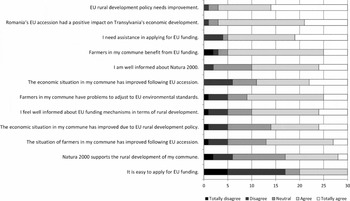
To obtain an overview of inherent development problems and opportunities or impediments in relation to EU rural development policy, we prepared a structured questionnaire with 12 statements (Fig. 2) that covered three topics: (1) the role of EU accession for Romania in general and in particular for the respective commune and local farmers; (2) the role of EU rural development funding measures for sustainable rural development, including potential challenges; and (3) the impact of the Natura 2000 status on biodiversity conservation and sustainable rural development. We posed single statements that could be answered on a five-point Likert scale.
Perception of EU rural development policy, as provided by 30 local mayors or their representatives in Southern Transylvania.
To test whether perceptions differed between villages, we arranged data in a contingency table, differentiating between villages whose land was completely within a Natura 2000 site versus other villages. We tested for the independence of association between agreement type and protection status using Fisher's exact tests in the software R. As we did not find any significant dependencies, we pooled answers across all villages. Results are therefore presented in descriptive terms, showing how many town hall representatives agreed to different extents with a given statement in the questionnaire.
Semi-structured interviews
To capture important nuances concerning how locals perceived EU rural development policy, the distribution of structured questionnaires was accompanied by semi-structured interviews. These were structured around the same three topics outlined above, and sought to elucidate further detail on the answers provided to the structured questionnaire (Appendix 1, see supplementary material at Journals.cambridge.org/ENC). Town hall representatives were free to discuss matters at depth, and were allowed to raise additional issues not covered in the questionnaire.
To obtain information on the local perception of EU policy from a different governance perspective, we also interviewed four individuals in charge of CAP funds (hereafter referred to as CAP experts) at the level of Mureş county; and three representatives of local NGOs specifically interested in biodiversity conservation and sustainable rural development (referred to as NGO representatives). Interviews with both CAP experts and NGO representatives followed the structure of the questionnaires, but questionnaires were not completed by these individuals.
In combining structured questionnaires and semi-structured interviews, we obtained a rich narrative about problems in our study area and a solid overview of local perceptions on EU rural development policy at both individual and village level. We did not record the interviews because we deemed this culturally inappropriate, but instead took notes which were transcribed. Approximately half of the interviews were conducted with the help of translators. The quotes given by us therefore correspond to the translation of our intermediaries, and do not reflect the exact wording of the respective interviewee. When analysing the interviews by means of word processing and spreadsheet software, salient topics emerged that were raised independently by different interviewees. These topics were grouped into categories or ‘themes’ (Ryan & Bernard Reference Ryan and Bernard2003).
RESULTS
Structured questionnaires
Twenty-five interviewees (83%) were older than 40 years, and 26 (87%) were male. Twenty-seven respondents (90%) agreed or totally agreed that EU accession had a positive impact on regional economic development. Agreement was substantially lower, however, when interviewees were asked about economic benefits at the commune level (Fig. 2).
Two-thirds of respondents felt well informed about EU rural development funding opportunities. However, 57% thought it was difficult to apply for funding, and 83% admitted to requiring assistance with funding applications. Regarding the relationship between EU accession and farming, 57% felt the situation of local farmers had improved since 2007. Although the vast majority of respondents (83%) saw farmers as benefiting from EU funding, most (70%) also perceived that farmers had difficulties in adjusting to EU environmental standards.
Two-thirds of respondents felt well informed about Natura 2000, but 57% disagreed with or were neutral about the statement that Natura 2000 supported the development of their commune. Twenty-seven respondents (90%) agreed or totally agreed that EU rural development policy needed improvement.
Semi-structured interviews
Interviewees were asked about the effects of EU accession: (1) with respect to effects on the commune in general, (2) specifically with respect to EU funding, and (3) with respect to any possible effects of the newly established Natura 2000 site. Salient themes in the responses related to the changing role of agriculture, CAP support for small-scale farming, access to information, social and economic problems, village-based rural development measures, and compromises between rural development and nature conservation.
The changing role of agriculture
Town hall representatives explained that agriculture played a key role in most communes. With the exception of few big farmers (fermieri), most communes were dominated by subsistence or semi-subsistence farmers (agricultori), who use little machinery or agrochemicals. Small-scale farmers typically sell low quantities of milk products, honey, meat or wool. However, agriculture was changing in many ways. For economic reasons, cows increasingly were being replaced by sheep, whose grazing behaviour contributes to vegetation degradation (NGO representative 3). ‘Informal institutions are [also] rapidly changing: Shepherds move away and no longer fulfil their traditional role’ (NGO representative 1); and ‘many [farmers] don't make cheese in a traditional way anymore’ (NGO representative 2). With an ageing rural population it appears that ‘the Romanian tradition of subsistence agriculture will disappear in favour of farmers who practice agriculture for profit’ (mayor 1, Mureş county). In fact, this transition may be actively ‘enhanced by current EU payment schemes’ (mayor 6, Braşov county).
CAP support for small-scale farming
Many small-scale farmers were not eligible for rural development funding because most measures require a minimum parcel size of 0.3 ha and a cumulative total field size of 1 ha (vice mayor 1, Sibiu county; CAP expert 3). Mayors stated that most farmers who were eligible were applying for direct payments under CAP pillar 1 and agri-environmental payments under CAP pillar 2. According to NGO representative 1 and CAP experts 1, 3 and 4, farmers of the region were further applying for support measures for semi-subsistence farming (measure 141) and for young farmers (measure 112), as specified in the Rural Development Regulation (MADR 2008).
Increasingly, small-scale farmers signed leasing contracts to formally join fields for funding applications (mayors 5 and 7, Braşov county). However, such joint applications were sometimes abused by the lead applicant who might not share the received funding equally (communal assistant 5, Mureş county). In a few communes, there were Local Action Groups created under the EU rural development programme ‘LEADER’ (Council Regulation (EC) 1698/2005); however in many communes farmers were hesitant to apply for funding applications due to mistrust or a lack of knowledge about the benefits with respect to CAP measures. According to some town hall representatives, farmers often claimed to work more land than they actually did, because official authorities were unable to validate such claims. This problem was also mentioned by the CAP experts 1 and 3.
According to the interviewed CAP experts, small-scale farmers are ‘not real farmers’ (CAP experts 2, 3 and 4) because they are ‘not economically viable’ (CAP expert 4) and ‘a barrier to regional development’ (CAP expert 1). CAP expert 1 further explained that the small size of most parcels in the study region led to massive bureaucratic effort to monitor compliance with CAP funding requirements: ‘Bureaucracy simply eats up more money than all these micro-farmers receive in the end’.
Access to information
Many interviewees felt there was an information deficit regarding EU policy and funding. Although the CAP payment agencies for agriculture (Payment and Intervention Agency for Agriculture [APIA]) or rural development (Payment Agency for Rural Development and Fisheries [APDRP]) held workshops in all communes about funding opportunities, participation was typically low (mayor 12, Sibiu county). ‘People are simply not interested in politics’ (CAP expert 4). Moreover, the ‘smart farmers’ who knew about leasing contracts and other means to access funding often received their information ‘via informal networks’, while ‘the ordinary farmer usually has no access to information about EU funding’ (communal assistant 5, Mureş county).
For farmers with low levels of education, it was virtually impossible to consult the CAP funding guide (ghidul solicitantului), which was distributed by CAP agencies to town halls (NGO representative 1). Some NGOs assisted in the distribution of funding information to mayors and farmers, and thus acted as intermediaries: ‘But sometimes the information is misleading, so we prefer to hand out information ourselves’ (CAP expert 4). Even when people knew about application procedures, they often faced difficulties in gathering all requested documentation, for example, because of unclear land ownership rights (communal assistant 5 and mayor 9, both Mureş county). Moreover, many farmers were reluctant to enrol in the officially required ‘Farm Register’ because they feared additional taxes and the involvement of the State (CAP expert 3; NGO representative 1).
Another problem was that farmers needed to make a business plan prior to their application: ‘Yet, most of them don't know how to do this’ (CAP expert 3). Mayors themselves had difficulties with EU funding policy. For example, mayor 1 (Mureş county) stated that the benefits of EU funding had not been properly communicated to the town halls. Another mayor (mayor 2, Sibiu county) explained that farmers would be at a loss about how to manage their land if EU funding ceased. According to CAP expert 4, mayors themselves were part of the problem through their lack of leadership: ‘If a mayor does not proactively promote EU funding, of course no farmer will know how to benefit from EU accession.’
Social and economic problems
According to local administrators, most villages were suffering from poverty, insufficient off-farm employment opportunities, poor education and poor development perspectives. Moreover, many villages experience social tensions and the emigration of young and skilled people. Land abandonment was reported as a common consequence, which is a major challenge to regional farmland biodiversity (NGO representative 1). Many town hall representatives complained about poor infrastructure, a lack or low quality of drinking water, and rising tensions between ethnic groups. Regarding rural development opportunities beyond farming, mayor 3 from Mureş county said: ‘How can we develop tourism if we don't even have running water?’
Village-based rural development policy
With the exception of CAP payments to individual farmers, many mayors complained about inadequate funding for rural development at the village level. Several town hall representatives explained their funding applications had been rejected. Mayor 1 (Mureş county) stated that ‘the Romanian Government isn't able to get hold of [sufficient] EU funds through the present mechanisms. I sincerely hope that this will change in the next funding period’. Several town hall representatives explained that to be eligible for renewal projects, communes needed a development strategy. Developing such a strategy typically required the use of a consulting agency, which many communes could not afford (communal assistant 1, Sibiu county; mayor 1, Mureş county).
Some mayors hoped for foreign investment and actively promoted their commune because ‘agriculture serves to nourish people but doesn't provide any income. Hence, it's not a viable long-term development strategy for our commune’ (agricultural assistant 2, Sibiu county). Several interviewees stated that they would need to make better use of the communes’ natural and cultural values. The sale of certified organic products or increasing tourism were seen as the most promising options.
Development versus conservation
Several town hall representatives considered the recently acquired Natura 2000 status a barrier to rural development. They deemed the need to implement environmental impact assessments before applying for development projects an undue administrative burden, with many proposals being rejected (mayor 6, Braşov county; mayor 10, Sibiu county). Notably, not all mayors were in agreement on this issue. Mayor 17 (Mureş county) argued that ‘people tend to see the restrictions rather than the benefits derived from having Natura 2000 status. Natura 2000 can be important if it's used properly. Our region doesn't have many development alternatives. So the designation should be better linked to its positive aspects’. NGO representative 1 stated that payments for Natura 2000 were obligatory according to EU law, but could not be distributed until management plans were in place. Several NGOs were developing such plans for Romania, which will be ready for implementation in 2014. Moreover, unlike other EU members, the Romanian government had not opted for integrating compensatory Natura 2000 payments into its Rural Development Programme (NGO representative 1).
Overall, the interviews with CAP experts suggest a tendency of the country's government to prefer economic development over farmland biodiversity. CAP expert 4 stated that ‘in unnecessarily supporting these small scale farmers Romania will never catch up with the West and lose any kind of competition’. CAP expert 1 reasoned that ‘the problem with smallholder farmers will be solved by itself: as soon as they die out, Romania can finally modernize’. NGO representative 1, by contrast, argued that small-scale farmers were ‘not the conservation problem’. The EU did not understand that Romania was so rich in biodiversity because of traditional land uses: ‘To keep this biodiversity, there is no point in supporting only large-scale farms’ (NGO representative 1). According to NGO representative 2, the biggest problem was ignorance. Owing to EU subsidies, people turned into ‘fake farmers: They build houses they don't need, get susceptible to bribery, and burn their fields to pretend working their land for EU funding. They don't care about nature preservation anymore. Socialism killed all values and ties to nature’. Consequently, the mentality of both farmers and government officials may need to change: Whereas small-scale farmers need to develop ‘a more economic way of thinking’ and ‘innovative capacity’ which they have lost ‘during socialism’, Romania's ‘political elite’ should ‘come to its senses and start working towards the whole country's benefits’ (CAP expert 4).
DISCUSSION
Accession to the EU has provided both threats and opportunities for farmland biodiversity conservation in Southern Transylvania. According to mayors and local experts, the implementation of EU rural development policy is heavily biased towards economic development, with relatively little explicit acknowledgement of the interdependencies between economic, social and environmental development. How EU rural development policy and its implementation on the local level develop in the future will, to a large extent, shape the type, scale and intensity of farming, and consequently the trajectory of the region's farmland biodiversity. Agricultural intensification appears likely at the moment because it is widely seen as desirable by government officials. The environmental consequences of intensification would undoubtedly be negative, as highlighted by experiences in much of Western Europe (Donald et al. Reference Donald, Green and Heath2001). Although a large part of our study area is located within a Natura 2000 site, the status as a ‘protected area’ is very unlikely to effectively safeguard biodiversity; there were no apparent differences between the perceptions of mayors within and outside the Natura 2000 site regarding EU policy, or regarding their preferences for economic development. Based on our analysis, priorities for the improvement of EU rural development policy should focus on the following five areas.
EU policy needs adjustment to better fit local conditions
Our findings underlined that most villages are dominated by semi-subsistence farming, which often contributes substantially to rural livelihoods (Davidova et al. Reference Davidova, Fredriksson, Gorton, Mishev and Petrovici2012). Because of poor income alternatives and weak infrastructure, villagers of Southern Transylvania should be able to expect substantial support through EU rural development funding. However, existing funding schemes are poorly suited to local conditions. The small scale of arable parcels and the necessity to develop business plans make funding essentially unattainable for many villagers (Gorton et al. Reference Gorton, Hubbard and Hubbard2009; Redman Reference Redman2010). This ‘misfit’ between EU funding measures and rural realities becomes apparent when looking at the expenditures of the Romanian Rural Development Programme (RDP) during 2007–2010 (ENRD [European Network for Rural Development] 2011): measure 141 (semi-subsistence farming support) used less than 5% of its programmed expenditure, whereas measure 121 (modernization of agricultural holdings) used 33%. These figures show that neither EU measure was fully implemented and at the same time support our findings that government officials prioritize economic development over sustainability concerns (compare Beckmann & Dissing Reference Beckmann and Dissing2004). Bache (Reference Bache2010) suggested the ‘misfit’ between EU requirements and domestic institutional structures can create pressure for domestic governance to adapt to EU policy, implying that domestic change is desirable whereas EU policy must be taken as given. In contrast, our case study indicates that, particularly in poor settings, greater flexibility is needed at the EU level to account for local conditions. Consequently, local governments and capacities need to be strengthened to better represent local needs at the national and EU levels (Young Reference Young2002; Galaz et al. Reference Galaz, Olsson, Hahn, Folke, Svedin, Young, King and Schroeder2008).
EU rural development policy needs to be more clearly communicated
Our findings suggest that available funding measures are often poorly communicated to those who could benefit from them, including both small-scale farmers and mayors. Indeed, the main obstacle to successful rural development may not be a lack of well-intended policies, but their inadequate implementation (Jordan Reference Jordan1999; van der Ploeg & Renting Reference van der Ploeg and Renting2000). Communication failure can occur at multiple levels (national, county and local), involve multiple actors (Ministry of Agriculture, its county Directorates, payment agencies or councils), and can even occur between different agencies at the same level (Dobre Reference Dobre2010; Wegener et al. Reference Wegener, Labar, Petrick, Marquardt, Theesfeld and Buchenrieder2011). Local mayors are therefore highly dependent on functioning links between many actors, especially at higher levels. Even if mayors are well informed, information flows within communes can be poor because of a historically grounded lack of trust (Beckmann & Dissing Reference Beckmann and Dissing2004; Fischer et al. Reference Fischer, Hartel and Kuemmerle2012) and unequal access to informal networks. The poor information exchange within our study area reveals a deficient multi-level governance system. Despite well-recognized information deficits, CAP experts were reluctant to involve non-state actors in the dissemination of information, which may indicate a prevailing top-down mind-set and scepticism towards public participation (Buzogány Reference Buzogány and Börzel2009; Börzel & Buzogány Reference Börzel and Buzogány2010). To improve information flows, the midterm evaluation of the National Programme for Rural Development (MADR 2011) recommended better targeting advisory and consultancy services at small-scale farmers, and improving direct communication to raise awareness about available CAP measures (see Wegener et al. Reference Wegener, Labar, Petrick, Marquardt, Theesfeld and Buchenrieder2011).
Cooperation among stakeholders needs to increase
Many EU rural development measures target only relatively large arable plots, groups of producers, or Local Action Groups within the LEADER axis of the EU Rural Development Regulation (Council Regulation (EC) No. 1698/2005). Our findings suggest that unless small-scale farmers find ways to cooperate and associate, they will emerge as losers from their integration into the EU. However, at present, many communities are characterized by mistrust, a lack of participation and scepticism towards the government (T. Hartel, unpublished interviews with villagers, 2011). Many communities suffer from tensions, including ethnic conflicts, demographic change, economic fragmentation and perceived inequalities in land restitution following the collapse of communism (Fischer et al. Reference Fischer, Hartel and Kuemmerle2012). To facilitate cooperation, a greater level of participation will be necessary, which will need to be based on rules and norms that are acceptable to all stakeholders involved (Fazey et al. Reference Fazey, Gamarra, Fischer, Reed, Stringer and Christie2010; Rustagi et al. Reference Rustagi, Engel and Kosfeld2010).
Bridging organizations need to be strengthened
‘Bridging’ organizations can play a crucial role in encouraging farmer associations and fostering a vertical information flow between funding agencies, local governments and villagers, including subsistence farmers who play a critical role in maintaining regional biodiversity. Initially introduced by Cash and Moser (Cash & Moser Reference Cash and Moser2000) as boarding organizations designed to mediate the linkages between researchers and decision makers, the term bridging organization now typically encompasses any organization that bridges local actors and communities with other organizational levels (Olsson et al. Reference Olsson, Folke, Galaz, Hahn and Schultz2007). Bridging organizations provide valuable links between actors with various interests and worldviews (Olsson et al. Reference Olsson, Folke, Galaz, Hahn and Schultz2007; Berkes Reference Berkes2009; Börzel & Buzogány Reference Börzel and Buzogány2010). Bridging organizations thus provide an arena for building social capital through fostering trust, learning, vertical and horizontal collaboration, and conflict resolution (Folke et al. Reference Folke, Hahn, Olsson and Norberg2005). Although there is no designated bridging organization in our study area, some NGOs fulfil this role in practice. For example, the ADEPT foundation organizes workshops on CAP measures for farmers (Akeroyd & Page Reference Akeroyd and Page2011) and engages in lobbying at county, national and EU levels. Similarly, the Mihai Eminescu Trust has helped to promote community cohesion by setting up communal centres and conducting vocational training in some villages. Given the potential value of bridging organizations, these should be further strengthened in the future.
Rural development goals cannot be pursued in isolation from social and ecological goals
Compared to most of the EU, Southern Transylvania is relatively poor in monetary terms, which explains the strong interest in economic development voiced by interviewed mayors and CAP experts. However, greater recognition is needed that economic development can be achieved in many ways, with intensification of farming being just one option. Within the agricultural sector, an alternative would be to focus on developing certified organic agriculture. This is known to be less harmful to biodiversity than conventional agriculture (Bengtsson et al. Reference Bengtsson, Ahnstrom and Weibull2005; Hole et al. Reference Hole, Perkins, Wilson, Alexander, Grice and Evans2005), would be much more compatible with high nature value farmland (Kuemmerle et al. Reference Kuemmerle, Mueller, Griffiths and Rusu2009) and would not cause difficulties with respect to Natura 2000 regulations. In addition, Southern Transylvania most likely still exhibits unused potential to develop rural enterprises of greater value, such as agroenvironmental tourism or specialty foods (Davidova et al. Reference Davidova, Fredriksson, Gorton, Mishev and Petrovici2012). To realize this potential, local innovation capacity needs to be fostered. This, in turn, will require a more holistic approach to rural development policy at the national and EU levels, which more explicitly recognizes the multiple functions of agriculture (Beckmann & Dissing Reference Beckmann and Dissing2004; Clark Reference Clark2006; Hubbard & Gorton Reference Hubbard and Gorton2011). Such a shift in mind-set could also positively contribute towards the re-coupling of people and nature in Southern Transylvania, which could have major benefits for biodiversity conservation (Fischer et al. Reference Fischer, Hartel and Kuemmerle2012).
CONCLUSIONS
Accession to the EU has exposed the villages of Southern Transylvania to a complex system of multi-level governance which, as our study indicates, provides both challenges and opportunities. Notably, the new governance system was superimposed onto a political culture characterized by a history of central control, state-led decision making, weak public participation and suppression of non-state actors. Regarding EU rural development policy, we found that current EU requirements are poorly aligned with many existing rural realities. Among these are land-use patterns characterized by very small agricultural plots that are not eligible for most measures, and a culture of mistrust and political disinterest that prevents the development of associations necessary to access EU funding. A comprehensive approach to rural development is needed to tackle the existing implementation deficit of EU policy, while at the same time supporting the ecological and social infrastructure of the study area. At the EU level, future policies may need to be more flexibly designed to account for the particular challenges of semi-subsistence areas such as Southern Transylvania. At the national and county levels, administrative capacities and information flows need to be improved to foster the cooperation and knowledge transfer between CAP funding agencies and local communes. Finally, within communes, community cohesion needs to improve. Active bridging organizations are likely to play a key role in assisting the harmonization of local needs and EU policy. A key concern is that biodiversity is not forgotten in the process. Existing incentives provided by rural development policy will favour agricultural intensification, despite its likely ecological costs. Under a scenario of only minor changes to the CAP and its implementation post 2013, the EU is thus well on the way to (once again) miss its goal of halting farmland biodiversity decline.
ACKNOWLEDGEMENTS
We appreciate the time and expertise of all interviewees. The research was funded through a Sofja Kovalevakaja Award by the Alexander von Humboldt Foundation to Joern Fischer financed by the German Ministry for Research and Education. Tibor Hartel was supported by an Alexander von Humboldt post-doctoral fellowship. We thank Jan Hanspach for his help with the statistical analysis, Ine Dorresteijn for help with Figure 1 and David Abson for editorial assistance. Comments by three anonymous reviewers greatly helped to improve the manuscript.



