


A. Introduction
At its core, the international norm of non-refoulement encapsulates the idea that a person should not be sent to a country where she may face persecution or a serious human rights violation.Footnote 1 It is derived from several international treaties, including evidently, the 1951 Convention Relating to the Status of Refugees (the Refugee Convention).Footnote 2 The United Nations Conventions against Torture and the Convention on Enforced Disappearances contain express non-refoulement provisions.Footnote 3 Moreover, both regional human rights courts and United Nations Treaty Bodies (UNTBs) interpret non-refoulement as an implied aspect of other rights, in particular, but not restricted to, the right to life and the prohibition of torture, cruel, inhuman and degrading treatment. Based in the main on these widespread commitments, non-refoulement is widely recognized as a principle of customary international law, and may be “ripe for recognition” as jus cogens.Footnote 4
Given this range of sources, non-refoulement has been extensively interpreted and applied across the domestic and international terrain in individual cases. International interpreters include regional courts such as the European Court of Human Rights (ECtHR), the Inter-American Court of Human Rights (IACtHR) and the Court of Justice of the European Union (CJEU), alongside the focus of this article, the optional quasi-judicial individual complaints mechanisms established under the United Nations Human Rights Treaties. We refer to these UNTBs as “soft courts,” to capture both their quasi-judicial adjudicative function and the lack of express binding force of their decisions. Around 80 % of all the individual cases before the CAT concern non-refoulement, as does one third of the combined litigation before all four UNTBs. Remarkably, the UNTBs routinely decide on individual non-refoulement cases from the Global North, and specifically half of the cases are from European states which are also parties to the ECHR.
This multiplicity of both sources and interpreters of non-refoulement opens up a new avenue of scholarly inquiry, the comparative studies of non-refoulement. In general studies of human rights law on migration, there has been some comparison of the ECtHR and CJEU on non-refoulement,Footnote 5 and work comparing the ECtHR and IACtHR.Footnote 6 Jane McAdam’s seminal contribution in 2007 examined the protections derived from the CAT, ECHR, ICCPR and CRC in the round, and identified their capacity to act as a complementary form of protection, beyond refugee protection.Footnote 7 In 2009, Kees Wouters’s masterful study of non-refoulement across the Refugee Convention, ICCPR and CAT compared and contrasted the scope of protection under those instruments.Footnote 8 More recently, Eman HamdanFootnote 9 and Fanny de WeckFootnote 10 have published studies comparing non-refoulement under Article 3 ECHR with Article 3 of CAT. Yet, none of these studies has systematically and comprehensively addressed how the jurisprudence of the four UNTBs, in particular in light of the views on non-refoulement of the Committee on the Elimination of All Forms of Discrimination against Women (CEDAW) and the Committee on the Rights of the Child (CRC), as soft courts has contributed to the development of non-refoulement in the last decades and whether they differ in their interpretations from hard courts. This Article aims to fill this gap by offering an account of the interpretation of non-refoulement in the burgeoning individual decisions of UNTBs from a comparative perspective.
This Article seeks to answer two key questions. First, we examine how the four UNTBs that have delivered individual decisions interpret the norm. Second, we compare their interpretation to that of the European Court of Human Rights.
Concerning the first issue, UNTBs’ interpretation of the norm, we consider whether the plurality of sources and institutions on non-refoulement at the level of UNTBs contributes to the progressive development or fragmentation of the norm. The scholarship on fragmentation in international law warns us that norm fragmentation is not only a matter that arises between two opposing norms,Footnote 11 but that it can also happen when more than one institution aims to protect normatively similar or identical norms.Footnote 12 Comparative international human rights law research further shows that different factors, namely, textual differences, the legal culture of the interpreting institution, and the broader political environment in which different institutions are embedded influence how divergent the interpretations of similar norms become.Footnote 13 The literature, however, also cautions against a presumption of norm fragmentation when multiple interpreters are at play. Multiple interpreters are also influenced by dynamics of systemic integration, harmonization, mutual learning, cross-fertilization, and norm borrowing across institutions over time and may lead to norm consolidation globally rather than norm fragmentation.Footnote 14 Thus the comparative analysis of multiple normative outputs from UNTBs can reveal a multiplicity of dynamics, which warrant comparative investigation over time.
Second, we examine how the interpretation and approach of UNTBs as soft courts compares to that of the European Court of Human Rights. In many respects, the ECtHR may be characterized as the vanguard institution on non-refoulement, offering the first forum to enhance the enforceability of the norm, and substantively leading the development of international law at the outset. Thirty years after Soering,Footnote 15 it appears that UNTBs are now also a popular forum to contest removals. Intuitively, one may expect soft courts to be more likely to progressively interpret norms than hard courts. Our analysis tests this assumption. Given that around half of the individual cases decided by UNTBs thus far were brought against states also subject to the jurisdiction of the ECtHR, we examine whether UNTBs as soft courts follow or “break ranks” with the interpretations of ECtHR.
Our two-level comparative study has important implications for the enforcement of non-refoulement norm domestically, as the compliance pull of norms depends in some measure on their coherence and clarity.Footnote 16 If international non-refoulement caselaw diverges, states, as compliance constituents, could argue that they will struggle to bring their actions in line with what non-refoulement requires. Moreover, variations in interpretation could more easily facilitate the evasion of accountability by offering states opportunities to bend the norm to their will and choose the more convenient interpretation, particularly in domestic environments hostile to non-refoulement. We know already that states have made several attempts to limit the absolute character of non-refoulement, both before the ECtHRFootnote 17 and national courts.Footnote 18 They have also resisted the expansion of the norm in various other ways, for instance arguing for “blind trust” across states with cooperative agreements for the transfer of asylum applicants, in particular under the Dublin System,Footnote 19 and limiting the norm in so-called “health cases” where deportation may lead to suffering and death due to absence of medical care in the receiving state.Footnote 20 Given the plurality of bodies interpreting the norm, a range of outcomes is possible. Interpretive overlap between hard and soft courts could contribute to the enhancement of the norm’s coverage and efficacy; or it may lead to such a degree of fragmentation that it ceases to effectively guide states’ conduct; or indeed, ambivalent mixed outcomes. States may “norm shop” based on what is convenient or only follow hard courts. Alternatively, a mixed outcome might be indicative of productive frictions between different UNTBs, and between courts and UNTBs, in a manner suggestive of a “constructive human rights pluralism.”Footnote 21
Further research could fruitfully compare the UNTBs and the Inter-American standards. The protections under Article I of the American Declaration of the Rights and Duties of Man, which protects everyone’s “right to life, liberty and the security of his person,”Footnote 22 arguably preclude removal to a wider range of harms than the ECHR.Footnote 23 However, the lack of legal mobilization before UNTBs from states in the Americas may suggest that the UNTBs are not perceived as offering any additional protections there, but this assumption, naturally, warrants further investigation.
In Part B, we explain our methodology for identifying relevant cases and give an overview of the UNTBs caselaw on non-refoulement between 1990–2019. A high proportion of the cases are against European states, against whom similar claims have already been brought before the ECtHR. Part C identifies the main facets of the non-refoulement norm, which render the norm vulnerable to fragmentation across multiple entry points. It then comparatively analyses the four UNTBs’ interpretations of these aspects, identifying points of divergence and convergence. Part D then examines the UNTBs’ standard of review, that is, how deferential or invasive they are when reviewing national decisions. This issue is of great practical concern given that most of the non-refoulement cases are brought by rejected asylum-seekers, whose claims have been examined in the national asylum systems of the states concerned. In Part E we explore to what extent the UNTBs can be described as trend-setters or trend-followers in the area of non-refoulement, principally by comparing their normative interpretations to those of the ECtHR. Based on the analysis, we argue that UNTBs act both as norm consolidators and agents of fragmentation in the interpretation of non-refoulement, in particular for the European compliance constituents. Yet, their soft courts status does not ipso facto make them more progressive interpreters of non-refoulement across the board compared to the ECtHR. In this respect, UNTBs as soft courts are largely complementary to the ECtHR, yet, they also offer alternative forms of accountability in some respects than the ECtHR. Part F concludes.
B. Methodology and Cases
In order to investigate the contribution of the UNTBs as soft courts to the protection of non-refoulement, we compiled a unique database of non-refoulement cases before the four aforementioned UNTBs, starting with the first case in 1990 and leading up to 2019.Footnote 24 For completeness, we have also included in our substantive discussion an important case decided by the Human Rights Committee (HRC) on October 24, 2019, but distributed in January 2020, on climate related displacement.Footnote 25 The database was compiled using the jurisprudence search engine available on the website of the Office of the High Commissioner for Human Rights (OHCHR).Footnote 26 We selected “non-refoulement” and “extradition” under the “Issues” option and then searched for cases from 1990 to 2019 for each of the four relevant UNTBs. Cases in the database cover all those when any of the Committees had issued either a) a full merits decision, or b) a finding on admissibility. We excluded all discontinuance decisions. In addition to this online search, we cross-referenced our results with a number of prominent publications, and added several cases that the online database search did not deliver,Footnote 27 as well as some recent cases that came to our attention from other sources.Footnote 28 In the end, we included 506 non-refoulement cases that were brought before these four Committees. Breaking that down by Committee, this represents 370 before the CAT, 107 before the HRC, 23 before the CEDAW Committee and 6 before the CRC.Footnote 29
While hard courts are usually in a reactive stance, dependent on the cases brought before them, UNTBs also shape norms proactively through General Comments, which act as normative guidance for deciding on individual cases.Footnote 30 The main focus of the Article is cases, but we also analyze the UNTBs’ shaping of non-refoulement through General Comments. We only consider the work of the UNTBs in general monitoring where pertinent Concluding Observations broke new legal ground, but overall our main focus is on adjudication in individual cases.
Non-refoulement is the single most salient issue that has attracted individual views from the four identified UNTBs since 1990. The first non-refoulement case at the UNTBs that we identified was Torres v. Finland,Footnote 31 an extradition case before the HRC heard in 1990, around a year after the landmark Soering case at the ECtHR. The HRC, in the 1990s, heard just nine non-refoulement cases, with significantly higher numbers in later decades. The CAT heard its first non-refoulement case, Mutombo v. Switzerland,Footnote 32 in April 1994. Three years later, on November 21, 1997, it adopted its General Comment No. 1 (recently updated as General Comment No. 3) on non-refoulement. Despite the Optional Protocol to CEDAW being in force since 2000, the CEDAW Committee considered its first non-refoulement case in May 2007 with the case of N.S.F. v. U.K.Footnote 33 The CRC’s first ever case in 2018, I.A.M. v. Denmark Footnote 34 under its relatively new individual communications procedure, related to non-refoulement, and since then it has issued a further substantive view (as well as four admissibility decisions) on this issue in D.D. v. Spain, concerning Spain’s practice of summary returns of those attempting to enter Spanish territory by land from Morocco via Spain’s enclaves of Ceuta and Melilla.Footnote 35 There is now also an extensive body of jurisprudence on age determination in the asylum context.Footnote 36
Applications from individuals who have had their asylum applications refused at the national level and are therefore seeking humanitarian protection are the most common types of cases across the four Committees. These cases represent 90 % (n = 333) of the CAT’s non-refoulement caselaw, 71 % (n = 76) of the non-refoulement cases taken before the HRC and 100 % of both the CEDAW Committee’s (n = 23) and the CRC’s (n = 6) caselaw on non-refoulement. Extradition cases represent the second biggest proportion of non-refoulement cases, comprising 14 % (n = 15) before the HRC and 6 % (n = 24) before the CAT. The remaining non-refoulement cases relate mainly to the deportation of permanent residents due to their criminal convictions or the removal of asylum seekers to other European countries under the Dublin System.Footnote 37
Complaints brought against European states (see Chart 1) make up the bulk of the non-refoulement case law before the UNTBs with Canada and Australia representing the two non-European states (see Chart 2) with a high volume of cases. The top four States with non-refoulement cases before CAT are Switzerland (n = 105), Sweden (n = 91), Canada (n = 50) and Australia (n = 37). They are closely followed by Denmark (n = 23) and the Netherlands (n = 21). The very same countries have the highest number of non-refoulement cases before the HRC with the exception of Switzerland, which has not ratified the First Optional Protocol to the ICCPR. Before the HRC, Denmark has the highest number of cases (n = 38) followed by Canada (n = 30) and Australia (n = 15). The CEDAW Committee has considered a relatively low number of non-refoulement cases but yet again the countries that are represented follow a similar pattern with Denmark being the respondent with the highest number of cases (n = 15), followed by Canada (n = 3), the Netherlands (n = 2) and the UK (n = 2). Denmark is also over-represented in the CRC’s non-refoulement jurisprudence as the respondent State Party in five out of six cases.
Countries with access to ECtHR, total non-refoulement cases before all UNTBs, 1990–2019, (n = 347).
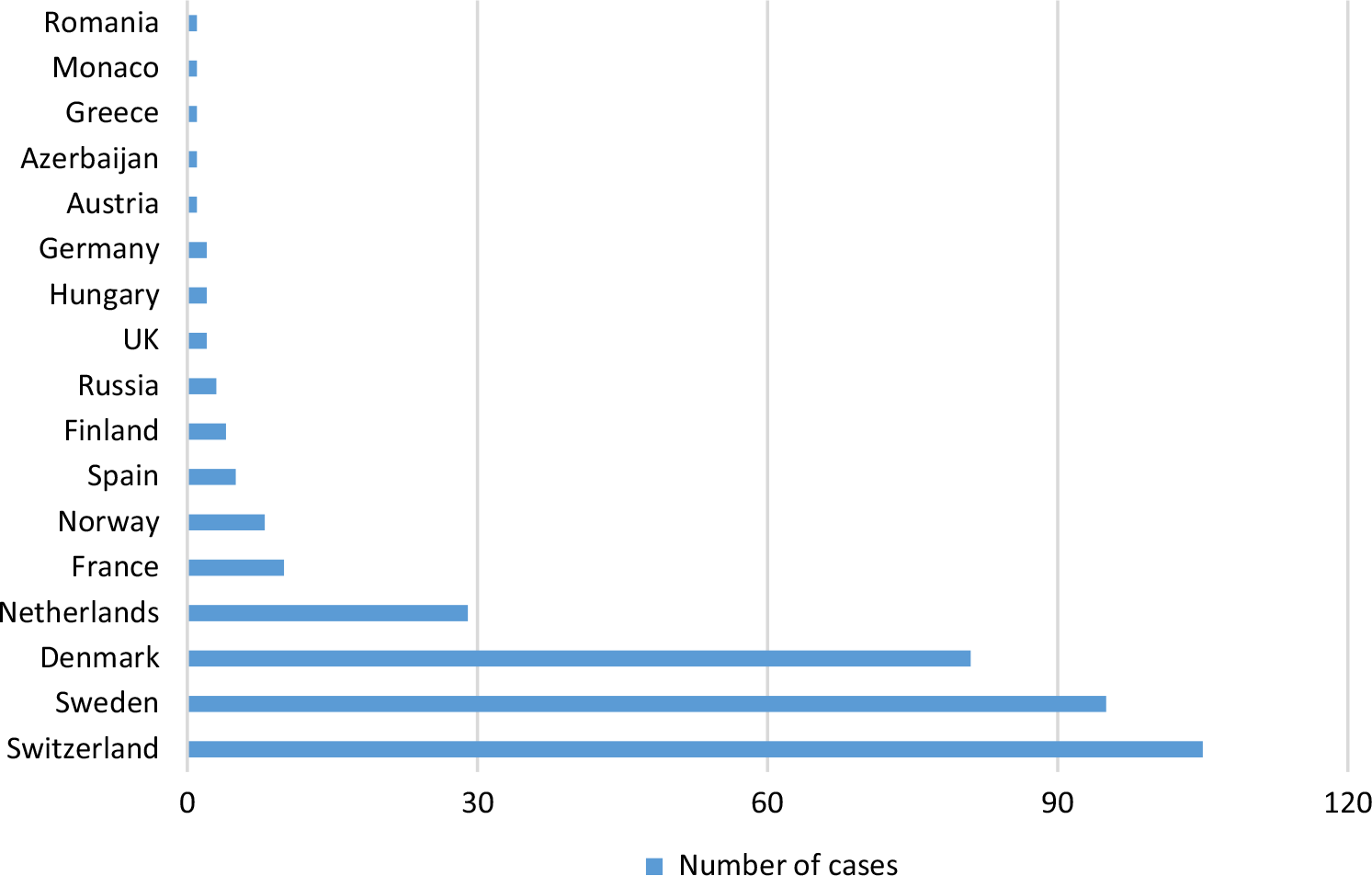
Countries without access to ECtHR, total non-refoulement cases before all UNTBs, 1990–2019 (n = 154).

Given our stated interest in exploring the relationship between enforceability and interpretative scope, it is worth considering, briefly, the issue of compliance. How well states comply with UNTBs’ views, specifically in non-refoulement cases has not yet been subject to comprehensive empirical analysis. We note that a previous analysis of the UNTB caselaw on non-refoulement against Canada highlighted some highly visible instances of non-compliance, citing examples of situations where Canada outright refused to take steps to implement the decision after the finding of a violation or delayed taking necessary action for more than 20 years.Footnote 38 Despite these concerns related to the compliance with final Views we do note, however, that the interim measures granted by UNTBs are complied with at a very high level (see Chart 3). Of all the cases where interim measures were granted by the Committees (n = 367) we recorded positive compliance when the interim measures were complied with and then subsequently lifted by the Committee before the conclusion of the case.Footnote 39
Compliance with interim measures in non-refoulement cases across all four UNTBs, 1990–2019.

In terms of the case outcomes, a fairly low proportion of complaints end with violation decisions. The HRC has found a violation in 36% (n = 39) of its non-refoulement cases followed by CAT at 24% (n = 88). The CEDAW Committee has found only two violations in the 23 cases before it, and while the CRC has also found two violations, this is from a much smaller pool of just six cases.
The general analysis of the pattern of cases before the UNTBs reveals two important features. First, there are high numbers of cases being brought against a small number of key states. Denmark, the Netherlands, Canada and Australia are prominent examples of this. This makes the investigation of the interpretation of non-refoulement across UNTBs all the more worthwhile, as the views of the Committees are capable of sending different signals to individuals in terms of their prospects of success and states in terms of their compliance with these views. Second, a significant number of individuals who bring cases before the UNTBs are also apparently capable of bringing cases, in particular, before the European Court of Human Rights, but seem to prefer the UNTBs regardless. Yet, there are no cases from the Americas or Africa from individuals who also have resort to regional human rights courts or commissions.Footnote 40
This trend may suggest that individuals and their lawyers who take cases to the UNTBs may believe that they have a better chance of success with their cases there than before the ECtHR, in terms of a positive and speedy determination of admissibility and/or a finding of a violation. A full investigation of the reasons applicants and their lawyers are turning to “soft courts” is beyond the scope of this Article. But the fact that there is now a significant body of UNTB cases on “Dublin transfers” across Europe is highly suggestive. European governments have strongly resisted the “human rights brakes” that the ECtHR has put on Dublin transfers, and often sought to limit the impact of Strasbourg rulings, including by arguing for a limited reading of the Strasbourg caselaw before the CJEU.Footnote 41 Moreover, the Strasbourg Court has been overburdened with applications for interim measures to halt such “transfers.”Footnote 42 Against this backdrop, it appears that Strasbourg has established thresholds to halt removal that are difficult to meet in practice, often requiring some exceptional vulnerability on the part of the applicant. It seems at this point at least plausible that cases go to “soft courts” when they offer protection that hard courts are rationing.
C. Non-Refoulement: Interpretation and Contestation Across Five Dimensions
This part compares how the UNTBs as soft courts interpret non-refoulement, examining the various facets of the norm that are contested. Section I explores the UNTB approaches to the geographical scope of the norm, in particular the extent to which it applies extraterritorially, a matter of great practical importance given the ubiquity of extraterritorial migration controls. Section II turns to the approaches to types of state conduct that may be regarded as engaging the norm, noting the settled issue of indirect refoulement and the incipient recognition of the notion of constructive refoulement. Section III examines how UNTBs approach the norm’s substantive scope, in the sense of which harms will trigger its protection, and by whom. Section IV, relatedly, considers whether the UNTBs allow for mitigation of risks of harm by, for example, returning individuals to countries that offer diplomatic assurances of no harm, or to a specific area in the country where they may be safe, the so-called “internal protection alternative.” Section V analyzes how the UNTBs define the standard and burden of proof for non-refoulement claims. Section VI provides a comparative analysis across the UN case law.
I. Extraterritoriality
The question of the territorial scope of non-refoulement is intimately linked with the question of the general concept of “jurisdiction” in international human rights law.Footnote 43 Most human rights treaties have a jurisdiction clause, limiting their scope of application. Notably, the ICCPR applies to actions within states’ “territory and jurisdiction,”Footnote 44 while the CAT provides in Article 2(1) that “[E]ach State Party shall take effective legislative, administrative, judicial or other measures to prevent acts of torture in any territory under its jurisdiction.” The CRC in Article 2 requires state parties to “respect and ensure the rights set forth in the present Convention to each child within their jurisdiction.” Notably, the CEDAW does not have a jurisdictional clause. The ECHR applies to acts within states’ “jurisdiction” simpliciter.Footnote 45 On the scope of non-refoulement specifically, the question of extraterritoriality is a live one, in particular given interdiction at sea and other extraterritorial border control practices.Footnote 46
The HRC, notwithstanding the potentially limitative ICCPR text, has taken a generally broad view of the geographical scope of that instrument. As HRC member Yuval Shany puts it: “The HRC, relying on the ICCPR, which uses more restrictive language than the ECHR, has in fact adopted a more expansive view of jurisdiction than the ECtHR.”Footnote 47 The HRC first asserted this view in the context of its Concluding Observations. For example, in its Concluding Observations on the United States of America (2006) the HRC stated that non-refoulement under the ICCPR applied extraterritorially, in particular to transfers from extraterritorial places of detention.Footnote 48
In the body of non-refoulement caselaw we reviewed, this expansive notion of “jurisdiction” under the ICCPR is evident in Munaf v. Romania,Footnote 49 which involved a dual American/Iraqi national. Following a visit to the Romanian embassy, Munaf allegedly left voluntarily to the US embassy, and was subsequently subjected to prolonged detention in poor conditions, whilst awaiting execution. The Committee declared the case against Romania admissible and issued their Views on the merits. On the facts, it was found that Romania had not breached his rights when it permitted him to leave the Romanian embassy in Iraq. While there were some contested facts around the transfer from the Romanian embassy to US custody, the majority’s treatment implies that the mere fact of his presence in the Romanian embassy was sufficient to establish Romanian jurisdiction. Admittedly, there were two dissenting opinions arguing the case should be inadmissible for lack of “jurisdiction.”Footnote 50 A similarly broad take on jurisdiction seems to have found support in the HRC’s recent General Comment on the right to life: States “must also take appropriate legislative and other measures to ensure that all activities taking place in whole or in part within their territory … but having a direct and reasonably foreseeable impact on the right to life of individuals outside their territory … are consistent with article 6 ….”Footnote 51
The CAT has a clear stance on the extra-territorial application of the principle of non-refoulement, under the CAT, as exemplified by the J.H.A. v. Spain (Marine I) case.Footnote 52 The case concerned a Spanish naval vessel’s rescue of migrants off the shore of Mauritania, their transport to Mauritania and detention in Nouadhibou. The Committee recalled its General Comment No. 2, in which it stated that the jurisdiction of a State party refers to any territory in which it “exercises, directly or indirectly, in whole or in part, de jure or de facto effective control, in accordance with international law.”Footnote 53 On the facts, it noted that Spain “maintained control over the persons on board the Marine I from the time the vessel was rescued and throughout the identification and repatriation process that took place at in Mauritania.”
The CEDAW and the CRC also follow an expansive interpretation of jurisdiction in the context of non-refoulement. Whilst CEDAW has not addressed this yet in an individual case, it supports a generally broad concept of effects-based jurisdiction, stating that States parties are “responsible for all their actions affecting human rights, regardless of whether the affected persons are in their territories.”Footnote 54 The CRC has defended a broad concept both through its General Comments and views on non-refoulement. In particular in its joint General Comment No. 3 with the Committee on the Rights of Migrant Workers (CMW), it lists the situations as to when non-refoulement applies as when a child is within their jurisdiction, including the jurisdiction arising from a State exercising effective control outside its borders, when a child is only partly under the jurisdiction of the State, “including in international waters or other transit zones where States put in place migration control mechanisms.”Footnote 55 The CRC further notes that “the obligations apply within the borders of the State, including with respect to those children who come under its jurisdiction while attempting to enter its territory.”Footnote 56 The CRC’s most high-profile non-refoulement case, D.D. v. Spain,Footnote 57 concerning summary returns of individuals apprehended attempting to enter Spanish territory, follows this. The CRC stated that procedures had to be in place “at the border”Footnote 58 and that Spain ought to revise the entire legislative regime applicable in Ceuta and Melilla, as that regime purported to legalize Spain’s “practice of indiscriminate summary deportations at the border.”Footnote 59
II. Forms of Refoulement
It is well-settled that the norm applies to deportation, extradition and any other form of removal to another territory. In these contexts, the state generally actively transfers an individual from one place to another.Footnote 60 Two further issues emerge as to what forms of state conduct will amount to refoulement. First, we consider how the UNTBs approach the well-settled notion of indirect refoulement. Secondly, we consider the notion of constructive refoulement.
The protections also apply to indirect refoulement, where a state transfers an individual to another, from which in turn the risk of refoulement arises. This form of refoulement has been acknowledged by the HRCFootnote 61 and the CAT.Footnote 62 The HRC has also commented on this form of refoulement in a General Comment.Footnote 63 To illustrate, in Korban v. Sweden, the CAT expressed the view that the expulsion of an Iraqi citizen to Jordan, his wife’s country of nationality, would violate Article 3 CAT, because of the risk of onward expulsion to Iraq. The risk of onward refoulement originally opened the door for challenges against Dublin transfers before the European Court of Human Rights across European states,Footnote 64 as well as other transfers elsewhere.Footnote 65 In D.D. v. Spain,Footnote 66 the CRC had a chance to pronounce on chain non-refoulement, as those rejected at the Spanish border were at risk of return by Moroccan authorities, but did not. Instead, it focused on risks in Morocco only.Footnote 67
A less well-developed concept is constructive refoulement. It has been suggested that states should also be found responsible for refoulement where they orchestrate material conditions to compel individuals to leave, putting themselves at risk of the requisite degree of harm. Penelope Mathew in particular has argued in favor of the recognition of this concept, noting “a small but growing body of jurisprudence acknowledging the concept of constructive or disguised refoulement.”Footnote 68 The CAT Committee has said in a General Comment that States should not “compel” return through “dissuasive measures or policies.”Footnote 69
III. Harm
1. Types of Harm
There are apparent differences between the UNTBs in terms of the harms to which return may not be countenanced. While the HRC focuses on the right to life (Article 6 ICCPR) and the prohibition on torture and other cruel, inhuman, or degrading treatment or punishment (Article 7 ICCPR), it expresses the scope of protection against refoulement in a broad fashion, relating to any “irreparable harm,” as discussed further below.Footnote 70 The CAT non-refoulement provision only explicitly covers risks of torture, although as will be seen the CAT has interpreted the prohibition more widely.Footnote 71 CEDAW, in its General Recommendation No. 32, notes that State parties have duties “to protect women from being exposed to a real, personal and foreseeable risk of serious forms of discrimination against women, including gender-based violence.”Footnote 72 The CRC also uses the term “irreparable harm,” and in its General Comment No. 6 and Joint General Comment with the Committee on Migrant Workers cites breach of the right to life, and Article 37 CRC, which includes both protection against torture and inhuman or degrading treatment and the right to liberty, as examples.Footnote 73 In addition, its interpretation of the best interests principle informs these protections against refoulement.Footnote 74 The language of irreparable harm is also used in the Global Compact for Migration.Footnote 75
a) HRC on Harm
Commentators have tended to criticize the HRC’s irreparable harm criterion for its indeterminacy,Footnote 76 but as McAdam notes, it is not employed as an independent standard.Footnote 77 In practice, all violations found in its non-refoulement cases have concerned Article 6 (right to life) and Article 7 (no torture, cruel, inhuman or degrading treatment).Footnote 78 In this section, we examine some of the developments in the HRC’s jurisprudence, in order to convey its evolutive approach.
An evolution is also evident in the HRC’s treatment of return to face the death penalty. The ICCPR did not originally prohibit the death penalty, but did restrict its use significantly under Article 6(2). The Second Optional Protocol to the ICCPR prohibits the death penalty. The early HRC caselaw on the death penalty focused on whether certain means of execution were in breach of Article 7.Footnote 79 This position changed in 2003, when in Judge v. Canada, the HRC found that under the particular fact constellation at issue, returning someone to a country where they would face the death penalty (without assurances that it would not be carried out) amounted to a violation of Article 6.Footnote 80
The HRC has also developed a line of cases on socio-economic deprivation in the context of non-refoulement. The cases arise in the context of challenges to returns under the EU’s Dublin System. The HRC’s first Dublin case was Jasin v. Denmark in 2015.Footnote 81 The Committee held that Denmark failed to conduct an individualized assessment of risk to the author, and relied too heavily on general reports of the situation in Italy for asylum seekers. The Committee attached significant weight to the author’s own testimony with regard to the situation she would face in Italy, which the Committee noted included “indigence and extreme precarity.”Footnote 82 Alongside the majority decision, one member issued a dissenting opinion,Footnote 83 while two members concurred separately with the majority, all emphasizing that economic destitution itself was not sufficient to trigger non-refoulement, but that in this case, there was a danger the family would be forced to return to their home country given the poor conditions in Italy, an acknowledgement of constructive refoulement discussed above.Footnote 84 The concurring opinion also introduced a notion of “extreme vulnerability” based on the individual circumstances of the applicants, and the HRC applies this notion of extreme vulnerability in its subsequent caselaw on socio-economic deprivation in the context of Dublin removals.Footnote 85 In O.A. v. Denmark,Footnote 86 an unaccompanied minor successfully argued against his transfer to Greece. In the case supported by the Danish Refugee Council, the HRC emphasized his vulnerability, under Articles 7 and Article 24.
The HRC recently clarified its position on risks to the right to life in an important case on climate-related displacement, Teitiota v. New Zealand.Footnote 87 The author had sought protection in New Zealand, arguing that his return to his home on the island of Tarawa in the Republic of Kiribati would imperil his right to life, given that sea level rise was endangering lives and livelihoods there, including through a lack of drinkable water, contributing to a rise in generalized violence due to pressure on resources. Concerning the risk to the author’s right to life from generalized violence, the HRC found that he did not face a “real, personal and reasonably foreseeable risk of a threat to his right to life as a result of violent acts resulting from overcrowding or private land disputes in Kiribati.”Footnote 88 The HRC also did not deem the shortage of drinkable water in the particular case as as a reasonably foreseeable threat that would impair his right to enjoy a life with dignity, or cause his unnatural or premature death.Footnote 89 Nor was the risk of exposure to “a situation of indigence, deprivation of food, and extreme precarity” such as to “threaten his right to life, including his right to a life with dignity.”Footnote 90 The focus on foreseeability in this context is crucial. In some previous jurisprudence, the HRC had treated the imminence of harm as pertinent to the assessment of the risk to life, a legal wrong turn as scholars have demonstrated.Footnote 91 While some language in the decision emphasizes imminence as the standard, overall the approach cites foreseeability, and clarifies that the right to life is a “right to a life with dignity,” which may be imperiled by a range of scenarios, including generalized violence, and threats to socioeconomic rights such as the right to water, food and livelihood. While on the facts, these risks were not sufficiently real, personal, and reasonably foreseeable in the particular case, protections against refoulement would be triggered if the context was more acute and the scientific evidenceFootnote 92 supported the risk assessment presented. Noteworthy also were two powerful dissents, taking a different view of the facts and the foreseeability of sufficiently serious harm.Footnote 93
b) CAT on Harm
Article 3 of the CAT Convention expressly prohibits States from removing an individual in any manner whatsoever where there are substantial grounds for believing that doing so would expose him or her to a danger of being subjected to torture. Unlike the other instruments we examine, Article 3 does not refer to the other forms of absolutely prohibited ill-treatment, namely cruel, inhuman, and degrading treatment.Footnote 94 However, in its General Comment No. 2, the CAT effectively expanded its non-refoulement protection, offering an interpretation of torture that emphasized that torture and the other harms were interrelated, both materially and causally,Footnote 95 including in the non-refoulement scenario.Footnote 96
To illustrate the breadth of the protection, consider the decision in F.B. v. Netherlands,Footnote 97 the deportation of a woman who had undergone FGM in her youth, and had reconstructive surgery in the Netherlands. She was at risk of stigmatization and being forced to undergo further FGM if returned to her country of origin, Guinea. The CAT held that “in assessing the risk that the complainant would face if returned to her country of origin, the State party has failed to take into due consideration the complainant’s allegations regarding the events she experienced in Guinea, her condition as single woman within the Guinea society, the specific capacity of the authorities in Guinea to provide her with protection so as to guarantee her physical and mental integrity, and the severe anxiety that her return to Guinea may cause her within this context.”Footnote 98
The CAT’s examination of Dublin cases also reflects the breadth of protection. In A.N. v. Switzerland,Footnote 99 an Eritrean protection seeker successfully resisted removal from Switzerland to Italy. His particular vulnerability as a victim of torture was noted.Footnote 100 The Committee emphasized that for return to Italy to be permissible, Switzerland would have needed “individual assurances” from the Italian authorities, including as regards his access to rehabilitation services as a victim of torture, drawing on Articles 14 and 16 CAT. Notably, the Committee stated that the likely ill-treatment in Italy, “together with the absence of the stable social environment provided by his brother, would entail a risk of his depressive states worsening to the extent that he would be likely to commit suicide and that, in the circumstances of this case, this ill-treatment could reach a level comparable to torture.”Footnote 101In Harun v. Switzerland,Footnote 102 the author of the complaint was an Oromo political activist from Ethiopia, who had been severely tortured in detention in Ethiopia. He successfully argued that his return to Italy would violate Article 3, with the Committee taking due account of his vulnerability, not only as a victim of torture, but also as asylum seeker.Footnote 103
c) CEDAW on Harm
As mentioned above, CEDAW protects against return to “serious forms of discrimination against women, including gender-based violence.”Footnote 104 Its Views assume that domestic violenceFootnote 105 and other serious acts of gender-based violence such physical arson attacks, fall into this category,Footnote 106 as do FGMFootnote 107 and forced marriage.Footnote 108
However, overall, we share Loveday Hodson’s 2014 assessment that, as yet, “[t]he Committee has … been unable to establish much of a voice on the asylum claims of vulnerable women.”Footnote 109 She illustrates her claim with cases including Zheng v. Netherlands,Footnote 110 which concerned a woman trafficked for prostitution to the Netherlands. The case illustrates that the overlapping regimes of asylum and trafficking often leave women unprotected.Footnote 111 International law on trafficking tends to treat the return of victims to their home states as the default. However, often such women are at risk of re-trafficking, or will suffer gender-based stigma and violence on return. In some states, these risks have been regarded as gender-based persecution, such as to warrant recognition as a refugee.Footnote 112 For our analysis, suffice to note that the CEDAW has not been at the vanguard of these developments, but rather has taken a tentative, deferential approach in its non-refoulement cases. We illustrate this claim principally in Part IV below on CEDAW’s approach to state protection.
d) CRC on Harm
The CRC employs a dynamic definition of harm. What is harm in the context of children facing non-refoulement has to be assessed on a case by case basis, taking the best interests of the child into account.Footnote 113 According to the CRC, the notion of irreparable harm covers persecution, torture, gross violations of human rights, or other irreparable harm. The “other” irreparable harm is open-ended, and it may include harm to the survival, development, or health (physical or mental) of the child.
The CRC protections have both procedural and substantive aspects, including a requirement to appoint a guardian to an unaccompanied minor facing deportation,Footnote 114 and also to take into account “the particularly serious consequences for children of the insufficient provision of food or health services.”Footnote 115
2. Source of Harm and Absence of State Protection
In terms of the types of harms that engage non-refoulement obligations, there is convergence across the UNTBs that this includes harm from non-state actors.
The HRC considers the adequacy of state protection as a key mitigating factor when evaluating risk at the hands of non-state actors.Footnote 116 As is discussed further below, the CAT is complicated by that instrument’s focus on torture by state agents, or with their consent or acquiescence.Footnote 117 The CEDAW caselaw makes clear that harm from non-state actors will engage non-refoulement obligations where the state is unable or unwilling to offer protection.Footnote 118 The CEDAW Committee also recognizes the unique position that women face in countries where gender-based violence occurs with wide impunity and accessing state protection is extremely difficult. In these contexts, the Committee accepts that the applicant need not show that she sought protection from the state.Footnote 119
The approach of CAT illustrates that UNTB’s evolutive interpretation. As mentioned, the focal torture definition in CAT deals with torture by state agents, or with their consent or acquiescence. Yet, there have been incremental moves to include torture by non-state actors, which accords with Article 7 ICCPR and Article 3 ECHR. As well as the textual expansion to torture by non-state actors with the state’s “consent or acquiescence,” the CAT has also acknowledged in Elmi v. Australia, that where non-state actors (in that case, factions in Somalia) exercised prerogatives comparable to those normally exercised by legitimate governments, those actions would be treated as tantamount to torture by state officials for the purposes of Article 1.Footnote 120 In its new General Comment, the CAT stated clearly that risk of torture at the hands of non-state actors engages non-refoulement obligations when the State of deportation has limited control over the non-state actors and/or is unable to sufficiently protect the applicant.Footnote 121
Given that the CEDAW Views generally consider harm by private actors, the question of absence of state protection is imperative, in particular, given the importance of a contextualized understanding of how patriarchal violence and statism are imbricated. Even though the cases before the CEDAW Committee generally concerned gender-based violence perpetrated by private parties, its assessment of the absence of state protection in some cases was surprisingly cursory. In cases concerning returns to Mexico, China, and India,Footnote 122 the Committee simply stated that the author of the communication had not attempted to seek protection from the state authorities, and had not offered prima facie evidence of the absence of state protection. However, one could argue that the CEDAW itself could offer an account of how these states in question protect women from gender-based violence, given this UNTB’s general functions. In contrast, in two successful complaints the CEDAW found an absence of state protection. Concerning a woman who fled Pakistan, in A. v. Denmark, the Committee found it was “unrealistic to require the author to have sought protection in advance of her flight,” and noted the concluding observations on Pakistan that there is a “persistence of patriarchal attitudes and deep-rooted stereotypes concerning women’s roles.”Footnote 123 In R.S.A.A. etal. v. Denmark, CEDAW found that the Danish asylum authority’s assessment on state protection was incorrect, “especially taking into account the level of tolerance towards violence against women in Jordan,” as “reflected in the Committee’s concluding observations on the periodic report of Jordan … and the additional country information provided by the author.”Footnote 124
The CRC’s General Comment No. 6 makes clear that non-refoulement obligations apply when the harms faced by children originate from non-State actors.Footnote 125 In its joint General Comment, too, the CRC notes that harms may originate from transnational organized crime, including trafficking, sale of children, commercial sexual exploitation of children, and child marriage.Footnote 126 This outlook was also affirmed in the first case the CRC considered under the individual complaints procedure, which related to the applicant’s risks of undergoing FGM at the hands of her family members.Footnote 127
3. Health Cases
An issue that has generated a particularly unstable jurisprudence, including before the ECtHR,Footnote 128 emerges when individuals seek to challenge their removal because it will imperil their life or health, particularly where they have a pre-existing medical condition and they will not receive adequate healthcare in the country to which return is contemplated.
The HRC accepts that deterioration of a medical condition can amount to a breach of Article 7 ICCPR in certain exceptional circumstances,Footnote 129 although findings of violations on that basis are rare. An example of these exceptional circumstances can be found in the A.H.G. v. Canada case where the author, who suffered from schizophrenia, was at risk of deportation to Jamaica where he faced the prospect of no family support or medical treatment. As is often the case with treaty body decisions there is very little elaboration on the legal basis for the majority’s finding in the A.H.G. case. In one of two separate but concurring opinions, member Yuval Shany proposed that this case is an example of a “contextual violation.”Footnote 130
The CAT formerly had an even more restrictive position on health cases, finding in several cases that deterioration of a health condition never reaches the threshold to amount to a breach of Article 3 CAT.Footnote 131 In K.K. v. Switzerland (2003), the CAT held that the absence of adequate psychiatric treatment in the country of return for post-traumatic stress disorder, aggravating the individual’s state of health, did not amount to torture.Footnote 132 This restrictive position softened, as has now been clarified in the new General Comment on Article 3, which includes a duty on states to refrain from deportation when victims of torture require specialized rehabilitation services due to conditions that have directly resulted from their torture.Footnote 133 This General Comment seems in turn to have influenced the Dublin CAT cases discussed above.Footnote 134
IV. State Protection
1. Diplomatic Assurances
Diplomatic assurances are a controversial aspect of the non-refoulement jurisprudence, on which the HRC and CAT jurisprudence diverges. Neither the CEDAW Committee nor the CRC have yet been called on to adjudicate on this issue.
The CAT is highly resistant to the acceptance of diplomatic assurances, and in almost all of its cases where diplomatic assurances were obtained refused to accept them as effective risk mitigation.Footnote 135 To illustrate, in X. v. Kazakhstan, the CAT stated categorically that “such assurances cannot be used as an instrument to avoid the application of the principle of non-refoulement.”Footnote 136 The CAT attempted to bolster its bright-line objection to diplomatic assurances in its recent amendments to the General Comment on non-refoulement. The first draft of the text stated simply that diplomatic assurances “are contrary to the principle of ‘non-refoulement.’”Footnote 137 State pushback (during the consultation process before adoption) on this aspect of the draft was strong,Footnote 138 which led the CAT to soften its stance in the final amended General Comment, which instead states that diplomatic assurances “should not be used as a loophole to undermine the principle of non-refoulement.”Footnote 139 Nevertheless, the CAT remains highly unlikely to accept the validity of diplomatic assurances.
In contrast to the CAT, the HRC accepts, in principle, that diplomatic assurances may be relied upon, subject to a thorough assessment of their quality and reliability.Footnote 140 The HRC seems particularly focused on robust monitoring mechanisms when assessing the reliability of diplomatic assurances. For example, in Valetov v. Kazakhstan, the HRC stated that, in order to be relied upon, “at the very minimum, the assurances procured should contain a monitoring mechanism and be safeguarded by practical arrangements as would provide for their effective implementation by the sending and the receiving States.”Footnote 141 In this case Kazakhstan failed to comply with the Committee’s interim measures and extradited the author to Kyrgyzstan before the conclusion of his case. As a result, the Committee was able to obtain evidence showing that the assurances as given had not, in fact, been properly implemented.
2. Internal Protection Alternative (IPA)
Under the Refugee Convention, the refugee definition includes the requirement that to be a refugee, one must be “unable or unwilling” to avail oneself of the protection of the state in question.Footnote 142 This is generally interpreted as a requirement of failure of state protection. However, some states have developed a gloss on the Convention definition that tends to lead to the rejection of claims on the grounds that the applicant could have sought protection elsewhere in her home state.Footnote 143 IPA practices are controversial, both doctrinally and practically.Footnote 144
There is clear divergence in the caselaw of the UNTBs with respect to the issue of internal flight. The CAT is yet again highly resistant to relying on this doctrine, and in the newly revised General Comment it is unequivocal that, as a risk mitigation strategy, internal flight “is not reliable or effective.”Footnote 145 This position, however, represents an evolution in the Committee’s approach. The Committee has always reviewed claims that applicants had the possibility to relocate. For instance, in Ismail Alan v. Switzerland, Switzerland argued that the author, a Turkish Kurd, could relocate.Footnote 146 The CAT found that on the facts, as he had been targeted previously in Izmir, no question of safe relocation arose. On other facts, the Committee did occasionally appear to accept internal protection arguments.Footnote 147 Around 2011/2012 the Committee began to express more general doubts about the use of internal flight arguments,Footnote 148 with the current bright-line position appearing in the case of N.S. v. Canada in 2017.Footnote 149 Recently, in I.A. v. Sweden, the Committee has reiterated that states’ partial or de-facto control over non-state entities who seek to inflict severe pain or suffering, alongside states’ inability to prevent such unlawful acts and counter impunity, are important barriers for internal relocation arguments.Footnote 150
The HRC and CEDAW, on the other hand, accept that internal flight is a valid risk mitigation strategy.Footnote 151 In a separate but concurring opinion of the HRC in the B.L. v. Australia case, members Neumann and Iwasawa describe it as “the well-established principle of the ‘internal flight alternative,’ a basic rule of international refugee law as well as international human rights law.”Footnote 152 In General Recommendation No. 32, CEDAW views internal flight as a mitigating strategy that can be relied upon but subject to strict requirements, including a full awareness of the gender related aspects of the case.Footnote 153 Yet, in cases that it has handled with an internal flight aspect, CEDAW has allocated the burden of proof to applicants and found their arguments on systemic deficiencies in the receiving countries not adequately substantiated, even when applicants provided evidence of past failure to prosecute by the authorities.Footnote 154 This issue of internal flight has yet to be addressed in the caselaw of the CRC in a case. The CRC, however, holds that best interests of the child overrides considerations relating to general migration control.Footnote 155 In the case of return, a key consideration is the best interests of the child. All solutions have to take into account each child’s circumstances.
V. Standard and Burden of Proof
1. Standard of Proof
The standard of proof applied by the UNTBs is, on its face at least, similar. The HRC refers to the need to demonstrate “substantial grounds for believing that there is a real risk of irreparable harm.”Footnote 156 The CAT expects to see “substantial grounds” for believing that the author is in danger of experiencing torture or other pertinent harm, and the risk thereof must be “foreseeable, personal, present and real.”Footnote 157 The CEDAW Committee, in its General Recommendation No. 32, notes that State parties have duties “to protect women from being exposed to a real, personal and foreseeable risk of serious forms of discrimination against women, including gender-based violence.”Footnote 158 In its views, it has been confronted with rejected asylum claimants, and reminded States parties that they “should take into account that the threshold for accepting asylum applications should be measured not against the probability, but against the reasonable likelihood that the claimant has a well-founded fear of persecution or that she would be exposed to persecution upon her return.”Footnote 159
The CRC’s position is that states must not return children to countries where there are “substantial grounds for believing that that there is a real risk of irreparable harm to the child.”Footnote 160 In I.A.M. v. Denmark, the CRC emphasized the principle of precaution when determining non-refoulement claims, stating that “[t]he evaluation of a risk for a child to be submitted to an irreversible harmful practice such as female genital mutilation in the country to which he or she is being returned should be adopted following the principle of precaution, and where reasonable doubts exist that the receiving State cannot protect the child against such practices, State parties should refrain from returning the child.”Footnote 161
In all of the UNTBs, therefore, the Committees use a standard of proof that requires “substantial grounds” for believing that the individual faces a “real risk” of harm. It has been argued, however, that the CAT applies a lower standard of proof than that used by the HRC, which is said to be “extremely high.”Footnote 162 It is true that the HRC has noted that “there is a high threshold for providing substantial grounds to establish that a real risk of irreparable harm exists,”Footnote 163 which can be contrasted to the CAT position that the standard of proof does not have to reach the threshold of being “highly probable.” Despite this stated divergence we find it difficult to thoroughly assess whether the standards of proof, when applied in practice, are much divergent across these two UNTBs given the frequent lack of substantial legal reasoning provided in the Views issued by the UNTBs. Furthermore, even if it were accepted that the CAT did indeed provide for a significantly lower standard of proof, we note that this has not necessarily translated into the CAT finding in favor of authors at a higher rate than the HRC. The HRC, in the time period studied, found a violation in 36 % (n = 40) of its cases compared to the CAT finding violations in 23 % (n = 81) of its cases. While this could have many explanatory facts, it at least calls into question the idea that the standard of proof applied by the CAT is dramatically lower than that of the HRC.
2. Burden of Proof
Generally, there is convergence across the UNTBs that the burden of proof lies principally on the author/complainant in non-refoulement cases.Footnote 164 However, there is divergence on the extent to which the state shares the burden of finding or establishing evidence in cases. The CAT, in its recently updated General Comment on non-refoulement, has created the most radical reverse burden of proof, which is said to fall on the state when the author of the complaint faces difficulties in obtaining evidence to substantiate her claim:
[W]hen the complainant is in a situation where he/she cannot elaborate on his/her case, for instance, when the complainant has demonstrated that he/she has no possibility of obtaining documentation relating to his/her allegation of torture or is deprived of his/her liberty, the burden of proof is reversed and it is up to the State party concerned to investigate the allegations and verify the information on which the communication is based.Footnote 165
The position taken in the General Comment, however, goes some way beyond the existing caselaw of the CAT in this area. While a reverse burden of proof is evident in the Committee’s caselaw, this has previously only ever shifted to the state after the complainant has provided enough evidence to substantiate their case.Footnote 166 This suggests, therefore, that the newly adopted General Comment is an attempt by the CAT to significantly develop its position on the burden of proof. In fact, there was significant pushback from states to this element of the draft during the consultation process but the Committee ignored this in its adoption of the final version.Footnote 167
Any kind of reversed or shared burden of proof is absent from the caselaw of the HRC and the CEDAW Committee. Nevertheless, the CEDAW Committee does acknowledge that women, in particular, may find it difficult to obtain documentary evidence to support their claim and as such the state should use other means to assess credibility in the absence of supporting documentation.Footnote 168 This does not, however, amount to a reverse burden of proof. The CRC, in its decision in D.D. v. Spain, proposes that the burden of proof “cannot rest solely on the author of the communication” given the unequal access to evidence faced by the parties, noting that “frequently the State party alone has access to the relevant information,” although there is no clear statement as to when, and in what circumstances, the burden would shift to the state.Footnote 169
VI. Comparing the UNTBs’ Interpretation
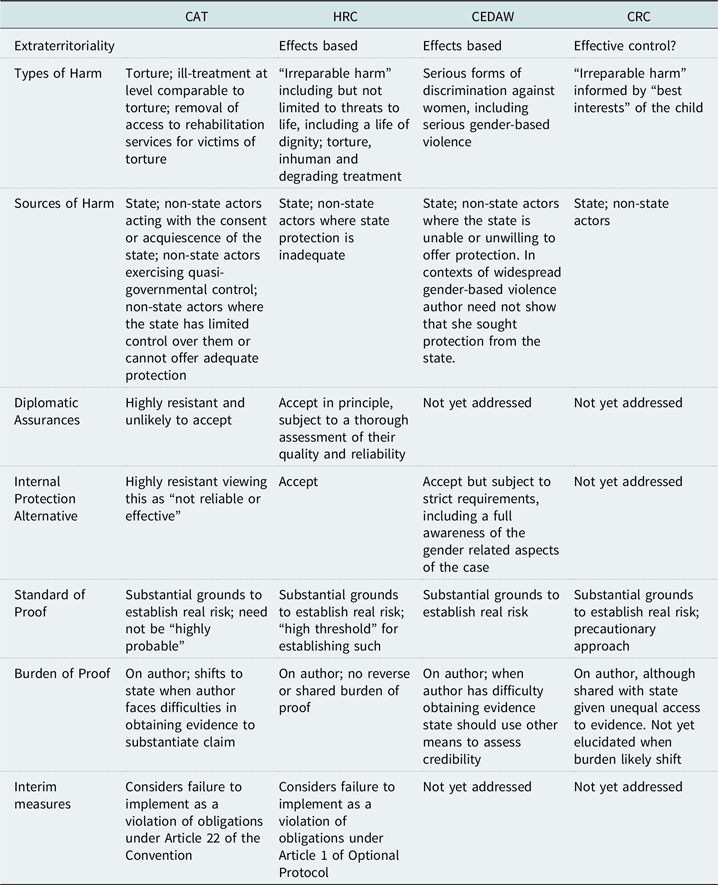
To summarize, across the issues identified as key to the interpretation of non-refoulement, we have identified several commonalities across the four UNTBs, and some striking points of divergence. Notwithstanding the highly fact-specific nature of the UNTBs’ views, we can summarize the divergences as set out in Table 1.
Comparison of interpretative approaches to non-refoulement across the four UNTBs
D. UNTBs’ Standard of Review
In this part, we turn to the UNTBs’ approach to fact-finding. The cases we examined raise profound questions as to the degree of deference, if any, due to domestic authorities in non-refoulement cases. This issue is of great practical importance given that most of the cases in question concern individuals who have had claims for asylum or international protection rejected. Usually, the respondent state contests the facts strongly, and relies on the integrity of the factual determinations made in the national asylum system. The first case before the CAT Committee reflects this typical fact pattern. Mutombo v. Switzerland Footnote 170 concerned Mr. Balabou Mutombo, a torture victim who fled Zaire and sought asylum in Switzerland. In spite of medically corroborated evidence of his past experience of torture, he was disbelieved at two levels in his asylum process in Switzerland, with the Swiss asylum authorities also denying that in Zaire there is a “consistent pattern of gross, flagrant or mass violations of human rights.” The CAT Committee found that such a pattern existed, drawing on UN sources, and that the applicant is personally at risk of torture.
As mentioned at the outset, the question of how the UNTBs exercise their fact-finding functions is of immense conceptual and practical concern. UNTBs are not appellate bodies for domestic asylum applicants, and understandably seek to limit their review functions. However, they are frequently presented with asylum determinations that appear to rest on poor factual analyses. This section provides a short insight into how the UNTBs calibrate their standard of review, a matter in need of further research.
The HRC states in its caselaw that it will only interfere with the assessment of the case conducted by the state authorities when it is found to be clearly arbitrary or it amounts to a denial of justice.Footnote 171 From our analysis of the caselaw it can be concluded that the HRC applies this margin fairly consistently, even though there are instances where it has clearly conducted its own assessment of risk. In these cases, more often than not there are dissenting opinions that point this out.Footnote 172 The recent case of Teitiota v. New Zealand exemplifies this approach.Footnote 173 The HRC devoted ten paragraphs to summarizing the reasoned rejections of the New Zealand authorities and courts, reflective of its deferential stance to the fact-finding of those authorities, as discussed above.
The CEDAW Committee follows the approach of the HRC in its use of a “clearly arbitrary or denial of justice” test, but it adds one other ground on which it justifies interference with the state’s assessment of the author’s claim—when it can be established that the evaluation was biased or based on gender stereotypes that constitute discrimination against women.Footnote 174 As yet, the CEDAW Committee has yet to find any examples of gender biased or stereotyping in national decision-making, although we suggest that it may be pervasive. Evidently, the CEDAW Committee could use this tool as a basis for deeper scrutiny into national systems, should it wish to develop a more proactive role. As yet, the CEDAW Committee also applies its deferential standard of review fairly consistently.
The CRC has followed in the footsteps of the HRC and CEDAW and also adopts a strong deferential standard of review and has stated that it will only interfere with the state’s assessment when it can be shown to be arbitrary or to have amounted to a denial of justice.Footnote 175 In four out of the six non-refoulement cases that it has considered the CRC deemed them inadmissible because the applicant failed to adduce such evidence. This is despite the fact that Committee has also indicated that the “best interests of the child” principle in cases of asylum claims of unaccompanied minors is an autonomous concept that may significantly limit domestic authorities’ leeway.Footnote 176 This is apparent in the caselaw on age determination in particular,Footnote 177 and may also come to inform its future non-refoulement assessments.
The CAT appears to take on a more robust fact-finding role in refoulement cases. Unlike the other UNTBs, which will (in most instances) only interfere with state findings of fact in very limited circumstances the approach of the CAT, as stated in its General Comment on non-refoulement, is that it gives “considerable weight” to findings of fact made by the state authorities but is “not bound by such findings,” meaning that it can choose to “make a free assessment of the information available to it … taking into account all the circumstances relevant to each case.”Footnote 178 This gives the CAT a certain degree of flexibility in how it assesses cases and this is evident from the caselaw analysis.
The CAT approach may be illustrated in two cases where it found a violation of Article 3. In Arana v. France,Footnote 179 the author, Josu Arkauz Arana, a Spanish national and Basque activist, was handed over directly by French police to their Spanish counterparts. At the time, the CAT Committee had already criticized Spain’s practice of prolonged detention incommunicado, commenting in its periodic reviews that it “seemed to facilitate the practice of torture.”Footnote 180 Against this background, and in light of the irregular mode of transfer, the CAT Committee found a violation of Article 3. A more typical asylum case was that of Hamid Reza Eftekhary v. Norway,Footnote 181 concerning the return of a journalist to Iran. The Norwegian asylum authorities deemed some of the documentation on which he relied to substantiate his asylum claim to be forged. On that basis, they deemed his account to be generally incredible. The Committee stated that it could not resolve the factual question relating to the veracity of the documents, but rather noted that the Norwegian authorities had not contested the authenticity of two summonses to appear before the Revolutionary Court. On that basis, and in light of the general human rights situation in Iran at the time, the CAT Committee found that his removal to Iran would breach Article 3.
In both cases, the CAT Committee’s approach to fact-finding is robust, if economical. It notes the factual contestations, but in effect gives individuals the benefit of the doubt. As it repeatedly states, “complete accuracy is seldom to be expected by victims of torture, especially when the victim suffers from post-traumatic stress syndrome.”Footnote 182
This approach to fact-finding may allow the Committee to do justice to the individual case. Yet, it also makes its case law unpredictable. There are some instances in the caselaw where it is stated that the CAT will only interfere where state consideration was arbitrary or amounted to a denial of justice, bringing it in line with the positions of the other UNTBs.Footnote 183 In several cases the Committee also states that “it is not an appellate, quasi-judicial or administrative body” and follows the findings of fact made by governments.Footnote 184 At the other end of the spectrum, there are instances where the Committee does overturn the state party’s findings of fact and does so without performing any kind of assessment of the state’s procedures. Instead, the Committee simply asserts its right to conduct a full consideration of the facts, in accordance with the previous and revised General Comment.Footnote 185
E. Non-Refoulement: Soft Courts vs. Hard Courts?
The previous sections have outlined the contours of the UNTBs’ non-refoulement caselaw, identifying some points of convergence, and some notable divergences amongst the soft courts. In this section, we compare the four soft courts with the regional court most pertinent given the preponderance of UNTB cases against European states parties. While a short section cannot do justice to all the complexities of the Strasbourg caselaw,Footnote 186 we offer here some stylized points of contrast. This section is the first step towards a comprehensive response to the following questions: Are the UNTBs more progressive interpreters of non-refoulement than the ECtHR? Or do they seek to act as norm consolidators, following their European hard court co-interpreter closely?
I. The ECtHR’s Approach to Non-Refoulement
Strasbourg’s approach to extra-territoriality is restrictive, based on a test of effective control over territory or persons.Footnote 187 It remains to be seen whether it will be expanded to include those seeking protection from abroad,Footnote 188 beyond the maritime context.Footnote 189 Accordingly, it does not readily extend to those who have not yet crossed a border. Recently, the ECtHR has also held that those who cross border fences in large numbers and are subsequently returned do not come within the scope of the prohibition of collective expulsion.Footnote 190
The ECtHR understanding of harm focusses on a real risk of being subjected to torture or to inhuman or degrading treatment or punishment. Over the years it has created a very restrictive test that found removal in the context of deteriorating health only to amount to a violation of the Convention in very exceptional circumstances where the person was close to death.Footnote 191 Whilst the Court has in principle recognized that harm may engage Articles 4 (prohibition of slavery and forced labour),Footnote 192 5 (right to liberty and security),Footnote 193 6 (right to a fair trial),Footnote 194 8 (right to respect for private and family life),Footnote 195 and 9 (right to freedom of thought, conscience, and religion),Footnote 196 a very high standard is required in such cases—a “flagrant denial” of a right—which has rarely been met.Footnote 197 In practice, most non-refoulement protection falls under Article 3. Further, as the Court noted in Z. and T., “it would be difficult to visualise a case in which a sufficiently flagrant violation of Article 9 [freedom of thought, conscience and religion] would not also involve treatment in violation of Article 3 of the Convention.”Footnote 198
In Dublin cases, the Strasbourg Court accepts that living conditions can meet the minimum level of severity of torture, inhuman and degrading treatment.Footnote 199 However, it has focused of late on the need to demonstrate some particular vulnerability on the part on the applicant, rather that its focus on the structural vulnerability of asylum-seekers as acknowledged in the ground-breaking judgment of M.S.S. v. Belgium and Greece. The ECtHR recognizes that the source of harm can be from a state or a non-state actor.Footnote 200 The ECtHR accepts diplomatic assurances subject to an assessment of their reliability as set out in the Othman case.Footnote 201 It also considers internal protection alternatives.Footnote 202
A reverse burden of proof does appear in the caselaw of the ECtHR, although the burden of proof only shifts to the state once the applicant has substantiated their claim sufficiently.Footnote 203 In the ECtHR, the applicant must adduce evidence of individual circumstances and the state has the burden of evaluating the general situation in a country.Footnote 204 This is also the position in EU law. The CJEU has found that Member States must “cooperate actively” in the process of establishing the relevant facts and obtaining supporting documentation, noting that: “A Member State may also be better placed than an applicant to gain access to certain types of documents.”Footnote 205 The ECtHR is very well known for its margin of appreciation approach to identifying human rights violations, and in the F.G. v. Sweden case its use of this in non-refoulement cases is explicitly re-affirmed.Footnote 206 When employing margin, the Strasbourg Court gives weight to the determinations of state authorities when there is an effective system in place or when it finds that proceedings are not flawed.Footnote 207
II. Comparative Analysis: Variations in Hard Protections through Soft Courts
UNTBs both depart from the standards articulated by the ECtHR and offer added protection, and follow its apparent lead. There are, however, important variations across the UNTBs in terms of how they interpret non-refoulement. Their interpretive stances therefore cannot be explained in light of their “soft” character alone.
Looking at the caselaw as a whole, the CAT and the CRC most deserve the label of vanguard bodies amongst the UNTBs, in their attempts to create new and more progressive doctrines in their general approach to non-refoulement. The CAT has innovated a reverse burden of proof in its new General Comment when individuals have difficulty in substantiating their case. Neither the European Court of Human Rights (or the CJEU for that matter) quite reach the level of a full reverse burden of proof as per the CAT’s new approach. The CAT also attempted (albeit failed) to have the use of diplomatic assurances in non-refoulement cases forbidden. This is yet further evidence of its role as offering an expansive interpretation of non-refoulement. Internal flight is another area where the CAT has taken on the role of trailblazer in its attempt to cast doubt on this as a valid risk mitigation strategy in principle, which is accepted as thus by both European courtsFootnote 208 and the other UNTBs. Furthermore, CAT gives itself the possibility of making its own findings of fact without deference to domestic authorities.
The CRC has taken a vanguard position concerning extra territoriality by stating that states that find children at their borders have a duty to protect them. This principle goes well beyond the effective control doctrine and puts the CRC ahead of the ECtHR. In a recent judgment by the Grand Chamber of the ECtHR, those who were seeking to collectively cross a border (in the numbers of hundreds) and subsequently pushed back were not treated as subjects of the prohibition of collective expulsion.Footnote 209 The CRC’s approach to harm, best interests of the child at its core, is also much more open and dynamic than that of the ECtHR. The CRC does not (currently) employ any doctrine of deference. This may be due to significant deficiencies it finds in the countries it has cases from, such as the lack of adequate processes for identification of the age of children and lack of immediate guardianship assigned to children in non-refoulement and asylum proceedings.Footnote 210 The CRC, with its limited number of cases and General Comments, therefore offers real added value in terms of how children’s non-refoulement rights need to be interpreted. The same cannot yet be strongly observed in the case of CEDAW individual Views. Whilst the CEDAW’s General Comment No. 32 provides a gender-sensitive and broad interpretation of non-refoulement obligations of type and sources of harm, in individual cases it has adopted a deferential standard of review. Yet, gaps in gender sensitive interpretations of non-refoulement and gender stereotypes are prevalent in Europe, also in the caselaw of the ECtHR.Footnote 211
Otherwise, the UNTBs follow the ECtHR. For example, the approach to health cases taken by the HRC and articulated above in the discussion of the A.H.G. case closely follows the position of the ECtHR.Footnote 212 In a more recent case, however, Paposhvili v. Belgium, this position has been softened somewhat with the Court noting that situations where the applicant was not necessarily at immediate risk of dying but would still face a real risk “of being exposed to a serious, rapid and irreversible decline in his or her state of health resulting in intense suffering or to a significant reduction in life expectancy” then Article 3 could be engaged.Footnote 213 What this does is lower the threshold for what counts as “very exceptional circumstances” beyond imminent death in the Court’s approach to non-refoulement and deterioration of a health condition. It will be interesting to see if the approach by the UNTBs also softens in response to this change in the ECtHR approach. Moreover, the HRC has recently clarified, admittedly in the climate rather than health context, that foreseeability rather than imminence of harm, is the key test.
On Dublin cases, the HRC also appears to have followed the ECtHR in its approach. Broadly speaking, the HRC took a similar approach in Jasin v. Denmark, its first case of this kind, and in subsequent cases.Footnote 214 However, the CAT cases, particularly those concerning torture victimsFootnote 215 in acute need of rehabilitation, appears to offer greater protection than that currently being afforded by the ECtHR. Admittedly, determinations of both soft and hard courts in these cases are highly fact-specific, if not casuistic. In particular, the concept of “vulnerability” is employed by both sets of bodies to calibrate the sort of treatment and living conditions that will be deemed acceptable or otherwise, dependent on the profile of the individual concerned. While this is not the place for a thorough analysis of this concept, suffice to note at this point that it is double-edged, allowing a court, soft or hard, to adapt to the facts presented in either a protective or stereotypical assessment.
There are even areas where the UNTBs appear to adopt a more restrictive position than the ECtHR. One example of this is the approach to generalized states of violence. The UNTBs are all fairly strict in their insistence that applicants demonstrate a degree of personal risk. It is extremely rare to see UNTBs find violations purely on the basis of generalized states of violence. The CAT has done so based on generalized states of violence against women in some cases,Footnote 216 and while it does take into account patterns of mass violations of human rights, applicants are still expected to demonstrate personal risk. The HRC also emphasizes personal risk as part of its risk assessment, although again, in Teitiota v. New Zealand it countenances that generalized phenomena such as climate change-related sea level rise, may generate further generalized risks to a dignified life of such foreseeability and seriousness as to be “personal” to any individuals so affected. This may suggest a move towards a greater acceptance of claims based on generalized violence, a move already evident in caselaw of the ECtHR and the CJEU.Footnote 217
F. Conclusion
In this Article, we comparatively analyzed the non-refoulement case law of the four key UNTBs with the aim to identify the dynamics of norm development, convergence, and fragmentation in a crowded field of interpreters comprised of soft and hard international courts. Our comparative analysis had two levels. At the first level, we analyzed how the UNTBs interpret non-refoulement in the light of their respective treaties. At the second level, we compared the UNTBs, as soft courts, to the interpretations of the ECtHR.
Our analysis tested and complicated the simplistic view that the UNTBs are more likely to be progressive interpreters because of their soft court status. We demonstrated that, across various elements of the non-refoulement norm, some of the UNTBs, at times, do adopt a more progressive position than their “harder” regional court counterparts but that there are also instances where they closely follow the interpretations of the regional courts and, on occasion, adopt a more restrictive position.
The UNTBs following the ECtHR lend additional support to already existing judicial protections of non-refoulement and send signals equivalent to those sent by regional courts to domestic authorities and courts. The consolidation of the prohibition of non-refoulement through soft courts following hard courts is a pathway to harden protections through UNTB individual cases. The prohibitive status of the norm through reiterated interpretations by hard and soft courts in tandem enables soft courts to act as meaningful sites for accountability, at least in Europe. The similarities in interpretation between the HRC and the ECtHR shows that the HRC has taken this path by following the ranks of Strasbourg in its case law.
Yet, multiple interpreters of non-refoulement also breed interpretive variation and generate tensions between progressive, pro person interpretations of the norm and statist and migration-control indulgent interpretations. Our study has shown that this variation is not strictly between UNTBs as soft courts and the ECtHR, but more significantly amongst the UNTBs themselves. The two UNTBs that have a single-issue focus, the CAT with the prohibition of torture and the CRC’s role for the protection of children, in particular, challenge the logic of migration control and operate with less deferential standards than the HRC, CEDAW, and the ECtHR. Against the backdrop of efforts by states in and beyond Europe to interpret non-refoulement restrictively, these variations can be pitted against each other by domestic authorities. Progressive soft courts can be on the losing end of compliance and diffusion in these cases. This insight calls for further and close attention to be paid to UNTB caselaw on non-refoulement by the ECtHR in the spirit of internal coherence of the global prohibition of non-refoulement and external effectiveness, vis-à-vis domestic decision makers.


 Open access

