

Introduction: a shortage of research within social policy
International voluntary organisations have been relatively neglected within the study of social policy. This reflects a wider historical ‘double knowledge gap’ within social policy research (Lewis, Reference Lewis, Surender and Walker2013). First, reflecting its intellectual heritage, research has tended to focus on national social policy in industrialised country contexts. Second, research has tended to focus on the welfare state, with less emphasis on the role of non-state actors. However, the importance of research on international voluntary organisations has recently been highlighted by an emerging move – as part of a conversation between social policy and development studies – towards considering social policy within ‘developing’ country contexts, where the role of domestic and international ‘non-governmental organisations’ in the provision of welfare cannot be ignored (Gough and Wood, Reference Gough and Wood2004; Surender and Walker, Reference Surender and Walker2013). The importance of research into international voluntary organisations has been further underlined by the rise of the field of global social policy, which has highlighted the role of actors whose activities transcend the nation state. This includes not only the activities of elite international financial institutions but also those of a wide range of actors, including large and small voluntary organisations, that link people and places internationally (Yeates, Reference Yeates2008; Yeates and Holden, Reference Yeates and Holden2009).
These developments provide further strength to calls to end the ‘parallel worlds’ of separate research which sees ‘domestic’ ‘voluntary organisations’ (or ‘nonprofit organisations’) increasingly studied within social policy but the study of international ‘NGOs’ confined largely to development studies (Lewis, Reference Lewis2014). This de facto separation occurs despite common ‘structural/operational’ approaches to definition: voluntary organisations are formal organisations (with internal structure and meaningful boundaries) which are self-governing, independent of government, not profit-distributing, and voluntary, while NGOs are often understood as the subset of voluntary organisations engaged in humanitarian or development work (Salamon and Anheier, Reference Salamon and Anheier1992; Kendall and Knapp, Reference Kendall and Knapp1993; Vakil, Reference Vakil1997; Lewis, Reference Lewis, Surender and Walker2013). This separation has persisted, as Lewis (Reference Lewis2014) points out, despite common themes in the respective literatures surrounding, for example, accountability, effectiveness, and the nature of the relationship with the state; despite common interests in concepts like ‘social capital’ and ‘civil society’; and despite patterns of globalisation which problematise binary distinctions between ‘developed’ and ‘developing’ countries. The separation has served to hinder the potential for learning across the two literatures. Importantly, it may also have served to divert scholarly attention from the many international voluntary organisations that are not ‘NGOs’ in the sense that they do not work in development or in ‘developing’ country contexts.
There has been a particular shortage of research which has been able to provide basic empirical evidence about the trends in the number of voluntary organisations operating internationally, and about the geographical patterns in their operation. First, in terms of trends, there are accounts that the extensity and intensity of contemporary global networks (Held et al., Reference Held, McGrew, Goldblatt and Perraton1999; Bebbington and Kothari, Reference Bebbington and Kothari2006), reflected for example in advances in communication and increased international travel, have facilitated an increase in the number of international ‘citizen initiatives’ – small-scale ‘grassroots’ voluntary organisations which directly involve non-development professionals in the provision of goods and services overseas (Develtere and De Bruyn, Reference Develtere and De Bruyn2009; Schnable, Reference Schnable2014; Kinsbergen et al., Reference Kinsbergen, Tolsma and Ruiter2013). However, there is little empirical evidence with which to examine this apparent trend: since income across the sector is dominated by large development organisations, trends in aggregate voluntary income for international causes – documented, for example, by Atkinson et al. (Reference Atkinson, Backus, Micklewright, Pharoah and Schnepf2012) – provide no insight into the number of smaller international organisations; the Yearbook for International Organisations has historical data on numbers of organisations, but excludes many smaller organisations since it is intended to include only those oriented to three or more countries.
Second, in terms of geographical patterns in the operation of international voluntary organisations, there is growing recognition of the importance of improving the scant evidence base (Watkins et al., Reference Watkins, Swidler and Hannan2012). This is particularly the case for organisations working in development, given a prominent debate about priorities for aid. Recently the bilateral aid review, in which country priorities were reassessed, heralded significant changes in the allocation of UK official aid and the end of financial assistance to a number of countries (DFID, 2011). Many voluntary organisations, as well as official agencies, have been reviewing their priorities: Dame Anne Owers, the Chair of Christian Aid, acknowledged that “Christian Aid and the wider development community have big decisions to make about where we work, and how” (Christian Aid, Reference Aid2011). However, while geographical patterns in official (government) development assistance (ODA) are well monitored, much less is known about the geography of operation of international voluntary organisations (Agg, Reference Agg2006; Hénon, Reference Hénon2014; International Development Committee, 2012). An emerging literature has started to examine the aid allocation of international NGOs (Nunnenkamp et al., Reference Nunnenkamp, Weingarth and Weisser2009; Dreher et al., Reference Dreher, Mölders and Nunnenkamp2010; Dreher et al., Reference Dreher, Nunnenkamp, Thiel and Thiele2012; Büthe et al., Reference Büthe, Major and de Mello e Souza2012), but none of these studies focus on UK-based international voluntary organisations.
Therefore, given the lack of existing research, this paper examines the international activity of voluntary organisations registered as charities in England and Wales. Basic questions remain unanswered in existing empirical work: for example, how many charities operate internationally, and how has this number changed over time? Has there been an increase in the number of small-scale ‘grassroots’ international charities? What is the geographical pattern in the country of operation of international charities? Are certain countries distinctive in terms of the high, or low, number of charities working there? Does charitable operation tend to focus on countries with poor governance, or are charities less likely to work in countries with high levels of instability and/or corruption? Are charities more likely to work in countries with historical colonial links to the UK? What is the relationship with the pattern of UK ODA: does charitable operation tend to coincide with, or differ from, government priorities? This paper answers these questions for the first time.
We adopt a distinctive empirical approach. We examine charitable operation across all countries, and therefore are able to move away from a restrictive focus on either ‘developing’ or ‘developed’ country contexts, often characteristic of the ‘parallel worlds’ of research into voluntary organisations and NGOs respectively (Lewis, Reference Lewis2014). We include not only the large development organisations, which are typically the focus of the few existing studies in the emerging literature on the aid allocation of NGOs (Koch, Reference Koch2009; Büthe et al., Reference Büthe, Major and de Mello e Souza2012; Dreher et al., Reference Dreher, Nunnenkamp, Thiel and Thiele2012), but also we are able to provide evidence about smaller ‘grassroots’ international voluntary organisations. This is important because it is in keeping with global social policy's interest in the dense network of international connections of ‘non-elite’, as well as elite, actors (Yeates and Holden, Reference Yeates and Holden2009).
Data and method
The paper makes use of a unique administrative dataset from the Charity Commission (CC). The CC registers and regulates charities – voluntary organisations that benefit the public in a way that the law says is charitable – in England and Wales. Through the returns that each of these charities are required to complete annually, the CC collects information on every country in which each charity operates. This is a mandatory field, so is completed by all charities. The information has not yet been used in academic research.
The main analysis of this paper is based on CC data from 2014. The total number of registered charities in England and Wales in 2014 is c.163,000. The analysis in this paper shows that, of this total, c.16,500 indicate that they operate in at least one country or territory outside the UK. Since we have information not only on the population of currently registered organisations, but also on all of those that have registered and dissolved in our analysis period, this paper is also able to present trends in the number of registered charities operating internationally between 1995 and 2014Footnote 1 . Further details about the CC data, including a discussion of data quality and the steps involved in the data preparation, are provided in section 1 of the online supplementary material.
We link the data on the international operation of charities to relevant country-level covariate data. Table 1 presents descriptive statistics on the distribution of countries according to these covariates. The World Bank's (2012) country classification identifies high income countries and those in different regions. The Worldwide Governance Indicators (WGI) (Kaufman et al., Reference Kaufmann, Kraay and Mastruzzi2011) provide measures of political stability and absence of violence/terrorism, and of control of corruption. We include measures of the links between the UK and overseas: whether the country is a former British territory (Mayer and Zignago, Reference Mayer and Zignago2011); whether the country has English as an official and/or commonFootnote 2 language (Mayer and Zignago, Reference Mayer and Zignago2011); and 2011 census information on the number of people by their country of birth for residents of England and Wales (ONS, 2013). To compare current patterns of official UK aid with patterns of overseas charitable operation, we link in information on bilateral priorities for official aid from the Department for International Development (DFID, 2011). We also link in data on total population size (World Bank, 2013). We use the recently developed Multidimensional Poverty Index (MPI) (Alkire et al., Reference Alkire, Conconi and Seth2014) as a source of data on the number of people living in poverty in a country, reflecting an understanding of poverty as a multi-dimensional concept not well described by income alone.
Number of countries by country-level covariates

Notes: The regional covariate treats high-income countries within these regions as a separate category.
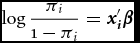
When examining geographical patterns in the overseas operation of charities we restrict analysis to charities that operate outside the UK, considering the operation of 16,274 charities across 201 countriesFootnote 3 . We organise our data into 3,271,074 rows defined by unique combinations of charity and country. We generate a 0/1 indicator variable which, for each of these row combinations, indicates whether or not that charity operates in that country: for each charity, countries are coded 1 where a charity reports operation and 0 where no operation is reported. The mean number of countries in which a charity operates is 4.7. Therefore, across the population of charities that operate overseas, the average probability π of a charity operating in any given overseas country is 4.7/201=0.023Footnote 4 . Using the 0/1 indicator variable as our outcome, we use logistic regression to examine how this probability π i varies according to our covariates:
 $$\begin{equation*}
\log \frac{\pi _i}{{1 - {\pi _i}}} = {\bm x}_{{\bm i}}^{\prime}{\bm \beta }
\end{equation*}$$
$$\begin{equation*}
\log \frac{\pi _i}{{1 - {\pi _i}}} = {\bm x}_{{\bm i}}^{\prime}{\bm \beta }
\end{equation*}$$
where the i observations are defined by the 3,271,074 unique combinations of charity and country, ${\bm x}_{{\bm i}}$
is a vector of covariates and
${\bm x}_{{\bm i}}$
is a vector of covariates and ${\bm \beta }$
is a vector of coefficients. Our main interest is in assessing how overseas charitable operation varies according to seven country-level covariates of interest (listed in Table 1). However we also include in our regression a charity-level covariate describing the geographical scope of the charity (whether it operates in one country/2–9 countries/more than 10 countries). We also control for country population size given that, on average, more charities work in countries with bigger populationsFootnote
5
.
${\bm \beta }$
is a vector of coefficients. Our main interest is in assessing how overseas charitable operation varies according to seven country-level covariates of interest (listed in Table 1). However we also include in our regression a charity-level covariate describing the geographical scope of the charity (whether it operates in one country/2–9 countries/more than 10 countries). We also control for country population size given that, on average, more charities work in countries with bigger populationsFootnote
5
.
The analysis in this paper has its limitations. It focuses on charities registered in England and Wales that work internationally. It does not consider charities ‘excepted’ or ‘exempted’ from registration with the Charity Commission; those diasporic organisations, including informal groups and mutual funds, with links to their countries of origin but which are not registered charities (see, for example, Van Hear et al., Reference Van Hear, Pieke and Vertovec2004); and noncharitable civil society organisations including mutuals and social enterprises. It does not consider individuals’ remittances which, after foreign direct investment, represent the largest source of external finance for developing countries (see Solimano, Reference Solimano and Atkinson2005), or the work of ‘free-floating altruists’ not connected with an organisation. Therefore, while the paper illustrates the activity of registered charitable organisations that operate overseas – including that of many ‘grassroots’ organisations – this represents only a partial perspective on the nature of philanthropic activity that links people and places internationally.
The paper does not seek to provide insight into the sum of charitable activity in a particular overseas country, since it does not include the activity of ‘domestic’ organisations or of international organisations registered in other countries. It focuses on the ‘selection’ rather than ‘allocation’ stage – whether or not a charity works in a particular country, rather than the share of resources allocated to operation in that countryFootnote 6 . It focuses on the country level, not on patterns in charitable activity at the sub-national level.
Results
In total 16,502 charitiesFootnote 7 indicate that they operate in at least one country or territory outside of the UKFootnote 8 . This represents a significant proportion – 10 per cent – of the population of c.163,000 registered charities in England and Wales in March 2014. The total of c.16,500 includes a small number of large organisations, including c.200 with an income of more than £10m, and c.1,000 with an income of more than £1m. However, and notably, the majority of charities operating overseas are small in size. Around a third (34 per cent) have an annual income under £10,000; nearly three quarters (73 per cent) have an income under £100,000Footnote 9 . These small organisations draw on significant voluntary resources: there are 54,000 trustees involved in running those overseas charities with an income under £100,000. Most charities operating overseas have a limited geographical scope. Indeed, more than half of charities working overseas (9,050; 55 per cent) operate in just one country; around a third (5,748; 35 per cent) operate in between 2 and 9 countries, while 10 per cent (1,704) operate in 10 countries or more. As expected, charities with a smaller income tend to have a more restricted geographical scope (Table 2). While most overseas charities (9,792, or 59 per cent) operate exclusively within countries that are classed as eligible for ODA by the OECD, a significant fraction (41 per cent) operate in ‘developed’ country contexts – either in addition to operation within ODA-eligible countries (3,348 charities; 20 per cent of the total) or exclusively in non-ODA eligible countries (3,362; 20 per cent).
Number of charities working internationally, by annual income (£) and geographical scope

Notes: Row percentages in brackets. Annual income in 2012.
Source: author's analysis
Trends over time
The results indicate a sizeable increase in the number of registered charities operating overseas: there are 3.6 times more charities working internationally in 2014 (16,502) than in 1995 (4,599) (Figure 1). Importantly, this is during a period in which the total number of registered charities has remained at around 160,000 throughout, so the share of charities that operate internationally has also increased sizeably. Figure 2 shows the trend disaggregated according to the size of charity, in terms of headline incomeFootnote 10 . There has been an increase in the number of charities working internationally across the whole size distribution. However, in absolute and in relative terms, there has been a more significant increase in the number of small charities than in the number of large charities: there are 4.7 times more charities sized £0–10k in 2012 than in 1995 (4,709/1,007); 4.2 times more charities sized £10k–100k (5,412/1,297); and 3.1 times the number of very large charities (£10m+) (198/63).
Trend in the number of English and Welsh charities operating internationally

Trend in the number of English and Welsh charities operating internationally, by size (income, £)

Patterns in country of operation: relationship with covariates
Across the population of 16,274 charities and 201 countries as a whole, the average predicted probability of a charity working in any given overseas country is 0.023 (2.3 per cent). However the results from the logistic regression models show considerable variation across countries in the likelihood of charitable operation. In models A1–A7 we consider patterns according to each of our country-level covariates in turn. While we use the logit link, which models the log-odds, we present the results in terms of predicted probabilities. In each case, the predicted probabilities are calculated for different levels of the covariate of interest while holding other variables in the model, country population size and the geographical scope of the charity, constant at the observed sample values. Then the average of these predicted probabilities is taken across the sample observations. Table 3 collates the results, presenting the average predicted probability of a charity working in any given overseas country by covariate characteristics. The probability of any given charity operating in any given country remains low, conditional on covariates. For example the average predicted probability of a charity working in a given country is 3.7 per cent if the country is a former British territory and 1.7 per cent if the country is not a former British territory. However it is the relative risks (RR: ratios of the probabilities across the different levels of a covariate), rather than the probabilities themselves, that are of particular substantive interest.
Logistic regression results (Models A1-A2; considering all charities that operate outside the UK): average predicted probability of a charity working in any given overseas country, by covariate characteristics
Notes: All models also include controls for the logarithm of the country population size (main effect and squared terms). Number of observations=201 countries × 16,274 charities= 3,271,074. 95% CI in brackets.
Source: author's analysis Logistic regression results (Models A3-A4; considering all charities that operate outside the UK): average predicted probability of a charity working in any given overseas country, by covariate characteristics
Notes: All models also include controls for the logarithm of the country population size (main effect and squared terms). Number of observations = 201 countries × 16,274 charities = 3,271,074. 95% CI in brackets.
Source: author's analysis Logistic regression results (Models A5-A6; considering all charities that operate outside the UK): average predicted probability of a charity working in any given overseas country, by covariate characteristics
Notes: All models also include controls for the logarithm of the country population size (main effect and squared terms). Number of observations = 201 countries × 16,274 charities = 3,271,074. 95% CI in brackets.
Source: author's analysis Logistic regression results (Models A7-A8; considering all charities that operate outside the UK): average predicted probability of a charity working in any given overseas country, by covariate characteristics
Notes: All models also include controls for the logarithm of the country population size (main effect and squared terms). Number of observations = 201 countries × 16,274 charities = 3,271,074. 95% CI in brackets.
Source: author's analysis Logistic regression results (Models A9-A10; considering all charities that operate outside the UK): average predicted probability of a charity working in any given overseas country, by covariate characteristics
Notes: All models also include controls for the logarithm of the country population size (main effect and squared terms). Number of observations (A9: 201 countries × 16,274 charities=3,271,074; A10: 201 countries × 12,771 charities with non-missing income=2,566,971). 95% CI in brackets.
Source: author's analysis


English and Welsh charities are most likely to work in countries in South Asia (SA) or in Sub-Saharan Africa (SSA) (Model A1). Charities are over twice (RR=c.0.032/c.0.013=2.5) as likely to work in countries in these two regions than in countries in East Asia and the Pacific (EAP), Latin America and the Caribbean (LAC), the Middle East and North Africa (MENA), or Europe and Central Asia (ECA)Footnote 11 . Notably, charities are also more likely to work in high-income countries than in countries in these last four regions.
Charities are less likely to work in countries with low levels of governance: compared to other countries, charities are 13 per cent less likely (RR=1-(0.021/0.024)=0.87) to work in countries that are considered the least politically stable (in the top decile of the WGI's instability distribution) (Model A2), and 25 per cent less likely (RR=1-(0.018/0.024)=0.75) to work in countries where corruption is considered to be least under control (in the top decile of WGI's corruption distribution) (Model A3).
Charities are much more likely to work in countries with historical connections to the UK: compared to other countries, they are more than twice as likely to work in a country that was at some stage a territory that formed part of the British Empire (RR=0.037/.017=2.2) (Model A4); more than twice as likely to work in a country where many people have moved after birth to currently reside in England and Wales (probability of 0.046 for more than 100,000 people, compared to 0.018 for less than 50,000; RR=2.6) (Model A5); and more than twice as likely to work where English is an official or common spoken language (RR=0.038/.017=2.2) (Model A6).
Charities are much more likely to work in countries that are priorities for UK government aid (Model A7): compared to other countries, they are more than twice as likely (RR=0.039/0.019=2.1) to work in a country identified as a ‘focus’ country in the 2011 bilateral aid review.
The main results are robust to model specification. As with Models A1–A7, which consider each of our country-level covariates in turn, a model which includes all seven covariates together shows that charities are more likely to work in countries with colonial and linguistic ties to the UK and less likely to work in countries with high levels of instability or corruption (Model A8). Comparing Model A8 with the previous models also points to the inter-relationships between our covariates. For example in Model A8, when we control for other covariates, there is a smaller difference between former British territories and other countries in the probability of charitable operation than in Model A4. This suggests that associations between a country's colonial past and other covariates – including, for example, the use of the English language – help to explain why charities are more likely to work in former British territories.
Does the importance of the covariates vary according to the size of charity? In Model A9 we find evidence for a significant interaction between the importance of colonial ties and the geographical scope of the charityFootnote 12 . A charity with a large scope – working in at least 10 countries – is 50 per cent more likely to work in a particular country if it is a former British territory (RR=0.189/0.129=1.5). However, for charities working in just one country, their operation is even more heavily concentrated in former British territories (RR=0.0121/0.0018=6.7). Similarly, while the largest charities in financial terms – with an annual income greater than £10m – are more likely to work in a country if it is a former British territory (RR:1.7), this pattern is particularly pronounced for the smallest charities (RR: 2.7 and 2.5 for charities with an income of less than £10,000 or between £10,000 and £100,000 respectively) (Model A10).
Does the importance of these covariates extend not only to the population of charities in general, but also specifically to established development organisations? We repeated the modelling process, using the same covariates, for a sub-population of charities recognised as working in international development – members of the umbrella body BONDFootnote
13
(Table 4; Models B1–B8). BOND members are on average much larger than the overseas charitable population as a whole: they had a median income in 2012 of £1.1m, and a mean of £5.2m, compared to £23,400 and £970,500 respectively for the population of charities that work internationally. Given these organisations’ focus on poverty, we use the number of people identified as multi-dimensionally poor in each country (Alkire et al., Reference Alkire, Conconi and Seth2014), rather than the total population, as a control. Therefore the frame of comparison is also differentFootnote
14
: we make comparisons not across 201 countries, but across 98 low- and middle-income countries for which data on acute multi-dimensional poverty are available. There are 28,714 observations across the combination of 293 charities and 98 countries. Table 4 presents the results. After controlling for the number of MPI poor, international development charities are around 50 per cent more likely to work in countries in South Asia and Sub-Saharan Africa than in ECA or MENA (Model B1), though regional differences are reduced when we control for other covariates (Model B8). International development charities are, compared to other countries and after controlling for the number of MPI poor, 19 per cent less likely to work in countries considered the least politically stable (RR=0.81) (Model B2); 25 per cent less likely to work in countries where corruption is considered least under control (RR=0.75) (Model B3); twice as likely to work in former British territories (RR=1.95) (Model B4); more likely to work in a country where many people have moved after birth to currently reside in England and Wales (Model B5); more likely to work where English is an official or common spoken language (RR=1.87) (Model B6); and twice as likely to work in the ‘focus’ countries that are a priority for UK official aid (RR=2.08) (Model B7). Importantly, therefore, these results illustrate considerable unevenness in charitable operation between countries according to our covariates – even for this sub-population of large development charities.
Logistic regression results (Models B1-B2; considering only charities that are members of UK overseas development umbrella body BOND): average predicted probability of a charity working in any given overseas country, by covariate characteristics
Notes: All models also include controls for the logarithm of the number of people identified as multidimensionally poor in each country (main effect and squared terms). Number of observations for all models = 98 countries (with information on multidimensional poverty) × 293 charities (BOND members)=28,714. 95% CI in brackets.
Source: author's analysis Logistic regression results (Models B3-B4; considering only charities that are members of UK overseas development umbrella body BOND): average predicted probability of a charity working in any given overseas country, by covariate characteristics
Notes: All models also include controls for the logarithm of the number of people identified as multidimensionally poor in each country (main effect and squared terms). Number of observations for all models = 98 countries (with information on multidimensional poverty) × 293 charities (BOND members) = 28,714. 95% CI in brackets.
Source: author's analysis Logistic regression results (Models B5-B6; considering only charities that are members of UK overseas development umbrella body BOND): average predicted probability of a charity working in any given overseas country, by covariate characteristics
Notes: All models also include controls for the logarithm of the number of people identified as multidimensionally poor in each country (main effect and squared terms). Number of observations for all models = 98 countries (with information on multidimensional poverty) × 293 charities (BOND members) = 28,714. 95% CI in brackets.
Source: author's analysis Logistic regression results (Models B7-B8; considering only charities that are members of UK overseas development umbrella body BOND): average predicted probability of a charity working in any given overseas country, by covariate characteristics
Notes: All models also include controls for the logarithm of the number of people identified as multidimensionally poor in each country (main effect and squared terms). Number of observations for all models = 98 countries (with information on multidimensional poverty) × 293 charities (BOND members) = 28,714. 95% CI in brackets.
Source: author's analysis


Patterns in country of operation: individual countries
The regression results provide a helpful summary of the relationship between charitable operation and the covariates, which is a useful basis for exploring patterns at the level of individual countries. Figures 3a and 3b Footnote 15 present scatterplots of the total number of charities operating in particular countries, by region, within the context of the countries’ population size (log scale). In Figure 3a, countries indicated by triangles are those that used to be British territories; in Figure 3b, countries indicated by triangles are those in the top decile of the WGI corruption distribution. Countries are labelled using ISO codes, which are listed in Table 5. It is instructive to consider countries on the scatterplots that are outliers, in departing from the general tendency for countries with higher populations to have more charities operating there.
Total number of English and Welsh charities operating in particular countries. Source: author's analysis.

Total number of English and Welsh charities operating in particular countries. Source: author's analysis.

List of ISO country codes, to accompany Figures 3–4

Note: This lists the 157 countries with a population of at least 1 million that are displayed in Figures 3–4, not the full population of 201 countries used in the regression models.
Within the group of high-income countries, Israel (ISR) is particularly distinctive as a country where a high number of charities work given its population size (Figure 3a), reflecting the country's religious and ethnic significance. The distinctively high number of charities in Ireland (IRL) reflects the country's close historical links to the UK. Countries that are outside of Europe and not former British territories, like Japan (JPN), South Korea (KOR) and Saudi Arabia (SAU), have a distinctively low number of charities given their population sizeFootnote 16 .
Sub-Saharan Africa and South Asia are of particular interest since charities have the highest propensity to operate in these regions. India, with a very large population and colonial links, has the highest number of charities of any country (Figure 3a). More generally, holding population size constant, countries that used to be British territories (indicated by triangles) tend to have higher numbers of charities. For example, there are 3–4 times more charities working in each of the former British territories of Zimbabwe (ZWE), Zambia (ZMB) and Malawi (MWI) than in countries of comparable size without these historical links: Niger (NER), Mali (MLI), Cote d'Ivoire (CIV), Burkina Faso (BFA), Senegal (SEN), Chad (TCD), Benin (BEN) and Guinea (GIN). Similar differences can be seen for other countries of comparable size but which differ according to whether they are a former British territory: Sierra Leone (SLE) vs. Burundi (BDI) and Togo (TGO); Ghana (GHA) vs. Mozambique (MOZ), Angola (AGO) and Madagascar (MDG). However, it is also clear that there is considerable variation in charitable operation even among these countries with colonial ties: there are particularly high numbers of charities working in Kenya (KEN), Uganda (UGA) and South Africa (ZAF) – more than in other former British territories with comparable or larger populations, including Tanzania (TZA) and Nigeria (NGA) and, in South Asia, Pakistan (PAK) and Bangladesh (BGD). Meanwhile, given their population size, there are relatively low numbers of charities in many of the countries that are in the top decile of WGI's instability distribution – indicating those considered least politically stable / most at risk of politically-motivated violence and terrorism – including Ethiopia (ETH), Democratic Republic of Congo (COD), Sudan (SDN), Afghanistan (AFG), NER, and South Sudan (SSD).
In Europe and Central Asia, a distinctively high number of charities work in Romania (ROU) (Figure 3b; note the different vertical axis scale compared to Figure 3a). Generally, for a given population size, more charities operate in European countries (e.g. ALB, BGR, BLR, LVA, MDA, SRB) than in the Caucasus (ARM, AZE, GEO) and Central Asia (KAZ, KGZ, TKM, TJK, UZB). In the Latin American and Caribbean region, given its population size, Jamaica (JAM) has a high number of charities, reflecting its historical connections to the UK. In the Middle East, more charities work in the Palestinian territories (PSE), Lebanon (LBN) and Jordan (JOR) than, for example, populous but relatively closed Iran. Given their population size, North Korea (PRK), Turkmenistan (TKM), Uzbekistan (UZB), and Venezuela (VEN) all stand out in their respective regions as countries where few charities operate. Notably these countries (indicated by triangles) are all in the top decile of the WGI corruption distribution.
What are the patterns by country for the specific sub-population of BOND members involved in international development? Figure 4 provides a scatterplot for these charities, with the horizontal axis representing not the total population but the number of people who are multi-dimensionally poor in each countryFootnote 17 . Only two regions are included – SA and SSA – which are collectively home to 80 per cent of the world's multidimensional poor. Interestingly, the country pattern in operation for the 293 BOND members – which are on average much larger than the other overseas charities – is generally similar to that for the 16,274 charities as a whole. Thus, former British territories tend to have a much higher number of international development charities than other countries given the number of multi-dimensionally poor: for example, ZWE, ZMB, MWI, SLE have between c.2 and 4 times more BOND members operating than do NER, BFA, MLI, SEN, BDI, CIV, TCD, MDG, GIN, and TGO. As before, there is variation even among the countries with colonial ties, with KEN and UGA particularly distinctive in the high number of BOND members that operate there.
Number of members of UK overseas development umbrella body BOND, operating in particular countries. Source: author's analysis.

The results in Figures 3a, 3b and 4 make it possible to compare current priorities for UK official aid, in terms of countries that were chosen as one of 27 ‘focus countries’ in the DFID bilateral review, with country patterns in the operation of charities registered in England and Wales. Many of the focus countries are also countries where a high number of charities operate (for example, KEN, UGA, and TZA). Nevertheless there are some focus countries, including some chosen as part of the UK government's commitment to support fragile and conflict-afflicted states, where the number of charities operating is relatively low (for example: Yemen (YEM), PSE in MENA; COD, Liberia (LBR) in SSA; AFG in SA; Kyrgyzstan (KGZ), Tajikistan (TJK) in ECA). It is interesting to note countries with a high development need but which are not DFID focus countries, and where a relatively low number of charities operate (for example, AGO; BEN; BDI; BFA; CIV; GIN; MDG; MLI; NER; SEN; TCD). In these countries the lack of historical UK ties may help to explain not only the low level of charitable operation but also DFID's decision not to prioritise countries where, compared to other bilateral programmes or compared to multilateral aid, there was felt to be a lack of UK comparative advantage in delivering aid (DFID, 2011).
Discussion
This paper provides new information about trends in the number, and patterns in the geographical reach, of English and Welsh charities operating internationally. It adopts a distinctive empirical approach. In examining the population of international voluntary organisations that collectively work across every country globally, we move away from a binary focus on either ‘developing’ or ‘developed’ country contexts (Lewis, Reference Lewis2014). In examining the full size distribution of charities, including small ‘grassroots’ charities as well as large professionalised organisations, we gain insight into the international connections provided by ‘non-elite’ as well as ‘elite’ actors (see Yeates and Holden, Reference Yeates and Holden2009). The results therefore provide a fresh empirical perspective on international charitable activity: while it is the large charities working in overseas development in aid-recipient contexts that are household names, there is perhaps less public awareness of the extent of international activity that takes place through small-scale ‘grassroots’ registered charities, and of the extent of activity in ‘developed’, as well as ‘developing’, country contexts.
Trends over time
This paper documents a sizeable increase in the number of voluntary organisations working internationally. The results are consistent with the possibilities for international collaboration provided by accessible methods of travel and communication. Importantly, recognising the significance of these technologies does not equate to ‘assigning them as a determining role’ in international processes given their mediation by a variety of factors (Yeates, Reference Yeates2008: 4). It should also be emphasised that international civil society is not new, and has been facilitated by technological improvements for hundreds of years (Davies, Reference Davies2013). Instead the focus is on the continuing processes of integration that ‘bring together’ or ‘enmesh’ the lives of ‘distant people and places around the world’ (Yeates, Reference Yeates2008: 3; Held et al., Reference Held, McGrew, Goldblatt and Perraton1999).
Importantly, while there has been a sizeable increase in the number of large charities that work overseas since the mid-1990s, there has been a particularly significant increase in the number of small organisations. These results are consistent with the growing importance of small-scale ‘grassroots’ international voluntary organisations (Schnable, Reference Schnable2014) or international citizen ‘private initiatives’ (Kinsbergen and Schulpen, Reference Kinsbergen and Schulpen2013). These tend to be small organisations, founded by non-development specialists, run by volunteers and funded by individuals, focused on the direct provision of goods or services to individuals and communities overseas (Schnable, Reference Schnable2014; Kinsbergen and Schulpen, Reference Kinsbergen, Schulpen and Hoebink2009; Reference Kinsbergen and Schulpen2013; Kinsbergen et al., Reference Kinsbergen, Tolsma and Ruiter2013). These small-scale organisations are little discussed in academic and policy circles. Recent policy interest in private actors in development has focused instead on the role of large-scale foundations and high-net-worth donors (International Development Committee, 2012; see Bishop and Green, Reference Bishop and Green2008, Hénon, Reference Hénon2014). World culture theorists emphasise the networks of large-scale NGOs rather than the networks of ‘small-scale altruists’ (see Hannan, Reference Hannan2012). More generally, empirical research on small international voluntary organisations has been limited by a lack of available data (Develtere and De Bruyn, Reference Develtere and De Bruyn2009). Therefore this paper, which for the first time provides insight into the sizeable number of small English and Welsh charities operating overseas, provides important empirical support for Schnable's (forthcoming) call for ‘conversations about globalisation to be voluntarised’ and for ‘conversations about [voluntary organisations] and voluntarism to be globalised’ – ‘to take into account the small scale voluntary groups that are linking distant communities’.
Patterns in country of operation
The paper describes, for the first time, patterns in the countries of operation of English and Welsh charities working overseas. It illustrates considerable unevenness in charitable operation, even after controlling for total population size or the total number of people in poverty. This aligns with the emerging literature on the aid allocation of international development NGOs which, while showing that development need is indeed a predictor of aid allocation, also illustrates that international NGOs are more likely to operate in countries with shared colonial ties, are more likely to operate in countries that are prioritised by the respective official donors, and are less likely to engage in countries with poor governance (Nunnenkamp et al., Reference Nunnenkamp, Weingarth and Weisser2009; Koch, Reference Koch2009; Dreher et al., Reference Dreher, Mölders and Nunnenkamp2010; Dreher et al., Reference Dreher, Nunnenkamp, Thiel and Thiele2012; Büthe et al., Reference Büthe, Major and de Mello e Souza2012). However, these existing studies focus on a small number of large NGOs involved in development – for example, 40–50 of the largest international NGOs in Germany or in the US – and only compare the operation of organisations across aid-recipient countries. Therefore, while these studies successfully capture the bulk of international financial flows, they miss much of the voluntary activity that links people and places internationally. This paper shows that there are more than 10,000 charities in England and Wales with annual incomes of under £100,000 that operate overseas, involving around 54,000 trustees in their operation. Thus this paper makes a distinct and complementary contribution to the body of existing research. For the first time, we illustrate considerable unevenness in patterns of operation across ‘developed’, as well as ‘developing’ country contexts, and for charitable organisations in general – encompassing not just large development NGOs but also large numbers of small ‘grassroots’ voluntary organisations.
These results have theoretical implications. Economic demand-side factors explain the existence of voluntary organisations as a response to the need for goods and services that are undersupplied by the market and the state (for example, Weisbrod, Reference Weisbrod1975), and as reflecting the need for a nonprofit-distributing constraint as an assurance to donors ‘purchasing’ services for third parties with whom they have little contact (Hansmann, Reference Hansmann1996). However the supply of resources, and the institutional context, are also considered important to an understanding of voluntary activity (see DiMaggio and Anheier, Reference DiMaggio and Anheier1990). Indeed, differences in the supply of human and financial resources provide a strong theoretical basis for expecting geographical unevenness in voluntary activity (see James, Reference James1987; Salamon, Reference Salamon1987). However, while the potential for unevenness in voluntary activity has been a prominent theme in research for many years, thus far there has been relatively little empirical work to complement and test existing theory. Significantly, the few existing empirical studies have focused on examining geographical variations in the activity of domestic voluntary organisations within industrialised country contexts (for example, Bielefeld and Murdoch, Reference Bielefeld and Murdoch2004). In contrast there has been a lack of empirical research, outside the specific focus on large development organisations within the aid allocation literature, into the geography of operation of international voluntary organisations. Therefore this paper's distinctive empirical evidence, showing the considerable variation in charitable operation across countries even after controlling for population size and poverty, serves to illustrate the importance of supply-side theories, as well as demand-side factors, to an understanding of international voluntary activity. It is able to show unevenness in the international activity of English and Welsh charities that is consistent with differences in the institutional environment – with fewer charities operating in countries with poor governance – and consistent with differences in the supply of entrepreneurs along colonial lines – with fewer charities operating in countries without historic and linguistic ties with the UK.
These patterns suggest that the ‘philanthropic particularism’ (Salamon, Reference Salamon1987) of English and Welsh charities operating internationally – the clear tendency to focus on certain countries rather than others – cannot be understood independently from historically embedded social and institutional networks (see Bebbington and Kothari, Reference Bebbington and Kothari2006). This insight applies to the population of international charities as a whole, but the results also illustrate its particular relevance for smaller organisations: the c.9,000 charities that work in just one country overseas, which have a median annual income of £17,000, are 6.7 times more likely to work in former British territories than in other countries. This is consistent with descriptive accounts that point to the importance of social networks to the emergence of these ‘grassroots’ international voluntary organisations. Thus Schnable (Reference Schnable2014) and Kinsbergen and Schulpen (Reference Kinsbergen and Schulpen2013) argue that many emerge from direct personal relationships that are formed through travel to overseas countries. The corollary is that, while they may emerge out of ‘coincidental’ encounters (Kinsbergen and Schulpen, Reference Kinsbergen and Schulpen2013: 57), the geographical distribution of these organisations may be also socially structured by the strength of existing ties between countries, and by path-dependent processes as the social networks created through these grassroots organisations reinforce themselves (Koch, Reference Koch2009).
Conclusion
This paper has examined the international activity of registered charities in England and Wales. The paper's results – showing a sizeable increase in the number of charities working internationally, and considerable unevenness in their countries of operation – represent new empirical evidence in an area of research which has been relatively neglected within social policy. However we anticipate that these results will be of considerable public, and not only scholarly, interest. Members of the public, given the high profile of international voluntary organisations and the significant voluntary donations to international causes (see Atkinson et al., Reference Atkinson, Backus, Micklewright, Pharoah and Schnepf2012; Micklewright and Schnepf, Reference Micklewright and Schnepf2009), may be interested to learn more about the nature of international charitable activity. The hundreds of established development charities that are members of BOND, together with the wider population of 16,500 voluntary organisations and the associated 83,000 trustees, will benefit from the information needed to place their international activity within a wider context. In addition the files prepared during the paper's analysis, including a file for each of the 201 countries considered with details of every registered charity working there, are being made available to users through the UK Data Service and should be of considerable practical use (see part 2 of online supplementary material). They will be of interest, for example, to grant-making bodies looking to fund organisations working in a particular country. They will also provide a basis for information-sharing where, as Kinsbergen and Schulpen (Reference Kinsbergen and Schulpen2013) point out, there is often limited knowledge about other organisations working in the same country context. Indeed the author recently liaised with BOND, who are involved with information-sharing and coordination activities for UK NGOs working in Ebola-affected countries, to provide them with a database on the organisations with experience of working in these countries. The paper therefore serves to illustrate the potential of this strand of research. Further research, making use of newly available data on voluntary organisations, promises not only to further enhance our understanding of international voluntary activity but also to inform policy and practice.
Supplementary material
To view supplementary material for this article, please visit http://dx.doi.org/10.1017/S0047279416000076
Acknowledgements
This work was supported by the Economic and Social Research Council [grant number ES/K00137X/1]. Many thanks to John Mohan, Director of the Third Sector Research Centre (TSRC), for his continued advice and support and to the Charity Commission for use of their Register data. I am grateful for comments, conversations, suggestions and assistance from Peter Backus, Steve Barnard, Peter Brierley, Rachel Cooper, Hugh Darrah, Tim Davies, Allan Findlay, David Kane, Tom King, Andrew McCulloch, Silke Roth and Peter Smith. Many thanks to the referees for their thoughtful and constructive comments and suggestions. Any errors, omissions or opinions are the responsibility of the author alone.


 Open access

