

Human violence takes an enormous toll on the environment and other species within it (Brauer Reference Brauer2009). Yet the extent to which humans at war show concern for the welfare of other species is surprisingly unclear (Meiches Reference Meiches2023; Sandvik Reference Sandvik2023). Our study makes a novel contribution to the conflict literature by providing insights into public concern for animal suffering during war. In this study, we examine public sensitivity toward animal welfare in Ukraine following Russia’s 2022 invasion. In addition to widespread human suffering (Cooper et al. Reference Cooper, Gibbons-Neff, Schmitt and Barnes2023) and environmental devastation (Pereira et al. Reference Pereira, Bašić, Bogunovic and Barcelo2022; Rawtani et al. Reference Rawtani, Gupta, Khatri, Rao and Hussain2022), Russia’s invasion has also inflicted suffering on animals, including domestic pets, farm animals, and wildlife (Holtze, Gruetzmacher, and Prylutska Reference Holtze, Gruetzmacher and Prylutska2023). While more researchers are addressing the plight of animals during forced displacement (Sandvik Reference Sandvik2023) and their rights under international humanitarian law (Peters, Hemptinne, and Kolb Reference Peters, de Hemptinne and Kolb2022), little is known about public concern for animal welfare during wartime.
We consider the case of animal suffering in Ukraine in the aftermath of Russia’s 2022 invasion. Using survey experiments with a sample of 2,008 respondents from a May 2024 survey of Ukraine, we consider how Ukrainians respond to animal suffering vis-à-vis the suffering of humans. Our preregistered hypotheses, informed by theory on economic, psychological, and behavioral ecological responses to violence, predict anthropocentric orientations where Ukrainians should prioritize the welfare of fellow humans over animals.
In contrast to our preregistered expectations, however, a plurality of respondents exhibit biocentric attitudes, emphasizing equal concern for human and animal suffering. Fewer respondents are anthropocentric, expressing greater empathy for humans over animals, while a small minority can be classified as zoocentric, being more concerned about the suffering of animals than humans. However, very few people could be classified as extreme speciesists (showing great concern for humans but no concern for animals) or extreme anti-speciesists (the reverse prioritization).
These value orientations appear relatively stable across three randomized survey experiments. In the first, we find that priming on conflict-related suffering of humans and animals has limited effect on general regard for human versus animal welfare. Instead, concern for animal suffering is highly correlated with ingrained social norms about the imperative to care for animals and beliefs about animal sentience and capabilities. Having relationships with companion animals is positively correlated with concern for animal welfare, while younger respondents and women also display less anthropocentrism than older respondents and men. In a second survey experiment, we focus on resource allocation to human- versus animal-focused charitable relief organizations and identify stronger biocentric allocation behavior than anticipated. In a third experiment, we find evidence of biocentric understandings of justice and accountability in assigning punishments for conflict-related actions that resulted indirectly in the death of animals or humans. While anthropocentrism was still evident in many respondents’ behavior, our experiments revealed greater concern for and compassion toward animal suffering than anticipated. Comparison data also show elevated biocentric concern for animal suffering in Ukraine compared to neighboring Moldova and the United States—a possible conflict-related development. We discuss the implications of our findings for posthumanist conceptions of wartime suffering.
Concern for Animal Welfare
Concepts employed in the literature to describe people who show greater concern for human over animal welfare are wide ranging. At one end is speciesism, a term popularized by Singer (Reference Singer1975), which implies prejudice or discrimination against animals relative to humans that diminishes or disregards animal rights and welfare. Singer’s (Reference Singer1975) utilitarian views on animal welfare were based in part on the argument that animals, like humans, have the capacity to feel pain, and any human actions that inflict pain on animals are morally indefensible. His work drew the attention of other scholars who have debated the moral and ethical foundations for animal rights with important contributions on animal sentience (Rollin Reference Rollin2010), on animals’ “inherent value” (Regan Reference Regan1983), on legal foundations for animal rights beyond human property (Francione Reference Francione1995), on animal capabilities (Sunstein and Nussbaum Reference Sunstein and Nussbaum2004), on conceptions of animal rights and protections as citizenship rights (Donaldson and Kymlicka Reference Donaldson and Kymlicka2016), and on understandings of animal justice and equity derived from critical environmental theory (Pellow Reference Pellow2017).
Recent scholarship, for example, has focused on multispecies justice (Celermajer et al. Reference Celermajer, Chatterjee, Cochrane, Fishel, Neimanis, O’Brien, Reid, Srinivasan, Schlosberg and Waldow2020), which rejects exceptionalist arguments that humans are separate and distinct from nonhuman lifeforms, unique in their consciousness and agency, and more important than other life. Those in activist communities will often self-identify as zoocentric or anti-speciesist, an attribution that can be seen as analogous to anti-racist (Delgado and Stefancic Reference Delgado and Stefancic2023). A more moderate conceptualization utilizes terminology such as anthropocentrist or human exceptionalist to describe adherents of exceptionalist arguments, who are often contrasted with biocentrists or ecocentrists (Stone Reference Stone1972; P. Taylor Reference Taylor1986), sentiocentrists (Pereira Reference Pereira2021), and posthumanists (Barad Reference Barad2003; Reference Barad2007; Wolfe Reference Wolfe2010), who attempt to situate humans into the broader ecology. Ecocentrists in particular value ecosystems as a whole, including applications of moral reasoning to nonsentient entities like plants and rivers (as opposed to just sentient species). We illustrate the potential range of terminologies in figure 1 along a single left–right continuum where those increasingly on the left maximize all animal welfare, those on the right prioritize human welfare over animals, and those in the middle take a balanced view of human versus animal welfare.Footnote 1
Conceptualizing Concern for Animal Welfare

Although speciesism is considered common within and across human societies, critical theorists reject the argument that humans are hardwired to be indifferent to animal suffering. In a review article, Weitzenfeld and Joy (Reference Weitzenfeld and Joy2014, 3) describe speciesism (as well as anthropocentrism or human exceptionalism) as “not an innate disposition but a historical outcome of a distorted humanism in which human freedom is founded upon the unfreedom of human and animal others.” As such, speciesism is regarded as a socially constructed belief system that privileges humans and creates social structures to reinforce human hierarchy over animals. Nibert (Reference Nibert2013) traces the historical roots of speciesism to animal domestication, which he argues facilitated hierarchical social structures, reinforced capitalism, and contributed to militarism and environmental destruction. As such, speciesism is regarded as deeply intertwined with human oppression, economic inequality, and global conflict.
Where do we find speciesist attitudes and behavior among humans? In a review article by Cornish, Raubenheimer, and McGreevy (Reference Cornish, Raubenheimer and McGreevy2016), concern for animal welfare is negatively correlated with gender (men), age (older), religiosity, and diet (meat consumption), while concern for animal welfare is positively correlated with experience with animals (especially in childhood), contact with animals (especially companion animals), belief in animal sentience, and how closely people associate animal cognition with that of humans. Cornish, Raubenheimer, and McGreevy also find that rural people, despite having better knowledge and greater contact with farm animals, often show less concern for farm animals than urban dwellers, and hunting is also generally negatively associated with animal welfare concern. In addition, Everett and colleagues (Reference Everett, Caviola, Savulescu and Faber2019) observe that speciesism strongly correlates with other forms of prejudice, including racism, sexism, and homophobia. Speciesism also associates highly with social dominance orientation, which involves preferences for social hierarchy and inequality (Dhont, Hodson, and Leite Reference Dhont, Hodson and Leite2016; Pratto et al. Reference Pratto, Sidanius, Stallworth and Malle1994), and correlates with right-wing authoritarian ideology (Altemeyer Reference Altemeyer1981).
Most research, however, is restricted to Western, postindustrial, peaceful, democratic societies. Concern for animal welfare is especially strong in the European Union (EU) (Eurobarometer 2023), but less is known about concern for animal welfare in developing countries (Parlasca et al. Reference Parlasca, Knößlsdorfer, Alemayehu and Doyle2023). For example, a recent study in China by Carnovale and colleagues (Reference Carnovale, Jin, Arney, Descovich, Guo, Shi and Clive2021) suggests that most respondents had little understanding of “animal welfare.” Research in six Asian countries (China, Vietnam, Thailand, Malaysia, India, and Bangladesh) by Sinclair, Fryer, and Phillips (Reference Sinclair, Fryer and Clive2019) revealed that animal welfare concerns were largely “people-centric”—focused on food quality and human health. Only in India did people show concern for animal welfare to the benefit of animals themselves. However, a broader cross-national study by Sinclair and colleagues (Reference Sinclair, Lee, Hötzel, de Luna, Sharma, Idris and Derkley2022) in 14 countries (Australia, Bangladesh, Brazil, Chile, China, India, Malaysia, Nigeria, Pakistan, Philippines, Sudan, Thailand, United Kingdom, and the US, N = 4,291) found greater evidence of positive cross-cultural support for animal welfare, which varies primarily by animal exposure and contact (i.e., farming cultures placing greater importance on the welfare of farm animals)—a finding somewhat at odds with the review by Cornish, Raubenheimer, and McGreevy (Reference Cornish, Raubenheimer and McGreevy2016), suggesting that attitudes toward animal well-being in farming communities could be culture- and context-dependent.
Although scholars underscore how public attitudes toward animal welfare and animal rights have shifted in a more favorable direction, violence against animals by humans remains commonplace in everyday life, including food consumption, clothing, manufacturing, medical research, consumer product testing, and in warfare (Ricard Reference Ricard2016). However, human recognition and awareness of widespread animal suffering and environmental devastation during conflict are surprisingly underexplored.Footnote 2 While many researchers have focused on the origins and consequences of human victimization during conflict (see the meta-analysis by Bauer et al. [Reference Bauer, Blattman, Chytilová, Henrich, Miguel and Mitts2016]), far less is known about animal suffering, especially in wartime.
In response to these gaps, scholars of international relations are calling for more attention to posthumanist and interspecies viewpoints, challenging anthropocentric orientations in war and security. Mitchell (Reference Mitchell2014) critiques conventional security paradigms, advocating a “worldly” approach that includes nonhuman entities. Burke (Reference Burke2023) develops the concept of “interspecies cosmopolitanism,” emphasizing nonhuman agency in shaping global order. Leep (Reference Leep2021a; Reference Leep2021b) explores affective dimensions of interspecies relationships in war and politics, highlighting loss, belonging, and ethical responsibilities. Fougner (Reference Fougner2024) advances a “sentientist security” framework, suggesting ethical considerations of nonhuman suffering in security discourse. Cudworth and Hobden (Reference Cudworth and Hobden2017; Reference Cudworth and Hobden2023) advocate posthumanist emancipation, arguing for integrating animals into global politics. Meiches (Reference Meiches2023) explores the role of nonhuman entities in humanitarianism, focusing on how animals and technology increasingly participate in and influence humanitarian practices. Youatt (Reference Youatt2014; Reference Youatt2017) critiques anthropocentrism, stressing the importance of interspecies relations and legal personhood for nature. At the same time, Pereira (Reference Pereira2021) also considers tensions within sentiocentrism—an ethical viewpoint that moral reasoning should be applied to all sentient beings—emphasizing instead the importance of context rather than rigid impartiality in the treatment of animals relative to humans. Focusing specifically on environmental and food insecurity, Milburn (Reference Milburn2023) argues that a just global food system must consider both human and nonhuman interests, including a transition away from animal agriculture to more ethical and sustainable plant-based alternatives. While all challenge human exceptionalism, they differ in focus: some emphasize political structures, while others examine ethical and affective dimensions. Collectively, these scholars push for rethinking global security, ethics, and governance beyond human-centered frameworks.
In international law, researchers also recognize the need for a more comprehensive legal framework to address the role and suffering of animals in war. International humanitarian law marginalizes animals, treating them as property or instruments rather than victims of war, which creates practical difficulties in implementing legal protections for animals in war zones (Hemptinne Reference Hemptinne and Peters2020; Peters and Hemptinne Reference Peters, de Hemptinne, Peters, de Hemptinne and Kolb2022; Peters, Hemptinne, and Kolb Reference Peters, de Hemptinne and Kolb2022; Wolfe Reference Wolfe2012). Some scholars have called for an “animal law of peace,” advocating for a legal paradigm shift that recognizes animals as stakeholders in wartime and peacetime alike (Stucki Reference Stucki2023).
Recent research on animal displacement, migration, and border politics underscores the legal complications surrounding animals in wartime. Animals are increasingly regarded as active participants in migration and border crossings, rather than passive objects of human conflict (Ozguc and Burridge Reference Ozguc and Burridge2023). Certain animals, particularly pets, receive special legal and humanitarian attention during crises, and their treatment contrasts with that of other animals and even some human refugees (Sandvik Reference Sandvik2023). Like humans, animals can become refugees, caught in geopolitical struggles that shape their movement and survival (Holmberg Reference Holmberg2025). Such works intersect with the legal discussions about how animals’ wartime experiences and legal rights extend beyond the battlefield, influencing refugee policies, border enforcement, and international responses to displacement. They challenge conventional legal frameworks and reinforce the broader argument for integrating nonhuman considerations into international law and humanitarian policies.
We advance the literature by inquiring whether recognition of animal suffering alongside human experiences of wartime trauma and victimization increase or reduce speciesism in the context of war. At present, the ethical and legal dimensions of human responsibility for environmental welfare, including that of animal species, are unclear (Hemptinne Reference Hemptinne2017; Meisels Reference Meisels2023; Milburn and Van Goozen Reference Milburn and Van Goozen2023), and those ambiguities are evident in public perceptions of animal suffering during wartime. Drawing on research into war-related human suffering, we develop theoretical predictions about human concern for animals, which we then evaluate in the context of the Ukraine war.
Animal Suffering during War
Animals are often made visible during wartime (Arnheim Reference Arnheim2023; Kean Reference Kean and Hediger2013). In conflict, animals have long played a utilitarian role, most notably horses in cavalry and artillery units or dogs used for scouting, policing, and explosives detection, but also in combat support roles such as mules and camels hauling supplies, carrier pigeons delivering messages, for consumption as food, or for morale purposes as companion animals or unit mascots in trenches, ships, and even on airplanes (Mayor Reference Mayor and Campbell2014; Morrón Reference Morrón, Nocella, Salter and Judy2015). More often, animals are portrayed as victims rather than accessories to human violence—collateral damage from military campaigns and their destructive impact on the environments that both humans and animals inhabit (Lawrence et al. Reference Lawrence, Holly, Zolderdo, Struthers and Cooke2015).Footnote 3
Far less attention has been paid to animal agency and accountability in violence. Animals are generally perceived as sentient, capable of suffering, and entitled to rights and protections, but there is greater contention over whether they also possess agency and responsibility for their actions (Carter and Charles Reference Carter and Charles2013; Howell Reference Howell, Kean and Howell2018; McFarland and Hediger Reference McFarland and Hediger2009). Similar controversies have been noted concerning children in conflict (Bloom Reference Bloom and Horgan2019; Drumbl and Barrett Reference Drumbl and Barrett2019). For example, Nowrot (Reference Nowrot2015) explores the legal status of animals as “soldiers,” analyzing how international law struggles to categorize them within existing frameworks.Footnote 4 In this study, we focus on perceptions of animal suffering but note that questions of animal agency are also important and deserve greater attention.
How might humans respond to animal suffering during conflict? For insights, we first draw on the literature on human behavior during war. In a recent meta-analysis, Bauer and colleagues (Reference Bauer, Blattman, Chytilová, Henrich, Miguel and Mitts2016) identify three main perspectives on human responses to violence from the fields of economics, behavioral ecology, and psychology. First, economists have argued that conflict can promote cooperation among humans as a form of social insurance to help protect their property against risks of theft and destruction (though see Hager, Krakowski, and Schaub [Reference Hager, Krakowski and Schaub2019] for a counterexample). Regarding concern for animal welfare, neoclassical economics has a strong inclination toward anthropocentrism, focusing on human self-interest such as financial incentives regarding the utility of animals (e.g., food consumption) or fear of property loss during warfare. It provides a compelling explanation for how humans might be indifferent to the suffering of animals that serve no clear utility or have no proprietary value (see Francione [Reference Francione1995] and Ricard [Reference Ricard2016] on property rights understandings of human–animal relations).Footnote 5 In contrast, behavioral and ecological economics emphasize the role of social norms, emotions, and ethical considerations beyond self-interest in directing human preferences toward animals, including concern for animal welfare and wartime animal suffering (Budolfson et al. Reference Budolfson, Espinosa, Fischer and Treich2024; Espinosa Reference Espinosa2024; Espinosa and Treich Reference Espinosa and Treich2024; Irlenbusch and Villeval Reference Irlenbusch and Villeval2015; Johansson-Stenman Reference Johansson-Stenman2018; Lusk and Norwood Reference Lusk and Norwood2012).
Anthropocentrism is also evident in the field of behavioral ecology. War has been shown to encourage parochialism among humans, where increased in-group bonding enhances group fitness when facing threats from others. But conflict also increases aversions to threatening outgroups that are competing for scarce resources (Choi and Bowles Reference Choi and Bowles2007). Since the survival of the in-group is a paramount concern, behavioral ecology could also justify speciesism. Animals could be targeted for violence, including destruction if they are regarded as in the service of out-groups. At the same time, animals are likely prized for their in-group fitness-enhancing qualities like food, clothing, and transportation. Concern for animal welfare, being instrumental to in-group needs, could also take precedence over concern for the welfare of threatening human out-groups. But such concern for animals remains largely anthropocentric to human survival. Hence, just as regard for human suffering may be conditional on in-group/out-group boundaries, concern for animals during conflict likely depends on whether the animals serve to enhance the fitness of the in-group or somehow advantage the out-group during war.
Finally, psychological perspectives point to mixed potential for concern for human versus animal well-being during war. Psychology research underscores both post-traumatic stress and post-traumatic growth responses to violence. Post-traumatic stress emphasizes increased alienation, detachment, and turning away from others, as well as hypervigilance to potential threats (Lim et al. Reference Lim, Wilson, Chudzicka-Czupała, McIntyre, Teopiz, Ho and Cyrus2022). While post-traumatic stress could result in detachment from animals as well, psychologists have also found therapeutic benefits of companion animals, such that post-traumatic stress could encourage human–animal relationships (McConnell et al. Reference McConnell, Brown, Shoda, Stayton and Martin2011). However, even this relationship appears primarily anthropocentric in its instrumentality to human needs.
In contrast, post-traumatic growth offers the clearest theoretical explanation for how concern for animal suffering could increase during conflict. Empathy provides a key mechanism. Although empathy has been defined in many ways, we consider empathy to be a concern or regard for the welfare and well-being of others in distress (see Cuff et al. [Reference Cuff, Brown, Taylor and Howat2016] for a more detailed discussion).Footnote 6 Conflict exposure and victimization lead to recognition of the suffering of others, and this empathy may also extend to the suffering of animals. In humans, Bruneau, Cikara, and Saxe (Reference Bruneau, Cikara and Saxe2017) show that recalling traumatic experiences of suffering increases willingness to protect other people from harm and help others in need. Vollhardt, Nair, and Tropp (Reference Vollhardt, Nair and Tropp2016) describe empathy as a form of inclusive victim consciousness that arises through awareness of commonalities and experiences among victims (Cikara et al. Reference Cikara, Bruneau, Van Bavel and Saxe2014; Eklund, Andersson-Stråberg, and Hansen Reference Eklund, Andersson-Stråberg and Hansen2009; Sirin, Valentino, and Villalobos Reference Sirin, Valentino and Villalobos2017). Finally, Hartman, Morse, and Weber (Reference Hartman, Morse and Weber2021) identify three mechanisms driving empathy toward others: a self-centered response focused on reducing internal distress over others’ suffering, an other-centered response that prioritizes reducing others’ suffering, and a perspective-taking response that involves both self- and other-regarding motivations. The other-regarding mechanism is the least anthropocentric (most zoocentric), while the perspective-taking mechanism appears the more balanced or biocentric of the three, but it is unclear which of these mechanisms dominates, especially concerning human versus animal empathy.
How might conflict increase concern for animal suffering relative to humans? We begin with assumptions grounded in the literature that most people have anthropocentric, if not speciesist, orientations toward human versus animal suffering. In our preregistered design, we anticipated at baseline that people are more sensitive to the suffering of humans than animals, more willing to allocate resources to alleviate human suffering, and more willing to punish perpetrators for harm to humans than harm to animals.
We then ask whether raising awareness of human suffering during violence would increase tendencies toward speciesist attitudes and behavior. Priming involves the activation of cognitive stimuli affecting attitudes, judgments, and behaviors. Specifically, priming on human-suffering experiences should activate cognitive encoding processes that generate empathy for victims, increasing willingness to allocate resources to alleviate suffering and punish perpetrators for violence (see Molden [Reference Molden2014] on priming effects in social psychology). Key scope conditions likely include whether human victims are perceived as sharing commonalities (in-group) or as potential competitors or threats (out-groups). Such in-group/out-group distinctions could include whether there is a shared experience of trauma or victimization (Cikara et al. Reference Cikara, Bruneau, Van Bavel and Saxe2014; Eklund, Andersson-Stråberg, and Hansen Reference Eklund, Andersson-Stråberg and Hansen2009; Sirin, Valentino, and Villalobos Reference Sirin, Valentino and Villalobos2017). Under these conditions, we anticipate the priming on human suffering would increase speciesism/anthropocentrism relative to baseline. We test the following preregistered hypothesis:
H1 (speciesism and war): priming on human suffering during conflict increases speciesism/anthropocentrism relative to a control group.
We also consider whether priming on animal suffering could generate greater empathy for animals, increase willingness to allocate resources toward animal welfare, and punish perpetrators for violence against animals. Following the literature, we assume reductions in anthropocentrism could be conditional on such demographic factors as gender, age, experience and contact with animals, belief in animal sentience, and urban or rural environment (Cornish, Raubenheimer, and McGreevy Reference Cornish, Raubenheimer and McGreevy2016). Concern for animal suffering might also be contingent on whether animals are seen as fitness-enhancing of an in-group or as a valuable commodity (Francione Reference Francione1995), or whether humans recognize any form of “inherent value” and shared suffering with animals that generate empathy (Regan Reference Regan1983). Animal empathy is also likely conditional on moral norms surrounding the rights of animals to care and protection (Donaldson and Kymlicka Reference Donaldson and Kymlicka2016), as well as on beliefs about animal sentience and agency (Rollin Reference Rollin2010), including pain sensitivity (Singer Reference Singer1975) and capabilities for self-help or self-reliance (Sunstein and Nussbaum Reference Sunstein and Nussbaum2004). Alongside other mitigating factors like age, gender, and animal companionship (Cornish, Raubenheimer, and McGreevy Reference Cornish, Raubenheimer and McGreevy2016), technology and media could play a role in driving this shift through the widespread use of photography and video technology that documents suffering and the sharing of those images and videos through social media (Slovic et al. Reference Slovic, Västfjäll, Erlandsson and Gregory2017; Sontag Reference Sontag2002; Whitley, Kalof, and Flach Reference Whitley, Kalof and Flach2021); by focusing attention on animals in war, either in terms of their suffering or their “heroism” in combat (Baker Reference Baker2001; N. Taylor Reference Taylor, Almiron, Cole and Freeman2015); or by instilling cultural norms around human–animal cohabitation, such as kinship bonds through pet ownership and animal husbandry (Franklin Reference Franklin1999; Volsche et al. Reference Volsche, Wathan, Abbas, Kimwele, Capponi, Ontillera-Sánchez, Zoubek, Ramasawmy, Maréchal and Zee2024). Within these scope conditions, we evaluate the following hypothesis:
H2 (concern for animal welfare): priming on animal suffering during conflict reduces speciesism/anthropocentrism relative to a control group.
Finally, we conceive of speciesism/anthropocentrism in terms of both attitudes and behavior. We focus on empathy for human versus animal suffering as an attitudinal dimension, where high human empathy but low animal empathy would be consistent with a speciesist orientation. Behaviorally, we evaluate speciesism through resource allocation to alleviate human versus animal suffering during conflict.Footnote 7 We also include a joint attitudinal-behavioral component that examines perceptions of justice and accountability for perpetrators of violence against humans relative to animals, where speciesists are expected to hand down harsher punishments to perpetrators who inflict human suffering than to those who inflict animal suffering.Footnote 8 Compared to baseline assumptions of anthropocentrism, we expect our human-suffering treatments to increase speciesism and animal-suffering treatments to reduce it. We now turn to our case selection: human and animal suffering during the current Russia–Ukraine war.
Rationale for Case Selection
Ukraine is a compelling case for examining the impact of conflict on concern for animal welfare for several reasons. First, as in much of the world, Ukraine is a case where recognition of animal rights and legal protections is limited. Although Ukraine passed the Law on the Protection of Animals from Cruelty in 2006, Ukraine is given a low grade by the nongovernmental organization (NGO) World Animal Protection (2020) in its 2020 Animal Protect Index (grade E on an A–G scale) due to limited legal prohibitions against animal cruelty and a lack of clear institutional authority to monitor and enforce existing law. Ukraine’s overall grade fell below neighboring countries, including Russia (grade D), Romania (D), and Poland (C). Only Belarus scored lower (grade F), and Moldova was not assessed. In a global comparison of 50 states, Ukraine is comparable in grade to Argentina, China, Indonesia, Japan, Nigeria, South Africa, and Venezuela. Most EU states received at least a C rating. The highest grades in the EU were B rankings. No country received an A rating. The US, Canada, Australia, and most countries in Latin America received a D rating. Hence, Ukraine is on the low side of the spectrum in terms of legal support for animal welfare, suggesting an environment where concern for animal rights is not well institutionalized in the legal system. However, this is a grade given by animal rights activists to countries based on assessments of their legal protections for animals. It does not reflect public attitudes about animal welfare.
Second, there is limited information about public opinion on animal welfare in cases where greater legal protections for animals are most needed. Within Europe, public attitudes are generally favorable toward the welfare of both companion and farm animals, according to recent pan-European survey data from a March 2023 Eurobarometer study (Eurobarometer 2023). Attitudes toward animal welfare in Ukraine fare better than in neighboring Russia, where, according to a 2018 multinational YouGov study by Mata, Soares, and Cerqueira (Reference Mata, Araujo, Soares and Cerqueira2022), there is a gender gap, with the majority of Russian women supporting animal protection while most Russian men do not. In contrast, prewar concern for animal welfare in Ukraine is comparable to other countries in the region (see Tomasevic et al. Reference Tomasevic, Bahelka, Čítek, Čandek-Potokar, Djekić, Getya and Guerrero2020), all of which showed strong positive support for greater animal welfare protections—at slightly lower levels than in other EU states but more than in Russia or Belarus. As is often the case with political and policy preferences, animal welfare concern also reflects potential East–West-type divisions in Ukraine (Frye Reference Frye2015).
Third, Ukraine may be typical of a case where the law lags behind public opinion on animal welfare. Within Ukraine, the NGO Open Cages Ukraine has conducted several opinion polls on public support for animal welfare. In one publicly available September 2017 survey of 2,027 respondents, conducted using computer-assisted telephone interview (CATI) methods by the Kyiv International Institute of Sociology (KiiS), respondents were asked a range of detailed questions related to better protections for farm animals.Footnote 9 While the questions are not entirely compatible with the Eurobarometer data, results generally indicate that a majority of Ukrainians support reforms to provide better conditions for livestock and are willing to pay slightly higher prices in return. Regard for animal welfare was positively correlated with education and residing in urban centers, while people from the eastern regions of Ukraine tended to be less concerned than those from other regions, as were people of Russian nationality. Other demographics were not predictive of animal welfare concern. For example, Open Cages Ukraine did not find a gender gap like that observed by Mata, Soares, and Cerqueira (Reference Mata, Araujo, Soares and Cerqueira2022) in Russia. Overall, prewar concern for animal welfare in Ukraine is consistent with levels observed in Eurobarometer data from Romania and Poland, suggesting that EU pressure is the main reason Ukraine lags behind its EU neighbors on legal reforms. Publics in EU border countries appear similar in their views on animal protection.
Fourth, Ukraine provides an opportunity to examine perspectives on animal welfare amid conflict. While several studies have attempted to estimate the human and environmental costs of Russia’s invasion (Pereira et al. Reference Pereira, Bašić, Bogunovic and Barcelo2022; Rawtani et al. Reference Rawtani, Gupta, Khatri, Rao and Hussain2022), less is known about the war’s consequences for companion animals, farm animals, and wildlife (Holtze, Gruetzmacher, and Prylutska Reference Holtze, Gruetzmacher and Prylutska2023). At the same time, attention to the suffering of animals in Ukraine has received widespread media coverage, raising public awareness (Sandvik Reference Sandvik2023). At present, there has been limited data since 2022 to assess how the war has affected public opinion on animal welfare. We are aware of one study, again by Open Cages Ukraine, which reported in November 2022 that the war had not changed Ukrainian attitudes toward animal welfare and Ukrainians were still willing to pay higher prices for more humane conditions for farm animals.Footnote 10 The NGO Four Paws has also been active in Ukraine since the war began, and, as part of the Ukrainian Pet Association Worldwide, administered a 2022 survey of 670 animal caregivers. This study indicated that the greatest problems facing companion pets were abandonment, starvation, and overbreeding, and that the greatest challenges they faced as caregivers included the overcrowding of abandoned animals in shelters and a lack of funds to care for them, particularly concerning food, medication, and veterinary support staff.Footnote 11
Beyond companion pets, the NGO Ukraine War Environmental Consequences Work Group (2022) reports data from the Ukrainian Ministry of Agrarian Policy and Food indicating that “42,000 sheep, 92,000 cattle, 258,000 pigs, more than 5.7 million poultry” died, largely from starvation, in just the first four months following Russia’s invasion as industrial farms were abandoned. Exotic animals also perished in zoos under Russian occupation outside Kyiv and Kharkiv, and in the wild following the destruction of the Nova Kakhovka dam (Gavin, Zimmermann, and Guillot Reference Gavin, Zimmermann and Guillot2023). An untold number of wildlife have also died due to habitat loss and from missile strikes and landmines. In the Black Sea, The Economist (2024) reports estimates that over fifty thousand dolphins were killed off Ukraine’s coastline, which is attributed to acoustic trauma from military use of sonar. Richardson (Reference Richardson2023) catalogs the devastation of constant artillery shelling (tens of thousands of rounds per day) on the bee population in eastern Ukraine, which affects plants that animals consume.
Finally, there is no international system of accountability for crimes against animals that could be applied to perpetrators of animal violence in Ukraine. Although UNESCO issued the Universal Declaration of Animal Rights in 1978 (revised in 1989), there are no statutes under international law to deal with war crimes related to animals. International human rights and humanitarian law are entirely anthropocentric (Neumann Reference Neumann2012). Even under Ukrainian law, it is unclear how war-related crimes against animals would be prosecuted and with what outcomes.
Within this context, we consider whether the war has potentially elevated public concern for animal welfare, where several factors are likely influencing public perceptions. Widespread photographic and video discrimination through new technology and social media has likely aided the growth of awareness and empathy for animal suffering following Russia’s invasion (Müller and Christ Reference Müller and Christ2023; Smith and Kuzo Reference Smith and Kuzo2024; Wanner and Pavlenko Reference Wanner, Pavlenko, Mezzenzana and Peluso2023; Zasiekin et al. Reference Zasiekin, Kuperman, Hlova and Zasiekina2022). Animals have also been depicted in positive terms as heroes (e.g., bomb-sniffing “hero” dogs like Patron and Ammo) and as objects of affection for both civilians and soldiers at the front (Klumbytė and Yeremieieva Reference Klumbytė and Yeremieieva2024; Pankieiev Reference Pankieiev2024; Rakityanskaya Reference Rakityanskaya2023). Ukraine is also developing increasingly strong cultural norms about pet ownership, and companion animals have played a visible emotional support role during the war (Kateryna et al. Reference Kateryna, Trofimov, Vsevolod, Tetiana and Liudmyla2023). Animals also figure prominently in Ukrainian culture and folklore (Kryzhko Reference Kryzhko2021). Hence, Ukrainians may be more amenable to animal empathy than cultures with greater prohibitions or taboos against human–animal cohabitation (Foltz Reference Foltz2014; Kemmerer Reference Kemmerer2012). Finally, our case study also speaks to the potential impact of conflict on concern for animal welfare, with implications for a range of conflict and postconflict settings, including long-term problems of environmental devastation and consequences for animal welfare.
Research Design
Our research design was preregistered with Open Science Framework on January 28, 2024, and we provide our pre-analysis plan in the online appendix for reference.Footnote 12 We utilize three randomized controlled survey experiments to assess how priming about human and animal suffering during the war affects empathy, resource allocation, and punishment of perpetrators of violence leading to the deaths of humans and animals. Priming experiments involve the activation of mental representations that influence attitudes, judgments, and behaviors, and priming tends to reinforce existing attitudes rather than create new ones (Molden Reference Molden2014). Survey vignette experiments, a subset of priming studies, yield better replication and external validity than small-N psychology priming experiments, reducing the risk of statistical errors (Hainmueller, Hangartner, and Yamamoto Reference Hainmueller, Hangartner and Yamamoto2015). Our study, with a sample of over two thousand people, is well powered to detect treatment effects, reducing concern about committing type II errors.
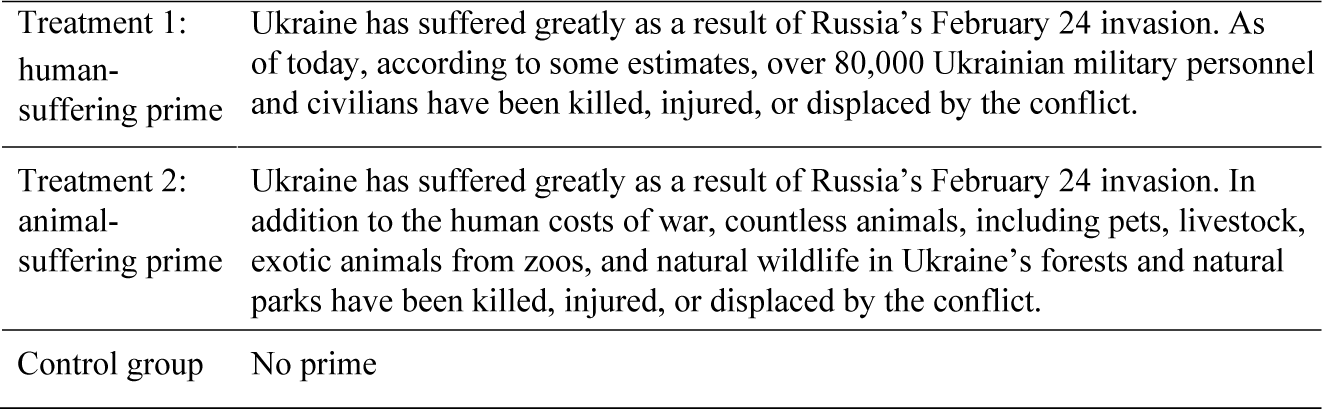
In our first experiment, we focus on the effects of priming about animal or human suffering on empathy. We randomize respondents to two treatment groups and a control group. Treatment 1 examines human dimensions of suffering with a prompt that includes estimates of Ukrainian military and civilian deaths, injuries, and displacement resulting from Russia’s February 2022 invasion. Our casualty rates were taken from official Ukrainian governmental estimates of deaths, injuries, and displacement on the Ukrainian side of the conflict, but likely understate the extent of human suffering during the war, as estimates vary widely (Cooper et al. Reference Cooper, Gibbons-Neff, Schmitt and Barnes2023). We do not consider human casualties on the Russian side of the conflict at this time, which are also largely unknown and also have wide-ranging estimates. Hence, we anticipate that the human-suffering prime encompasses largely in-group suffering among humans with a shared Ukrainian civic and ethnonational identity for most respondents in our survey.
Treatment 2 focuses on animal suffering, although we also do not have precise estimates of animal deaths, injuries, and displacement since the 2022 invasion. We do not attempt to devalue human suffering in the second treatment but rather note that “in addition to the human costs of war,” animals are suffering too. We do this to prevent a potential backlash should our treatment appear to discount the importance of human suffering. As such, treatment 2 offers a softer, less focused acknowledgment of human suffering while drawing attention to animal suffering. We also decided to approach animal suffering holistically, including not just companion animals (pets), but also livestock, animals in zoos, and wildlife in Ukraine’s forests and parks. We will consider more nuanced variations in our animal-suffering treatment in future designs, but we anticipate the more holistic prime should have the greatest likelihood of boosting empathy because it encompasses a wide range of animal suffering.
We compare both groups to a control group with no priming on animal or human suffering. We treat this as a placebo control because it is hard to imagine people in Ukraine not being aware of either human or animal suffering over the past two years, if not longer. However, priming provides an additional activation of cognitive awareness and emotional recognition of others’ suffering relative to respondents who may be both aware and sensitized to human and animal violence at baseline in the control group. The experimental treatment text is provided in figure 2 for both treatments.
Experiment 1: Empathy and Awareness of Human versus Animal Suffering
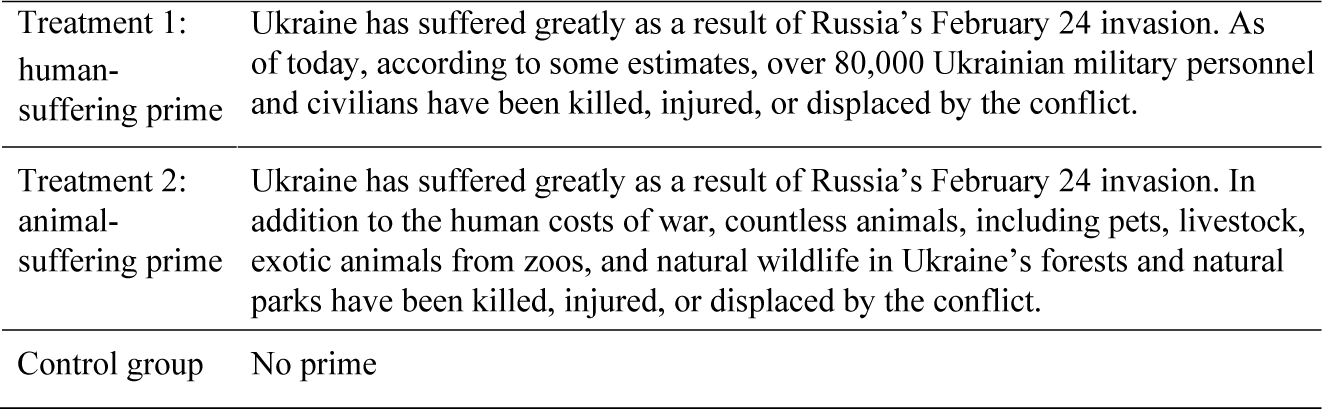
Figure 2 Long description
The table consists of three rows separated by horizontal lines.
* Row 1: Treatment 1 human-suffering prime. The text states that Ukraine has suffered greatly as a result of Russia's February 24 invasion. It notes that as of today, according to some estimates, over 80,000 Ukrainian military personnel and civilians have been killed, injured, or displaced by the conflict.
* Row 2: Treatment 2 animal-suffering prime. The text repeats the first sentence regarding the invasion and adds that in addition to human costs, countless animals, including pets, livestock, exotic animals from zoos, and natural wildlife in Ukraine's forests and natural parks have been killed, injured, or displaced.
* Row 3: Control group. The text simply states No prime.
We measure empathy through a survey item about the relative concern for human and animal suffering. We ask respondents, “Compared to the suffering of people during war, how worried are you about the suffering of animals?” Response options range from zero (more worried about animal suffering) to 10 (more worried about human suffering), with five indicating about the same level of worry for both human and animal suffering. We also include three other related outcome variables to understand possible rationalizations of anthropocentric views of suffering. The first assesses a moral-ethical motivation for greater concern for human suffering over animals. We ask respondents if they agree or disagree that “society has a moral responsibility to protect people before animals.” We also include a cognitive psychological or biological sentience rationale asking respondents if they agree or disagree that “people feel pain and suffering more than animals.” Finally, we include a key outcome measure that prioritizes the prevention of human suffering, asking people whether they agree or disagree that “protecting people during war is more important than protecting animals.” For each variable, we measure agreement from zero to 10, with zero indicating “strongly disagree,” 10 indicating “strongly agree,” and five indicating “neither agree nor disagree.” We anticipate that priming on human victimization would increase concern for human suffering, which could be justified by moral/ethical or cognitive/biological beliefs about the responsibility to protect humans over animals and concerns about greater human sensitivity to pain relative to animals. These beliefs would then reinforce agreement over the importance of prioritizing the protection of humans over animals during war. The human victimization prime should increase anthropocentric views relative to control. In contrast, priming on animal suffering should reduce speciesist beliefs relative to control, possibly by raising concern for animal suffering (empathy) or reducing anthropocentric views prioritizing moral responsibility to humans and/or heightening recognition of animal pain sensitivity.
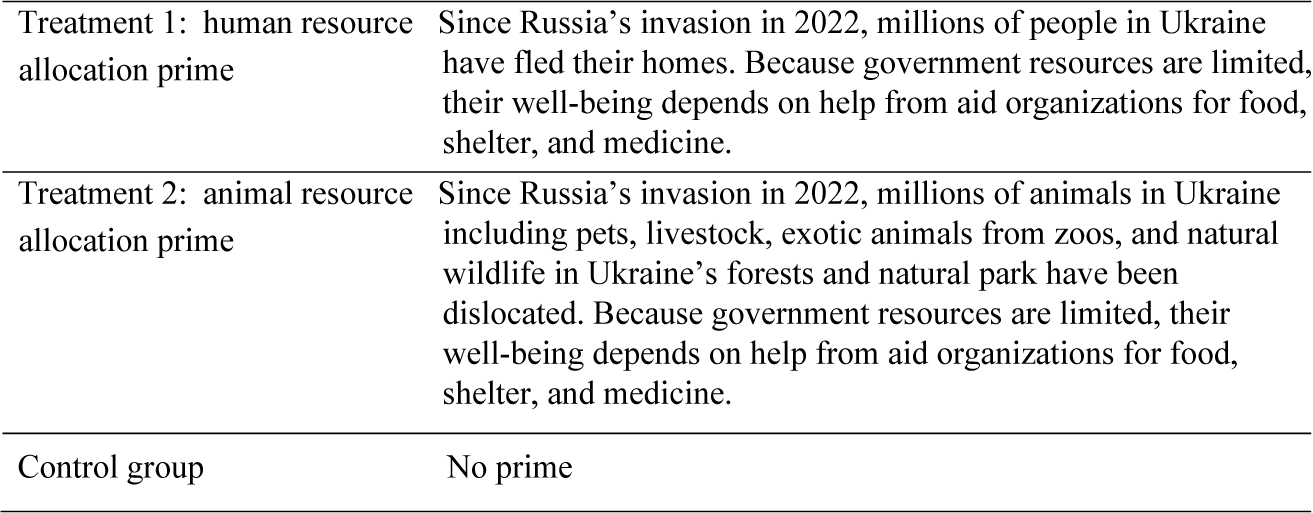
Next, we consider the consequences of priming on conflict-related human and animal suffering for resource allocation. As before, we randomize respondents to two treatment groups and a control group as shown in figure 3.
Experiment 2: Resource Allocation to Alleviate Human versus Animal Suffering
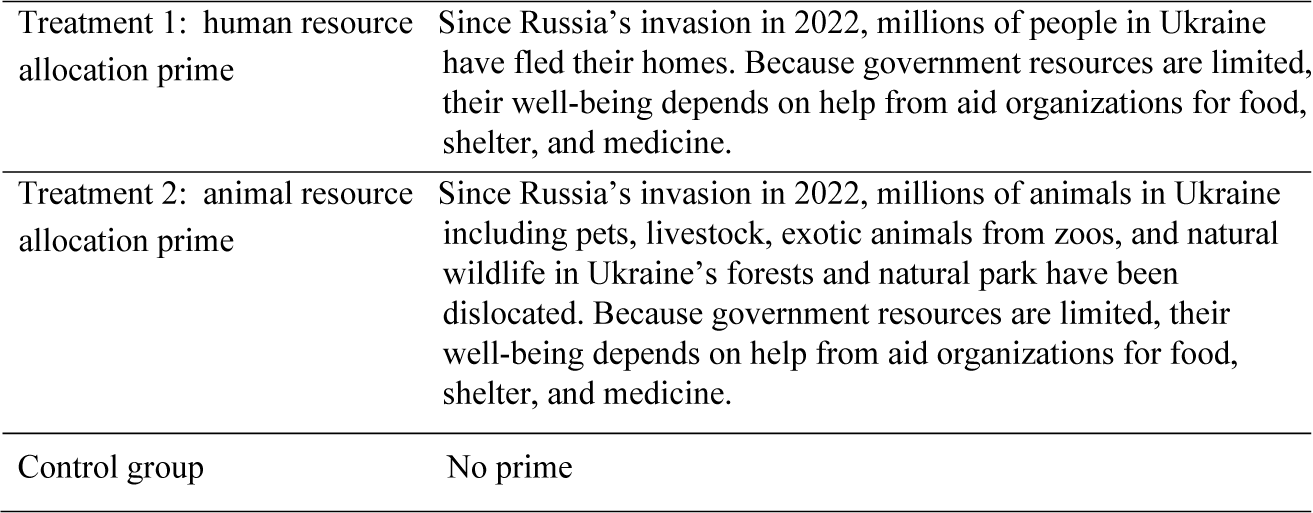
Figure 3 Long description
The table consists of three rows and two columns.
* The first row is Treatment 1: human resource allocation prime. The text states: Since Russia’s invasion in 2022, millions of people in Ukraine have fled their homes. Because government resources are limited, their well-being depends on help from aid organizations for food, shelter, and medicine.
* The second row is Treatment 2: animal resource allocation prime. The text states: Since Russia’s invasion in 2022, millions of animals in Ukraine including pets, livestock, exotic animals from zoos, and natural wildlife in Ukraine’s forests and natural park have been dislocated. Because government resources are limited, their well-being depends on help from aid organizations for food, shelter, and medicine.
* The third row is Control group. The text states: No prime.
Rather than emphasizing human casualties, treatment 1 focuses on the need for more resources to deal with widespread population upheaval following Russia’s invasion, stressing limited government resources and thus dependency on aid organizations to meet gaps in assistance. Treatment 2 takes a similar approach but emphasizes animal dislocation and reliance on aid organizations due to limited government resources. Again, our control group can be thought of as a placebo in that even people in the control group are surely aware of both human and animal suffering due to displacement and dislocation. However, the treatment groups provide additional cognitive reinforcement on either human or animal suffering relative to control.
To measure outcomes, we focus on potential empathy-generating effects of our priming on human or animal suffering. Similar to the first experiment, we ask respondents, “Compared to caring for the needs of displaced people during war, how worried are you about caring for the needs of animals?” Response options range from zero (more worried about animals) to 10 (more worried about humans), with five indicating about the same level of worry for both animals and humans. We also include an additional moral-ethical outcome variable, asking respondents if they agree or disagree that “society has a moral responsibility to provide for people before animals.” We include a cognitive-biological agency item asking if respondents agree that “people are better able to provide for themselves than animals.” In each case, response options range from zero (strongly disagree) to 10 (strongly agree), with five indicating neither agreement nor disagreement. Finally, we utilize a third-party dictator game to examine resource allocation to aid groups focusing on providing either for human or animal welfare (see Engel [Reference Engel2011] for an overview of the dictator game). Each respondent receives the following prompt:
Imagine that you are given 1,000 hryvnia to allocate between two aid organizations. One focuses on giving aid (food, shelter, medical aid) to people displaced due to the war. Another focuses on giving aid (food, shelter, medical aid) to lost and abandoned animals during the war.
We then ask respondents to decide how much of the thousand-hryvnia sum (about $25 at the time of our study) they would allocate between an organization “helping displaced persons” and an organization “helping animals.” Although the decision is hypothetical, recent studies by Masclet and Rebière (Reference Masclet and Rebière2023) indicate that qualitative differences in dictator-game allocations are consistent when randomizing respondents to real versus hypothetical decision making. In other words, while self-interest might affect the quantitative amount given to others, qualitative distinctions favoring one recipient over another are largely consistent. In our design, we also remove self-interest from consideration. The respondents do not keep any of the hypothetical sum for themselves. Also, we insist that the decision is hypothetical to avoid deception. We did not have the funding to provide aid to organizations in Ukraine. We anticipate that priming on human suffering will increase resource allocation to the human relief organization, while priming on animal suffering will increase allocation for animal relief. Concern for human versus animal suffering, beliefs about the moral responsibility to provide for humans, and/or cognitive, biological advantages favoring humans in caring for themselves could potentially influence resource allocation.
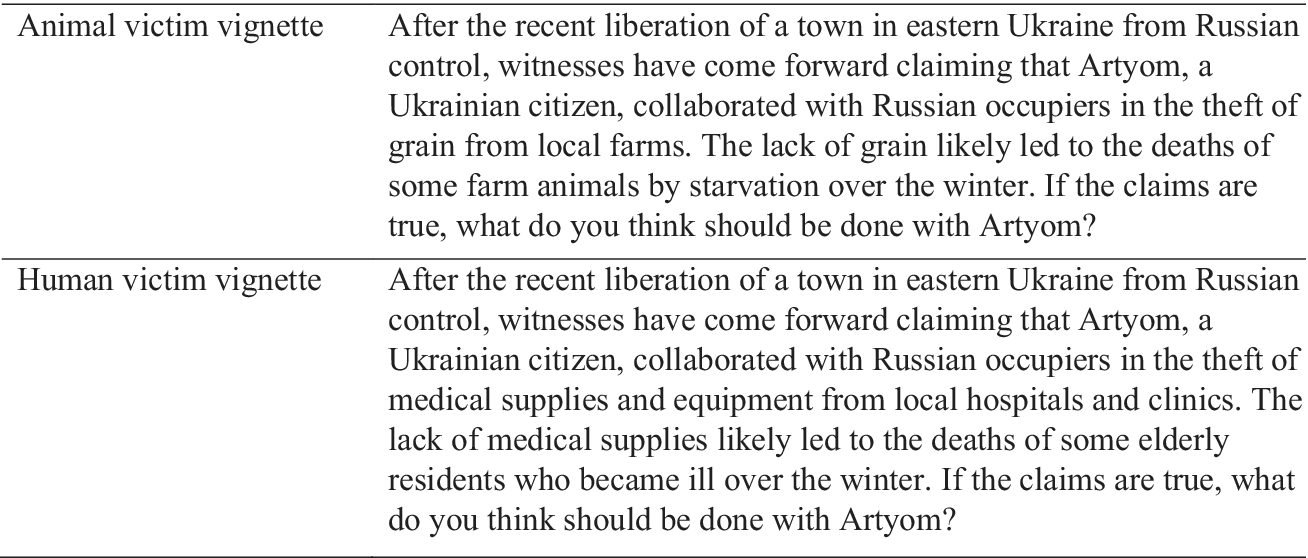
Finally, we designed a war crime punishment experiment to examine respondent views on justice and accountability for human versus animal victims of conflict-related violence. We utilize a survey vignette where a Ukrainian citizen is accused of taking actions under Russian occupation that led to the death of either animals or humans. The vignettes are shown in figure 4.
Experiment 3: Justice and Accountability

Figure 4 Long description
The table is divided into two horizontal sections separated by a line.
* Top row: Titled Animal victim vignette. The text describes the liberation of a town in eastern Ukraine from Russian control. Witnesses claim Artyom, a Ukrainian citizen, collaborated with Russian occupiers to steal grain from local farms. This theft likely caused farm animals to starve to death over the winter. It concludes by asking what should be done with Artyom if the claims are true.
* Bottom row: Titled Human victim vignette. The text is identical to the first vignette except for the specific crime and victims. It states Artyom collaborated in the theft of medical supplies and equipment from local hospitals and clinics. This lack of supplies likely led to the deaths of some elderly residents who became ill over the winter. It concludes with the same question regarding Artyom's punishment.
Each vignette focuses on a theft that resulted in the indirect death of either humans or animals, and the perpetrator in each case is a Ukrainian citizen whose actions took place under Russian occupation. As such, these actions reflect opportunism that resulted in either human or animal deaths. We ask respondents what should be done in each case, with response options ranging between one (amnesty, should be pardoned), two (short-term prison detention of less than six years), three (medium-term prison detention of six to 15 years), four (long-term prison detention of 16–25 years), five (a lifetime prison sentence), and six (the death penalty, if possible). We acknowledge that the death penalty does not exist under Ukrainian law, so the last option indicates severe retributive inclinations and suggests potential support for extrajudicial violence. Option 1 indicates no punishment is required for the action, while options 2–4 offer the possibility for eventual rehabilitation and reentry into society. Option 5 is more punitive and indicates a more retributive rather than rehabilitative conception of justice, but is less severe than a death penalty outcome. These options correspond to different conceptions of retributive versus restorative justice both in Ukraine and around the globe (see Terrill Reference Terrill2015).
In summary, our experiments engage respondents to reflect on empathy and awareness of animal suffering during violence, support for animal welfare resource allocation, and holding perpetrators of violence against animals accountable. Our preregistered hypotheses predict a baseline where respondents are predisposed to anthropocentric/speciesist views, which could be intensified or reduced through priming about human versus animal suffering. For analysis of outcome variables and hypothesis testing, we utilize ordinary least squares regression (OLS) on the following basic model:

In each experiment, the outcome variable measures a degree of anthropocentrism in terms of empathy, resource allocation, and punishment choices.Footnote 13 In the first two experiments, we compare the average treatment effect of priming on human versus animal suffering (β1 – 2) to a control group. Our preregistered hypotheses are that priming on human suffering should exert a positive effect on speciesism/anthropocentrism (H1) while priming on animal suffering will reduce speciesism/anthropocentrism relative to control (H2). In the third experiment, there are only two treatment groups, and we compare the average treatment effect of the human-suffering vignette to animal suffering on punishment choices, where anthropocentrism would predict reduced punishment in the human-suffering treatment. Though successful randomization should preclude the need for extended controls on other observed variables (Montgomery, Nyhan, and Torres Reference Montgomery, Nyhan and Torres2018), we include the possibility of pretreatment moderators (if applicable) using a vector of extended controls, including treatment interaction terms (βn). We note any changes in treatment effects when conditioning on covariates. We also indicate if treatment moderation exists, but reserve models with moderated treatment effects using interaction terms to the online appendix.
Next, to evaluate potential mechanisms in our preregistered design, we utilize a parallel design where we randomize respondents into three subgroups: a manipulation-of-mediator group (using concurrent double randomization with blockage/encouragement-discouragement manipulation to assess the X*–M*–Y pathway), a more conventional measurement-of-mediation group (to assess X*–M–Y without randomization of the mediator), and a placebo group (to evaluate X*–Y, i.e., direct effects [effects with no measured or manipulated mediation]).Footnote 14 Here, we report the direct treatment effects and consider mediation in the online appendix. We also report balance tests and sensitivity analysis in the online appendix to rule out possible anomalies in the randomization process or confounding due to selection on unobservables.
Beyond Ukraine, we examine public concern for animal welfare in Ukraine alongside cross-national data to determine how much such social attitudes are influenced by broad, universal factors versus how much they are shaped by specific conditions unique to Ukraine’s historical, cultural, and war-related context (De Vaus Reference De Vaus, Alasuutari, Bickman and Brannen2008). While causal inference can be improved upon by selecting cases that reflect either key differences in outcomes among cases that are otherwise similar or key similarities among cases that are otherwise different from one another (Przeworski and Teune Reference Przeworski and Teune1966; Ragin Reference Ragin2014), establishing causal identification at the case level remains challenging due to the “many variables, small number of cases” problem posed by Lijphart (Reference Lijphart1971, 685; see also Jackman Reference Jackman1985). Nevertheless, small-N comparison services the goals of generalizability (as well as replication) and helps to build better scope conditions for general theories of interest.
We compare public concern for animal welfare in Ukraine to neighboring Moldova and the US. Comparisons with Moldova, a bordering country with a shared Soviet cultural legacy and similar levels of economic development, and with the US, an advanced postindustrial society and economy, should help to contextualize support for animal welfare that is common to the region from what may be unique to wartime conditions. Other cultural and historical differences aside, Ukraine is currently experiencing war, while Moldova is not (notwithstanding past conflict and tensions in Transnistria). The US offers a placebo control with neither shared cultural context nor wartime experience to affect public perceptions of animal suffering.
Within Ukraine, we can also explore subcase variation in victimization experiences at the local and individual level, which gives us some leverage on how war impacts concern for animal well-being. However, we acknowledge that causal inference regarding the effects of war on public attitudes toward animal welfare is limited in both case comparisons and analysis of subcase variation. But our study marks an important initial step that can be investigated with better causal identification in future research designs.
Sampling and Randomization
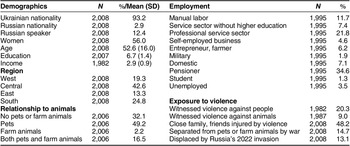
Our survey was conducted by KiiS between February 17 and 28, 2024. The sampling method consisted of CATI based on a random sample of mobile telephone numbers with 2,008 respondents aged 18 and older, who are Ukrainian citizens living in Ukraine. KiiS estimates that 96% of adults in Ukraine have access to cell phones, and Ukraine has maintained good wireless access since the start of the war. We provide summary demographics in table 1. The sample is 93.2% Ukrainian by nationality with fewer than 3% identifying as Russian, which is consistent with demographic trends away from Russian identification. A larger number (12.4%) indicated they were most comfortable speaking Russian when completing the survey. The remaining respondents were of varying ethnicity or nationality. The sample is 56% female, and KiiS provided survey weights to adjust for gender imbalances based on 2021 demographic data from the Ukrainian State Statistics Service. However, we do not claim to make population inferences because there has not been a census in Ukraine since 2001; as such, population parameters are at best rough estimates. Most respondents (90%) completed at least the 10th–11th school grade and 35% completed secondary technical school, while 44% engaged in postsecondary education. Despite the war, most respondents indicate that they have enough income for food (95.5%), but 32% acknowledge difficulty providing for basic needs beyond food, and 39% have enough for basic necessities, but not discretionary items. Correlations between income and employment reveal that pensioners, older respondents in general, and the unemployed have the most difficulty meeting basic needs. Regional distribution of respondents excludes those from the Crimea, Donetsk, and Luhansk regions, other Russian-occupied territory, and Ukrainians living abroad.
Survey Demographics

Table 1 Long description
The table is divided into two main vertical sections.
Left Section: Demographics
- Ukrainian nationality: N = 2,008, 93.2 percent.
- Russian nationality: N = 2,008, 2.9 percent.
- Russian speaker: N = 2,008, 12.4 percent.
- Women: N = 2,008, 56.0 percent.
- Age: N = 2,008, Mean 52.6, S D 16.0.
- Education: N = 2,007, Mean 6.7, S D 1.4.
- Income: N = 1,982, Mean 2.9, S D 0.9.
- Region: West 19.3 percent, Central 42.6 percent, East 13.3 percent, South 24.8 percent.
- Relationship to animals: No pets or farm animals 32.1 percent, Pets 49.2 percent, Farm animals 2.2 percent, Both 16.5 percent.
Right Section: Employment and Exposure to Violence
- Employment (N = 1,995): Manual labor 11.7 percent, Service sector without higher education 7.4 percent, Professional service sector 21.8 percent, Self-employed business 4.6 percent, Entrepreneur or farmer 6.2 percent, Military 1.9 percent, Domestic 7.1 percent, Pensioner 34.6 percent, Student 1.3 percent, Unemployed 3.5 percent.
- Exposure to violence: Witnessed violence against people 20.3 percent, Witnessed violence against animals 9.0 percent, Close family or friends injured by violence 48.2 percent, Separated from pets or farm animals by war 14.7 percent, Displaced by Russia's 2022 invasion 13.1 percent.
Demographic items relevant to animal welfare indicate that a majority of respondents have companion animals (pets, 49.2%) or both pets and farm animals (16.5%), while about one-third (32.1%) have neither pets nor farm animals. In terms of conflict exposure, one in five respondents have witnessed conflict-related violence causing physical or psychological harm to other people, while 9% report witnessing some harm to animals. Nearly half the sample (48.2%) report experiencing either personal injury or the injury or death of close family members and friends since Russia’s 2022 invasion, 13.1% have been internally displaced by the violence in Ukraine (as opposed to displacement abroad), and nearly 15% report that they were either temporarily or permanently separated from pets or farm animals during the war. Correlates of conflict exposure, reported in the online appendix, indicate that men, younger respondents, those in the military, poorer respondents, and those from the eastern regions of Ukraine are more likely to have witnessed violence against people and animals and are more likely to be displaced. In addition to those correlates, farmers are more likely to have lost animals since the war began. We also report balance tests on each experiment in the online appendix, which show that randomization was successful on observed demographics. The sample is well balanced across all treatment and control groups.
Finally, our research follows American Political Science Association guidelines for the ethical conduct of research, which we discuss in greater detail in the online appendix. Our research received institutional review board approval, and no adverse events were reported during data collection.
Results
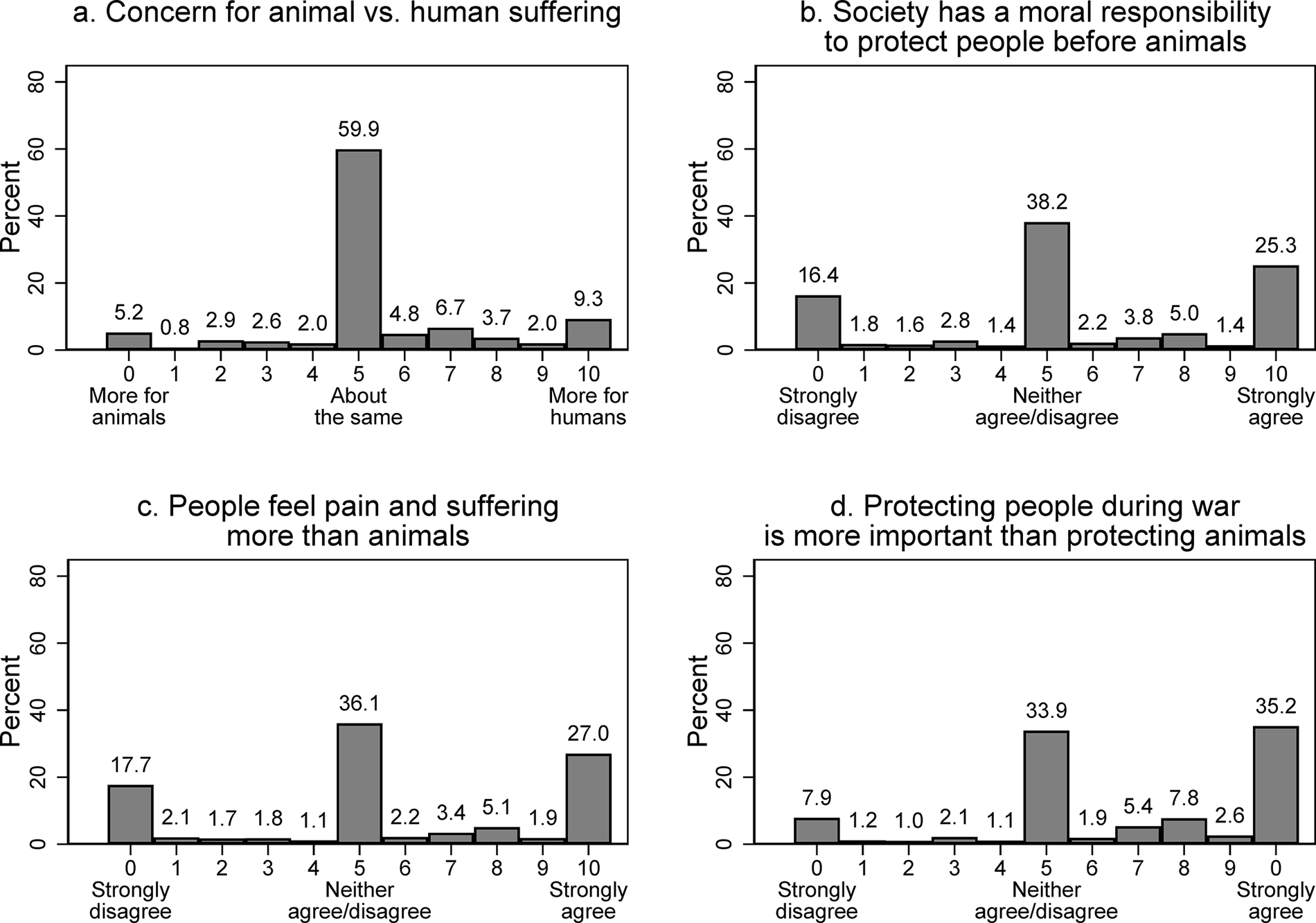
We begin with an overview of the outcome variables in experiment 1, which focuses on the relationship between human and animal suffering and empathy. Figure 5 provides a basic overview of the distribution of responses on key outcome variables. First, people are divided on concern for the suffering of animals relative to humans. In figure 5a, the majority of respondents indicate equal concern for both human and animal suffering based on responses to the question, “Compared to the suffering of people during war, how worried are you about the suffering of animals?” Just over 13% claim they are more concerned about animal suffering, while 26.5% are more concerned about human suffering. Other outcome measures show greater division on whether “society has a moral responsibility to protect people before animals” (figure 5b), whether “people feel pain and suffering more than animals” (figure 5c), and whether “protecting people during war is more important than protecting animals” (figure 5d). With the exception of figure 5d, a plurality of respondents display attitudes consistent with greater eco/biocentrism or posthumanism (equal empathy for animals and humans) than anthropocentrism/human exceptionalism, extreme speciesism (more empathy for humans than animals), or zoocentrism or anti-speciesism (more empathy for animals than humans).Footnote 15
Experiment 1: Human versus Animal Empathy (Outcome Variables)

Figure 5 Long description
A four-panel set of bar charts labeled a through d. Each chart has a Y-axis representing Percent from 0 to 80 and an X-axis with a scale from 0 to 10.
Panel a. Concern for animal versus human suffering. The X-axis ranges from 0 (More for animals) to 5 (About the same) to 10 (More for humans). A dominant peak occurs at 5 with 59.9 percent. Other values are low, ranging from 0.8 to 9.3 percent.
Panel b. Society has a moral responsibility to protect people before animals. The X-axis ranges from 0 (Strongly disagree) to 5 (Neither agree or disagree) to 10 (Strongly agree). There are three main peaks: 16.4 percent at 0, 38.2 percent at 5, and 25.3 percent at 10.
Panel c. People feel pain and suffering more than animals. The X-axis scale is the same as panel b. Peaks occur at 0 (17.7 percent), 5 (36.1 percent), and 10 (27.0 percent).
Panel d. Protecting people during war is more important than protecting animals. The X-axis scale is the same as panel b. Peaks occur at 0 (7.9 percent), 5 (33.9 percent), and 10 (35.2 percent).
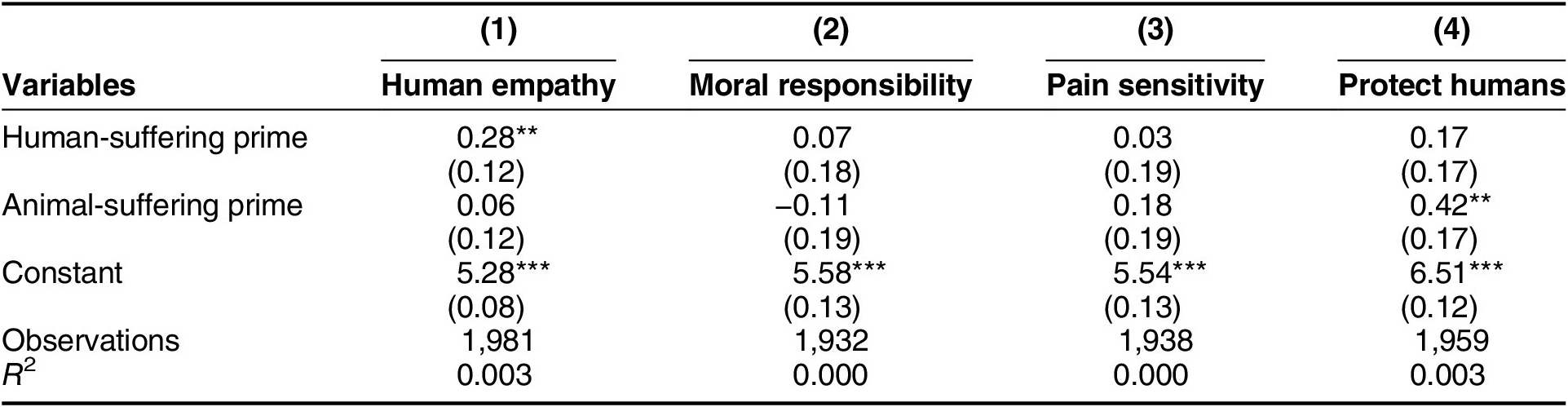
Next, we focus on how the response distribution of each outcome variable is affected by experimental priming on human and animal suffering relative to control. In table 2, we report average treatment effects using OLS regression where the baseline (constant) comparison is the control group.Footnote 16 Overall, we find only modest treatment effects for priming on both human and animal suffering and empathy-related items. Specifically, priming on human suffering led to a small increase in human empathy relative to control in model 1 (Cohen’s d = 0.13, two-sample Wilcoxon test z = 2.47, p = 0.014) and respondents reacted negatively to priming on animal suffering in model 4, which resulted in a modest increase in support for efforts to protect humans relative to animals (Cohen’s d = 0.14, two-sample Wilcoxon test z = 2.56, p = 0.011). In both cases, the effect size measured by Cohen’s d is relatively small (d < 0.20), indicating that reminding people about both human and animal suffering amid conflict has relatively limited influence on empathy-related attitudes or desire to protect humans or animals from harm. It also does not affect perceptions of moral responsibility or awareness of pain sensitivity in either humans or animals.
Experiment 1: Human versus Animal Empathy (OLS Regression)
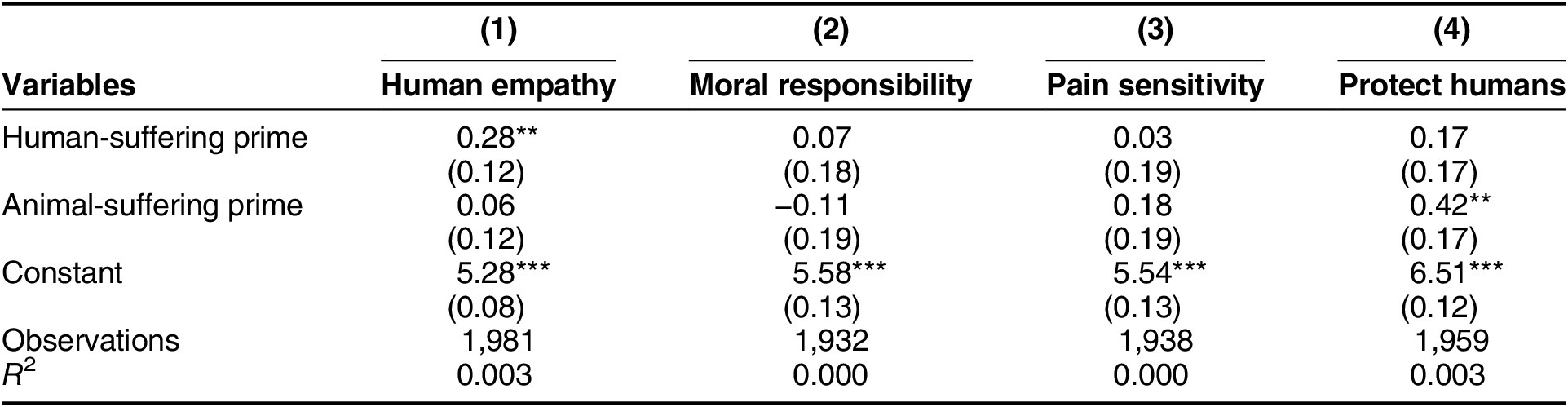
Table 2 Long description
The table presents O L S regression results for Experiment 1. The columns are numbered 1 through 4, corresponding to the dependent variables: Human empathy, Moral responsibility, Pain sensitivity, and Protect humans.
Row 1: Human-suffering prime.
- Column 1: 0.28 with a standard error of 0.12, significant at p < 0.05.
- Column 2: 0.07 with a standard error of 0.18.
- Column 3: 0.03 with a standard error of 0.19.
- Column 4: 0.17 with a standard error of 0.17.
Row 2: Animal-suffering prime.
- Column 1: 0.06 with a standard error of 0.12.
- Column 2: minus 0.11 with a standard error of 0.19.
- Column 3: 0.18 with a standard error of 0.19.
- Column 4: 0.42 with a standard error of 0.17, significant at p < 0.05.
Row 3: Constant.
- Column 1: 5.28 with a standard error of 0.08, significant at p < 0.01.
- Column 2: 5.58 with a standard error of 0.13, significant at p < 0.01.
- Column 3: 5.54 with a standard error of 0.13, significant at p < 0.01.
- Column 4: 6.51 with a standard error of 0.12, significant at p < 0.01.
Row 4: Observations.
- Column 1: 1,981.
- Column 2: 1,932.
- Column 3: 1,938.
- Column 4: 1,959.
Row 5: R-squared.
- Column 1: 0.003.
- Column 2: 0.000.
- Column 3: 0.000.
- Column 4: 0.003.
Notes: Robust standard errors in parentheses. *** p < 0.01; ** p < 0.05; * p < 0.1.
Beyond direct treatment effects, we do not find evidence of extensive speciesist or anthropocentric views among respondents. We anticipate this is likely due to widespread awareness and recognition of animal and human suffering since the war began. At this point, people are likely settled into biocentric, zoocentric, or anthropocentric cohorts, which vary across key demographics and attitudes held by respondents in the sample. In the online appendix, we provide extended controls that anthropocentric views are lower among pet owners than livestock owners or those with no animals, lower among women, and greater among older respondents, which is consistent with Cornish, Raubenheimer, and McGreevy (Reference Cornish, Raubenheimer and McGreevy2016). Other controls for conflict-related victimization, education, income, and employment, as well as regional effects, are not consistently significant across our models. We also find that animal empathy, beliefs about the moral responsibility to protect animals, concern about animal pain sensitivity, and desire to protect animals from harm are all positively intercorrelated. In the online appendix, we provide additional robustness checks including balance tests, sensitivity analysis, and power estimations. Mediation analysis in the online appendix also shows that treatment effects in models 1 and 4 are driven by the reactions of compliers and noncompliers to randomized encouragement/discouragement manipulations on animal versus human empathy in treatment subgroups. Anthropocentrists, in particular, intensify their views when met with encouragement or discouragement of their prior beliefs about the primary importance of human suffering during violence.
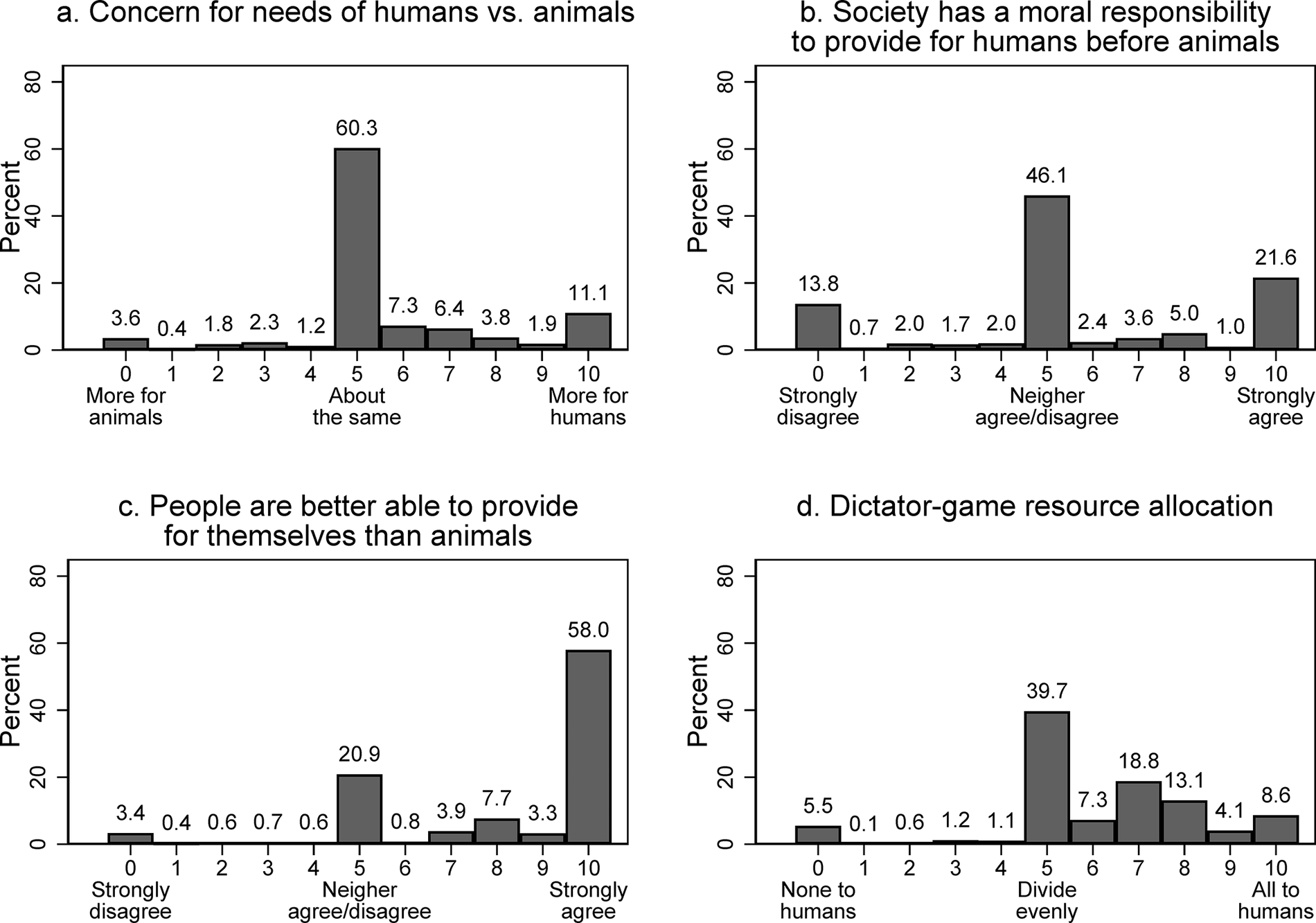
So far, we have found limited effects of awareness-raising about human or animal suffering on empathy-related outcomes. In our second experiment, we focus on the impact of priming on resource allocation to human versus animal charitable aid. Figure 6 provides response distributions for four items. We find comparable response distributions on concern for the needs of humans relative to animals, as we did with empathy previously. In figure 6a, a majority responded biocentrically to the question, “Compared to caring for the needs of displaced people during war, how worried are you about caring for the needs of animals?” with 60% indicating the same level of worry. We also find that a plurality are neutral on whether “society has a moral responsibility to provide for people before animals” in figure 6b. In contrast, respondents have a more anthropocentric view of self-help capabilities, where 58% strongly agree that “people are better able to provide for themselves than animals” in figure 6c. Finally, dictator-game resource allocations range from the full amount for human welfare (8.6%) to the full amount for animal welfare (5.5%).Footnote 17 Overall, 51.9% gave more to humans than animals, 39.7% allotted resources equally, and 8.4% allotted more to animal welfare than human welfare, indicating a broadly anthropocentric inclination toward human needs among respondents (figure 6d).
Experiment 2: Human versus Animal Resource Allocation (Outcome Variables)

Figure 6 Long description
A four-panel figure labeled a through d. Each panel uses a Y-axis representing Percent from 0 to 80 and an X-axis with a scale from 0 to 10.
Panel a, Concern for needs of humans versus animals. The X-axis ranges from 0 (More for animals) to 10 (More for humans). A dominant peak occurs at 5 (About the same) at 60.3 percent. A secondary smaller peak is at 10 with 11.1 percent. Other values range from 0.4 to 7.3 percent.
Panel b, Society has a moral responsibility to provide for humans before animals. The X-axis ranges from 0 (Strongly disagree) to 10 (Strongly agree). The highest bar is at 5 (Neither agree/disagree) at 46.1 percent, followed by 10 at 21.6 percent and 0 at 13.8 percent.
Panel c, People are better able to provide for themselves than animals. The X-axis ranges from 0 (Strongly disagree) to 10 (Strongly agree). The distribution is heavily skewed toward 10 with 58.0 percent. A smaller peak exists at 5 with 20.9 percent. Values for 0 through 4 are all below 4 percent.
Panel d, Dictator-game resource allocation. The X-axis ranges from 0 (None to humans) to 10 (All to humans). The primary peak is at 5 (Divide evenly) at 39.7 percent. Significant bars also appear at 7 (18.8 percent) and 8 (13.1 percent). Only 5.5 percent chose 0 and 8.6 percent chose 10.
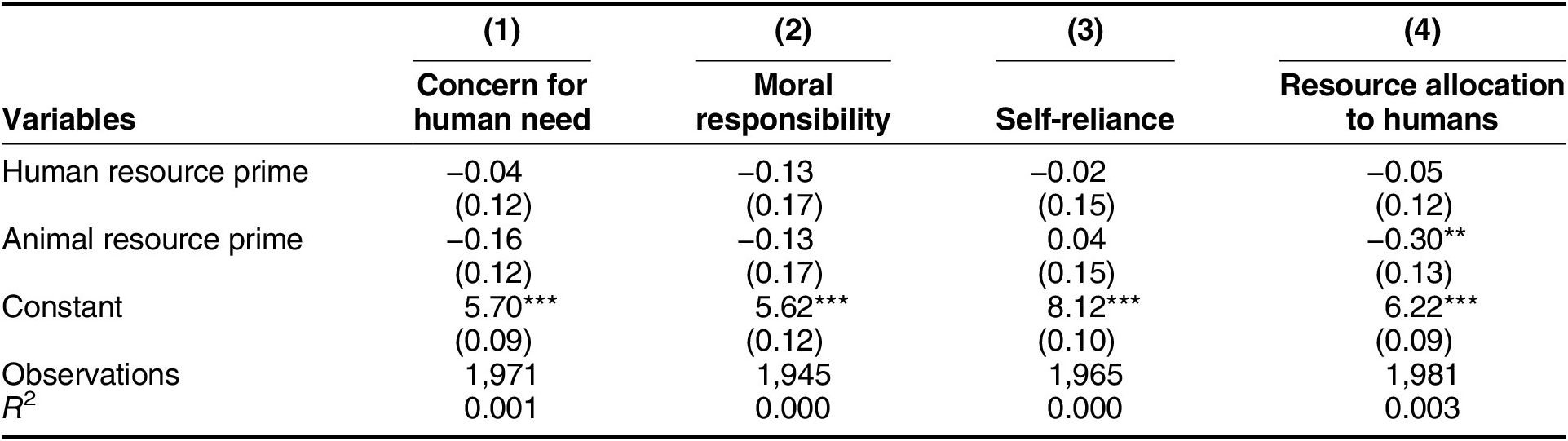
Next, we examine the treatment effects of priming on human and animal suffering for resource allocation. As with empathy, we see no clear movement on priming about human or animal suffering in terms of concern for the needs of humans versus animals (table 3, model 1), beliefs about the moral responsibility to provide for humans (model 2), or understandings of human versus animal capabilities of self-reliance (model 3). Finally, in table 3, model 4, we find a reduction in resource allocation away from human and toward animal welfare organizations when priming on animal suffering relative to control. The dependent variable here is the amount allocated for human welfare, ranging from zero to 10. Again, however, the overall treatment effect size is small (Cohen’s d = 0.13, two-sample Wilcoxon text z = 1.957, p = 0.050), indicating that the movement was relatively modest in the direction hypothesized by H2. We find no support for H1 on human-suffering priming affecting resource allocation. As with empathy, we also found that extended controls for gender showed reduced anthropocentrism among women and owners of companion animals, consistent with Cornish, Raubenheimer, and McGreevy (Reference Cornish, Raubenheimer and McGreevy2016). Also, concern for animal welfare, a belief in the moral responsibility to care for animals, and a belief that humans are more capable of self-help/self-reliance than animals correlate positively with allocating resources to animal welfare. Models with extended controls are available in the online appendix, alongside balance tests, sensitivity analysis, power calculations, and other robustness checks.
Experiment 2: Human versus Animal Resource Allocation (OLS Regression)
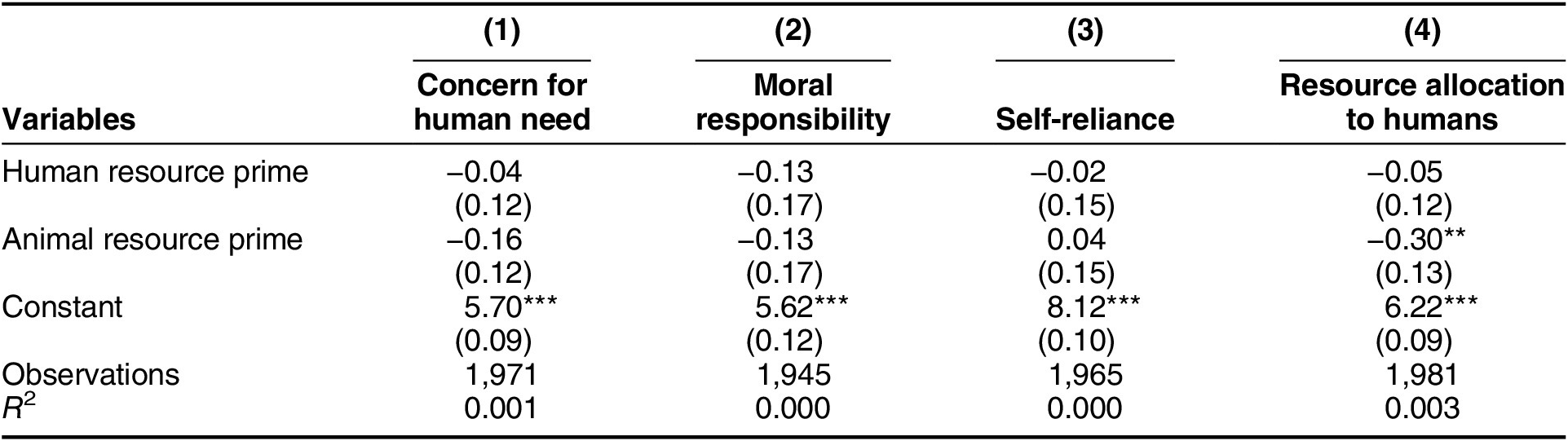
Table 3 Long description
The table presents O L S regression results for Experiment 2. The columns represent four dependent variables: 1 Concern for human need, 2 Moral responsibility, 3 Self-reliance, and 4 Resource allocation to humans.
Row 1: Human resource prime. Coefficients are -0.04 for column 1, -0.13 for column 2, -0.02 for column 3, and -0.05 for column 4. Standard errors range from 0.12 to 0.17.
Row 2: Animal resource prime. Coefficients are -0.16 for column 1, -0.13 for column 2, 0.04 for column 3, and -0.30 for column 4. The coefficient for column 4 is statistically significant at p < 0.05.
Row 3: Constant. Values are 5.70 for column 1, 5.62 for column 2, 8.12 for column 3, and 6.22 for column 4. All constants are significant at p < 0.01.
Bottom Rows: Observations range from 1,945 to 1,981 across models. R-squared values are very low, ranging from 0.000 to 0.003. Robust standard errors are provided in parentheses below each coefficient.
Notes: Robust standard errors in parentheses. *** p < 0.01; ** p < 0.05; * p < 0.1.
In summary, as with empathy, we find respondents divided into zoocentric, biocentric, and anthropocentric cohorts that show limited reaction to experimental priming. However, a larger segment than anticipated exhibited biocentric behavior on resource allocation in our preregistration. In the online appendix, we show that the direct treatment effect in model 4 of table 3 can be attributed to discouragement/encouragement effects of human versus animal welfare concern in a manipulation-of-mediator subgroup randomization. The reduction in anthropocentric giving in model 4 is driven by noncompliers in an anthropocentric discouragement subgroup and compliers in biocentric/zoocentric subgroups. In other words, people of different inclinations (anthropocentric, biocentric, or zoocentric) appear somewhat stubborn. They can be “nudged” experimentally in the direction of their attitudes and behavior, but tend to resist priming that challenges their concern for human versus animal welfare.
In our final experiment, we turn to questions of justice and accountability for crimes that resulted in human or animal suffering. We asked respondents whether or to what degree perpetrators of actions during the conflict that resulted indirectly in the death of either humans or animals should be punished. Figure 7 reports the distribution of punishment choices where the treatment either involves the death of animals or the death of humans. The modal response in the animal victim treatment is short-term incarceration (less than six years) compared to medium-term incarceration (six to 15 years) for the human victim treatment. While few people chose extreme options of complete amnesty or severe punishments such as the death penalty, the distribution shows that respondents handed down harsher punishments for actions leading to human deaths than animal deaths (two-sample t-test = 6.1, p < 0.0001). A nonparametric equality-of-medians test is also significant when comparing punishments for human deaths relative to animal deaths (Pearson’s chi-squared = 25.1, p < 0.001). The effect size is larger than we have observed in previous experiments and should be considered a moderate treatment effect (Cohen’s d = 0.29). In ordered probit regression analysis, reported in the online appendix, we do not see gender, age, or pet ownership effects on punishment choices as before. Instead, we find that people who have personally experienced conflict-related injuries or have family and close friends who were injured or killed since Russia’s 2022 invasion select greater punishment in both human and animal treatments. In contrast, people who identify primarily as Russian-language speakers select lesser punishments than those who identify as Ukrainian speakers, though controls for Russian ethnicity or nationality were not significant. Finally, education is associated with lesser punishment in both treatments, while people who are employed in farming are less punitive in the animal victim treatment than in the human victim treatment compared to people of other employment backgrounds, which appears consistent with findings from Cornish, Raubenheimer, and McGreevy (Reference Cornish, Raubenheimer and McGreevy2016).Footnote 18 In summary, results indicate stronger punishments for crimes involving human rather than animal victims, but we do not see the differences rising to the level of speciesism. Respondents show concern for animal victimization and for ensuring justice and accountability in their overall punishment decisions.
Experiment 3: Human versus Animal Punishment Decisions (Outcome Variables)

Figure 7 Long description
Two panels show the percentage of punishment decisions. Both charts share a Y axis labeled Percent ranging from 0 to 40 and an X axis with six categories: Amnesty, Short-term prison, Medium-term prison, Long-term prison, Life in prison, and Death penalty.
Left Panel: Animal victims prime.
* Amnesty: 3.1 percent.
* Short-term prison: 31.1 percent.
* Medium-term prison: 28.8 percent.
* Long-term prison: 13.2 percent.
* Life in prison: 13.1 percent.
* Death penalty: 10.6 percent.
Right Panel: Human victims prime.
* Amnesty: 1.8 percent.
* Short-term prison: 17.3 percent.
* Medium-term prison: 32.1 percent.
* Long-term prison: 16.9 percent.
* Life in prison: 17.6 percent.
* Death penalty: 14.2 percent.
We conclude by comparing results from our study to cross-national data from two additional cases: Moldova and the US. Data collection was completed in Moldova in February 2025 (N = 1,000) using CATI methodology and in the US in January 2025 (N = 1,360) using a representative online sample (see the online appendix for more details). In both surveys, we asked respondents, “Compared to the suffering of people during war, how worried are you about the suffering of animals?” with response options on an 11-point scale with increasing concern for animal welfare. Kernel density plots and histograms in figure 8 indicate that response distributions vary between Ukraine and the other two cases. Ukrainians are less likely to hold anthropocentric views favoring human over animal welfare than people in Moldova and the US (27.5% vs 36.8% and 35.3% respectively). Though Ukrainians are not more zoocentric than in the comparison cases, they are more likely to view animal versus human suffering with equal concern (59.1% versus 33.0% and 39.4%, respectively). Hence, rather than amplifying speciesism, Ukrainians have sustained a remarkably balanced, biocentric view of wartime suffering in response to Russia’s invasion.
Concern for Animal Suffering during War in Comparative Perspective

Figure 8 Long description
The image consists of two panels.
Left Panel: A kernel density plot titled Concern for Animal versus Human Suffering. The y-axis is labeled Kernel density plot with values from 0 to 1.5. The x-axis ranges from 0 to 10, where 0 is More for animals, 5 is About the same, and 10 is More for humans.
- Ukraine (solid line) shows a sharp, high peak at 5, reaching approximately 1.4, with minor fluctuations elsewhere.
- Moldova (long-dashed line) shows a broad, low peak centered around 5, reaching approximately 0.2.
- United States (short-dashed line) shows a slightly higher broad peak centered around 5, reaching approximately 0.3.
Right Panel: Three vertical bar charts labeled Percent on the y-axis (0 to 80) and categorized by country.
- Ukraine: Zoocentric is 13.4 percent, Equal/Biocentric is 59.1 percent, and Anthropocentric is 27.5 percent.
- Moldova: Zoocentric is 30.2 percent, Equal/Biocentric is 33.0 percent, and Anthropocentric is 36.8 percent.
- United States: Zoocentric is 25.3 percent, Equal/Biocentric is 39.4 percent, and Anthropocentric is 35.3 percent.
Discussion and Conclusion
Russia’s war against Ukraine has inflicted devastating trauma on both humans and animals. While we cannot say whether the invasion has significantly changed orientations toward human versus animal suffering in Ukraine because we lack the prewar baselines needed to make a comparison, our study illustrates how Ukrainians display considerable empathy and concern for the welfare of animals relative to humans during a brutal war. The Ukrainians we surveyed also show a strong willingness to hold perpetrators of violence against animals accountable to justice. We find broad support within the Ukrainian public for a posthumanist understanding of animal welfare.Footnote 19
In our initial preregistration, we anticipated greater baseline anthropocentric attitudes and behavior, and that priming on human suffering during the war would increase those baselines, while priming on animal suffering would reduce them. We also anticipated greater conflict-related effects where victimization during war could heighten speciesist orientations toward human needs and human suffering, consistent with theorizing on human responses to violence in the literature (see Bauer et al. Reference Bauer, Blattman, Chytilová, Henrich, Miguel and Mitts2016). In contrast to those expectations, we find a remarkably balanced biocentric or ecocentric awareness of human and animal suffering among most Ukrainians. Many Ukrainians do not see a trade-off between caring and providing for humans and animals, though we were careful to frame our priming on animal suffering in a way that did not neglect or appear to discount human suffering during the war. Ukrainians also support punishing perpetrators for actions that inflict harm on animals, suggesting that the public supports expanding conceptions of war crimes to include animal neglect and willful cruelty.
Hence, we find that Ukrainians care about animals and are willing to devote resources to improve their welfare. Treatments encouraging further speciesism or concern for animal well-being were weak or ineffective at moving opinion.Footnote 20 One possibility we consider is that CATI surveys, where short primes are read over the phone to respondents, are prone to weak treatment effects, and other venues with greater visual priming, for example, might yield stronger treatment effects. We consider this a potential mode effect and recommend mixed-mode designs for future research (Vannieuwenhuyze, Loosveldt, and Molenberghs Reference Vannieuwenhuyze, Loosveldt and Molenberghs2010). Another possibility is that priming is affected by prior awareness, strength, and repetition (Molden Reference Molden2014). While repetition promotes awareness (as in advertising), excessive repetition leads to habituation or neural adaptation, reducing responsiveness over time and diminishing returns with repeated exposures due to cognitive fatigue (Grill-Spector, Henson, and Martin Reference Grill-Spector, Henson and Martin2006). In the context of Ukraine, treatment effects could be weak because respondents have been repeatedly primed about both human and animal suffering since the war began, leading to habituation. News reports from Ukraine are replete with depictions of not only human and animal suffering but also of Ukrainians caring for animals during the war.Footnote 21
Beyond Ukraine, our results speak to the potential for a broadly posthumanist understanding of suffering during war. Concern for animal welfare is an emerging social norm that is increasingly found beyond the postmaterialist societies of Western Europe and appears to cross cultural boundaries (Parlasca et al. Reference Parlasca, Knößlsdorfer, Alemayehu and Doyle2023; Sinclair et al. Reference Sinclair, Lee, Hötzel, de Luna, Sharma, Idris and Derkley2022). Our results also confirm what others have found cross-culturally, including that posthumanist views are correlated with gender (women more than men), age (young more than old), and contact with animals (see Cornish, Raubenheimer, and McGreevy Reference Cornish, Raubenheimer and McGreevy2016; Mata, Soares, and Cerqueira Reference Mata, Araujo, Soares and Cerqueira2022).
Our study shows that war need not heighten anthropocentrism or speciesism or further erode norms regarding the treatment of animals. Instead, war could serve as a call to action rallying the public, activist networks, civil society organizations, and political elites to move closer toward the foundational goals of the Universal Declaration of Animal Rights to increase visibility and awareness of animal suffering during violence, and to hold perpetrators of animal suffering accountable for the harm they cause to animals and the environment more broadly. For animal rights groups, our study shows how an approach that both recognizes dimensions of human suffering while raising awareness of the plight of animals in a holistic, biocentric, or posthumanistic manner should be more effective than a zoocentric or anti-speciesist framing, which will likely face greater resistance. There might also be advantages to pairing human and animal relief in order to increase resource allocation to both in tandem.
We urge scholars to build upon our initial findings in other conflict-affected environments to broaden our understanding of how societies respond to conflict-related animal violence worldwide.Footnote 22 Specifically, we hope that others will explore questions of animal agency and potential contingencies in empathy for animal suffering. For example, does concern for animal suffering extend to animals utilized in conflict by hostile forces as agents of violence against humans? Or is animal concern only one sided—that is, is it in the service of in-group rather than out-group human means and ends? We encourage others to explore this important question.
More broadly, a future research agenda on animal rights during war should address several key areas of theoretical, empirical, and policy consideration. First, we call for greater attention to ethical frameworks for animal rights in war in relation to human rights and humanitarianism. We also encourage more work on legal recognition and protection of animals in armed conflict, focusing on how international humanitarian law can better incorporate protections for animals during wartime. Second, we support greater comparative and interdisciplinary approaches that evaluate historical and contemporary conflicts to understand how attitudes toward animals in war have evolved. Specific areas of empirical interest may include the role of animals in wartime displacement and how humanitarian organizations aid both humans and animals caught in war zones, analyzing the effects of war on wildlife, ecosystems, and biodiversity loss, considering both direct (e.g., bombings) and indirect (e.g., habitat destruction) consequences. More attention is also needed to understand the mechanisms driving differential regard for human versus animal welfare beyond our initial efforts to explore them in this manuscript. For example, context is important for understanding how animals are perceived by humans. As one reviewer correctly noted, “animal agency is not uniform, which makes the question of which specific animals are being discussed pertinent.”Footnote 23 Our main focus here is less about animal agency than representations of animal suffering. Representations of animals as victims could elicit less speciesism in human responses than representations of animals as perpetrators of violence. As such, we recommend greater attention to the role that animals play in military operations, including the ethical and legal implications of combat animals and their postwar care and rehabilitation. Finally, we encourage reflection on how public perceptions of animals in war could influence policy making. We encourage collaboration across disciplines (law, political science, environmental studies, animal rights) to develop comprehensive solutions, establishing frameworks for postwar ecological restoration. We also see pathways where advocacy groups could influence international law and policy on animal protection during war. By addressing these areas of inquiry, future research can contribute to a more posthumanist understanding of war trauma that acknowledges the suffering and agency of animals and recognizes the importance of their welfare.
Supplementary material
To view supplementary material for this article, please visit http://doi.org/10.1017/S1537592725101862.
Acknowledgments
The authors wish to thank Eugen Ilenko and Yulia Sakhno at KiiS in Ukraine, Angela Cijevschi in Moldova, and the Dynata team in the US for invaluable help with data collection. We also thank the editors and reviewers at Perspectives on Politics for their guidance, support, and many helpful comments, as well as Lyn Flight for copyediting. Any errors are ours alone.
Data replication
Data replication sets are available in Harvard Dataverse at: https://doi.org/10.7910/DVN/KRU17D.