

But reason and science have always performed, and still perform, only an auxiliary function in the life of peoples, and it will be like that till the end of time. Nations are formed and moved by some other force whose origin is unknown and unaccountable … Footnote 1
To be interested in thinking how we learn about thinking is a condition for politics (including ethics), theology, and metaphysics alike.Footnote 2
I Introduction: Sacred Foundations
If a world is to be lived in, it must be founded.Footnote 3 This foundational function belongs to the sovereign imagination. What a polity names as sovereign in the state of exception, when the sacred irrupts anew, is a matter of individual and collective responsibility. In this dispensation, law, politics, and religion become inescapably entangled in metaphysics. It behooves us to understand the nature and consequences of this state of affairs.
Throughout history the human mind has sought knowledge from the beginning of things. Mircea Eliade used the phrase “Illud Tempus,” the beginning time, to describe “the stupendous instant in which a reality was created.”Footnote 4 This is the moment at which foundational narratives call into being a nomos, a living legal reality, the emergence of a world. The beginning time marks the time of the sacred – that uncanny source of immeasurable abundance out of which a world of meaning emerges. Rudolf Otto called it the “numinous.” Standing before the numinous as it shimmers in a place, a text, or an image, we sense a strange excess, the presence of something immanent, as yet unseen in the visible world. The numinous radiates an inexpressible intensity. We shudder in wonder, or terror, at its absolute otherness.Footnote 5 The Event of the sacred calls out to us – for naming.
One senses in the sacred, for both law and religion, a curious bond between the bounded and the boundless. As the great American poet Wallace Stevens wrote: “A violent order is disorder; and a great disorder is an order. These two things are one.”Footnote 6
On the threshold of that impossible polarity, it is as if (to cite another of Stevens’ lines) “an inhuman order” sounds on the evening air, as if a singer’s song were “fluttering its empty sleeves,” making a place for being – there, in the song the singer sings – even as the threshold on which we stand to hear it comes no closer to its source: for the song makes the sky “acutest at its vanishing.”Footnote 7 That vanishing point marks the threshold of the sacred.
In law, the paradox of form and spirit, order and disorder, structure and anti-structure, arises under the rubric of sovereignty. Sovereignty directs us to an ultimate authority for law that lies outside law itself. As Harold Berman has written: “Law – in all societies – derives its authority from something outside itself.”Footnote 8 Or as Jacques Derrida more recently put it: “The positing or establishing of law or right are exceptional and are in themselves neither legal nor properly juridical.”Footnote 9
As the concept of sovereignty emerged in the sixteenth century, it came to describe the absolute power of the ruler of the state. This power was generally thought to reside in the office of the king,Footnote 10 but it also could be held by the nobility, or the people.Footnote 11 Regardless of where its power lay, however, sovereignty was conceived as indivisible, absolute, unlimited. In this sense, it transcended positive (or written) law as such.Footnote 12 To command in the name of the state without the authority of the sovereign lacks legitimacy. If such a state of affairs were to persist, the rottenness at the core of things would fester and spread, and the state ultimately would most likely fail.Footnote 13
To be sure, positive rules may generate and sustain valid legal systems. Rules demand obedience. To this extent, the power of the state is on their side. But extralegal values and beliefs aligned with a sovereign source of authority go beyond formal validity. What is sovereign renders law legitimate. Higher values and beliefs inspire acceptance of the rules of law as “right” and “good.” This sense of “rightness” goes beyond fear of disobedience as a basis for accepting law’s commands. In this sense, the legitimacy that comes with higher values transmutes validity (based on fear of “the gunman writ large,” as legal positivist H. L. A. Hart put it)Footnote 14 into moral significance (law’s rightful authority as a warrant for respectful acceptance). In short, with legitimacy comes belief, and from belief comes fidelity to the rule of law.Footnote 15
In a reflection on Kafka’s modern parable, “Before the Law,” Gershom Scholem once noted that under conditions of “validity without significance” legitimacy becomes but a rumor.Footnote 16 For Scholem, this encounter with the dead spirit of the law describes the nothingness of revelation, the zero point of law and politics, a legal space in which the Nothing appears. This begins to describe the metaphysics of nihilism, a topic to which we will return.
For now, let us take as our point of departure the irruption of the sacred, that numinous, irreducible excess – evident in Durkheim’s “collective effervescence”Footnote 17 or Weber’s “charisma”Footnote 18 – which animates and binds us to law beyond the merely formal claims of validity that a given legal system may demand. In the premodern era, one associates this excess with the divine right of kings. In the modern era, we associate it with the rise of popular sovereignty and the nation state.Footnote 19
Carl Schmitt famously proclaimed, “Sovereign is he who decides on the exception.”Footnote 20 Acting within a state of exception in the name of a sovereign authority, the sovereign – whether monarch, Parliament, or people – may choose to abandon constitutional law (the supreme law of the land). Contention over the rightful genealogy or nomenclature or interpretation of the decision that determines what is sovereign may significantly disrupt civil society, leading to political strife and perhaps ultimately civil war. In the state of exception, the history, form, and significance of sovereignty come into view. At such times, as history has shown, the people may repudiate a king’s sovereign proclamation, just as the state may repudiate acclamations by the people – in blood, if need be.
Given the historic association of violence with the founding of political and legal systems, it should not prove surprising to witness the invisible ink of sovereignty materializing on the flesh of the body politic. As Thomas Jefferson famously wrote: “The tree of liberty must be refreshed from time to time with the blood of patriots & tyrants.”Footnote 21 Or as Walter Benjamin observed: “Violence crowned by fate is the origin of law.”Footnote 22 Jacques Derrida has followed suit: “Since the origin of authority, the foundation or ground, the position of law can’t by definition rest on anything but themselves, they are themselves a violence without ground.”Footnote 23 Or as Paul Kahn has more recently said: “The order of law begins in the exception of the Revolution.”Footnote 24
In its founding moment, law is neither legal nor illegal. Derrida calls this the absolute limit of the mystical foundation of law. We return here to Eliade’s Illud Tempus, the beginning time, which signals an irruption of the sacred into the realm of the profane. The state of emergency or exception, the moment of the Schmittian decision, when sovereignty is named anew, is a time out of time, a Dionysian moment, a time of wonder or terror, often signed in blood.
How do we understand this recurrent, exceptional state of affairs out of which fundamental political and legal formations take shape? At the outset, it is important to recognize that this is a metaphysical question. To grapple with the sacred is to reckon with its nature and naming. This is simultaneously a matter of epistemology, ontology, poetics, affect, and history. Do we perceive the undifferentiated, as yet inchoate presence of the sacred, as a black hole, empty of content? Is this what Otto meant when he alluded to “the holy minus morality?”Footnote 25 Is this but another name for Eros – a formless intensity that shimmers beyond good and evil? Might this be the Nothing of revelation to which Scholem referred? Is this what Schmitt regarded as the modern secular version of the divine act of creation ex nihilo?
To feel appalled in the face of such a capricious nominalism, the Nothing of nihilism’s empty, yet totalizing power, is already to identify a very different metaphysical origin.Footnote 26 But what if, rather than evoke the Nothing, one were to experience the original presence of the sacred as redolent with significance, rendering it inseparable from morality? What if, for example, at the heart of the numinous, one discerned the inexpressible abundance of love? An event such as this – simultaneously passing human understanding, yet evoking “something understood”Footnote 27– might conceivably identify the very source of our yearning for justice, a longing coupled with a hope to somehow complete in history what seems to arise outside it.Footnote 28 A metaphysic of love abhors exaltation of the Nothing. In Old Testament terms, to worship charisma or mystery or power for its own sake is the very definition of idolatry: the worship of a false god.Footnote 29 If love watches over justice,Footnote 30 the metaphysic of love cannot but condemn and repel a metaphysic of nihilism.
The question may come down to this: is the existence of the state, the autonomy of the political as such, the primary objective of politics and law, or does politics exist to serve a higher end?Footnote 31 The metaphysics of authority determines how we answer this question. But which metaphysic do we choose? For example, is it the one underlying Schmitt’s political theology of executive decision as an act of creation ex nihilo, echoing the all-powerful will of a pre-Reformation deity unconstrained by natural law? Or does the sovereign acquire legitimate authority from a source extrinsic to his or her will, such as the scriptural promise of redemptive justice or love?
Let it suffice for now simply to say that the sacred presence in question points to an excess we can neither adequately measure or express. To encounter the sacred in the state of exception is to risk a suspension of familiar organizing structures and their respective norms, whether utility or right.Footnote 32 Therein lies both the danger and promise of the sacred. Disruption is its signature, yet it shimmers with possibility. When the sacred irrupts into profane time the flash of its presence, like an uncanny x-ray, momentarily captures the structures of order (of knowing and judging) that have been invisibly operating all along. It is as if to say, yes, this is the network of forms in which we have been living, thinking, feeling, judging. These are the codes, and this is the shared imaginary that has been organized around these largely hidden, unconsciously entangled, cognitive, epistemological, affective, and metaphysical components. These are the frames that have been constituting the form of life that normalizes (establishes and polices) law and politics as we have known them.
The irruption of the sacred provides potential liberation from pre-existing constraints, including laws and moral codes. This “anarchic breeze” (as Gershom Scholem once put it),Footnote 33 akin to Benjamin’s “divine violence,”Footnote 34 negates structure in order to permit what Smith has referred to as a “free response” to another order of being and knowing.Footnote 35 In this respect, the sacred is a highly charged state of affairs that offers a passage that may lead to a fundamental change in our state of mind, identity, heart, and tongue. The sacred shakes a polity to its foundation, reviving the violence of its origin. The emergence of the sacred coincides with a state of emergency in the life of the body politic, when basic norms are suspended. At such times, a particular form of life, a discrete way of knowing and being among others, may be either reaffirmed or given up for another. Dwelling within this paradoxical, disruptive, highly expectant state of knowing-unknowing, a sacred past may seem to merge anew with the present, or the present may seem to shimmer with the future perfect – the already now of a perennial, redemptive promise. Yet, the tenses remain asymptotic: the present is an imperfect meeting ground, a place of endless negotiation among others, for past and future only truly merge in messianic time.Footnote 36
It is law, redolent of finitude, imperfection, and error,Footnote 37 like any other expressive form in profane time, that keeps messianic fulfillment at bay. Indeed, to presume messianic certainty in the state of exception is to risk totalizing both knowledge and will. This is the risk that would lead beyond good and evil, where power does what it will.Footnote 38 If justice, as I shall soon suggest, remains inextricably tied to the ever-present risk of error, then power, once totalized, remains forever estranged from justice. This threat, no less metaphysical than existential, waits upon naming what is sovereign. Whether such naming is an act of meaningful freedom or totalizing power takes us to the crux of the metaphysical dilemma that the sovereign imagination historically faces.
We hear this challenge resonate as far back as Plato in the course of his probing of the meaning of love: What god do you follow?Footnote 39 Which is to say, in the name of what essence, if any at all, do you claim (or what god or essence claims through you) the meaning of your life among others? For to be in the image of God (or a god, or an essence) is to enact its reality, its being, its presence. One could say, in this sense, that political life, as well as life in the law, is rife with gods, or with none. What does the sacred call for? God’s (or a god’s) love of the beautiful and the just, or the impulse of terror in the face of death, or the ecstasy of a sovereign will that prompts us to divest all power from self to state sovereignty?
In short, naming promises (or threatens) to lead us from one state of knowing and being, one fundamental network or system of order, one polity or shared or individual identity to another. Knowing as a state of being means that we become what we come to know, the way coming to know love is to love and coming to know justice is to act justly. Knowledge in this sense is always a verb, a way of being in the world among others. The promise of naming lies in the hope of renewal, which is to say, transformation in the direction of some shared vision of flourishing. The threat of naming lies in not knowing, whilst in the grip of wonder or terror, what force one may be serving before the agony of naming and its consequences may be completed. Naming, in this sense, invites the kind of thinking that takes responsibility for thinking about thinking in the sudden freedom of choosing. Naming responds to what calls, bringing into being that which is named;Footnote 40 and yet, the danger of misnaming cannot be avoided. It is this inescapable risk of error that gives birth to the ethical: thinking with utmost care about thinking in the context of power and the negotiation of human needs.Footnote 41
In the context of human affairs, when it comes to living in community among others, the foundational act (and constitutive offshoots) of naming operates within the realm of culture. As Castoriadis writes, “Culture is the domain of the imaginary … the domain of the poietic, of the element of society that goes beyond the merely instrumental.”Footnote 42 The history of culture provides a vast panorama of the different ways in which the sacred irrupts into history – catalyzing the construction of “actual minds and possible worlds”Footnote 43 – entangling new esthetic and ethical forms, new epistemological and artistic registers, bound by the libidinal conatus of poetic imagination.Footnote 44 From Anaximander’s apeiron (the boundless) to the hundred letter long thunderclap of Zeus accompanying the fall of Adam and Eve that irrupts on the first page of James Joyce’s Finnegan’s Wake (“Bababadalgharaghtakamminarronnkonnbronntonnerronntuonnthunntrovarrhounawnskawntoohoohoordenenthurnuk”): language harbors more than it can bare when it strives to elucidate the sacred. Similarly, foundational images also may shimmer with an irreducible excess.Footnote 45 Here as well a strange surplus pulses beneath the surface of form, sometimes marring the very form from which it seeks release.
We witness such radiance in early medieval times, for example, when viewers might gaze with the eyes of the spirit upon an image constituted not as a representation, but as a threshold. The icon thus becomes not simply a form or object, but an activity, a crossing over, a liturgical performance in which the flesh of the gaze meets with “the flesh of the resurrected,” as Ivan Illich once put it.Footnote 46 Or, leaping forward in time by a millennium, consider Vermeer’s Girl with a Red Hat (1665) where we witness another kind of uncanny visual excess (see Figure 3.1).
Vermeer’s Girl with a Red Hat (1665)

A Vermeer’s Girl with a Red Hat (1665)
What is that looming vermillion field resting on top of this girl’s head – that strange pictorial intensity that barely even pretends to be a hat? Its very presence seems to undermine the painting’s representational coherence. We might say it is a kind of painterly disfigurement, an eruption that points toward an entirely different sort of aesthetic, as if another expressive code were breaking through. This esthetic disruption forces viewers to look differently. In the process, it also forces us to confront our assumptions about what painting is. Something is happening here. This isn’t conventional mimesis as representation. It is as if something is bursting forth from the painter’s unconscious – like a symptom.Footnote 47
In mid-twentieth century abstract expressionist painting, we witness a further shift in representational authority – away from formal representation itself. In abstract expressionist works all representational form has been evacuated. Only a shimmering color field remains, as in Mark Rothko’s Four Darks in Red (1958) (Figure 3.2).
Four Darks in Red (1958) Scala Archives

B Rothko’s Four Darks in Red (1958)
Without figures or representations of any kind to relate to, there are no stories to tell.
Words fall away, as will happen when one is immersed in music. All that remains is the slow dance of these shimmering color forms, and your own gaze feeling its way across, around, and within the canvas. It is a strange visual dance, as if accompanied by an other-worldly score, watching subtle hues (black within black, red within red) separate out and move amongst themselves within each separate band, as each band oscillates against the unsettled borders of its neighbor, and the ensemble oscillates together as a unified whole within the larger luminous field of incandescent red. Without words, affect surges. An uncanny joy pierces the heart, a deathly despair, an insistent hope, as of daybreak…
By turns riddling, parabolic, discordant – the mystifying trace of the sacred is never fully at home in language or image. Ordinarily, the sacred remains immanent, latent in extant political, legal, and cultural structures. In times of crisis, however, when core beliefs are shaken and states “yet unborn”Footnote 48 may appear on the horizon, the polity undergoes an “ordeal of the undecidable.”Footnote 49 It will ease once foundational cultural and cognitive sources of authority have been named anew.
One thing is certain: the sacred may be elusive, but it is not abstract. What we know of (or from) it is a state of knowing not a concept of one. One does not shudder from abstractions. We shudder in the grip of intense forces that threaten to destabilize all that we are and know. Forces on such a scale are sovereign: they go to the heart of the sovereign imaginaries that strive to contain them. Let us see, then, whether a bit more may be said about the historic nature and function of sovereign imaginaries.
II Sovereign Imaginaries: On the Threshold of the Abyss
An imaginary is both a repository for and a discrete way of organizing sensory data as well as affective intensities, memories, beliefs, and other constituents of meaningful experience. Shared imaginaries generate common understandings that make possible common practices, expectations, and beliefs constituting a collective sense of political and legal legitimacy. The imaginary – or imaginaries – we inhabit are descriptive as well as normative: they tell us how things typically go, and how they ought to go. Since people ordinarily are not conscious of the constitutive elements of a given imaginary, conflicts or even contradictions that arise as we shift from one framework to another are usually not an issue. It’s just “the way things are”: the way events and others appear to us when a given set of cognitive routines, affects, and expectations are cued up by the particular set of circumstances we find ourselves in. As Jerome Bruner has noted, we inhabit different worlds when we shift from one way of knowing to another, shifting ways of minding self, others, and events around us.Footnote 50
This understanding of sovereign imaginaries builds upon Charles Taylor’s notion of the social imaginary, which is to say, the way people “imagine their social existence, how they fit together with others, how things go on between them and their fellows, the expectations which are normally met, and the deeper normative notions and images which underlie these expectations.”Footnote 51 The social imaginary offers a common understanding which makes possible “common practices, and a widely shared sense of legitimacy.”Footnote 52 Notably, Taylor also acknowledges that the social imaginary “can never be adequately expressed in the form of explicit doctrines, because of its very unlimited and indefinite nature.”Footnote 53 In other words, the excess that it translates in coherent form carries an overarching authority that remains irreducible to any particular cultural (visual or textual) expression or repertoire of ceremonial or shared ritual practices. In short, the operative authority will never be fully theorized or modeled. A good deal of tacit understanding remains operative in the interpretive or adjudicative process. What may be experienced as an epiphany (a self-authenticating experience of the overpowering force of God’s love, say, or existential anxiety before death in the midst of a Hobbesian state of nature) remains irreducible to the expressive forms that epiphany produces.Footnote 54
What Taylor calls a sense of “fullness,” what Durkheim calls “collective effervescence,” and what I call the uncanny shimmer of the numinous in the presence of the sacred animates the sovereign authority that binds the community.Footnote 55 In this sense, one may say along with Santner that the libidinal investment of Eros in foundational rituals, texts and images provides the prime bonding energy that holds a community or polity together.Footnote 56 This includes the community of law. As Robert Cover famously wrote: “No set of legal institutions or prescriptions exist apart from the narratives that locate it and give it meaning. For every constitution there is an epic, for each Decalogue a scripture.”Footnote 57 And whether in words or images (augmented perhaps by sound or the integration of multiple expressive media),Footnote 58 stories cannot be adequately understood in isolation from the play of emotional, normative, and spiritual intensity. The same may be said in regard to the functional limits of abstract rules and concepts. They simply cannot be relied on to do the work of justice on their own. Narrative rises to the particular, as Jerome Bruner has said (citing Karl Marx).Footnote 59
We find signs of such intensity in foundational representations of sovereignty as well as in sovereignty’s nullification or absence. Here is where we encounter the disorder that lies at the heart of law’s order. In this reckoning, sovereignty and the sacred occur together. While the anti-structural animus of the sacred disrupts conventional esthetic and ethical codes (like market economics and utility),Footnote 60 its incalculable excess offers a potentially revolutionary source of authority. Sovereignty arises out of the forge of these antiphonal forces. In the presence of such forces we shudder. That shudder, as we read in Plato’s “Phaedrus,”Footnote 61 is the soul’s signature: the mark of the sacred in the flesh.Footnote 62
When law authorizes a particular world of meaning (along with a discrete set of meaning making practices) we may speak of a sovereign imaginary. It is sovereign because, like the one ring of power in J. R. R. Tolkien’s great saga,Footnote 63 this one rules them all. If you operate in a knowledge system or use an expressive code unrecognized within law’s sovereign imaginary you are off the power grid: your claims of right will remain unheard and unseen. This is why Aboriginal land claims in Australia, for example, based on alternative (non-logocentric) metaphysical assumptions (like the Ancestral Spirit), expressed in correspondingly alien codes, such as sacred songs and dances, fell upon deaf ears and blind eyes within the official Australian court system.Footnote 64 This is what it is like to lay claim to a metaphysical order that eludes conventional epistemologies.
If the operative code of a sovereign imaginary remains veiled or ill-understood, those who wield power in law’s name remain unable to knowingly or intelligently justify the basis for law’s authority – much less regulate the scope of its application in particular cases. Law’s legitimation requires a knowing acceptance of the shared cultural resources for legal meaning and meaning making practices that constitute and codify the particular sovereign imaginary in which a given legal system operates.Footnote 65 By addressing this matter self-reflexively, cultural literacy informs critical judgment in regard to a crucial task, namely: whether to affirm the legitimacy of a given sovereign imaginary – or perhaps imagine an alternative. Critical judgment embraces a process I shall describe shortly as “thinking about thinking.” This kind of thinking may be seen as a prerequisite to the meaningful exercise of freedom in society.
Whether in politics or law, it matters not only in what values and beliefs we invest, but also where along a spectrum of possible affects and emotions we stake a shared public claim. For example, recently, in both the United States and England, voters faced a political landscape awash in the affective intensity of the friend/enemy polarity.Footnote 66 Rage against the alien Other was presented and widely accepted as the agency of a newly empowered nationalism. Nationalism of this sort typically operates within a localized affective bandwidth. Staking a claim within a dominant affect must be accounted for in cognitive as well as in esthetic and ethical terms.Footnote 67 Shifting interpretations of the sacred, including the manner in which authoritative interpretations are either justified or simply expressed, make genealogies of law’s historic claims to sovereign authority both revealing and necessary. Each generation needs to recognize the actual and possible cultural, cognitive, affective, and metaphysical sources of authorized legal meanings and meaning making practices that originate within and operate alongside a given sovereign imaginary.
Charles Taylor has written that a salient feature of social imaginaries is their ability to help us recognize “ideal cases” and to discern the underlying moral or metaphysical assumptions that constitute the ideal. This is also the case in regard to sovereign imaginaries. For example, consider in this sense early modern legal emblems that visually depict the sovereign source of law’s legitimacy. Ernst Kantorowitz famously coined the expression, the King’s two bodies to describe the integration of the divine and the human in the symbol of royal authority.Footnote 68 This sovereign authority vividly appears in the legal emblem: “Wisdom dominates the stars” (1635) (Figure 3.3).
Wisdom dominates the stars (1635)

A Wisdom Dominates the Stars (1635)
Here the Sovereign stands between the globe and the heavens. As Peter Goodrich writes: “The celestial light rains down on the book of wisdom which as sovereign speech is the highest law.”Footnote 69 In this image, the theological provenance of law’s divine authorization is plain. The King’s two bodies – human and divine – manifest the divine source of the law. As Louis XIV liked to say, “The King is like the Sun, holding everything together.”
But something striking happened in the latter half of the seventeenth century. By 1656, eight years after the bloody, chaotic Thirty Years War in Europe (with its mind boggling eight million casualties), the divine authority of law’s sovereignty seemed to be slipping away. We get a sense of this metaphysical shift in a famous, and very strange painting by Velazquez (Figure 3.4).
Velasquez, Las Meninas (1656) Prado Meuseum

B Velazquez, Las Meninas (1656)
We stand before a painting of the king and queen of Spain. Except there’s one problem: they’re not really part of the picture. They are enigmatically present as absence – like ghosts, in the form of reflected images in a small mirror at the rear of the studio. They exist only as images within an image. Images without an original: how perfectly postmodern. King Philip IV and Queen Mariana are gazing out at us, the viewer. But there’s something odd about this gaze. As our eyes (the gaze of the spectator) meet theirs (the royal gaze), together with the sovereign gaze of the painter, a sudden realization strikes. How uncanny! We can only meet the gaze of the king and queen from their mirrored image if we are standing in the very place they themselves ought to be occupying. How curious: we, the viewers, have taken over the space of the sovereign gaze. This is more than a little strange. Are we missing from the mirror where our image ought to be? Or are the king and queen missing from the external reality that their image mirrors? The image that is painted on the painting within the painting might tell us – if it weren’t turned away from our eyes, as unknowable as its source. Dwelling on this paradox can trigger a sense of vertigo – like desire trying to grab hold of itself. In short, it’s like standing on the threshold of an abyss – the province of the sacred.
In Las Meninas the vanishing point of perspective terminates in a vertiginous paradox. On the threshold of sovereignty we witness something phantasmal. The disruptive irruption of the sacred appears as an absconded authority, or perhaps as a subversive substitution. Is it royal or popular sovereignty that is angling for our gaze? Velazquez’s vertiginous painting takes us beyond the conventional bounds of representable authority. It is as if the ground beneath our feet has opened. Somehow, we are falling while standing still, as if we’ve all suddenly been transported to some strange liminal no-man’s-zone, like a dream from which it is difficult to awaken.Footnote 70
This is what it’s like when what is sovereign remains in suspension. Everything becomes phantasmal. As Foucault put it in his deft description of Las Meninas:
All the interior lines of the painting, and above all those that come from the central reflection, point towards the very thing that is represented, but absent. At once object – since it is what the artist represented is copying onto his canvas – and subject – since what the painter had in front of his eyes, as he represented himself in the course of his work, was himself, since the gazes portrayed in the picture are all directed towards the fictitious position occupied by the royal personage, which is also the painter’s real place, since the occupier of that ambiguous place in which the painter and the sovereign alternate, in a never- ending flicker, as it were, is the spectator, whose gaze transforms the painting into an object, the pure representation of that essential absence.Footnote 71
The suspension of sovereignty activates the experience of vertigo that the state of exception triggers. We stand against a void. In the state of exception, the boundary condition for the bounded (naming what is sovereign) is the boundless. By reducing sovereignty to the vanishing point, Velazquez creates a startling, and perhaps dangerous tear in the fabric of authority. Nietzsche once wrote: “[M]an would rather will nothingness than not will.”Footnote 72 The will to power, in this sense, seeks power in its naked intensity for the sake of life itself. But this kind of nihilism, the will to intensity in itself, independent of content, risks terror.Footnote 73
These stakes are hardly abstract. By the eighteenth century, in post-revolutionary America, France, and England, popular sovereignty had become a fait accompli. The great French painter Jacques-Louis David captured the moment visually. David was a member of the extremist Jacobin group led by Robespierre. He was elected to the National Convention in 1792, and by 1793 he rose to a position of dominance in the art world in France. (His nickname was “Robespierre of the brush.”) The Death of Marat (1793) (Figure 3.5) was one of David’s masterworks. It invites us to visualize yet again the devolution of power that Velazquez dared to imagine in Las Meninas. Here we encounter in visceral terms the move away from the King’s two bodies to what Eric Santner has called the People’s two bodies.Footnote 74
David, Death of Marat (1793) Royal Museum of Fine Arts, Belgium

C David’s The Death of Marat
Of particular interest in this image is the strange empty space that occupies nearly half of David’s canvas. Art historian T. J. Clark has noted that in the cult of Marat, David saw the first forms of a liturgy and ritual in which “the truths of the revolution itself would be made flesh – People, Nation, Virtue, Reason, Liberty.”Footnote 75 But how would such a “liturgy” find an appropriate form of expression? Santner discerns an aesthetic revolution at work in David’s painting. It emerges as a new kind of abstraction. According to Santner (citing T. J. Clark), the painter “seems to make Marat much the same substance – the same abstract material – as the empty space above him.”Footnote 76 Equating that enigmatic space with the King’s sublime body (“the flesh”), this abstraction of sovereignty – its sudden vacancy – symbolizes “the impossible representation of the People.” The provenance of popular sovereignty marks the revolutionary shift that is at work. No less is at stake here than the dissolution of the iconic representation of the incarnation of Christ, established for centuries, as the underlying model for the King’s transcendental body. In this newly emergent sovereign imaginary, the people’s transcendental body is animated by a libidinal excess, a somatic surplus of immanence, that we discern as a remnant of sacred violence.Footnote 77
This uncanny animus is now viewed as something every citizen carries within his or her own flesh. Eros, the libidinal god translated as sovereign in the state of exception, bears the power of life and death, to declare who is worthy of life (heimlich) and who is not (unheimlich). Of course, as the ensuing Reign of Terror would all too vividly reveal, when popular sovereignty crowds out the self in favor of the “mass”Footnote 78 the risk of error is greatly ramified.
When we return to the beginning time of sovereign imaginaries we confront fundamental assumptions that constitute a given imaginary’s founding vision. These assumptions are of metaphysical moment, which is to say, they address states of affairs not subject to human will.Footnote 79 It is at this juncture that we must return to a theme deferred: the difficult matter of clashing metaphysics. Naming what is sovereign in the state of exception poses a metaphysical dilemma. Is it the Nothing of revelation of which Scholem spoke, the naked power of deciding what is sovereign ex nihilo, which echoes in Carl Schmitt’s executive decision in that state of exception? Or might we shift metaphysical registers from the nothingness of the ex nihilo to a sense of irrepressible abundance within an economy of excess wherein one might discern the shimmer of love watching over justice?Footnote 80
III Poised between Power and Justice: In the Penumbra of Error
In Political Theology, Carl Schmitt draws an analogy between the sovereign decision that declares a “state of exception” and the secular miracle of law that subsists beyond the will of the sovereign. Schmitt deems the decision that identifies the state of emergency as necessary in order to save the state from enemies within and without. There is no rule, no law, no institution that can constrain that decision. Both the Schmittian state of exception and the miracle signify a break with the existing order of things; and both project a model of sovereignty that is based on absolute power. For Schmitt, this act models God’s creation of the world out of nothing (creatio ex nihilo). As Schmitt writes: “the decision emanates from nothingness.”Footnote 81
Whether or not one accepts this interpretation of creation ex nihilo in the Old Testament, and the matter is controversial,Footnote 82 it is important to recognize the implications of doing so. If God remains unconstrained by nature, if his will alone is supreme, then (as Rudolf Otto puts it): “good is good because God wills it, instead of that God wills it because it is good.”Footnote 83 If law’s sovereignty follows this model then there can be no moral check on its power. No power exists to oppose the sovereign’s “absolutely fortuitous will.”Footnote 84 If the sacred is beyond good and evil, naming what emerges as sovereign from out of that numinous origin may proceed as an act of pure will unconstrained by moral considerations. Indeed, this is the divine command theory that Schmitt embraced. As Otto observed, the intensity of the numinous stands apart from any normative content.Footnote 85
Whether the sacred gives rise to absolute sovereign power unconstrained by morality or remains bound to an essential claim (the unchanging natural law) of justice,Footnote 86 is a metaphysical question. As such it lies outside the realm of certainty. If uncertainty, then, is the one thing that is given, how might this point of departure shape and inform our approach to sovereignty and the sacred? In the dispensation proposed here, we need a metaphysic of freedom, based on the ineluctable risk of error, to guide thinking on the threshold of the abyss of the sacred. If power without moral content becomes the model for what is sovereign it is possible to exalt any value or none at all. This is nihilism.Footnote 87 In such a state, error in the grip of a totalized will to power risks becoming totalized. The safeguard against totalized error is thinking, or more particularly, what Rowan Williams (following Gillian Rose) calls “thinking about thinking.”
If the intensity of the sacred rends structure and, in so doing, opens up the possibility of new political and legal forms, metaphysical reflection arises in the reflective moment of freedom that the possibility of error creates. As Williams writes: “Once we start creating a city in discourse, working at and testing the bonds that language requires and presupposes so as to rule out the arbitrary and the partial, the ‘passionate’ in isolation, the task before us is finally ‘metaphysical.’”Footnote 88 In Williams’ terms, the primary metaphysical question from which the origin of law and politics arises is this: What name are we to assign to the “underlying intelligible structure” of “human bondedness and exchange?” This describes the shared responsibility of forging that brand of legal and political discourse in which particular ways of life may be negotiated, which is to say, articulated and defended among others.Footnote 89
To the extent that metaphysics addresses the essence of what it is to be human, that state of affairs which remains exempt to willful or ideological forging, error and the sacred origin of sovereignty must walk hand in hand. Intensity requires the modulating effect of humility.Footnote 90 The inescapable prospect of error, getting the sacred wrong, argues for intelligible action, which is to say, “action that can be criticised and defended.”Footnote 91 The alternative risks imposing erroneous names upon autonomous others. In short, it risks crushing actual minds and possible worlds by sheer force of will. The metaphysics of error tempers the metaphysics of power by interceding with self-doubt in naming what is sovereign. Williams aptly describes this as the way in which “properly political life is made functional to the economic exchanges in civil society.”Footnote 92 By contrast, fiat, the totality of will evident in the Schmittian decision, cuts short the possibility of reflection (thinking about thinking) that meaningful freedom in the face of error requires.
The metaphysics of error and power are incessantly self-correcting in the face of the sacred. This elevates Keats’s “negative capability,” the ability to tolerate uncertainty as an inescapable condition of life among others, as the key to staving off the prospect of totalizing error.Footnote 93 Negative capability is the armor meaningful freedom dons against the tyranny of false certainty. This leaves us with the unending political and legal task of identifying and clarifying our individual and collective understanding of the source and authenticity of what we name as sovereign. In this sense, the task of legal and political thinking is inescapably metaphysical. Like theological thinking, legal and political thinking thinks what is difficult, which is to say, it holds fast to the prospect of error in naming what is sovereign. As Williams writes: “Thinking what is difficult, thinking in dispossession, is essential to a politics that is anything other than a programme for the alternation of tyrannies and the unthought conflict of unreflective interest; thinking what is difficult … insists on an ontology of some sort, capable of holding together the reality of difference and the imperative of work (i.e., reconciliation).”Footnote 94
In an effort to anchor what has been said here to something firmer and closer by, I will close with a vivid, recent illustration of this kind of thinking in the act of naming what is sovereign on the threshold of the sacred. It is a story of political resistance and hope in the life of a teenager called by tragedy and love to political action. It narrates in brief how a young woman named Emma Gonzalez publicly assumed responsibility for naming what is sovereign.
IV The Sacred Now: Holding the Stillness
Sovereign imaginaries arise, transform, and fall apart in a variety of ways. To trace this history in law and politics is to engage in a genealogy of the sacred in history. In early American history, for example, popular sovereignty emerged in public expressions of the people’s will. At first, still parasitic upon the sovereign imaginary of the King’s two bodies, the people or their representatives assumed responsibility for saying when the king’s commands ran counter to the will of God.Footnote 95 Thereafter, public conventions of the people came to displace the royal will altogether.Footnote 96 Petitions and assemblies now became the source of a new sovereign authority: the people in the act of naming themselves as sovereign.Footnote 97 The American Declaration of Independence explicitly identifies that authority in its opening words: “We the People.”
Over time, that sovereign authority has been reasserted in a variety of ways. For example, it has been identified in the form of labor’s right to “the general strike” from which the right to overthrow the legal system may be inferred.Footnote 98 It also has been described as a “constitutional moment” in which the sovereign will of the people manifests itself by seizing control over all the branches of government. Starting with an appeal to “higher law,” this kind of transformation culminates in the codification of novel claims of right ultimately sealed either by the combined authority of the legislature and the highest court in the land or by a super-majoritarian ratification of a proposed constitutional amendment.Footnote 99
At other times, the legal and political force of popular sovereignty irrupts in symbolic acts of organized violence. For example, in the years immediately preceding the American civil war, John Brown’s raid on Harper’s Ferry captured the imagination of the nation, and of opponents to slavery in particular. Brown’s biblically based, righteous anger against the evil of slavery invoked a right to sovereign violence that made him a touchstone for justice in his time. While the action itself, in which Brown and twenty-one raiders seized arms from a federal arsenal with the intent of sparking a broad slave rebellion, was naïve and ineffective in practical terms, the spirit of the act far transcended its immediate outcome. When Brown was hanged for treason, Henry David Thoreau commented: “No man in America has ever stood up so persistently and effectively for the dignity of human nature, knowing himself for a man, and the equal of any and all governments.”Footnote 100 When federal troops marched in the bloody civil war that put an end to slavery, singing “John Brown’s body lay a mouldering in the grave, but his spirit goes marching on,” they elevated his “body politic” over his natural body. As Smith writes, Brown “marched on as a figure for sovereignty.”Footnote 101
Non-violence has likewise captured the transcendent spirit of a popular, grass roots movement that sought to renew the meaning of justice in the people’s name. Consider in this regard the American civil rights movement’s quest for racial equality during the late 1950s and 1960s. It was a movement that forced into view the very foundation upon which the American republic was built. As Martin Luther King famously wrote from a Birmingham jail cell:
An unjust law is a code that a majority inflicts on a minority that is not binding on itself. This is difference made legal. On the other hand, a just law is a code that a majority compels a minority to follow, and that it is willing to follow itself. This is sameness made legal … One day the South will know that when these disinherited children of God sat down at [segregated] lunch counters they were in reality standing up for the best in the American dream and the most sacred values in our Judeo-Christian heritage.Footnote 102
In the state of exception, the sacred irrupts anew. On such occasions new words come to frame foundational values as well as the emotional tone and texture of a community’s or state’s constitutive bond. Risks abound in the act of naming what is sovereign. As Judith Butler notes, “if and when political orders deemed democratic are brought into crisis by an assembled or orchestrated collective that claims to be the popular will, to represent the people along with a prospect of a more real and substantive democracy, then an open battle ensues on the meaning of democracy, one that does not always take the form of deliberation.”Footnote 103 There is no predicting how the sacred will irrupt into history, whether with righteous violence or peaceful civil disobedience, whether in fiery words of retributive anger or the silent stillness of prayer.Footnote 104
I want to pause for a moment over the latter possibility. Can silence make the sacred break into secular time, infusing words that ensue with the shimmer of sovereign authority? Let us consider one such moment in recent history – a moment in which a young student leader named Emma Gonzalez publicly held a fierce and sublime stillness in order to name justice anew.
Toward the end of the school day on February 14, 2018, nineteen-year-old Nikolas Cruz walked into Marjory Stoneman Douglas High School in Parkland, Florida, armed with an AR-15 military style semi-automatic rifle and multiple magazines. After firing indiscriminately at students and teachers, seventeen people lay dead, fourteen students and three teachers. Seventeen others were wounded. The carnage lasted a little over six minutes.
This was not an isolated event. In 2012, at Sandy Hook Elementary school in New Jersey, twenty children and six adults were shot dead. Since Sandy Hook, there have been 290 recorded shooting incidents at schools in the United States, ranging from mass killing and wounding to accidental gun discharges and suicides.Footnote 105 In the aftermath of the tragedy at Marjory Stoneman Douglas High School in Parkland, Florida, student survivors launched a high-profile campaign for tougher gun laws and safer schools. These efforts included the creation of a group called Never Again MSD through which student leaders organized public demonstrations around the country. The largest assembly was held in Washington, DC, on March 24, 2018.
Emma Gonzalez was one of those student leaders. Earlier on the day of the shooting at Parkland, in anticipation of Valentine’s Day, Gonzalez had arranged a school event in which students inscribed and sent Valentine cards that expressed love to friends, acquaintances, and others known perhaps from afar. Some of the recipients of these love notes were killed or wounded later that day. Gonzalez’s own brush with death was close. She and a friend had planned to be in one of the classrooms at a time when the gunfire there was most intense. If not for her assembly room teacher’s unexpected insistence that students sign an attendance sheet Gonzalez herself might well have been among the casualties.Footnote 106
Grieving for her lost friends, traumatized by her own proximity to death, and outraged by the unwillingness of elected officials to take action in support of safe schools and new gun control laws, Gonzalez took her place as the final speaker at the Washington rally on March 24, 2018 (see Figure 3.6). Gazing out at a crowd estimated at from 200,000 to as many as 800,000 people, Gonzalez began to speak: “Six minutes and about twenty seconds,” she said. “In a little over six minutes, seventeen of our friends were taken from us, fifteen were injured, and everyone in the Douglas community was forever altered.” She continued: “Everyone who has been touched by the cold grip of gun violence understands. No one understood the extent of what had happened. No one could believe that there were bodies in that building waiting to be identified for over a day. No one could comprehend the devastating aftermath or how far this would reach, or where this would go.” She added: “For those who still can’t comprehend because they refuse to, I’ll tell you where it went: right into the ground, six feet deep.”
Marjory Stoneman Douglas student Emma Gonzalez at the ‘March for Our Lives’ demonstration for stricter gun control laws on March 24, 2018, in Washington, DC.
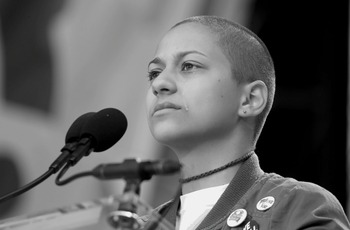
Gonzalez went on next to name all the victims of the Parkland shooting. Then she stopped speaking altogether. She stood in silence, staring into the distance before her, tears streaming down her face, nearly immobile, audibly taking in great gulps of air, until a timer beeped. Six minutes and twenty seconds had elapsed: the time that it took, as she would tell the straining crowd before her, for Nikolas Cruz to kill and wound thirty-four teachers and students.
Gonzalez finished by speaking these words: “Fight for your lives before it’s somebody else’s job.”
For six tense minutes Emma Gonzalez maintained a fierce, poignant, discomforting silence. Somehow, the focus and intensity of her passion proved strong enough to hold many thousands of people in a shared stillness.Footnote 107 It felt like the stillness of prayer.
Stillness and prayer are not strangers. As Rowan Williams has said: “You have to still your body and your imagination … [P]rayer is communion, it’s that allowing the depth within and the depth outside to come together.”Footnote 108 Williams goes on to speak about the richness of silence:
R. S. Thomas wrote a number of poems about prayer, and they’re mostly to do with waiting and silence and a sense of the absence of God, and yet in the middle of that awareness of absence there is the realization that you have arrived: there is a reality and it’s beyond the words you could find and you’ve got to wait, you’ve got to stay with it.Footnote 109
According to this dispensation, prayer challenges us to hold that stillness. And it is in this sense, I submit, that Emma Gonzalez’s embodiment of a fierce stillness invoked a state of exception in which naming what is sovereign emerged from an uncanny silence, a silence akin to a political and legal prayer.
Strange grace: the truth of tragic suffering and love that converged and filled Emma Gonzalez, distilling into a silent cry for justice. If, as Williams has put it, “the point of it all is that prayer is allowing truth and reality to flower in you, and therefore it’s part of becoming more human and more yourself,”Footnote 110 then we may say that Emma Gonzalez’s cry for justice radiated in those six tense minutes of silence the truth of her being. On the cusp of the sacred, knowing and being merged. It is the uncanny, shimmering grace of this uncontainable intensity that empowered Gonzalez to hold so many thousands of souls in a shared stillness. Thus empowered, Gonzalez sought to pry open the gates guarding state and federal houses of legislation in an effort to infuse life into the dead letter of gun control law.Footnote 111 In short, she dared to catalyze a state of exception in which tragic suffering, fused with love, named anew what is sovereign. Taking public responsibility for naming what is sovereign, Emma Gonzalez called justice from a sacred, enfolding silence into impassioned speech, so that legal and political change might ensue.
This is how the sovereign imagination works. It is how the sacred bond that holds together a community, or a polity, may be woven anew – on the threshold of an abyss, in an exceptional moment, when the uncanny power of the sacred suddenly shines forth. When law and politics take flight in words that shimmer with an uncanny intensity, ensuing perhaps from the poetic stillness of a prayerful silence, justice may be named anew. Thus does the sovereign imagination expand and revitalize the constitutive bounds of legal and political discourse.
V Conclusion
The sacred radiates with an uncanny power, but lacks intrinsic content. Its nature is to disrupt, bringing structures of sovereign authority into question. On the threshold of the sacred, sources of legitimation, old and new, come into view. But judgments must be made reflecting the individual and collective responsibility for naming what is sovereign.
The sacred irrupts as a liberation from structure and utility, placing extant moral codes in suspense. In the state of exception we respond to a sacred call and a sacred calling. Akin to Scholem’s “anarchic breeze”Footnote 112 and Walter Benjamin’s concept (and John Brown’s putative embodiment) of “divine violence,” the sacred invites alternative ways of being and knowing. But is it the call of illimitable justice or naked power that invites this kind of free response? Following Schmitt, sovereignty invites us to name political and legal power ex nihilo, with no responsibility to others. Justice, on the other hand, invites us to name what is sovereign in situ, which is to say, in relation to others and the needs they exist in. The new names of justice that emerge out of the state of exception arise in response to those needs. They also arise against the ever-present specter of human error. To name what is sovereign absent self-reflexive awareness of error risks totalizing political and legal power on the basis of a false certainty. The competing metaphysics of justice and nihilism (the will to power ex nihilo) split around this pivot.
Thinking about thinking in the act of naming what is sovereign thinks about error. This is what safeguards thinking from injustice. Power gives birth to the ethical on the back of the sacrificed other. Meaning is born in our attunement to need: the needs of self and the needs of others. This is the way love (self-love as well as love of others) watches over justice.Footnote 113
Idolatry, according to the metaphysics of justice, is indifference to need. Justice, locked within the metaphysics of power, is the triumph of will. On the threshold of an abyss, when the sacred irrupts into presence, the sovereign imaginary prepares for grace or terror in the act of naming. Freedom gains or loses meaning in the choice of names we assign – which is to say, in the polities we enact and the identities we thereby assume – in the political and legal act of accepting (or rejecting) those names as our very own. In this sense, responsibility for freedom is metaphysical. And it is in freedom and wonder (or terror) that we name what is sovereign.
Sovereign imaginaries arise from states of exception in the course of which metaphysical truths about the way humans and things exist in the world come into play within history. The foundational narratives that constitute such imaginaries contain visions that are consonant with the metaphysical underpinnings of the narrative in question. Each narrative assumes certain constants about what it is to be human, what thinking and feeling are like, and how living within particular registers of thought and feeling gives rise to particular ways of being among others. This is what it means to speak of a sovereign imaginary as a constitutive nomos, a way of life – which includes discrete ways of being together in need and aspiration within a political and legal order.
The sacred may announce a new possibility, but how we construe that announcement remains crucial. The Schmittian decision in the state of exception totalizes will and occludes the interpretive and corrective power of thought and negotiated action. It refuses to acknowledge its totalitarian power is subject to error. Whether in the service of law or the political for its own sake,Footnote 114 the absolutized decision amplifies risk absolutely. By contrast, the constitutive metaphysical narrative of meaningful freedom under the rubric of error leaves uncertainty in place. In this view, interpretation and negotiated clarification of need and power are part and parcel of the dynamic of temporal fragmentation of the ideal. There is no release from the responsibility of thinking about thinking in the penumbra of error. That is our ethical calling.
On the threshold of a great abyss, we stand witness, bedeviled by the urgency of naming, as the sacred irrupts anew. When worlds of meaning are at stake, we can ill afford to disavow responsibility for the metaphysics of sovereign imaginaries.


 Open access