







1 Introduction
In this paper, we study an analog of the Erdős–Ko–Rado theorem [Reference Erdős, Ko and Rado7] in the setting of permutation groups. Let G be a finite permutation group acting on a finite set $\Omega $
. A subset
$\Omega $
. A subset $\mathcal {F} \subseteq G$
is called
intersecting
if, for all
$\mathcal {F} \subseteq G$
is called
intersecting
if, for all $g, h \in \mathcal {F}$
, the permutation
$g, h \in \mathcal {F}$
, the permutation $gh^{-1}$
fixes at least one point in
$gh^{-1}$
fixes at least one point in $\Omega $
.
$\Omega $
.
Each point stabilizer $G_\omega $
is an example of an intersecting set and, more generally, so is any of its cosets. For the symmetric group
$G_\omega $
is an example of an intersecting set and, more generally, so is any of its cosets. For the symmetric group $G = \mathrm {Sym}(\Omega )$
, it was shown independently by Cameron and Ku [Reference Cameron and Ku5], and Larose and Malvenuto [Reference Larose and Malvenuto12], that these examples are optimal: any intersecting subset of
$G = \mathrm {Sym}(\Omega )$
, it was shown independently by Cameron and Ku [Reference Cameron and Ku5], and Larose and Malvenuto [Reference Larose and Malvenuto12], that these examples are optimal: any intersecting subset of $\mathrm {Sym}(\Omega )$
has size at most
$\mathrm {Sym}(\Omega )$
has size at most $(|\Omega | - 1)!$
, with equality if and only if it is a coset of a point stabilizer.
$(|\Omega | - 1)!$
, with equality if and only if it is a coset of a point stabilizer.
However, in general permutation groups, such neat characterizations do not always hold. There are groups in which the largest intersecting sets are not cosets of point stabilizers and the point stabilizers themselves may fail to be of maximum size among intersecting subsets. In other settings, multiple distinct types of maximal intersecting sets can exist. For instance, in the $2$
-transitive action of
$2$
-transitive action of $\mathrm {PGL}_d(q)$
on the projective space
$\mathrm {PGL}_d(q)$
on the projective space $\mathrm {PG}_{d-1}(q)$
, maximal intersecting sets are cosets of either point stabilizers or hyperplane stabilizers [Reference Spiga19].
$\mathrm {PG}_{d-1}(q)$
, maximal intersecting sets are cosets of either point stabilizers or hyperplane stabilizers [Reference Spiga19].
To help quantify how closely a group G follows an Erdős–Ko–Rado-type behavior, Li, Song, and Pantangi introduced in [Reference Li, Song and Pantangi13] the notion of $\boldsymbol {intersection\ density}$
. Given
$\boldsymbol {intersection\ density}$
. Given ${\omega \in \Omega }$
, let
${\omega \in \Omega }$
, let $G_\omega $
be a point stabilizer in G of maximum cardinality. The intersection density of an intersecting set
$G_\omega $
be a point stabilizer in G of maximum cardinality. The intersection density of an intersecting set $\mathcal {F} \subseteq G$
is defined by
$\mathcal {F} \subseteq G$
is defined by $\rho (\mathcal {F}) = |\mathcal {F}|/|G_\omega |$
, and the
$\rho (\mathcal {F}) = |\mathcal {F}|/|G_\omega |$
, and the $\boldsymbol {intersection\ density}$
of the group G is given by
$\boldsymbol {intersection\ density}$
of the group G is given by
 $$ \begin{align*} \rho (G) = \max \{ \rho (\mathcal {F}) \mid \mathcal {F} \subseteq G\ \text{intersecting} \}. \end{align*} $$
A useful tool in this context is the $\boldsymbol {derangement\ graph}\ \Gamma _G$
of G, whose vertex set is G, with an edge between x and y whenever
$\boldsymbol {derangement\ graph}\ \Gamma _G$
of G, whose vertex set is G, with an edge between x and y whenever $xy^{-1}$
is a derangement (that is, an element with no fixed points). Equivalently,
$xy^{-1}$
is a derangement (that is, an element with no fixed points). Equivalently, $\Gamma _G$
is the Cayley graph of G with connection set equal to the set of derangements. We note that some authors require a Cayley graph to be defined on a generating set, whereas the set of derangements may generate a proper subgroup. Intersecting subsets of G correspond precisely to independent sets in
$\Gamma _G$
is the Cayley graph of G with connection set equal to the set of derangements. We note that some authors require a Cayley graph to be defined on a generating set, whereas the set of derangements may generate a proper subgroup. Intersecting subsets of G correspond precisely to independent sets in $\Gamma _G$
. We write
$\Gamma _G$
. We write $\omega (\Gamma _G)$
and
$\omega (\Gamma _G)$
and $\alpha (\Gamma _G)$
for the clique number and independence number of
$\alpha (\Gamma _G)$
for the clique number and independence number of $\Gamma _G$
, respectively. Then, the standard clique–coclique inequality [Reference Godsil and Meagher9, Theorem 2.1.1] implies
$\Gamma _G$
, respectively. Then, the standard clique–coclique inequality [Reference Godsil and Meagher9, Theorem 2.1.1] implies
 $$ \begin{align*} \alpha(\Gamma_G) \cdot \omega(\Gamma_G) \leq |G|, \end{align*} $$
which leads to a bound on the intersection density:
 $$ \begin{align} \rho(G) \leq \frac{|\Omega|}{\omega(\Gamma_G)}. \end{align} $$
In [Reference Meagher, Razafimahatratra and Spiga14], Meagher et al. proved that for any transitive group G with $|\Omega | \geq 3$
, the derangement graph
$|\Omega | \geq 3$
, the derangement graph $\Gamma _G$
contains a triangle. As a consequence, from (1-1), they showed that
$\Gamma _G$
contains a triangle. As a consequence, from (1-1), they showed that $\rho (G) \leq |\Omega |/3$
. Their work also raised the following broader question [Reference Meagher, Razafimahatratra and Spiga14, Question 6.1].
$\rho (G) \leq |\Omega |/3$
. Their work also raised the following broader question [Reference Meagher, Razafimahatratra and Spiga14, Question 6.1].
Does there exist a function $f : \mathbb {N} \to \mathbb {N}$
such that, for every transitive group G of degree n, if the derangement graph
$f : \mathbb {N} \to \mathbb {N}$
such that, for every transitive group G of degree n, if the derangement graph $\Gamma _G$
contains no k-clique, then
$\Gamma _G$
contains no k-clique, then $n \leq f(k)$
?
$n \leq f(k)$
?
The main result of [Reference Fusari, Previtali and Spiga8] provides a positive answer to [Reference Meagher, Razafimahatratra and Spiga14, Question 6.1] for arbitrary values of k, albeit under the stronger assumption that the permutation group G is
innately transitive
, meaning that G possesses a minimal normal subgroup that is transitive. For small values of k, partial answers are known: when $k = 2$
, Jordan’s classical result implies
$k = 2$
, Jordan’s classical result implies $n \leq 1$
and, as noted above, when
$n \leq 1$
and, as noted above, when $k = 3$
, the result of [Reference Meagher, Razafimahatratra and Spiga14] yields
$k = 3$
, the result of [Reference Meagher, Razafimahatratra and Spiga14] yields $n \leq 2$
. The present paper continues this line of investigation by settling the case
$n \leq 2$
. The present paper continues this line of investigation by settling the case $k = 4$
.
$k = 4$
.
Theorem 1.1. Let G be a finite transitive group on $\Omega $
. Then, the derangement graph of G does not contain a clique of size at least
$\Omega $
. Then, the derangement graph of G does not contain a clique of size at least $4$
if and only if one of the following holds:
$4$
if and only if one of the following holds:
-
(1) $|\Omega | \le 3$
;
$|\Omega | \le 3$
; -
(2)
$|\Omega | = 6$
and
$G \cong \mathrm {Alt}(4)$
; -
(3)
$|\Omega | = 18$
,
$|G| = 324$
, and G is
$G_{18}$
; -
(4)
$|\Omega | = 30$
and G is
$G_{30}$
or
$G_{30}^{*}$
.


In cases (2)–(4), the derangement graph of G contains cliques of size $3$
, whereas, in case (1), the derangement graph of G contains cliques of size
$3$
, whereas, in case (1), the derangement graph of G contains cliques of size $|\Omega |$
.
$|\Omega |$
.
In Section 2, we describe the three exceptional groups $G_{18}$
,
$G_{18}$
, $G_{30}$
, and
$G_{30}$
, and $G_{30}^{*}$
, whose Magma IDs are
$G_{30}^{*}$
, whose Magma IDs are $\texttt {TransitiveGroup}(18,142)$
,
$\texttt {TransitiveGroup}(18,142)$
, $\texttt {TransitiveGroup}(30,126)$
, and
$\texttt {TransitiveGroup}(30,126)$
, and $\texttt {TransitiveGroup}(30,233)$
, respectively.
$\texttt {TransitiveGroup}(30,233)$
, respectively.
From (1-1), Theorem 1.1 shows that most transitive groups have intersection density at most $|\Omega |/4$
.
$|\Omega |/4$
.
This result also contributes to a broader set of problems concerning subgroup coverings and their applications to field extensions. In particular, there is a connection to the Kronecker classes, explored in [Reference Klingen11] and summarized in [Reference Bubboloni, Spiga and Weigel3, Section 1.7]. We recall the following definition.
Definition 1.2. Let A be a finite group with a normal subgroup H. A subgroup ${U \le H}$
is said to be an
${U \le H}$
is said to be an $A \text{-}\boldsymbol{covering\ subgroup}$
of H if
$A \text{-}\boldsymbol{covering\ subgroup}$
of H if $H = \bigcup _{a \in A} U^a$
.
$H = \bigcup _{a \in A} U^a$
.
A central open problem in this area is the following conjecture by Neumann and Praeger [Reference Praeger16, Conjecture 4.3], also recorded as [Reference Khukhro and Mazurov10, 11.71] in the Kourovka Notebook.
Conjecture 1.3 (Neumann–Praeger).
There is a function $g : \mathbb {N} \to \mathbb {N}$
such that, whenever U is an A-covering subgroup of H with
$g : \mathbb {N} \to \mathbb {N}$
such that, whenever U is an A-covering subgroup of H with $|A : H| = n$
, we have
$|A : H| = n$
, we have $|H : U| \le g(n)$
.
$|H : U| \le g(n)$
.
The conjecture is Jordan’s theorem when $n = 1$
and was proved in [Reference Saxl18] for
$n = 1$
and was proved in [Reference Saxl18] for $n = 2$
. Using Theorem 1.1, we establish it for
$n = 2$
. Using Theorem 1.1, we establish it for $n = 3$
.
$n = 3$
.
Proof of Conjecture 1.3 for
$n = 3$
.

Let $\Omega $
be the set of right cosets of U in A and consider the natural action of A on
$\Omega $
be the set of right cosets of U in A and consider the natural action of A on $\Omega $
. Since U is a point stabilizer and
$\Omega $
. Since U is a point stabilizer and $H = \bigcup _{a \in A} U^a$
, it follows that H contains no derangements.
$H = \bigcup _{a \in A} U^a$
, it follows that H contains no derangements.
Let C be a clique in the derangement graph of A acting on $\Omega $
. For any distinct
$\Omega $
. For any distinct $x, y \in C$
, the element
$x, y \in C$
, the element $xy^{-1}$
is a derangement and thus belongs to a distinct right coset of H in A. Therefore,
$xy^{-1}$
is a derangement and thus belongs to a distinct right coset of H in A. Therefore, $|C| \le |A : H| = 3$
. By Theorem 1.1, this implies that
$|C| \le |A : H| = 3$
. By Theorem 1.1, this implies that $|A : U| \le 30$
and, hence,
$|A : U| \le 30$
and, hence, $|H : U| \le 10$
.
$|H : U| \le 10$
.
The proof above is a particular case of an argument given in [Reference Fusari, Previtali and Spiga8, page 934]. The authors have shown the following theorem.
Theorem 1.4 (See [Reference Fusari, Previtali and Spiga8, page 934]).
If [Reference Meagher, Razafimahatratra and Spiga14, Question 6.1] has a positive answer, then the Neumann–Praeger conjecture [Reference Khukhro and Mazurov10, 11.71] is true, and the function g can be chosen to be $g(n)=f(n)/n$
.
$g(n)=f(n)/n$
.
It is unclear whether the Praeger–Neumann conjecture [Reference Khukhro and Mazurov10, 11.71] is actually equivalent to a positive answer to [Reference Meagher, Razafimahatratra and Spiga14, Question 6.1].
The groups of degree 30 in Theorem 1.1(4) in fact show that the function g in Conjecture 1.3 can be chosen so that $g(3) = 10$
. In Section 2, we collect some information on the groups appearing in Theorem 1.1(2)–(4). This information is useful to provide a complete classification of the subgroup chains
$g(3) = 10$
. In Section 2, we collect some information on the groups appearing in Theorem 1.1(2)–(4). This information is useful to provide a complete classification of the subgroup chains $U < G < A$
satisfying the hypotheses of Conjecture 1.3 with
$U < G < A$
satisfying the hypotheses of Conjecture 1.3 with $n = 3$
.
$n = 3$
.
2 A description of the groups in Theorem 1.1(2)–(4)
We start by describing $G_{18}$
. Let
$G_{18}$
. Let $v_1, v_2, v_3$
be the canonical basis for the three-dimensional vector space
$v_1, v_2, v_3$
be the canonical basis for the three-dimensional vector space $\mathbb {F}_3^3$
over the field
$\mathbb {F}_3^3$
over the field $\mathbb {F}_3$
with
$\mathbb {F}_3$
with $3$
elements. Let
$3$
elements. Let ${V = \langle v_1, v_2, v_3 \rangle }$
, so V is an elementary abelian
${V = \langle v_1, v_2, v_3 \rangle }$
, so V is an elementary abelian $3$
-group of order
$3$
-group of order $27$
.
$27$
.
Now, let $x, y, u \in \mathrm {GL}_3(3)$
be defined as follows:
$x, y, u \in \mathrm {GL}_3(3)$
be defined as follows:
 $$ \begin{align*} x = \begin{pmatrix} 1 & 0 & 0 \\ 0 & -1 & 0 \\ 0 & 0 & -1 \end{pmatrix}, \quad y = \begin{pmatrix} -1 & 0 & 0 \\ 0 & 1 & 0 \\ 0 & 0 & -1 \end{pmatrix}, \quad u = \begin{pmatrix} 0 & 1 & 0 \\ 0 & 0 & 1 \\ 1 & 0 & 0 \end{pmatrix}, \end{align*} $$
and let $K = \langle x, y, u \rangle $
. It is easy to verify that
$K = \langle x, y, u \rangle $
. It is easy to verify that $K \cong \mathrm {Alt}(4)$
. Finally, let
$K \cong \mathrm {Alt}(4)$
. Finally, let $H = V \rtimes \langle x, y \rangle $
and
$H = V \rtimes \langle x, y \rangle $
and $A = V \rtimes K$
. In particular,
$A = V \rtimes K$
. In particular, $|A| = 27 \cdot 12 = 324$
,
$|A| = 27 \cdot 12 = 324$
, $H \unlhd A$
, and
$H \unlhd A$
, and $|A : H| = 3$
. Now, let
$|A : H| = 3$
. Now, let ${U = \langle v_1, v_2 - v_3 \rangle \rtimes \langle x \rangle }$
. Clearly,
${U = \langle v_1, v_2 - v_3 \rangle \rtimes \langle x \rangle }$
. Clearly, $|U| = 9 \cdot 2 = 18$
. It is not hard to verify that
$|U| = 9 \cdot 2 = 18$
. It is not hard to verify that ${H=\bigcup _{a \in A} U^a }$
and, hence, U is an A-covering subgroup of H.
${H=\bigcup _{a \in A} U^a }$
and, hence, U is an A-covering subgroup of H.
Now, let G be the permutation group induced by the action of A on the set $\Omega $
of right cosets of U in A. Clearly, G has degree
$\Omega $
of right cosets of U in A. Clearly, G has degree $324 / 18 = 18$
and, in fact, G is permutation isomorphic to
$324 / 18 = 18$
and, in fact, G is permutation isomorphic to $G_{18}$
. The lattice of subgroups of A containing U is the chain:
$G_{18}$
. The lattice of subgroups of A containing U is the chain: $ U < V \rtimes \langle x \rangle < H < A.$
The group $G_{30}$
can be described in a similar manner. Let
$G_{30}$
can be described in a similar manner. Let $v_1, v_2$
be the canonical basis for the two-dimensional vector space
$v_1, v_2$
be the canonical basis for the two-dimensional vector space $\mathbb {F}_5^2$
over the field
$\mathbb {F}_5^2$
over the field $\mathbb {F}_5$
with
$\mathbb {F}_5$
with $5$
elements and let
$5$
elements and let $V = \langle v_1, v_2 \rangle $
.
$V = \langle v_1, v_2 \rangle $
.
Now, let $x, y, u \in \mathrm {GL}_2(5)$
be defined as follows:
$x, y, u \in \mathrm {GL}_2(5)$
be defined as follows:
 $$ \begin{align*} x = \begin{pmatrix} 2 & 0 \\ 0 & 3 \end{pmatrix}, \quad y = \begin{pmatrix} 0 & 1 \\ -1 & 0 \end{pmatrix}, \quad u = \begin{pmatrix} 3 & -1 \\ 3 & 1 \end{pmatrix}, \end{align*} $$
and let $K = \langle x, y, u \rangle $
. It is easy to verify that
$K = \langle x, y, u \rangle $
. It is easy to verify that $\langle x, y \rangle \cong Q_8$
, where
$\langle x, y \rangle \cong Q_8$
, where $Q_8$
is the quaternion group of order
$Q_8$
is the quaternion group of order $8$
, and that u has order
$8$
, and that u has order $3$
and normalizes
$3$
and normalizes $\langle x, y \rangle $
. Finally, let
$\langle x, y \rangle $
. Finally, let $H = V \rtimes \langle x, y \rangle $
and
$H = V \rtimes \langle x, y \rangle $
and $A = V \rtimes K$
. In particular,
$A = V \rtimes K$
. In particular, $|A| = 25 \cdot 24 = 600$
,
$|A| = 25 \cdot 24 = 600$
, $H \unlhd A$
, and
$H \unlhd A$
, and $|A : H| = 3$
. Now, let
$|A : H| = 3$
. Now, let $U = \langle v_2 \rangle \rtimes \langle x \rangle $
. Clearly,
$U = \langle v_2 \rangle \rtimes \langle x \rangle $
. Clearly, $|U| = 5 \cdot 4 = 20$
. As above, it is not hard to verify that U is an A-covering subgroup of H.
$|U| = 5 \cdot 4 = 20$
. As above, it is not hard to verify that U is an A-covering subgroup of H.
The permutation group induced by the action of A on the set of right cosets of U has degree $600 / 20 = 30$
and is permutation isomorphic to
$600 / 20 = 30$
and is permutation isomorphic to $G_{30}$
. The lattice of subgroups of A containing U is the chain:
$G_{30}$
. The lattice of subgroups of A containing U is the chain: $ U < V \rtimes \langle x \rangle < H < A.$
The group $G_{30}^{*}$
can be easily described, as it contains the group
$G_{30}^{*}$
can be easily described, as it contains the group $G_{30}$
as a subgroup of index
$G_{30}$
as a subgroup of index $2$
. Let
$2$
. Let $v_1, v_2, x, y, u$
be as in the previous paragraph, let
$v_1, v_2, x, y, u$
be as in the previous paragraph, let $z \in \mathrm {GL}_2(5)$
be defined as follows:
$z \in \mathrm {GL}_2(5)$
be defined as follows:
 $$ \begin{align*} z = \begin{pmatrix} 2 & 0 \\ 0 & 2 \end{pmatrix}, \end{align*} $$
and let $K = \langle x, y, z, u \rangle $
. It is easy to verify that
$K = \langle x, y, z, u \rangle $
. It is easy to verify that $\langle x, y, z \rangle \cong Q_8 \circ C_4$
has order
$\langle x, y, z \rangle \cong Q_8 \circ C_4$
has order $16$
and that
$16$
and that $K \cong (Q_8 \rtimes C_3) \circ C_4$
has order
$K \cong (Q_8 \rtimes C_3) \circ C_4$
has order $48$
. Finally, let
$48$
. Finally, let $H = V \rtimes \langle x, y, z \rangle $
and
$H = V \rtimes \langle x, y, z \rangle $
and $A = V \rtimes K$
. In particular,
$A = V \rtimes K$
. In particular, $|A| = 25 \cdot 48 = 1200$
,
$|A| = 25 \cdot 48 = 1200$
, $H \unlhd A$
, and
$H \unlhd A$
, and $|A : H| = 3$
. Now, let
$|A : H| = 3$
. Now, let $U = \langle v_2 \rangle \rtimes \langle x, z \rangle $
. Clearly,
$U = \langle v_2 \rangle \rtimes \langle x, z \rangle $
. Clearly, $|U| = 5 \cdot 8 = 40$
. Moreover, it can be verified that U is an A-covering subgroup of H.
$|U| = 5 \cdot 8 = 40$
. Moreover, it can be verified that U is an A-covering subgroup of H.
The permutation group induced by the action of A on the set of right cosets of U has degree $1200 / 40 = 30$
and is permutation isomorphic to
$1200 / 40 = 30$
and is permutation isomorphic to $G_{30}^{*}$
. The lattice of subgroups of A containing U is the chain:
$G_{30}^{*}$
. The lattice of subgroups of A containing U is the chain: $U < V \rtimes \langle x \rangle < H < A.$
3 Preliminaries: basic definitions and basic results
This section is divided into three parts. In the first part, we present basic definitions and recall standard results from permutation group theory. The second part is devoted to deeper auxiliary results that support the main arguments of this paper. Finally, in the third part, we introduce and employ a new concept—hyper-transitive $(a,b)$
-hypergraphs—particularly suited for formulating statements that are used inductively in the proof of Theorem 1.1.
$(a,b)$
-hypergraphs—particularly suited for formulating statements that are used inductively in the proof of Theorem 1.1.
3.1 Basic definitions and a basic result
For future reference, we provide a summary of key definitions.
Let G be a group and let $\Sigma $
be a system of imprimitivity for the action of G on
$\Sigma $
be a system of imprimitivity for the action of G on $\Omega $
and let
$\Omega $
and let $\Delta \in \Sigma $
. We let
$\Delta \in \Sigma $
. We let $G_{\{\Delta \}}=\{g\in G\mid \Delta ^g=\Delta \}$
be the setwise stabilizer of
$G_{\{\Delta \}}=\{g\in G\mid \Delta ^g=\Delta \}$
be the setwise stabilizer of $\Delta $
in G and we let
$\Delta $
in G and we let $G_{(\Delta )}=\{g\in G\mid \delta ^g=\delta \,\text { for all } \delta \in \Delta \}$
be the pointwise stabilizer of
$G_{(\Delta )}=\{g\in G\mid \delta ^g=\delta \,\text { for all } \delta \in \Delta \}$
be the pointwise stabilizer of $\Delta $
in G. Moreover, we let
$\Delta $
in G. Moreover, we let $G_{\{\Delta \}}^\Delta $
denote the permutation group induced by
$G_{\{\Delta \}}^\Delta $
denote the permutation group induced by $G_{\{\Delta \}}$
on
$G_{\{\Delta \}}$
on $\Delta $
.
$\Delta $
.
Lemma 3.1. Let A and B be two commuting regular subgroups of $\mathrm {Sym}(\Delta )$
. Then, either there exist
$\mathrm {Sym}(\Delta )$
. Then, either there exist $a\in A\setminus \{1\}$
and
$a\in A\setminus \{1\}$
and $b\in B\setminus \{1\}$
such that
$b\in B\setminus \{1\}$
such that $ab$
is a derangement, or
$ab$
is a derangement, or $|\Delta |\le 2$
.
$|\Delta |\le 2$
.
Proof. Fix $\delta _0 \in \Delta $
and let
$\delta _0 \in \Delta $
and let $\varepsilon \colon \Delta \to A$
be the map defined by
$\varepsilon \colon \Delta \to A$
be the map defined by $\delta \varepsilon = a$
when
$\delta \varepsilon = a$
when $\delta _0^a = \delta $
. Observe that
$\delta _0^a = \delta $
. Observe that $ \varepsilon $
is a well-defined bijection, because A is a regular subgroup of
$ \varepsilon $
is a well-defined bijection, because A is a regular subgroup of $\mathrm {Sym}(\Delta )$
. Now, consider the function
$\mathrm {Sym}(\Delta )$
. Now, consider the function $\iota _\varepsilon \colon \mathrm {Sym}(\Delta ) \to \mathrm {Sym}(A)$
defined by
$\iota _\varepsilon \colon \mathrm {Sym}(\Delta ) \to \mathrm {Sym}(A)$
defined by $\sigma \iota _\varepsilon = \varepsilon ^{-1} \circ \sigma \circ \varepsilon $
. Observe that the image of
$\sigma \iota _\varepsilon = \varepsilon ^{-1} \circ \sigma \circ \varepsilon $
. Observe that the image of $A \le \mathrm {Sym}(\Delta )$
under
$A \le \mathrm {Sym}(\Delta )$
under $\iota _\varepsilon $
is the right regular representation of A. As
$\iota _\varepsilon $
is the right regular representation of A. As $B \le \mathrm {Sym} (\Delta )$
is a regular subgroup commuting with A, the image of B under
$B \le \mathrm {Sym} (\Delta )$
is a regular subgroup commuting with A, the image of B under $\iota _\varepsilon $
is a regular subgroup of
$\iota _\varepsilon $
is a regular subgroup of $\mathrm {Sym}(A)$
commuting with the right regular representation of A. Thus, by [Reference Cameron4, 1.5, page 27], the image of B under
$\mathrm {Sym}(A)$
commuting with the right regular representation of A. Thus, by [Reference Cameron4, 1.5, page 27], the image of B under $\iota _\varepsilon $
is the left regular representation of A.
$\iota _\varepsilon $
is the left regular representation of A.
Summing up, replacing $\Delta $
, A, and B if necessary, we may suppose that
$\Delta $
, A, and B if necessary, we may suppose that $\Delta $
is a group X, and that A and B are the right and left regular representations of X, respectively.
$\Delta $
is a group X, and that A and B are the right and left regular representations of X, respectively.
Assume $|X|=|\Delta |\ne 1$
. Let
$|X|=|\Delta |\ne 1$
. Let $x,y\in X\setminus \{1\}$
and consider
$x,y\in X\setminus \{1\}$
and consider $\rho _x\lambda _y$
. If
$\rho _x\lambda _y$
. If $\rho _x\lambda _y$
is not a derangement on X, then there exists
$\rho _x\lambda _y$
is not a derangement on X, then there exists $\omega \in X$
with
$\omega \in X$
with
 $$ \begin{align*}\omega=\omega^{\rho_x\lambda_y}=y^{-1}\omega x,\end{align*} $$
that is, $\omega x\omega ^{-1}=y$
. In particular, x and y belong to the same X-conjugacy class. If X has only one conjugacy class of nonidentity elements, then
$\omega x\omega ^{-1}=y$
. In particular, x and y belong to the same X-conjugacy class. If X has only one conjugacy class of nonidentity elements, then $|X|=2$
.
$|X|=2$
.
3.2 The O’Nan–Scott theorem and auxiliary results for the proof of Theorem 1.1
Let G be a group and let N be the socle of G. The O’Nan–Scott theorem describes in detail the embedding of N in G and collects some useful information about the action of N. In [Reference Praeger17], eight types of primitive groups are defined (depending on the group- and action-structure of the socle), namely HA (Affine), HS (Holomorph of simple), HC (Holomorph of compound), AS (Almost Simple), PA (Product Action), SD (Simple Diagonal), CD (Compound Diagonal), and TW (Twisted Wreath), and it is shown that every primitive group belongs to exactly one of these types.
We do not give a full description of these types here and instead refer to [Reference Praeger17] for details. Here, we just state some basic facts. Let G be primitive with domain $\Omega $
and socle N.
$\Omega $
and socle N.
If G is of type HA, then N is an elementary abelian p-group, for some prime number p, and it is a minimal normal subgroup. A similar structure holds when G is of TW type; indeed, N is a minimal normal subgroup acting regularly on $\Omega $
, but there, the socle is nonabelian.
$\Omega $
, but there, the socle is nonabelian.
When G is of type HS or HC, G has exactly two minimal normal subgroups, say $M_1$
and
$M_1$
and $M_2$
; these are pairwise isomorphic and nonabelian. Moreover,
$M_2$
; these are pairwise isomorphic and nonabelian. Moreover, $N = M_1 \times M_2$
, and
$N = M_1 \times M_2$
, and $M_1, M_2$
act regularly on
$M_1, M_2$
act regularly on $\Omega $
. The stabilizer of a point in N embeds diagonally in N. When G is of type HS,
$\Omega $
. The stabilizer of a point in N embeds diagonally in N. When G is of type HS, $M_1, M_2$
are nonabelian simple; when G is of type HC,
$M_1, M_2$
are nonabelian simple; when G is of type HC, $M_1, M_2$
are the direct products of more than one nonabelian simple group.
$M_1, M_2$
are the direct products of more than one nonabelian simple group.
When G is of type SD or CD, N is a minimal normal subgroup of G and N is nonabelian. The stabilizer of a point in N embeds diagonally in N. When G is of type SD, the stabilizer of a point in N is a nonabelian simple group; when G is of type CD, the stabilizer of a point in N is the direct product of more than one nonabelian simple group.
When G is of type AS, N is a nonabelian simple group, but here there is no description of the action of N on $\Omega $
. However, there is a strong algebraic description of the whole of G, because G, as an abstract group, is contained in the automorphism group of N.
$\Omega $
. However, there is a strong algebraic description of the whole of G, because G, as an abstract group, is contained in the automorphism group of N.
When G is of type PA, N is a minimal normal subgroup of G and is nonabelian. Here, G preserves a nontrivial Cartesian decomposition of $\Omega $
, and the action on a Cartesian factor is primitive of type AS.
$\Omega $
, and the action on a Cartesian factor is primitive of type AS.
Before applying the O’Nan–Scott theorem, we first recall a theorem of Saxl.
Theorem 3.2 (Saxl; see [Reference Saxl18, Proposition 2]).
Let T be a nonabelian simple group and let M be a subgroup of T. If
 $$ \begin{align*}T=\bigcup_{\varphi\in\mathrm{Aut}(T)}M^\varphi,\end{align*} $$
then $T=M$
.
$T=M$
.
We have the following observation.
Lemma 3.3. Let G be a transitive permutation group on $\Omega $
and let
$\Omega $
and let $\Sigma $
be a system of imprimitivity for the action of G on
$\Sigma $
be a system of imprimitivity for the action of G on $\Omega $
. If
$\Omega $
. If $C\subseteq G$
is a clique for the derangement graph
$C\subseteq G$
is a clique for the derangement graph $\Gamma _{G,\Sigma }$
of G in its action on
$\Gamma _{G,\Sigma }$
of G in its action on $\Sigma $
, then C is also a clique for the derangement graph
$\Sigma $
, then C is also a clique for the derangement graph $\Gamma _{G,\Omega }$
of G in its action on
$\Gamma _{G,\Omega }$
of G in its action on $\Omega $
.
$\Omega $
.
Proof. Let $C\subseteq G$
be clique for the derangement graph of G in its action on
$C\subseteq G$
be clique for the derangement graph of G in its action on $\Sigma $
. Now, given two distinct elements g and h of C, we have that
$\Sigma $
. Now, given two distinct elements g and h of C, we have that $gh^{-1}$
fixes no element of
$gh^{-1}$
fixes no element of $\Sigma $
. Since
$\Sigma $
. Since $\Sigma $
is a system of imprimitivity for
$\Sigma $
is a system of imprimitivity for $\Omega $
,
$\Omega $
, $gh^{-1}$
cannot fix any element of
$gh^{-1}$
cannot fix any element of $\Omega $
. Therefore, C is a clique for the derangement graph of G in its action on
$\Omega $
. Therefore, C is a clique for the derangement graph of G in its action on $\Omega $
.
$\Omega $
.
For improving the flow of the argument in the proof of Proposition 3.5, we prove the following lemma.
Lemma 3.4. Let G be a transitive group on $\Omega $
, let
$\Omega $
, let $\Sigma $
be a system of imprimitivity for the action of G on
$\Sigma $
be a system of imprimitivity for the action of G on $\Omega $
, and let
$\Omega $
, and let $\Delta \in \Sigma $
. Suppose:
$\Delta \in \Sigma $
. Suppose:
-
•
$G_{\{\Delta \}}$
acts primitively on
$\Delta $
; -
•
$G_{(\Sigma )}\ne 1$
; and -
•
$G_{(\Delta )}=1$
.


Let M be a minimal normal subgroup of G contained in $G_{(\Sigma )}$
. Then, either:
$G_{(\Sigma )}$
. Then, either:
-
(1) M is a minimal normal subgroup of
$G_{\{\Delta \}}$
for every
$\Delta \in \Sigma $
; or -
(2) M is the socle of
$G_{\{\Delta \}}$
and is the direct product of two isomorphic minimal normal subgroups
$M_{1,\Delta },M_{2,\Delta }$
acting regularly on
$\Delta $
for every
$\Delta \in \Sigma $
.


Proof. Assume first that M is abelian. Since $G_{\{\Delta \}}$
is primitive on
$G_{\{\Delta \}}$
is primitive on $\Delta $
and
$\Delta $
and $M\unlhd G_{\{\Delta \}}$
, we deduce that M is transitive on
$M\unlhd G_{\{\Delta \}}$
, we deduce that M is transitive on $\Delta $
. As
$\Delta $
. As $G_{(\Delta )}=1$
,
$G_{(\Delta )}=1$
, $G_{\{\Delta \}}$
is faithful on
$G_{\{\Delta \}}$
is faithful on $\Delta $
and, hence, we deduce that M is regular on
$\Delta $
and, hence, we deduce that M is regular on $\Delta $
. In particular, the primitive group
$\Delta $
. In particular, the primitive group $G_{\{\Delta \}}$
has a normal abelian regular subgroup. From the O’Nan–Scott theorem, the primitive groups having a normal abelian regular subgroup are of affine type; thus, M is actually the socle of
$G_{\{\Delta \}}$
has a normal abelian regular subgroup. From the O’Nan–Scott theorem, the primitive groups having a normal abelian regular subgroup are of affine type; thus, M is actually the socle of $G_{\{\Delta \}}$
and it is the unique minimal normal subgroup of
$G_{\{\Delta \}}$
and it is the unique minimal normal subgroup of $G_{\{\Delta \}}$
. Since this argument does not depend on
$G_{\{\Delta \}}$
. Since this argument does not depend on $\Delta $
, we get that M is the socle of
$\Delta $
, we get that M is the socle of $G_{\{\Delta '\}}$
and is the unique minimal normal subgroup of
$G_{\{\Delta '\}}$
and is the unique minimal normal subgroup of $G_{\{\Delta '\}}$
for every
$G_{\{\Delta '\}}$
for every $\Delta '\in \Sigma $
. In particular, part (1) holds.
$\Delta '\in \Sigma $
. In particular, part (1) holds.
Assume now that M is nonabelian, and write $M=T_1\times \cdots \times T_\ell $
for some positive integer
$M=T_1\times \cdots \times T_\ell $
for some positive integer $\ell $
and for some pairwise isomorphic nonabelian simple groups
$\ell $
and for some pairwise isomorphic nonabelian simple groups $T_1,\ldots ,T_\ell $
. Let
$T_1,\ldots ,T_\ell $
. Let $M_1$
be a minimal normal subgroup of
$M_1$
be a minimal normal subgroup of $G_{\{\Delta \}}$
with
$G_{\{\Delta \}}$
with $M_1\le M$
. Therefore, relabeling the indexed set
$M_1\le M$
. Therefore, relabeling the indexed set $\{1,\ldots ,\ell \}$
if necessary, we may suppose that
$\{1,\ldots ,\ell \}$
if necessary, we may suppose that $M_1=T_1\times \cdots \times T_\kappa $
for some
$M_1=T_1\times \cdots \times T_\kappa $
for some $1\le \kappa \le \ell $
. If
$1\le \kappa \le \ell $
. If $\kappa =\ell $
, then M is a minimal normal subgroup of
$\kappa =\ell $
, then M is a minimal normal subgroup of $G_{\{\Delta \}}$
. As
$G_{\{\Delta \}}$
. As $M\unlhd G$
and G is transitive on
$M\unlhd G$
and G is transitive on $\Sigma $
, we deduce that M is a minimal normal subgroup of
$\Sigma $
, we deduce that M is a minimal normal subgroup of $G_{\{\Delta '\}}$
for every
$G_{\{\Delta '\}}$
for every $\Delta '\in \Sigma $
. Therefore, part (1) holds.
$\Delta '\in \Sigma $
. Therefore, part (1) holds.
Suppose $\kappa <\ell $
. Let
$\kappa <\ell $
. Let $M_2$
be a minimal normal subgroup of
$M_2$
be a minimal normal subgroup of $G_{\{\Delta \}}$
with
$G_{\{\Delta \}}$
with $T_{\kappa +1}\le M_2\le M$
. From [Reference Dixon and Mortimer6, Theorem 4.3B], a finite primitive group has at most two minimal normal subgroups and, in the case that it does have two minimal normal subgroups, these are isomorphic. Hence, we deduce that
$T_{\kappa +1}\le M_2\le M$
. From [Reference Dixon and Mortimer6, Theorem 4.3B], a finite primitive group has at most two minimal normal subgroups and, in the case that it does have two minimal normal subgroups, these are isomorphic. Hence, we deduce that $M_1\cong M_2$
,
$M_1\cong M_2$
, $\ell =2\kappa $
, and
$\ell =2\kappa $
, and $M=M_1\times M_2$
. Since
$M=M_1\times M_2$
. Since $M_1$
and
$M_1$
and $M_2$
are transitive on
$M_2$
are transitive on $\Delta $
and centralize each other, by [Reference Cameron4, 1.5, page 27],
$\Delta $
and centralize each other, by [Reference Cameron4, 1.5, page 27], $M_1$
and
$M_1$
and $M_2$
both act regularly on
$M_2$
both act regularly on $\Delta $
. In particular, M is the socle of
$\Delta $
. In particular, M is the socle of $G_{\{\Delta \}}$
. As above, since
$G_{\{\Delta \}}$
. As above, since $M\unlhd G$
and G is transitive on
$M\unlhd G$
and G is transitive on $\Sigma $
, M is the socle of
$\Sigma $
, M is the socle of $G_{\{\Delta '\}}$
for every
$G_{\{\Delta '\}}$
for every $\Delta '\in \Sigma $
. Thus, part (2) holds.
$\Delta '\in \Sigma $
. Thus, part (2) holds.
Proposition 3.5. Let G be a transitive group on $\Omega $
, let
$\Omega $
, let $\Sigma $
be a system of imprimitivity for the action of G on
$\Sigma $
be a system of imprimitivity for the action of G on $\Omega $
, and let
$\Omega $
, and let $\Delta \in \Sigma $
. Suppose:
$\Delta \in \Sigma $
. Suppose:
-
•
$G_{\{\Delta \}}$
acts primitively on
$\Delta $
; -
•
$G_{(\Sigma )}\ne 1$
; and -
•
$G_{(\Delta )}=1$
.


Then, there exists $g\in G_{(\Sigma )}$
acting as a derangement on
$g\in G_{(\Sigma )}$
acting as a derangement on $\Omega $
.
$\Omega $
.
Proof. Since $G_{(\Delta )}=1$
and since
$G_{(\Delta )}=1$
and since $G_{(\Sigma )}\le G_{\{\Delta \}}$
, the group
$G_{(\Sigma )}\le G_{\{\Delta \}}$
, the group $G_{(\Sigma )}$
acts faithfully on
$G_{(\Sigma )}$
acts faithfully on $\Delta $
.
$\Delta $
.
We use the O’Nan–Scott theorem. Let ${\Delta '}\in \Sigma $
and let
${\Delta '}\in \Sigma $
and let $g\in G$
with
$g\in G$
with ${\Delta '}=\Delta ^g$
. As
${\Delta '}=\Delta ^g$
. As $G_{\{{\Delta }\}}$
and
$G_{\{{\Delta }\}}$
and $G_{\{\Delta '\}}$
are G-conjugate, the O’Nan–Scott type of the group
$G_{\{\Delta '\}}$
are G-conjugate, the O’Nan–Scott type of the group $G_{\{\Delta \}}$
acting on
$G_{\{\Delta \}}$
acting on $\Delta $
is identical to that of
$\Delta $
is identical to that of $G_{\{{\Delta '}\}}$
acting on
$G_{\{{\Delta '}\}}$
acting on ${\Delta '}$
.
${\Delta '}$
.
Let S be a minimal normal subgroup of G contained in $G_{(\Sigma )}$
. We use Lemma 3.4.
$G_{(\Sigma )}$
. We use Lemma 3.4.
If $G_{\{\Delta \}}^\Delta $
has type HA or TW, then S is the socle of
$G_{\{\Delta \}}^\Delta $
has type HA or TW, then S is the socle of $G_{\{{\Delta '}\}}$
and hence it acts regularly on
$G_{\{{\Delta '}\}}$
and hence it acts regularly on ${\Delta '}$
, for every
${\Delta '}$
, for every ${\Delta '}\in \Sigma $
. Therefore, every non-identity element of S is a derangement on
${\Delta '}\in \Sigma $
. Therefore, every non-identity element of S is a derangement on $\Omega $
.
$\Omega $
.
If $G_{\{\Delta \}}^\Delta $
has type HS or HC, then
$G_{\{\Delta \}}^\Delta $
has type HS or HC, then $S=S_{1,\Delta '}\times S_{2,\Delta '}$
, where
$S=S_{1,\Delta '}\times S_{2,\Delta '}$
, where $S_{1,\Delta '}$
and
$S_{1,\Delta '}$
and $S_{2,\Delta '}$
are the two minimal normal subgroups of
$S_{2,\Delta '}$
are the two minimal normal subgroups of $G_{\{{\Delta '}\}}$
generating the socle of
$G_{\{{\Delta '}\}}$
generating the socle of $G_{\{{\Delta '}\}}$
for all
$G_{\{{\Delta '}\}}$
for all ${\Delta '}\in \Sigma $
. From the structure of groups of type HS and HC, every simple direct factor of S acts semiregularly on
${\Delta '}\in \Sigma $
. From the structure of groups of type HS and HC, every simple direct factor of S acts semiregularly on ${\Delta '}$
for each
${\Delta '}$
for each ${\Delta '}\in \Sigma $
. Therefore, every nonidentity element of S lying in a simple direct factor of S is a derangement on
${\Delta '}\in \Sigma $
. Therefore, every nonidentity element of S lying in a simple direct factor of S is a derangement on $\Omega $
.
$\Omega $
.
Suppose $G_{\{\Delta \}}^\Delta $
has type SD or CD. Then,
$G_{\{\Delta \}}^\Delta $
has type SD or CD. Then,
 $$ \begin{align*}S=T_1\times\cdots \times T_{\ell},\end{align*} $$
where $T_1,\ldots ,T_{\ell }$
are pairwise isomorphic nonabelian simple groups. Observe that, from the structure of groups of type SD and CD, for each
$T_1,\ldots ,T_{\ell }$
are pairwise isomorphic nonabelian simple groups. Observe that, from the structure of groups of type SD and CD, for each $i\in \{1,\ldots ,\ell \}$
, the group
$i\in \{1,\ldots ,\ell \}$
, the group $T_i$
acts semiregularly on the domain
$T_i$
acts semiregularly on the domain ${\Delta '}$
for each
${\Delta '}$
for each ${\Delta '}\in \Sigma $
. In particular, from this, it follows that, for every i, the nonidentity elements of
${\Delta '}\in \Sigma $
. In particular, from this, it follows that, for every i, the nonidentity elements of $T_i$
are derangements on
$T_i$
are derangements on $\Omega $
.
$\Omega $
.
Suppose that $G_{\{\Delta \}}^\Delta $
is of type AS or PA. In particular, S is the unique minimal normal subgroup of
$G_{\{\Delta \}}^\Delta $
is of type AS or PA. In particular, S is the unique minimal normal subgroup of $G_{\{\Delta '\}}$
and is the socle of
$G_{\{\Delta '\}}$
and is the socle of $G_{\{{\Delta '}\}}$
for all
$G_{\{{\Delta '}\}}$
for all ${\Delta '}\in \Sigma $
. Suppose that S has no derangement in its action on
${\Delta '}\in \Sigma $
. Suppose that S has no derangement in its action on $\Omega $
. Let
$\Omega $
. Let $\omega _0\in \Delta $
. Then,
$\omega _0\in \Delta $
. Then,
 $$ \begin{align}S=\bigcup_{\omega\in \Omega}S_\omega=\bigcup_{g\in G}S_{\omega_0}^g.\end{align} $$
For every $g\in G$
, the action of g by conjugation on S induces an automorphism of S. Therefore, from (3-1), we have
$g\in G$
, the action of g by conjugation on S induces an automorphism of S. Therefore, from (3-1), we have
 $$ \begin{align}S=\bigcup_{\varphi\in \mathrm{Aut}(S)}S_{\omega_0}^\varphi. \end{align} $$
From the definition of primitive groups of AS and PA type, the $G_{\{\Delta \}}$
-set
$G_{\{\Delta \}}$
-set $\Delta $
admits a Cartesian decomposition and, hence,
$\Delta $
admits a Cartesian decomposition and, hence, $\Delta =\Lambda ^\ell $
for some finite set
$\Delta =\Lambda ^\ell $
for some finite set ${\Lambda }$
with
${\Lambda }$
with $|{\Lambda }|\ge 5$
and for some
$|{\Lambda }|\ge 5$
and for some $\ell \ge 1$
(the value
$\ell \ge 1$
(the value $\ell =1$
corresponds to the case where
$\ell =1$
corresponds to the case where $G_{\{\Delta \}}$
is of AS type). Moreover,
$G_{\{\Delta \}}$
is of AS type). Moreover,
 $$ \begin{align*}G_{\{\Delta\}}\le H \mathop{\mathrm{wr}} \mathrm{Sym}(\ell),\end{align*} $$
where $H\le \mathrm {Sym}({\Lambda })$
, H is almost simple and acts primitively on
$H\le \mathrm {Sym}({\Lambda })$
, H is almost simple and acts primitively on ${\Lambda }$
, and
${\Lambda }$
, and $G_{\{\Delta \}}$
is endowed with the product action. We identify the elements of
$G_{\{\Delta \}}$
is endowed with the product action. We identify the elements of $\Delta $
with the elements of
$\Delta $
with the elements of ${\Lambda }^\ell $
and we identify
${\Lambda }^\ell $
and we identify $G_{\{\Delta \}}$
with its image in the embedding in
$G_{\{\Delta \}}$
with its image in the embedding in $H \mathop {\mathrm {wr}} \mathrm {Sym}(\ell )$
. Here, the socle S of
$H \mathop {\mathrm {wr}} \mathrm {Sym}(\ell )$
. Here, the socle S of $G_{\{\Delta \}}$
is
$G_{\{\Delta \}}$
is $T^\ell $
, where T is the socle of H. As
$T^\ell $
, where T is the socle of H. As $\Delta =\Lambda ^\ell $
, we have
$\Delta =\Lambda ^\ell $
, we have $\omega _0=(\lambda _1,\ldots ,\lambda _\ell )$
for some
$\omega _0=(\lambda _1,\ldots ,\lambda _\ell )$
for some $\lambda _1,\ldots ,\lambda _\ell \in \Lambda $
. Since
$\lambda _1,\ldots ,\lambda _\ell \in \Lambda $
. Since $G_{\{\Delta \}}$
is transitive on
$G_{\{\Delta \}}$
is transitive on $\Delta =\Lambda ^\ell $
, there exists
$\Delta =\Lambda ^\ell $
, there exists $g\in G_{\{\Delta \}}$
with
$g\in G_{\{\Delta \}}$
with ${\omega _0^g=(\lambda ,\ldots ,\lambda )}$
for some
${\omega _0^g=(\lambda ,\ldots ,\lambda )}$
for some $\lambda \in \Lambda $
. Thus, replacing
$\lambda \in \Lambda $
. Thus, replacing $\omega _0$
with
$\omega _0$
with $\omega _0^g$
if necessary, we may suppose that
$\omega _0^g$
if necessary, we may suppose that $\omega _0=(\lambda ,\ldots ,\lambda )$
for some
$\omega _0=(\lambda ,\ldots ,\lambda )$
for some $\lambda \in \Lambda $
. Therefore,
$\lambda \in \Lambda $
. Therefore,
 $$ \begin{align*}S_{\omega_0}=T_{\lambda}\times \cdots \times T_{\lambda}=T_{\lambda}^\ell.\end{align*} $$
Since $\mathrm {Aut}(S)=\mathrm {Aut}(T^\ell )=\mathrm {Aut}(T) \mathop {\mathrm {wr}} \mathrm {Sym}(\ell )$
, from (3-2), we deduce
$\mathrm {Aut}(S)=\mathrm {Aut}(T^\ell )=\mathrm {Aut}(T) \mathop {\mathrm {wr}} \mathrm {Sym}(\ell )$
, from (3-2), we deduce
 $$ \begin{align} T^\ell=S=\bigcup_{\varphi\in\mathrm{Aut}(S)}S_{\omega_0}^\varphi=\bigcup_{\varphi\in \mathrm{Aut}(T^\ell)}(T_{\lambda}^\ell)^\varphi= \bigcup_{\varphi\in \mathrm{Aut}(T) \mathop{\mathrm{wr}} \mathrm{Sym}(\ell)}(T_{\lambda}^\ell)^\varphi. \end{align} $$
Since $T_{\lambda }^\ell $
is normalized by
$T_{\lambda }^\ell $
is normalized by $\mathrm {Sym}(\ell )$
, that is,
$\mathrm {Sym}(\ell )$
, that is,
 $$ \begin{align*} (T_{\lambda}^\ell)^\varphi=T_{\lambda}^\ell\quad\text{for all } \varphi\in\mathrm{Sym}(\ell), \end{align*} $$
from (3-3), we deduce
 $$ \begin{align}T^\ell=\bigcup_{\varphi_1,\ldots,\varphi_\ell\in \mathrm{Aut}(T)}T_{\lambda}^{\varphi_1}\times \cdots \times T_{\lambda}^{\varphi_\ell}.\end{align} $$
In particular, by considering only the first direct factor of $T^\ell $
, from (3-4), we get
$T^\ell $
, from (3-4), we get
 $$ \begin{align*}T=\bigcup_{\varphi\in\mathrm{Aut}(T)}T_{\lambda}^\varphi.\end{align*} $$
However, this contradicts Theorem 3.2.
3.3
$\mathbf {(a,b)}$
-Hypergraphs

A finite
hypergraph
is an ordered pair $\Gamma =(V,E)$
, where V is a finite set and E is a collection of subsets of V. It is customary to say that
$\Gamma =(V,E)$
, where V is a finite set and E is a collection of subsets of V. It is customary to say that $\Gamma $
is a-uniform if every element in E has cardinality a.
$\Gamma $
is a-uniform if every element in E has cardinality a.
Let a and b be positive integers with $a\ge 2$
. An
$a\ge 2$
. An $(a,b)$
-
hypergraph
is an ordered pair
$(a,b)$
-
hypergraph
is an ordered pair $\Gamma =(V,E)$
, where V is a finite set and where the elements e of E are partitions of
$\Gamma =(V,E)$
, where V is a finite set and where the elements e of E are partitions of $ab$
-subsets of V into b parts each having cardinality a. For instance, when
$ab$
-subsets of V into b parts each having cardinality a. For instance, when $a=2$
and
$a=2$
and $b=3$
, a typical element of E is of the form
$b=3$
, a typical element of E is of the form
 $$ \begin{align*}\{\{v_1,v_2\},\{v_3,v_4\},\{v_5,v_6\}\}.\end{align*} $$
In the special case where $b=1$
, our definition returns the notion of an a-uniform hypergraph, except for having an extra set of braces around the elements; that is, when
$b=1$
, our definition returns the notion of an a-uniform hypergraph, except for having an extra set of braces around the elements; that is, when $b=1$
, a typical element of E in an
$b=1$
, a typical element of E in an $(a,b)$
-hypergraph is of the form
$(a,b)$
-hypergraph is of the form $\{\{v_1,\ldots ,v_a\}\}$
. This connection motivates our terminology. In general, an
$\{\{v_1,\ldots ,v_a\}\}$
. This connection motivates our terminology. In general, an $(a,b)$
-hypergraph is not a hypergraph.
$(a,b)$
-hypergraph is not a hypergraph.
An
automorphism $\varphi $
of the
$\varphi $
of the $(a,b)$
-hypergraph
$(a,b)$
-hypergraph $\Gamma $
is a permutation of V preserving E, that is,
$\Gamma $
is a permutation of V preserving E, that is, $e^\varphi \in E$
for every
$e^\varphi \in E$
for every $e\in E$
. Let G be a group acting on
$e\in E$
. Let G be a group acting on $\Gamma $
by automorphisms (in particular, we are not insisting that G acts faithfully on V). We say that
$\Gamma $
by automorphisms (in particular, we are not insisting that G acts faithfully on V). We say that $\Gamma $
is G-
vertex transitive
if G acts transitively on V and, analogously, we say that
$\Gamma $
is G-
vertex transitive
if G acts transitively on V and, analogously, we say that $\Gamma $
is G-
edge transitive
if G acts transitively on E.
$\Gamma $
is G-
edge transitive
if G acts transitively on E.
In Proposition 3.6, we are interested only in certain $(a,b)$
-hypergraphs. We say that G is
hyper-transitive
for
$(a,b)$
-hypergraphs. We say that G is
hyper-transitive
for $\Gamma $
if:
$\Gamma $
if:
-
•
$\Gamma $
is G-vertex and G-edge-transitive; and -
• for every edge
$e=\{p_1,\ldots ,p_b\}\in E$
, the edge stabilizer
$G_e$
is transitive on the b parts of e, and either:-
–
$G_e$
is also transitive on
$p_1\cup \cdots \cup p_b$
, that is,
$G_e$
is transitive on the underlying set of vertices appearing in e; or -
–
$a=2$
.
-




Given a positive integer c, a
proper coloring
of the $(a,b)$
-hypergraph
$(a,b)$
-hypergraph $\Gamma $
with c colors is a function
$\Gamma $
with c colors is a function $\eta :V\to \{1,\ldots ,c\}$
such that there exists no
$\eta :V\to \{1,\ldots ,c\}$
such that there exists no $e=\{p_1,\ldots ,p_b\}\in E$
, where
$e=\{p_1,\ldots ,p_b\}\in E$
, where $p_i$
is
monochromatic
for every i, that is, all of its elements have the same image via
$p_i$
is
monochromatic
for every i, that is, all of its elements have the same image via $\eta $
. The
chromatic number
$\eta $
. The
chromatic number $\chi (\Gamma )$
of
$\chi (\Gamma )$
of $\Gamma $
is the minimum c such that
$\Gamma $
is the minimum c such that $\Gamma $
admits a proper coloring with c colors. In the special case where
$\Gamma $
admits a proper coloring with c colors. In the special case where $b=1$
and
$b=1$
and $a=2$
, our definition of chromatic number coincides with the classic definition.
$a=2$
, our definition of chromatic number coincides with the classic definition.
Proposition 3.6 complements Proposition 3.5. In the proof of Proposition 3.6 and throughout the rest of the paper, we use a slight abuse of notation, which we now explain. Let $\ell $
be a positive integer and let X be a group. A
diagonal subgroup
of the Cartesian product
$\ell $
be a positive integer and let X be a group. A
diagonal subgroup
of the Cartesian product $X^\ell $
is a subgroup of the form
$X^\ell $
is a subgroup of the form
 $$ \begin{align*} \{ (x^{\varphi_1},x^{\varphi_2},\ldots,x^{\varphi_\ell}) \mid x\in X \} \end{align*} $$
for some $\varphi _1,\ldots ,\varphi _\ell \in \mathrm {Aut}(X)$
. We denote such a subgroup by
$\varphi _1,\ldots ,\varphi _\ell \in \mathrm {Aut}(X)$
. We denote such a subgroup by $\mathrm {Diag}(X^\ell )$
; this is where our abuse of notation lies, since the subgroup depends on the choice of
$\mathrm {Diag}(X^\ell )$
; this is where our abuse of notation lies, since the subgroup depends on the choice of $\varphi _1,\ldots ,\varphi _\ell $
, and different choices of automorphisms give rise to different subgroups.
$\varphi _1,\ldots ,\varphi _\ell $
, and different choices of automorphisms give rise to different subgroups.
Proposition 3.6. Let G be a transitive group on $\Omega $
, let
$\Omega $
, let $\Sigma $
be a system of imprimitivity for the action of G on
$\Sigma $
be a system of imprimitivity for the action of G on $\Omega $
, and let
$\Omega $
, and let $\Delta \in \Sigma $
. Suppose:
$\Delta \in \Sigma $
. Suppose:
-
•
$G_{\{\Delta \}}$
acts primitively on
$\Delta $
; -
•
$G_{(\Sigma )}\ne 1$
; -
•
$G_{(\Delta )}\ne 1$
; and -
• the primitive permutation group
$G_{\{\Delta \}}^\Delta $
has nonabelian socle.


Let S be the socle of $G_{(\Sigma )}$
and let
$G_{(\Sigma )}$
and let $\omega \in \Delta $
. Then, either
$\omega \in \Delta $
. Then, either $G_{(\Sigma )}$
contains a derangement on
$G_{(\Sigma )}$
contains a derangement on $\Omega $
or
$\Omega $
or $S=N_1\times \cdots \times N_s$
such that:
$S=N_1\times \cdots \times N_s$
such that:
-
(1)
$N_i$
is a minimal normal subgroup of
$G_{(\Sigma )}$
for each
$i\in \{1,\ldots ,s\}$
and
$s\ge 5$
; -
(2)
$N_i\cong T^\kappa $
for some nonabelian simple group T and some
$\kappa \ge 1$
, and if
$s=5$
, then
$N_i\cong T\cong \mathrm {Alt}(5)$
; -
(3) G acts transitively by conjugation on
$\{N_1,\ldots ,N_s\}$
; -
(4) there exists an
$(a,b)$
-hypergraph
$\Gamma $
such that:-
(a)
$\Gamma $
has vertex set
$\{N_1,\ldots ,N_{s}\}$
; -
(b)
$\chi (\Gamma )\ge t+1$
, where t is the number of
$\mathrm {Aut}(T^\kappa )$
-conjugacy classes in
$T^\kappa $
; -
(c)
$G/G_{(\Sigma )}$
is hyper-transitive for
$\Gamma $
; -
(d)
$G_{\{\Delta \}}$
fixes some edge
$e=\{p_1,\ldots ,p_b\}$
of
$\Gamma $
;
-
-
(5) for
$i\in \{1,\ldots ,b\}$
, let
$N_{p_i}=\prod _{N\in p_i}N$
and let
$\mathrm {Diag}(N_{p_i})$
be a diagonal subgroup of the direct product
$N_{p_i}$
, we have
$$ \begin{align*}S\cap G_\omega=\prod_{i=1}^b\mathrm{Diag}(N_{p_i})\times \prod_{N\notin p_1\cup\cdots\cup p_b} N.\end{align*} $$









Proof. Let W be a maximal subgroup of $G_{(\Sigma )}$
with
$G_{(\Sigma )}$
with $G_\omega \cap G_{(\Sigma )}\le W$
. Assume that
$G_\omega \cap G_{(\Sigma )}\le W$
. Assume that $G_{(\Sigma )}$
has no derangement on
$G_{(\Sigma )}$
has no derangement on $\Omega $
. As
$\Omega $
. As $G_{(\Sigma )}$
has no derangements on
$G_{(\Sigma )}$
has no derangements on $\Omega $
,
$\Omega $
, $G_{(\Sigma )}\unlhd G$
, and
$G_{(\Sigma )}\unlhd G$
, and $G_\omega \cap G_{(\Sigma )}\le W$
, we have
$G_\omega \cap G_{(\Sigma )}\le W$
, we have $G_{(\Sigma )}=\bigcup _{a\in G}W^g.$
Therefore, W is a G-covering subgroup of
$G_{(\Sigma )}=\bigcup _{a\in G}W^g.$
Therefore, W is a G-covering subgroup of $G_{(\Sigma )}$
. Let
$G_{(\Sigma )}$
. Let $K=\bigcap _{a\in G}W^a$
.
$K=\bigcap _{a\in G}W^a$
.
Assume for a contradiction that $K\ne 1$
. Since
$K\ne 1$
. Since $G_{\{\Delta \}}$
is primitive on
$G_{\{\Delta \}}$
is primitive on $\Delta $
and since
$\Delta $
and since ${K\unlhd G_{\{\Delta \}}}$
, we deduce that either K is transitive on
${K\unlhd G_{\{\Delta \}}}$
, we deduce that either K is transitive on $\Delta $
or
$\Delta $
or $K\le G_{(\Delta )}$
. The latter possibility is excluded by the fact that
$K\le G_{(\Delta )}$
. The latter possibility is excluded by the fact that $1\ne K\unlhd G$
. Therefore, K is transitive on
$1\ne K\unlhd G$
. Therefore, K is transitive on $\Delta $
and, hence,
$\Delta $
and, hence,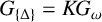 $G_{\{\Delta \}}=KG_\omega $
. Intersecting both sides with
$G_{\{\Delta \}}=KG_\omega $
. Intersecting both sides with $G_{(\Sigma )}$
and using the modular law, we get
$G_{(\Sigma )}$
and using the modular law, we get
 $$ \begin{align*}G_{(\Sigma)}=K(G_{(\Sigma)}\cap G_\omega)\le KW\le W\le G_{(\Sigma)},\end{align*} $$
which contradicts the fact that $W\ne G_{(\Sigma )}$
. This shows that
$W\ne G_{(\Sigma )}$
. This shows that $\bigcap _{a\in G}W^a=K=1$
and, hence, the hypotheses of [Reference Praeger15, Proposition 3.1] are all satisfied, that is, W is a G-covering subgroup of
$\bigcap _{a\in G}W^a=K=1$
and, hence, the hypotheses of [Reference Praeger15, Proposition 3.1] are all satisfied, that is, W is a G-covering subgroup of $G_{(\Sigma )}$
that is maximal in
$G_{(\Sigma )}$
that is maximal in $G_{(\Sigma )}$
and is core-free in G. Observe that the socle S of
$G_{(\Sigma )}$
and is core-free in G. Observe that the socle S of $G_{(\Sigma )}$
cannot be abelian because we are assuming the primitive permutation group
$G_{(\Sigma )}$
cannot be abelian because we are assuming the primitive permutation group $G_{\{\Delta \}}^\Delta $
has nonabelian socle. Now, parts (1)–(3) follow immediately from [Reference Praeger15, Proposition 3.1 (i) and (ii)].
$G_{\{\Delta \}}^\Delta $
has nonabelian socle. Now, parts (1)–(3) follow immediately from [Reference Praeger15, Proposition 3.1 (i) and (ii)].
Let $T_1,\ldots ,T_{\kappa s}$
be the simple direct factor of S. We label these subgroups so that
$T_1,\ldots ,T_{\kappa s}$
be the simple direct factor of S. We label these subgroups so that $N_y=T_{(y-1)\kappa +1}\times \cdots \times T_{y\kappa }$
. Consider the subsets
$N_y=T_{(y-1)\kappa +1}\times \cdots \times T_{y\kappa }$
. Consider the subsets $p=\{y\in \{1,\ldots ,s\}\mid N_y\nleq G_{(\Delta )}\}$
and
$p=\{y\in \{1,\ldots ,s\}\mid N_y\nleq G_{(\Delta )}\}$
and $P=\{x\in \{1,\ldots ,\kappa s\}\mid T_x\nleq G_{(\Delta )}\}$
. Thus,
$P=\{x\in \{1,\ldots ,\kappa s\}\mid T_x\nleq G_{(\Delta )}\}$
. Thus,
 $$ \begin{align*}P=\{(y-1)\kappa+v\mid y \in p, v \in \{1,\ldots,\kappa\}\}.\end{align*} $$
If we let $P_y=\{(y-1)\kappa +v\mid v\in \{1,\ldots ,\kappa \}\}$
, then
$P_y=\{(y-1)\kappa +v\mid v\in \{1,\ldots ,\kappa \}\}$
, then $\{P_y\mid y\in p\}$
is a partition of P and
$\{P_y\mid y\in p\}$
is a partition of P and $N_y=\prod _{x\in P_y}T_x$
.
$N_y=\prod _{x\in P_y}T_x$
.
Since by part (1) $N_y$
is a minimal normal subgroup of
$N_y$
is a minimal normal subgroup of $G_{(\Sigma )}$
for each
$G_{(\Sigma )}$
for each $y\in \{1,\ldots ,s\}$
, we deduce
$y\in \{1,\ldots ,s\}$
, we deduce $S\cap G_{(\Delta )}=S_{(\Delta )}=\prod _{y\notin p}N_y$
and
$S\cap G_{(\Delta )}=S_{(\Delta )}=\prod _{y\notin p}N_y$
and
 $$ \begin{align*}S=\prod_{y\in p}N_y\times S_{(\Delta)},\end{align*} $$
where $\prod _{y\in p}N_y$
acts faithfully on
$\prod _{y\in p}N_y$
acts faithfully on $\Delta $
. Moreover, as
$\Delta $
. Moreover, as $S_\omega \ge S_{(\Delta )}$
, we may write
$S_\omega \ge S_{(\Delta )}$
, we may write ${S_\omega =Z\times S_{(\Delta )}}$
for some subgroup Z of
${S_\omega =Z\times S_{(\Delta )}}$
for some subgroup Z of $\prod _{y\in p}N_y$
. From [Reference Praeger15, Proposition 3.1 (iii)], there exist two distinct indices
$\prod _{y\in p}N_y$
. From [Reference Praeger15, Proposition 3.1 (iii)], there exist two distinct indices $i,j\in \{1,\ldots ,s\}$
with
$i,j\in \{1,\ldots ,s\}$
with
 $$ \begin{align} S\cap W=D\times\prod_{\ell\neq i,j}N_\ell, \end{align} $$
where D is a diagonal subgroup of $N_i\times N_j$
. Relabeling the indexed set
$N_i\times N_j$
. Relabeling the indexed set $\{1,\ldots ,s\}$
if necessary, we suppose
$\{1,\ldots ,s\}$
if necessary, we suppose $i=1$
and
$i=1$
and $j=2$
. Clearly,
$j=2$
. Clearly, $S\cap W\ge S_\omega $
. We now use the O’Nan–Scott theorem to determine the type of
$S\cap W\ge S_\omega $
. We now use the O’Nan–Scott theorem to determine the type of $G_{\{\Delta \}}^\Delta $
and to obtain some preliminary information for the proof of parts (4) and (5).
$G_{\{\Delta \}}^\Delta $
and to obtain some preliminary information for the proof of parts (4) and (5).
This action cannot be of type AS or PA, because in these cases, the structure of $S_\omega $
is incompatible with the description of
$S_\omega $
is incompatible with the description of $S \cap W$
in (3-5) and with the inclusion
$S \cap W$
in (3-5) and with the inclusion $S_\omega \le S \cap W$
. It is also clear that it cannot be of type HA, since S is nonabelian. If it were of type TW, then
$S_\omega \le S \cap W$
. It is also clear that it cannot be of type HA, since S is nonabelian. If it were of type TW, then $\prod _{x \in P} T_x$
would act regularly on
$\prod _{x \in P} T_x$
would act regularly on $\Delta $
and, hence,
$\Delta $
and, hence, $Z=1$
and
$Z=1$
and $S_\omega = S_{(\Delta )}$
. In particular, the elements of
$S_\omega = S_{(\Delta )}$
. In particular, the elements of $S_\omega $
can be viewed as
$S_\omega $
can be viewed as $\kappa s$
-tuples of elements of T whose entries are
$\kappa s$
-tuples of elements of T whose entries are $1$
in the coordinates corresponding to the simple direct factors indexed by the elements of P. Now, since S has no derangements in its action on
$1$
in the coordinates corresponding to the simple direct factors indexed by the elements of P. Now, since S has no derangements in its action on $\Omega $
, we would have
$\Omega $
, we would have
 $$ \begin{align*} S = \bigcup_{g \in G} S_\omega^g = \bigcup_{g \in G} S_{(\Delta)}^g. \end{align*} $$
However, this leads to a contradiction: if we take $g_i \in T_i \setminus \{1\}$
for every
$g_i \in T_i \setminus \{1\}$
for every $i \in \{1, \ldots , \kappa s\}$
, then
$i \in \{1, \ldots , \kappa s\}$
, then $g = (g_i)_{i} \in S$
, but
$g = (g_i)_{i} \in S$
, but $g \notin \bigcup _{g \in G} S_{(\Delta )}^g,$
because no coordinate of g is
$g \notin \bigcup _{g \in G} S_{(\Delta )}^g,$
because no coordinate of g is $1$
. It follows that the action of
$1$
. It follows that the action of $G_{\{\Delta \}}$
on
$G_{\{\Delta \}}$
on $\Delta $
is of type HS, SD, HC, or CD.
$\Delta $
is of type HS, SD, HC, or CD.
Assume $G_{\{\Delta \}}^\Delta $
is of type HS. Then, from the description of the primitive groups of SD type,
$G_{\{\Delta \}}^\Delta $
is of type HS. Then, from the description of the primitive groups of SD type,
 $$ \begin{align*} |T| = |\Delta| = |S : S_\omega| \ge |S : S \cap W| = |N_1\times N_2:\mathrm{Diag}(N_1\times N_2)|=|T|^\kappa. \end{align*} $$
Hence, $\kappa =1$
and
$\kappa =1$
and $N_x=T_x$
for every
$N_x=T_x$
for every $x\in \{1,\ldots ,s\}$
. Moreover,
$x\in \{1,\ldots ,s\}$
. Moreover, $S \cap W = S_\omega $
and
$S \cap W = S_\omega $
and $D=Z = \mathrm {Diag}(T_1 \times T_2)$
. In this case, for the proof of parts (4) and (5), we set
$D=Z = \mathrm {Diag}(T_1 \times T_2)$
. In this case, for the proof of parts (4) and (5), we set $e = \{\{T_1, T_2\}\}$
,
$e = \{\{T_1, T_2\}\}$
, $a = 2$
, and
$a = 2$
, and $b = 1$
.
$b = 1$
.
Assume that $G_{\{\Delta \}}^\Delta $
is of type SD. Thus,
$G_{\{\Delta \}}^\Delta $
is of type SD. Thus,
 $$ \begin{align*} Z = \mathrm{Diag} \bigg(\prod_{x \in P} T_x\bigg)\cong T. \end{align*} $$
From the description of the primitive groups of SD type, we deduce that $G_{\{\Delta \}}$
acts primitively by conjugation on
$G_{\{\Delta \}}$
acts primitively by conjugation on $\{T_{x} \mid x \in P\}$
. Since
$\{T_{x} \mid x \in P\}$
. Since $G_{(\Sigma )} \unlhd G_{\{\Delta \}}$
, it follows that either
$G_{(\Sigma )} \unlhd G_{\{\Delta \}}$
, it follows that either $G_{(\Sigma )}$
acts trivially by conjugation on
$G_{(\Sigma )}$
acts trivially by conjugation on $\{T_{x} \mid x \in P\}$
or
$\{T_{x} \mid x \in P\}$
or $G_{(\Sigma )}$
acts transitively by conjugation on
$G_{(\Sigma )}$
acts transitively by conjugation on $\{T_{x} \mid x \in P\}$
. We now prove that the latter case does not occur. Indeed, if
$\{T_{x} \mid x \in P\}$
. We now prove that the latter case does not occur. Indeed, if $G_{(\Sigma )}$
acted transitively by conjugation on
$G_{(\Sigma )}$
acted transitively by conjugation on $\{T_{x} \mid x \in P\}$
, then
$\{T_{x} \mid x \in P\}$
, then $\prod _{x \in P} T_{x}$
would be a minimal normal subgroup of
$\prod _{x \in P} T_{x}$
would be a minimal normal subgroup of $G_{(\Sigma )}$
contained in S and, hence,
$G_{(\Sigma )}$
contained in S and, hence, $N_y = \prod _{x \in P} T_{x}$
for some
$N_y = \prod _{x \in P} T_{x}$
for some $y \in \{1, \ldots , s\}$
, because
$y \in \{1, \ldots , s\}$
, because $N_1,\ldots ,N_s$
are the unique minimal normal subgroups of
$N_1,\ldots ,N_s$
are the unique minimal normal subgroups of $G_{(\Sigma )}$
contained in S by part (1). Consequently,
$G_{(\Sigma )}$
contained in S by part (1). Consequently,
 $$ \begin{align*} |T|^\kappa=|N_y|=\bigg|\prod_{x\in P}T_x\bigg|=|T|^{|P|}=|T|^{\kappa |p|} \end{align*} $$
and $|p|=1$
. Thus,
$|p|=1$
. Thus, $p=\{1\}$
,
$p=\{1\}$
, $P=P_1=\{1,\ldots ,\kappa \}$
, and
$P=P_1=\{1,\ldots ,\kappa \}$
, and
 $$ \begin{align*} S_\omega =Z\times \prod_{y\ne 1}N_y=\mathrm{Diag}(N_1) \times \prod_{y \ne 1} N_y. \end{align*} $$
However, this is incompatible with the inclusion $S_\omega \le S \cap W$
and with the description of
$S_\omega \le S \cap W$
and with the description of $S \cap W$
in (3-5). Therefore, this contradiction shows that
$S \cap W$
in (3-5). Therefore, this contradiction shows that $G_{(\Sigma )}$
acts trivially by conjugation on
$G_{(\Sigma )}$
acts trivially by conjugation on $\{T_x \mid x \in P\}$
. In particular,
$\{T_x \mid x \in P\}$
. In particular, $\kappa = 1$
and
$\kappa = 1$
and $N_x = T_x$
for every
$N_x = T_x$
for every $x \in \{1, \ldots , s\}$
. In this case, for the proof of parts (4) and (5), we set
$x \in \{1, \ldots , s\}$
. In this case, for the proof of parts (4) and (5), we set
 $$ \begin{align*} e = \{ \{T_x \mid x \in p\} \}, \quad a = |p|, \quad b = 1. \end{align*} $$
Assume $G_{\{\Delta \}}^\Delta $
is of type HC. In this case,
$G_{\{\Delta \}}^\Delta $
is of type HC. In this case, $G_{\{\Delta \}}^\Delta $
is a subgroup of the holomorph
$G_{\{\Delta \}}^\Delta $
is a subgroup of the holomorph $T^{\kappa b} \rtimes \mathrm {Aut}(T^{\kappa b})$
, where
$T^{\kappa b} \rtimes \mathrm {Aut}(T^{\kappa b})$
, where $|P| = 2\kappa b$
. Therefore, Z is isomorphic to
$|P| = 2\kappa b$
. Therefore, Z is isomorphic to $\mathrm {Diag}(T^{\kappa b} \times T^{\kappa b})\cong T^{\kappa b}$
and is the direct product of
$\mathrm {Diag}(T^{\kappa b} \times T^{\kappa b})\cong T^{\kappa b}$
and is the direct product of $\kappa b$
subgroups of the form
$\kappa b$
subgroups of the form $\mathrm {Diag}(T \times T)$
. We now give a more precise description. As
$\mathrm {Diag}(T \times T)$
. We now give a more precise description. As $G_{\{\Delta \}}^\Delta $
is of type HC, the group
$G_{\{\Delta \}}^\Delta $
is of type HC, the group $G_{\{\Delta \}}$
has two orbits of the same cardinality
$G_{\{\Delta \}}$
has two orbits of the same cardinality $\kappa b$
(respectively b) in its action by conjugation on
$\kappa b$
(respectively b) in its action by conjugation on $\{T_x\mid x\in P\}$
(respectively
$\{T_x\mid x\in P\}$
(respectively $\{N_y\mid y\in p\}$
). Therefore,
$\{N_y\mid y\in p\}$
). Therefore,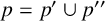 $p=p'\cup p"$
admits a partition into two sets of cardinality b such that
$p=p'\cup p"$
admits a partition into two sets of cardinality b such that $S'=\prod _{y\in p'}N_y$
and
$S'=\prod _{y\in p'}N_y$
and $S"=\prod _{y\in p"}N_y$
are the two minimal normal subgroups of
$S"=\prod _{y\in p"}N_y$
are the two minimal normal subgroups of $G_{\{\Delta \}}$
contained in
$G_{\{\Delta \}}$
contained in $\prod _{y\in p}N_y$
. Moreover,
$\prod _{y\in p}N_y$
. Moreover, $S_\omega =\mathrm {Diag}(S'\times S")\times S_{(\Delta )}$
. In particular, there exists a bijection
$S_\omega =\mathrm {Diag}(S'\times S")\times S_{(\Delta )}$
. In particular, there exists a bijection $F:\bigcup _{y\in p'}P_y\to \bigcup _{y\in p"}P_y$
such that
$F:\bigcup _{y\in p'}P_y\to \bigcup _{y\in p"}P_y$
such that
 $$ \begin{align*} S_\omega=\prod_{x\in \bigcup_{y\in p'}P_y}\mathrm{Diag}(T_x\times T_{F(x)})\times S_{(\Delta)}. \end{align*} $$
As $S_\omega \unlhd G_{(\Sigma )}\cap G_\omega $
and as
$S_\omega \unlhd G_{(\Sigma )}\cap G_\omega $
and as $G_{(\Sigma )}\cap G_\omega $
acts transitively by conjugation on the simple direct factors of
$G_{(\Sigma )}\cap G_\omega $
acts transitively by conjugation on the simple direct factors of $N_y$
for each y, we deduce that the bijection F induces a bijection
$N_y$
for each y, we deduce that the bijection F induces a bijection $f:p'\to p"$
such that
$f:p'\to p"$
such that
 $$ \begin{align*}S_\omega=\prod_{y\in p'}\mathrm{Diag}(N_y\times N_{f(y)})\times S_{(\Delta)}.\end{align*} $$
Thus, the set p indexing the $G_{(\Sigma )}$
-minimal normal subgroups of
$G_{(\Sigma )}$
-minimal normal subgroups of $\prod _{y \in p} N_y$
admits a partition
$\prod _{y \in p} N_y$
admits a partition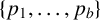 $\{p_1, \ldots , p_b\}$
into b parts of cardinality
$\{p_1, \ldots , p_b\}$
into b parts of cardinality $2$
. Namely,
$2$
. Namely, $\{\{y,f(y)\}\mid y \in p'\}$
. If we set
$\{\{y,f(y)\}\mid y \in p'\}$
. If we set $p_i = \{v_i, w_i\}$
for each i, then
$p_i = \{v_i, w_i\}$
for each i, then $p'=\{v_1,v_2,\ldots ,v_b\}$
,
$p'=\{v_1,v_2,\ldots ,v_b\}$
, $p"=\{w_1,w_2,\ldots ,w_b\}$
, and
$p"=\{w_1,w_2,\ldots ,w_b\}$
, and
 $$ \begin{align*} Z =\mathrm{Diag}(S'\times S")=\prod_{y\in p'}\mathrm{Diag}(N_y\times N_{f(y)})= \mathrm{Diag}(N_{v_1} \times N_{w_1}) \times \cdots \times \mathrm{Diag}(N_{v_b} \times N_{w_b}). \end{align*} $$
In this case, for the proof of parts (4) and (5), we set
 $$ \begin{align*} e = \{ \{N_y \mid y \in p_i\}\mid i \in \{1,\ldots,b\} \}, \quad a = 2. \end{align*} $$
Assume $G_{\{\Delta \}}^\Delta $
is of type CD. Hence,
$G_{\{\Delta \}}^\Delta $
is of type CD. Hence, $G_{\{\Delta \}} / G_{(\Delta )}$
is embedded in
$G_{\{\Delta \}} / G_{(\Delta )}$
is embedded in
 $$ \begin{align*} Y \, \mathop{\mathrm{wr}} \, \mathrm{Sym}(B), \end{align*} $$
with the primitive product action, where Y is a primitive group of SD type and $B \ge 2$
. In particular, Z is a direct product of B diagonal subgroups pairwise isomorphic to T of the direct product
$B \ge 2$
. In particular, Z is a direct product of B diagonal subgroups pairwise isomorphic to T of the direct product $\prod _{x \in P} T_x$
of
$\prod _{x \in P} T_x$
of $|P|=\kappa |p|$
copies of T. The group
$|P|=\kappa |p|$
copies of T. The group $G_{\{\Delta \}}$
acts transitively by conjugation on
$G_{\{\Delta \}}$
acts transitively by conjugation on $\{T_x\mid x\in P\}$
and on
$\{T_x\mid x\in P\}$
and on $\{N_y\mid y\in p\}$
. As
$\{N_y\mid y\in p\}$
. As $S_\omega $
is the direct product of B diagonal subgroups isomorphic to T, the set P admits a uniform partition
$S_\omega $
is the direct product of B diagonal subgroups isomorphic to T, the set P admits a uniform partition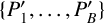 $\{P_1',\ldots ,P_B'\}$
such that
$\{P_1',\ldots ,P_B'\}$
such that
 $$ \begin{align} S_\omega=\mathrm{Diag}\bigg(\prod_{x\in P_1'}T_x\bigg)\times \cdots \times \mathrm{Diag}\bigg(\prod_{x\in P_B'}T_x\bigg)\times S_{(\Delta)}. \end{align} $$
Observe that, as Y has type SD, the normalizer of $\prod _{x\in P_i'}T_x$
acts primitively by conjugation on
$\prod _{x\in P_i'}T_x$
acts primitively by conjugation on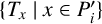 $\{T_x\mid x\in P_i'\}$
. The set P admits also a second uniform partition (with
$\{T_x\mid x\in P_i'\}$
. The set P admits also a second uniform partition (with $|P|/\kappa =|p|$
parts of cardinality
$|P|/\kappa =|p|$
parts of cardinality $\kappa $
) given by the orbits of the action of
$\kappa $
) given by the orbits of the action of $G_{(\Sigma )}$
by conjugation on
$G_{(\Sigma )}$
by conjugation on $\{T_x\mid x\in P\}$
. Indeed, this second uniform partition of P is
$\{T_x\mid x\in P\}$
. Indeed, this second uniform partition of P is $\{P_y\mid y\in p\}$
.
$\{P_y\mid y\in p\}$
.
We claim that $|P_y\cap P_i'|\le 1$
for every
$|P_y\cap P_i'|\le 1$
for every $y\in p$
and for every
$y\in p$
and for every $i\in \{1,\ldots ,B\}$
. Assume
$i\in \{1,\ldots ,B\}$
. Assume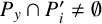 $P_y\cap P_i'\neq \emptyset $
. Since the partitions
$P_y\cap P_i'\neq \emptyset $
. Since the partitions $\{P_1',\ldots ,P_B'\}$
and
$\{P_1',\ldots ,P_B'\}$
and $\{P_y\mid y \in p\}$
label two systems of imprimitivity for the action of
$\{P_y\mid y \in p\}$
label two systems of imprimitivity for the action of $G_{\{\Delta \}}$
on
$G_{\{\Delta \}}$
on $\{T_x\mid x\in P\}$
, since the meet of two systems of imprimivity is a system of imprimivity, and since the normalizer of
$\{T_x\mid x\in P\}$
, since the meet of two systems of imprimivity is a system of imprimivity, and since the normalizer of $\prod _{x\in P_i'}T_x$
acts primitively by conjugation on
$\prod _{x\in P_i'}T_x$
acts primitively by conjugation on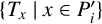 $\{T_x\mid x\in P_i'\}$
, we deduce that either
$\{T_x\mid x\in P_i'\}$
, we deduce that either $\{P_y\mid y\in p\}$
is a coarser partition than
$\{P_y\mid y\in p\}$
is a coarser partition than $\{P_1',\ldots ,P_B'\}$
or the meet of
$\{P_1',\ldots ,P_B'\}$
or the meet of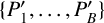 $\{P_1',\ldots ,P_B'\}$
and
$\{P_1',\ldots ,P_B'\}$
and $\{P_y\mid y\in p\}$
is the trivial partition. In the first case, arguing as in the SD case, we obtain a contradiction using (3-5) and the inclusion
$\{P_y\mid y\in p\}$
is the trivial partition. In the first case, arguing as in the SD case, we obtain a contradiction using (3-5) and the inclusion $S_\omega \le S\cap W$
. Therefore, the meet of
$S_\omega \le S\cap W$
. Therefore, the meet of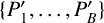 $\{P_1',\ldots ,P_B'\}$
and
$\{P_1',\ldots ,P_B'\}$
and $\{P_y\mid y\in p\}$
is the trivial partition, that is,
$\{P_y\mid y\in p\}$
is the trivial partition, that is, $|P_y\cap P_i'|\le 1$
for every
$|P_y\cap P_i'|\le 1$
for every $y\in p$
and for every
$y\in p$
and for every $i\in \{1,\ldots ,B\}$
. From this, (3-6), and arguing as in the SD case, it follows
$i\in \{1,\ldots ,B\}$
. From this, (3-6), and arguing as in the SD case, it follows
 $$ \begin{align*}S_\omega=\prod_{i=1}^b\mathrm{Diag}(N_{p_i})\times S_{(\Delta)}\end{align*} $$
for some partition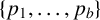 $\{p_1,\ldots ,p_b\}$
of p, with
$\{p_1,\ldots ,p_b\}$
of p, with $b=B/\kappa $
. In this case, we set
$b=B/\kappa $
. In this case, we set
 $$ \begin{align*} e = \{ \{N_y \mid y \in p_i\}\mid i \in \{1,\ldots,b\} \}, \quad a =|P|/B. \end{align*} $$
We are now ready to prove parts (4) and (5). We consider the function $\theta $
having domain
$\theta $
having domain $\Sigma $
and codomain the set of all subsets of
$\Sigma $
and codomain the set of all subsets of $\{N_1,\ldots ,N_{s}\}$
. For each
$\{N_1,\ldots ,N_{s}\}$
. For each $\Delta '\in \Sigma $
, we let
$\Delta '\in \Sigma $
, we let $\theta (\Delta ')=\{N_i\mid N_i\nleq G_{(\Delta ')}\}$
. For instance,
$\theta (\Delta ')=\{N_i\mid N_i\nleq G_{(\Delta ')}\}$
. For instance, $\theta (\Delta )=\{N_y\mid y\in p\}$
. Since G acts transitively on
$\theta (\Delta )=\{N_y\mid y\in p\}$
. Since G acts transitively on $\Sigma $
, the sets
$\Sigma $
, the sets $\theta (\Delta ')$
all have the same cardinality, say
$\theta (\Delta ')$
all have the same cardinality, say $k=|p|$
. Moreover, from the O’Nan–Scott type of
$k=|p|$
. Moreover, from the O’Nan–Scott type of $G_{\{\Delta \}}^{\Delta }$
that we have highlighted in the previous paragraph, we deduce that
$G_{\{\Delta \}}^{\Delta }$
that we have highlighted in the previous paragraph, we deduce that $\theta (\Delta ')$
is endowed with a natural partition into b sets of cardinality
$\theta (\Delta ')$
is endowed with a natural partition into b sets of cardinality $k/b$
. Let
$k/b$
. Let $V=\{N_1,\ldots ,N_{s}\}$
, let
$V=\{N_1,\ldots ,N_{s}\}$
, let $a=k/b$
, and let E be the image of
$a=k/b$
, and let E be the image of $\theta $
. In particular,
$\theta $
. In particular, $\Gamma =(V,E)$
is an
$\Gamma =(V,E)$
is an $(a,b)$
-hypergraph and part (a) is satisfied. Moreover,
$(a,b)$
-hypergraph and part (a) is satisfied. Moreover, $G_{\{\Delta \}}$
fixes the edge
$G_{\{\Delta \}}$
fixes the edge $\theta (\Delta )$
of
$\theta (\Delta )$
of $\Gamma $
by construction and, hence, part (d) is satisfied. Since the action of G by conjugation on V is transitive and since G is transitive on
$\Gamma $
by construction and, hence, part (d) is satisfied. Since the action of G by conjugation on V is transitive and since G is transitive on $\Sigma $
, we deduce that
$\Sigma $
, we deduce that $\Gamma $
is G-vertex and G-edge transitive. By construction, the group
$\Gamma $
is G-vertex and G-edge transitive. By construction, the group $G_{\{\Delta \}}$
acts transitively on the b parts of
$G_{\{\Delta \}}$
acts transitively on the b parts of $\theta (\Delta )$
. Finally, when Y has O’Nan–Scott type SD or CD,
$\theta (\Delta )$
. Finally, when Y has O’Nan–Scott type SD or CD, $G_{\{\Delta \}}$
is also transitive on
$G_{\{\Delta \}}$
is also transitive on $p_1\cup \cdots \cup p_b$
and, when Y has O’Nan–Scott type HS or HC, we have
$p_1\cup \cdots \cup p_b$
and, when Y has O’Nan–Scott type HS or HC, we have $a=2$
. We deduce that part (c) is satisfied.
$a=2$
. We deduce that part (c) is satisfied.
Let t be the number of $\mathrm {Aut}(T^\kappa )$
-conjugacy classes in
$\mathrm {Aut}(T^\kappa )$
-conjugacy classes in $T^\kappa $
and let
$T^\kappa $
and let $x_1,\ldots ,x_t$
be a set of representatives. Let c be the chromatic number of
$x_1,\ldots ,x_t$
be a set of representatives. Let c be the chromatic number of $\Gamma $
. Suppose
$\Gamma $
. Suppose $c\le t$
. In particular, there exists a coloring
$c\le t$
. In particular, there exists a coloring $\eta $
of V where we can use as ‘colors’ the elements in
$\eta $
of V where we can use as ‘colors’ the elements in $\{x_1,\ldots ,x_t\}$
. Using the coloring
$\{x_1,\ldots ,x_t\}$
. Using the coloring $\eta $
, consider
$\eta $
, consider
 $$ \begin{align*}g=({\eta(N_1)},{\eta(N_2)},\ldots,{\eta(N_{s})})\in N_1\times \cdots\times N_{ s}=S, \end{align*} $$
in other words, we are considering the element of S where in the i th coordinate, we put the element having color $\eta (N_i)$
. Since we are dealing with the case that
$\eta (N_i)$
. Since we are dealing with the case that $G_{(\Sigma )}$
has no derangements, we deduce that g fixes some point of
$G_{(\Sigma )}$
has no derangements, we deduce that g fixes some point of $\Omega $
, because
$\Omega $
, because $S\le G_{(\Sigma )}$
. Without loss of generality, g fixes
$S\le G_{(\Sigma )}$
. Without loss of generality, g fixes $\omega $
and, hence,
$\omega $
and, hence, $g\in S\cap G_\omega $
. However, from part (5), we see that the coordinates of g belonging to the same part of the edge
$g\in S\cap G_\omega $
. However, from part (5), we see that the coordinates of g belonging to the same part of the edge $\theta (\Delta )$
must be conjugate under some automorphism of
$\theta (\Delta )$
must be conjugate under some automorphism of $T^\kappa $
, that is, all the parts of the edge
$T^\kappa $
, that is, all the parts of the edge $\theta (\Delta )$
are monochromatic, which contradicts the fact that
$\theta (\Delta )$
are monochromatic, which contradicts the fact that $\eta $
is a coloring of
$\eta $
is a coloring of $\Gamma $
. This contradiction has arisen from assuming
$\Gamma $
. This contradiction has arisen from assuming $c\le t$
and, hence, part (b) follows.
$c\le t$
and, hence, part (b) follows.
Remark 3.7. Here, we give a natural example of a transitive permutation group satisfying the assumptions in Proposition 3.6. Consider the nonabelian simple group $T=\mathrm {Alt}(5)$
, let
$T=\mathrm {Alt}(5)$
, let $G=T \mathop {\mathrm {wr}} \mathrm {Sym}(5)$
, and let
$G=T \mathop {\mathrm {wr}} \mathrm {Sym}(5)$
, and let $N=T^{5}$
be the base group of G. Let
$N=T^{5}$
be the base group of G. Let ${H=\{(t_1,t_2,t_3,t_4,t_5)\in N\mid t_1=t_2\}\cong T^{4}}$
and let
${H=\{(t_1,t_2,t_3,t_4,t_5)\in N\mid t_1=t_2\}\cong T^{4}}$
and let $\Omega $
be the set of right cosets of H in G. Thus,
$\Omega $
be the set of right cosets of H in G. Thus, $|\Omega |=|\mathrm {Sym}(5)|[N:H]=120\cdot 60$
and G can be viewed as a permutation group on
$|\Omega |=|\mathrm {Sym}(5)|[N:H]=120\cdot 60$
and G can be viewed as a permutation group on $\Omega $
.
$\Omega $
.
Let $\Sigma $
be the system of imprimitivity on
$\Sigma $
be the system of imprimitivity on $\Omega $
consisting of the orbits of N. The kernel of the action of G on
$\Omega $
consisting of the orbits of N. The kernel of the action of G on $\Sigma $
is
$\Sigma $
is $G_{(\Sigma )} = \bigcap _{\Delta \in \Sigma } G_{\{\Delta \}} = N \neq 1$
. For each
$G_{(\Sigma )} = \bigcap _{\Delta \in \Sigma } G_{\{\Delta \}} = N \neq 1$
. For each $\Delta \in \Sigma $
, we have
$\Delta \in \Sigma $
, we have ${G_{\{\Delta \}} = N}$
, since the quotient group
${G_{\{\Delta \}} = N}$
, since the quotient group $G/N$
acts regularly on
$G/N$
acts regularly on $\Sigma $
. Moreover, as H is a maximal subgroup of N, we deduce that
$\Sigma $
. Moreover, as H is a maximal subgroup of N, we deduce that $G_{\{\Delta \}}$
acts primitively on
$G_{\{\Delta \}}$
acts primitively on $\Delta $
. Finally, as the core of H in N is isomorphic to
$\Delta $
. Finally, as the core of H in N is isomorphic to $T^{3}$
, we deduce
$T^{3}$
, we deduce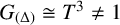 $G_{(\Delta )}\cong T^{3}\neq 1$
.
$G_{(\Delta )}\cong T^{3}\neq 1$
.
Let $(t_1,t_2,t_3,t_4,t_5)\in N=G_{(\Sigma )}$
. As T has only four
$(t_1,t_2,t_3,t_4,t_5)\in N=G_{(\Sigma )}$
. As T has only four $\mathrm {Aut}(T)$
-conjugacy classes, there exist two distinct indices
$\mathrm {Aut}(T)$
-conjugacy classes, there exist two distinct indices $i,j\in \{1,\ldots ,5\}$
with
$i,j\in \{1,\ldots ,5\}$
with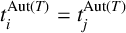 $t_i^{\mathrm {Aut}(T)}=t_j^{\mathrm {Aut}(T)}$
. Since
$t_i^{\mathrm {Aut}(T)}=t_j^{\mathrm {Aut}(T)}$
. Since $\mathrm {Sym}(5)$
acts
$\mathrm {Sym}(5)$
acts $2$
-transitively on the five simple direct factors of N, there exists
$2$
-transitively on the five simple direct factors of N, there exists $\sigma \in G$
with
$\sigma \in G$
with $(t_1,t_2,t_3,t_4,t_5)^\sigma \in H$
. This shows that every element of
$(t_1,t_2,t_3,t_4,t_5)^\sigma \in H$
. This shows that every element of $G_{(\Sigma )}$
fixes some point of
$G_{(\Sigma )}$
fixes some point of $\Omega $
and, hence, no element of
$\Omega $
and, hence, no element of $G_{(\Sigma )}$
acts as a derangement on
$G_{(\Sigma )}$
acts as a derangement on $\Omega $
.
$\Omega $
.
In this example, the auxiliary $(a,b)$
-hypergraph arising in Proposition 3.6(4) has parameters
$(a,b)$
-hypergraph arising in Proposition 3.6(4) has parameters $a=2$
and
$a=2$
and $b=1$
, and is the complete graph on five vertices.
$b=1$
, and is the complete graph on five vertices.
4 The action of G on a maximal system of imprimitivity
$\Sigma _1$

In this section, we start the proof of Theorem 1.1 and we fix the notation that is maintained for the rest of the paper.
In the proof of Theorem 1.1, we argue by induction on $|G|$
. Specifically, by substituting G with a proper transitive subgroup if necessary, we may assume that
$|G|$
. Specifically, by substituting G with a proper transitive subgroup if necessary, we may assume that
 $$ \begin{align} G \textrm{ is minimally transitive}, \end{align} $$
meaning that every proper subgroup of G acts intransitively on $\Omega $
.
$\Omega $
.
Let G be a transitive group having domain $\Omega $
and suppose that the derangement graph
$\Omega $
and suppose that the derangement graph $\Gamma _{G,\Omega }$
of G in its action on
$\Gamma _{G,\Omega }$
of G in its action on $\Omega $
has no cliques of size
$\Omega $
has no cliques of size $4$
. If
$4$
. If $\Gamma _{G,\Omega }$
has no triangles, then the result follows from [Reference Meagher, Razafimahatratra and Spiga14], indeed, part (1) is satisfied with
$\Gamma _{G,\Omega }$
has no triangles, then the result follows from [Reference Meagher, Razafimahatratra and Spiga14], indeed, part (1) is satisfied with $|\Omega |\le 2$
. Therefore, we may suppose that
$|\Omega |\le 2$
. Therefore, we may suppose that $\Gamma _{G,\Omega }$
has at least one triangle. In particular,
$\Gamma _{G,\Omega }$
has at least one triangle. In particular, $|\Omega |>2$
.
$|\Omega |>2$
.
Lemma 4.1. The group G possesses a system of imprimitivity $\Sigma _1$
with
$\Sigma _1$
with $|\Sigma _1|=3$
. The permutation group induced by G on
$|\Sigma _1|=3$
. The permutation group induced by G on $\Sigma _1$
is
$\Sigma _1$
is $\mathrm {Alt}(\Sigma _1)$
and
$\mathrm {Alt}(\Sigma _1)$
and $G_{(\Sigma _1)}$
has no derangements.
$G_{(\Sigma _1)}$
has no derangements.
Proof. Let $\Sigma _1$
be a system of imprimitivity for the action of G on
$\Sigma _1$
be a system of imprimitivity for the action of G on $\Omega $
of minimal cardinality. Consider the natural homomorphism
$\Omega $
of minimal cardinality. Consider the natural homomorphism
 $$ \begin{align*}\bar{\,}:G\to \mathrm{Sym}(\Sigma_1)\end{align*} $$
arising from the action of G on $\Sigma _1$
.
$\Sigma _1$
.
Since the derangement graph of G on $\Omega $
lacks cliques of size
$\Omega $
lacks cliques of size $4$
, by Lemma 3.4, the derangement graph
$4$
, by Lemma 3.4, the derangement graph $\Gamma _{\bar G,\Sigma _1}$
also lacks such cliques.
$\Gamma _{\bar G,\Sigma _1}$
also lacks such cliques.
Now, suppose the derangement graph $\Gamma _{\bar {G},\Sigma _1}$
has no triangles. As
$\Gamma _{\bar {G},\Sigma _1}$
has no triangles. As $|\Sigma _1|>1$
, according to [Reference Meagher, Razafimahatratra and Spiga14], we have
$|\Sigma _1|>1$
, according to [Reference Meagher, Razafimahatratra and Spiga14], we have $|\bar {G}|=|\Sigma _1|=2$
. Consequently,
$|\bar {G}|=|\Sigma _1|=2$
. Consequently, $[G:G_{(\Sigma _1)}]=2$
and
$[G:G_{(\Sigma _1)}]=2$
and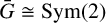 $\bar {G}\cong \mathrm {Sym}(2)$
. Notice that each element in
$\bar {G}\cong \mathrm {Sym}(2)$
. Notice that each element in $G\setminus G_{(\Sigma _1)}$
acts as a derangement on
$G\setminus G_{(\Sigma _1)}$
acts as a derangement on $\Sigma _1$
and, thus, on
$\Sigma _1$
and, thus, on $\Omega $
as well.
$\Omega $
as well.
Consider $g\in G\setminus G_{(\Sigma _1)}$
. If
$g\in G\setminus G_{(\Sigma _1)}$
. If $G_{(\Sigma _1)}$
contains a derangement k in its action on
$G_{(\Sigma _1)}$
contains a derangement k in its action on $\Omega $
, then
$\Omega $
, then $gk$
and
$gk$
and $gkg^{-1}$
are both derangements since
$gkg^{-1}$
are both derangements since $gk\in G\setminus G_{(\Sigma _1)}$
and
$gk\in G\setminus G_{(\Sigma _1)}$
and $gkg^{-1}$
is conjugate to k. Consequently,
$gkg^{-1}$
is conjugate to k. Consequently,
 $$ \begin{align*}C=\{1,g,k,gk\}\end{align*} $$
forms a clique of size four in $\Gamma _{G,\Omega }$
, which contradicts the assumption that
$\Gamma _{G,\Omega }$
, which contradicts the assumption that $\Gamma _{G,\Omega }$
has no
$\Gamma _{G,\Omega }$
has no $4$
-cliques. Hence,
$4$
-cliques. Hence, $G_{(\Sigma _1)}$
, in its action on
$G_{(\Sigma _1)}$
, in its action on $\Omega $
, contains no derangements. Consequently, the derangement graph
$\Omega $
, contains no derangements. Consequently, the derangement graph $\Gamma _{G,\Omega }$
is bipartite with bipartition
$\Gamma _{G,\Omega }$
is bipartite with bipartition
 $$ \begin{align*}G_{(\Sigma_1)},G\setminus G_{(\Sigma_1)}.\end{align*} $$
However, this contradicts the fact that $\Gamma _{G,\Omega }$
admits a triangle.
$\Gamma _{G,\Omega }$
admits a triangle.
This contradiction demonstrates that the derangement graph $\Gamma _{\bar {G},\Sigma _1}$
of
$\Gamma _{\bar {G},\Sigma _1}$
of $\bar G$
has a triangle but no
$\bar G$
has a triangle but no $4$
-clique. Since
$4$
-clique. Since $\bar {G}$
is primitive, by [Reference Fusari, Previtali and Spiga8, Theorem 1.2], we conclude that
$\bar {G}$
is primitive, by [Reference Fusari, Previtali and Spiga8, Theorem 1.2], we conclude that $|\Sigma _1|=3$
and
$|\Sigma _1|=3$
and $\mathrm {Alt}(\Sigma _1)\le \bar G\le \mathrm {Sym}(\Sigma _1)$
.
$\mathrm {Alt}(\Sigma _1)\le \bar G\le \mathrm {Sym}(\Sigma _1)$
.
Now, let $\tilde G$
be the preimage under
$\tilde G$
be the preimage under $\bar {\,}$
of
$\bar {\,}$
of $\mathrm {Alt}(\Sigma _1)$
. We have
$\mathrm {Alt}(\Sigma _1)$
. We have $[G:\tilde G]=1$
when
$[G:\tilde G]=1$
when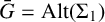 ${\bar G=\mathrm {Alt}(\Sigma _1)}$
and
${\bar G=\mathrm {Alt}(\Sigma _1)}$
and $[G:\tilde G]=2$
when
$[G:\tilde G]=2$
when $\bar G=\mathrm {Sym}(\Sigma _1)$
. We claim that
$\bar G=\mathrm {Sym}(\Sigma _1)$
. We claim that $\tilde G$
is transitive on
$\tilde G$
is transitive on $\Omega $
. This is clear when
$\Omega $
. This is clear when $G=\tilde G$
. Suppose then
$G=\tilde G$
. Suppose then $|G:\tilde G|=2$
. If
$|G:\tilde G|=2$
. If $G_{\omega _1}\le \tilde G$
, then from the bijection between systems of imprimitivity of G on
$G_{\omega _1}\le \tilde G$
, then from the bijection between systems of imprimitivity of G on $\Omega $
and the interval lattice of
$\Omega $
and the interval lattice of $G/G_{\omega _1}$
, we deduce that G has a system of imprimitivity of size
$G/G_{\omega _1}$
, we deduce that G has a system of imprimitivity of size $2$
, because
$2$
, because ${|G:\tilde G|=2}$
and
${|G:\tilde G|=2}$
and $G_{\omega _1}\le \tilde G$
. However, this contradicts the fact that we have shown that the minimal cardinality of a system of imprimitivity for G is
$G_{\omega _1}\le \tilde G$
. However, this contradicts the fact that we have shown that the minimal cardinality of a system of imprimitivity for G is $3$
. Therefore,
$3$
. Therefore, $G_{\omega _1}\nleq \tilde G$
. Since
$G_{\omega _1}\nleq \tilde G$
. Since ${|G:\tilde G|=2}$
, we have
${|G:\tilde G|=2}$
, we have $G=G_{\omega _1}\tilde G$
. We deduce by the Frattini argument that
$G=G_{\omega _1}\tilde G$
. We deduce by the Frattini argument that $\tilde G$
is transitive on
$\tilde G$
is transitive on $\Omega $
.
$\Omega $
.
By (4-1), we conclude that $G=\tilde G$
, which implies
$G=\tilde G$
, which implies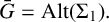 $ \bar G=\mathrm {Alt}(\Sigma _1).$
Suppose $G_{(\Sigma _1)}$
contains a derangement k in its action on
$G_{(\Sigma _1)}$
contains a derangement k in its action on $\Omega $
. Now, let
$\Omega $
. Now, let $c\in G$
such that
$c\in G$
such that $\bar {c}$
acts as a cycle of length
$\bar {c}$
acts as a cycle of length $3$
on
$3$
on $\Sigma _1$
, that is,
$\Sigma _1$
, that is, $\bar G=\mathrm {Alt}(\Sigma _1)=\langle \bar {c}\rangle $
. Following the previous argument, we observe that
$\bar G=\mathrm {Alt}(\Sigma _1)=\langle \bar {c}\rangle $
. Following the previous argument, we observe that $C=\{1,c,c^2,k,ck,c^2k\}$
forms a clique of size six in
$C=\{1,c,c^2,k,ck,c^2k\}$
forms a clique of size six in $\Gamma _{G,\Omega }$
, which contradicts the assumption that
$\Gamma _{G,\Omega }$
, which contradicts the assumption that $\Gamma _{G,\Omega }$
has no
$\Gamma _{G,\Omega }$
has no $4$
-cliques. Therefore,
$4$
-cliques. Therefore, $G_{(\Sigma _1)}$
in its action on
$G_{(\Sigma _1)}$
in its action on $\Omega $
contains no derangement.
$\Omega $
contains no derangement.
5 The action of G on a refinement
$\Sigma _2$
of
$\Sigma _1$


Notation 5.1. We establish some necessary notation for the subsequent steps of the proof of Theorem 1.1. From Lemma 4.1, we know that $G_{(\Sigma _1)}$
has no derangements in its action on
$G_{(\Sigma _1)}$
has no derangements in its action on $\Omega $
, and thus,
$\Omega $
, and thus,
 $$ \begin{align} G_{(\Sigma_1)}=\bigcup_{\omega\in \Omega}G_\omega. \end{align} $$
Let $\Sigma _1=\{\Delta _1,\Delta _2,\Delta _3\}$
and choose
$\Sigma _1=\{\Delta _1,\Delta _2,\Delta _3\}$
and choose $\omega _i\in \Delta _i$
for all
$\omega _i\in \Delta _i$
for all $i\in \{1,2,3\}$
.
$i\in \{1,2,3\}$
.
Since G is imprimitive on $\Omega $
with a system of imprimitivity
$\Omega $
with a system of imprimitivity $\Sigma _1$
, and G induces
$\Sigma _1$
, and G induces $\mathrm {Alt}(\Sigma _1)$
on
$\mathrm {Alt}(\Sigma _1)$
on $\Sigma _1$
by Lemma 4.1, we embed
$\Sigma _1$
by Lemma 4.1, we embed
 $$ \begin{align*}G\le H \mathop{\mathrm{wr}} \mathrm{Alt}(3),\end{align*} $$
where $H\le \mathrm {Sym}(\Delta )$
, H is transitive, and
$H\le \mathrm {Sym}(\Delta )$
, H is transitive, and $\Delta $
is a finite set with
$\Delta $
is a finite set with $|\Delta |=|\Delta _i|$
. Under this identification, we may write
$|\Delta |=|\Delta _i|$
. Under this identification, we may write
 $$ \begin{align*}\Delta_1=\Delta\times\{1\},\, \Delta_2=\Delta\times\{2\},\, \Delta_3=\Delta\times\{3\},\end{align*} $$
and regard G as endowed with its imprimitive action on $\Omega =\Delta \times \{1,2,3\}$
. Specifically,
$\Omega =\Delta \times \{1,2,3\}$
. Specifically,
 $$ \begin{align*}G_{(\Sigma_1)}\le H\times H\times H.\end{align*} $$
For each $i\in \{1,2,3\}$
, let
$i\in \{1,2,3\}$
, let $\pi _i:G_{(\Sigma _1)}\to H$
be the projection onto the
$\pi _i:G_{(\Sigma _1)}\to H$
be the projection onto the $i\,{\mathrm {th}}$
direct factor. Without loss of generality (by potentially replacing H with the permutation group induced by
$i\,{\mathrm {th}}$
direct factor. Without loss of generality (by potentially replacing H with the permutation group induced by $G_{(\Sigma _1)}$
on its action on
$G_{(\Sigma _1)}$
on its action on $\Delta _i$
), we may assume that
$\Delta _i$
), we may assume that
 $$ \begin{align*}H=\pi_1(G_{(\Sigma_1)})=\pi_2(G_{(\Sigma_1)})=\pi_3(G_{(\Sigma_1)}).\end{align*} $$
This allows a concrete representation of the elements of G; indeed, each element of G takes the form $(h_1,h_2,h_3)(1\,2\,3)^i$
for some
$(h_1,h_2,h_3)(1\,2\,3)^i$
for some $h_1,h_2,h_3\in H$
and
$h_1,h_2,h_3\in H$
and $i\in \{0,1,2\}$
.
$i\in \{0,1,2\}$
.
Let $c\in G\setminus G_{(\Sigma _1)}$
with
$c\in G\setminus G_{(\Sigma _1)}$
with $\Delta _1^c=\Delta _2$
. Then,
$\Delta _1^c=\Delta _2$
. Then, $c=(h_1,h_2,h_3)(1\,2\,3)$
for some
$c=(h_1,h_2,h_3)(1\,2\,3)$
for some $h_1,h_2,h_3\in H$
and
$h_1,h_2,h_3\in H$
and $G=G_{(\Sigma _1)}\langle c\rangle $
. Let
$G=G_{(\Sigma _1)}\langle c\rangle $
. Let $h=h_1h_2h_3$
. Note that
$h=h_1h_2h_3$
. Note that
 $$ \begin{align*} (1,h_1^{-1},h_2^{-1}h_1^{-1})^{-1}c(1,h_1^{-1},h_2^{-1}h_1^{-1})&= (1,h_1,h_1h_2)(h_1,h_2,h_3)(1\,2\,3)(1,h_1^{-1},h_2^{-1}h_1)\\ &=(h_1,h_1h_2,h_1h_2h_3)(h_1^{-1},h_2^{-1}h_1^{-1},1)(1\,2\,3)\\ &=(1,1,h)(1\,2\,3). \end{align*} $$
This shows that, by replacing G with its conjugate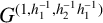 $G^{(1,h_1^{-1},h_2^{-1}h_1^{-1})}$
in
$G^{(1,h_1^{-1},h_2^{-1}h_1^{-1})}$
in $H \mathop {\mathrm {wr}} \mathrm {Alt}(3)$
, we may assume that
$H \mathop {\mathrm {wr}} \mathrm {Alt}(3)$
, we may assume that
 $$ \begin{align*} c=(1,1,h)(1\,2\,3). \end{align*} $$
Of course, this substitution does not affect the fact that $\Gamma _{G,\Omega }$
has no
$\Gamma _{G,\Omega }$
has no $4$
-clique.
$4$
-clique.
Notice that if G is primitive on $\Omega $
, then
$\Omega $
, then $\Sigma _1=\Omega $
, which implies that part (1) of Theorem 1.1 holds with
$\Sigma _1=\Omega $
, which implies that part (1) of Theorem 1.1 holds with $|\Omega |=3$
. Hence, for the remainder of the proof of Theorem 1.1, we assume that G is imprimitive on
$|\Omega |=3$
. Hence, for the remainder of the proof of Theorem 1.1, we assume that G is imprimitive on $\Omega $
, meaning
$\Omega $
, meaning $|\Omega |>3$
.
$|\Omega |>3$
.
Lemma 5.2. The group G admits a system of imprimitivity $\Sigma _2$
that is a refinement of
$\Sigma _2$
that is a refinement of $\Sigma _1$
, such that the permutation group induced by G on
$\Sigma _1$
, such that the permutation group induced by G on $\Sigma _2$
is permutation isomorphic to the action of
$\Sigma _2$
is permutation isomorphic to the action of $\mathrm {Alt}(4)$
on the six
$\mathrm {Alt}(4)$
on the six $2$
-subsets of
$2$
-subsets of $\{1,2,3,4\}$
.
$\{1,2,3,4\}$
.
Proof. From Notation 5.1, we have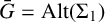 $\bar G=\mathrm {Alt}(\Sigma _1)$
and, hence,
$\bar G=\mathrm {Alt}(\Sigma _1)$
and, hence, $G_{\{\Delta _i\}}=G_{(\Sigma _1)}$
, because
$G_{\{\Delta _i\}}=G_{(\Sigma _1)}$
, because $\mathrm {Alt}(\Sigma _1)$
acts regularly on
$\mathrm {Alt}(\Sigma _1)$
acts regularly on $\Sigma _1$
. As
$\Sigma _1$
. As $G_{\{\Delta _i\}}$
is transitive on
$G_{\{\Delta _i\}}$
is transitive on $\Delta _i$
, we deduce that
$\Delta _i$
, we deduce that
 $$ \begin{align*} G_{(\Sigma_1)}\text{ is transitive on }\Delta_i\quad \text{for each }i\in \{1,2,3\}. \end{align*} $$
Since $|\Omega |>|\Sigma _1|=3$
, G admits a system of imprimitivity
$|\Omega |>|\Sigma _1|=3$
, G admits a system of imprimitivity $\Sigma _2\ne \Sigma _1$
that is a refinement of
$\Sigma _2\ne \Sigma _1$
that is a refinement of $\Sigma _1$
. Among all such systems of imprimitivity, choose one so that
$\Sigma _1$
. Among all such systems of imprimitivity, choose one so that $|\Sigma _2|$
is as small as possible. Just as in the proof of Lemma 4.1, we may replace G with the permutation group induced by G on
$|\Sigma _2|$
is as small as possible. Just as in the proof of Lemma 4.1, we may replace G with the permutation group induced by G on $\Sigma _2$
and, hence, we may suppose that
$\Sigma _2$
and, hence, we may suppose that $\Sigma _2=\{\{\omega \}\mid \omega \in \Omega \}$
. Therefore, we need to show that the action of G on
$\Sigma _2=\{\{\omega \}\mid \omega \in \Omega \}$
. Therefore, we need to show that the action of G on $\Omega $
itself is permutation isomorphic to the action of
$\Omega $
itself is permutation isomorphic to the action of $\mathrm {Alt}(4)$
on the six
$\mathrm {Alt}(4)$
on the six $2$
-subsets of
$2$
-subsets of $\{1,2,3,4\}$
.
$\{1,2,3,4\}$
.
The minimality of $|\Sigma _2|$
implies that
$|\Sigma _2|$
implies that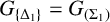 $G_{\{\Delta _1\}}=G_{(\Sigma _1)}$
is primitive in its action on
$G_{\{\Delta _1\}}=G_{(\Sigma _1)}$
is primitive in its action on $\Delta _1$
. If
$\Delta _1$
. If $G_{(\Delta _1)}= 1$
, then the hypotheses of Proposition 3.5 are satisfied and, hence,
$G_{(\Delta _1)}= 1$
, then the hypotheses of Proposition 3.5 are satisfied and, hence, $G_{(\Sigma _1)}$
contains a derangement in its action on
$G_{(\Sigma _1)}$
contains a derangement in its action on $\Omega $
, which contradicts (5-1) (or the conclusion of Lemma 4.1). This contradiction implies that
$\Omega $
, which contradicts (5-1) (or the conclusion of Lemma 4.1). This contradiction implies that $ G_{(\Delta _1)}\ne 1,$
that is,
$ G_{(\Delta _1)}\ne 1,$
that is, $G_{\{\Delta _1\}}$
does not act faithfully on
$G_{\{\Delta _1\}}$
does not act faithfully on $\Delta _1$
. Although we are in a position to apply Proposition 3.6, we choose not to do so here. Instead, we argue using an ad hoc method, as we believe this approach could be applied more generally. However, at present, we do not know how to achieve this broader generalization.
$\Delta _1$
. Although we are in a position to apply Proposition 3.6, we choose not to do so here. Instead, we argue using an ad hoc method, as we believe this approach could be applied more generally. However, at present, we do not know how to achieve this broader generalization.
Since $G_{(\Sigma _1)}$
is primitive on
$G_{(\Sigma _1)}$
is primitive on $\Delta _i$
,
$\Delta _i$
, $G_{\omega _i}$
is maximal in
$G_{\omega _i}$
is maximal in $G_{(\Sigma _1)}$
. We claim that
$G_{(\Sigma _1)}$
. We claim that
 $$ \begin{align} G_{(\Delta_1\cup\Delta_2)}=G_{(\Delta_1\cup \Delta_3)}=G_{(\Delta_2\cup\Delta_3)}=1. \end{align} $$
Observe that, since G acts transitively by conjugation on $\Sigma _1=\{\Delta _1,\Delta _2,\Delta _3\}$
, the groups
$\Sigma _1=\{\Delta _1,\Delta _2,\Delta _3\}$
, the groups $G_{(\Delta _1\cup \Delta _2)}$
,
$G_{(\Delta _1\cup \Delta _2)}$
, $G_{(\Delta _1\cup \Delta _3)}$
, and
$G_{(\Delta _1\cup \Delta _3)}$
, and $G_{(\Delta _2\cup \Delta _3)}$
are G-conjugate. Hence, if one of them is trivial, all must be trivial. We argue by contradiction and we suppose that
$G_{(\Delta _2\cup \Delta _3)}$
are G-conjugate. Hence, if one of them is trivial, all must be trivial. We argue by contradiction and we suppose that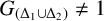 $G_{(\Delta _1\cup \Delta _2)}\ne 1$
. Observe that
$G_{(\Delta _1\cup \Delta _2)}\ne 1$
. Observe that
 $$ \begin{align*}G_{(\Delta_1)}\cap G_{(\Delta_2)}\cap G_{(\Delta_3)}=G_{(\Delta_1\cup\Delta_2\cup\Delta_3)}=G_{(\Omega)}=1.\end{align*} $$
Since $G_{(\Delta _1\cup \Delta _2)}\unlhd G_{(\Sigma _1)}$
and since
$G_{(\Delta _1\cup \Delta _2)}\unlhd G_{(\Sigma _1)}$
and since $G_{\omega _3}$
is a maximal subgroup of
$G_{\omega _3}$
is a maximal subgroup of $G_{(\Sigma _1)}$
, we deduce that either
$G_{(\Sigma _1)}$
, we deduce that either $G_{(\Sigma _1)}=G_{\omega _3}G_{(\Delta _1\cup \Delta _2)}$
or
$G_{(\Sigma _1)}=G_{\omega _3}G_{(\Delta _1\cup \Delta _2)}$
or $G_{(\Delta _1\cup \Delta _2)}\le G_{\omega _3}$
. If
$G_{(\Delta _1\cup \Delta _2)}\le G_{\omega _3}$
. If $G_{(\Delta _1\cup \Delta _2)}\le G_{\omega _3}$
, then, using the fact that
$G_{(\Delta _1\cup \Delta _2)}\le G_{\omega _3}$
, then, using the fact that $G_{(\Delta _1\cup \Delta _2)}\unlhd G_{(\Sigma _1)}$
and that
$G_{(\Delta _1\cup \Delta _2)}\unlhd G_{(\Sigma _1)}$
and that $G_{(\Sigma _1)}$
is transitive on
$G_{(\Sigma _1)}$
is transitive on $\Delta _3$
, we get
$\Delta _3$
, we get
 $$ \begin{align*}G_{(\Delta_1\cup\Delta_2)}\le \bigcap_{k\in G_{(\Sigma_1)}}G_{\omega_3}^k=\bigcap_{\omega\in \Delta_3}G_{\omega}=G_{(\Delta_3)}.\end{align*} $$
Thus, $G_{(\Delta _1\cup \Delta _2)}=G_{(\Delta _1\cup \Delta _2\cup \Delta _3)}=1$
, which contradicts the fact that we are assuming
$G_{(\Delta _1\cup \Delta _2)}=G_{(\Delta _1\cup \Delta _2\cup \Delta _3)}=1$
, which contradicts the fact that we are assuming $G_{(\Delta _1\cup \Delta _2)}\ne 1$
. Therefore,
$G_{(\Delta _1\cup \Delta _2)}\ne 1$
. Therefore,
 $$ \begin{align*}G_{(\Sigma_1)}=G_{\omega_3}G_{(\Delta_1\cup\Delta_2)}.\end{align*} $$
Since $G_{(\Sigma _1)}$
is transitive on
$G_{(\Sigma _1)}$
is transitive on $\Delta _3$
, the Frattini argument implies that
$\Delta _3$
, the Frattini argument implies that $G_{(\Delta _1\cup \Delta _2)}$
is transitive on
$G_{(\Delta _1\cup \Delta _2)}$
is transitive on $\Delta _3$
. In particular, from Jordan’s theorem, there exists
$\Delta _3$
. In particular, from Jordan’s theorem, there exists $k_3\in G_{(\Delta _1\cup \Delta _2)}$
such that
$k_3\in G_{(\Delta _1\cup \Delta _2)}$
such that $k_3$
is a derangement on
$k_3$
is a derangement on $\Delta _3$
and fixes each point in
$\Delta _3$
and fixes each point in $\Delta _1\cup \Delta _2$
. With a similar argument, we obtain
$\Delta _1\cup \Delta _2$
. With a similar argument, we obtain $k_1\in G_{(\Delta _2\cup \Delta _3)}$
acting as a derangement on
$k_1\in G_{(\Delta _2\cup \Delta _3)}$
acting as a derangement on $\Delta _1$
and
$\Delta _1$
and $k_2\in G_{(\Delta _1\cup \Delta _3)}$
acting as a derangement on
$k_2\in G_{(\Delta _1\cup \Delta _3)}$
acting as a derangement on $\Delta _2$
. The support of the permutation
$\Delta _2$
. The support of the permutation $k_i$
is exactly
$k_i$
is exactly $\Delta _i$
and, hence,
$\Delta _i$
and, hence, $k=k_1k_2k_3\in G_{(\Sigma _1)}$
is a permutation having support exactly
$k=k_1k_2k_3\in G_{(\Sigma _1)}$
is a permutation having support exactly $\Delta _1\cup \Delta _2\cup \Delta _3=\Omega $
. Therefore, k is a derangement of
$\Delta _1\cup \Delta _2\cup \Delta _3=\Omega $
. Therefore, k is a derangement of $\Omega $
belonging to
$\Omega $
belonging to $G_{(\Sigma _1)}$
, which contradicts (5-1) (or the conclusion of Lemma 4.1). This contradiction has established the veracity of (5-2).
$G_{(\Sigma _1)}$
, which contradicts (5-1) (or the conclusion of Lemma 4.1). This contradiction has established the veracity of (5-2).
Now, we use the embedding $G\le H \mathop {\mathrm {wr}} \mathrm {Alt}(3)$
; see Notation 5.1. Let
$G\le H \mathop {\mathrm {wr}} \mathrm {Alt}(3)$
; see Notation 5.1. Let
 $$ \begin{align*} A&:=\pi_2(G_{(\Delta_1)})\le \mathrm{Sym}(\Delta), \\ B&:=\pi_3(G_{(\Delta_1)})\le \mathrm{Sym}(\Delta). \end{align*} $$
Thus,
 $$ \begin{align} G_{(\Delta_1)}\le 1\times A\times B. \end{align} $$
Using the maximality of $G_{\omega _2}$
and
$G_{\omega _2}$
and $G_{\omega _3}$
in
$G_{\omega _3}$
in $G_{(\Sigma _1)}$
, we get
$G_{(\Sigma _1)}$
, we get $G_{(\Sigma _1)}=G_{\omega _2}G_{(\Delta _1)}=G_{\omega _3}G_{(\Delta _1)}$
. Thus, from the Frattini argument, we deduce that
$G_{(\Sigma _1)}=G_{\omega _2}G_{(\Delta _1)}=G_{\omega _3}G_{(\Delta _1)}$
. Thus, from the Frattini argument, we deduce that $G_{(\Delta _1)}$
is transitive on
$G_{(\Delta _1)}$
is transitive on $\Delta _2$
and on
$\Delta _2$
and on $\Delta _3$
, that is, A and B are transitive subgroups of
$\Delta _3$
, that is, A and B are transitive subgroups of $\mathop {\mathrm {Sym}}(\Delta )$
.
$\mathop {\mathrm {Sym}}(\Delta )$
.
Conjugating $G_{(\Delta _1)}$
by
$G_{(\Delta _1)}$
by $c=(1,1,h)(1\,2\,3)$
(see Notation 5.1) we deduce
$c=(1,1,h)(1\,2\,3)$
(see Notation 5.1) we deduce
 $$ \begin{align*} G_{(\Delta_2)}&=G_{(\Delta_1)}^c\le (1\times A\times B)^c=(1\times A\times B)^{(1,1,h)(1\,2\,3)}\\ &=(1\times A\times B^h)^{(1\,2\,3)}=B^h\times 1\times A.\nonumber \end{align*} $$
In fact, this computation shows that
 $$ \begin{align} \pi_1(G_{(\Delta_2)})&=B^h \quad \text{and}\quad \pi_3(G_{(\Delta_2)})=A. \end{align} $$
As $G_{(\Delta _1)},G_{(\Delta _2)}\unlhd G_{(\Sigma _1)}$
, we have
$G_{(\Delta _1)},G_{(\Delta _2)}\unlhd G_{(\Sigma _1)}$
, we have
 $$ \begin{align*}[G_{(\Delta_1)},G_{(\Delta_2)}]\le G_{(\Delta_1)}\cap G_{(\Delta_2)}=G_{(\Delta_1\cup\Delta_2)}=1,\end{align*} $$
where in the last equality, we have used (5-2). Hence, $G_{(\Delta _1)}$
commutes with
$G_{(\Delta _1)}$
commutes with $G_{(\Delta _2)}$
. From (5-3) and (5-4), we deduce that
$G_{(\Delta _2)}$
. From (5-3) and (5-4), we deduce that $[A,B]=1$
. As A and B are both transitive subgroups of
$[A,B]=1$
. As A and B are both transitive subgroups of $\mathrm {Sym}(\Delta )$
, from [Reference Cameron4, page 27, 1.5], we get
$\mathrm {Sym}(\Delta )$
, from [Reference Cameron4, page 27, 1.5], we get
 $$ \begin{align*} B=\mathbf{C}_{\mathrm{Sym}(\Delta)}(A) \quad \text{and}\quad A=\mathbf{C}_{\mathrm{Sym}(\Delta)}(B). \end{align*} $$
We have $A=B$
if and only if A is abelian and, in this case, A acts regularly on
$A=B$
if and only if A is abelian and, in this case, A acts regularly on $\Delta $
. If
$\Delta $
. If $A\ne B$
, then A and B both act regularly on
$A\ne B$
, then A and B both act regularly on $\Delta $
, and we may identify the action of A on
$\Delta $
, and we may identify the action of A on $\Delta $
via its right regular representation and the action of B on
$\Delta $
via its right regular representation and the action of B on $\Delta $
via the left regular representation of A itself.
$\Delta $
via the left regular representation of A itself.
Conjugating by c again, we deduce
 $$ \begin{align*}G_{(\Delta_3)}=G_{(\Delta_2)}^c\le (B^h\times 1\times A)^c=A^h\times B^h\times 1. \end{align*} $$
As above, this computation shows that
 $$ \begin{align} \pi_1(G_{(\Delta_3)})&=A^h \quad \text{and}\quad \pi_2(G_{(\Delta_2)})=B^h. \end{align} $$
Arguing as above, we see that $G_{(\Delta _3)}$
commutes with
$G_{(\Delta _3)}$
commutes with $G_{(\Delta _1)}$
and with
$G_{(\Delta _1)}$
and with $G_{(\Delta _2)}$
. From (5-3) and (5-5), we deduce that
$G_{(\Delta _2)}$
. From (5-3) and (5-5), we deduce that $[A,B^h]=1$
. As A and
$[A,B^h]=1$
. As A and $B^h$
are both transitive subgroups of
$B^h$
are both transitive subgroups of $\mathrm {Sym}(\Delta )$
, from [Reference Cameron4, page 27, 1.5], we get
$\mathrm {Sym}(\Delta )$
, from [Reference Cameron4, page 27, 1.5], we get
 $$ \begin{align*}B^h=\mathbf{C}_{\mathrm{Sym}(\Delta)}(A)=B.\end{align*} $$
Thus, h normalizes B. As $A=\mathbf {C}_{\mathrm {Sym}(\Delta )}(B)$
, we get
$A=\mathbf {C}_{\mathrm {Sym}(\Delta )}(B)$
, we get
 $$ \begin{align*}A^h=\mathbf{C}_{\mathrm{Sym}(\Delta)}(B^h)=\mathbf{C}_{\mathrm{Sym}(\Delta)}(B)=A.\end{align*} $$
Thus, h normalizes A. Now, from (5-3), (5-4), and (5-5), we have
 $$ \begin{align} G_{(\Delta_1)}&\le 1\times A\times B,\nonumber\\ G_{(\Delta_2)}&\le B\times 1\times A,\\ G_{(\Delta_3)}&\le A\times B\times 1,\nonumber \end{align} $$
where $B=\mathbf {C}_{\mathop {\mathrm {Sym}}(\Delta )}(A)$
and A is a regular subgroup of
$B=\mathbf {C}_{\mathop {\mathrm {Sym}}(\Delta )}(A)$
and A is a regular subgroup of $\mathrm {Sym}(\Delta )$
.
$\mathrm {Sym}(\Delta )$
.
Now, we use (5-2) combined with (5-6). Indeed, from (5-2) and from the first line in (5-6), we deduce that, for every $a\in A$
, there exists a unique
$a\in A$
, there exists a unique $b\in B$
with
$b\in B$
with $(1,a,b)\in G_{(\Delta _1)}$
. In particular, the mapping
$(1,a,b)\in G_{(\Delta _1)}$
. In particular, the mapping $\varphi : A \to B$
, characterized by the property that
$\varphi : A \to B$
, characterized by the property that $(1, a, a^\varphi ) \in G_{(\Delta _1)}$
for every
$(1, a, a^\varphi ) \in G_{(\Delta _1)}$
for every $a \in A$
, defines a group isomorphism from A to B. Similarly, (5-2) and the remaining two lines of (5-6) imply that there exist two more group isomorphisms
$a \in A$
, defines a group isomorphism from A to B. Similarly, (5-2) and the remaining two lines of (5-6) imply that there exist two more group isomorphisms $\psi ,\eta :A\to B$
with
$\psi ,\eta :A\to B$
with
 $$ \begin{align*} G_{(\Delta_1)}&=\{(1,a,a^\varphi)\mid a\in A\},\\ G_{(\Delta_2)}&=\{(a^\psi,1,a)\mid a\in A\},\\ G_{(\Delta_3)}&=\{(a,a^\eta,1)\mid a\in A\}. \end{align*} $$
We are now ready to conclude the proof of this result. Since A and B are commuting regular subgroups of $\operatorname {Sym}(\Delta )$
, we may apply Lemma 3.1. Assume there exist
$\operatorname {Sym}(\Delta )$
, we may apply Lemma 3.1. Assume there exist $a \in A \setminus \{1\}$
and
$a \in A \setminus \{1\}$
and $b \in B \setminus \{1\}$
such that
$b \in B \setminus \{1\}$
such that $ab$
is a derangement (on
$ab$
is a derangement (on $\Delta $
). Then,
$\Delta $
). Then,
 $$ \begin{align*} \underbrace{(a^\psi,1,a)}_{\in G_{(\Delta_2)}} \underbrace{(1,b^{\varphi^{-1}},b)}_{\in G_{(\Delta_1)}} = (a^\psi, b^{\varphi^{-1}}, ab) \in G_{(\Sigma_1)}. \end{align*} $$
The first two coordinates of this element lie in regular subgroups, and are different from the identity since $\varphi $
and
$\varphi $
and $\psi $
are group isomorphisms. Therefore, each coordinate acts as a derangement on its corresponding block and we deduce that
$\psi $
are group isomorphisms. Therefore, each coordinate acts as a derangement on its corresponding block and we deduce that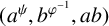 $(a^\psi , b^{\varphi ^{-1}}, ab)$
is a derangement on
$(a^\psi , b^{\varphi ^{-1}}, ab)$
is a derangement on $\Omega $
, which contradicts (5-1). This contradiction shows that only the other case of Lemma 3.1 can occur, namely
$\Omega $
, which contradicts (5-1). This contradiction shows that only the other case of Lemma 3.1 can occur, namely $|\Delta | = 2$
and
$|\Delta | = 2$
and $|\Omega | = |\Sigma _1||\Delta | = 6$
.
$|\Omega | = |\Sigma _1||\Delta | = 6$
.
This has shown that G is a subgroup of $\mathrm {Sym}(2) \mathop {\mathrm {wr}} \mathrm {Alt}(3)$
in its natural imprimitive action of degree
$\mathrm {Sym}(2) \mathop {\mathrm {wr}} \mathrm {Alt}(3)$
in its natural imprimitive action of degree $6$
. It can be checked, either by hand or with the aid of a computer, that
$6$
. It can be checked, either by hand or with the aid of a computer, that $\mathrm {Sym}(2) \mathop {\mathrm {wr}} \mathrm {Alt}(3)$
has three conjugacy classes of transitive subgroups, namely:
$\mathrm {Sym}(2) \mathop {\mathrm {wr}} \mathrm {Alt}(3)$
has three conjugacy classes of transitive subgroups, namely: $\mathrm {Sym}(2) \mathop {\mathrm {wr}} \mathrm {Alt}(3)$
;
$\mathrm {Sym}(2) \mathop {\mathrm {wr}} \mathrm {Alt}(3)$
; $\operatorname {Alt}(4)$
in its action on the six
$\operatorname {Alt}(4)$
in its action on the six $2$
-subsets of
$2$
-subsets of $\{1,2,3,4\}$
; and the cyclic group
$\{1,2,3,4\}$
; and the cyclic group $C_6$
of order
$C_6$
of order $6$
. Since G is minimally transitive, we have
$6$
. Since G is minimally transitive, we have $G \ne \mathrm {Sym}(2) \mathop {\mathrm {wr}} \mathrm {Alt}(3)$
. Moreover, since the derangement graph of
$G \ne \mathrm {Sym}(2) \mathop {\mathrm {wr}} \mathrm {Alt}(3)$
. Moreover, since the derangement graph of $C_6$
has cliques of size
$C_6$
has cliques of size $6$
, we also have
$6$
, we also have $G \ne C_6$
. Thus, G is permutation-isomorphic to
$G \ne C_6$
. Thus, G is permutation-isomorphic to $\operatorname {Alt}(4)$
in its action on the six
$\operatorname {Alt}(4)$
in its action on the six $2$
-subsets of
$2$
-subsets of $\{1,2,3,4\}$
.
$\{1,2,3,4\}$
.
6 The action of G on a refinement
$\Sigma _3$
of
$\Sigma _2$


Notation 6.1. Building upon Notation 5.1 and using Lemma 5.2, we introduce additional notation crucial for the subsequent steps of the proof.
We let $\Sigma _2$
be a system of imprimitivity of G on
$\Sigma _2$
be a system of imprimitivity of G on $\Omega $
having cardinality
$\Omega $
having cardinality $6$
, which is a refinement of
$6$
, which is a refinement of $\Sigma _1$
. We let
$\Sigma _1$
. We let $\Sigma _2=\{\Delta _{1,1},\Delta _{1,2},\Delta _{2,1},\Delta _{2,2},\Delta _{3,1},\Delta _{3,2}\},$
where
$\Sigma _2=\{\Delta _{1,1},\Delta _{1,2},\Delta _{2,1},\Delta _{2,2},\Delta _{3,1},\Delta _{3,2}\},$
where $\Delta _i=\Delta _{i,1}\cup \Delta _{i,2}$
for all
$\Delta _i=\Delta _{i,1}\cup \Delta _{i,2}$
for all $i\in \{1,2,3\}.$
Moreover, we choose
$i\in \{1,2,3\}.$
Moreover, we choose $\omega _{i,j}\in \Delta _{i,j}$
for all
$\omega _{i,j}\in \Delta _{i,j}$
for all $i\in \{1,2,3\}$
and
$i\in \{1,2,3\}$
and $j\in \{1,2\}$
.
$j\in \{1,2\}$
.
Using the system of imprimitivity $\Sigma _2$
, we obtain an embedding
$\Sigma _2$
, we obtain an embedding
 $$ \begin{align*}G\le K \mathop{\mathrm{wr}} \mathrm{Alt}(4),\end{align*} $$
where $K\le \mathrm {Sym}(\Delta )$
,
$K\le \mathrm {Sym}(\Delta )$
, $\Delta $
is a finite set with
$\Delta $
is a finite set with $|\Delta |=|\Delta _{i,j}|$
, and K is the permutation group
$|\Delta |=|\Delta _{i,j}|$
, and K is the permutation group $G_{\{\Delta _{i,j}\}}^{\Delta _{i,j}}$
. Under this identification, we may write
$G_{\{\Delta _{i,j}\}}^{\Delta _{i,j}}$
. Under this identification, we may write
 $$ \begin{align*} \Delta_{1,1}&=\Delta\times\{1\}, \Delta_{1,2}=\Delta\times\{2\},\\ \Delta_{2,1}&=\Delta\times\{3\}, \Delta_{2,2}=\Delta\times\{4\},\\ \Delta_{3,1}&=\Delta\times\{5\}, \Delta_{3,2}=\Delta\times\{6\}, \end{align*} $$
and we may think about G as endowed with its imprimitive action on $\Omega =\Delta \times \{1,2,3,4,5,6\}$
. In particular,
$\Omega =\Delta \times \{1,2,3,4,5,6\}$
. In particular,
 $$ \begin{align*}G_{(\Sigma_2)}\le K\times K\times K\times K\times K\times K.\end{align*} $$
For each $i\in \{1,2,3\}$
and
$i\in \{1,2,3\}$
and $j\in \{1,2\}$
, let
$j\in \{1,2\}$
, let $\pi _{i,j}:G_{(\Sigma _2)}\to K$
be the projection obtained by restricting a permutation of
$\pi _{i,j}:G_{(\Sigma _2)}\to K$
be the projection obtained by restricting a permutation of $G_{(\Sigma _2)}$
to
$G_{(\Sigma _2)}$
to $\Delta _{i,j}$
. Since the union of the G-conjugates of
$\Delta _{i,j}$
. Since the union of the G-conjugates of $G_{\omega _{1,1}}$
is
$G_{\omega _{1,1}}$
is $G_{(\Sigma _1)}$
by (5-1), we have
$G_{(\Sigma _1)}$
by (5-1), we have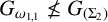 $G_{\omega _{1,1}}\nleq G_{(\Sigma _2)}$
. As
$G_{\omega _{1,1}}\nleq G_{(\Sigma _2)}$
. As $[G_{\{\Delta _{1,1}\}}:G_{(\Sigma _2)}]=2$
and
$[G_{\{\Delta _{1,1}\}}:G_{(\Sigma _2)}]=2$
and $G_{\omega _{1,1}}\le G_{\{\Delta _{1,1}\}}$
, we deduce
$G_{\omega _{1,1}}\le G_{\{\Delta _{1,1}\}}$
, we deduce
 $$ \begin{align*} G_{\{\Delta_{1,1}\}}=G_{\omega_{1,1}}G_{(\Sigma_2)}. \end{align*} $$
Now, the Frattini argument implies that $G_{(\Sigma _2)}$
is transitive on
$G_{(\Sigma _2)}$
is transitive on $\Delta _{1,1}$
. As
$\Delta _{1,1}$
. As $G_{(\Sigma _2)}\unlhd G$
, we get that
$G_{(\Sigma _2)}\unlhd G$
, we get that $G_{(\Sigma _2)}$
is transitive on
$G_{(\Sigma _2)}$
is transitive on $\Delta _{i,j}$
for every
$\Delta _{i,j}$
for every $i\in \{1,2,3\}$
and
$i\in \{1,2,3\}$
and $j\in \{1,2\}$
.
$j\in \{1,2\}$
.
We let
 $$ \begin{align*}L=\pi_{i,j}(G_{(\Sigma_2)}),\end{align*} $$
and observe that L does not depend on $i,j$
and, from the paragraph above, L is a transitive subgroup of K with
$i,j$
and, from the paragraph above, L is a transitive subgroup of K with $[K:L]\le 2$
.
$[K:L]\le 2$
.
We claim that
 $$ \begin{align*} G_{\{\Delta_i\}}=G_{\{\Delta_{i,j}\}}G_\omega\quad \text{for all } i\in \{1,2,3\}, j\in \{1,2\}, \omega\in \Omega\setminus\Delta_i. \end{align*} $$
Indeed, as $[G_{\{\Delta _i\}}:G_{\{\Delta _{i,j}\}}]=2$
, we have either
$[G_{\{\Delta _i\}}:G_{\{\Delta _{i,j}\}}]=2$
, we have either $G_{\{\Delta _i\}}=G_{\{\Delta _{i,j}\}}G_\omega $
or
$G_{\{\Delta _i\}}=G_{\{\Delta _{i,j}\}}G_\omega $
or $G_\omega \le G_{\{\Delta _{i,j}\}}$
. In the latter case, if we let
$G_\omega \le G_{\{\Delta _{i,j}\}}$
. In the latter case, if we let $\Delta _{i',j'}$
be the block of
$\Delta _{i',j'}$
be the block of $\Sigma _2$
containing
$\Sigma _2$
containing $\omega $
, we have
$\omega $
, we have $G_\omega \le G_{\{\Delta _{i,j}\}}\cap G_{\{\Delta _{i',j'}\}}=G_{(\Sigma _2)}$
. However, this contradicts the fact that
$G_\omega \le G_{\{\Delta _{i,j}\}}\cap G_{\{\Delta _{i',j'}\}}=G_{(\Sigma _2)}$
. However, this contradicts the fact that $G_{(\Sigma _2)}$
is transitive on each block of
$G_{(\Sigma _2)}$
is transitive on each block of $\Sigma _2$
.
$\Sigma _2$
.
The embedding of G in $K \mathop {\mathrm {wr}} \mathrm {Alt}(4)$
allows a concrete representation of the elements of G; indeed, each element of G is of the form
$K \mathop {\mathrm {wr}} \mathrm {Alt}(4)$
allows a concrete representation of the elements of G; indeed, each element of G is of the form $(k_1,k_2,k_3,k_4,k_5,k_6)\sigma $
for some
$(k_1,k_2,k_3,k_4,k_5,k_6)\sigma $
for some $k_1,k_2,k_3,k_4,k_5,k_6\in K$
and
$k_1,k_2,k_3,k_4,k_5,k_6\in K$
and
 $$ \begin{align*} \sigma\in \langle (1\,3\,5)(2\,4\,6),(1\,2)(3\,4)\rangle\cong\mathrm{Alt}(4). \end{align*} $$
In particular, the element c defined in Notation 5.1 can now be written as
 $$ \begin{align*} c=(1,1,1,1,k_1,k_2)(1\,3\,5)(2\,4\,6). \end{align*} $$
If $G_{(\Sigma _1)}$
is primitive on
$G_{(\Sigma _1)}$
is primitive on $\Delta _i$
, then
$\Delta _i$
, then $\Sigma _2=\Omega $
. Now, to establish part (2) of Theorem 1.1, it is necessary to omit the assumption in (4-1). This is deduced through computation: the derangement graph of every proper overgroup of
$\Sigma _2=\Omega $
. Now, to establish part (2) of Theorem 1.1, it is necessary to omit the assumption in (4-1). This is deduced through computation: the derangement graph of every proper overgroup of $\mathrm {Alt}(4)$
in its degree 6 action contains a clique of size
$\mathrm {Alt}(4)$
in its degree 6 action contains a clique of size $4$
. Therefore, in the rest of the proof of Theorem 1.1, we may assume that
$4$
. Therefore, in the rest of the proof of Theorem 1.1, we may assume that $G_{(\Sigma _1)}$
is imprimitive on
$G_{(\Sigma _1)}$
is imprimitive on $\Delta _{i}$
, that is,
$\Delta _{i}$
, that is, $|\Omega |>6=|\Sigma _2|$
.
$|\Omega |>6=|\Sigma _2|$
.
Lemma 5.2 has already shown that $|\Omega |$
is a multiple of
$|\Omega |$
is a multiple of $6$
.
$6$
.
Lemma 6.2. Let X be the group $\mathrm {Alt}(4)$
in its transitive degree
$\mathrm {Alt}(4)$
in its transitive degree $6$
action, and let
$6$
action, and let $\Gamma $
be an
$\Gamma $
be an $(a,b)$
-hypergraph such that X is hyper-transitive for
$(a,b)$
-hypergraph such that X is hyper-transitive for $\Gamma $
and the stabilizer of a point in X fixes some edge of
$\Gamma $
and the stabilizer of a point in X fixes some edge of $\Gamma $
. Then,
$\Gamma $
. Then, $\chi (\Gamma ) \leq 4$
.
$\chi (\Gamma ) \leq 4$
.
Proof. Let $\Gamma = (V, E)$
be an
$\Gamma = (V, E)$
be an $(a,b)$
-hypergraph that is hyper-transitive for X and suppose that the stabilizer of a point in X fixes some edge of
$(a,b)$
-hypergraph that is hyper-transitive for X and suppose that the stabilizer of a point in X fixes some edge of $\Gamma $
. Since X acts transitively on both V and E, it follows that these sets are transitive X-sets.
$\Gamma $
. Since X acts transitively on both V and E, it follows that these sets are transitive X-sets.
If $|V| \leq 4$
, then it is clear that
$|V| \leq 4$
, then it is clear that $\chi (\Gamma ) \leq 4$
because we may assign to each element of V a different color. Suppose instead that
$\chi (\Gamma ) \leq 4$
because we may assign to each element of V a different color. Suppose instead that $|V|> 4$
. In particular, the action of X is either permutation isomorphic to the action of
$|V|> 4$
. In particular, the action of X is either permutation isomorphic to the action of $\mathrm {Alt}(4)$
on the
$\mathrm {Alt}(4)$
on the $2$
-subsets of
$2$
-subsets of $\{1, \ldots , 4\}$
or to the regular action of
$\{1, \ldots , 4\}$
or to the regular action of $\mathrm {Alt}(4)$
on itself by right multiplication.
$\mathrm {Alt}(4)$
on itself by right multiplication.
Assume the first case holds. Then,
 $$ \begin{align*} X = \langle (1\,6)(4\,5),\ (1\,6)(2\,3),\ (1\,2\,4)(3\,5\,6) \rangle. \end{align*} $$
Let $e = \{p_1, \ldots , p_b\} \in E$
. By hypothesis, up to replacing e by a suitable conjugate, we may assume
$e = \{p_1, \ldots , p_b\} \in E$
. By hypothesis, up to replacing e by a suitable conjugate, we may assume $X_e \geq \langle (1\,6)(4\,5) \rangle $
. Thus, we have the following possibilities:
$X_e \geq \langle (1\,6)(4\,5) \rangle $
. Thus, we have the following possibilities:
-
•
$X_e = X$
; -
•
$X_e = \langle (1\,6)(4\,5),\ (1\,6)(2\,3) \rangle $
; or -
•
$X_e = \langle (1\,6)(4\,5) \rangle $
.



If $X_e = X$
, then
$X_e = X$
, then $E = \{e\}$
because X is transitive on E, and
$E = \{e\}$
because X is transitive on E, and $e = \{\{1,2,3,4,5,6\}\}$
or
$e = \{\{1,2,3,4,5,6\}\}$
or ${e = \{\{1,2\}, \{3,4\}, \{5,6\}\}}$
, as
${e = \{\{1,2\}, \{3,4\}, \{5,6\}\}}$
, as $X_e$
must be transitive on the b parts of e. In this case,
$X_e$
must be transitive on the b parts of e. In this case, ${\chi (\Gamma ) = 2}$
. A 2-coloring is given by assigning
${\chi (\Gamma ) = 2}$
. A 2-coloring is given by assigning $\chi (x) = \texttt {red}$
when
$\chi (x) = \texttt {red}$
when $x \ne 6$
and
$x \ne 6$
and $\chi (x) = \texttt {blue}$
when
$\chi (x) = \texttt {blue}$
when $x=6$
.
$x=6$
.
If $X_e = \langle (1\,6)(4\,5),\ (1\,6)(2\,3) \rangle $
, then
$X_e = \langle (1\,6)(4\,5),\ (1\,6)(2\,3) \rangle $
, then
 $$ \begin{align*} E = \{\{1,6\}\},\ \{\{4,5\}\},\ \{\{2,3\}\}. \end{align*} $$
A 2-coloring is given by assigning $\chi (x) = \texttt {red}$
for all
$\chi (x) = \texttt {red}$
for all $x \in \{1,3,5\}$
and
$x \in \{1,3,5\}$
and $\chi (x) = \texttt {blue}$
for all
$\chi (x) = \texttt {blue}$
for all $x \in \{2,4,6\}$
, so
$x \in \{2,4,6\}$
, so $\chi (\Gamma ) = 2$
.
$\chi (\Gamma ) = 2$
.
Finally, if $X_e = \langle (1\,6)(4\,5) \rangle $
, then, up to relabeling the points, we may assume
$X_e = \langle (1\,6)(4\,5) \rangle $
, then, up to relabeling the points, we may assume ${e = \{\{1,4\}, \{5,6\}\}}$
and
${e = \{\{1,4\}, \{5,6\}\}}$
and
 $$ \begin{align*} E =\{& \{\{1,3\}, \{2,6\}\}, \{\{2,5\}, \{3,4\}\}, \{\{1,5\}, \{4,6\}\}, \{\{1,2\}, \{3,6\}\},\\ &\{\{1,4\}, \{5,6\}\}, \{\{2,4\}, \{3,5\}\} \}. \end{align*} $$
In this case, $\chi (\Gamma ) \leq 3$
, since a proper 3-coloring is given by assigning
$\chi (\Gamma ) \leq 3$
, since a proper 3-coloring is given by assigning $\chi (x) = \texttt {red}$
for
$\chi (x) = \texttt {red}$
for $x \in \{1,3\}$
,
$x \in \{1,3\}$
, $\chi (x) = \texttt {blue}$
for
$\chi (x) = \texttt {blue}$
for $x \in \{2,4\}$
, and
$x \in \{2,4\}$
, and $\chi (x) = \texttt {black}$
for
$\chi (x) = \texttt {black}$
for $x \in \{5,6\}$
.
$x \in \{5,6\}$
.
The case where the action of X is permutation isomorphic to the regular action of $\mathrm {Alt}(4)$
on itself by right multiplication can be treated in a similar manner.
$\mathrm {Alt}(4)$
on itself by right multiplication can be treated in a similar manner.
Lemma 6.3. The group G admits a system of imprimitivity $\Sigma _3$
that is a refinement of
$\Sigma _3$
that is a refinement of $\Sigma _2$
, such that the permutation group induced by G on
$\Sigma _2$
, such that the permutation group induced by G on $\Sigma _3$
is permutation equivalent to the group
$\Sigma _3$
is permutation equivalent to the group $(18,142)$
,
$(18,142)$
, $(30,126)$
, or
$(30,126)$
, or $(30,233)$
in the library of transitive groups in Magma.
$(30,233)$
in the library of transitive groups in Magma.
Before proceeding with the proof of Lemma 6.3, we observe that the group $G_{30}$
is a subgroup of
$G_{30}$
is a subgroup of $G_{30}^{*}$
and, moreover, that
$G_{30}^{*}$
and, moreover, that $G_{30}$
is minimally transitive—that is, it is transitive but has no proper transitive subgroups. This observation is relevant for (4-1).
$G_{30}$
is minimally transitive—that is, it is transitive but has no proper transitive subgroups. This observation is relevant for (4-1).
Proof. Since $|\Omega |> |\Sigma _2 | = 6$
, G admits a system of imprimitivity
$|\Omega |> |\Sigma _2 | = 6$
, G admits a system of imprimitivity $\Sigma _3\ne \Sigma _2$
that is a refinement of
$\Sigma _3\ne \Sigma _2$
that is a refinement of $\Sigma _2$
. Among all such systems of imprimitivity, choose one so that
$\Sigma _2$
. Among all such systems of imprimitivity, choose one so that $|\Sigma _3 |$
is as small as possible. Just as in the proof of Lemma 4.1 and of Lemma 5.2, we may replace G with the permutation group induced by G on
$|\Sigma _3 |$
is as small as possible. Just as in the proof of Lemma 4.1 and of Lemma 5.2, we may replace G with the permutation group induced by G on $\Sigma _3$
and, hence, we may suppose that
$\Sigma _3$
and, hence, we may suppose that $\Sigma _3 = \{\{\omega \} \mid \omega \in \Omega \}$
.
$\Sigma _3 = \{\{\omega \} \mid \omega \in \Omega \}$
.
If $G_{(\Sigma _2)}=1$
, then G acts faithfully on
$G_{(\Sigma _2)}=1$
, then G acts faithfully on $\Sigma _2$
and, hence,
$\Sigma _2$
and, hence, $G\cong \mathrm {Alt}(4)$
, because the permutation group induced by G on
$G\cong \mathrm {Alt}(4)$
, because the permutation group induced by G on $\Sigma _2$
is
$\Sigma _2$
is $\mathrm {Alt}(4)$
in its degree-six action. Since
$\mathrm {Alt}(4)$
in its degree-six action. Since $12=|G|\ge |\Omega |>|\Sigma _2|=6$
, we deduce
$12=|G|\ge |\Omega |>|\Sigma _2|=6$
, we deduce $|\Omega |=12$
and G acts regularly on
$|\Omega |=12$
and G acts regularly on $\Omega $
, which is clearly a contradiction. Therefore,
$\Omega $
, which is clearly a contradiction. Therefore,
 $$ \begin{align}G_{(\Sigma_2)}\ne 1. \end{align} $$
The minimality of $|\Sigma _3|$
implies that
$|\Sigma _3|$
implies that $G_{\{\Delta _{1,1}\}}$
is primitive in its action on
$G_{\{\Delta _{1,1}\}}$
is primitive in its action on $\Delta _{1,1}$
. If
$\Delta _{1,1}$
. If ${G_{(\Delta _{1,1})}= 1}$
, then the hypotheses of Proposition 3.5 are satisfied and, hence,
${G_{(\Delta _{1,1})}= 1}$
, then the hypotheses of Proposition 3.5 are satisfied and, hence, $G_{(\Sigma _2)}$
contains a derangement in its action on
$G_{(\Sigma _2)}$
contains a derangement in its action on $\Omega $
, which contradicts (5-1). This contradiction implies that
$\Omega $
, which contradicts (5-1). This contradiction implies that
 $$ \begin{align} G_{(\Delta_{i,j})}\ne 1\quad\text{ for all } i\in \{1,2,3\}, j\in \{1,2\}. \end{align} $$
Suppose that the primitive permutation group $G_{\{\Delta _{i,j}\}}^{\Delta _{i,j}}$
has nonabelian socle. Summing up:
$G_{\{\Delta _{i,j}\}}^{\Delta _{i,j}}$
has nonabelian socle. Summing up:
-
•
$G_{\{\Delta _{i,j}\}}$
acts primitively on
$\Delta _{i,j}$
, by Notation 6.1; -
•
$G_{(\Sigma _2)} \ne 1$
, by (6-1); -
•
$G_{(\Delta _{i,j})} \ne 1$
, by (6-2); and -
•
$G_{\{\Delta _{i,j}\}}^{\Delta _{i,j}}$
has nonabelian socle, by the current hypothesis.


Therefore, we are now in a position to apply Proposition 3.6 (with $\Sigma = \Sigma _2$
and
$\Sigma = \Sigma _2$
and ${\Delta = \Delta _{i,j}}$
) and the notation therein. Since, by (5-1),
${\Delta = \Delta _{i,j}}$
) and the notation therein. Since, by (5-1), $G_{(\Sigma _2)}$
has no derangements, we deduce that parts (1)–(5) of Proposition 3.6 are satisfied. In particular, by parts (c) and (d) of Proposition 3.6, there exists an
$G_{(\Sigma _2)}$
has no derangements, we deduce that parts (1)–(5) of Proposition 3.6 are satisfied. In particular, by parts (c) and (d) of Proposition 3.6, there exists an $(a,b)$
-hypergraph
$(a,b)$
-hypergraph $\Gamma $
that is hyper-transitive for
$\Gamma $
that is hyper-transitive for $G/_{(\Sigma _2)} \cong \mathrm {Alt}(4)$
and with the property that
$G/_{(\Sigma _2)} \cong \mathrm {Alt}(4)$
and with the property that $G_{\{\Delta _{i,j}\}} / G_{(\Sigma _2)} \cong C_2$
fixes some edge of
$G_{\{\Delta _{i,j}\}} / G_{(\Sigma _2)} \cong C_2$
fixes some edge of $\Gamma $
. In particular, the stabilizer of a point in
$\Gamma $
. In particular, the stabilizer of a point in $\mathrm {Alt}(4)$
(in its action of degree
$\mathrm {Alt}(4)$
(in its action of degree $6$
) fixes some edge of
$6$
) fixes some edge of $\Gamma $
. From Lemma 6.2,
$\Gamma $
. From Lemma 6.2, $\chi (\Gamma ) \leq 4$
.
$\chi (\Gamma ) \leq 4$
.
Observe that, by Burnside’s $p^\alpha q^\beta $
theorem, a nonabelian simple group has order divisible by at least three distinct primes and, hence, the nonabelian simple group T appearing in the statement of Proposition 3.6 has at least
$p^\alpha q^\beta $
theorem, a nonabelian simple group has order divisible by at least three distinct primes and, hence, the nonabelian simple group T appearing in the statement of Proposition 3.6 has at least $4\, \mathrm {Aut}(T)$
-conjugacy classes. From Proposition 3.6 part (b) and the previous paragraph, we immediately obtain a contradiction.
$4\, \mathrm {Aut}(T)$
-conjugacy classes. From Proposition 3.6 part (b) and the previous paragraph, we immediately obtain a contradiction.
Assume that $G_{\{\Delta \}}^\Delta $
has abelian socle. Let V be a minimal normal subgroup of G with
$G_{\{\Delta \}}^\Delta $
has abelian socle. Let V be a minimal normal subgroup of G with $V\le G_{(\Sigma _2)}$
. Then, V is an elementary abelian p-group for some prime number p. From (5-1), we have
$V\le G_{(\Sigma _2)}$
. Then, V is an elementary abelian p-group for some prime number p. From (5-1), we have
 $$ \begin{align*} V=\bigcup_{\omega\in \Omega}V_\omega. \end{align*} $$
Since $V_\omega $
is normalized by V and by
$V_\omega $
is normalized by V and by $G_\omega $
, we get
$G_\omega $
, we get $\mathbf {N}_G(V_\omega )\ge G_\omega V=G_{\{\Delta \}}$
and, hence, the union above consists of at most
$\mathbf {N}_G(V_\omega )\ge G_\omega V=G_{\{\Delta \}}$
and, hence, the union above consists of at most $|\Sigma _2|$
elements. Therefore,
$|\Sigma _2|$
elements. Therefore,
 $$ \begin{align*} p^a=|\Delta|=|V:V_{\omega}|<|\Sigma_2|=6. \end{align*} $$
Thus, $|\Omega |=p^a|\Sigma _2|\le 30$
. The rest of the result follows from a computer computation using the database of transitive groups of degree at most
$|\Omega |=p^a|\Sigma _2|\le 30$
. The rest of the result follows from a computer computation using the database of transitive groups of degree at most $30$
.
$30$
.
7 Final step
The objective of this section is to establish Theorem 1.1.
Lemma 7.1. Let G be the group $(18,142)$
or
$(18,142)$
or $(30,126)$
in the library of transitive groups in Magma, and let
$(30,126)$
in the library of transitive groups in Magma, and let $\Gamma $
be an
$\Gamma $
be an $(a,b)$
-hypergraph
$(a,b)$
-hypergraph $\Gamma $
such that G is hyper-transitive for
$\Gamma $
such that G is hyper-transitive for $\Gamma $
and such that the stabilizer of a point in G fixes some edge of
$\Gamma $
and such that the stabilizer of a point in G fixes some edge of $\Gamma $
. Then,
$\Gamma $
. Then, $\chi (\Gamma )\le 4$
.
$\chi (\Gamma )\le 4$
.
Proof. This follows from a computer computation; see also the proof of Lemma 6.2. Given G as above, we constructed all $(a,b)$
-hypergraphs
$(a,b)$
-hypergraphs $\Gamma $
such that G is hyper-transitive for
$\Gamma $
such that G is hyper-transitive for $\Gamma $
and such that the stabilizer of a point in G fixes some edge of
$\Gamma $
and such that the stabilizer of a point in G fixes some edge of $\Gamma $
. We give some details of the computation. Let
$\Gamma $
. We give some details of the computation. Let $\Gamma = (V, E)$
be hyper-transitive for G, where V is the set of vertices and E is the set of edges of
$\Gamma = (V, E)$
be hyper-transitive for G, where V is the set of vertices and E is the set of edges of $\Gamma $
. Since
$\Gamma $
. Since $\Gamma $
is hyper-transitive for G, it follows that V and E are transitive G-sets. In particular, this significantly narrows down the number of possibilities for V and for E. Indeed, V can be any transitive G-set. However, once V is fixed, edge transitivity implies that the set of edges E is uniquely determined by
$\Gamma $
is hyper-transitive for G, it follows that V and E are transitive G-sets. In particular, this significantly narrows down the number of possibilities for V and for E. Indeed, V can be any transitive G-set. However, once V is fixed, edge transitivity implies that the set of edges E is uniquely determined by $e^G$
, where
$e^G$
, where $e = \{p_1, \ldots , p_b\}$
is a fixed edge of
$e = \{p_1, \ldots , p_b\}$
is a fixed edge of $\Gamma $
, which, by definition, is a partition of an
$\Gamma $
, which, by definition, is a partition of an $ab$
-subset of V into b parts of cardinality a.
$ab$
-subset of V into b parts of cardinality a.
This partition e is in turn very limited by the assumption that the stabilizer of a point in G fixes e. Moreover, the choice of e is further restricted because, by definition, the edge stabilizer $G_e$
is transitive on the b parts of e, and either
$G_e$
is transitive on the b parts of e, and either $G_e$
is also transitive on the underlying set of e or
$G_e$
is also transitive on the underlying set of e or $a = 2$
. All of these conditions impose severe constraints on
$a = 2$
. All of these conditions impose severe constraints on $\Gamma $
.
$\Gamma $
.
Then, for each $(a,b)$
-hypergraph
$(a,b)$
-hypergraph $\Gamma = (V, E)$
, we randomly constructed
$\Gamma = (V, E)$
, we randomly constructed $10^6$
maps
$10^6$
maps $\eta : V \to \{1,2,3,4\}$
and checked whether each map was a coloring of
$\eta : V \to \{1,2,3,4\}$
and checked whether each map was a coloring of $\Gamma $
. In all cases, we found such a map. Incidentally, these
$\Gamma $
. In all cases, we found such a map. Incidentally, these $(a,b)$
-hypergraphs may have a smaller chromatic number. The choice of
$(a,b)$
-hypergraphs may have a smaller chromatic number. The choice of $10^6$
bears no particular meaning; it was simply large enough to ensure that the computer could find a suitable coloring for each
$10^6$
bears no particular meaning; it was simply large enough to ensure that the computer could find a suitable coloring for each $\Gamma $
by random search within a reasonable amount of time.
$\Gamma $
by random search within a reasonable amount of time.
Theorem 7.2 (See [Reference Bereczky1, Theorems 1 and 2]).
Let p be an odd prime number and $a\ge 1$
. If
$a\ge 1$
. If $p+1<b<3(p+1)/2$
or if
$p+1<b<3(p+1)/2$
or if $b=p+1$
and
$b=p+1$
and $a\ge 2$
, then every transitive group of degree
$a\ge 2$
, then every transitive group of degree $p^a\cdot b$
contains a derangement of p-power order.
$p^a\cdot b$
contains a derangement of p-power order.
Lemma 7.3. Let X be a finite group and let N be a normal subgroup of X such that $X/N$
is solvable. Then, either N is contained in the Frattini subgroup of X or
$X/N$
is solvable. Then, either N is contained in the Frattini subgroup of X or $X = NM$
for some maximal subgroup M of X. Therefore, in either case, there exists a solvable subgroup Y of X such that
$X = NM$
for some maximal subgroup M of X. Therefore, in either case, there exists a solvable subgroup Y of X such that $X = YN$
.
$X = YN$
.
Proof. Let $\Phi (X)$
denote the Frattini subgroup of X. If
$\Phi (X)$
denote the Frattini subgroup of X. If $N \nleq \Phi (X)$
, then there exists a maximal subgroup M with
$N \nleq \Phi (X)$
, then there exists a maximal subgroup M with $N \nleq M$
. The maximality of M implies
$N \nleq M$
. The maximality of M implies $X = NM$
.
$X = NM$
.
For the final statement, we argue by induction on $|X|$
. If
$|X|$
. If $|X| = 1$
, the result is trivial. If
$|X| = 1$
, the result is trivial. If $N \leq \Phi (X)$
, then X is solvable because
$N \leq \Phi (X)$
, then X is solvable because $X/N$
is solvable and
$X/N$
is solvable and $\Phi (X)$
is nilpotent. Hence, we may take
$\Phi (X)$
is nilpotent. Hence, we may take $Y = X$
in this case.
$Y = X$
in this case.
If $N \nleq \Phi (X)$
, then as noted above,
$N \nleq \Phi (X)$
, then as noted above, $X = NM$
for some maximal subgroup M of X. Since
$X = NM$
for some maximal subgroup M of X. Since $|M| < |X|$
and
$|M| < |X|$
and $M/(M \cap N) \cong X/N$
is solvable, by the inductive hypothesis, there exists a solvable subgroup Y of M such that
$M/(M \cap N) \cong X/N$
is solvable, by the inductive hypothesis, there exists a solvable subgroup Y of M such that $M = Y(M \cap N)$
. It follows that
$M = Y(M \cap N)$
. It follows that $X = NM = Y(M \cap N)N = YN$
, as required.
$X = NM = Y(M \cap N)N = YN$
, as required.
Proof Theorem 1.1.
We use the notation established throughout Sections 4, 5, and 6.
Let $\Sigma _4$
be a system of imprimitivity for G that is a refinement of
$\Sigma _4$
be a system of imprimitivity for G that is a refinement of $\Sigma _3$
. Just as in the proof of Lemmas 4.1, 5.2, and 6.3, we may replace G with the permutation group induced by G on
$\Sigma _3$
. Just as in the proof of Lemmas 4.1, 5.2, and 6.3, we may replace G with the permutation group induced by G on $\Sigma _4$
and, hence, we may suppose that
$\Sigma _4$
and, hence, we may suppose that $\Sigma _4 =\{\{\omega \} | \omega \in \Omega \}$
.
$\Sigma _4 =\{\{\omega \} | \omega \in \Omega \}$
.
Suppose first $G_{(\Sigma _3)}=1$
. Then G, as an abstract group, is isomorphic to the permutation group induced by G on
$G_{(\Sigma _3)}=1$
. Then G, as an abstract group, is isomorphic to the permutation group induced by G on $\Sigma _3$
and, hence, it is isomorphic to the transitive group
$\Sigma _3$
and, hence, it is isomorphic to the transitive group $(18,142)$
or
$(18,142)$
or $(30,126)$
in the library of transitive groups in Magma [Reference Bosma, Cannon and Playoust2]. We have checked with a computer that these two permutation groups of degree
$(30,126)$
in the library of transitive groups in Magma [Reference Bosma, Cannon and Playoust2]. We have checked with a computer that these two permutation groups of degree $18$
and
$18$
and $30$
do not admit a transitive action on a set
$30$
do not admit a transitive action on a set $|\Omega |>|\Sigma _3|$
such that the derangement graph has no
$|\Omega |>|\Sigma _3|$
such that the derangement graph has no $4$
-cliques. Therefore,
$4$
-cliques. Therefore, $G_{(\Sigma _3)}\ne 1$
. Let
$G_{(\Sigma _3)}\ne 1$
. Let $\Delta \in \Sigma _3$
.
$\Delta \in \Sigma _3$
.
Suppose $G_{(\Delta )}=1$
. Then, by Proposition 3.5,
$G_{(\Delta )}=1$
. Then, by Proposition 3.5, $G_{(\Sigma _3)}$
admits a derangement for its action on
$G_{(\Sigma _3)}$
admits a derangement for its action on $\Omega $
, which contradicts (5-1). Therefore,
$\Omega $
, which contradicts (5-1). Therefore, $G_{(\Delta )}\ne 1$
.
$G_{(\Delta )}\ne 1$
.
Assume that $G_{\{\Delta \}}^\Delta $
has nonabelian socle. We now apply Proposition 3.6 and the notation therein. Since by (5-1),
$G_{\{\Delta \}}^\Delta $
has nonabelian socle. We now apply Proposition 3.6 and the notation therein. Since by (5-1), $G_{(\Sigma _3)}$
has no derangements, we deduce that parts (1)–(5) of Proposition 3.6 are satisfied. Observe that, by Burnside’s
$G_{(\Sigma _3)}$
has no derangements, we deduce that parts (1)–(5) of Proposition 3.6 are satisfied. Observe that, by Burnside’s $p^\alpha q^\beta $
theorem, a nonabelian simple group has order divisible by at least three distinct primes and, hence, the nonabelian simple group T appearing in the statement of Proposition 3.6 has at least
$p^\alpha q^\beta $
theorem, a nonabelian simple group has order divisible by at least three distinct primes and, hence, the nonabelian simple group T appearing in the statement of Proposition 3.6 has at least $4\, \mathrm {Aut}(T)$
-conjugacy classes. From Proposition 3.6(b) and the previous paragraph, we immediately obtain a contradiction.
$4\, \mathrm {Aut}(T)$
-conjugacy classes. From Proposition 3.6(b) and the previous paragraph, we immediately obtain a contradiction.
Assume that $G_{\{\Delta \}}^\Delta $
has abelian socle. Let V be a minimal normal subgroup of G with
$G_{\{\Delta \}}^\Delta $
has abelian socle. Let V be a minimal normal subgroup of G with $V\le G_{(\Sigma _3)}$
. Then, V is an elementary abelian p-group for some prime number p. From (5-1), we have
$V\le G_{(\Sigma _3)}$
. Then, V is an elementary abelian p-group for some prime number p. From (5-1), we have $V=\bigcup _{\omega \in \Omega }V_\omega .$
Since
$V=\bigcup _{\omega \in \Omega }V_\omega .$
Since $V_\omega $
is normalized by V and by
$V_\omega $
is normalized by V and by $G_\omega $
, we get
$G_\omega $
, we get $\mathbf {N}_G(V_\omega )\ge G_\omega V=G_{\{\Delta \}}$
and, hence, the union above consists of at most
$\mathbf {N}_G(V_\omega )\ge G_\omega V=G_{\{\Delta \}}$
and, hence, the union above consists of at most $|\Sigma _3|$
elements. Therefore,
$|\Sigma _3|$
elements. Therefore,
 $$ \begin{align*}p^a=|\Delta|=|V:V_{\omega}|<|\Sigma_3|. \end{align*} $$
Observe that, since $|G:G_{(\Sigma _1)}|=3$
and
$|G:G_{(\Sigma _1)}|=3$
and $G_{(\Sigma _1)}\unlhd G$
, if
$G_{(\Sigma _1)}\unlhd G$
, if $p\ne 3$
, then every p-element of G is contained in
$p\ne 3$
, then every p-element of G is contained in $G_{(\Sigma _1)}$
. Hence, G has no derangements of p-power order with
$G_{(\Sigma _1)}$
. Hence, G has no derangements of p-power order with $p\ne 3$
by (5-1). Therefore, using Theorem 7.2:
$p\ne 3$
by (5-1). Therefore, using Theorem 7.2:
-
•
$|\Sigma _3|=18$
and
$|\Delta |\in \{2,3,4,5,7,8,9,11,16,17\}$
; or -
•
$|\Sigma _3|=30$
and
$|\Delta |\in \{2,3,4,7,8,9,11,13,16,17,19,27,29\}$
.



We claim that G is solvable. Observe that $G/G_{(\Sigma _3)}$
is solvable and, hence, by Lemma 7.3, there exists
$G/G_{(\Sigma _3)}$
is solvable and, hence, by Lemma 7.3, there exists $Y\le G$
with Y solvable and
$Y\le G$
with Y solvable and $G=G_{(\Sigma _3)}Y$
. In particular Y is transitive on
$G=G_{(\Sigma _3)}Y$
. In particular Y is transitive on $\Sigma _3$
and, hence,
$\Sigma _3$
and, hence, $VY$
is transitive on
$VY$
is transitive on $\Omega $
. The minimality of G implies
$\Omega $
. The minimality of G implies $G=YV$
and, hence, G is solvable.
$G=YV$
and, hence, G is solvable.
Using the computer algebra system Magma, we have dealt with the cases:
-
•
$|\Sigma _3|=18$
and
$|\Delta | \in \{2,3,4,5\}$
; and -
•
$|\Sigma _3|=30$
and
$|\Delta | \in \{2,3,4\}$
.




In all of these cases, no counterexample arises. The main tool used in these computations is the built-in function MaximalSubgroups in Magma, with ad hoc arguments for some of the cases. Indeed, for each solvable primitive group X of affine type of degree $p^d$
, we have constructed
$p^d$
, we have constructed $X\mathrm {wr }\, G/G_{(\Sigma _3)}$
and working inductively on the subgroup lattice, we have constructed the relevant groups. Observe that, by the minimality of G and by the fact that G is solvable, we may suppose that X is a
$X\mathrm {wr }\, G/G_{(\Sigma _3)}$
and working inductively on the subgroup lattice, we have constructed the relevant groups. Observe that, by the minimality of G and by the fact that G is solvable, we may suppose that X is a $\{2,3,p\}$
-group when
$\{2,3,p\}$
-group when $|\Sigma _3|=18$
and a
$|\Sigma _3|=18$
and a $\{2,3,5,p\}$
-group when
$\{2,3,5,p\}$
-group when $|\Sigma _3|=30$
. Here, by relevant, we mean a transitive subgroup Y of
$|\Sigma _3|=30$
. Here, by relevant, we mean a transitive subgroup Y of $X\mathrm {wr }\, G/G_{(\Sigma _3)}$
projecting surjectively to
$X\mathrm {wr }\, G/G_{(\Sigma _3)}$
projecting surjectively to $G/G_{(\Sigma _3)}$
and with the stabilizer of
$G/G_{(\Sigma _3)}$
and with the stabilizer of $\Delta \in \Delta _3$
in Y projecting surjectively to X.
$\Delta \in \Delta _3$
in Y projecting surjectively to X.
For the rest of the argument, we exclude the cases $|\Sigma _3|=18$
and
$|\Sigma _3|=18$
and $|\Delta | \in \{2,3,4,5\}$
, and
$|\Delta | \in \{2,3,4,5\}$
, and $|\Sigma _3|=30$
and
$|\Sigma _3|=30$
and $|\Delta | \in \{2,3,4\}$
. We claim that
$|\Delta | \in \{2,3,4\}$
. We claim that
 $$ \begin{align} G_{(\Delta_1)}\le G_{(\Sigma_3)}. \end{align} $$
When $|\Sigma _3|=30$
, it can be verified with a computer that in
$|\Sigma _3|=30$
, it can be verified with a computer that in $G_{30}$
, the identity is the unique element fixing the ten elements in
$G_{30}$
, the identity is the unique element fixing the ten elements in $\Sigma _3$
contained in
$\Sigma _3$
contained in $\Delta _1$
. In
$\Delta _1$
. In $G_{18}$
, the pointwise stabilizer of the six elements of
$G_{18}$
, the pointwise stabilizer of the six elements of $\Sigma _3$
contained in
$\Sigma _3$
contained in $\Delta _1$
has order
$\Delta _1$
has order $3$
and fixes none of the remaining
$3$
and fixes none of the remaining $12$
elements of
$12$
elements of $\Sigma _3$
. This implies that, if
$\Sigma _3$
. This implies that, if $G_{(\Delta _1)}\nleq G_{(\Sigma _3)}$
, then there exists
$G_{(\Delta _1)}\nleq G_{(\Sigma _3)}$
, then there exists $g\in G_{(\Delta _1)}$
fixing pointwise
$g\in G_{(\Delta _1)}$
fixing pointwise $\Delta _1$
and fixing setwise no element
$\Delta _1$
and fixing setwise no element $\Delta \in \Sigma _3$
with
$\Delta \in \Sigma _3$
with $\Delta \subseteq \Delta _2\cup \Delta _3$
. Now, let
$\Delta \subseteq \Delta _2\cup \Delta _3$
. Now, let $\Lambda _1,\ldots ,\Lambda _6$
be the remaining six elements of
$\Lambda _1,\ldots ,\Lambda _6$
be the remaining six elements of $\Sigma _3$
contained in
$\Sigma _3$
contained in $\Delta _1$
and let
$\Delta _1$
and let $\omega _i\in \Lambda _i$
for each i. If
$\omega _i\in \Lambda _i$
for each i. If
 $$ \begin{align*} V_{\omega_1}\cup V_{\omega_2}\cup V_{\omega_3}\cup V_{\omega_4}\cup V_{\omega_5}\cup V_{\omega_6}\subsetneq V, \end{align*} $$
then there exists $z\in V\setminus (V_{\omega _1}\cup \cdots \cup V_{\omega _6})$
. Clearly,
$z\in V\setminus (V_{\omega _1}\cup \cdots \cup V_{\omega _6})$
. Clearly, $gz$
is a derangement on
$gz$
is a derangement on $\Omega $
, because
$\Omega $
, because $gz$
fixes no block of
$gz$
fixes no block of $\Sigma _3$
outside
$\Sigma _3$
outside $\Delta _1$
and acts as the derangement z on
$\Delta _1$
and acts as the derangement z on $\Delta _1$
. However, this contradicts (5-1). Therefore,
$\Delta _1$
. However, this contradicts (5-1). Therefore, $V_{\omega _1}\cup V_{\omega _2}\cup V_{\omega _3}\cup V_{\omega _4}\cup V_{\omega _5}\cup V_{\omega _6}= V$
and, hence,
$V_{\omega _1}\cup V_{\omega _2}\cup V_{\omega _3}\cup V_{\omega _4}\cup V_{\omega _5}\cup V_{\omega _6}= V$
and, hence, ${6>|V:V_{\omega _i}|=p^d}$
. However, we are excluding these cases here. This has established (7-1).
${6>|V:V_{\omega _i}|=p^d}$
. However, we are excluding these cases here. This has established (7-1).
We claim that
 $$ \begin{align*} G_{(\Delta_{1,1})}\le G_{(\Sigma_3)} \quad \text{and}\quad |\Delta|\in \{11,16\}\quad \text{when }|\Sigma_3|=30. \end{align*} $$
The argument here is similar to that in the paragraph above. In $G_{30}$
, the pointwise stabilizer of the five elements of
$G_{30}$
, the pointwise stabilizer of the five elements of $\Sigma _3$
contained in
$\Sigma _3$
contained in $\Delta _{1,1}$
has order
$\Delta _{1,1}$
has order $5$
and fixes none of the remaining
$5$
and fixes none of the remaining $25$
elements of
$25$
elements of $\Sigma _3$
. This implies that if
$\Sigma _3$
. This implies that if $G_{(\Delta _{1,1})}\nleq G_{(\Sigma _3)}$
, then there exists
$G_{(\Delta _{1,1})}\nleq G_{(\Sigma _3)}$
, then there exists $g\in G_{(\Delta _{1,1})}$
fixing pointwise
$g\in G_{(\Delta _{1,1})}$
fixing pointwise $\Delta _{1,1}$
and fixing setwise no element
$\Delta _{1,1}$
and fixing setwise no element $\Delta \in \Sigma _3$
with
$\Delta \in \Sigma _3$
with $\Delta \subseteq \Delta _{1,2}\cup \Delta _2\cup \Delta _3$
. Now, let
$\Delta \subseteq \Delta _{1,2}\cup \Delta _2\cup \Delta _3$
. Now, let $\Delta _{1,1,1},\ldots ,\Delta _{1,1,5}$
be the remaining five elements of
$\Delta _{1,1,1},\ldots ,\Delta _{1,1,5}$
be the remaining five elements of $\Sigma _3$
contained in
$\Sigma _3$
contained in $\Delta _{1,1}$
and let
$\Delta _{1,1}$
and let $\omega _i\in \Delta _{1,1,i}$
for each i. If
$\omega _i\in \Delta _{1,1,i}$
for each i. If
 $$ \begin{align*} V_{\omega_1}\cup V_{\omega_2}\cup V_{\omega_3}\cup V_{\omega_4}\cup V_{\omega_5}\subsetneq V, \end{align*} $$
then there exists $z\in V\setminus (V_{\omega _1}\cup \cdots \cup V_{\omega _5})$
. Clearly,
$z\in V\setminus (V_{\omega _1}\cup \cdots \cup V_{\omega _5})$
. Clearly, $gz$
is a derangement on
$gz$
is a derangement on $\Omega $
, because it fixes no block of
$\Omega $
, because it fixes no block of $\Sigma _3$
outside
$\Sigma _3$
outside $\Delta _{1,1}$
and it acts as the derangement z on
$\Delta _{1,1}$
and it acts as the derangement z on $\Delta _{1,1}$
. However, this contradicts (5-1). Therefore,
$\Delta _{1,1}$
. However, this contradicts (5-1). Therefore, $V_{\omega _1}\cup V_{\omega _2}\cup V_{\omega _3}\cup V_{\omega _4}\cup V_{\omega _5}= V$
and, hence,
$V_{\omega _1}\cup V_{\omega _2}\cup V_{\omega _3}\cup V_{\omega _4}\cup V_{\omega _5}= V$
and, hence, $5>|V:V_{\omega _i}|=p^d$
. However, we are excluding these cases here. This has established
$5>|V:V_{\omega _i}|=p^d$
. However, we are excluding these cases here. This has established $G_{(\Delta _{1,1})}\le G_{(\Sigma _3)}$
. Now, the group
$G_{(\Delta _{1,1})}\le G_{(\Sigma _3)}$
. Now, the group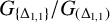 $G_{\{\Delta _{1,1}\}}/G_{(\Delta _{1,1})}$
is embedded in
$G_{\{\Delta _{1,1}\}}/G_{(\Delta _{1,1})}$
is embedded in $\mathrm {AGL}_d(p) \mathop {\mathrm {wr}} L$
, where L is the permutation group induced by
$\mathrm {AGL}_d(p) \mathop {\mathrm {wr}} L$
, where L is the permutation group induced by $G_{30}$
on the five elements of
$G_{30}$
on the five elements of $\Sigma _3$
contained in
$\Sigma _3$
contained in $\Delta _{1,1}$
. It can be verified that L is a Frobenius group of order
$\Delta _{1,1}$
. It can be verified that L is a Frobenius group of order $20$
and that in
$20$
and that in $G_{30}$
, the stabilizer of a block of cardinality
$G_{30}$
, the stabilizer of a block of cardinality $5$
has order
$5$
has order $100$
. As
$100$
. As $G_{(\Delta _{1,1})}\le G_{(\Sigma _3)}$
,
$G_{(\Delta _{1,1})}\le G_{(\Sigma _3)}$
, $|G_{\{\Delta _{1,1}\}}:G_{(\Sigma _3)}|=100$
divides the order of
$|G_{\{\Delta _{1,1}\}}:G_{(\Sigma _3)}|=100$
divides the order of $\mathrm {AGL}_d(p) \mathop {\mathrm {wr}} L$
and, hence,
$\mathrm {AGL}_d(p) \mathop {\mathrm {wr}} L$
and, hence, $100/20=5$
divides
$100/20=5$
divides $|\mathrm {GL}_d(p)|$
. This implies
$|\mathrm {GL}_d(p)|$
. This implies $|\Delta |\in \{11,16\}$
.
$|\Delta |\in \{11,16\}$
.
A similar argument holds when $|\Sigma _3|=18$
. We claim that
$|\Sigma _3|=18$
. We claim that
 $$ \begin{align*} |G_{(\Delta_{1,1})}:G_{(\Delta_{1,1})}\cap G_{(\Sigma_3)}|\le 3 \quad \text{and}\quad |\Delta|\in \{9,16\}\quad \text{when }|\Sigma_3|=18. \end{align*} $$
In $G_{18}$
, the pointwise stabilizer of the three elements of
$G_{18}$
, the pointwise stabilizer of the three elements of $\Sigma _3$
contained in
$\Sigma _3$
contained in $\Delta _{1,1}$
has order
$\Delta _{1,1}$
has order $9$
. Let
$9$
. Let $\Delta _{1,1,1}$
,
$\Delta _{1,1,1}$
, $\Delta _{1,1,2}$
, and
$\Delta _{1,1,2}$
, and $\Delta _{1,1,3}$
be the three elements of
$\Delta _{1,1,3}$
be the three elements of $\Sigma _3$
with
$\Sigma _3$
with $\Delta _{1,1}=\Delta _{1,1,1}\cup \Delta _{1,1,2}\cup \Delta _{1,1,3}$
. In particular,
$\Delta _{1,1}=\Delta _{1,1,1}\cup \Delta _{1,1,2}\cup \Delta _{1,1,3}$
. In particular,
 $$ \begin{align*} |G_{\{\Delta_{1,1,1}\}}\cap G_{\{\Delta_{1,1,2}\}}\cap G_{\{\Delta_{1,1,3}\}}:G_{(\Sigma_3)}|=9. \end{align*} $$
Assume now
 $$ \begin{align*} G_{\{\Delta_{1,1,1}\}}\cap G_{\{\Delta_{1,1,2}\}}\cap G_{\{\Delta_{1,1,3}\}}=G_{(\Delta_{1,1})}G_{(\Sigma_3)}. \end{align*} $$
This implies that there exists $g\in G_{(\Delta _{1,1})}$
fixing pointwise
$g\in G_{(\Delta _{1,1})}$
fixing pointwise $\Delta _{1,1}$
and fixing setwise no element
$\Delta _{1,1}$
and fixing setwise no element $\Delta \in \Sigma _3$
with
$\Delta \in \Sigma _3$
with $\Delta \subseteq \Delta _{1,2}\cup \Delta _2\cup \Delta _{3}$
. Now, let
$\Delta \subseteq \Delta _{1,2}\cup \Delta _2\cup \Delta _{3}$
. Now, let $\omega _i\in \Delta _{1,1,i}$
for each
$\omega _i\in \Delta _{1,1,i}$
for each $i\in \{1,2,3\}$
. If
$i\in \{1,2,3\}$
. If $V_{\omega _1}\cup V_{\omega _2}\cup V_{\omega _3}\subsetneq V,$
then there exists
$V_{\omega _1}\cup V_{\omega _2}\cup V_{\omega _3}\subsetneq V,$
then there exists $z\in V\setminus (V_{\omega _1}\cup V_{\omega _2}\cup V_{\omega _3})$
. Clearly,
$z\in V\setminus (V_{\omega _1}\cup V_{\omega _2}\cup V_{\omega _3})$
. Clearly, $gz$
is a derangement on
$gz$
is a derangement on $\Omega $
, which contradicts (5-1). Therefore,
$\Omega $
, which contradicts (5-1). Therefore, $V_{\omega _1}\cup V_{\omega _2}\cup V_{\omega _3}= V$
and, hence,
$V_{\omega _1}\cup V_{\omega _2}\cup V_{\omega _3}= V$
and, hence, $3>|V:V_{\omega _i}|=p^d$
. However, we are excluding these cases here. This has established
$3>|V:V_{\omega _i}|=p^d$
. However, we are excluding these cases here. This has established $|G_{(\Delta _{1,1})}:G_{(\Delta _{1,1})}\cap G_{(\Sigma _3)}|\le 3$
. Now, the group
$|G_{(\Delta _{1,1})}:G_{(\Delta _{1,1})}\cap G_{(\Sigma _3)}|\le 3$
. Now, the group $G_{\{\Delta _{1,1}\}}/G_{(\Delta _1,1)}$
is embedded in
$G_{\{\Delta _{1,1}\}}/G_{(\Delta _1,1)}$
is embedded in $Z \mathop {\mathrm {wr}} L$
, where L is the permutation group induced by
$Z \mathop {\mathrm {wr}} L$
, where L is the permutation group induced by $G_{18}$
on the three elements of
$G_{18}$
on the three elements of $\Sigma _3$
contained in
$\Sigma _3$
contained in $\Delta _{1,1}$
and Z is a solvable primitive subgroup of
$\Delta _{1,1}$
and Z is a solvable primitive subgroup of $\mathrm {AGL}_d(p)$
. It can be verified that L is the symmetric group of degree
$\mathrm {AGL}_d(p)$
. It can be verified that L is the symmetric group of degree $3$
and that in
$3$
and that in $G_{18}$
, the stabilizer of a block of cardinality
$G_{18}$
, the stabilizer of a block of cardinality $3$
has order
$3$
has order $54$
. As
$54$
. As $|G_{(\Delta _{1,1})}:G_{(\Delta _{1,1})}\cap G_{(\Sigma _3)}|\le 3$
,
$|G_{(\Delta _{1,1})}:G_{(\Delta _{1,1})}\cap G_{(\Sigma _3)}|\le 3$
, $|G_{\{\Delta _{1,1}\}}:G_{(\Sigma _3)}G_{(\Delta _{1,1})}|$
is either
$|G_{\{\Delta _{1,1}\}}:G_{(\Sigma _3)}G_{(\Delta _{1,1})}|$
is either $18$
or
$18$
or $54$
(depending on whether
$54$
(depending on whether $|G_{(\Delta _{1,1})}:G_{(\Delta _{1,1})}\cap G_{(\Sigma _3)}|$
equals 3 or 1). In particular,
$|G_{(\Delta _{1,1})}:G_{(\Delta _{1,1})}\cap G_{(\Sigma _3)}|$
equals 3 or 1). In particular, $18$
divides the order of
$18$
divides the order of $\mathrm {AGL}_d(p) \mathop {\mathrm {wr}} L$
and, hence,
$\mathrm {AGL}_d(p) \mathop {\mathrm {wr}} L$
and, hence, $18/6=3$
divides
$18/6=3$
divides $|\mathrm {GL}_d(p)|$
. This implies
$|\mathrm {GL}_d(p)|$
. This implies $|\Delta |\in \{9,16\}$
.
$|\Delta |\in \{9,16\}$
.
Summing up, the remaining cases are:
-
•
$|\Sigma _3|=18$
and
$|\Delta | \in \{7,9,16\}$
; and -
•
$|\Sigma _3|=30$
and
$|\Delta | \in \{11,16\}$
.




The rest of the proof is computational with ad hoc arguments for each of the cases.


 Open access

