
Introduction
K.R.U. Todd (adapted from Reference WoodWood 1952: pl. I).

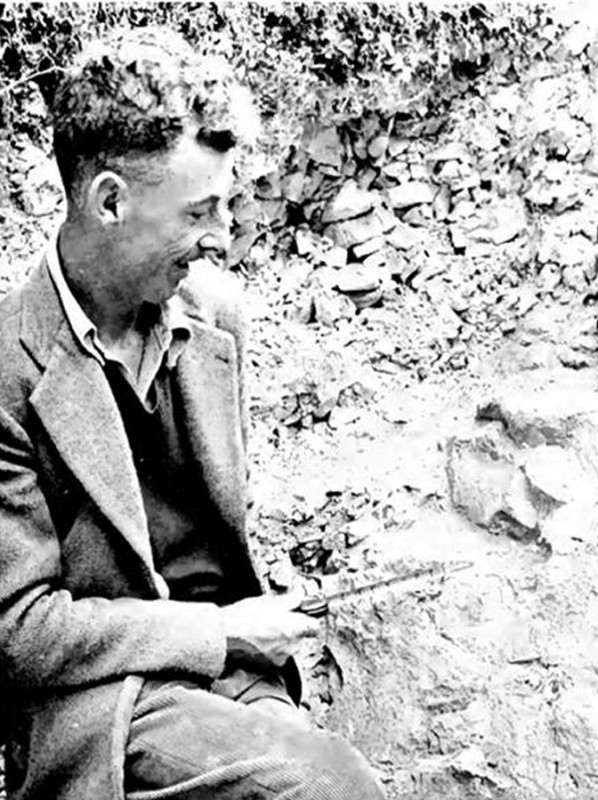
During the nineteenth and early twentieth centuries, significant contributions to the study of India’s prehistory were made by the enthusiastic and dedicated work of, amongst others, geologists, planters and military personnel. While the exemplary contributions of R.B. Foote (Reference PappuPappu 2008) and M.C. Burkitt (Reference SmithSmith 2013) have been recognised, others have received sparse attention. Killingworth Richard Utten Todd, better known as K.R.U. Todd (Figure 1), is one such neglected personality in the history of Indian archaeology. Todd’s best-known publications concern his research into the stratigraphy and prehistoric cultural sequence of Bombay (modern Mumbai), which are still quoted today.
Todd was born in 1905. He joined the Royal Indian Navy as a Sub-Lieutenant, rising to the post of Commander. During World War II, he led the H.M.I.S Jumna from Chittagong to Akyab for the Burma Operations. Despite these duties, he pursued his archaeological interests in both South Asia and England.
Around Bombay
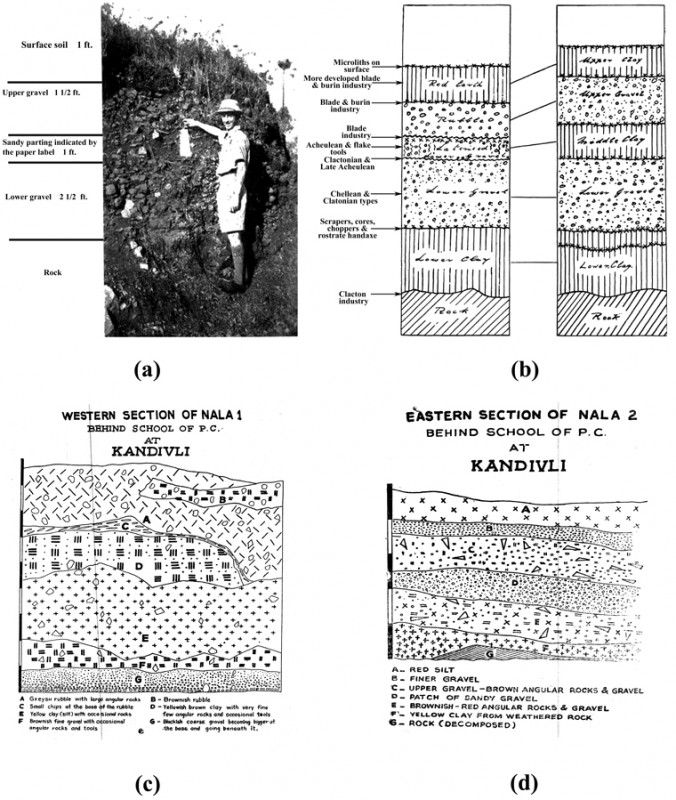
a) K.R.U. Todd pointing at the Khandivli section, identifying a sequence with bed rock, capped by lower, middle and upper clays interstratified with lower and upper gravel (adapted from Reference ToddTodd 1939: pl. XIV B); b) Todd’s culture sequence from Khandivli section (adapted from Reference ToddTodd 1939: 258, fig. 1); c) and d) H.D. Sankalia’s interpretation of the Khandivli section: rock, clay, rubble, gravel with sandy partings at places topped by humus (adapted from Sankalia 1959–60: figs. 1 & 2).

His classic research papers on the prehistory of Bombay (Reference ToddTodd 1932, 1939, 1950) document the discovery and establishment of a prehistoric cultural sequence in the region. Todd’s (1932) initial surveys around Worli led to the discovery of what he termed ‘Chellean’ artefacts including handaxes. He appears to have followed on from the work of G.E. Carter (Indian Civil Service) who reported early Palaeolithic tools here. Discussing the classic site of Khandivli, Reference ToddTodd (1939) identified a stratigraphic section showing a continuous cultural sequence (Figure 2). He noted handaxes, comparing these with those of the ‘Madras industries’ in modern Tamil Nadu (Reference Pappu, Petraglia and AllchinPappu 2007). He also discovered what he termed ‘Mousterian’ and ‘Aurignacian’ tools at Colaba and Worli respectively. At various other localities around Bombay, Todd discovered microliths and compared them with those he discovered at Calicut (Kerala) (Reference ToddTodd 1932: 42). He also discovered fossils at Kasu Shoal (Reference ToddTodd 1932: 38) and Khandivli (Reference ToddTodd 1939: 261). In 1935, he excavated at Marve (Bombay), discovering microliths, pot sherds and hearths (Reference ToddTodd 1939). Todd (1932: 35, 39) wrote that tools found in Back Bay reclamation material came from Worli Hill, later accepting E.R. Perry’s (Indian Civil Service) observation that this was partly from Khandivli (Reference ToddTodd 1939: 257).
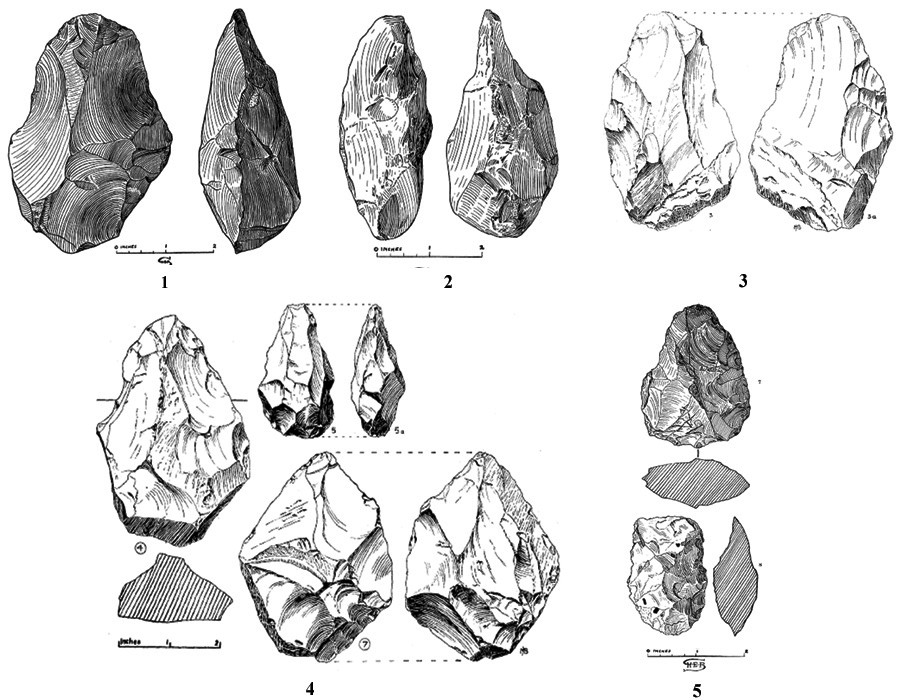
This region was later investigated by others (Reference KalapesiKalapesi 1946; Reference MalikMalik 1959; Sankalia 1959–60; Reference GuzderGuzder 1975). Malik agreed with Todd’s stratigraphy but could not find ‘Clactonian’, ‘Chellean-Clactonian’ or Late Acheulean tools. Sankalia (1959–60) termed Todd’s research as ‘classic’, owing to the discovery of a continuous sequence, unknown at that point in time in South Asia. Sankalia, a leading contemporary figure in Indian prehistory, however, disagreed with Todd’s stratigraphy of Khandivli both in terms of field observations and interpretation, and in terms of tool types and the formation of the deposits noted. Important in this respect is that Sankalia could not find any handaxes in Khandivli while illustrations by M.C. Burkitt’s wife in Todd’s article (1932: 42) clearly indicate that some tools were indeed bifaces (Figure 3).
Microliths and Mysore
Bifaces as classified and illustrated by Todd: 1) Khandivli: on clay under gravel: hand-axe (Reference ToddTodd 1939: 260, fig. 3); 2) Khandivli: on clay under gravel: rostro-carinate (Reference ToddTodd 1939: fig. 4); 3) handaxe from Bombay (Reference ToddTodd 1932: 37, figs. 3 & 3a); 4) handaxes from Bombay (Reference ToddTodd 1932: 38, figs. 4, 5, 5a, 7 & 7a); 5) Khandivli: handaxe, cleaver (Reference ToddTodd 1939: 263, figs. 7 & 8).

Todd’s understanding of microliths is notable, as micro-burins collected by him and examined by J.G.D. Clark (Reference ToddTodd 1950: 6) were possibly the first to be reported in India. Todd (1948: 30) was also one of the earliest to point out the association of microlithic tools with medium- to heavy-duty tools.
By 1948, Todd’s understanding had deepened, looking at microliths from a chronological as well as a regional perspective. This is seen from his work at Mysore, in southern India, which has received far less prominence, despite his observations of microliths at Jalahalli, capped by a horizon with ceramics. Placing Jalahalli in a chronological framework, he pointed out that the association of microliths with medium to heavy tools was absent in southern India and Ceylon but present in Bombay and northern India (Reference ToddTodd 1948). On this basis he tried to differentiate between early and late microlithic phases and placed Bombay and Jalahalli in early and late phases respectively. He considered burins to be chronological markers, as they were invariably found along with flake-blades and continuing right up to the microlithic industries. He concluded that these microliths predated the Iron Age of southern India (Reference ToddTodd 1948). The contradictions with H.D. Sankalia continued here, disagreeing with the latter’s typology of microlithic assemblages in western India. Todd attempted to situate this Indian data in a global context and proposed theories on population dispersals along the coast and compared this with the ‘strandloopers’ of South Africa (Reference ToddTodd 1950: 10).
The Soan
Todd’s work predates de Terra and Paterson’s (1939) classic research in the Soan. Following observations by Reference WadiaWadia (1928) and reports of stray Palaeolithic finds from the Sohan (Soan) Valley in 1880, Todd undertook a survey at Pindi Gheb, the only note of which to be found is in the Punjab Gazetteers (Reference GarbettGarbett 1930: 20–21). This note is referred to by de Terra and Paterson (1939: 293). He later collaborated with T.T. Paterson on a joint unpublished paper of 1947 on the flint assemblage from the Lyari River, Karachi. He also exchanged ideas with M.C. Burkitt, A.S. Barnes and J. Reid Moir (Reference ToddTodd 1932).
In England
E.S. Reference WoodWood (1952), writing in memory of Todd, describes his work in England, which comprised a small excavation in a medieval flint mine at East Horsley and a wider survey of the Neolithic sites of west Surrey in 1949, but Todd died in 1950 before he could complete his work there.
His premature demise may explain why his role in the vibrant study of Indian prehistory during the 1930s and 1940s has been neglected. His contribution lies in his discovery of stratified deposits, the establishment of a cultural sequence, surveys in areas untouched by fellow researchers, attempts to establish chronological and regional schemes and to link assemblages in India with those of West Asia and Africa. His work, although brief, created a base for future researchers of Indian prehistory.
Acknowledgements
I thank Professor Shanti Pappu and Professor S.N. Rajguru for help and advice on this topic. I thank staff of the Pitt Rivers Museum, Surrey Archaeological Society and National Archives, UK, for their help with this study.