




Introduction
Ectropis grisescens Warren and Ectropis obliqua (Prout) (Lepidoptera: Geometridate: Ennominae) feed on tea leaves and tender buds. They infest thousands of hectares of tea a year, severely reducing growth, and impacting the tea production in the following year (Zhang & Tan, Reference Zhang and Tan2004; Zhang et al., Reference Zhang, Ysuan, Zhang, Yin, Tang, Guo, Fu and Xiao2014). E. grisescens has been reported from Anhui, Fujian, Henan, Hunan, Hubei, Jiangxi and Zhejiang provinces in China (Jiang et al., Reference Jiang, Liu, Xue, Tang, Xiao and Han2014). It is probably indigenous to China, as there are no reports of E. grisescens abroad (Warren, Reference Warren1894; Swinhoe, Reference Swinhoe1902; Wehrli, Reference Wehrli and Seitz1939–Reference Wehrli and Seitz1954). E. obliqua was first found and named in Japan, and now in Korea and in China (Wehrli, Reference Wehrli and Seitz1939–Reference Wehrli and Seitz1954; Sato, Reference Sato1984; Kim et al., Reference Kim, Beljaev, Oh and Park2001). E. obliqua has been reported from Anhui, Jiangsu and Zhejiang provinces and Shanghai city in China (Jiang et al., Reference Jiang, Liu, Xue, Tang, Xiao and Han2014). E. grisescens and E. obliqua are morphologically similar and hard to discriminate in tea plantations. Because of these similarities, E. obliqua is likely mistaken for a variant of E. grisescens as it was when reported for the first time (Warren, Reference Warren1894).
Despite their morphological similarities, E. obliqua and E. grisescens are two sibling species in the same genus in China (Jiang et al., Reference Jiang, Liu, Xue, Tang, Xiao and Han2014; Zhang et al., Reference Zhang, Ysuan, Zhang, Yin, Tang, Guo, Fu and Xiao2014). Our previous research of tea loopers from 17 tea fields in different parts of China shows that the two species, although being morphologically similar, had clear reproductive isolation and variable mitochondrial cytochrome oxidase I (COI) sequences (Zhang et al., Reference Zhang, Ysuan, Zhang, Yin, Tang, Guo, Fu and Xiao2014). Recently, by microscopic examination of some morphological traits can separate the two species. In additional, a genetic distance between E. obliqua and E. grisescens, based on COI sequences, of about 3.7% (Jiang et al., Reference Jiang, Liu, Xue, Tang, Xiao and Han2014). These phylogenetic analyses revealed that E. obliqua and E. grisescens COI sequences fall into two taxonomic clades, and form separate monophyletic groups (Jiang et al., Reference Jiang, Liu, Xue, Tang, Xiao and Han2014; Zhang et al., Reference Zhang, Ysuan, Zhang, Yin, Tang, Guo, Fu and Xiao2014). Previous attempts to cross E. grisescens and E. obliqua did produce fewer female offspring than intraspecies mating, which resulted in an unbalanced sex ratio in the hybrid F 1 generation. The hatching rate, survival to adult, and percent of normal adults was much lower than with intra-species mating. Moreover, a self-cross of F 1 generation adults produced infertile eggs or no eggs (Xi et al., Reference Xi, Yin, Tang and Xiao2014; Zhang et al., Reference Zhang, Ysuan, Zhang, Yin, Tang, Guo, Fu and Xiao2014). These findings can be explained as closely related species often have incompletely isolated mate recognition systems (Reitz & Trumble, Reference Reitz and Trumble2002). Laboratory experiments have shown that E. grisescens and E. obliqua are capable of producing viable F 1 hybrids but that these females are sterile as their F 2 generation was not viable (hybrid breakdown), indicating, most likely, a post-zygotic reproductive barrier (Xi et al., Reference Xi, Yin, Tang and Xiao2014; Zhang et al., Reference Zhang, Ysuan, Zhang, Yin, Tang, Guo, Fu and Xiao2014).
Asymmetric mating behaviour of both males and females may lead to different consequences in reproductive performance contributing to facilitation or prevention of competitive displacement of indigenous species by invaders (Scott Schneider et al., Reference Scott Schneider, DeGrandi-Hoffman and Smith2004; Crowder et al., Reference Crowder, Horowitz, De Barro, Liu, Showalter, Kontsedalov, Khasdan, Shargal, Liu and Carriere2010a, Reference Crowder, Sitvarin and Carriereb; Hochkirch & Lemke, Reference Hochkirch and Lemke2011; Chapple et al., Reference Chapple, Simmonds and Wong2012; Luan & Liu, Reference Luan and Liu2012; Wang et al., Reference Wang, Crowder and Liu2012; Luan et al., Reference Luan, De Barro, Ruan and Liu2013). Such sexual interaction plays a critical role in biological invasion and has been called reproductive interference. Reproductive interference is defined as any kind of interspecific sexual interaction, caused by incomplete species recognition systems, which can reduce the fitness of individuals of at least one of the species involved (Gröning & Hochkirch, Reference Gröning and Hochkirch2008). Reproductive interference is one of the major factors mediating species exclusion among insects (Reitz & Trumble, Reference Reitz and Trumble2002). Reproductive interference is generally asymmetric (one species is affected more than the other) and is positively frequency-dependent (Gröning & Hochkirch, Reference Gröning and Hochkirch2008; Kishi et al., Reference Kishi, Nishida and Tsubaki2009). Reproductive interference can affect the population dynamics, abundance, habitat choice, geographical distribution of the species involved, is more likely to lead to species exclusion or niche partitioning (Gröning et al., Reference Gröning, Lücke, Finger and Hochkirch2007; Hochkirch et al., Reference Hochkirch, Gröning and Bucker2007; Liu et al., Reference Liu, De Barro, Xu, Luan, Zang, Ruan and Wan2007; Gröning & Hochkirch, Reference Gröning and Hochkirch2008; Kishi et al., Reference Kishi, Nishida and Tsubaki2009; Luan et al., Reference Luan, Wang, Colvin and Liu2014; Sun et al., Reference Sun, Li, Liu, Crowder and Liu2014). Studies on such interspecific interactions in species can give information about the maintenance of speciation, as they might drive speciation due to reinforcement of pre-mating barriers (Servedio & Noor, Reference Servedio and Noor2003; Seehausen, Reference Seehausen2004; Keranen et al., Reference Keranen, Kahilainen, Knott, Kotiaho and Kuitunen2013). However, the ecological significance of reproductive interference has mostly been discussed in the context of biological invasions, and is still often undervalued.
Previously we found that E. grisescens and E. obliqua occur in separate tea plantations, despite being reported from the same provinces (Zhang et al., Reference Zhang, Ysuan, Zhang, Yin, Tang, Guo, Fu and Xiao2014). Here additional collections were undertaken and mixed populations of two species were found in Hangzhou, Wuhan, Xinyang, and Nanchang (Jiang et al., Reference Jiang, Liu, Xue, Tang, Xiao and Han2014; partial data is not published). Previous studies indicated that interspecific sexual interaction (reproductive interference) might explain this distribution pattern (e.g. Gröning et al., Reference Gröning, Lücke, Finger and Hochkirch2007; Hochkirch et al., Reference Hochkirch, Gröning and Bucker2007; Thum, Reference Thum2007; Noriyuki et al., Reference Noriyuki, Osawa and Nishida2012). In this study, we tested whether asymmetric reproductive interference occurs in E. grisescens and E. obliqua when they co-exist under laboratory conditions and examined the reproductive consequences of these interferences, and whether reproductive success is dependent in the abundances of sexual interacting species.
Materials and methods
Collection and culturation of E. grisescens and E. obliqua
The population of E. grisescens used in this study was collected in 2012 from Songyang (119°42′E, 28°49′N), Zhejiang; whereas the population of E. obliqua was obtained from Yuhang (119°90′E, 30°39′N), Zhejiang, China. All species were maintained under the same conditions in the laboratory of the Plantation Centre of Tea Research Institute of Chinese Academy of Agricultural Sciences (CAAS), Hangzhou, China. Cultures of both species were fed with tea fresh leaves in laboratory conditions for a year. All the experiments were conducted at 24 ± 1°C, 13:11 h (L:D) and 75 ± 5% relative humidity (RH).
Collection of newly emerged virgin adults
In order to ensure that the adults used were virgin, a few days prior to experiments, tea looper pupae from each culture were collected singly and their sex determined using a stereo microscope before adults emerged. The male and female pupae of each population were placed singly into transparent, colourless glass cages. Newly emerged adults were randomly chosen and prepared for experiments.
Crossing experiments between E. grisescens and E. obliqua
Crossing experiments were conducted in transparent, colourless glass cages with three combinations of the two species (table 1): (i) E. obliqua in single culture (two pairs), eight replicates; (ii) E. grisescens in single culture (two pairs), eight replicates; and (iii) E. grisescens and E. obliqua in mixed culture (one pair of each species), twelve replicates. All the females were allowed to lay eggs for 5 days and then removed. Females that did not lay eggs during this period, or females that laid eggs that did not hatch in 10 days, were considered sterile. The eggs laid by each female in a replicate were calculated by the total eggs weight divided by average egg weight. Then the number of developing larvae and pupae, and emerged adults was recorded every 24 h for 30–35 days. These records were used to calculate the rates of hatching, pupation and emergence, the proportions of normal adults, and the female progeny ratios.
Number of F 1 eggs laid, their hatching, pupation, emergence rate and female progeny ratio, in crossing experiments of E. grisescens and E. obliqua.

N*, number of replicates.
Data in the table are mean ± SE, and means on the same line followed by different letters indicate significant differences (P < 0.05).
Mating interactions in mixed cultures with E. grisescens and E. obliqua
In order to study the difference in offspring in the mixed of E. grisescens and E. obliqua, three treatments were conducted with different initial relative abundance for each of the two species in transparent colourless glass cages (table 2). One pair of one species adults was supplemented with one or two pairs of the same or the other species. Eight replicates were used for each treatment. Number of eggs, larvae, pupae and adults were counted. The hatching rate, progeny survival to adulthood and female progeny in F 1 were calculated.
Number of F 1 eggs laid, their hatchability, progeny survival to adulthood and female progeny ratio, in reproductive interference with different mix of E. grisescens and E. obliqua.

N*, number of replicates.
Data in the table are mean ± SE, and means on the same line followed by different letters indicate significant differences (P < 0.05).
Mating opportunity of E. grisescens and E. obliqua
In order to study whether the presence of individuals of different species affected female mating opportunity with males of the same species, three independent treatments with different proportions of species were compared in transparent colourless glass cages: (iv) only a single conspecific couple were introduced into a cage (number of the conspecific pairs : number of heterospecific pairs = 1:0); (v) one pair of each species in each replicate were introduced into a cage (1:1) and (vi) two pairs of one species and one pair of the other species were introduced into a cage (2:1 or 1:2). The proportion of mated females was compared among the three treatments. The species were discriminated by the marked wings of male adults between individuals. Each treatment started in the middle of the day and we recorded whether intraspecific (conspecific) and interspecific (heterospecific) mating occurred in the evening. Eight replications were arranged for each trial.
Mating interference in males of E. grisescens and E. obliqua
In order to test whether male behaviour is responsible for mating interference, two parallel treatments were conducted. Changes in the mean number of intraspecific mating and production of progeny for the first 5 days after emergence were recorded after a pair of E. obliqua ♂ × ♀ was respectively supplemented with one, two and three virgin males of E. obliqua or E. grisescens. The same experiment was conducted with a pair of E. grisescens ♂ × ♀ supplemented with one to three virgin males of E. grisescens or E. obliqua. The experiment was replicated 8 times for each combination. We recorded if successful mating occurred in the first evening. Number of eggs, larvae, pupae and adults, and female progeny in F 1 were determined as described in the crossing experiments.
Data analysis
For crossing experiments between E. grisescens and E. obliqua, some parameters were compared among treatments using one-way analysis of variance (ANOVA) and means were separated by Duncan's multiple range test.
For mating interactions in mixed cultures with E. grisescens and E. obliqua, data were analysed by one-way ANOVA and Duncan's multiple range tests of variance.
For mating opportunity of E. grisescens and E. obliqua, mating success of individual female from each species was analyzed by using a generalized linear model (GLM) with a binomial error structure that indicated whether each individual female was successfully mated (no mating = 0, mating = 1). Absolute species density (number of conspecific pairs/cage) and relative species density (number of conspecific pairs/total number of species in cage) were represented as main effects.
For mating interference in males of E. grisescens and E. obliqua, all parameters were analyzed using by one-way ANOVA followed by Duncan's multiple range test, and percentages were transformed by arcsine square root before analysis.
All statistical analyses were done using the IBM SPSS statistical software version 21.0.
Results
Crossing experiments between E. grisescens and E. obliqua
The presence of males and females of different species was found to disturb the reproduction of mated females (table 1). While there was no significant difference in the number of eggs laid per female of each treatment (F 2,24 = 1.921, P = 0.168), significant hatching reduction was observed in mixed cultures (F 2,24 = 6.398, P = 0.006). The pupation rate and emergence rate of F 1 were both lower in mixed cultures than that in pure culture, even these parameters were not significantly different between pure and mixed cultures (F 2,25 = 0.640, P = 0.536; F 2,25 = 2.109, P = 0.142). Moreover, there was no significant difference in female ratio in F 1 (F 2,25 = 0.579, P = 0.568), the female ratio of F 1 was less than that from pure parents. Therefore, the less F 2 progeny were produced.
Mating interactions in mixed cultures with E. grisescens and E. obliqua
Comparisons among all the three treatments indicated there were no significant differences in the hatching rate of F 1 (F 2,21 = 1.498, P = 0.246), survival to adult (F 2,21 = 0.110, P = 0.896) and female progeny ratio of the F 1 (F 2,21 = 0.481, P = 0.625), although these parameters were lower when E. grisescens and E. obliqua equally presented (table 2). Significantly fewer eggs were observed in the third treatment (two pairs of E. obliqua and one pair of E. grisescens) compared with the other two treatments (F 2,21 = 4.426, P = 0.025).
Mating opportunity of E. grisescens and E. obliqua
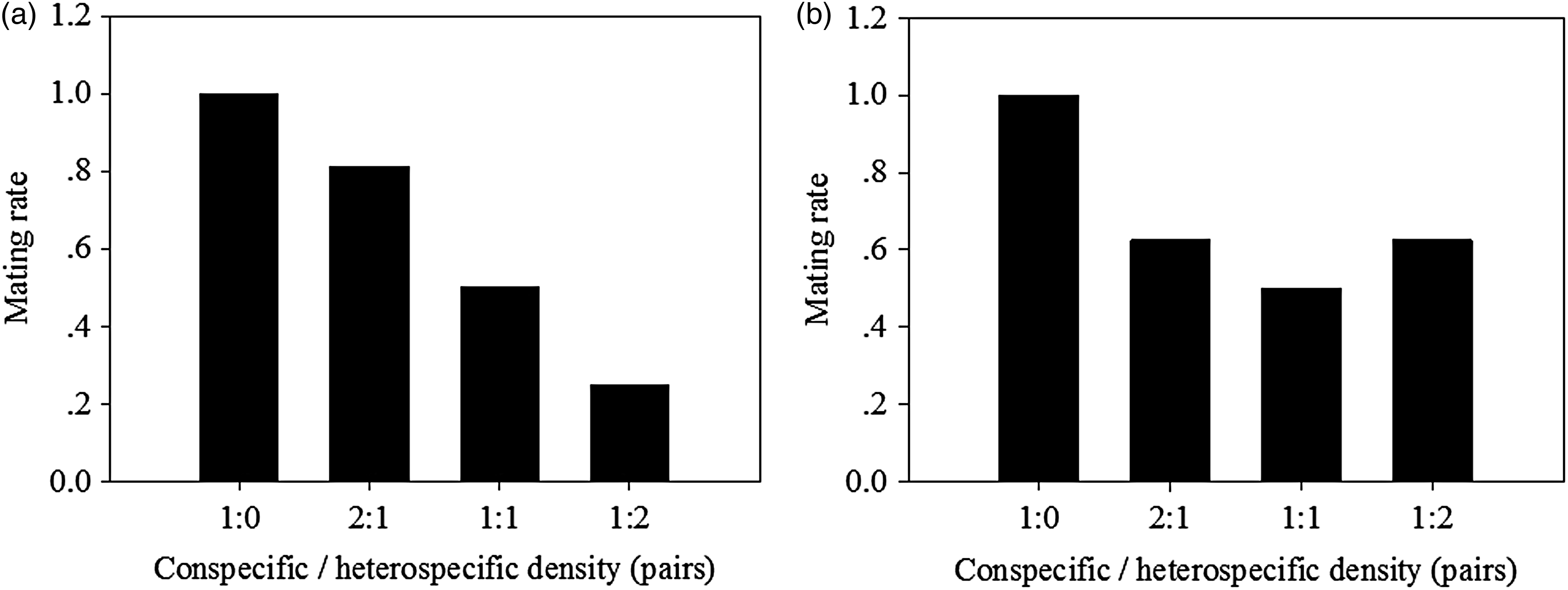
Next, we tested the mating opportunities of two species. The mating rate of E. obliqua females was not affected by the absolute species density, but was significantly affected by the relative species density in the given treatment (fig. 1a, GLM, absolute density, the parameter estimate ± SE =3.17 ± 3.44, d.f. = 1, P = 0.36; relative density, 1.93 ± 0.97, d.f. = 1, P < 0.05). Interestingly, mating success of intraspecific male was relatively higher in the 1:0 trial but was the lowest in the 1:2 trial. Nevertheless, E. grisescens females mating success was not affected by the absolute or relative species density (fig. 1b, GLM, absolute density, the parameter estimate ± SE = −1.36 ± 5.33, d.f. = 1, P = 0.70; relative density, 0.98 ± 0.87, d.f. = 1, P = 0.26).
Mating rate in relation to relative species density in (a) E. obliqua and (b) E. grisescens females.
Mating interference in males of E. grisescens and E. obliqua
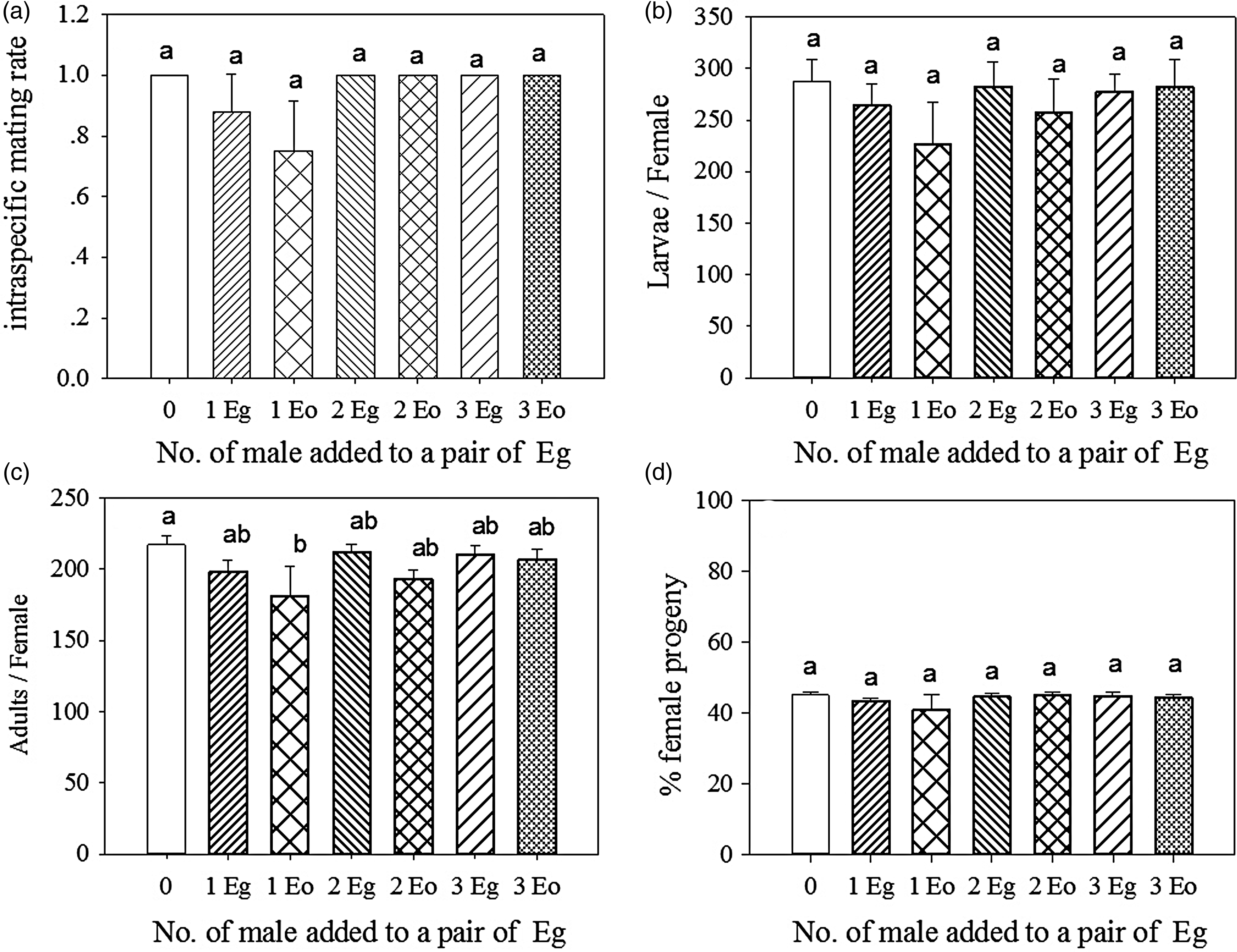
We found an influence of additional E. grisescens males on reproductive success of a pair of E. obliqua, but no effect of additional E. obliqua males on E. grisescens matings. As shown in fig. 2, the intraspecific mating rate of E. obliqua decreased with the addition of E. grisescens males (fig. 2a; F 6,49 = 16.62, P < 0.001). Adding E. obliqua males into E. obliqua pair decreased the number of larvae slightly, however, the negative effects only became statistically significant when 3 E. grisescens males were introduced to E. obliqua pair (fig. 2b). For the total number of F 1 progeny reaching adulthood, we observed a slight, but statistically insignificant decrease in the number of F 1 adults produced by E. obliqua pair when 1, 2, or 3 additional E. obliqua males were present. However, adding E. grisescens males in with the E. obliqua pair reduced the number of F 1 adults produced significantly (fig. 2c; F 6,49 = 39.07, P < 0.001). The proportion of F 1 female progeny (sex ratio) was not significantly affected by any additional (1–3) E. obliqua males, while the sex ratio was significantly reduced with an increasing trend of negative influence as more E. grisescens males were added into the E. obliqua pair (fig. 2d; F 6,49 = 9.89, P < 0.001).
E. obliqua (Eo) performance as affected by E. grisescens (Eg) males. (a) Intraspecific mating rate, (b) mean larvae, (c) mean adults and (d) proportion of female progeny within E. obliqua when a pair of E. obliqua ♂ × ♀ was supplement with 1, 2 or 3 ♂ of E. obliqua or E. grisescens. Error bars represent standard error of the means and different letters above bars indicate significant differences (P < 0.05).

Mating interference was also examined by introducing different numbers (1–3) of E. grisescens males or E. obliqua males into E. grisescens pair. We recorded the number of intraspecific mating between the two species. Results (fig. 3) showed that E. grisescens did not engage in interspecific mating in most cases, except for a combination of E. grisescens pair with one E. obliqua male (fig. 3a). This only interspecific mating group subsequently produced the lowest numbers of larvae and adults and smallest female ratio in F 1 generation, but the influence was not statistically significant. Except for this group, adding more E. obliqua males or E. grisescens males to the E. grisescens pair did not show any negative impact on mating and reproduction (fig. 3).
E. grisescens (Eg) performance as affected by E. obliqua (Eo) males. (a) Intraspecific mating rate, (b) mean larvae, (c) mean adults and (d) proportion of female progeny within E. grisescens when a pair of E. grisescens ♂ × ♀ was supplement with 1, 2 or 3 ♂ of E. grisescens or E. obliqua. Error bars represent standard error of the means and different letters above bars indicate significant differences (P < 0.05).
Discussion
Our results from the laboratory experiments revealed that reproductive interference occurs in E. grisescens and E. obliqua, and the interaction is asymmetric possibly due to different mating behaviour between the two sibling species leading to different consequences of reproductive performance. In the current research, mixed populations of E. grisescens and E. obliqua were found in the tea plantations of Chun'an, Hangzhou, Wuhan, Xinyang and Nanchang. Therefore, reproductive interactions between E. grisescens and E. obliqua are likely to occur naturally because of their overlapping niches.
Studies on insects mating strategy may provide insight into the evolution of mating behaviour, competitive interactions and speciation (Rowe & Arnqvist, Reference Rowe and Arnqvist2002; Chapman et al., Reference Chapman, Arnqvist, Bangham and Rowe2003). Females can recognize conspecific males or reject misdirected courtships from unsuitable males, and females always exert more influence over mating than males (Gröning & Hochkirch, Reference Gröning and Hochkirch2008). We observed that the frequency of E. obliqua females successfully mating with conspecific males was decreased as the proportion of individuals of the other species increased (fig. 1a). In contrast, the frequency of E. grisescens female mating was not affected by the species density ratio (fig. 1b). Results from our other experiments support the conclusion of an asymmetric mating interaction between E. grisescens and E. obliqua. Adding more males of E. grisescens into the E. obliqua pair tend to induce more interspecific crosses (E. obliqua♀ × E. grisescens♂) (fig. 2a), but the similar phenomenon (E. grisescens♀ × E. obliqua♂) was not observed in mating interaction cross between E. grisescens female and E. obliqua male (fig. 3a). These results suggest that males of E. grisescens have a greater ability to cause mating interference than E. obliqua males. As suggested above, the reduced mating success of E. obliqua in the mixed treatments may be the consequence of asymmetric mate recognition ability, e.g. females of E. grisescens were often highly sensitive in recognition and rejection males of E. obliqua, while E. obliqua females were less selective against males of E. grisescens. Such asymmetric mating preference phenomenon might be the result of reproductive isolation and could be a clue for the direction of evolution. Further studies will be expected to reveal the factors determining the differences in mating behaviour and mating systems that produce an asymmetric mating interaction between species.
Mate quality and number of mates are the key factor affecting female reproductive success (Bleu et al., Reference Bleu, Bessa-Gomes and Laloi2012; Himuro & Fujisaki, Reference Himuro and Fujisaki2012). Our mating interference experiments suggested that mating interactions between E. grisescens and E. obliqua were frequency-dependent. When a pair of E. obliqua ♂ × ♀ was supplemented with different numbers of virgin males of E. grisescens, the overall number and female ratio of F 1 offspring was reduced dramatically, and the more males of E. grisescens, the fewer offspring (fig. 2). However, the overall number and female ratio of F 1 offspring did not change much when a pair of E. grisescens ♂ × ♀ was supplemented with virgin males of E. obliqua (fig. 3). Mating attempts by E. grisescens males reduced the fecundity of E. obliqua females much more than mating attempts by E. obliqua males reduced the fecundity of E. grisescens females. Consequently, we suggest that the fecundity of females of both species would decrease as the number of the other species males increase, possibly due to this male frequency-dependent effect on mating success. The crossing experiments we conducted demonstrated that the presence of males and females of other species could reduce offspring sex ratio and the number of F 1 offspring (table 1). Furthermore, offspring from differently initial relative abundance of E. grisescens and E. obliqua did suffer the impact of interspecific crossing, and was less affected by the initial relative abundance (table 2). Overall, the presence of the other species males can affect the intraspecific mating success, and offspring were decreased after adding either male only or both males and females in laboratory.
Asymmetric mating interaction has mainly been discussed in the context of biological invasive species or hybrid zones, for example, whiteflies (Liu et al., Reference Liu, De Barro, Xu, Luan, Zang, Ruan and Wan2007), spider mites (Ben-David et al., Reference Ben-David, Gerson and Morin2009), ground-hopper (Gröning et al., Reference Gröning, Lücke, Finger and Hochkirch2007), beetle (Kishi et al., Reference Kishi, Nishida and Tsubaki2009), and ladybird beetle (Soares & Serpa, Reference Soares and Serpa2007). Although the hypothesis of species exclusion still needs to be tested experimentally, it has been suggested that reproductive interference might also offer opportunities for pest control (Ardeh et al., Reference Ardeh, de Jong, Loomans and van Lenteren2004). For example, competitive exclusion has been successfully applied in biological control of exotic Homoptera (Reitz & Trumble, Reference Reitz and Trumble2002). With increasing public awareness of the ecological problems of conventional insecticides, integrated pest management techniques (multiple tactics used in eradication programs) are needed (Suckling et al., Reference Suckling, Stringer, Stephens, Woods, Williams, Baker and El-Sayed2013). Mating disruption, reducing the number of offspring, is an effective, very selective, and environmentally-benign tactic, especially for moth pests (Judd & Gardiner, Reference Judd and Gardiner2005; Harari et al., Reference Harari, Zahavi, Gordon, Anshelevich, Harel, Ovadia and Dunkelblum2007; Suckling et al., Reference Suckling, Stringer, Stephens, Woods, Williams, Baker and El-Sayed2013). For this reason, based on the experimental data, E. obliqua seemed to be the inferior species. E. grisescens has a stronger capacity for excluding E. obliqua than vice versa, and this capacity is associated with asymmetric reproductive interference favouring E. grisescens. The basic study of mating interference is significant for evolution of species, control of heredity, and prevention of insect pests. This study established a foundation for exploring the possibility to reduce the fitness of E. obliqua by releasing E. grisescens into E. obliqua -dominated areas.
Mating behavioural interactions between closely related species resulting from incompletely isolated mate recognition systems may lead to reproductive interference that is often asymmetric and can have serious population consequences (geographic separation) for the species (Liu et al., Reference Liu, De Barro, Xu, Luan, Zang, Ruan and Wan2007; Gröning & Hochkirch, Reference Gröning and Hochkirch2008; Crowder et al., Reference Crowder, Horowitz, De Barro, Liu, Showalter, Kontsedalov, Khasdan, Shargal, Liu and Carriere2010a, Reference Crowder, Sitvarin and Carriereb; Noriyuki et al., Reference Noriyuki, Osawa and Nishida2012). Reproductive interference has been commonly found under laboratory conditions, but is not always found in field conditions (Coyne & Orr, Reference Coyne and Orr1989; Thum, Reference Thum2007). Under natural conditions, environmental factors and several ecological mechanisms of the location might influence interactions between species and produce different results (Dame & Petren, Reference Dame and Petren2006; Hochkirch & Groning, Reference Hochkirch and Groning2012). Our study shows reproductive interference in laboratory conditions and these two species with the same life history and behavioural traits have the potential for interaction in the field, but further studies are needed to determine if mating interference will occur in field conditions. Ultimately, linking detailed laboratory studies with long-term field survey datasets may provide the key to predicting patterns of species exclusion or coexistence.
Acknowledgements
The authors thank all the anonymous reviewers for their constructive comments that help improve the manuscript. We thank Eric Scott from Tufts University of USA for editorial assistance. Financial support for this study was provided by the Chinese Academy of Agricultural Sciences through Agricultural Sciences Innovation Project (CAAS-ASTIP-2014-TRICAAS), the Fundamental Research Funds of National Science and Technology (2013FY113200), and the National Science and Technology Support Program Projects (2011BAD01B02).


 Open access

