



INTRODUCTION
Rabies is still a major public health issue across large parts of the world. On average one person dies from rabies every 15 minutes, with most of the cases reported from Africa and Asia [Reference Rupprecht, Hanlon and Hemachudha1]. In those regions, as well as parts of Latin America, bites from rabid dogs are the primary source of infection, but there is growing concern about the role played by various bat species as reservoirs for lyssaviruses. In addition, recent reports have suggested that bat-borne rabies can be transmitted from bats to carnivores with successful establishment in the novel host [Reference Leslie2, Reference Kuzmin3].
In Latin America, dog rabies is a public health concern in Haiti, Bolivia, Guatemala, Dominican Republic, Brazil, and Peru [Reference Vigilato4]. Furthermore, bat-borne rabies is increasing in importance in this region [Reference Vigilato4, Reference Schneider5]. In Chile rabies control and surveillance policies are based on outdated information and practices. For example, in early 2014 the Chilean Government published a policy for rabies control and prevention improving technical aspects for rabies prevention (e.g. vaccination). However, this policy allows and promotes bat culling (Article 8 [6]), which raises concern for wildlife conservation. The first rabies-positive bats were found in 1985 [Reference Núñez7]. Since then, every occurrence has been followed by massive bat captures and testing from public health agencies, a policy termed active surveillance. Testing of opportunistic samples submitted by or following reports by members of the public of suspect bats (i.e. flying at day, erratic flying, loss of fear of people or domestic animals, incapacity to fly, dead) constitute passive surveillance [Reference Favi and Catalán8].
We analysed surveillance data collected by the Instituto de Salud Publica de Chile since 1985 to describe the long-term patterns of rabies reports in Chile. We aim to describe past and current trends of rabies in different geographical areas, periods, viral strains, and host species involved, contributing to the knowledge of rabies epidemiology in Chile and proposing future steps in research and policy. Beyond its importance for Chile, this study provides much needed information in the context of growing concern about the potential role of bats as reservoirs of zoonotic pathogens worldwide.
METHODS
Rabies reports from the Rabies Laboratory at the Instituto de Salud Pública de Chile (ISP; Chilean Institute of Public Health) were entered into an electronic database. We included data from epidemiological surveillance from 1985 to 2012, as 1985 was the year of the first reported rabies-positive bat in Chile. Species were identified using morphological characteristics. Each sample was catalogued by year, month, county, Chilean region, animal species, type of surveillance (active or passive), and diagnosis (positive, negative, inconclusive). Brains from all animals submitted were examined for rabies antigens by means of the fluorescent antibody test (FAT). For positive samples we included the antigenic variant (AgV) type and localization. We used descriptive analysis to identify epidemiological patterns of samples submitted compared to positive samples since 1985.
In order to establish if samples submitted were distributed uniformly or clustered we looked for spatial autocorrelation of samples by county. To visualize clusters of positive bats we applied a kernel density analysis using the geographical coordinates. Kernel density is an interpolation technique used to convert point data into a continuous surface that shows the reporting intensity. We created thematic maps to describe spatial patterns of rabies occurrence by county, number of bats species in Chile, and number of AgVs by Chilean region. To establish the spatial trend of rabies reports historically, we calculated the centroid of bat rabies occurrence by Chilean region and the standard distance separating the x and y directions of all occurrences by region. This was done to define axes used to generate an ellipsoid that allowed us to visualize the ellipsoid orientation that included the majority (68%) of all rabies occurrences. These analyses were conducted across central Chile to define the direction of rabies reports. Data were handled and stored in Excel (Microsoft, USA), and statistical analyses were performed using R [9], and spatial analysis were conducted in ArcGIS 9·3 (ESRI, USA).
RESULTS
We found that from January 1985 to December 2012, 61076 samples were submitted to the ISP laboratory for rabies testing (Fig. 1). Passive surveillance was the main source of samples (Table 1). In total, 29 715 samples were from dogs, 27 264 bats, 2882 cats, 987 other wild animals, 171 from livestock, and seven from humans (Table 1), including 258 samples without report of type of surveillance that were excluded on posterior analysis. Positive samples were found in 159 counties from the 289 counties tested, but 16% of counties did not send samples (Fig. 2).
Yearly bat samples submitted from 1985 to 2012 through passive (black lines) and active (blue lines) surveillance. Active surveillance started in 1994. Vertical bars show the proportion of samples that tested positive for rabies. Years 1991–1993 were excluded because of lack of data from negative samples in some months.

Seasonal trends in samples from bats through passive surveillance (grey boxes), and prevalence of rabies in these samples (red boxes) from 1994 to 2012.

Proportion of samples by host group and surveillance from 1985 to 2012

Livestock: goats, pigs, cattle, sheep, horses, llamas. Other: wild animals other than bats, including native and invasive. Samples without report of the type of surveillances were excluded.
According to data from passive surveillance by host group, bat samples had the highest proportion of positive cases (8·63%), followed by livestock (2·04%; bovine, caprine, ovine, equine, porcine, llama), cats (0·61%), and dogs (0·09%, Table 1). Active surveillance only identified positive samples from bats, at a much lower prevalence (0·44%). According to the type of surveillance, most of active surveillance data came from the bat species Tadarida brasiliensis. We did not consider 581 samples as they were inadequate for FAT (e.g. in formalin, dry, or putrefactive). We found that cats and dogs had lower proportion of rabies than bats (Table 1, Supplementary Fig. S1). Samples from dogs and cats were submitted from across Chile, but we found several gaps in surveillance and differences in sampling efforts (Supplementary Fig. S1). When active and passive surveillance efforts were compared historically, the reduction in active surveillance in recent years was evident (Fig. 1). Rabies positivity in bats from passive surveillance has remained fairly constant since 2000; yet the number of bats sampled by active surveillance has been decreasing markedly since 2004 (Fig. 1).
None of the 950 samples from wild animals other than bats was positive. From this group, wild animals (non-bats) native to Chile included foxes (120, Pseudalopex spp.), skunks (5, Conepatus chinga), lesser grisons (4, Galictis cuja), South American sea lions (3, Otaria flavescens), guignas (3, Leopardus guigna), coypus (2, Myocastor coypus), cougar (1, Puma concolor), and colocolo (1, Leopardus colocolo). Others not identified to species level included small rodents (161), camelids (4) and marsupials (3). Wild animals non-native to Chile included rats (298), hamsters (174), rabbits (72), hares (66), monkeys (13), minks (8), squirrels (4), ferrets (3), guinea pigs (2), gerbil (1), ant-eater (1) and beaver (1).
Rabies in bats
We found that the majority of positive samples came from bats (1339/1376 positive samples). The first rabid bat was received in January 1985. On average 47 bat samples were submitted every month from passive surveillance, with a clear seasonal pattern showing peaks in submission in January and September. Prevalence of rabies in these samples exhibited a variable pattern (Fig. 2). Regions with fewer samples were found in North and South Chile (Fig. 3). Reports of rabies-positive bats by county varied across Chile, but were spatially autocorrelated (P < 0·01, Fig. 3). Density analysis of reports revealed hotspots of rabid bats across central Chile; the area with the most reports of positive bats was Santiago, Chile's largest city and capital, followed by Concepción and Valparaíso (Supplementary Table S1). Ellipsoids for bat rabies spatial density showed a clear association with urban areas (Fig. 4).
Proportion of rabies-positive bats by county (polygons) between 1994 and 2012. Colour range represent the proportion by county from low (yellow) to high (dark brown), and counties with no data (white). The map of Chile was divided in four sections from north to south (a, b, c, d) for better visualization. Scale bars represent the true size in kilometres. The inset in panel (d) shows the latitudinal sections.

Directional distribution trend of bat-borne rabies reports in central Chile (red ellipsoids). Ellipses measure whether a distribution of features exhibits a directional trend. Note the overlap of ellipsoids of rabies reports with the most populated urban areas (blue). (Source: Sistema Nacional de Coordinación de Información Territorial 2008–2010; http://www.snit.cl).

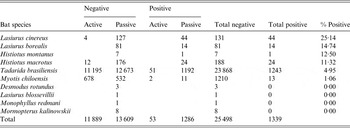
Bats submitted for rabies testing, proportion of positivity, and number of samples varied by region and bat species (Tables 1 and 2, Supplementary Table S1). Six bat species out of the 11 present in Chile were rabies-positive, all insectivorous. When the rabies-positive bat species were considered separately, we found that there was a decrease in the number of samples in winter in all species, but the proportion of positive samples was similar through the year (data not shown). The species found rabid most frequently was T. brasiliensis, although based on proportion of positive samples Lasiurus cinereus was the most important (Table 2). Efforts for monitoring rabies through active surveillance focused on the bat species T. brasiliensis and Myotis chiloensis, but positivity was low in both species, 0·45% and 0·29%, respectively.
Bat species submitted for rabies test in Chile since 1985. One positive bat from the Myotis genus was not identified to species level and was not included
We found that the greatest richness of bat species was in central Chile, while southern Chile has few bat species (Fig. 5). Five AgVs have been reported in Chile, including one canine-related variant (AgV2) and four bat-related variants (AgV4 Tadarida, AgV6 Lasiurus, AgV not typed for Histiotus, AgV3 M. chiloensis). The highest number of AgVs found in central Chile overlapped with the high bat species richness (Fig. 5).
Distribution of antigenic variants (AgVs) of bat rabies in Chile. Pie charts represent the number of AgVs by Chilean region. Variant of Tadarida brasiliensis (Tb, red), Myotis chiloensis (Mch, yellow), Lasiurus borealis + L. cinereus (Lc, white), and Histiotus macrotus (Hm, blue), virus variants are placed on a species richness layer with high (black) or low (white) number of bat species. N/A, No data available.

DISCUSSION
The rabies situation in Chile has changed markedly over the last 50 years. In 1961 mass vaccination and stray dog elimination campaigns were implemented, resulting in a marked reduction in rabies cases [Reference Ernst and Fabrega10]. An epidemiological study in Chile between 1950 and 1986 (37 years) recorded 5409 laboratory-confirmed cases of rabies (~146 positives per year), mainly from dogs [Reference Ernst and Fabrega10]. Here, we summarize 1376 confirmed cases between 1985 and 2012 (27 years, ~50 positives by year), mainly from bats. Bats were diagnosed as rabies positive for the first time in 1985 [Reference Favi and Catalán8]. Today bats are the main reservoir of rabies in Chile. The number of submissions through passive surveillance increased in 1994, and have ranged from 700 to 1100 per year since then. The prevalence of rabies in those samples has remained around 9%. Campaigns of active surveillance triggered by the detection of rabid bats indicate that the true prevalence of rabies in target bat colonies is around 0·4%, although we lack relevant epidemiological and ecological information (e.g. age groups, sex ratios, colony size). Active surveillance in bats focused on species living in aggregation [Reference Iriarte11], this reflects that the active effort in rabies monitoring in Chile is generating information biased towards the most common and easily observable species (i.e. T. brasiliensis and M. chiloensis).
All reported rabies cases in dogs and cats were caused by bat-borne rabies; only one rabid dog was from a canine variant in 1990 [Reference Favi and Duran12–Reference Favi14]. According to our results, dogs are not important for transmission of canine-related rabies (i.e. AgV2) today in Chile, but they remain a public health problem due to the high density of stray dogs in urban areas. Chilean dogs are a reservoir for many parasites and diseases including, for example, philariasis, leptospirosis, echinocososis [Reference Tuemmers15–Reference López18]. After the success of the rabies control programme, the massive vaccination and stray dog elimination campaigns were stopped. As consequence, there is now a high number and density of stray dogs across the country without immunity against rabies [Reference Acosta-Jamett19–Reference Ibarra22]. Dog bites now represent a serious public health problem, resulting in 1262 people bitten per 100 000 individuals annually, just in the city of Santiago [Reference Ibarra, Morales and Cáceres23]. The high number of rabid bats we found and the high density of stray dogs in Chile present a potential scenario for cross-species transmission and the emergence of bat rabies lineages in dogs. Recent studies have reported successful adoption of bat-borne rabies into carnivores, including skunks (Mephitis mephitis) and foxes (Urocyon cinereoargenteus) with animal-to-animal transmission and human and pet exposures [Reference Leslie2, Reference McCollum24].
Historically in Chile, dog rabies reports were highest in October and November [Reference Ernst and Fabrega10]. We found that seasonal trends in bat rabies were biased due to reporting methods. While the numbers of passive surveillance samples peak in January and September (driving the total numbers of bat rabies cases), the prevalence of rabies in those samples usually peaks in March–April and again in November (Fig. 2). By contrast, the majority of bat rabies cases from active surveillance were reported from January to March (32/53). Seasonal variation could be linked to low activity patterns in bats after reduction in food resources for low temperatures in the South Hemisphere [Reference Bozinovic25].
There is a lack of bat samples in northern and southern Chile, although we found few bat species reported in those areas. In central Chile, where the greatest number of bat species and rabies AgVs are present, no samples were submitted from several counties during the last 27 years, resulting from a severe lack of surveillance or low bat abundance. The geographical distribution of bat samples was strongly linked to human settlements, mainly urban areas, reflecting the sampling bias from passive surveillance. When only positive bats are considered, several important hotspots were found across central Chile, with the most populated urban areas falling inside the risk areas. In Chile the surveillance of wild animals other than bats begun in 1985, and included testing foxes, mustelids and felids, with negative results [Reference Favi and Catalán8]. In this context, the number of samples and species submitted increased, but the negative status remained.
Only one human case was reported between 1985 and 2012, a child infected with bat-borne rabies from a T. brasiliensis lineage [Reference Favi26]. However, we found only seven records of human samples tested for rabies over that period. Surveillance of rabies in people should increase in Chile, and rabies should be included as a differential diagnosis for encephalitis in view of the highly diverse symptoms of this disease [Reference Senthilkumaran27].
The consistently high prevalence of rabies in bats submitted through passive surveillance has to be interpreted with caution in the light of results from active surveillance. In addition, we found no evidence of re-emergence of the disease in humans or domestic animals. Previous research found an increase in the proportion of positive bats [Reference Favi14], with special interest in the metropolitan region [Reference Favi28]. When more years and areas were considered we did not see a considerable increase in the proportion of bat-borne rabies. It is very important to consider both risks to public health and the imperative of biodiversity conservation when considering potential control measures. Recent studies in South America have shown that various attempts to control bat populations failed to reduce rabies transmission [Reference Streicker29, Reference Blackwood30]. In addition, bat elimination may cause ecological imbalance with negative consequences for agriculture and public health [Reference Kunz31]. Rabies control and prevention efforts in Chile should focus on education to increase the rates of samples submitted through passive surveillance, to reduce exposure, and to increase the immunization rates of pets and exposed people. Longitudinal or even cross-sectional serological studies may be more informative that culling bats, as serology in bat colonies provides crucial information to understand transmission rabies dynamics [Reference Gilbert32]. For example, in Spain, a long-term serological study of spatial and seasonal variation of lyssavirus seroprevalence across 20 bat species has provided useful data to establish the area and time of the highest risk of transmission [Reference Serra-Cobo33].
In conclusion, to reduce the risk of bat-borne rabies in humans, local public health agencies need to understand the basic ecology of bats and the potential role of stray dogs and cats as amplifiers through spillover (species that increase the chance of rabies transmission to humans) for an effective intervention and prevention.
ACKNOWLEDGEMENTS
We thank the Sección de Rabia, Instituto de Salud Pública, Government of Chile, for help in data compilation, especially Cristina Toledo. Valeska Rodríguez helped in data tabulation. L.E.E. is a student in the Conservation Medicine Programme at the Universidad Andres Bello, this paper is a requirement for his PhD degree.
L.E.E. was supported by Universidad Andres Bello (grant DI-412-13/I). O.R. is supported by the Royal Society through a University Research Fellowship, and acknowledges funding from the Research and Policy on Infectious Disease Dynamics (RAPIDD) Program of the Fogarty International Center, National Institutes of Health and Science and Technology Directorate, Department of Homeland Security.
SUPPLEMENTARY MATERIAL
For supplementary material accompanying this paper visit http://dx.doi.org/10.1017/S095026881400226X.
DECLARATION OF INTEREST
None.



