





Introduction
Environmental identity (EID) is a belief of individuals that they are components of nature (Schultz & Tabanico, Reference Schultz and Tabanico2007) and it is a way of measuring individuals’ interdependence with nature or their self-perception of nature (Clayton, Reference Clayton, Clayton and Opotow2003). EID, broadly defined as a close psychological relationship between oneself and nature, has a wide range of conceptualisations. As Clayton and Opotow (Reference Clayton, Opotow, Clayton and Opotow2003) point out, it appears to include a variety of aspects, ranging from those that are more socioculturally influenced to others that are likely more personal. In general, EID has a significant effect on environmental behaviours (Blatt, Reference Blatt2014; Kempton & Holland, Reference Kempton, Holland, Clayton and Opotow2003). EID may be both the effect and the cause of dual variable characteristics (Devine-Wright & Clayton, Reference Devine-Wright and Clayton2010). In this study, EID was considered not as a cause variable but as an outcome variable. It was tested the impact of participants’ environmental behaviours, closeness to nature and connectedness to nature on their EIDs. In addition, by testing how well these variables explain the EID of pre-service teachers, we tried to determine how effective these variables would be on their EID.
Theorical framework
Identity is the answer to characterising who the individual is. Identity is a complex concept that encompasses several issues, including self-definition, personal roles and characteristics, social networking/membership and local or geographic citizenship, as well as community connections (Devine-Wright & Clayton, Reference Devine-Wright and Clayton2010). Furthermore, identity is the qualities, beliefs, personality, looks and expressions that define a person. It begins to develop from childhood because of individuals’ self-meaning and the reflections of the people. Many factors have affected the development of self-identity, the main one of which is physical environment, followed by others such as religion and personality characters. For example, education and schooling can impact a person’s perspective on the world through factors such as beliefs, values, principles and identities (Riggs, Reference Riggs2015; Tok & Kılıç, Reference Tok and Kılıç2013).
Environmental psychology considers the place of residence to exert a distinct effect on the self-identity. Cultural, inherited and social structures all influence EID (Qazimi, Reference Qazimi2014). Kempton and Holland (Reference Kempton, Holland, Clayton and Opotow2003) proposed three steps of development of EID: (1) Salience: Gaining an awareness of environmental issues. (2) Empowerment: Self-identification as an environmental actor. (3) Activism: Participating in environmental practices on a level of community. The awareness activates the salience stage, then the individual thinks and actively engages in the natural assets and starts working for the environment. The final stage of activism consists of awareness and knowledge arriving through action.
EID involves many factors such as beliefs, values, attitudes and behaviours and the positions people take during environmental conflicts (Clayton & Opotow, Reference Clayton, Opotow, Clayton and Opotow2003), and it is one of the definitions aiming to reveal the relationship between the individual and nature (Blatt, Reference Blatt2014; Brügger, Kaiser, & Roczen, Reference Brügger, Kaiser and Roczen2011; Mayer & Frantz, Reference Mayer and Frantz2004; Nisbet, Zelenski, & Murphy, Reference Nisbet, Zelenski and Murphy2011). EID is based on values, history, desire for self-understanding, emotional links with nature, and social or group expectations, emotional and behavioural responses (Whitmarsh & O’Neill, Reference Whitmarsh and O’Neill2010). EIDs, affected by attitudes, personal norms, intentions, behaviour and identification with the natural environment, lead to environmental values (Steg, Bolderdijk, Keizer, & Perlaviciute, Reference Steg, Bolderdijk, Keizer and Perlaviciute2014). An important point to consider is that the identity of environmentalists has shifted dramatically over the last three decades (Gallup, Reference Gallup2016). In 1991, an overwhelming 78 per cent of Americans identified as environmentalists. By 2016, it had dropped to 42%. According to recent research, conducted in the United States, environmentalists are often perceived as radical activists (e.g., militants) who pose a risk to society. Individuals are more likely to move away from environmentalists if their identification with them indicates negative characteristics such as radicalism (Hoffarth & Hodson, Reference Hoffarth and Hodson2016).
Researchers have proposed some models to identify factors that influence people’s general and specific environmental behaviours. Ramsey and Rickson (Reference Ramsey and Rickson1977) asserted a basic and linear model that explains the relationship among knowledge, attitude and eco-friendly behaviour (EFB). Reasoned Action Behavior (Ajzen & Fishbein, Reference Ajzen and Fishbein1980) assumes that behaviour is a function of intention and attitudes. And, according to the theory, value systems such as individuals’ beliefs have the potential behavioural change. Ajzen’s (Reference Ajzen1991; p. 182) Planned Behavior Theory is based on three conceptually predictive factors of ‘behavioural intention: attitude towards the behaviour, subjective norm, and perceived behaviour control’. According to identity theory, self-identity is constituted of a series of acts that a person plays, which leads to a predictable behaviour to validate the self-concept (Stets & Burke, Reference Stets and Burke2000). Self-identity strives to achieve stability between attitudes and behaviours, inducing specific intentions in the process (Christensen, Rothberger, Wood, & Matz, Reference Christensen, Rothberger, Wood and Matz2004). As a result, the more coherent identity is, the more identity-compatible behaviours it displays (Laverie & Arnett, Reference Laverie and Arnett2000). According to several studies, self-identity is a significant predictor of both intentions and behaviours (Brick & Calvin, Reference Brick and Calvin2018; Carfora, Caso, Sparks, & Conner, Reference Carfora, Caso, Sparks and Conner2017; Paquin & Keating, Reference Paquin and Keating2017). Furthermore, the study’s findings revealed that increased intention to behave on environmental problems/issues supported EFB. As a result, it appears that EFB is significantly predicted by environmental knowledge, attitude and internal locus of control. Then, many other researchers added significant predictors to the literature on behaviour through their research. In this respect, new variables should be investigated in addition to those commonly used in previous studies to see if they affect EFB.
The present study was designed to evaluate EID in terms of connectedness to nature, EFB and closeness to nature variables to assess the importance of EFBs. Some scholars have argued that EID may be linked to environmental behaviour since identity enforces their activities continually (Blatt, Reference Blatt2014; Kempton & Holland, Reference Kempton, Holland, Clayton and Opotow2003). Recent evidence suggests that in the United States, environmentalist identity, rather than political orientation, is a better predictor of self-reported EFB (Brick, Sherman, & Kim, Reference Brick, Sherman and Kim2017). If EID can be measured to assess an individual, hypotheses for specific cases can be tested, making them significant in predicting behaviour. Determining and exposing the relationships between the predictor variables that affect the EID of individuals can help define this complex concept and understand associations.
The purpose of this research is to investigate pre-service teachers’ EIDs in terms of EFB, connectedness to nature and closeness to nature. Furthermore, we intend to analyse and interpret the significant determinants of EID using a conceptual model that we have developed. We expected to clarify EID predictors using closeness to nature, connectedness to nature and EFBs. The theoretical structural model (Figure 1) illustrates the assumed relationships between these constructs. According to the model, our assumptions were that educational, economic and recycling behaviours affect EFBs directly and EID indirectly through EFBs.
The theoretical path analysis model for illiustrating the variables’ relationships.

Purpose and significance of the study
In the present study and model, we tried to explain the effects of closeness to nature, connectedness to nature and EFB variables on EID. Unlike in previous studies, EID in this study was evaluated as a result of variables rather than as a reason and thus significantly contributes to the understanding of pre-service teachers’ EID. As a result, it can help us understand some of the critical components of EID. Schooling is a social endeavour that defines who we are and thus identity, which has a significant impact EID. One of the goals of environmental education is to provide every person with opportunities to acquire the knowledge, values, attitudes, commitment and skills needed to protect and improve the environment (UNESCO, 1977). Since children are the main recipients of environmental education, often connected with their curricula, it makes sense to focus on them when studying the promotion of pro-environmental behaviours. Furthermore, since teachers are practitioners of curricula, it would be appropriate to focus on the factors affecting their education and environmental identities. Teachers are responsible for instilling in their students the knowledge, values, attitudes and skills required to preserve the environment. People are unlikely to take sustained environmental action unless they incorporate environmental protection and improvement into their identity. As a result, it is critical to comprehend how people develop an identity as someone who cares about the environment and the forms of action that are important to them. Pre-service teachers’ environmental identities may have a potential effect on their students’ identities in ways such as how they handle environmental problems, their sensitivity to environmental issues, the positions they will take during disputes/rebuttal/challenges, and students’ positive opinions and attitudes towards the environment. Tugurian and Carrier (Reference Tugurian and Carrier2017) suggest that children’s EID augmentation can be supported by developing children’s identities in the context of science, more specifically the natural world learners. The identity and faith systems of teachers have the potential to affect their instruction. We believe that teachers who have a strong EID have the potential to shape their students’ EIDs by serving as role models. Our findings can be used to effectively design, plan and implement novel, legitimate environmental education programmes for pre-service teachers. Finally, to contribute to the field of environmental higher education curricula forward theoretically and practically we provide a theoretical model of how to affect pre-service teachers’ EID to illustrate variables relevant to nature and EFB research.
Research questions
-
1. How do behaviours related to environmental education, recycling and economics affect EFBs?
-
2. What are the direct effects of connectedness to nature, EFBs and closeness to nature on EID?
-
3. What are the indirect effects of environmental education, recycling and economical behaviours on EID through EFBs?
-
4. What are the indirect effects of connectedness to nature and closeness to nature on EID through EFBs?
Method
Procedure and sample
After granting the required permission from the local ethical committee, we reached out to 552 college students studying in different programmes at a public university located in South-eastern Turkey. After excluding missing responses, we concluded the study with 518 participants. We received an informed consent form from the participants to ensure voluntary participation in the study. The face-to-face data collection process was applied by using paper and pencil administration. During the 2020 spring semester, the data collection process took four weeks.
The survey package consisted of two psychometric scales with 24 items in total and some demographic questions, including 28 items in total. There were 298 female students (57.5%) and 220 male students (42.5%). There were 135 (26.1%), Department of Primary Education, Program in Pre-school Education students, 159 (30.7%) Program in Primary School Education students, 109 (21.0%) Department of Turkish and Social Sciences Education, Program in Social Studies Education students, 68 (13.1%) Program in Turkish Education students and 47 (9.1%) Department of Mathematics and Science Education, Program in Science Studies Education students in the sample. The average participant age was 21.36 with a standard deviation of 2.17.
Across cultures, the importance and strength of an EID may vary. Therefore, the geographic and cultural characteristics of the sample of our study are, in brief, as follows: Our students are generally from the South-eastern Anatolian Region of Turkey. It is bounded to the west by the Mediterranean region, to the north by the Eastern Anatolian Region, to the south by Syria and to the south-east by Iraq. Many refugees migrated to this region because of the Syrian civil war. These immigrants make up 5–10% of our student distribution of the university. The province’s industrial activities are limited, and the region’s people primarily earn a living through agricultural activities. Kilis has good agricultural land that is irrigated by small rivers, and 68% of the land area is planted. Kilis accounts for nearly 4% of Turkey’s grape production. Olives, fruit, wheat, barley and tobacco are also important agricultural products. Waste Disposal & Recycling activities have been carried out across the province in recent years, with the participation of local governments, universities and non-governmental organisations.
Measures
Pro-environmental behaviour scale
The scale aims to measure students’ pro-environmental behaviours and was developed by Tanık (Reference Tanık2012). The scale consists of 10 items with five response options for each item (1: Never to 5: Always) and is comprised of three subscales as environmental education behaviours (3 items), economical behaviours (4 items) and recycling behaviours (3 items). One sample item is ‘‘Warning people who pollute the environment’’. In the original study, the Cronbach internal consistency was .82, .60 and .68 for the environmental education behaviours, economical behaviours and recycling behaviours subscales, respectively. In our study, Cronbach alpha values were .80, .64 and .75, respectively. The original scale’s model fit indexes were chi-square/df = 2.083, p-value = .000, root mean square error of approximation (RMSEA) = .047, NFI = .943, comparative fit index (CFI) = .969 and Tucker–Lewis index (TLI) = .947.
EID scale
Clayton (Reference Clayton, Clayton and Opotow2003) developed the English version of the scale, and Clayton and Kılınç (Reference Clayton and Kılınç2013) adapted and validated it into Turkish. The scale aims to measure the university students’ EID. The short version of the scale is comprised of four subscales as EID with four items, closeness to nature with three items, connectedness to nature with four items and EFBs with three items, for a total of 14 items. All survey items had seven response options ranging from 1: Not at all true to 7: Completely true. One sample item is ‘‘Being a part of the ecosystem is an important part of who I am’’. In the original study, the Cronbach internal consistency was .80, .60, .66 and .72 for the EID, closeness to nature, connectedness to nature and EFBs subscales, respectively. In our study, Cronbach alpha values were .87, .70, .71 and .76, respectively. The original scale’s model fit indexes are chi-square/df = 4.277, p-value = .000, RMSEA = .082, NFI = .825, CFI = .857 and TLI = .796.
Data analysis
First, confirmatory factor analysis for each of the measurement models was applied to assess the theoretical construct of the scales.
Fit indices of measurement models
In the present study, fit indexes and CFA values for the scales and theoretical path model are presented below.
The fit indices of the confirmatory model for the pro-environmental behaviour scale were chi-square: χ2(32) = 248.56 and p < .00, CFI = .93, TLI = .90, RMSEA = .06 and weighted root mean square residual (WRMR) = 1.41. The fit indices of the confirmatory model for the EID scale were chi-square: χ2(71) = 536.18 and p < .00, CFI = .95, TLI = .93, RMSEA = .06 and WRMR = 1.30 (Table 1). Based on confirmed criteria (Schermelleh-Engel, Moosbrugger, & Müller, Reference Schermelleh-Engel, Moosbrugger and Müller2003), model fit indices indicated good or acceptable fit.
Fit indexes and CFA values for the scales and theoretical path model

** p < .001.
Fit indices of theoretical path model
The fit indices of the theoretical path model were chi-square: χ2 (3) = 14.383 and p < .00, CFI = .98, TLI = .95, RMSEA = .07 and standardised root mean square residual (SRMR) = .01. Based on the confirmed criteria (Schermelleh-Engel et al., Reference Schermelleh-Engel, Moosbrugger and Müller2003), model fit indices indicated good or acceptable fit.
Then, based on the literature, we developed the theoretical path analysis model depicted in Figure 1. As shown in the model, we hypothesise that connectedness to nature and closeness to nature are directly affected by EID. Indirect effects mediated by EFBs are also expected from these two variables on EID. Furthermore, environmental education behaviours, economic behaviours, recycling behaviours all have indirect effecs on the EID, and these three indirect effects are mediated by the EFBs. Methodologically, environmental education behaviours, economical behaviours, recycling behaviours, connectedness to nature and closeness to nature are the exogenous variables (i.e., no arrow pointing to them), and EID is the endogenous variable (i.e., arrow pointing to it). Also, EFB has mediating roles in the relationship between EID and other variables.
As cited above, the final dataset did not have any missing values. The bivariate correlation means and standard deviations amongst variables are given in Table 2.
Bivariate correlations, means and standard deviations amongst the variables (N = 518)
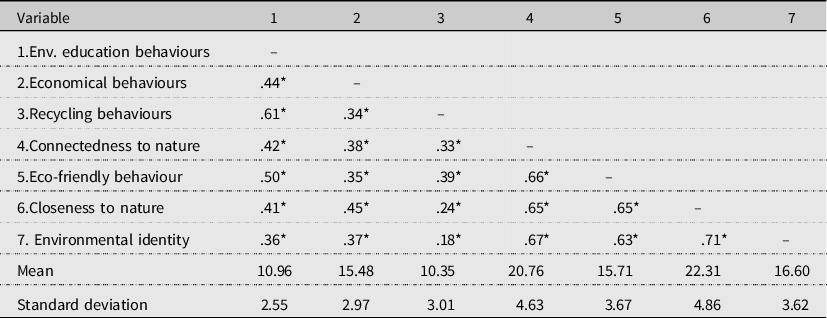
* p < .01.
We ran the confirmatory models and theoretical path model in Mplus software version 8® (Muthén & Muthén, Reference Muthén and Muthén1998–2017) and used the 10,000 iterations bootstrap. The bootstrap standardised direct, indirect and total effects are given in Tables 3 and 4. The standardised coefficients in the model are also presented in Figure 2.
Standardised coefficients of the paths in the model. *p < .05.

Total, direct and indirect effects of exogenous variables on endogenous variables

* p < .05.
Total, direct and indirect effects of endogenous variables on endogenous variables

* p < .05.
Results
Results are presented in the order of research questions for easy follow-up.
Direct, indirect and total effects
Environmental education behaviours
Environmental education behaviours had significant total effects on EFBs (.16) and EID (.03). The .16 effect on environmental behaviour was entirely direct effect, as specified in the model, but the .03 effect on EID was entirely indirect; and was mediated through EFBs.
Economical behaviours
Economical behaviours had total effects on EFBs (−.05) and EID (−.00). The −.05 effect on EFBs was entirely direct effect, as specified in the model, but the −.00 effect on EID was entirely indirect effect, mediated through EFBs. However, none of the effects was significant.
Recycling behaviours
Recycling behaviours had significant total effects on EFB (.10) and EID (.01). The .10 effect on EFB was entirely direct effect, as specified in the model, but the .01 effect on EID was entirely indirect effect, mediated through EFBs.
Connectedness to nature
Connectedness to nature had significant total effects on EFB (.34) and EID (.35). The .34 effect on EFB was entirely direct effect, as specified in the model, but the .35 effect on EID was the partially direct effect (.29) and partially indirect (.06). The indirect effect was mediated through EFB.
Closeness to nature
Closeness to nature had significant total effects on EFB (.36) and EID (.47). The .36 effect on EFB was entirely direct effect, as specified in the model, but the .47 effect on EID was partially direct effect (.41) and partially indirect (.06). The indirect effect was mediated through EFB.
Eco-friendly behaviour
EFB had a significant total effect on EID (.16); according to model specification, this effect was completely a direct one.
Discussion
There is widespread recognition that a broad spectrum of EFBs, or environmental lifestyles, must be adopted to enable an alteration to a sustainable future, such as recycling, alternative transportation use, green consumer behaviour and environmentalist activism (Kashima, Paladino, & Margetts, Reference Kashima, Paladino and Margetts2014). If some causal factors drive a variety of EID, it may be possible to enhance a transition to eco-friendly lifestyles by constructing a sociocultural context in which these mechanisms encourage citizens to move in that direction. In the present study participants’ EFB had a significant and moderate effect on their EIDs. Öztarakçı (Reference Öztarakçı2019) found that there was a positive and weak relationship between EID and EFB scores of teacher candidates (r = .414, p < 0.01). EID was significantly correlated with private pro-environmental behaviour in a study by Dresner, Handelman, Braun, and Rollwagen-Bollens (Reference Dresner, Handelman, Braun and Rollwagen-Bollens2015) (r = .274, p < 0.01). Clayton (Reference Clayton, Clayton and Opotow2003) and Brügger et al. (Reference Brügger, Kaiser and Roczen2011) found that EID was significantly correlated with self-reported behaviour in their studies, with r = .69 and r = 0.49, with respectively. Prati, Albanesi, and Pietrantoni (Reference Prati, Albanesi and Pietrantoni2015) found that EFB had a significant effect (β = .09, p = .05) on social identity. In the study of Van der Werff, Steg, and Keizer (Reference Van der Werff, Steg and Keizer2014), past EFBs had a significant effect (β = .26, p < .001) on EID. Environmental self-identity can be influenced by past EFB. Furthermore, EFB can be encouraged by reminding people of their past pro-environmental actions, which strengthens one’s environmental self-identity (Van der Werff et al., Reference Van der Werff, Steg and Keizer2014).
The identity consistency model states that EID is associated with more EFB. For environmentalists, the effect of identity on behaviour can be beneficial. When an environmentalist engages in environmentally friendly behaviour, such as using reusable shopping bags, being noticed by someone else may encourage and sustain the behaviour (Brick et al., Reference Brick, Sherman and Kim2017). In addition to EID dependence, EFBs are related to social, political and economic contexts (Kollmuss & Agyeman, Reference Kollmuss and Agyeman2002). Clayton and Opotow (Reference Clayton, Opotow, Clayton and Opotow2003) contended that people’s EIDs and EFBs have a strong link and that identity influences environmental behaviour (Steg, Berg, & DeGroot, Reference Steg, Berg and DeGroot2015). EID is the extent to which you see yourself as a person whose behaviour is environmentally friendly. Hence, a person with a strong EID will more strongly see themselves as an eco-friendly person and be more likely to behave in line with this identity (Van der Werff et al., Reference Van der Werff, Steg and Keizer2014). EID plays a significant role in a person’s relationship with nature and the environment (Göregenli, Reference Göregenli2018). As the level of EID increases, environmental behaviours (donations are an example) also increase (Eby, Reference Eby2016) and the stronger their environmental self-identity, which in turn influences their future EFBs (Van der Werff et al., Reference Van der Werff, Steg and Keizer2014). The researchers also reported a positive correlation between EID, EFB and civic governance with recurrent participation in voluntary events, where volunteers who had both with high environmental awareness and high EID were the most likely to feel personally attached to their environs. Therefore, the more often pre-service teachers behaved eco-friendly in the past as well as in higher education, the more likely it is that they will endorse pro-environmental attitudes and perceive themselves to be members of the environmentalist teachers’ group. Furthermore, they believe in the power of their efforts to aid in the resolution of environmental issues, and they appreciate being an environmentalist member of society. According to Öztarakçı (Reference Öztarakçı2019), pre-service science teachers defined the EID using metaphors such as environmental behaviours, environmental awareness, environmental friendliness, as part of the environment, and environmental responsibility. Individuals’ environmental identities can be of different difficulty levels and directions. EID provides consistency and continuity in our attitudes and actions between experiences. As a result, there is also consistency in EFB.
The general assumption is that augmenting environmental variables will increase EFBs. If an individual develops a significant awareness of environmental problems from ecological and human perspectives, one may feel responsible for EFBs. Environmental education and recycling behaviours had a positive but low effect on EFBs in the current study. These findings indicated that participants who warned others about pollution, advised about protecting the environment and discussed environmental issues were more likely to engage in EFB. Similarly, participants who are participated in recycling activities were inclined to display more EFBs, meaning participants have gained a meaningful understanding of recycling and educational behaviours. The low effect of recycling behaviours appears to contradict EID and may be explained through social life experiences. Individuals’ experiences, emotions and behaviours are influenced by their social identities. The following explains why recycling has such a small impact on EFB: When a specific action versus identity is concerned, social, cultural characteristics, personality and geographical location are thought to vary across individuals. Our sample lives in an area with a relatively low incidence of environmental problems and recycling activities. Perhaps our participants have less awareness of EID than recycling in a location where curbside collection exists and requires more effort. Therefore, one may not have felt responsible for recycling behaviours. In other words, if one anticipates the impact of non-recyclable materials on nature and human life, then one may customarily peruse labels on the products and prefer recyclable ones (Alper, Reference Alper2014). Given the educational roles that teachers play in society, pre-service teachers may be more willing to warn those around them to be more environmentally conscious; this situation may be related to their teacher/educator identity. After some time, the responsibility may evolve to a personal need. This situation reveals how important it is to gain pre-service teachers’ EFBs to influence children. As we know, class and family shape children’s behaviours together with social interactions. Economic behaviours, which did not differ significantly, affected EFBs. These findings can be interpreted as participants failing to reconcile EFB with financial/monetary behaviour or overlooking economic behaviour as EFBs. In fact, it can be considered a positive outcome for pre-service teachers to view the environment as spiritual values rather than material values. According to Diekmann and Preisendörfer’s (Reference Diekmann and Preisendörfer1992) ‘Low-cost/High-cost theory’, when individuals engage in EFB, they consider the cost–benefit aspect of the behaviour from their point of view. Most people prefer behaviours, that are of no cost to them in time and effort, and they do not step out of their comfort zone. In another opinion, participants may have considered economic behaviours as high cost and difficult to perform. Therefore, participants may not consider these behaviours as EFBs. People frequently act in their own self-interest by ignoring their funds, health and nature. People engage in some purposeful activities to manage their status, such as striving to appear socially valuable and preferring social environments that elevate their status. People demonstrate positive identities in part due to what is reputable in their social environment (Anderson, Hildreth, & Howland, Reference Anderson, Hildreth and Howland2015). As a result, whether a person will embark on a decreasing consumption behaviour may be influenced by cultural norms and how other people are supposed to react to the behaviour (Brick et al., Reference Brick, Sherman and Kim2017).
Connectedness to nature is reasoned to be a prerequisite for engagement in EFBs (Frantz & Mayer, Reference Frantz and Mayer2014). In the present study, connectedness to nature and closeness to nature affected EFBs positively and moderately. These results indicated that pre-service teachers who preferred outdoors and lived close to nature tended to behave environmentally friendly. This is consistent with the findings of Duerden and Witt (Reference Duerden and Witt2010), Ferreira (Reference Ferreira2018), Frantz and Mayer (Reference Frantz and Mayer2014), Samperiz and Herrero (Reference Samperiz and Herrero2018), Otto and Pensini (Reference Otto and Pensini2017), and Whitburn, Linklater, and Milfont (Reference Whitburn, Linklater and Milfont2018), who found that direct contact/connection with nature has an impact on attitudes and behaviours. According to Barbaro and Pickett’s (Reference Barbaro and Pickett2016) findings, connectedness to nature indirectly affects the relationship between mindfulness and pro-environmental behaviour. Indeed, connectedness to nature seems to be a significant predictor of ecological behaviour. That connectedness to nature and EFB share up to 60% of common variance has been shown in the studies by Brügger et al. (Reference Brügger, Kaiser and Roczen2011) and Otto and Pensini (Reference Otto and Pensini2017). Correlations between connectedness to nature and biospheric values, environmentalism and ecological behaviour are as high as .45, .61 and .45, respectively (Mayer & Frantz, Reference Mayer and Frantz2004). Similarly, Otto and Pensini (Reference Otto and Pensini2017) found that the effect of connectedness to nature on ecological behaviour was considerably stronger (β = .83; p < .001) than the effect of environmental knowledge on ecological behaviour (β = .13; p = .035). Given that connectedness to nature is an indicator of the individual’s closeness to nature, this can be fostered through contact and experiences.
Closeness to nature had the best potential positive effect on EID. Identity and physical surroundings were found to be inextricably linked (Devine-Wright & Clayton, Reference Devine-Wright and Clayton2010). EID is formed by the amount of time an individual spends in nature, the experiences one has while interacting with the environment and the education one receives (Dindar, Reference Dindar2014). Broom (Reference Broom2017) discovered links between nature experiences that may be fostered (or cultivated) in childhood and later attitudes and actions towards the environment. Zoo and botanical garden visitation or bush/tree planting activities are typical examples of being in closeness to nature. Without a doubt, an individual will be eventually attracted and connected to nature after several temporary exercises, even hobbies such as gardening, hunting, fishing and walking (Mayer, Frantz, Bruehlman-Senecal, & Dolliver, Reference Mayer, Frantz, Bruehlman-Senecal and Dolliver2009). Natural environmental interactions or visits to a nearby park and garden have been reported to improve general well-being, medium-level cognition, memory and awareness. The research draws attention to reducing stress and anxiety-related disorders (Dillon et al., Reference Dillon, Rickinson, Teamey, Morris, Choi, Sanders and Benefield2006). Working with soil, planting and the sensory joy of growing produce are all basic gardening behaviours that contribute to being close to mother earth (Kiesling & Manning, Reference Kiesling and Manning2010). Prevot, Clayton, and Mathevet (Reference Prevot, Clayton and Mathevet2018) found significant differences in EID levels among participants enrolled in various programmes (ecology, other sciences and non-science curricula), with students from ecology degree programmes outperforming others; in fact, EID was influenced by personal nature experiences. The use and presence in natural surroundings, being grown in rural areas, promoted EID scores; once the properties of the habitat and community are established, the individual readily identifies with the locality, bringing about supportive action of that place and acting in the restoration of the ecosystem, mitigating problems (Stedman, Reference Stedman2002). In environmental psychology, the place of residence has a specific effect on the person’s identity; place identity and EID are differentiated by geographical location; explicit experiences bring about distinct memories, causing variations in cognitive aspects. People who have attachments to the natural environment demonstrate pro-environmental behaviour because they have a sense of identity with the environment (Ferreira, Reference Ferreira2018). Indeed, people strongly believe in their connection to the natural world and identify themselves with the environment (Gkargkavouzi, Paraskevopoulos, & Matsiori, Reference Gkargkavouzi, Paraskevopoulos and Matsiori2018). This is clearly distinct and quite variable from regional and global natural ecosystems with diverse ecosystem services. EID, which has its roots in social and community interaction, can expand and be in synergy with the natural world (Devine-Wright & Clayton, Reference Devine-Wright and Clayton2010).
The term ‘connectedness to nature’ is related to determining how people identify with nature and the relationships they form with nature. It also refers to people’s involvement in emotional commitment to the components of ecosystems (Restall & Conrad, Reference Restall and Conrad2015). This term is related to, but not the same as, opinions, value systems, attitudes, behaviours and natural experiences (Salazar, Monroe, Jordan, Ardoin, & Beery, Reference Salazar, Monroe, Jordan, Ardoin and Beery2021). People’s perceptions of nature, particularly wildlife, are positively influenced by a strong EID (Clayton, Reference Clayton2009). Our results agree with the EID scores of Prevot et al. (Reference Prevot, Clayton and Mathevet2018), and the inclusion of nature in self is positively correlated (r = .63, p < .001). In similar, Gkargkavouzi et al. (Reference Gkargkavouzi, Paraskevopoulos and Matsiori2018) and Olivos, Aragones, and Amerigo (Reference Olivos, Aragones and Amerigo2011) found that the correlation between connectedness to nature and EID is positive and significant (r = .53, r = .63, p < .01 respectively). Individuals who are more connected to nature may be more interested in learning about the natural environment and how to protect it (Otto & Pensini, Reference Otto and Pensini2017). Positive and significant experiences with nature strengthen the connection with species, eventually leading to the inclusion of nature in one’s cognitive depiction of himself or herself (Williams & Chawla, Reference Williams and Chawla2016; Thomashow, Reference Thomashow2002). Tanık (Reference Tanık2012) reported higher EID scores of pre-service science teachers who expressed themselves as part of nature. Dindar (Reference Dindar2014) also reported similar results with pre-service teachers with high EID, identifying themselves as a part of nature, which is consistent with our findigs. For three reasons, nature has the potential to become a significant component of individuals’ identity. First, it provides many people with emotionally appealing and meaningful experiences that make them memorable. Second, it appears to be a context that encourages self-reflection. Finally, it has the capacity to meet some fundamental human needs. EIDs may help meet all these needs, but perhaps most notably the need for connection and belonging (Clayton, Reference Clayton, Clayton and Opotow2003). Many people say that their experiences in nature make them feel ‘connected to everything else’ and ‘a part of the entire interdependent system’ (Clayton, Irkhin, & Nartova-Bochaver, Reference Clayton, Irkhin and Nartova-Bochaver2019). The findings of Williams and Chawla’s (Reference Williams and Chawla2016) study revealed that many of the memories shared by participants correspond to significant elements in the formation of a social-environmental identity, which is combined with an ecological identity that emphasises the knowledge and emotional bonds formed through direct encounters with nature.
EID means identifying with the natural environment and protecting nature (Kals & Ittner, Reference Kals, Ittner, Clayton and Opotow2003). As a result, while the definition of the EID can help predict their EFBs, the opposite is also possible. The information about pre-service teachers’ EID provides the opportunity to get to identify them more closely. A strong EID can assist pre-service teachers in overcoming the difficulties of gaining an environmentalist perspective while also being aware of nature protection. EID development for pre-service teachers is critical if they are to be confident and competent in providing environmental education in the classroom.
Teachers are effective community leaders/mentors and role models in society, and they may foster the development of individuals with powerful environmental identities. If we promote conceptualisation of EID by pre-service teachers, we will expect a complementary increase in student environmental identities. Therefore, revealing pre-service teachers’ environmental identities and factors modulating EIDs is critical for the development of environmental education programmes to promote pre-service teachers’ and society’s EIDs.
Conclusion
The current complexity of environmental problems, as well as the expansion of their impact areas, have led to questions about the adequacy of existing environmental education. At universities, there is no systematic approach to environmental education. There are very few environmental-themed elective or compulsory courses in the Faculty of Education’s course pool. Only the science and primary education departments have compulsory environmental lessons, but other departments offer elective courses.
Environmental education instils knowledge and fosters experience to alter beliefs, attitudes, and, most importantly, behaviour. Our results have shown that connectedness to nature, EFBs and closeness to nature affected EID. Given that teachers are community leaders/mentors and role models in society, the recommendations for developing pre-service education curricula are as follows.
In environmental education, people’s connectedness to nature should be addressed both in the ecological dimension and a variety of natural, artificial, social, economic, cultural, technological, ethical, historical, psychological and aesthetical elements.
Education for sustainable development should be included in other curriculums and should be given as a compulsory course (environmental education) at all departments of education faculty and all grade levels.
Related to nature, subjects should be implemented with outdoor activities. Therefore, it may be possible to ensure that pre-service teachers are in closeness to nature.
Connectedness to nature should be regarded not only as an important assessment tool for environmental education curricula but also as an important objective of these programmes.
Limitations
The present study has described and emphasised direct and indirect factors affecting the EID, but at the same time has minor limitations. Identity is a complex inherent characteristic that contends with multiple level of nuances, often context-specific and constantly changing, so all aspects of an individual’s identity are not expressed at a specific time. The convenience sampling method was used, which means that some results may or may not be generalisable across different samples. The current study can be designed to use a random sampling method in the future. Our cross-sectional output may not be useful for causal inference implications; the findings can be preferentially tested in a longitudinal study. In conclusion, since the constructs of environmental attitudes, behaviours, identities etc., are complicated to predict, research design and implementation need comprehensive planning. Furthermore, it is recommended to conduct a qualitative study to better understand opinions towards EID.
Acknowledgements
The authors would like to extend a sincere thanks to Prof. Dr Figen Erkoç for critical review of the manuscript.
Conflicts of Interest
No potential conflict of interest was reported by authors.
Financial Support
This research received no specific grant from any funding agency, commercial, or not-for-profit sectors.
Ethical Standards
Nothing to note.
Ali Derya Atik works as an assistant professor in the Department of Science Education at Kilis 7 Aralik University, Turkey. He specialises in ecology, biodiversity, biology education and secondary school biology curriculum issues. Has published articles about environmental education and books/chapters, participated in national congresses and symposia, and was an advisor to students in national science school project competitions.
Halil Ibrahim Sari works as postdoctoral associate in Counseling and Human Development Program in the Warner School of Education at the University of Rochester.
Yakup Doğan works as an associate professor in the Department of Elementary Education at Kilis 7 Aralik University, Turkey. His main research fields are environmental education, ecology education and biology education issues. He has published articles about biology education, environmental education, ecology education and book chapters and participated in international/national congresses and symposia.


 Open access

