

Introduction
Unpaid carers, sometimes referred to as informal carers, provide help or support to someone due to long-term physical or mental ill-health, disability, or care needs related to older age (ONS, 2024). Ageing populations, changing family structures and fiscal pressures on health and social care systems mean that demand for care is increasing worldwide (Eurofound, 2025; IACO, 2021). Where formal care services do exist, their expansion has not kept pace with the growing need for care among older adults (Carrino et al., Reference Carrino, Nafilyan and Avendano2023) so the demand for unpaid care has intensified and is expected to increase over the coming decades. Nearly one third of the EU population (32.1 per cent) provides unpaid care, with women providing most of that care (Eurocarers, 2021; Eurofound, 2025).
In the UK there are currently 10–12 million carers (Carers Week, 2023; Petrillo et al., Reference Petrillo, Bennett and Pryce2022; Zhang et al., Reference Zhang, Bennett and Yeandle2019) with 1.5 million in England and Wales providing over 50 hours of care per week (an increase of 152,000 over the past decade) (ONS, 2023). Unpaid carers’ contribution to the health and social care system in the United Kingdom is considerable at £184 billion a year (Petrillo et al., Reference Petrillo, Zhang and Bennett2024a; Zhang et al., Reference Zhang, Petrillo and Bennett2023; Zhang et al., Reference Zhang, Petrillo and Bennett2024), yet there are significant costs to individuals, with a growing body of quantitative evidence identifying its association with negative employment, income and health outcomes (Carr et al., Reference Carr, Murray, Zaninotto, Cadar, Head, Stansfeld and Stafford2018; Fleitas Alfonzo et al., Reference Fleitas Alfonzo, Disney, Singh, Simons and King2024; Keating et al., Reference Keating, Fast, Lero, Lucas and Eales2014; Lacey et al., Reference Lacey, Xue, Di Gessa, Lu and McMunn2024; Petrillo et al., Reference Petrillo, Ibarra, Rahal, Zhang, Pryce and Bennett2024b).
This evidence is essential in determining some of the material and health consequences of providing unpaid care and the scale of the problem. Yet our systematic review of the international evidence on care and financial wellbeing (FWB) demonstrated the dearth of evidence on how caring influences subjective (Watkins & Overton, Reference Watkins and Overton2025). This paper fills that evidence gap and makes three key contributions. First, drawing on qualitative interviews with fifty unpaid carers, it provides original empirical evidence showing how the financial consequences of caregiving are cumulative, uneven, and experienced differently across life stages, extending understanding beyond short-term income effects to long-term FWB. Second, it develops a new life-course conceptualisation of unpaid carers’ FWB by adapting an ecological framework to reveal the dynamic interaction between individual circumstances and resources, family relationships and expectations, and care, work and welfare systems. Third, it uses this integrated evidence to reframe policy debates, demonstrating how the costs of unpaid care are systematically individualised over time and arguing for life-stage-sensitive interventions as a necessity to prevent cumulative financial disadvantage.
The paper proceeds with an outline of the UK and international policy context and conceptual framework, followed by methodology, findings, and a discussion of key theoretical and policy contributions.
Unpaid care and the individualisation of economic risk
Most unpaid care is provided by women of working age (ONS, 2023). Carers also tend to be concentrated towards the bottom of the income distribution (and, for high-intensity carers, in more deprived areas) with disproportionately lower educational qualifications (Burchardt, Reference Burchardt2025a; Creelman, Reference Creelman2020; Verbakel et al., Reference Verbakel, Tamlagsrønning, Winstone, Fjær and Eikemo2017). The incidence of becoming a carer is therefore unequal, but so too is the capacity to deal with the social and economic risks associated with providing unpaid care. These include increased expenditure and loss of earnings, barriers to continuing in paid employment, isolation and adverse health outcomes (Morgan, Reference Morgan2018, Reference Morgan and Carmel2019) which can be mitigated by welfare state provision such as cash payments, work-related and social rights and the provision of formal care services (Burchardt, Reference Burchardt2025a; Burchardt, Reference Burchardt2025b; Eggers & Grages, Reference Eggers and Grages2023; Frericks et al., Reference Frericks, Jensen and Pfau-Effinger2014).
However, in the UK and other advanced economies, there is an increasing onus on individuals to manage uncertainty and the life course risks of ill health, unemployment, needing care/becoming a carer and planning for retirement (Hacker, 2006, Reference Hacker2019; Hamilton, Reference Hamilton2014) through the accumulation and management of income and assets (Hacker, Reference Hacker2006, Reference Hacker2019; Prabhakar, Reference Prabhakar2019). This individualisation of responsibility for managing economic risk (Doling & Ronald, Reference Doling and Ronald2010; Hillig, Reference Hillig2019; Hacker, Reference Hacker2006, Reference Hacker2019) disproportionately affects vulnerable groups and those with limited resources (financial and knowledge-based resources). In this context, interrupted work and wealth accumulation histories from periods spent caring, for example, can also be detrimental to individual (later life) financial security (Foster, Reference Foster2023; Polivka, Reference Polivka2020; Price & Livsey, Reference Price, Livsey, Ramia, Farnsworth and Irving2013; Wilkinson & Adams, Reference Wilkinson and Adams2024) while also reinforcing gender and class-based inequalities (Kemshall, Reference Kemshall2002).
Across Europe, Nordic countries are frequently held up as having the most generous support services and protections for carers, while many in Southern and Eastern Europe are often categorised as offering very little, with the rest of Europe falling somewhere in between (Bouget et al., Reference Bouget, Spasova and Vanhercke2016; Eggers et al., Reference Eggers, Grages, Pfau-Effinger and Och2020; Spasova et al., Reference Spasova, Baeten, Coster, Ghailani, Peña-Casas and Vanhercke2018). Thus, while some nation states show relatively high potential for alleviating carers’ social risks others are associated with higher risks of income loss and insufficient social security and work-related rights (Eggers et al., Reference Eggers, Grages, Pfau-Effinger and Och2020).
In England, under regulation enshrined in the Care Act 2014, unpaid carers are entitled to a needs assessment to determine their eligibility for help and support such as practical help with housework or gardening jobs, equipment or alterations to the home, breaks from caring and advice about benefits. Eligibility is based on whether the carer’s role has (or is likely to have) a ‘significant impact on their wellbeing’ in accordance with an explicit focus on wellbeing as one of the key principles of the Care Act (LGA, 2023).
Carers Allowance is the primary care-related social security benefit in England, Wales and Northern Ireland worth £86.45Footnote 1 per week at the time of writing (Carers UK, 2026). However, the eligibility criteria are stringent, and entitlement is based on looking after someone for at least 35 hours per week, not earning more than £204 per week after deductions, including tax, national insurance and certain expenses and not being in full-time education, among other conditions (Carers UK, 2026). Carer’s leave was also introduced (via Carer’s leave Act, 2023), which gives unpaid carers the right to take up to five days of leave per year but, crucially, this remains unpaid at present (Lloyd, Reference Lloyd2023).
In comparative context, England offers greater generosity of work-related rights for unpaid carers than many Eastern and Southern European countries, but much less protection than Norway and Germany, for example, in terms of access to public support for care given its strict means and needs test (Eggers & Grages, Reference Eggers and Grages2023). So while the UK and other European Welfare states have introduced policies that offer some form of pay, care leave and social and work-related rights for carers (Eggers et al., Reference Eggers, Grages, Pfau-Effinger and Och2020; Eggers & Grages, Reference Eggers and Grages2023; Hamblin et al., Reference Hamblin, Heyes and Fast2024; Le Bihan et al., Reference Le Bihan, Da Roit and Sopadzhiyan2019; Ungerson & Yeandle, Reference Ungerson and Yeandle2007), significant variations in the nature and extent of carer support remain. The continuation of inadequate and inconsistent protection in many countries means the primary welfare and economic risks associated with unpaid care remain individualised, rather than socialised, to a greater or lesser extent (Morgan, Reference Morgan2018, Reference Morgan and Carmel2019; Rummery, Reference Rummery2021). It is important to note, however, that while retrenchment of public provision is increasingly shaping the care landscape in the UK and other ‘liberal regimes’ (Esping-Anderson, Reference Esping-Andersen1990), elsewhere, particularly in the Global South, the long-standing inadequacy of social welfare packages and retirement security significantly increases the financial burden on carers (Griffiths & Bunrayong, Reference Griffiths and Bunrayong2016; Iwuagwu et al., Reference Iwuagwu, Ngwu and Ekoh2022).
Against this backdrop, carers’ existing financial circumstances and resources also play an important role in shaping how the financial implications of care are experienced and underscore, once again, the significance of personal asset-holding in a system where care costs, and the associated risks, are highly individualised. In the UK and similar liberal or asset-based welfare states, limited opportunity to earn income and accumulate savings and investments has significant implications for individual FWB and the ability to lead independent lives, but it also has far-reaching consequences for employment rates, economic growth and sustainable health systems. While the costs of adequate social care reform have been presented as prohibitive for decades in the UK, and particularly in England, continued inaction will place more pressure on unpaid carers (at the expense of their wellbeing), be more costly to the state in the long run, and worsen wider social and economic outcomes (House of Commons Health and Social Care Committee, 2025).
An ecological life course approach to FWB
Although there is no universally agreed-upon definition of FWB, evidence from multiple countries suggests the need for a greater focus on subjective experience and perception (i.e. the way that people feel about their finances), on current and future finances, on being free from financial stress or feelings of anxiety (Brüggen et al., Reference Brüggen, Hogreve, Holmlund, Kabadayi and Lofgren2017; CFPB, 2015; Riitsalu et al., Reference Riitsalu, Atkinson and Pello2023) and on the centrality of ‘peace of mind’ (Riitsalu et al., Reference Riitsalu, Atkinson and Pello2025). This is in addition to objective measures such as income, debt, savings and accumulated wealth (Netemeyer et al., Reference Netemeyer, Warmath, Fernandes and Lynch2018; Riitsalu & Van Raaij, Reference Riitsalu and Van Raaij2022; Warmath, Reference Warmath, Nicolini and Cude2021). Netemeyer et al. (Reference Netemeyer, Warmath, Fernandes and Lynch2018) argue that FWB may exert a stronger influence on individual wellbeing than factors like health, relationships and job satisfaction, while Arber et al. (Reference Arber, Fenn and Meadows2014) demonstrate that subjective FWB plays an important role in health outcomes and general wellbeing across the life course, but particularly in later life. In the context of care, Keating et al. (Reference Keating, McGregor and Yeandle2021) developed a caregiver wellbeing framework that highlights relational, subjective and material wellbeing as being essential to a sustainable care system. Thus, a clear understanding of the influences on FWB is crucial in this context of broader carer wellbeing and sustainable care systems. This study draws on these more subjective definitions of FWB to offer a deeper understanding of the lived experience of unpaid caregiving.
Salignac et al. (Reference Salignac, Hamilton, Noone, Marjolin and Muir2020) used qualitative methods to establish three ‘linked but discrete’ components of FWB: ‘meeting expenses and having some money left over, being in control, and feeling financially secure’ (p. 1590). While FWB is often considered at an individual level (Brown et al., Reference Brown, Banks and Bowman2020), this conceptualisation is broader, acknowledging that an individual’s FWB develops in interaction with their environment, asserting that familial circumstances, social structures, institutions and historical contexts influence both objective and subjective FWB across the life course. Kendig and Nazroo (Reference Kendig and Nazroo2016) argue that inequalities can intensify across the life course, as earlier advantages accumulate for some, while disadvantages compound for others. This accumulation model supports the notion that longer (or more frequent) periods of caring across the life course could have a more adverse impact on later life outcomes. Indeed, in their 2020 paper, Salignac et al. identified care as an important dimension of the household/family level influence on FWB, and the role of care in relation to women’s household and personal finance is relatively well established (Buckland et al., Reference Buckland, Nur and Dueck-Read2023; Folbre, Reference Folbre2012, Reference Folbre2020). However, our review of the literature (Watkins & Overton, Reference Watkins and Overton2025) identified that no study had applied an ecological life course approach to care and FWB. Our study is, therefore, the first to apply this approach directly to the analysis of unpaid carer experiences and, in so doing, extends and deepens our understanding of the individual, relational and structural risks to unpaid carers’ FWB over time (Fast et al., Reference Fast, Keating, Eales, Kim and Lee2021; Keating et al., Reference Keating, Eales, Funk, Fast and Min2019).
Methodology
Reflecting the need for a deeper and more nuanced understanding of the factors shaping unpaid carers’ FWB across the life course, we employed a qualitative research design and developed a novel methodology for investigating issues related to FWB, inspired by life-history methods (Sikes & Goodson, Reference Sikes, Goodson, Goodson, Antikainen, Sikes and Andrews2017). (This methodology will be the subject of another publication). We encouraged participants to offer unique accounts of their journeys into caring, caring situations, decisions and contexts, the financial implications of providing unpaid care and their broader sense of FWB participants discussed issues that were important to them, but a semi-structured interview guide provided a framework for the conversations with open-ended questions on five key themes: (1) participants’ background, (2) views on, and experiences of, providing care, (3) costs of caring and current and future financial circumstances, (4) future ambitions and aspirations and (5) attitudes to care policies and systems. Caring and personal finance are potentially sensitive topics, so we approached participant interviews with care, provided clear information on what would be discussed, ensured participants understood they were not required to answer questions if they did not want to or felt uncomfortable, and issued information signposting participants to a range of support services. We provided written and verbal information about the study and participants’ right to withdraw and gained informed written consent. The study received ethical approval from the research ethics committee at the University of Birmingham in July 2023.
Interviews were conducted during August and September 2023, at a time when the cumulative effect of rising prices, which peaked in the UK at just over 11 per cent in 2022, was still being felt (Francis-Devine, Reference Francis-Devine2025). As our findings demonstrate, the high cost of living, particularly for households already experiencing financial insecurity, intensified the financial challenges associated with unpaid care.
The interviews took place online via video call or over the telephone, according to participant preference. Conducting interviews remotely can offer participants more flexibility than face-to-face interviews (Wakelin et al., Reference Wakelin, McAra-Couper and Fleming2024) and a safe space to share deeply personal experiences (Jenner & Myers, Reference Jenner and Myers2019). These factors were considered beneficial for participants who were short of time, combining work and care, and discussing the emotional and financial consequences of caring. A total of fifty participants were interviewed in-depth, once, while a subset of this sample, representing unpaid carers in different life stages, completed a second, critical event timeline interview (Adriansen, Reference Adriansen2012). Timelines have been used to explore many different aspects of people’s lives in sociological, psychological and educational studies (e.g. Garcia-Iglesias et al., Reference Garcia-Iglesias, Lloyd, Freethy, Smeeton, Wellings, Jones, Wills and Brown2023; Looman et al., Reference Looman, Eull, Bell, Gallagher and Nersesian2022; Spicksley & Watkins, Reference Spicksley, Watkins, Kington and Blackmore2020), but this is the first time they have been used to understand the influences on individuals’ sense of FWB over time.
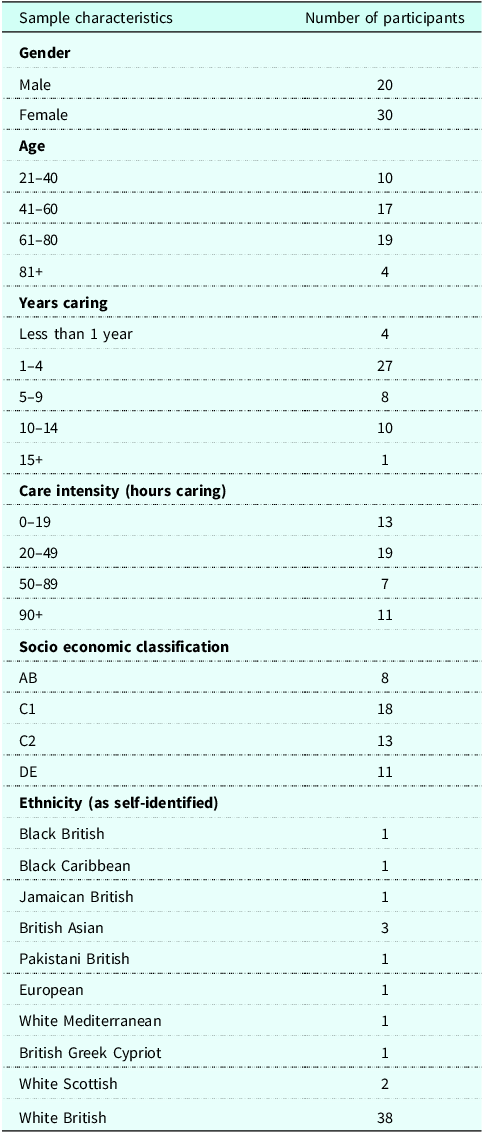
All participants provided regular support to a relative or friend who needed help on a day-to-day basis because of a (long-term) health condition, disability or needs related to older age. Purposive sampling was used to recruit a diverse range of participants in terms of age, gender, years caring, caring intensity, ethnicity and socioeconomic classification (defined by occupation, household income and education level), to explore and better understand the financial implications of providing unpaid care at different ages/life stages (Levinson, Reference Levinson1986; McKerlie, Reference McKerlie2013) and how these are experienced unequally by different groups (i.e. the socioeconomic determinants of caring) (Burchardt, Reference Burchardt2025a; Verbakel et al., Reference Verbakel, Tamlagsrønning, Winstone, Fjær and Eikemo2017). The sample was geographically dispersed, with forty-five participants from across England and Wales and five from Scotland. Participants were recruited with the support of a professional recruitment agency that used our detailed screener containing the relevant quotas and inclusion and exclusion criteria to achieve our maximum variation sample. Table 1 summarises the sample characteristics.
Sample characteristics

Table 1. Long description
A table summarizing the characteristics of participants providing regular support to relatives or friends with health conditions, disabilities, or age-related needs. The table has 12 rows and 2 columns. The columns are labeled Sample characteristics and Number of participants. The rows are grouped under different categories: Gender, Age, Years caring, Care intensity, Socioeconomic classification, and Ethnicity. Row 1: Gender, Male, 20. Row 2: Gender, Female, 30. Row 3: Age, 21-40, 10. Row 4: Age, 41-60, 17. Row 5: Age, 61-80, 19. Row 6: Age, 81+, 4. Row 7: Years caring, Less than 1 year, 4. Row 8: Years caring, 1-4, 27. Row 9: Years caring, 5-9, 8. Row 10: Years caring, 10-14, 10. Row 11: Years caring, 15+, 1. Row 12: Care intensity, 0-19 hours, 13. Row 13: Care intensity, 20-49 hours, 19. Row 14: Care intensity, 50-89 hours, 7. Row 15: Care intensity, 90+ hours, 11. Row 16: Socioeconomic classification, AB, 8. Row 17: Socioeconomic classification, C1, 18. Row 18: Socioeconomic classification, C2, 13. Row 19: Socioeconomic classification, DE, 11. Row 20: Ethnicity, Black British, 1. Row 21: Ethnicity, Black Caribbean, 1. Row 22: Ethnicity, Jamaican British, 1. Row 23: Ethnicity, British Asian, 3. Row 24: Ethnicity, Pakistani British, 1. Row 25: Ethnicity, European, 1. Row 26: Ethnicity, White Mediterranean, 1. Row 27: Ethnicity, British Greek Cypriot, 1. Row 28: Ethnicity, White Scottish, 2. Row 29: Ethnicity, White British, 38.
Interviews ranged in duration from 35 to 70 minutes (50 minutes on average) and, with participants’ prior permission, were digitally recorded and transcribed. Identifying information was removed, and participants were assigned pseudonyms. The data were rigorously and systematically analysed using the Framework thematic analysis method outlined by Ritchie and Lewis (Reference Ritchie and Lewis2003, Reference Ritchie and Lewis2014). We independently noted initial codes and themes across the data set, then discussed, debated and refined them to ensure intercoder reliability (O’Connor & Joffe, Reference O’Connor and Joffe2020). This process of discussing discrepancies to understand different interpretations was crucial to enabling consistency and reducing bias in our team-based analysis, but it also enhanced the overall quality and depth of our analytic discussion prior to collating the themes and subthemes in the coding index. We then conducted the third, indexing stage of framework analysis, dividing the transcripts between us and coding each section with the agreed-upon themes and subthemes generated in the previous step. We ordered and grouped the coded data by developing multiple thematic matrices where each row represented an interviewee and each column contained data extracts relating to the themes and subthemes. This enabled us to unpack and interrogate the nature of each theme in-depth and explore the range and diversity of responses across cases. We further classified the ordered data to help us understand and explain the influences on unpaid carers’ FWB over time. It was during this stage of developing descriptive and explanatory accounts (Ritchie & Lewis, Reference Ritchie and Lewis2003, Reference Ritchie and Lewis2014) that we applied, and subsequently adapted, Salignac et al.’s (Reference Salignac, Hamilton, Noone, Marjolin and Muir2020) ecological approach to FWB to enable us to make sense of the relationality between the individual caring experience, family circumstances, work contexts and broader welfare/care systems.
Findings – care-related risks to FWB
In this section, we present new qualitative evidence to understand how and why unpaid caregiving shapes FWB. Our analysis identifies multiple, often intersecting, care-related risks to FWB arising from the interaction of factors operating at individual (e.g. financial resources, personal circumstances and beliefs), familial (e.g. care roles, household income and family norms) and societal levels (e.g. care policies and systems, workplace policies/practices and access to welfare benefits and services), and demonstrates how these risks unfold unevenly across the life course. Synthesising these findings, we develop the multidimensional model of unpaid carers’ FWB presented in Figure 1, which offers a new conceptual framework for understanding how financial risks and protective factors are structured, experienced and accumulated for carers in different circumstances and at different life stages.
Multi-dimensional model of unpaid carers FWB.

Everyday expenses and other essentials
Everyday or out-of-pocket expenses have been identified as a key element of the financial implications of unpaid care (Keating et al., Reference Keating, Fast, Lero, Lucas and Eales2014; Shooshtari et al., Reference Shooshtari, Duncan, Roger, Fast and Han2017), but our results suggests that the nature and extent of these costs, as well as the strategies deployed for meeting them, varies according to the needs of the care recipient and the existing financial circumstances of carers and care recipients.
Tom and Izzy’s experiences are illustrative of the additional personal finance pressures for young adult carers and how they serve to exacerbate the more widespread unique savings challenges facing this generation due to high living and housing costs, student debt, irregular work patterns and other structural disadvantages (Okello, Reference Okello2025). They are also indicative of the unequal incidence of becoming a carer (Burchardt, Reference Burchardt2025a) since Tom’s parents and Izzy’s grandma had their own health conditions to contend with. Living in low-middle income households, the wider family could neither afford to pay for care nor act as primary carers.
Tom was 21 years old at the time of the interview and worked from home. His grandma had multiple physical and mental health conditions, so he visited her every day to help with shopping, travel to medical appointments and gardening. Tom described how paying for the ‘extras’ that came with caring for his grandma varied, but, along with his other expenses (including £850 per month in rent and food and energy bills going up), they reduced his ability to save:
Petrol’s a big one [expense], obviously … So, if I’m nipping out to the shops, driving up to the shops, the petrol going there and back if I’m getting anything to do with gardening when I’m over, she might need something as small as milk or washing-up liquid, I’ll just go out and get it. But that could be anything from £5 to £20 a week… (Tom, 21, caring for his grandma, 0-19hrs, C1)
Izzy also worked mostly from home, and while this ‘allowed’ her the flexibility to travel to a different city by bus every week to look after her grandad living with dementia, it incurred additional costs that she could ill afford. Despite concerted efforts to carefully plan her finances and stick to a strict weekly spending budget, Izzy had no opportunities to save and sometimes had to resort to using buy-now,-pay-later products to pay for groceries. When asked if she was able to save any of her income, she said:
…maybe a week before the end of the month, there’s nothing left. I would like to save but living by myself, getting to [city] all the time [to care for her Grandad], there’s not a penny left … Sometimes nearing the end of the month, I might have to use Klarna because you can use that on Deliveroo to get some food shopping. (Izzy, 22, caring for her grandad, 20–49 hrs, C1)
For many of the participants in the study, the impact of these costs was exacerbated by increases in the cost of living (Hick & Collins, Reference Hick and Collins2024), and frequent references were made to the additional challenge of trying to make ends meet with ‘costs soaring’. While this affected levels of disposable income for many, for others, like Shaun, it also led to problem debt. Missing out on overtime opportunities to look after his dad and the added expenses related to his son’s health condition meant that even before the cost-of-living crisis, Shaun said he had no choice but to take out pay day loans to keep his head above water:
You pay the £150 off, and they [doorstep lenders] say, “do you want £200? You’re eligible for another one now”. And obviously you’d say “Oh, go on then”. Then you’d have to go a few months of paying whatever £20 a week when they come every Friday or whatever. And once you’ve nearly paid that off, they’d say “do you want £300?” It’s like a vicious circle. (Shaun, 49, caring for his son and dad, 0–19 hrs, DE)
The many and varied care-related expenses that participants had to meet made things more difficult for those living on low incomes and led to (further) reduced financial freedom, limited savings opportunities and increased reliance on unaffordable credit and the accumulation of problem debt. For others, the additional expenses were easier to meet due to their relatively privileged financial position. These participants were typically older, owned their homes outright and were able to pay for the extra costs and larger outlays like bathroom adaptations using existing income and savings. Although this meant depleting resources (in the region of thousands of pounds for some), the money was nevertheless available to meet caring-related expenses. This stands in stark contrast to the younger adult carers and those on low incomes who were less able to accumulate savings, absorb additional costs and were consequently more vulnerable to current and future financial insecurity.
Impact on paid work (income, savings and investments)
Quantitative evidence has established a wage penalty for unpaid carers (Petrillo et al., Reference Petrillo, Ibarra, Rahal, Zhang, Pryce and Bennett2024b; Raiber et al., Reference Raiber, Visser and Verbakel2022), but our research sheds new light on how and why unpaid care impacts paid work and individuals’ related income, savings and investment opportunities.
One of the most significant influences stemmed from the demands and challenges of providing unpaid care with limited formal or informal support, which often left participants struggling to maintain or combine care and full-time work. The knock-on effects for pay and career progression were significant for many, but those working in roles with very limited flexibility proved particularly problematic. Participants in these circumstances often felt the need to change jobs, usually to ones with poorer pay but greater flexibility. Kaye, for instance, was working as a teacher at the time of the interview and was the sole carer for her mum. She had already reduced her working week to four days but still felt unable to manage the competing demands because of the nature of her work:
…it’s just not very flexible with my care commitments. You know, you have to be in at 8:00 and you can’t leave before 4:30. Otherwise it’s frowned upon … With the current situation I’m looking at maybe changing my job… (Kaye, 48, caring for her mum, 20–49 hrs, C1)
Similarly, Anna had reduced her hours but still couldn’t manage, so she left her bar job. She described how her son’s autism made it difficult for him to cope with her changing shift pattern: ‘Sometimes, you finish at 11:00, sometimes you might finish at midnight, and it’s just not practical, having different people at your house, putting the kids to bed, just doesn’t work’ (Anna, 29, caring for her son, 90+ hrs, C2).
When people reduce their hours or leave their paid jobs altogether to provide care (Raiber et al., Reference Raiber, Visser and Verbakel2024), they may be unaware of the extent to which this can affect their lifetime earnings and retirement security. Women are disproportionately affected because they are more likely to do this (ONS, 2019; Petrillo et al., Reference Petrillo, Bennett and Pryce2022), but they are also more likely to care earlier in life than men (on average by age 46 – 11 years earlier) (Zhang et al., Reference Zhang, Bennett and Yeandle2019). These prolonged or premature breaks in employment reduce women’s overall earning potential and ultimately their pension savings (DWP, 2023).
While participants like Kaye and Anna did not explicitly consider the immediate or long-term financial impact of their care and work ‘decisions’, others, like Emily, reflected on earlier circumstances and experiences in their lives when they had left paid employment to look after young children and were now concerned about the impact of subsequent and multiple episodes of caring (Keating et al., Reference Keating, Eales, Funk, Fast and Min2019) on their retirement provisions. Emily’s unpaid care experiences also illustrate the cumulative costs that are disproportionately borne by women (Fast et al., Reference Fast, Keating, Eales, Kim and Lee2021; Gomez-Leon et al., Reference Gomez-Leon, Evandrou, Falkingham and Vlachantoni2019) as they transition into and out of caring roles (Petrillo et al., Reference Petrillo, Bennett and Pryce2022):
…by the time I retire, I’ll have probably done 40 years of service, but I will probably have only had 25 reckonable service, which, yeah, it’s gonna have a massive impact on the pension that I can draw, but back then it wasn’t even a consideration. (Emily, 54, caring for her mum, 0–19 hrs, AB)
In contrast, most older men in this study had enjoyed uninterrupted work histories, but many of them felt that the current and future financial consequences of their caring were significant, nonetheless. For example, Robert cared for his mum and dad and had initially reduced his hours at work. As his dad’s Alzheimer’s progressed and his mum could no longer cope alone, Robert had to leave his job altogether to provide full-time care. Their reduced household income remained sufficient for meeting day-to-day costs (supported by his wife’s salary and being mortgage-free), but Robert was concerned about not being able to save for the future:
I used to put money away every month for saving and I’ve not done that for years. And obviously, we’ve dipped into the savings a couple of times, for different things, so they have kind of dwindled. I’m nearly 50, retirement’s not that far away … I think it [caring] will definitely have a negative effect on it. (Robert, 49, caring for his mum and dad, 50–89 hrs, C2)
Michael, aged 59, was similarly concerned about the impact of caring on his retirement security after struggling to run his own business alongside looking after his parents. Michael explained that the ‘inevitable’ knock-on effects of the constant juggling included missing important client meetings, late-night working to make up for lost time during the day and losing business as a result.
Michael’s experience also underscores the limits of self-employment as a solution to successfully combining work and care due to its (perceived) flexibility (Lim, Reference Lim2019; Raiber et al., Reference Raiber, Visser and Verbakel2022). The intensity of Michael’s caring responsibilities, coupled with the nature of his self-employment, meant that caring created acute financial strain. And while losing a business may seem like the ultimate price to pay, providing unpaid care presented risks to (self) employment and associated income generation for many of the participants in our study, to a greater or lesser extent. Those with ‘supportive’ line managers or jobs that lent themselves more favourably to remote working were better placed to combine paid work and care, but even in these instances, caring responsibilities continued to impact paid work in more indirect ways.
Caring intensity (the number of hours of providing care) has been found to correlate positively with unemployment and low labour market participation – i.e. the more hours someone cares, the more likely they are to be unemployed (Petrillo et al., Reference Petrillo, Bennett and Pryce2022; Vlachantoni et al., Reference Vlachantoni, Evandrou, Falkingham and Gomez-Leon2020). But these statistics fail to capture the impact of a ‘sense of being on call’, which our study revealed, and how this can also limit labour market participation and career progression: ‘I have to be a bit more cautious of what I do agree to [in terms of work commitments] in case of an emergency, in case anything happened or whatever’ (Izzy).
Other young adult carers in the study felt that their potential career progression was impacted by their caring roles. Ahmed, age 37, and Tom, aged 21, were both caring for close relatives. Ahmed enjoyed relatively flexible working arrangements and commented that he had an ‘understanding’ line manager, but he nevertheless decided to postpone a promotion application because he was concerned about how he would manage his caring responsibilities with additional responsibility at work. Tom was also keen to gain a professional qualification in engineering to increase his salary, but he worried that the additional reading and course work around his day job and looking after his grandma were ‘unsustainable’.
Although this study focused on the FWB impact of caring, most working-age carers also discussed the effects of trying to juggle care and work on their health and wellbeing. Alongside some of the positive effects of caring, such as the opportunity to nurture strong bonds between the carer and cared-for person, participants often talked about the physical and mental strain of being ‘utterly exhausted’, not having enough time or money to take part in social activities, and feelings of anxiety and stress that had resulted in sick leave from paid work and even resignation. For many participants, the double burden of combining care and work had depleting consequences for both financial and general wellbeing. Reducing hours, switching to lower-paid, part-time and insecure work or leaving the labour market altogether had a detrimental impact on their current and future finances, but our findings also reveal the more indirect impact of needing to be available or ‘on call’ and the resultant opportunity costs – i.e. what carers have to give up in terms of career progression and pay. These experiences highlight the necessity for a more systemic approach to protecting working carers and enabling them to combine their multiple roles more effectively.
Access to services and welfare benefits
Barriers to accessing care services and support
A small number of participants were accessing supplementary support from social care services to help them manage the intensity of their caring roles, but the large majority were either providing care alone or receiving some help from other family members. Research suggests that good quality ‘replacement care’ can support the unpaid carer’s employment (Milne et al., Reference Milne, Brigden, Palmer and Konta2013; Pickard et al., Reference Pickard, Brimblecombe, King and Knapp2018) and that an improvement in the quality and extent of social care is critical to improving carers’ lives (Fenney et al., Reference Fenney, Thorstensen-Woll and Bottery2023). But when we asked participants how the decisions and care arrangements were made and whether any (paid for) alternatives such as home care services, respite, assisted living or other residential options were considered, many reported being unable to consider these options due to the prohibitive cost and/or unavailability of services: ‘It’s just too much to pay home help to come in. So that’s why I just do it all myself’ (Claire, 46, caring for her Mum, 20–49hrs, DE).
Participants also talked about reduced, or non-existent, day care services that they expected to be available through local councils or community groups. These can offer much-needed respite and support to carers (Gitlin et al., Reference Gitlin, Roth, Marx, Parker, Koeuth, Dabelko-Schoeny, Anderson and Gaugler2024; Tretteteig et al., Reference Tretteteig, Vatne and Rokstad2016), but austerity measures in the UK since the 2010 financial crisis have seen funding and provision of these publicly funded services reduced (Deusdad et al., Reference Deusdad, Pace and Anttonen2016; Glasby et al., Reference Glasby, Zhang, Bennett and Hall2021) and an increasing reliance on family care.
Parents who were providing ‘extra care’ (Roberts & Lawton, Reference Roberts and Lawton2001) to children with special educational needs and/or disabilities explained that accessing appropriate care services was very difficult. Luna was a single parent of four children; one had severe autism and learning difficulties. Having left the labour market to care for her children some years ago, she anticipated returning to paid employment, but her son’s needs and insufficient care services made this extremely difficult: ‘…the plan was always once the kids are old enough, was for me to go into the workforce, but now I just don’t see how that can happen because there’s no kind of wrap around care services’ (Luna, 40, caring for her son, 90+ hrs, DE).
Cost and availability were not the only barriers to accessing care services, however. Many participants talked about having ‘peace of mind’ and ‘comfort’ in providing care themselves and having developed a ‘kind of trust’ that could not be replaced by paid carers. This motivated them to be sole carers, even when it had a detrimental impact on their financial, relational and subjective wellbeing (Keating et al., Reference Keating, McGregor and Yeandle2021). While Luna struggled to access wrap-around care services for her son, she acknowledged that she found it difficult to trust others to meet her son’s needs effectively:
…I can’t provide for him by working because I can’t have anybody else look after him. The thing is, he self-injures when he’s distressed, and I couldn’t ever leave him with someone knowing that he can’t make himself understood, knowing that he could be injuring himself and other people. The stakes are too high.
Interestingly, and worryingly, perhaps, participants who worked in or close to the care sector were particularly reluctant to relinquish the care of their family members to paid care services:
I can’t really trust the carers… When I got here [to the UK], I was working in a college, … we were running different health and social care courses. And sometimes the students who were going to work in the care homes, I was not getting all the time positive news and sometimes the care homes were getting in touch with us, as they were not happy with the students… So, it’s, you know, the peace of mind in providing the care. You can’t compare it with anything else. (Ahmed, 37, caring for his father-in-law, 20–49 hrs, C1)
This dynamic in the caring relationship was observed in many other participants’ accounts of how and why they came to be the person providing care. It was often further complicated by, or layered with, a sense of duty, doing the right thing by family and/or reciprocating the care they had previously received. Pam, who had retired early to care for her mum (now claiming Carers Allowance and income support), explained:
I wouldn’t like Mum to go into a home, so that was in the back of my mind as well… So, to be honest, I wasn’t even thinking about the financial aspect or whatever, I was just thinking, straight away, I’m going to look after Mum because she’s looked after me. (Pam, 55, caring for her Mum, 90+ hrs, DE)
These care decisions, however, were often accompanied by ambivalence and such mixed feelings caused increased stress and anxiety for some of the participants in our study:
At first, I was all guns blazing that I would be there no matter what… After a few months realising how hard it was, emotionally draining it was and how much I missed my own life … it was like I realised how much of myself I’d really have to give up, to commit to doing that full time … then I felt really torn because I feel like I owe my grandparents to have somebody who is there to look after them, who knows them, who I can have confidence is going to do it to the best of their ability, because we all… I work in the care sector, and we know what can happen… (Izzy)
These findings are consistent with other studies suggesting that family care is often considered as the ideal (Brear et al., Reference Brear, Manderson, Nkovana and Harling2024; Kadi et al., Reference Kadi, Rodrigues, Kahlert, Hofmann and Bauer2024), with the status of care work seen as non-professional (Burns et al., Reference Burns, Hamblin, Fisher and Goodlad2023) and low levels of satisfaction with the quality of social care (Brimblecombe et al., Reference Brimblecombe, Pickard, King and Knapp2018; Taylor et al., Reference Taylor, Lobont, Dayan, Merry, Jefferies and Wellings2025). Our analysis emphasises the importance of trusting relationships in caregiving, while also raising questions about family members feeling obligated to care even when care services could help them to remain in employment (Pickard et al., Reference Pickard, King, Brimblecombe and Knapp2015) and protect their FWB.
Barriers to accessing benefits
Participants also reported on the difficulty of accessing means and needs tested welfare benefits. Among those in receipt of such benefits, there was consensus that the level of support was inadequate and not fit for purpose: ‘There are costs to being a carer, and there are costs to having disabled relatives that other people don’t have to incur, and it’s not even anywhere near minimum wage. It’s £270 a month, and that’s just, it’s just not enough’ (Luna).
While the material inadequacy did little to support participants’ FWB, it was also perceived as devaluing the essential nature of their care work, with negative consequences for their wider wellbeing:
You do feel isolated and undervalued. I think I worked out once that, you know there is a requirement for Carers Allowance that you do 35 hours a week caring, obviously I do a lot more than that, but I’m sure I worked it out with something like £1.89 an hour they give you. So, you’re like well, that’s slave wages. (Robert)
When claiming benefits, interactions with the Department for Work and Pensions (DWP) were frequently experienced as negative and characterised by mutual distrust. Participants reported feeling treated as potential fraudsters, having to fight for entitlements through a laborious process, compounded by extensive administrative demands and the need to repeatedly provide the same information to multiple agencies.
Mandatory reconsideration appeals were also a source of stress for some. Cam recalled the impact of appealing a DWP decision: ‘…we ended up at a tribunal, which was just so much stress for my mum; I was at uni. It was so stressful. I don’t think I’ve ever been that stressed in my life’ (Cam, 32, caring for his mum, C1).
Alongside the burdensome and distressing benefits application and appeals process (Roberts et al., Reference Roberts, Stuart, Allan and Gumley2024), our discussions revealed that inflexible systems and rigid rules discourage some carers from accessing essential financial support. Monisa’s mother-in-law was living with disability and required more than 40 hours of care per week. With three children and a household income of around £20,000, Carers Allowance could have eased some of the financial pressures:
…if I’m claiming Carers Allowance then it affects my tax credits as well, so… And obviously, they take money off her, don’t they, to give me the Carers [Allowance]? That’s another thing. So sometimes you think it’s probably not worth doing that. (Monisa, 39, caring for her mother-in-law, 20–49hrs, C2)
While Monisa was correct that claiming Carers Allowance can reduce care recipients’ benefits (such as Severe Disability Premium), her confusion around the overlapping benefits rules illustrates the complexity of the system that claimants must navigate. This lack of clarity and understanding about Carers Allowance and other benefits was common among participants, with many unable to access appropriate welfare advice, guidance and information.
Discussion
This study provides new insight into an issue of increasing international salience: the FWB of unpaid carers. It extends our empirical understanding of how care-related financial disadvantage accumulates unevenly over time and advances our conceptual thinking about FWB in a care context by revealing the dynamic interplay between individual circumstances and resources, family situations, labour markets and welfare systems. Our findings demonstrate that caring generates multiple, overlapping risks to current and future FWB, requiring a reframing of policy debates away from the systematic individualisation of care costs towards dynamic approaches that reduce the private burden and acknowledge life course challenges and opportunities.
Participants incurred additional expenses, challenges combining care and paid work (with implications for income, savings and investments), barriers to accessing benefits and services and negative effects on wider wellbeing. While the nature and extent of these impacts varied according to individual circumstances (including age/ life stage), familial influences such as income and wealth, care expectations and norms and broader structural inequalities, they consistently affected the multiple dimensions of FWB including income, savings and debt, meeting expenses, financial control, security, stress and peace of mind (CFPB, 2015; Riitsalu et al., Reference Riitsalu, Atkinson and Pello2023, Reference Riitsalu, Atkinson and Pello2025; Salignac et al., Reference Salignac, Hamilton, Noone, Marjolin and Muir2020).
The life course accumulation of assets such as housing equity, savings and pension wealth meant that some older carers in the study were more financially resilient to the economic impact of caring, while young adult carers were much less able to absorb the increased costs. This affected their sense of financial freedom and choice in the short term, as well as compromising their financial futures. For those already facing financial insecurity, the role of care-related cumulative disadvantage posed an even greater risk to FWB (Kendig & Nazroo, Reference Kendig and Nazroo2016), while the cumulative costs of caring were particularly felt by participants who had been caring for many years. This impact was most acute at or near retirement, when mid life carers experienced stress and anxiety over inadequate pension savings they felt unable to remedy. Applying a life course approach revealed not only these cumulative effects (beyond a snapshot of carers’ experiences), but also that carers rarely considered long-term financial consequences when making care and work ‘decisions’. This has important implications for how the concept of FWB itself should be understood in care contexts: not as a stable state, but as a dynamic and accumulating condition shaped by the timing, duration and intensity of care across the life course. Our findings thus extend Salignac et al.’s (Reference Salignac, Hamilton, Noone, Marjolin and Muir2020) ecological framework by demonstrating that its temporal dimension, hitherto underspecified, is central to understanding carer FWB.
More broadly, the findings highlight the individualisation of responsibility and risk for income and care needs in Britain, and the limited provision of state support relative to some other European countries (e.g. Norway, Germany). However, given substantial international variation in the nature and extent of caregiver support, the study raises questions about the unequal impact of care-related costs both within Britain and in contexts with even greater reliance on unpaid care and weaker social protection, where FWB risks are likely to be much greater. The ecological life course conceptualisation developed here provides a transferable analytical lens for examining these questions across different welfare settings.
Moreover, as caring responsibilities and the capacity to manage the financial consequences are unevenly distributed, policy responses must recognise carers’ unequal starting points. Younger carers would benefit from early saving support, affordable and secure housing and low-cost travel, while mid- and later-life carers need clear pension information and protection from the long-term financial effects of care-related work interruptions. Improved workplace pension communication, income-averaging arrangements that do not penalise caregiving breaks and extended paid leave at the onset of caring would allow carers time to consider longer-term implications rather than making rapid decisions under crisis conditions (often involving immediate income loss).
The limited compensation available through UK carers’ leave, particularly compared with more generous schemes elsewhere (e.g. France) (COFACE, 2022; Rocard & Llena-Nozal, Reference Rocard and Llena-Nozal2022), restricts carers’ ability to weigh alternatives and has lasting implications for FWB. Even where alternatives were explored, high costs, limited availability and low trust in formal care services constrained participants’ choice and undermined their FWB.
For those who chose or felt compelled to provide care, the inadequacy and complexity of care-related benefits further undermined FWB. Carer’s Allowance remains one of the least generous working-age benefits in the UK, with strict eligibility and overlapping benefit rules excluding many carers. Payments neither replace lost income nor adequately meet care-related costs (Morgan & Zechner, Reference Morgan and Zechner2022), while earnings limits add further obstacles for those who qualify. Raising earnings thresholds or allowing partial payments when care is shared (as is the case in Australia)Footnote 2 would better support household incomes during intensive caring periods.
Participants also reported high levels of stress and distrust associated with benefit assessments and tribunals, highlighting how system design itself can damage FWB. More generous, navigable and supportive benefit systems are needed, including streamlined assessments and locally coordinated advice to reduce administrative and emotional burdens. Finally, insufficient job flexibility forced many carers into lower-paid work or out of employment entirely. Policies such as tailored flexible working rights, paid carers’ leave and support for remaining in well-paid employment are essential to improving carers’ financial and wider wellbeing.
Focussing primarily on improving labour market participation offers an incomplete solution, however, because the drivers of care-related risks to FWB extend beyond employment barriers and reflect wider structural disadvantages. Carer FWB should also be considered within a framework that incorporates caregiving as a social good fulfilling an important social and economic function. The multidimensional model of unpaid carers’ FWB developed in this paper, integrating individual, familial and societal factors across the life course, provides a basis for designing and evaluating such approaches.
Conclusion
Unpaid care is one of the defining social policy challenges of our time, yet its consequences for carers’ long-term FWB have been poorly understood. This paper addresses that gap through rigorous qualitative research with fifty carers in Britain and the first application of an ecological life course approach to FWB in a care context. Our findings demonstrate that the financial costs of caring are not discrete events but cumulative, dynamic and patterned by life stage; with risks shaped by the interaction of individual resources and circumstances, family situations and work, welfare and care systems. In extending both the empirical evidence base and the conceptual tools available to researchers and policymakers, the paper makes a case for a fundamental reorientation in how carer support is conceived: away from residual, siloed responses and towards holistic, systemic, life stage-sensitive interventions (Brown et al., Reference Brown, Noone and Salignac2024; Clark et al., Reference Clark, Davies, Owen and Williams2024) that recognise unpaid care as a vital foundation of health and social care systems, and protect those who provide it from long-term financial disadvantage. As demand for unpaid care continues to grow internationally, this evidence underscores the importance of developing context-sensitive policies that share the costs of caring more fairly across individuals, families and states.
Funding statement
The authors gratefully acknowledge the support of the Economic and Social Research Council (ESRC; award reference ES/W002302/1). The Centre for Care is funded by the ESRC with contributions from the Department of Health and Social Care’s National Institute for Health and Care Research (NIHR) and partner universities. The views expressed are those of the authors and are not necessarily those of the ESRC, UK Research and Innovation (UKRI), National Health Service (NHS) or NIHR. The ESRC played no role in the design, execution, analysis of data or writing of this article.
Competing interests
The authors declare no competing interests.


 Open access

