

1. Introduction
In a series of papers [
Reference Szabó37
,
Reference Szabó39
,
Reference Szabó40
], Szabó introduced and in the process, systematised, strongly self-absorption of dynamical systems for actions of locally compact, Hausdorff groups. Motivated by the work of [
Reference Hirshberg, Rørdam and Winter19
] on strongly self-absorption of upper semi-continuous fields of $C^*$
-algebras, the second author and Gardella were naturally led in [
Reference Forough and Gardella13
] to extend Szabó’s framework to Rieffel’s upper semi-continuous fields of actions, see [
Reference Rieffel35
, Definition 3·1]. The second author and Gardella had the need for and proved, together with Thomsen, the following (special case of the) lifting theorem in [
Reference Forough, Gardella and Thomsen14
], which is also the main technical tool in [
Reference Forough and Gardella13
].
$C^*$
-algebras, the second author and Gardella were naturally led in [
Reference Forough and Gardella13
] to extend Szabó’s framework to Rieffel’s upper semi-continuous fields of actions, see [
Reference Rieffel35
, Definition 3·1]. The second author and Gardella had the need for and proved, together with Thomsen, the following (special case of the) lifting theorem in [
Reference Forough, Gardella and Thomsen14
], which is also the main technical tool in [
Reference Forough and Gardella13
].
Theorem 1·1 ([
Reference Forough, Gardella and Thomsen14
, Theorem 3·4]). Let G be a locally compact, Hausdorff, second countable group and $(A,\alpha)$
be a separable, nuclear, G-
$(A,\alpha)$
be a separable, nuclear, G- $C^*$
-algebra. Let
$C^*$
-algebra. Let
 \begin{align*}0 \rightarrow (I,\gamma) \rightarrow (B,\beta) \xrightarrow{p} (D,\delta) \rightarrow 0\end{align*}
be a G- $C^*$
-extension, with B separable. Let
$C^*$
-extension, with B separable. Let $\psi \,:\, A \rightarrow D$
be a G-equivariant, completely positive and contractive map. Then there exists a sequence of completely positive and contractive maps
$\psi \,:\, A \rightarrow D$
be a G-equivariant, completely positive and contractive map. Then there exists a sequence of completely positive and contractive maps $\varphi_n\,:\, A \rightarrow B$
,
$\varphi_n\,:\, A \rightarrow B$
, $n \in \mathbb{N}$
, such that
$n \in \mathbb{N}$
, such that $p \circ \varphi_n=\psi$
and
$p \circ \varphi_n=\psi$
and
 \begin{equation*}\lim_{n \rightarrow \infty} \sup_{g \in K} \left\lVert \beta_g (\varphi_n(a))-\varphi_n(\alpha_g(a)) \right\rVert=0,\end{equation*}
for all $a \in A$
and for all compact subsets
$a \in A$
and for all compact subsets $K \subseteq G$
.
$K \subseteq G$
.
It is well known by now that Arveson, in his work [
Reference Arveson2
], used previous lifting theorems of Vesterstrøm, Anderson and Ando, to prove that the Brown–Douglas–Fillmore group $\mathrm{Ext}(X)$
for a compact metric space X ([
Reference Brown, Douglas and Fillmore9
]), is indeed a group. Soon afterwards, Choi-Effros in their remarkable paper [
Reference Choi and Effros10
] generalised all the previously known lifting theorems for completely positive (and contractive) maps. Within a year, Arveson, in his seminal paper [
Reference Arveson3
], introduced the ubiquitous quasi-central approximate units and used it firstly, to simplify Choi and Effros’ proof of their lifting theorem and secondly, to show that the Brown–Douglas–Fillmore group
$\mathrm{Ext}(X)$
for a compact metric space X ([
Reference Brown, Douglas and Fillmore9
]), is indeed a group. Soon afterwards, Choi-Effros in their remarkable paper [
Reference Choi and Effros10
] generalised all the previously known lifting theorems for completely positive (and contractive) maps. Within a year, Arveson, in his seminal paper [
Reference Arveson3
], introduced the ubiquitous quasi-central approximate units and used it firstly, to simplify Choi and Effros’ proof of their lifting theorem and secondly, to show that the Brown–Douglas–Fillmore group $\mathrm{Ext}(A)$
for a separable, nuclear
$\mathrm{Ext}(A)$
for a separable, nuclear $C^*$
-algebra A is again indeed a group, which was previously shown to be a semigroup by Voiculescu. Using similar ideas, Kasparov in [
Reference Kasparov20
] showed that
$C^*$
-algebra A is again indeed a group, which was previously shown to be a semigroup by Voiculescu. Using similar ideas, Kasparov in [
Reference Kasparov20
] showed that $\mathrm{Ext}(A,B)$
for a separable, nuclear
$\mathrm{Ext}(A,B)$
for a separable, nuclear $C^*$
-algebra A and a stable,
$C^*$
-algebra A and a stable, $\sigma$
-unital
$\sigma$
-unital $C^*$
-algebra B is a group too. By now, the Choi-Effros lifting theorem is a standard, important technical tool, which also plays a crucial role in the recent breakthrough [
Reference Tikuisis, White and Winter42
]. It may also be perceived as a noncommutative analogue of the Michael’s selection theorem [
Reference Michael28
]; see, for instance [
Reference Kirchberg23
,
Reference Gabe15
].
$C^*$
-algebra B is a group too. By now, the Choi-Effros lifting theorem is a standard, important technical tool, which also plays a crucial role in the recent breakthrough [
Reference Tikuisis, White and Winter42
]. It may also be perceived as a noncommutative analogue of the Michael’s selection theorem [
Reference Michael28
]; see, for instance [
Reference Kirchberg23
,
Reference Gabe15
].
Although, the framework in [
Reference Forough and Gardella13
] is general enough to include most of the cases of interest, it is, however, in many ways natural to let the group act on the base of the field of $C^*$
-algebras, i.e., to consider G-
$C^*$
-algebras, i.e., to consider G- $C_0(X)$
-algebras in Kasparov’s sense, [
Reference Kasparov21
, Definition 1·5]. As a first step towards this direction, one would need to establish Theorem 1·1 for such algebras which does not follow automatically. The difficulty maybe perceived from the observation that Theorem 1·1 enables one to obtain only fiber-wise, quasi-invariant lifts; one then has to glue them in order to construct a global lift which is nearly impossible except for a few pathological cases. Another scenario, which is again natural, is to consider, roughly speaking, dynamical systems
$C_0(X)$
-algebras in Kasparov’s sense, [
Reference Kasparov21
, Definition 1·5]. As a first step towards this direction, one would need to establish Theorem 1·1 for such algebras which does not follow automatically. The difficulty maybe perceived from the observation that Theorem 1·1 enables one to obtain only fiber-wise, quasi-invariant lifts; one then has to glue them in order to construct a global lift which is nearly impossible except for a few pathological cases. Another scenario, which is again natural, is to consider, roughly speaking, dynamical systems $(A(x),G(x),\alpha(x))$
varying continuously on some parameter space X. The obstruction is similar; one only has fiber-wise, quasi-invariant lifts.
$(A(x),G(x),\alpha(x))$
varying continuously on some parameter space X. The obstruction is similar; one only has fiber-wise, quasi-invariant lifts.
Our approach is to take the more general vantage point of groupoids and along the way, include foliations into the framework. Introduced in operator algebras more than four decades ago by Connes, by now, there is a substantial literature on groupoids and their dynamical systems. The dynamical flavour of groupoids was investigated in [ Reference Renault34 ] probably for the first time and studied from the perspective of Kasparov’s bivariant theory in [ Reference Le Gall25 ]. The latter was then successfully employed in [ Reference Tu43 ] in the context of the Baum-Connes conjecture. We take the very first steps in this article of a systematic exploration of strongly self-absorption for groupoid dynamical systems, aiming towards generalisations of [ Reference Szabó38 , Reference Suzuki36 ] and the recent breakthrough papers [ Reference Gabe and Szabó17 , Reference Gabe and Szabó16 ]. Let us now state (a special case of) our main theorem, which is a vast generalisation of Theorem 1·1.
Theorem 1·2. Let G be a locally compact, Hausdorff, second countable groupoid. Let $(A,\alpha)$
be a separable,
$(A,\alpha)$
be a separable, $C_0(G^{(0)})$
-nuclear, G-
$C_0(G^{(0)})$
-nuclear, G- $C^*$
-algebra and let
$C^*$
-algebra and let
 \begin{align*}0 \rightarrow (I,\gamma) \rightarrow (B,\beta) \xrightarrow{p} (D,\delta) \rightarrow 0\end{align*}
be a G- $C^*$
-extension with B separable. Let
$C^*$
-extension with B separable. Let $\psi\,:\, A \rightarrow D$
be a G-equivariant,
$\psi\,:\, A \rightarrow D$
be a G-equivariant, $C_0(G^{(0)})$
-linear, completely positive and contractive map. Then there exists a sequence of
$C_0(G^{(0)})$
-linear, completely positive and contractive map. Then there exists a sequence of $C_0(G^{(0)})$
-linear, completely positive and contractive maps
$C_0(G^{(0)})$
-linear, completely positive and contractive maps $\varphi_n\,:\, A \rightarrow B$
,
$\varphi_n\,:\, A \rightarrow B$
, $n \in \mathbb{N}$
, such that
$n \in \mathbb{N}$
, such that $p \circ \varphi_n=\psi$
and
$p \circ \varphi_n=\psi$
and
 \begin{equation*}\lim_{n \rightarrow \infty} \sup_{g \in K} \left\lVert \beta_g ((\varphi_n)_{s(g)}(a(s(g))-(\varphi_n)_{r(g)}(\alpha_g(a(s(g)))) \right\rVert=0,\end{equation*}
for all $a \in A$
and for all compact subsets
$a \in A$
and for all compact subsets $K \subseteq G$
.
$K \subseteq G$
.
We refer the reader to the next section for the undefined terminology and end this introduction with a few words on the proof. Our approach is standard and is already taken in [
Reference Forough, Gardella and Thomsen14
] to prove Theorem 1·1. Roughly speaking, $C_0(G^{(0)})$
-nuclearity ensures the existence of a
$C_0(G^{(0)})$
-nuclearity ensures the existence of a $C_0(G^{(0)})$
-linear, completely positive and contractive lift. We then “average” this lift with respect to a quasi-invariant, quasi-central, approximate units. This is achieved by first considering the case when the codomain is a Calkin algebra and then using the Busby invariant to pass to the general case. However, there are few a technical points that are worth mentioning. Firstly, the existence of such an approximate units goes back to [
Reference Le Gall25
] and we modify his construction to suit our needs. Secondly, while considering the case when the codomain is a Calkin algebra, framing the right statement becomes cumbersome due to the fact that neither the multiplier nor the Calkin algebra is a
$C_0(G^{(0)})$
-linear, completely positive and contractive lift. We then “average” this lift with respect to a quasi-invariant, quasi-central, approximate units. This is achieved by first considering the case when the codomain is a Calkin algebra and then using the Busby invariant to pass to the general case. However, there are few a technical points that are worth mentioning. Firstly, the existence of such an approximate units goes back to [
Reference Le Gall25
] and we modify his construction to suit our needs. Secondly, while considering the case when the codomain is a Calkin algebra, framing the right statement becomes cumbersome due to the fact that neither the multiplier nor the Calkin algebra is a $C_0(G^{(0)})$
-algebra. After fleshing out the necessary technical details, one faces the problem of constructing the Busby invariant for groupoid actions. We overcome this but in a slightly less degree of generality than one might hope for. This is mainly due to the fact that the corresponding theory in the case of group actions relies heavily on the automatic continuity theorem of [
Reference Thomsen41
] and [
Reference Brown8
] which we lack. We conjecture, however, that this should continue to hold in our case as well. We note that Theorem 1·2 is similar to [
Reference Higson and Kasparov18
, Theorem 8·1]; however, the precise connection is yet to be examined. While preparing a first draft of this paper, we came to know about the paper [
Reference Gabe15
] which provides a generalisation of the Choi-Effros lifting theorem. We talk about this paper in relation to our results in the somewhat longer appendix.
$C_0(G^{(0)})$
-algebra. After fleshing out the necessary technical details, one faces the problem of constructing the Busby invariant for groupoid actions. We overcome this but in a slightly less degree of generality than one might hope for. This is mainly due to the fact that the corresponding theory in the case of group actions relies heavily on the automatic continuity theorem of [
Reference Thomsen41
] and [
Reference Brown8
] which we lack. We conjecture, however, that this should continue to hold in our case as well. We note that Theorem 1·2 is similar to [
Reference Higson and Kasparov18
, Theorem 8·1]; however, the precise connection is yet to be examined. While preparing a first draft of this paper, we came to know about the paper [
Reference Gabe15
] which provides a generalisation of the Choi-Effros lifting theorem. We talk about this paper in relation to our results in the somewhat longer appendix.
We end this introduction by briefly describing the organisation of this article. In Section 2, we gather the necessary background material on groupoids and their actions in a self-contained fashion, as much as possible. Section 3 fleshes out the technicalities of the Busby invariant for groupoid actions. In Section 4, we construct the averaging tool, namely, the quasi-invariant, quasi-central, approximate units. Section 5 contains the main results. As mentioned above, the somewhat longer Appendix A is dedicated to the clarification of one of our assumptions and on describing the precise relation of our results to [ Reference Gabe15 ].
Notations and conventions. The norm-closed linear span of a subset S of a Banach space is denoted by [S]. For a right Hilbert A-module E, $\mathcal{L}(E)$
denotes the
$\mathcal{L}(E)$
denotes the $C^*$
-algebra of adjointable operators on E. A
$C^*$
-algebra of adjointable operators on E. A $*$
-homomorphism
$*$
-homomorphism $\pi\,:\, A \rightarrow \mathcal{L}(E)$
is called nondegenerate if
$\pi\,:\, A \rightarrow \mathcal{L}(E)$
is called nondegenerate if $[\pi(A)E]=E$
.
$[\pi(A)E]=E$
.
2. Groupoids and their actions
In this section, we collect a few basic definitions concerning (locally compact, Hausdorff) groupoids and their actions. We will give precise references as we proceed but we will generally follow [
Reference Le Gall25
]. To fix notation, we recall that a groupoid is a small category in which each arrow is invertible. If G is a groupoid, we write $G^{(0)}$
for the set of objects;
$G^{(0)}$
for the set of objects; $G^{(2)}$
is the set of composable arrows; r and s are the range and source maps, respectively; u denotes the unit map from
$G^{(2)}$
is the set of composable arrows; r and s are the range and source maps, respectively; u denotes the unit map from $G^{(0)}$
to G. For more details, we refer to [
Reference Renault33
, Chapter 1]. In what follows, by a space we mean a locally compact, Hausdorff space and by a groupoid we mean a locally compact, Hausdorff groupoid.
$G^{(0)}$
to G. For more details, we refer to [
Reference Renault33
, Chapter 1]. In what follows, by a space we mean a locally compact, Hausdorff space and by a groupoid we mean a locally compact, Hausdorff groupoid.
Given a groupoid G, a space X and a continuous map $p\,:\, X \rightarrow G^{(0)}$
, we write, by a slight abuse of notation,
$p\,:\, X \rightarrow G^{(0)}$
, we write, by a slight abuse of notation, $s^{*}X$
for the pullback
$s^{*}X$
for the pullback $G^{\,\,s}{\times}{_{G^{(0)}}} X$
(borrowed from [
Reference Proietti and Yamashita31
]) of the diagram
$G^{\,\,s}{\times}{_{G^{(0)}}} X$
(borrowed from [
Reference Proietti and Yamashita31
]) of the diagram

i.e.,
 \begin{align*}s^{*}X =\{(g,x) \in G \times X \mid s(g)=p(x)\},\end{align*}
and equip it with the relative topology of $G \times X$
. Similarly, we shall write
$G \times X$
. Similarly, we shall write $r^{*}X$
for
$r^{*}X$
for $G ^{\,\,r}{\times}{_{G^{(0)}}} X$
.
$G ^{\,\,r}{\times}{_{G^{(0)}}} X$
.
Definition 2·1. Let G be a groupoid. A (left) G-space is a triple $(X,p,\alpha)$
where X is a space, p is a continuous map from X to
$(X,p,\alpha)$
where X is a space, p is a continuous map from X to $G^{(0)}$
, called the moment map, and
$G^{(0)}$
, called the moment map, and $\alpha$
is a continuous map from
$\alpha$
is a continuous map from $s^{*}X \rightarrow X$
,
$s^{*}X \rightarrow X$
, $\alpha(g,x)\,:\!=\,g \cdot x$
, satisfying the following conditions:
$\alpha(g,x)\,:\!=\,g \cdot x$
, satisfying the following conditions:
-
(i) for all $x \in X$
,
$u_{p(x)} \cdot x=x$
;
$x \in X$
,
$u_{p(x)} \cdot x=x$
; -
(ii) if
$(g,h) \in G^{(2)}$
and
$(h,x) \in s^{*}X$
then
$(g, h \cdot x)\in s^{*}X$
and
$(gh) \cdot x=g \cdot (h \cdot x)$
.


It follows that $p(g \cdot x)=r(g)$
, i.e.,
$p(g \cdot x)=r(g)$
, i.e., $(g,g \cdot x) \in r^{*}X$
. Thus one may view
$(g,g \cdot x) \in r^{*}X$
. Thus one may view $\alpha$
as a continuous map from
$\alpha$
as a continuous map from $s^{*}X \rightarrow r^{*}X$
. To define G-actions on
$s^{*}X \rightarrow r^{*}X$
. To define G-actions on $C^{*}$
-algebras, we need some preparation. Let X be a space.
$C^{*}$
-algebras, we need some preparation. Let X be a space.
Definition 2·2 ([
Reference Kasparov21
, Definition 1·5]). A $C_{0}(X)$
-algebra is a pair
$C_{0}(X)$
-algebra is a pair $(A,\theta_{A})$
consisting of a
$(A,\theta_{A})$
consisting of a $C^{*}$
-algebra A and a nondegenerate
$C^{*}$
-algebra A and a nondegenerate $*$
-homomorphism
$*$
-homomorphism $\theta_{A} :C_{0}(X) \rightarrow \mathcal{M}(A)$
such that
$\theta_{A} :C_{0}(X) \rightarrow \mathcal{M}(A)$
such that $\theta_{A}(C_{0}(X)) \subset \mathcal{Z} \mathcal{M}(A)$
, the center of the multiplier algebra
$\theta_{A}(C_{0}(X)) \subset \mathcal{Z} \mathcal{M}(A)$
, the center of the multiplier algebra $\mathcal{M}(A)$
.
$\mathcal{M}(A)$
.
By slightly abusing notation, we will only write A for a $C_{0}(X)$
-algebra
$C_{0}(X)$
-algebra $(A,\theta_{A})$
, suppressing the structural map
$(A,\theta_{A})$
, suppressing the structural map $\theta_{A}$
. We will also write fa for
$\theta_{A}$
. We will also write fa for $\theta_{A}(f)(a)$
, where
$\theta_{A}(f)(a)$
, where $f \in C_{0}(X)$
and
$f \in C_{0}(X)$
and $a \in A$
.
$a \in A$
.
Let A be a $C_{0}(X)$
-algebra. For
$C_{0}(X)$
-algebra. For $x \in X$
, we denote by
$x \in X$
, we denote by $\mathfrak{m}_{x}$
the maximal ideal in
$\mathfrak{m}_{x}$
the maximal ideal in $C_{0}(X)$
consisting of continuous functions on X that vanish at x. The norm-closed linear span
$C_{0}(X)$
consisting of continuous functions on X that vanish at x. The norm-closed linear span $[\mathfrak{m}_{x}A]$
is a (closed, two-sided) ideal in A. The fiber of A at x, denoted by A(x), is the quotient
$[\mathfrak{m}_{x}A]$
is a (closed, two-sided) ideal in A. The fiber of A at x, denoted by A(x), is the quotient $C^{*}$
-algebra
$C^{*}$
-algebra $A/[\mathfrak{m}_{x}A]$
. We denote the quotient map by
$A/[\mathfrak{m}_{x}A]$
. We denote the quotient map by $\pi_{x}\,:\, A \rightarrow A(x)$
and write
$\pi_{x}\,:\, A \rightarrow A(x)$
and write $\pi_{x}(a)=a(x)$
, for all
$\pi_{x}(a)=a(x)$
, for all $a \in A$
. For
$a \in A$
. For $f \in C_{0}(X)$
and
$f \in C_{0}(X)$
and $a \in A$
, one has
$a \in A$
, one has $(fa)(x)=f(x)a(x)$
. For
$(fa)(x)=f(x)a(x)$
. For $a \in A$
, the map
$a \in A$
, the map $x \mapsto \left\lVert a(x) \right\rVert$
is upper semi-continuous and
$x \mapsto \left\lVert a(x) \right\rVert$
is upper semi-continuous and $\left\lVert a \right\rVert=\sup_{x \in X}\left\lVert a(x) \right\rVert$
. If the map
$\left\lVert a \right\rVert=\sup_{x \in X}\left\lVert a(x) \right\rVert$
. If the map $x \mapsto \left\lVert a(x) \right\rVert$
is continuous for all
$x \mapsto \left\lVert a(x) \right\rVert$
is continuous for all $a \in A$
, we say that A is a continuous field of
$a \in A$
, we say that A is a continuous field of $C^{*}$
-algebras.
$C^{*}$
-algebras.
Definition 2·3. Let A and B be two $C_0(X)$
-algebras. A
$C_0(X)$
-algebras. A $*$
-homomorphism (or a completely positive map)
$*$
-homomorphism (or a completely positive map) $\varphi\,:\, A \to B$
is
$\varphi\,:\, A \to B$
is $C_0(X)$
-linear if
$C_0(X)$
-linear if $\varphi(fa)=f\varphi(a)$
, for all
$\varphi(fa)=f\varphi(a)$
, for all $f \in C_0(X)$
and
$f \in C_0(X)$
and $a \in A$
.
$a \in A$
.
If $\varphi\,:\, A \to B$
is a
$\varphi\,:\, A \to B$
is a $C_0(X)$
-linear,
$C_0(X)$
-linear, $*$
-homomorphism, then it induces a
$*$
-homomorphism, then it induces a $*$
-homomorphism
$*$
-homomorphism $\varphi_x\,:\, A(x) \to B(x)$
for every
$\varphi_x\,:\, A(x) \to B(x)$
for every $x \in X$
. By [
Reference Le Gall25
, Proposition 3·1],
$x \in X$
. By [
Reference Le Gall25
, Proposition 3·1], $\varphi$
is injective (respectively, surjective) if and only if
$\varphi$
is injective (respectively, surjective) if and only if $\varphi_x$
is injective (respectively, surjective), for all
$\varphi_x$
is injective (respectively, surjective), for all $x \in X$
. Similarly, if
$x \in X$
. Similarly, if $\varphi\,:\, A \to B$
is a
$\varphi\,:\, A \to B$
is a $C_0(X)$
-linear, completely positive map, then by [
Reference Borys7
, Lemma 3·4], then it induces a completely positive map
$C_0(X)$
-linear, completely positive map, then by [
Reference Borys7
, Lemma 3·4], then it induces a completely positive map $\varphi_x\,:\, A(x) \to B(x)$
for every
$\varphi_x\,:\, A(x) \to B(x)$
for every $x \in X$
.
$x \in X$
.
Definition 2·4. Let A be a $C_{0}(X)$
-algebra.
$C_{0}(X)$
-algebra.
-
(i) Given an open subset U of X, the restriction of A to U, denoted by
$A_{U}$
, is the
$C_{0}(U)$
-algebra
$C_{0}(U)A$
. -
(ii) Similarly, given a closed subset F of X, the restriction of A to F, denoted by
$A_{F}$
, is the
$C_{0}(F)$
-algebra
$A/[m_{F}A]$
, where
\begin{align*}m_{F}=\{f \in C_{0}(X) \mid f(x)=0 \text{ for all } x \in F\}.\end{align*}


Let A be a $C_0(X)$
-algebra, B a
$C_0(X)$
-algebra, B a $C_0(Y)$
-algebra and consider the
$C_0(Y)$
-algebra and consider the $*$
-homomorphism
$*$
-homomorphism
 \begin{align*}C_{0}(X) \otimes C_{0}(Y) \to \mathcal{Z}\mathcal{M}(A) \otimes\mathcal{Z}\mathcal{M}(B) \rightarrow \mathcal{Z}\mathcal{M}(A\otimes^{\mathrm{max}} B). \end{align*}
By [
Reference Blanchard5
, Corollary 3·16], $A \otimes^{\mathrm{max}} B$
together with the above
$A \otimes^{\mathrm{max}} B$
together with the above $*$
-homomorphism becomes a
$*$
-homomorphism becomes a $C_{0}(X \times Y)$
-algebra. Moreover, for
$C_{0}(X \times Y)$
-algebra. Moreover, for $(x,y) \in X \times Y$
, the fiber
$(x,y) \in X \times Y$
, the fiber $(A \otimes^{\mathrm{max}} B)(x,y)$
can naturally be identified with
$(A \otimes^{\mathrm{max}} B)(x,y)$
can naturally be identified with $A(x) \otimes^{\mathrm{max}} B(y)$
. Strictly speaking, [
Reference Blanchard5
, Corollary 3·16] holds only if X is compact. However, as noted in [
Reference Echterhoff and Williams11
], the same proof holds when the space is X is merely locally compact; see the discussion before Definition 2·3 of [
Reference Echterhoff and Williams11
].
$A(x) \otimes^{\mathrm{max}} B(y)$
. Strictly speaking, [
Reference Blanchard5
, Corollary 3·16] holds only if X is compact. However, as noted in [
Reference Echterhoff and Williams11
], the same proof holds when the space is X is merely locally compact; see the discussion before Definition 2·3 of [
Reference Echterhoff and Williams11
].
Definition 2·5. Let A and B be two $C_{0}(X)$
-algebras. The balanced or relative tensor product, denoted by
$C_{0}(X)$
-algebras. The balanced or relative tensor product, denoted by $A \otimes^{\mathrm{max}}_{C_{0}(X)} B$
, is the
$A \otimes^{\mathrm{max}}_{C_{0}(X)} B$
, is the $C_{0}(X)$
-algebra
$C_{0}(X)$
-algebra $(A \otimes^{\mathrm{max}} B)_{\Delta(X)}$
, obtained from restricting the
$(A \otimes^{\mathrm{max}} B)_{\Delta(X)}$
, obtained from restricting the $C_{0}(X \times X)$
-algebra
$C_{0}(X \times X)$
-algebra $A \otimes^{\mathrm{max}} B$
to the diagonal
$A \otimes^{\mathrm{max}} B$
to the diagonal
 \begin{align*}\Delta(X)=\{(x,x) \in X \times X \mid x \in X\}.\end{align*}
Instead of the maximal tensor product, we could have as well chosen the minimal tensor product $\otimes^{\mathrm{min}}$
in the above definition to define
$\otimes^{\mathrm{min}}$
in the above definition to define $\otimes^{\mathrm{min}}_{C_{0}(X)}$
. However,
$\otimes^{\mathrm{min}}_{C_{0}(X)}$
. However, $\otimes^{\mathrm{min}}_{C_{0}(X)}$
is not associative; see [
Reference Blanchard5
, Section 3·3]. There are at least two more different ways of defining
$\otimes^{\mathrm{min}}_{C_{0}(X)}$
is not associative; see [
Reference Blanchard5
, Section 3·3]. There are at least two more different ways of defining $\otimes^{\mathrm{max}}_{C_{0}(X)}$
(and of course,
$\otimes^{\mathrm{max}}_{C_{0}(X)}$
(and of course, $\otimes^{\mathrm{min}}_{C_{0}(X)}$
); see [
Reference Kasparov21
, Definition 1·6] and [
Reference Echterhoff and Williams11
, Definition 2.5]. The latter considers the (closed, two-sided) ideal
$\otimes^{\mathrm{min}}_{C_{0}(X)}$
); see [
Reference Kasparov21
, Definition 1·6] and [
Reference Echterhoff and Williams11
, Definition 2.5]. The latter considers the (closed, two-sided) ideal
 \begin{align*}I\,:\!=\,\{ fa \otimes^{\mathrm{max}} b - a \otimes^{\mathrm{max}}fb \mid f \in C_{0}(X), a \in A, b \in B\}\end{align*}
of $A \otimes^{\mathrm{max}} B$
and defines
$A \otimes^{\mathrm{max}} B$
and defines $A \otimes^{\mathrm{max}}_{C_{0}(X)} B$
to be the quotient
$A \otimes^{\mathrm{max}}_{C_{0}(X)} B$
to be the quotient $A \otimes^{\mathrm{max}} B/I$
. Using the relative tensor product, we can now define pullbacks.
$A \otimes^{\mathrm{max}} B/I$
. Using the relative tensor product, we can now define pullbacks.
Definition 2·6. Let A be a $C_{0}(X)$
-algebra, Y be a locally compact, Hausdorff space, and
$C_{0}(X)$
-algebra, Y be a locally compact, Hausdorff space, and $p\,:\, Y \rightarrow X$
be a continuous map. The pullback, denoted by
$p\,:\, Y \rightarrow X$
be a continuous map. The pullback, denoted by $p^{*}A$
, is the
$p^{*}A$
, is the $C_{0}(Y)$
-algebra
$C_{0}(Y)$
-algebra $A \otimes_{C_{0}(X)} C_{0}(Y)$
.
$A \otimes_{C_{0}(X)} C_{0}(Y)$
.
Note that, $p^*A$
is, a priori, only a
$p^*A$
is, a priori, only a $C_0(X)$
-algebra; the
$C_0(X)$
-algebra; the $C_0(Y)$
-algebra structure comes from the canonical inclusion
$C_0(Y)$
-algebra structure comes from the canonical inclusion $C_0(Y) \rightarrow \mathcal{M}(A \otimes_{C_0(X)} C_0(Y))$
. Note further, that it is not necessary to specify whether we use the minimal tensor product
$C_0(Y) \rightarrow \mathcal{M}(A \otimes_{C_0(X)} C_0(Y))$
. Note further, that it is not necessary to specify whether we use the minimal tensor product $\otimes^{\mathrm{min}}$
or the maximal tensor product
$\otimes^{\mathrm{min}}$
or the maximal tensor product $\otimes^{\mathrm{max}}$
because
$\otimes^{\mathrm{max}}$
because $C_{0}(Y)$
is nuclear. Alternatively, one can define
$C_{0}(Y)$
is nuclear. Alternatively, one can define $p^{*}A$
as the restriction of the
$p^{*}A$
as the restriction of the $C_{0}(X \times Y)$
-algebra
$C_{0}(X \times Y)$
-algebra $A \otimes C_{0}(Y)$
to the closed set
$A \otimes C_{0}(Y)$
to the closed set $\{(p(y),y) \mid y \in Y\}$
of
$\{(p(y),y) \mid y \in Y\}$
of $X \times Y$
. For
$X \times Y$
. For $y \in Y$
,
$y \in Y$
, $(p^{*}A)(y)$
is naturally identified with A(p(y)). Given two
$(p^{*}A)(y)$
is naturally identified with A(p(y)). Given two $C_{0}(X)$
-algebras A and B, one can identify
$C_{0}(X)$
-algebras A and B, one can identify $p^{*}A \otimes^{\mathrm{max}}_{C_{0}(Y)} p^{*}B$
with
$p^{*}A \otimes^{\mathrm{max}}_{C_{0}(Y)} p^{*}B$
with $p^{*}(A \otimes^{\mathrm{max}}_{C_{0}(X)} B)$
; similar identification holds if we replace
$p^{*}(A \otimes^{\mathrm{max}}_{C_{0}(X)} B)$
; similar identification holds if we replace $\otimes^{\mathrm{max}}$
with
$\otimes^{\mathrm{max}}$
with $\otimes^{\mathrm{min}}$
. Given a
$\otimes^{\mathrm{min}}$
. Given a $C_{0}(X)$
-linear,
$C_{0}(X)$
-linear, $*$
-homomorphism (or a completely positive map)
$*$
-homomorphism (or a completely positive map) $\varphi\,:\, A \rightarrow B$
, there is a
$\varphi\,:\, A \rightarrow B$
, there is a $C_{0}(Y)$
-linear,
$C_{0}(Y)$
-linear, $*$
-homomorphism (respectively, a completely positive map)
$*$
-homomorphism (respectively, a completely positive map) $p^{*}\varphi\,:\, p^{*}A \rightarrow p^{*}B$
. Finally, by [
Reference Popescu30
, Corollary 1·26], the pullback functor is exact, i.e., if
$p^{*}\varphi\,:\, p^{*}A \rightarrow p^{*}B$
. Finally, by [
Reference Popescu30
, Corollary 1·26], the pullback functor is exact, i.e., if
 \begin{align*}0 \rightarrow I \rightarrow A \rightarrow B \rightarrow 0\end{align*}
is a short exact sequence of $C_{0}(X)$
-algebras and
$C_{0}(X)$
-algebras and $C_{0}(X)$
-linear,
$C_{0}(X)$
-linear, $*$
-homomorphisms, then
$*$
-homomorphisms, then
 \begin{align*}0 \rightarrow p^{*}I \rightarrow p^{*}A \rightarrow p^{*}B \rightarrow 0,\end{align*}
too is a short exact sequence of $C_{0}(Y)$
-algebras and
$C_{0}(Y)$
-algebras and $C_{0}(Y)$
-linear
$C_{0}(Y)$
-linear $*$
-homomorphisms, for every continuous map
$*$
-homomorphisms, for every continuous map $p\,:\, Y \rightarrow X$
. This is will be important for us. In particular, this implies that the “fiber” functor, i.e., that sends A to A(x), being the pullback functor via
$p\,:\, Y \rightarrow X$
. This is will be important for us. In particular, this implies that the “fiber” functor, i.e., that sends A to A(x), being the pullback functor via ${x} \rightarrow X$
, is exact.
${x} \rightarrow X$
, is exact.
Before going to the definition of a groupoid action on a $C^{*}$
-algebra, let us mention that oftentimes, it is helpful to view a
$C^{*}$
-algebra, let us mention that oftentimes, it is helpful to view a $C_{0}(X)$
-algebra A as an (upper semi-continuous) bundle of
$C_{0}(X)$
-algebra A as an (upper semi-continuous) bundle of $C^{*}$
-algebras. For that purpose, we set
$C^{*}$
-algebras. For that purpose, we set $\mathcal{A}=\bigsqcup_{x \in X} A(x)$
and let
$\mathcal{A}=\bigsqcup_{x \in X} A(x)$
and let $\pi\,:\, \mathcal{A} \to X$
to be the projection map. We topologise
$\pi\,:\, \mathcal{A} \to X$
to be the projection map. We topologise $\mathcal{A}$
by taking the subsets
$\mathcal{A}$
by taking the subsets
 \begin{equation}W(a, U, \epsilon)=\{b \in \mathcal{A} \mid \pi(b) \in U \text{ and } \left\lVert a(\pi(b))-b \right\rVert \lt \epsilon \},\end{equation}
where $a \in A$
,
$a \in A$
, $U \subset X$
is open and
$U \subset X$
is open and $\epsilon \gt0$
, as a basis. Let
$\epsilon \gt0$
, as a basis. Let $\Gamma_0(X;\,\mathcal{A})$
denote the algebra of continuous sections of the upper semi-continuous
$\Gamma_0(X;\,\mathcal{A})$
denote the algebra of continuous sections of the upper semi-continuous $C^{*}$
-bundle
$C^{*}$
-bundle $\mathcal{A}$
vanishing at infinity, then A and
$\mathcal{A}$
vanishing at infinity, then A and $\Gamma_0(X;\,\mathcal{A})$
are isomorphic as
$\Gamma_0(X;\,\mathcal{A})$
are isomorphic as $C_{0}(X)$
-algebras. Moreover, this process can be reversed; see, for example, [
Reference Kirchberg and Wassermann24
, Introduction], [
Reference Rieffel35
, Section 1], or [
Reference Williams44
, Appendix C] for more details. As an example, let A be a
$C_{0}(X)$
-algebras. Moreover, this process can be reversed; see, for example, [
Reference Kirchberg and Wassermann24
, Introduction], [
Reference Rieffel35
, Section 1], or [
Reference Williams44
, Appendix C] for more details. As an example, let A be a $C_0(X)$
-algebra and let
$C_0(X)$
-algebra and let $\pi\,:\, \mathcal{A} \to X$
be the upper semi-continuous
$\pi\,:\, \mathcal{A} \to X$
be the upper semi-continuous $C^*$
-bundle associated to A. If
$C^*$
-bundle associated to A. If $p\,:\, Y \to X$
is a continuous map, one defines the pullback
$p\,:\, Y \to X$
is a continuous map, one defines the pullback $p^*\mathcal{A}=\{(c, y) \in \mathcal{A} \times Y \mid \pi(c)=p(y)\}$
, which is again an upper semi-continuous
$p^*\mathcal{A}=\{(c, y) \in \mathcal{A} \times Y \mid \pi(c)=p(y)\}$
, which is again an upper semi-continuous $C^*$
-bundle. It follows from [
Reference Raeburn and Williams32
, Proposition 1·3] that
$C^*$
-bundle. It follows from [
Reference Raeburn and Williams32
, Proposition 1·3] that $p^*A$
and
$p^*A$
and $\Gamma_{0}(X;\,p^{*} \mathcal{A})$
are isomorphic as
$\Gamma_{0}(X;\,p^{*} \mathcal{A})$
are isomorphic as $C_{0}(Y)$
-algebras.
$C_{0}(Y)$
-algebras.
Returning back to defining groupoid actions on $C^{*}$
-algebras, suppose now that we have a
$C^{*}$
-algebras, suppose now that we have a $C_{0}(G^{(0)})$
-algebra A and a
$C_{0}(G^{(0)})$
-algebra A and a $C_{0}(G)$
-linear,
$C_{0}(G)$
-linear, $*$
-isomorphism
$*$
-isomorphism $\alpha\,:\, s^{*}A \rightarrow r^{*}A$
. Then
$\alpha\,:\, s^{*}A \rightarrow r^{*}A$
. Then $\alpha$
induces
$\alpha$
induces $*$
-isomorphisms
$*$
-isomorphisms $\alpha_{g}\,:\, A(s(g)) \rightarrow A(r(g))$
for each
$\alpha_{g}\,:\, A(s(g)) \rightarrow A(r(g))$
for each $g \in G$
.
$g \in G$
.
Definition 2·7 ([
Reference Le Gall25
, Definition 3·5]). Let G be a groupoid. A G- $C^*$
-algebra is a triple
$C^*$
-algebra is a triple $(A,\theta_{A},\alpha)$
where
$(A,\theta_{A},\alpha)$
where $(A,\theta_{A})$
is a
$(A,\theta_{A})$
is a $C_{0}(G^{(0)})$
-algebra and
$C_{0}(G^{(0)})$
-algebra and $\alpha$
is a
$\alpha$
is a $C_0(G)$
-linear,
$C_0(G)$
-linear, $*$
-isomorphism
$*$
-isomorphism $\alpha\,:\, s^*A \to r^*A$
such that
$\alpha\,:\, s^*A \to r^*A$
such that $\alpha_g \circ \alpha_h=\alpha_{gh}$
, whenever
$\alpha_g \circ \alpha_h=\alpha_{gh}$
, whenever $(g,h) \in G^{(2)}$
.
$(g,h) \in G^{(2)}$
.
Again by slightly abusing notation, we will only write $(A,\alpha)$
for a G-
$(A,\alpha)$
for a G- $C^*$
-algebra
$C^*$
-algebra $(A,\theta_{A},\alpha)$
, suppressing the structural map
$(A,\theta_{A},\alpha)$
, suppressing the structural map $\theta_{A}$
. The following lemma puts the above definition in terms of the bundle picture.
$\theta_{A}$
. The following lemma puts the above definition in terms of the bundle picture.
Lemma 2·8 ([
Reference Muhly and Williams29
, Lemma 4·3]). Let G be a groupoid and $(A,\theta_{A})$
be a
$(A,\theta_{A})$
be a $C_0(G^{(0)})$
-algebra. Suppose that
$C_0(G^{(0)})$
-algebra. Suppose that $(\alpha_g)_{g \in G}$
is a family of
$(\alpha_g)_{g \in G}$
is a family of $*$
-isomorphisms
$*$
-isomorphisms $\alpha_g\,:\, A(s(g)) \to A(r(g))$
such that
$\alpha_g\,:\, A(s(g)) \to A(r(g))$
such that $\alpha_g \circ \alpha_h=\alpha_{gh}$
, whenever
$\alpha_g \circ \alpha_h=\alpha_{gh}$
, whenever $(g,h) \in G^{(2)}$
. Then the following are equivalent:
$(g,h) \in G^{(2)}$
. Then the following are equivalent:
-
(i) there exists a
$C_0(G)$
-linear,
$*$
-isomorphism
$\alpha\,:\, s^*A \to r^*A$
such that
$\alpha(s^*(a))(g)=\alpha_g(a(s(g)))$
, making
$(A,\theta_{A},\alpha)$
into a G-
$C^*$
-algebra; -
(ii) for
$(g,a) \in s^{*} \mathcal{A}$
, setting
$\tilde{\alpha}(g,a)=\alpha_g(a)$
makes
$(\mathcal{A},\pi, \tilde{\alpha})$
into a G-space; -
(iii) for any
$a \in A$
, the map
$g \mapsto \alpha_g(a(s(g)))$
is a bounded continuous section of
$G \to r^*\mathcal{A}$
.


We end this section with one more definition.
Definition 2·9. Let G be a groupoid, and $(A,\alpha)$
and
$(A,\alpha)$
and $(B,\beta)$
be two G-algebras. A
$(B,\beta)$
be two G-algebras. A $C_0(G^{(0)})$
-linear map
$C_0(G^{(0)})$
-linear map $\varphi \colon A \to B$
is said to be G-equivariant if
$\varphi \colon A \to B$
is said to be G-equivariant if $(r^*\varphi) \circ \alpha= \beta \circ (s^*\varphi)$
, i.e., for all
$(r^*\varphi) \circ \alpha= \beta \circ (s^*\varphi)$
, i.e., for all $g \in G$
,
$g \in G$
, $\varphi_{r(g)} \circ \alpha_g=\beta_g \circ \varphi_{s(g)}$
.
$\varphi_{r(g)} \circ \alpha_g=\beta_g \circ \varphi_{s(g)}$
.
3. Equivariant extensions and the Busby invariant
This section describes how for a groupoid G, extensions of G- $C^*$
-algebras are in one-one correspondence with their Busby invariants. This extends well-known results from [
Reference Thomsen41
, Section 2] and [
Reference Kasparov20
, Section 7] in the case when G is a group and from [
Reference Blanchard6
, Section 1] for
$C^*$
-algebras are in one-one correspondence with their Busby invariants. This extends well-known results from [
Reference Thomsen41
, Section 2] and [
Reference Kasparov20
, Section 7] in the case when G is a group and from [
Reference Blanchard6
, Section 1] for $C_0(X)$
-algebras with X compact. Most of the results are straightforward; however, for the readers’ convenience, we provide full details. To begin with, we will throughout this article write
$C_0(X)$
-algebras with X compact. Most of the results are straightforward; however, for the readers’ convenience, we provide full details. To begin with, we will throughout this article write $q_A\,:\, \mathcal{M}(A) \rightarrow \mathcal{Q}(A)$
for the canonical projection. Let X be a space and let A be a separable,
$q_A\,:\, \mathcal{M}(A) \rightarrow \mathcal{Q}(A)$
for the canonical projection. Let X be a space and let A be a separable, $C_0(X)$
-algebra. For any
$C_0(X)$
-algebra. For any $x \in X$
, we define
$x \in X$
, we define
 \begin{equation}\xi_{x} \colon \mathcal{M}(A) \to \mathcal{M}(A(x)), \quad \xi_x(m)(e(x))=(me)(x),\end{equation}
for any $m \in \mathcal{M}(A)$
and
$m \in \mathcal{M}(A)$
and $e \in A$
, i.e.,
$e \in A$
, i.e., $\xi_x$
is the canonical surjective extension of
$\xi_x$
is the canonical surjective extension of $\pi_x\,:\, A \to A(x)$
, see, for instance, [
Reference Akemann, Pedersen and Tomiyama1
, Theorem 4·2]. In turn,
$\pi_x\,:\, A \to A(x)$
, see, for instance, [
Reference Akemann, Pedersen and Tomiyama1
, Theorem 4·2]. In turn, $\xi_x$
induces
$\xi_x$
induces
 \begin{equation}\zeta_x\,:\, \mathcal{Q}(A) \to \mathcal{Q}(A(x))\end{equation}
such that the following diagram

commutes. It is an easy check that if $f \in \mathfrak{m}_x$
and
$f \in \mathfrak{m}_x$
and $m \in \mathcal{M}(A)$
, then
$m \in \mathcal{M}(A)$
, then
 \begin{equation}\xi_x(\theta_A(f)m)=\zeta_x(q_A(\theta_A(f)m))=0.\end{equation}
Given a $C_0(X)$
-extension of A by another
$C_0(X)$
-extension of A by another $C_0(X)$
-algebra I, i.e., a short exact sequence
$C_0(X)$
-algebra I, i.e., a short exact sequence
 \begin{equation}\qquad\qquad\qquad\qquad\qquad\qquad\qquad0 \rightarrow I \xrightarrow{\iota} B \xrightarrow{p} A \rightarrow 0,\end{equation}
of $C_0(X)$
-algebras and
$C_0(X)$
-algebras and $C_0(X)$
-linear,
$C_0(X)$
-linear, $*$
-homomorphisms
$*$
-homomorphisms $\iota\,:\, I \rightarrow B$
and
$\iota\,:\, I \rightarrow B$
and $p\,:\, B \rightarrow A$
, for any
$p\,:\, B \rightarrow A$
, for any $x \in X$
, the sequence
$x \in X$
, the sequence
 \begin{equation}\qquad\qquad\qquad\qquad\qquad\qquad\qquad 0 \rightarrow I(x) \xrightarrow{\iota_x} B(x) \xrightarrow{p_x} A(x) \rightarrow 0,\end{equation}
is exact; conversely, given ( $\eta$
) such that for each
$\eta$
) such that for each $x \in X$
, (
$x \in X$
, ( $\eta$
(
$\eta$
( $\chi$
)) is exact then (
$\chi$
)) is exact then ( $\eta$
) is exact. This follows from the fact that the “fiber” functor, i.e., that sends A to A(x) is the pullback functor via
$\eta$
) is exact. This follows from the fact that the “fiber” functor, i.e., that sends A to A(x) is the pullback functor via ${x} \rightarrow X$
, which is exact and [
Reference Popescu30
, Lemma 1·25]. For such an extension, we define
${x} \rightarrow X$
, which is exact and [
Reference Popescu30
, Lemma 1·25]. For such an extension, we define
 \begin{equation}\bar{\mu}(\eta)\,:\, B \to \mathcal{M}(I), \quad \bar{\mu}(\eta)(b)(e)=b \iota(e)\end{equation}
for all $b \in B$
and
$b \in B$
and $e \in I$
. Note that we also have the
$e \in I$
. Note that we also have the $*$
-homomorphism
$*$
-homomorphism
 \begin{equation}\bar\mu(\eta(x))\,:\, B(x) \rightarrow \mathcal{M}(I(x))\end{equation}
for the extension ( $\eta(x)$
). We observe that although
$\eta(x)$
). We observe that although $\mathcal{M}(I)$
is not a
$\mathcal{M}(I)$
is not a $C_0(X)$
-algebra (see, for instance, [
Reference Williams44
, Remark C·14]), the
$C_0(X)$
-algebra (see, for instance, [
Reference Williams44
, Remark C·14]), the $*$
-homomorphism
$*$
-homomorphism $\bar \mu$
satisfies a type of “
$\bar \mu$
satisfies a type of “ $C_0(X)$
-linearity” in the sense of the following definition.
$C_0(X)$
-linearity” in the sense of the following definition.
Definition 3·1. Let B and I be $C_0(X)$
-algebras. A
$C_0(X)$
-algebras. A $*$
-homomorphism (or a completely positive map)
$*$
-homomorphism (or a completely positive map) $\varphi\,:\, B \to \mathcal{M}(I)$
is said to be
$\varphi\,:\, B \to \mathcal{M}(I)$
is said to be $C_0(X)$
-linear if
$C_0(X)$
-linear if
 \begin{align*}\varphi(\theta_A(f)b)=\theta_I(f)\varphi(b),\end{align*}
for all $f \in C_0(X)$
and
$f \in C_0(X)$
and $b \in B$
.
$b \in B$
.
If I is separable, then given a $C_0(X)$
-linear
$C_0(X)$
-linear $\varphi\,:\, B \rightarrow \mathcal{M}(I)$
,
$\varphi\,:\, B \rightarrow \mathcal{M}(I)$
, $b \in B$
,
$b \in B$
, $x \in X$
and
$x \in X$
and $f \in \mathfrak{m}_x$
, by (3·5), it follows that
$f \in \mathfrak{m}_x$
, by (3·5), it follows that
 \begin{align*}\xi_x(\varphi(\theta_B(f)b))=\xi_x(\theta_I(f)\varphi(b))=0,\end{align*}
so that
 \begin{equation}\varphi_x\,:\, B(x) \to \mathcal{M}(I(x)), \quad \varphi_x(b(x))=\xi_x(\varphi(b))\end{equation}
is a well-defined $*$
-homomorphism such that the following diagram
$*$
-homomorphism such that the following diagram
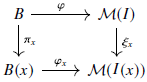
commutes.
Lemma 3·2. The $*$
-homomorphism
$*$
-homomorphism
 \begin{align*}\bar\mu(\eta(x))\,:\, B(x) \rightarrow \mathcal{M}(I(x))\end{align*}
for the extension ( $\eta(x)$
) coincides with the
$\eta(x)$
) coincides with the $*$
-homomorphism
$*$
-homomorphism
 \begin{align*}\bar\mu(\eta)_x\,:\, B(x) \rightarrow \mathcal{M}(I(x))\end{align*}
as defined in (3·8) above, whenever I is separable.
Proof. The proof is a plain computation which goes as follows. We fix $x \in X$
,
$x \in X$
, $b \in B$
and
$b \in B$
and $e \in I$
. We then have
$e \in I$
. We then have
 \begin{align*}\begin{aligned}\bar\mu(\eta)_x(\pi_x(b))(e(x)) &{}=\xi_x(\mu(\eta)(b))(e(x))\\&{}=((\bar\mu(\eta)(b))(e))(x)\\&{}=(b\iota(e))(x)\\&{}=b(x)\iota_x(e(x))\\&{}=\bar\mu(\eta(x))(b(x))e(x);\end{aligned}\end{align*}
where the first equality is by commutativity of (3·9); the second equality is by definition of $\xi_x$
; the third equality is by definition of
$\xi_x$
; the third equality is by definition of $\bar\mu(\eta)$
; and the fifth equality is by definition of
$\bar\mu(\eta)$
; and the fifth equality is by definition of $\bar\mu(\eta(x))$
. Since
$\bar\mu(\eta(x))$
. Since $\pi_x$
is surjective, the proof is complete.
$\pi_x$
is surjective, the proof is complete.
In particular, the following square

commutes. As in the ordinary $C^*$
-algebraic case, we define the Busby invariant
$C^*$
-algebraic case, we define the Busby invariant
 \begin{equation}\mu(\eta)\,:\, A \to \mathcal{Q}(I), \quad \mu(\eta)(p(b))=q_I(\bar{\mu}(\eta)(b)).\end{equation}
Note that we also have the Busby invariant
 \begin{equation}\mu(\eta(x))\,:\, A(x) \rightarrow \mathcal{Q}(I(x))\end{equation}
for the extension ( $\eta(x)$
). Again although
$\eta(x)$
). Again although $\mathcal{Q}(I)$
is not a
$\mathcal{Q}(I)$
is not a $C_0(X)$
-algebra, the Busby invariant
$C_0(X)$
-algebra, the Busby invariant $\mu$
satisfies a type of “
$\mu$
satisfies a type of “ $C_0(X)$
-linearity” in the sense of the following definition.
$C_0(X)$
-linearity” in the sense of the following definition.
Definition 3·3. Let A and I be $C_0(X)$
-algebras. A
$C_0(X)$
-algebras. A $*$
-homomorphism (or a completely positive map)
$*$
-homomorphism (or a completely positive map) $\psi\,:\, A \to \mathcal{Q}(I)$
is said to be
$\psi\,:\, A \to \mathcal{Q}(I)$
is said to be $C_0(X)$
-linear if
$C_0(X)$
-linear if
 \begin{equation*}\psi(\theta_A(f)a)=q_I\theta_I(f)\psi(a),\end{equation*}
for all $f \in C_0(X)$
and
$f \in C_0(X)$
and $a \in A$
.
$a \in A$
.
Once again, if I is separable, given such a $C_0(X)$
-linear
$C_0(X)$
-linear $\psi\,:\, A \rightarrow \mathcal{Q}(I)$
,
$\psi\,:\, A \rightarrow \mathcal{Q}(I)$
, $a \in A$
,
$a \in A$
, $x \in X$
and
$x \in X$
and $f \in \mathfrak{m}_x$
, by (3·5), it follows that
$f \in \mathfrak{m}_x$
, by (3·5), it follows that
 \begin{align*}\zeta_x(\psi(\theta_A(f)a))=\zeta_x(q_I(\theta_I(f)))\zeta_x(\psi(a))=0,\end{align*}
so that
 \begin{equation}\psi_x\,:\, A(x) \to \mathcal{Q}(I(x)), \quad \psi_x(a(x))=\zeta_x(\psi(a))\end{equation}
is a well-defined $*$
-homomorphism such that the following diagram
$*$
-homomorphism such that the following diagram
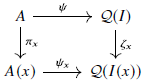
commutes.
Lemma 3·4. The Busby invariant
 \begin{align*}\mu(\eta(x))\,:\, A(x) \rightarrow \mathcal{Q}(I(x))\end{align*}
for the extension ( $\eta(x)$
) coincides with the
$\eta(x)$
) coincides with the $*$
-homomorphism
$*$
-homomorphism
 \begin{align*}\mu(\eta)_x\,:\, A(x) \rightarrow \mathcal{Q}(I(x))\end{align*}
as defined in (3·13) above, whenever I is separable.
Proof. The proof is a plain computation which goes as follows. We fix $x \in X$
and
$x \in X$
and $b \in B$
. We then have
$b \in B$
. We then have
 \begin{align*}\begin{aligned}\mu(\eta)_x(\pi_x(p(b))) &{}=\zeta_x(\mu(\eta)(p(b)))\\[4pt] &{}=\zeta_x(q_I(\bar \mu(\eta)(b)))\\[4pt] &{}=q_{I(x)}\xi_x(\bar \mu(\eta)(b))\\[4pt] &{}=q_{I(x)}\bar \mu(\eta(x))(\pi_x(b))\\[4pt] &{}=\mu(\eta(x))(p_x\pi_x(b))\\[4pt] &{}=\mu(\eta(x))(\pi_xp(b));\end{aligned}\end{align*}
where the first equality is by commutativity of (3·14); the second equality is by definition of $\mu(\eta)$
; the third equality is by commutativity of (3·4); the fourth equality is by commutativity of (3·10); the fifth equality is by definition of
$\mu(\eta)$
; the third equality is by commutativity of (3·4); the fourth equality is by commutativity of (3·10); the fifth equality is by definition of $\mu(\eta(x))$
and the sixth equality is because p is
$\mu(\eta(x))$
and the sixth equality is because p is $C_0(X)$
-linear. Since p and
$C_0(X)$
-linear. Since p and $\pi_x$
are surjective, the proof is complete.
$\pi_x$
are surjective, the proof is complete.
In particular, the following square
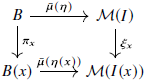
commutes.
Proposition 3·5. Let I and A be two separable, $C_0(X)$
-algebras and let
$C_0(X)$
-algebras and let $\mu\,:\, A \to \mathcal{Q}(I)$
be a
$\mu\,:\, A \to \mathcal{Q}(I)$
be a $C_0(X)$
-linear,
$C_0(X)$
-linear, $*$
-homomorphism. Set
$*$
-homomorphism. Set
 \begin{align*}B=\{(m,a) \in \mathcal{M}(I) \oplus A \mid q_I(m)=\mu(a) \},\end{align*}
 \begin{align*}\iota\,:\, I \rightarrow B, e \mapsto (e,0), \quad p\,:\, B \rightarrow A, (m,a) \mapsto a.\end{align*}
Then the following statements hold:
-
(1) B can be uniquely made into a
$C_0(X)$
-algebra such that
$\iota$
and p are
$C_0(X)$
-linear; -
(2) for any
$x \in X$
, the fiber B(x) is isomorphic to
\begin{align*}B_x\,:\!=\,\{(m', a') \in \mathcal{M}(I(x)) \oplus A(x) \mid q_{I(x)}(m')=\mu_x(a') \} ; \end{align*}
-
(3) the extension
(η)is a
\begin{equation} \qquad\qquad\qquad\qquad\qquad\qquad 0 \rightarrow I \xrightarrow{\iota} B \xrightarrow{p} A \rightarrow 0\end{equation}
$C_0(X)$
-extension such that
$\mu(\eta)=\mu$
.


Proof. We begin by observing that since $\mu$
is
$\mu$
is $C_0(X)$
-linear, for any
$C_0(X)$
-linear, for any $f \in C_0(X)$
, and
$f \in C_0(X)$
, and $(m,a) \in B$
,
$(m,a) \in B$
, $(\theta_I(f)m,\theta_A(f)a)$
is in B too. Let then
$(\theta_I(f)m,\theta_A(f)a)$
is in B too. Let then $\theta_B\,:\, C_0(X) \rightarrow \mathcal{M}(B)$
to be the
$\theta_B\,:\, C_0(X) \rightarrow \mathcal{M}(B)$
to be the $*$
-homomorphism defined as
$*$
-homomorphism defined as $\theta_B(f)(m,a)=(\theta_I(f)m,\theta_A(f)a)$
, for
$\theta_B(f)(m,a)=(\theta_I(f)m,\theta_A(f)a)$
, for $f \in C_0(X)$
, and
$f \in C_0(X)$
, and $(m,a) \in B$
. It is easy to see that
$(m,a) \in B$
. It is easy to see that $\theta_B(C_0(X)) \subset \mathcal{ZM}(B)$
. It is equally easy to see that
$\theta_B(C_0(X)) \subset \mathcal{ZM}(B)$
. It is equally easy to see that $\iota$
and p are
$\iota$
and p are $C_0(X)$
-linear. Next, we show that
$C_0(X)$
-linear. Next, we show that $\theta_B$
is nondegenerate. For that, we set
$\theta_B$
is nondegenerate. For that, we set $B_X=[C_0(X)B]$
. By
$B_X=[C_0(X)B]$
. By $C_0(X)$
-linearity of
$C_0(X)$
-linearity of $\iota$
and p together with exactness of (
$\iota$
and p together with exactness of ( $\eta$
), we obtain that
$\eta$
), we obtain that
 \begin{align*}0 \rightarrow I \xrightarrow{\iota} B_X \xrightarrow{p} A \rightarrow 0,\end{align*}
is also exact. Thus we have the following commutative diagram
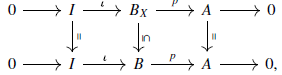
with exact rows. The Five lemma then implies that $B=B_X$
, i.e., B is a
$B=B_X$
, i.e., B is a $C_0(X)$
-algebra. To conclude (i), we now show uniqueness of this
$C_0(X)$
-algebra. To conclude (i), we now show uniqueness of this $C_0(X)$
-algebra structure. For that, let
$C_0(X)$
-algebra structure. For that, let $\theta'_B\,:\, C_0(X) \rightarrow \mathcal{ZM}(B)$
be another nondegenerate,
$\theta'_B\,:\, C_0(X) \rightarrow \mathcal{ZM}(B)$
be another nondegenerate, $*$
-homomorphism which makes B into a
$*$
-homomorphism which makes B into a $C_0(X)$
-algebra such that
$C_0(X)$
-algebra such that $\iota$
and p are
$\iota$
and p are $C_0(X)$
-linear. We fix
$C_0(X)$
-linear. We fix $f \in C_0(X)$
,
$f \in C_0(X)$
, $(m,a) \in B$
, and write
$(m,a) \in B$
, and write $\theta'_B(f)(m,a)=(m',a')$
. Let
$\theta'_B(f)(m,a)=(m',a')$
. Let $(u_n)_{n \in \mathbb{N}}$
be an approximate unit of I. Then we note that
$(u_n)_{n \in \mathbb{N}}$
be an approximate unit of I. Then we note that $(m'u_n,0)=\theta'_B(f)(m,a)(u_n,0)=(m,a)\theta'_B(f)(u_n,0)=(m,a)(\theta_I(f)u_n,0)=(\theta_I(f)mu_n,0)$
. Letting
$(m'u_n,0)=\theta'_B(f)(m,a)(u_n,0)=(m,a)\theta'_B(f)(u_n,0)=(m,a)(\theta_I(f)u_n,0)=(\theta_I(f)mu_n,0)$
. Letting $n \rightarrow \infty$
, we see that
$n \rightarrow \infty$
, we see that $m'=\theta_I(f)m$
; here we have used the centrality of
$m'=\theta_I(f)m$
; here we have used the centrality of $\theta_B$
and
$\theta_B$
and $\theta'_B$
together with the
$\theta'_B$
together with the $C_0(X)$
-linearity of
$C_0(X)$
-linearity of $\iota$
. Now since p is also
$\iota$
. Now since p is also $C_0(X)$
-linear, we obtain that
$C_0(X)$
-linear, we obtain that $a'=\theta_A(f)a$
, by applying p to the both sides of
$a'=\theta_A(f)a$
, by applying p to the both sides of $\theta'_B(f)(m,a)=(m',a')$
. Thus
$\theta'_B(f)(m,a)=(m',a')$
. Thus $\theta_B(f)(m,a)=(\theta_I(f)m,\theta_A(f)a)$
and this concludes (i). Moreover, (iii) follows as well since (
$\theta_B(f)(m,a)=(\theta_I(f)m,\theta_A(f)a)$
and this concludes (i). Moreover, (iii) follows as well since ( $\eta$
) is in particular an ordinary
$\eta$
) is in particular an ordinary $C^*$
-extension.
$C^*$
-extension.
For (ii), we fix $x \in X$
. We observe that if (m, a) is in B, then by commutativity of (3·4) and (3·14),
$x \in X$
. We observe that if (m, a) is in B, then by commutativity of (3·4) and (3·14), $(\xi_x(m),a(x))$
is in
$(\xi_x(m),a(x))$
is in $B_x$
. We set
$B_x$
. We set $\iota'_x\,:\, I(x) \rightarrow B_x$
,
$\iota'_x\,:\, I(x) \rightarrow B_x$
, $e(x) \mapsto (e(x),0)$
,
$e(x) \mapsto (e(x),0)$
, $p'_x\,:\, B_x \rightarrow A(x)$
,
$p'_x\,:\, B_x \rightarrow A(x)$
, $(m',a') \mapsto a'$
and
$(m',a') \mapsto a'$
and $\varphi\,:\, B \rightarrow B_x$
,
$\varphi\,:\, B \rightarrow B_x$
, $(m,a) \mapsto (\xi_x(m),a(x))$
. Then, by definition, we have the following commutative diagram
$(m,a) \mapsto (\xi_x(m),a(x))$
. Then, by definition, we have the following commutative diagram

with exact rows. The Snake lemma then implies that the following sequence
 \begin{align*}0 \rightarrow [\mathfrak{m}_xI] \rightarrow \ker(\varphi) \rightarrow [\mathfrak{m}_xA] \rightarrow 0\end{align*}
is exact. By (3.5), we observe that $[\mathfrak{m}_xB] \subseteq \ker(\varphi)$
. Moreover, we have the following commutative diagram
$[\mathfrak{m}_xB] \subseteq \ker(\varphi)$
. Moreover, we have the following commutative diagram
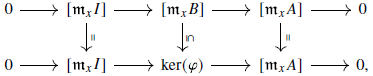
with exact rows. Again by the five lemma, we conclude that $\ker(\varphi)=[\mathfrak{m}_xB]$
, i.e.,
$\ker(\varphi)=[\mathfrak{m}_xB]$
, i.e., $\varphi$
descends to an isomorphism from B(x) to
$\varphi$
descends to an isomorphism from B(x) to $B_x$
. This concludes (ii) and the proof.
$B_x$
. This concludes (ii) and the proof.
We now proceed towards a G-equivariant version of Proposition 3·5 and we begin by fixing some notations. Let G be a second countable groupoid and $(A,\alpha)$
be a separable, G-
$(A,\alpha)$
be a separable, G- $C^*$
-algebra. We will write
$C^*$
-algebra. We will write
 \begin{align*}\bar \alpha\,:\, \mathcal{M}(s^*A) \rightarrow \mathcal{M}(r^*A), \quad \tilde \alpha\,:\, \mathcal{Q}(s^*A) \rightarrow \mathcal{Q}(r^*A),\end{align*}
for the induced $*$
-isomorphisms, so that the diagram
$*$
-isomorphisms, so that the diagram

commutes. Since $\alpha$
is
$\alpha$
is $C_0(G)$
-linear, so are
$C_0(G)$
-linear, so are $\bar \alpha$
and
$\bar \alpha$
and $\tilde \alpha$
. Thus for each
$\tilde \alpha$
. Thus for each $g \in G$
, the following diagrams
$g \in G$
, the following diagrams

and
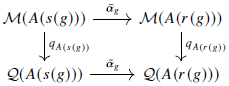
commute. An extension
 \begin{equation}\qquad\qquad\qquad\qquad\qquad\qquad0 \rightarrow I \xrightarrow{\iota} B \xrightarrow{p} A \rightarrow 0\end{equation}
of G- $C^*$
-algebras and G-equivariant,
$C^*$
-algebras and G-equivariant, $*$
-homomorphisms, will be called a G-
$*$
-homomorphisms, will be called a G- $C^*$
-extension. In particular, (
$C^*$
-extension. In particular, ( $\eta$
) is a
$\eta$
) is a $C_0(G^{(0)})$
-extension and therefore
$C_0(G^{(0)})$
-extension and therefore $\bar \mu(\eta)$
is
$\bar \mu(\eta)$
is $C_0(G^{(0)})$
-linear. As one might expect,
$C_0(G^{(0)})$
-linear. As one might expect, $\bar \mu(\eta)$
is G-equivariant in a sense, which we make precise now.
$\bar \mu(\eta)$
is G-equivariant in a sense, which we make precise now.
Definition 3·6. Let $(B,\beta)$
and
$(B,\beta)$
and $(I,\gamma)$
be G-
$(I,\gamma)$
be G- $C^*$
-algebras. A
$C^*$
-algebras. A $C_0(G^{(0)})$
-linear
$C_0(G^{(0)})$
-linear $*$
-homomorphism (or completely positive map)
$*$
-homomorphism (or completely positive map) $\varphi\,:\, B \rightarrow \mathcal{M}(I)$
is said to be G-equivariant if
$\varphi\,:\, B \rightarrow \mathcal{M}(I)$
is said to be G-equivariant if $\varphi_{r(g)}\beta_g=\bar \gamma_g \varphi_{s(g)}$
, i.e., the diagram
$\varphi_{r(g)}\beta_g=\bar \gamma_g \varphi_{s(g)}$
, i.e., the diagram

commutes for all $g \in G$
.
$g \in G$
.
Lemma 3·7. The $*$
-homomorphism
$*$
-homomorphism
 \begin{align*}\bar \mu(\eta)\,:\, B \rightarrow \mathcal{M}(I)\end{align*}
for the extension ( $\eta$
) is G-equivariant, whenever I is separable.
$\eta$
) is G-equivariant, whenever I is separable.
Proof. We fix $b \in B$
,
$b \in B$
, $e \in I$
. We then have for all
$e \in I$
. We then have for all $g \in G$
,
$g \in G$
,
 \begin{align*}\begin{aligned}\bar \mu_{r(g)}(\beta_g(b(s(g))))(e(r(g)))=&{}\beta_g(b(s(g)))\iota_{r(g)}(e(r(g)))\\=&{}\beta_g(b(s(g)))\iota_{r(g)}(\gamma_g(\gamma_g^{-1}(e(r(g)))))\\=&{}\beta_g(b(s(g)))\beta_g(\iota_{s(g)}(\gamma_g^{-1}(e(r(g)))))\\=&{}\gamma_g(b(s(g))\iota_{s(g)}(\gamma_g^{-1}(e(r(g)))))\\=&{}\gamma_g(\bar \mu_{s(g)}(b(s(g)))(\gamma_g^{-1}(e(r(g)))))\\=&{}\bar \gamma_g (\bar \mu_{s(g)}(b(s(g))))(e(r(g))),\end{aligned}\end{align*}
where the first equality is by definition of $\bar \mu_{r(g)}$
; the third equality is by G-equivariance of
$\bar \mu_{r(g)}$
; the third equality is by G-equivariance of $\iota$
; the fifth equality is again by definition of
$\iota$
; the fifth equality is again by definition of $\bar \mu_{s(g)}$
and the sixth equality is by definition of
$\bar \mu_{s(g)}$
and the sixth equality is by definition of $\bar \gamma_g$
. This completes the proof.
$\bar \gamma_g$
. This completes the proof.
Similarly, the Busby invariant $\mu\,:\, A \rightarrow \mathcal{Q}(I)$
is
$\mu\,:\, A \rightarrow \mathcal{Q}(I)$
is $C_0(G^{(0)})$
-linear. Moreover, it is G-equivariant in the following sense.
$C_0(G^{(0)})$
-linear. Moreover, it is G-equivariant in the following sense.
Definition 3·8. Let $(A,\alpha)$
and
$(A,\alpha)$
and $(I,\gamma)$
be G-
$(I,\gamma)$
be G- $C^*$
-algebras. A
$C^*$
-algebras. A $C_0(G^{(0)})$
-linear
$C_0(G^{(0)})$
-linear $*$
-homomorphism (or completely positive map)
$*$
-homomorphism (or completely positive map) $\psi\,:\, A \rightarrow \mathcal{Q}(I)$
is said to be G-equivariant if
$\psi\,:\, A \rightarrow \mathcal{Q}(I)$
is said to be G-equivariant if $\psi_{r(g)}\alpha_g=\tilde \gamma_g \psi_{s(g)}$
, i.e., the diagram
$\psi_{r(g)}\alpha_g=\tilde \gamma_g \psi_{s(g)}$
, i.e., the diagram

commutes for all $g \in G$
.
$g \in G$
.
Lemma 3·9. The Busby invariant
 \begin{align*}\mu\,:\, A \rightarrow \mathcal{Q}(I)\end{align*}
for the extension ( $\eta$
) is G-equivariant, whenever I is separable.
$\eta$
) is G-equivariant, whenever I is separable.
Proof. We fix $b \in B$
. We then have for all
$b \in B$
. We then have for all $g \in G$
,
$g \in G$
,
 \begin{align*}\begin{aligned}\mu_{r(g)}(\alpha_g(p_{s(g)}(b_{s(g)})))=&{}\mu_{r(g)}(p_{r(g)}(\beta_g(b_{s(g)})))\\=&{}q_{I(r(g))}(\bar \mu_{r(g)}(\beta_g(b(s(g)))))\\=&{}q_{I(r(g))}(\bar \gamma_g(\bar \mu_{s(g)}(b(s(g)))))\\=&{}\tilde \gamma_g(q_{I(s(g))}(\bar \mu_{s(g)}(b(s(g)))))\\=&{}\tilde \gamma_g(\mu_{s(g)}(p_{s(g)}(b(s(g))))),\end{aligned}\end{align*}
where the first equality is by equivariance of p; the second equality is by definition of $\mu_{r(g)}$
; the third equality is by Lemma 3·7; the fourth equality is by the commutativity of the square (3·18) and the fifth equality is again by definition of
$\mu_{r(g)}$
; the third equality is by Lemma 3·7; the fourth equality is by the commutativity of the square (3·18) and the fifth equality is again by definition of $\mu_{s(g)}$
. This completes the proof.
$\mu_{s(g)}$
. This completes the proof.
One might expect that the converse to the lemma above holds too, i.e., for a G-equivariant, $*$
-homomorphism
$*$
-homomorphism $\mu\,:\, A \rightarrow \mathcal{Q}(I)$
, the pullback B in Proposition 3·5 is a G-
$\mu\,:\, A \rightarrow \mathcal{Q}(I)$
, the pullback B in Proposition 3·5 is a G- $C^*$
-algebra and the extension (
$C^*$
-algebra and the extension ( $\eta$
) is a G-
$\eta$
) is a G- $C^*$
-extension such that
$C^*$
-extension such that $\mu(\eta)=\mu$
. Indeed, when G is a group, this is [
Reference Thomsen41
, Theorem 2·2]. However, we note that [
Reference Thomsen41
, Theorem 2·2] is a corollary of the automatic continuity result [
Reference Thomsen41
, Theorem 2·1] which was more generally proved in [
Reference Brown8
, Theorem 2]. Lacking such a result, we follow [
Reference Kasparov20
, Section 7] and make the following definition.
$\mu(\eta)=\mu$
. Indeed, when G is a group, this is [
Reference Thomsen41
, Theorem 2·2]. However, we note that [
Reference Thomsen41
, Theorem 2·2] is a corollary of the automatic continuity result [
Reference Thomsen41
, Theorem 2·1] which was more generally proved in [
Reference Brown8
, Theorem 2]. Lacking such a result, we follow [
Reference Kasparov20
, Section 7] and make the following definition.
Definition 3·10. Let G be a second countable groupoid, $(I,\gamma)$
and
$(I,\gamma)$
and $(A,\alpha)$
be two separable, G-
$(A,\alpha)$
be two separable, G- $C^*$
-algebras and
$C^*$
-algebras and $\mu\,:\, A \rightarrow \mathcal{Q}(I)$
be a G-equivariant,
$\mu\,:\, A \rightarrow \mathcal{Q}(I)$
be a G-equivariant, $*$
-homomorphism. We say
$*$
-homomorphism. We say $\mu$
is G-admissible if given
$\mu$
is G-admissible if given $a \in A$
and
$a \in A$
and $m \in \mathcal{M}(I)$
with
$m \in \mathcal{M}(I)$
with $q_{I}(m)=\mu(a)$
, the section
$q_{I}(m)=\mu(a)$
, the section $g \mapsto \gamma_g\xi_{s(g)}(m)\gamma_g^{-1}$
is continuous.
$g \mapsto \gamma_g\xi_{s(g)}(m)\gamma_g^{-1}$
is continuous.
Some remarks are in order. Firstly, we topologise $\bigsqcup_{g \in G} \mathcal{M}(I(r(g)))$
as in [
Reference Akemann, Pedersen and Tomiyama1
, Section 3] and note that although the reference deals with continuous fields, the topology nevertheless makes sense with upper semi-continuity instead of continuity; see also [
Reference Williams44
, Lemma C·11]. Secondly, with this topology, the section
$\bigsqcup_{g \in G} \mathcal{M}(I(r(g)))$
as in [
Reference Akemann, Pedersen and Tomiyama1
, Section 3] and note that although the reference deals with continuous fields, the topology nevertheless makes sense with upper semi-continuity instead of continuity; see also [
Reference Williams44
, Lemma C·11]. Secondly, with this topology, the section $g \mapsto \gamma_g\xi_{s(g)}(m)\gamma_g^{-1}$
in the above definition is required to be norm-continuous instead of strictly-continuous. Finally, that the class of G-admissible,
$g \mapsto \gamma_g\xi_{s(g)}(m)\gamma_g^{-1}$
in the above definition is required to be norm-continuous instead of strictly-continuous. Finally, that the class of G-admissible, $*$
-homomorphisms is not empty follows from the following corollary to Lemma 3·7.
$*$
-homomorphisms is not empty follows from the following corollary to Lemma 3·7.
Corollary 3·11. The Busby invariant
 \begin{align*}\mu(\eta)\,:\, A \rightarrow \mathcal{Q}(I)\end{align*}
for the extension ( $\eta$
) is G-admissible, whenever B is separable.
$\eta$
) is G-admissible, whenever B is separable.
Proof. We fix $a \in A$
and
$a \in A$
and $m \in \mathcal{M}(I)$
with
$m \in \mathcal{M}(I)$
with $q_I(m)=\mu(a)$
. We choose
$q_I(m)=\mu(a)$
. We choose $b \in B$
such that
$b \in B$
such that $m=\bar \mu(\eta)(b)$
. By Lemma 3.7, we conclude that the section
$m=\bar \mu(\eta)(b)$
. By Lemma 3.7, we conclude that the section $g \mapsto \gamma_g\xi_{s(g)}(m)\gamma_g^{-1}$
is the image of the section
$g \mapsto \gamma_g\xi_{s(g)}(m)\gamma_g^{-1}$
is the image of the section $g \mapsto \beta_g(b(s(g))$
under
$g \mapsto \beta_g(b(s(g))$
under $\bar \mu(\eta)$
. The result now follows since the latter section is continuous and
$\bar \mu(\eta)$
. The result now follows since the latter section is continuous and $\bar \mu(\eta)$
is a
$\bar \mu(\eta)$
is a $*$
-homomorphism.
$*$
-homomorphism.
The following corollary to Proposition 3·5 sets up the bijection between G- $C^*$
-extensions and G-admissible,
$C^*$
-extensions and G-admissible, $*$
-homomorphisms as defined above.
$*$
-homomorphisms as defined above.
Corollary 3·12. Let G be a second countable groupoid, $(I,\gamma)$
and
$(I,\gamma)$
and $(A,\alpha)$
be two separable, G-
$(A,\alpha)$
be two separable, G- $C^*$
-algebras and let
$C^*$
-algebras and let $\mu\,:\, A \to \mathcal{Q}(I)$
be a G-admissible,
$\mu\,:\, A \to \mathcal{Q}(I)$
be a G-admissible, $*$
-homomorphism. Then the following statements hold:
$*$
-homomorphism. Then the following statements hold:
-
(1) The
$C_0(G^{(0)})$
-algebra B from Proposition 3·5 can be uniquely made into a G-
$C^*$
-algebra such that
$\iota$
and p are G-equivariant. -
(2) The extension
(η)(
\begin{equation}0 \rightarrow I \xrightarrow{\iota} B \xrightarrow{p} A \rightarrow 0\end{equation}
$ \eta $
)is a G-
$C^*$
-extension such that
$\mu(\eta)=\mu$
.


Proof. We note that (ii) follows from (i) and Proposition 3·5. To prove (i), we will use lemma 2·1. To that end, we note that for any $g \in G$
and
$g \in G$
and $(m,a) \in B$
,
$(m,a) \in B$
, $(\gamma_g\xi_{s(g)}(m)\gamma_g^{-1},\alpha_g(a(s(g)))) \in B_{r(g)}$
, by Proposition 3·5 and Lemma 3·9. The result now follows since
$(\gamma_g\xi_{s(g)}(m)\gamma_g^{-1},\alpha_g(a(s(g)))) \in B_{r(g)}$
, by Proposition 3·5 and Lemma 3·9. The result now follows since $\mu$
is assumed to be G-admissible. Uniqueness follows from a careful adaptation of the trick in the proof of Proposition 3·5.
$\mu$
is assumed to be G-admissible. Uniqueness follows from a careful adaptation of the trick in the proof of Proposition 3·5.
Corollary 3·13. Let G be a locally compact, Hausdorff and second countable group, $(A, \alpha)$
and
$(A, \alpha)$
and $(I, \gamma)$
be two separable, G-
$(I, \gamma)$
be two separable, G- $C^*$
-algebras, and let
$C^*$
-algebras, and let $\mu \colon A \to \mathcal{Q}(I)$
be a
$\mu \colon A \to \mathcal{Q}(I)$
be a $*$
-homomorphism. Then
$*$
-homomorphism. Then $\mu$
is G-admissible if and only if
$\mu$
is G-admissible if and only if $\mu$
is G-equivariant.
$\mu$
is G-equivariant.
Proof. First, we assume that $\mu$
is G-admissible. Then by Corollary 3·12 and Lemma 3·9,
$\mu$
is G-admissible. Then by Corollary 3·12 and Lemma 3·9, $\mu$
is G-equivariant. The converse follows from [
Reference Thomsen41
, Theorem 2·1] and Corollary 3·11.
$\mu$
is G-equivariant. The converse follows from [
Reference Thomsen41
, Theorem 2·1] and Corollary 3·11.
We remark that by Corollary 3·12 and Lemma 3·9, it also follows that for a groupoid G, G-admissibility implies G-equivariance. Therefore it is natural to conjecture the following.
Conjecture 3·14. Let G be a second countable groupoid, $(A, \alpha)$
and
$(A, \alpha)$
and $(I, \gamma)$
be two separable, G-
$(I, \gamma)$
be two separable, G- $C^*$
-algebras, and let
$C^*$
-algebras, and let $\mu \colon A \to \mathcal{Q}(I)$
be a
$\mu \colon A \to \mathcal{Q}(I)$
be a $*$
-homomorphism. If
$*$
-homomorphism. If $\mu$
is G-equivariant then
$\mu$
is G-equivariant then $\mu$
is G-admissible.
$\mu$
is G-admissible.
We end this section with a definition and an easy lemma.
Definition 3·15. Let G be a groupoid, $(A,\alpha)$
be a G-
$(A,\alpha)$
be a G- $C^*$
-algebra and I be an ideal in A. We say that I is a G-invariant ideal if
$C^*$
-algebra and I be an ideal in A. We say that I is a G-invariant ideal if $\alpha(s^*I)=r^*I$
.
$\alpha(s^*I)=r^*I$
.
Lemma 3·16. Let $(A,\alpha)$
be a G-
$(A,\alpha)$
be a G- $C^*$
-algebra and I be a G-invariant ideal in A. Then the quotient
$C^*$
-algebra and I be a G-invariant ideal in A. Then the quotient $A/I$
can be made into a G-
$A/I$
can be made into a G- $C^*$
-algebra such that the extension
$C^*$
-algebra such that the extension
 \begin{align*}0 \rightarrow I \rightarrow A \rightarrow A/I \rightarrow 0\end{align*}
is a G- $C^*$
-extension.
$C^*$
-extension.
Proof. It is easy to see that $A/I$
can be made into a
$A/I$
can be made into a $C_0(G^{(0)})$
-algebra via
$C_0(G^{(0)})$
-algebra via $\theta_A$
such that the extension
$\theta_A$
such that the extension
 \begin{align*}0 \rightarrow I \rightarrow A \rightarrow A/I \rightarrow 0\end{align*}
is a $C_0(G^{(0)})$
-extension. The result now is immediate from the definition of a G-invariant ideal and the fact that the pullback functor is exact.
$C_0(G^{(0)})$
-extension. The result now is immediate from the definition of a G-invariant ideal and the fact that the pullback functor is exact.
4. Some technical results on quasi-central approximate units
As the title suggests, in this section, we gather some technical results on quasi-central approximate units that form one of the main technical tools for our main theorem. More precisely, we present variations of the Kasparov lemma ([ Reference Kasparov21 , Lemma 1·4]) as presented in [ Reference Forough, Gardella and Thomsen14 ].
Lemma 4·1. Let J be a separable $C^*$
-algebra,
$C^*$
-algebra, $0 \leq d \leq 1$
be a strictly positive element in J and
$0 \leq d \leq 1$
be a strictly positive element in J and $M_0 \subseteq \mathcal{M}(J)$
be a separable
$M_0 \subseteq \mathcal{M}(J)$
be a separable $C^*$
-subalgebra. Then there exists a countable approximate unit
$C^*$
-subalgebra. Then there exists a countable approximate unit $(x_n)_{n \in \mathbb{N}}$
for J contained in
$(x_n)_{n \in \mathbb{N}}$
for J contained in $C^*(d)$
with the following properties:
$C^*(d)$
with the following properties:
-
(i) for each
$n \in \mathbb{N}$
,
$0 \leq x_n\leq 1$
and
$x_{n+1}x_n=x_n$
; -
(ii) for each
$b \in M_0$
,
$\left\lVert x_nb-bx_n \right\rVert \rightarrow 0$
as
$n \rightarrow \infty$
.


The following lemma is the groupoid analogue of [ Reference Kasparov21 , Lemma 1·4] proved in [ Reference Le Gall25 , Corollary 6·1] and [ Reference Tu43 , Corollary 4·4].
Lemma 4·2. Let G be a second countable groupoid, $(J,\gamma)$
be a separable, G-
$(J,\gamma)$
be a separable, G- $C^*$
-algebra,
$C^*$
-algebra, $0 \leq d \leq 1$
be a strictly positive element in J and
$0 \leq d \leq 1$
be a strictly positive element in J and $M_0 \subseteq \mathcal{M}(J)$
be a separable
$M_0 \subseteq \mathcal{M}(J)$
be a separable $C^*$
-subalgebra. Then there exists a countable approximate unit
$C^*$
-subalgebra. Then there exists a countable approximate unit $(u_n)_{n \in \mathbb{N}}$
of J contained in
$(u_n)_{n \in \mathbb{N}}$
of J contained in $C^*(d)$
with the following properties:
$C^*(d)$
with the following properties:
-
(i) For each
$n \in \mathbb{N}$
,
$0 \leq u_n\leq 1$
and
$u_{n+1}u_n=u_n$
; -
(ii) For each
$b \in M_0$
,
$\left\lVert u_nb-bu_n \right\rVert \rightarrow 0$
as
$n \rightarrow \infty$
; -
(iii) For any compact subset
$K \subseteq G$
,
\begin{align*} \max_{g \in K}\left\lVert \gamma_{g}(u_n(s(g))-u_n(r(g)) \right\rVert \rightarrow 0 \text{ as } n \rightarrow \infty.\end{align*}


Proof. We apply Lemma 4·1 to find a countable approximate unit $(x_n)_{n \in \mathbb{N}}$
contained in
$(x_n)_{n \in \mathbb{N}}$
contained in $C^*(d)$
satisfying (i)–(iii). By the proof of [
Reference Tu43
, Lemma 4·3], there exists a countable approximate unit
$C^*(d)$
satisfying (i)–(iii). By the proof of [
Reference Tu43
, Lemma 4·3], there exists a countable approximate unit $(u_n)_{n \in \mathbb{N}}$
such that for all
$(u_n)_{n \in \mathbb{N}}$
such that for all $n \in \mathbb{N}$
,
$n \in \mathbb{N}$
, $u_n \in \mathrm{Conv}(x_m)_{m \geq n}$
. We observe that since each
$u_n \in \mathrm{Conv}(x_m)_{m \geq n}$
. We observe that since each $u_n \in \mathrm{Conv}(x_m)_{m\geq n}$
,
$u_n \in \mathrm{Conv}(x_m)_{m\geq n}$
, $(u_n)_{n \in \mathbb{N}}$
satisfies (i)–(iii) as well.
$(u_n)_{n \in \mathbb{N}}$
satisfies (i)–(iii) as well.
We recall the following lemma.
Lemma 4·3 ([
Reference Arveson3
, Lemma 1·1]). Let J be a $C^*$
-algebra,
$C^*$
-algebra, $\epsilon \gt0$
and f be a continuous function on [0, 1] satisfying
$\epsilon \gt0$
and f be a continuous function on [0, 1] satisfying $f(0)=0$
. Then there is a
$f(0)=0$
. Then there is a $\delta \gt0$
such that for each pair (a,e) of contractions in J with
$\delta \gt0$
such that for each pair (a,e) of contractions in J with $a \geq 0$
, one has
$a \geq 0$
, one has
 \begin{align*}\left\lVert ae-ea \right\rVert \leq \delta \implies \left\lVert f(a)e-ef(a) \right\rVert \leq \epsilon.\end{align*}
The following lemma is one of the main technical tools in the proof of our main theorem.
Lemma 4·4. Let G be a second countable groupoid, $(J,\gamma)$
be a separable, G-
$(J,\gamma)$
be a separable, G- $C^*$
-algebra,
$C^*$
-algebra, $0 \leq d \leq 1$
be a strictly positive element in J,
$0 \leq d \leq 1$
be a strictly positive element in J, $(W_n)_{n \in \mathbb{N}}$
be an increasing sequence of compact subsets in
$(W_n)_{n \in \mathbb{N}}$
be an increasing sequence of compact subsets in $\mathcal{M}(J)$
and
$\mathcal{M}(J)$
and $(K_n)_{n \in \mathbb{N}}$
be an increasing sequence of compact subsets in G. Then there exists a countable approximate unit
$(K_n)_{n \in \mathbb{N}}$
be an increasing sequence of compact subsets in G. Then there exists a countable approximate unit $(u_n)_{n \in \mathbb{N}}$
of J contained in
$(u_n)_{n \in \mathbb{N}}$
of J contained in $C^*(d)$
such that if we set
$C^*(d)$
such that if we set
 \begin{align*}\Delta_0=\sqrt{u_0}, \quad \Delta_n=\sqrt{u_n-u_{n-1}},\end{align*}
for $n \geq 1$
, the following properties are satisfied:
$n \geq 1$
, the following properties are satisfied:
-
(i) for each
$n \in \mathbb{N}$
,
$0 \leq u_n \leq 1$
and
$u_n=u_{n+1}u_n$
; -
(ii) for each
$n \in \mathbb{N}$
,
$\Delta_{n+1}u_n=0$
; -
(iii) for any compact subset
$K \subseteq G$
,
\begin{align*}\max_{g \in K} \left\lVert \gamma_g(u_n(s(g))-u_n(r(g)) \right\rVert \rightarrow 0 \text{ as } n \rightarrow \infty ;\end{align*}
-
(iv) for each
$n \in \mathbb{N}$
and for any
$m \in W_n$
,
\begin{align*} \left\lVert \Delta_n m-m\Delta_n \right\rVert \leq 1/n^2 ;\end{align*}
-
(v) for each
$n \in \mathbb{N}$
and for any
$g \in K_n$
,
\begin{align*} \left\lVert \gamma_g(\Delta_n(s(g)))-\Delta_n(r(g)) \right\rVert \leq 1/n^2;\end{align*}
-
(vi) for each
$n \in \mathbb{N}$
, for any
$m \in W_n$
,
\begin{align*} \left\lVert m(1-u_n) \right\rVert \leq \left\lVert q_J(m) \right\rVert + 1/n^2.\end{align*}


Proof. The proof is similar to the proof of [
Reference Forough, Gardella and Thomsen14
, Lemma 2·3]. Let $M_0 \subseteq \mathcal{M}(J)$
be the separable
$M_0 \subseteq \mathcal{M}(J)$
be the separable $C^*$
-subalgebra generated by
$C^*$
-subalgebra generated by $\bigcup_{n \in \mathbb{N}} W_n$
and let
$\bigcup_{n \in \mathbb{N}} W_n$
and let $(y_n)_{n \in \mathbb{N}}$
be a countable approximate unit of J contained in
$(y_n)_{n \in \mathbb{N}}$
be a countable approximate unit of J contained in $C^*(d)$
satisfying (i)–(iv) of Lemma 4·2. By approximating the square root function on [0, 1] by polynomials, we see that given
$C^*(d)$
satisfying (i)–(iv) of Lemma 4·2. By approximating the square root function on [0, 1] by polynomials, we see that given $\epsilon \gt 0$
, there is a
$\epsilon \gt 0$
, there is a $\delta \gt0$
such that
$\delta \gt0$
such that
 \begin{align*}\left\lVert \gamma_g(a(s(g)))-a(r(g)) \right\rVert \leq \delta \implies \left\lVert \gamma_g\left(\sqrt{a(s(g))}\right)-\sqrt{a(r(g))} \right\rVert \leq \epsilon,\end{align*}
for any positive contraction $a \in J$
and
$a \in J$
and $g \in G$
. Together with Lemma 4·3, this implies that for each
$g \in G$
. Together with Lemma 4·3, this implies that for each $n \in \mathbb{N}$
, there is a
$n \in \mathbb{N}$
, there is a $\delta_n \gt 0$
such that given a positive contraction
$\delta_n \gt 0$
such that given a positive contraction $a \in J$
,
$a \in J$
,
 \begin{align*}\left\lVert \gamma_g(a(s(g)))-a(r(g)) \right\rVert \leq \delta_n \implies \left\lVert \gamma_g\left(\sqrt{a(s(g))}\right)-\sqrt{a(r(g))} \right\rVert \leq \frac{1}{n^2},\end{align*}
for any $g \in K_n$
and
$g \in K_n$
and
 \begin{align*}\left\lVert am-ma \right\rVert \leq \delta_n \implies \left\lVert \sqrt{a}m-m\sqrt{a} \right\rVert \leq \frac{1}{n^2},\end{align*}
for any $m \in W_n$
. Now using (iii) of Lemma 4·2, we find a subsequence
$m \in W_n$
. Now using (iii) of Lemma 4·2, we find a subsequence $(u_n)_{n \in \mathbb{N}}$
of
$(u_n)_{n \in \mathbb{N}}$
of $(y_n)_{n \in \mathbb{N}}$
such that given any
$(y_n)_{n \in \mathbb{N}}$
such that given any $n \in \mathbb{N}$
,
$n \in \mathbb{N}$
,
 \begin{align*}\left\lVert \gamma_g((u_{n}-u_{n-1})(s(g)))-(u_{n}-u_{n-1})(r(g)) \right\rVert \leq \delta_n,\end{align*}
for any $g \in K_n$
and
$g \in K_n$
and
 \begin{align*}\left\lVert (u_{n}-u_{n-1})m-m(u_{n}-u_{n-1}) \right\rVert \leq \delta_n,\end{align*}
for any $m \in W_n$
. Using the fact that
$m \in W_n$
. Using the fact that
 \begin{align*}\left\lVert q_J(m) \right\rVert=\lim_{n \to \infty}\left\lVert m(1-y_n) \right\rVert\end{align*}
for all $m \in \mathcal{M}(J)$
and passing to a further subsequence, we obtain
$m \in \mathcal{M}(J)$
and passing to a further subsequence, we obtain $(u_n)_{n \in \mathbb{N}}$
satisfying (i)–(vi).
$(u_n)_{n \in \mathbb{N}}$
satisfying (i)–(vi).
5. The main results
We now come, as the title suggests, to the main results of this paper. The approach is standard, as is already taken in [ Reference Forough, Gardella and Thomsen14 ] and [ Reference Gabe15 ]; namely, we first consider the case when the codomain is a Calkin algebra and then use the Busby invariant to pass to the general case. We begin with the following definition.
Definition 5·1. Let G be a groupoid, $(A,\alpha)$
and
$(A,\alpha)$
and $(B,\beta)$
be two G-
$(B,\beta)$
be two G- $C^*$
-algebras,
$C^*$
-algebras, $\varphi\,:\, A \rightarrow B$
be a completely positive and contractive map,
$\varphi\,:\, A \rightarrow B$
be a completely positive and contractive map, $F \subset A$
be a finite subset of A and
$F \subset A$
be a finite subset of A and $K \subset G$
be a compact subset of G. The equivariance modulus of
$K \subset G$
be a compact subset of G. The equivariance modulus of $\varphi$
with respect to
$\varphi$
with respect to $\alpha$
,
$\alpha$
, $\beta$
, F and K, denoted
$\beta$
, F and K, denoted $\left\lVert (\varphi,\alpha,\beta) \right\rVert_{F,K}$
is defined to be the number
$\left\lVert (\varphi,\alpha,\beta) \right\rVert_{F,K}$
is defined to be the number
 \begin{equation}\left\lVert (\varphi,\alpha,\beta) \right\rVert_{F,K}=\max_{a \in F}\sup_{g \in K}\left\lVert \beta_g (\varphi_{s(g)}(a(s(g))-\varphi_{r(g)}(\alpha_g(a(s(g)))) \right\rVert.\end{equation}
We remark that the above definition still makes sense when G is second countable and B is $\mathcal{M}(I)$
or
$\mathcal{M}(I)$
or $\mathcal{Q}(I)$
for a separable, G-
$\mathcal{Q}(I)$
for a separable, G- $C^*$
-algebra
$C^*$
-algebra $(I,\gamma)$
, with
$(I,\gamma)$
, with $\bar \gamma$
, respectively
$\bar \gamma$
, respectively $\tilde \gamma$
, playing the role of
$\tilde \gamma$
, playing the role of $\beta$
and we will continue to write
$\beta$
and we will continue to write $\left\lVert (\varphi,\alpha,\bar \gamma) \right\rVert_{F,K}$
, respectively
$\left\lVert (\varphi,\alpha,\bar \gamma) \right\rVert_{F,K}$
, respectively $\left\lVert (\varphi,\alpha,\tilde \gamma) \right\rVert_{F,K}$
, for the equivariance modulus. Now we can state the technical lemma for our main result.
$\left\lVert (\varphi,\alpha,\tilde \gamma) \right\rVert_{F,K}$
, for the equivariance modulus. Now we can state the technical lemma for our main result.
Lemma 5·2. Let G be a second countable groupoid, $(A,\alpha)$
and
$(A,\alpha)$
and $(I,\gamma)$
be two G-
$(I,\gamma)$
be two G- $C^*$
-algebras with A and I separable. Let
$C^*$
-algebras with A and I separable. Let $\varphi\,:\, A \to \mathcal{M}(I)$
and
$\varphi\,:\, A \to \mathcal{M}(I)$
and $\psi\,:\, A \to \mathcal{Q}(I)$
be two
$\psi\,:\, A \to \mathcal{Q}(I)$
be two $C_0(G^{(0)})$
-linear, completely positive and contractive maps such that
$C_0(G^{(0)})$
-linear, completely positive and contractive maps such that $q_I \circ \varphi=\psi$
. Then given a finite subset
$q_I \circ \varphi=\psi$
. Then given a finite subset $F \subset A$
, a compact set
$F \subset A$
, a compact set $K \subset G$
and
$K \subset G$
and $\epsilon \gt0$
, there exists a
$\epsilon \gt0$
, there exists a $C_0(G^{(0)})$
-linear, completely positive and contractive map
$C_0(G^{(0)})$
-linear, completely positive and contractive map $\varphi'\,:\, A \to \mathcal{M}(I)$
such that
$\varphi'\,:\, A \to \mathcal{M}(I)$
such that $q_I \circ \varphi'=\psi$
and
$q_I \circ \varphi'=\psi$
and
 \begin{equation}\left\lVert (\varphi',\alpha,\bar \gamma) \right\rVert_{F,K} \leq \left\lVert (\psi,\alpha,\tilde \gamma) \right\rVert_{F,K} + \epsilon.\end{equation}
Proof. We begin the proof by fixing an increasing sequence of finite subsets $(F_n)_{n \in \mathbb{N}}$
of A with dense union in A and
$(F_n)_{n \in \mathbb{N}}$
of A with dense union in A and $F \subseteq F_0$
. Similarly, we fix an increasing sequence of compact subsets
$F \subseteq F_0$
. Similarly, we fix an increasing sequence of compact subsets $(K_n)_{n \in \mathbb{N}}$
of G whose union equals G itself and
$(K_n)_{n \in \mathbb{N}}$
of G whose union equals G itself and $K \subseteq K_0$
. Now we set
$K \subseteq K_0$
. Now we set $W_n=\varphi(F_n)$
,
$W_n=\varphi(F_n)$
, $n \in \mathbb{N}$
, and by Lemma 4·4 we obtain an approximate unit
$n \in \mathbb{N}$
, and by Lemma 4·4 we obtain an approximate unit $(u_n)_{n \in \mathbb{N}}$
of I, hence the sequence
$(u_n)_{n \in \mathbb{N}}$
of I, hence the sequence $(\Delta_n)_{n \in \mathbb{N}}$
satisfying the conditions (i)–(vi) as in Lemma 4·4 for the sequences
$(\Delta_n)_{n \in \mathbb{N}}$
satisfying the conditions (i)–(vi) as in Lemma 4·4 for the sequences $(W_n)_{n \in \mathbb{N}}$
and
$(W_n)_{n \in \mathbb{N}}$
and $(K_n)_{n \in \mathbb{N}}$
. By [
Reference Manuilov and Thomsen26
, Lemma 3·1], we see that for every
$(K_n)_{n \in \mathbb{N}}$
. By [
Reference Manuilov and Thomsen26
, Lemma 3·1], we see that for every $n \in \mathbb{N}$
, the sequence
$n \in \mathbb{N}$
, the sequence
 \begin{equation}\sum_{l=n}^k \Delta_l\varphi(a)\Delta_l\end{equation}
converges in the strict topology of $\mathcal{M}(I)$
as
$\mathcal{M}(I)$
as $k \to \infty$
and
$k \to \infty$
and
 \begin{equation}\left\lVert \sum_{l=n}^\infty \Delta_l\varphi(a)\Delta_l \right\rVert \leq 1.\end{equation}
Therefore, for each $n \in \mathbb{N}$
, we can define a completely positive and contractive map
$n \in \mathbb{N}$
, we can define a completely positive and contractive map
 \begin{equation}\varphi_n \colon A \to \mathcal{M}(I),\end{equation}
by setting for each $a \in A$
,
$a \in A$
,
 \begin{equation}\varphi_n(a)=\sum_{l=n}^\infty \Delta_l \varphi(a) \Delta_l.\end{equation}
We note that, since $\varphi$
is
$\varphi$
is $C_0(G^{(0)})$
-linear, so is
$C_0(G^{(0)})$
-linear, so is $\varphi_n$
, for each
$\varphi_n$
, for each $n \in \mathbb{N}$
. Furthermore, property (iv) in Lemma 4·4 implies that
$n \in \mathbb{N}$
. Furthermore, property (iv) in Lemma 4·4 implies that
 \begin{equation}\sum_{l=n}^{k} \left\lVert \varphi(a) \Delta_l^2 - \Delta_l \varphi(a) \Delta_l \right\rVert \leq \sum_{l=n}^{k} \left\lVert \varphi(a) \Delta_l - \Delta_l \varphi(a) \right\rVert \leq \sum_{l=n}^{k} \frac{1}{l^{2}},\end{equation}
for all $n \in \mathbb{N}$
,
$n \in \mathbb{N}$
, $a \in F_n$
and
$a \in F_n$
and $k \gt n$
. Therefore, the series
$k \gt n$
. Therefore, the series
 \begin{equation}\sum_{l=0}^{\infty} \left(\varphi(a) \Delta_l^2 -\Delta_l \varphi(a) \Delta_l \right),\end{equation}
converges in norm, for all $a \in \bigcup_{l \in \mathbb{N}}F_l$
, hence for all
$a \in \bigcup_{l \in \mathbb{N}}F_l$
, hence for all $a \in A$
, to an element in I as each summand is an element of I. Since
$a \in A$
, to an element in I as each summand is an element of I. Since $\sum_{l=0}^{\infty}\Delta_l^2$
converges strictly to 1, we have
$\sum_{l=0}^{\infty}\Delta_l^2$
converges strictly to 1, we have
 \begin{equation}\varphi(a) - \varphi_n(a) = \sum_{l=0}^{\infty} (\varphi(a) \Delta_l^2- \Delta_l \varphi(a) \Delta_l) + \sum_{l=0}^{n-1} \Delta_l \varphi(a) \Delta_l,\end{equation}
for all $a\in A$
and
$a\in A$
and $n \in \mathbb{N}$
. Since each summand of the above sum is in I,
$n \in \mathbb{N}$
. Since each summand of the above sum is in I, $\varphi(a) - \varphi_n(a)$
is in I as well, i.e.,
$\varphi(a) - \varphi_n(a)$
is in I as well, i.e., $q_I \circ \varphi_n=q_I \circ \varphi=\psi$
, for all
$q_I \circ \varphi_n=q_I \circ \varphi=\psi$
, for all $n \in \mathbb{N}$
. Now since
$n \in \mathbb{N}$
. Now since $((u_n)(x))_{n \in \mathbb{N}}$
is an approximate unit of I(x) for all
$((u_n)(x))_{n \in \mathbb{N}}$
is an approximate unit of I(x) for all $x \in G^{(0)}$
,
$x \in G^{(0)}$
,
 \begin{equation}\left\lVert q_{I(x)}(m) \right\rVert=\lim_{n \rightarrow \infty}\left\lVert m((1-u_n)(x)) \right\rVert\end{equation}
for $m \in \mathcal{M}(I(x))$
. We can then find
$m \in \mathcal{M}(I(x))$
. We can then find $n_0 \in \mathbb{N}$
such that whenever
$n_0 \in \mathbb{N}$
such that whenever $a \in F$
,
$a \in F$
, $g \in K$
and
$g \in K$
and $n \geq n_0$
,
$n \geq n_0$
,
 \begin{equation}\sum_{l=n}^\infty \frac{1}{l^2} \leq \frac{\epsilon}{4\left\lVert a \right\rVert},\end{equation}
and
 \begin{equation}\begin{aligned}&{}\left\lVert (\bar \gamma_g (\varphi_{s(g)}(a(s(g))))-\varphi_{r(g)}(\alpha_g(a(s(g))))(1-u_n)(r(g)) \right\rVert\\&\quad\leq {} \left\lVert q_{I(r(g))}(\bar \gamma_g (\varphi_{s(g)}(a(s(g))))-\varphi_{r(g)}(\alpha_g(a(s(g)))) \right\rVert + \frac{\epsilon}{2}\\&\quad={}\left\lVert \tilde \gamma_g(\psi_{s(g)}(a(s(g)))-\psi_{r(g)}(\alpha_g(a(s(g))))) \right\rVert + \frac{\epsilon}{2},\end{aligned}\end{equation}
where in the last step we use the commutativity of the square (3·18). By (v) of Lemma 4·4, we obtain for all $l \in \mathbb{N}$
and for all
$l \in \mathbb{N}$
and for all $a \in F$
,
$a \in F$
,
 \begin{align}&{} \left\lVert \gamma_g(\Delta_l(s(g)))\bar \gamma_g(\varphi_{s(g)}(a(s(g)))\gamma_g(\Delta_l(s(g)))-\Delta_l(r(g))\bar \gamma_g(\varphi_{s(g)}(a(s(g)))\Delta_l(r(g)) \right\rVert \\&\quad{} \leq \frac{2\left\lVert a \right\rVert}{l^2}.\end{align}
Therefore, for all $n \geq n_0$
,
$n \geq n_0$
, $a \in F$
and
$a \in F$
and $g \in K$
, we have
$g \in K$
, we have
 \begin{align}&{} \left\lVert \bar \gamma_g((\varphi_n)_{s(g)}(a(s(g)))-\sum_{l=n}^\infty \Delta_l(r(g))\bar \gamma_g(\varphi_{s(g)}(a(s(g)))\Delta_l(r(g)) \right\rVert \\&\quad={} \left\lVert \sum_{l=n}^\infty \gamma_g(\Delta_l(s(g))) \bar \gamma_g(\varphi_{s(g)}(a(s(g)))\gamma_g(\Delta_l(s(g)))\right.\\&\quad\quad-{}\left.\sum_{l=n}^\infty \Delta_l(r(g))\bar \gamma_g(\varphi_{s(g)}(a(s(g)))\Delta_l(r(g)) \right\rVert \\&\quad\leq {} \sum_{l=n}^\infty \frac{2\left\lVert a \right\rVert}{l^2}\\ &\quad\leq {} \frac{\epsilon}{2},\end{align}
where the first inequality is by (5·12) and the second inequality is by (5·11a). We also note that we have used the identity ( $a \in A$
),
$a \in A$
),
 \begin{align*}(\varphi_n)_x(a(x))=\sum_{l=n}^\infty \Delta_l(x) \varphi_x(a(x))\Delta_l(x)\end{align*}
which holds since $\xi_x$
is continuous with respect to the strict topology, for all
$\xi_x$
is continuous with respect to the strict topology, for all $x \in G^{(0)}$
; and the fact that
$x \in G^{(0)}$
; and the fact that $\bar \gamma_g$
is continuous with respect to the strict topology, for all
$\bar \gamma_g$
is continuous with respect to the strict topology, for all $g \in G$
. We now show that
$g \in G$
. We now show that $\varphi_n$
satisfies the inequality (5·2) in the statement for
$\varphi_n$
satisfies the inequality (5·2) in the statement for $n \gt n_0$
. So we fix
$n \gt n_0$
. So we fix $N \gt n_0$
and observe that for
$N \gt n_0$
and observe that for $n \geq N$
,
$n \geq N$
, $\Delta_n=(1-u_{n_0})\Delta_n$
, since
$\Delta_n=(1-u_{n_0})\Delta_n$
, since $u_{n_0}\Delta_n=0$
. Therefore, for
$u_{n_0}\Delta_n=0$
. Therefore, for $l \gt k \geq N$
, using Cauchy-Schwarz inequality for the Hilbert module
$l \gt k \geq N$
, using Cauchy-Schwarz inequality for the Hilbert module $\mathcal{M}(I(r(g)))^{l-k+1}$
at the first step, and (5·11b) at the second, we obtain
$\mathcal{M}(I(r(g)))^{l-k+1}$
at the first step, and (5·11b) at the second, we obtain
 \begin{align}&{}\left\lVert \sum_{n=k}^l\Delta_n(r(g))(\bar \gamma_g\varphi_{s(g)}(a(s(g)))-\varphi_{r(g)}(\alpha_g(a(s(g))))\Delta_n(r(g)) e(r(g))\right\rVert \\&\quad={} \left\lVert \sum_{n=k}^l\Delta_n(r(g))(\bar \gamma_g(\varphi_{s(g)}(a(s(g))))\right.\\&\quad\quad-{}\left.\vphantom{\sum_{n=k}^l}\varphi_{r(g)}(\alpha_g(a(s(g))))(1-u_{n_0})(r(g))\Delta_n(r(g))e(r(g)) \right\rVert \\&\quad\leq {} \left\lVert (\bar \gamma_g(\varphi_{s(g)}(a(s(g))))- \varphi_{r(g)}(\alpha_g(a(s(g))))(1-u_{n_0})(r(g)) \right\rVert \\&\quad\quad{} \left\lVert \sum_{n=k}^l e(r(g))^*\Delta_n^2(r(g))e(r(g)) \right\rVert \\&\quad\leq {} \left(\left\lVert \tilde \gamma_g(\psi_{s(g)}(a(s(g)))-\psi_{r(g)}(\alpha_g(a(s(g)))) \right\rVert + \frac{\epsilon}{2} \right) \left\lVert (e^*(u_l-u_k)e)(r(g)) \right\rVert\end{align}
for all $a \in F$
,
$a \in F$
, $g \in K$
and
$g \in K$
and $e \in I$
. We note that
$e \in I$
. We note that $e^*(u_l-u_k)e$
converges to zero in norm as
$e^*(u_l-u_k)e$
converges to zero in norm as $l,k \to \infty$
, since
$l,k \to \infty$
, since $(u_l)_{l \in \mathbb{N}}$
is an approximate unit of I. Hence,
$(u_l)_{l \in \mathbb{N}}$
is an approximate unit of I. Hence,
 \begin{equation}\sum_{n=N}^\infty \Delta_n(r(g))(\bar \gamma_g\varphi_{s(g)}(a(s(g)))-\varphi_{r(g)}(\alpha_g(a(s(g))))(r(g))\Delta_n(r(g))\end{equation}
converges in the strict topology of $\mathcal{M}(I(r(g)))$
such that
$\mathcal{M}(I(r(g)))$
such that
 \begin{align}&{} \left\lVert \sum_{n=N}^\infty \Delta_n(r(g)) (\bar \gamma_g\varphi_{s(g)}(a(s(g)))-\varphi_{r(g)}(\alpha_g(a(s(g))))(r(g))\Delta_n(r(g)) \right\rVert \\&\quad\leq {} \left\lVert \tilde \gamma_g(\psi_{s(g)}(a(s(g)))-\psi_{r(g)}(\alpha_g(a(s(g)))) \right\rVert + \frac{\epsilon}{2},\end{align}
for all $a \in F$
and
$a \in F$
and $g \in K$
. Now we have all the estimates to end the proof, so to that end, fix
$g \in K$
. Now we have all the estimates to end the proof, so to that end, fix $a \in F$
and
$a \in F$
and $g \in K$
. Then
$g \in K$
. Then
 \begin{equation}\begin{aligned}&{} \left\lVert (\bar \gamma_g((\varphi_N)_{s(g)}(a(s(g))))-(\varphi_N)_{r(g)}\alpha_g(a(s(g)))) \right\rVert \\&\quad\leq \left\lVert (\bar \gamma_g((\varphi_N)_{s(g)}(a(s(g))))-\sum_{n=N}^\infty \Delta_n(r(g))\bar \gamma_g(\varphi_{s(g)}(a(s(g))))\Delta_n(r(g))) \right\rVert \\\end{aligned}\end{equation}
 \begin{equation}\begin{aligned} &\quad\quad+ \left\lVert (\sum_{n=N}^\infty \Delta_n(r(g))\bar \gamma_g(\varphi_{s(g)}(a(s(g))))\Delta_n(r(g))-(\varphi_N)_{r(g)}\alpha_g(a(s(g)))) \right\rVert \\&\quad\leq \frac{\epsilon}{2} + \left\lVert (\sum_{n=N}^\infty \Delta_n(r(g))(\bar \gamma_g\varphi_{s(g)}(a(s(g)))-\varphi_{r(g)}(\alpha_g(a(s(g))))\Delta_n(r(g))) \right\rVert \\&\quad\leq \epsilon + \left\lVert \tilde \gamma_g(\psi_{s(g)}(a(s(g)))-\psi_{r(g)}(\alpha_g(a(s(g)))) \right\rVert,\end{aligned} \\[6pt] \end{equation}
where, the second inequality is by (5·13) and the definition of $\varphi_N$
; and the final inequality is by (5·16). This completes the proof.
$\varphi_N$
; and the final inequality is by (5·16). This completes the proof.
Now we are in the position to prove our main result.
Theorem 5·3. Let G be a second countable groupoid and $(A,\alpha)$
be a separable, G-
$(A,\alpha)$
be a separable, G- $C^*$
-algebra. Let
$C^*$
-algebra. Let
 \begin{align*}0 \rightarrow (I,\gamma) \rightarrow (B,\beta) \xrightarrow{p} (D,\delta) \rightarrow 0\end{align*}
be a G- $C^*$
-extension with B separable. Let
$C^*$
-extension with B separable. Let $\varphi\,:\, A \rightarrow B$
and
$\varphi\,:\, A \rightarrow B$
and $\psi\,:\, A \rightarrow D$
be two
$\psi\,:\, A \rightarrow D$
be two $C_0(G^{(0)})$
-linear, completely positive and contractive maps such that
$C_0(G^{(0)})$
-linear, completely positive and contractive maps such that $p \circ \varphi=\psi$
. Then given
$p \circ \varphi=\psi$
. Then given $\epsilon \gt 0$
, a finite subset
$\epsilon \gt 0$
, a finite subset $F \subset A$
of A, a compact subset
$F \subset A$
of A, a compact subset $K \subset G$
of G, there exists a
$K \subset G$
of G, there exists a $C_0(G^{(0)})$
-linear, completely positive and contractive map
$C_0(G^{(0)})$
-linear, completely positive and contractive map $\varphi'\,:\, A \rightarrow B$
such that
$\varphi'\,:\, A \rightarrow B$
such that $p \circ \varphi'=\psi$
and
$p \circ \varphi'=\psi$
and
 \begin{equation}\left\lVert (\varphi',\alpha,\beta) \right\rVert_{F,K} \leq \left\lVert (\psi,\alpha,\delta) \right\rVert_{F,K} + \epsilon.\end{equation}
Proof. We begin by considering the G- $C^*$
-extension
$C^*$
-extension
 \begin{equation} \qquad\qquad\qquad\qquad\qquad\qquad 0 \rightarrow I \rightarrow B \rightarrow D \rightarrow 0,\end{equation}
and the associated $*$
-homomorphims
$*$
-homomorphims
 \begin{equation}\bar \mu(\eta)\,:\, B \rightarrow \mathcal{M}(I), \quad \mu(\eta)\,:\, D \rightarrow \mathcal{Q}(I).\end{equation}
Setting
 \begin{equation}E=\{(m,c) \in \mathcal{M}(I) \oplus D\,:\, q_I(m)=\mu(\eta)(c)\},\end{equation}
and
 \begin{equation}\Theta\,:\, B \to E, \quad \Theta(b)=(\bar \mu(\eta)(b),p(b)) \text{ for all } b \in B,\end{equation}
by Corollary 3·12, we see that E can be made into a G- $C^*$
-algebra and
$C^*$
-algebra and $\Theta$
is a G-equivariant isomorphism. Let
$\Theta$
is a G-equivariant isomorphism. Let
 \begin{equation}\dot{\varphi}=\bar \mu(\eta) \circ \varphi\,:\, A \rightarrow \mathcal{M}(I), \text{ and } \dot{\psi}=\mu(\eta) \circ \psi\,:\, A \rightarrow \mathcal{Q}(I),\end{equation}
so that
 \begin{equation}q_I \circ \dot{\varphi}=q_I \circ \bar \mu(\eta) \circ \varphi=\mu(\eta) \circ p \circ \varphi=\mu(\eta) \circ \psi=\dot{\psi},\end{equation}
i.e., we are in the setting of Lemma 5·2. Therefore we find
 \begin{equation}\dot{\varphi}'\,:\, A \rightarrow \mathcal{M}(I) \text{ such that } q_I \circ \dot{\varphi}'=\dot{\psi}\end{equation}
and
 \begin{equation}\left\lVert (\dot \varphi',\alpha,\bar \gamma) \right\rVert_{F,K} \leq \left\lVert (\dot \psi,\alpha,\tilde \gamma) \right\rVert_{F,K} + \epsilon.\end{equation}
This implies that for all $a \in A$
,
$a \in A$
, $q_I(\dot \varphi'(a))=\dot \psi(a)=\mu(\eta)(\psi(a))$
, i.e.,
$q_I(\dot \varphi'(a))=\dot \psi(a)=\mu(\eta)(\psi(a))$
, i.e., $(\dot \varphi'(a), \psi(a)) \in E$
. We can therefore define
$(\dot \varphi'(a), \psi(a)) \in E$
. We can therefore define
 \begin{equation}\varphi'\,:\, A \to B \quad \varphi'(a)=\Theta^{-1}(\dot \varphi'(a),\psi(a)), \quad a \in A,\end{equation}
which is then clearly a $C_0(G^{(0)})$
-linear, completely positive and contractive map such that
$C_0(G^{(0)})$
-linear, completely positive and contractive map such that $p \circ \varphi'=\psi$
. To end the proof, we need the control on the equivariance modulus of
$p \circ \varphi'=\psi$
. To end the proof, we need the control on the equivariance modulus of $\varphi'$
. To that end, we fix
$\varphi'$
. To that end, we fix $g \in G$
and
$g \in G$
and $a \in A$
and observe that
$a \in A$
and observe that
 \begin{equation}\begin{aligned}\tilde \gamma_g(\dot \psi_{s(g)}(a(s(g)))) & = \tilde \gamma_g(\mu(\eta)_{s(g)}(\psi_{s(g)}(a(s(g)))))\\ & = \tilde \gamma_g(q_{I_{s(g)}}(\bar \mu(\eta)_{s(g)}(\varphi_{s(g)}(a(s(g))))))\\ & = q_{I_{r(g)}}(\bar \gamma_g(\bar \mu(\eta)_{s(g)}(\varphi_{s(g)}(a(s(g))))))\\ & = q_{I_{r(g)}}(\bar \mu(\eta)_{r(g)}(\beta_g(\varphi_{s(g)}(a(s(g))))))\\ & = \mu(\eta)_{r(g)}(p_{r(g)}(\beta_g(\varphi_{s(g)}(a(s(g))))))\\ & = \mu(\eta)_{r(g)}(\delta_g((p_{s(g)}(\varphi_{s(g)}(a(s(g)))))))\\ & = \mu(\eta)_{r(g)}(\delta_g(\psi_{s(g)}(a(s(g))))),\end{aligned}\end{equation}
where the first equality is by definition of $\dot \psi$
, (5·22); the second equality is by (5·23); the third equality is by (3·18); the fourth equality is by Lemma 3·7; the fifth equality is by definition of
$\dot \psi$
, (5·22); the second equality is by (5·23); the third equality is by (3·18); the fourth equality is by Lemma 3·7; the fifth equality is by definition of $\mu(\eta)$
; the sixth equality is because p is G-equivariant and the final equality is by hypothesis. This, together with (5·25), implies
$\mu(\eta)$
; the sixth equality is because p is G-equivariant and the final equality is by hypothesis. This, together with (5·25), implies
 \begin{equation}\begin{aligned}\left\lVert (\dot \varphi',\alpha,\bar \gamma) \right\rVert_{F,K} \leq \left\lVert (\psi,\alpha,\delta) \right\rVert_{F,K} + \epsilon.\end{aligned}\end{equation}
which, combined with the fact that $\Theta$
is G-equivariant, in turn yields (5·18), as desired. This completes the proof.
$\Theta$
is G-equivariant, in turn yields (5·18), as desired. This completes the proof.
Remark 5·4. We remark that the existence of $\varphi$
in the theorem is a nontrivial question. If A is
$\varphi$
in the theorem is a nontrivial question. If A is $C_0(X)$
-nuclear and D is separable, then Proposition A.4 guarantees the existence of
$C_0(X)$
-nuclear and D is separable, then Proposition A.4 guarantees the existence of $\varphi$
. We expound on this issue in more detail in the Appendix A below.
$\varphi$
. We expound on this issue in more detail in the Appendix A below.
Since A is separable and G is second countable, we obtain the following theorem as a corollary to Theorem 5·3.
Theorem 5·5. Let G be a second countable groupoid and $(A,\alpha)$
be a separable, G-
$(A,\alpha)$
be a separable, G- $C^*$
-algebra. Let
$C^*$
-algebra. Let
 \begin{align*}0 \rightarrow (I,\gamma) \rightarrow (B,\beta) \xrightarrow{p} (D,\delta) \rightarrow 0\end{align*}
be a G- $C^*$
-extension with B separable. Let
$C^*$
-extension with B separable. Let $\varphi\,:\, A \rightarrow B$
and
$\varphi\,:\, A \rightarrow B$
and $\psi\,:\, A \rightarrow D$
be two
$\psi\,:\, A \rightarrow D$
be two $C_0(G^{(0)})$
-linear, completely positive and contractive maps with
$C_0(G^{(0)})$
-linear, completely positive and contractive maps with $\psi$
equivariant and such that
$\psi$
equivariant and such that $p \circ \varphi=\psi$
. Then there exists a sequence of
$p \circ \varphi=\psi$
. Then there exists a sequence of $C_0(G^{(0)})$
-linear, completely positive and contractive maps
$C_0(G^{(0)})$
-linear, completely positive and contractive maps $\varphi'_n\,:\, A \rightarrow B$
,
$\varphi'_n\,:\, A \rightarrow B$
, $n \in \mathbb{N}$
, such that
$n \in \mathbb{N}$
, such that $p \circ \varphi'_n=\psi$
and
$p \circ \varphi'_n=\psi$
and
 \begin{equation}\lim_{n \rightarrow \infty} \sup_{g \in K}\left\lVert \beta_g ((\varphi'_n)_{s(g)}(a(s(g))-(\varphi'_n)_{r(g)}(\alpha_g(a(s(g)))) \right\rVert=0,\end{equation}
for all $a \in A$
and for all compact subsets
$a \in A$
and for all compact subsets $K \subseteq G$
.
$K \subseteq G$
.
We thank Valerio Proietti for pointing out that the above theorem is similar to [ Reference Higson and Kasparov18 , Theorem 8·1]; however, the precise connection is yet to be established.
Appendix A.
The purpose of this appendix is to clarify some of the lifting results related to this paper from [ Reference Kasparov and Skandalis22 , Reference Bauval4 , Reference Gabe15 ] and to address the issue mentioned in Remark 5·4 above. We begin with the latter.
Definition A·1 ([
Reference Kasparov and Skandalis22
, Section 6·2], [
Reference Bauval4
, Definition 2·1]). Let A and B be two $C_0(X)$
-algebras.
$C_0(X)$
-algebras.
-
(i) A completely positive,
$C_0(X)$
-linear map
$\varphi\,:\, A \to B$
is said to be
$C_0(X)$
-factorable if it admits a factorisation
$\varphi=\sigma \circ \tau$
, where
$n \in \mathbb{N}$
,
$\tau\,:\, A \to M_n(\mathbb{C}) \otimes C_0(X)$
and
$\sigma\,:\, M_n(\mathbb{C}) \otimes C_0(X) \to B$
are completely positive,
$C_0(X)$
-linear maps. -
(ii)
$\varphi$
is said to be strongly
$C_0(X)$
-factorable if moreover
$\sigma$
and
$\tau$
can be chosen to be contractive.


Let $\mathrm{fact}^1(X;\,A,B)$
denote the set of all
$\mathrm{fact}^1(X;\,A,B)$
denote the set of all $C_0(X)$
-factorable and contractive maps; further, let
$C_0(X)$
-factorable and contractive maps; further, let $\mathrm{fact}^s(X;\,A,B)$
denote the subset of all strongly
$\mathrm{fact}^s(X;\,A,B)$
denote the subset of all strongly $C_0(X)$
-factorable, completely positive maps. By [
Reference Bauval4
, Proposition 2·3],
$C_0(X)$
-factorable, completely positive maps. By [
Reference Bauval4
, Proposition 2·3], $\mathrm{fact}^s(X;\,A,B)$
is dense in
$\mathrm{fact}^s(X;\,A,B)$
is dense in $\mathrm{fact}^1(X;\,A,B)$
in the point-norm topology. When
$\mathrm{fact}^1(X;\,A,B)$
in the point-norm topology. When $X=\{pt\}$
, the two coincide. Let us also write
$X=\{pt\}$
, the two coincide. Let us also write $\mathrm{cp}^1(X;\,A,B)$
for the set of all
$\mathrm{cp}^1(X;\,A,B)$
for the set of all $C_0(X)$
-linear, completely positive and contractive maps.
$C_0(X)$
-linear, completely positive and contractive maps.
Definition A·2. Let A and B be two $C_0(X)$
-algebras.
$C_0(X)$
-algebras.
-
(i)
$\varphi \in \mathrm{cp}^1(X;\,A,B)$
is said to be
$C_0(X)$
-nuclear if it is in the closure of
$\mathrm{fact}^1(X;\,A,B)$
in the point-norm topology. -
(ii) A is said to be
$C_0(X)$
-nuclear if the identity map
$\mathrm{id}_A\,:\, A \rightarrow A$
is
$C_0(X)$
-nuclear.


We note that A being $C_0(X)$
-nuclear in particular implies that A is nuclear in the ordinary sense. Thus for each
$C_0(X)$
-nuclear in particular implies that A is nuclear in the ordinary sense. Thus for each $x \in X$
, A(x) is nuclear as well. The following (restatement of a) striking theorem of Bauval provides a converse.
$x \in X$
, A(x) is nuclear as well. The following (restatement of a) striking theorem of Bauval provides a converse.
Theorem A·3 ([
Reference Bauval4
, Theorem 7·2]). Let A be a $C_0(X)$
-algebra. Then the following are equivalent:
$C_0(X)$
-algebra. Then the following are equivalent:
-
(i) A is
$C_0(X)$
-nuclear; -
(ii) A is nuclear and is a continuous field of
$C^*$
-algebras.


In [
Reference Kasparov and Skandalis22
], the authors obtain the following analogue of the Choi-Effros lifting theorem, more generally for $C_0(X)$
-nuclear maps.
$C_0(X)$
-nuclear maps.
Proposition A·4 ([
Reference Kasparov and Skandalis22
, Section 6·2]). Let A be a separable, $C_0(X)$
-nuclear
$C_0(X)$
-nuclear $C^*$
-algebra; let
$C^*$
-algebra; let
 \begin{align*}0 \rightarrow I \rightarrow B \xrightarrow{p} D \rightarrow 0\end{align*}
be a $C_0(X)$
-extension with B separable and let
$C_0(X)$
-extension with B separable and let $\psi \in \mathrm{cp}^1(X;\,A,D)$
. Then there is a
$\psi \in \mathrm{cp}^1(X;\,A,D)$
. Then there is a $\varphi \in \mathrm{cp}^1(X;\,A,B)$
such that
$\varphi \in \mathrm{cp}^1(X;\,A,B)$
such that $p \circ \varphi=\psi$
.
$p \circ \varphi=\psi$
.
We note that this proposition ensures the existence of $\varphi$
as in Remark 5·4. Now, although the proof is a slight adaptation of Arveson’s proof in [
Reference Arveson3
], we sketch it nevertheless, for the sake of completeness. To that end, we fix a separable,
$\varphi$
as in Remark 5·4. Now, although the proof is a slight adaptation of Arveson’s proof in [
Reference Arveson3
], we sketch it nevertheless, for the sake of completeness. To that end, we fix a separable, $C_0(X)$
-nuclear
$C_0(X)$
-nuclear $C^*$
-algebra A and a
$C^*$
-algebra A and a $C_0(X)$
-extension
$C_0(X)$
-extension
 \begin{align*}0 \rightarrow I \rightarrow B \xrightarrow{p} D \rightarrow 0,\end{align*}
with B separable. We write
 \begin{align*}\mathrm{lift}(X;\,A,D)=\{\psi \in \mathrm{cp}^1(X;\,A,D)\,:\, \text{there is a } \varphi \in \mathrm{cp}^1(X;\,A,B) \text{ such that } p \circ \varphi=\psi \}.\end{align*}
Then the following lemma is the $C_0(X)$
-version of [
Reference Arveson3
, Theorem 6] whose proof is identical and hence omitted.
$C_0(X)$
-version of [
Reference Arveson3
, Theorem 6] whose proof is identical and hence omitted.
Lemma A·5. $\mathrm{lift}(X;\,A,D)$
is closed in
$\mathrm{lift}(X;\,A,D)$
is closed in $\mathrm{cp}^1(X;\,A,D)$
in the point-norm topology.
$\mathrm{cp}^1(X;\,A,D)$
in the point-norm topology.
The next step is to show that “factorable maps are liftable”.
Lemma A·6. $\mathrm{fact}^1(X;\,A,D) \subseteq \mathrm{lift}(X;\,A,D)$
.
$\mathrm{fact}^1(X;\,A,D) \subseteq \mathrm{lift}(X;\,A,D)$
.
The above lemma follows immediately from the following one.
Lemma A·7. $\mathrm{cp}^1(X;\,M_n(\mathbb{C}) \otimes C_0(X),D) \subseteq \mathrm{lift}(X;\,M_n(\mathbb{C}) \otimes C_0(X),D)$
.
$\mathrm{cp}^1(X;\,M_n(\mathbb{C}) \otimes C_0(X),D) \subseteq \mathrm{lift}(X;\,M_n(\mathbb{C}) \otimes C_0(X),D)$
.
Proof. To begin with, let us write $B_b=\{m \in \mathcal{M}(B)\,:\, fm \in B \text{ for all } f \in C_0(X)\}$
as in [
Reference Le Gall25
] (which is denoted
$B_b=\{m \in \mathcal{M}(B)\,:\, fm \in B \text{ for all } f \in C_0(X)\}$
as in [
Reference Le Gall25
] (which is denoted $\mathcal{M}^{\#}(B)$
in [
Reference Fieux12
]). Let
$\mathcal{M}^{\#}(B)$
in [
Reference Fieux12
]). Let $\bar p\,:\, \mathcal{M}(B) \to \mathcal{M}(D)$
be the canonical, surjective extension of
$\bar p\,:\, \mathcal{M}(B) \to \mathcal{M}(D)$
be the canonical, surjective extension of $p\,:\, B \rightarrow D$
, see for instance [
Reference Akemann, Pedersen and Tomiyama1
, Theorem 4·2]. Since p is a
$p\,:\, B \rightarrow D$
, see for instance [
Reference Akemann, Pedersen and Tomiyama1
, Theorem 4·2]. Since p is a $C_0(X)$
-linear,
$C_0(X)$
-linear, $\bar p$
maps
$\bar p$
maps $B_b$
onto
$B_b$
onto $D_b$
. Now let
$D_b$
. Now let $\psi \in \mathrm{cp}^1(X;\,M_n(\mathbb{C}) \otimes C_0(X),D)$
and define
$\psi \in \mathrm{cp}^1(X;\,M_n(\mathbb{C}) \otimes C_0(X),D)$
and define $\bar \psi\,:\, M_n(\mathbb{C}) \to D_b$
by
$\bar \psi\,:\, M_n(\mathbb{C}) \to D_b$
by
 \begin{align*}\bar \psi(a)=\lim_{\lambda} \psi(a \otimes f_{\lambda}),\end{align*}
where $(f_{\lambda})$
is an approximate unit for
$(f_{\lambda})$
is an approximate unit for $C_0(X)$
with
$C_0(X)$
with $0 \leq f_{\lambda} \leq 1$
, see the proof of [
Reference Fieux12
, Proposition 3·6]. It is easy to see that
$0 \leq f_{\lambda} \leq 1$
, see the proof of [
Reference Fieux12
, Proposition 3·6]. It is easy to see that $\bar \psi$
is completely positive and contractive and hence there exists a completely positive and contractive
$\bar \psi$
is completely positive and contractive and hence there exists a completely positive and contractive $\bar \varphi\,:\, M_n(\mathbb{C}) \to B_b$
such that
$\bar \varphi\,:\, M_n(\mathbb{C}) \to B_b$
such that $\bar p \circ \bar \varphi=\bar \psi$
. Now set
$\bar p \circ \bar \varphi=\bar \psi$
. Now set $\varphi\,:\, M_n(\mathbb{C}) \otimes C_0(X) \to B$
to be
$\varphi\,:\, M_n(\mathbb{C}) \otimes C_0(X) \to B$
to be
 \begin{align*}\varphi(a \otimes f)=f\bar \varphi(a).\end{align*}
It is clear that $\varphi \in \mathrm{cp}^1(X;\,M_n(\mathbb{C}) \otimes C_0(X),B)$
such that
$\varphi \in \mathrm{cp}^1(X;\,M_n(\mathbb{C}) \otimes C_0(X),B)$
such that $p \circ \varphi=\psi$
.
$p \circ \varphi=\psi$
.
Proof of Proposition A·4. The result follows from Lemmas A·5, A·6 and A·7.
Let us remark that in [
Reference Bauval4
, Section 3], the author obtains similar results which coincide with the ones presented above in the case when B is unital. This completes the second purpose of this appendix and we now move onto the first. In [
Reference Gabe15
], the author proves a sweeping generalisation of Proposition A·4 in the context of $C^*$
-algebras over topological spaces. One should note, however, that [
Reference Gabe15
] does not refer to [
Reference Kasparov and Skandalis22
] or [
Reference Bauval4
] and it is therefore reasonable to relate the results of the former with the latter ones. Let us begin with a few notations. Let
$C^*$
-algebras over topological spaces. One should note, however, that [
Reference Gabe15
] does not refer to [
Reference Kasparov and Skandalis22
] or [
Reference Bauval4
] and it is therefore reasonable to relate the results of the former with the latter ones. Let us begin with a few notations. Let $\mathfrak{X}$
be a topological space and A be a
$\mathfrak{X}$
be a topological space and A be a $C^*$
-algebra. We will write
$C^*$
-algebra. We will write $\mathbb{O}(\mathfrak{X})$
for the complete lattice of open sets of
$\mathbb{O}(\mathfrak{X})$
for the complete lattice of open sets of $\mathfrak{X}$
and
$\mathfrak{X}$
and $\mathbb{I}(A)$
for the complete lattice of closed, two-sided ideals of A.
$\mathbb{I}(A)$
for the complete lattice of closed, two-sided ideals of A.
Definition A·8. Let $\mathfrak{X}$
be a topological space. An
$\mathfrak{X}$
be a topological space. An $\mathfrak{X}$
-
$\mathfrak{X}$
- $C^*$
-algebra is a pair
$C^*$
-algebra is a pair $(A,\Theta_A)$
, where A is a
$(A,\Theta_A)$
, where A is a $C^*$
-algebra and
$C^*$
-algebra and $\Theta_A\,:\, \mathbb{O}(\mathfrak{X}) \rightarrow \mathbb{I}(A)$
is an order preserving map, i.e., a map such that if
$\Theta_A\,:\, \mathbb{O}(\mathfrak{X}) \rightarrow \mathbb{I}(A)$
is an order preserving map, i.e., a map such that if $U \subseteq V$
in
$U \subseteq V$
in $\mathbb{O}(\mathfrak{X})$
then
$\mathbb{O}(\mathfrak{X})$
then $\Theta_A(U) \subseteq \Theta_A(V)$
.
$\Theta_A(U) \subseteq \Theta_A(V)$
.
It is customary to write only A for an $\mathfrak{X}$
-
$\mathfrak{X}$
- $C^*$
-algebra
$C^*$
-algebra $(A,\Theta_A)$
, suppressing the structure map
$(A,\Theta_A)$
, suppressing the structure map $\Theta_A$
. It is also customary to write A(U) for
$\Theta_A$
. It is also customary to write A(U) for $\Theta_A(U)$
, whenever
$\Theta_A(U)$
, whenever $U \in \mathbb{O}(\mathfrak{X})$
.
$U \in \mathbb{O}(\mathfrak{X})$
.
A remarkable feature (at least to the authors!) of the general nature of $\mathfrak{X}$
-
$\mathfrak{X}$
- $C^*$
-algebras is the following. Let A be a
$C^*$
-algebras is the following. Let A be a $\mathfrak{X}$
-
$\mathfrak{X}$
- $C^*$
-algebra. Then
$C^*$
-algebra. Then $\mathcal{M}(A)$
and
$\mathcal{M}(A)$
and $\mathcal{Q}(A)$
can both be made into
$\mathcal{Q}(A)$
can both be made into $\mathfrak{X}$
-
$\mathfrak{X}$
- $C^*$
-algebras as follows. Given
$C^*$
-algebras as follows. Given $U \in \mathbb{O}(\mathfrak{X})$
, one sets
$U \in \mathbb{O}(\mathfrak{X})$
, one sets
 \begin{align} \mathcal{M}(A)(U)=\{m \in \mathcal{M}(A)\,:\, m(a) \in A(U) \text{ for all } a \in A\}, \\[-24pt] \end{align}
 \begin{align} \mathcal{Q}(A)(U)=q_A(\mathcal{M}(A)(U)). \\[-6pt] \end{align}
Definition A·9. Let A and B be two $\mathfrak{X}$
-
$\mathfrak{X}$
- $C^*$
-algebras. A
$C^*$
-algebras. A $*$
-homomorphism (or a completely positive map)
$*$
-homomorphism (or a completely positive map) $\varphi\,:\, A \rightarrow B$
is said to be
$\varphi\,:\, A \rightarrow B$
is said to be $\mathfrak{X}$
-equivariant if
$\mathfrak{X}$
-equivariant if $\varphi(A(U)) \subseteq B(U)$
for all
$\varphi(A(U)) \subseteq B(U)$
for all $U \in \mathbb{O}(\mathfrak{X})$
.
$U \in \mathbb{O}(\mathfrak{X})$
.
Because of the general nature of $\mathfrak{X}$
-
$\mathfrak{X}$
- $C^*$
-algebras, one oftentimes needs some continuity conditions, made precise in the following definition.
$C^*$
-algebras, one oftentimes needs some continuity conditions, made precise in the following definition.
Definition A·10. Let A be an $\mathfrak{X}$
-
$\mathfrak{X}$
- $C^*$
-algebra. A is said to be:
$C^*$
-algebra. A is said to be:
-
(i) finitely lower semi-continuous if
$A(\mathfrak{X})=A$
and given
$U,V \in \mathbb{O}(\mathfrak{X})$
, one has
\begin{align*} A(U) \cap A(V)=A(U \cap V); \end{align*}
-
(ii) lower semi-continuous if
$A(\mathfrak{X})=A$
and given a family
$(U_{\lambda}) \subseteq \mathbb{O}(\mathfrak{X})$
, one has where U is the interior of
\begin{align*} \bigcap_{\lambda}A(U_{\lambda})=A(U), \end{align*}
$\bigcap_{\lambda} U_{\lambda}$
;
-
(iii) finitely upper semi-continuous if
$A(\emptyset)=0$
and given
$U,V \in \mathbb{O}(\mathfrak{X})$
, one has
\begin{align*} A(U)+A(V)=A(U \cup V); \end{align*}
-
(iv) monotone upper semi-continuous if given an increasing net
$(U_{\lambda}) \subseteq \mathbb{O}(\mathfrak{X})$
, one has
\begin{align*} \overline{\bigcup_{\lambda}A(U_{\lambda})}=A\left(\bigcup_{\lambda}U_{\lambda}\right); \end{align*}
-
(v) upper semi-continuous if it is finitely and monotone upper semi-continuous.


Let $\mathfrak{X}$
be a locally compact, Hausdorff space X (note the difference in notation as we exclusively used X for a space). By [
Reference Meyer and Nest27
, Section 2], there is a bijective correspondence between finitely lower semi-continuous and upper semi-continuous
$\mathfrak{X}$
be a locally compact, Hausdorff space X (note the difference in notation as we exclusively used X for a space). By [
Reference Meyer and Nest27
, Section 2], there is a bijective correspondence between finitely lower semi-continuous and upper semi-continuous $\mathfrak{X}$
-
$\mathfrak{X}$
- $C^*$
-algebras and
$C^*$
-algebras and $C_0(X)$
-algebras. Furthermore, if A and B are two
$C_0(X)$
-algebras. Furthermore, if A and B are two $C_0(X)$
-algebras and
$C_0(X)$
-algebras and $\varphi\,:\, A \rightarrow B$
is
$\varphi\,:\, A \rightarrow B$
is $*$
-homomorphism or a completely positive map, then the following are equivalent:
$*$
-homomorphism or a completely positive map, then the following are equivalent:
-
(1)
$\varphi$
is
$C_0(X)$
-linear; -
(2)
$\varphi$
is
$\mathfrak{X}$
-equivariant; -
(3)
$\varphi([\mathfrak{m}_xA]) \subseteq [\mathfrak{m}_xB]$
for all
$x \in X$
, i.e.,
$\varphi$
descends to
$\varphi_x\,:\, A(x) \rightarrow B(x)$
.



Actually, more is true.
Lemma A·11. Let $\mathfrak{X}$
be locally compact, Hausdorff space X, A and B be two
$\mathfrak{X}$
be locally compact, Hausdorff space X, A and B be two $C_0(X)$
-algebras, B be separable and
$C_0(X)$
-algebras, B be separable and $\varphi\,:\, A \to \mathcal{M}(B)$
be a
$\varphi\,:\, A \to \mathcal{M}(B)$
be a $*$
-homomorphism (or a completely positive map). Then the following are equivalent:
$*$
-homomorphism (or a completely positive map). Then the following are equivalent:
-
(i)
$\varphi$
is
$C_0(X)$
-linear; -
(ii)
$\varphi$
is
$\mathfrak{X}$
-equivariant; -
(iii) For each
$x \in X$
,
$\varphi$
induces a
$*$
-homomorphism (or a completely positive map)
$\varphi_x\,:\, A(x) \to \mathcal{M}(B(x))$
such that
$\varphi_x(a(x))=\xi_x(\varphi(a))$
.




Proof.
-
(i)
$\implies$
(ii). We recall that for
$U \in \mathbb{O}(\mathfrak{X})=\mathbb{O}(X)$
,
$A(U)=C_0(U)A$
. Then i.e.,
\begin{align*}\varphi(A(U))(B)=\varphi(C_0(U)A)(B)=C_0(U)\varphi(A)(B) \subseteq C_0(U)B=B(U),\end{align*}
$\varphi(A(U)) \subseteq \mathcal{M}(B)(U)$
for all
$U \in \mathbb{O}(\mathfrak{X})=\mathbb{O}(X)$
.
-
(ii)
$\implies$
(iii). It is enough to observe that for every
$x \in X$
,
$\varphi(a) \in \mathcal{M}(B)(X \setminus \{x\})$
, whenever
$a \in \mathfrak{m}_xA=A(X \setminus \{x\})$
. -
(iii)
$\implies$
(i). We fix
$f \in C_0(X)$
and
$a \in A$
. Then for every
$x \in X$
,i.e.,
\begin{align*}\xi_x(\varphi(fa)-\theta_B(f)\varphi(a))=\varphi_x(f(x)a(x))-f(x)\varphi_x(a(x))=0,\end{align*}
$((\varphi(fa)-\theta_B(f)\varphi(a))(b))(x)=0$
for all
$x \in X$
and all
$b \in B$
, i.e.,
$\varphi(fa)-\theta_B(f)\varphi(a)=0$
, i.e.,
$\varphi$
is
$C_0(X)$
-linear.


Lemma A·12. Let $\mathfrak{X}$
be a locally compact, Hausdorff space X, A and B be two
$\mathfrak{X}$
be a locally compact, Hausdorff space X, A and B be two $C_0(X)$
-algebras, and
$C_0(X)$
-algebras, and $\psi\,:\, A \to \mathcal{Q}(B)$
be a
$\psi\,:\, A \to \mathcal{Q}(B)$
be a $C_0(X)$
-linear
$C_0(X)$
-linear $*$
-homomorphism (or a completely positive map) such that there is a
$*$
-homomorphism (or a completely positive map) such that there is a $C_0(X)$
-linear, completely positive lift
$C_0(X)$
-linear, completely positive lift $\varphi\,:\, A \rightarrow \mathcal{M}(B)$
with
$\varphi\,:\, A \rightarrow \mathcal{M}(B)$
with $q_B \circ \varphi=\psi$
. Then
$q_B \circ \varphi=\psi$
. Then $\psi$
is
$\psi$
is $\mathfrak{X}$
-equivariant.
$\mathfrak{X}$
-equivariant.
Proof. We fix $U \in \mathbb{O}(\mathfrak{X})=\mathbb{O}(X)$
. Then
$U \in \mathbb{O}(\mathfrak{X})=\mathbb{O}(X)$
. Then
 \begin{align*}\psi(A(U))=q_B(\varphi(A(U))) \subseteq q_B(\mathcal{M}(B)(U))=\mathcal{Q}(B)(U),\end{align*}
which completes the proof.
After these preliminaries, we can state (some special cases of) the results from [ Reference Gabe15 ].
Proposition A·13 ([
Reference Gabe15
, Proposition 5·4]). Let $\mathfrak{X}$
be a topological space, A be a separable, nuclear, lower semi-continuous
$\mathfrak{X}$
be a topological space, A be a separable, nuclear, lower semi-continuous $\mathfrak{X}$
-
$\mathfrak{X}$
- $C^*$
-algebra, B be a separable,
$C^*$
-algebra, B be a separable, $\mathfrak{X}$
-
$\mathfrak{X}$
- $C^*$
-algebra with property (UBS) and
$C^*$
-algebra with property (UBS) and $\psi\,:\, A \rightarrow \mathcal{Q}(B)$
be an
$\psi\,:\, A \rightarrow \mathcal{Q}(B)$
be an $\mathfrak{X}$
-equivariant, completely positive map. Then there is an
$\mathfrak{X}$
-equivariant, completely positive map. Then there is an $\mathfrak{X}$
-equivariant, completely positive map
$\mathfrak{X}$
-equivariant, completely positive map $\varphi\,:\, A \rightarrow \mathcal{M}(B)$
such that
$\varphi\,:\, A \rightarrow \mathcal{M}(B)$
such that $q_B \circ \varphi=\psi$
.
$q_B \circ \varphi=\psi$
.
Several remarks are in order. Firstly, property (UBS) is another regularity condition and is defined in [
Reference Gabe15
, Definition 4·12]. Secondly, let $\mathfrak{X}$
be a locally compact, Hausdorff space X in the above proposition. Then by the discussion before Lemma A.11, A is a separable, nuclear, continuous field of
$\mathfrak{X}$
be a locally compact, Hausdorff space X in the above proposition. Then by the discussion before Lemma A.11, A is a separable, nuclear, continuous field of $C^*$
-algebras, i.e., A is
$C^*$
-algebras, i.e., A is $C_0(X)$
-nuclear. By [
Reference Gabe15
, Example 4·14], B automatically has property (UBS) in this case. The lift
$C_0(X)$
-nuclear. By [
Reference Gabe15
, Example 4·14], B automatically has property (UBS) in this case. The lift $\varphi$
is
$\varphi$
is $C_0(X)$
-linear by Lemma A·11 and therefore
$C_0(X)$
-linear by Lemma A·11 and therefore $\psi$
itself is
$\psi$
itself is $C_0(X)$
-linear, by Lemma A·12. Thirdly, the proof of [
Reference Gabe15
, Proposition 5·4], shows that if
$C_0(X)$
-linear, by Lemma A·12. Thirdly, the proof of [
Reference Gabe15
, Proposition 5·4], shows that if $\psi \in \mathrm{cp}^1(X;\,A,\mathcal{Q}(B))$
then
$\psi \in \mathrm{cp}^1(X;\,A,\mathcal{Q}(B))$
then $\varphi \in \mathrm{cp}^1(X;\,A,\mathcal{M}(B))$
, allowing a bit abuse of notation, of course, because none of the codomain algebras are
$\varphi \in \mathrm{cp}^1(X;\,A,\mathcal{M}(B))$
, allowing a bit abuse of notation, of course, because none of the codomain algebras are $C_0(X)$
-algebras. Let us summarise our discussion.
$C_0(X)$
-algebras. Let us summarise our discussion.
Proposition A·14 Let A and B be two $C_0(X)$
-algebras, A be separable and
$C_0(X)$
-algebras, A be separable and $C_0(X)$
-nuclear, B be separable and
$C_0(X)$
-nuclear, B be separable and $\psi \in \mathrm{cp}^1(X;\,A,\mathcal{Q}(B))$
. Then there is a
$\psi \in \mathrm{cp}^1(X;\,A,\mathcal{Q}(B))$
. Then there is a $\varphi \in \mathrm{cp}^1(X;\,A,\mathcal{M}(B))$
such that
$\varphi \in \mathrm{cp}^1(X;\,A,\mathcal{M}(B))$
such that $q_B \circ \varphi=\psi$
.
$q_B \circ \varphi=\psi$
.
We note, however, in this form, we are able to prove the above proposition differently than the proof in [
Reference Gabe15
]. More precisely, although $\mathcal{Q}(B)$
is not a
$\mathcal{Q}(B)$
is not a $C_0(X)$
-algebra and one cannot therefore apply Proposition A·4, one can, however, still run the proof as described above, especially, Lemma A·7. Thus we obtain another justification of the assumption of Lemma 5·2. Finally, we have the following (special case of the)
$C_0(X)$
-algebra and one cannot therefore apply Proposition A·4, one can, however, still run the proof as described above, especially, Lemma A·7. Thus we obtain another justification of the assumption of Lemma 5·2. Finally, we have the following (special case of the) $\mathfrak{X}$
-equivariant Choi-Effros lifting theorem. Before stating it, let us recall that an
$\mathfrak{X}$
-equivariant Choi-Effros lifting theorem. Before stating it, let us recall that an $\mathfrak{X}$
-
$\mathfrak{X}$
- $C^*$
-extension is a short exact sequence
$C^*$
-extension is a short exact sequence
 \begin{align*}0 \rightarrow I \rightarrow B \rightarrow D \rightarrow 0,\end{align*}
of $\mathfrak{X}$
-
$\mathfrak{X}$
- $C^*$
-algebras and
$C^*$
-algebras and $\mathfrak{X}$
-equivariant,
$\mathfrak{X}$
-equivariant, $*$
-homomorphims such that for each
$*$
-homomorphims such that for each $U \in \mathbb{O}(\mathfrak{X})$
, the sequence
$U \in \mathbb{O}(\mathfrak{X})$
, the sequence
 \begin{align*}0 \rightarrow I(U) \rightarrow B(U) \rightarrow D(U) \rightarrow 0\end{align*}
is exact.
Theorem A·15 ([
Reference Gabe15
, Theorem 5·6]). Let $\mathfrak{X}$
be a topological space and A be a separable, nuclear, lower semi-continuous
$\mathfrak{X}$
be a topological space and A be a separable, nuclear, lower semi-continuous $\mathfrak{X}$
-
$\mathfrak{X}$
- $C^*$
-algebra. Let
$C^*$
-algebra. Let
 \begin{align*}0 \rightarrow I \rightarrow B \xrightarrow{p} D \rightarrow 0\end{align*}
be an $\mathfrak{X}$
-
$\mathfrak{X}$
- $C^*$
-extension, such that I is separable and has property (UBS). Let
$C^*$
-extension, such that I is separable and has property (UBS). Let $\psi\,:\, A \rightarrow D$
be an
$\psi\,:\, A \rightarrow D$
be an $\mathfrak{X}$
-equivariant, completely positive map. Then there is an
$\mathfrak{X}$
-equivariant, completely positive map. Then there is an $\mathfrak{X}$
-equivariant, completely positive map
$\mathfrak{X}$
-equivariant, completely positive map $\varphi\,:\, A \rightarrow B$
such that
$\varphi\,:\, A \rightarrow B$
such that $p \circ \varphi=\psi$
.
$p \circ \varphi=\psi$
.
Again several remarks are in order. Firstly, let $\mathfrak{X}$
be a locally compact, Hausdorff space X in the above theorem. Then A is a separable, nuclear, continuous field of
$\mathfrak{X}$
be a locally compact, Hausdorff space X in the above theorem. Then A is a separable, nuclear, continuous field of $C^*$
-algebras, i.e., A is
$C^*$
-algebras, i.e., A is $C_0(X)$
-nuclear. Secondly,
$C_0(X)$
-nuclear. Secondly,
 \begin{align*}0 \rightarrow I \rightarrow B \rightarrow D \rightarrow 0\end{align*}
is a $C_0(X)$
-extension with I separable. Finally, by the remarks just before lemma A·11,
$C_0(X)$
-extension with I separable. Finally, by the remarks just before lemma A·11, $\psi$
is a
$\psi$
is a $C_0(X)$
-linear, completely positive map. Thus Theorem A·15, in this very special case, is a slightly weaker version of Proposition A·4, in that both
$C_0(X)$
-linear, completely positive map. Thus Theorem A·15, in this very special case, is a slightly weaker version of Proposition A·4, in that both $\varphi$
and
$\varphi$
and $\psi$
being contractions is omitted, which is, however, easy to deduce from the proof.
$\psi$
being contractions is omitted, which is, however, easy to deduce from the proof.
To conclude, let us note that [ Reference Gabe15 , Proposition 5·5] is similarly related to our Proposition 3·5; to show equivalence of the latter with the former, one needs to show that the pullback in the former proposition is finitely lower semi-continuous and upper semi-continuous. In this regard, our Proposition 3·5 seems to be slightly more efficient.
Acknowledgments
The first author was supported by the NFR project 300837 “Quantum Symmetry” and the Charles University PRIMUS grant Spectral Noncommutative Geometry of Quantum Flag Manifolds PRIMUS/21/SCI/026. He expresses his sincere gratitude to Sergey Neshveyev for several uplifting discussions on the subject and his support throughout the preparation of this paper. He also thanks Valerio Proietti for pointing out the similarity of Theorem 1·2 to [ Reference Higson and Kasparov18 , Theorem 8·1] and several fruitful discussions, Joachim Zacharias for pointing out [ Reference Forough, Gardella and Thomsen14 ], Pierre-Yves Le Gall and Jonathan Crespo for several email correspondences. The second author thanks the University of Oslo for support during a visit in summer of 2023, when part of this work was carried out.


 Open access

