

1 Introduction
Encountering the Rūs on the banks of the Volga River in AD 922, eyewitness observer Ibn Faḍlān explains: ‘I was told that they set fire to their chieftains when they die. Sometimes they do more, so I was very keen to verify this. Then I learned of the death of an important man’ (Ibn Faḍlān, Reference Ibn Faḍlān, Mackintosh-Smith and Montgomery2014, p.245).
With this combination of morbid curiosity and serendipitous timing which left him equipped to write a detailed account of this funeral, Ibn Faḍlān secured his fate as a flagship source for scholarly discussions of not only Rūs funerary rituals, but also of funerary rituals across the pagan Viking world.Footnote 1 Offering textual discussion of ritual practices otherwise attested to only via archaeological remains or later, Christian writing, Ibn Faḍlān’s account and other external geographical sources written in Arabic and Persian serve as important sources of information. But while some of these texts have circulated widely, translated into European languages and readily accessible to scholars of the Viking world who might not be able to engage with these sources in their original languages, many more are difficult to access, untranslated, or otherwise uninvolved in the scholarly conversation on Rūs funerary rituals. In what follows, I offer a re-evaluation of Islamicate geographical writing on death rituals, presenting the contents of an extended corpus of sources and discussing key trends in their circulation.
The sources featured in this Element were written in Arabic and Persian in locations as varied as Damascus, Isfahan, Córdoba, and Cairo. The earliest of these sources are from the tenth century, sometimes drawing on slightly earlier source material, but since recognisable kernels of information on the Rūs continued to be transmitted for centuries, and since this later dissemination offers insights into continued geographical and historical treatment of funerary practices, the sources drawn on in this Element extend from the tenth to the seventeenth centuries AD, written under the auspices of different empires and polities. They all have to do with death among the Rūs, or the adjacent Ṣaqāliba (see Section 1.1), and describe pagan or pre-Christian funerary practices of various kinds. Some have cremation, some inhumation, and others detailed narratives of funerary sacrifice. The aim of this Element is not to assess the accuracy of this information relative to other forms of evidence for death rituals in the Viking world; rather, I present this material in order to examine what, exactly, this rich body of sources had to say about funerary practices in the north.
1.1 The Rūs and Ṣaqāliba
Some of the most critical terminology in use in this Element are the ethnonyms by which my geographical sources refer to their subjects. Since the aim of this Element is to introduce readers to the contents of the Islamicate sources, I prefer the terminology of medieval informants over the classifications used by scholars today; as such, since I retain both Rūs and Ṣaqāliba without translating these terms, it is worth discussing both ethnonyms briefly here.
For the geographers discussed in this Element, the Rūs are al-Rūs or al-Rūsiyyah, and opinion is split as to who, precisely, they might be. They are often a mercantile group in the source material, but are also frequently the aggressors in accounts of raids around the Caspian and Black Seas. Some geographers view them as an independent people. Others consider them to be a people of the Ṣaqāliba and still others write that they are a people of the Turks (Hraundal, Reference Hraundal2013b, Reference Hraundal, Shepard and Treadwell2023). Less often, geographers speculate as to a possible connection between Rūs raiders in the east and majūs (Viking) raiders in the west who harried the coast of al-Andalus. Much of the Islamicate material on the Rūs paints a cultural picture which scholars often recognise from their study of Viking Scandinavia (Hraundal, Reference Hraundal, Shepard and Treadwell2023, pp.241–242).
For scholars working with this material since the eighteenth century, the question of who the ‘Rūs’ are has at times been somewhat contentious. This issue has to do with aligning the mercantile Rūs (who operated along the riverways of modern Ukraine and Russia between the ninth and eleventh centuries and founded cities such as Kyiv) with modern national identities, an issue understood as the Normanist or Varangian controversy. Normanists have argued for a Scandinavian background for the settlers who founded Kyiv and paved the way for the creation of states. Anti-Normanists have argued the opposite: that the Viking merchants who made their way from Sweden to the Eurasian steppe, taking advantage of riverine trade routes, were in fact inconsequential to the formation of Rūs and later political developments, instead crediting state formation to the Slavs (Klejn, Reference Klejn, Bjerg, Lind and Sindbæk2013; Melnikova, Reference Melnikova and Taras2013; Pritsak, Reference Pritsak1977; Stender-Petersen, Reference Stender-Petersen1953). It is a debate which stems from a desire to paint a sense of continuity extending from the Middle Ages to the present day as a means of legitimising states (Vukovich, Reference Vukovich, Anderson and Ivanova2023a, p.129), and it is moreover a debate which fails to account for additional actors in the region, such as the Khazars and various Turkic cultures (Hraundal, Reference Hraundal, Burkhardt and Foerster2013a; Plokhy, Reference Pokhy2006; Vukovich, Reference Vukovich, Byrne and Ellis2023b). Since my treatment of Arabic and Persian geographical sources involves pagan ritual and not discussions as to the location of cities of the Rūs or the development of a state, it suffices to say here that my understanding of the Rūs in this Element hinges on the use of ‘Rūs’ or an equivalent ethnonym by my geographers, rather than the projection of modern national identities. I work to present the contents of these sources without knitting their ethnonyms to modern geopolitical concepts.
In presenting and discussing the Rūs, I direct this work in particular towards scholars and students working with aspects of the Viking world. That is, though my concern is first and foremost with geographical discussions of an entity known as Rūs, this discussion emerges from and speaks primarily to the field of Viking studies. Since the sources I discuss throughout this Element first entered European scholarly conversations, they have tended to be associated with Scandinavia on the basis of recognisable cultural elements and on the basis of the study of the eastern theatre of the Viking Age (Rasmussen, Reference Rasmussen1814). Today, they are frequently used by scholars dealing with various aspects of the Viking diaspora, and the contents of this textual material on the Rūs are used to inform a range of discussions applicable to areas such as ritual in Viking-Age Scandinavia (Duczko, Reference Duczko2004; Jesch, Reference Jesch1991, pp.117–123; Schjødt, Reference Schjødt, Hermann, Schjødt and Kristensen2007). I do not account for or address all of the scholarship undertaken by scholars of Old Norse ritual who make use of the Islamicate sources on Rūs funerary rituals, but present this Element as a means of contextualising this source material against adjacent Islamicate sources. This is not to explicitly endorse ‘Vikingist’ (Montgomery, Reference Montgomery, Brink and Price2008, p.554) interpretations of this source material; rather, it is an acknowledgement that the arena in which sources on Rūs funerals and sacrifice are frequently in demand is one in which language frequently acts as a barrier to full engagement with and access to these sources.
The other term used frequently throughout this Element is Ṣaqāliba. A complicated term, which appears sometimes to have been used as something of an umbrella term for northern peoples, Ṣaqāliba is often translated simply as ‘Slav’ (Hraundal, Reference Hraundal2013b, p.65). It is multivalent, used in geographical terms to define specific regions and populations, but also used as a label denoting people enslaved from the north, thus exhibiting a degree of slippage as a geographical and racial classification (Schine, Reference Schine2022, pp.342–343; Upham, Reference Upham2023b, pp.15–18). It is important to bear this polysemy in mind – just as I refrain from translating Ṣaqāliba on the basis of its multivalence, so too should the reader bear in mind that this term does not map neatly onto a single, static geographical area.Footnote 2 I present the Ṣaqāliba alongside the Rūs in this Element to offer context; sometimes the Rūs are understood to be Ṣaqāliba, or to have similar customs, whereas at other times Rūs rituals are carefully distinguished. Offering readings of the Ṣaqāliba alongside readings of the Rūs therefore provides a helpful comparative starting point.
1.2 Islamicate Geography
Where the Rūs are discussed in Arabic and Persian, it is never as a focal topic. Rather, they appear in the context of large geographical and chronicle works, dealing either with understandings of the known world or with broad swathes of world history. As such, they are in general a distant, peripheral geographical or historical subject. The sources dealt with in this Element hail from an array of geographical and historical genres. I discuss geography only briefly here, since I overview key source patterns in Section 3 and provide detailed source-specific information in the online material.
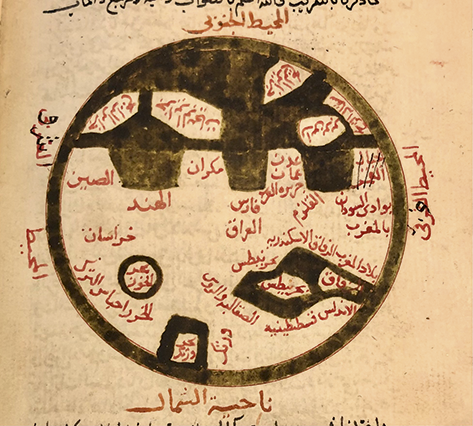
I draw from a range of largely geographical material on the Rūs, much of which is written in Arabic (Montgomery, Reference Montgomery, Brink and Price2008). The genre of geography covers a vast range of approaches and styles, much of which was influenced by classical ideas, especially in the ninth and tenth centuries as a result of the translation of major Greek geographical works into Arabic (Ahmad and Taeschner, Reference Ahmad and Taeschner2012; Gutas, Reference Gutas1998; Silverstein, Reference Silverstein2020). Some geographers subscribed to the Ptolemaic theory of the seven climes, organising the known world (and their geographical works) according to climatic zones in which climate might affect the temperament and lives of the people therein. Others operated alphabetically in their creation of geographical encyclopaedias, or organised their encyclopaedias thematically. Some geographies can be classified as ʿajāʾib – collections of wonders – though the source matrix provided in Table 1 will indicate only a limited amount of this geographical genre among discussants of Rūs funerals (Ahmad and Taeschner, Reference Ahmad and Taeschner2012; Miquel, Reference Miquel1973). At the same time, the art of map-making was in development, and we begin to see the Rūs mapped against the rest of the world (see Figure 1) (Danilenko, Reference Danilenko2021; Pinto, Reference Pinto2016).
A map of the world from Yāqūt al-Ḥamawī’s thirteenth-century geographical encyclopedia Muʿjam al-Buldān. This copy comes from MS Cod. Arab. 99 fol. 15b, Det Kongelige Bibliotek, København. The north, including the Rūs and Ṣaqāliba, is rendered towards the bottom of the map.
Across these genres we see also the development of geographical traditions. None of the writers penning material on the Rūs (and on the known world generally, since the Rūs were only a small part of much broader works) was operating in a vacuum. As such, the same gobbets of material can be identified across texts, leading to the categorisation of some geographical works into ‘schools’ or ‘traditions’ (see Sections 3.2 and 3.3 on the Jayhānī and Balkhī traditions) and the flourishing of certain ideas and ways of working with the world. As Adam Silverstein points out, though, most of those composing geographical works were not, necessarily, geographers: ‘The overwhelming majority of the authors of geographical treatises were polymaths for whom the topic of geography was but one interest amongst many, and almost always not their primary intellectual focus’ (Silverstein, Reference Silverstein2020). I note in Section 3 that I tend to refer to geographical works by their authors rather than by their titles, as a shorthand for ease of understanding (and also because many geographical works bear the same or similar titles). It should be remembered, though, that many of these authors also composed a variety of other works. Among these other forms of work are chronicles, or universal histories, within which we encounter the Rūs in the context of events such as military raids and occupations. In this Element, this genre is particularly relevant as a result of discussions of funerary rituals during the 943 Rūs occupation of Bardhaʿa, Azerbaijan (see Section 3.5).
Much of the Arabic geographical material on the Rūs has been edited, compiled, and translated in anthologies, with a particular focus on the eyewitness account of Ibn Faḍlān (Birkeland, Reference Birkeland1954; Frenkel, Reference Frenkel2015; Ibn Faḍlān, Reference Ibn Faḍlān and Togan1939, Reference Ibn Faḍlān2005, Reference Ibn Faḍlān, Lunde and Stone2012, Reference Ibn Faḍlān, Mackintosh-Smith and Montgomery2014, Reference Ibn Faḍlān and Montgomery2017; McKeithen, Reference McKeithen1979; Samarrai, Reference Samarrai1959; Seippel, Reference Seippel1928). The Arabic material in particular has been well discussed (for instance Ducène, Reference Ducène, Shepard and Treadwell2023; Hraundal, Reference Hraundal2013b, Reference Hraundal2014; Montgomery, Reference Montgomery2000, Reference Montgomery2001, Reference Montgomery, Shepard and Treadwell2023; Treadwell, Reference Treadwell2020, Reference Treadwell, Shepard and Treadwell2023). The later material, in Arabic and Persian, has not always been so widely studied.
It is helpful to bear in mind that the sources presented in this Element come from a variety of geographical traditions, rely on an array of different sources, and stand as individual geographical reactions to Rūs death rituals. Zayde Antrim frames geographical writing as a form of ‘textual performance’, prompting a variety of acts and reflections for both the reading and the aural audience. She suggests that this performance might spark a desire to alter, edit, or revise, and this is an impulse we encounter in some of the material studied in this Element (Antrim, Reference Antrim2012, p.3) – hence the value of extending our focus to consider so many Islamicate discussions of Rūs funerals, to survey the material retained by later writers even when space was at a premium. The dissemination of geographical knowledge often involved close quotation – with or without named acknowledgement – of previous geographers. Sometimes viewed as ‘plagiarism’ by medieval contemporaries and modern scholars, this method of geographical repetition allows us to see how information is used, whether expanded, abbreviated, or omitted. Much of the material in this Element survives thanks to the work of others, such as the quotations or adaptations of Ibn Faḍlān or the extended versions of al-Masʿūdī’s royal Ṣaqāliba funerals (see Sections 3.4 and 5.4).
1.3 Using This Element
After a brief treatment of Rūs (and Viking) archaeological and textual routes into the study of this topic, this Element deals with Islamicate writings on Rūs rituals, beginning with an overview matrix which presents the relevant source material. From there, I overview key patterns of transmission and overarching trends in the content and contexts of these Arabic and Persian sources, covering key themes such as the mode of funeral and sacrifice, the identity of the deceased and their sacrificial victims, evidence for ritual leaders, and cross-cultural comparisons made by the authors of these sources.
With the exception of the two lengthiest sources used in this Element (Ibn Faḍlān and Amīn Rāzī, who are therefore quoted and referenced in translation throughout this Element where necessary), the reader will find my own translations of all texts used in this study in Section 10. For biographical information on each geographer and chronicler, alongside some introductory reading and preliminary pointers about translations and editions, the reader is directed to the online material connected to this Element.
2 Viking and Norse Archaeological and Textual Evidence
The intention of this Element is to allow the Arabic and Persian material to stand on its own, in order to facilitate readings which prioritise the patterns and trends of these sources over their correlation or ‘accuracy’ relative to other source types. It is helpful, however, to briefly survey Rūs and Viking funerary rituals before introducing the Islamicate material. This section treats archaeological and textual material relating to the Viking world.
Archaeological evidence for funerary practices across the Viking world is extensive. Evidence in Ukraine and Russia (for instance at Chernihiv, Shestovitsia, Staraja Ladoga, Gnezdovo, and Rurikovo Gorodische) as well as across Scandinavia indicates a multitude of funerary practices, including cremation, inhumation, the digging of large chamber graves, boat burials, and the deposition of grave goods (Duczko, Reference Duczko2004, pp.155–188; Franklin and Shepard, Reference Franklin and Shepard1996, pp.65–68; Katona, Reference Katona2023, pp.96–98; Price, Reference Price, Brink and Price2008, Reference Price2022, pp.67–68). Among this burial evidence are several particularly lavish depositions, sometimes containing the remains of more than one person, though it is difficult to read these multiple burials as evidence of funerary sacrifice (Moen and Walsh, Reference Moen and Walsh2021, pp.604–605; Price, Reference Price, Brink and Price2008, pp.266–267; Toplak, Reference Toplak, Gardeła, Bønding and Pentz2023). This material is extensive, and archaeological sites such as Birka, Sweden have fielded particularly detailed evidence for Viking burial customs (Gräslund, Reference Gräslund1981; Ringstedt, Reference Ringstedt1997).
Though rich, the archaeological material offers a sense of the completed ritual, with details on the funerary process itself harder to glean (Price, Reference Price, Brink and Price2008, p.267, Reference Price2010). Looking to the Old Norse written material, however, does not provide much more narrative detail; there is no detailed saga description of a Viking funeral, and what can be gathered from the Old Norse source material generally relies on material written down later, after the Christianisation of Scandinavia (Roesdahl, Reference Roesdahl2022; Schjødt, Reference Schjødt, Hermann, Schjødt and Kristensen2007, p.134). Snorri Sturluson’s thirteenth-century Ynglinga Saga discusses the burning of the dead on pyres, but beyond this, the extant source material does not really offer much specificity as to earlier, pagan practices (Hraundal, Reference Hraundal2013b, p.110; Price, Reference Price, Brink and Price2008, p.257). We might supplement this material with non-Scandinavian sources, such as Adam of Bremen’s discussion in Latin of eleventh-century sacrificial rituals at Gamla Uppsala, Sweden, where dogs, horses, and men were hanged (Adam of Bremen, 2002; Hultgård, Reference Hultgård2022).
That the material is sparse and generally not incredibly narratively detailed is a key aspect of the appeal of Islamicate writings on the Rūs; in particular in the case of Ibn Faḍlān’s eyewitness account, the existence of a narrative description of a ritual viewed as Norse enough to be applicable to Scandinavian ritual has been important to scholars who have used the text to interpret archaeological evidence or to supplement the Old Norse material (Price, Reference Price2010, Reference Price, Shepard and Treadwell2023; Sass and Warmind, Reference Sass and Warmind1989; Schjødt, Reference Schjødt, Hermann, Schjødt and Kristensen2007; Warmind, Reference Warmind, Crumlin-Pedersen and Thye1995). These readings do sometimes suffer from an exclusion of cultural and ritual readings other than ‘Viking’ and ‘Slavic’, especially where Turkic cultural parallels with the contents of Rūs funerary rituals might be considered, but the sources nonetheless serve as an important textual corpus utilised by scholars of the Viking Age (Hraundal, Reference Hraundal, Burkhardt and Foerster2013a, Reference Hraundal, Shepard and Treadwell2023, pp.241–242).
3 Key Sources and Patterns of Transmission
Before discussing overall trends and the contents of the various Arabic and Persian sources on Rūs funerary rituals, it is helpful to begin with an overview of the sources we have. This is particularly important since this Element expands the range of sources under consideration, introducing new material and emphasising the links between various geographical works. As such, this section begins with a basic reference matrix, split over a series of tables, which outlines the sources to be discussed and then introduces key source groups and patterns of transmission as a means of grounding the information circulated by the geographers discussed here (see Table 1 on the following pages). The matrix offers titles of texts; henceforth, for the sake of saving space, texts will generally be referred to by the names of their authors.
This Element does not seek to be the last word on Arabic and Persian accounts of Rūs death rituals; whilst I expand the corpus of available material here (and particularly that which is available in English), it would be a mistake to consider this overview of extant accessible material an exhaustive treatment of the sources on Rūs funerals and sacrifice. Table 1, however, offers a survey of Arabic and Persian writings on both Rūs and Ṣaqāliba death rituals, presented roughly chronologically by author. Excerpted translations of everything except Ibn Faḍlān’s funerary account and its later Persian adaptation by Amīn Rāzī can be found in Section 10. Detailed biographies of individual geographers and preliminary reading recommendations can be found in the online material which accompanies this Element. The reader is strongly encouraged to make use of this for accompanying context, and moreover to read the sources presented in this matrix individually.
| Author and text | Date (AD) | Language | Nature of source | Rūs | Ṣaqāliba | Relationship to other sources in this Element? |
|---|---|---|---|---|---|---|
| Ibn Rusta, Kitāb al-Aʿlāq al-Nafīsa | Early tenth century | Arabic | Geography | Chamber burials for important men, with a female sacrificial victim | Cremation; funerary suicide by hanging for a woman who loved the deceased, then cremation | Jayhānī tradition. See also Ḥudūd al-ʿĀlam, Gardīzī, al-Bakrī, Fakhr-i Mudabbir. |
| Non-funerary sacrifice of men, women, and beasts by medicine men or physicians | ||||||
| Ibn Faḍlān, Risāla or Kitāb | Journey 921–922 | Arabic | Eyewitness report | Exposure of slaves | This version is preserved in the Mashhad compendium and in Yāqūt al-Ḥamawī’s thirteenth-century Muʿjam al-Buldān. See also Amīn Rāzī. | |
| Small boat cremations for the poor | ||||||
| Lavish boat cremations for the wealthy, with an enslaved sacrificial victim | ||||||
| Ibn Waṣīf Shāh, Kitāb Akhbār al-Zamān wa-ʿAjāʾib al-Buldān | Tenth century (quoted from around 941/942) | Arabic | History and geography | Funerary cremation | Sometimes attributed to al-Masʿūdī |
Table 1a Long description
Table outlining the sources discussed in this Element, with seven columns: Author and Text; Date; Language; Nature of Source; specific details on the Rūs, Ṣaqāliba; relationship to other sources in this Element. Each row supplies details of an individual source.
Row 1. Author and text: Ibn Rusta, Kitāb al-Aʿlāq al-Nafīsa; Date (AD): Early tenth century; Language: Arabic; Nature of source: Geography; Rūs: Chamber burials for important men, with a female sacrificial victim and Non-funerary sacrifice of men, women, and beasts by medicine men or physicians; Ṣaqāliba: Cremation. Funerary suicide by hanging for a woman who loved the deceased, then cremation; Relationship to Other Sources in this Element: Jayhānī tradition – see also Ḥudūd al-ʿĀlam, Gardīzī, al-Bakrī, Fakhr-i Mudabbir.
Row 2. Author and text: Ibn Faḍlān, Risāla or Kitāb; Date (AD): Journey 921–922; Language: Arabic; Nature of source: Eyewitness report; Rūs: Exposure of slaves, Small boat cremations for the poor and Lavish boat cremations for the wealthy, with an enslaved sacrificial victim; Ṣaqāliba: blank; Relationship to Other Sources in this Element: This version is preserved in the Mashhad compendium and in Yāqūt al-Ḥamawī’s thirteenth-century Muʿjam al-Buldān. See also Amīn Rāzī.
Row 3. Author and text: Ibn Waṣīf Shāh, Kitāb Akhbār al-Zamān wa-ʿAjāʾib al-Buldān; Date (AD): Tenth century (quoted from around 941/942); Language: Arabic; Nature of source: History and geography; Rūs: blank; Ṣaqāliba: Funerary cremation; Relationship to Other Sources in this Element: Sometimes attributed to al-Masʿūdī.
| Author and text | Date (AD) | Language | Nature of source | Rūs | Ṣaqāliba | Relationship to other sources in this Element? |
|---|---|---|---|---|---|---|
| Al-Masʿūdī, Murūj al-Dhahab | Written in 943; revised in 947 and 956 | Arabic | History and geography | On the pagans (including the Rūs and Ṣaqāliba) living among the Khazars: cremation of the dead, wives (or posthumous wives) burned alongside dead men | The information on the Sirtīn especially is echoed and sometimes expanded by al-Bakrī, al-Waṭwāṭ, and al-Dimashqī. | |
| Following the death of a king of the Sirtīn (a tribe of the Ṣaqāliba), people burn themselves and his beasts. | ||||||
| Al-Iṣṭakhrī, Kitāb al-Masālik wa l-Mamālik | Mid tenth century | Arabic | Geography | Cremation of the dead; slave girls burned with rich men | Balkhī tradition. See also Ibn Ḥawqal and al-Waṭwāṭ. | |
| Ibn Ḥawqal, Kitāb al-Masālik wa l-Mamālik, or Kitāb Ṣurāt al-Arḍ | 978–988 | Arabic | Geography | Cremation of the dead; slave girls burned with rich men. | Balkhī tradition – development of al-Iṣṭakhrī | |
| Anon, Ḥudūd al-ʿĀlam | 982–983 | Persian | Geography | Burial of the dead with grave goods | Cremation of the dead; funerary suicides by women | Jayhānī tradition |
Table 1b Long description
Table outlining the sources discussed in this Element, with seven columns: Author and Text; Date; Language; Nature of Source; specific details on the Rūs, Ṣaqāliba; relationship to other sources in this Element. Each row supplies details of an individual source.
Row 1. Author and text: Al-Masʿūdī, Murūj al-Dhahab; Date (AD): Written 943, revised in 947 and 956; Language: Arabic; Nature of source: History and geography; Rūs and Ṣaqāliba: On the pagans (including the Rūs and Ṣaqāliba) living among the Khazars: cremation of the dead, wives (or posthumous wives) burned alongside dead men; Ṣaqāliba: Following the death of a king of the Sirtīn (a tribe of the Ṣaqāliba), people burn themselves and his beasts; Relationship to Other Sources in this Element: The information on the Sirtīn especially is echoed and sometimes expanded by al-Bakrī, al-Waṭwāṭ, and al-Dimashqī.
Row 2. Author and text: Al-Iṣṭakhrī, Kitāb al-Masālik wa l-Mamālik; Date: Mid-tenth century; Language: Arabic; Nature of source: Geography; Rūs: Cremation of the dead, slave girls burned with rich men; Ṣaqāliba: blank; Relationship to Other Sources in this Element: Balkhī tradition – see also Ibn Ḥawqal and al-Waṭwāṭ.
Row 3. Author and text: Ibn Ḥawqal, Kitāb al-Masālik wa l-Mamālik, or Kitāb Ṣurāt al-Arḍ; Date: 978–988; Language: Arabic; Nature of source: Geography; Rūs: Cremation of the dead, slave girls burned with rich men; Ṣaqāliba: blank; Relationship to Other Sources in this Element: Balkhī tradition – development of al-Iṣṭakhrī.
Row 4. Author and text: Anon, Ḥudūd al-ʿĀlam; Date: 982–983; Language: Persian; Nature of source: Geography; Rūs: Burial of the dead with grave goods; Ṣaqāliba: Cremation of the dead, funerary suicides by women; Relationship to Other Sources in this Element: Jayhānī tradition.
| Author and text | Date (AD) | Language | Nature of source | Rūs | Ṣaqāliba | Relationship to other sources in this Element? |
|---|---|---|---|---|---|---|
| Miskawayh, Tajārib al-Umam wa-Taʿāqib al-Himam | Chronicle reaches the year 982 | Arabic | Universal history | Discussion of the Rūs occupation of Bardhaʿa in 943: burial of dead Rūs soldiers with grave goods, one or more sacrificial victims | See other Bardhaʿa chronicles – al-Hamadānī, Ibn al-Athīr, al-ʿAynī, Ibn Lutfūllah. | |
| Al-Bīrūnī, Taʾrīkh al-Hind, or Kitāb fī Taḥqīq mā lil-Hind min Maqūla | c. 1030 | Arabic | History and culture of India | Sets Ṣaqāliba funerary cremation in contemporary and historical context | ||
| Gardīzī, Zayn al-Akhbār | First half of the eleventh century | Persian | History; cultural history | Chamber burials for important men, with a female sacrificial victim | Funerary cremation | Jayhānī tradition; Gardīzī studied under al-Birūnī. |
| Non-funerary sacrifice of men and women by medicine men or physicians |
Table 1c Long description
Table outlining the sources discussed in this Element, with seven columns: Author and Text; Date; Language; Nature of Source; specific details on the Rūs, Ṣaqāliba; relationship to other sources in this Element. Each row supplies details of an individual source.
Row 1. Author and text: Miskawayh, Tajārib al-Umam wa-Taʿāqib al-Himam; Date (AD): Chronicle reaches the year 982; Language: Arabic; Nature of source: Universal history; Rūs: Discussion of the Rūs occupation of Bardhaʿa in 943: burial of dead Rūs soldiers with grave goods, one or more sacrificial victims; Ṣaqāliba: blank; Relationship to Other Sources in this Element: See other Bardhaʿa chronicles – al-Hamadānī, Ibn al-Athīr, al-ʿAynī, Ibn Lutfūllah.
Row 2. Author and text: Al-Bīrūnī, Taʾrīkh al-Hind, or Kitāb fī Taḥqīq mā lil-Hind min Maqūla; Date (AD): c. 1030; Language: Arabic; Nature of source: History and culture of India; Rūs: blank; Ṣaqāliba: Sets Ṣaqāliba funerary cremation in contemporary and historical context; Relationship to Other Sources in this Element: blank.
Row 3. Author and text: Gardīzī, Zayn al-Akhbār; Date (AD): First half of the eleventh century; Language: Persian; Nature of source: History, cultural history; Rūs: Chamber burials for important men, with a female sacrificial victim and Non-funerary sacrifice of men and women by medicine men or physicians; Ṣaqāliba: Funerary cremation; Relationship to Other Sources in this Element: Jayhānī tradition, Gardīzī studied under al-Birūnī.
| Author and text | Date (AD) | Language | Nature of source | Rūs | Ṣaqāliba | Relationship to other sources in this Element? |
|---|---|---|---|---|---|---|
| Al-Bakrī, Kitāb al-Masālik wa l-Mamālik | 1067–1068 | Arabic | Geography | Following the death of a king of the Sirtīn (a tribe of the Ṣaqāliba), people burn themselves and his beasts. Funerary suicide by hanging for a woman who loved the deceased, then cremation | Al-Bakrī combines information here from al-Masʿūdī with material from the Jayhānī tradition. | |
| Al-Hamadānī, Takmilat Tārīkh al-Ṭabari | Chronicle reaches the year 1094 | Arabic | Universal history | Discussion of the Rūs occupation of Bardhaʿa in 943: burial of dead Rūs soldiers with grave goods, one or more sacrificial victims | See other Bardhaʿa chronicles. | |
| Al-Idrīsī, Nuzhat al-Mushtāq fī Khtirāq al-Āfaq | 1154 | Arabic | Geography | Funerary cremation | Elements of al-Idrīsī’s work are found in the earlier works of al-Iṣṭakhrī and Ibn Ḥawqal. He is cited as a source by al-Waṭwāṭ and al-Dimashqī. |
Table 1d Long description
Table outlining the sources discussed in this Element, with seven columns: Author and Text; Date; Language; Nature of Source; specific details on the Rūs, Ṣaqāliba; relationship to other sources in this Element. Each row supplies details of an individual source.
Row 1. Author and text: Al-Bakrī, Kitāb al-Masālik wa l-Mamālik; Date (AD): 1067–1068; Language: Arabic; Nature of source: Geography; Rūs: blank; Ṣaqāliba: Following the death of a king of the Sirtīn (a tribe of the Ṣaqāliba), people burn themselves and his beasts. Funerary suicide by hanging for a woman who loved the deceased, then cremation; Relationship to Other Sources in this Element: Al-Bakrī combines information here from al-Masʿūdī with material from the Jayhānī tradition.
Row 2. Author and text: Al-Hamadānī, Takmilat Tārīkh al-Ṭabari; Date (AD): Chronicle reaches the year 1094; Language: Arabic; Nature of source: Universal history; Rūs: Discussion of the Rūs occupation of Bardhaʿa in 943: burial of dead Rūs soldiers with grave goods, one or more sacrificial victims; Ṣaqāliba: blank; Relationship to Other Sources in this Element: See other Bardhaʿa chronicles.
Row 3. Author and text: Al-Idrīsī, Nuzhat al-Mushtāq fī Khtirāq al-Āfaq; Date (AD): 1154; Language: Arabic; Nature of source: Geography; Rūs: Funerary cremation; Ṣaqāliba: blank; Relationship to Other Sources in this Element: Elements of al-Idrīsī’s work are found in the earlier works of al-Iṣṭakhrī and Ibn Ḥawqal. He is cited as a source by al-Waṭwāṭ and al-Dimashqī.
| Author and text | Date (AD) | Language | Nature of source | Rūs | Ṣaqāliba | Relationship to other sources in this Element? |
|---|---|---|---|---|---|---|
| Fakhr-i Muddabir, Shadjarah-i Ansāb, or Kitāb-i Baḥr-i Ansāb | 1206 | Persian | Genealogy and geography | Cremation and burial of the dead | Some relation to the Jayhānī tradition, but less cohesion with the other geographers writing within this tradition | |
| Ibn al-Athīr, al-Kāmil fī al-Tārikh | History reaches the year 1231 | Arabic | World history | Discussion of the Rūs occupation of Bardhaʿa in 943: burial of dead Rūs soldiers with grave goods | See other Bardhaʿa chronicles. | |
| Al-Waṭwāṭ, Mabāhij al-Fikar wa-Manāhij al-ʿIbar | Late thirteenth/early fourteenth century | Arabic | Encyclopaedia – geography and science | Cremation of the dead; slave girls burned with rich men | Following the death of a king of the pagan Ṣaqāliba, he is cremated with his slaves and attendants. | Among his sources, al-Waṭwāṭ names al-Masʿūdī, al-Bakrī, and al-Idrīsī. He also presents recognisable material from Ibn Ḥawqal. |
| Al-Dimashqī, Nukhbat al-Dahr fī ʿAjāʾib al-Barr wa-al-Baḥr | Early fourteenth century (after al-Waṭwāṭ) | Arabic | Geography | Funerary cremation | Following the death of a king of the pagan Ṣaqāliba, he is cremated with his slaves and attendants. | Working from al-Waṭwāṭ, al-Dimashqī cites al-Masʿūdī, al-Bakrī, and al-Idrīsī. |
Table 1e Long description
Table outlining the sources discussed in this Element, with seven columns: Author and Text; Date; Language; Nature of Source; specific details on the Rūs, Ṣaqāliba; relationship to other sources in this Element. Each row supplies details of an individual source.
Row 1. Author and text: Fakhr-i Muddabir, Shadjarah-i Ansāb, or Kitāb-i Baḥr-i Ansāb; Date (AD): 1206; Language: Persian; Nature of source: Genealogy and geography; Rūs: Cremation and burial of the dead; Ṣaqāliba: blank; Relationship to Other Sources in this Element: Some relation to the Jayhānī tradition, but less cohesion with the other geographers writing within this tradition.
Row 2. Author and text: Ibn al-Athīr, al-Kāmil fī al-Tārikh; Date (AD): History reaches the year 1231; Language: Arabic; Nature of source: World history; Rūs: Discussion of the Rūs occupation of Bardhaʿa in 943: burial of dead Rūs soldiers with grave goods; Ṣaqāliba: blank; Relationship to Other Sources in this Element: See other Bardhaʿa chronicles.
Row 3. Author and text: Al-Waṭwāṭ, Mabāhij al-Fikar wa-Manāhij al-ʿIbar; Date (AD): Late thirteenth/early fourteenth century; Language: Arabic; Nature of source: Encyclopaedia – geography and science; Rūs: Cremation of the dead, slave girls burned with rich men; Ṣaqāliba: Following the death of a king of the pagan Ṣaqāliba, he is cremated with his slaves and attendants; Relationship to Other Sources in this Element: Among his sources, al-Waṭwāṭ names al-Masʿūdī, al-Bakrī, and al-Idrīsī. He also presents recognisable material from Ibn Ḥawqal.
Row 4. Author and text: Al-Dimashqī, Nukhbat al-Dahr fī ʿAjāʾib al-Barr wa-al-Baḥr; Date (AD): Early fourteenth century (after al-Waṭwāṭ); Language: Arabic; Nature of source: Geography; Rūs: Funerary cremation; Ṣaqāliba: Following the death of a king of the pagan Ṣaqāliba, he is cremated with his slaves and attendants; Relationship to Other Sources in this Element: Working from al-Waṭwāṭ, al-Dimashqī cites al-Masʿūdī, al-Bakrī, and al-Idrīsī.
| Author and text | Date (AD) | Language | Nature of source | Rūs | Ṣaqāliba | Relationship to other sources in this Element? |
|---|---|---|---|---|---|---|
| Al-Nuwayrī, Nihāyat al-Arab fī Funūn al-Adab | 1314–1330 | Arabic | Encyclopaedia | Following the death of a king of the Sirtīn (a tribe of the Ṣaqāliba), funerary cremation and the burning of the king’s beasts | Al-Nuwayrī is understood to have relied heavily on al-Waṭwāṭ, but cites al-Masʿūdī as his source here and provides names which al-Waṭwāṭ omits. | |
| Al-ʿAynī, Iḳd al-Djumān fī Taʾrīkh Ahl al-Zamān | History reaches the year 1446 | Arabic | History | Discussion of the Rūs occupation of Bardhaʿa in 943: burial of dead Rūs soldiers with grave goods | See other Bardhaʿa chronicles. | |
| Amīn Rāzī, Haft Iqlīm | 1594 | Persian | Geographical encyclopaedia | Adapted version of Ibn Faḍlān’s Rūs funerary narrative – exposure of dead slaves/the poor, lavish boat cremation of important men with enslaved sacrificial victim | See Ibn Faḍlān. | |
| Ibn Lutfūllah (Müneccimbaşı), Jāmiʿ al-Duwal | History reaches the year 1678 | Arabic | World history | Discussion of the Rūs occupation of Bardhaʿa in 943: burial of dead Rūs soldiers with grave goods | See other Bardhaʿa chronicles. Ibn Lutfūllah is working from Ibn al-Athīr. |
Table 1f Long description
Table outlining the sources discussed in this Element, with seven columns: Author and Text; Date; Language; Nature of Source; specific details on the Rūs, Ṣaqāliba; relationship to other sources in this Element. Each row supplies details of an individual source.
Row 1. Author and text: Al-Nuwayrī, Nihāyat al-Arab fī Funūn al-Adab; Date (AD): 1314–1330; Language: Arabic; Nature of source: Encyclopaedia; Rūs: blank; Ṣaqāliba: Following the death of a king of the Sirtīn (a tribe of the Ṣaqāliba), funerary cremation and the burning of the king’s beasts; Relationship to Other Sources in this Element: Al-Nuwayrī is understood to have relied heavily on al-Waṭwāṭ, but cites al-Masʿūdī as his source here and provides names which al-Waṭwāṭ omits.
Row 2. Author and text: Al-ʿAynī, Iḳd al-Djumān fī Taʾrīkh Ahl al-Zamān; Date (AD): History reaches the year 1446; Language: Arabic; Nature of source: History; Rūs: Discussion of the Rūs occupation of Bardhaʿa in 943: burial of dead Rūs soldiers with grave goods; Ṣaqāliba: blank; Relationship to Other Sources in this Element: See other Bardhaʿa chronicles.
Row 3. Author and text: Amīn Rāzī, Haft Iqlīm; Date (AD): 1594; Language: Persian; Nature of source: Geographical encyclopaedia; Rūs: Adapted version of Ibn Faḍlān’s Rūs funerary narrative – exposure of dead slaves/the poor, lavish boat cremation of important men with enslaved sacrificial victim; Ṣaqāliba: blank; Relationship to Other Sources in this Element: See Ibn Faḍlān above.
Row 4. Author and text: Ibn Lutfūllah, Jāmiʿ al-Duwal; Date (AD): History reaches the year 1678; Language: Arabic; Nature of source: World history; Rūs: Discussion of the Rūs occupation of Bardhaʿa in 943: burial of dead Rūs soldiers with grave goods; Ṣaqāliba: blank; Relationship to Other Sources in this Element: See other Bardhaʿa chronicles. Ibn Lutfūllah is working from Ibn al-Athīr.
3.1 Ibn Faḍlān’s Risala
Perhaps the most notorious Islamicate source on Rūs funerary practices is Ibn Faḍlān’s eyewitness account, sometimes described as a risāla (letter) or a kitāb (book).Footnote 3 The source is the personal account of an ʿAbbāsid observer dispatched by the caliph al-Muqtadir from Baghdad to the Volga River in 921 as part of a mission to the king of the Volga Bulghārs (Ibn Faḍlān, Reference Ibn Faḍlān, Mackintosh-Smith and Montgomery2014). Notable within an extraordinary eyewitness account is his discussion of the Rūs, which involves observation of the tenth and final day of a funeral for an important man. This funerary ritual involves the sacrifice of an enslaved volunteer (on which see Section 5), the killing of animals, and the burning of a lavish boat arrangement. The ritual is presided over by a woman known as the Angel of Death (see Section 7.1).
Ibn Faḍlān has been well discussed, both by Arabists and by scholars of the Viking world (most recently, see Shepard and Treadwell, Reference Treadwell, Shepard and Treadwell2023). His account survives in multiple forms. There are at least thirteen variations, versions, or recognisable iterations of material from Ibn Faḍlān’s account (Kuleshov, Reference Kuleshov, Shepard and Treadwell2023; Treadwell, Reference Treadwell, Shepard and Treadwell2023).Footnote 4 Of relevance here are the two key forms of this account – lengthy quotations of Ibn Faḍlān by thirteenth-century geographical encyclopaedist Yāqūt al-Hamawī in his Muʿjam al-Buldān, and the fullest extant version of the source, in the Mashhad manuscript (MS Riḍawīya 5229). This latter manuscript is a copy of a compendium of four geographical and eyewitness texts compiled during the tenth century, likely around the 950s or 960s (Kuleshov, Reference Kuleshov, Shepard and Treadwell2023, pp.18–19; Treadwell, Reference Treadwell2020, Reference Treadwell, Shepard and Treadwell2023, pp.44–46). James Montgomery has translated both versions of the text, which offer the same description of the Rūs funeral (Ibn Faḍlān, Reference Ibn Faḍlān, Mackintosh-Smith and Montgomery2014, pp.244–253, Reference Ibn Faḍlān and Montgomery2017, pp.58–62).
In addition to Mashhad and Yāqūt, and several different routes of transmission and repetition in Arabic, Persian, and Ottoman Turkish, an important version of the text is the sixteenth-century Persian iteration of Ibn Faḍlān’s funerary account in Amīn Rāzī’s Haft Iqlīm. Arguments have been advanced for Amīn Rāzī’s use of an earlier source text than Mashhad or Yāqūt enjoyed access to; Luke Treadwell notes that this view has been ‘uncritically adopted’ and requires further investigation (Treadwell, Reference Treadwell, Shepard and Treadwell2023, p.63 n.106). The key appeal of this later Persian variant of the funerary narrative lies in its variations, sometimes characterised as the geographer’s attempts to ‘rationalise’ information he didn’t understand, which offer additional interpretative fodder (Price, Reference Price, Shepard and Treadwell2023; Smyser, Reference Smyser, Bessinger and Creed1965, p.95; Upham, Reference Upham2022). These variants lend themselves to interpretations of the sacrificial aspect of the funeral as a form of posthumous marriage (see Section 6.4).
3.2 The Jayhānī Tradition
One of the major groups of source information discussed in this Element is often classified as coming from the Jayhānī geographical tradition (Göckenjan and Zimonyi, Reference Göckenjan and Zimonyi2001; Hraundal, Reference Hraundal2013b, pp.71–76). It is perhaps misleading to call this a tradition or a school – rather than geographers training under each other and deliberately communicating on the coordination of information on their works, this is a collection of sources containing recognisable material understood to derive from a common source (Danilenko, Reference Danilenko2021, p.28). Among them are Ibn Rusta, Gardīzī, al-Bakrī (though not on the Rūs), and Ḥudūd al-ʿĀlam (Göckenjan and Zimonyi, Reference Göckenjan and Zimonyi2001; Smith, Reference Smith and MaCartney1930; Zimonyi, Reference Zimonyi1990, Reference Zimonyi2016).Footnote 5 Historically, scholars have pointed to the lost tenth-century geography of al-Jayhānī as the source of this information, but Jean-Charles Ducène suggests that the date does not add up against Ibn Rusta’s time of writing; he argues instead that these authors, many of whom do cite al-Jayhānī on other regions, are in fact citing an earlier text known as the ‘Anonymous Relation’ (Ducène, Reference Ducène, Shepard and Treadwell2023).
These sources (Ḥudūd al-ʿĀlam to a slightly lesser extent than Ibn Rusta and Gardīzī) present shared information on Rūs and Ṣaqāliba funerary rituals, attesting to chamber graves and funerary sacrifice among the Rūs and cremation and funerary suicide among the Ṣaqāliba. They also present information on non-funerary rituals, in the form of discussion of Rūs physicians or ritual leaders (see Section 7.2). A number of other sources within this tradition discuss the Rūs. However, they do not perpetuate this information on funerary rituals, preferring instead to focus on issues such as inheritance (see Section 9).
3.3 The Balkhī Tradition
Another geographical school relevant here, though again we should lay more weight on the individual authors themselves rather than on the lost works of an earlier geographer, is the Balkhī school, named for tenth-century geographer al-Balkhī (Ahmad and Taeschner, Reference Ahmad and Taeschner2012; Hraundal, Reference Hraundal2013b, pp.80–81). Alongside tenth-century geographer al-Muqaddasī, who does not discuss Rūs death rituals, the core geographers who fall within this geographical tradition are al-Iṣṭakhrī and Ibn Ḥawqal, who created a continuation of the former’s work with his permission (Danilenko, Reference Danilenko2021, 55; Dunlop, Reference Dunlop2012; Ibn Ḥawqal, Reference Ibn Ḥawqal and Kramers2014, 329). The close relationship between the two texts means it is possible to see what Ibn Ḥawqal has added to al-Iṣṭakhrī where Rūs funerals are concerned.
The Rūs material from this tradition is enriched by manuscript engagement. Ibn Ḥawqal’s text exists in multiple versions; the two key versions offer slightly varying readings of Rūs funerary rituals, presenting different cross-cultural comparisons (see Section 10). In addition to these two geographers, al-Waṭwāṭ quotes from Ibn Ḥawqal in some manuscript witnesses. He does not directly name his source, but includes him among a selection of other major sources on the Rūs.
This branch of sources offers information on Rūs cremation and the burning of willing slave girls alongside wealthy men. The later expansions of this material by Ibn Ḥawqal and al-Waṭwāṭ draw comparisons with funerary rituals in India and West Africa (see Section 8).
3.4 Al-Masʿūdī
Among the geographical sources which discuss the rituals of the Ṣaqāliba, a great many rely on the works of renowned polymath al-Masʿūdī, whether directly or indirectly (Hermes, Reference Hermes2012; Pellat, Reference Pellat and al-Masʿūdī2012). A prolific geographer and historian, al-Masʿūdī discusses Rūs and Ṣaqāliba funerary cremation and sacrifice on more than one occasion, both in a generalised discussion of pagan practices and in a specific enumeration of ten different types of Ṣaqāliba, in which he explains that a type called the Sirtīn hold lavish funerals for their kings which involve additional deaths. References to al-Masʿūdī in this Element pertain to discussions throughout his Murūj al-Dhahab. His Kitāb al-Tanbīh wa l-Ishrāf also survives, but does not contain discussion of Rūs death rituals. Ibn Waṣīf Shāh’s Kitāb Akhbār al-Zamān, presented in this Element, has previously been misattributed to al-Masʿūdī.
We encounter in this Element a number of subsequent geographers who make use of al-Masʿūdī’s information on the Sirtīn: al-Bakrī, al-Waṭwāṭ, al-Dimashqī, and al-Nuwayrī. While al-Bakrī produces a fairly recognisable form of the anecdote, though referring to the Sirtīn as Sirbīn, this context is missing from later versions of the anecdote because al-Waṭwāṭ (or an earlier intermediary source) felt that the ten names of Ṣaqāliba tribes offered by al-Masʿūdī were too foreign to be rendered in his own writing (MS Köprülü I Fazil Ahmed Paşa 1170 fol. 376). Nevertheless, the extended form of royal funeral found in al-Waṭwāṭ and al-Dimashqī offers an expanded assemblage of sacrificial victims burned with the Sirtīn king, including slaves and various ‘special’ attendants (see Section 5.4).
3.5 The Bardhaʿa Chronicles
Turning from the geographical to the universal histories or chronicles, we have a series of Arabic historical accounts of the 943 Rūs raid on the city of Bardhaʿa, Azerbaijan. Bardhaʿa was a prosperous trading hub once described as the Baghdad of its region (al-Muqaddasi, Reference al-Muqaddasi2001, p.331). The city was especially renowned for its fruit trees, its ibrīsm silk, its hazelnuts and chesnuts, and its market (Ibn Ḥawqal, Reference Ibn Ḥawqal and Kramers2014, p.336; Minorsky, Reference Minorsky1937, p.143; Mustawfī, Reference Mustawfī1919, pp.92–93; Nuriev and Wordsworth, Reference Nuriev, Wordsworth and Hoyland2020; Yāqūt al-Ḥamawī, Reference al-Ḥamawī and Wüstenfeld1866, p.559).
When the Rūs arrived in 943, they took Bardhaʿa’s army by surprise, swiftly overwhelming amassed forces, issuing evacuation orders, massacring much of the remaining population, and ransoming those who survived. Women and children were enslaved and raped by the occupying forces (Miskawayh, Reference Lunde and Stone2012, pp.147–149). The occupation of Bardhaʿa lasted a year and was devastating to the city and the region, precipitating an overall decline over the course of the tenth century (Birkeland, Reference Birkeland1954, pp.48–49; Ibn Ḥawqal, Reference Ibn Ḥawqal and Kramers2014, pp.337–339; Wordsworth, Reference Wordsworth, Anderson, Hopper and Robinson2018, p.147). Despite significant military efforts, the occupation only began to fail when the Rūs, unused to the famous fruits of this more southerly climate, contracted a plague of dysentery brought on by overconsumption. They therefore retreated, departing for their ships under cover of night with their loot and the women and children they had enslaved (Miskawayh, Reference Lunde and Stone2012, pp.150–151).
The key chronicle account of the Bardhaʿa occupation comes from Miskawayh’s tenth-century universal history, with subsequent historians making use of this account to present less-detailed versions of the occupation. These are al-Hamadānī, Ibn al-Athīr, al-ʿAynī, and Aḥmad ibn Lutfūllah, who abridges Ibn al-Athīr in the seventeenth century. Where the Bardhaʿa chronicles are mentioned in this Element, I refer to these five texts, with Miskawayh and al-Hamadānī in particular serving as important sources not only for Rūs burials but also for the sacrifice of men (see Section 5.2). Ibn Khaldūn also describes the occupation in detail in his fourteenth-century Arabic Kitāb al-ʿIbar, but does not discuss funerary or sacrificial rituals (Birkeland, Reference Birkeland1954, p.125).
The Bardhaʿa chronicles present Rūs burial practices. In the context of increasing deaths attributed to the plague of dysentery they were experiencing, they explain that the Rūs buried their dead with their weapons. Moreover, these chroniclers state that this is known to be true because in the aftermath of the occupation the swords of the dead Rūs occupiers were exhumed from their graves. In varying levels of detail according to the space afforded to their accounts of this occupation, chroniclers outline various grave goods and weapons and (in earlier accounts) a series of potential sacrificial victims, among them slave boys (see Section 5.2).
4 Forms of Funeral and Sacrifice
Among these various geographical traditions and chains of transmission, we encounter a variety of ideas as to Rūs death rituals. These ideas encompass the people entitled to these rituals, the mode in which their body was dealt with (namely cremation or inhumation), sacrificial victims, and grave goods. In this section, I survey some key ideas as to forms of funeral and explore how geographers dealt with and accounted for differing ideas about funerary rituals.
Ordinarily, geographers are relatively narrow in their presentations of funerary form; they explain either that the Rūs burned their dead or that they buried their dead. Of course, archaeologically speaking, both practices resonate with scholarly understandings of Rūs funerary practices (Duczko, Reference Duczko2004). Textually, however, aside from Fakhr-i Mudabbir in the thirteenth century (who understands the Rūs to have been comprised of various groups, some of whom burned the dead and some of whom buried them), geographers commonly present just one form of funerary method in their writing on the Rūs. The connotations of these behaviours, and the importance of adjacent Ṣaqāliba funerary practices, are discussed throughout Section 4.
4.1 Cremation
A common refrain across these sources is that the Rūs are a people who burn their dead. Indeed, many of the translations found in Section 10 contain identical or very closely analogous constructions of this basic information. As such, cremation is a broadly attested funerary method, though variation arises especially where sacrificial victims are involved (see Section 5). Here, it is helpful to consider Ibn Faḍlān’s framing of his Rūs funerary narrative. At the outset of his discussion of the funeral, he presents his shock concerning the rumour that the Rūs burned their dead – none of the other funerary rituals he describes, however detailed or unusual, involves cremation (Ibn Faḍlān, Reference Ibn Faḍlān, Mackintosh-Smith and Montgomery2014, pp.209, 239, 255). Watching the Rūs funeral pyre burn, he is drawn (albeit perhaps reluctantly) into conversation with a Rūs man and his interpreter (Upham, Reference Upham, Price, Bonsall and Khoury2023a, p.134). Through the translator, the Rūs man explains:
‘You Arabs, you are a lot of fools! … Because you purposefully take your nearest and dearest and those whom you hold in the highest esteem and put them in the ground, where they are eaten by vermin and worms.’
This conversation appears indicative of a prior discussion between the Rūs and Ibn Faḍlān or another member of his party regarding funerary differences. It offers a flipped perspective – just as Ibn Faḍlān and various geographers are surprised by the burning rituals of the Rūs, so too are the Rūs characterised as surprised to discover that the Arabs bury their dead. Cremation, then, carries an additional cultural shock for Muslim observers of the Rūs, in being such a dissimilar mortuary practice.Footnote 6
Aside from Ibn Faḍlān’s funerary description, we encounter cremation across the linked accounts of al-Iṣṭakhrī, Ibn Ḥawqal, al-Idrīsī, al-Waṭwāṭ, and al-Dimashqī. To this we might also add al-Masʿūdī’s joint presentation of Rūs and Ṣaqāliba cremation. Much of this material comes with sacrificial victims, who are discussed in Section 5.
4.2 Inhumation
Other source transmission chains present forms of inhumation when they discuss Rūs funerary practices. Those of the Jayhānī sources which deal with Rūs funerals describe the burial of dead Rūs men – and the fuller versions of this anecdote specify that these are important men (on which see Section 6.3) – in huge chamber burials with an array of grave goods. We encounter versions of this in Ibn Rusta, Ḥudud, and Gardīzī. Similarly, the Bardhaʿa chronicles, though not as detailed with regard to the appearance and construction of Rūs graves, testify to the burial of Rūs soldiers in the occupied town, their swords later being exhumed.
In like manner to the rich array of objects and possessions discussed in the preparation of Ibn Faḍlān’s burning boat, the Islamicate sources which deal with inhumation tend to outline a lavish selection of grave goods. These lists span food and drink, weaponry, clothing, and considerable wealth. They also, in a very objectifying fashion, list sacrificial victims (Ibn Rusta and Gardīzī from the Jayhānī tradition, Miskawayh and al-Hamadānī of the Bardhaʿa chroniclers) at the end of a summary of grave goods. These sacrificial victims (discussed in Section 5) vary in their backgrounds and identities, but serve as just one more object of many interred with dead Rūs men. The Jayhānī sources are specific in the horror of this, closing out their descriptions of extravagant grave goods with the alarming clarification that the women buried with dead men are buried alive. The Bardhaʿa sources do not specify whether sacrificial victims are still alive at the point of interment, perhaps because this was harder to verify if information on Rūs burial practices during the occupation stemmed primarily or entirely from what could be deduced once the graves had been excavated. In any case, the focus of these accounts appears to be grandiosity, with an emphasis on the scale and ostentation of the burial and its contents.
4.3 Ṣaqāliba Distinctions
It is helpful at this stage to consider the inhumation of Rūs in the Jayhānī sources (Ibn Rusta, Ḥudud, Gardīzī) against communicated information about the Ṣaqāliba in the same sources, since this offers potential reflections as to the preference in these sources for Rūs inhumation rather than cremation. In this collection of sources, it is common to find dead Ṣaqāliba burned and dead Rūs interred. Vladimir Minorsky has observed that the source text (be it al-Jayhānī or the ‘Anonymous Relation’) from which these geographers worked ‘formally distinguishes the Rūs from the Slavs’ (Minorsky, Reference Minorsky1937, p.433), and this is reflected across these three extant sources. Aside from one comment by Gardīzī in which he reflects jointly on the clothing of the ‘people of the Rūs and the Ṣaqāliba’ (Martinez, Reference Martinez1982, p.168), these sources typically emphasise difference. In presenting the intricacies of northern cultures, perhaps the source text for these geographers sought distinctive details. By offering a clear distinction between the two peoples, geographers could more easily maintain a sense of contrast and avoid an appearance of generalisation in their discussion of distant peoples.
This distinction differs somewhat from the other trails of Ṣaqāliba information dealt with in this Element. In initial discussion in his Murūj al-Dhahab, al-Masʿūdī presents Rūs and Ṣaqāliba funerary burning as a common ritual shared not only by these peoples, but also by all the pagans residing among the Khazars. When he returns to Ṣaqāliba funerary practices later in this work for his discussion of the Sirtīn, he harks back to this earlier discussion, reminding his reader that the Rūs behaved similarly. This correlating rather than distinguishing information on the Rūs and Ṣaqāliba is not fully carried over by later geographers making use of al-Masʿūdī’s information, but al-Waṭwāṭ (and, therefore, al-Dimashqī) do integrate separate ideas about Rūs burning, recognisable from Ibn Ḥawqal though not attributed to him.
It is unsurprising that there should be some variation and that the Rūs are at times aligned with and at other times contrasted with the Ṣaqāliba. The Rūs are, after all, sometimes understood as a people of the Ṣaqāliba, and sometimes understood as their enemy (Hraundal, Reference Hraundal, Shepard and Treadwell2023; Ibn Khurradadhbih, Reference Ibn and de Goeje2014, p.154). Moreover, since Ṣaqāliba often appears to function as something of a catch-all term not only for northern populations in a geographical sense, but also for the populations from which slaves known as ‘Ṣaqāliba’ were taken, this tendency to generalise about the north by applying the more recognisable of these two ethnonyms makes sense (Hraundal, Reference Hraundal2013b, p.65; Schine, Reference Schine2022, p.342). Some of the Ṣaqāliba sources I have included in this Element – namely Ibn Waṣīf Shāh, al-Masʿūdī, al-Bakrī, al-Nuwayrī (with al-Waṭwāṭ and al-Dimashqī quailing at the prospect of copying so many foreign names) – survey a number of Ṣaqāliba tribes and account for religious and ritual variation among them. Others, such as al-Bīrūnī, generalise on the Ṣaqāliba because further detail is not required. Across shifting understandings of what it meant to be Rūs or Ṣaqāliba, we thus observe within the sources discussed in this section source groups which work to firmly distinguish the Rūs from the Ṣaqāliba, and others which see little reason to emphasise the differences between the two.
5 Sacrificial Practices and Their Victims
One of the most central aspects of many of these sources, whether they deal with inhumation or cremation, is funerary sacrifice. Apart from later or condensed discussions of Rūs funerals which emphasise burning rather than ritual killing as the horrifying component of the ritual act (for instance Ḥudud, al-Idrīsī, Fakhr-i Muddabir, al-Waṭwāṭ, al-Dimashqī), or the later Bardhaʿa chronicles whose main concern is the swords with which Rūs soldiers are buried rather than the existence of sacrificial victims (namely Ibn al-Athīr, al-ʿAynī, Ibn Lutfūllah), the funerals of rich Rūs men can typically be distinguished on the basis of the killing of one person or more to accompany the dead. These sources have often been utilised as evidence for the roles and grim circumstances of Rūs women (Jesch, Reference Jesch1991, p.118; Mägi, Reference Mägi2018, p.204; Moen and Walsh, Reference Moen and Walsh2021; Upham, Reference Upham and Jakobsson2024a).
Across the Arabic and Persian Rūs funerary sources, there is considerable variation in sacrificial victim. This section handles the described identities of those who were killed – willingly or unwillingly – during the rituals presented in these texts. It covers enslaved and free victims, in addition to the more complex sacrificial assemblages of some of the Ṣaqāliba reports, and moreover surveys expressions of emotion and issues of consent.
Ahead of this discussion, however, it is perhaps helpful to consider the issue of sacrificial terminology from an anthropological approach, and to acknowledge that the funerary killings presented in these sources might not, strictly speaking, meet definitions of sacrifice (Moen and Walsh, Reference Moen and Walsh2021, pp.599–600). That is, whereas human sacrifice is generally understood as a process of making something sacred, usually for a higher power, the Islamicate funerary sources tend to present funerary killing as occurring for the deceased rather than for a deity. We can look to Miranda Aldhouse Green’s ritual criteria, which requires tangible individual or community benefits (Green, Reference Green2002, p.20).
To take Ibn Faḍlān as our lengthiest narrative example, we do not see the fulfilment of these criteria. Although the important dead man is claimed to be on a journey to his lord, and is understood by the Rūs to have earned his lord’s love in the process (Ibn Faḍlān, Reference Ibn Faḍlān, Mackintosh-Smith and Montgomery2014, p.253), the killing of his slave girl is not explicitly related to this relationship between spiritual lord and deceased enslaver. His enslaved victim is understood by the Rūs to be on her way to paradise too, but she is undertaking the journey at the behest of the dead man, who is apparently calling to her from the afterlife, rather than at the behest of a higher power. This does not necessarily diminish the understood spirituality of the ritual act, but this Arabic narrative of Rūs funerary killing is consequently highly individualised in its motivation – it does not strictly or explicitly adhere to Green’s definition of sacrifice.
We see more obvious forms of sacrifice or offering elsewhere. Ibn Faḍlān writes that when the Rūs arrive to trade, they set up wooden figurines, in front of which they leave offerings of thanks in the form of meat and the heads of slaughtered cows or sheep. These gifts are intended for a non-human recipient, though Ibn Faḍlān wryly observes that the Rūs appear unaware that their offerings are being consumed by dogs rather than by their lord (Ibn Faḍlān, Reference Ibn Faḍlān, Mackintosh-Smith and Montgomery2014, pp.243–245). Among the sources on Rūs ʾaṭibbāʾ (medicine men), Ibn Rusta discusses human sacrifices ordered and overseen by ʾaṭibbāʾ, whose victims are offerings for their god (see Section 7.2).
Geographers and chroniclers do not use a specific word to describe the act of funerary killing by the Rūs – there is no common formulation which encapsulates any aspect of this ritual, which is immensely varied in its selection of victims and method. Nor is there substantial discussion as to why a dead man might require one or several additional deaths in connection with his funeral, with the exception of al-Masʿūdī’s posthumous marriage of unmarried men (discussed in Section 6.4). In summarising these ritual fates, then, and in the absence of terminology from the geographers and historians themselves, I use ‘sacrifice’ in what follows.
5.1 Rūs Slave Girls
Principal among those killed during the funerals of important men are enslaved women. We encounter them in Ibn Faḍlān’s funerary narrative, where the slave girl he observes is plied with drink, ritually assaulted, stabbed, and strangled – this enslaved status applies to the versions of the account preserved in the Mashhad manuscript and Yāqūt’s thirteenth-century quotations, and also to Amīn Rāzī’s Persian version of the ritual. We also encounter enslaved women and girls burning of their own will in the linked accounts of al-Iṣṭakhrī, Ibn Ḥawqal, and al-Waṭwāṭ.
None of these sources dwell on the specific necessity of sacrificing an enslaved woman. For Ibn Faḍlān, the choice of sacrificial victim is exclusively enslaved – only the dead man’s slaves are invited to ‘volunteer’ (see Section 5.5). Typically, and in the case of the funeral which Ibn Faḍlān observes, it is only enslaved women who are invited to die alongside the deceased. However, there is also precedent for the canvassing of the deceased’s male slaves alongside the female slaves; I discuss this in Section 5.2. Although this is a possibility which is significant enough to have been conveyed to Ibn Faḍlān, he nonetheless reports that it is typically female slaves who volunteer.
The dead man on the banks of the Volga has surviving family, who we might assume are present for the ritual since Ibn Faḍlān elsewhere describes the metallic adornment of Rūs wives (see Section 7.1). Evidently, free Rūs women are travelling with the party, whatever their involvement in the human trafficking and other mercantile activities undertaken by this group of Rūs. To the surviving relatives – the family or household – of Ibn Faḍlān’s important dead man, one third of the deceased’s wealth is allotted, the other two thirds paying for the dead man’s funerary garments, prepared by the enslaved funerary attendants and sewn by the Angel of Death (see Section 7.1), and for the nabīdh (drink) which the funeral party is to drink on the tenth and final day of this ritual (Ibn Faḍlān, Reference Ibn Faḍlān, Mackintosh-Smith and Montgomery2014, pp.244–245).Footnote 7 Ibn Faḍlān’s ‘family’ of the dead man becomes more specific in Amīn Rāzī’s sixteenth-century Persian; rather than allotting this inheritance money to the household of the deceased, Amīn Rāzī specifies that the money goes to his ‘daughters and wives’, perhaps in reflection of adjacent geographical ideas about female inheritance among the Rūs (Amīn Aḥmad Rāzī, Reference Samadi1972, pp.28–29; Upham, Reference Upham2023b, pp.166–177).
Despite this assumed abundance of female relatives, however, there is no suggestion that one of the dead man’s free female relatives should offer herself as a sacrificial victim. Indeed, it is the dead man’s household – his family – who are responsible for canvassing his slaves for a volunteer; their participatory role requires that they find an enslaved sacrificial victim (Ibn Faḍlān, Reference Ibn Faḍlān, Mackintosh-Smith and Montgomery2014, pp.246–247). For Ibn Faḍlān, and especially Ibn Faḍlān as preserved by Yāqūt and the Mashhad compendium rather than Amīn Rāzī’s arguably marital interpolations (see Section 6.4), sacrificial victims were enslaved, typically female, and not explicitly understood to be fulfilling a marital role in the afterlife.
For al-Iṣṭakhrī, Ibn Ḥawqal, and al-Waṭwāṭ, all presenting the same recognisable kernel of information, sacrificial victims are also exclusively enslaved, and in this case are exclusively female, burned with wealthy dead men of their own will. Here, we do not see a lengthy exploration of the funerary or volunteering processes, as we do with Ibn Faḍlān’s funerary narrative, so we do not receive a sense of who among a dead man’s slave girls might have been considered an appropriate sacrificial victim, or whether a choice was offered in similar manner to Ibn Faḍlān’s Rūs slaves. Instead, as we will explore in Section 8, Ibn Ḥawqal and al-Waṭwāṭ are among the geographers who furnish their Rūs sacrificial information with cross-cultural comparisons which draw on African and Indian practices.
These sources use the same terminology to refer to the enslaved women killed during these funerals: they call them jāriya (pl. jawārī). In the same way, Ibn Faḍlān’s other references to enslaved women – to the enslaved women assaulted and sold by Rūs slavers in the houses they build on the banks of the Volga River, to the enslaved women assigned to guard over the funeral’s sacrificial victim, and to the enslaved women who wait on and are used sexually by the fabled Rūs king and his comrades – similarly refer to jawārī (Ibn Faḍlān, Reference Ibn Faḍlān, Mackintosh-Smith and Montgomery2014, pp.242, 246, 252). For geographers writing in Arabic about Rūs slave girls, jāriya is the common term.
Yet the language of slavery is often considered ambiguous, especially where terminology must be translated into English (Barker, Reference Barker2019, pp.14–15; Brink, Reference Brink2021b, pp.122–124; Karras, Reference Karras1988, pp.1–2; Marmon, Reference Marmon, Perry, Eltis, Engerman and Richardson2021, p.187; Myrne, Reference Myrne2019, p.206 n.42). Jāriya is a commonly used term indicative of female slavery. Lamia Balafrej writes:
Although the term could also designate a free young woman, in Arabic jāriya was most often employed for a female slave, regardless of age; preferred to less ambivalent denominations such as ama, it was the word of choice in the slave trade’s written record.
Owing to this ambiguity, however, in that jāriya also has the potential to refer to young women who are not enslaved, there has been some disagreement as to the precise circumstances of these enslaved Rūs sacrificial victims which has sometimes led them to be characterised as ‘young maidens’ rather than slaves (Upham, Reference Upham and Jakobsson2024a, pp.29–31).
Honing our consideration of the enslaved status of these sacrificial victims beyond these suggestions of their unfreedom, we might also look to the broader connotations of jāriya in medieval Arabic writing. Surveying the often euphemistic language used to refer to slaves in Arabic, Shaun Marmon calls jāriya ‘juvenilizing’ – it is literally ‘little girl’ or ‘young girl’ – observing further that uses of this term to refer to female slaves often bore sexual connotations (Marmon, Reference Marmon, Perry, Eltis, Engerman and Richardson2021, p.202). As Neil Price points out, these jawārī were often truly juvenile, barely more than teenagers (Price, Reference Price2010, p.136). Contextually speaking, these sacrificial victims were relatively young, and – as is supported by Ibn Faḍlān’s account of the repeated assault of jawārī in funerary and non-funerary settings – sexually exploited at the same time as they were exposed to violent and fatal ritual practices.
We might also consider the race of the sacrificial jawārī of these accounts, an issue elided when the trafficked status of these young women is under-acknowledged by scholars and translators. In the absence of discussion or acknowledgement by geographers as to the anticipated ethnicities of these sacrificial victims, and in light of the deracination of these women – if not by their enslavers, then certainly by these geographers – once they were forcibly integrated into Rūs society, it is useful to consider the earlier trafficking to which these women had likely been subjected. This contributes to our broader understanding of the serious circumstances of a jāriya’s position among the Rūs, the better to reckon with the issues of scholarly sensitivity which we will visit in Section 5.5.
For traffickers, slaves were racially understood via their jins (pl. ajnās) – their race, type, or tribe, or even stock – a declared origin point (Schine, Reference Schine2022, p.334). Not inherently a mode of categorising and racing slaves, this tool nonetheless lent itself to the language of human trafficking.Footnote 8 Marmon writes:
[Jins] is a neutral unit of classification in any taxonomy, a tool for ordering things, animate or inanimate. Jins, as a way of ordering human beings, was inexorably linked to slavery. Within this context, jins and its plural ajnas might best be understood as categories of the enslaveable other.
These ajnās were heavily discussed by those in the business of human trafficking, informing purchase contracts, hierarchies and rankings of desirable slaves, and ideas as to the characteristics of slaves from specific ajnās (Myrne, Reference Myrne2019, pp.207–214). They were not necessarily a precise indicator of a slave’s race, but rather served as something of a ‘marketing tool’ which marked a trafficked person as enslaveable (Marmon, Reference Marmon, Perry, Eltis, Engerman and Richardson2021, p.206). The characteristics associated with a given jins informed broader thinking on slavery. An eleventh-century treatise on examining and purchasing slaves written by Christian theologian and physician Ibn Buṭlān neatly exemplifies this. One of many treatises or manuals on the purchase of slaves, in a genre which had been developed from earlier Greek treatises (Barker, Reference Barker2019, p.4, Reference Barker2016, pp.3–4; Myrne, Reference Myrne2019, pp.199–200), Ibn Buṭlān’s Risāla reflects, for example, on the barrenness of Ṣaqāliba women and describes Turkish women as ‘treasure mines for children’ (translation in Lewis, Reference Lewis1987, pp.246–250).
Geographical applications of ideas about ajnās could vary somewhat, though there was still room for what Rachel Schine identifies as ‘exonymic slippage’. Ibn Faḍlān, for instance, has a tendency to refer to the Volga Bulghārs to whom he has been sent by the name ‘Ṣaqāliba’, likely influenced by the vast numbers of Ṣaqāliba slaves trafficked into the ʿAbbāsid Caliphate (Jankowiak, Reference Jankowiak2017; Schine, Reference Schine2022, p.342). For Ibn Faḍlān, racial understandings of the ajnās of those with whom he interacts are influenced by the categories applied to those who are enslaved.
Many geographers concern themselves with the trafficking activities of the Rūs and their neighbours. Al-Iṣṭakhrī writes that the pagans enslaved by the Khazars – among whom, al-Masʿūdī tells us, are the Rūs and Ṣaqāliba – sell their children into slavery (translation in al-Iṣṭakhrī, Reference Ibn Faḍlān, Lunde and Stone2012, p.156). Ibn Rusta and Gardīzī write that the Rūs kidnap the Ṣaqāliba and sell them along the trafficking networks of the Volga River (Ibn Rusta, Reference Rusta, Lunde and Stone2012, p.126; Jankowiak, Reference Jankowiak, Biermann and Jankowiak2021, pp.162–163; Martinez, Reference Martinez1982, p.167). Al-Maqdisī in the tenth century and Yāqūt in the thirteenth echo this, while Ḥudūd writes that the Rūs keep the Ṣaqāliba as slaves to serve them (Maqdisī, Reference Maqdisī1907, pp.62–63; Minorsky, Reference Minorsky1937, p.159; Samarrai, Reference Samarrai1959, p.120). Al-Masʿūdī notes that women and children were seized by the Rūs during an early tenth-century raid on the Caspian Sea (Masʿūdī, Reference al-Masʿūdī, Lunde and Stone2012, p.145), and the Bardhaʿa chronicles testify to the rape and enslavement of, variously, women and children, women, and beautiful women (Upham, Reference Upham2024b, pp.447–448). This is by no means an exhaustive list of Rūs trafficking – Fakhr-i Mudabbir, like Ibn Rusta and Gardīzī before him, briefly notes that the Rūs enslave the Ṣaqāliba, while Ibn Ḥawqal informs us that all Ṣaqāliba slaves pass through al-Andalus, in large part because Ṣaqāliba slaves intended to be sold as eunuchs are castrated in the area around al-Andalus (Frye, Reference Frye1950, p.23; Ibn Hawqal, Reference Lunde and Stone2012, p.173).
This does not tell us the background of the jawārī involved in the sacrificial rituals described in these sources, but it does offer a sense of the varied trafficking networks in which the Rūs were involved. Many jawārī may well have been enslaved Ṣaqāliba girls, perhaps with somewhat adjacent beliefs if we are to consider the interchangeability of Ṣaqāliba and Rūs in al-Masʿūdī’s generalised discussion of pagan funerary practices. But still others will have arrived from further afield, from vastly different cultures and vastly different belief systems – in particular, we might consider the women and children enslaved at Bardhaʿa, who would have been Muslim and Christian.
Regardless of these flattened identities, these women participated (willingly or not) in a major Rūs ritual activity. Alice Rio observes that those enslaved and traded onwards by the Rūs had a tendency to assume ‘a strong social and cultural role’ in societies such as that of the Rūs, even where their interactions with and experience of Rūs society was fleeting (Rio, Reference Rio2024, pp.27–28). In these geographical accounts, Rūs jawārī appear to buy in to the system in which they have been enslaved; many of these jawārī are presented as having volunteered for their own killing, or were otherwise reportedly burned of their own will. Ibn Faḍlān’s sacrificial jāriya goes a step further; she participates in the overall fabric of the ritual, even vocalising an image which the Rūs are to recognise as paradise when she is lifted to look over a door frame (Ibn Faḍlān, Reference Ibn Faḍlān, Mackintosh-Smith and Montgomery2014, p.249). Whether a sign of true spiritual conviction in line with Rūs or adjacent beliefs, the recitation of a required series of descriptive lines perhaps fed to her by the Angel of Death, or the result of her excessive intoxication, this enslaved cultural outsider becomes a central voice for the expression of Rūs ritual ideas and beliefs. This is only amplified by the rarity of female voices in Ibn Faḍlān’s account (Upham, Reference Upham, Price, Bonsall and Khoury2023a, p.133); the jāriya is a spokesperson for the rituals of a culture into which she has been trafficked.
This section has accounted only for those women whose status is specifically marked as enslaved. As will become clear in Section 5.3, the status and circumstances of other women involved in Rūs funerary rituals can be unclear. Some of the women presented as sacrificial victims in Miskawayh’s Bardhaʿa funerary account, for instance, may well have numbered among the enslaved Muslim and Christian women of the occupied city. In the cases discussed earlier in this section, though, we can be relatively unequivocal as to the unfree status of these women, and benefit from the consideration of their circumstances not only as widespread victims of funerary sacrifice, but as young women forcibly displaced from their homes.
5.2 Rūs Slave Boys
Alongside the sacrifice of enslaved women and girls, a number of Arabic sources on Rūs funerary practices testify to the sacrifice, or hypothetical sacrifice, of enslaved men and boys. My discussion in this section focuses on three sources: Ibn Faḍlān’s funerary account as it appears in Arabic, and the Bardhaʿa funerary accounts of Miskawayh and al-Hamadanī.
As I outlined in the previous section, the choice of sacrificial victim in the format of funeral witnessed by Ibn Faḍlān required that the deceased’s slaves be canvassed for a ‘volunteer’ who is to be killed and burned with the dead man. In what I have argued elsewhere could be a sleight of hand intended to suggest he witnessed more than he actually did, Ibn Faḍlān presents both a generalised version of the funerary volunteering process and the scenario specific to the funeral he witnesses (Upham, Reference Upham, Price, Bonsall and Khoury2023a, p.130). In the generalised case which comes first, Ibn Faḍlān explains that the family of the deceased ask the dead man’s slave girls and slave boys: ‘Who will die with him?’ (Ibn Faḍlān, Reference Ibn Faḍlān, Mackintosh-Smith and Montgomery2014, pp.246–247).
At this juncture, as established in Section 5.1, Ibn Faḍlān explains that the volunteer tends to be female, even when male and female slaves are canvassed. In the specific funeral he witnesses, it is only the dead man’s jawārī who are asked to volunteer. No reason is offered as to why the pool of potential sacrificial victims is limited, or why this pool might include male victims in the first place. Later in his funerary narrative, when Ibn Faḍlān is describing the creation of noise as the sacrificial victim is assaulted, stabbed, and strangled (discussed in Section 5.5), he explains that the screams of the jāriya must be drowned out so that potential future victims could not hear her reaction to the experience: ‘Otherwise, it would terrify the other female slaves, and they would not seek to die with their masters’ (Ibn Faḍlān, Reference Ibn Faḍlān, Mackintosh-Smith and Montgomery2014, pp.250–251). By this stage, then, Ibn Faḍlān appears to have accepted the role of sacrificial victim as a distinctly female one, despite having earlier accounted for the possibility of male sacrificial victims.
Compared to the enslaved women discussed in Section 5.1, enslaved male victims have been relatively overlooked, but scholars are beginning to direct attention to these funerary sacrificial victims (Moen, Reference Moen, Gardeła, Bønding and Pentz2023; Moen and Walsh, Reference Moen and Walsh2021, p.602; Montgomery, Reference Montgomery and Maróth2004, p.59 n.11; Upham, Reference Upham2024b, Reference Upham2023b, pp.229–239). In particular, attention has focused on the subject of male sacrifice in Ibn Faḍlān; in contrast to the Bardhaʿa chronicle sources discussed next, Ibn Faḍlān’s ritual narrative is detailed enough to contain lengthy discussion of sexual activity. This has led to questions, left unanswered by Ibn Faḍlān and his informants, as to how the ritual might have appeared had the victim in this specific case been male. Moen and Walsh write: ‘Would the ensuing rituals have looked the same or very different, and would the scholarly treatment of the text have been different, had it been a male slave at the end of the knife?’ (Moen and Walsh, Reference Moen and Walsh2021, p.602).
This is a question which we might consider in conjunction with the Bardhaʿa chronicle accounts of Miskawayh and al-Hamadanī. Ibn Faḍlān does not devote much peripheral attention to slave boys in his discussion of the Rūs – they are not present in the debauched mercantile tableau he offers of Rūs slavers assaulting the slave girls they will imminently sell, nor are they ancillary participants in the funerary ritual as is the case for the two jawārī dubbed the daughters of the Angel of Death (discussed in Section 7.1), nor do they feature among the enslaved attendants in the Rūs king’s palace (Ibn Faḍlān, Reference Ibn Faḍlān, Mackintosh-Smith and Montgomery2014, pp.243, 247, 253). Indeed, slave boys are not even listed among the merchandise of the Rūs, when they make their offerings to their lord in the hope of good trade – by Ibn Faḍlān’s telling, merchants only explain that they have jawārī and sable pelts to sell (Ibn Faḍlān, Reference Ibn Faḍlān, Mackintosh-Smith and Montgomery2014, pp.242–245). As a result, we do not receive from Ibn Faḍlān a strong sense of how the Rūs might have felt about their slave boys, or an idea as to how this might affect their involvement in the funerary rituals of the Rūs. The Bardhaʿa chronicles, in contrast, offer a significant emotional caveat. Miskawayh, echoed with slight abbreviations by al-Hamadanī, explains that a slave boy might be buried with a dead Rūs soldier, but only if he loved him. In these two cases, the sacrifice of a male slave occurs alongside the sacrifice of a female victim and arises only on the basis of sufficient emotional regard.
It is worth interrogating this emotional regard, which has been somewhat downplayed by some translations of this material and thus has eluded scholars of the Viking Age (Upham, Reference Upham2024b: 454–455). The formulation of love offered is not overly complex, though there is admittedly room for interpretation as to which ‘he’ loved which ‘him’ in the Arabic of both Miskawayh and al-Hamadānī – in kāna yuḥibbuhu (Meskawayh, Reference Meskawayh and Hassan2018, p.268; Seippel, Reference Seippel1928, p.84). My reading prioritises the emotions of the dead man as likely to be more significant than the feelings of the potential sacrificial victim, and so I understand this as the love of the deceased for his dead slave boy. This is informed in part by the use of a similar formulation to describe the female sacrificial victims of Ibn Rusta’s Rūs funerary account – the woman the dead man loved – which might imply a broader understanding of the supremacy of the emotions of the deceased over those of a potential victim (see Section 5.3).
Semantically, this form of love – ḥubb – is not an overly intense emotional state. It is used in the Qurʾān as an expression of love for God, and later Arabic literature tends to use the term to connote divine love. In other contexts, ḥubb does not tend to be a particularly erotic, intense, or passionate form of love, and it is certainly not the most poetic term which these chroniclers could have employed (Arkoun, Reference Arkoun2012; Bray, Reference Bray2017, p.13; Chittick, Reference Chittick, Levin and Post2010, pp.170–171; Lumbard, Reference Lumbard2007, p.347 Obiedat, Reference Obiedat, Korangy, al-Samman and Beard2017). Instead, we might read ḥubb as indicative of a strong and established level of love, which is not exoticised or made scandalous by Miskawayh and, later, al-Hamadānī (Upham, Reference Upham2024b).
There are two aspects of the sacrifice of these beloved slave boys which we might now interrogate: the connotations and implications of this love with regard to the use and abuse of trafficked people, and their status as slave boys. I begin with the latter, as a means of grounding my reflections on broader contextual understandings as to love for and the assault of slave boys.
As was the case in the sources attesting to the sacrifice of slave girls, these three sources are uniform in their designation of male sacrificial victims as ghulām (pl. ghilmān) – as slave boys. Perhaps more so than Rūs jawārī, Rūs ghilmān have struggled to make themselves visible in the translated textual material, where they are often rendered simply as servants. As with jāriya, this term carries with it some ambiguity, being representative not only of enslaved men and boys, but also of servants (Barker, Reference Barker2019, p.14). It could also refer to free young boys. Everett Rowson surveys these meanings, writing: ‘A ghulām is a “boy”, especially a pre-pubescent or pubescent one. By extension, the word is also commonly used to refer to a male slave, of any age, and can be applied, as a euphemism, specifically to a eunuch’ (Rowson, Reference Rowson, Farmer and Pasternack2003, p.48). In keeping with the frequency with which it appears alongside an equivalent female term denoting slavery, ghulām is best read in this source material as denoting enslaved boys.Footnote 9
The Bardhaʿa chroniclers know that prior to their military losses, gastrointestinal afflictions, and subsequent funerals, the Rūs had enslaved children at Bardhaʿa. More so than that, Miskawayh writes that the Rūs not only enslaved, but also raped the women and children of Bardhaʿa. In initial reference to this, he offers a collective noun for the children but later, in describing how the Rūs trafficked their slaves out of Bardhaʿa as they retreated, he explains that the Rūs took women, boys, and girls (Meskawayh, Reference Meskawayh and Hassan2018, pp.266–268). Here, then, is a casual allusion to the sexual assault of boys who doubtless became ghilmān to their Rūs enslavers.
For a chronicler like Miskawayh, it would not have been particularly surprising or shocking to imagine that a slave boy might be sexually abused. Although sexual activity with a male slave – irrespective of who owned the slave – was not a licit activity as the sexual abuse of female slaves was, non-geographical Arabic sources make frequent references to the sexual uses of ghilmān (Rowson, Reference Rowson2008, pp.198–199). That a ghulām might be sexually abused did not, therefore, have to be explicitly stated, though it is not, of course, a verifiable component of the soldier–ghulām relationship as we might understand it from the Bardhaʿa chronicles. These chronicle accounts are predominantly concerned with accounting for the events of the military occupation and Rūs military capabilities, hence the targeted interest of later chroniclers not in the overall burial assemblages, but in the swords excavated from Rūs graves. Nonetheless, there is in this presentation of information by Miskawayh and al-Hamadānī a quiet declaration of the hypothetical love which a Rūs soldier might feel for a member of a demographic (boys and youths enslaved by the Rūs) who the Rūs were known to have sexually abused.
This is a fraught presentation of a love which we might read as homosexual, or at least homosocial, in a funerary sacrificial context. Certainly the skewed power dynamics of enslaver and enslaved must be fully acknowledged, and it is useful to consider that Miskawayh, as the first purveyor of this information, does not volunteer any ideas as to consent and willingness in this sacrificial ritual. This Rūs love must therefore be handled with extreme care.
Among the Rūs, the funerary sacrifice of slave boys is attested to, but largely in hypotheticals or general terms. There were certainly male victims of funerary and non-funerary rituals in this body of sources; I discuss the non-funerary sacrifice of men by Rūs ʾaṭibbāʾ in Section 7.2. In funerary contexts, men number among the sacrificial victims of the Ṣaqāliba – the identities of the enslaved and free boys and men listed as sacrificial victims in the works of al-Waṭwāṭ and al-Dimashqī are discussed in Section 5.4. Among the Rūs, though, there is a reasonable amount of evidence that the practice of sacrificing ghilmān during the funerals of men must have been widespread enough – and therefore well known enough among these commentators – to be considered worth mentioning alongside the sacrifice of free and enslaved women.
5.3 Rūs Women
Turning now to other sacrificial victims of Rūs funerary rituals, we find various discussions of female victims who are not presented as enslaved. Among the Jayhānī sources which account for the death of a sacrificial victim (Ibn Rusta and Gardīzī), al-Masʿūdī’s discussion of joint Rūs–Ṣaqāliba pagan rituals, and the Bardhaʿa chronicles, women emerge as various kinds of cremated and buried sacrificial victims.
Perhaps the most shockingly visceral of these sacrificial accounts are the funerals of important Rūs men presented by Ibn Rusta and Gardīzī. While other geographers and historians within this general tradition (particularly Ḥudud) focus their attention on other aspects of this funerary narrative, namely the inanimate components of the important dead man’s funerary assemblage, Ibn Rusta and Gardīzī conclude their descriptions of chamber graves the size of a house, replete with extensive grave goods, by mentioning the inclusion of a female victim.
Ibn Faḍlān aside, these sources perhaps constitute our most extensive narrative account of precisely how a Rūs sacrificial victim might die. Whereas other sources, especially those discussing cremation, do dwell briefly on the process of burning women, Ibn Rusta and Gardīzī distinguish themselves by contemplating the process of sacrificial death. They do similar, too, when they discuss the funerary suicides of Ṣaqāliba women following the deaths of men (see Section 5.4). In the case of the Rūs, Ibn Rusta and Gardīzī explain that the woman the dead man loved is placed in the grave alongside him. Both geographers carefully explain that she remains alive in the grave while the Rūs seal the top of the grave. It is thus that she dies – suffocated in the chamber grave, having been buried alive.
These women are, we might assume, the wives of the important Rūs men. The language of these geographers does not explicitly suggest slavery and refers simply to women or wives. However, in Ibn Rusta’s case, these women are distinguished emotionally. In the same manner that the ghilmān of Miskawayh and al-Hamadānī’s Bardhaʿa chronicles are only sacrificed in the event that their enslaver loves them (see Section 5.2), Ibn Rusta pinpoints the identity of the victim on the basis that she is the woman the dead man loves (Upham, Reference Upham2024b, 451). This could be indicative of the existence of multiple women from whom a victim might be chosen for this grim asphyxiation, but Ibn Rusta’s account focuses on the nature of the sacrificial victim’s death rather than on the process of selection and any ideas as to the victim’s willingness. It is noteworthy, though, that this account offers a sense that funerary sacrifice revolves around the emotions (and specifically love, in the same manner as is discussed in Section 5.2) of the deceased.
Women are also the sacrificial victims of al-Masʿūdī’s discussion of pagan (Rūs and Ṣaqāliba) practices among the Khazars. Presenting cremation, rather than inhumation as we have just seen with Ibn Rusta and Gardīzī, al-Masʿūdī writes that pagan men are burned with their women. We can read these women as wives on the basis of his subsequent discussion of the posthumous marriage of unmarried men (see Section 6.4). The wives of dead pagan men, then, are burned alive, though not necessarily entirely willingly – I discuss consent to these sacrificial rituals in Section 5.5. Any willingness these women have to participate in the act apparently stems from a belief that such a ritual act – being burned alive on their husbands’ funeral pyres – will allow them to enter paradise.
In accounting for the funerary fates of these Rūs wives, al-Masʿūdī offers an unusual additional reflection by accounting for the reverse mortuary situation. But whereas the wives of dead men are burned, he says, women who predecease their husbands are not afforded the reverse ritual during their funeral: husbands are not burned for their wives. I return to this in Section 6.2.
Further discussion of the sacrifice of free women arises in the earlier of the Bardhaʿa chronicles – those written by Miskawayh and al-Hamadānī. In the case of Miskawayh, multiple types of women are offered as sacrificial options in a brief notice which does not fully account for modes of sacrifice and explains simply that these women are buried with the dead Rūs men. None of his descriptors for these women is automatically indicative of slavery, though we might deduce from the presentation of options that some of these women might have been enslaved. In al-Hamadānī’s chronicle, the abbreviation of the account leaves us with only one type of woman who is to be buried. In both instances, these women might constitute the only sacrificial victim of the dead Rūs soldiers, or might be buried alongside a ghulām, as discussed in Section 5.2. Unlike these male victims, however, there is no opinion conveyed as to the ascribed emotions of the deceased Rūs men – how they felt about the women buried alongside them is not specified.
The precise reasoning behind the necessity of a woman – married or not – among the funerary assemblages of dead Rūs men is not offered. In the cases discussed earlier in this section, though, the practice appears to be understood by geographers and chroniclers as relatively universal. That is, it is not a particularly conditional practice, but rather it is something of a given for these writers that if a Rūs man dies, his wife should be killed during the funerary process.
It is difficult to extrapolate or generalise from this material. I discuss in Section 6.4 the relatively limited extent to which the Islamicate sources account explicitly for the potential practice of posthumous marriage by the Rūs. Some of these sources, moreover, speak to specific and rather isolated cultural contexts: al-Masʿūdī refers to the combined practices of various pagans living among the Khazars, while the Bardhaʿa accounts are a snapshot of a year in the life of military occupiers far from home. Across a range of funerary modes, they offer varied reflections on the female victims of Rūs funerary rituals.
5.4 Sacrifice and the Ṣaqāliba
As a follow-up to the discussion of Rūs sacrificial victims, it is worthwhile to consider the Ṣaqāliba, especially because there is at times an overlap in discussions of the practices of the two peoples. In this section, I survey the funerary victims of the Jayhānī sources (Ibn Rusta, al-Bakrī, and Ḥudud), but devote particular attention to the victims of the royal funerary rituals initially associated with al-Masʿūdī’s Sirtīn.
As far as the death of others during the funerals of Ṣaqāliba men is concerned, the Jayhānī sources are slightly more retentive of this sacrificial material than they are of the equivalent information on funerary deaths among the Rūs. Whereas only Ibn Rusta and Gardīzī retain information about the funerary sacrifice of Rūs women, we encounter funerary suicides of Ṣaqāliba women in Ibn Rusta (Gardīzī’s material on Ṣaqāliba funerals is slightly abbreviated, omitting the act of suicide), in al-Bakrī and Ḥudud. Of these two latter sources, Ḥudud omitted the sacrifice of Rūs women from its account of Rūs burial practices, while al-Bakrī omitted the Jayhānī material on Rūs funerals in favour of other material, namely the eyewitness material of tenth-century traveller Ibrahīm Ibn Yaʿqūb (Smith, Reference Smith and MaCartney1930, p.210). As I discuss throughout this section, though, al-Bakrī synthesises multiple sources in his discussion of the Ṣaqāliba, combining this Jayhānī material on funerary suicides with al-Masʿūdī’s material on the Sirtīn which is discussed in this section.
The overall premise of this Ṣaqāliba funerary material appears to be that in the aftermath of the death of a Ṣaqāliba man, one of his women (his only woman, in the case of Ḥudud, but one of his three women in Ibn Rusta), on the basis of her love for him, will kill herself. The mode of killing is not specified in the abbreviated version of this material in Ḥudud, but Ibn Rusta and al-Bakrī present a detailed tableau involving the construction of posts from which the woman can hang herself. As with the Rūs, Ibn Rusta dwells on the asphyxiation of female accompaniments to dead men. Similarly, al-Bakrī writes that she is left hanging and struggling through this grisly end. Following this, she is cut down and burned.
The timing of this ritual is not entirely clear. It appears that this funerary suicide might have been understood to occur a year after the death of a Ṣaqāliba man, following a gathering atop the hill or mound in which the man’s funerary urn is buried and on which hives of bees have been placed. These sources do not seem to suggest that the Ṣaqāliba woman who has chosen to kill herself is subsequently burned alongside the corpse of her husband. Rather, in al-Bakrī’s case, this cremation process is framed as a means by which the woman is able to join the dead man.
There is an implication of willingness in this narrative of funerary suicide. These women use their suicides as a means of declaring their love (in the same sense as we encounter among the Rūs ghilmān discussed in Section 5.2, and the Rūs women buried alive in Section 5.3) for the dead man. As such, consent might be presumed; if this love did not exist, particularly if these Ṣaqāliba women are given a year in order to think about this, then perhaps this suicide was not expected, mandated, or otherwise socially coerced by the Ṣaqāliba. In describing the process by which the suicide is undertaken, moreover, weight is laid on the actions of the woman who is to die. It is she who erects the posts from which she will hang herself; the Ṣaqāliba bystanders to this ritual are mostly inactive until the woman is dead.
The other Ṣaqāliba funerary and sacrificial tradition in evidence in this Element’s source material is that of kings. Specifically, the practices of pagan kings of the Sirtīn, a jins (people, type, or tribe) of the Ṣaqāliba, are presented first by al-Masʿūdī and subsequently by a range of geographers outlined in the following paragraphs of this section. Some of these later geographers offer additional detail on sacrificial victims, and some omit the name of this particular type of Ṣaqāliba. This sacrificial assemblage, consisting of various people with specific societal functions, is quite distinct from the other forms of funerary sacrificial arrangement which we find among the sources surveyed earlier in this Element.
The Sirtīn (Sirbīn for al-Bakrī) are among al-Masʿūdī’s ten types of Ṣaqāliba, and are apparently a formidable group feared by their neighbours. In the initial form of the anecdote as found in al-Masʿūdī, it is explained that the Sirtīn burn themselves when their king or leader dies, alongside the king’s beasts. Al-Bakrī and al-Nuwayrī follow suit in the eleventh and fourteenth centuries respectively, explaining as al-Masʿūdī does that this funerary custom is comparable to the customs of India (see Section 8.1). Across these sources, the extent of funerary burning is not interrogated, nor is the identity of those who might be burned.
This changes with al-Waṭwāṭ and, as a result, al-Dimashqī. These geographers, neglecting to engage fully with al-Masʿūdī’s ten types of Ṣaqāliba on the basis that their names are too foreign and thus difficult to copy, focus instead on the distinction between the Christian Ṣaqāliba and those without religion, far to the north. In this iteration of the burning of pagan Ṣaqāliba kings, a very specific list of sacrificial victims is presented, among them male and female slaves, though using ʿabd and ama for these slaves, rather than ghulām and jāriya as was the case in Sections 5.1 and 5.2, both common and unequivocal indicators of enslaved status (Barker, Reference Barker2019, p.14). The sacrificial arrangement included, additionally, the king’s women, and a series of staff considered special to the king: his kātib – a secretary or clerk, a vizier or assistant (wazīr), a companion or associate (nadīm), and his ṭabīb – a medicine man or physician (see Section 7.2 for Rūs medicine men). The assemblage skews towards the professional, perhaps implying the perceived necessity of these attendants after death, and is noteworthy in its human cost when compared against the other sacrificial accounts of this region.
Its character is somewhat reminiscent of al-Bakrī’s description of the funerals of the kings of the city of Ghāna (see Section 8.2), who are similarly pagan (though many of the king’s officials and ministers were Muslims). Al-Bakrī describes the construction of a large tomb in which the king is placed on a bed with grave goods, weapons, food and drink, and the ‘men who used to serve his meals’ (translation in Levtzion and Hopkins, Reference Levtzion, Hopkins and Hopkins1981, pp.80–81).
These fourteenth-century iterations of al-Masʿūdī’s Sirtīn stand out from the other sources surveyed, offering a picture of excess which exceeds even the lavish funeral witnessed by Ibn Faḍlān in terms of its human cost. Even so, the pagan Ṣaqāliba kings remain rooted in somewhat more humble tenth-century ideas. Al-Masʿūdī closes his discussion of the Sirtīn’s funerary practices by reminding the reader that the funerary burnings of the Ṣaqāliba and Rūs have been discussed at an earlier stage in his work. Why al-Waṭwāṭ (and by extension al-Dimashqī) offer such an expanded version of this account, with specific job titles for the free men sacrificed alongside the king, is unclear, but their specificity offers good potential for the consideration of the mortuary attendants which these thirteenth- and fourteenth-century geographers understood a pagan king of the Ṣaqāliba to require.
5.5 Reckoning with Sacrificial Experiences
One aspect of these sacrificial practices on which some geographers and commentators have ruminated, and which scholars are increasingly beginning to consider, is the experience of the sacrificial victims. Ibn Faḍlān offers some poignant discussions of the consent and willingness of his sacrificial victim, while geographers such as al-Masʿūdī, al-Iṣṭakhrī, Ibn Ḥawqal, and al-Waṭwāṭ also reflect on the willingness of those who die with the dead. In this final sacrificial subsection, I reckon with these impressions of consent and agency against a modern historiographical backdrop.
To once again begin with Ibn Faḍlān as the longest narrative iteration of ideas on sacrifice and consent, we find multiple reflections on the willingness of sacrificial victims. His first introduction of the premise of ritual killings is a volunteering process; he says that the family of the deceased ask the jawārī: ‘Who will die with him?’ (Ibn Faḍlān, Reference Ibn Faḍlān, Mackintosh-Smith and Montgomery2014, p.247). He is unequivocal as to the binding nature of this volunteering process: ‘At this point the words become binding. There is no turning back. It is not even an option’ (Ibn Faḍlān, Reference Ibn Faḍlān, Mackintosh-Smith and Montgomery2014, pp.246–247). Having sealed her fate, the sacrificial victim is placed under guard. While there are ritual- and status-based aspects to the roles of the enslaved attendants assigned to wait on the sacrificial slave girl, Ibn Faḍlān remarks nonetheless that they accompany her everywhere; in other words, once a young woman has volunteered to die, she is not left unsupervised.
In this context, we might consider the process of bringing the sacrificial victim into the yurt, arranged aboard the boat which is to be burned. Ibn Faḍlān writes:
I could see that she was befuddled. She went to enter the yurt but missed it, placing her head to one side of the yurt, between it and the boat. The crone [the Angel of Death] took hold of her head and entered the yurt with her.
The sacrificial victim, having imbibed copious amounts of nabīdh, must be manhandled violently into place, not fully aware of what is going on. It is at this point – inside the yurt, assaulted for a final time by six of the Rūs men, stabbed, and strangled – that she begins to scream. Ibn Faḍlān offers a grim reflection on this:
The men began to bang their shields with the sticks, so that the sound of her screaming would be drowned out. Otherwise, it would terrify the other female slaves, and they would not seek to die with their masters.
Ibn Faḍlān’s narration paints an alarming image. He does not explain whether this interpretation of the reasons for the sound was explained to him by an informant, or whether it is his own deduction. By Ibn Faḍlān’s reporting, though, this sound appeared to have been designed with the express purpose of keeping the ritual’s most gruesome aspects a secret from future sacrificial victims. In this, Ibn Faḍlān suggests quite shrewdly that the slave girls ‘volunteering’ for this ritual were unaware of precisely what they were volunteering for – they were, on the basis of Ibn Faḍlān’s formulaic volunteering script, choosing to die with the dead man, but they were not knowingly volunteering for all that the ritual entailed.
Particularly in situations where Ibn Faḍlān’s interpretative and linguistic skills are criticised in order to call into question the value of his observations, this noisemaking ritual has been used as evidence that the outside observer cannot possibly understand what he is seeing. Władysław Duczko, for instance, argues that this interpretation is not ‘wholly correct’ (Duczko, Reference Duczko2004, p.151). He suggests instead, using Byzantine and Scandinavian parallels, that noisemaking is an important part of the ritual.
Ibn Faḍlān does not have recourse to the cultures and activities Duczko offers as evidence for ritual noise (tenth-century Gothic dances in Constantinople and Scandinavian lawmakers). He must react to what is in front of him. However, many other things influenced his observations: his emotional response, certainly – and Ibn Faḍlān does appear to withdraw somewhat over the course of the funeral, hiding his observations behind the words of his translator – but also his own skills as an observer, the supporting information of his translators and through them, his observational subjects themselves (Upham, Reference Upham, Price, Bonsall and Khoury2023a, pp.131–135; Zadeh, Reference Zadeh2011, p.39). For Ibn Faḍlān, the interpretation of noise as intended to drown the screams of the slave girl must have appeared credible, whether he reached this conclusion independently, by considering the placement of the other slave girls and their own responses, or whether his interpreter’s commentary aided in this understanding. In taking his narrative at face value, we might perhaps trust Ibn Faḍlān that this understanding was a valid conclusion to draw in response to the ritual he viewed. From this we can surmise that the consent offered by victims of this ritual was partial at best; it was irrevocable and based on a shaky understanding of what the funerary process entailed.
Of course, that Ibn Faḍlān was close enough to see through this apparent ruse might indicate that it was ultimately futile and that the other slave girls likewise understood what was going on and could hear the victim scream. Other aspects of this ritual were similarly accessible and visible to our outside observer, and so by extension we might imagine that they were equally accessible and visible to the surviving slave girls, who might have had additional grounds for understanding on the basis of their presence and forced integration into this Rūs milieu. If the observing slave girls were themselves to remain among the Rūs (that is, not sold onwards to others) long enough for their own enslaver to die, they may well have had a clear understanding of this ritual.
Other geographers also placed special emphasis on the consent of enslaved sacrificial victims of the Rūs. Al-Iṣṭakhrī’s tenth-century information, echoed and extended by Ibn Ḥawqal and al-Waṭwāṭ, elaborates three key facts in his statement that the Rūs burn their dead: that wealthy men are burned alongside a sacrificial victim, that these victims are slave girls, and that they are willing participants in the ritual. Without follow-up commentary from these geographers, this reflection on consent and willingness is limited, but seems to suggest that in a geographical context, the willingness of sacrificial victims to be burned with the dead was a particularly noteworthy and pertinent detail.
We see a confusing mix in al-Masʿūdī, in that he explains that the free women who are burned alive with dead Rūs men ‘eagerly desire’ this. His cultural comparison for this ritual, however, is India (see Section 8.1). In aligning the rituals of Rūs and Ṣaqāliba pagans with rituals in India, al-Masʿūdī notes that the crucial difference between these two rituals is that in India (and he specifies India – al-Hind – rather than Rūs and Ṣaqāliba), the women are only burned if they wish to be. This is somewhat jarring against his explanation that these northern pagan women wish to be burned in order to enter paradise, but perhaps speaks to a wider preoccupation with the topic. That is, geographers had to reckon with the idea not only that there were people who burned the dead, but also that some women might be burned alive with them, and that some of them might actively desire this. In drawing cultural comparisons and surveying the willingness of sacrificial victims, al-Masʿūdī is perhaps searching for logic (Hraundal, Reference Hraundal2013b, p.120).
There is no suggestion that al-Masʿūdī, or indeed al-Iṣṭakhrī (or the first proponent of the information which Ibn Ḥawqal and al-Waṭwāṭ then repeat) witnessed Rūs funerary burning or sacrifice. Their own voyeuristic interest in the willingness of women – free or enslaved – to be burned alive is second-hand, conducted from afar. But these emphases of willing victims constitute a stark evaluation of the act at hand, in presenting to geographical readers a shocking ritual system into which even the victims were fully invested. It is, perhaps, one thing to testify to the violence visited on women by pagan nations, but quite another to argue that a pagan belief system leads women to wish for such violence. In presenting a dual sense of consent, then, al-Masʿūdī treads a careful line in suggesting that these women are complicit in their own gruesome deaths, while also implying the futility of refusing even if these women wished to.
These types of reflections on the responses of geographers to the appeal or horror of a willing sacrificial victim might also arise in modern reactions to this material. Writing on Ibn Faḍlān’s account, Moen and Walsh argue that as a perfect and willing victim, the sacrificed slave girl who expresses her consent to die ‘takes on an air of enticement to modern readers of the narrative, perhaps even seductive in its submissive aspects’ (Moen and Walsh, Reference Moen and Walsh2021, p.600). This is a helpful framing of the appeal of this initial consent in the context of the following brief discussion of how the experiences of (often enslaved) Rūs sacrificial victims have been reckoned with by modern scholars.
Commentary on Ibn Faḍlān’s sacrificial victim has speculated that in volunteering or consenting to ritual killing, an enslaved person might be grasping for choice and agency in choosing death alongside their enslaver. Moen and Walsh write: ‘To the slave girl, this may have been a rational gamble aimed at improving an otherwise confined and constrained existence, an activated agential manifestation of her desire to improve her destiny’ (Moen and Walsh, Reference Moen and Walsh2021, p.601). This presentation of ‘self-determination’ is representative of a more recent trend in scholarship, which has sought to imbue enslaved sacrificial victims with a sense of agency and choice in these rituals. I have written elsewhere that gendered readings of Islamicate writings on the Rūs have in the past been held back by broader impulses in Viking and medieval gender studies which have sought and prioritised powerful women over, for instance, enslaved ones, and thus been disappointed by the relative predominance of enslaved women in the (most widely accessible) sources (Upham, Reference Upham and Jakobsson2024a, pp.24–26). Targeted readings of the agency of a slave girl who committed to a brutal death perhaps arose in response to an earlier sense of the passivity of these women.
This move by some scholars towards an agentive reading, moreover, offers a different focus to the nature of this ritual, emphasising the choices of the enslaved victim. This is in marked contrast to many earlier phases of research on Ibn Faḍlān and his funerary narrative, which have tended to render the sacrificial victim as a participant in an ‘orgy’ and prioritised an at times voyeuristic enjoyment of a brutal ritual (for instance Smyser, Reference Smyser, Bessinger and Creed1965, p.111). In this thinking, and as a final argument for the extended consideration of the various circumstances of the victims of these sacrificial rituals, it is instructive to consider how this source material is situated, and how modern scholars react. Against gleeful presentations of the repeated assault of Ibn Faḍlān’s sacrificial victim and readings which suggest the entire ritual was something the slave girl might have enjoyed, Thorir Jonsson Hraundal writes:
There is certainly an alarming discordance between these interpretations and the actual description of the slave girl’s death as it appears in Ibn Fadlan’s text. How [various scholars] have been able to construe the depiction of multiple rapes and brutal strangulation as an illustration of a happy or peaceful occasion is intriguing.
By this reckoning with earlier scholarship, we might wonder if the tenth-century eyewitnesses and geographers were perhaps more concerned with the consent and experiences of these sacrificial victims than some modern scholars have been, even if the aforementioned geographical commentaries on the willingness of sacrificial victims stemmed from morbid curiosity and a voyeuristic interest in the rituals of the pagan Rūs rather than genuine concern for sacrificial victims.
The experiences of the victims of funerary sacrifice outlined throughout this section are brutal and harrowing. Sometimes they hinge on a certain degree of consent, but they often revolve around members of oppressed or exploited groups, and this amplifies the need for a responsible approach to reading and acknowledging the contents of these sources which pushes for better reading practices (Schine, Reference Schine2017, p.300 n.5). In focusing in detail on the backgrounds and experiences of those who are killed as part of Rūs death rituals, then, we read patterns of gendered and racialised violence against displaced and trafficked individuals, which linger across large amounts of this source material. If modern scholars have sometimes felt funerary sacrifice to be a prevailing feature of Islamicate writings on the Rūs, it is worth interrogating the experiential components of these discussions and reflecting on the varied and uncomfortable experiences of these sacrificial victims.
6 The Deceased
Just as archaeological evidence tends to privilege the burial rites of the wealthy (who are more likely to be buried with lavish grave goods which will survive even when their bones do not), so too do the Arabic and Persian geographical sources skew towards rituals involving the wealthy. Having dealt with the sacrificial victims involved, willingly or not, in these funerary rituals, this section covers information on the deaths of slaves and the poor, free women, wealthy men, and unmarried men.
6.1 Slaves and the Poor
Ibn Faḍlān supplies what information we have on the death rituals of those who do not rank among the upper echelons of Rūs society. He does so in tandem with his standard discussion of customary approaches to sickness, common throughout his account, and in his prefatory remarks about the lavish funeral he witnesses. This material feeds into his generalised anthropological remarks on Rūs customs, ritual, and belief, separate from the direct observations he relays as to Rūs activity and customs. His material on slavery has been used by historians of Viking slavery as a supplement to archaeological evidence (Brink, Reference Brink, Gruszczyński, Jankowiak and Shepard2021a, p.45).
Ibn Faḍlān explains that the sick are isolated in tents placed far from the rest of the Rūs for the duration of their illness, in a similar manner to the practices al-Bīrūnī describes in his eleventh-century historical description of death rituals in India (Al-Biruni, Reference al-Biruni1910, p.167). The Rūs leave the sick with bread and water, and are especially strict in ignoring and avoiding sick slaves or those of lower social standing. Ibn Faḍlān notes: ‘If he recovers and gets back on his feet, he rejoins them. If he dies, they set fire to him. They do not bury dead slaves but leave them as food for the dogs and the birds’ (Ibn Faḍlān, Reference Ibn Faḍlān, Mackintosh-Smith and Montgomery2014, p.245). He reports similar practices among the Ghuzziyah Turks, both in isolating the sick in tents and in neglecting to bury slaves or the poor (Hraundal, Reference Hraundal, Shepard and Treadwell2023, p.244; Ibn Faḍlān, Reference Ibn Faḍlān, Mackintosh-Smith and Montgomery2014, p.209). In reading this, we might consider not only the ramifications of this information in terms of Ibn Faḍlān’s understanding of the socially stratified approach to care for the sick and to burial rites, but also the implicit comparisons of this statement. Ibn Faḍlān, travelling from Baghdad, was accustomed to more active and equal care for the sick (Hermes, Reference Hermes2012, pp.96–97).
Slaves, then, are neither buried nor burned when they die outside of the funerary rituals of their enslavers. Nor are thieves granted any kind of death ritual; they are hanged from trees and left to decompose (Ibn Faḍlān, Reference Ibn Faḍlān, Mackintosh-Smith and Montgomery2014, p.245). One step up from this are the impoverished dead, who are cremated inside small boats built specially for the occasion: ‘When the deceased is poor, they build a small boat for him, place him inside and burn it’ (Ibn Faḍlān, Reference Ibn Faḍlān, Mackintosh-Smith and Montgomery2014, p.245). Such an effort – allotting lumber to the construction of a small boat – for the apparently impoverished dead appears to be a considerable effort, but must nonetheless be compared with the ostentatious ritual account which follows in Ibn Faḍlān’s Risala.
6.2 Women
Women’s funerary rituals are discussed far less frequently than those of men. Outlining the combined pagan rituals of the Rūs and Ṣaqāliba living among the Khazars, al-Masʿūdī explains simply that although women are burned alive alongside dead men, the reverse procedure does not occur; men are not sacrificed during the funerals of women. Otherwise, Rūs funerary accounts appear to be limited to ungendered generalisations (as to the burning of the dead, without specific detail supplied on the basis of gender) or to discussions of the funerals of rich and important men.
It must be recalled that these geographers are compiling information on rituals unfolding at a great distance from them – generalisations are to be expected, particularly when geographers are composing extensive works covering huge geographical areas. As I noted at the outset of this Element, the Rūs were hardly a central preoccupying topic for geographers writing in Arabic and Persian; as such, a thorough investigation of ritual minutiae is an unrealistic expectation. Geographers, further, tended to make a note of something if it was exceptional or striking; unless information had circulated about the ostentatious funeral of a Rūs queen, or unless informants had supplied details of a specific and distinctive funerary ritual, geographers are unlikely to have had something explicit and concrete to say about the death rituals of women.
It is difficult to draw confident conclusions as to what the absence of Islamicate geographical discussions of women’s funerals might mean. Aside from the fact that later geographers could not integrate information which earlier geographers had not recorded, we might speculate as to gendered expectations of funerary rituals on the part of our geographers. In this, it is perhaps instructive to look to ʿAbbāsid ideas about women. Kecia Ali reflects on a firm sense of difference between men and women in legal and social terms via formative Islamic jurisprudence. In the ninth century, jurist Muḥammad ibn Idrīs al-Shāfiʿī offered some instructive statements in his Kitāb al-Umm. Discussing a query from someone asking whether women could sexually exploit their male slaves in the same way that men sexually exploited their female slaves, al-Shāfiʿī responds: ‘It is the man who takes a wife and it is the man who takes a female slave for sex. It is the woman who is married, and it is the woman (slave) who is taken for sex. It is not permitted to make an analogy between opposites’ (Translation from Marmon, Reference Marmon, Perry, Eltis, Engerman and Richardson2021, p.185).
This debate as to how a woman might use the men she enslaved was not limited to al-Shāfiʿī, but consistently involved a rejection of the idea that women had a sexual right to those they enslaved in the same way that men did; this sexual activity was not considered appropriate or licit (Ali, Reference Ali2010, pp.12–15). For Ali, ‘The Umm appeals to fundamental gender differences that it deems vital to marriage, divorce, spousal prerogatives, and, ultimately, legal personhood’ (Ali, Reference Ali2010, p.15). And in verbalising this crucial difference in how male and female enslavers were considered able to interact with those they trafficked, Marmon argues, al-Shāfiʿī offers a chilling ‘summation of the ways in which most slaveholding societies have historically understood the intersection of gender, sex, and slavery’ (Marmon, Reference Marmon, Perry, Eltis, Engerman and Richardson2021, p.187). If our Islamicate geographers speculated about the issue of free Rūs women’s funerals at all, it is likely that they might have operated along these or similar lines of thought in terms of the assumptions made as to women’s (sexual) need for sacrificial victims. Presuming that geographers understood sacrificial victims, whether free or enslaved, to fulfil some manner of (typically sexual or ancillary) post-mortem function, the sacrifice of men during the funerals of women does not make sense. If a woman cannot use a male slave for sex, there is, arguably, little reason to suppose that a Rūs woman would have need of a male slave after her death in the same way that a Rūs man would need a female slave. This tentative nod to Islamic jurisprudence, then, might preclude hypothetical queries as to female participation in the more lavish and heavily discussed types of death ritual found in this source material.
6.3 Wealthy Men
The vast majority of funerary rites, then, pertain to the funerals of wealthy and important men. Ibn Faḍlān’s opulent funerary ritual involves considerable wealth divided three ways: for his family, for the nabīdh to be drunk throughout the ritual, and for the funerary garments. That funerary customs should be contingent on wealth is clear from the scale of grave goods which sources such as Ibn Faḍlān, Ibn Rusta, and Gardīzī stipulate, and from their emphasis that these customs only apply to the funerals of men who are in some way important. Geographers do appear to be aware that these lavish customs would not have been accessible to all: al-Iṣṭakhrī, Ibn Ḥawqal, and al-Waṭwāṭ echo the previously cited sources in stipulating that the dead men afforded funerary sacrifices must be wealthy or high-ranking. In this, a distinction is offered between the generalised burning of the Rūs (that is, as seen in al-Idrīsi, Fakhr-i Muddabir, al-Dimashqī) and the costly customs of the wealthy, which entailed the sacrifice of a slave – itself a significant financial undertaking when the cost of trafficked lives is considered – alongside material wealth. Even the military funerals at Bardhaʿa speak to a considerable degree of wealth, whether the dead were already in possession of multiple slaves and riches or whether these had been acquired as a result of the occupation.
The Ṣaqāliba, by contrast, only see such heavy wealth-based distinction in those sources where the Sirtīn are discussed, and particularly in later iterations of this funerary information. Here, in funerary customs restricted to the Sirtīn’s kings or leaders, we find grounds for this ritual’s exclusivity; many of the sacrificial victims are those who fulfil royal or stately functions – the general population would have no use for them in life or the afterlife. In this, Ṣaqāliba (and specifically Sirtīn) funerary customs speak more heavily of matters of kingship and politics than they do of the kind of generalised funerary practices and social stratification we find among the Rūs.
6.4 Unmarried Men
It is common to interpret Rūs funerary rituals which involve the sacrifice of enslaved women as a form of posthumous marriage. This interpretation is, perhaps, a more comfortable framing of a brutal ritual, designed to offer some sense of heteronormative and socially structured ‘purpose’ to a ceremony which can then be better romanticised in modern presentations of this material (Hraundal, Reference Hraundal2014, p.84). It assigns purpose and meaning to the killing of enslaved women which speaks more strongly of an elevated social status (and social inclusion, for foreign slaves deracinated not only by their forcible integration into Rūs society but then by their sacrificial marriage) than it does of sexual abuse and continued servitude in the afterlife. As such, it is worthwhile to explore the extent to which posthumous marriage or maritally aligned contexts are presented in the Islamicate written material.
There is some evidence that geographers conceived of the sacrifice of female slaves as a form of posthumous marriage, but it is limited. Most explicit is al-Masʿūdī, who explains that if an unmarried man dies among the Rūs and Ṣaqāliba pagans living in Khazars lands, ‘he is married after his death’ (see full translation in Section 10.5). In al-Masʿūdī’s overall discussion of the live burning of women during the funerals of men (both married and unmarried), he does not stipulate that the women being married or united with the dead men are enslaved, nor does he clarify what such a posthumous marital ritual might have entailed. He remarks only that unmarried men are burned alongside a (living) woman to whom they have been posthumously married.
The other key reflection of posthumous marital ideas is Amīn Rāzī’s sixteenth-century version of Ibn Faḍlān’s funeral. In this case, the dead man is not, strictly speaking, unmarried as the time of his death – the third of the dead man’s wealth which Ibn Faḍlān says is allotted to the deceased’s family is developed by Amīn Rāzī into an inheritance specifically for wives and daughters – but this source has been particularly important to readings of posthumous marriage. Amīn Rāzī describes the enslaved victim as the dead man’s wife and the dead man as her husband, and characterises the final funerary killing as the the wife being laid ‘to sleep beside her husband’, strangled by the Angel of Death, who kills her by ‘twisting her veil’ (Amīn Aḥmad Rāzī, Reference Samadi1972; translation in Smyser, Reference Smyser, Bessinger and Creed1965, p.100). Elements of the ritual have been read through a Norse ritual lens, with attention paid to the enslaved woman’s veil and its Old Norse textual parallels. Neil Price has offered a recent exploration of these marital interpretations of Amīn Rāzī’s funerary account (Price, Reference Price, Shepard and Treadwell2023, pp.189–193).
Ibn Faḍlān’s text as it is preserved in Arabic by Yāqūt and the Mashhad compendium has regularly been subject to marital interpretations, especially in Viking or Viking-adjacent contexts. These interpretations occur on the basis of the social elevation of the sacrificial victim throughout the ritual and the privileged rite of cremation (for instance, Schjødt, Reference Schjødt, Hermann, Schjødt and Kristensen2007, p.138; Warmind, Reference Warmind, Crumlin-Pedersen and Thye1995, pp.133–134; for the opposite view, see Taggart, Reference Taggart2022, pp.445–449). Amīn Rāzī, then, helpfully makes explicit the Norse ritualistic readings of this text by combining the funereal and the marital. Duczko uses Amīn Rāzī’s marital context to support broader arguments as to the elevation of the sacrificial victim’s role during the funeral, while Ruth Mazo Karras suggests slippage between the concepts of ‘wife’ and ‘slave’ on the part of Arab or Persian disseminators of the funerary narrative (Duczko, Reference Duczko2004, pp.145–146; Karras, Reference Karras1988, pp.71, 212 n.9).
One of the more extensive treatments of Amīn Rāzī’s Haft Iqlīm is an essay by H. M. Smyser. He produces a convoluted and indirect English translation of the Persian version of this funerary account, formed from the footnotes of Ahmet Zeki Validi Togan’s (Ibn Faḍlān, Reference Ibn Faḍlān and Togan1939) German translation of the Mashhad manuscript and Marius Canard’s (Reference Canard1958) French translation of the same. He explains that he orders Amīn Rāzī’s account according to its appearance in Togan’s footnotes since he has no recourse to the Persian. Smyser is working with a view to reading the funerary account against the Old English Beowulf, with reference to Old Norse saga material also, and argues that Amīn Rāzī’s account presents a posthumous marriage ceremony (Smyser, Reference Smyser, Bessinger and Creed1965, pp.111–112). Smyser argues that Amīn Rāzī ‘rationalized’ the funerary account by adding ‘rather improbable explanation’ to some of the details of his account (Price, Reference Price, Shepard and Treadwell2023, p.190; Smyser, Reference Smyser, Bessinger and Creed1965, p.95).
For Smyser, not all of Amīn Rāzī’s apparent ‘rationalisations’ are created equal. Whilst he notes that ‘nothing could be more plausible’ than the posthumous marital readings we encounter in the Persian text, he is disbelieving of Amīn Rāzī’s claim that Rūs women wore brooches from childhood in order to prevent the growth of their breasts (Smyser, Reference Smyser, Bessinger and Creed1965, p.95). This latter claim, however, can be read against shifting Arabic and Persian geographical and literary traditions surrounding Amazons and islands and cities of women. By looking to analogues in material which Amīn Rāzī may have encountered, we find a potential context for Amīn Rāzī’s view that Rūs women, like other (mythical or otherwise) northern women, might restrict or remove their breasts (Upham, Reference Upham2022). If Amīn Rāzī was rationalising his work, it would be helpful to consider that he did so in a specific geographical and literary context which might have allowed adjacent ideas (such as those on Amazons, in the case of the brooches) to infiltrate his work; his Haft Iqlīm, after all, was a lengthy text symbolising many years of research (Berthels, Reference Berthels2012).
It is possible, though by no means certain, that Amīn Rāzī was working from an earlier or fuller witness to Ibn Faḍlān’s Risala than is preserved by Yāqūt or Mashhad (Ibn Faḍlān, Reference Ibn Faḍlān and Togan1939, pp.xi–xiii; Canard, Reference Canard1958, p.43; Treadwell, Reference Treadwell, Shepard and Treadwell2023, p.63 n.106). Even so, it is unclear whether this more explicitly marital version of the funerary account arises from a potential extended version of Ibn Faḍlān’s eyewitness account, or whether the sixteenth-century geographer was working to rationalise the funerary narrative, perhaps as a means of finding a clearer reason for the requirement of a sacrificial victim. If the marital tone of the account is a later interpolation and not reflective of an ‘original’ version of Ibn Faḍlān’s account, Amīn Rāzī certainly had no recourse to the Norse material used so often to bear out these marital parallels. If he relied on an additional source to support the notion that this funerary ritual also doubled as a marriage ceremony, it is more likely (incredibly speculatively) that he had access to something like al-Masʿūdī, or some version or kernel of this tenth-century Arabic source specifically attesting posthumous marriage. Here, then, it is helpful to think about the source context and the transmission of information.
Tantalising though these glimpses of posthumous marriage are, however, geographers and historians do not appear uniformly to have understood or anticipated that unmarried or married men might require a posthumous wife in the afterlife, whether one was assigned from among the dead man’s enslaved women and girls, or whether she came from a separate demographic of Rūs society. For the majority of these geographers, sacrifice emerges as a funerary process without explicit marital connotations. If the lived reality of these rituals was one which revolved around posthumous marriage, geographers were rarely preoccupied by or even aware of this fact.
7 Ritual Leaders
Arabic and Persian writings on Rūs death rituals supply two sets of ideas about ritual leaders. In a funerary context, Ibn Faḍlān’s eyewitness testimony introduces the Angel of Death. Within the branches of the Jayhānī tradition dealing with sacrificial and funerary rituals, we encounter Rūs ʾaṭibbāʾ (physicians or medicine men) as ritual leaders. Their presence as sacrificial victims is also attested to in later iterations of al-Masʿūdī’s royal Sirtīn funerary rites. The following section considers ritual leadership roles among the Rūs and Ṣaqāliba.
7.1 The Angel of Death
For Ibn Faḍlān, the final rites of the Rūs funeral he observes are presided over by a figure known as the Angel of Death. His rendering of her is grim and sinister, and she is central to the violence of the funerary ritual. She arrives, like Ibn Faḍlān, on the tenth day of the ritual; her role apparently does not require her to travel alongside bands of travelling Rūs merchants, or perhaps this ritual role was occupied by few enough ritual leaders, if any others at all, that there could not always be an Angel of Death present when somebody important died. The Angel of Death is unique to Ibn Faḍlān’s funerary account and is increasingly beginning to receive scholarly attention, particularly in archaeological and gender studies contexts (Moen, Reference Moen, Gardeła, Bønding and Pentz2023, p.163; Moen and Walsh, Reference Moen and Walsh2021, pp.602–604).
The Angel of Death sews the dead man’s funerary garments, prepares the body, and takes charge of the killing of the sacrificial victim, arranging the rope with which the six Rūs killers will strangle the slave girl, and herself stabbing the girl repeatedly (Ibn Faḍlān, Reference Ibn Faḍlān, Mackintosh-Smith and Montgomery2014, p.247). For these duties, Price characterises her as a ‘funeral director’ (2010, p.135). The Angel of Death apparently assumes this role regularly; although this is an extraordinarily lavish funeral for an important man, Ibn Faḍlān observes that she kills slave girls, plural, and not simply this individual sacrificial victim – for the Angel of Death, killing is central and ongoing (Ibn Faḍlān, Reference Ibn Faḍlān, Mackintosh-Smith and Montgomery2014, p.246).
Ibn Faḍlān’s description of this murderous ritual leader is somewhat confusing; he describes her as jawānbīrah. A parallel in another Arabic text (al-Tanūkhī’s late tenth-century Nishwār al-muḥādarah) might suggest this should be read as ‘middle-aged’, but James Montgomery posits that Ibn Faḍlān’s jawānbīrah should be understood as more ominous than this particular usage (Ibn Faḍlān, Reference Ibn Faḍlān, Mackintosh-Smith and Montgomery2014, p.266 n.64). Ahmet Zeki Velidi Togan and James McKeithen offer readings of jawānbīrah as a Persian borrowing, combining javan – warrior – and the feminine version of pir – old man (Ibn Faḍlān, Reference Ibn Faḍlān and Togan1939, p.91 n.4; McKeithen, Reference McKeithen1979, p.141 n.462). Elsewhere in the funerary narrative, Ibn Faḍlān describes her as an old woman or crone (Ibn Faḍlān, Reference Ibn Faḍlān, Mackintosh-Smith and Montgomery2014, p.250). In his initial, ambiguous description, though, beyond this juxtaposition of youth and age in jawānbīrah, Ibn Faḍlān presents a ritual leader with an imposing physical presence; he describes her as corpulent and menacing.
When Ibn Faḍlān typically considers the appearance of women throughout his travels, he is rarely so physically descriptive. He looks, certainly; most scandalously, Ibn Faḍlān is shocked to witness a Ghuzziyah woman expose and scratch her vulva (Ibn Faḍlān, Reference Ibn Faḍlān, Mackintosh-Smith and Montgomery2014, p.203). Nizar Hermes points out that Ibn Faḍlān’s horrified and repentant reaction to this incident was far stronger than necessary had this inadvertent sight of an exposed woman been purely fleeting and accidental. He must therefore have actively chosen to gaze at the Ghuzziyah woman’s body (Hermes, Reference Hermes2012, p.86; Upham, Reference Upham, Price, Bonsall and Khoury2023a, pp.125–126). Elsewhere, Ibn Faḍlān engages with the female body in the Volga River, where he finds himself compelled to intervene and entreat the women of the Volga Bulghārs not to bathe naked with the Bulghār men (Ibn Faḍlān, Reference Ibn Faḍlān, Mackintosh-Smith and Montgomery2014, p.233).Footnote 10 While Ibn Faḍlān indulges in a lengthy and bodily description of the physical appearance of Rūs men, his discussion of Rūs women has a different focus (Ibn Faḍlān, Reference Ibn Faḍlān, Mackintosh-Smith and Montgomery2014, p.241). He fixates on the metallic adornment of these wives of slavers, whose display of wealth accrued via human trafficking, though ‘exotic and erotic’, is nonetheless carefully restricted to their adornments rather than their bodies (Hermes, Reference Hermes2012, p.95; on the slave trade connections, see Roach and Marshall, Reference Roach, Marshall, Gruszczyński, Jankowiak and Shepard2021, p.81). The Angel of Death’s body, then, attracts an unusual amount of physical attention from Ibn Faḍlān.
As for her name, ‘Angel of Death’ (Ar. malak al-mawt), this appellation has proved particularly vexing to Norse readings of the funerary ritual, which have tended to view the use of this name, evocative of ʿIzrāʾīl and the Qurʾanic Angel of Death, as a distinctly Muslim framing of this ritual leader (Duczko, Reference Duczko2004, p.147; Sass and Warmind, Reference Sass and Warmind1989, p.41; Schjødt, Reference Schjødt, Hermann, Schjødt and Kristensen2007, p.139 n.10). For some scholars, Ibn Faḍlān’s funerary framing of the Angel of Death, taken alongside his un-Valhalla-like characterisation of the green paradise observed by the sacrificial victim, is evidence that ‘he could not have been trusted not to infuse Muslim ideas’ (Warmind, Reference Warmind, Crumlin-Pedersen and Thye1995, p.135). Working on a Norse interpretative basis, others have suggested that this is perhaps the closest translational approximation which Ibn Faḍlān could have made for valkyrja, or ‘chooser of the dead’ (Price, Reference Price2010, p.133). By refocusing on the minutiae of Ibn Faḍlān’s eyewitness account, however, we can see how carefully Ibn Faḍlān emphasises that this is the name by which the Rūs call their ritual leader (Hraundal, Reference Hraundal2013b, p.113). He often refers to the ritual leader not as malak al-mawt but more simply as an ‘old woman’ or ‘crone’. When he does name the Angel of Death outright, he consistently offers the caveat that this is what she is called, or the name she is known by, almost ad nauseam (Ibn Faḍlān, Reference Ibn Faḍlān, Mackintosh-Smith and Montgomery2014, p.249).
It seems to be rather important to Ibn Faḍlān, then, that his report should not imply that the Angel of Death was his own interpolation and that this ritual leader should not be misunderstood in Qurʾanic terms. This was, after all, a horrifying ritual; I have argued elsewhere that Ibn Faḍlān’s increased reference to a translator over the course of the funerary process speaks to his growing discomfort and instinct to withdraw (Upham, Reference Upham, Price, Bonsall and Khoury2023a, pp.131–135). To attach Qurʾanic imagery to these terrifying ritual scenes, and, moreover, to do so to a tableau unfolding at the time of the Friday afternoon prayer (which Ibn Faḍlān must therefore be foregoing), would not fit with Ibn Faḍlān’s overall behaviour and expectations (Ibn Faḍlān, Reference Ibn Faḍlān, Mackintosh-Smith and Montgomery2014, p.249). Among the Bulghārs, Ibn Faḍlān exercises his role as religious advisor in order to provide guidance to the king and his muezzin as to the proper performance of the call to prayer and appropriate phrases to be delivered from the minbar (Ibn Faḍlān, Reference Ibn Faḍlān, Mackintosh-Smith and Montgomery2014, pp.218–223). In neither case is he willing to accept anything other than proper practice. Indeed, the king of the Bulghārs uses Ibn Faḍlān’s meticulous approach to Islamic observance to his advantage as a catalyst for confrontation by reversing Ibn Faḍlān’s instructions as to the call to prayer in order to provoke a response from his guest. Among the Rūs, Ibn Faḍlān has likely shared his own religious customs, since the Rūs understand that the Arabs bury their dead (Ibn Faḍlān, Reference Ibn Faḍlān, Mackintosh-Smith and Montgomery2014, p.253). It seems unlikely, then, that Ibn Faḍlān would comfortably associate this menacing ritual leader with ʿIzrāʾīl or suggest that Rūs and Muslim death rituals and beliefs were aligned. He does not reflect on the origins of the name or its resonance for the Rūs; we therefore know simply that it is very much an appellation of Rūs choosing.
Further ambiguity as to the Angel of Death’s role arises via discussion of the enslaved attendants to the sacrificial victim. Although the Angel of Death has only arrived on the tenth day of the funeral, presumably having travelled for a number of days to reach the banks of the Volga, two other women have been involved in the coordination of the ritual and the care of the jāriya who the Angel of Death will kill. They are, like the enslaved victim, themselves slave girls, and their initial assignment to this role appears incidental. They are simply two of the other slave girls (possibly even some of the dead man’s other jawārī), assigned to wait on and guard the sacrificial victim from the moment she volunteers, as well as to attend to other tasks:
So they put two other female slaves in charge of her, caring for her and accompanying her wherever she went, even to the point of washing her feet with their hands. Then they attended to the chieftain, cutting his garments and setting in order what was required for him.
Later, as these funerary attendants are gifted the anklets worn by the sacrificial victim, Ibn Faḍlān reveals that they are the daughters of the Angel of Death. It is somewhat surprising that the daughters of an important ritual leader might be enslaved and that this central ritual role (guarding the sacrificial victim, caring for her, and attending to the deceased) should be entrusted to slaves rather than other members of this merchant group. Their role is closely intertwined with that of the Angel of Death, though; she sews the funerary garments that her ‘daughters’ have cut, and then kills the woman they have been responsible for.
It has been suggested that the relationship between the Angel of Death and her ‘daughters’ might have been ritual rather than biological (Moen and Walsh, Reference Moen and Walsh2021, p.604; Montgomery, Reference Montgomery2000, p.15 n.48; Upham, Reference Upham2023b, p.185). In this, then, perhaps Ibn Faḍlān understands a connection between these various female ritual roles. It adds an additional facet to the Angel of Death; she is at once a mother figure and the most violent and murderous actor in this ritual.
Once the Angel of Death has stabbed the sacrificial victim, she disappears from the funerary narrative and is not mentioned again. As a final reflection on her, however, it is perhaps instructive to briefly allude to one manuscript variation which sees her assume a slightly more prestigious role in the funerary tableau. In the first witness of Yāqūt’s Muʿjam al-Buldān from which Ibn Faḍlān was identified by Western Orientalist scholars, Copenhagen Cod. Arab. 99, a small textual variant arises, perhaps as a result of a scribal eye slip (Fraehn, Reference Fraehn1823, p.110 n.116). In this variant, hardly addressed since the early nineteenth century, the Angel of Death arrives and, rather than having Byzantine brocades to spread across the couch or throne on which the dead man is to be laid, instead takes her seat upon the throne, setting herself centre stage in this funerary tableau (MS Cod. Arab. 99 fol. 260b; Rasmussen, Reference Rasmussen1814, p.64).
Fuller manuscript witnesses to Yāqūt and Ibn Faḍlān emerged within a decade of this Danish manuscript witness, and so this textual variant was quickly sidelined without further discussion, simply being ‘corrected’ in the margins by the Danish Orientalist who first identified the text (see Figure 2). Nonetheless, we might wonder about the ramifications of this variant, even if it is a case of scribal error. Allocating an important seat for an arriving ritual leader – and an old woman at that – offers intriguing potential for further work and interpretation (Upham, Reference Upham2023b, pp.64–70).Footnote 11
Textual emendation in Yāqūt al-Ḥamawī’s Muʿjam al-Buldān, showing the missing sentence ‘corrected’ in the margins. MS Cod. Arab. 99 fol. 260b, Det Kongelige Bibliotek, København.

7.2 Al-Ṭabīb
Though some scholars have argued for the existence of a family of ‘magicians-priests’ consisting of the Angel of Death and her daughters or other counterparts, and the ritual leaders to be discussed in this section (Duczko, Reference Duczko2004, p.147), no source makes explicit a connection between Ibn Faḍlān’s female ritual leader on the Volga and the ritual leaders in evidence across the Jayhānī tradition. A selection of the sources which fall under this classification present sacrifice in a non-funerary context, overseen by a ṭabīb (pl. ʾaṭibbāʾ) (Golden, Reference Golden2012). Presented by Ibn Rusta in Arabic in the tenth century and Gardīzī in Persian (as ṭabībān) in the eleventh with small variations in victims and purpose, the essence of this anecdote is that the Rūs possess ʾaṭibbāʾ – doctors, physicians, or medicine men – who are able to command the sacrifice of men, women, and sometimes also beasts at the behest of a god or king. The term ṭabīb, Thorir Jonsson Hraundal suggests, might be indicative of a shamanistic role (Hraundal, Reference Hraundal2014, p.89). It has been argued that this role is the male equivalent to that of the Angel of Death, though as we shall see, the responsibilities of these ritual leaders differ somewhat (Watson, Reference Watson2004, p.297).
In contrast to the Angel of Death, the position of al-ṭabīb is attested to as a role occupied by more than one person at once. The ʾaṭibbāʾ do not appear to include women among their ranks, unless female ʾaṭibbāʾ were understood by these geographers as implicit in the plural use of the term. Unlike with Ibn Faḍlān’s funerary ritual and its dubious volunteering process, in the case of this non-funerary sacrifice, it is the ʾaṭibbāʾ who select and hang their own victims, with absolute control over the selection and fulfilment of their chosen sacrifice. These geographical anecdotes emphasise the power of the ʾaṭibbāʾ, particularly in relation to the power of Rūs kings.
Within the Jayhānī tradition on the Rūs, ʾaṭibbāʾ are otherwise attested only in Ḥudud, where the anonymous author simply writes: ‘And they hold the physicians in esteem’ (my translation, Sutūda, Reference Sutūda1962, p.189).Footnote 12 Elsewhere, for evidence of ʾaṭibbāʾ in the vicinity of a king it is helpful to look to the Ṣaqāliba funerary anecdotes of al-Waṭwāṭ and al-Dimashqī. Among the list of slaves, women, and special staff such as the secretary and vizier who are to burn when the king dies, both geographers name al-ṭabīb as an important candidate for sacrifice. The inclusion of ʾaṭibbāʾ as special companions to the king is suggestive of the social and political weight of their role, though in this Ṣaqāliba funerary setting, the ʾaṭibbāʾ become sacrificial victims rather than sacrificial actors.
8 Funerals and Sacrifice in Context
The Rūs were not alone in attracting scrutiny of their death rituals. Although Ibn Faḍlān’s Rūs funerary ritual stands out as an eyewitness account, he expressed an interest throughout his journey in the death rituals of those he encountered. The linking passage of the tenth-century compiler of the compendium preserved by the Mashhad manuscript summarises Ibn Faḍlān’s account as containing observations on the ‘various customs and ways of living’ of various peoples (Ibn Faḍlān, Reference Ibn Faḍlān, Mackintosh-Smith and Montgomery2014, p.191).Footnote 13 Ibn Faḍlān’s anthropological and ritual-based interests did not emerge only among the Rūs.
As a crucial ritual symbolic of the beliefs of other peoples and cultures, the question of what might be done with the dead is a pertinent geographical one, and so it is unsurprising that this information should be recorded in these Arabic and Persian geographical texts. In the process of navigating foreign ritual customs, it can be helpful to consider what comparisons geographers make in their efforts to understand and map pagan death rituals. This section, then, sets Rūs death rituals in a wider contemporary or near-contemporary context, by considering how they are understood comparative to other cultures.
8.1 Al-Hind
Contemporary comparisons with India (al-Hind) are the most common cross-cultural comparison made in writings on Rūs and Ṣaqāliba funerals. A series of writers, among them Ibn Ḥawqal, al-Bīrūnī, al-Masʿūdī (and through him al-Bakrī and al-Nuwayrī) draw on correlating geographical ideas about rituals in India in order to offer context to the Rūs and Ṣaqāliba practices they describe. It is not unusual to compare cremation rituals with India for the sake of offering what is perhaps a better-known parallel; though his Rūs and Ṣaqāliba rituals are not framed comparatively, Gardīzī compares the Khirkhiz practice of cremation with that of India (Martinez, Reference Martinez1982, p.128).
Beginning with Ibn Ḥawqal, who writes specifically on the Rūs, we find reflections on parallel cremation and female burning rituals in India across both Version One and Version Two of the text (using J. H. Kramers’ categorisation – see Section 3.3). In Version One, based on MS Eski Saray 3346, it suffices to say that similar practices occur in al-Hind. Version Two, which Michael Jan de Goeje edited on the basis of manuscripts in Leiden and Oxford, presents us with a small elaboration: here, Ibn Ḥawqal’s text explains that these Indian practices occur in places such as Kannauj. In neither version does Ibn Ḥawqal elaborate on the substance of these rituals, but the reference to Kannauj orients the ritual against a politically important city in the north of India, in modern Uttar Pradesh, which geographers understood as a significant power base in India (Auer, Reference Auer2018; Longworth Dames and Burton-Page, Reference Longworth Dames and Burton-Page2012).
The other locationally specific comparison against India comes from al-Masʿūdī, who explains on both occasions where he discusses Rūs or Ṣaqāliba cremation rituals in his Murūj al-Dhahab that the custom is the same in al-Hind, and refers back to his earlier discussion of this. The earlier discussion to which he refers for the sake of comparison is a funerary anecdote about the death of kings in Sarandīb (Sri Lanka), which al-Masʿūdī claims to have personally witnessed (Al-Masʿūdī and Barbier de Meynard, Reference al-Masʿūdī and Barbier de Meynard1861, pp.167–168).
Al-Masʿūdī’s Sri Lankan account is not actually his own eyewitness testimony. The anecdote previously appears in Akhbār al-Ṣīn wa l-Hind, a collection of two travel accounts compiled by Abū Zayd al-Sīrāfī in the tenth century. The individual tale likely came from Sulaymān al-Tājir, and it is possible that al-Sīrāfī passed this account to al-Masʿūdī when the pair met (Ḵẖān, Reference Ḵẖān1981, pp. 134–135; al-Sīrāfī, Reference al-Sīrāfī, Mackintosh-Smith and Montgomery2014). The version of the account in al-Sīrāfī’s compilation explains that the king of Sarandīb’s corpse is paraded in a cart, and that the king’s women enter the funeral pyre if they wish; in replicating this anecdote, however, al-Masʿūdī omits this detail on the willingness of the king’s women, which would have been the critical comparison between this practice and the cremation rituals he describes among the Rūs and Ṣaqāliba (al-Sīrāfī, Reference al-Sīrāfī, Mackintosh-Smith and Montgomery2014, pp.56–57; Upham, Reference Upham2023b, pp.247–248).
Other comparisons with India are less meticulously detailed. Al-Bakrī and al-Nuwayrī, working from al-Masʿūdī, simply explain that the Sirtīn customs described in their accounts of the Ṣaqāliba are like the customs of India. In the case of al-Bīrūnī, geographical focus means that the Ṣaqāliba rituals he alludes to are only minimally relevant. For al-Bīrūnī, whose work is specifically concerned with the politics, culture, and history of India, reference to the Ṣaqāliba comes in a comparative historical overview of cremation which discusses, among others, the customs of the Persian Zoroastrians (al-majūs), the ancient Greeks and Hindus, and the practices of the Ghuzziyyah Turks (namely the placing of those who have drowned on biers on the river). The Ṣaqāliba serves as his contemporary touchstone among a broadly encompassing summary of religious belief and funerary ritual in the context of an overall discussion of India (Al-Biruni, Reference al-Biruni1910, pp.167–169; Upham, Reference Upham2023b, pp.248–249).
8.2 Ghāna and Kūgha
Though India consumes the majority of comparative energy for accounts of both the Rūs and the Ṣaqāliba, a return to Ibn Ḥawqal (and, by extension, al-Waṭwāṭ) offers further comparative material in Africa. The two versions of Ibn Ḥawqal’s work which I make reference to are consistent in comparing Rūs cremation and sacrifice with Ghāna and Kūgha. He notes further that the practice occurs in other areas besides these, but does not offer up additional names. In al-Waṭwāṭ’s iteration, the Rūs are compared with the Kūgha in al-Sūdān. This comparison hinges not on cremation but on the killing of slaves (Levtzion and Hopkins, Reference Levtzion, Hopkins and Hopkins1981, p.382 n.22).
Where Ibn Ḥawqal writes Ghāna, he refers not to the present-day country of Ghana, but to a town in the kingdom of Nigerian Sudan in West Africa whose location is often equated with Kumbi Ṣāliḥ in modern Mauritania (Cornevin, Reference Cornevin2012). Many geographers focus on Ghāna’s gold, and as such accounts often emphasise the wealth of Ghāna’s king. Ibn Ḥawqal, who considers Ghāna to be the name of the town’s king as well as of the town itself, writes: ‘Ghāna is the wealthiest king on the face of the earth because of his treasures and stocks of gold extracted in olden times for his predecessors and himself’ (Translation in Levtzion and Hopkins, Reference Levtzion, Hopkins and Hopkins1981, p.49).
Less wealthy than Ghāna is Kūgha, king of a nearby town and a recipient of gifts from Ghāna (Levtzion, Reference Levtzion1968, pp.229–230). Kūgha has not been securely identified, but is described by al-Bakrī as being located fifteen stages from Ghāna (Levtzion and Hopkins, Reference Levtzion, Hopkins and Hopkins1981, pp.83, 450). Alongside Ibn Ḥawqal, al-Waṭwāṭ follows in comparing Rūs funerals with Kūgha, which he describes as being in al-Sūdān – bilād al-Sūdān, the ‘Land of the Blacks’ (Hunwick, Reference Hunwick2005; Schine, Reference Schine2022, p.338). This comparative note does not offer additional funerary detail, but appears to serve as a helpful point of reference against which readers might orient their understandings of this Rūs ritual.
For Ibn Ḥawqal in the tenth century, this was evidently a comparison which made sense, and it is once which we might contextualise against his understanding of broad similarities between pagan kingdoms, regardless of their geographical location. Discussing the kingdom of Ballaharā in Mysore, India, and the practice of kings being known by the name of their kingdoms, he writes: ‘This is a custom which I have found in many outlying countries, where unbeliever kings prevail, such as the lands of Khazar, Sarīr, al-Lān, Ghāna and Kūgha’ (Levtzion and Hopkins, Reference Levtzion, Hopkins and Hopkins1981, p.52). It is not unusual, then, that he should react to the material on Rūs funerary burning and sacrifice which he had developed from al-Iṣṭakhrī’s work by indexing this ritual across correlating practices elsewhere.
Encountering comparable concepts across the known world, geographers such as Ibn Ḥawqal worked to set the Rūs and Ṣaqāliba into context as pagan nations. This provides them with a place in a geographical framework, not only situated according to their geographical location, but also analysed against the practices of other kingdoms. These comparisons constitute a generalisation, certainly, but one which speaks to the analytical acuity of geographers who did not simply note down potted facts about a location before moving on, but instead considered the world as a whole. This is particularly important when we recall that peoples such as the Rūs were small, relatively unimportant geographical subjects subsumed into broader works with much wider foci; comparative comments might have served to render these distant peoples more easily comprehensible. The Rūs and Ṣaqāliba were global for our geographers – discussed in Arabic and Persian, they were not confined to their distant north but laid out on a pagan world stage. The material discussed in this Element is often laid into a broader geographical perspective, in that it is considered against the backdrop of the Viking world as a whole, on the basis of the framework available to scholars considering Rūs death rituals today. The cross-cultural comparisons explored in this section are merely the equivalent framework available to geographers working from the tenth century and onwards.
9 Conclusion
In the thirteenth century, as a conclusion to his quotation of Ibn Faḍlān’s tenth-century funerary narrative, Yāqūt writes: ‘I have taken this word for word from Ibn Faḍlān’s epistle. He is the one responsible for this account. Only God knows whether it is authentic. Nowadays, everyone knows that the Rūs practice Christianity’ (Ibn Faḍlān, Reference Ibn Faḍlān and Montgomery2017, p.62). Neatly sidestepping responsibility for the contents of Ibn Faḍlān’s account, and underscoring his astonishment that a now-Christian people could have undertaken this shocking type of funerary ritual, Yāqūt’s Rūs conclusion encapsulates an enduring geographical interest in Rūs funerary rituals (Treadwell, Reference Treadwell, Shepard and Treadwell2023, p.59).
It might at times appear that the ferocity with which many of these Islamicate geographers cling to the shocking pagan funerary rites of the Rūs and Ṣaqāliba is evidence of poor geographical skills, the slow circulation of knowledge, and a tendency to look to the past rather than the present. After all, if later geographers cannot be trusted to maintain up-to-date information on the religious circumstances of the people of the north, can earlier proponents of the same material be trusted as sources for Rūs and Ṣaqāliba ritual?
Yet the discussions of this Element lay bare the relationships between source material, a process of development over time – be it abbreviation or additional explanation and rationalisation – and an enduring fascination and interest which arguably speaks to the circulation of this material in the first place. Just as Ibn Faḍlān, at the outset of this Element, stood in tense anticipation on the banks of the Volga as he learned of a chance to witness a Rūs funeral first-hand, so too was Yāqūt compelled to dwell on the matter some three hundred years later, despite knowing the Rūs no longer behaved in this manner.
And this is not to say that the Rūs remained frozen in pre-Christian time, for all that this extensive array of sources across an impressive time span might suggest otherwise at first glance. Our latest source, in the seventeenth century, was writing history, not contemporary geography; Ibn Lutfūllah was likely not labouring under the assumption that Rūs soldiers continued to bury their dead as they had at Bardhaʿa in 943. A number of geographers and encyclopaedists testify to the presence of pagans and Christians among the Rūs and Ṣaqāliba, leaving open the possibility for pagan ritual discussion even as they acknowledged the spread of Christianity.
More so than that, we might look to the sources not discussed in this Element, since this selection of source material offers only a partial, topic-based view of Islamicate geographical writing on the Rūs. Funerary rituals and sacrificial practices proliferate in Arabic and Persian, but they are by no means the greatest ongoing concern of geographers writing on the Rūs. Instead, we might consider a separate anecdote on the Rūs: the idea that when a boy is born, he is presented with a sword and told to make his own living, first extant in Ibn Rusta in the tenth century. Over a lengthy chain of geographical transmission, this anecdote takes on a life of its own. It is interpreted as evidence that girls rather than boys inherited property in Rūs society, and it is further couched as a pre-Christian practice which can be compared and contrasted against the subsequent Christian and Islamic conversions of the Rūs, allowing the anecdote to maintain its currency and relevance through translations not only from Arabic into Persian, but then from Persian into Ottoman Turkish. This anecdote on inheritance, surviving until the sixteenth century, is more prolific than any single kernel of information on Rūs funerals and sacrifice (Upham, Reference Upham2023b, pp.166–177). Funerary practices were of enduring interest, certainly, but they were not the sole or even the most important idea about the Rūs.
It is my hope that this Element opens a door and invites further engagement with this textual material. Even the later sources, being part of a rich and varied geographical tradition, offer reflection and reconsideration of the multifaceted rituals of the Rūs, which stirred up no small interest in the minds of eyewitnesses, geographers, historians, and chroniclers writing in Arabic and Persian. Section 10 of this Element contains a series of narrowly excerpted translations of the majority of the material I have discussed here, and suggestions for further reading can be found in the online material. Having reevaluated the contents of Islamicate geographical and chronicle writing on Rūs death rituals, with a focus on what the sources themselves have to say, it is my hope that these geographers might be revisited in a new light.
10 Sources on Rūs and Ṣaqāliba Death Rituals
The following appendix presents my own translations of the majority of the sources discussed throughout this Element, with the exception of Ibn Faḍlān’s Rūs funerary account and its Persian adaptation by Amīn Rāzī. I provide this material for several reasons: to collate it alongside this targeted discussion of death rituals for the sake of easy reference; to make these sources more accessible, particularly those which have not previously been edited or translated into English; to standardise translations for the sake of making parallels between sources clearer; and to update existing translations. I omit Ibn Faḍlān due to the length of his account and the existence of a reliable edition and translation, in both a facing translation and a single-language edition (Ibn Faḍlān, Reference Ibn Faḍlān, Mackintosh-Smith and Montgomery2014, Reference Ibn Faḍlān and Montgomery2017). Amīn Rāzī is omitted due to similar issues of length.
The difficulty of a topic-based focus on the Rūs is that considerable amounts of textual material must be excluded, and the sources must therefore be narrowly excerpted to contain only the most relevant parts of this material. The online pedagogical material will direct the reader to fuller editions and translations of this material, where these exist. Further reading will demonstrate the broader context of these funerary anecdotes in accounts of the Rūs and Ṣaqāliba. The following translations are arranged roughly chronologically.
10.1 Ibn Rusta on Rūs ʾAṭibbāʾ
And they have physicians among them. They preside over their king and are like lords to them. They command them to gather with what they intend for their creator, from among the women and the men and the beasts of burden. And when the physicians have ruled, there can be found no means by which to refrain from their command. So the physician takes a person or beast from among them and casts a rope around his neck, and hangs him from a piece of timber until his life pours out, and he says that this is a sacrifice to god (Ibn Rusta, Reference Ibn Rusta and de Goeje1892, p.146).
10.2 Ibn Rusta on Rūs Funerals
And when a man of rank among them dies, they dig for him a grave like a wide house and they place him in it, and they put clothes on his body and the gold bracelets which he used to wear, and lots of food and pitchers of drink and riches too. And they place with him in the grave his woman, who he loved, while she is still alive, and they seal the door of the grave so that she dies there (Ibn Rusta, Reference Ibn Rusta and de Goeje1892, pp.146–147).
10.3 Ibn Rusta on Ṣaqāliba Funerals
And when someone among them dies, they burn him with fire. And their women cut their hands and faces with a knife when someone belonging to them dies. And when the dead man has been burned, they return to him the next day and gather the ashes from that place to put in a clay vessel, and they create a mound. Then, when a year has passed since the death, they take a quantity of twenty jars of honey, more or less, and they go with it to that mound. And the household of the dead assemble and they eat and drink there, and then depart. And if the dead man had three wives and one of them claims she loved him, she props two timbers near her dead and stands them up on the ground, and then places another timber across the top of them. And she suspends from the middle of it a rope, the other end tied fast around her neck, while she is standing on a chair. When she has done this, the chair is taken from under her, and she is left hanging until she asphyxiates and dies. And when she is dead, she is cast on the fire and burned (Ibn Rusta, Reference Ibn Rusta and de Goeje1892, pp.143–144).
10.4 Ibn Waṣīf Shāh on Ṣaqāliba Burning
And most of their tribes are majūs [fire-worshippers]. They burn themselves with fire and they worship it (Seippel, Reference Seippel1928, pp.127–128).
10.5 Al-Masʿūdī on Rūs and Ṣaqāliba Funerals
And as for the pagans of this country [the land of the Khazars], there are multiple peoples, among them the Ṣaqāliba and the Rūs. And they are on the one side of the city. And they burn their dead and the beasts of the dead, and with him his tools and ornaments. And when a man dies, his woman is burned with him while she is still alive, but if a woman dies the man is not burned. And when an unmarried man among them dies, he is married after his death. And the women eagerly desire to burn themselves, so that they may enter paradise. And so goes the custom in al-Hind, in line with what we have discussed above, except that it is not the custom in al-Hind to burn the woman with her husband unless she is so inclined (Masʿūdī, Reference al-Masʿūdī2010a, p.189).
10.6 Al-Masʿūdī on the Funerals of the Sirtīn
And of the people [of the Ṣaqāliba] who we just named, those known as the Sirtīn burn themselves with fire when a king or leader among them dies, and they also burn his beasts. And their customs are like the customs of al-Hind. And in what came earlier in this book, we already presented some discussion of them when we brought up Mount al-Qabkh [the Caucasus] and the Khazars, and [mentioned] that in the land of the Khazars are peoples from the Ṣaqāliba and the Rūs, and that they burn themselves with fire, and that the people of the Ṣaqāliba and others are connected with the east and travel from the west (Masʿūdī, Reference al-Masʿūdī2010b, p.35).
10.7 Al-Iṣṭakhrī on Rūs Funerals
And the Rūs are a people who burn themselves when they die. And together with their rich men, slave girls are burned of their own accord (al-Iṣṭakhrī, Reference al-Iṣṭakhrī and de Goeje1870, p.226).
10.8 Ibn Ḥawqal on Rūs Funerals
And the Rūs are a people who burn themselves when they die. And together with their rich men, slave girls are burned of their own accord, like they do in Ghāna and Kūgha and regions of the land of al-Hind, in Kannauj and others besides (Ibn Ḥawqal, Reference Ibn Ḥawqal and de Goeje1873, p.286).Footnote 14
10.9 Ḥudud al-ʿĀlam on Rūs Burials
And they place the dead in the grave with all that they own, of clothing and jewellery, and they put down in the grave with them food and wine (Sutūda, Reference Sutūda1962, p.189).
10.10 Ḥudud al-ʿĀlam on Ṣaqāliba Rituals
And they burn the dead. And when a man dies, if his woman has love for him, she kills herself. And they all wear shirts and boots [that go] up to the ankle. And they all worship fire (Sutūda, Reference Sutūda1962, p.188).
10.11 Miskawayh on Rūs Burials at Bardhaʿa
And when a man among them died, they buried him with his weapons, clothes, and tools, and his wife or another from among his women, and his slave boy, if he loved him, in their custom. After they abandoned their occupation, the Muslims excavated the burial grounds and removed swords from them, which are sought after today for their sharpness and quality (Meskawayh, Reference Meskawayh and Hassan2018, p.268).
10.12 Al-Bīrūnī on Ṣaqāliba Burning
And in our time, the Ṣaqāliba burn the dead, and it is probable that the Ancient Greeks were in the habit of both burning and of burial (al-Bīrūnī, Reference al-Bīrūnī2008, p.437).
10.13 Gardīzī on Rūs ʾAṭibbāʾ
And they have physicians whose commands are accepted by their kings. And if a physician takes a man or a woman and casts a rope around his neck and hangs him from a place until he should perish, and says: ‘This is the king’s command,’ nobody would say anything to him, except that they consent to it (Gardizi and Habibi, Reference Gardīzī, Abd-al-H. and Habibi1968, p.277).
10.14 Gardīzī on Rūs Funerals
And when an important man is killed, they make for him a grave in the earth, wide and large, as wide as a house, and they place with him all the clothes on his body, bracelets, pitchers and wine, food, and riches. And they seat his woman, alive, with him inside the grave. And they close the top of the grave, so that the woman might die herself (Gardizi and Habibi, Reference Gardīzī, Abd-al-H. and Habibi1968, p.278).
10.15 Gardīzī on Ṣaqāliba Funerals
And if someone among them should die, they burn him. And if those who die have women, the woman cuts her hand and they cut her face with a knife. And when they burn the dead, they come the following day and take from there the ashes, and put them in jars and place them on top of a slope (Gardizi and Habibi, Reference Gardīzī, Abd-al-H. and Habibi1968, p.276).
10.16 Al-Bakrī on Ṣaqāliba Funerals
[Al-Masʿūdī says:] And the race that we mentioned that is called Sirbīn burn themselves with fire when their leader dies, and they burn their beasts. And their customs are like the customs of al-Hind. And they connect with the east and depart from the west. And they are delighted and they rejoice when the dead burn, and they assert that their happiness and delight is the mercy of their lord for him. And the wives of the dead cut their hands and faces with knives. And if one of them claims she loved him, she suspends a rope, ascends to it on a chair, and ties it fast around her neck. Then the chair is taken from under her, and she is left hanging, struggling until she dies. Then she is burned and is joined with her husband (al-Bakrī, Reference Bakrī, ʿAbdallāh and Tolba2003, p.257).
10.17 Al-Hamadānī on Rūs Burials at Bardhaʿa
And when one among them died, he was dressed for the grave with his possessions and weapons, and his wife was buried with him, and his slave boy if he loved him. And when they left, the Muslims proceeded to excavate wealth from their graves (Seippel, Reference Seippel1928, p.84).
10.18 Al-Idrīsī on Rūs Funerals
And the Rūs burn their dead and do not bury them (Al-Idrīsī, Reference al-Idrīsī, Abd, ʻAbd A., al-Ḥammūdī al-Ḥasanī, Cerulli, Gabrieli and Vida1978, p.918).
10.19 Fakhr-i Mudabbir on Rūs Funerals
And some groups of them burn the dead, and other groups of them remaining [i.e. in the grave] (Faḫr-al-Mudabbir and Ross, Reference Faḫr-al-Mudabbir and Ross1927, pp.42–43).
10.20 Ibn al-Athīr on Rūs Burials at Bardhaʿa
And when they buried a man, they buried him with his weapons. And so the Muslims extracted from there many things after the retreat of the Rūs (Seippel, Reference Seippel1928, p.99).
10.21 Al-Waṭwāṭ on Rūs Funerals
And they burn their dead with fire. And together with their rich men, slave girls are burned of their own accord, as do the Kūgha in al-Sūdān (MS Köprülü I Fazil Ahmed Paşa 1170 fol. 377).Footnote 15
10.22 Al-Waṭwāṭ on Ṣaqāliba Funerals
And they burn their kings when they die and they burn with them their male slaves and their female slaves and their women and those of them who are special, like the secretary and the vizier and the boon companion and the physician (MS Köprülü I Fazil Ahmed Paşa 1170 fol. 376).
10.23 Al-Dimashqī on Rūs Funerals
And they used to be majūs [fire-worshippers], then they converted to Christianity. And they burn their dead with fire. (Dimas̆qî et al., Reference al-Dimashqī, Fraehn and van Mehren1866, p.262).
10.24 Al-Dimashqī on Ṣaqāliba Funerals
And they burn their kings when they die and they burn with them their male slaves and their female slaves and their women and those of them who are special, like the secretary and the vizier and the boon companion and the physician (Dimas̆qî et al., Reference al-Dimashqī, Fraehn and van Mehren1866, p.261).
10.25 Al-Nuwayrī on Ṣaqāliba Funerals
[Al-Masʿūdī] said: and the type which is called Sirtīn burn with fire, and if a king or leader of theirs dies, they burn his beasts. And their customs are like the customs of al-Hind (Nuwayrī, Reference Nuwayrī and ʿAbd al-W.1949, p.284).
10.26 Al-ʿAynī on Rūs Burials at Bardhaʿa
And when one of them died, they buried him together with his weapons and his possessions, and so the Muslims recovered them (Seippel, Reference Seippel1928, p.112).
10.27 Ibn Lutfūllah on Rūs Burials at Bardhaʿa
And when they buried a man, they buried him with his weapons. And so the Muslims recovered from there many things after the retreat of the Rūs (MS Esad Efendi 2102 f. 335a).
Acknowledgements
Earlier versions of this work benefitted from thoughtful discussion, reading, and critique by Thórir Jónsson Hraundal, Pernilla Myrne, Nizar Hermes, Richard Cole, Agnes Arnórsdóttir, and Pernille Hermann. Holly McArthur and Irene García Losquiño generously read and commented on various draft forms of this Element. Pernilla Myrne kindly discussed a difficult turn of phrase in one of my Arabic translations. I was also fortunate to be able to discuss aspects of this research at various seminars, including with the Institute of Historical Research, London, and the Slavonic & East European Medieval Studies Group. Thanks to the anonymous peer reviewers and the editors for their helpful comments on my work, and to my colleagues at the Centre for the World in the Viking Age, Uppsala for ongoing discussions as I have revised this Element. I would also like to thank everyone involved in copyediting, typesetting, and preparing this Element for publication.
Funding from a Past & Present fellowship at the Institute of Historical Research, London, enabled the writing of this Element, while fellowships at the Swedish Research Institute in Istanbul enabled much of my manuscript research. I am grateful to Süleymaniye Kütüphanesi, Istanbul and Det Kongelige Bibliotek, København for facilitating manuscript access.
Geraldine Heng
University of Texas at Austin
Geraldine Heng is Perceval Professor of English and Comparative Literature at the University of Texas, Austin. She is the author of The Invention of Race in the European Middle Ages (2018) and England and the Jews: How Religion and Violence Created the First Racial State in the West (2018), both published by Cambridge University Press, as well as Empire of Magic: Medieval Romance and the Politics of Cultural Fantasy (2003, Columbia). She is the editor of Teaching the Global Middle Ages (2022, MLA), coedits the University of Pennsylvania Press series, RaceB4Race: Critical Studies of the Premodern, and is working on a new book, Early Globalisms: The Interconnected World, 500–1500 CE. Originally from Singapore, Heng is a Fellow of the Medieval Academy of America, a member of the Medievalists of Color, and Founder and Co-director, with Susan Noakes, of the Global Middle Ages Project: www.globalmiddleages.org.
Susan J. Noakes
University of Minnesota–Twin Cities
Susan J. Noakes is Professor of French and Italian at the University of Minnesota–Twin Cities, where she also serves as Chair of the Department of French and Italian. For her many publications in French, Italian, and comparative literature, the university in 2009 named her Inaugural Chair in Arts, Design, and Humanities. Her most recent publication is an analysis of Salim Bachi’s L’Exil d’Ovide, exploring a contemporary writer’s reflection on his exile to Europe by comparing it to Ovid’s exile to the Black Sea; it appears in Salim Bachi, edited by Agnes Schaffhauser, published in Paris by Harmattan in 2020.
Lynn Ramey
Vanderbilt University
Lynn Ramey is Professor of French and Cinema and Media Arts at Vanderbilt University and Chair of the Department of French and Italian. She is the author of Jean Bodel: An Introduction (2024, University Press of Florida), Black Legacies: Race and the European Middle Ages (2014, University Press of Florida), and Christian, Saracen and Genre in Medieval French Literature (2001, Routledge). She is currently working on recreations of medieval language, literature, and culture in video games for which she was awarded an NEH digital humanities advancement grant in 2022.
About the Series
Elements in the Global Middle Ages is a series of concise studies that introduce researchers and instructors to an uncentered, interconnected world, c. 500–1500 CE. Individual Elements focus on the globe’s geographic zones, its natural and built environments, its cultures, societies, arts, technologies, peoples, ecosystems, and lifeworlds.


