


1. Introduction
Through the analysis of design practice, we unpack design-led engagement(s) deployment tools that design sustainable practice via a community-driven positive and impactful change. This work is the foundational structure of the Ecological Citizen(s) Network +, forming new ways to approach Sustainable Digital Societies. A qualitative analysis of sixteen interviews identifies repeatable: assets, approaches and strategies for fostering sustainability at a social level.
1.1. Engaging design position
The article Designing Condition(s) (Reference Gant and PhillipsGant & Phillips, 2020) articulates a clear “post-participatory” dimension of design (Reference Gooding, Baurley, Boxall, Knox, Nordmoen, Shepley, Phillips, Simmons and WestGooding et al., 2024), and introduces the concept of Engaging Design (ED) as a design practice that responds to environmental concerns by empowering communities, and stimulating sustainable behaviour through collective authorship (Reference Gant and PhillipsGant & Phillips, 2020). In this paper, we expand on this definition by outlining transferable processes and approaches that consolidate it as a ‘conventional design practice(s)’ for engaging people to form new opportunities for sustainable development (Reference PataPata, 2025). ED formalises a new repertoire of design materials evolving from wood, metal, plastics, interfaces, digital connectivity (and more) to ethics, inclusion, cultural approaches, transition and civic action. We view these as the materiality to practice ED and means for designing the ‘art of engagement’ (Reference Mach, Lemos, Meadow, Wyborn, Klenk, Arnott, Ardoin, Fieseler, Moss, Nichols and StultsMach, et al., 2020). Building from previous literature (Reference Gant and PhillipsGant & Phillips, 2020; Reference Phillips, Gant, Anderson, Boucher and GaverPhillips, et al., 2020, p.26), and through the qualitative analysis of sixteen design projects, we outline the ED’s quest of designing means for empowering citizens in taking climate actions by using this materiality. Eleven themes articulate the ‘how to’ of ED materiality to instil sustainable transitions through the autonomy and agency – i.e., the perceived capacity of an individual to influence personal life circumstances given a set of opportunities (Reference Hitlin and LongHitlin & Long 2009). – of those parties engaged. Hence, our contribution to sustainable design practice consists of underpinning the ‘ingredients’ for designing sustainable living through ED product, system design, circular economy strategies used as instruments to catalyse sustainable change at the population level. Our standpoint draws from planetary futures (Reference Ellis, Malhi and RitchieEllis, et al., 2025) which describes that interconnected challenges should be undertaken by a chorus of diverse audience (Reference BlanchetBlanchet, 2024), and from social design regenerating communities and places through design-led social innovations (Reference Gutiérrez and JurowGutiérrez, et al., 2018). Furthermore, we frame our position around contexts including, Climate Regeneration, Place-based Scenarios and Design as practices and tools that create planetary future experiences contrasting the “lack of agency, [and] the opportunities for citizens to engage in climate action [that] are conceptualized too narrowly as consumer choice and climate activism” (Reference De Meyer, Ryan, Isbell and FinneganDe Meyer, et al., 2021). With the analysis, we intend to outline how ad hoc ED practices share transferable common factors and elements that induce collective actions that design engagement.
1.2. Climate regeneration and place-based scenarios
With science providing evidence that climate challenge is human, we all have a role to play within this contextual complexity that motivate some of today’s climate anxiety (Reference Asgarizadeh, Gifford and ColborneAsgarizadeh, et al., 2023), which witnesses disappearance of wild nature, forever chemicals and more (Reference HeinbergHeinberg, 2024). However, we often require new means to navigate complexities. For example, sustainable tourism provides solutions to climate related challenges (Reference Peeters, Çakmak and GuiverPeeters, et al., 2024). Alternative citizen-led design-led responses stimulating actions to mobilise and enable collective agency include: Neighbourhood 3 degrees positioning practical community transitions as the contexts within the Polycrisis (Civic Square, 2024). Climate Change & Health, which 1) promotes actions that both reduce carbon emissions and improve health, 2) builds better, more resilient and environmentally sustainable health systems, and 3) implements public health measures to protect from the range of climate risks to health (Reference Campbell-Lendrum, Neville, Schweizer and NeiraCampbell-Lendrum, 2023). Citizen Science which catalyses people engagement with the natural to preserve and protect it (Reference Shinbrot, Jones, Newman and Ramos-EscobedoShinbrot, et al., 2023). These methods leverage the people genuine desire to step toward autonomy (Reference Kainuma, Mori, Mikami, Asakawa, Nishioka, Khodke and IshikawaKainuma, et al., 2024). This is the ground from which ED stems from; under ED lenses, the climate, sustainability, and our culture all interlink as experiences and autonomy we must enable us all to enact change that we want to see, rather than be dictated to. In sustainability, rootedness is crucial. Studies outline the importance of “place, of the locality where materials come from, and how they might relate to particular ecosystems” (Reference PanneelsPanneels, 2023) to discuss the availability and productivity of land, water, agriculture, forests, fuels, and minerals in a place which determines possible local development. Clearly, economic development is at least partly dependent on the natural resource endowments of place (Reference Shrivastava and KennellyShrivastava, et al., 2013). Within ‘climate times’, we must look to place-based propositions; include communities, materials, cultural nuances, religion, legislation, and politics bounded by those communities and localities. Having a sense of place is a way of “knowing deeply and caring intensely about any unique place, region, or bioscape, including the entire planet” (Reference Shrivastava and KennellyShrivastava, et al., 2013).
1.3. Designing with not for
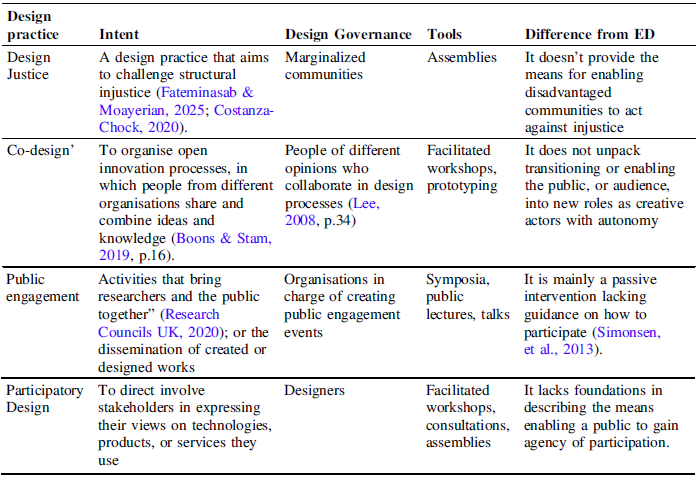
The context of ED moves beyond the framing of design as aesthetics, heuristics, manufacture or the digitisation of assets (Reference PotterPotter, 1989), to focus on a specific typology where design (as a practice) has evolved from efficiency, to generating ‘our’ public voice, thus enabling us to engage with different mediums, formats and developments. In the table below, we list collaborative design practice that similarly has shifted its mission to the social and environmental domains. We use this table to outline the differences from ED.
Positioning ED in collaborative design practices

We argue that the shift in ownership, reappropriation and transition are the foundations of ED. Described as a noun, which borrows from design traditions and emergent design disciplines, as verb, i.e., as a tool (for change) to design in ways that engage (adjective), ED is a process that recognises its own engagement attitude as materiality whose value consist of supporting people in interacting with critical issues of our time (Phillips, et al., 2020, p.26). Crucially, a critical element that needs to be considered in generating “sustainable living environment[s] is that this should be shaped in ecological, economic, and pro-social ways” (Reference Kołacz and PodlasekKołacz & Podlasek, 2024). ED concerns deeper interactions truly engaging audiences in moving to “post-participatory” approaches (Reference Phillips, Alexander, Baurley, Boxall, Gooding, Knox, Nordmoen, Shepley, Simpson, Simmons and WestPhillips, et al., 2024), i.e., participation that is aimed at providing tools and conditions for agency and autonomy. As we believe that celebrating people’s voice is critical, we treat ED as a ‘design with’ approach. In summary, ED position unites the domains of: designing ‘with’, place-based scenarios and climate regeneration (Reference De Toni and MorelloDe Toni, et al., 2025). We see this combination as a new means to navigate our contemporary times; design ‘fail-to-safe’ means that designers, sustainability experts, engineers and creative practitioners can use this framework to implement their designs to grant them a social life of their own. This ‘appropriation’ enables citizen(s) to build new visions of their place-based futures.
2. The post-participatory approach of ED: hypothesis and typologies
Our definition of ED follows as: A practice that connects communities and stakeholders for the resolution of complex challenges (natural and human). Engagement Design is a ‘metaphorical bridge’ that can be cultivated and designed; hence, it can be interpreted as a (applied) process in its own right. In ED, we dissolve disciplinary boundaries and contexts around design, and describe that design is a tool and strategy that can be used every day – in terms of creativity and imagination – to shift behaviours and attitudes that make negative impact to complex planetarian challenges.
Our hypothesis is that ‘participation’ is not sufficient to stimulate collective actions that can bring impactful responses to today’s challenges. To create coordination, it is necessary to formulate attitudes that value everyday experiences and practice. Indeed, regardless of the context(s) we occupy – being it; sisters, mothers, fathers, professionals, beneficiaries or activists – we all create knowledge and skills which are valuable assets for making our collective community thrive according to the value(s) we wish to follow. The hypothesis we put forward to describe ED-led actions stems from rewarding lived experiences as ‘knowledge’ to be activated through creative practices. We hypothesise that ED practice leads to empowering conditions ‘activated’ by ED; this ‘designed activation’ leads to citizen-led collective and coordinated actions. We consider this to be a ‘post–participation’ scenario, which aims to empower the variety of experience(s) of our society for generating proactive behaviour to address complex challenges. To expand this hypothesis, we created five typologies of ED practice: Engagement as an Artefact; Engagement as a System, Engagement as a Partnership, Engagement as a Process/Event; Engagement as Affect. These result from observations drawn from the authors’ professional experience focussed on designing practices for engaging communities (Reference PhillipsPhillips, R.,2019; Reference Ferrarello, Hall, Anderson, Cooper and RossFerrarello, 2020).
2.1. Engagement as artefact
Definition: a stand-alone “object” providing tangible/physical/tactile boundaries for conversations. Example: The Big Compost Experiment is a citizen–science project to comprehend the biodegradability of compostable plastic(s). People can practise composting, placing a few biodegradable plastic items in the compost under controlled conditions, and reporting back.
Map of projects constituting the dataset of ED. This shows how projects centre around proximity to ED (previously outlined) and the citizen autonomy they create

2.2. Engagement as a system
Definition: the complex set of relationships between people, institutions, things, ideas, and specific places. Example: The GoodWaste transforms ‘waste’ material(s) into interiors and artefacts. It diverts industrial waste from landfill, integrating circular economy principles and regenerative values. This work represents a manufacturing model as it is highly local and highly circular; it dissolves the area’s waste problem, preventing an influx of low quality, mass-manufactured goods shipped internationally.
2.3. Engagement as partnership
Definition: describing the role and value of collaborating for developing Partnership for developing and strengthening relationships between parties. Example: The Sheffield Wheat Experiment was a work aimed at getting people to grow tiny amounts of population wheat in their gardens, allotments, or even on a balcony to understand how such an important commodity has an enormous impact on the environment, biodiversity, and how we feed ourselves. Drawing interest in learning about food systems, this work interlinks soil, carbon and climate change by putting a lens on how wheat differentiation increases food resilience – e.g. in the event of extreme weather – but it’s not legal to grow this type of wheat, for commercial sale.
2.4. Engagement as process/event
Definition: a linear or cyclical processes, event or knowledge-to-action type of decision making. Example: My Naturewatch responds to the fundamental role that nature plays for us humans. My Naturewatch Camera captures pictures of wildlife through an inexpensive DIY camera that people make on ‘the kitchen table’. Countless units have been constructed to engage with wildlife through limited or no prior ‘digital’ skill(s). This designer-led citizen-enacted project gives citizen(s) a voice to observe their natural worlds.
2.5. Engagement as affect
Definition: the final configuration manifesting the object Design for Engagement. Example: InHouse Records is the world’s first record label launched to support inmates to make and produce music. Through considered and designed engagement activities, InHouse Records facilities provide individuals with the tools and opportunities to change their lives, and the lives of others. The skills learnt through this rehabilitating programme create dignified and skilled employment, whilst providing services to prevent reoffending. InHouse Records seeks to create safer communities, fewer victims of crime, rehabilitation and employment with dignity and aspiration.
3. Method
To test and validate our hypothesis, we interviewed 47 practitioners following these inclusion criteria: 1) intent in fostering citizens’ autonomy, 2) openness beyond initial reach or initial, 3) outcomes finalised at connecting communities, 4) being as accessible ‘as possible’ to a target audience, 5) a clear intention of sustainable and socially driven practice, 6) a clear evidence of potential lifelong learning processes, and 7) being across science, design, art, education, and technology from the outset. We interviewed one or two members per project (CEO, creative and concept directors, or project managers) between 2021-2024. From a recruitment process based on email exchanges describing the rational for being selected, and how to be involved, a letter of consent, we collect stories from European small-scale practice (1-5 employees), from Africa, from North America, and Asia. We often received rejections due to time or funding issues. Twenty of the interviewees were women, twenty-seven men. The semi-structured interview process (Reference Adeoye-Olatunde and OlenikAdeoye-Olatunde, et al., 2021) focussed on unpacking the process they created for engaging, their creative internationalities, and what they described as “method for engagement” in the context of the project. We asked to all 47 projects the following: (Q1.) Explain the impact(s) of the project, specifically the audience and repeatable elements/lessons? (Q2) In relation to Engaging Design definition(s), what aspects of your project articulates and unpacks: opportunities, benefits and pitfalls? (Q3) Please unpack how your project includes communities and means to catalyse/foster engagement? (Q4). What are key repeatable lessons and/or insights from your experience(s)? Before asking the questions, we reiterated why the interviewees were selected, how we would manage the data, and when they would expect a follow up Furthermore, our questions wanted to give interviewees open spaces to manage more directed responses (Reference Walker, Sidnell and StiversWalker, 2012) and lessons from leading consultancies in their versions of guided tours (Reference Fuge and AgoginoFuge, 2015), and narratives (Reference Rau and CoetzeeRau, et al., 2022). These interviews highlighted original insights that are not often communicated through media. We followed Frayling’s Research Through Design (RtD): “the closest to the actual design practice, recasting the design aspect of creation as research. Designer/researchers who use RtD create new products, experimenting with new processes” (Reference Godin and ZahediGodin, 2014, p.3).
3.1. Analysis method
Following the signage of a written consent including an explanation of how we would use the data, we scheduled online meetings to undertake the interviews. The audio files were recorded and temporarily in our personal computers. Once these were transcribed, we deleted the source file. From the original 47 projects, we analysed the sixteen ones that focused on designing the conditions for fostering sustainable practice. We familiarised with the dataset by also creating a coding frame to capture features from the data of analytical significance (Reference O’Connor and JoffeO’Connor & Joffe, 2020). The frame consisted of the following: (1) project mission- what authors intended to achieve; (2) means of engagement – tools/platforms used to engage an audience; (3) engagement experience – how the audience was engaged; (5) learnings – what the audience learnt. This framing gave us the analytic lens to uncover any ED methodological pattern of enabling empowerment, and the analytical perspective to synthetise the data in concepts that can validate, or the opposite, our ED hypothesis. Our agreement was defined over regular reflective discussions we exchanged from the beginning to the end of the project. Over two years, we engaged in regular dialogue that verified consistency and alignment. We discussed our personal positions in each stage of the process – from the selection criteria to the themes – by openly questioning our personal understandings to ensure credibility. Furthermore, the coding analysis gave us the means for exchanging critical and reflective discussions that tested the robustness of our coding frame. To further testing credibility, we applied the coding framework and subsequent codes to the remaining 47 interviews. This verified applicability and transferability. Additionally, developing a coding frame supported our confidence and contributed to our training. The coding of the sixteen interviews was processed through NVivo. We extracted the dataset through an inductive bottom-up approach (Reference Braun and ClarkeBraun & Clarke, 2006). Coding created the analytical framework that guided our interpretation of the dataset; through it, we discerned what the data says from what the data means (Reference Braun and ClarkeBraun & Clarke, 2006). We created 64 codes. The thematic analysis revealed the ED methodological construction operating through and in specific socio-cultural, and environmental contexts. This allowed us to describe the ED as a practice of designing bridges through specific attitudes, processes, and human conditions (ED materiality). For example, this sentence was coded as: “Listening”: “Listening is really important. Listening to each other, and if you can’t, you can offer a framework by which you offer a space where people can listen outside of this Jumping forward to fix a problem, or try and answer, it will be the right one” The final themes colliding the codes were eleven and emerged from the latent interpretation of the dataset, i.e., an interpretation that goes beyond the data semantic meaning, to identify underlining concepts that shape and inform it (Reference Braun and ClarkeBraun & Clarke, 2006). These are: Shifting perceptions/perspective, Foster/create understanding, Engaging lived experiences, Representative, Designing co-existence, Design for understanding, Designing for Community activation, Designing to build bridge, The Interface of different knowledge(s,) Design for infrastructuring. They describe how to use ED materiality for creating ED projects of engagement. Furthermore, these themes outline how ED materiality is not made of discrete items, but related conditions that create engagement at the ecosystem level (Reference Phillips and FerrarelloPhilips et al., 2025). Indeed, the data analysis evidences the systemic and embodied nature of ED, and how holistic approaches are an inherent quality of this design practice to deploy its materiality (e.g., empathy, inclusion, cultural approaches, rituals, humbleness).
3.2. ED themes
1. Shifting perceptions/perspective. ED design can guide the development of everyday sustainable life as an attitude by leveraging personal motivation. Design practice can be a means of supporting the re-framing and re-learning of existing knowledge, allowing one to reinterpret and negotiate what is known. Projects focusing on shifting perception present a common trajectory of deploying design as an object to leverage critical engagement that stimulates questions and champions attitudes.
2. Foster/create understanding. ED projects describe a practice that aims to foster understanding that puts one in the condition of developing new knowledge. Here, design practice leverages (designed) interactions of specific qualities, like being memorable or multimodal. To foster understanding, ED leverages trust as a condition for establishing ownership.
3. Engaging lived experiences. The development of sustainable practices is a process that can be enabled through the sharing of personal experience across communities. This has the positive effect of transferring personal knowledge and fostering mutual learning. To enable this transfer, it is key to create safe and caring conditions of exchange. Furthermore, designing the means for exchanging knowledge helps one develop self-awareness and an informed understanding of how personal lived experience contributes to the development of sustainable practice and long-term impact.
4. Representative. There are underlying principles that characterise a context “able to host” conditions like those described above. Crucially, this space should promote equality and mutual respect so that diverse voices have fair opportunities to be heard.
5. Designing co-existence. ED interaction can be described as in-between spaces where dialogue is the process that enables alignment aimed at change. An in-between practice can be interpreted as a vector whose direction indicates the way for change, in the case of ED. Hence, to follow such a direction and create balance, participants need to demonstrate openness toward perspectives that might differ from personal positions. These characteristics “design co-existence”. Furthermore, “co-existence” vectors are not univocal, but feedback loops connecting the different parts of the system.
6. Design for know-how. In ED practice, a designer can take the role of a chaperone, showing communities the means to harness their knowledge and skills. To achieve this, a designer should coach communities to increase their resilience and self-reliance.
7. Design for understanding. Framing ED practice as post-participatory design means describing it as a vehicle-ing practice of empowerment. Empowerment is stimulated when knowledge and skills vehiculated by ED practice are felt tangible and embodied by all receivers. Furthermore, ED-designed situations are platforms where participants feel they can voice their views through non-judgmental dialogues. These conditions are key to enabling processes of understanding.
8. Designing for Community activation. Activating change is a process that occurs at the scale of the individual through conditions that encode in communication channels empathy, shared responsibility towards the aimed goal, and a perception of agency for creating change. At the scale of the community, change becomes a shared domain that can be associated with democratic processes, multiculturalism, and ambassadorial attitudes. Neither scale is exclusive but complementary; a design intervention should account for both. ED practice liaises with the interactions between these two levels of scale, which act independently.
9. Designing to build bridges. A key factor for ED interventions is time. The length of a project influences any aimed impact. In addition, time illustrates the benefits a community gains from an ED intervention through the events that this design practice has designed to achieve its goals. Acknowledging the importance of time means that the timeline of a project is as important as other types of interventions; this is because impact takes shape through time. ED projects should define how they enable advocacy, create a memory, and skill development to provide a community with the necessary ownership to lead a project outcome after its end. This explains the future quality of ED interventions.
10. The Interface of different knowledge(s). Designing bridges requires a reflection on the types of conditions that create a bridge, i.e., conditions that foster partnership and trusted relationships. Knowledge-exchange processes developed through questions are means for generating constructive bridges grounded on the respect of different opinions.
11. Design for infrastructuring. As situated in socio-cultural systems, ED practice includes work that is unfinished, flexible, ceremonial, and emergent. ED projects have qualities such as being trustworthy, relational, experiential, and prone to listening; these are the foundation of ED for designing impact through the legacy of a project, i.e., the exit (Authors, 2025).
Finally, it needs to be noted that there are codes appearing in different themes; this explains the uniqueness of ED projects where meanings might shit from a context to another, and situations are described by different relations. This uniqueness needs to be accounted when designing ED processes. The analysis revealed that codes can shift meanings and themes provide contextual guidance that shape meaning through given situations. For instance, the code empathic appears in three different themes, but its meaning differs as the overarching conditions are different (e.g., it changes from the recipient’s attitude to a means for activation, to a quality of a systemic relation).
4. Discussion
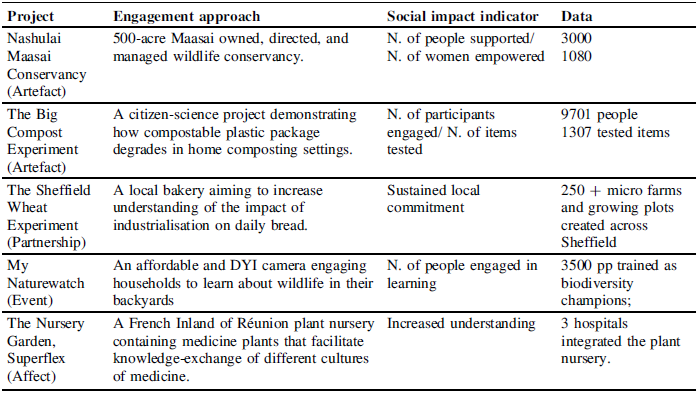
Building from the top-down deductive approach used to create the five typologies underpinning ED, we analysed sixteen design practioners’ interviews focussed on designing conditions for sustainable living. A latent interpretative approach of this dataset tested and validated our initial hypothesis: the thematic analysis confirmed that ED is a situated design practice defining the means for communities to create and sustain collective actions through objects, partnerships, processes and events. This is what makes it a post-participatory approach. In addition, the eleven themes provide a practical and detailed description of how to use ED materiality to create bridging conditions of engagement through everyday actions. Furthermore, the analysis outlined the different dimensions of ED, which often intersect the scale of the human with social and environmental contexts. Such systemic and holistic approach is key to endure impact and reinforces that ED projects are not ends but means for creating change. ED socio-cultural systems are unfinished and holistic; their goal is to ‘design with’, which is a fundamental factor for developing understanding that makes change both at the individual and community scale. This decentralises design; even though a design intervention is no longer at the centre of its context, its visibility is not cut out. The ED infrastructuring quality (Reference KarastiKarasti, 2014) grants it a new visibility through the interactions that objects, processes, partnerships, and systems generate with the objective of creating more sustainable lifestyles. The table below indicates how this was achieved in some of projects we analysed.
ED exemplars with indicators

By articulating the means and qualities of engaging as post-participatory practice, the eleven themes position ED in the design literature of interventions to urgent social and environmental issues. ED is a design practice and method that doesn’t aim to design sustainable outputs, as platforms, objects, technologies, or services. ED designs systems connected through designed products, services, strategies, or technologies. Such a role assigns the designed object the task of helping a community voice their agency. By providing the ‘how’s’ to create means for engagement, ED projects connect points of an infrastructure that one can work out to achieve aimed goals and ambitions. Lastly, in writing this article, we, as authors, acknowledge that our perspective is for the global north, specifically the UK and Europe. We acknowledge that beyond ours there are other experiences that would increase understanding on how to practice ED. Hence, we intend to use this work to build more dialogue in the area, in particular for those regions our analysis didn’t cover. We wish to collect wider resources that reflect on methods that are non-extractive and regenerative for future work. We are aware of different cultural needs, restrictions, colonialist perspectives, and encourage cultures outside of this frame to take, leave, re-appropriate but, hopefully, build on this.
5. Conclusion
The work and insights often sound utopian, but trust citizen(s) to enact sustainable change in their area(s) or provinces. Design, instigate and create systems where it is avoided the one-size-fits-all approach but a clear process that can be appropriated for local needs with clear motivational alignment(s). Creating post-participatory agreements and/or social contracts could create transparency, provide agency and autonomy to citizen(s). In this paper, we articulated how to promote a new post-participatory culture of design aiming at ‘Designing Exit’, i.e., the strategy for enabling any aimed impacts after the end of a project which can be conceived as an exercise of governance, human toil, good will and the grind that the voluntary sector has learned (Reference Flanagan and HancockFlanagan, et al., 2010). Here, ED guides the exploration of the leverage points outside of the voluntary sector enabling people to become Ecological Citizen(s) enacting change benefits wider society and the planet (Reference Phillips, Alexander, Baurley, Boxall, Gooding, Knox, Nordmoen, Shepley, Simpson, Simmons and WestPhillips et al., 2024).
Acknowledgement
Nick Gant as initial conversations shaped this design space. Rights Retention Statement: This work was informed by a UKRI grant (EP/W020610/1). For the purpose of open access, the author has applied a Creative Commons Attribution (CC BY) licence to any Author Accepted Manuscript version arising. The Ecological Citizen(s) is a cross-RCA research network led by Dr. Rob Phillips, Professor Sharon Baurley, and Tom Simmonds, in partnership with Professor Sarah West of the Stockholm Environment Institute (SEI) at the University of York, and Professor Alec Shepley Faculty of Arts, Science and Technology at Wrexham University. Ecological Citizens is a Digital Economy EPSRC Network+ award (EP/W020610/1). We thank: The Ash Project, Climate Nan, The Big Compost Experiment, Bristol Sound Walks, Coast Snap, Collection 374 Leather, Felt like Sheep, Hannafore Outflow pipe, My Naturewatch, The Nashulai Massai Conservancy, Nmbello Studio, Seed Exchange, The Sheffield Wheat Experiment, Superflex – Nursery Garden, Telepresent Wind, The Good Waste, VR Swing, Warrior Moms. The Royal College of Art (RCA) & École Polytechnique Fédérale de Lausanne (EPFL) gives to cultivate theoretical and practical frameworks, for the space they provide.


 Open access

