





Management Implications
An informed public is critical for sound invasive species management. Stakeholder education can contribute to buy-in for management activities requiring collective action (e.g., on public lands or waters) and improve confidence and decision making for laypersons involved in contracting or performing control efforts. Nonprofessional stakeholders are uniquely involved in invasive species management of lakes in much of the United States, but these individuals (e.g., community lake association members) typically lack foundational training in the science and management of aquatic invasive species (AIS). Educational programs geared toward nonprofessional stakeholders are an underutilized opportunity to improve stakeholder understanding and engagement in invasive species management to ultimately create more successful management outcomes. Improving availability and access to this kind of educational programming can deepen stakeholder understanding of management options, create more engaged and informed consumers of invasive species management services, and provide “do-it-yourself” invasive species managers with critically needed education.
Introduction
Invasive species management education is most often targeted toward professionals and licensed pesticide applicators. For example, 39% of forestland in the United States is noncommercial, family-owned land (Butler et al. Reference Butler, Butler, Caputo, Dias, Robillard and Sass2021), yet Clarke et al. (Reference Clarke, Ma, Snyder and Floress2019) found that nearly half of surveyed family forest owners lacked confidence in their ability to manage invasive plants on their land. There are few examples where invasive species management educational programs are targeted toward stakeholders, consumers of management programs, or “do-it-yourself” property owners—a population that is probably uniquely likely to cause unintended harm (e.g., Church et al. Reference Church, Buhler, Bradley and Stinner2012; Meyer et al. Reference Meyer, Burrows, Jeannette, Welty and Boyson2010; Weeks et al. Reference Weeks, Hoyer and Gillett-Kaufman2020). There are even fewer examples of consumer-level invasive species management education for aquatic environments; we identified only one documented in the literature (Weeks et al. Reference Weeks, Hoyer and Gillett-Kaufman2020). While workshops and training focusing on aquatic invasive species (AIS) have been offered for nonprofessionals, these tend to focus on identification and surveillance efforts rather than management (Dits Reference Dits2020; Herman and Wickman Reference Herman and Wickman2016; Larkin et al. Reference Larkin, Weber, Galatowitsch and Gupta2018; Russell Reference Russell2020).
Despite the lack of available education for nonprofessional stakeholders, they are often responsible for decision making around AIS management, including funding and contracting control efforts and even implementing control themselves. The state of Minnesota (USA) is home to more than 200,000 lakeshore property owners who collectively play a substantial role in decision making regarding aquatic plant management in Minnesota lakes (Ibrahim et al. Reference Ibrahim, Marko, Bjertness and Zabel2017; Payton and Fulton Reference Payton and Fulton2004). While manual removal is the most commonly reported control type, herbicide use is prevalent; this is particularly true in the Twin Cities Metropolitan Region, where 32% of lakeshore homeowners reported using herbicides for aquatic plant management. The majority of those lakeshore landowners performed their own aquatic plant management, with only 30% and 10% inside and outside the metro region, respectively, hiring professionals (Payton and Fulton Reference Payton and Fulton2004). Where broader, lake-wide AIS management decisions are being made, that is, beyond the scale of individual lakeshore properties, community-based organizations (lake associations) are a common nexus for management decision making; however, there is no expectation or requirement that lake association board members have aquatic science or conservation-related expertise (Ibrahim et al. Reference Ibrahim, Marko, Bjertness and Zabel2017). Pesticide applicator licenses are not required for most aquatic pesticides in Minnesota, though all chemical treatments in public waters require permitting from the Minnesota Department of Natural Resources (MNDNR; Minnesota Rules, part 6280.0250).
An informed public is a critical component of invasive species management. Lack of information, misinformation, and mistrust have led to cases where management programs have been delayed or halted due to pressure from local residents and organizations (Bergquist Reference Bergquist2014; Bertolino and Genovesi Reference Bertolino and Genovesi2003; Legere Reference Legere2019; Williams Reference Williams2019). Concerns have also been raised about the overuse of herbicides and other control tools to achieve unrealistic goals in invasive species management (Davis et al. Reference Davis, Chew, Hobbs, Lugo, Ewel, Vermeij, Brown, Rosenzweig, Gardener, Carroll, Thompson, Pickett, Stromberg, Del Tredici and Sunding2011; Radomski and Perleberg Reference Radomski and Perleberg2019). Communication about invasive species management should provide a nuanced view that addresses both the potential benefits of management and the potential negative impacts, particularly harm to non-target native species and other unintended consequences. Furthermore, communication should engage a broad constituency in management decisions (Crowley et al. Reference Crowley, Hinchliffe and McDonald2017).
There is also risk, as for any consumers of technical services, that those contracting AIS management lack sufficient understanding of the science to ensure they are contracting services that are both (1) necessary and (2) have a high probability of achieving desired management objectives. As with a car owner who lacks the technical knowledge to evaluate the necessity of a repair recommended by an automotive shop, nonprofessionals contracting AIS control efforts may lack the confidence to decide whether a proposed course of treatment is cost-effective, likely to succeed, and appropriate for the situation.
Materials and Methods
Course Development
We identified the need for this online course through a developmental evaluation framework (Patton Reference Patton1994) focused on engaging lake associations in invasive aquatic plant management monitoring. After working with a local Minnesota lake group to pilot a training program, we held a focus group with participants to elicit feedback before developing the next stage of the program. This feedback caused us to reconsider our plans and ultimately shift our focus from a citizen-science approach to monitoring of AIS management to a consumer-focused educational curriculum.
In particular, analysis of the focus group results revealed a strong interest in learning more about AIS management and how permit-granting authorities and applicators make their decisions. Focus group participants wished to be more involved in decision making around AIS management on their lake but felt they lacked the knowledge to do so. They additionally expressed general distrust of recommendations made solely by commercial applicators—out of concern that applicators’ financial incentives could cause them to advocate for more expensive treatment programs. They also wanted to better understand why permitting agencies were requiring certain data or would not allow certain treatment programs.
Based on this developmental evaluation, we set out to create a new course targeted toward laypersons with the following goals:
-
1. Provide foundational knowledge that empowers nonprofessionals to become more involved in invasive species management decisions and savvier consumers of AIS treatment services.
-
2. Address concerns about the use of various management tools, particularly the unintended consequences of chemical management programs.
-
3. Encourage caution in embarking upon a management program (whether using a hired professional or a do-it-yourself approach), particularly for chemical management.
-
4. Help individuals understand why management outcomes may fall short of expectations and why results can vary from year to year or lake to lake.
-
5. Foster the setting of realistic expectations for outcomes of AIS management programs in the context of long-term goal setting.
We developed this new, fully online course, called “Aquatic Invasive Species Management 101,” from September 2018 to May 2019, piloted it in the summer of 2019, revised it based on feedback from pilot participants, and launched it fully in May 2020. The course was designed to include information relevant to Minnesota and focuses on priority AIS for the state. However, much of the content is applicable across a broader geographic scale, with the exception of state-level regulatory information (and federal regulatory information for participants outside the United States). We continue to make adjustments to the curriculum based on participant evaluations of the course and feedback solicited on components that students find to be unclear.
Course Structure
The course is an asynchronous, online course hosted using the learning management system Canvas (Instructure, Salt Lake City, Utah, USA). It is offered annually in late winter to early spring; however, the course was offered later in the year in 2020 (late spring to early summer) due to changes to our broader AIS Extension program’s scheduling amid the COVID-19 pandemic. Participants are given 6 wk to complete all course modules. The course is intended to include approximately 8 h of content, though the actual time to completion varies substantially across individuals. A variety of interactive learning tools are incorporated, including expert videos, call-out boxes (specially formatted text boxes to highlight key information), interactive and animated images, group discussion forums, check-your-knowledge quizzes, and course organization tools built into Canvas (e.g., “drawers” and “call-out boxes”).
Participants first complete a check-in knowledge assessment to unlock the modules. This assessment consists of 20 multiple-choice, true–false, and matching questions, including “I don’t know” answer options. Check-in knowledge assessment scores and correct answers are not revealed at this point, as the same questions are repeated for a check-out knowledge assessment to quantify student learning gains.
The course comprises seven modules: Aquatic Plant Management, Other Aquatic Pests, Understanding Pesticides, Pesticide Regulations, Other Types of Control, Evaluating Management Effectiveness, and Taking a Long View (see Table 1 for module learning objectives). Each module encompasses a series of pages that explain concepts within that topic area using the various tools described earlier. Following each module, participants complete a three-question check-your-knowledge quiz to reinforce the concepts they learned and are then asked to participate in a discussion board. Discussion boards have prompts to (1) elicit qualitative responses building on the concepts in the module, (2) ask questions of the course instructors, and (3) flag concepts that remain unclear. A detailed course outline is available in Supplementary Appendix S1.
Learning objectives for each of the seven modules presented in the course.
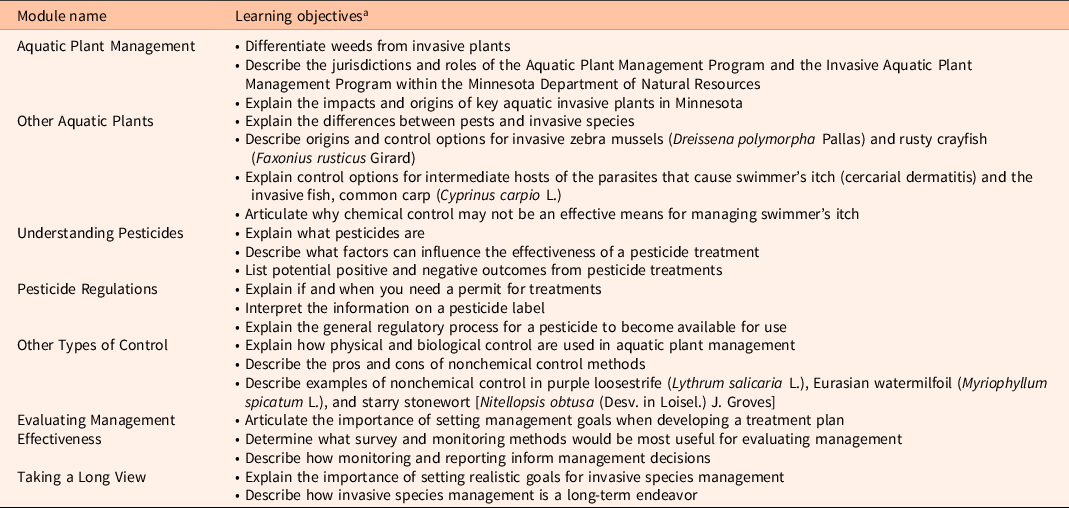
a Each learning objective indicates a skill the participant should be able to demonstrate upon completion of the module.
Upon completing all modules, participants retake the knowledge assessment as a check-out test. A passing score is achieved by answering 70% or more of the questions correctly. Participants are permitted to retake the assessment up to 10 times to improve their scores. We measured knowledge gains by comparing check-in and first-attempt check-out scores. We tested for significant knowledge gains, and differences in knowledge gains between cohorts (the year the course was taken), using a linear mixed-effects model. Assessment score was the responsible variable, with assessment stage (check-in vs. check-out) and year as predictors, and an identifier for each student as a random-effects intercept term to account for repeated measures. This model was implemented using the nlme package in R v. 4.0.3 (Pinheiro et al. Reference Pinheiro, Bates, DebRoy and Sarkar2020; R Development Core Team 2020).
In addition to in-course assessments to measure knowledge gains, we evaluated the course through two types of participant surveys. The first survey was a postcompletion evaluation sent to participants immediately after they submitted the check-out assessment. This survey evaluated participants’ experience completing the online course, their self-perceived knowledge gains, and their opinions on course strengths and weaknesses. Quantitative questions were offered on a scale of 1 to 5, where 5 represented the top of the scale (i.e., most agreement, most understanding, best quality). The second survey was sent out in the fall after course completion to learn whether and how participants applied what they learned during the period when AIS management is typically performed in Minnesota (late spring to early fall). Timing of the second survey (late September to early October) was intended to be late enough that most management actions for the year would not be missed, but early enough that early-season management actions would not be forgotten by respondents. This left 3 and 5 mo between the course closing and the distribution of the second survey for 2020 and 2021, respectively. We tested whether the proportion of respondents who took action differed between the 2020 and 2021 cohorts by using a Fisher’s exact test for count data, which was also performed in R. We attempted to survey participants who did not complete the course to learn more about their reasons for noncompletion but did not receive any responses from this group.
Finally, we sought to measure the time students actually spent on the course relative to our 8-h expectation. Canvas tracks the time spent on course pages by each student; however, it does not differentiate “active” time from unattended course pages being left open. Thus, these data are inherently inflated, that is, the active time can be lower than the recorded value but not higher. We downloaded time records for both cohorts, removed obvious outliers (>50 h) resulting from unattended pages, and calculated median times for each cohort.
Results and Discussion
Knowledge Gains
Of the 138 total participants who enrolled in the course in 2020 (n = 81) and 2021 (n = 57), 112 completed the course, including the check-out assessment. While only 32 participants who completed the course received a passing score on the check-in knowledge assessment, most participants (n = 99) received a passing score on their first attempts of the check-out assessment, and all but one received a passing score on their final attempts. The median number of check-out assessment attempts was 2, though many participants who made multiple attempts received a passing score on their first attempts (the median number of attempts to pass was 1). Participants made significant improvements in their scores (P < 0.0001) from their check-in assessments (2020 mean ± SE: 59.7 ± 1.8%; 2021: 55.2 ± 1.9%) to their first check-out attempts (2020: 79.0 ± 1.1%; 2021: 77.7 ± 1.4%) (Figure 1); scores were marginally higher in 2020 than 2021 (P = 0.089).
Mean check-in and check-out assessment scores (± 1 SE) from both cohorts of participants who completed the course (2020 n = 81, 2021 n = 57). Seventy percent (dashed line) was considered a passing score.

The check-in assessment indicated that participants came into the course with a good understanding of basic concepts; for example, many understood that aquatic plants often referred to as “weedy” are critical components of lake ecosystems and that having a good management plan can yield both financial and ecological benefits. Questions most often answered incorrectly on the check-in knowledge assessment related to regulatory issues and more specific management questions, for example: “Which of the following activities would require an Aquatic Plant Management Permit from [MNDNR]?” or “Which of the following is NOT something we have learned from robust long-term monitoring of curly-leaf pondweed management?” Such questions tended to show the greatest improvement between check-in and check-out knowledge assessments. A full summary of results from the check-in and check-out assessments is provided in Supplementary Table S1.
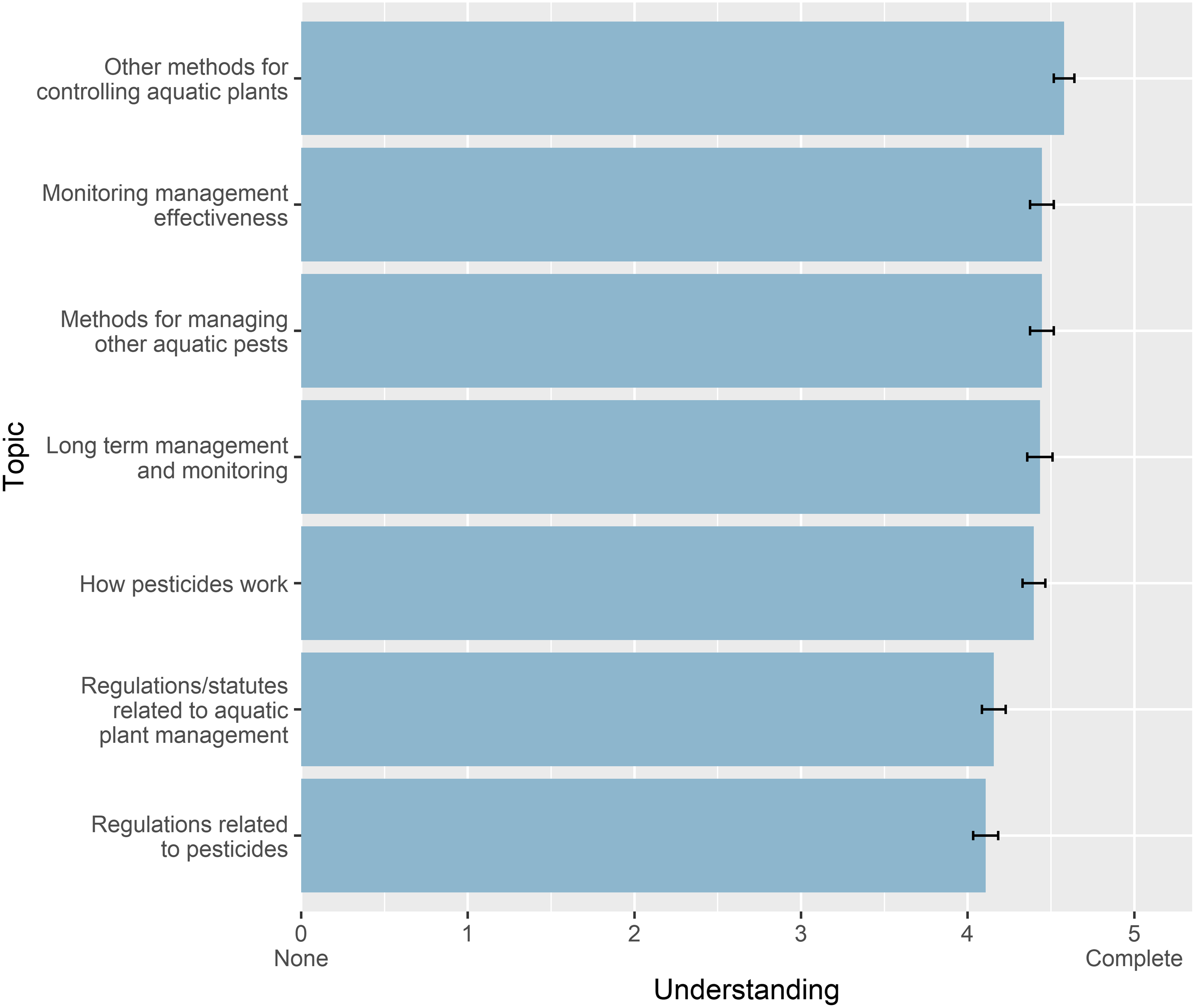
Eighty-three of the 112 participants who completed the course participated in the course evaluation, a 74% response rate. Participants indicated an overall high level of understanding of course content and satisfaction with the course. Most respondents (77%) “strongly agreed” that they felt more knowledgeable about AIS management. Participants were asked to indicate their levels of understanding of seven key concepts from the course (regulations and statutes related to aquatic plant management, methods for managing other aquatic pests, how pesticides work, regulations related to pesticides, other methods of controlling aquatic plants, monitoring management effectiveness, long-term management and monitoring). Mean ratings for these concepts were high, ranging from 4.1 to 4.4 (with a value of 5 indicating “complete understanding”; Figure 2).
Mean self-reported ratings for level of understanding of seven primary course concepts from end of course surveys by participants who completed the AIS Management 101 course in 2020 and 2021 (n = 83). Rated on a scale of 1 to 5, with 5 indicating complete understanding.
Applying Learning to Action
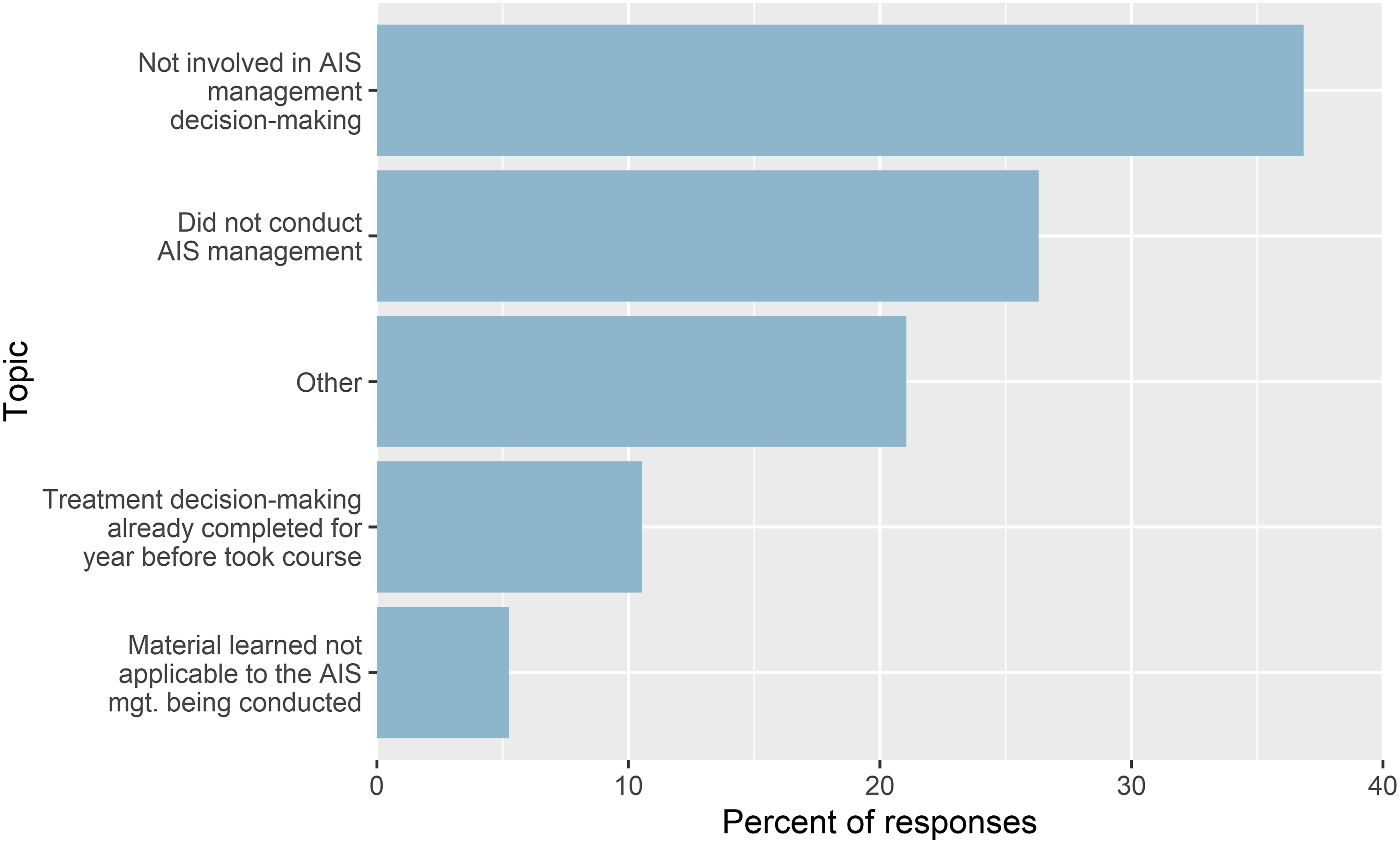
Fifty-two of the 112 participants who finished the course in 2020 and 2021 completed the end of season survey (a 46% response rate). Most respondents (71%) indicated that they took some kind of action during the summer based on what they learned during the course. A somewhat higher proportion of respondents to the 2021 survey (88%) indicated they took some kind of action compared to respondents of the 2020 survey (64%), but this difference was not significant (P = 0.11). Figure 3 illustrates the reasons the remaining 15 respondents indicated that they did not take action. Of the respondents who indicated they acted based on what they learned in the course, 38% did so in decision-making situations regarding AIS management, 39% found applications for what they learned outside AIS management, and 100% shared information they learned with others—predominantly with members of a respondent’s lake association or other neighbors on a lake. We also asked participants if they planned to apply what they learned in the following season (some management decisions may have already been made before participants completed the course, limiting their ability to use their knowledge for same-year management actions); 85% of respondents indicated intent to use knowledge gains from the course in the following year.
Reasons given by participants for not taking action based on what they learned in the course (n = 15).
Emergent Themes
Qualitative assessment of the questions and responses in the group discussion forums also revealed some consistent themes. Questions from students in the pesticide modules commonly concerned safety; in particular, a number of participants raised questions around the use and continued registration of glyphosate as an active ingredient, in light of lawsuits against the manufacturer of Roundup® (Monsanto Company, Marysville, OH, USA 43041) that received substantial media attention (Tauhata et al. Reference Tauhata, Araújo, Oliveira Alves, Martins, Lopes and Casaletti2020). Additionally, there were numerous requests during the 2020 course for clarification regarding how one might choose between alternative aquatic plant survey techniques that were discussed. After updates to the course to provide more information on the strengths and limitations of the different techniques, this question was far less prevalent in 2021.
Participants consistently commented on the timing of the course offering being critical for their participation and ability to apply what they learned. The May to June schedule in 2020 was regarded as too late in the season, as many management decisions had already been made, in particular for curly-leaf pondweed (Potamogeton crispus L.), which is typically treated in early spring in Minnesota (MNDNR 2015). The 2021 course began in March, allowing more time for participants to apply what they learned to that year’s management activities.
Course Structure
While our intent in designing the course was to create approximately 8 h of content, actual time spent by participants in the course may have been longer. The median time spent in 2020 and 2021 was similar (9 h, 51 min, and 9 h, 21 min, respectively); as noted earlier, both are likely overestimates. Actual time spent after removing outliers ranged from just over 2 h to about 31.5 h. Course evaluation data did not indicate any pattern of dissatisfaction regarding the length of the course.
Our use of a variety of tools to convey information was identified as a strength by participants in open-ended evaluation questions. Example responses from students asked to identify the greatest strengths of the course included, “Great information, variety of learning presentations,” “Very good course. I really liked the combination of written materials, videos, info from experts, citations for research papers, local news stories, etc.,” and “The variation of tools used to present the material.” In addition to their qualitative responses, the mean responses to the Likert-scale prompt, “effectiveness of images and visuals at conveying concepts,” were 4.7 and 4.6 (with 5 indicating “most effective”) in 2020 and 2021, respectively. O’Bannon et al. (Reference O’Bannon, Skolits and Lubke2017) found a similarly positive response to interactive learning tools by students in a K–12 teaching licensure course, and further demonstrated improved learning results for students using interactive learning tools rather than traditional lectures.
Reviewing learner comments and iteratively adjusting course materials are critical components of effective online education (Czerkawski and Lyman Reference Czerkawski and Lyman2016). We asked participants to identify the biggest areas for improvement within the course as an open-ended question in the course evaluation. A clear trend emerged in the 2020 cohort indicating the sound quality, for one expert video in particular, was frustrating for students. The video issues were addressed before the launch of the 2021 course, after which we received fewer overall responses to that question and more responses indicating no improvements to suggest.
While online course formats can present challenges for access due to technological barriers, there are significant benefits to access in other respects (Baldwin and Ching Reference Baldwin and Ching2021). The online format allowed us to reach participants across a broader geographic range, both within and beyond the state of Minnesota, than has been our experience for in-person workshops. Additionally, the online format allows Minnesotans who spend winter months in warmer climates—common in older “snowbird” populations—access to the training despite its late-winter to early-spring offering. While we did not ask students about accessibility related to physical limitations, there also may be benefits in this regard.
Conclusions and Future Directions
Our results demonstrate significant knowledge gain by course participants. Students reported high levels of understanding in all seven topic areas related to AIS management and translated knowledge to action by applying the concepts they learned. Additionally, participants shared information they learned with others, especially fellow lakeshore homeowners. These results and self-reported applications are important outcomes toward creating a more informed consumer base for AIS management. Over the last 20 yr, property owners in Minnesota have implemented ∼40% of permitted aquatic plant management activities, with the remaining 60% being contracted out to professionals (Hansen and Jorgenson Reference Hansen and Jorgenson2018; McBride and Jorgenson Reference McBride and Jorgenson2020). In addition, an unknown number have conducted illicit aquatic plant management without a permit or performed management not requiring a permit. The discrepancy between these figures as reported to DNR and the self-reported numbers from Payton and Fulton (Reference Payton and Fulton2004) may indicate that activities not captured by MNDNR’s reporting system are more likely to be performed by the homeowner. Regardless, there are two main groups of individuals who can benefit from this kind of educational opportunity: individuals contracting a professional management company (who can be better informed consumers) and individuals conducting “do-it-yourself” management activities (to instill more understanding of regulations and the complexities of management in an aquatic environment). Knowledge assessments and course evaluations showed significant knowledge gains that can aid both groups of nonprofessional stakeholders.
Due to substantial enrollment and the demonstrated need for education like this, we will continue to offer the course annually, targeting a February or March start date to maximize potential benefits. The greater (albeit nonsignificant) proportion of 2021 participants who took action based on what they learned in the course is consistent with the benefits of starting the course earlier in the year. This timing is also supported by adult learning research indicating that such “just-in-time” learning, where information is presented shortly before the new skills are applied, is desirable for adult learners and promotes knowledge retention. Bose (Reference Bose2012) and Rushby (Reference Rushby2006) found that participants are more motivated by an imminent need to use new skills, and minimizing the amount of time between learning and application of new skills reduces loss of information and reinforces learning through application to real-life scenarios.
Both the course evaluation and end-of-season surveys included an open-ended question asking participants what topics they would like to learn more about. One frequent request was for deeper learning on invasive species identification across a broader range of taxa, which our team currently offers through a single-day aquatic plant identification workshop and a more in-depth flipped classroom training (Larkin et al. Reference Larkin, Weber, Galatowitsch and Gupta2018) that serves as the entry point for our AIS volunteer program. The most common request was for more detailed information about the specifics of control techniques for particular invasive species, notably Eurasian watermilfoil (Myriophyllum spicatum L.) and P. crispus. These responses likely reflect a desire to be in a better position to contribute to decision making, a yearning that we noted during the focus group and that represents a further opportunity for creating educational materials for nonprofessionals.
While our program addresses aquatic invasive species in particular, invasive species management education for nonprofessionals is likely to confer benefits in other systems. Additionally, despite portions of the course focusing on information specific to Minnesota, participants joining from outside Minnesota increased from 7% in 2020 to 13% in 2021. While this may be attributable to broader advertisement in 2021, it could also reflect a geographically broader unmet need for this type of education. We encourage organizations to consider incorporating more education pertaining to management in their invasive species outreach efforts in order to better equip nonprofessionals and community groups tasked with making challenging invasive species management decisions. Such education could further help with stakeholder buy-in for invasive species management on public lands (Bremner and Park Reference Bremner and Park2007).
Supplementary material
To view supplementary material for this article, please visit https://doi.org/10.1017/inp.2022.10
Acknowledgments
Development of this course was supported by the Minnesota Aquatic Invasive Species Center with funding provided by the Environment and Natural Resources Trust Fund, as recommended by the Legislative-Citizen Commission on Minnesota Resources. We are grateful to Alison Holland for her assistance in building the virtual course experience. Peer and technical review of the course content was provided by Kylie Cattoor, Allison Gamble, Jolene Hendrix, Kelly Pennington, Tim Plude, April Rust, and Heidi Wolf. We would also like to thank Wendy Crowell, John Hansen, Carolyn Link, Keegan Lund, Shane McBride, Patrick Selter, and Michael Verhoeven for their appearances in expert videos included in the course; the members of the Lake Demontreville and Olsen Association, who participated in the focus group inspiring this course; and the 41 AIS Detectors program volunteers who offered feedback on the pilot launch of this course. No conflicts of interest have been declared.


 Open access

