




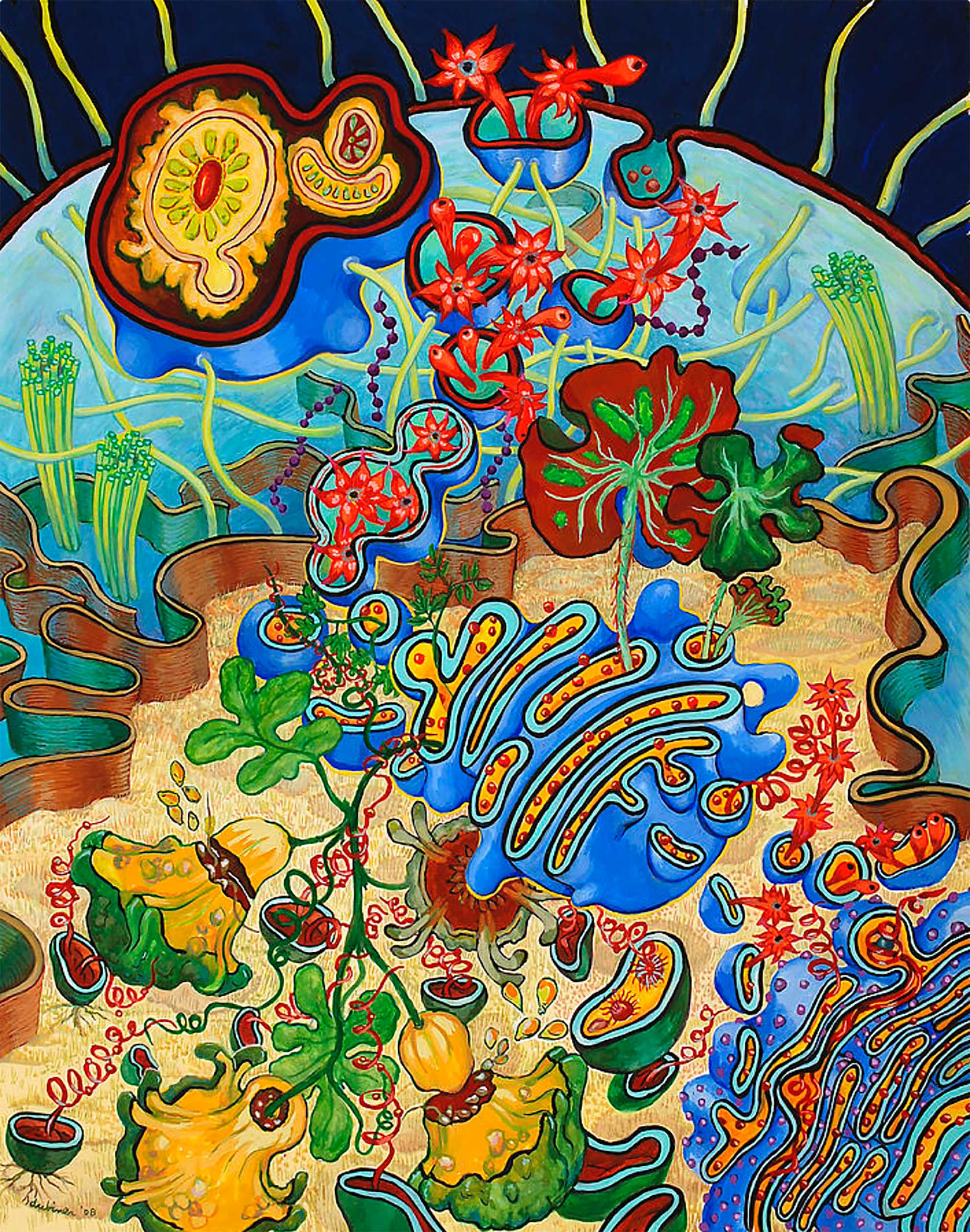
Art is what the body does, not only with its hands, vocal cords or feet in obedience to the commands of the mastermind (which is the conscious mind) but also with its cells and tissues, hormonal networks and glands, as well as, more generally what it does with matter, including the materials from which an inanimate body is, strictly speaking, crafted (Marder Reference Marder, Bekirović and Marder2019) (Figure 1).
Shoshanah Dubiner, Cell Garden, 30″ × 24″, 2009.
Photo Credits Shoshanah Dubiner.
The Earth suffers from metabolic disorders. Disruptions in natural cycles, global warming, and species extinction lead to an indigestibility of being (Marder Reference Marder, Bekirović and Marder2019), where the planet’s metabolism becomes increasingly dysfunctional, akin to the clogged pores of being (Marder Reference Marder, Bekirović and Marder2019). In his essay On Art as Planetary Metabolism, Marder proposes an intriguing remedy: art as a form of metabolism, capable of counteracting these global dysfunctions. In this work-based essay Footnote 1 , we examine selected contemporary works from the fields of Eco Art, Bio Art, Bio Design, and Socially Engaged Art to explore how these, in the context of Marder’s theory, can metabolically counteract the dysfunctions of planet Earth. The starting point is the publication’s central question: “How can biotechnologies and biomaterials shape and sustain habitats in extreme and space environments?” (Belling et al. Reference Belling, Brandić Lipińska, van Ellen, Nerlich, Rothschild and Maurer2023).
We focus on planet Earth as an extreme environment based on the symptoms of the climate crisis. At the center of the investigation is the thesis that art, as a field of experimentation, can unite scientific and sociological findings, envision alternative realities of life, and stimulate sustainable social transformation processes. This gives rise to the following questions: How can artistic explorations of biomaterials and biotechnologies sustainably shape living spaces in extreme environments, such as planet Earth? What can artworks teach us about global metabolism? How can they integrate past knowledge, react to the present, and sensitize us to the future – materially, aesthetically, technically, and ethically? Following Marder’s theory, we have selected four works that are the subject of our respective research.Footnote 2 We assume that the following works contain metabolic aesthetic moments that can lead to a stimulation of the global metabolism: Life (from the Protocells Triptych) (2022) by artist Shoshanah Dubiner; Internal Burial Suit (since 2008) by Jae Rhim Lee; Fermenting Futures (2022) by Anna Dumitriu and Alex May; and Return to Sender (2022) by Nest Collective.
Material aesthetics, inherently tied to material transformations, have the potential to activate planetary metabolism – a concept that could be described as “metabolic aesthetics.” This notion operates on two levels: it highlights the intrinsic activity of matter itself and facilitates its integration into social contexts, where it unveils transformative potential and fosters socio-cultural change. Artistic strategies in this framework are shaped by a renewed understanding of matter, as articulated in New Materialism and ecological philosophy, particularly by Bennett (Reference Bennett2010). These perspectives emphasize matter’s active role in artistic creation, positioning it as a co-creator within the design process (Pomyalova Reference Pomyalova, Godlewicz-Adamiec, Piszczatowski, Włodarczyk and Kociumbas2022). Throughout our collaboration, we identified a cyclical relationship within the content of our selected works, which is reflected in the structure we developed: Life, After Life, Fermenting Futures, Return to Sender. Following this sequence, we describe each work and connect analytical insights with theoretical perspectives to build upon Marder’s ideas.
Our essay is positioned within the theoretical discourses from the humanities on post-anthropocentrism, New Materialism, and ecocentrism. In response to the multiple crises of the Anthropocene, these discourses advocate for a decentered view of the human being, seeing it as an integral part of a connected environment. Matter is understood as vibrant, possessing “intrinsic vitality,” with particular emphasis on its self-organization and emergence (Witzgall Reference Witzgall, Witzgall and Stakemeier2014). Therefore, we place the following theoretical sources alongside our works: Donna Haraway’s Staying with the Trouble: Making Kin in the Chthulucene (2016), Metamorphosis: Life has many forms. A Philosophy of Transformation (2020) by Emanuele Coccia, and Degrowth and the Arts (2022) by Daphne Dragona.
In his essay, Marder traces the “indigestibility of being” to the “clogged pores of being.” He refers to the selective permeability of membranes as a fundamental principle of biology that enables essential metabolic functions. Living organisms are in continuous exchange with their environment, which is vital for their survival. The selective permeability of cell membranes allows the targeted transport of nutrients into the cell and the removal of metabolic waste products from the cell. These processes are based on complex metabolic pathways, making living organisms effective energy converters. Sociologist Hannah Landecker describes metabolism as an In Between concept, serving as an interface for conversions and encompassing multiple dimensions of life:
Metabolism is a set – it does not consist in any one reaction, but is a cumulus of interlocking cycles. It is in cells and between cells, in organs and between organs. It is individual and communal. It is the interface between inside and outside, the space of conversion of one to another, of matter to energy, of substrate to waste, of synthesis and breakdown (Landecker Reference Landecker, Malkmus and Cooper2013).
The existence of porous membranes is crucial, as they enable exchange with the environment and, thus, metabolic processes. When these processes become imbalanced, Marder suggests that indigestibility and metabolic stagnation can occur, such as an excess of nutrients. In his theory, Marder draws parallels between nutrient excess and political developments, such as the rise of nationalism, which impedes the cosmopolitan metabolism. According to Marder any form of pollution – whether sensory, cognitive, informational, physical, or atmospheric – results from the pursuit of an isolated, sterile life, which fosters blockages (Marder Reference Marder, Bekirović and Marder2019). Pollution is traced back to the negation of an ideal of purity, leading to a multitude of indigestible elements in the world today. This stagnation affects not only individuals but also entire ecosystems, techno-bio-social networks, and the planet Earth as a whole.
The diagnosis that follows: Planetary Indigestion.
Art projects that operate with living processes and transformations, establishing connections and critical reflections on metabolic activity in the world and society, have great potential to address planetary digestive disorders. Artistic practices such as Bio Art, Speculative Bio Design, and Socially Engaged Art create complex material-socio-cultural entanglements and engage in practices of repair and regeneration within the disaster narrative of the Anthropocene (Dürbeck Reference Dürbeck2018). In Bio Art, artists work with living tissue, organisms, and biological processes, often conducting artistic research in laboratories, frequently in collaboration with scientists from the life sciences (Weintraub Reference Weintraub2012). A distinctive feature of Bio Art is the fusion of medium and concept. Instead of representation, artists display the mutable physical foundation of matter by artistically staging transformations or reactions.Footnote 3 While Bio Art used to focus primarily on the transformation of matter, today it is increasingly focusing on ecological questions and the relationships between different species (Reichle Reference Reichle2019). Bio Art covers a wide spectrum, including Transgenic Art, Genetic Art, Eco Art and Land Art (Capucci Reference Capucci and Bulatov2013). Eco Art in particular focuses on the fact that art is created from material elements, its energies are stored in the matter and its processes become visible in the matter (Weintraub Reference Weintraub2012). In Speculative Bio Design, the experimental process is central, blending fictional and real interventions in the environment in a playful way to explore alternative versions of the world and ways of acting. The role of design here goes far beyond product development for daily demand. Rather, it involves proposals for social change and future [co]existence (Banz Reference Banz2016).
Based on a democratic attitude of participation, which implies caring, investigative, and process-oriented qualities, Socially Engaged Art (Hofmann et al. Reference Hofmann, Euler and Zurmühlen2022) develops and tests sustainable work and life concepts (Mehrwald, Püttmann Reference Mehrwald, Püttmann, Gampe and Söylemez2024). This art form is collaborative, often participatory, and involves people as both medium and material in the work. Its starting point is the thesis that art can make a social, ecological, and other meaningful difference. Furthermore, this art form operates at the intersection of activism and is considered the antithesis to the art market, as it is difficult to own, preserve, or exhibit (Glossary of Sam Fox School of Design & Visual Art 2024). Subsequently, the works will be presented, followed by a concluding synthesis of the findings considering the original research question.
Life
Critters interpenetrate one another, loop around and through one another, eat each other, get indigestion, and partially digest and partially assimilate one another, and thereby establish sympoietic arrangements that are otherwise known as cells, organisms, and ecological assemblages (Haraway Reference Haraway2016).
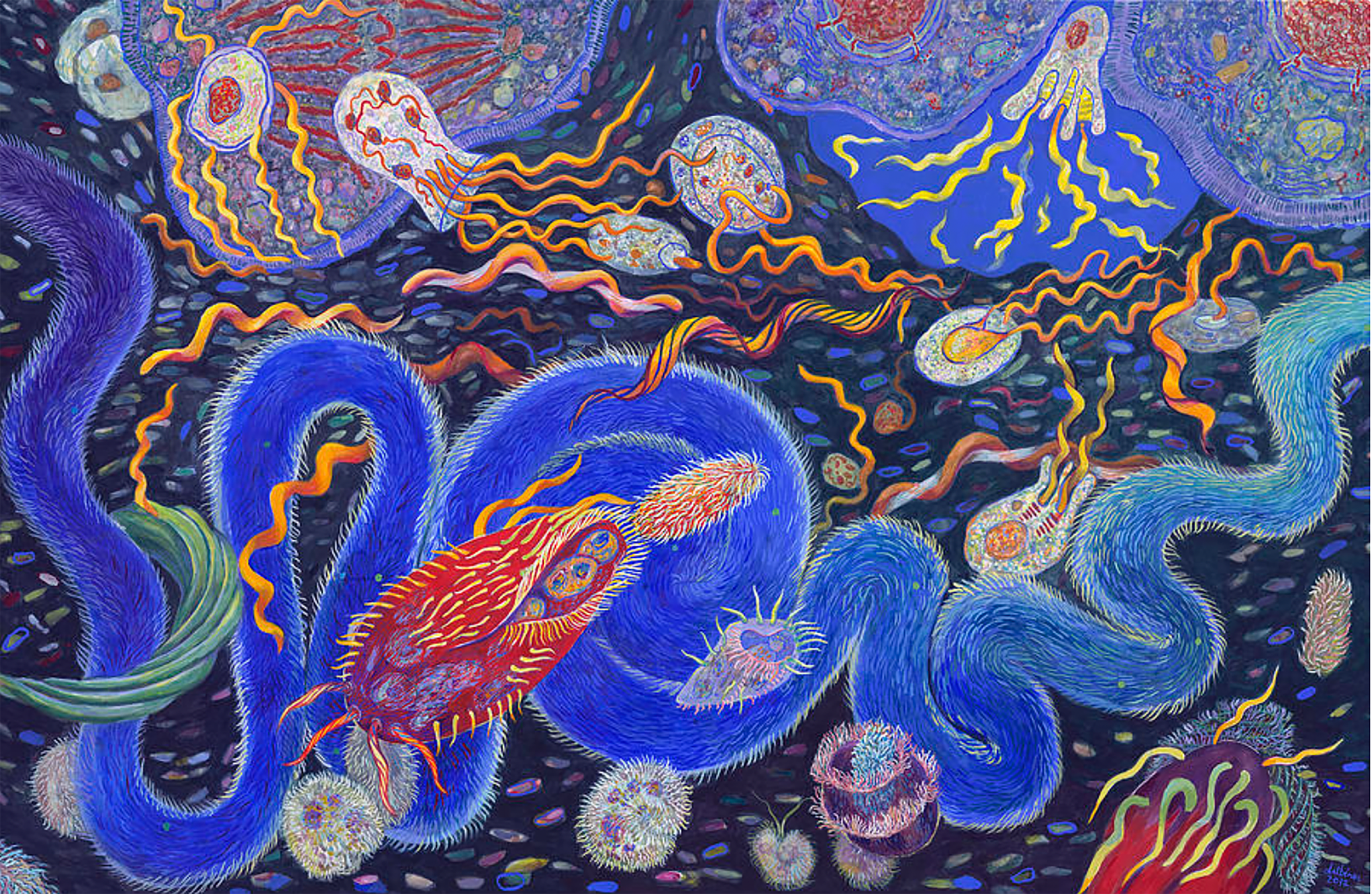
Intestine-like, the tubes coil over and under each other, winding from different directions at the edges of the image towards the center (see Figure 2). They twist and turn until they open and flow out in a stream-like manner. The tubes appear to be organized in a decentralized way, making it unclear where they begin, whether they end at their openings, connect elsewhere, or spiral independently. The black background is speckled with bright dots, evoking a sense of celestial existence. Are we in outer space? What shoots out from the brightly red-blue colored tubes can be described as tiny creatures in shimmering shapes and colors. Upon closer inspection, numerous crawling critters can be seen, although it’s difficult to determine exactly what kind of beings they are. They could be imagined, yet they appear both alive and representative of entities that might be buzzing around out there somewhere. Or perhaps inside of every entity including us?Footnote 4 Assuming that the artist is turning the human body interior outward in this painting, the work suggests a visually recreated digestive scenario, as might occur within the intestinal tract.
Shoshanah Dubiner, Life (from the Protocells Triptych), 30″ × 24″ 2022. Presented for a year at Norris Center for Natural History at University of California Santa Cruz.
Photo Credits Shoshanah Dubiner.

The work Life (from the Protocells Triptych) by artist Shoshanah Dubiner tells a visually unconventional story of what might come to mind with the title “Life.” Dubiner, who describes her paintings as being dedicated to nature and inspired by science, particularly cell biology and botany, explores emergent worldviews in her works, visually rewriting conventional notions of “life” using her own artistic language. In her painterly worlds, she creates abstract systems of environmental agents that are invisible to the human eye, yet simultaneously shaping and permeating human bodies.
Inspired by biologist Lynn Margulis (see Figure 3), it seems fitting to introduce the theorist Donna Haraway here, whose work has been strongly influenced by Margulis. In her theory, Haraway introduces the concept of sympoiesis (sym: together, poiesis: making) as a counter-term to autopoiesis (from the Greek “self-creation”), offering an alternative model for describing our world of interconnected living beings (Haraway Reference Haraway2016, 58). Sympoiesis represents “collectively producing systems that do not have selfdefined spatial or temporal boundaries” (Haraway Reference Haraway2016, 61). Every species evolves in constant interaction with other species. No living being organizes itself. Each is dependent on the cooperation of others, meaning that living beings constitute themselves through mutual becoming (Haraway Reference Haraway2016, 60). The fictional translation of complex biological phenomena and theories, as Dubiner does in her paintings, allows for a playful approach without requiring a background in the natural sciences. As viewers, we are confronted with the realization that human bodies are part of the entanglement of species. They exist in interdependence with one another, as well as with the invisible and the unknown. The survival of the human species on a damaged Earth, therefore, depends on its relationships with other environmental actors. In the spirit of Haraway’s call for “We need other kinds of stories” (Terranova Reference Terranova2016) in the film “Donna Haraway: Story Telling for Earthly Survival,” the artist creates a spectral narrative of interconnected, porous forms of life, inviting viewers to become aware of the porosity of their own being and to situate themselves within “life.”
Shoshanah Dubiner, Endosymbiosis: Homage to Lynn Margulis, 2012.
Photo Credits Shoshanah Dubiner.
This creates a bridge to Marder’s theory of the indigestibility of being, which leads us to the following questions: What does it mean not only to digest but also to be digested? How does the digestibility of our being influence the digestion of planet Earth and that of future colonized planets? And if the Earth’s metabolism is influenced by the human species, how can we (human entities) make ourselves more digestible to stimulate the planet’s metabolism? And finally: How do we want to become-with and how do we want to die together, to use Haraway’s words?
After life
Fungi are the interface organisms between life and death (Stamets Reference Stamets2011).
Death is the eventual distribution of the body into the earth via decay. The ultimatum formlessness, weightlessness of the body (Lee Reference Lee2006).
The Internal Burial Suit (see Figure 4) is a specialized suit for ecological burials, developed by speculative bio art designer Jae Rhim LeeFootnote 5 . On the one hand, fungi are meant to help break down toxins from deceased bodies and transform them into clean compost, thereby contributing to soil quality improvement. On the other hand, the project aims to raise awareness of death and decomposition in Western culture, fostering greater acceptance of these natural processes. The black cotton suit consists of a hooded sweatshirt and pants that cover the entire body. Bold, lightning-shaped white threads on the surface of the black suit imitate the branching morphology of fungal hyphae. Inside, the suit contains actual fungi, with a lining made from a patented biomix that includes spores of the Infinity Mushroom (such as shiitake and oyster mushrooms) in a nutrient-rich gel (see Figure 5).
Jae Rhim Lee, Internal Burial Suit, since 2008. Exhibition view: Nature, Cube Design Museum, Kerkrade NL, May 2019. Photo: Anna Pomyalova.
Photographer: Anna Pomyalova, Photo from the exhibition “Nature” at Cube Design Museum in Kerkrade, Netherlands, taken in May 2019.

Jae Rhim Lee, Internal Burial Suit (since 2008). View: Decompiculture Kit: Capsules with spores of the Infinity Mushroom, nutrient-rich gel.
Screenshot from TED Talk https://www.youtube.com/watch?v=_7rS_d1fiUc5:23/7:30.

The lining dissolves upon contact with a dead immune system, allowing the deceased body to serve as nourishment for the fungi. The fungi then begin to break down organic remains, detoxifying harmful substances and returning nutrients to the natural cycle, transforming the corpse into clean humus soil. During her research, bio-designer Lee found out through the US Centre for Disease Control that around 219 toxins such as tobacco residues, heavy metals, cleaning agents, pesticides, preservatives and many more are released from the human body into the environment during a funeral, continuing the cycle of contamination. In cremations, approximately 50 kg of CO2 are emitted (Lee Reference Lee2016). Additionally, Lee references the American burial tradition, where bodies are embalmed with highly toxic formaldehyde, preserved with fillers and cosmetics to make them appear as lifelike as possible, rendering them practically indigestible to microorganisms).
Lee criticizes this form of burial and body preservation because it continues to contaminate the environment with toxins even after death, denies the natural decay of the body, and interrupts ecological cycles. In addition to developing the Suit, Lee has engaged in extensive educational work through lectures, workshops, and actions, including founding the so-called Decompiculture Society to raise awareness about these issues.Footnote 6
Figure 6 shows Jae Rhim Lee lying in a pit, which outlines her body. Fourteen wooden stakes, connected by white threads, encircle Lee’s body like a cocoon. The depiction symbolizes death as a transitional zone and transformation, with the connections resembling threads and fungal hyphae. This is an action by the Decompiculture Society, which was founded by Lee to explore post-mortem possibilities and replace the denial of death with a culture of decay. In the Internal Burial Suit, compostingFootnote 7 is used as a deconstructive practice both biologically and artistically to counter the indigestibility of being through transformative decomposition. The work methodically employs the metabolism of fungi, or mycoremediationFootnote 8 , for environmentally friendly decomposition of organic remains and their reintegration into ecological cycles. In this way, Lee presents death as an integral part of life processes. BioremediationFootnote 9 , as experimented with by Lee in her work, can be linked to Haraway’s concept of sympoiesis in the following way: becoming-with the environment occurs through the incorporation of the Other and the assimilation of the environment (Haraway Reference Haraway2016, 58). Contamination, therefore, is regulated through digestion. The breakdown of toxic substances is a multi-step, lengthy process of “becoming together,” which revitalizes cycles and counteracts the metabolic stagnation described by Marder.
Jae Rim Lee, Internal Burial Suit (since 2008) Installation View: A proposal for a mushroom-burial site in Northern California.
https://fellowsblog.ted.com/how-the-mushroom-death-suit-will-change-the-way-we-die-a52f486dc816 Apr 13, 2016.

The philosopher Emanuele Coccia also writes about the reincarnation of matter, linking it to a cyclical way of thinking: Every death is a continuation of life in different forms (Coccia Reference Coccia and Mackay2021, 85-112). In his chapter “Eating and Metamorphosis,” he cites environmental philosopher Val Plumwood, who emphasizes that the ecological crisis can only be overcome if we accept equality and reciprocity in the food chain: All living creatures are food (Coccia Reference Coccia and Mackay2021, 85-112). Coccia concludes that the desire for burial in a stable coffin reflects an attempt to remove the human body from the food cycle. His conclusion is: We can only become other living beings, because everything that lives does so through transformation, that is, through the transformative repetition of what preceded it (Coccia Reference Coccia and Mackay2021, 85-112).
Internal Burial Suit offers a proposal for ecological thinking in cycles and tells “the systemic stories of the linked metabolisms” demanded by Haraway through composting (Haraway Reference Haraway2016, 49). Haraway uses the metaphor of compost to illustrate that life and death are continuous metabolic processes. Composting serves as a model for a postanthropocentric worldview that emphasizes the permeability of boundaries and mutual dependence. Survival on Earth is not ensured by isolated action, but by the constant interplay of human and non-human actors. The piece embodies post-anthropocentric perspectives on the world through composting and shows how this worldview could transform human death culture. The artistic project not only highlights that humans are part of a complex network but also concretely affirms Marder’s thesis on the indigestibility of our existence.
Fermenting futures
How could yeast, which once contributed to the development of our entire civilization through fermentation practices, be used today to help address the current problems of plastic pollution and climate change?
The Bio Art artists Anna Dumitriu and Alex May explore the transformative potential of yeast in their project series Fermenting Futures (see Figure 7). In their artistic research, they use genetically modified yeast to create sustainable bioplastic and reflect on the biocultural relevance of yeast biotechnology, both in the past and the present. During the production of the pieces, the artists combine multidisciplinary approaches from synthetic biology, digital technologies, sculpture, and craft. The project was developed during a residency at the Institute of Microbiology and Microbial Biotechnology of the University of Natural Resources and Life Sciences in Vienna, Austria.
Anna Dumitriu and Alex May, Fermenting Futures, 2022, glass flask with bubbling CRISPR-modified Pichia pastoris yeast, 3D printed elements, Installation View at The Regency Townhouse, UK.
Photo Credit Anna Dumitriu and Alex May.

The Fermenting Futures installation consists of a transparent laboratory glass flask with a cloudy, bubbling yeast solution inside, whose outer surface is covered with 3D-printed plastic elements. The largest of these plastic elements encircles the neck of the flask and holds transparent, thin-walled plastic tubes together, which erupt fountain-like from the inside of the bottle. These are enlarged microscopic depictions of yeast cells, with one element made from a special bioplastic. For the production of the bioplastic, the CRISPR-modified Pichia pastoris yeast housed in the sculpture was used. This yeast can bind CO2 from the atmosphere and release lactic acid, which is used to produce PLA plastic. This plastic filament is biodegradable. The yeast’s sculptural form was produced by the artists using a 3D printer and then assembled. Through this, an artistic translation of the transformation processes of yeast and its products into a tangible sculptural form takes place.
In Fermenting Futures and Culture, Dumitriu and May artistically situate the metabolism of yeast at the intersection of the future and the past. Yeast plays a central role in synthetic biology and has a wide range of applications, from food production and beer- and winemaking to carbon capture, bioplastic production, and vaccine development. The special properties of yeast were already known in antiquity and were significant long before Pasteur officially discovered fermentation in 1857 (Dumitriu and May Reference Dumitriu and May2022). Current humanities discourse increasingly engage with fermentation as a biocultural phenomenon that extends far beyond food production or preservation. At the core is the assumption that the ability to convert sugar into alcohol may have contributed to the emergence of the first settlements and complex social structures, as humans had to become sedentary to produce these products.Footnote 10 The installation Culture (see Figure 8) artistically addresses this hypothesis through a model of such a settlement. The facades of the model’s houses are made from breadcrumbs baked from dough using Pichia pastoris yeast. Fermentation as an artistic medium embodies the continuum between nature, humanity, and culture, as well as the agency of both humans and microbes (Bobadilla, Serrano Reference Bobadilla and Serrano2022). Alongside Bio Art and Eco Art, it forms a narrative within art activism.
Anna Dumitriu and Alex May, Culture, 2022, House models made from bread crumbs, baked with dough from Pichia pastoris yeast, installation view at The Regency Townhouse, UK.
Photo Credit Anna Dumitriu and Alex May.

Fermenting Futures demonstrates how yeast, through biotechnological applications, can contribute to solving environmental problems by capturing CO2 and producing sustainable materials. On one hand, bioplastic, as the product of the process-based sculpture Fermenting Futures, is presented as a potential alternative to conventional plastics. Plastic disrupts natural cycles and causes an imbalance or “metabolic standstill” through pollution (Marder Reference Marder, Bekirović and Marder2019). Thus, Fermenting Futures counters the blockage of ecological cycles. At the same time, the artwork encourages deeper reflection on the complex coexistence of biological and cultural processes. It centers on the metabolism of yeast as the key medium, highlighting the interactions between humans, microorganisms, and the environment. In line with Marder’s concept of “planetary metabolism,” yeast is portrayed as part of a global metabolic system that manifests the evolutionary and cultural connections between various life forms. Art here is not merely an aesthetic expression but an active agent of ecological and social change, promoting sustainable collaboration and the overcoming of dualities such as nature and culture. With a focus on stimulating global metabolism, Dumitriu and May present transdisciplinary solutions that not only propose new materials but also provoke deep reflection on the significance and future potential of yeast. These approaches help to counter what Marder describes as the “indigestibility of being.”
Return to sender
Unlike the other works, Return to Sender (see Figure 9) does not involve biomaterial products or biotechnological solutions. Instead, it expands the essay’s scope by examining the relationship between technical innovation and social reorganization. Created by the Nairobi-based Nest Collective for document a fifteen (2022) in Kassel, Germany, the installation features a cube-shaped structure made from bales of used clothing, known as Mitumba in Kenya. These bales, byproducts of the fast-fashion industry, are shipped from the Global North to the Global SouthFootnote 11 . Scattered around the cube are additional bales of textile and electronic waste, accompanied by ambient sounds recorded at second-hand markets in Nairobi. Inside the cube, visitors encounter the documentary Return to Sender – Delivery Details, where experts and affected individuals discuss the complexities of Kenya’s “waste lobby.” The work critiques the charitable framing of clothing donations, highlighting how items undergo qualitative selection before being sold, with lower-value goods compacted into bales and sent to the Global South.
Installation View: The Nest Collective, custom-built pavilion for “Return to Sender,” shown at documenta fifteen in Kassel, 2022. Foto: Nils Klinger.
Photo Credit Nils Klinger, documenta Archive.
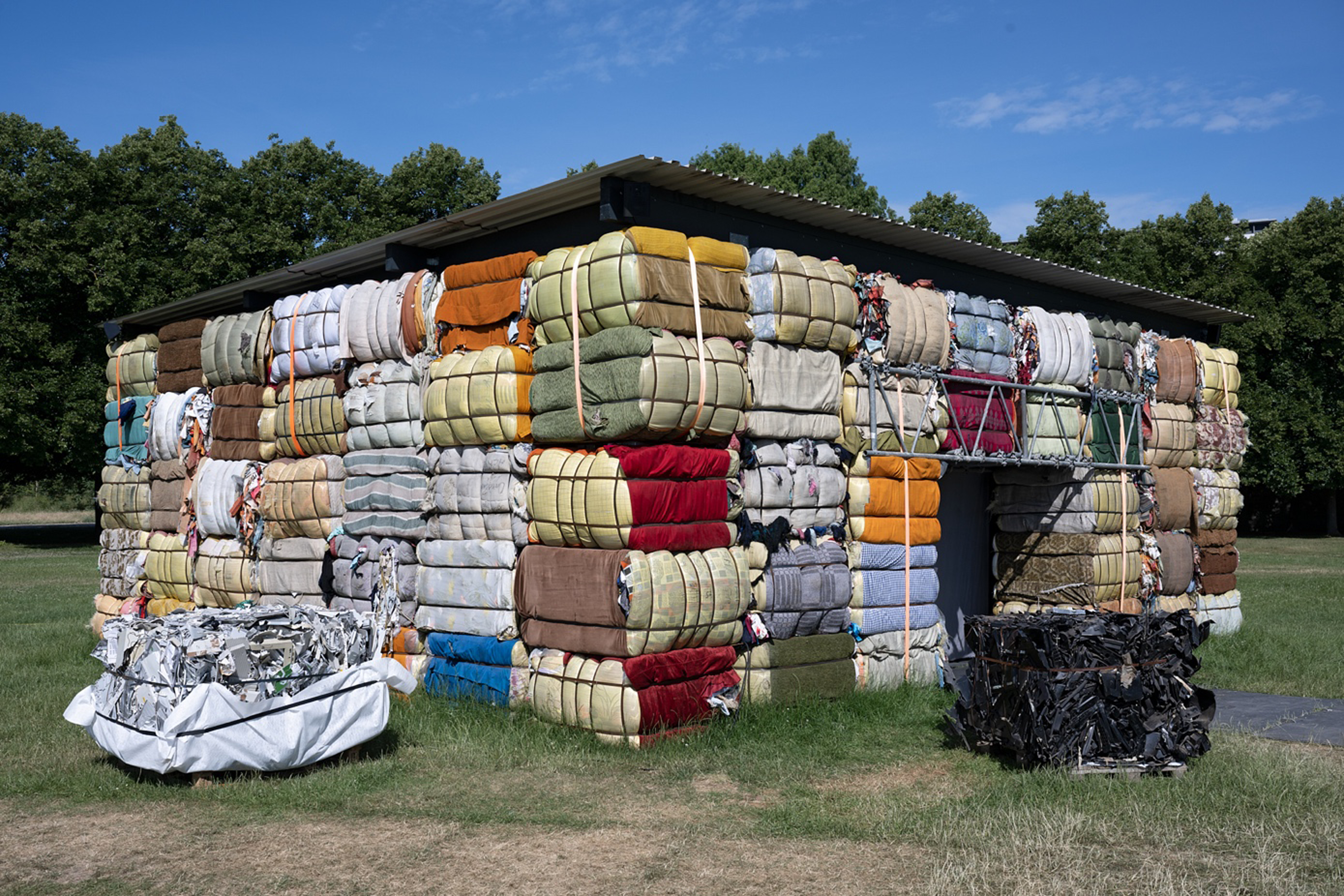
Up to 40% of imported second-hand clothing bales are unusable and end up in landfills, turning parts of the Global South into dumping grounds for hyper-consumerist societies. Economic conditions force locals to trade these bales, often risking debt by purchasing them without knowing the amount of usable clothing inside (The Nest Collective 2022). Return to Sender immerses viewers in a dense, dark space built from waste, engaging them on a visceral, material level while provoking reflection on the fate of their donated clothing. Rather than offering technological solutions or exit strategies, the work confronts the viewers with the proverbial “indigestibility” of artificially produced, overabundant materials and engages them in questions of [their own]Footnote 12 geo-social responsibilities. The appeal is directed at the sender. But who is this sender? Is it the consumers? Is it the individual who finds themselves with an overflowing wardrobe and doesn’t know what to do with all the excess? Where does individual responsibility lie, and to what extent are individuals themselves instrumentalized within a capitalist machine, such as the second-hand industry?
As one possible perspective, we introduce the concept of De-Growth, as the art theorist Daphne Dragona has applied it to artistic processes and production in her essay “Degrowth and the Arts” (2022). Scholars argue that the illusion of growth and progress, rooted in Western and Global North constructs, is tied to the exploitation of the Global South (Schmeltzer et al. Reference Schmeltzer, Vetter and Vansintjan2022). De-Growth challenges this framework through actions that respect planetary boundaries and acknowledge social and ecological interdependencies. It promotes equality among all forms of life, emphasizing community and coexistence. Transitioning to sustainability requires questioning Western ideals of time, gender, death, and democracy, moving beyond optimization and productivity tied to dominance. The “de-” prefix calls for actively “un-making” linear progress narratives and rethinking them (Dragona Reference Dragona2022).
We include Return to Sender in this essay for its unflinching exposure of planetary digestive disruptions, confronting social responsibility and vulnerability within capitalist structures. The work raises ethical questions aligned with Marder’s concept of stimulating planetary metabolism, urging viewers to reflect on their agency, coexistence, and exploitation. In the context of this publication, it specifically addresses the question of how we want to relate to ethical issues surrounding the production of biotechnologies and biomaterials. The work is thus reflexive, throwing us back on our own and collective agency. Ultimately, the waste returns, and with it come heavy metals, hormones, microplastics, antibiotics (Volkart, Reference Volkart and Maeder2017) – as well as questions concerning our individual and collective responsibilities.
Conclusions and impact statement
This is the point where the realm of art, balancing at the edge of the private and the historical, becomes a place where one can experiment with experiences at the edge of the anthropocentric, where the rubble lies, and build an imaginative society in which the human is not at the center of our cosmology, but only one element in harmony with all living and non-living world-makers […] (Christov-Bakargiev Reference Christov-Bakargiev2011).
Building on the central question – “How can biotechnologies and biomaterials shape and sustain habitats in extreme and space environments?” – this essay has explored how contemporary artistic practices engage with the planet’s metabolic disorders, as articulated by Marder. By analyzing works in Eco Art, Bio Art, Bio Design, and Socially Engaged Art, we have highlighted art’s potential to address ecological and social dysfunctions through its material, conceptual, and ethical dimensions. These insights now inform our concluding reflections on the role of art in envisioning sustainable futures and stimulating planetary metabolism.
The exploration of socially engaged art highlights the necessity of embedding democratic and participatory principles in the development of biotechnologies and biomaterials. Rather than offering definitive solutions, artworks as Return to Sender confront us with the complexities and contradictions of our current ecological and social systems, urging us to reflect on the ethical and inclusive dimensions of technological progress. By asking, “How do we wish to produce and consume in the future?” and “Who is included or excluded in these processes?”, they emphasize socially conscious approaches to bio-futures. Harun Farocki’s (1969) question – whose interests are served or harmed? – remains central to envisioning equitable, sustainable futures. Furthermore, the examination of pieces like Fermenting Futures reveal the intricate relationship between past knowledge and future innovation. The notion that “everything we need is already here” underscores the potential of drawing from historical, cultural, and ecological wisdom to inform contemporary and future practices. This cyclical view of time challenges linear progress narratives, advocating for strategies that draw on diverse insights and post-colonial perspectives. Such reflections inspire inclusive approaches to decision-making in extreme and extraterrestrial environments.
A recurring theme is the question of legacy – both material and conceptual. Internal Burial Suit for example prompts us to consider not only what we aim to create but also what we leave behind – After Life. Discussions on death and ecological cycles suggest biotechnologies and biomaterials as tools for integrating remains into ecosystems. These reflections extend beyond Earth, urging responsible integration into newly inhabited environments and recognizing that our creations and actions shape future generations and ecologies. At its core, this inquiry into biotechnologies and biomaterials is an inquiry into life itself. By dissolving boundaries between internal and external, human and non-human, the artworks emphasize the interconnectedness of living systems as we can see in Dubiner’s works Life and Cell Garden. They challenge dualistic frameworks, offering paradigms for sustainable habitats that respect and enhance interconnections. This perspective encourages solutions aligned with relational and ecological balance.
Artistic practices, as explored in this work-based essay, act as both metaphors and material interventions that illuminate global metabolic processes. By revealing entanglements between natural and human systems, art inspires innovative thinking and action, providing a space for experimenting with solutions rooted in an understanding of earthly interdependencies. Art thus functions as a reflective and generative tool, enabling transformative processes aligned with Marder’s notion of global metabolism. The relational self-understanding fostered by these artworks is crucial for the survival of human and more-than-human cultures. Beyond technological innovation, collaborative spaces where artistic and scientific research intersect are urgently needed. Such spaces can cultivate relational thinking and interdisciplinary insights. The fundamental question of how we wish to live and die together lies at the heart of this endeavor. Art provokes, deconstructs, and experiments, becoming a critical instrument for imagining and shaping sustainable ways of being in extreme environments. It reminds us that technological advancement must align with social and ecological justice, ensuring inclusive, equitable, and resilient futures.
Data availability statement
The data that support the findings of this study can be obtained upon request from the corresponding author. Transparency and openness in data sharing align with the principles of reproducibility and integrity in research. The image rights are secured to the best of our judgment. As you can see from our list of references, we have worked in part with German sources. If required, we can provide original English quotations. Researchers interested in accessing the data for legitimate purposes are encouraged to contact the corresponding authors.
Acknowledgements
We would like to thank Prof. Dr. Birgit Mersmann (Department for Contemporary Art and Digital Image Cultures, University of Bonn, Germany) for her expertise in the field of art science and Prof. Dr. Uta Paszkowski (Department of Plant Sciences, Cambridge University, England) for her support in the field of biology. Special thanks go to our friend and fellow artist Nina Paszkowski and Shoshanah Dubiner for the inspiring exchange and insights into her artistic work as well as Gert van der Merwe for his support. We would also like to thank Monica Moniz for her editorial support and Layla van Ellen for the invitation and realization of this project. Finally, Anna Pomyalova thanks the ELES Doctoral Student Research Scholarship and her supervisors, Univ.-Prof. Dr. Timo Skrandies and Prof. Dr. Jessica Ullrich, for supporting her dissertation project.
Author contributions
The authors of this manuscript adhere to the ethical guidelines and principles set forth by Cambridge University Press. The contributions of each author to the development and completion of this work are outlined below:
Manuela Mehrwald, Anna Pomyalova: Conceptualization, Methodology, and Writing – Original Draft Preparation.
Manuela Mehrwald, Anna Pomyalova: Data Collection, Analysis, and Formal Investigation.
Prof. Dr. Birgit Mersmann, Prof. Dr. Uta Paszkowski: Review and Editing, Visualization, and Validation.
Monica Moniz, Layla van Ellen: Project Administration
Gert van der Merwe: Proofreading
Each author has critically reviewed and approved the final version of the manuscript. The authors affirm that this work represents an accurate and ethical contribution to academic and scientific knowledge.
Financial support
This paper was written independently and is not funded by the latter.
Competing interests
None.
Ethics statement
This research was conducted in accordance with the ethical guidelines and principles established by Cambridge University Press. Any potential conflicts of interest have been disclosed, and steps were taken to minimize bias and ensure the integrity of the research process. The authors are committed to transparency in reporting and have provided accurate and complete information in the manuscript. Any deviations from the approved protocols have been duly explained. For further information regarding the ethical considerations of this study, please contact the corresponding author.


 Open access




Comments
No accompanying comment.