


Introduction
A large number of business school academics will have mental health concerns at some time in their career with the duration and intensity altering depending on the condition (Urbina‐Garcia, Reference Urbina‐Garcia2020). For business school academics, this can occur at various career moments from starting a research career to building their brand name then stepping into administrative roles. Mental health can be defined in various ways depending on the perception around its importance. The World Health Organisation (2022:8) defines mental health as ‘a state of mental well-being that enables people to cope with the stresses of life, to realize their abilities, to learn well and work well and to contribute to their communities.’ This definition will be adopted in this editorial, as it provides a holistic way to understand mental health in business school academia.
Physical health used to be a priority for professionals and continues to be essential, but in recent years, mental health concerns have significantly risen. Mental disorders can range in type, as they can be diagnosed before, during, and after certain events. They affect directly a person but also surrounding family, friends, and acquaintances. This means most people in society will have to deal with mental health issues at some point in their lives. Getting access to support systems to help people with mental health issues is a necessity and can provide coping mechanisms in order to lessen the adverse effects (Quijada, Reference Quijada2021).
Academics especially those in business schools have long recognised the interconnectedness between their home and work life with more emphasis being on work/life balance. There still is though limited research about mental health in business academics (Kinman, Reference Kinman2016). This is surprising given a large number of academics are in business schools. Mental health is a state of being and refers to how someone feels, acts, and thinks (Hughes & Byrom, Reference Hughes and Byrom2019). It can be hard to diagnose, as it is not readily evident when looking at a person and is often hidden. It is an illness that can have emotional reasons based on psychological events or be evident in certain situations. A person’s mental health influences how a person interacts with others and is affected by environmental factors. This is especially relevant in university environments in which increased metrics need to be fulfilled that makes it hard for academics to juggle multiple tasks (Fox & Gasper, Reference Fox and Gasper2020). This influences how academics manage their relationships due to performance targets. The distress from mental health disorders impacts the ability of academics to do their job. This means many academics have high stress levels, anxiety, depression, and other disorders (Hammoudi Halat, Soltani, Dalli, Alsarraj & Malki, Reference Hammoudi Halat, Soltani, Dalli, Alsarraj and Malki2023).
Studies on mental health tend to take a broad view that it applies in all sectors of the economy but is especially concerning in university environments (Akinlotan, O’Connor & Okunzuwa, Reference Akinlotan, O’Connor and Okunzuwa2026). In reality, specific industries such as the education sector have special features that stand them apart from other sectors due to the high degree of knowledge intensity and long training periods required to become a qualified academic. This means the higher education context poses a way to understand mental health in academia. By doing so this editorial will contribute to a better understanding of mental health in the higher education sector. The central aim of this editorial is to draw attention to how the higher education sector can benefit from a more interdisciplinary understanding of mental health. To this end, we point to the psychology and education literature to review mental health issues. This will guide future ways issues related to mental health are managed in academia.
The research questions are then to answer: what is the current state of the literature regarding mental health in business school academia? How does the higher education sector differ to other workplace environments regarding mental health? And what are the implications for educators, students, universities, and other stakeholders? To answer these research questions takes time as these are hard questions to answer. However, they are important questions needing answers, given the way mental health issues have broader societal implications. This involves articulating in a clear way how knowledge regarding mental health in academia can be advanced.
The scope of this editorial is focusing specifically on mental illness in business academics. There is a dearth of research critically examining the impact of mental illnesses on business academics (Nicholls, Nicholls, Tekin, Lamb & Billings, Reference Nicholls, Nicholls, Tekin, Lamb and Billings2022). Academics with mental illnesses can be unfairly judged, and prejudices may occur. This means a caring attitude is required in understanding an academic. This is easier said than done as academics might work in a specific field such as human resource management that focuses on talent management but in reality have different views. As a consequence, empathy is required in how academics that are high functioning but have mental illnesses behave. It can be difficult and career damaging when mentioning mental illnesses to co-workers and supervisors.
The implications of mental illness in academia can have impacts on others in an academic environment including students (Apostolopoulos et al., Reference Apostolopoulos, Ratten, Stavroyiannis, Makris, Apostolopoulos and Liargovas2020). When exposed to a mental illness, there are multi-faceted and complex matters that need to be taken into account. Strategies to effectively deal with mental illness in academia are needed in order to support better psychological well-being (Jivraj, Reference Jivraj, M., A., N. and L.2024). This includes educating others about mental illness in order to successfully adapt workplaces.
This editorial is structured as follows. Firstly, definitions and conceptualisations of mental health are discussed. This leads to information being provided about how mental health in business school academia differs and why it is a useful context. Potentially useful ways to alleviate worries of mental health are then stated. This leads to more insights being provided about promoting good mental health practices in terms of future research questions and areas to be addressed.
Mental health conditions
Mental health conditions occur when there is a disturbance in a person’s mental functioning (Lau & Pretorius, Reference Lau, Pretorius, L., L. and B.2019). This can include cognitive behaviour in terms of thought patterns and assumptions around environmental changes. There are human made events that cause mental illness as well as biological and physical issues. Poor mental health is a result of a clinical diagnosis that affects the ability of a person to properly function (Ratten, Reference Ratten2012). This means it may include the idea of strain or hardship. Mental illness is defined as ‘diagnosable mental disorders characterised by significant disturbances in cognition and emotion regulation, or behaviour that reflects dysfunction in psychological, biological, or developmental processes causing distress and impairment’ (Hanson & Rosado-Solomon, Reference Hanson, Rosado-Solomon and E.H.2025:13). Mental illness can occur based on an event or during a specific time period, and its severity differs based on individual’s abilities to cope (Parra Saiani, Di Stefano & Ivaldi, Reference Parra Saiani, Di Stefano and Ivaldi2025). Mental health conditions can be contagious when academics interact with others, which can influence the teaching and research abilities of an academic.
Management academics have long been interested in health issues in the workplace. Mental health issues can be easily diagnosable in terms of human behaviour but are often diagnosed too late in life. Mental disorders vary in their symptoms and responsiveness to therapy. This makes it hard to analyse the consequences of mental illnesses without knowing more information. Often mental disorders are clusters of related symptoms that result in behaviour changes. In academia, mental disorders influence a person’s ability to function properly and in an efficient manner. This includes thinking in a reasonable and analytic way rather than just being responsive to what others are saying or doing. The onset of mental illness can be a result of job changes or personal issues. When there is discord at a workforce, it can influence the onset of mental illnesses.
Most academics have the option to utilise counselling services on a free basis for a period of time but are often worried about confidentiality and privacy issues. This means whilst the services are available, the way they are offered does not generate trust. Well-being initiatives are marketed at universities, but in reality should not be needed if the work environment is good. Instead, universities need to be asking why are academics having mental illnesses and is it the work environment that is causing these instabilities. Furthermore, whilst the emphasis on well-being is good, there should also be a focus on unachievable performance outcomes in which all academics are expected to achieve. There should be a stress on diversity in performance outcomes that acknowledges people do tasks differently depending on their skills and experience. Rather than expecting everyone to be good at all tasks having a diversity in performance perspective will achieve a more healthier outcome.
Stress
Stress is defined as ‘a relationship in which a person’s environment is seen to exceed his or her resources and jeopardizes his or her well-being’ (Miller, Wiklund & Yu, Reference Miller, Wiklund and Yu2020:57). There are a variety of ways stress can occur and it differs in terms of how people respond. It puts a person at risk of harm, as they find it difficult to cope. This means a person may not know how to handle the changes in feelings. Some people thrive under stressful conditions, as they become energised whilst others flounder and begin a downward spiral. The signs of stress vary and they can include visible signs such as sweating or body movements.
Intense workloads often cause stress to academics that leave little time for other activities including research. This causes both mental and physical ailments that are not acknowledged properly in the workplace. The mental ailments result in anxiety and depression with a change in personality and outlook occurring. The physical ailments include sore bodies and less active people due to the time taken to do certain tasks. Whilst time management techniques can be used often, the amount of work required is not indicative in academic workloads. Set time frames are included, whereas the actual time taken is much more. This is associated with having multiple instances of subject offerings across campuses within a country and externally. The sheer nature of coordination is mostly not included in set time frames given in workload models. This means the actual hours worked per week exceeds the guidelines.
Academic stress can be the result of a need for perfectionism in academics that means they go over allocated workload hours. They want to do the best possible job due to their strong work ethic. An inability to detach from academic work caused by emails and online discussions further complicates matters. Before the internet, class hours were normally set hours and questions from students were asked during class time or the allocated consultation hour. With email, there can be a constant flurry of messages at all hours. Whilst there are laws such as the right to disconnect in Australia and other countries, in reality academics are answering emails at all times. Most universities have a time policy in responding to emails, and this puts further pressure on academics to respond quickly. Furthermore, the number of questions in an email can be quite long that result in often 30–45 minutes writing a reply. This means email correspondence is not officially taken into account in workload allocations, because it is assumed the email questions are either short or not significant.
Academic burnout can result from stress due to the feeling of not being adequate. This is despite many academics publishing articles and teaching classes, but the performance goals increase to an extent that it is not physically possible to achieve. This is sad as many of these academics if given more reasonable performance goals would be much happier. Perhaps some of the misunderstanding comes from workload metrics not being reasonable given past outputs.
Academics can feel a sense of chronic exhaustion due to the constant pressure to substantiate their role. To be a good teacher and researcher is possible, but there needs to be more acceptance about time allocations. This will decrease the sleep disturbances academics have from overthinking things or staying up later in order to complete tasks. As classes are now taught at various hours of the day, including early morning and late at night, this can complicate things. Furthermore, if teaching is done overseas, the class time for those involved may be outside normal work hours.
Academic burnout can result in reduced motivation, and this can have contagion effects. As a consequence, academics can feel disengagement and a loss of job control. To reduce the stress, it is important that academics get proper sleep and regular exercise, but given cost of living and time pressures, this may not be possible. This means that then success in academia should be redefined in terms of sustainable performance metrics. This is important as the United Nations sustainable development goals are often prioritised in university discussions and rankings. Goals such as gender equity and adequate work should be linked to the actual work that academics can realistically complete. Often unachievable targets are put in place that causes academics much stress.
Anxiety
Business academics often have anxiety that is characterised by intense worry that can be more pronounced in a workplace setting or at home. It includes a feeling of intense fear about a situation or being around certain people. This is due to the information others may convey when in their presence. It can be treated with lifestyle changes but this can be difficult when the workplace environment does not change.
Common symptoms of anxiety include uncontrollable worry that is linked to a sense of apprehension about current and future events. It can be caused by past interactions that have given rise to certain situations. Academics with anxiety can be irritable in terms of having negative feelings or alternatively they may be restless in terms of constantly doing some kind of activity. The physical symptoms of anxiety include increased blood pressure and sweating. Academics may have muscle tension caused by time periods spent during the same activity. Cognitive symptoms of anxiety include avoiding people or situations that cause anxiety for academics. This may mean avoiding other academics that make them feel uneasy. Anxiety can be evident in an academic’s mind going blank and them being unsure of their physical surroundings. This may be associated with panic attacks when a person feels intense worry.
Social anxiety is a type of anxiety disorder that is evident when an academic feels a fear of being in the company of other academics. It can be caused by feeling that the other academics are judging them unfairly or disrespecting them due to perceived personal or work traits. This leads to the academics being embarrassed in a social situation that includes a large number of people. Due to the critical nature of academia with research and teaching methods being questioned unexpected social anxiety can arise.
Depression
Cubbon, Darga, Wisnesky, Dennett & Guptill (Reference Cubbon, Darga, Wisnesky, Dennett and Guptill2021:2) states ‘depression is a family of disorders characterised by sadness, lack of pleasure, and psychomotor and cognitive changes that interfere with a person’s ability to function’. Academics can become depressed when there is sadness in their feelings. It can include a loss of interest in academic and other activities that makes life difficult. There are different symptoms of depression that include having low energy and difficulty concentrating. Whilst the topic of depression has been widely discussed in popular culture, less understood are specific contexts and professions. The impact of depression in academics is profound, as already isolating work environments make it hard for them to recover. Moreover, there are productivity losses associated with academic depression including observable and non-observable effects. Observable effects included reduced on the job productivity and absenteeism. Non-observable effects can include self-harm and further illnesses caused by stress.
Depressive symptoms can exist for an extended time frame and can be heightened by stressful events. Therapy in a variety of forms can be used to treat depression, but the underlying reasons for the depression often need to be solved. Academics can be intrinsically motivated to be in universities and their sense of self is tied to job satisfaction. Increased emphasis on productivity and internationalisation trends has raised questions about the role of depression of academics. Furthermore, increased workloads associated with larger and more classes as well as the competitiveness of funding opportunities have put pressure on academics.
Reduced autonomy and more bureaucratic procedures have resulted in job insecurity in academics. The difficulty in balancing work and home life with more emphasis on accountability makes it hard for academics. Academic work is challenging, and academics are at increased risk of depression. Many academics enjoy their work due to the freedom to determine their own research topics and way of working. Academia can be a high-risk profession due to the need to work long hours with uncertain outcomes. This creates personal problems about being a successful academic whilst maintaining a positive life outlook. The benefits of academia in terms of freedom can be contrasted with an increased risk of mental disorders. This comes from a range of positive and negative emotions being experienced simultaneously amongst academics. Some academics may be predisposed to depression due to lifestyle conditions that give rise to more depressive episodes when in academia.
Academics with depressive disorders can have thoughts of death that can lead to suicide. This means there are mental health risks of academics experiencing depression that can make them vulnerable. Academics can feel isolated due to working long hours and high workloads. The nature of academia can mean working alone with little emotional support. Isolation can lead to depression and is a continuing issue in academia. Good health and well-being are associated with social support. This means academics can have depressed moods when there are stressful working conditions.
Academic burnout
Academic burnout is a result of job stress and it has serious consequences for the academic profession. Many academics quit the profession due to burnout reasons, and it is a critical concern for universities due to the knowledge intensive nature of the industry. To minimise the risk of burnout academics should look after their own well-being. Burnout is a result of a feeling of reduced accomplishment that leads to emotional exhaustion. It is based on a sense of cynicism around workload with the consequences being decreased performance. It depletes a person’s emotional resources in terms of being able to handle a situation. This can lead to a decline in whether a person feels they have the competency required to do the work. When an academic is burnt out, they are likely to detach from aspect of the job and feel a sense of disengagement from others.
Academics have high job demands based on different skillsets that require social interaction but also solo-based work. The need to manage different tasks is difficult for academics who often do not receive any immediate reassurance about their work. This creates psychological costs when an academic questions whether the work they are doing is worthwhile.
To cope with role conflict and ambiguity can cause stress. Academics are required to present their work in front of others but also be competent teachers. At the same time, they are expected to do research that tends to be done alone and at their own pace. Both research and teaching pressures required different skillsets and can lead to high job demands.
Academic burnout is manifested in all types of business studies but particularly amongst those feeling more dissatisfaction with their jobs. It costs universities money in turnover and less productivity gains. Leaving academia as a result of burnout can be hard to do for academics who are based at a specific geographic university with few other universities in the surrounding area. Some universities have a sabbatical system designed to give academics time off in order to recharge that can result in lower burn out rates.
The entrepreneurial academic
Academics are now supposed to bring in grant money but doing this can be difficult due to other workload commitments such as teaching. There are research fellows who are assigned research roles as well as teaching fellows who are focused on teaching. However, most academics have both teaching and research roles as well as service expectations. This makes judging each type of commitment quite difficult during the calendar year as often research publications take time to get peer reviewed, then revised and finally published. The metrics academics have to follow tend to be the same for each level based on percentage allocation in their workload. This means it can be unfair when an academic is doing the required teaching at a high level, but their research publications are taking time due to reasons beyond their control. This delay in publishing articles means the required metrics might not be met on a yearly basis so a longer time frame should be used. Furthermore, the increased emphasis on grants and publications puts more stress on academics as grants are a different category of activity. Whilst academics can apply for grants it is beyond their control whether their applications are successful.
Many universities have set income targets associated with grants that are quite high compared to the yearly wage of an academic. It can work out as a high percentage of income required to meet the benchmarks, and this is difficult to achieve particularly when they have teaching and service allocations. Academics can obtain grants from external bodies, but these going often to non-academics without research profiles. Thus, it can be unfair to emphasise grants to academics when it takes a lot of time and effort to find suitable grants in their research area and then to apply. Compared to overseas institutions particularly those in Europe where there is a tendency to automatically give grants to research active academics, the situation in Australia is quite different.
Grants are emphasised quite a lot in Australian academic circles but in overseas universities particularly in the United States the situation can be quite different depending on the location and type of the university. Even in Europe and the United Kingdom, many professors do not have many if any grants in the business management field. The grants they do have are often European Union grants that have been allocated to specific universities and then academic researchers assigned, so particularly European academics moving to Australian universities are often at an advantageous position due to these grants. In Australia, there is not the same kind of European Union grant initiative programmes that include multiple institutional partners although some are beginning to take shape in the academic environment.
Resilience
Traumatic events can cause detrimental psychological outcomes that lead to a change in behaviour. The effects of stressful events are a major factor in psychological changes that can accumulate over time or be based on one major event. Academics need to be resilient to cope with change as it enables them to adapt to new circumstances. Kimhi (Reference Kimhi2016:164) states resilience is ‘a positive trajectory of adaptation after a disturbance, distress or an adversity’. It enables a person to move forward with their life despite periods of hardship. In the context of a stressful event, resilience can provide a way to acknowledge the stress but heal.
Resilience is a form of successful coping and provides a way for a person to return to good health conditions. The idea of resilience is to return to a person’s pre-traumatic condition before the stress occurred. Individual resilience is a specific form of resilience, as it tracks healthy behaviour following stress. The goal is for a person to buffer or offset the negative consequences of an event. Each person’s feelings about a trauma is shaped by their environment and ability to understand what happened. This means each person experiences an event based on their cognitive functioning and this is subjective. Thus, resilience is an individual attribute in terms of comprehension and understanding. Academics will manage trauma in their own way based on a sense of meaningfulness. Some events are controllable and foreseeable so academics can put a plan in place to cope with the change. Other events are unforeseen and take academics completely by surprise. This relates to the rate of recovery in terms of time taken to cope with the change. Having positive social interactions in an academic environment can help an academic respond better. However, a lot of the work academics do is lonely and strict guidelines are followed in terms of behaviour. Recent and past life events can influence the prevalence of resilience. Academics with a healthy outlook and low levels of existing health conditions may respond better compared to others with existing health conditions.
Business management academics exist within a broader spectrum of academic study. This relates to their sense of self and identity as an academic. Having social resilience enables an academic to foster and engage in better social relationships that often include other academics. This is important as networking is a way to sustain academic performance. Social isolation often occurs in academia due to the reliance on digital technology and a need to complete tasks by oneself. This can make it harder to recover from life stressors when it is difficult for an academic to explain to others about a traumatic event.
The social resilience of an academic is based on communication and level of trust. This includes the capacity of an individual to share information and to explain their feelings. This can be a complex task for academics who may be ashamed or embarrassed about an event. Other academics need to be attentive listeners and listen with compassion. This may be difficult when other academics have not experienced the same kind of events.
A protective factor that is part of resilience is having the ability to envision a person’s life in the future. This future orientation is a way to overcome trauma and be more optimistic. Academics may feel a sense of hopelessness due to uncontrollable events. Academics need to engage in risk management in order to survive and overcome trauma. Academics should try to be positive rather than afraid of change. To cope with stress having a resilient identity can help.
Organisational citizenship behaviours
Organisational citizenship behaviour is an implicit way of responding to others in an organisational setting. It refers to moral and ethical values associated with being a member of an organisation. It was defined by Organ (Reference Organ1988:4) as ‘individual behaviour that is discretionary, not directly or explicitly recognized by the formal reward system, and that in the aggregate promotes the effective functioning of the organization’. It is not a required behaviour enforced by an organisation rather it is a way of working that is expected due to the reputation of an organisation. This means it is not part of an academic’s job description but can be a behavioural goal. As a consequence, it is based on social expectations and behavioural norms.
The main organisational citizenship behaviours include altruism, compliance, courtesy, conscientiousness and sportsmanship (Organ, Reference Organ1988). Altruism involves helping individuals because of a specific reason including when they need reassurance and support. This means working towards shared goals in terms end results. It can involve doing tasks when others are busy or overloaded. Compliance involves ensuring the general expectations about how to interact with others is followed. Courtesy is being polite and ensuring others are given a say. Conscientiousness means adhering to certain time frames and deadlines. Sportsmanship involves working in a way that is fair and acknowledging others strengths. This means recognising what is the right thing to do depending on reading the surrounding environment. It can prevent tension and enables others to continue to do things. All types of organisational citizenship behaviours should be used by business school academics to facilitate better management of mental health disorders.
Discussion and future research
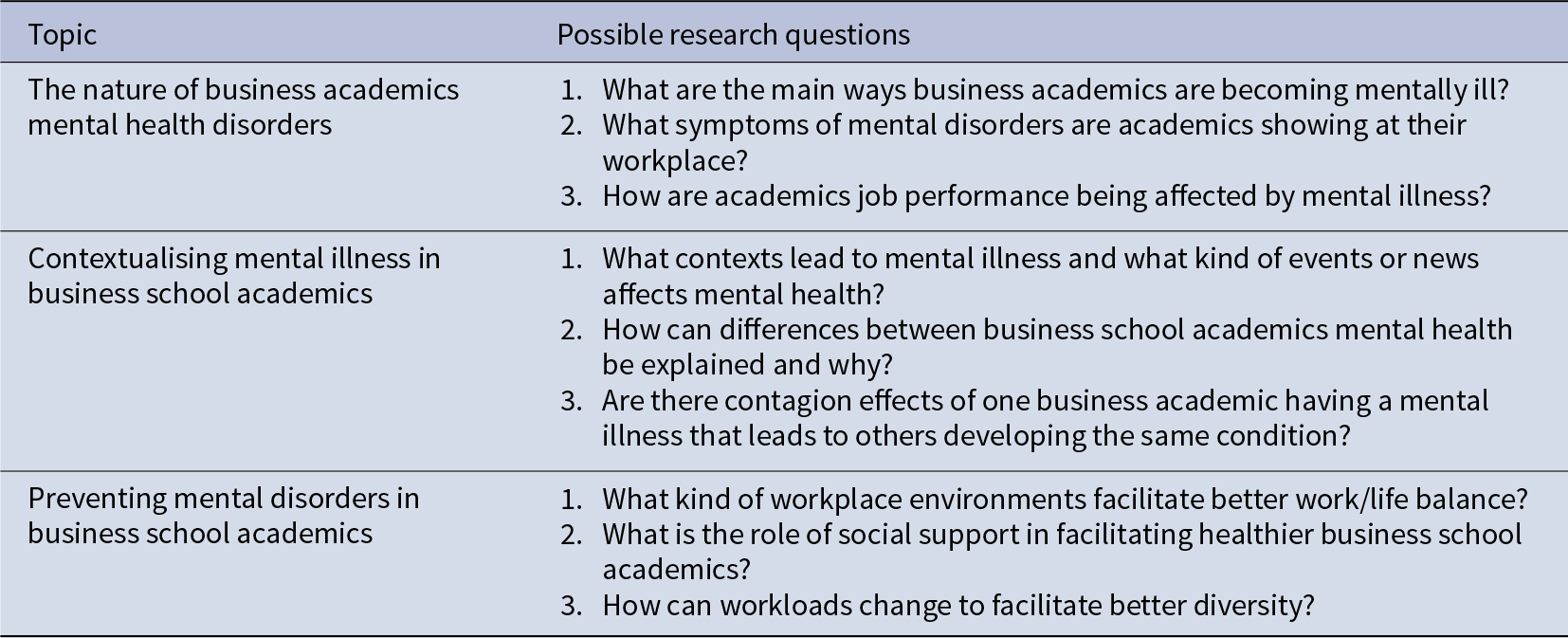
The goal of this editorial is to draw attention to mental health issues in business academics that should be researched more intensively. The current main mental disorders business academics face in academia were highlighted that provides a platform for future research. New and challenging research is required that specifically concentrates on business school academics mental illnesses in order to advance our understanding of this important issue. This section will provide information on ways to further the knowledge base on mental health by integrating different perspectives. This will contextualise mental health in business schools. Table 1 summarises the main opportunities for future research about mental health in business school academics by topic and possible research questions.
Opportunities for future research about mental health in business school academics
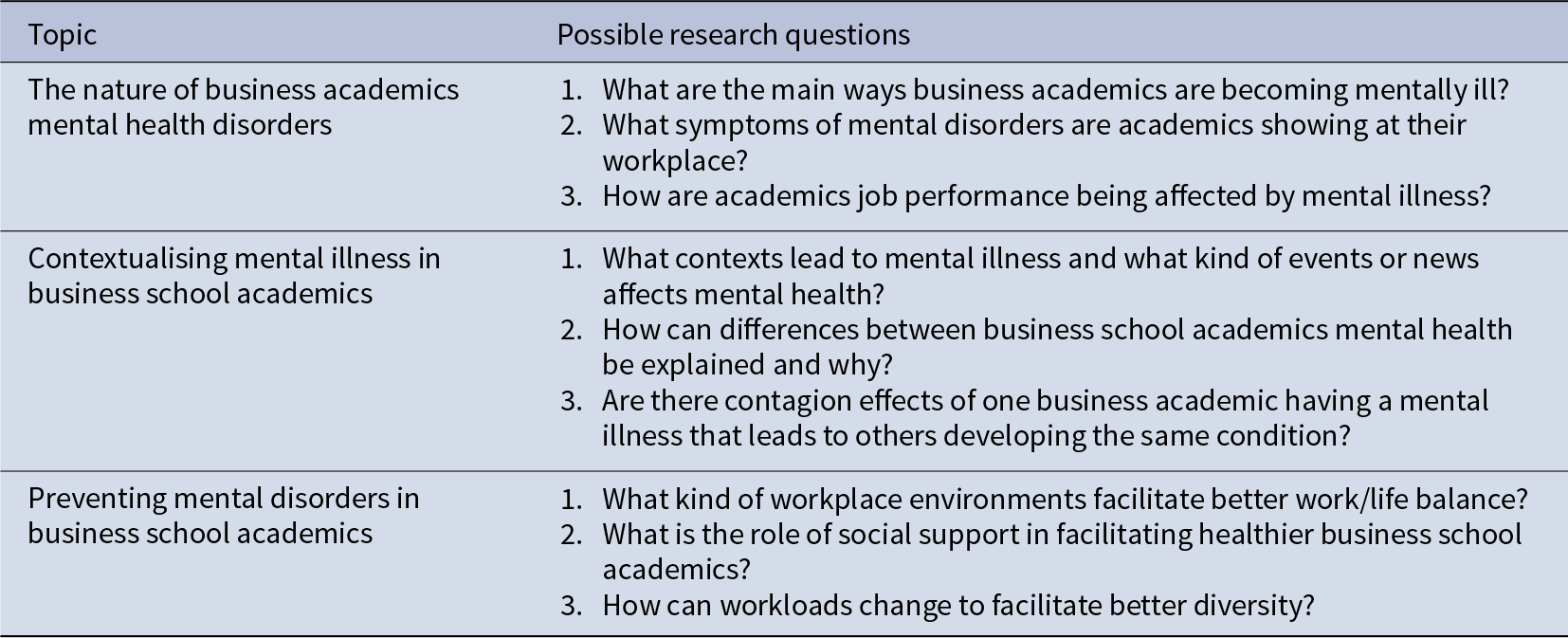
Table 1 Long description
The table lists three topic areas and sample research questions about mental health among business school academics. The first topic focuses on the nature of disorders, asking how academics become mentally ill, what workplace symptoms appear, and how job performance is affected. The second topic frames mental illness in context, asking which situations, events, or news influence mental health, why mental health differs across academics, and whether one person’s illness can influence others. The third topic addresses prevention, asking what workplace environments support work life balance, how social support contributes to healthier staff, and how workload changes might improve diversity. Each topic includes three questions, moving from describing problems to explaining influences and then identifying preventive workplace conditions. The questions are illustrative prompts rather than findings, so the table does not provide evidence or rank priorities.
The nature of business academics mental health disorders
This editorial focused on types of mental health disorders evident in business school academics. It finds that there are increasingly complex ways business academics feel stress, anxiety, and depression. A call for more information to be obtained on the nature of business academics mental illnesses compared to other types of academics is required. This will highlight how the context of a business school may lead to changes in the attitudes of an academic to work. Thereby, future research is needed to theorise about the range of contextual conditions influencing mental illness.
Business school academics need to be studied in more depth in terms of how and why their mental illnesses occur and at what stage of their career this happens. To do this longitudinal data that tracks and academics mental illness with their permission should be obtained. This will help bridge the knowledge about the onset of mental illness and how to decrease its occurrence in academia.
Contextualising mental illness in business school academics
This editorial calls for greater consideration about the context of business schools in terms of environments that can lead to mental illness. Business schools are unique and have special characteristics that may make them causes of depression in academics. Research on how the pace and change occurring at business schools influence mental distress is needed. There can be opportunities but also risks for business academics being at a business school. The link between type of work and pay rate compared to other academic environments is required. This will help unpack how environmental and work conditions influence work/life balance.
Preventing mental disorders in business school academics
There is a saying that prevention is better than a cure and this is true in terms of preventing mental disorders in business school academics. The way to do this is to have a better workplace environment that values diversity in performance as well as in cultural attitudes. At the moment there is a one size fits all mentality with regards to research publications, grants and teaching scores for business school academics with a teaching and research role. There are differences for those with a solely teaching or research role, but this then diminishes the usefulness of academics who are good at both. Normalising that grants and publications are required can make it difficult for academics especially those good at writing compared to those good at obtaining income. There should be some leniency and better understanding about what is realistically achievable during an academic calendar year. This includes looking at previous years’ performance instead of putting too high an output requirement for business academics. This will then lighten their workload but at the same time maintain quality requirements.
Practical implications
The practical significance of mental health issues in business school academics is in how its importance is emphasised in university settings. Entrepreneurial universities that value their place in society should communicate more about mental health disorders and the positive programmes they are implementing to address these issues. Mental health disorders are often a product of workplace environments that lead to stress, anxiety, and depression. So, it is useful to have positive psychology programmes that emphasise organisational citizenship behaviours. Positive psychology is a field of interest that focuses on promoting good mental health. This includes sentiments of happiness and fulfilment in life activities. This means psychology can be used in a good way to enable people to self-actualise their goals. This differs to traditional views of psychology as a way to heal the sick. This related to negative feelings people have from experiences that result in detrimental behaviour. By taking stock of what we know about mental health in business academics this editorial will inspire more attention on this topic. Thereby highlighting the uniqueness of business school academics and the struggles they face as being part of the academic ecosystem.
Conclusion
In this editorial, I have discussed the importance of mental health issues in business school academics. It revealed the nature of mental health and its consequences of disorders. Drawing on the workplace literature and emotional perspectives, I showed that mental health is a complex issue based on contextual understandings. The perceived importance of having healthy academics in universities was discussed through individualistic and social perspectives. The prevalence of mental health conditions in academics is an issue worthy of more attention. Little to no attention has been given to business academics in terms of how their mental health conditions may differ to other types of academics. This means this editorial is a relevant topic needing of more research. I hope that the editorial will provide more awareness about the intricate and dynamic nature of mental health. This will help navigate future practice in helping those with mental health issues in academia.

 Open access

