




Introduction
Battles never end on the battlefield. In the heyday of the Mughal empire (circa 1560s–1720s) in India, battles were often fertile grounds upon which to make claims regarding martial valour and political identity. Since the military-administrative system was the foundation of Mughal bureaucracy, the rhetoric of battle and warfare touched all aspects of the empire. Moreover, in a multi-ethnic, early modern military labour market,Footnote 1 battles could involve several potential stakeholders. For some groups, imperial battles often set in motion processes that had unintended but far-reaching local consequences. Battlegrounds, therefore, were more than just physical spaces for military confrontation between warring sides. For one, the Mughal bureaucratic apparatus encouraged displays of loyalty and gallantry to the state.Footnote 2 Mughal military rank holders (manṣabdārs)Footnote 3 often performed feats of bravery or otherwise demonstrated loyalty to the emperor in the hope of moving up the ranks.
Simultaneously, as this article will show, Mughal military elites were also invested in leveraging their wartime combat to bolster their power in their sub-imperial domains.Footnote 4 They aimed to maintain their warrior identities by emphasising loyalty and bravery during imperial conflicts. To immortalise their heroic deeds, military elites hired bards and poets, commissioning literary works that celebrated their accomplishments. In these compositions, Mughal battles served as central themes to honour and commemorate individual warriors, clan leaders, chiefs, and specific lineages. As a result, retellings of Mughal battles became popular motifs in early modern literature.Footnote 5 The current study argues that these retellings became an arena within which military elites made claims about their warrior virtues. These retellings were not merely literary accounts but rather strategic endeavours aimed at legitimising their status and authority within the socio-political hierarchy of the Mughal empire in the localities.
On 26 April 1658,Footnote 6 during the Mughal War of Succession (1657–1659),Footnote 7 a battle took place at Dharmat (near present-day Fatehabad) in Malwa Province (Western Madhya Pradesh). The Battle of Dharmat was fought between the army loyal to Emperor Shah Jahan (r. 1628–1658) and his eldest son, Dara Shukoh (d. 1659) on one side, and the combined forces of Princes Aurangzeb (d. 1707) and Murad (d. 1661) on the other. At Dharmat, Shah Jahan’s imperial forces were led by the pre-eminent RajputFootnote 8 king from the Rathor (Rāṭhauṛa) clan (and the emperor’s first cousin) and a high-ranking Mughal nobleman,Footnote 9 Maharaja Jaswant RathorFootnote 10 of JodhpurFootnote 11 (r. 1638–1678, hereafter Jaswant), along with another Mughal nobleman, Qasim Khan. In a direct confrontation, the princes’ army defeated the imperial forces. The Rajput contingent (consisting of chiefs and minor kings representing several clans) served under Jaswant, who, sensing imminent defeat, escaped to Jodhpur while his army was massacred. This battle was Prince Aurangzeb’s first major military success during the War of Succession and is traditionally seen as a pivotal moment in his political career. It paved the way for his ascension to the Mughal throne, marking the beginning of his long reign as Emperor Alamgir (Prince Aurangzeb’s regnal title, r. 1658–1707). This is the textbook version of the Battle of Dharmat.Footnote 12 It is a well-known imperial event that was documented in contemporary Mughal official sources written in Persian. Historians have since relied on these sources to analyse the battle and its significance in Mughal history.Footnote 13
This article, by contrast, examines the significance of the battle for one of its stakeholders, the Rajputs. Several Rajput vernacular retellings of the Battle of Dharmat emerged in the immediate aftermath of the event. In these retellings, the focus shifted to the slain Rajput warriors, overshadowing the victories of Aurangzeb and Murad. This was prompted by the events that unfolded at Dharmat on the day of the battle. Since the Rajput maharaja fled the battlefield, smaller Rajput clans within the ranks of the Mughal army put forward claims that their kings had died in the end, when the cause was already lost, thus becoming the pre-eminent martyrs of Dharmat. They commissioned vernacular literary works to set the record straight on who achieved greater glory on the battlefield. Conflicting accounts about which Rajput warriors died on the battlefield, who died at the end of the battle, who escaped, and the sequence of events became the fulcrum of Rajput literature and memory of Dharmat. In this way, contested claims to heroism and martyrdom among the Rajput lineages became the mainstay of Dharmat’s Rajput discourse in the vernacular. These vernacular works do not disregard the battle’s result; rather, they acknowledge Prince Aurangzeb’s victory and subsequent ascendancy to the Mughal throne. The battle acts as a plot device for minor clans to retell their stories, depicting their fallen chiefs as leaders of the imperial forces. The slain Rajput warriors are celebrated for embodying their caste virtue of unwavering commitment to svāmmī Footnote 14 dharama (duty to their overlord) in these tales. They are revered for fulfilling their Kshatriya duties to protect others and choosing death over dishonour.Footnote 15 Thus, the slain Rajput warriors, only briefly mentioned in Mughal sources in Persian, became the exemplary heroes and martyrs in these works, while Jaswant’s role in the battle continued to be debated.
This article mainly focuses on the retellings of Dharmat which feature the Rajput warrior Ratan Rathor (d. 1658, hereafter Ratan) as the protagonist. Ratan was a Rajput rank holder from a Rathor subclan who perished in Dharmat while fighting for the imperial army under Jaswant. He is widely celebrated as a martyr of Dharmat and still commemorated for his ‘heroic sacrifice’ in some parts of central India.Footnote 16 Ratan’s death on the battlefield was a significant event for his clan’s myth-making, as it exemplified his ideal Rajput masculine qualities of gallantry, loyalty, and sacrifice, especially in contrast to Jaswant’s flight from the battlefield. Codes of Rajput heroism, as the following pages will illustrate, were employed to cast Ratan as the central figure in this Rathor clan’s retelling of Dharmat, in a DingalFootnote 17 work titled Vacanika Rathor Ratan Singhji ri Mahesdasot ri (The Vacanika Footnote 18 of Rathor Ratan Singh, Son of Mahesdas, hereafter referred to as the Vacanika, 1658). Ratan was not the only one commemorated after his death at Dharmat; the Gaurs, another minor Rajput clan that supported the imperial forces, projected their own protagonists in the Mughal War of Succession. Gaur court poet Mahesdas Rao composed the Binhai Raso (Tales of Two Sides, circa 1660?) in Pingal (a literary style associated primarily with early modern eastern Rajasthan) featuring Arjun Gaur (d. 1658), a rank holder in the Mughal army, as the hero.Footnote 19
I treat this Rajput contestation over the retelling of an imperial event as evidence of a ground-up Rajput engagement with the Mughal empire in the seventeenth century. Scholars have argued that the expansion of the Mughal state had a top-down impact on Rajput political organisation as egalitarian clanship made way for monarchies.Footnote 20 This was especially true during the initial phase of Rajput integration into the Mughal empire in the sixteenth century, which mainly involved the major established clans. However, in the seventeenth century, many minor Rajput clans began to assert their prominence against other Rajputs by leveraging their military service in Mughal battles or imperial events. These clans utilised their association with the Mughals to elevate their status within the Rajput clan hierarchy. For instance, our protagonist Ratan’s claim to valour and martyrdom in a Mughal battle was framed in contestation with other competing Rajput clans rather than against the Mughal state itself.
Therefore, this article situates the Vacanika at the intersection of a multilayered Mughal–Rajput engagement as well as intra-Rajput clan politics in the seventeenth century. In so doing, it does not merely offer a ‘Rajput’ perspective on a Mughal battle, rather it examines how Mughal high politics played out among regional elites in central India and Rajasthan. This article draws upon recent research on vernacular sources from the Mughal period, which have allowed us to reassess the imperial narratives of the Mughal empire and have offered an alternative perspective on its historical complexities. For example, a recent Special Issue of the Journal of the Royal Asiatic Society offers unique vernacular perspectives on Emperor Alamgir.Footnote 21 In a separate article, Cynthia Talbot suggests that we pay attention to the ways in which diverse linguistic and emotional communities integral to the Mughal empire may have perceived and reimagined it in different regions, localities, and vernaculars.Footnote 22 In conversation with these works, I argue that vernacular texts also played a central role in generating and sustaining Rajput clan conflict at the sub-imperial and local levels. Often, such works were less invested in providing a perspective on happenings in the Mughal empire and more inclined towards advancing their partisan interests. This became evident particularly during periods of heightened manoeuvring, such as the War of Succession, or events involving multiple stakeholders beyond the immediate Mughal courtly circles.Footnote 23 Dharmat was one such event for the Rajputs, and vernacular sources reveal the nature of Rajput politics in the Mughal empire at the sub-imperial and regional levels.
Before undertaking a thorough analysis of the Vacanika, this article discusses the role that Dingal literature played in shaping Rajput discourse and briefly outlines the contours of the Mughal–Rajput relationship on the eve of the War of Succession. Finally, we reconstruct the battle using both Persian and Marwari sources and explore how it was retold in Dingal literature, highlighting its significance for Ratan and his Rathor subclan.
Sources
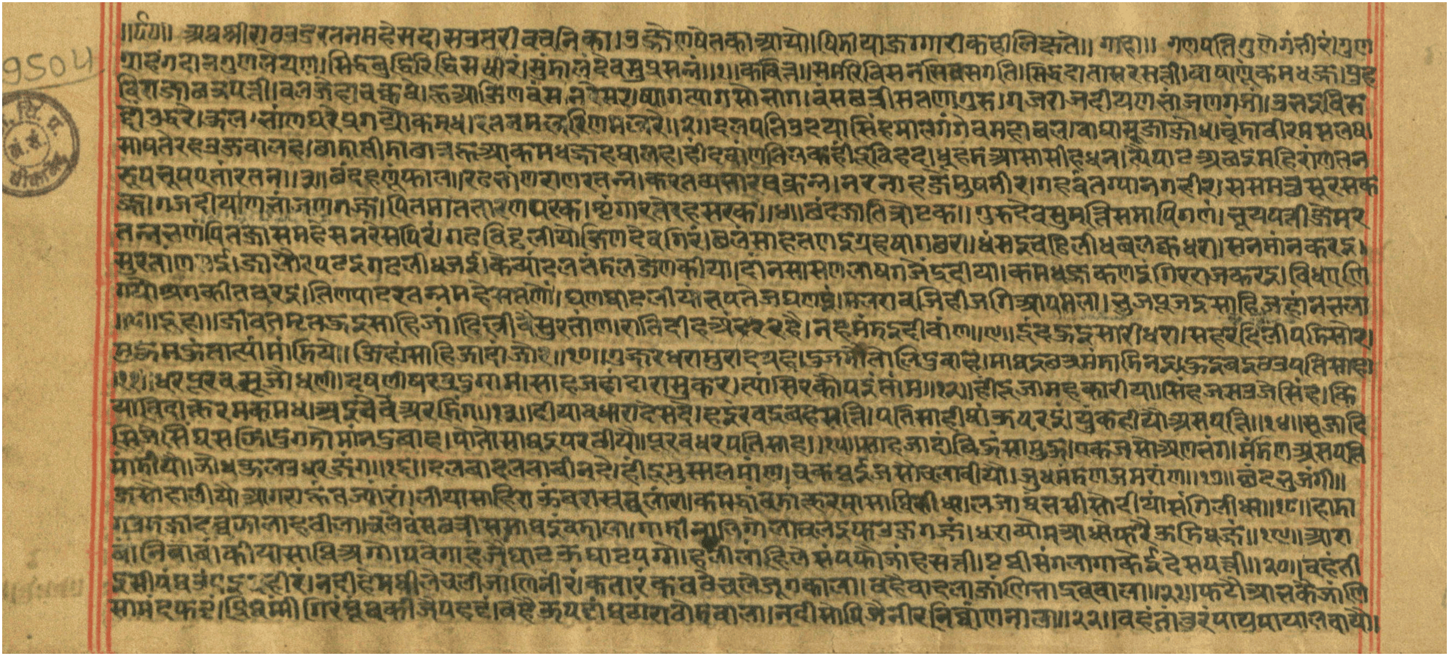
The Vacanika Footnote 24 was composed by Ratan’s court poet KhidiyaFootnote 25 Jaga, who belonged to a bardic Caran caste. Though the length of the text differs by manuscript, it contains approximately 173 stanzas of varying lengths and rhymes, including interspersed prose sections. The Vacanika manuscripts were widely produced and transcribed across Rajasthan and Malwa between the seventeenth and twentieth centuries (see Figure 1).Footnote 26 This suggests that the text received sustained patronage and that it played a major role in popularising Ratan as the pre-eminent Rajput martyr at Dharmat.Footnote 27 Although the Vacanika is a text with immense historical value, it is primarily a literary work.Footnote 28 The text satisfies the aesthetic and literary conventions of ornate epic poetry (kāvya), heroic poetry, and commemorative literature of early modern India. Despite being a well-known text, the Vacanika has received limited scholarly attention. Historian Raghubir Sinh, a twentieth-century descendant of Ratan’s lineage, has used the text to highlight Ratan’s role on the battlefield at Dharmat.Footnote 29 Recently, Vikas Rathee has analysed the Vacanika to show how vernacular poetic works often preferred clan names over umbrella terms such as the ‘Rajput’, contributing to the scholarship on plural identities in early modern India.Footnote 30
The Vacanika manuscript (1682), f. 1. Source: Rajasthan Oriental Research Institute, Bikaner (MSS. No 19504).

The Vacanika was composed in Dingal, the preferred language for Rajput war poetry.Footnote 31 Dingal poetry mainly celebrates and records Rajput masculine bravery and martyrdom on the battlefield, playing a significant role in creating and popularising Rajput martyrs. It honours the ‘self’ (heroic Rajputs) and condemns the ‘other’ (cowardly Rajputs). Dingal poetry also has a performative aspect. Dalpat Rajpurohit argues that while the Dingal tradition draws on both ‘the metrical and linguistic discourse prominent in the Apabhramsha literature and also takes elements from Sanskrit kāvya’, local contexts and performative traditions also mattered in their composition.Footnote 32 Dingal poets prophesised the inevitability of war and violence and used alliteration and rhymes to capture the sounds and visuals of actual battle.Footnote 33 Dingal works regularly constructed Rajput claims to valour, martyrdom, and heroism by synthesising familiar themes from the epic and vernacular heroic tradition with actual historical events rooted in the context of seventeenth-century Mughal–Rajput politics. In addition to the Vacanika, Ratan’s status as the leading martyr of Dharmat was further echoed by several undated Dingal poems, known as Gītas.Footnote 34 The Battle of Dharmat is also known as the Battle of Ujjain (Ujjain rī Rāṛh) in Rajput tradition because it took place near Ujjain, an ancient city and the Mughal provincial centre in Malwa. Numerous commemorative undated Dingal poems about the martyrs of Dharmat are found in the archives across Rajasthan and Malwa. Poems on Ratan’s bravery on the battlefield also feature in miscellaneous collections.Footnote 35
This article draws on the foundational methodologies concerning the intricate relationship between vernacular literature, history, and memory in South Asia, as developed by a generation of South Asianists.Footnote 36 For our purpose, Allison Busch’s formulation of ‘Poetry as History’ is especially instructive. Analysing Braj historical poems from the seventeenth century, she contends that such poems were ‘meaningfully structured literary accounts of the crucial events of their place and time’ that stemmed ‘from a post facto understanding of political outcomes that would not yet have been fully visible to an early 17th-century observer’.Footnote 37 Commenting on the historical significance of courtly works and retellings, Ramya Sreenivasan and Cynthia Talbot show how the retelling of the tales of Prithviraj Chauhan (d. 1192)Footnote 38 and Queen PadminiFootnote 39 in the vernacular at the seventeenth-century Mewar court helped the Mewar rulers participate in a heroic epic tradition.Footnote 40 They were also deployed as devices to redefine the relationship between the Mewar king and the nobility, portraying a stronger monarchy.Footnote 41
Mughal–Rajput entanglements
The creation of Rajput protagonists in the Battle of Dharmat was grounded in a century-long Mughal–Rajput engagement. Beginning in the mid sixteenth century, the trajectory of Mughal politics and expansion greatly impacted Rajput caste, clan, and political formation. The third Mughal emperor, Akbar (r. 1556–1605), used coercion, conciliation, friendship, and matrimonial relations to forge a solid Mughal–Rajput alliance in the late sixteenth century.Footnote 42 The Mughal state incorporated existing Rajput kingdoms by luring them into accepting hereditary kingship arrangements with the Mughal ruler regulating the succession.Footnote 43 Major Rajput powers, such as Jodhpur (Rathor), Bikaner (Rathor), Mewar (Sisodiā, after 1614), Amer (Kachavāhā), Bundi (Hādā), and several other pre-existing polities quickly assimilated themselves within the empire by serving as administrators, soldiers, and participants in Mughal political culture.Footnote 44 G. D. Sharma argues that these prominent Rajput clans and kings were granted ordinary revenue assignments like other Mughal rank holders, all with an eye to reminding them of their subordinate status.Footnote 45 Barring occasional conflicts and diplomatic failures, these clans became the poster children of ‘Mughal paramountcy’,Footnote 46 suggesting the emperor’s singular role in controlling subordinate rulers’ power, prestige, and succession.Footnote 47
Rajput participation in Mughal state-building increased through the seventeenth century. These men were in fact ubiquitous in the empire, leading the military campaigns and serving in various capacities.Footnote 48 Even a historian like A. C. Banerjee, who laments the Rajput rulers’ loss of ‘independence’ under Mughal rule, claims, ‘for good or for evil, the great Mughals destroyed the age-old barriers and opened Rajputana—its physical and mental border alike—to the wider world’.Footnote 49 A couplet from an undated Marwari poem captures the military service of an ideal Rajput warrior:
The Rajput stays at the king’s side,
Oscillates between homeland and abroad for service.Footnote 50
Indeed, this sustained Rajput engagement with Mughal political culture undergirds Rajput retellings of an imperial event such as Dharmat. Recent scholarship, drawing from a multilingual archive, has consistently demonstrated the evolving relationship between the Rajputs and the Mughals.Footnote 51 This research breaks away from earlier colonial and nationalist narratives that portrayed an inherent animosity between Muslims and Hindus in the Mughal vs. Rajput dynamic.Footnote 52 Instead, what is now patently clear is that Rajput court culture thrived under Mughal rule as regional courts became centres of artistic and cultural production.Footnote 53 The proliferation of praise poetry, battle narratives, eulogies, and oral epics—particularly in the vernacular in Rajput courts—was not unique to the Mughal period, and scholars have already shown the increased production of vernacular works in fifteenth-century India.Footnote 54 However, like elsewhere in the early modern world, their production and circulation intensified under Mughal rule.Footnote 55 For instance, Busch shows how the courts of major Rajput rank holders in the Mughal army became sites for thriving literary production.Footnote 56 This literary efflorescence was prompted by a multitude of parallel and overlapping factors, including but not limited to sophisticated bureaucratic and scribal practices, Mughal expansion and consolidation, the redistribution of resources, elite social mobility, patronage networks, the circulation of ideas and technologies, and new global connections.Footnote 57
Mughal political subordination created new opportunities for Rajput self-fashioning, with Rajput kings becoming the protagonists of court-produced cultural compositions, such as literary works, commentaries, and paintings. Subsequently, Rajput courtly literature, historical records, retellings, and paintings often grafted a ‘Rajput face’ onto Mughal events.Footnote 58 It has also been argued that the Rajputs often used vernacular tales and legends to talk back to the empire and negotiate Mughal subordination while asserting their local kingship.Footnote 59 Indeed, occasional criticism of Mughal administration and institutions is found in Rajput courtly accounts.Footnote 60 The content, theme, and tone of such works depended on the context and various historical factors, including political rivalries and patronage patterns.Footnote 61 Therefore, the ‘talking back’ metaphor is especially applicable for illustrating the complex relationship between a few prominent Rajput clans and the Mughals.Footnote 62 In contrast, numerous smaller Rajput clans, such as the Rathor subclan currently under examination, leveraged their loyalty to the Mughals to establish themselves as prominent powers in the sub-imperial domains of the empire.
Ratan Rathor: an ‘imperial Rajput’
The protagonist of the Vacanika and this article, Ratan, traced his lineage to the Jodhpur Rathor branch of Marwar (Western Rajasthan), generally considered to be the ‘original’ base for many Rathor clans. His father, Mahesdas Rathor (d. 1647), was a grandson of Udai Singh (r. 1583–1595), the Jodhpur king and a trusted ally of Emperor Akbar. Mahesdas had a modest paternal inheritance at Pisangan, a Jodhpur outpost facing the Mughal centre in Rajasthan in Ajmer. He joined the Mughal army in the service of the nobleman Mahabat Khan (d. 1634) during the early days of Emperor Shah Jahan’s reign, participated in Mughal frontier warfare in the Deccan and Balkh, fought with gallantry, and was rewarded a rank (manṣab) in the Mughal army in 1634. Mahesdas attained quick promotions, and in 1641 he was bestowed with a prized possession: a hereditary revenue assignment over the Jalor sub-district, a Rajput centre of power in Marwar.Footnote 63 Mahesdas consolidated his position as a Rajput king with Mughal support. In sum, this subclan was no more than a small Rathor branch before they found a place in the Mughal military-administrative system.
Ratan (r. 1647–1658) followed in the footsteps of his father. He too served at the Mughal frontier and administered Jalor in Marwar (1647–1656) and, later, Ratlam in Malwa (1656–1658). He can best be described as an ‘imperial Rajput’, signifying his role as a model Rajput military-administrative official within the Mughal army. This distinction sets him apart from ordinary Rajputs without a Mughal rank. Barring occasional exceptions, imperial Rajputs from major clans had become part of the emerging ‘corporate body of paid officers, with status and postings’ across the Mughal empire.Footnote 64 Mughal rank enabled the imperial Rajputs to act as kings in the regions and localities. As a result, they treated the empire as a collective endeavour that fostered their kingship claims.Footnote 65 This self-identification with the empire was crucial for evolving Rajput polities and the Mughal state in the sixteenth and seventeenth centuries. In addition, as with other imperial Rajputs, Ratan’s service on the battlefield and administrative role were intimately linked to his clan’s prestige and honour.
Battle of Dharmat (26 April 1658)
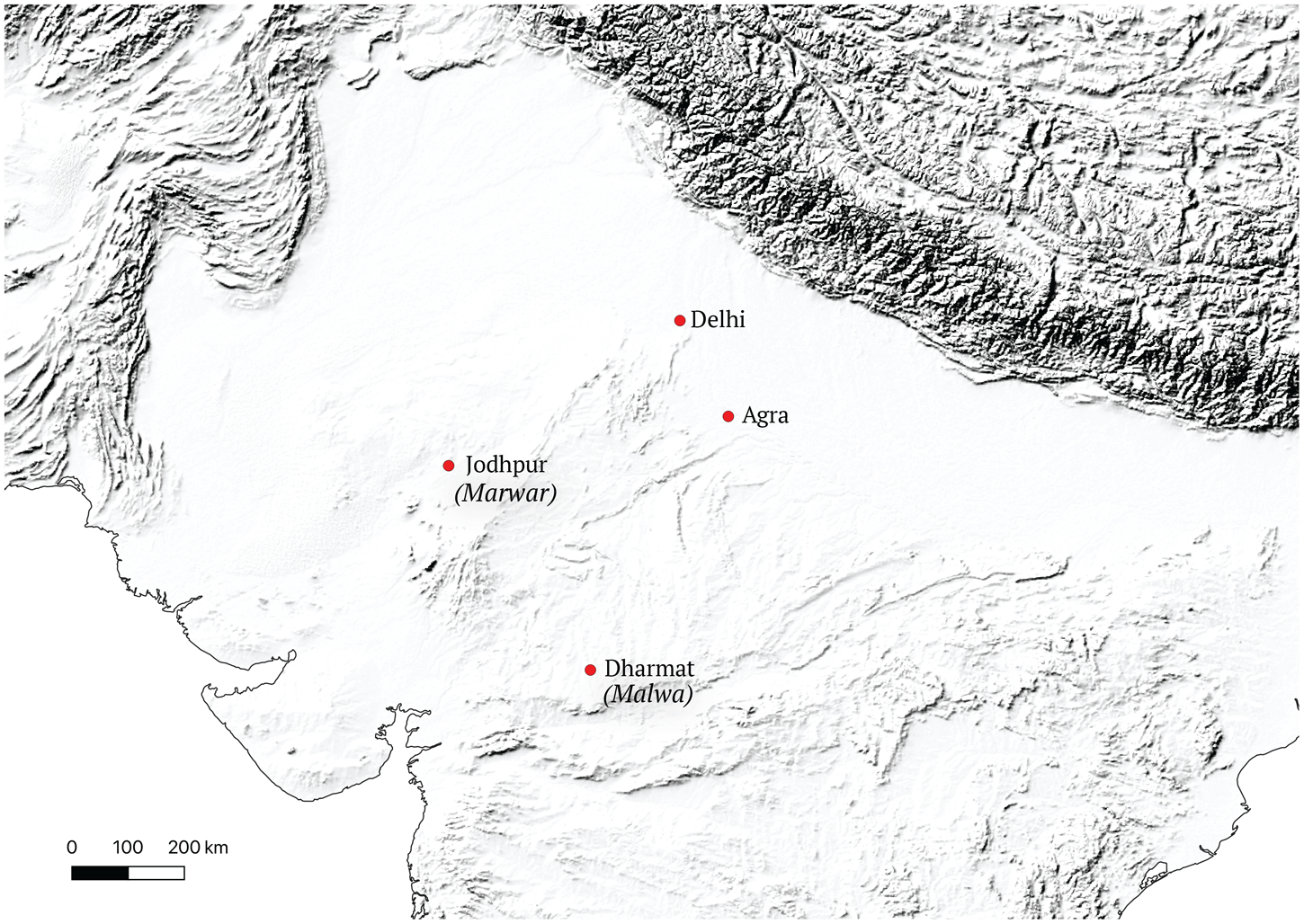
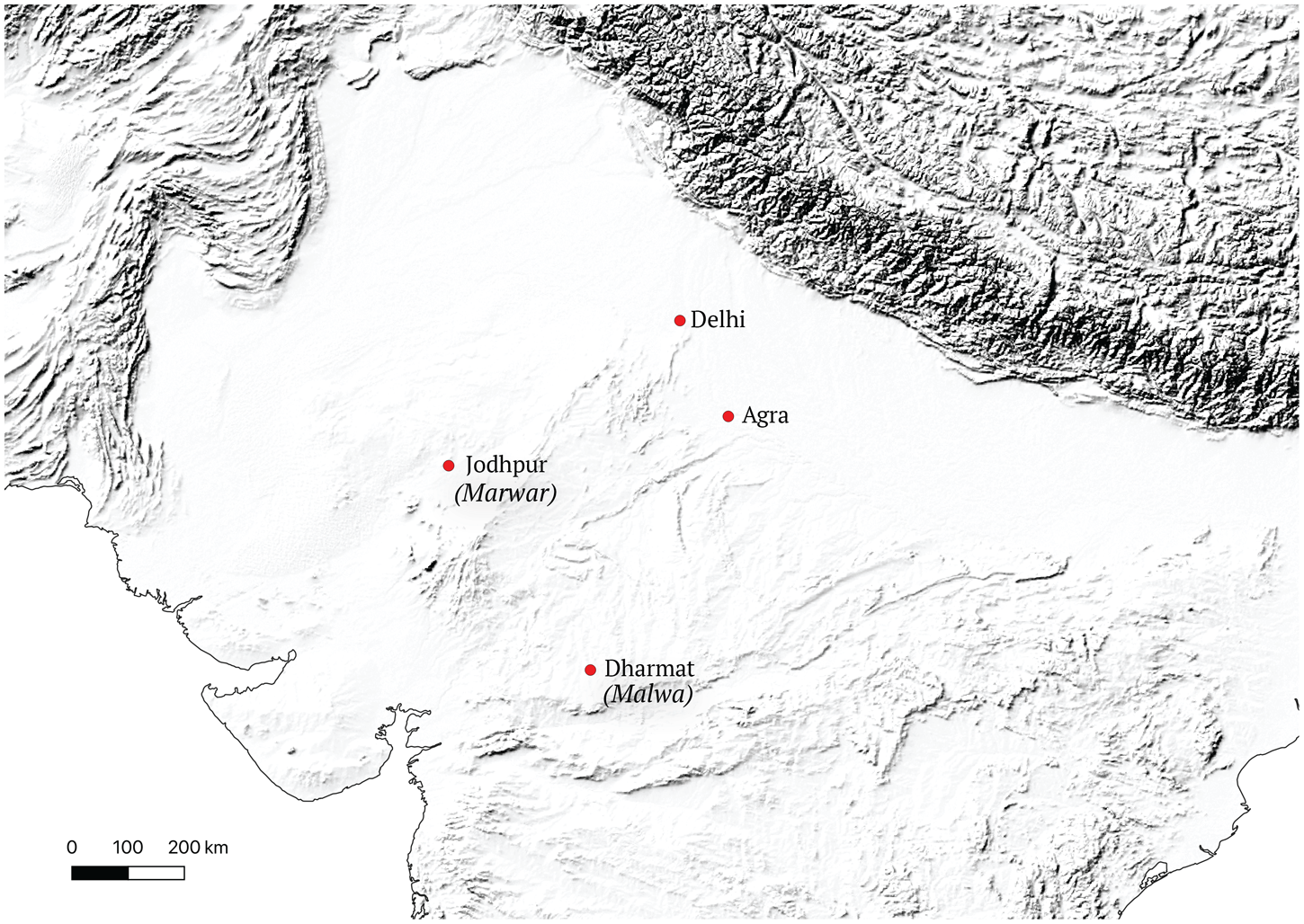
In 1657, a war of succession broke out across the Mughal empire. Emperor Shah Jahan’s preference for his eldest son, Dara Shukoh, and his attempts to establish Dara as his successor contributed to growing resentment from his three younger sons—Shuja (d. 1661), Murad, and Aurangzeb. When Shah Jahan vanished from court sessions, speculations spread that he had died. Although this was later proven not to be true, Shuja (governor of Bengal), Aurangzeb (governor of the Deccan), and Murad (governor of Gujarat) had already mobilised their forces to fight for the Mughal throne. Forces allied with Dara managed to check Shuja’s efforts to advance from the east in February 1658, but they now faced a bigger threat from the south. High-ranking noblemen Jaswant and Qasim Khan were dispatched to prevent Aurangzeb and Murad from marching towards the capital, Delhi, in December 1657.Footnote 66 In April 1658, the imperial army took its position outside the city of Ujjain in Malwa, at a place called Dharmat (see Figure 2), to check the northward advance of the princes’ combined forces.
Dharmat in India. Source: Map courtesy of Pulaha Roy.
By all accounts, the Battle of Dharmat was brief and lasted six to nine hours,Footnote 67 culminating in a resounding victory for the united forces of Aurangzeb and Murad. Jaswant and Qasim Khan, at the head of the imperial army, fled the battlefield after incurring huge losses. Many notable imperial Rajputs and their soldiers died. Some, like Devi Singh Bundela, changed sides, while others, like Rai Singh Sisodia, Sujan Singh Bundela, and Amar Singh Chandrawat, abandoned the battle early.Footnote 68 Key Rajput leaders perished in a confrontation between the princes’ artillery division and the imperial vanguard.Footnote 69 The imperial army managed to gain momentum by killing the opponent’s artillery division chief, Murshid Quli Khan. However, that advantage did not last long—organised military tactics, better positions, superior artillery divisions, and timely reinforcements from Murad left the Mughal army in tatters.Footnote 70 A contemporary Persian poetic account of the War of Succession states,
When Murshid Quli Khan died a martyr,
That king [Jaswant] emerged powerful.
With soldiers, brave and skilled at warfare,
[Murad] galloped towards the left flank with kettledrum and flute.Footnote 71
Contemporary Persian chronicles repeatedly mention that the Hada clan chief Mukund Hada’s death midway through the battle was the turning point as it weakened imperial resistance.Footnote 72 A few Persian sources claim that Jaswant fled the battlefield after sensing imminent defeat.Footnote 73 The Shah Jahan-era chronicle Amal-i Salih (Beneficent Works) condemns Jaswant and Qasim Khan for their dishonourable (bī ʿizzatī) act of escaping the battlefield.Footnote 74 In sum, according to contemporary Persian accounts, Jaswant’s exit formally ended the battle.
In the elaborate battle, countless Rajputs
Lost their lives with honour and dignity.
They fell and were killed in such a way in battle,
That the road for horsemen to pass was closed.Footnote 75
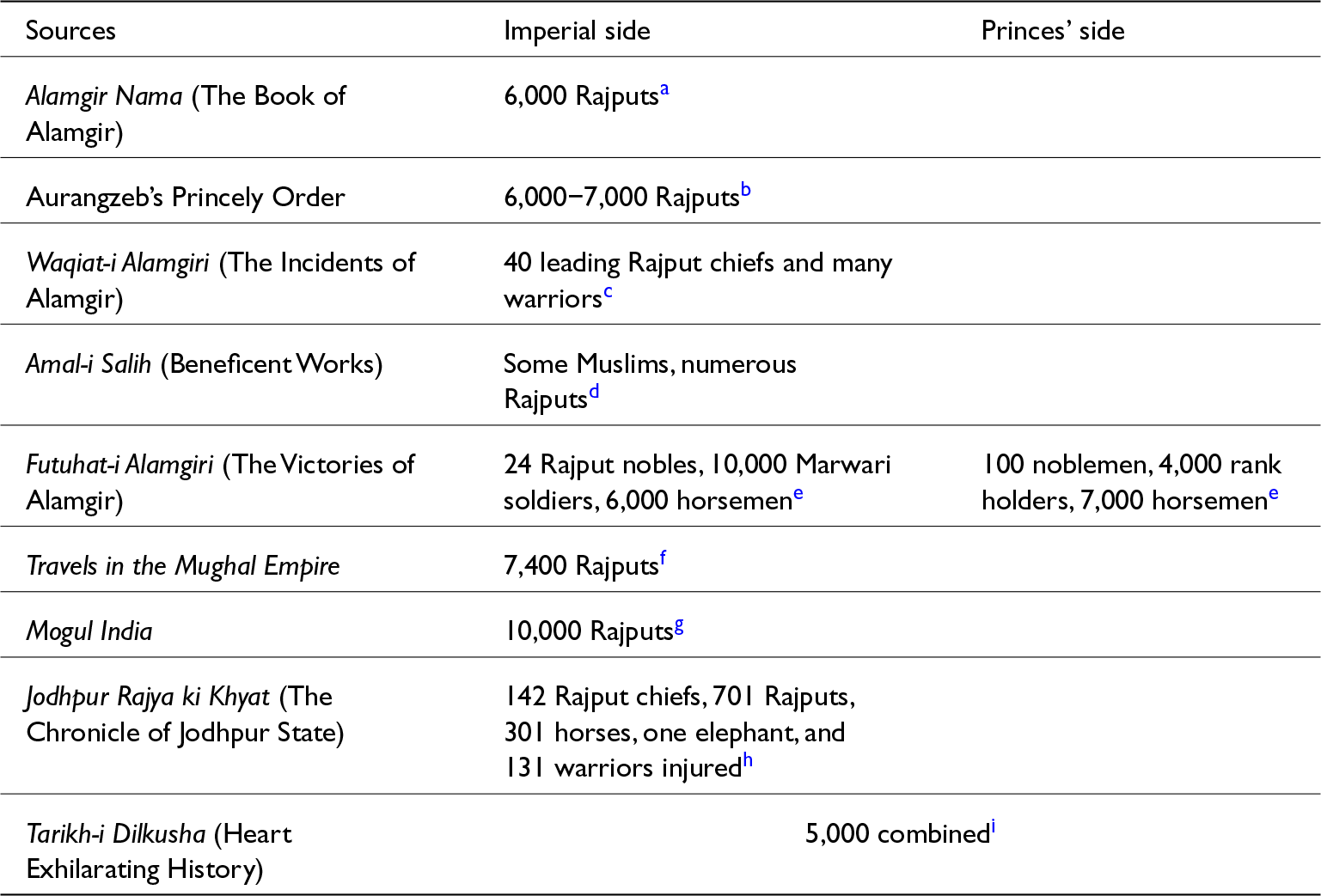
The above couplet from an eighteenth-century chronicle captures the massive destruction at Dharmat. The available record suggests that the imperial side suffered the most (Table 1), including the death of several Rajput caste and clan leaders. The armies were diverse,Footnote 76 but the Rajputs, especially from the Rathor clan, outnumbered the rest.
Casualties in the Battle of Dharmat according to different sources

Notes:
a Kazim, Alamgirnama, p. 73.
b Shyamaldas, Vir Vinod, (Delhi, 1886), vol. ii, pt. i, pp. 423–424.
c Razi, Waqiat-i Alamgiri, p. 16.
d Kamboh, Amal-i Salih, vol. iii, p. 287.
e Ishwardas, Futuhat-i Alamgiri, p. 29.
f Francois Bernier, Travels in the Mogul Empire, (trans.) A. Constable (London, 1916), p. 39.
g Niccolao Manucci, Mogul India, (trans.) William Irvine (London, 1907), p. 260.
hRaghubir Sinh and Manohar Singh Ranawat (eds.), Jodhpur Rajya ki Khyat (Jaipur, 1988), pp. 231–232.
i Bhimsen, Tarikh-i Dilkusha, pp. 18–19.
Ratan is mentioned as one of the slain Rajput warriors at Dharmat in a compilation of letters and a few contemporary and later Persian chronicles.Footnote 77 He ranked thirteenth among the twenty-nine Mughal officials on the imperial side with a minimum of a thousand zat rank. He led a contingent of 510 soldiers and was accompanied by his brother Fateh Singh, who also died at Dharmat.Footnote 78 Available Persian works from Alamgir’s period suggest that Ratan was killed early in the battle,Footnote 79 while an eighteenth-century Persian chronicle claims that he perished midway through.Footnote 80 Contrary to these imperial sources on Dharmat, the Vacanika claims that the battle ended with Ratan’s death and not with Jaswant’s escape.
Ratan Rathor in the Vacanika
Battle preparations
In the opening stanzas of the Vacanika, the poet places Ratan in the lineage of renowned Jodhpur Rathor rulers, including Rao Jodha (d. 1489), Rao Maldeo (d. 1562), and Raja Udai Singh. This sets the stage for a Rathor retelling of the Mughal War of Succession. The Vacanika briefly sums up Ratan and his father Mahesdas’s triumph in Mughal campaignsFootnote 81 and moves quickly to the central theme—the Mughal War of Succession. The text mentions that political uncertainty arose as Emperor Shah Jahan’s illness became known, causing conflict among his sons vying for the throne.Footnote 82 The emperor sent two separate armies under Rajput kings Jaswant Rathor and Jai Singh Kachhwaha (r. 1621–1667) to prevent a war among the princes, with Ratan joining Jaswant’s army marching towards Ujjain.
Raja Jaswant and Ratan, the [two] kings [gaṛhapati] met at Ujjain Fort,
Like Rama and Laxman Rathor, or Duryodhana and Karna.Footnote 83
As the above couplet shows, the poet references the Sanskrit epics to narrate the event of Ratan’s joining the imperial army under Jaswant. Scholars have demonstrated how Sanskrit epics are often re-enacted in regional martial epics, asserting that a multidimensional relationship exists between these epics, vernacular works, and oral epics, concerning adaptation and transmission.Footnote 84 However, in our present context, epic references are generally used as metaphors either for kinship or bravery. For instance, the Ramayana’s tale of Rama and Laxman’s brotherly bond emphasises Ratan’s kinship with Jaswant (first cousins once removed). The Rathor Rajputs attribute their Kshatriya caste origin to Rama, making this connection more than a typical one.Footnote 85 The poet also compared Jaswant and Ratan’s meeting to that of Duryodhana and Karna, the warriors from the epic Mahabharata.Footnote 86 In this context, it is not surprising that the poet draws comparisons between his protagonists and the antagonists of the Mahabharata, since Dingal poets valued heroism over partisanship. For example, while Ravana is typically depicted as the antagonist and condemned in the standard and popular versions of the Ramayana, Dingal poets often portray him as a symbol of individual valour and courage.Footnote 87
The Vacanika states that on the eve of the battle, Jaswant, the leader of the imperial army, sought counsel from his chiefs. However, they indicated that they were not qualified for such an important task, putting forward Ratan as the best candidate because of his Karna-like military prowess. The poet recounts:
The nobles uttered, who else is erudite like you, O King!
You are the shining Sun of the Hindus, the possessor of intelligence, good fortune, dominance, and aggression.
You are the King of the Jodhas [Jodhpur Rathors], as all Jodhas say,
You are the crown jewel of two religions, the emperor installed you as the governor of a province,
The Rathors say Ratan is the second Karna,
O King! If you want to understand war, ask Ratan for he knows battle strategy and warrior duty.Footnote 88
Accordingly, Jaswant invited Ratan to strategise for the battle the next day. This episode is pivotal in highlighting Ratan’s warrior prowess among the imperial Rajputs. Judging by his middling rank in the Mughal army, Ratan’s prominence in Jaswant’s contingent is not apparent. He was one of many imperial Rajputs who served at Dharmat. However, his reputation as a courageous warrior allowed him to transcend the hierarchy in the Mughal army, placing him at the core of Dharmat’s retelling. Using the voice of Jaswant’s chiefs, the poet emphasises that Ratan’s heroism was widely acknowledged and that he alone was deemed worthy to advise the Rathor clan leader in matters of warfare. This assertion elevated Ratan’s status in the imperial army at Dharmat, positioning him as the second-in-command to the Jodhpur ruler.
The poet further narrates that while strategising for the impending battle, Ratan persuaded the Maharaja to leave the battlefield and entrust the army to him. There is no other historical evidence for such an episode. Rather, as a post-facto text, the Vacanika’s narrative is premised on the defeat of the imperial army under Jaswant. Therefore, instead of altering the result of the battle, this text modifies the course of events to establish Ratan as the leader on the battlefield.Footnote 89 Ratan reasoned that, as the clan leader, Jaswant must survive to fight another day.Footnote 90 He assured Jaswant that the remaining warriors would valiantly fight, upholding the Rathor clan’s honour.Footnote 91 To persuade him further, Ratan requested Jaswant to inform Prince Aurangzeb that the battle would be as grand as the epic Battle of Kurukshetra in the Mahabharata. Jaswant agreed to Ratan’s plan.Footnote 92 The Vacanika states:
When Maharaja Jaswant said so,
In supplication, Mahesdas’s son [Ratan] replied,
Oh, Lord of Jodha, may you live long!
You are the adornment of the army and the lamp of the family.
Bestow upon me [commanding role] the army to [fight] the princes,
Give me the honour of dying in battle,
Allow me the honour of death,
[And] the kingdom is for you.Footnote 93
You enjoy the prosperous earth [kingdom],
Give me the responsibility of the battle,
With me in the battlefield, our rule will survive,
No one will belittle the Rathors.Footnote 94
In this manner, Ratan emerges as the protagonist of the tale and the battle. The above excerpts show that Ratan was ready to make the ultimate sacrifice to fulfil his warrior and caste duties even before the battle began. He desired to fight to the death, preserving his clan pride. Moreover, Ratan was resolute in safeguarding the reign and kingship of Jaswant. This on-the-surface selfless act aligns with the Rajput martyrological convention, which often associates voluntary sacrifice with the great Rajput warriors.Footnote 95 It sets the stage for the ‘tragic–heroic plot in which the Rajputs achieved victory through death’.Footnote 96 Dean Miller, in his study of Indo-European epic traditions, highlights the importance of heroic death for epic characters. He distinguishes between societal norms that define a ‘good death’ as one that comes after a long and fulfilling life, and the concept of ‘heroic good death’, which is characterised by violence and a voluntary choice.Footnote 97 Similarly, Jarrod Whitaker, in his analysis of the Mahabharata, argues that it was considered unrighteous for a Kshatriya to die peacefully in bed rather than on the battlefield.Footnote 98 He further explains that the epic tradition’s emphasis on heroic warriors’ dedication to sacrificing themselves on the battlefield has its roots in the ancient Vedic text, the Rigveda, which asserts that heroes who make the ultimate sacrifice in battle ‘rise immediately to heaven’.Footnote 99 Rajput courtly literature frequently referenced such Kshatriya ideals from Vedic and epic traditions. Accordingly, in the Vacanika, Ratan attains superior moral authority by choosing martyrdom early in the retelling. Finally, given the context of the text, Ratan’s request may seem justified, as he was an experienced frontier warrior.
All is not as it seems, however. Rather than propping up the tattered reputation of Jaswant (who, indeed, fled mid battle), the above episode subverts his leadership both on and off the battlefield. The narrative implies that Jaswant’s escape was premeditated. Nevertheless, the maharaja’s decision to leave the battlefield before the actual battle had even begun only exacerbated his already damaged reputation, given the Vacanika’s audience’s familiarity with the Rajput tradition of martyrdom. In contrast, this episode early on establishes Ratan as the only Rathor protagonist willing to uphold Rajput honour and allows for an overshadowing of the surviving maharaja’s earthly rule.
This episode also illustrates that Jaswant failed to live up to the Rajput ethics of warrior duty coded in svāmmī dharama. Ramya Sreenivasan argues that svāmmī dharama became the foundation for discourse around loyalty between the Rajput kings and their noblemen in seventeenth-century Mewar. She emphasises the significance of this normative Rajput code of conduct by showing that svāmmī dharama had become a Sanskritic poetic aesthetic (rasa). As a ‘politico-moral obligation and an aesthetic norm’,Footnote 100 svāmmī dharama was repeatedly invoked as a key component of Rajputness. Through the study of the retelling of the regional epic Prithviraj Raso at the Mewar court, Talbot argues that the very ‘essence of svāmi-dharma was: a willingness to fight when and where the master, and only the master, desired’.Footnote 101 In the Vacanika, this foundation of Rajput military service is inverted on two levels. First, the Mughal emperor entrusted Jaswant to lead the imperial army against rebel princes; by agreeing to Ratan’s proposal, Jaswant disobeyed his lord’s order and broke the vow of an ideal Rajput warrior. Second, although Ratan was not a retainer of Jaswant, based on rank and clan identity, he was subordinated to the Rathor clan leader. However, Ratan took it upon himself to lead the battle, determining the terms of his service on the battlefield rather than the Rathor clan leader, inverting the clan hierarchy in this retelling. In other words, this episode uncovers an important dimension in the struggle between dominant and subordinate Rajput clans. As Sreenivasan’s work has demonstrated, across the late sixteenth and early seventeenth centuries, with Mughal support, dominant lineages emerged to create powerful hierarchies and clear lines of authority among Rajput clans.Footnote 102 The Vacanika marks a notable attempt to upset the apple cart by supporting the claim of a subclan to political leadership.
Indeed, the Vacanika serves the Rathor subclan with an opportunity to put forward its claim as the saviour of the entire Rathor clan’s prestige, with Ratan at its centre. For instance, in contrast to other contemporary and later vernacular sources (to be discussed shortly), the Vacanika avoids explicitly reprimanding Jaswant for escaping. There may be an explanation for such an approach. It seems that as a Rathor scion, Ratan’s subclan did not wish to tarnish the entire clan’s prestige embodied in the figure of the Jodhpur king. This was perhaps prompted by the concern that denigrating the main Rathor family could have fuelled rival clans’ claims of heroism at Dharmat. Moreover, since the Rathors were one of the pre-eminent Rajput lineages in the Mughal empire,Footnote 103 the Vacanika chose to leverage their esteemed status to establish Ratan as a heroic king. In elevating Ratan as the main Rathor leader, the Vacanika also asserts his superiority over other competing imperial Rathor Rajputs and indicates that Ratan’s subclan was qualified to become the main Rathor lineage. Indeed, Ratan’s son Ram Singh (d. 1683) later petitioned Emperor Alamgir for the main Rathor seat during the Mughal–Jodhpur conflict (1678–1707), according to a seventeenth-century Marwari account.Footnote 104 Such an instance illustrates the extent to which Rajput clan competition animated the contours of Mughal–Rajput politics in this period.
Once Ratan secured permission from Jaswant to lead the army in his absence, the poet begins to construct Ratan’s image as an ideal king. His kingly attributes include his virtues as a pious warrior, donor, and benefactor.Footnote 105 The Vacanika mentions that after his conversation with Jaswant, Ratan returned to his camp, performed the ritual fire sacrifice (yajña), visited the temple, organised feasts for the priests, and distributed customary gifts.Footnote 106
Along with seven metals, four Lakshmis,Footnote 107
Ratan bestowed many horses and cows.
[He] visited temples, touched the feet of the deities,
Returned to camp after performing puja.Footnote 108
The Vacanika lauds Ratan’s heroism by narrating his battle preparations in the camp.Footnote 109 It states that Ratan motivated his soldiers in the traditional Rajput style, twirling his moustache,Footnote 110 brandishing his sword, and prophesying the upcoming battle at Ujjain would be the third great battle (Mahā bhāratha)Footnote 111—comparing its significance to the epic battles in the Mahabharata and Ramayana.Footnote 112 He vowed before his contingent that the Rathors were given the responsibility of Delhi (meaning the empire), and only by fighting with gallantry would they go to heaven (or embrace death).Footnote 113 The poet recounts:
Then the beneficent and braveheart King Ratan said, curling his mustache and raising his sword: ‘In the past the great battles have happened in Lanka and Kurukshetra. The gods and demons fought to death. Those tales survived four yugas. Veda Vyasa and Valmiki narrated [those battles]. The third great battle [Mahā bhāratha] will be in the field of Ujjain. Fire will roar. Wind will blow. The kings will die.’Footnote 114
Battle description
Since the battlefield was seen as the ideal place to demonstrate Rajput masculine bravery and martyrdom, the poet skilfully constructs a battle scene that befits Ratan’s heroism. He presents a graphic portrayal of the battlefield using familiar war metaphors and imageries. Here is an excerpt from the prose section from the Vacanika that captures the celebratory mood of the battle.
The horse riders jumped into the fire pit of war. They fought even after their heads were severed. They hoisted themselves upon the tusks of elephants. The army of Hindus and Muslims was an ocean of people.Footnote 115
This (beauty of the battlefield) had to be witnessed, it cannot be told. The day of battle is not limited to the beauty of one season, rather one can see the beauty of six seasons and nine rasas. How can such a scene be described? Blazing cannons and guns [produce] cataclysmic summer heat. The impotent lakes dry up, the only water remaining in deep wells.Footnote 116 Where can one see such a scene? The season of summer.Footnote 117
The description of the battle in the Vacanika evokes awe, excitement, and bewilderment. Grounded in a bardic and performative tradition and committed to celebrating warfare, the Dingal canon already had an enormous range of metaphors that poets utilised to build an idealised and gruesome battle sequence. For instance, the Vacanika celebrates the logistical details, arms and armaments, and warriors using the features of six seasons and qualities of nine literary aesthetics (rasas).Footnote 118 It compares firearms to the scorching heat of summer and musth Footnote 119 elephants’ screams to the thunderstorms of the rainy season. Similarly, four other seasons are employed as metaphors to aestheticise battle logistics. The text uses the individual warrior’s heroism to evoke heroic aesthetics and invokes Lord Shiva to describe the terrifying aesthetics (rudra rasa). Seven other aesthetic qualities are evoked using corresponding elements from the battlefield. Although common in the Dingal tradition, such a description helps the poet narrate a cataclysmic but celebratory Rajput event—the battle. The Vacanika states that the Hindu deities appeared in heaven to witness the occasion after the battlefield was prepared.Footnote 120
Next, the poet proceeds to recounts the battle’s sequence. Initially, he summarises the destruction that ensued until the afternoon (third prahara).Footnote 121 The intense battle resulted in devastating effects on both sides, with warriors falling, enraged animals, and the use of firearms reverberating through the earth and sky.Footnote 122 The poet compared Prince Aurangzeb’s warrior might to the incarnation of the creator god (daiv ra avatāra), from whom even the Hindu god of death (Yama) would retreat in fear.Footnote 123 The Vacanika continues:
The raging princes charged on the battlefield,
The warriors fell like pigeons by the strike of hail.Footnote 124
According to most Persian accounts, several Rajput commanders, chiefs, and warriors died early fighting on the imperial side. The poet narrates how the Rajput contingent under Jaswant responded to the impending defeat in the battle.
The Vacanika states that noblemen loyal to Jaswant, after much deliberation, decided that the time to save the maharaja’s life had finally arrived. As per the previous agreement, they reasoned, ‘Thakurs (noblemen), the game of chess is on. Save the raja! Only saving the raja will keep you in the game.’Footnote 125 The nobles contemplated that Aurangzeb was the inevitable successor since Shah Jahan’s reign was ending and opposing the future lord (svāmī) or the Mughal emperor was futile. Thus, the situation demanded a pragmatic albeit dishonourable (auochī baḍhau) approach, disregarding the shame of deserting the battlefield.Footnote 126 Here the poet includes the legend of the confrontation between Lord Krishna and King Kalayavana from the Hindu text Brahmanda Purana as a suitable comparison. In the Brahmanda Purana, the protagonist, Krishna, initially retreated from confronting Kalayavana’s superior army with his boon of being undefeated on the battlefield. Then, he outsmarted Kalayavana using trickery (instead of engaging in direct combat). Jaswant’s retreat also fits the rhetoric of temporary Rajput surrender, exemplified in the concept of dharma dvār nīsarṇo or ‘to leave/go out through the door of dharma’ (i.e., to leave a besieged fort with one’s life intact after making a pact with the enemy).Footnote 127 In addition, examples from the epics referring to occasional mistakes committed by great men were often invoked in the Rajput literary and historical tradition to justify instances involving ‘not-so-ideal Rajput behaviour’ of escaping the battlefield.Footnote 128 In a similar vein, the Kalayavana episode is used in the Vacanika to justify Jaswant’s escape.
The noblemen’s role in this episode is crucial. Although Jaswant had already agreed to leave the battlefield, the Vacanika made the noblemen execute the Maharaja’s escape. In this critical event, Jaswant’s voice is missing, and his noblemen justify his escape as a necessary battle strategy. On the other hand, the episode undermines Jaswant’s authority as the leader of the imperial forces and the Rathor clan since the maharaja seemed beholden to his noblemen’s wishes. It captures the persistent friction between the Rajput kings and their chiefs, which continued even after the latter were reduced to mere subsidiaries from their pre-eminent role and partnership in Rajput succession and politics in the pre-Mughal period.Footnote 129
On the other hand, Jaswant’s partisans utilise the same episode to relieve the maharaja’s guilt of fleeing the battlefield by shifting the blame of abandonment to the noblemen.Footnote 130 The Persian chronicle Futuhat-i Alamgiri (The Victories of Alamgir), compiled during Emperor Alamgir’s rule, mirrors the Jodhpur version of the event and states that despite the massacre, desertion, and death of numerous Rajput warriors, Jaswant remained steadfast. Finally, when a defeat was inevitable, persuaded by his fellow Rajput commanders, he left the battlefield.Footnote 131 Ishwardas Nagar, the author of the Futuhat, was a Brahmin scribe who served as a Mughal official in Jodhpur during the 1670s. It seems the author had some access to Jodhpur courtly elites, as he claimed to have played a crucial role in reconciling the Mughal–Jodhpur conflict in the early eighteenth century.Footnote 132 His account indicates that Jodhpur’s official position on Jaswant’s role in Dharmat also had some takers outside the Rathor court of Jodhpur. Although Munhot Nainsi, Jaswant’s prime minister and famed chronicler and historian from Marwar, glosses over the maharaja’s escape in his account by stating, ‘Shree Maharaja Ji fought; the imperial army lost.’Footnote 133 It indicates that there was unease within Jodhpur’s courtly circles about the king’s actions at Dharmat. Moreover, unlike other contemporary sources, Nainsi only mentions those who died serving Jaswant and does not refer to Ratan or other clan chiefs. However, later Jodhpur texts (possibly compiled in the late eighteenth and early nineteenth century) rank Ratan as foremost among the slain warriors, reinforcing the Vacanika’s assertion that Ratan was the most prominent martyr in Dharmat.Footnote 134 It seems that these texts adopted the Vacanika’s position,Footnote 135 presumably because the Vacanika does not explicitly criticise Jaswant. It may have also resulted from the particular politico-cultural circumstances of Rajput clan politics in the post-Mughal era.
Returning to the point about Jaswant’s escape from Dharmat in the Vacanika, finally, Ratan replaced the maharaja on the battlefield, allowing the latter to return to Jodhpur unscathed. Until this moment, the battle description resembles conventional Dingal war poetry. As a result, one gains a clear understanding of the battle’s catastrophic outcomes, setting the stage for the hero’s appearance. The Vacanika states:
The swords struck the warriors’ heads,
The warriors slew their enemies, the path to Vaikuntha was a river of blood.Footnote 136
Blessed are those Rathors who fought banking their life and death,
Jaswant returned after fighting, Ratan continued the battle.Footnote 137
Ratan now becomes the unifying authority for various warriors, clans,Footnote 138 and groups on the battlefield. The poet exclaims that Ratan adorned the honour of Hindustan (Mughal north India)Footnote 139 and describes the bravery of other Rajput leaders who fought alongside the hero. In an extended section, the poet spends a couplet or two extolling individual courageous warriors.Footnote 140 Such a description reinforces the idea that several Rajput clan leaders fought under Ratan’s banner and leadership. In a hierarchical and conflict-ridden Mughal–Rajput world, these textual strategies are often utilised to establish the patron and hero of the text as the protagonist of the event. The hero of the Vacanika, Ratan, led by example in confronting the opponent. The fallen warriors are also praised for fighting with valour. At the same time, the poet contrasts their death on the battlefield with Ratan, who stood firm and resolute, keeping his morale and pride high.Footnote 141
As the battle reaches its final stage, the level of violence escalates, and the poet stages a duel between Ratan and Aurangzeb. Although this never happened, the Vacanika describes their terrifying combat:
He [Ratan] caused pandemonium among the enemy.
The assault on the flags, elephants, and horses was unceasing.
When Ratan confronted Aurangzeb,
[It seemed that] both were great warriors like Yama.Footnote 142
This episode is clearly a device to glorify our Rajput protagonist.Footnote 143 After all, Aurangzeb went on to ascend the Mughal throne as Emperor Alamgir. The association with the emperor and princes in Rajput retellings played a significant role for emerging Rajput lineages to stake their claims in a burgeoning Rajput kingship culture under Mughal rule. Indeed, such claims not only highlight Ratan’s supreme valour among the Rajputs but also show the central place the Mughals occupied in shaping Rajput ideas of heroism. It reinforces the pivotal position that the Mughals held within Rajput imperial imagination. Therefore, the literary-historical works produced during this period often presented an ending that was not ‘historically accurate’ but rather served the purpose of promoting Rajput kingly virtue, often in conversation with Mughal battlefield prowess and strength.Footnote 144
The final battle sequence, not surprisingly, is focused on Ratan. The poet recounts how Ratan fell after receiving 300 arrows and 26 blows of swords, and with him, the battle ended.
Three hundred arrows, 26 spears,
Adorned his body as bamboo graces the mountain.
When 80 wounds of the sword struck his body,
The heir of the Jodha clan fell on the battlefield.
Duhau:
Ratan fell, the battle ended, Aurangzeb remained astounded,
The ceremonial musical began,
In his decorated chariot, the Sun God arose in awe.Footnote 145
The poet deploys phrases such as ‘bamboo graces the mountain’ to refer to the body of the fallen warrior and enhance the beauty of martyrdom. The arrows symbolise the fallen Rajput warriors at Dharmat, for whom Ratan’s body became the quiver. The poet states that the Rajput hero’s bravery left Aurangzeb in awe. Although Ratan died on the battlefield, the Vacanika does not end with his death. In an extended section on Ratan’s afterlife, he is explicitly constructed to be an ideal Rajput martyr.
The aftermath
Having established Ratan as the main protagonist of Dharmat, the poet turns to craft his immediate afterlife and martyrdom.Footnote 146 The poet elaborates on the merit of death in warfare by depicting how Ratan attained divine status. Such allusions to divine afterlives were central to the warrior ethos and political culture of an elite and upwardly mobile Rajput caste—saturated with metaphors and rhetoric championing warfare, martyrdom, and battle. In this context, the Rajput tradition exemplifies what Miller describes as the ‘heroic life pattern’ found in epics, which involves the hero’s early death leading to immortal fame.Footnote 147 The Mahabharata, as discussed by Pierre Filliozat, Minoru Hara, and Jarrod Whitaker, was also preoccupied with the merit of death on the battlefield and the after-death destiny of a Kshatriya hero.Footnote 148
The Vacanika states that after Ratan’s death, the Hindu gods welcomed him to Lord Vishnu’s abode, Vaikuntha (synonymous with heaven in Hindu religion and mythology),Footnote 149 thus validating Ratan’s martyrdom.Footnote 150 This time, the poet uses prose to narrate Ratan’s journey to the afterlife:Footnote 151
Arrows and swords were assembled to burn his [Ratan’s] body. Although his body turned into ashes, his immortal soul was on its way to meeting the [Hindu] gods. Supreme Brahma, Vishnu, Maheswara, Indra, and the Sun God Surya appeared. Goddess Indrani sang a Dhaval Mangal Footnote 152 song and greeted him by showering [him] with flowers. [The gods said to Ratan:] ride the heavenly cart to Vaikuntha.Footnote 153
Divine forces routinely show up in early modern vernacular texts.Footnote 154 In the Vacanika, they were first depicted as witnesses to Ratan’s bravery during the battle. However, only after Ratan’s death and funeral did the Hindu deities start playing an active role in granting him the status of an ideal martyr. In other words, the Vacanika upholds that Rajput martyrdom was the singular path to divine afterlives for the Rajput warriors.
The Vacanika reaffirms Ratan’s leadership of the imperial forces even in his afterlife. When the Hindu deities offered to accompany him to heaven, the Rathor hero advocated for equal treatment of all the dead Rajput warriors on the imperial side instead of enjoying individual privileges. The Vacanika narrates:
Then King Ratan, in folded hands, requested to Vishnu, ‘The great king! Rathors have been the lord of today’s battle. I was one of those Rathors. Hence, I should be called the leader. Several kings died with me, like Mukund Singh Hada, Arjun Gaur, Sujan Singh Sisodia, Dalthambh Jhala. Many other Hindu warriors from 36 Kshatriya families are also scattered on the battlefield. Bring them to life and give them residence in heaven…’ Lord (Vishnu) agreed to this proposal.Footnote 155
Here, Ratan first claims the Rathor clan’s leadership on the battlefield. Next, he assumes leadership in the afterlife by advocating for the resurrection of fallen Rajputs. The poet states that Lord Vishnu approved Ratan’s request and granted the slain Rajputs a place in heaven. He continues: Lord Vishnu ordered Lord Vishwakarma, the divine architect,Footnote 156 to build a heavenly city with golden buildings for Ratan. It was built immediately, and Lord Vishnu organised a reception for the slain Rajput heroes, many of whom are named in this narration. Ratan and his contingent gladly joined the celebrations. Minoru Hara states that in the Sanskrit tradition in ancient India dealing with the Kshatriya’s warrior duty, there was a romantic tinge (or even longing) for Lord Indra’s heaven that only a dead soldier could attain.Footnote 157 The Vacanika grants that privilege to Ratan in this extended section of his afterlife.
In conventional heroic literature and martyrology, witnessing death is regarded as synonymous with experiencing the truth—a central metaphysical aspect in several early modern religious traditions and martyrdom discourse.Footnote 158 Scholars have illustrated how martyrdom and tales of the ideal afterlife had concrete meaning in shaping worldly lives across varied South Asian traditions.Footnote 159 In the present context, the claim of Ratan’s death at the end of the battle was part of such a truth claim, as was his supposed duel with Aurangzeb. These truth claims operated alongside and in opposition to similar assertions made by other Rajput clans, such as the Gaur Rajputs.Footnote 160 In sum, members of the Rajput caste and community and poet-intellectuals attached the virtues of bravery, loyalty, masculinity, and caste superiority to the slain Rajput warriors, such as Ratan, transforming them into heroes, martyrs, and heroic kings. These martyrological tales were intended to serve a pedagogic role in shaping Rajput warrior culture and were significant in solidifying Rajput caste orthodoxy within the Mughal empire.
In an idealised Rajput warrior-martyr tradition, the death of the men on the battlefield was followed by their wives’ sati (self-immolation), which, according to Michael Bednar, formed two complementary aspects of Rajput identity.Footnote 161 Thus, Ratan’s ideal martyrdom also depended on the self-immolation of his queens and concubines. The Vacanika mentions that Ratan requested that Lord Vishnu wait twelve daysFootnote 162 for his satis to join him in death before he could finally take his destined place in heaven.Footnote 163 In normative Rajput tradition, ritualistic death on the pyre represented the union of Rajput women with their deceased husbands. This ensured the continuity of their companionship between their earthly life and the afterlife. The performance of sati guaranteed the protection of chastity of the wives and concubines of dead warriors, which was considered a masculine responsibility. Sati also symbolised the loyalty of the slain Rajput warriors’ wives and concubines,Footnote 164 since a pervasive anxiety about loyal service characterised medieval and early modern Rajput warrior tradition.Footnote 165 The poet praised Ratan’s satis for their valiant sacrifice.Footnote 166 The arrival of the satis in heaven marked the completion of the Vacanika as well as Ratan’s martyrology.
Making sense of Ratan Rathor’s martyrdom: Tales of Rajput heroism and cowardice
Ratan’s heroic status was heavily influenced by the socio-political and cultural values of Rajput society, which revered martyrs and condemned those who fled from battle. Unquestioned bravery in the face of war was the normative expectation for a Rajput warrior, since the violent end of either the enemy (victory) or the warrior (martyrdom) were preferred to cowardice. This elite Rajput warrior discourse adhered to several established Kshatriya values, which included a commitment to violence, martyrdom, martial ideals, masculinity, and the preservation of traditional caste and gender roles. Rajput socio-cultural spaces nurtured these virtues, fostering an identity that set them apart from the diverse and multi-ethnic groups of peasant soldiers in the North Indian countryside.Footnote 167 Similarly, the Rajput historical tradition advocated idealised ethics of protection and loyalty that permeated, overlapped, and were reinforced across conjugal units, households, and lineages.Footnote 168
Dingal literature, echoing a well-established Kshatriya epic tradition, frequently emphasised the importance of fulfilling one’s warrior duty (Kshatriya dharma/Kshatra dharam) of fighting courageously, revealing a more profound concern surrounding disciplining Rajput warriors who chose to escape the battlefield. Such instances challenged the idealised version of Rajput masculine behaviour and perpetuated the theme of cowardice as a menace in Rajput warrior culture.Footnote 169 This is also not unique to the Rajput case; across several epic traditions, we find regular references to the contrasting features of the heroes and cowards, where the cowards are constantly ridiculed and condemned.Footnote 170 Dingal poets arguably worked with these familiar themes and topics of battle, including normative ideals about bravery, cowardice, and Kshatriya tradition in the Sanskrit epics.
However, in the context of mid-seventeenth-century Mughal–Rajput politics, these familiar poetic devices were deployed to serve clan and caste interests. Thus, the figures of the Rajput hero and coward are the real antagonists in the Dingal canon, not the Mughal princes Aurangzeb, Shuja, and Murad, who rebelled against their father, Shah Jahan, and eldest brother Dara. Therefore, the princes were either praised as in the Vacanika or completely ignored in other Dingal poems on Dharmat.Footnote 171 In sum, Dharmat was a significant event that exemplified the contrast between bravery and cowardice, with the martyrdom of Ratan serving as an example of the former and the desertion of Jaswant demonstrating the latter.
The Rajput tradition’s emphasis on individual warriors’ loyalty and martyrdom was also deeply rooted in the unique circumstances of early modern India’s military culture. The military comprised large numbers of mobile temporary and part-time soldiers and thus lacked consistency and uniformity, leading to frequent desertion during battle.Footnote 172 Additionally, due to caste, class, regional, and ethnic divides, the state did not have the required infrastructure to create an ideal warrior type. According to Dirk Kolff, studying the Mughal army as a distinct entity is impossible since it cannot be separated from North Indian society.Footnote 173 Similarly, the Rajput chiefs relied on their clan network and recruited soldiers from a wide cross-section of the military labour market of early modern India that lacked uniformity. The persistent attempt by the upholders of the Rajput warrior tradition to advocate for a specific ‘code of conduct’, such as fighting to the death on the battlefield, is an indication that Rajput warriors often failed to live by the normative code of Rajput military service. Thus, Rajput retellings of Dharmat unfolded in two complementary ways—a celebration and commemoration of the martyrs of Dharmat, and questioning Jaswant’s role on the battlefield. It did not help Jaswant’s reputation that after Dharmat he also deserted the battlefield while serving in Emperor Alamgir’s army against Prince Shuja at the Battle of Khajwa (5 January 1659).Footnote 174 His actions in these two battles blemished his image as a warrior in the Rajput literary and public domains.
The Jodhpur king became a subject of ridicule and sarcasm in several Dingal poems. His masculinity was condemned regularly. Looking beyond the Vacanika, Jagga Bhat, a poet who received patronage from Jaswant, insulted the maharaja by calling him a stain on the family of the gods (Dēvan kul nē dāga)—referring to the Jodhpur Rathor family.Footnote 175 Another undated Dingal poem, Gīta Jaswantsingh ro Dharmat ri Rarh su Bhajan ro (The Poem of Jaswant Rathor’s Escape from the Battlefield), shames Jaswant for his actions at Dharmat and contrasts him with martyred Rajput warriors.Footnote 176 The poet uses the popular metaphor, widely used in the Mahabharata, of a wedding with the celestial maidens (apacharas) to denote the idealised death of a Rajput warrior on the battlefield.Footnote 177 In Dingal tradition, following the epics, warriors were seen as grooms destined to be united with celestial maidens in death. The poet tells Jaswant that the celestial maidens eagerly awaited his arrival. They were heartbroken and in tears upon learning of Jaswant’s escape from the battlefield after their long wait. Their desire to unite with him in death remained unfulfilled.Footnote 178 The poet exclaims that Jaswant was expected to embrace the celestial maidens by dying after receiving the blows of the swords.Footnote 179 However, by deserting the battlefield in fear, Jaswant tarnished the glory of his famous Rathor ancestors. The poet goes on to lament that, unlike Jaswant, Ratan attained glory through this union with celestial maidens—indicating that Ratan secured his place in heaven. He further reprimands the maharaja, stating, ‘What kind of a “groom” lets his party get killed on the wedding dais?’Footnote 180 The concept that a warrior who dies in battle ascends to a higher heavenly realm, even surpassing an ideal king who ruled justly but died of natural causes, is found in the Mahabharata.Footnote 181 In our present context, Ratan’s heroic sacrifice and subsequent ascension to heaven overshadow that of Jaswant, who fled the battlefield. Indeed, it was Ratan, rather than the maharaja, who embodied the quintessential hypermasculine role on the battlefield that often defines heroism in epic literature. It comes as no surprise that Jaswant often featured in the satirical gīta genre Visara, which was deployed to ridicule cowardly Rajput warriors.Footnote 182
That the Rajput discourse around Dharmat spread beyond vernacular literature is evident in seventeenth-century foreign travellers’ accounts. Popular tales questioning Jaswant’s role at Dharmat made their way into the writings of both François Bernier and Niccolao Manucci, both oft-cited European travelogues from the seventeenth century. They mention that Jaswant faced humiliation from close quarters following his retreat. Apparently, his primary wife, who was from Mewar’s Sisodia clan, felt so dishonoured by her husband’s cowardice that she decided to condemn and disown him. She could not bear the shame of being a coward’s wife and was getting ready for self-immolation to perform her caste and gender duty as an ideal Rajput woman.Footnote 183 However, the credibility of Bernier, Manucci, and other such European accounts from medieval and early modern India has rightly come under scrutiny in recent times. They have been accused of recording what has been loosely categorised as bazaar gossip. For instance, in the early twentieth century, historians of the Jodhpur princely stateFootnote 184 pointed out that Jaswant was not married into the Mewar’s Sisodia clan, contrary to Bernier’s claim.Footnote 185
However, such hearsay represents some commonly held beliefs about Rajput martial traditions in the seventeenth century. The Sisodias of Mewar were revered as the epitome of Rajput courage due to their unwavering resistance against the Mughals in the late sixteenth century. Therefore, disregarding factual accuracy, the Sisodia queen should be viewed as a symbol of Rajput valour and a reminder of how the maharaja failed to live up to these martial ideals. It is worth noting that Bernier included this section following his short introduction to the Rajputs, where he praises them for their bravery and fearlessness.Footnote 186 Jaswant’s tale serves as a contradiction to Bernier’s idealised description of the Rajputs.
Jaswant’s loyalists attempted to counter the campaign that disgraced the maharaja, with some Dingal poems attempting to mask his retreat by giving it a valiant twist. One such poem states that the enemy’s army blocked his path back to Jodhpur.Footnote 187 Jaswant courageously fought against them for nine hours (three prahars) on the way and finally reached home while gazing angrily over the princes’ army. Another poem claims that Jaswant defeated Aurangzeb’s mighty commanders and fought against the enemy forces on his way back to Jodhpur.Footnote 188 Outside Jodhpur, even a Mewar courtly vernacular work about its king, Rana Raj Singh (r. 1652–1680), Rāj-Vilās (Adventures of Raj), acknowledged Jaswant’s challenge to Aurangzeb in Dharmat. Composed in the early days of the Mughal–Jodhpur conflict, it states that Jaswant’s opposition to Emperor Alamgir during his princely days, particularly at Dharmat, led to Alamgir’s decision to deny his posthumous inheritance of Jodhpur, ultimately sparking this conflict.Footnote 189
Amidst various retellings, Ratan emerged as both a Rajput face and a valiant king in the Rajput account of a Mughal battle. He became an ideal hero in the Dingal canon and popular memory for performing his warrior duty and attaining martyrdom. Ratan’s death at Dharmat became the turning point in the subclan’s history. As a Mughal rank holder and a Rajput king of Jalor and Ratlam, Ratan executed local administration like any other imperial Rajput. However, his martyrology, the Vacanika, enhanced his kingship claims.
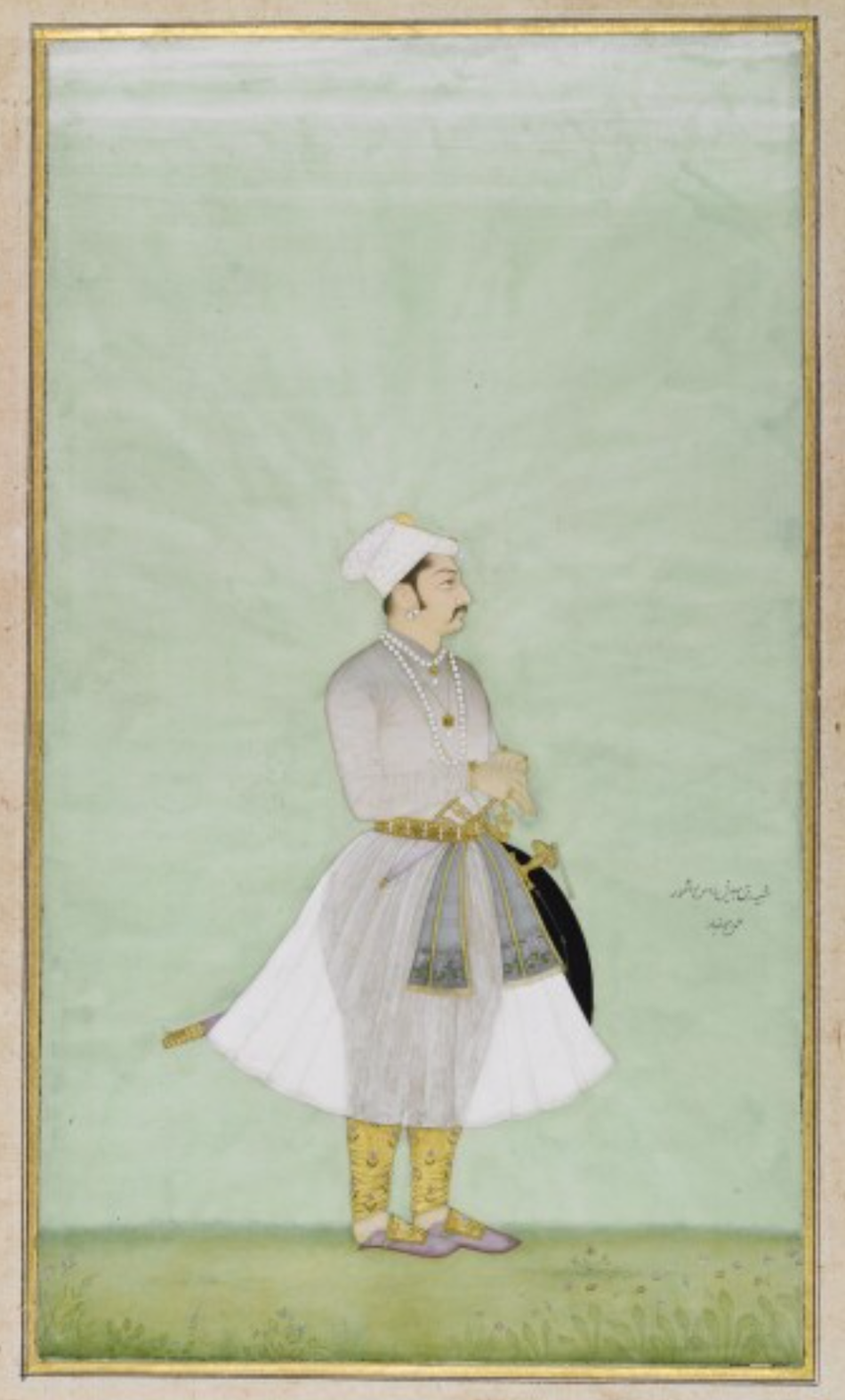
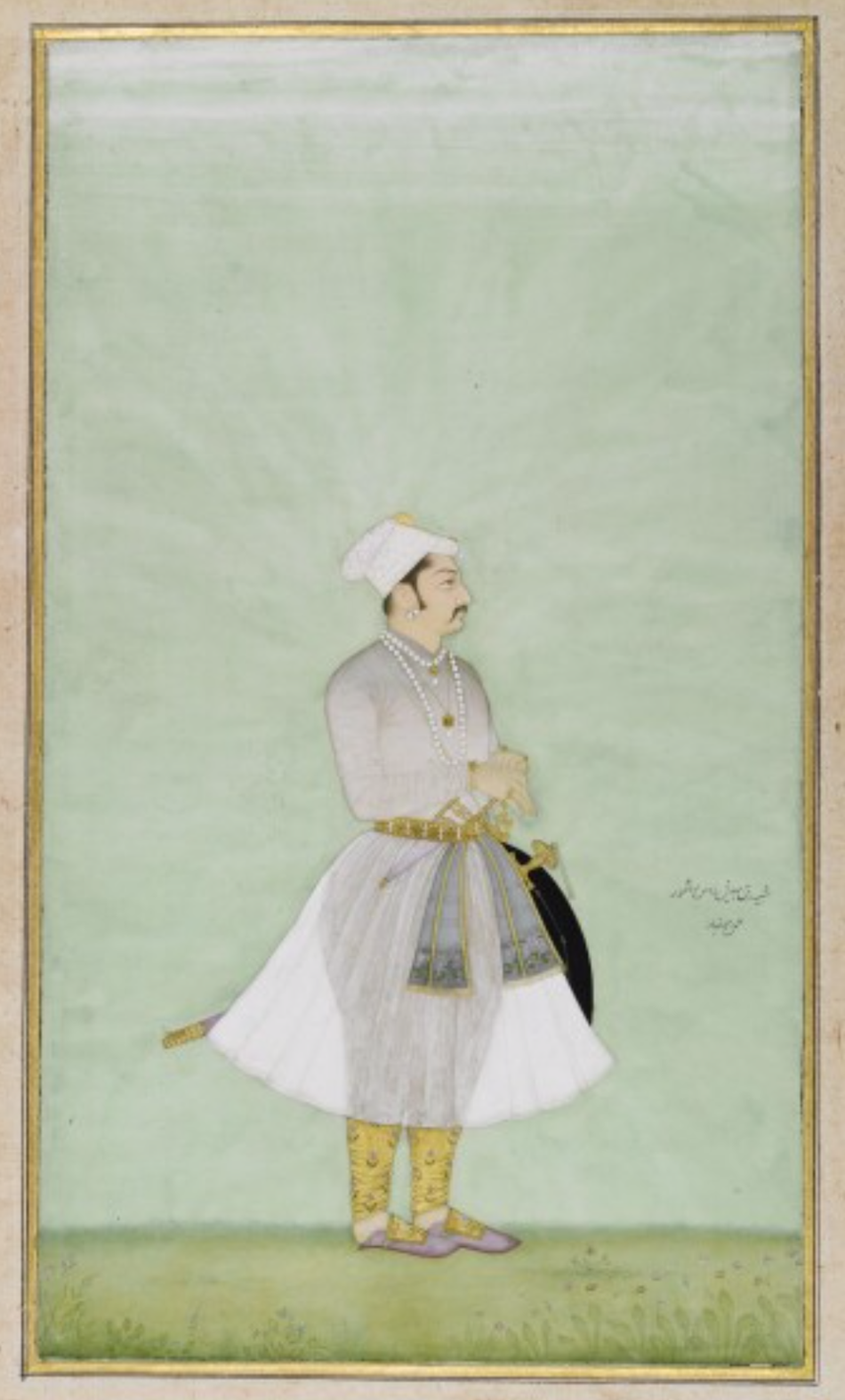
In 1659–1660, the Bikaner Rathor kingdom’s leading artist, Ruknuddin, produced a portrait of Ratan (see Figure 3). Without a substantial source base, it is difficult to tease out Ruknuddin’s motives for drawing this portrait.Footnote 190 So, we can only speculate. The portrait was made shortly after Ratan’s death, indicating that the tales of his martyrdom in Dharmat may have gained him some recognition in the broader Rajput community. In other words, textual production, oral traditions, rumours, and circulation of warrior tales might have prompted the Bikaner Rathors to celebrate Ratan’s feat as a martyr of Dharmat. In addition, considering the sustained tension between Jodhpur and Bikaner lineages, Ratan’s portrait can be interpreted as a way for the Bikaner Rathors to take a jibe at the Jodhpur ruler’s escape from the battlefield.
A portrait of Ratan Rathor by Ruknuddin, Bikaner, circa 1660–1670. Source: https://www.sothebys.com/en/auctions/ecatalogue/2014/arts-islamic-world-l14220/lot.71.html (accessed 20 August 2025).
Already, in the early eighteenth century, Ratan’s legacy as a warrior king of Ratlam in the central Indian province of Malwa was established even among non-Rathor clans. In June 1720, the influential noblemen of the Mughal court, the Sayyids of Barha, deputed Bhim Singh (d. 1720), the Hada Rajput king of Kota, to confront Chin Qilich Khan (d. 1748), a prominent Deccan-based Mughal nobleman. The battle between the two sides occurred in Malwa near the Narmada River, resulting in the death of Bhim Singh.Footnote 191 However, a painting by the Kota master depicts an alternate version of the event, showing Bhim Singh’s beheading of Chin Qilich Khan. While the intricate details of this incident are not relevant to our study, it is worth mentioning that the painting features Ratan as one of the Rajput kings, identified as Ratlam Maharaja Ratan Singh Ji, and portrayed as Bhim Singh’s partisan. It seems that this ‘historical inaccuracy’ was intentional. By the 1720s, Ratan and his lineage became synonymous with Ratlam, thanks to the sustained memorialisation of Ratan by his Malwa-based subclan and the circulation of his tale of exemplary martyrdom.Footnote 192 The artist’s decision to include Ratan in a battle that took place in Malwa merely reflects it.
Conclusion
Message: The incident of Delhi, the battle of Ujjain, will survive four yugas, [and] poets will talk about it.Footnote 193
The Vacanika ends with the poet’s message that he has narrated an imperial event that unfolded in Ujjain. A dramatic battle involving the death of numerous Rajput warriors and Jaswant Rathor’s escape all contributed to the making of Ratan Rathor’s legend. According to the vernacular tradition, Ratan rose to the occasion and became an unlikely protagonist in a Mughal battle. The Vacanika champions Ratan’s kingly attributes and commitment to bravery, loyalty, and martyrdom—the key components of Rajput heroism in early modern India. He became a saviour of Rajput tradition in vernacular retellings of a battle that created room for questioning Rajput warrior virtues. The proliferation of Dharmat’s retelling and the Vacanika’s circulation contributed to strengthening the discourse around Rajput normative caste and gender roles in Marwar and Malwa.
The study of Rajput discourse on Dharmat in seventeenth-century India reveals how high imperial conflicts were perceived and reproduced at the regional and local levels, having immediate and long-standing afterlives. Thus, although Dharmat is considered just another battle during the Mughal War of Succession, it was more than a fratricidal conflict. Even as the actual battle ended and the jubilant princes Aurangzeb and Murad advanced towards the Mughal capital in Agra, it remained a contested site in Rajput political culture, literature, history, and memory. The fact that Dharmat is not widely talked about today should not detract from its importance in the Rajput imagination of the mid and late seventeenth century. This was a time of flux, which certain clans took advantage of to try and upend existing social hierarchies. This was often conveyed through vernacular accounts like the Vacanika. Although Ratan’s successors were unable to become the primary Rathor lineage, this was not for want of trying. They were not alone. Other clans, too, tried similar strategies in the competitive world of Rajput politics. But that is another story.
Acknowledgements
This article grew out of my PhD dissertation research. I would like to express my gratitude to the American Institute of Indian Studies and the Department of History at the University of California, Berkeley, for supporting my fieldwork in India. The research for this article was conducted in the archives of Shree Natnagar Shodh Samsthan in Sitamau, Maharaja Man Singh Pustak Prakash in Jodhpur, Rajasthan State Archives in Bikaner, Rajasthan Oriental Research Institute in Jodhpur and Bikaner, and the Asiatic Society in Kolkata. I am thankful to the archivists and staff at these institutions for their assistance. Janaki Bakhle, Munis D. Faruqui, and Abhishek Kaicker have engaged with this project from its inception. Their questions, comments, and editorial intervention have been foundational for the ideas expressed in this article. Anurag Advani, Daniyal Channa, Amrita Chattopadhyay, Aparajita Das, Deepashree Dutta, Joanna Korey, Namrata Kotwani, Shaivya Mishra, Brent Otto, Anwesha Sengupta, Akshita Todi, and Amar Zaidi have read and engaged with this article at various stages. Notably, I thank Amar Zaidi for multiple discussions, which helped me streamline my argument. I also thank Vikas Rathee for sharing his insights on the battle of Dharmat at an early stage of my research. Finally, I am grateful to the two anonymous reviewers for their insightful comments, which helped me clarify the stakes of this project. All mistakes are mine alone.
Conflicts of interest
None.

 Open access

