


1.1 Introduction
The slow and intermittent electoral erosion of Social Democracy in the late twentieth century has accelerated over the past two decades across much of Europe. Almost none of the European social democratic parties has managed to defy the maelstrom of electoral decline. By the 2020s, most center-left parties carrying the social democratic, socialist, or labor label have become shadows of their former selves in terms of aggregate vote shares, members, activists, legislators, and government cabinet members.
Scholars have offered many explanations for Social Democracy’s misfortunes. No single hypothesis may be sufficient to account for this development exhaustively. Some of the explanations have a nostalgic flavor, arguing that social democratic parties have changed “too much” over the past decades, reneging on their established policy promises and thereby abandoning the needs of an erstwhile loyal electoral constituency. Other explanations posit that social democratic parties have changed “not enough,” failing to adapt to transformed voter potentials and to develop creative responses to novel societal and political-economic challenges that require Social Democrats to reimagine ways to advance social equality and universalism in society.
The first perspective – Social Democracy having changed “too much” – draws empirical support from some undeniable facts, such as the declining propensity to support Social Democracy among the parties’ traditional core constituencies, particularly blue-collar workers. However, the various empirical analyses in the chapters of this volume suggest that the overwhelming balance of evidence points toward Social Democrats not having adapted enough to changing substantive policy challenges, changing programmatic dynamics, and changing electoral landscapes. Social democratic parties encounter massive difficulties in reimagining their programmatic electoral appeal to stem electoral decline. These difficulties, however, are not simply the consequence of strategic mistakes or myopia. Rather, both structural political-economic change and strategic party calculations make it virtually impossible to capture as encompassing an electoral constituency as many social democratic parties did in the period of post–World War II (WWII) economic prosperity growth in the West. Society has been profoundly transformed both socially and economically; it has become pluralized and more fragmented, and so have programmatic electoral competition and party systems. In this more scattered and fragmented political space, ripe with political divides over programmatic positions and priorities, social democratic parties can nowhere extricate themselves from their current electoral predicaments. However, their fortunes vary with how they have coped over time with these new competitive situations. Most importantly, they are no longer the only and sometimes not even the largest parties in a “left field” of competitors – all of which embrace fundamental “social democratic values” but articulate them through different policies and by appealing to constituencies absent in the traditional social democratic electoral coalition.
Despite the societal and political transformation and fragmentation seen throughout Western Europe in the past decades, the questions at the heart of social democratic concerns – grievances of inequality, social marginalization or exclusion, and existential economic risk exposure – have clearly not vanished from the political agenda. Quite the opposite, in fact, they have taken on new forms and they have entailed debates over new policy instruments to address them. In particular, calls for “protective” income redistribution and income insurance against the vagaries of capitalist markets have been supplemented by new “investive” demands for greater public support for people’s skills and human capital and capabilities that should capacitate citizens to cope with the dynamic challenges of rapidly changing political economies. Similarly, the challenge of avoiding social marginalization and extending inclusive social solidarity to ever larger shares of the population have increasingly transcended the (male) working class that was at the center of the social democratic emancipative agenda in the mid to late twentieth century, extending to women, to newly spreading forms of employment or families, children, and adolescents, but also social minorities defined by immigrant status, disability, or sexual identity. These extensions of the social democratic agenda have enhanced its ambition but also brought about novel questions of emphasis and prioritization. Such policy demands and changing political constituencies often come into sharpest relief in polities where Social Democrats have previously been particularly successful in converting their ideas about equality and social protection into material public policies and institutions of contemporary welfare states, thereby contributing to the fundamental transformation of these very societies. Hence, to a certain extent, in these countries, Social Democrats have become victims of their own success, as the changing socioeconomic and political conditions they helped to shape have generated new strategic challenges to social democratic parties that they have found difficult to address. This process has led to programmatic divisions and party fragmentation within the broad field of political forces that endorse basic social democratic ideas but often do not run under social democratic labels.
Decline of the social democratic party family, then, is not coequal with decline of social democratic ideas and the “field” of parties that draw on it. Moreover, both the extent of Social Democrats’ electoral losses and the size and the composition of a polity’s field of left parties are at least in part subject to parties’ strategic choice of appeals. Social democratic parties not only shape their own situation in this changing context but also, importantly, codefine the political agenda for the entire field over which left parties are distributed. Social Democrats are often still the key strategic actors, especially if they are electorally larger than the other leftist competitors and situate themselves in more centrist positions in the overall field of party competition. This role endows them with higher bargaining power over government coalition formation and public policymaking, when compared to their more radical competitors in the social democratic field.
A stable differentiation of the left field into at least three branches – a Radical Left, a Green Left, and Social Democracy – has occurred primarily in the comprehensive welfare states of Northwestern Europe with proportional representation electoral systems. In Anglo-Saxon, first-past-the-post systems with less generous welfare states, these branches are still compelled to reside subordinated under a single Social Democratic or Labor party label umbrella, but struggle with one another for supremacy within those party organizations. And in Southern Europe, the post-WWII division of Social Democrats and Communists has sometimes carried over, at least on the social democratic side, or given way to a fluid situation without fixed left field players. Overall, however, the left field defined by a broadly shared social democratic agenda has pluralized in all countries, either within or beyond social democratic party organizations. Hence, most progressive voters in Western Europe today include several left parties in their “consideration set” of alternatives. They then make a vote choice between these parties or whichever political current or faction appears to dominate a social democratic or labor party.
The empirical analysis of social democratic party fortunes in this volume proceeds in three parts. Part I is a behavioral analysis of voting patterns and flows among parties, tracked initially at the mesolevel of aggregate voter partisan alignments in subnational regions with distinct political economies, then at the level of individual voter movements, as observed in patterns of vote switching across large numbers of elections, or over the course of individuals’ biographies and even in intergenerational transmission of partisan considerations. In Part II, the analyses turn to voter intentions and motivations in choosing among parties and in switching between parties. The chapters in both Parts I and II focus on the demand side of electoral politics, but with an important supply-side implication: If voters defect from Social Democracy in various directions, and for different reasons, it will be difficult to find a uniform strategy to counter this attrition. Part III, then, turns to the supply-side analysis directly. How have social democratic party strategies affected the size and composition of their electorates? Once again, the analysis reveals the complexity of choice among social democratic strategies. There are always trade-offs, whether they involve short-term gains achieved at the expense of long-term losses, or electoral gains from one set of parties that risk being offset by losses to another. A large part of the electoral decline of Social Democracy is not because such parties lack smart, able, or upright politicians – it is rather that these politicians are subjected to wrenching choices. However, as the analyses in this volume show, these choices – as hard as they may be – entail very different consequences, both in the short and the long run.
This book makes three contributions to the investigation of contemporary Social Democracy, left parties, and the dynamics of party systems in emerging knowledge societies of Western Europe. First, we assert that it is critical not just to analyze social democratic party families as the focal unit of analysis but also to place them within the evolution of the entire “left field” of political parties within a party system. Gains and losses of Social Democrats vis-à-vis other parties within the left field and outside the field must be distinguished carefully. Both field- and party-centered analysis must be combined, something rarely done in the existing Social Democracy literature.
Second, we employ citizens’ vote switching among parties and survey respondents’ ranking of party alternatives as empirical evidence to shed light on the strategic predicament of Social Democracy in contemporary knowledge societies. For want of comprehensive panel data, which hardly ever contain relevant attitudinal items, we use mostly vote switching data to identify the substantive and programmatic motives that drive voters’ choices toward and away from social democratic parties. We also use vignette survey studies to get at the programmatic preferences of voters in different contexts and to understand the dynamics of party competition social democratic parties are confronted with.
Third, we attempt to incorporate supply-side analyses of social democratic parties’ strategic choices, a subject matter on which research has generated rather few empirical contributions. Our results in the respective chapters are tentative, given the limited number of strategy observations empirical studies can work from. Nevertheless, they illustrate the complex trade-offs social democratic parties have to negotiate. Once again, the consequences of social democratic strategy choices may be quite different for the parties themselves, as compared to the impact on the left field, in the short run, as opposed to the longer run. Also, the consequences of a social democratic strategy may be different for the party itself when compared to those for the entire left electoral field.
Our analysis homing in on these three key directions of investigation focuses on what is explained in Section 1.2 as the temporally intermediate level of explanation of social democratic and left field electoral performance. Social structure, political economy, and (some) institutions set long-term constraints on a party’s strategy. There are many short-term factors as well; these are linked to government/opposition dynamics, issue attention cycles, and candidates. Party strategy, however, if pursued consistently, develops an impact over the course of an intermediate temporal horizon of one to three decades. We also choose to focus primarily on patterns generalizable across affluent European knowledge societies with liberal democratic polities. Nevertheless, in order to test the robustness of generalizable patterns and to understand the varying strategic configurations these parties encounter in different temporal or regional contexts, the contributing chapters of this book repeatedly probe into institutional and political-economic determinants of party dynamics within subsets of countries and subsets of time periods. While these more detailed analyses do uncover systematic variance, they also confirm generalizable patterns that apply to social democratic and left field partisan competition across the board.
In the remainder of this introduction, we first specify the three temporalities that draw attention to different causal mechanisms shaping the electoral performance of social democratic parties and left fields in the short, intermediate, and long run (Section 1.2). We then sketch the social democratic “ideas” that characterize social democratic parties but also pervade the field of left political parties, albeit modified, sharpened, and amended by other parties within the field (Section 1.3). Next, we focus on what we consider to be the main political-economic and societal challenges contemporary political parties have to address in public policymaking over the coming decades and the types of electoral choices and trade-offs these challenges are likely to entail given what we know about the patterns of voter preferences (Section 1.4). This sets the stage to introduce alternative social democratic party strategies and their electoral consequences for the parties and the left field at large and to account for the increasing party fragmentation of this field (Section 1.5). We then address country-specific conditions that moderate the distribution of voters’ preference profiles and the parties’ strategic options (Section 1.6). Finally, we provide a brief preview of the course of argumentation across the chapters of this book (Section 1.7).
1.2 Electoral Fortunes of Political Parties: Three Temporalities of Analysis
A lot of the public and scholarly debates around the electoral performance of social democratic parties take a particular interest in specific parties or elections that seem particularly significant, such as the quasi-implosion of social democratic parties in the Dutch and French national elections at the end of the 2010s, the German Social Democratic Party SPD under Gerhard Schröder, Tony Blair’s New Labour strategy, or the current efforts of the Danish social democratic party to navigate coalition formation in a fragmented party system. However, studying the determinants of the electoral weight of social democratic parties and social democratic programmatic ideas requires not only taking a longer-term perspective but also putting social democratic parties in the context of the broader development of the “left field” of party competition. Through such a wider lens, we see, first, that the performance of social democratic parties does not equal the performance of “the left” in postwar European politics and, second, that it is helpful to roughly distinguish between three broader periods of partisan development: a period of rising electoral strength between the end of WWII and the early 1980s, in which Social Democrats encountered few serious competitors within the left field; a subsequent period of stagnation and/or reorientation in many countries in which new left competitors took off electorally; and a recent period of electoral decline, in which alternative left-wing parties have occupied large areas of the left electoral field. This periodization contrasts with an either long-term, structural perspective on electoral shifts or with a more “conjunctural” focus on short-term factors relevant in individual elections. In this book, we contend that this intermediary temporality of decades is the right one to study the electoral efficacy of parties’ programmatic and strategic choices and the resulting partisan realignments. To motivate this perspective, we first briefly discuss the empirical trajectory of the electoral fortunes of left-wing parties in Western Europe and then present a distinction of three temporalities and how it relates to the history of the social democratic party family.
Figure 1.1 illustrates vote shares of different left-wing party families, as well as the joint left vote share for all West European countries pooled. Until around the late 1980s, the rising vote share of social democratic parties develops very much in parallel to the joint “left vote share,” highlighting the dominant position of social democratic parties in this field, albeit nested into different national competitive party system configurations such that social democratic strategies generated differential electoral yield. In this era of “modernization” (to use the periodization and terminology proposed by Hall Reference Hall, Hassel and Palier2021), social democratic parties nevertheless tended to grow, except in Nordic and Anglo-Saxon countries, where they already held a dominant position in the early 1960s. The era of modernization was followed by about two decades of massive ideological and structural contestation during which Social Democrats entered a trajectory of declining vote shares (except for Southern Europe, where late democratization led to catch-up effects). But again, strategic choices mattered. Depending on how Social Democrats positioned themselves, they gave up more or less electoral territory to alternative, green, and left-libertarian parties. For many social democratic parties, this profoundly changing context led to specific attempts at the renewal and reinvention of Social Democracy (think of the Third Way strategy in the UK) or to deep internal debates within the social democratic parties as to how to confront the emergence of the new left agenda (Kitschelt Reference Kitschelt1994).
Average vote shares of left parties in national elections in Europe, 1960–2020 (ParlGov data)

Over the past two decades, finally, the vote shares of social democratic parties have tended to decline everywhere, albeit with wide variance from incremental erosion to almost complete collapse. Depending on the parties’ strategic choices, this last period has brought about an even sharper dissociation of the fortunes of social democratic parties from those of the overall left field, now often composed of two or three political parties. While Social Democrats’ vote shares have declined, the overall left vote share has remained largely stable. Next to green and left-libertarian parties, a larger range of radical left parties have also managed to mobilize growing vote shares. Among these radical left parties, closer inspection reveals a turnover of the relevant parties, with more recently founded parties accounting for most of this party family’s support by the 2010s. Around 2020, the “left field” receives the support of about 35–45 percent of voters across European regions, whereas the social democratic parties gather about 20–25 percent on average. As a consequence, when assessing whether Social Democracy has done well or badly over the past generations, it is imperative to be specific: Is the question about political parties running under the social democratic (or labor) label, or is the question about all the parties in the broad “left,” noncommunist sector of parties with centrist to progressive positions on economic, sociopolitical, and cultural identity dimensions of political programs and preferences?
A regional breakdown of electoral performance of Social Democrats and other parties in the left field makes it possible to detect differences in the contexts under which strategic choices took place. In Northwestern Continental Europe, for a while after 1990 the entry of new left parties appeared to create a positive-sum electoral game with strategic options to expand the left sector, while only marginally diminishing the social democratic vote share. By contrast, in Nordic Europe Social Democrats and new left parties appear to have been locked for much longer in a zero-sum game about vote shares in the left field. That also applies to the Southern European region, although there Social Democrats encountered new radical left parties as their main competitors more so than the green and left-libertarian, something that may have to do with the lineage of left field divisions in the entire post-WWII era. Finally, in Anglo-Saxon countries, no doubt induced by institutional constraints, Social Democrats never experienced much challenge within the left field: Here, their strategic choices affect only the overall electoral size of the left field vis-à-vis non-left competitors, not so much the internal composition of the field.
How do we account for the patterns described in Figures 1.1 and 1.2? What is the role of programmatic orientations and strategies adopted by these parties on account of relative electoral success and erosion? There is no single-variable theory that would account for the rise and fall of political parties. Instead, a complex layering of short-term, intermediate-term, and long-term conditions jointly shape political parties’ appearance, their electoral rise and fall, and their fortunes in legislatures and governments. Let us briefly rehearse this causal layering and justify why and how the analysis in this book focuses on temporally “intermediate” causes of social democratic party performance and of the left electoral field.
Average vote shares of left parties in national elections in Europe, by region, 1960–2020 (ParlGov data)

In the very long run, structural political-economic, social, and political-institutional factors impose constraints on the performance of parties. Social Democracy is the offspring of industrial society and the rise of the blue-collar working class. In this perspective, the decline of that occupational category constrains the electoral fortunes of social democratic parties, as it generated an ecosystem of civic associations, labor unions, residential living spaces, and social networks, as well as a sticky social democratic party reputation – all generating an electoral momentum hard to reset entirely when circumstances changed (e.g., Gingrich and Lynch Reference Gingrich and Lynch2019; Benedetto et al. Reference Benedetto, Hix and Mastrorocco2020). Situated outside this specific societal ecosystem, recently growing occupational groups favorably disposed to basic social democratic principles and values in knowledge society may turn to other parties rather than “old Social Democracy” to advance their demands within the left field.
The high watermark of industrial manufacturing employment – in the ballpark of 40–50 percent of total employment – was attained in most Western countries between the advent of the twentieth century, or a couple of decades thereafter, and sustained until the 1960s or 1970s. It then began to decline, first gradually but later at a sharply accelerated pace between 1990 and 2010, recently falling to lows of 10–15 percent of the labor force in skilled and unskilled industrial manufacturing employment (Oesch Reference Oesch2013; Boix Reference Boix, Beramendi, Häusermann, Kitschelt and Kriesi2015). The occupational shift comes with changing political preference profiles, amply documented in a voluminous literature about the sociodemographics of the vote for political parties (e.g., Knutsen Reference Knutsen2006; Gingrich and Häusermann Reference Gingrich and Häusermann2015; Häusermann and Kriesi Reference Häusermann, Kriesi, Beramendi, Häusermann, Kitschelt and Kriesi2015; Oesch and Rennwald Reference Oesch and Rennwald2018). These long-term determinants of parties’ electoral success, then, operate primarily through incremental changes of demand-side dynamics along evolving dimensions of programmatic conflict and salience, and along gradually redefined group identities, such that voters’ foundational value dispositions mediate between their everyday life experiences, on one side, and their partisan choices, on the other.Footnote 1
“Chronic” structural determinants of social democratic party performance are, of course, only one element of the parties’ electoral success in any particular election. At the opposite extreme are a host of “conjunctural” factors that influence specific election outcomes. Incumbency in office creates divisiveness and vote loss (Paldam Reference Paldam1986; Strøm Reference Strøm1990). At the margin, economic performance affects incumbents and parties in opposition (cf. Duch and Stevenson Reference Duch and Stevenson2010; Kaiser Reference Kaiser, LeDuc, Niemi and Norris2014; Hernandez and Kriesi Reference Hernandez and Kriesi2016). Then there are the vagaries of parties managing crises and scandals and presenting politicians whose personality and personal display resonate favorably or unfavorably with citizens. Political marketing, the media, and more recently the use of social media loom large over these short-term effects.
In between “chronic” long-term and “conjunctural” short-term factors influencing the fortunes of social democracy are, however, “strategic” factors that play a considerable role. By strategy we mean here the appeals parties make to deliver a specific profile of goods through public policy and the general sort of political and social alliances they are striving for to achieve such outcomes. This “programmatic” political appeal may not leave much of a short-term imprint on voters, as many voters process little political information and often only with considerable time lags (cf. Zaller Reference Zaller1992; Adams et al. Reference Adams, Ezrow and Somer-Topcu2011; Adams Reference Adams2012). Parties must act consistently and tenaciously on their strategic programmatic messages to be noticed by large audiences and to develop a substantive and recognizable programmatic profile.
Long-term affective party identification limits the impact of party strategies on voter choices. Nevertheless, voters’ basic values and preference orientations dominate the effect of party identification, and voters may therefore act on strategic signals (cf. Carsey and Layman Reference Carsey and Layman2006; Goren Reference Goren2012; Goren and Chapp Reference Goren and Chapp2017; Evans and Neundorf Reference Evans and Neundorf2020). Successful parties hence do not simply adjust to a demand side of societal preferences but engage in “supply side” campaigns of programmatic party competition in which their strategic appeals, in interaction with the appeals of their competitors, resonate with the more fundamental attitudinal predispositions of their voters (see, e.g., Przeworski and Sprague Reference Przeworski and Sprague1986; Kitschelt Reference Kitschelt1994; Elff Reference Elff2007, Reference Elff2009; Evans and Tilley Reference Evans and Tilley2012a, Reference Evans and Tilley2012b). The intermediate strategic perspective is thus grounded in research findings on people’s political dispositions and information processing. It deviates from a highly voluntaristic actor-based approach to strategic voter mobilization by emphasizing the fact that both programmatic strategies by parties and their resonance in the electorate are structurally conditioned. Nevertheless, given the dispositions in the electorate, parties choose the salience they wish to place on different issues and dimensions of popular concern and the positions with which they venture to mobilize voters.
In order to visualize the logic of long-term structural, strategic, and conjunctural explanations, consider Figure 1.3 to account for the electoral returns of social democratic parties and, in the final panel, the difference between social democratic fields and parties. Each panel shows the progression of time from industrial to knowledge capitalism on the x-axis and the proportion of the industrial working class – as a key long-term structural determinant – on the y-axis.
Causal temporalities in the trajectory of social democratic parties
Continuous line: predicted support based on the long-term structural importance of industrial employment. Dashed line: predicted support based on intermediate-term strategic programmatic choices. Punctuated line: predicted support based on short-term factors.

Figure 1.3’s panel A in the upper left corner maps only the likely electoral results of social democratic parties as a function of the long-term structural development of the industrial working class as the traditional core constituency of Social Democracy – say as moving averages of four to five elections. This distribution is likely to approximate a simply normal distribution across the Western hemisphere, rising until the 1930–40s, then roughly stabilizing over several decades, and final descending at an accelerated pace after 1970–80. Panel B enters intermediate term widespread strategic choices for distinctive time periods. The heyday of revolutionary Marxism – in the core countries of the labor movement across Northwestern Europe – was probably in the decade running up to World War I (WWI), when anarchist and syndicalist alternatives had begun to fade. With the emergence of post-WWI Bolshevik communism and the Soviet Union, a social democratic program combining anti-capitalism and a liberal democratic political regime peaked before the Great Depression and the assault of fascism in its aftermath. Following WWII, Social Democracy moved on the classic “democratic class compromise,” conceding private ownership of the means of production in exchange for a comprehensive, universalistic welfare state. This program peaked in the second half of the “Thirty Golden Years” of economic reconstruction and growth after 1960.
Then, in the subsequent period after the oil crises (1973–82), most Western Organisation for Economic Co-operation and Development (OECD) countries began to confront the challenges of the transition to knowledge capitalism we will itemize more precisely later: the changing occupational structure due to (information) technological change and globalization, the transformation of gender relations and the rise of multiculturalism, the ecological/global climate crisis, and the demographic crisis, accompanied – in this era of liberalization – by an ideational push toward neoliberalism. As a central tendency, certain social democratic parties in this context of social democratic dis- and reorientation devised a “Third Way” reform strategy infusing competition and individual risk exposure, in tandem with lower social benefits due to resource constraints in the public social insurance system. While this strategy gave several social democratic parties a new lease on life at the beginning of the millennium, it did run out of steam in the aftermath of the Global Financial Crisis, when the electoral landscapes of Western Europe became dominated by an increased politicization of migration, the widespread rise of national conservatism, and the intensifying battles over global warming due to carbon emissions. This “era of knowledge-based growth” (Hall Reference Hall, Hassel and Palier2021: 9) has seen electoral politics move clearly past the “neoliberal” ideational impetus prominent in the previous era, renewing the primacy of politics in very different terms, that is, along mostly sociocultural lines of party competition. This change of context has Social Democracy, once again, groping for a new strategy.
Next, panel C in Figure 1.3 superimposes on long-term and intermediate-term causal mechanisms the diffuse and multifaceted array of short-term factors that shape electoral performance. These factors – ranging from the liabilities of office incumbency, particularly during periods of weak economic performance, through parties’ handling of valence issues (scandals, crises, and catastrophes) all the way to the personality and media appearance of the parties’ leaderships – generate sometimes violent oscillations of social democratic electoral performance around the steadier intermediate-term and long-term curves.
Finally, panel D adds another piece of information, which illustrates how after the 1980s the fate of the social democratic “project” became less and less directly related to the size of the industrial working class, which we have taken here as the key structural long-term factor shaping the development of social democratic electoral potentials. Over the past four decades, the social democratic field has become increasingly occupied by other parties than those with a social democratic label, among them particularly green and left-libertarian parties, albeit also left-socialist parties and a few social-liberal parties. We added a speculative note in this part figure: Can Social Democracy at least partially claw back some of the losses to other parties on the left field with a new strategy?
How can we study causal patterns of social democratic performance that characterize specific intermediate duration periods, here identified with time frames with a duration of up to one generation (15–25 years), compared to long-term “chronic” causal relations that may span a whole century or longer? One way to proceed is to specify causal relations for distinct time periods and – if the analysis is quantitative – compare the coefficients the same causal variable generates in different time periods. Ideally, such models can be estimated for different time periods. Those overarching models can be statistically implemented (see Bartolini Reference Bartolini2000; Benedetto et al. Reference Benedetto, Hix and Mastrorocco2020), but the cost is that they have to confine themselves to rather rough sets of macrolevel indicators, as more fine-grained evidence tends not to be systematically available for earlier time periods than that of the transition to contemporary knowledge capitalist democracies. The chapters of this volume, therefore, overwhelmingly focus on data that begin in the 1980s or 1990s. This constitutes a conscious concentration on the period in which knowledge society dynamics – the structural challenges discussed later – have reached their greatest intensity.
The focus on the time post-1980s is, however, not primarily a data-driven one. Rather, the diverging pattern of electoral returns to the “left field” and the “social democratic parties” across emerging knowledge societies is a key interest of the analyses in this book. The decline of Social Democracy goes with a transformation, not an inexorable electoral decline, of the left social democratic progressive political field. Amid this reconfiguration of the left field, there are underlying principles that continue to attract steady support by different electoral constituencies and voters. Section 1.3 discusses these principles and the reasons why social democratic parties struggle in their attempt to remain their sole – or merely main – proponent.
1.3 The Social Democratic Idea: Core Commitment, Ambiguities, and Historical Extensions
What we call the social democratic idea in this section refers to a core set of political ideas about how society should establish social order and manage scarcity. It is the product of a historical process rather than a theoretical definition, varies in time and space, and its political manifestation is contingent on the historical circumstances. Nevertheless, it is possible to characterize the social democratic “idea” or “project” along a few key dimensions of political ideology. Importantly, the social democratic idea refers to a set of principles and goals delineating the “left field” in the partisan space, rather than to a specific political organization. In other words, contingent on time and place, different types of organizations, not just social democratic parties, can become bearers of the social democratic idea.
Political ideologies tend to comprise a specific understanding of the hierarchy, interaction, and governance of three ideal-typical modes of arranging social order and of managing scarce resources in society: markets, state, and community. This trinity pervades intellectual history from the rallying cry of the French Revolution – Liberty, Equality, and Fraternity – to the historical analysis of Karl Polanyi (Reference Polanyi1944) – exchange, redistribution, and reciprocity. In the most simplistic account, social order and management of scarcity was primarily anchored in kinship-bounded communal arrangements for the longest of times in small-scale societies – practices of allocation, reciprocity, and solidarity integrated through a “cage of norms” affording little individual liberty (Acemoglu and Robinson Reference Acemoglu and Robinson2019). Societies scaled up by reducing the scope of primordial communal solidarity, and by differentiating social coordination – either through markets based on exchange and contract or through formal organizations based on positive statutes and laws. Compared to societies grounded in a primacy of the “cage” of norms, market commodification vastly expanded individual choice and opportunity, while formal organizations – particularly in the shape of states as geographically circumscribed coercive monopolies – organized binding frameworks that made possible the authoritative reallocation of resources. We can associate the principle of market-based social organization with a vision of emphasizing opportunity and freedom and the state-based social organization with a vision of emphasizing hierarchy, but also the opposite, equality through redistribution and protection.
For the social democratic idea, both equality and protection, as well as freedom and opportunity are fundamental principles whose interrelationship has developed across time. Historically, starting in the late nineteenth century, social democracy took a pronounced stance in favor of the primacy of formal organization – through statist economic planning and nationalization of the means of production, complemented by electoral democracy based on full universal suffrage – against a capitalist society based on the primacy of commodification/markets, against a cage of norms seen as complementary to that commodification (religion, the “opium” of/for the people) and against bureaucratic authoritarian states. This Revolutionary Marxist Democratic Socialism remained silent on communitarian social integration and presumed that what Marx and Engels called the “idiocy of village life,” as well as collective religious or ethnocultural identities would be swept away by capitalist commodification, preparing the way for a postsocialist, cosmopolitan, and libertarian fraternalism. The Socialist Internationals were the initial organizational manifestations of this cosmopolitan proletarianism to promote and to thrive on an emerging global consciousness, although in practice the associations’ deliberations were beset by national divisions. But reality interfered with this vision of maximizing liberty, equality, and fraternity simultaneously. First, the Bolshevik Revolution in Russia highlighted the tension between liberty in both economic and political spheres, on one side, and state-led control, on the other. It made Social Democrats insist on a bourgeois liberal-individualist conception of civil liberties and electoral democracy, paired with a managed, subordinated, state-led capitalism, a Democratic Marxist Socialism, in contrast to the monocratic conception of repressive bureaucratic hierarchy exemplified by communist party rule in the dictatorship of the proletariat. Then, in the aftermath of Great Depression and WWII, Social Democrats began to embrace a Democratic Class Compromise (Lipset Reference Lipset1960) that recognized the virtues of capitalist market incentives, when paired with the redistribution of an insurance-based comprehensive welfare state, promoting a balance of equality and freedom, of protection and opportunity. More recently, after a massive fiscal expansion of the welfare state from the 1950s to the 1980s, and in light of the beginning social challenges of postindustrial capitalism, new debates emerged within Social Democracy about a Third Way Social Democracy, augmenting the role of market-based individual incentives and personal accountability for citizens’ socioeconomic well-being (Giddens Reference Giddens1998). The debate between the right balance between state control and capitalism, between protection and opportunity has been ongoing within Social Democracy ever since, with the weight of support in many parties shifting back toward a stronger emphasis on state control and public intervention in the capitalist market economy in the aftermath of the financial crisis of 2007–09 and the Great Recession.
The key point here, however, is that both equality and protection, as well as individual freedom and opportunity have become key to the social democratic idea. Moreover, a solid, encompassing, and institutionalized baseline of state-led equality and protection is seen as a necessary condition for individual freedom and opportunity. This interdependency of equality and freedom even amounts to a philosophical core of the social democratic idea: Each human being has a right to a sense of personal dignity, acknowledged and respected by all others, to the articulation of political preferences and demands, and to the choice of a personal conception of the good life within the limits of granting the same opportunities to all others. In the social democratic perspective, to realize these individual rights and liberties requires democratic states to intervene in capitalist markets and to engineer substantial economic redistribution in favor of the weak and poor, to control markets, and to create the preconditions for actual opportunities. In this view, the basic liberal idea of individual freedom, of the emancipation of individuals from economic and political dependencies as the core of the social democratic “emancipatory project” (Frega Reference Frega2020), cannot be realized in a capitalist market economy without major political constraints and correctives.
It deserves emphasizing that starting with advocacy of women’s economic, political, and social emancipation and equal inclusion propagated in Western Marxism (cf. Ack Reference Ack1991) – for example, in the German pre-WWI, social democratic leader August Bebel’s (Reference Bebel1879) Women and Socialism – the social democratic idea promoted a libertarian agenda of individual rights and tolerance that historically went on to embrace a broad range of civil and political liberties in political governance.Footnote 2 This libertarian disposition contributed to the split of Social Democracy from collectivist authoritarian communism in 1917, one that morphed under Stalin into an increasingly nationalist and ethnocentric, often antisemitic and xenophobic creed that continued to exist throughout the geographic domain of “real existing” socialism across Eastern Europe and also Asia. These regimes thereby professed ideological dogmas that had little grounding in the intellectual foundations of Western Marxism as developed in the nineteenth century and then evolving within and beyond Social Democracy in advanced industrializing countries in the first half of the twentieth century.Footnote 3
For linking equality and freedom, protection and opportunity in such tight ways, social democratic theorists have often endorsed conceptions of justice as fairness (Rawls Reference Rawls1996) and of human capabilities (Sen Reference Sen2001, Reference Sen2009) as philosophical expression of the social democratic normative baseline.Footnote 4 Social Democracy fights for a Rawlsian first principle of justice (Rawls Reference Rawls1971) that calls for universal equality awarding all human beings equal endowments with “primary goods” that enable them to become and thrive as competent and capable members of their societies and conduct a “life worth living” with self-respect and ability to realize a particular individually chosen life plan. It is imperative to redistribute both ownership and resources and to regulate capitalist enterprises in pursuit of that standard.Footnote 5 It is only beyond that baseline of equality, protection, and redistribution that a second principle of social justice comes into play in two subclauses that allow for market-generated inequality within circumscribed contingencies: Inequalities are tolerable only to the extent that (1) such inequalities also make the worst-off in a society absolutely better off and (2) the winners’ advantages derive from a competition based on the principle of fair equality of opportunity, not some authoritative or accidental award of advantages to the few.
Beyond this specific social democratic understanding of the importance of material preconditions of individual liberty and opportunity, there is another specificity to the social democratic idea that demarcates it from a more generic liberal approach of liberty and opportunity. Social democracy implies a collective and institutional-political ambition of transforming society and societal power relations overall through policy. This is the core of the power resources idea (Korpi Reference Korpi1983; Esping-Andersen Reference Esping-Andersen1985, Reference Esping-Andersen1990), which sees equality and social protection not merely as policy outcomes of political mobilization but as mechanisms that endogenously transform society and stabilize the preconditions for opportunity and freedom through organization on the one hand (think of the Ghent system of trade unionism and social insurance) and through institutions on the other hand (think of universalistic social policies turning citizens into stakeholders). Hence, beyond conceptualizing the preconditions for individual liberty in terms of equality and protection, the social democratic idea also involves an ambition of anchoring these preconditions deeply in the social structure and politics through institutions. Liberal political democracy, based on individual choice, broad opportunities for grassroots political mobilization and collective action, and wide-ranging tolerance for political disagreements, is thereby constitutive for the social democratic idea.
So far, we have discussed how over time a specific conception of how equality and liberty relate to each other developed, an idea of how protection, redistribution, and opportunity depend on each other in advancing the grand emancipatory project at the heart of the social democratic idea. However, all these debates have been focused on the relationship between democratic state and capitalist market, to some extent glossing over the third element of social order and governance: the definition of the relevant community, of the boundaries of solidarity within which the political project unfolds its ambitions, and of the foundations of community and sociality that inspire the life plans competent individuals may wish to pursue in reciprocal cooperation with others. Individuals are embedded in affective bonds of social interaction, solidarity, and trust that enable them to imagine a satisfactory life plan and vision of the good life in the first place. These foundations of community and solidarity are not given, but they develop through experience and exchange with others, and to a large extent, they are endogenous in the political and institutional reference frame (Banting and Kymlicka Reference Banting and Kymlicka2017; Hall Reference Hall, Banting and Kymlicka2017).
Without theorizing it explicitly, the issue of community and boundaries seemed largely unproblematic for early Marxists and Social Democrats, for two reasons: First, the mobilization of the social democratic movement and its struggle for social rights unfolded within the still young nation-states and with their boundaries as a reference (Marshall Reference Marshall1950). The accent of the social democratic thinking was, of course, on the development of a class identity (vs. a national identity) but in the actual political struggles, the nation-state was the “natural” target of demands for social rights, as it had become the bearer of civil and political rights shortly before the democratic class struggle started to dominate the agenda.Footnote 6 Fundamentally, class as a basis of political mobilization was thought about or fought over within the nation-state, and with the nation-state as a reference point. Up to the middle of the twentieth century, the process of working-class formation was most vigorous, where class divisions were not cross-cut by religious collective divides that often stirred political mobilization prior to the rise of industrial capitalism and fragmented class mobilization (Lipset and Rokkan Reference Lipset, Rokkan, Lipset and Rokkan1967; Bartolini Reference Bartolini2000; Alesina and Glaeser Reference Alesina and Glaeser2006). In the absence of sociocultural divides, class itself would become the focal point and starting point of invoking community,Footnote 7 but class mobilization and the political demands associated to it (just like the religious cleavage, as well) were always targeted at the nation-state and – indeed – part of nation-building (Ansell and Lindvall Reference Ansell and Lindvall2020). Second, and more theoretically, early Marxists and Social Democrats expected (universal) class solidarity to arise spontaneously through the process of capitalist modernization, obliterating all particularistic cultural collective identities and asserting the polarizing division of class between capital owners and wage earners, unified by their respective class experiences.
Hence, there may be a lacuna in social democratic theorizing about the communal foundations of solidarity. While social democratic basic principles of liberty and distributive justice address the desired relationship between markets and political, organizational allocation of resources, the communal foundations of social order and boundaries of solidarity have been left more indeterminate. There is a parallel here to the long-standing debate that unfolded over the boundaries of Rawls’ Principles of Justice (Beitz Reference Beitz1999). Who is owed the equal allocation of “basic rights and liberties” from whom, and who is entitled to “fair equality of opportunity”? Do these principles apply within the nation-state, transnationally or even universally? Within one generation or intergenerationally? Similarly, what are the communal boundaries of equality and liberty, protection and opportunity? Male workers? Citizens? Country residents or humankind?
We highlight this fundamental ambiguity at the cross-section between normative political theory and the empirical reality of the social democratic idea (as an empirical historical-political project), because it constitutes a major challenge to Social Democracy in the early twenty-first century. There are several reasons for the acuity with which the question has come to haunt social democratic parties: First, of course, there is the ever closer economic, political, and social realities supra- and international integration. Globalization and denationalization have become the prism of many conflicts that involve queries about the construction of collective identities. Second, the cultural underpinnings of the communal infrastructures that nurtured the rise of class movements in the nineteenth and twentieth centuries and that were embedded in “proletarian milieus” (Katznelson and Zolberg Reference Katznelson and Zolberg1986; Kocka Reference Kocka1990) – in some countries crystallized around almost self-contained, “pillarized” subsocieties (Hellemans Reference Hellemans2020) – have dissolved under the impact of structural changes in wage labor relations (more skill-based occupational differentiation, smaller work places of offices and factories, etc.) as well as social and family structures – smaller families, more diverse and volatile gender relations, consumption, leisure and work unfolding beyond neighborhood spaces, and changed ways of mass communication (television, later internet and social media). Part of this fragmentation is, of course, the weakening of (nationally organized) mass organizations, in particular trade unions (Gingrich and Lynch Reference Gingrich and Lynch2019). Finally, and to quite a large extent a consequence of the first two developments, there is the increased salience of political competition between universalistic and particularistic sociocultural partisan policy programs in Western Europe. For all these reasons, the lack of an explicit definition of the foundations of community and solidarity in the social democratic idea has become a massive challenge to social democratic parties across Western Europe, a challenge whose consequences we theorize more explicitly in Section 1.4.
Let us assert, therefore, that Social Democracy has crystallized a discernable core idea concerning the relationship between politics and markets, even though at the margin more or less stringent advocacy of equality and redistribution creates disagreements among strands of social democratic positions (e.g., between “class compromise” and “Third Way” Social Democracy). What is critical for the foundational delineation of social democratic principles is the basic commitment to the provision of universal security, redistribution, and regulation – as ultimate desirable conditions of life as well as means for emancipation, liberty, and opportunity – as well as the acceptance of capitalist ownership and market competition beyond the boundaries of this basic commitment. This historically sets apart Social Democracy from competitors such as Marxian communism, classical liberalism (or its contemporary extreme: libertarian market anarchism), Christian conservatism, fascism, or communitarian anarchism and syndicalism.
This narrow “core” of the social democratic idea is a matter of principles, which need to find their historical expression in ways and specifications that are contingent upon time and place (e.g., Frega Reference Frega2021). There is not “pure” social democratic policy substance that remains fixed over time. To put it bluntly: The social democratic idea is not “the social democratic party program in Sweden in the 1960s.” Rather, at different points in time, parties in the social democratic ideas realm reevaluate and define the objects of equality and protection, and the preconditions and finalities of opportunities. For this reason, questions of nationalizing private corporations, entitlement formulas for social insurance expansion, and more recently also the relative emphasis on social protection from markets versus public investment in people’s capacities to compete in labor markets provide examples of these time–space specific expressions within the generic social democratic field of political ideas. These redefinitions of the adequate policies to realize the social democratic idea in different contexts can be contentious within the social democratic “field,” but they rely on a shared understanding of how equality and liberty matter and relate to each other.
When it comes to the relevant conceptions of community, however, there is more tension within the social democratic camp. This tension may even contribute to a fragmentation of the “left field” of political movements and parties, which all situate themselves within the social democratic conceptualization of politics and markets. There are at least two different strands of universalism inside the social democratic field. One strand asserts the absolute political primacy of addressing class and economic inequality over all other forms of social divisions. It asserts a “Republican” cosmopolitanism that contests collective divisions other than those based on socioeconomic inequality. The other strand of universalism emphasizes the multicultural pluralism of group identities in society and the equal recognition of communitarian divisions, within the limitations of mutual recognition, that cannot be reduced to property and income inequalities alone. It tolerates redistribution based not only on individuals’ (and families’) endowments but also based on sociocultural categories.Footnote 8 Later on in this chapter – in Section 1.5 – we will theorize these different emphases of universalism in terms of “New Left” and “Old Left” orientations.
But then there is also a third more particularist, if not national identity inspired, current within the broad social democratic field, often affiliated with more radical positions on economic redistribution: It claims that a social democratic class compromise cannot be sustained within global capitalist markets but that it requires a modicum of national autonomy of democratic polities that limits economic, political, and cultural globalization, including migration. Such a “left national” orientation takes more particularistic positions on questions of community and boundaries of solidarity. It is important to emphasize here, however, that even this more communitarian social democratic current is clearly demarcated from extreme ethnonationalist isolationism and quests for economic autarchy typically found in right-wing parties outside the social democratic baseline consensus on universalist redistribution within the polity.
All three conceptions of community can be – a priori – compatible with the core of the social democratic idea relative to equality and liberty, protection and opportunity. However, the debate over more republican understandings of cosmopolitanism, multicultural pluralism, or national communitarianism is a difficult one for the social democratic programmatic political field, not least because of the structural and political importance that migration has acquired in Western democracies, and the diversity of immigrant populations. This diversity in particular engenders difficult debates between more republican and multiculturalist understandings of society. While the free flow of immigrants from other regions of the world with conceptions of individual freedom similar to Western democracy is largely unproblematic in this regard, immigration by people practicing and calling for predominantly collectivist conceptions of compliance with cultural authorities, and especially with patriarchal conceptions of the family present the social democratic idea with more difficult challenges, which can to some extent, but possibly not entirely, be mitigated via state-supported redistribution, protection, and opportunity.
Why then do specific expressions of the social democratic idea crystallize around separate political parties in distinctive places and periods of time? We argue that this differentiation has to do with the specific economic and societal challenges prevailing in specific time periods and in particular polities. These structural challenges shape the preference profiles of diverse electoral constituencies, all of which are favorably disposed toward the core of the social democratic idea but tend to endorse different emphases and different concrete, historical expressions of left societal reform programs situated within the broad social democratic field. Hence, to theorize the configuration of the “left field” in the early twenty-first century and the ensuing programmatic strategic options for social democratic parties, we will first characterize the challenges in the transition to knowledge societies and how they are likely to generate distinctive societal constituencies, all of which are receptive to the core social democratic idea but would rather want to endorse a distinctive programmatic version of that idea (Section 1.4). Against this backdrop, we then introduce the partisan differentiation of the social democratic field evolving over the last two generations since the 1970s (Section 1.5) and theorize how the strategic options of social democratic parties vary across different contexts (Section 1.6).
1.4 Challenges to Social Democracy in the Twenty-First Century and Resulting Potential Trade-offs in Electoral Constituency Appeal
Much has been written on the structural transformations of twenty-first-century capitalist knowledge society, and there is no need or space to document the arguments and the evidence here in detail. Our contribution is rather to discuss possible policy responses to these challenges in the spirit of different dimensions of the social democratic idea: First, the idea of equality and social protection commands compensation and protection of the weaker and more vulnerable members of society from existential economic and political deprivations that would prevent them from security and autonomy. Second, the idea of opportunity calls for creating human capabilities, fairly allocated, to enable members of society to act, choose, and earn resources in the economic and political sphere, in order to make life better for themselves and their families. Third, social democratic policy responses to structural challenges also need to entail an idea of “us” and “them,” that is, a conception of solidarity, community, and collective cooperation, addressing the human need for collective social identities, reciprocity, and integration around particular visions of the good life.
Addressing such structural challenges of the twenty-first century – such as the occupational transformation resulting from the emergence of a knowledge economy, the demographic transition and the change of families as units of social reproduction, climate change, and the various facets of globalization – however, Social Democrats cannot escape from difficult trade-offs in at least two senses. On the one hand, budget constraints require prioritizing some policy areas compared to others and even within policy areas consider often conflicting policy alternatives some of which may put more emphasis on equality, others on opportunity, and yet further ones on community.
On the other hand, and maybe more consequentially, these different policy responses to the various challenges may appeal to the preferences and priorities of different constituencies even within an electorate broadly supportive of the social democratic idea. Tensions between objectives and policy options thus may result in electoral trade-offs in the parties’ capacity to attract different strands of the social democratic constituencies (Kitschelt Reference Kitschelt1994; Häusermann Reference Häusermann2010; Beramendi et al. Reference Beramendi, Häusermann, Kitschelt, Kriesi, Beramendi, Häusermann, Kitschelt and Kriesi2015; Rennwald Reference Rennwald2020). Some proposals will please one part of such electorate, while others may be either indifferent or even opposed to it. Abou-Chadi et al. (Reference Abou-Chadi, Häusermann, Mitteregger, Mosimann and Wagner2022) distinguish these two scenarios with the concepts of “saliency trade-offs” (one part of the electorate cares about the proposal and the other part deprioritizes it) and positional “zero sum trade-offs” (one part of the electorate is in favor of the proposal and the other part is against it). They find evidence for the existence of especially saliency trade-offs on a wide range of policy proposals even within the potential social democratic electorate and evidence for zero-sum trade-offs in the fields of multiculturalism, immigration, and climate change policies. Such trade-offs obviously entail political-electoral risks, at least in the medium to longer run, as they imply that policy proposals may either go directly against the preferences of parts of the electorate, or they may seem nonresponsive because they propose measures certain voters do not care about. Identifying the policy trade-offs encountered by parties within the social democratic field makes the strategic-political predicament or opportunity structure of social democratic parties in the twenty-first century intelligible.
It is typically not on the plane of abstract ethical policy principles – conceptions of equality, opportunity, or community – that these trade-offs come to the fore, but with regard to specific concrete policy proposals. For example, while both more or less educated voters in the social democratic field may endorse equality and opportunity, at the margin, when it comes to budgetary choices between boosting pension payments or tertiary education scholarships and training facilities, the central momentum of support within each of these categories will go in different directions. In some extreme cases, policy trade-offs relevant for electorates situated within the social democratic field may not surface within individual parties, as different parties in the field – Social Democrats, Green libertarians, and Radical Left – may appeal to distinctive electoral segments. Nevertheless, in most empirical instances, social democratic parties have still such large and heterogeneous electoral potentials that tensions and clashes between the preferences of distinctive socioeconomic groups and currents are likely (see, e.g., Chapter 6 by Häusermann in this volume).
To conceptualize the main electoral group trade-offs social democratic parties are likely to face when reacting to the structural challenges of the twenty-first century discussed later, let us highlight familiar differential political preference patterns based on income, education, occupational class, labor market status, gender, age, and urban/rural residence. We will deliver only a brief and schematic overview of key configurations and lines of conflict that structure patterns of attitudes, as much has been written on this subject (e.g., Kitschelt and Rehm Reference Kitschelt and Rehm2014; Häusermann and Kriesi Reference Häusermann, Kriesi, Beramendi, Häusermann, Kitschelt and Kriesi2015; Ares Reference Ares2017; Garritzmann et al. Reference Garritzmann, Busemeyer and Neimanns2018; Merkle and Zürn Reference Merkle, Zürn, de Wilde, Koopmans, Merkel, Strijbis and Zürn2019; Attewell Reference Attewell2021; Häusermann et al. Reference Häusermann, Pinggera, Ares and Enggist2021; Bremer Reference Bremer, Garritzmann, Häusermann and Palier2022). This will enable us to highlight later, when we discuss the different challenges, how different groups may opt for different concrete policy choices, contingent upon their varying emphasis for the principles of equality/social protection, opportunity/capacity development, and community/identity.
Different indicators of socioeconomic status (SES) – earnings, education, and occupational class – are key in conceptualizing the potential trade-offs social democratic parties may face, because the electorate in the social democratic field has undergone such a massive shift in favor of more highly educated voters over the past decades (Gingrich and Häusermann Reference Gingrich and Häusermann2015). Net of other assets and capabilities, income/social class – understood here as endowment with assets (capital and labor) and their flows of earnings (profit and wages) – affect social preferences vis-à-vis the key social democratic ideas. Owners of capital and recipients of higher incomes on average tend to be averse to both social protection/equality and state-led social investment, with stiffer resistance against the social protection and equalization than the equal opportunity agenda. High asset control and income, however, do not by themselves predispose citizens toward more or less universalistic and cosmopolitan governance, in the sense of support for individual lifestyle expressions, civil and political rights, and (multi)cultural conceptions of community.
In knowledge societies, the most powerful empirical correlate of political preference profiles structuring divisions in the whole electorate, but also within the social democratic field, is education. The extent to which different levels and forms of education may just constitute correlates of political preferences or actually generate causal channels creating preferences is still underresearched. For example, higher levels of education tend to make individuals particularly supportive of opportunity-oriented social democratic policies, while the link between education and social protection is more ambiguous and conditioned by occupational class (e.g., Garritzmann et al. Reference Garritzmann, Busemeyer and Neimanns2018; Busemeyer et al. Reference Busemeyer, Garritzmann and Neimanns2020; Häusermann et al. Reference Häusermann, Pinggera, Ares and Enggist2021; Bremer Reference Bremer, Garritzmann, Häusermann and Palier2022). With regard to the social democratic principle of social protection and economic equalization, less educated people tend to be more supportive than highly educated people, except those whose knowledge base leads them into sociocultural professions (Kitschelt and Rehm Reference Kitschelt and Rehm2014). With regard to policies advancing the principles of human social and economic opportunity, as well as the cosmopolitan recognition of each individual’s rights to self-determination, political participation, and cultural inclusion of diverse communities, actors with high education clearly support such principles more vigorously and give them more salience (Häusermann et al. Reference Häusermann, Abou-Chadi, Bürgisser, Enggist, Mitteregger, Mosimann and Zollinger2022). Less educated individuals on average prefer more authoritarian normative principles and political governance structures. They also tend to prefer narrower, more exclusive, particularistic or parochial collective identities.
One of the most salient policy questions of the twenty-first century, that of globalization of the flow of goods, services, capital, and human beings (migration), involves all social democratic principles simultaneously and consequently may divide social democratic electoral constituencies whose members may otherwise be less far apart on policy questions. In terms of social protection, those with low education and routine occupational task structures who perceive themselves as more vulnerable to foreign trade openness, the “off-shoreability” of their jobs into low wage countries (e.g., Dancygier and Walter Reference Dancygier, Walter, Beramendi, Häusermann, Kitschelt and Kriesi2015) and/or the influx of immigrants differ from those with high education and/or professions with nonroutine task structures. At the same time, net of economic income and asset considerations, education also divides voters with regard to the perception of the political and cultural merits of globalization. Once again, less educated citizens have a relatively higher preference for particularistic and parochial identities calling for national closure, while highly educated individuals tend to stand on the opposite side (cf. Hainmueller and Hopkins Reference Hainmueller and Hopkins2014; Inglehart and Norris Reference Inglehart and Norris2019; Margalit Reference Margalit2019).
Importantly, education and income interact and combine in shaping preference profiles (cf. Kitschelt and Rehm Reference Kitschelt and Rehm2019, Reference Kitschelt and Rehm2023). These interactions can also be meaningfully linked to particular occupational classes and social “milieus,” which are highly relevant to understand the attitudinal patterns within the potential social democratic electorate, especially in the relative priorities these groups assign to different policy orientations (Oesch Reference Oesch2006, Reference Oesch2013; Kitschelt and Rehm Reference Kitschelt and Rehm2014; Häusermann and Kriesi Reference Häusermann, Kriesi, Beramendi, Häusermann, Kitschelt and Kriesi2015, Häusermann et al. Reference Häusermann, Ares, Enggist and Pinggeraforthcoming). Low education/low capital asset holders are the bedrock of old Social Democracy, prioritizing redistributive social protection over social investment strategies, often combined with a more national particularist conception of communal democratic identity. In terms of occupational profiles, this category encompasses most routine task wage earners, typically lacking capital income and tertiary education, but endowed with different levels of vocational skills across the occupational spectrum (production workers, service workers, and clerks). People with high education but comparatively low capital asset ownership and revenues have become a new core constituency of the social democratic electorate. In terms of occupational profiles, they include mostly sociocultural professionals on the one hand and technical experts on the other hand. This segment of voters has not only become a key constituency of left-wing voting, but has also been expanding strongly in terms of employment over the past decades. They share a commitment to multicultural openness, both in terms of immigration as well as domestic cultural diversity. This group also tends to clearly and strongly support social investment and opportunity-oriented policies (Häusermann et al. Reference Häusermann, Pinggera, Ares and Enggist2021; Bremer Reference Bremer, Garritzmann, Häusermann and Palier2022). Support for redistributive social protection is more ambiguous (strong among sociocultural professionals, somewhat weaker among technical experts, cf. Kitschelt and Rehm 2013) and generally, this groups tends to prioritize social investment over social protection.
The potential tension between the preferences of these lower-to-middle-income, but highly educated middle-class voters (sociocultural professionals and technical experts), on the one hand, and routine manual and clerical wage earners with low education and lower income, on the other hand, is likely to be the most relevant predicament for social democratic parties. Basically, voters of both categories share a commitment to public, redistributive correction of market outcomes. This particularly holds for sociocultural professionals – more so than for technicians – in task structures that involve personal interaction through teaching, care (social, psychological, and medical care situations) advising or cultural interaction; these tasks tend to involve and train empathy with those worse-off, many of whom are their clients, patients or customers. Nevertheless, their preferences regarding preferred instruments to achieve market correction, and distributive priorities differ strongly (Rennwald Reference Rennwald2020), with highly educated professionals emphasizing social investment and universalism, and lower education manual and clerical wage earners emphasizing social consumption, protection and narrower boundaries of solidarity (Häusermann et al. Reference Häusermann, Pinggera, Ares and Enggist2021).
The other two combinations of earnings and education are less central in the potential social democratic electorate and thus for the choice of social democratic reform strategies. High education/high income individuals (most prevalent in the occupational class of high-skill business, technology, and finance professionals), if in the social democratic field at all, are likely to support a “Third Way” option of some social investment combined with constraining activation, but limited social protection, and cosmopolitan discounting of more narrow communitarian solidarity networks. Low exposure to the less well off in society limits this groups’ support for redistribution.
Finally, individuals with on average high incomes and/or control of capital assets, but low education (most prevalent in the occupational class of small business owners and their core employees in retail, crafts, and consumer services) may be least likely to be found in the social democratic field overall, as they tend to oppose both social protection with redistribution, as well as social investment. Further, in a knowledge society that strongly rewards education, members of this group are likely to foresee a personal future of status decline, a mechanism that has been shown to be a strong predictor of alienation from the social democratic field (cf. Gidron and Hall Reference Gidron and Hall2017, Reference Gidron and Hall2019; Burgoon et al. Reference Burgoon, Noort, Roodujin and Underhill2019; Kurer Reference Kurer2020; Bolet Reference Bolet2023 Kurer and Van Staalduinen Reference Kurer and Van Staalduinen2022).
Revenue, education, and occupational class are the key dimensions along which sociostructural conditions translate into preference patterns. Beyond those, two more specific labor market conditions may also generate relevant preference divergences. First, employment in the for-profit sector of capitalist markets or in nonprofit associations and public civil service jobs may be divided over social protection and especially over social investment. The latter are not only dependent on public provision as consumers of social protection and public services but in their very economic existence by working in jobs producing these services inside the public sector. At the same time, public sector employees are insulated from the pressures of market competition that makes private firm employees at all levels worry about the competitiveness of their companies when faced with high taxes and stiff regulation. It is unclear, however, whether sectoral employment conditions also affect people’s communitarian preferences.
Second, a further socioeconomic distinction of political preferences consequential for social democratic political strategy concerns that between labor market insiders and outsiders. Insiders are workers with high job security, at least semiskilled proficiency, full-time labor market participation and consequently higher incomes and continuous life-time employment yielding higher social security pensions. These workers tend to be found mostly in skilled industrial jobs and in public sector employment. They also tend to be most unionized. Labor market outsiders are wage earners with often lower skills, facing more volatile demand in labor markets, and consequently more disrupted employment biographies and lesser capacities and dispositions to engage in collective unionization (cf. Rueda Reference Rueda2005; Emmenegger et al. Reference Emmenegger, Häusermann, Palier and Seeleib-Kaiser2012). Whereas the insiders desire protection of the status quo (job security and benefits), combined with the maintenance of an early retirement into generous public pension schemes, outsiders should prioritize redistribution, elevated minimum wages, and more social investment and flexible employment-support (Häusermann et al. Reference Häusermann, Kurer and Schwander2015).
Let us finally bring in basic sociodemographics of gender, age and residence (urban–suburban–rural) as potentially relevant preference dividing lines. Much of their effects on preferences are, in fact, absorbed by variables that characterize experiences based on class and occupational position. Nevertheless, each may produce a limited distinctive effect on the availability of individuals to social democratic appeals and the specific configuration of them.
With regard to gender, due to still prevailing gender role dominance, women on average tend to express more vigorous support of redistributive social protection, particularly as they often take on roles of caregivers without market income. They may also be more likely to embrace more inclusive, universalistic conceptions of solidarity, as the narrow particularist communitarian visions usually relate to paternalist family norms and traditionalism more generally. Likewise, they more vigorously embrace social investment, given the opportunities that arise to them through education, labor market access, and more economic independence (Garritzmann and Schwander Reference Garritzmann and Schwander2021).
With regard to age, net of other attributes, older people tend to emphasize social protection more strongly, while younger people can take advantage of more social investment opportunities (Bremer Reference Bremer, Garritzmann, Häusermann and Palier2022; Häusermann et al. Reference Häusermann, Abou-Chadi, Bürgisser, Enggist, Mitteregger, Mosimann and Zollinger2022). Older people and cohorts are also more likely to embrace more homogenous conceptions of national community and solidarity, and thereby are also on average more skeptical of universalism and generally and consistently more particularistic (Caughey et al. Reference Caughey, O’Grady and Warshaw2019; O’Grady Reference O’Grady2022).
Patterns of residential settlement, finally, on the face of it offer stark patterns of spatially differentiated political preference distributions. Populations residing in urban service sector economies tend to have substantially different preference distributions than those living in industrial urban, suburban, exurban, or rural areas (see Gingrich’s analysis of spatial party support in this volume). While descriptively striking and important to highlight, spatial-residential differences for the most part seem to be a compositional effect of the different kinds of individuals and economies – in terms of occupational and educational achievements of the economically active population, presence of sociocultural or business-financial professionals and age as well as gender distribution – who live in different spatial environments (cf. Maxwell Reference Maxwell2019). Nevertheless, increasing differentiation and politicization of divides between centers and peripheries may contribute to a sense of neglect among more peripheral voters, making them more supportive of both protection and narrower boundaries of solidarity, while voters in centers may be more supportive of opportunity-oriented policies and universalistic understandings of solidarity and community.
All these potential divides we outlined earlier are not new and original to the twenty-first century, of course, even though some of them are certainly exacerbated by the structural challenges associated to the knowledge economy. However, increasing social fragmentation both at the organizational and at the individual-social levels fuels these divides. Indeed, the erosion of associational life in general, and trade unionism in particular, is likely to be a catalyst for preference divergences. The attrition of labor union membership has declined in all advanced knowledge economies, albeit from highly diverse levels in industrial society and at different speeds (Hassel Reference Hassel, Beramendi, Häusermann, Kitschelt and Kriesi2015). Labor unions were the prime associational form that shaped the extent to which wage earners from different sectors, skill levels, and so forth were organized around notions of shared economic interests. Industrial unionism, tightly affiliated with social democratic parties, certainly came closest to class mobilization. Research shows that where trade unions are less inclusive in terms of their membership, preferences over distributive outcomes also diverge more (Mosimann and Pontusson Reference Mosimann and Pontusson2017). But social fragmentation has also affected the microlevel of social solidarities. More recently, the proliferation of new social risks, especially expressed in unstable family structures and atypical, precarious, and disrupted employment (cf. Armingeon and Bonoli Reference Armingeon and Bonoli2006; Emmenegger et al. Reference Emmenegger, Häusermann, Palier and Seeleib-Kaiser2012), has contributed to the fragmentation of society.
In the following sections, we very briefly sketch four key structural challenges of the twenty-first century that social democratic parties have to address. In a stylized way, we distinguish potential policy proposals that pursue the goals of protection/equality, opportunity/investment, and community/solidarity in response to these challenges and outline what the resulting strategic trade-offs may be.
1.4.1 The Technological and Occupational Challenge
The greatest contributor to the social and occupational dislocation of human labor in the transition to knowledge society derives from the process of technological change itself: the massive displacement of low-skill routine jobs and high-skill routine jobs by automation/embedded code, and the concentration of human labor on time–space contingent and specific activities that involve local operations, idiosyncratic judgment and experience, combined with tacit knowledge (Polanyi Reference Polanyi1958) of judging particular courses of action in a distinctive decision-making situation (cf. as summary: Autor Reference Autor2015). Of course, the prevalence of cognitive creative and interactive work is not equally advanced in all countries, but the trend toward a greater reliance in the labor market on intellectual-cognitive abilities is ubiquitous (Powell and Snellman Reference Powell and Snellman2004). Aside from the shifting labor market demand and risk involved in the displacement of routine work by cognitive work, growing inequality in productivity, remuneration, and opportunities is a second correlate of progressing and accelerating technological change toward the knowledge economy. The massive expansion of higher education since the 1960s is both a driver and a consequence of these developments, and through educational primes, it contributes to growing inequality (Armingeon and Weisstanner 2018). Furthermore, there is also a horizontal division of occupations among different epistemic task structures (technical, organizational, and sociocultural) and individualized skills among highly educated professionals (cf. Oesch Reference Oesch2013). As Figure 1.4 tellingly illustrates, nonroutine cognitive professions have begun to dominate the occupational structure of postindustrial knowledge societies across all countries from a variety of economic and welfare regimes in Western Europe.
Structural occupational change in labor markets
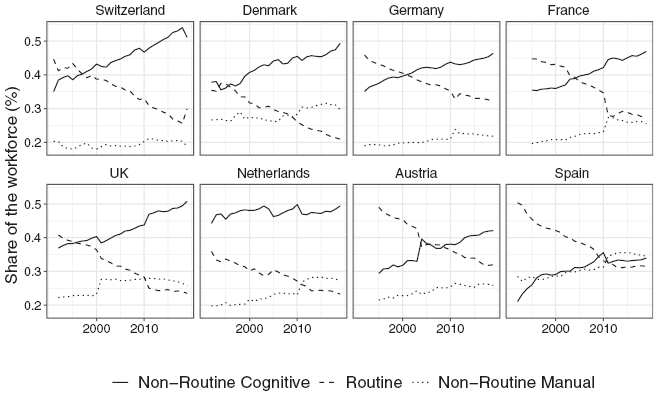
The social democratic challenge here is first and foremost the dislocation of existing job holders and growing inequalities in revenues and opportunities, with a range of direct and indirect negative correlates ranging from new poverty risks to potential structural unemployment or disintegrating opportunities for trade unionization. These developments are exacerbated by geographical concentrations, creating knowledge society jobs in metropolitan areas and draining them away from more peripheral and rural regions. Political choice is likely to be very important in shaping the distributive consequences of these structural developments, depending on whether governments focus on shielding citizens from the consequences of technological change or enabling them to adapt (Häusermann et al. Reference Häusermann, Ares, Enggist and Pinggeraforthcoming). Social protection-oriented policies coping with this challenge and compensating the losers of technological transformation would offer early retirement opportunities with generous pensions, high and durable unemployment wage replacement insurance rates, or even forms of minimum income or basic income schemes, as well as wage and employment protection as ways to alleviate the grievances and risks associated with technological change for wide segments of the workforce. Investment- and opportunities-oriented policy approaches would conversely focus on upgrading and reorienting the education system from preprimary “early childhood education and care ECEC” policies all the way up to expanded tertiary education tracks. That would be supplemented by public investments in research and development infrastructure, and innovation laboratories between private and public sector. Moreover, this strategy would commit to a massive expansion of (re)training of labor market participants with obsolete or insufficient skills. It would also increase the efficiency of financial systems encouraging venture capital and global capital flows and focus on infrastructural investments to support and sustain, rather than prevent the structural development toward a knowledge-oriented economy. Community- and solidarity-oriented policies, finally, would counter the spatial concentration of social deprivation in rural areas by beefing up local public transportation and labor market opportunities, for example, by locating public sector agencies, particularly those involved in occupational skill formation, in deprived areas and massively subsidizing private investments in such areas. They would also improve the local supply of capital through decentralized banking with particular incentives for small borrowers. Potential plausible answers to the transformation of risk structures may also involve protectionist measures for parts of the workforce, for example, by limiting immigration into (specific parts of) the labor market. Moreover, the introduction of an unconditional universal basic income (for all residents in case of a universalistic community conception, or for citizens only in case of a narrower understanding of community) may also come up as an instrument to create a new solidary baseline in society.
Quite a few of these reforms are likely to come with differential costs and benefits to different parts of the social democratic electoral potential. Given the overall agreement of potential social democratic voters on redistributive and equalizing social protection, we would not expect sharp trade-offs associated with social and income protection and wage support. However, different electoral groups based on education, gender, and insider–outsider status are likely to disagree on the orientation and prioritization of social investment policies (cf. Busemeyer et al. Reference Busemeyer, Abrassart and Nezi2021; Kurer and Häusermann Reference Kurer, Häusermann, Busemeyer, Kemmerling, Kersbergen and Marx2022, Häusermann et al. 2023), and we would certainly expect diverging preference patterns between voters from different educational levels, residence, and age cohorts when it comes to more universalistic and more nationalistic visions of creating community and solidarity. The key dividing variable in response to this challenge is likely to be education, as the costs, benefits, risks, and opportunities in the knowledge economy are tied so closely to human capital and capabilities. An additional challenge for social democratic parties lies in the fact that some of the policy responses to the knowledge economy (in particular education, and social and infrastructural investments more generally) are less likely to endogenously create communities of beneficiaries and of political support, because their benefits are more temporally distant and more diffuse (Beramendi et al. Reference Beramendi, Häusermann, Kitschelt, Kriesi, Beramendi, Häusermann, Kitschelt and Kriesi2015; Jacobs Reference Jacobs2016).
The upshot is that technological change, its consequences for the occupational structure and distributive outcomes are not deterministically given, but in part shaped by public policy, with policies intervening in the formation of human capital playing a critical role, and one where there may be tensions among parties and electoral constituencies within the social democratic field over the appropriate direction to select. Of course, these are not the only policy and institutional levers that come into play in order to influence and regulate evolving technological trajectories in light of societal and political preferences. A historical review of past technological trajectories as well as the examination of the current institutional challenges of regulating information and artificial intelligence technologies amply demonstrate the leeway political forces have in shaping the pathway of technological innovation and corresponding human capital qualifications (Acemoglu and Johnson Reference Acemoglu and Johnson2023: especially chapters 8 and 9).
1.4.2 The Demographic Challenge and New Social Risks
Studies of social democratic electoral strategies rarely focus on what is possibly the financially most expensive and in distributive terms highest stakes challenge, the demographic transition to a society with very high old-age dependency ratios, making established defined-benefits pay-as-you-go pension systems unaffordable without later retirement, lower benefits, and/or higher contributions.Footnote 9 Declining fertility and rising longevity have driven pension and elderly care costs up to 8–12 of GDP (OECD 2022 Social Spending Data). Likewise, health-care expenses, much of which are incurred by the elderly sky-rocketed in OECD countries from 3–5 percent of GDP in 1960 to 10–18 percent of GDP by the 2020s. Stagnating disposable incomes are in part due to higher pension and health-care payroll taxes to finance these insurance commitments. Given existing insurance systems, the demographic transition leads to a redistribution within income classes from younger to older workers and retirees more so than between classes. Today’s young cannot expect to enjoy the same kind of security as the currently elderly. While the political science literature holds many studies about engineering blame-avoiding pension reforms (for a summary, see Van Kersbergen and Vis Reference Van Kersbergen and Vis2014: chapter 9), curiously, there is to date much less research on the electoral impact of social democratic governments’ retrenchment of pension entitlements by raising standard retirement age thresholds or changing benefits calculation formulae. There has, however, been probably no single social democratic policy reform touching a greater share of voters and more unpopular among the parties’ core constituency since the 1990s than the often-administered extension of life-time work to age 67 or even higher, as new requirement for wage earners to qualify for full retirement pension benefits.
While the demographic challenge is driven mostly by increasing life expectancy and declining fertility rates, changed gender roles and patterns of family organization have also contributed to the emergence of a set of social risks the welfare states of Western Europe have been and are still ill-prepared to address. The literature on “new social risks” (Bonoli Reference Bonoli2005) has conceptualized these new social risks as those emerging from the interaction of changing family patterns and changing labor markets. Concretely, they manifest in the form of increasing shares of single parent families, heightened risks of child poverty, and the risk of insufficient contribution records especially for women with interrupted careers and atypical employment biographies. Many of these risks also concentrate in immigrant families with insufficient social and labor market integration. These patterns of precariousness contrast with capital-intensive families with all adults participating in both income provision and child rearing, with heavy investments of time and resources in children particularly among the educated strata (cf. Esping-Andersen Reference Esping-Andersen2015; Doepke and Zilibotti Reference Doepke and Zilibotti2019).
Again, social democratic parties can address these challenges in different ways. Social protection based social democratic strategies would want to maintain current retirement age and benefit levels under existing benefits-defined systems by providing more subsidies to the insurance systems from general government revenue or levy higher pension contributions from wage earners.Footnote 10 In response to changing gender roles and labor markets, pension formulae can be adjusted to provide a higher floor for those without enough years of earnings to qualify for a pension higher than means-tested public income assistance, responding also to new social risks. Increased child allowances and support for single-parent families are also potential responses to new social risks. In addition, public long-term care insurance may alleviate the worry of old-age impoverishment. Social investment-oriented reform addresses the fiscal crisis of social insurance and new social risks differently. A primary instrument is the promotion and support of active ageing, flexible retirement schemes and incentives to contribute longer into the pension scheme. Moreover, an investment-oriented reform may promote immigration, public childcare, and female labor market participation as ways to alleviate downward demographic pressure in the long run. Specific benefits to single parent families, as well as short and well-paid parental leave schemes are also supposed to support the earnings potential of families. Solidarity- and community-oriented policies, finally, may include initiatives to build community centers, joint living quarters with multigenerational participation, or local transport mobility initiatives to support active ageing and intergenerational solidarity. In terms of new social risks, social democratic answers may relate to either supporting immigrant families’ integration into society and labor markets, or more sanctioning assimilation-oriented policies, depending on the conceptualization of community pursued.
A key determinant of diverging preferences and trade-offs with regard to policies addressing these challenges lies in age- and cohort-specific preference patterns. This is obvious when it comes to pension-related aspects, where redistributive effects between generations become ever more prevalent, even in capitalized, defined-benefit systems (as states have to deliver statutory and legally guaranteed pensions to the elderly that are not financed through their contributions). But age divides are also plausible when it comes to social investment policies for (precarious) families and community/immigration-oriented policy proposals. Beyond age, we would expect revenue-divides and insider–outsider status to affect the individual cost–benefit calculations of voters in terms of pension rights, and gender as well as urban–rural residence to affect attitudes regarding social investment and community-oriented policies, with urban and female voters being more supportive of and placing heavier emphasis on investment-oriented and integrative policies.
1.4.3 The Global Climate Challenge
Global warming focuses on the avoidance of a global threat and as such may be expected to be perceived as a valence issue in party competition. But both at the global and the national levels, the implementation of concrete measures to slow down global warming raise complex positional distributive issues that are beginning to make the provision of the collective benefit an object of partisan division (Carter et al. Reference Carter, Ladrech, Little and Tsagkroni2018; Lockwood 2018; Bürgisser and Armingeon 2021; Otteni and Weisskircher 2022). This distributive conflict is expected to intensify, as the consequences of global warming hit particularly hard poor families and regions within countries and across the globe. Also, regions and voters in different sectors are likely to be affected differently by climate policies. Voters in emerging knowledge economies have a much easier time dealing with the transition to a carbon-neutral economy than those in the old sectors of primary resource extraction and the industrial manufacturing.Footnote 11 Again, different social democratic responses to the challenge are likely to differ both in whether they tend to sustain or slow down the adaptation to the structural challenge and in the distribution of the costs associated with adaptation.
Social protection strategies seek to tackle global warming with regulatory restrictions of carbon consumption, combined with redistributive schemes subsidizing the less well-off voters’ and sectors’ escalating expense for energy use. Investment- and opportunity-oriented strategies operate with incentive-based policies for consumers and producers, in particular carbon voucher markets, gradually raising the costs of carbon pollution and thereby incentivizing market participants to increase their investments in energy savings, renewable technology, and research and development to improve both. They also invest in green technologies and related research and development. Solidarity- and community-oriented policies focus on the spatial cost–benefit distribution of the exposure to global warming in the transition to a renewable energy economy. This involves public subsidies for the transition to a carbon-neutral energy use in rural areas with long commuting distances and a prevalence of less energy inefficient single-family homes. In urban areas, the emphasis is on infrastructure, densification, and encompassing ecological urban planning in terms of transport, commuting, and the use of private and public spaces.
Residence and age are likely to be the most important factors structuring attitudes in this area in a way as to result in potential trade-offs for social democratic parties, especially when it comes to opportunity/investment- and community-oriented policies. Younger and more urban segments of the electorate are likely to have a stronger preference for these policies than older and more peripherally located voters. Trade-offs on the appropriate level of subsidization and compensation in the area of protection/equality-oriented reforms, by contrast, may be more strongly structured by education and employment sector, as the costs and benefits are unequally distributed along these lines.
1.4.4 A Globalization Challenge
It is unclear to what extent “globalization” can and should be studied as a distinctive structural challenge or to what extent it is a synthetic term of transnational processes of structural development in many different areas of challenge, such as accelerated technological innovation, climate change, and even demographic and sociocultural change of families. However, as politicians oftentimes explicitly invoke “globalization” as cause of the lack of capacity of national governments to exercise domestic “room to maneuver,” it seems appropriate to take it seriously as structural political challenge. Globalization is a multifaceted process that may involve interrelated but still empirically distinct and partially separate dimensions of economics, politics, and cultural identities. Moreover, globalization affects and works through several of the challenges already introduced. Increasing global integration of markets may intensify technological innovation and occupational labor market changes. Immigration and emigration have consequences for the shape of a polity’s demographic transition. Cultural transmission and migration affect the foundations of communal social solidarities. And climate change is an intrinsically global phenomenon of spillovers and externalities.
We focus here on the intensified transnational integration and movement of capital and people, given that we have discussed technological change, demographic changes, and climate change earlier. Global capital liberalization has magnified the power and political influence of financial institutions and corporations, increasing the vulnerabilities of exposed voters and countries (Walter Reference Walter2017). More immediately for the experience of voters, the liberalization of labor markets has contributed to greater immigration and emigration flows across countries, and to a perception of growing risks of income loss and job security particularly among low-skilled routine jobs and “off-shoreable” jobs (Dancygier and Walter Reference Dancygier, Walter, Beramendi, Häusermann, Kitschelt and Kriesi2015). While there is agreement that distinctive low-skill tiers of the labor force are hit by lower wages or greater job insecurity due to globalization, the objective consequences of openness for the bulk of the labor force in knowledge societies is much more mixed and for many groups positive.Footnote 12 The politically critical consequence of increased labor and capital mobility, however, is that it encourages widespread perceptions of economic and cultural threat that resonate in receptive ears, even when realities are different, and thereby magnify the political salience of globalization challenges. For Social Democrats, the critical threat is not simply the economic facts of globalization, but the facts of public perceptions of such globalization, and particularly the societal and sociocultural interpretation of such developments.
In terms of social protection and equality, Social Democrats may be partially receptive to a certain containment of globalization. Even if global trade and capital flows may make the world (and individual countries) better off on average, gains tend to be moderate and unequally distributed so that domestic losers are more clearly identifiable than winners (Rodrik Reference Rodrik2011). And there is a hiatus between the objective distributive consequences of economic globalization and the public perception of globalization not only concerning trade but also immigration. Empirically, it is unlikely that immigration hurts labor market chances of all but a rather small slice of mostly unskilled wage earners, when compared to the labor market effects of automation and digitization.Footnote 13 But the political consequences of losses concentrated in group and geographical terms are empirically robust, clearly visible for residents in areas from which companies relocate large factories to new places of production abroad, and thereby easily politicized.Footnote 14 For that reason, Social Democrats may propose social protection-oriented policies in terms of certain barriers to trade, capital movements, or immigration (e.g., through the limitation of certain social rights to nationals or the implementation of long residency requirements for access to social rights).
At the same time, Social Democrats also see the potential of lowering national borders for trade, people and capital in generating wealth, innovation and employment. Opportunity- and investment-oriented reforms may thus focus on opening up the cross-border flow of goods, capital and people, boosting the competitiveness companies and sectors, and thereby creating jobs that did not exist before. A social democratic strategy would accompany this greater permeability of borders with strong investments in (re)training and education, to sustain adaptation. It would also actively support social and labor market integration of both immigrants and people affected by the accelerated structural change. Furthermore, great popularity among Social Democratic constituencies may be enjoyed by a revival of “industrial policies” that combine trade protection and public investments in new technologies in domestic firms and sectors, particularly when combined with national security considerations about the supply of raw materials and technologies controlled by autocratic hostile countries.
In terms of community- and solidarity-oriented policy responses, the menu of potential social democratic proposals ranges from supranational integration policies to a renewed defense of national economic and social borders and jurisdictions against supra- and international institutions. On this issue, social democratic parties are likely to be torn between a genuine political and sociocultural support for transnational integration and solidarity and a more economically motivated skepticism against the liberalization and integration of markets. This is also where the difficulties of indeterminacy of the social democratic idea to designate the boundaries of the relevant communities is most consequential. To what extent can political decision-making powers be delegated to regional and global political governance bodies without undercutting the principle of democratic self-determination, individual political rights, and civil liberties? And to what extent should members of a polity welcome ethnocultural diversity of individuals and cultural groups? Political responses to social and cultural integration and globalization are indeed a field where social democratic policy responses may be politically most difficult to define.Footnote 15
Employment status and sector – that is, high or low employment risk exposure – education and urban–rural residence are likely to constitute the most important sociostructural dividing lines that may generate strategic trade-offs for social democratic parties when devising policy proposals to address the challenges of globalization. On one side, more high-skilled workers and those protected from globalization labor market risks, as well as voters in urban centers characterized by dense opportunities and by social diversity, are likely to advocate lower barriers to trade and flows of capital and people, policies supporting the integration of markets and societies and cultural diversity, and the construction of a supranational community of solidarity. On the other side, voters who are and/or feel threatened by integrated markets and societies because of their skill profiles and those whose more rural lifestyle stands in contrast with increasing diversity and pluralism are likely to be much more skeptical and prefer higher barriers to integration and narrower boundaries of solidarity and community (Häusermann et al. 2023; Bornschier et al. 2024).
Table 1.1 summarizes our compressed treatment of challenges in order to highlight the range of policy options that may be compatible with some elements of the social democratic core principles. Furthermore, the table itemizes the types of electoral trade-offs choices among the strategies to confront the different challenges may entail.
| The challenges | Potential responses | Potential trade-offs |
|---|---|---|
| Challenge #1: Transformation of technology and occupations | Social protection – oriented responses: e.g., early retirement, generous unemployment insurance benefits, minimum income and wage protection, UBI, employment protection policies Social investment/opportunity – oriented responses: e.g., education and (re)training, early childhood education and care, R&D expansion, venture capital, infrastructural investments Community and/or solidarity – oriented responses: public investments in, subsidies for, and job creation in declining regions; immigration limitation for (specific parts of) the labor market; Universal Basic Income for all residents or for nationals only | No strong trade-offs expected Potential trade-offs based on education, gender, and insider–outsider status Potential trade-offs based on education, rural–urban residence, education, and age |
| Challenge #2: Demographic transition through aging of society and sociocultural pluralization | Social protection – oriented responses: e.g., minimum pension guarantees, fiscal subsidies to pay-as-you-go pension funds, securing of relatively low pension age, child allowances and support/social assistance for poverty risks, long and low-paid parental leave benefits Social investment/opportunity – oriented responses: e.g., early childhood education and care policies, generous and short parental leave schemes, support services for single families, active ageing, flexible retirement, gender equality policies Community and/or solidarity – oriented responses: e.g., social and educational support for immigrant integration OR limitation of immigration and assimilation policies, investments in local public services and infrastructure | Potential trade-offs based on income/SES, age, insider–outsider status, and potentially trade union membership Potential trade-offs based on income/SES, education, age, gender, and urban–rural residence Potential trade-offs based on education, age, gender, and urban–rural residence |
| Challenge #3: Global climate change | Social protection – oriented responses: e.g., regulatory restrictions combined with compensatory redistributive income subsidies for strongly affected industries and households Social investment/opportunity – oriented responses: e.g., incentives systems for producers and consumers; investments in green technologies and related R&D Community and/or solidarity – oriented responses: e.g., subsidies for transport and energy in remote areas; densification and encompassing ecological urban planning in more urban areas | (Weak) potential trade-offs based on education and employment sectors Potential trade-offs based on education, age, and urban–rural residence Potential trade-offs based on education, age, and urban–rural residence |
| Challenge #4: Economic, political, and cultural globalization | Social protection – oriented responses: e.g., trade restrictions and tariffs, barriers to global capital movements, welfare chauvinism Social investment/opportunity – oriented responses: e.g., trade openness, restructuring and retraining, free movement of people with support for social and labor market integration; new industrial policy promoting domestic technology and firms Community and/or solidarity – oriented responses e.g., supranational community building or defense of national political jurisdictions against supranational institutions; integration or limitation of immigration | Potential trade-offs based on income/class and employment status/sector Potential trade-offs based on employment status/sector and education Potential trade-offs based on education and urban–rural residence |
In our discussion of potential policy responses to emerging challenges, we focus on expansive policies, encompassing benefits, rights, services, subsidies, and incentives. Taxation can be one instrument to implement subsidies and services, but our discussion leaves aside a thorough discussion of the revenue side overall or the specific type of “social democratic” financing of all these diverse benefits and services. Obviously, a social democratic state – whether it emphasizes social protection, social investment, or community/solidarity – requires a high share of government in the gross domestic product, probably in the neighborhood of half of a country’s GDP or more. However, many politicians even in the social democratic field assert limits to the share of income governments can extract through taxation and allocate to public policy, as well as limits to the structural debt governments may cumulatively build up by not financing expenditures fully with taxes – even though on occasion center-left governments may have underestimates their leeway for countercyclical fiscal policies in times of economic crisis (Bremer Reference Bremer2023). From an electoral perspective then, addressing revenues and debt are a difficult subject for left politicians: while citizens have no fully formed preferences over the kinds of taxes they find most acceptable and while they generally seem to prefer a status quo of high social benefits to a change toward a lower tax regime with fewer social benefits (Ballard-Rosa et al. Reference Ballard-Rosa, Martin and Scheve2017; Barnes et al. Reference Barnes, Blumenau and Lauderdale2021; Bremer and Bürgisser Reference Bremer and Bürgisser2023), large majorities of left voters also intensely dislike a change of the status quo through tax increases to finance government expenses, and particularly public debt, as Bremer (Reference Bremer2023: 117) shows. How left parties cope with revenue constraints and public debt management, then, is one of the continuing sources of conflict within the left partisan field and has on many occasions driven Social Democrats to ally with center-right rather than starkly left socialist parties in government coalitions.
In terms of comparative policy analysis, differentiating between specific reforms and problem solving mechanisms as discussed in this section and Table 1.1 is highly relevant. However, in electoral-strategic terms, social democratic parties have to develop a more overarching, recognizable profile, by prioritizing and bundling some objectives and aligning policy proposals along them. Hence, in Section 1.5, we develop four possible strategic orientations for social democratic parties.
1.5 Party Strategic Alternatives to Respond to Structural Challenges and Transformation of the Social Democratic Electorate
In the second half of the twentieth century, that is, the era of the industrial society, Social Democrats mainly had to consider how much they would rely on their large working-class core electorate with a social protectionist and redistributive appeal, or also reach out to a more amorphous “middle class” electorate of white collar clerical wage earners and professionals (Przeworski and Sprague Reference Przeworski and Sprague1986). The strategy question was only one of “moderation” on a single broad economic dimension. Moreover, in the Cold War environment of the 1950s through 1980s, the only alternative to Social Democracy in the left field was often discredited as apologist of “real existing” socialist authoritarian rule in the Communist sphere. As a consequence, even moderation and middle-class outreach often cost Social Democrats nothing in terms of working-class support.Footnote 16
All this changed with the rise of knowledge capitalism and its related structural challenges. Now, indeed, there are multiple potential trade-offs between social groups sympathetic to core social democratic ideas but possibly calibrating their preferences differently and placing emphasis differently regarding questions of social protection, social investment, community, and solidarity (Gingrich and Häusermann Reference Gingrich and Häusermann2015; Oesch and Rennwald Reference Oesch and Rennwald2018; Abou-Chadi et al. Reference Abou-Chadi, Häusermann, Mitteregger, Mosimann and Wagner2022). Moreover, on the supply side, the communist rival vanished, often already before the collapse of East European communism. In its stead a variety of partisan enterprises have emerged that take advantage of the multifaceted nature of the programmatic field that broadly qualifies as social democratic. Depending on how parties calibrate their appeals, they are likely to resonate with different subsets of electorates within the social democratic field, as well as adjacent electoral potentials where they compete with parties just outside the social democratic field.
What unites the electorate available to parties within the social democratic field – and delimits the boundaries of that field – comes in three baselines. First, all of these voters endorse at least mildly progressive income redistribution and strong universal social protection. Second, they also are generally sympathetic to an emancipatory agenda of increasing individual opportunity and personal autonomy, paired with a penchant for social policy of investment in citizens’ capacities to participate in the labor market and in politics. Third, citizens in this field may have different ideas about community and solidarity, but they reject a starkly nationalist, exclusionary, nativist conception of collective identity.
Now the social democratic field in emerging knowledge societies is essentially structured by four strategic alternatives in a multidimensional space. Three of these are “outbound” strategies of progressive, radical change that accentuate one strand or dimension of the social democratic ideas complex. The fourth strategy is an “inbound” strategy of moderation, mildly gesturing toward “center-left” positions on all dimensions thereby attempting to unite the social democratic electorate around a smallest common denominator.
➢ The Old Left Strategy. It focuses primarily on economic redistribution and social protection of less well-off citizens. Issues of strengthening individual opportunities, especially via social investment are not rejected, but deemphasized. Likewise, this strategy tends to side-step questions of communitarian boundaries and takes a position of abstract republican universalism, aiming to negate multicultural divisions by emphasizing topics of traditional class divides. It thereby revives the traditional social democratic class politics appeal, geared toward a now smaller audience of blue-collar and clerical low-skilled wage earners and pensioners. It is, by contrast, less directed toward professionals, and especially sociocultural professionals.
➢ The New Left Strategy. It combines and emphasizes investment-oriented, opportunity creating social policies with libertarian positions on questions of sociocultural and sociopolitical governance (civil liberties, gender, family, political participation). With regard to questions of community and solidarity, a new left strategy emphasizes universalism based on the recognition of multicultural collective identities, liberal positions on immigration, as well as economic and political supranational integration. It also entails a strong ecological and climate change policy. It recognizes and supports but tones down redistributive and social protectionist claims, particularly in the realm of key compensatory policies such as pensions and job protection. This strategy is more clearly geared toward the preferences and priorities of the educated middle class, with some variance in how receptive they are to income redistribution and universal social protection. While sociocultural professionals are among the most fervent supporters of redistribution, the level of support is more moderate among technical experts and in particular managers. As a new left strategy emphasizes progressive, universalistic policies of opportunity creation and community at least on a par with income redistribution and social protection, it is less geared toward a particular prioritization of the demands and needs of lower income classes preferences and demands.
➢ The Left-National Strategy. It combines strong support for income redistribution and social protection with relatively more conservative positions when it comes to community, libertarian governance, immigration, and international integration. It also deemphasizes social policies focusing on opportunities and social investment at the benefit of a more “protective” approach in the response to structural challenges. Rather than supporting citizens in confronting the structural changes coming with changing labor markets and the knowledge economy more generally, this strategy focuses on shielding citizens from structural change and preserving established pools of community and solidarity. The strategy thereby picks up on the relative reluctance of many traditional working-class and low-skill white-collar supporters to embrace an agenda of strongly libertarian governance, multicultural identities, and globalization. While public opinion research consistently reveals a substantial left-authoritarian sector of public opinion, this strategy has a quantitatively limited appeal to voters in the broad social democratic field. It also clear antagonizes professionals of all kinds.
➢ The Centrist Strategy. This leaves finally a self-consciously centrist strategy, defined by moderate positions on all relevant aspects of the social democratic domain, social protection and redistribution, social investment and libertarian governance, and conception of communitarian boundaries, particularly through immigration policy. This “Third Way” (Giddens Reference Giddens1998) variant of Social Democracy intends to appeal to strands in all social constituencies receptive to basic social democratic ideas. And while it may resonate with weak social democratic supporters of all social strata also tempted to support liberal-conservative parties situated just beyond the perimeters of the social democratic field, it refrains from embracing leadership and a strong profile on any of the relevant programmatic dimensions. Thereby, it risks discouraging those who care strongly about aspects of all or some strands of the social democratic idea.
Social democratic parties have often attempted to place themselves in centrist positions on all salient policy dimensions, but in an increasingly pluralizing issue and party space, this has made them vulnerable to voter defections to novel and more extreme parties that jumped into the fray to thrive on dissatisfaction with social democratic party moderation (e.g., Kitschelt Reference Kitschelt1994). This process started with the emergence of left-socialist parties in Scandinavia, France, and the Netherlands in the 1960s and early 1970s that originally insisted on the revival of a starkly redistributive politics of universalistic class social protection. But these parties then in the 1970s and 1980s joined a second wave of “New Left” parties, often running under the green or ecological label, combining economic redistribution and social protection with a powerful emphasis on ecological protection, libertarian governance, social investment, and multiculturalism. Over time, these New Left parties began to dilute their social protectionist commitments in favor of progressive positions on social investment, libertarian governance, and multiculturalism. Some libertarian parties also jumped in or moved to squarely centrist social protectionist appeal, such as the Dutch Democrats 66 or the British Liberal Democrats, both skirting the boundaries of the social democratic field.
Centrism by many social democratic parties and emphasis on “second dimension” questions of sociopolitical governance, multiculturalism, and ecology by New Left parties also opened up a partisan space for a renewed “radical left” economic strategy emphasizing social protectionist stances, particularly in light of the Financial Crisis 2008–09 and the Great Recession in its aftermath. Examples are the Dutch Socialist Party, the German Left Party, the French La France Insoumise, Spain’s Podemos, and Greece’s Syriza. In their early days, some of these parties – such as the Dutch Socialist Party and the German Die Linke – combined their social protectionist agenda with a measure of national identity appeals and aversion to immigration. But these strategic experiments have nowhere found massive electoral traction and were abandoned by the parties that tried them out. Today, virtually all of the newer radical left parties combine a clear emphasis and priority of social protection with progressive and universalistic positions on questions of sociocultural governance, community, and solidarity.
Figure 1.5 maps the theoretical positioning of the different possible programmatic strategies in the social democratic left field and in the political space more generally in the 2020s. We have simplified the field by collapsing questions of progressive universalism with regard to both social investment and community/solidarity into a broad “progressive” politics agenda opposed to a “conservative” agenda of more authoritarian-traditional governance and national identity, and a social policy agenda focused on shielding citizens from structural change rather than investing in their human capital. Indeed, both conceptually and empirically, policies and politics with regard to social investment on the one hand and community/solidarity on the other hand align on a continuum between universalistic and particularistic positions (see, e.g., Beramendi et al. Reference Beramendi, Häusermann, Kitschelt, Kriesi, Beramendi, Häusermann, Kitschelt and Kriesi2015; Häusermann et al. Reference Häusermann, Ares, Enggist and Pinggeraforthcoming). Notice that some of the “New Left” parties may cover centrist positions on the dimension of social protection. As explained earlier, the “Old Left” parties today mostly embrace progressive positions on the second dimension, as well. The “Left national” parties for the most part are a hypothetical party formation that has not achieved electoral resonance. Outside the social democratic field, we distinguish the Moderate Right and the Radical Right. In this figure, we refrain from differentiating liberal from conservative right-wing parties, because in practice they heavily overlap (see empirical data later). Most “liberal” parties are best combined with the Moderate Right party camp. A few of them are libertarian progressives with economic centrism and thereby are actually closer to the economically centrist “New Left.”
Ideal-typical programmatic strategies in the political space

The stylized Figure 1.5 can be backed up with real data providing a mapping of European political parties in the two-dimensional space.Footnote 17 The figures are based on CHESS expert survey data from 2019 and display the positioning of party families across Western European countries. The circle diameters are proportional to the vote share of the parties in the last national elections before 2019. While Figure 1.6 places parties in a two-dimensional space composed of the economic left-right and the sociocultural GAL-TAN (Green-Alternative-Libertarian versus Traditional-Authoritarian-Nationalist) dimensions (combining questions of libertarian governance and cultural identity), Figure 1.7 does the same for the economic left-right dimension and a y-axis indicating average positions on immigration policy as a key component of the collapsed second dimension of party competition (which is, however, not included in the CHESS-GAL/TAN operationalization).
Programmatic positions of European parties on the economic and GAL-TAN dimensions (based on CHESS 2019)
Note: the figure shows parties of Western Europe with at least 5 percent vote share in the last national election before 2019. The size of the circles is proportional to the vote share of the parties in the last national elections. The complete list of party names is in the online codebook of the CHESS survey 2019. Direct link to the pdf download: https://tinyurl.com/ycyhrscb (access: March 22, 2024). The first two numbers identify the country (e.g., Switzerland = 36) and the last two numbers the party (e.g., Swiss Socialist Party = 3602). To quickly identify a party, we recommend using the search function.

Programmatic positions of European parties on the economic and immigration dimensions (based on CHESS 2019)
Note: the figure shows parties of Western Europe with at least 5 percent vote share in the last national election before 2019. The size of the circles is proportional to the vote share of the parties in the last national elections. The complete list of party names is in the online codebook of the CHESS survey 2019. Direct link to the pdf download: https://tinyurl.com/ycyhrscb (access: March 22, 2024). The first two numbers identify the country (e.g., Switzerland = 36) and the last two numbers the party (e.g., Swiss Socialist Party = 3602). To quickly identify a party, we recommend using the search function.

Two insights from Figures 1.6 and 1.7 are particularly important: First, in the empirical space of Western European party competition, social democratic parties empirically take only a limited set of strategic programmatic options. Most social democratic parties offer either a Centrist program or somewhat more radical economic positions moving them closer to New or Old Left programs. But while Social Democrats embrace some measure of libertarian progressivism and multiculturalism, they generally do so only with substantial restraint. This leaves room for distinctive new left (libertarian) and radical left parties with more extreme positions on one or the other dimension. Second, we do not see any social democratic party gravitate toward the left national region of the programmatic space. While in surveys, a substantial share of voters express left-authoritarian political dispositions, none of the parties originating in the social democratic field has moved to capture these voters outside the circumference of the field. What is more surprising, there are also hardly any parties originating outside the social democratic field that would have entered this field and achieved electoral success by expressing a left-nationalist appeal.
It is clear from our analytical characterization of the strategic alternatives Social Democrats face in party systems and within the social democratic field that all contributions in this volume are steeped in a spatial conception of party competition.Footnote 18 While this introduction cannot be the place to spell out the theorems and empirical implications of this general theoretical framework in detail, a few core postulates should be posited here as a reminder and a point of critical engagement with scholars who disagree with this framework.
In a spatial world, parties announce programmatic positions on a parsimonious set of issue dimensions, albeit not necessarily reduced to a single one. Critical subgroups of voters process these signals and update their vote choice by supporting the party (or a party in the expected winning coalition) that is closest to their own preference schedule, thereby creating a bond of accountability and responsiveness between parties and voters (Zaller’s Reference Zaller1992 RAS model: receive–accept–select). Most voters, however, do not act on information because they are simple party identifiers or apolitical or ideologues who process information but do not act on information contrary to their prior beliefs. But it is the critical minorities of voters who are “available” to strategic appeals and act on them. At the aggregate level, voter movements create the appearance of a “wisdom of the crowd” where electorates and subgroups rationally follow party signals. Our approach, in this regard, is thoroughly in opposition to Achen and Bartels (Reference Achen and Bartels2016), which assert the utter impossibility of rational information-based interaction between voters and politicians in electoral democracies.
In this spatial world, then, parties are vote- and/or office-seeking and aim to place themselves “close” to voters in the relevant dimensional space, yet sufficiently far part to prevent abstention due to indifference (even in two-party systems) or movements to close-by competitors. Some strategy of “product differentiation” is advisable: Policy positions serve vote- or office-seeking intentions. Contrary to earlier ambitions of spatial theory, realistic conceptions of party systems permitting entry and exit of parties, more than one dimension of competition, the significance of parties’ credibility for articulating positions, and strategic voting have to do without strong Nash equilibrium conceptions aiming to identify parties’ optimal positions. Parties, however, will update their positions in light of past electoral performance, albeit in a trial-and-error fashion based on simple rules that do not necessarily deliver electoral improvement in the future, let alone Nash equilibrium optimality (cf. Laver Reference Laver2005; Budge et al. Reference Budge, Ezrow and McDonald2010; Laver and Sergenti Reference Laver and Sergenti2011).
Over the past generation, spatial theories of party competition have been challenged by issue-based and “issue ownership” asserting theories of party competition. According to this alternative, parties do not compete by choosing positions on issue dimensions, but by boosting the salience of valence issues for which they have acquired a notoriety and perception of competence, often referred to as “issue ownership” (Budge Reference Budge2015). They differentiate issues and issue salience, not issue positions. While we agree that there may be instances of striking issue ownership and electoral leverage parties derive from it, let us advance five arguments to substantiate the priority we give to a spatial perspective in this volume.
First, issue ownership is typically that of a party position, not of a subject matter. Parties are perceived to “own” the “environment,” because they take an uncompromising position favoring (or opposing) costly environmental protection. Likewise, parties may own immigration, because they take a clear position in favor or opposing generous immigration laws. When politicians promise to contain inflation, they are typically perceived to impose austerity and allow unemployment to rise. When they promise to come down “hard” in the fight against crime, it usually implies they are willing to disregard restrictions on police action to protect civil liberties and due legal process. Often enough, an issue is “owned” by a party, because it successfully manages to place itself near the median voter on a positional issue and also manages to gain credibility for that spatial strategy (Seeberg Reference Seeberg2020).
Second, there is now overwhelming evidence that parties in campaign cannot compete just on issues that they “own.” The campaign agenda is to a large extent a “party system agenda” (Green-Pedersen Reference Green-Pedersen2019) shared by and imposed on all parties. Societally important issues – and competitors who threaten to take votes away – impose themselves on political parties (Spoon et al. Reference Spoon, Hobolt and de Vries2014; Seeberg Reference Seeberg2023). Only when issues are not so crucial for mass publics at a particular point in time can parties exercise discretion and select specific issues for higher salience (Kristensen et al. Reference Kristensen, Green-Pedersen, Mortensen and Seeberg2022).
Third, party issue “ownership” comes with an attribution of competence, but that attribution is to a large extent endogenous, based on the voter’s perception of the proximity of a party’s position on an issue to her own position, the voter’s party identification, and the voter’s association of social group positions with that issue position (cf. Stubager and Slothuus Reference Stubager and Slothuus2013; Stubager 2018).
Fourth, issues are not stand alone, but issue positions map onto underlying moral-ethical principles, like those we discuss earlier to identify the social democratic idea. This is the reason why in many societal contexts a stance against immigration also predicts an individual’s preferences over gender relations, deference to authority, conformity to cultural precepts, and so on. In terms of political strategic terms, this means that politicians who intuitively “know” how issue positions cluster can switch issue salience and promote new issues with equivalent positions on the same dimension: The same people they might agitate today with an anti-immigrant position will tomorrow embrace antigay positions and the day after assert meat-eating-cum-pick-up-trucks against a vegan-and-bicycles culture. Politicians do not invent issue dimensions on which people’s political predispositions can be aroused, but they find the issues that achieve this most efficiently at a particular point in time.
Fifth, this brings us to one of the most thorny questions of spatial competition theory, that of the salience of issues and dimensions, something undertheorized in the early Downs (1957) work and theorized away by focusing on unidimensional competitive spaces. Issue theories of competition posit that spatial theory cannot incorporate how politicians calibrate the differential salience of issues and dimensions. But that is not entirely true. Spatial conditions affect how a party may choose to emphasize a dimension. If its position is far removed from the median voter on an important issue dimension – for example, distributive fairness – it will choose to compete on a different dimension, for example, by emphasizing a nationalist identity position or strong religious affinity (De Sio and Weber Reference De Sio and Weber2014; Tavits and Potter Reference Tavits and Potter2015). A number of studies have argued, and more recently demonstrated in empirically convincing fashion, that the greater or lesser convergence of conventional center-left and center-right parties on variants of what Lipset called the “democratic class compromise” increased voter indifference between the parties on that erstwhile dimension and made them more available to vote in favor of parties that take extreme positions on another dimension, the GAL-TAN dimension, for example, by emphasizing national identity, opposition to immigration, law and order, or traditional gender relations (cf. Kitschelt and McGann Reference Kitschelt and McGann1995; Carter Reference Carter2005; Spies and Franzmann Reference Spies and Franzmann2011; De Vries and Hobolt Reference De Vries and Hobolt2012; Spoon & Klüver Reference Spoon and Klüver2019). So salience of issues – and strategic choice of issue salience – is to a considerable share endogenous to parties’ positioning.
All this does not imply that spatial competition theory explains everything. The content of issue competition originates in societal conditions the illumination of which requires political-economic, sociological, and social-psychological investigations and theorizing. Moreover, there are, in fact, valence components of the production function of electoral votes that have little to do with parties’ spatial political positioning. Affective party identifications are one such aspect, personality traits of individual candidates offer a second, and the attribution of competence to parties based on the performance of macroeconomic operators before an election (“retrospective economic voting”) may be a third. Other valence components, such as the mobilizational capabilities of a party’s organization, may play a further role in shaping electoral outcomes. But most of these valence elements operate in the short run, affecting specific individual elections. When it comes to the intermediate range shaping of political parties’ brand images and appeals that affect floor and ceiling of parties’ electoral performance over a multiplicity of elections, spatial considerations are critical.
1.6 How Political-Economic Legacies Condition Social Democratic Trade-offs across Regions
We have so far confined our argument to a general, transversal logic of conflict alignment and strategic trade-offs of social democratic parties in the transition to knowledge societies, because the fundamental structural and economic sources underlying the changing dynamics of left-wing voting apply to all Western European democracies. In Section 1.5, we have outlined different strategic-programmatic options for social democratic parties to respond to these changing conditions. As we discussed in the beginning of this introductory chapter, the debate about the underlying reasons for electoral decline of social democratic parties often pits claims that these parties “have not adapted enough” to those according to which these parties have programmatically “changed too much.” Given the fundamental structural transformations and challenges the societies of Western European democracies have confronted over the past decades, we contend the former rather than the latter.
However, both the possibilities of social democratic parties to adapt – or even “reinvent themselves” – and their needs to do so differ, of course, between different contexts. This is why in this section, we want to highlight a set of variables that affect this context. Several chapters in this book then delve deeper analytically in the effects of these regional context variables (in particular Chapters 2, 4, 7, 10, and 11).
We focus on three aspects that radically affect the opportunity structures social democratic parties confront: the development of the knowledge economy, the size and type of the welfare state, and the degree of party system fragmentation that different electoral systems allow. Our goal her is not to create sets of country groups or “regimes,” with set values on the variables we itemize. Rather all three aspects involve complex variation between countries, and they may even combine in idiosyncratic ways for certain countries. However, it is well established that – as they interact – these variables tend to cluster in country groups, and these clusters allow us theorizing specific, stylized contexts for social democratic party adaptation. In particular, it is the Northwest European countries – above all the Scandinavian countries – that provide the greatest potential for a deep reconfiguration of the left political field, as they exhibit proximity to the global knowledge innovation frontier, encompassing and redistributive welfare states with high employment shares of sociocultural professionals, as well as proportional electoral systems and a high saliency of sociocultural electoral competition. In this context, it might be difficult for social democratic parties to remain a broad, encompassing “umbrella” party for all parts of the left electorate.
At the other end of the spectrum, the Southern European countries tend to be further behind in terms of knowledge society occupational structures and associated international economic competitiveness, and they feature welfare states that are less encompassing, redistributive, human capital investment- and service-oriented. Overall, both the size of the professionalized middle classes, as well as the degree of sociocultural realignment are weaker and given the lower degree of welfare state maturation, claims for welfare expansion receive stronger generalized support across the political spectrum. Furthermore, there is a strong communist party-rooted leftist organized tradition that always fragmented the left field. In such a context, after the implosion of the old communist parties, a radical leftist (populist) party is more likely to gain electoral strength than the emergence of a powerful green left alternative. This Radical Left may be complemented by a centrist party that evolves from the left field or by continuity of an established social democratic party. The key point, however, is that left-libertarian politics remains subdued and subordinated to radical left, classical social democratic, or centrist partisan strategies.
However, there is of course a lot of relevant variance across and within these regional clusters that needs to be taken into consideration depending on the specific research question at hand. Hence, we now discuss the three key aspects of context-variation sequentially.
The most important condition relates to structural economic development, more precisely the country’s socioeconomic proximity to the knowledge society innovation frontier. The higher the share of highly skilled and/or educated professionals in cognitive, creative, and interpersonal services in the occupational labor force, the greater the likelihood of a differentiation of the social democratic field into distinctive parties of the Green Left, Radical Left, and Social Democracy. The variance in terms of employment in “knowledge-intensive activities” (KIA) matters both at the national level and within countries, of course, as it is something that typically concentrates in major metropolitan centers or medium-sized university-centered cities. Figure 1.8 plots both the levels and development of employment in KIA between 2008 and 2021 across Western Europe. We see that on average, Nordic, Anglo-Saxon and – to varying degrees – continental countries have markedly higher shares of the workforce employed in KIA than Southern European countries. And while knowledge economy employment is growing in all these countries over time (hence our contention that this is a universal challenge affecting all countries and parties, see Section 1.4), we also see that over time, the discrepancies between Northwestern and Anglo-Saxon Europe and the Mediterranean countries remain clear and strong.Footnote 19
Development of the occupational knowledge economy: service sector employees with tertiary education as a share of total service sector employment
Data: Eurostat. Annual data on employment in knowledge-intensive activities at the national level.

Hence, Southern European countries have a higher potential to exhibit a different pattern of party evolution in the leftist field than the Netherlands, Denmark, or Sweden. We thus expect losses toward green and left-libertarian parties to be higher in countries with stronger knowledge economy employment. At the same time, in the less advanced regions and countries, relative or absolute economic decline, compared to the centers of knowledge economies, may invigorate radical left party support. In some instances, the Radical Left might displace or absorb much of the social democratic center-left within the left field. Left radicalism is likely to thrive particularly in places where labor market demand and education system supply mismatch, that is, where young, educated professionals cannot find adequate employment, unless they emigrate to more advanced knowledge society centers (cf. Rooduijn et al. Reference Rooduijn, Burgoon, van Elsas and van de Werfhorst2017; Garritzmann et al. Reference Garritzmann, Häusermann and Palier2022).
A second variable that matters sociostructurally, especially for the left field of party competition concerns the generosity and orientation of the welfare state. Both the sheer size of the redistributive welfare effort, as well as its consumption versus service orientation is relevant here. Figure 1.9 plots the aggregate expenditures on social investment and social consumption against their ratio (similar to Beramendi et al. Reference Beramendi, Häusermann, Kitschelt, Kriesi, Beramendi, Häusermann, Kitschelt and Kriesi2015). The more encompassing and investment/service-oriented welfare systems are, that is, the more they have created nonprofit social services – such as in childcare, education and training, health care, sociocultural services, and assistance to the elderly – the higher the share of (male and especially female) sociocultural professionals in the labor force and the higher the political and economic demand for and support of strong welfare services. As we see in the figure, this applies mostly to the Nordic countries in the upper right-wing corner. A generous welfare state may stabilize the size of the left field also in continental countries (e.g., the lower right corner) but less so through its effect on the employment structure and hence directly on electoral potentials. As discussed earlier, sociocultural professionals tend to support social democratic ideas strongly, but on average are drawn toward a green/left-libertarian version of social democratic ideas. As Loxbo et al. (Reference Loxbo, Hinnfors, Hagevi, Blombäck and Demker2021) convincingly show, Social Democracy, as a particular party brand, in such strongly service- and investment-oriented welfare states may be undermined by its own success. However, if these knowledge society adaptations of the welfare state may to some extent become electorally detrimental to social democratic parties, they are likely to stabilize the overall left-wing partisan field. Most of the time, but not under all circumstances, broad welfare states can also dampen the electoral attractiveness of left- and right-wing populism (Burgoon and Schakel 2022).
Total expenditures on consumption and investment and weight of spending on investment in total expenditure
Data: OECD spending data. Social investment operationalized by public spending on tertiary education, active labor market policies, and early childhood education and care. Social consumption operationalized by public spending on unemployment, disability, and pension benefits. 2010–17 is chosen because of many missing values after 2018. Since there is no data on ECEC spending for the Belgium and Greece, these countries are missing from the graph.

The third contextual aspect we want to highlight when theorizing the leeway of social democratic parties for programmatic adaptation refers to the degree of party system fragmentation that different electoral systems entail and the extent of this fragmentation along sociocultural lines of electoral competition. Systems of proportional representation have the obvious consequence of encouraging fragmentation of the social democratic field, especially when the underlying political-economic conditions of emerging knowledge economies support this differentiation. Moreover, PR systems make it more likely that centrist parties exist just outside the social democratic field to whom moderates previously within this field may defect, thereby incentivizing some parties within the social democratic field to adopt very moderate positions.
Plurality single-member district systems, by contrast, counteract party system fragmentation, including fragmentation of the social democratic field, even when societal pressures are high to support differentiation of parties supporting basic social democratic ideas (such as in the KIA-intensive labor markets of the UK, see Figure 1.8). This dampens green left as well as radical left party support within the social democratic field, but also radical right performance in the right-wing field. But such majoritarian systems may promote polarization among the major parties, when radical activists capture those mainstream left and/or right parties for want of more distinctive, radical party profiles. Polarization may then generate a vacuum in the political center, as starkly demonstrated by recent developments in the US and the British party systems. The transformation of party systems under plurality rule, therefore, may also express itself in the differential abstention of voter groups, either by centrists, when one or both parties intensify polarization, or by right-wing authoritarian or left-wing libertarians, when the major parties gravitate to the center. Overall, moderate left parties in plurality electoral system countries such as the UK and US may lose a greater proportion of voters to the pool of disaffected abstentionists than in countries with PR systems, where other alternatives within the left field are readily available and can win legislative representation. The analyses by Abou-Chadi and Wagner and by Bischof and Kurer (in this volume) indeed find relatively higher levels of vote switching to abstention in plurality electoral systems. At times, new parties may make an appearance in plurality electoral systems, but they tend to score electoral support primarily in secondary subnational (local or regional) or supranational (European) elections. Also, past core electorates of the major parties – working-class constituencies as bedrock of social democratic party support (inclusive UK Labour and US Democrats) and the educated bourgeoisie as stalwarts of the liberal-conservative party – may become swing electorates between the strategically often volatile major two established party alternatives in first-past-the-post-systems (Kitschelt and Rehm Reference Kitschelt and Rehm2019, Reference Kitschelt and Rehm2023). Several countries with plurality electoral systems, therefore, have come to the institutional breaking point of questioning the plurality single-member district party systems, but only one (New Zealand) has made the leap to abandon it in favor of proportional representation, with the consequence of generating a party system configuration very similar to that of Northwestern Europe.
In a sentence, while the structural transformation of voter preference profiles and the sociodemographic attributes of partisan electorates of the left and the right fields are similar in knowledge societies with proportional representation and those with majoritarian plurality rules, the institutional opportunities to express these changes in party realignments are very different. Because this book emphasizes vote switching between Social Democrats and competitor parties within the left field, not all chapters, therefore, will include Anglo-Saxon countries.
Figure 1.10 illustrates the effect of these institutional differences impressively. In Continental and Nordic countries, we see massive party system fragmentation: within the left field in particular, the decline of social democratic vote shares over time has been paralleled by the rise of far left and green parties. Over time, far left and green parties cumulatively rise to a comparable vote share than Social democratic parties. We also observe more limited fragmentation in Southern Europe, where different electoral systems prevail (more majoritarian in Spain, more proportional in Portugal, and mixed in Greece and Italy). In line with the hypotheses based on knowledge-economy development in this region, we see the Far Left emerge as the main contender of social democratic parties from the late 1990s onwards, and to a much weaker extent the green parties. The starkest contrast, however, is clearly with the more majoritarian Anglo-Saxon countries, where party system fragmentation has remained much more limited.
Development of electoral shares in national elections for different party families over time, by regions (Continental, Nordic, Southern, and Anglo-Saxon European countries)
Data: ParlGov data.

In PR systems, the chances for social-democratic parties to remain broad, encompassing left-wing parties are much lower than in majoritarian systems. Hence, both the need and the possibility of programmatic reorientation are on average higher in PR systems. The orientation of this programmatic adaptation, however, whether in more radical economic or along predominantly sociocultural directions may differ.
We suggest that while the realignment of voter attitudes along the sociocultural dimension has progressed across all Western European countries, it is particularly consequential for social democratic parties in Nordic and Continental countries. One indication for this is the rise of green parties as seen in Figure 1.10, as well as the fact that virtually all far left competitor parties in these countries are left-libertarian on cultural issues, as well (see, e.g., Chapter 6 by Häusermann in this volume). Another indication can be seen in Figure 1.11. The three graphs plot the average predicted support for socio-economic etatism and market correction (i.e., strong support for public redistribution) and socio-cultural universalism (i.e., strong support for cultural liberalism, internationalization, and immigration) by left-right self-positioning of respondents. While slopes can be compared, absolute levels should not, as the underlying questions are different.
Left–right self-positioning and policy preferences on the two dimensions of political competition
Data: ESS 2018. Indicators of etatism-market-liberalism (socio-economic) and universalism-particularism (socio-cultural) are unweighted, additive, normalized indices and follow similar scales in the literature. Etatism includes support for government redistribution and income equality; universalism includes support for working mothers, for adoption rights for homosexual couples, European unification, as well as the evaluation of immigration as positive in cultural or economic terms. Models include country-fixed effects and poststratification weights.

A first observation is that the understanding of what “left” and “right” mean has become connoted in both economic and cultural terms in all countries. Especially for younger generations (see, e.g., Häusermann et al. Reference Häusermann, Ares, Enggist and Pinggeraforthcoming) identifying as “left-wing” correlates even stronger with attitudes on questions of sociocultural governance than with attitudes on state correction of market outcomes. This is a fundamental realignment of the political space voters orient themselves in.
While the attitudinal realignment is similar in Nordic and Anglo-Saxon countries, etatist policies receive higher and less controversial support in Southern Europe and universalism is on average lower and more disputed than in the rest of the European countries. These differences are likely to matter for the need and possibilities of programmatic reorientation. In Nordic and Continental countries, voters who identify as being “on the left” on average hold clearly progressive attitudes on both economic and cultural policies (see also Chapter 9). A new left strategy reflects this combination of attitudes most directly. In Southern Europe, by contrast, the opportunities for broader, economically based claims may not just appeal to broader segments of voters but also be less controversial in the electorate. Programmatic reorientations are, of course, more constrained in Anglo-Saxon countries due to the electoral system, but this does not imply moderation. Exacerbating political-economic circumstances may amplify polarization: Weak welfare states with little redistribution to the poor against the backdrop of very high primary pretax/transfer income inequality make conservative parties emphasize noneconomic nationalist and ethnoculturally nativist and particularist positions (Tavits and Potter Reference Tavits and Potter2015). Center-left parties may reciprocate with more radical positions on economic redistribution as well as multicultural identity politics.
Beyond the three aspects discussed in this section, there are, of course, other factors and variables that matter. A final aspect we want to mention refers to the history of strategic interaction among political parties. This concerns both the position-taking of competitors, as well as their practices of government coalition participation, as well as their policy choices when in government. Particularly important is a history of “convergence” between moderate parties of the Left and the Right. Where these parties have promoted policy positions that are quite similar and/or where such parties have been in (grand) coalition governments for extended time periods, they may fuel disaffection among their more radical voters. Because the costs of defection from a moderate party of the Left or Right appear to be minimal, as centrist coalition governments have only a low potential to move the status quo on policies more than marginally, and particularly in the always salient fields of economic and social policy, such voters are tempted to support more radical parties within their respective fields. Convergence hence fuels support for Green Left and Radical Left within the social democratic field, while it promotes the Radical Right outside that field (Spoon and Klüver Reference Spoon and Klüver2019; Grant and Tilley Reference Grant and Tilley2023).
The precise configuration of the dimensions and variables discussed in this section varies across individual countries and is further diversified by other, idiosyncratic national and subnational factors. Particularly complex cases, for instance, include Ireland and France.Footnote 20 In this volume, we thus do not create fixed set of country groups, but across the three parts of the volume, we theorize regional variation in the expected voters flows, motivations, and electoral outcomes depending on the specific research question at hand. Importantly, however, we want to point out that it is the Northwest European countries that provide the greatest potential for a deep reconfiguration of the left political field, as both structural and institutional factors clearly point in the direction of party-system fragmentation and realignment, as well as profound changes in the structural composition of the electorate.
1.7 Outline of the Book
This volume is structured in three parts. After a short theory chapter on our approach toward voter behavior and party competition, Part I addresses voter flows and electoral potentials. It contains five chapters, which use different data sources and focus on different levels of analyses to study changes in the composition of party electorates. They demonstrate that social democratic parties in Western Europe have lost voters in all directions, but mostly they have lost well-educated voters toward green and left-libertarian parties, with whom they compete in the contemporary, realigned electoral space. The chapters jointly put to rest the idea that the decline in social democratic vote shares over the past decades was due to massive voters switching from the left to conservative and/or authoritarian parties. Part II then goes into the attitudinal determinants of voter flows, studying considerations of vote choice. Three chapters again leverage different types of survey data and research designs to better understand why voters stick with social democratic parties or switch away from them. They demonstrate how strongly the left field of electoral politics – including trade union politics – has become marked by left-libertarian, culturally liberal attitudes of voters. Finally, Part III of this volume brings both the supply side and party competition dynamics front and center to the analysis, studying the correlates of different social democratic strategies and configurations of competition. The five chapters of this part jointly demonstrate not only the strategic predicament social democratic parties face but also the impact of programmatic strategies on electoral performance which trumps more short-term factors, such as leadership turnover. In this section, we briefly give an overview of the individual chapters.
Chapter 2 by Jane Gingrich “The Changing Geography of the Social Democratic Vote” takes a bird’s eye view and examines aggregate regional patterns of electoral realignment. It finds that shifts in voting patterns from moderate to radical parties manifest themselves in distinctive configurations across geographically varied, more urban versus more rural regions. This regional variation reveals the structural dilemma in which the Moderate Left finds itself, namely that it would have to choose different appeals in order to simultaneously recover electoral shares in different regions. The combination of the transition to knowledge-based growth with the social sorting of voters who are both culturally liberal and economically progressive into vibrant metropolitan areas, while many of their past core voters with more moderate positions – at least on the cultural dimension – are residing in what are now lagging, from the vantage point of knowledge society more peripheral spaces, has imposed cross-pressures on the mobilization strategy of – formerly encompassing – moderate Left parties. The geographical dilemma evidenced in this chapter underlines two key contentions of the entire volume: It has become virtually impossible for Social Democrats to devise programmatic appeals that effectively and successfully resonate simultaneously in their different distinctive core constituencies; and radical parties of the Left and Right – especially in PR systems – are more successful in proposing such distinctive programs.
In Chapter 3 “Losing the Middle Ground: The Electoral Decline of Social Democratic Parties since 2000,” Tarik Abou-Chadi and Markus Wagner put two widespread narratives of the decline of social democratic parties over the past decades to test. The economic narrative points to these parties’ centrist positioning as the key cause and the Radical Left and Right as the key beneficiaries. By contrast, the cultural narrative focuses on the liberal positions of social democratic parties on new issues relating to cultural issues such as immigration, gender equality, and European integration and paints to the Radical Right as key beneficiaries. What links these two narratives is the idea that Social Democrats have alienated the working class. In their chapter, Abou-Chadi and Wagner use individual-level survey data to show that although social democratic parties have seen losses among all electoral groups, the voters who left social democratic parties were disproportionately centrist and educated. Second, they show that only a small share of former social democratic voters defected directly to parties of the Radical Right. Instead, social democratic parties lost most voters to moderate right, green, and left-libertarian parties.
More evidence on voter flows away from social democratic parties and toward alternative, left-libertarian parties is provided in Chapter 4 by Macarena Ares and Mathilde van Ditmars “Who Continues to Vote for the Left? Social Class of Origin, Intergenerational Mobility, and Party Choice in Western Europe.” This chapter analyzes the class base of support for left-wing parties in Western Europe, in light of early political socialization and patterns of intergenerational social mobility. Ares and van Ditmars ask to what extent contemporary left-wing party support is a legacy of political socialization in the traditional social democratic constituency class of industrial workers – and if this is a sustainable model for future social democratic support considering postindustrial occupational transformation and upgrading. By investigating support for the Social Democrats in contrast to green and left-libertarian, radical left, moderate and radical right parties, they identify the main competitors of the Social Democrats among classes traditionally associated with social democratic support. Analyses using the European Social Survey (2002–10) indicate three main findings. First, the composition of the electorates indicates that Social Democrats rely more than other parties on support from individuals socialized in the industrial working class. Second, contemporary middle-class social democratic support is largely a legacy from socialization in the working class, especially among older generations in Northwestern Europe. Third, new legacies are being built along postindustrially realigned patterns, as offspring of sociocultural professionals is relatively more likely to vote for the Left, but for the Green Left or Radical Left instead of the Social Democrats. However, the impact of socialization among younger generations appears to be weaker than the one identified for working-class origins in older generations.
Using panel survey data from Germany, Switzerland, and the UK, Daniel Bischof and Thomas Kurer study voters flows at the individual level in their Chapter 5 “Lost in Transition – Where Are All the Social Democrats Today?” The data allow the authors to follow voter transitions over almost forty years. The key goal of this chapter is to understand where initial voters of the Social Democrats are at the end of the observation period, and which individual level characteristics correlate with leaving social democratic parties. They show that Social Democrats manage to keep some of their core, but that a lot of their core gets demobilized or moves on to more progressive options (in particular green and left-libertarian parties). Moreover, social democratic parties struggle in all countries to attract new voters, less so in Switzerland which we think is at least partly due to the progressive offer provided by the Swiss social democratic party. By contrast, the German SPD loses to everyone and gains almost nothing. They also find evidence on the demographic challenge to social democratic parties: The key factor correlated with “leaving” is the generational cohort Social Democrats belong to. In other words, social democratic parties lose core voters to mortality without managing to renew their electorate to similar extents.
Silja Häusermann in Chapter 6 uses yet another type of data – voting propensities from the EES surveys – to study composition changes of the left-wing electorate in her chapter “Social Democracy in Competition: Voting Propensities, Electoral Potentials and Overlaps.” She shows that the electoral potential of social democratic parties – that is, the number of voters who include the social democratic party in their consideration set – is still very high, at about 40–50 percent on average. She uses voting propensities to compare electoral potentials, overlaps with rival party electorates, as well as the sociodemographic profile of voters who are part of inward or outward overlaps between social democratic parties and their rivals. Consistent with the other chapters of this part of the volume, the analyses show that overlaps are massive within the left field, especially between green/left-libertarian and the social democratic electorates, but only marginal between the social democratic and radical right parties. Moreover, the majorities of inward and outward overlaps – especially within the left field – concentrate among middle class voters with medium or high levels of education. The chapter also compares in- and outward overlaps and discusses them in relation to the four programmatic strategies developed in this book. In relative terms, the New Left strategy turns out to be the one for which potential electoral gains from green and left-libertarian parties seem both highest, as well as most realistic, compared to on average very low potential losses to the Right, in particular to the Radical Right. Overall, however, outward overlaps are systematically higher than inward overlaps for social democratic parties.
Chapter 7 by Herbert Kitschelt and Philipp Rehm opens Part II of the volume on motivations of vote choice with their chapter “Vote Switchers and Social Democracy in Contemporary Knowledge Capitalism: How Voter Rationales Signal Strategic Dilemmas of Social Democracy.” The authors ask why voters acceded to or abandoned social democratic parties in the most recent decades? Do voters move to parties that are more consistent with their preferences than those they abandon? Their chapter tests the spatial argument with European Election Study data from 1999 to 2019 focusing on those respondents who report a different party preference at the time of a survey compared to their past vote recall (“vote switchers”). Their analyses reveal a robust relationship between switching direction and voter preferences, bearing out rational spatial theories of voting. For Social Democrats’ strategy considerations, however, their findings shed light on an inconvenient fact: voters abandon their parties for very different reasons heading to a plurality of alternatives. Consequently, no unified party strategy is likely to stop the vote erosion on all fronts of competition.
In Chapter 8 “Labor Unionization and Social Democratic Parties,” Silja Häusermann, Herbert Kitschelt, Nadja Mosimann, and Philipp Rehm compare the changing constituencies and constituency preferences of social democratic parties and trade unions. The middle-class shift in the employment structure of West European countries, the emergence of second dimension politics, and the pluralization and fragmentation of the “left field” raise several questions regarding the – formerly tightly interlinked – relationship between trade unions and social democratic parties: Have the constituencies of left parties and trade unions developed in parallel or they diverged? Do the average preferences of trade union members and left voters align or diverge? Do unionized left voters sort increasingly into radical left, social democratic, or green and left-libertarian parties? The authors use microlevel data on membership, political preference profiles, and electoral behavior to answer these questions. They find that the bond between labor union members and Social Democrats is anchored in a rather close similarity and convergence of policy preferences. This proximity of beliefs is not limited to questions of economic redistribution but also covers policy issues concerning societal governance and immigration. In many instances, unionists are – on average – even more libertarian on questions pertaining to the dimension of socioculturally progressive politics, and more inclusive and universalistic on questions of citizenship than nonunionized social democratic voters. In consequence, trade union constituencies are progressively less an uncontested electoral preserve of Social Democracy.
Using novel survey data and vignette experiments, Tarik Abou-Chadi, Silja Häusermann, Reto Mitteregger, Nadja Mosimann, and Markus Wagner study voter preferences for different social democratic programmatic strategies in Chapter 9 “Old Left, New Left, Centrist, or Left National? Determinants of Support for Different Social Democratic Programmatic Strategies.” In line with the theoretical framework of the volume, they suggest that there are four different strategies social democratic parties could currently pursue: Old Left, New Left, Centrist, or Left National. Through original survey data from six European countries (Austria, Denmark, Germany, Spain, Switzerland, and Sweden), the authors present these four strategies to respondents in the form of tabular vignettes to examine which programmatic strategies resonate with, on the one hand, the general electorate, and, on the other hand, the potential social democratic electorate. They also study support for the different programmatic strategies across subgroups of voters, and they analyze the determinants of voters’ choice between particular social democratic strategies and matched competitor party programs. The findings show that while in the overall electorate, Centrist Left and Left National programmatic profiles enjoy high levels of support, potential social democratic voters on average more strongly support Old Left and New Left programs. From the perspective of voters, there might be less of a trade-off between “redistribution and recognition” policies than public debates would have us think. In line with these findings, they show that choices between social democratic parties and their direct competitors within the left bloc indeed depend on programmatic supply. However, the choice between social democratic parties and parties of the Right is much less strongly affected by social democratic strategic programmatic positioning.
Jonathan Polk and Johannes Karreth open Part III of the volume with Chapter 10 on determinants of electoral outcomes for social democratic parties and the left more generally with their chapter on “Voter Responses to Social Democratic Ideological Moderation after the Third Way.” To what extent does moderation in ideological positioning by social democratic parties affect their short- and long-term electoral fortunes? Do existing social democratic electorates respond differently to moderation from the major parties of the Moderate Left on the economic as opposed to the cultural dimension? Previous research suggests that social democratic parties received an influx of centrist voters postmoderation, but that these new centrist voters were less attached to the party and left in later elections, as did left-leaning Social Democrats frustrated by moderation strategies. Their chapter further probes whether there is a link between moderation and individual voters’ shifts from social democratic parties at a later point, by considering a larger number of cases and by differentiating between the economic and cultural dimensions. Polk and Karreth examine individual-level data on voting behavior combined with information on mainstream left parties’ ideological shifts in up to fifty elections in sixteen countries over recent decades. The findings show that moderation can have detrimental consequences in the longer term and that the consequences of moderation differ across the left-right and cultural dimensions of electoral competition.
In Chapter 11 “Social Democracy and Party Competition: Mapping the Electoral Payoffs of Strategic Interaction,” Herbert Kitschelt and Philipp Rehm focus on the electoral performance of social democratic parties in different institutional and competitive contexts. Kitschelt and Rehm explore three avenues to shed some light on the relationship between social democratic parties’ strategic interaction with competitors and their respective electoral payoffs. They start from premises of spatial theories of party competition but hypothesize only behavioral relations between party choices and electoral outcomes, not strategic equilibrium configurations. They ask three questions: First, holding all other parties’ positions constant, do party positions closer to the center of a policy dimension – where empirically most voters are located – pay off in electoral terms and does this effect vary across relevant dimension of party competition? Second, does distance of parties from competitors improve their electoral fortunes? Taking spatial considerations of the first two questions together, are parties electorally better off if they place themselves closer to the center of policy spaces, while simultaneously facing only distant competitors? Third, what are the electoral consequences of two focal parties – a moderate left (social democratic) and a moderate right (conservative or Christian Democratic or People’s) party – simultaneously choosing positions in a multiparty field? These consequences may be different for the individual parties and for their ideological “field.” The performance of individual parties turns out to be much in line with spatial theory: When Social Democrats move to the center, they are likely to win voters from the center-right but lose votes to green left and radical left parties within the left field. Social Democrats often perform stronger when they move left than to the center. But there is a crucial difference between their choices when it comes to considering the electoral performance of the entire set of left-field parties. By moving to the center, and shedding votes to their leftist competitors, Social Democrats sometimes effectively increase the size of the leftist field and thereby also boost their own bargaining power over coalition governments, as they are usually the most moderate party in the left field and most capable of crafting coalitions with parties of the center-right, particularly if Social Democrats control the median voter.
In the last few decades, many moderate left parties adopted centrist strategies. These strategies did not only involve a programmatic repositioning but also the implementation of a set of economic policies with substantial distributive effects. In his Chapter 12 “The Electoral Consequences of Centrist Policies: Fiscal Consolidations and the Fate of Social Democratic Parties,” Björn Bremer studies the consequences of these shifts. This chapter assesses the electoral costs associated with centrist policies by focusing on the case of fiscal consolidations. It considers the relationship between different types of fiscal consolidations and the electoral performance of social democratic parties. The results suggest that implementing fiscal consolidations is risky for social democratic parties but that not all fiscal consolidations are equal. Social democratic parties lose particularly badly when they implement spending-based consolidations that cut investment spending or public sector wages. Fiscal consolidations centered around tax increases are not associated with losses. Most forms of fiscal consolidations have a smaller or no effect on the likelihood to win office, but they still decrease the size of the left field. Overall, this suggests that fiscal consolidations, which hurt key constituencies of social democratic parties, are particularly costly for social democratic parties.
Finally, Chapter 13 by Zeynep Somer-Topcu and Daniel Weitzel empirically looks into an alternative, rival explanation for eroding vote shares, that is, leadership instability. In their chapter “Leadership Turnovers and Their Electoral Consequences: A Social Democratic Exceptionalism?,” Somer-Topcu and Weitzel test the contention that the frequency of party leadership churns has been a key factor in the decline of social democratic parties. More generally, when and why do political parties change their leaders, and what are the electoral consequences of these changes? Using original party leadership data from ten parliamentary democracies across three decades, they show that while factors that affect leader durations in office vary across countries/regions, there are no unique factors influencing social democratic leaders’ tenure. In addition, while leadership changes and the frequency of leadership changes have some minor impact on polling results, they do not influence election results, and once again, their effects do not vary across party families. These results call into question arguments about the increasing presidentialization of politics in parliamentary systems, as well as the relevance of leadership changes (as short-term factors) in explaining the electoral performance of social democratic parties.
In the concluding chapter, we synthesize the findings of this book into an empirically substantiated account of the factors that explain the reconfiguration of the “left field” in Western European electoral politics. We demarcate this account from two rival explanations, one focusing on volatility and dealignment and the other focusing on changing capitalist class politics only. Finally, we address the looming challenges the parties of the left field will be called to address over the coming decades, speculating about different scenarios of the future of progressive politics in Western Europe.


 Open access