


Introduction
A light-weight and inexpensive radar sounder for temperate glaciers was developed in the 1970s by the U.S. Geological Survey (Reference Watts and EnglandWatts and England, 1976; Reference Watts and Wright Watts and Wright, 1981). We have extended the versatility of this sounder by including a low-cost digital receiver (Fig. 1). The receiver uses an IBM-compatible lap-top computer interfaced with a computer-controlled digital-storage oscilloscope. The computer acquires the radar wave forms, displays and processes the signals, and stores them on disk. Software allows wave-form stacking and measurement of time, voltage, and frequency. The total weight of the pack-mounted receiver, including generator and insulated container, is 22 kg.
The PC-based ice-radar receiver in operation on Mount Estelle glacier, Alaska, U.S.A.

Our system is less complicated to assemble than other portable digitally recording ice-radar receivers (Reference Jacobel, Anderson and RiouxJacobel and others, 1988; Reference Jones, Narod and ClarkeJones and others, 1989), because commercial components are used and no custom engineering effort is required. Our system is inexpensive: the total cost, including the lap-top PC, is less than $2000 U.S. Our system is versatile, because the presence of an IBM-compatible personal computer (PC) in the field allows many software options for data acquisition, display, and processing.
System Components
The radar pulse is generated by a resistively loaded dipole antenna excited by a high-voltage pulse generator. The direct and reflected radar wave forms are digitized and stored by the oscilloscope and lap-top PC. A block diagram of an ice-radar system using the PC-based receiver is shown in Figure 2. Specifications for the receiver are given in Table I.
Block diagram of an ice-radar system including the PC-based receiver.

Receiver Specifications
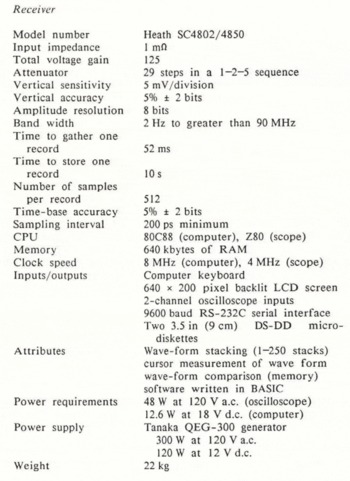
Antennas
We use resistively loaded center-fed dipole antennas following the U.S. Geological Survey design (Reference Watts and EnglandWatts and England, 1976; Reference Watts and WrightWatts and Wright, 1981). We depart from the original design only by incorporating a small nylon cord into each antenna arm and binding the cord and the antenna together with clear polyolefin shrink tubing. The antenna arms are thus very strong and durable, quickly repaired if broken (rarely), and easily coiled into a compact form.
Digital storage oscilloscope
Recent developments in wave-form digitization technology have led to inexpensive computer-controlled oscilloscopes. These devices interface with a PC through a serial port or logic bus and use computer software to display, store, and process the signal. For repetitive signals, such as radar echoes, digital oscilloscopes can achieve very short sampling intervals by using equivalent time sampling. This means that only one sample is taken each time the oscilloscope is triggered. This is not a serious limitation for our system because our transmitter produces 10 000 pulses/s. An entire 512 point wave form can be acquired in 52 ms.
We chose to use a Heath SC-4802 Computer Oscilloscope as the wave-form digitizer in our ice-radar receiver mainly because it can be used with any lap-top IBM-compatible PC with a standard RS-232C serial interface. All other computer oscilloscopes that we know of require internal expansion cards in the PC and thus would not work with most lap-tops.
The Heath unit has several additional characteristics that make it suitable for use in an ice-radar receiver:
-
The oscilloscope accurately samples radar wave forms in the frequency range appropriate for ice radar (1–20 MHz) at a sampling interval as short as 0.2 ns.
-
The unit has a vertical resolution of 8 bits (1 part in 256), a value comparable to the best analog oscilloscope screens.
-
The sampling circuits can be reached only by signals below 100 MHz. Thus, alias-free measurements can be assured simply by using a sampling interval less than 5 ns.
-
The record length is 512 digital samples, sufficient for many ice-radar applications.
-
The unit allows interactive cursor measurements of time and voltage, thus allowing accurate determinations of reflection times and amplitudes in the field.
-
The instrument, which draws 48 W, can be powered by a very light-weight a.c./d.c. generator or can be modified for use with batteries.
-
The oscilloscope costs less than $300 U.S.
A limitation of the Heath computer oscilloscope is that it does not contain a delay line. This means that some data immediately after the trigger point will be lost. According to the manufacturer, the amount of lost data depends on the sampling interval: at a 4 ns sampling interval, 345 ns of data are lost; at a 0.2 ns sampling interval, 80 ns of data are lost. We verified these delay times by laboratory tests.
Lap-top PC
The computer oscilloscope interfaces directly with a lap-top PC through a RS-232C serial interface. We use a Zenith 181–93 lap-top computer. However, any battery-powered IBM-compatible lap-top computer with a RS-232C serial interface. Color Graphics Adapter (CGA) screen, and floppy drive could be used. The computer screen functions as a display monitor in the field and signals can be viewed in near-real time as they are collected.
The digitized wave forms, along with oscilloscope parameters, are stored as files on floppy disks. Although other researchers have reported problems with floppy disks in the field, we had no problems with 3½ in (9 cm) diskettes at temperatures of 2–3°C. Using the software supplied with the oscilloscope, approximately 270 radar wave forms can be sorted on a 720 kbyte diskette. However, because each record consists of exactly 512 data bytes plus 5 parameter bytes, data compression could increase the number of records per diskette to over 1400.
The presence of a PC in the field provides considerable versatility:
-
Signals can be stacked to any desired degree before storage.
-
Signal processing can be accomplished in the field using a wide variety of existing software for IBM-compatible computers.
-
Previously collected wave forms and cross-sections can be displayed at any time.
-
The operator can use the computer to record field observations and survey information.
Field Test
The receiver was successfully field tested on Mount Estelle glacier in Alaska in 1988. Approximately 150 soundings were made to determine the ice thickness of the glacier and to map power-reflection coefficients of the ice–bedrock interface (Reference HammondHammond, unpublished). A pulse generator, based on the U.S. Geological Survey design, was used (Reference Watts and EnglandWatts and England, 1976;Reference Watts and Wright Watts and Wright, 1981). Resistively loaded dipole antennas, separated by 30 m, were deployed in the broadside parallel mode. Spectral analysis of a typical bedrock reflection indicated reflection peak power at 2.86 MHz (Fig. 3). We found the wave-form stacking feature useful for eliminating radio-frequency interference caused by the generator, other geophysical equipment in operation, and FM radio transmissions. Air temperatures of 2–3°C did not adversely affect operation of either the computer or the oscilloscope. Light precipitation fell during one period but was dealt with by covering the operator and radar receiver with a clear plastic sheet.
A typical digital wave form recorded on Mount Estelle glacier, Alaska, and its power spectrum. The PC-based receiver allows the use of a wide variety of standard signal-analysis software in the field.

The records along a bottom-echo profile at the test site were 2µs in length and were digitally sampled at a 4 ns interval (Fig. 4). Although the oscilloscope triggered on the onset of the air wave at the receiving antenna, zero time on the traces was set at the impulse time in the transmitter. We did this by assuming a 100 ns delay between transmitter impulse time and the onset of the air wave at the receiver 30 m away. The leading edge (345 ns) of the air wave was not recorded because of the digital sampling circuitry. Hence, the first recorded information was 445 ns after the impulse time in the transmitter. In spite of this delay, the peak and trailing edge of the air wave are discernible on all the traces. Naturally, our system, like any radar system that attempts to trigger off the air wave, is subject to errors associated with varying surface conditions that might affect the slope of the leading edge of the coupled air wave.
An ice-radar profile across Mount Estelle glacier as recorded using the PC-based receiver.

Conclusions
The PC-based ice-radar receiver described is light-weight, versatile, and inexpensive. The entire receiver unit, including the generator, weighs 22 kg and can be carried on a back-pack. The PC not only displays and stores the data but also allows the use of commercial signal-analysis software in the field. The cost of the receiving unit, including the computer, is less than $2000 U.S.
The accuracy and signal quality of our system are sufficient for many radar applications. The vertical voltage resolution as well as the time-base accuracy are rated at 5% ± 2 bits (Table I). These errors can be minimized by keeping the displayed wave form as large as possible on the screen. Because random noise can be reduced by averaging, our system is capable of producing very clean records. The traces in Figure 4, for example, were stacked 50 times. The digitizing error, which includes the effects of power-supply variations, temperature variations, temperature-induced gain variations, and input noise is limited, according to the manufacturer, to the two least significant bits. Two bits out of 256 bits represents less than a 1% error due to digitizing noise.
The major problem with the system is the loss of data immediately after the trigger point. This problem could be overcome by the addition of a commercially available video delay line. The receiving antenna would be connected to both input channels of the oscilloscope and the delay line placed on one channel. The air wave would trigger the oscilloscope and the delay line could be adjusted to show the entire wave form including pre-trigger information. Possible errors associated with varying slopes on the leading edge of the coupled air wave could then be evaluated.
Although we obtained completely adequate results at 2–3°C, operation of the radar receiver in harsher and colder glacial environments needs further evaluation. Technically, the specified minimum operating temperature of the computer and the oscilloscope is 10°C. However, discussions with the manufacturers suggest that adequate performance should be obtainable to much lower temperatures provided that the liquid-crystal display on the computer does not freeze. A rugged lap-top computer, especially designed for harsh environments and cold temperatures, would improve the radar receiver.
Acknowledgements
Field testing of the digital radar receiver was funded in part by Cominco Alaska Exploration. L. O'Conner, of the Cominco Geophysics Department, and M.M. Miller, of the Glaciological and Arctic Sciences Institute, University of Idaho, provided valuable discussion. Technical support was provided by K. Gordon and D. Dodge, College of Mines and Earth Resources, University of Idaho. The Mount Estelle glacier radar surveys could not have been accomplished without the expertise of helicopter pilot R. Long. This paper is dedicated to him in memoriam.



