




Macau, a Chinese city located on the western side of the Pearl River Delta, was under Portuguese colonial rule for over four centuries. After the handover of sovereignty in 1999, it became a Special Administrative Region (SAR) of the People’s Republic of China (PRC) under the “one country, two systems” framework. Unlike its fellow SAR, Hong Kong – which has experienced frequent protests in recent decadesFootnote 1 – Macau has maintained a relatively stable political environment, receiving less attention from media and academia. This stability is often attributed to the absence of a strong opposition, a legacy of pro-establishment and pro-Beijing dominance since colonial times, the government’s co-optation of emerging elites, and institutional mechanisms that ensure executive control over the legislative and judicial branches.Footnote 2 Within this executive-led structure, Macau’s Legislative Assembly is often dismissed as a “rubber stamp” or mere window dressing.Footnote 3
Nevertheless, studies reveal that various societal forces compete for legislative representation in Macau, often employing clientelist electoral tactics.Footnote 4 The co-optation theory, in particular, frames the legislature and elections as tools for the regime to identify and integrate opposition groups that could threaten stability.Footnote 5 Indeed, many studies on Macau politics reference government co-optation strategies. In this framework, the legislature enables opposition legislators to access rents and influence policies. However, combining existing evidence with co-optation theory raises two questions. First, who is co-opted? It is unclear which political forces in Macau are powerful enough to warrant co-optation rather than repression. Second, while co-optation assumes legislators represent constituents post-election, few studies examine legislative activity, making it difficult to assess such representation.
We address these questions using original datasets on legislative activities, including roll-call voting records and committee deliberation durations for the fifth (2013–2017) and sixth (2017–2021) legislative terms. Our analysis proceeds in two steps. First, we use voting similarity and ideal point estimation to identify legislators’ ideological positions. This reveals the dominance of pro-establishment forces alongside small, variable opposition groups, aligning with conventional understandings but contradicting one prior systematic study.Footnote 6 This illustrates the extent of legislative contestation acceptable under the “one country, two systems” framework. Indeed, in 2017, a top Chinese official praised Macau as a model SAR for adhering to “one country” while utilizing “two systems.”Footnote 7
Building on these findings, we examine how bill deliberation reflects the functional logics of authoritarian legislatures. Beyond co-optation, we consider two additional frameworks: the information-collection framework, which views legislatures as conduits for relaying constituents’ grievances on non-sensitive issues,Footnote 8 and the elite-bargaining framework, which highlights legislatures as arenas for regime insiders to reveal positions and influence outcomes.Footnote 9 Our analysis shows that bills facing dissent from pro-establishment legislators undergo longer deliberation than those opposed by opposition members. These findings suggest elite bargaining and intra-regime information sharing are at work in Macau’s Legislative Assembly rather than definitively refuting co-optation. Co-optation may operate via alternative mechanisms, such as distributing economic rents, which lie beyond this article’s scope.Footnote 10
Our study contributes to several pieces of literature. First, it adds to research on meaningful representation in competitive authoritarian regimes.Footnote 11 Second, it offers the first systematic analysis of legislative voting and deliberation in Macau, addressing post-election legislative behaviour that prior studies have largely overlooked. Third, Macau, as one of 14 autonomous regions globally, provides an important benchmark for comparative studies.Footnote 12 For regions navigating between secession and unification, autonomy may offer a viable alternative.
This article proceeds as follows. We first outline the Macau legislature’s institutional rules and review prior studies of this institution and its counterparts. Next, we present descriptive analyses of roll-call voting data, uncovering patterns of contestation that inform our analysis of committee deliberation. Finally, we analyse deliberation durations and connect our findings to theories of authoritarian legislatures.
The Legislative Assembly of Macau
Macau’s electoral representation dates back to 1583, when Portuguese settlers established the Loyal Senate (Leal Senado).Footnote 13 The Senate comprised six representatives who were elected every three years, but suffrage was restricted to Portuguese residents, primarily men, thereby excluding the majority Chinese residents.Footnote 14 Following Portugal’s 1974 Carnation Revolution, which sparked global democratization, the Macau legislature began to modernize. In 1976, Macau held its first legislative election that allowed Chinese residents to vote.Footnote 15
The current Legislative Assembly was established in 1999, when sovereignty was handed over to China. Before the handovers of Hong Kong (1997) and Macau (1999), China’s National People’s Congress (NPC) enacted the Basic Laws for the respective SARs, granting them a high degree of autonomy under the “one country, two systems” framework. These laws stipulate that Macau and Hong Kong should maintain their socio-economic systems for at least 50 years. The Basic Laws grant SARs legislative power, ensuring national laws (enacted by the NPC) are not applied, except those listed in Annex III.Footnote 16 However, Macau’s political system is executive-led, with power concentrated in the chief executive. As an appointed official of the PRC central government, the chief executive ensures Macau’s laws and policies align with national directives. Several institutional features further weaken the legislature’s power, contributing to executive dominance.
First, while law-making is shared between the legislature and executive, the legislature’s ability to propose bills is limited. Legislators cannot propose bills related to public expenditure, political structure or government operations without the consent of the chief executive.Footnote 17 Although bills can pass with a simple majority,Footnote 18 the chief executive can return bills deemed incompatible with SAR interests.Footnote 19 Consequently, over 80 per cent of the bills submitted between 1999 and 2023 originated from the executive, with 95 per cent of passed bills being executive proposals.
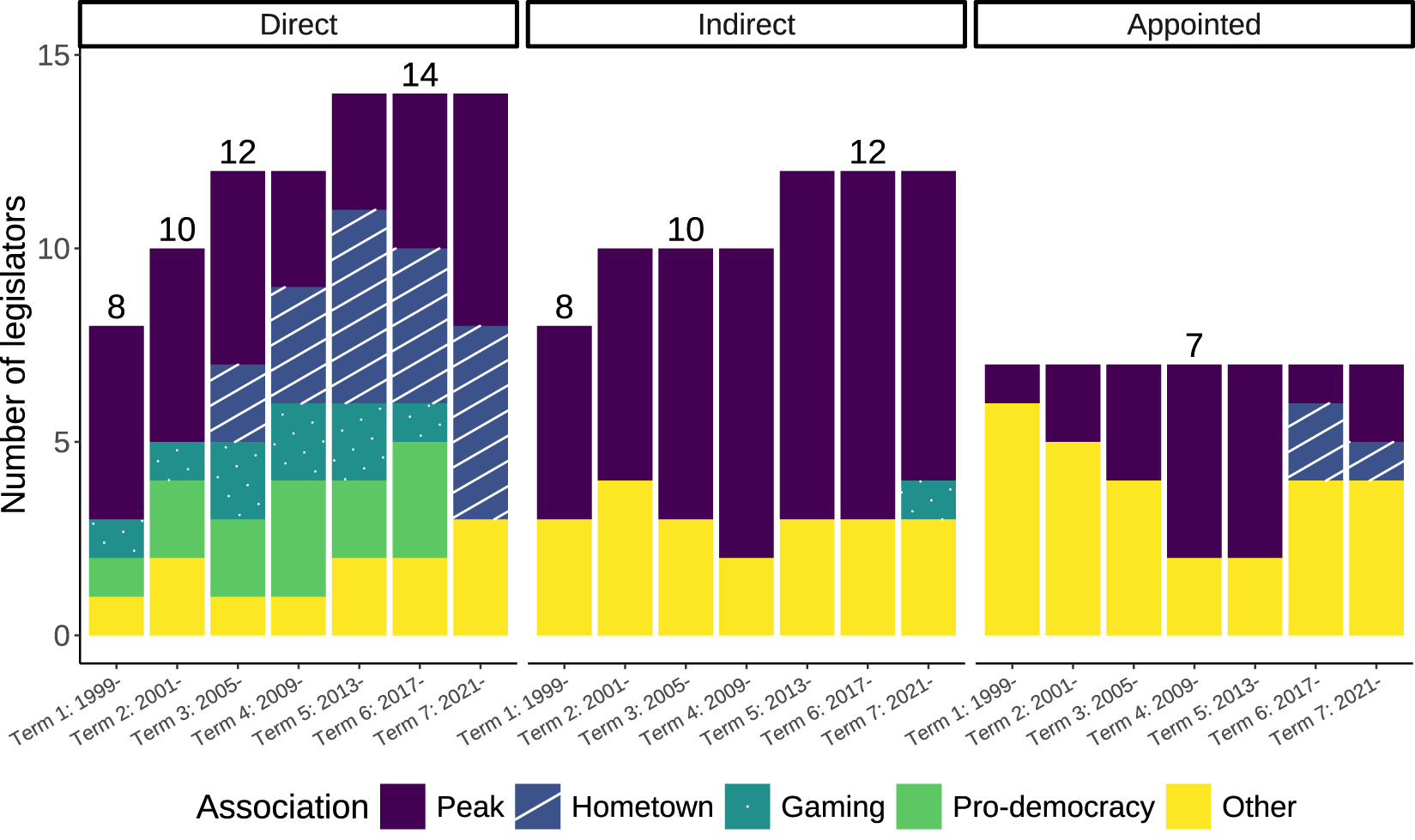
Second, less than half of the legislature’s members are directly elected. The legislature comprises 33 members: 14 (42.4 per cent) are directly elected, 12 (36.4 per cent) are indirectly elected as functional representatives and 7 (21.2 per cent) are appointed by the chief executive. As shown in Figure 1, the number of direct and indirect seats has increased from 8 each to 14 and 12, respectively, while the number of appointed seats remains unchanged at 7. However, frequent uncontested elections in indirect constituencies suggest limited competitive representation. Additionally, a 2016 amendment to Macau’s Electoral Law granted the executive authority to disqualify candidates who are considered to be disloyal to the Macau SAR or its Basic Law.Footnote 20 This clause was first invoked in the 2021 legislative election, disqualifying numerous candidates on political grounds and effectively enabling the executive to screen candidates. While this study focuses on legislative data up to 2021, the introduction of this clause may have created additional pressure for legislators to avoid actions perceived as disloyal to the executive, even before its enforcement.
Distribution of Legislators’ Selection Methods and Political Affiliations

Third, both direct and indirect elections use a proportional representation system via the modified D’Hondt method,Footnote 21 which penalizes larger political groups.Footnote 22 This system promotes diverse representation but hinders the formation of a unified opposition. As shown in Figure 1, seats are held by various political forces, including prominent organizations like the Macau Chamber of Commerce (Aomen Zhonghua zongshanghui 澳門中華總商會), the General Union of Neighbourhood Associations of Macau (Aomen jiefanghui lianhe zonghui 澳門街坊會聯合總會), and the Macau Federation of Trade Unions (Aomen gonghui lianhe zonghui 澳門工會聯合總會). Despite their pro-establishment and pro-Beijing stances, these organizations represent distinct interests – business, neighbourhoods, and trade unions, respectively. They secure representation through elections and appointments. Other forces include the gaming industry, pro-democracy groupsFootnote 23 and “hometown associations” (tongxianghui 同乡会) linking residents to ancestral hometowns.Footnote 24
Fourth, Macau’s institutional framework reinforces the chief executive’s power by incorporating legislators who align with government policies.Footnote 25 This includes the seven appointed members and legislators serving on the Executive Council, which is a policymaking body, as defined in Article 56 of the Basic Law, comprising top-ranking executive officials, at least two Assembly members, and community leaders.
Studies on the legislature in Macau and other authoritarian regimes
Previous studies of the Macau legislature have focused primarily on legislative elections, highlighting how societal groups mobilize through clientelist electoral strategies.Footnote 26 However, these studies offer limited insights into post-election legislative activities and how legislators represent constituents’ interests. This oversight reflects a common perception of the Macau legislature as a rubber-stamping body that primarily endorses the chief executive’s decisions. Yet, if the legislature serves only symbolic purposes, it raises the question of why political groups invest resources in securing legislative seats.
Recent studies on authoritarian legislatures that challenge the rubber-stamp view identify three key functions that facilitate authoritarian rule: co-optation, information collection and elite bargaining. The co-optation theory frames legislatures as mechanisms through which rulers incorporate opposition forces via rent distribution and policy concessions, neutralizing potential threats.Footnote 27 The information-collection theory posits that autocrats use loyal legislators to learn about and respond to citizen grievances before such issues escalate, thereby mitigating the elite–mass information asymmetries.Footnote 28 Finally, the elite-bargaining theory sees legislatures as arenas for negotiating policies and resolving disputes among regime insiders, addressing monitoring and commitment problems.Footnote 29 In this context, dissent from allied legislators on government proposals serves as a credible signal. Open intra-coalition discord can damage the regime’s reputation by exposing vulnerabilities and emboldening opposition forces.Footnote 30 Despite their distinct focuses, these three functions are not mutually exclusive: while the information-collection framework focuses on channelling constituent demands, such information also facilitates co-optation and elite bargaining, demonstrating how legislatures can fulfil multiple roles simultaneously.
Given these insights, focusing narrowly on legislators’ selection processes has left an underdeveloped understanding of Macau’s legislature. Key questions remain unanswered. Which political forces win seats and are co-opted by the ruling elite? Figure 1 shows nominal representation, but it provides little insight into contestation patterns between the ruling elites and legislators. Who are the opposition legislators strong enough for co-optation yet loyal enough to be included? Do legislators represent their constituents’ interests? Addressing these questions is essential for advancing our understanding of Macau’s legislative politics.
To systematically analyse legislative activities in Macau, roll-call voting data offer a valuable starting point. Roll-call votes record each member’s position on bills or resolutions, providing insights into legislators’ preferences and alignments.Footnote 31 While roll-call voting analyses have commonly focused on democratic contexts, they are equally relevant for competitive authoritarian legislatures with available voting records. For example, studies of Hong Kong’s Legislative Council have used roll-call votes to analyse party cohesion and political cleavages.Footnote 32 Macau’s legislature exhibits similar characteristics, making roll-call analysis just as pertinent.Footnote 33
In this context, Jinhyeok Jang’s analysis of roll-call data is a valuable first step.Footnote 34 The study is notable for finding intense contestation between two coalitions of similar size, contradicting conventional views. However, this finding stems from using roll-call data on resolutions, which have less impact than bills on law and policy. Uncooperative voting stakes are higher in bill votes, which provide a more accurate picture of parliamentary contestation. As we demonstrate, our analysis reveals a distinctly different pattern among legislators.
Our findings also provide a foundation for analysing legislative activities beyond floor voting. Owing to frequent unanimity and difficulty obtaining records, recent studies of authoritarian legislatures focus on pre-voting processes.Footnote 35 Following these studies, future research in Macau could examine pre-voting activities such as public hearings, debates and amendments. As a preliminary analysis, we investigate committee deliberation data, focusing on how opposition patterns influence deliberation duration.
Roll-call Voting Analysis
This section analyses roll-call voting data from the Macau Legislative Assembly, which uses majority roll-call votes to decide all resolutions and bills. Resolutions address procedural matters, while bills are proposed laws that become binding upon legislative approval and endorsement by the chief executive. Unlike previous studies focusing on resolutions, we examine the more impactful roll-call voting records on bills.Footnote 36 Systematic online archives of voting records have been available only since the fifth term (2013–2017).Footnote 37 Therefore, our analysis focuses on the fifth and sixth terms (2013–2021). We collected data by downloading all roll-call vote PDFs from the official website and manually recording votes for each legislative bill.
Voting at the legislature
Bills may be introduced by the executive branch, by individual legislators or jointly by up to nine legislators. Initially, a bill undergoes general voting to determine if it should proceed for further scrutiny. Approved bills are assigned to one of three standing committees, comprising 10–11 legislators, for closed-door review. Next, the bill proceeds to detailed voting, where each article or set of articles is subject to public roll-call votes in plenary sessions. During the fifth and sixth terms, the number of roll-call votes per bill at this stage ranged from 1 to 65, with an average of 11 and a median of 8. All decisions require a simple majority. If approved at the detailed voting stage, the bill is sent to the chief executive for approval or veto. Should the chief executive refuse to sign, the bill returns to the legislature for reconsideration. A two-thirds majority vote is required to override the veto, as stipulated by Article 51 of the Basic Law.
Legislators vote in favour (Yea), against (Nay) or abstain (Abstention). Abstentions, which are common in the Macau legislature, are treated as an intermediate position, reflecting mild dissent compared to outright opposition. This interpretation aligns with ideal point estimation applications across various contexts, including position-taking by political parties,Footnote 38 by US solicitors general,Footnote 39 by organized interest groupsFootnote 40 and by UN member states.Footnote 41 Legislators absent or unavailable for a vote are recorded as not available (NA). Treating abstentions as part of the ordinal structure ensures that their substantive meaning is incorporated into the analysis. This avoids the potential biases that could arise from treating them as missing data, particularly given that abstentions are relatively frequent in the Macau legislature.Footnote 42
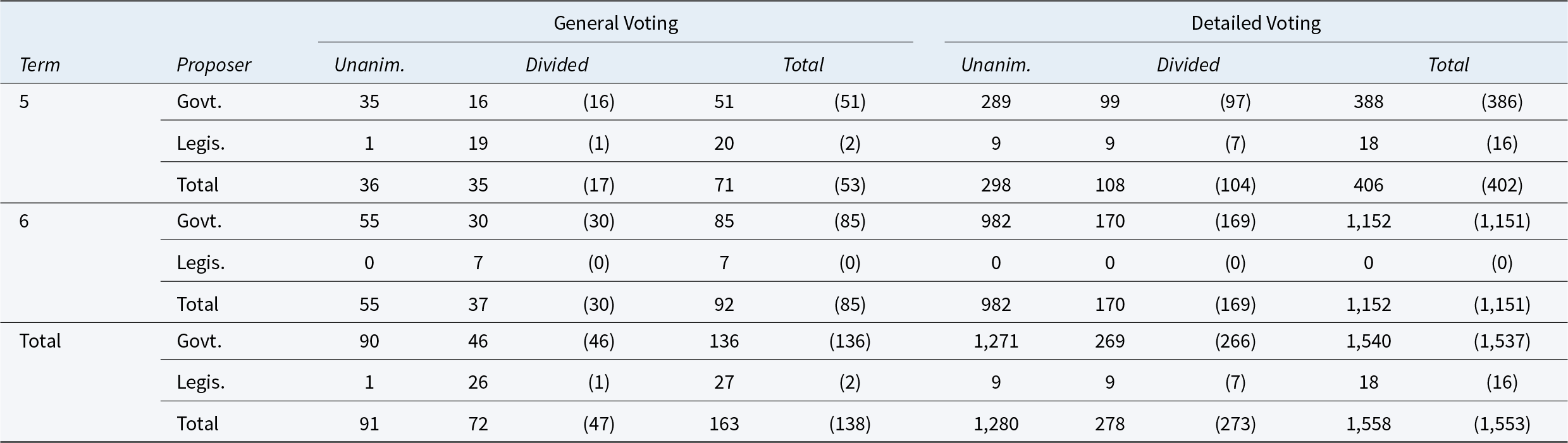
Table 1 summarizes the roll-call voting results for all bills during the fifth and sixth terms. “Unanim.” columns indicate proposals receiving unanimous Yea votes, while “Divided” columns reflect votes with Nay or Abstentions. The legislature considered 163 bills, 136 (83 per cent) of which were proposed by the executive (“Govt.” rows). All 136 government-sponsored bills passed the general voting stage, with around two-thirds (90) passing unanimously and one-third (46) facing dissent. Conversely, only 2 of 27 legislator-sponsored bills (“Legis.” rows) were approved. At the detailed voting stage, 1,558 voting opportunities arose across 138 bills.
Roll-call Record for Bill Voting during the Fifth and Sixth Terms

Source: Authors’ count. Numbers in parentheses show bills and articles that were approved.
The 7 per cent passage rate for legislator-sponsored bills, compared to the 100 per cent passage rate for government-sponsored bills, reinforces perceptions of the legislature as limited in influence. However, dissent does occur. Over 30 per cent of government-proposed bills (46 of 136) faced non-unanimous votes. Public dissent carries reputational costs, exposing legislators to risks in an autocratic setting.Footnote 43
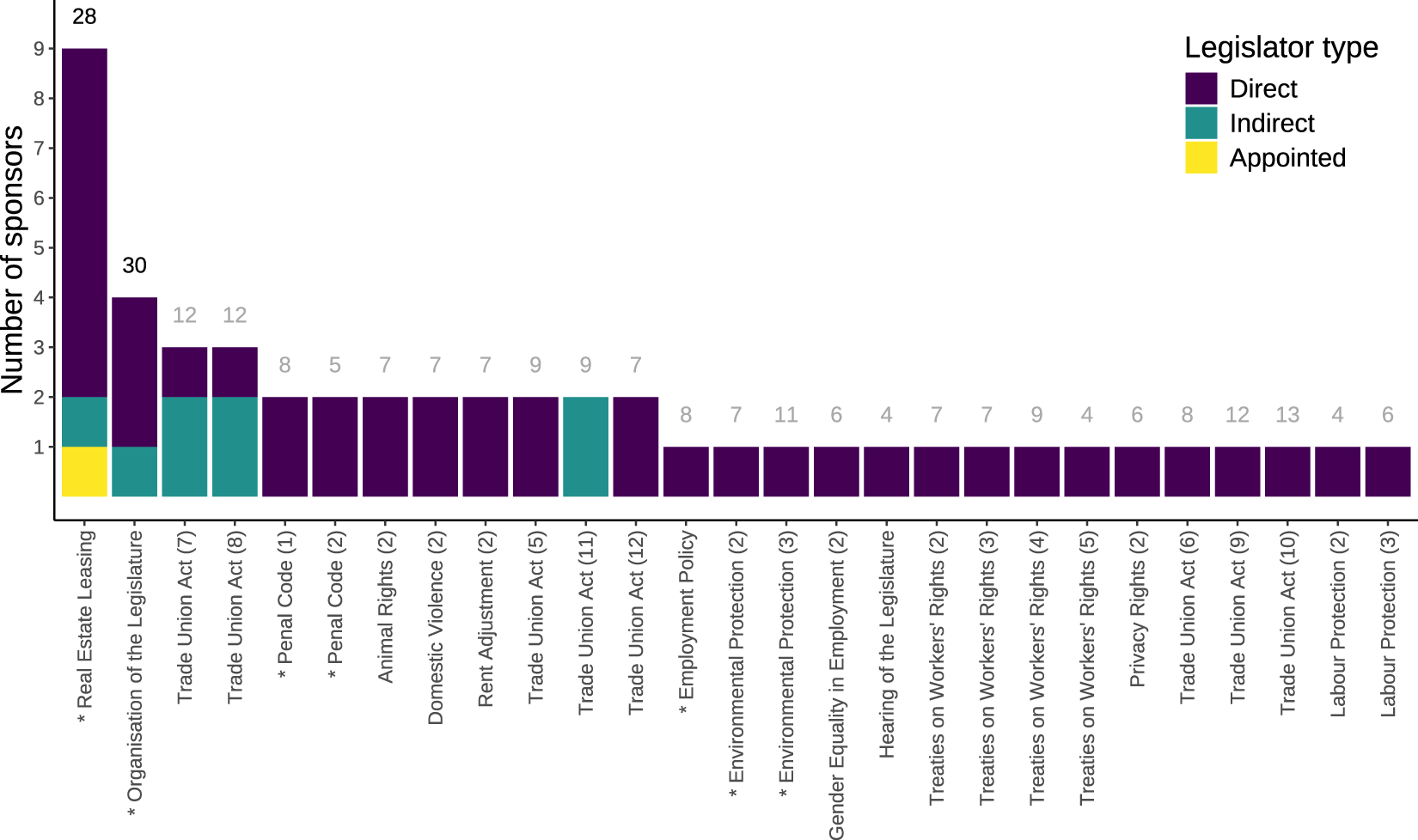
Legislators also propose bills to reveal policy positions. Figure 2 shows the sponsors and supporters of the 27 legislator-sponsored bills during the fifth and sixth terms. Two bills passed, both co-sponsored by multiple legislators across political associations. The first, addressing real estate leasing, was co-sponsored by nine legislators from six associations. The second, an amendment to the Assembly’s organic laws, had four co-sponsors from four associations.
Sponsors and Supporters of 27 Legislator-proposed Bills in the Fifth and Sixth Terms

Even failed bills influence policymaking. Of 25 failed legislator proposals, 16 addressed workers’ rights. Notably, the Trade Union Act was proposed 12 times between 2005 and 2020; it was consistently rejected but sometimes only narrowly.Footnote 44 This led to a government-proposed version in 2024.Footnote 45 Similarly, a bill to criminalize domestic violence failed twice before the government enacted its own version.Footnote 46 Roll-call votes thus serve as tools for legislators to signal positions to constituents and ruling elites. The following analysis explores these dynamics using voting similarity visualization and ideal point estimation.
Co-voting network analysis
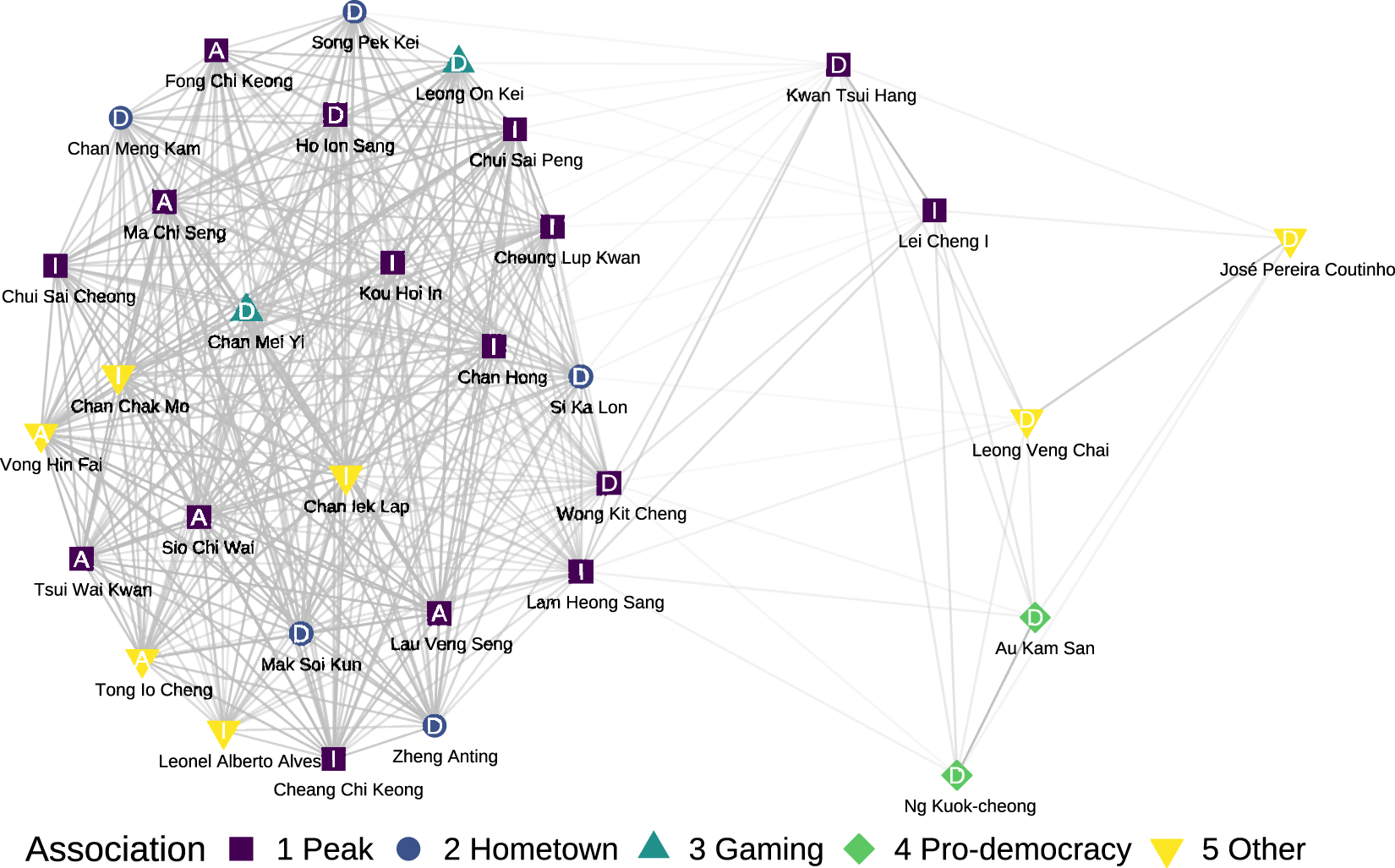
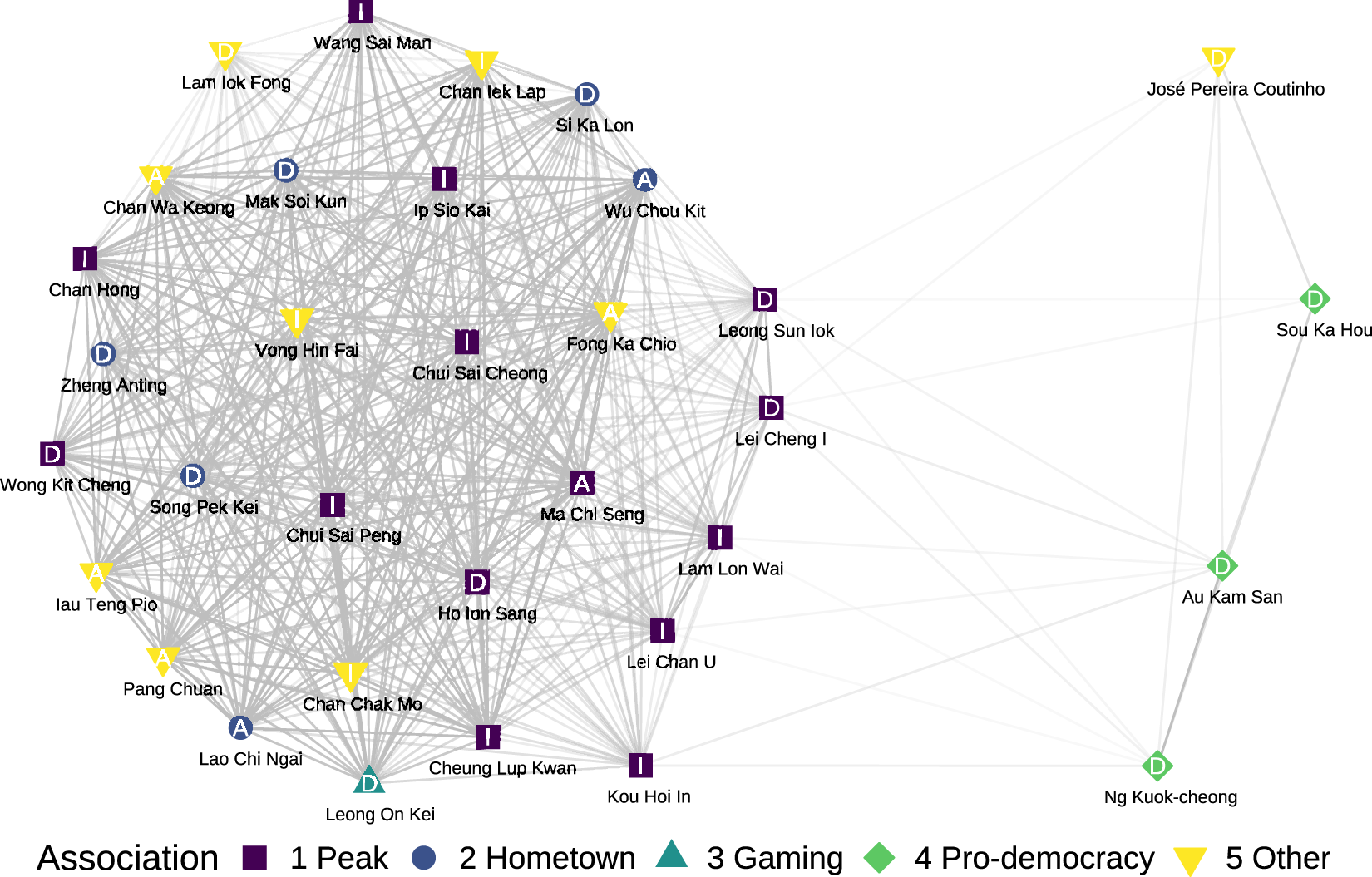
This subsection examines co-voting network graphs to identify groups of legislators with similar voting records. We focus on non-unanimous voting records, as unanimous votes do not reveal ideological differences. As shown in Table 1, there were 143 non-unanimous votes (35 General and 108 Detailed) in the fifth term and 207 (37 General and 170 Detailed) in the sixth term. These data form n 5 = 32 by k 5 = 143 and n 6 = 33 by k 6 = 207 voting matrices, where nj denotes the number of legislators in term j, and kj denotes the number of voting opportunities.Footnote 47 Each cell in these matrices represents a legislator’s vote (Yea, Nay or Abstain). Abstentions are treated as part of the ordinal voting structure, consistent with their treatment in the ideal point estimation framework. Using these voting records, we construct nj by nj voting similarity matrices, where each entry is the Spearman rank correlation between two legislators’ voting records. Figures 3 and 4 visualize these matrices for the fifth and sixth terms, respectively. Nodes represent legislators, and edges indicate positive correlations.Footnote 48 Edge thickness reflects the strength of the voting similarity.
Co-voting Network for the Fifth Term, 2013–2017

Co-voting Network for the Sixth Term, 2017–2021

The network graphs reveal a consistent structural dichotomy across both terms. On the left, a large, dense pro-establishment group includes all appointed legislators and representatives from hometown associations and the gaming industry. These legislators typically support government-sponsored bills and oppose legislator-sponsored bills. On the right, a smaller, loosely connected opposition group includes two pro-democracy legislators in the fifth term (three in the sixth) and a few others. The median correlation among pro-establishment legislators is approximately 0.6, compared to 0.3 within the opposition group, reflecting weaker internal cohesion. The median correlation between the two groups is −0.14, highlighting distinct patterns of voting behaviour.
The term “opposition group” is used in a relative sense, referring to legislators less supportive of the executive compared to their pro-establishment counterparts. Owing to Macau’s institutional constraints, even opposition legislators must demonstrate loyalty to the government to qualify for election. Unlike opposition parties in competitive democracies, Macau’s opposition group is defined by relative independence and a tendency to support legislator-sponsored bills while opposing government-sponsored ones more frequently.
This structural dichotomy contrasts with Jang’s analysis, which describes “two distinct groups of approximately equal size.”Footnote 49 His opposition group includes 15 legislators, which is more than double our six-member group in Figure 3.Footnote 50 This discrepancy likely arises from differences in vote types analysed. Jang focuses on resolution votes, where dissent is less consequential, potentially overestimating opposition size. In contrast, our analysis of bill voting, where dissent has greater stakes, yields a smaller opposition group.
Examining the networks, legislators from the same political associations generally cluster together, with some exceptions. Pro-democracy legislators (two in the fifth term, three in the sixth) are adjacent in both terms. José Pereira Coutinho 高天賜, a prominent opposition member from New Hope (Xin xiwang 新希望), representing civil servants and Portuguese and Macanese residents, is positioned next to Leong Veng Chai 梁榮仔, another New Hope legislator. In the sixth term, New Hope held only one seat.
However, members of some peak organizations do not consistently cluster. For example, in the fifth term, two women legislators from the Trade Union, Kwan Tsui Hang 關翠杏 and Lei Cheng I 李靜儀, align with the opposition, while their colleague, Lam Heong Sang 林香生, is pro-establishment. This divergence partly reflects their voting on the 2013 domestic violence prevention bill: Kwan and Lei voted Yea, while Lam abstained, along with nine others.Footnote 51 In the sixth term, Lei Cheng I aligns with the pro-establishment group, clustering with Trade Union representatives Lam Lon Wai 林倫偉, Lei Chan U 李振宇 and Leong Sun Iok 梁孫旭. Their pro-labour stance positions them closer than other pro-establishment members to the opposition group.
In summary, the network graphs reveal distinct voting blocs, with a cohesive pro-establishment majority and a smaller, less unified opposition. While this aligns with the common understanding of Macau’s legislature,Footnote 52 correlation-based analyses have limitations. They do not account for the relative importance of bills or variation in observation counts across legislator pairs. To address these, we turn to ideal point estimation in the next subsection.
Ideal Point Estimation
This subsection presents ideal point estimation to infer legislators’ ideological positions based on roll-call votes.Footnote 53 The method employs a spatial model of parliamentary voting, assuming legislators decide their votes by comparing their ideological positions with those of proposed bills within a unidimensional policy space. Lower values represent pro-establishment positions, while higher values correspond to anti-establishment (i.e. opposition) positions.Footnote 54
While the unidimensional framework provides a parsimonious way to model legislative behaviour, we recognize that it reflects a simplification of the complexities inherent in policymaking. This approach assumes that much of the variation in roll-call voting can be captured by a single underlying dimension of conflict, such as the divide between pro- and anti-establishment stances. However, legislators may also hold issue-specific stances that deviate from this primary dimension, such as economic priorities or social policy preferences. In our case, the unidimensional model was chosen because it aligns well with the dominant pattern of legislative conflict and provides a superior model fit compared to multidimensional alternatives.Footnote 55 Nevertheless, we acknowledge that this approach does not preclude the existence of issue-specific variation, which could be explored with more complex models in future research.
The analysis estimates three parameters: legislator-level ideal points, bill-level difficulty (representing the ideological position of bills) and bill-level discrimination (capturing bill saliency).Footnote 56 The sign of the discrimination parameter allows us to infer a bill’s pro-establishment tendency from the data. A positive discrimination value indicates that legislators with stronger pro-establishment preferences are more likely to vote positively (i.e. Yea over Abstain, or Abstain over Nay), while those with anti-establishment preferences are more likely to vote negatively on the same bill. The model is identified by imposing unit variance on legislators’ ideal points and setting pro-establishment positions as lower than pro-government positions.
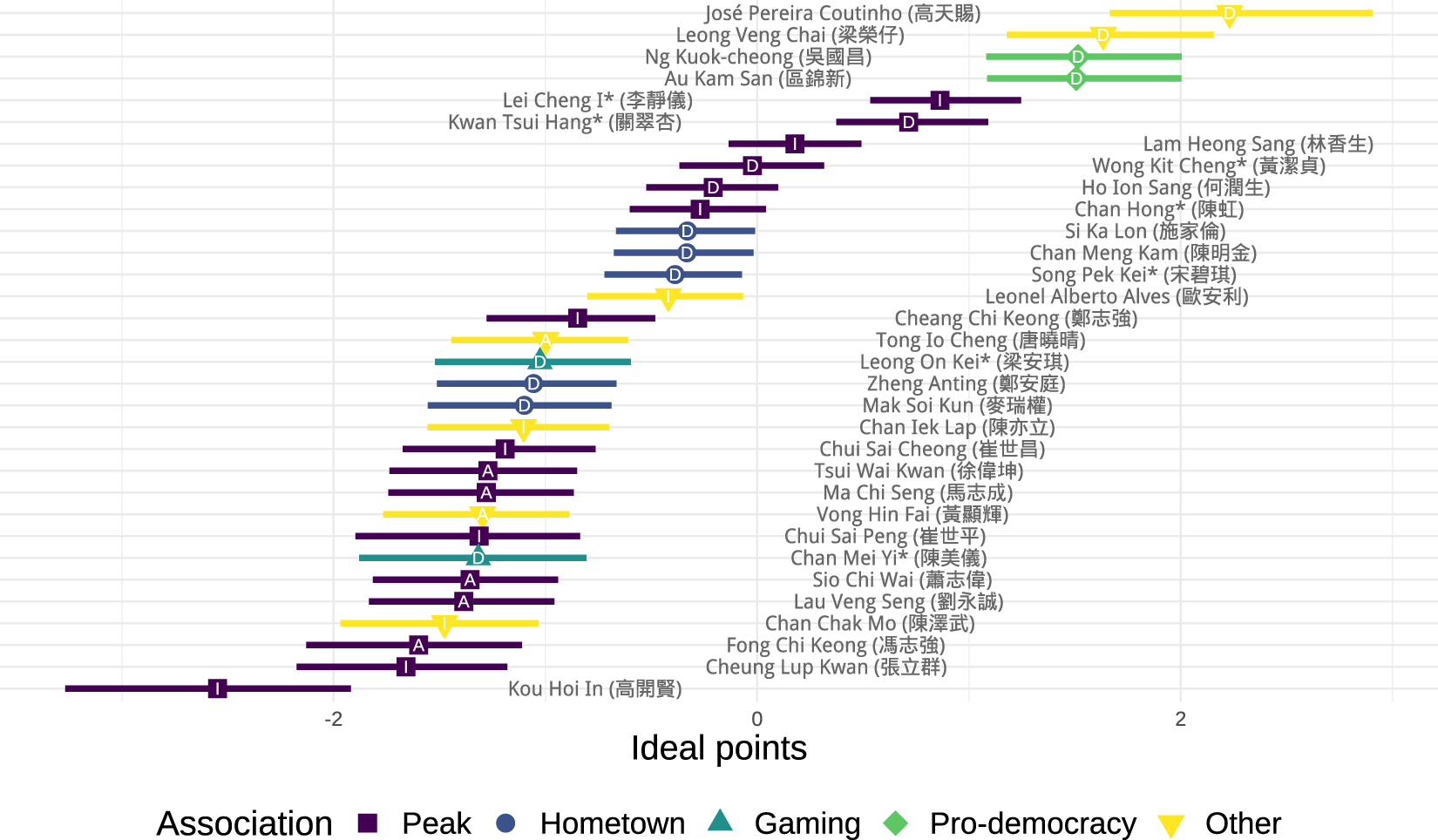
Figure 5 shows the estimated ideal points for the fifth term, with legislators ordered from pro-establishment (left) to anti-establishment (right). Consistent with the co-voting network (Figure 3), the six opposition legislators appear on the right. Lam Heong Sang, a Trade Union representative classified as pro-establishment, is positioned closest to the opposition, reflecting voting overlaps on specific bills. Three legislators from the Union for Promoting Progress (Qunli cujinhui 群力促進會) – Ho Ion Sang 何潤生, Wong Kit Cheng 黃潔貞 and Chan Hong 陳虹 – are also located near the boundary between the two groups. Although they are pro-establishment, their relative independence is evident in their voting behaviour. Similarly, legislators representing the Macau United Citizens Association (Fujian hometown association) occupy mid-range pro-establishment positions, while Macau-Guangdong Union legislators Zheng Anting 鄭安庭 and Mak Soi Kun 麥瑞權 hold more pro-establishment stances.
Estimated Ideal Points of Legislators for the Fifth Term, 2013–2017

Interestingly, appointed legislators, who are typically assumed to be the most pro-establishment, do not uniformly hold the lowest positions. Two indirectly elected legislators, including Kou Hoi In 高開賢 (Macau Chamber of Commerce), are more pro-establishment than any appointed member. Furthermore, legislators serving on the Executive Council – Chan Meng Kam 陳明金, Leonel Alberto Alves 歐安利, Cheang Chi Keong 鄭志強 and Chan Chak Mo 陳澤武 – do not consistently adopt the most pro-establishment stances. Notably, Chan Meng Kam and Leonel Alberto Alves align closer to the opposition, challenging conventional assumptions about the strongest government supporters.Footnote 57
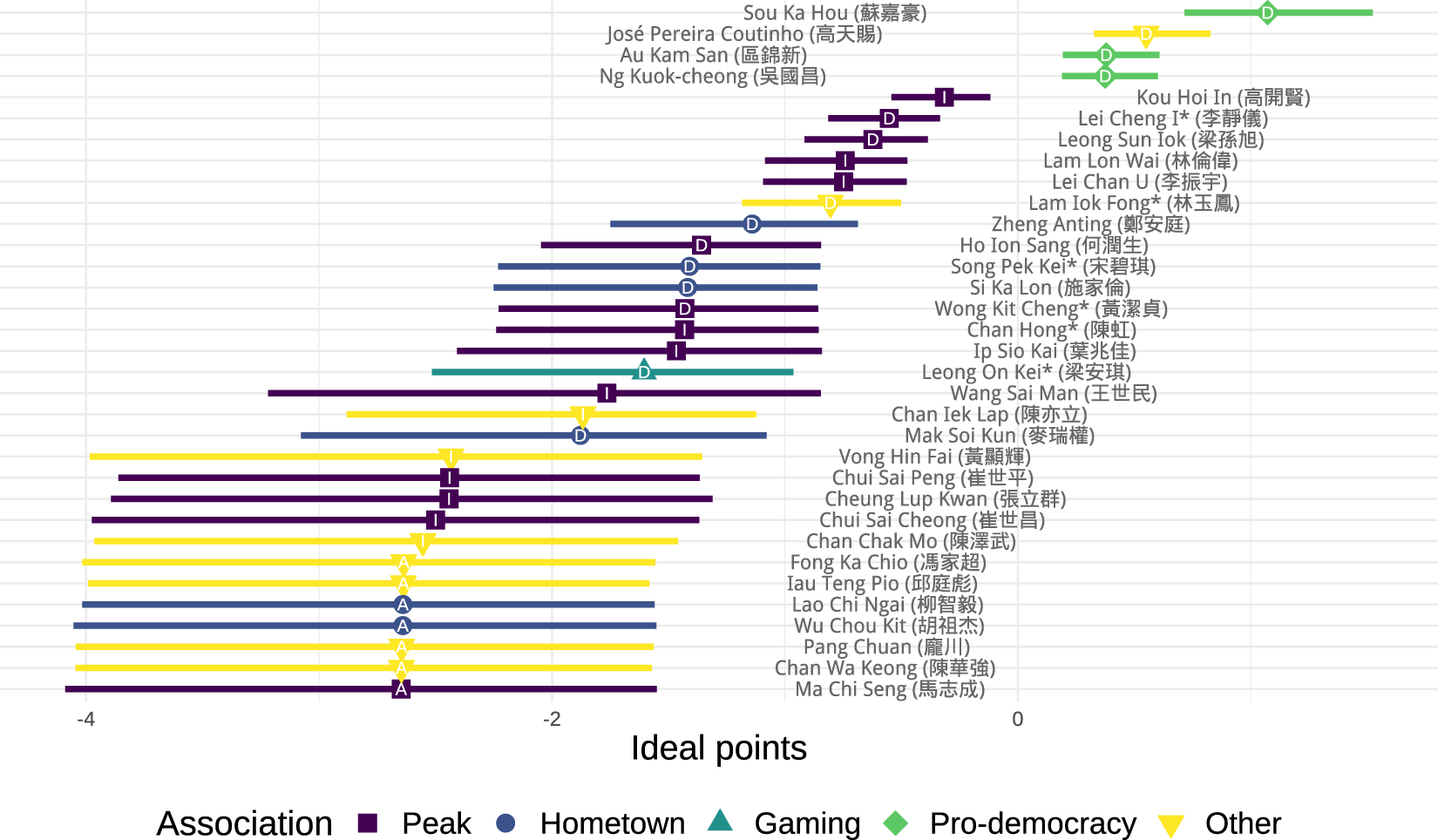
Figure 6 presents the results for the sixth term, showing a sharper divide between the pro- and anti-establishment groups. The seven appointed legislators, including Executive Council members Chan Chak Mo and Iau Teng Pio 邱庭彪, occupy the most pro-establishment positions. The opposition group consists of three pro-democracy legislators and José Pereira Coutinho from New Hope. The increased isolation of the opposition group reflects both a smaller group size and a wider ideological gap between the two camps. Among the pro-establishment bloc, voting records for 12 legislators (displayed at the bottom of the figure) were highly similar, with ten casting identical votes on all roll-call opportunities, resulting in wider credible intervals for these legislators.
Estimated Ideal Points of Legislators for the Sixth Term, 2017–2021

A notable shift is observed in Kou Hoi In’s position. Previously the most pro-establishment legislator in the fifth term, his position moves to the least pro-establishment within the pro-government camp in the sixth term. Kou Hoi In became president of the legislature during this term, which resulted in fewer voting opportunities.Footnote 58 However, his reduced participation does not fully explain his shift. Kou opposed government proposals four times and abstained 17 times, diverging from the stronger pro-government stance of most appointed and indirectly elected legislators.Footnote 59
In summary, ideal point estimation models legislators’ ideological positions based on roll-call votes, capturing the primary divide between pro- and anti-establishment camps. While the unidimensional framework simplifies policymaking complexities, it aligns well with the dominant pattern of legislative conflict. The results reveal ideological variation within the pro-establishment bloc and shifts in individual legislators’ positions across terms, reflecting both structural alignments and independent voting behaviour.
Committee Deliberation Analysis
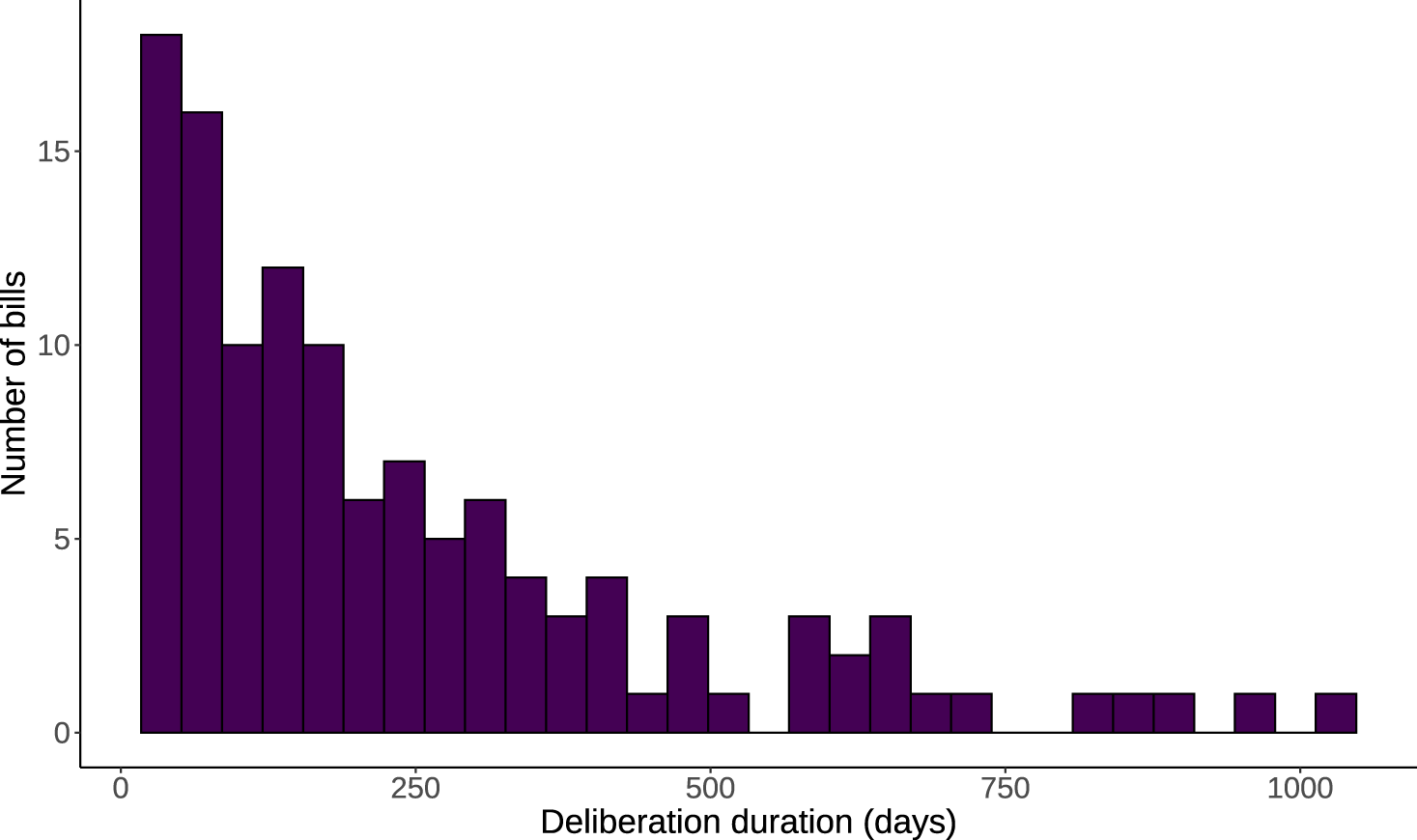
Using our classifications of pro-establishment and opposition legislators, we extend our analysis to non-voting legislative activities, focusing on committee deliberation. While a comprehensive analysis is beyond this article’s scope, this preliminary examination highlights the utility of our results in understanding legislative processes. Committee deliberation occurs between the general and detailed voting stages, where legislative committee members and executive agents discuss and potentially amend bills. The duration of this process, measured as the time between these two stages, serves as a proxy for the effort spent reviewing and modifying legislation. Between 2013 and 2021, deliberation durations for 121 government-sponsored bills ranged from 22 days to 33 months, with a mean of 246 days. Figure 7 shows the distribution of deliberation durations, with nearly half of the bills resolved within six months but over 20 per cent taking more than a year.Footnote 60
Committee Deliberation Durations for Government-sponsored Bills

To explore the variation in deliberation durations, we use Cox proportional hazard models, with opposition patterns as key explanatory variables. Specifically, we include two binary indicators for dissent during general voting:
1. Nay or Abstain from Pro-Establishment Legislators: coded as 1 if any pro-establishment legislators cast dissenting votes, and 0 otherwise.Footnote 61
2. Nay or Abstain from Opposition Legislators: coded as 1 if only opposition legislators cast dissenting votes, and 0 otherwise.Footnote 62
These variables are mutually exclusive and both equal 0 for unanimously supported bills. We estimate three models: one with each variable separately and one with both jointly. Control variables include:
• Sixth Term: a binary variable distinguishing between the fifth and sixth legislative terms.
• Bill Length: a proxy for bill complexity, measured as the natural logarithm of the number of pages in the initial proposal.
• Days Left in Term: the remaining days in the legislative session, as a time-varying variable.
• Number of Bills per Committee: capturing committee workload, also as a time-varying variable.
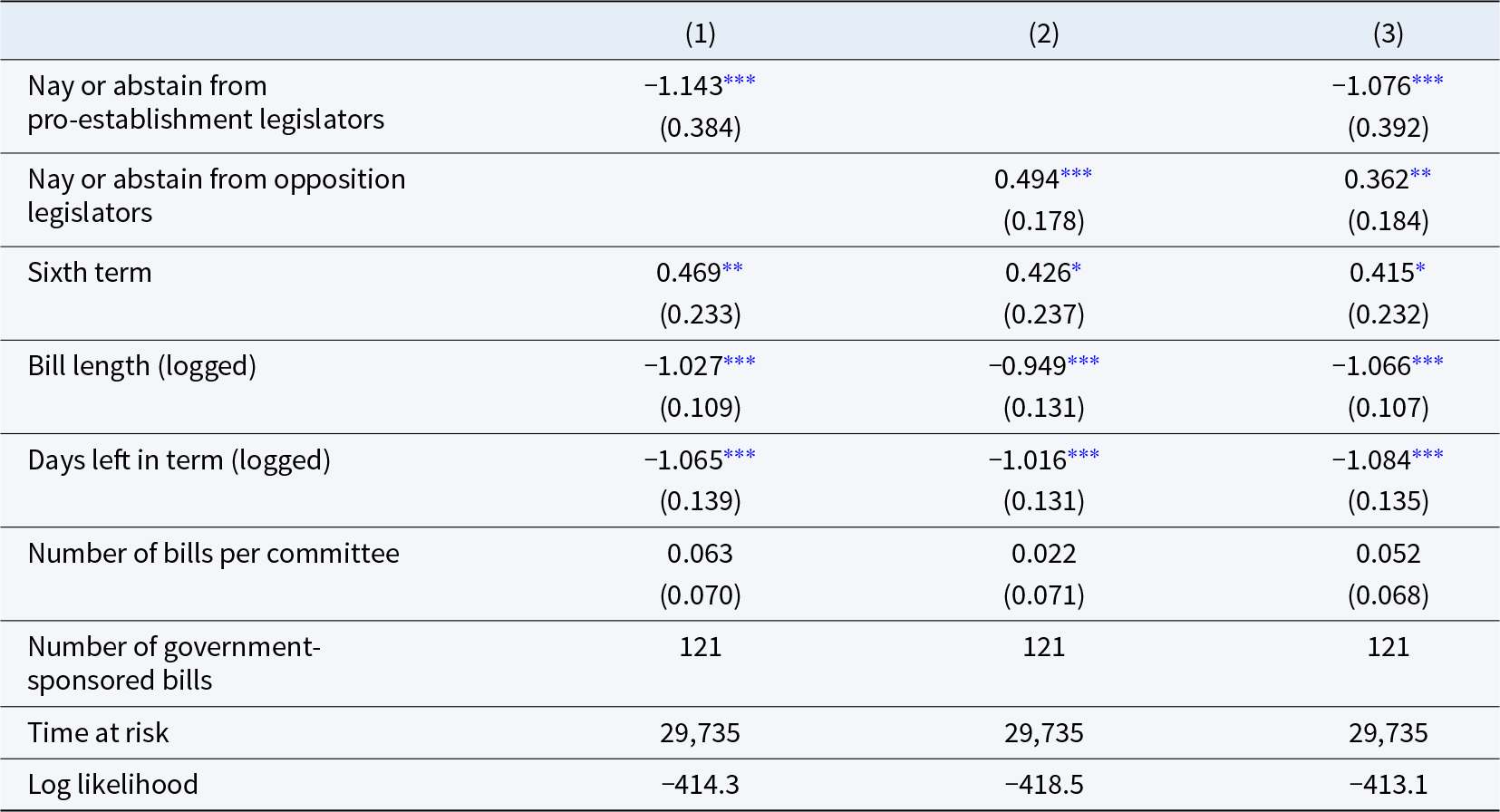
Table 2 presents the results, where positive coefficients indicate an increase in the hazard of deliberation termination, which corresponds to shorter deliberation durations, while negative coefficients indicate a decrease in the hazard, leading to longer durations.Footnote 63
Cox Proportional Hazard Models of Committee Deliberation Durations

* Notes: p < 0.10, **p < 0.05, ***p < 0.01. Hazard rate coefficients are reported, with robust standard errors clustered by bills in parentheses. Positive values indicate shorter durations.
Dissent from pro-establishment legislators significantly increases deliberation durations, as indicated by the negative coefficients in Models (1) and (3). For example, the coefficient of −1.143 in Model (1) implies that such dissent reduces the hazard of deliberation termination by 68 per cent, leading to longer deliberations.Footnote 64 This finding aligns with two key theories of authoritarian legislative politics: elite bargaining and information provision. Dissent from pro-establishment legislators serves as a credible signal of policy disagreements, prompting extended intra-elite negotiations to maintain coalition stability.Footnote 65 Additionally, committee deliberations provide a forum for gathering critical feedback from professionals and stakeholders, requiring the government to invest time in addressing public inputs.
Qualitative evidence supports these interpretations. During the plenary session on the Amendment to Law No. 5/2011 (Smoking Prevention and Control System), dissenting pro-establishment legislators Kou Hoi In and Zheng Anting raised concerns about the economic impact of banning smoking in casinos. Their opposition during general voting triggered two years of committee deliberations, during which legislators negotiated concessions with government representatives that ultimately allowed for smoking rooms in casinos. Additionally, the committee report on the Smoking Prevention and Control System bill documented efforts to consider input from casino staff associations, public health specialists and tobacco retailers.Footnote 66 This case demonstrates the dual roles of Macau’s legislature: its committee deliberations serve as venues for resolving intra-elite disagreements and as channels for incorporating feedback from societal groups.
In contrast, dissent from opposition legislators is associated with shorter deliberation durations, as indicated by the positive coefficients in Models (2) and (3). This suggests that the co-optation mechanism does not operate as effectively in this context. The executive appears less accommodating to opposition demands, particularly on bills addressing issues central to regime survival (i.e. political reform). For example, opposition legislators often vote against such bills, but the government accelerates deliberations to assert its authority, sidelining opposition grievances.Footnote 67 This finding underscores the limited influence of opposition legislators in Macau’s legislative process, where the ruling coalition prioritizes its core interests over accommodating dissent from opposition groups.Footnote 68
Conclusion
Using novel datasets of roll-call votes and committee deliberations from the Macau Legislative Assembly (2013–2021), this study analyses legislative politics in the Macau SAR. Our findings reveal a structural dichotomy: a dominant, cohesive pro-establishment faction and a smaller, fragmented opposition group. Some elected legislators exhibit behaviour consistent with co-optation theory, actively performing representative functions through bill sponsorship and dissent. While the opposition has limited influence – evidenced by the rejection of nearly all legislator-sponsored bills – their position-taking actions allow them to communicate to constituents.Footnote 69 Motivated by re-election incentives, these legislators use proposals and negative votes to differentiate themselves, similar to their democratic counterparts.Footnote 70
Contrary to the presumption that appointed legislators align uniformly with the executive, our analysis reveals instances where they diverge from government positions. This highlights the importance of considering intra-regime discord in analysing legislative policymaking, even in an executive-dominant authoritarian regime. The ruling coalition, while powerful over opposition forces, is not monolithic.Footnote 71 Ally legislators are not mere “clerks” but political actors with policy preferences, capable of influencing legislation. Divergences within the coalition arise from competing interests, fostering intra-elite negotiations.Footnote 72 While ruling elites aim to incorporate ally preferences during bill formation, information gaps persist due to the relative privacy of executive rooms.Footnote 73 Legislative institutions compensate for this by facilitating information sharing, effective monitoring and credible policy communication.Footnote 74
In Macau’s legislature, pro-establishment legislators signal disagreement through dissenting votes, which often prompt amendments. Our analysis of deliberation durations supports both elite-bargaining and information theories: the executive learns about ally preferences through legislative processes and takes them more seriously than the preferences of opposition legislators. Although opposition behaviour aligns with co-optation logic, the government appears reluctant to accommodate dissent and instead prioritizes cohesion within the pro-establishment coalition.Footnote 75
While the Macau Legislative Assembly remains a “rubber stamp” in that the legislative outcomes are tightly controlled and no government bills are rejected, this label obscures significant activity and contestation. Recent studies suggest authoritarian legislatures are “places of action,”Footnote 76 where members actively engage in queries, proposals, debates and amendments.Footnote 77 Our study contributes to this literature by demonstrating how mechanisms of co-optation, elite bargaining and information sharing operate in Macau’s legislature through detailed analyses of roll-call votes and committee deliberations.
Comparatively, Macau occupies a unique position within the “one country, two systems” framework and the broader Chinese political system. It represents a mid-point on the spectrum between China’s People’s Congress system (PC system) and Hong Kong’s Legislative Council (LegCo): more open than the PC system in electoral competition and opposition participation but less so than the pre-2021 LegCo. For example, unlike the PC system, where formal opposition is virtually absent, Macau’s legislature includes directly elected legislators who can voice dissent and engage in position-taking. However, unlike the pre-2021 LegCo, where opposition legislators held veto potential, Macau allocates less than half of its legislative seats to direct elections, ensuring institutionalized executive control. The 2021 electoral reforms in Hong Kong – which expanded the LegCo from 70 to 90 seats while reducing the proportion of directly elected seats from 50 per cent to 22 per cent and introducing a screening committee to vet candidates – might have brought the LegCo closer to Macau’s legislature in terms of contestation and executive dominance.Footnote 78
Beyond Macau, our findings contribute to comparative research on legislative politics in electoral authoritarian regimes and autonomous regions. Macau’s legislature offers a valuable case for scholars of Hong Kong politics to study how representative structures and legislative rules adapt to regime control.Footnote 79 Future research could leverage high-quality records from Macau’s Legislative Assembly and Hong Kong’s Legislative Council to explore legislators’ representation styles, amendment processes and the government’s responsiveness. A promising avenue for further study involves micro-level analyses comparing these two regions to gain deeper insights into legislative dynamics under the “one country, two systems” framework.
Acknowledgements
We thank the seminar participants at Kobe University, the University of Macau and the City University of Hong Kong, where earlier versions of this manuscript were presented. In particular, we are grateful for the comments and suggestions provided by Peter Beattie, Tianji Cai, Edmund Cheng, Naofumi Fujimura, Masaki Higashijima, Yue Hou, Takeshi Iida, Ukyo Kanetaka, Ngok Ma, Tak-Wing Ngo, Yosuke Sunahara, Atsushi Tago, Yuki Yanai and Jiangnan Zhu. Special thanks go to Junyang Chen for his assistance with data collection. This study has received no funding.
Competing interests
None.
Daina CHIBA is an associate professor in the department of government and public administration at the University of Macau. His research interests lie at the intersection of data science, comparative politics and international relations. His work has appeared in the American Political Science Review, American Journal of Political Science and Political Analysis, among other journals.
Meng U IEONG is an assistant professor in the department of government and public administration at the University of Macau. His work has appeared in Review of Policy Research, Journal of Asian Public Policy, Asian Survey and The China Review, among other journals. He is also the editor of Macau Twenty Years after the Handover: Changes and Challenges under the “One Country, Two Systems.”
Jiying JIANG is an assistant professor in the department of government and public administration at the University of Macau. She received her PhD in political science from the University of California, San Diego. Her research focuses on legislative politics and lawmaking, with a regional specialization in China. She uses large collections of texts on legislative and policy processes to answer questions of how public policy is formulated and how policy power is shared within the regime. Her recent work employs text-as-data methods to explore the dynamics of bill change in China.

 Open access

