


Introduction
Free and fair democratic elections take two different institutional forms: elections that choose parliamentary representatives and referendums that decide policies. Representative democracy gives voters the opportunity to influence who governs and policies are made by their representatives; policy making is only indirectly influenced by the people (Schumpeter Reference Schumpeter1952). Referendums are an institution of direct democracy. Voters are the principals deciding a specific government policy without the intermediation of elected representatives. Surveys show that citizens see both referendums and representative elections as desirable democratic institutions (see Ferrín & Kriesi Reference Ferrín and Kriesi2016; Wike & Fetterolf Reference Wike and Fetterolf2018). Moreover, both types of elections are authorised in the laws of nearly every European state.
Electing representatives and voting on issues have common features. Elections are free and fair; all citizens have the right to vote; and parties and organised groups can campaign for votes. If the outcome is uncertain, this shows that a referendum is democratically competitive (cf. Przeworski Reference Przeworski1995). If the government has effectively determined the result by conducting an unfair and unfree election, the ballot is an undemocratic plebiscite not a referendum (Ulieri Reference Ulieri and Rose2000). In public policy terms, the critical difference between the two institutions is that voting for representatives is an input into the policy‐making process, while in a referendum votes determine a policy output: the adoption or repeal of a proposed Act of Parliament, a constitutional clause or a treaty.Footnote 1
Representative democracy is both the norm and normal in political science studies of democratic elections, which concentrate on the election of Members of Parliaments and presidents. In Robert Dahl's (Reference Dahl1989) classic Democracy and Its Critics, there is no index reference to referendums or to direct democracy. Of the 41 chapters in a major review of the literature on elections, only one chapter is about referendums (Fisher et al. Reference Fisher, Fieldhouse, Franklin, Gibson, Cantijoch and Wlezien2018: 256–266). Reviews of deliberative democracy also tend to neglect referendums (e.g., Warren Reference Warren2017). When political theorists do take notice of referendums, they disagree about whether referendums make a positive contribution to civic democracy by encouraging participation or a negative contribution by supporting populist values (cf. Budge Reference Budge1996; Saward Reference Saward2000; Offe Reference Offe2017; Weale Reference Weale2018; Rosenbluth & Shapiro Reference Rosenbluth and Shapiro2018; for qualified approval of referendums, see LeDuc Reference LeDuc2003; Independent Commission on Referendums 2018). Judgements are usually made without systematic empirical evidence.
Relying exclusively on elected representatives to make policies on behalf of voters assumes that an individual's vote for a party is an endorsement of all its major policies. However, votes can reflect long‐term party identification, the appeal of a party leader, and a voter may disagree with one or more of their party's economic or cultural policies (Fisher et al. Reference Fisher, Fieldhouse, Franklin, Gibson, Cantijoch and Wlezien2018, chapters 10–16; Kriesi Reference Kriesi2010). Referendums avoid the ambiguity of interpreting what voters for a party want, since voters directly endorse their preferred policy without the intermediation of a party acting as their agent. The binary choice on a referendum ballot ensures that a policy is approved by an absolute majority of voters and parallels the binary choice in Schumpeter's (Reference Schumpeter1952) model of parliamentary democracy offering voters the choice of voting for the government of the day or for the official opposition. Winning a referendum requires an absolute majority of the vote, whereas the governing party often represents just a plurality of voters.
Every European country but two, Belgium and Germany, have legal provisions for calling referendums and referendums have been called by constitutional requirement, legislative choice and, where it exists, popular initiative (Morel & Qvortrup Reference Morel and Qvortrup2018: 29ff). The use of referendums is growing in Europe: three‐quarters of the ballots, held since the end of the Second World War, have occurred since 1990 (ibid.: 51). In the textbook example of representative democracy, the British Parliament, even though most MPs voted to remain in the European Union referendum, they deferred to the referendum majority that voted to leave the EU (Rose Reference Rose2020). Political entrepreneurs demand referendums to advance their particular cause or to embarrass a government pursuing an unpopular policy. Since 2014, six national referendums on EU issues have rejected policies supported by the government and the EU (Rose Reference Rose2019). Governing parties responsible for a controversial policy may use a referendum in the belief that its position represents an absolute majority of voters. The government's position is endorsed in a majority of contested referendums in Europe (cf. Qvortrup Reference Qvortrup2018: 291–298).
The first innovative contribution of this paper is its integration of populist and civic theories of public support for referendums. Second, it tests competing hypotheses with data from 24,872 respondents in 17 countries surveyed by the International Social Survey Programme (ISSP). The use of comparative data avoids the limitations of analysis of a single referendum or a single country. Third, focussing on support for the principle of referendums avoids the limitation of studies confined to a specific issue such as nationalism or the European Union, since the particular issue may determine support or opposition to referendums in principle (cf. Mendez, Mendez & Triga Reference Mendez, Mendez and Triga2014). Our evidence rejects the assumption that populist values endorse referendums as giving voice to the will of the people. It shows that support for referendums primarily comes from people who favour political participation and democracy as an ideal, and is also influenced by whether they perceive their representatives as responsive to them in practice as they are meant to be in democratic theory.
Populist and civic theories of referendum support
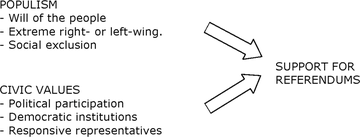
Theories of populism and civic values are normally discussed independently of each other; this makes it impossible to test which has the greater impact on support for referendums. In Figure 1, we present an integrated model that can be used to determine which theory receives stronger backing when both are tested together. Given the multiple meanings associated with populism, we identify three populist characteristics that influence individuals favouring referendums: the belief that the will of the people cannot be constrained; being ideological extremists; and being socially excluded. We likewise specify three civic attitudes that could influence support: favouring individual participation; the evaluation of democratic institutions in theory; and whether representatives are seen as responsive to voters in practice.
A model of influences on referendum support.

Populist theories
The literature on populism emphasises ideas at the theoretical level; discussions of populist parties may cite single cases as evidence; and electoral studies may focus narrowly on voting for populist parties getting a tenth to a fifth of the popular vote (for reviews, see Mudde & Kaltwasser Reference Mudde and Kaltwasser2017; Müller Reference Müller2017; Kaltwasser et al. Reference Kaltwasser, Taggart, Espejo and Ostiguy2018). Nominally, populism ought to encourage people to participate in politics, including referendums giving citizens the power to make policy decisions directly without intermediation by political elites. However, a leading theorist of populism argues that populist leaders are not anti‐elite, but are an alternative elite that claims its insight into the people's will should ensure it acts in government ‘as a proper elite that will not betray the people's trust’ (Müller Reference Müller2017: 30).
Populist theories postulate that ‘real’ people are in agreement about what government ought to do (Mudde & Kaltwasser Reference Mudde and Kaltwasser2017: 16ff; Weale Reference Weale2018). It is an undivided volonté générale in the manner of Rousseau. Instead of viewing politics and elections as being about a choice between competing values, populist leaders treat elections as a means of endorsing their view of the general will. A referendum offers a winner‐take‐all dichotomous choice that makes no concessions to the losing side. Therefore, populists confident that a referendum majority will endorse their views should favour this institution (Müller Reference Müller2017: 20ff).
H1a: If people believe that the will of the people should not be constrained by minorities, they are more likely to favour referendums.
Political ideologies of the Left and Right emphasise divisions within the electorate. Empirical research shows that most voters tend to place themselves towards the centre of a Left/Right scale. Therefore, parties competing for office will advance policies that emphasise consensus and valence goals rather than alternative policies (Stokes Reference Stokes1963). By contrast, a referendum offers a binary choice in which the alternatives are categorical rather than a centrist compromise; this should appeal particularly to ideological extremists (cf. Georgiadou, Lamprini & Roumania Reference Georgiadou, Lamprini and Roumania2018).
H1b: If people have an extreme right‐ or left‐wing ideology, they are more likely to support referendums.
Theories of inequality postulate that representative democracy favours elites because they have the socioeconomic resources to participate effectively in politics, whereas social and economically excluded individuals also suffer political exclusion (Plutzer Reference Plutzer2018; Gidron & Hall Reference Gidron and Hall2017). The anti‐elitist rhetoric of populists plays up to the socially excluded. Low education and low income are major causes of being left out of politics, and Europeanisation and globalisation reinforce the tendency of those with few resources to be left behind by social change. By contrast, young people are more likely to avoid exclusion because they are more educated, economically mobile and cosmopolitan (cf. Eatwell & Goodwin Reference Eatwell and Goodwin2018, chapter 5). However, those with a higher income and education are a minority of the population and the referendum requirement of an absolute majority for victory amplifies the voice of the excluded.
H1c: If people are socially excluded, they are more likely to support referendums.
Civic theories
Since referendums increase the opportunity for individuals to participate in politics, support may also reflect democratic values about how citizens and their elected representatives ought to behave. To avoid confusion with many meanings applied to the word democracy (Collier & Levitsky Reference Collier and Levitsky1997), we describe these norms as civic values about political participation, democratic political institutions, and the responsiveness of elected representatives. Populist leaders argue that democratic institutions and practice are a sham. Political elites are described as unresponsive to the will of the people and should be replaced by populist leaders who will act on behalf of the ‘real’ people. ‘Populism is not a path to more participation in politics’ (Müller Reference Müller2017: 29).
Advocates of participatory democracy describe representative democracy as ‘thin democracy’ because citizens only have one chance every four years or so to elect parliamentary representatives. Thus, Carol Pateman (Reference Pateman1970) declares that multiple forms of political participation are good for individuals and for a society. Benjamin Barber (Reference Barber2004) has advocated referendums as a means of making democracy stronger. While a referendum is not the only institution for expanding participation (van Deth Reference van Deth and Fisher2018), it is the only one that gives all citizens a chance to make a binding policy decision. A major comparative review concludes that participation in referendums tends to make better citizens (Talpin Reference Talpin, Morel and Qvortrup2018: 406ff).
H2a: If people favour political participation, they are more likely to support referendums.
If referendums are to affect public policy, democratic institutions must work well and citizens should trust public officials to administer institutions correctly (cf. Markova Reference Markova2004; Warren Reference Warren and Uslaner2018). The point is particularly relevant for referendums, which have a history of being plebiscites manipulated by undemocratic rulers to their own advantage (Morel & Qvortrup Reference Morel and Qvortrup2018: 11ff; Ulieri Reference Ulieri and Rose2000).
H2b: If people are positive about how their democratic institutions work, they are more likely to support referendums.
If civic participation is to be meaningful, the behaviour of politicians should be responsive to the inputs of citizens in a continuing feedback process (Easton Reference Easton1965). Responsiveness involves emotional affect in which politicians show empathy with the people they represent rather than being self‐centred in pursuit of their own interests. Responsiveness thus differs from the transactional approach of principal‐agent relations (cf. Gailmard Reference Gailmard, Bovens, Goodin and Schillemans2014). A feeling that politicians are responsive to the concerns of ordinary people should make voters more willing to accept politicians making decisions on their behalf without themselves having to decide how to vote in a referendum (Hibbing & Theiss‐Morse Reference Hibbing and Theiss‐Morse2002). Similarly, if political parties give voters a choice of policies, a referendum becomes redundant (cf. Eulau & Karps Reference Eulau and Karps1977; Powell Reference Powell, Müller and Narud2013).
H2c: If people perceive their representatives as responsive, they are less likely to favour referendums.
How much popular support for referendums?
Survey data to test the above hypotheses must meet three criteria: have a measure of support for the principle of referendums; include relevant indicators of both populist and civic values and cover enough countries to control for the effect of national context. The 2014 Citizenship Survey of the ISSP (2014) meets all three requirements.Footnote 2 It asked the relevant questions in its Citizenship Survey. Its nationally stratified samples in 17 European democracies produced 24,872 valid interviews. Since each participating country was required to fund its own survey, the coverage was opportunistic; nonetheless, the 2014 ISSP survey covered 12 older European democracies and 5 post‐1989 democracies.
Respondents were asked to say whether they agreed or disagreed with the statement, ‘Referendums are a good way to decide important political questions’. The generic phrasing avoids confounding attitudes towards the principle of referendums with attitudes towards a specific issue that could be the subject of a ballot (Marsh Reference Marsh2018). Because the Citizenship Survey is about national politics rather than European Union affairs, it avoids confounding judgements about the referendum with attitudes towards the European Union (cf. Mendez, Mendez & Triga Reference Mendez, Mendez and Triga2014). The suitability of the question for cross‐national comparison was tested by the ISSP piloting the questionnaire in multiple languages and national contexts prior to its adoption (see Scholz et al. Reference Scholz, Jutz, Pammett and Hadler2017).
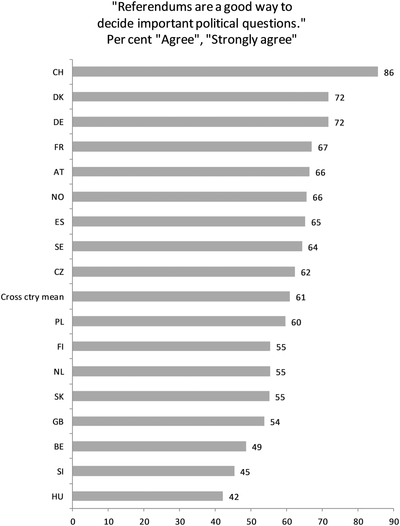
Theoretical critiques of referendums have not captured the minds of Europeans, nor does public opinion show a homogeneous will in favour of referendums. Altogether, 61 per cent endorse referendums, of which 22 per cent strongly agree that they are desirable and 39 per cent simply agree. The second‐largest category consists of 27 per cent who were undecided in one way or another. Among the 12 per cent who explicitly rejected referendums, 3 per cent strongly disagreed with calling them a good thing and 9 per cent simply disagreed.
Although in every country respondents divide in their views, in 14 of 17 there is an absolute majority in favour of the principle of referendums (Figure 2). Support was highest in Switzerland, where referendums have a unique history and a high frequency of use. Notwithstanding the abuse of referendums as plebiscites in Hitler's Third Reich, more than three‐quarters of Germans also endorse referendums. The maximum proportion disapproving of referendums was 25 per cent in Slovenia, where no opinion was the median response. In every country, those with no opinion outnumber those rejecting referendums.
Support for referendums by country.
Source: 2014 Citizenship Survey of International Social Survey Programme.

Testing theories of referendum support
The central question is whether populism or civic values is of primary importance for referendum support or whether only one theory or neither is important. Because our integrated model assumes that both populist and civic values affect referendum support, we test both theories in a single logistic regression that includes indicators for the three hypotheses relevant to each theory. Doing so provides a discriminating understanding of which aspects of populism and civic values are of particular importance.
Since there are 24,872 respondents in our 17‐country ISSP dataset, we set the level of statistical significance at <0.000. To identify which indicators have a stronger or lesser impact we focus on odds ratios, which reflect the estimated effect of a significant variable on referendum support. A value above 1.00 shows that the measure increases referendum support, while below 1.00 shows it reduces support. For ease of comparison of odds ratios, all variables are coded on a 0–1 scale. The Appendix gives details of the coding of variables.
The large number of questions relevant to civic values and populism in the ISSP Citizenship questionnaire enabled us to conduct analysis in two stages. We ran a preliminary logistic regression including a variety of questions that might have conceptual relevance for social exclusion, such as being foreign‐born or unemployed. To avoid distracting attention from significant influences, those that were not significant in the preliminary analysis were not included in Table 1, except when necessary to demonstrate the rejection of a hypothesis. In some cases, a single variable was suitable for testing a concept, for example, the rejection of minority rights. The hypothesis about ideological extremism was tested with a pair of indicators taken from a single ideology question. Given the multiple causes of social exclusion cited in the literature, three variables – income, education and age, and their interactions – were used.
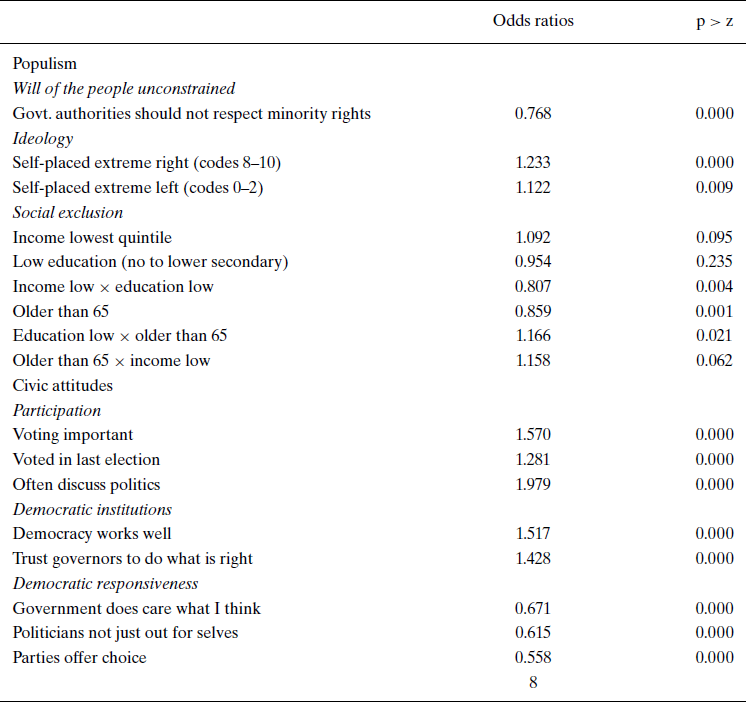
Influences on support for referendums

Notes: Multilevel mixed‐effects logistic regression (QR decomposition). Observations: 24,872. Null model: ll‐16642.423, BIC 33294.97, AIC 33286.85; estimated model: ll‐15726.33, BIC 31.645, AIC 31490. Pseudo‐R2 (McFadden adjusted) 0.054.
The dependent variable is measured by whether respondents did or did not endorse referendums as a good idea. Sixty‐one per cent who did so are coded 1; respondents who did not think it a good idea or who had no opinion were coded 0. We have run an additional OLS regression in which the dependent variable was coded ordinally on a five‐point scale from strongly agree to strongly disagree, with ‘no opinion’ in the middle. The structure of coefficients and significance was very similar. However, the ordinal dependent variable produces a weaker statistical explanation of referendum support than does dividing respondents into two categories, those who favour referendums and those who do not.
Since our ISSP database pools respondents from countries with sample sizes varying from 889 in Sweden to 2,264 in Belgium, we weighted each country to 1,000 respondents. Initially we conducted a multilevel regression analysis to test the effect of contextual variables using multivariate analysis. None of the aggregate national variables tested – low economic growth, high numbers of immigrants, corruption as measured by Transparency International and the frequency of national referendums – was significant. We have therefore used fixed effects to control for cross‐national variations.
Limited support for populist hypotheses
The ISSP has a direct measure of attitudes towards a unitary general will. It asks whether it is important for government to respect and protect the rights of minorities. A very small proportion of respondents, 3 per cent, hold the populist view that the will of the people does not need to recognise the rights of minorities. By contrast, 73 per cent believe government should respect minority rights, with the remainder having no clear opinion. Contrary to H1a, those who think there is no need to pay attention to minorities are less likely to favour referendums; the odds ratio is 0.768 (Table 1). This may reflect those who are ready to deny minority rights do not want to be constrained by elections.
Political parties are often described as having a comprehensive ideology. Most populist parties have a right‐wing ideology and a smaller proportion a left‐wing ideology (Rooduijn Reference Rooduijn2019). The ISSP asks respondents to indicate their ideology by placing themselves on an 11‐point left/right scale. Placing oneself at points 0–2 makes the respondent a left‐wing extremist and at points 8–10 a right‐wing extremist.
There is weak support for ideology H1b. Citizens who place themselves on the extreme Right are significantly more likely to support referendums, but the impact on referendum support is not large. The odds ratio for the influence of extreme right‐wing views is 1.233. Moreover, the effect is limited, since people on the extreme Right are only 15 per cent of all respondents. Being on the extreme Left falls just short of statistical significance. Relaxing the significance standard would have only a minimal effect, since the odds ratio for extreme left‐wing views is lower still, 1.122. Thus, any attempt to explain referendum support by reference to extreme right‐wing or left‐wing ideologies is inadequate, because their adherents are a limited minority while referendums are supported by three‐fifths of citizens, most of whom have a centrist ideology or none.
Theories of social exclusion invoke a profusion of indicators. Our logistic regression finds that neither being in the lowest third of society for education nor in the lowest fifth for income has a significant effect on referendum support. Given the empirical association between income and education, we also tested the effect of their interaction on referendum support; this too failed to achieve statistical significance (Table 1).
Older people are more likely to be left behind by Europeanisation because they are less mobile in many senses. However, being older falls just short of having a significant effect. Given the tendency for lower education and income to correlate with old age, we also tested the potential influence on referendum support of an interaction between age and education and age and income. Neither interaction was statistically significant (Table 1). The failure of all three indicators to have any significance rejects the theory of H1c, those who are socially excluded are driving support for referendums.
Additional evidence of the rejection of social exclusion comes from our preliminary logistic analysis in which we included additional measures for social exclusion. Those who are native‐born were not significantly more likely to support referendums than those who are not, nor do the unemployed differ significantly from the mass of respondents in their view of referendums. Even though women are a majority of the electorate but a minority of elected representatives, women were not more likely to favour referendums. Thus, there is no significant difference in support for referendums between people who are socially excluded and people who are socially integrated.
The failure of socioeconomic attributes to have any influence is a reminder of Giovanni Sartori's (Reference Sartori1987) caution of the dangers of sociologising politics, that is, assuming a wide variety of political attitudes and their associated effects can be inferred from socioeconomic characteristics. It is the attitudes that people hold, whether ideological or civic values, rather than their sociological characteristics, that are important here.
Civic values encourage referendum support
Political participation can involve formal as well as informal institutions. Discussing politics informally with friends, neighbours and others at work does not limit people to talking about the agenda set by parties and the media. They can discuss whatever issues are of concern to themselves, such as immigration. A preliminary analysis found that such discussions are not strongly associated with exposure to news on television and in print. In the ISSP survey, 12 per cent said they often discussed politics with their friends, relatives or colleagues at work, and an additional 41 per cent reported sometimes doing so. Actively engaging in informal discussions of politics has the strongest effect on referendum support of any independent variable: the odds ratio is 1.979 (Table 1).
Voting is the most common way in which people formally participate in politics, albeit it is only an occasional activity. Among ISSP respondents, 71 per cent reported they had voted in their most recent parliamentary election. This is very close to officially recorded turnout. While voting has a significant effect on referendum support, the relationship is limited; the odds ratio is 1.281. This weak relationship is likely to reflect that for some people voting is simply a habit (Dinas Reference Dinas2012).
The belief that people ought to vote is a civic norm. Among ISSP respondents, 79 per cent said they thought voting was a necessary condition of good citizenship. This attitude significantly increases referendum support. Moreover, the impact of this normative belief is greater than the habit of voting; the odds ratio for having normative commitment to voting is 1.570 (Table 1). As predicted in H2a, both formal and informal aspects of participation encourage referendum support.
Because democracy is a broad positive symbol, the ISSP asks respondents to evaluate how they see the institutions of democracy working in their country. An absolute majority, 57 per cent, see it working well. Respondents who see democratic institutions working well are more likely to support referendums (odds ratio 1.517). For democratic elections to merit participation, election officials should administer them fairly according to election laws. Among ISSP respondents, 28 per cent think that public officials can be trusted to do the right thing with the effect of making them more likely to favour referendums (odds ratio: 1.428). H2b is supported. Satisfaction with how the institution of democracy is working and with the people working in the institution both encourage support for referendums. The evidence rejects the view that referendums are primarily supported by people dissatisfied with democratic institutions; support comes from people who are positive about both direct and representative democracy.
The behaviour of politicians is meant to be responsive to the concerns of citizens on whom they depend for the votes that give them office and the Citizenship Survey provides three questions indicating responsiveness. Among the 25 per cent who feel that government cares what people like themselves think, support for referendums is, as predicted, substantially less (odds ratio: 0.671). Reciprocally, the 57 per cent who see government as run by uncaring politicians are more likely to support referendums.
Democratic theories assume that the behaviour of politicians will give priority to being responsive to the interests of voters rather than their own self‐interest (cf. Becker Reference Becker1997). While self‐interest may motivate politicians to appear responsive when seeking votes, there is empirical evidence that once elected voters see them as just looking out for themselves (Rose & Wessels Reference Rose and Wessels2019, table 1). Twenty‐three per cent who think that politicians put broader interests before selfish interests are, as predicted, substantially less likely to endorse holding referendums (odds ratio: 0.615), while the 53 per cent who perceive politicians as just out for themselves are more likely to support referendums.
Since voters differ in their views of public policy, democratic elections should offer voters a choice of policies, but whether parties do so is up to politicians to decide (cf. Katz & Mair Reference Katz and Mair2018). Among ISSP respondents, 21 per cent think parties offer real policy choices; 30 per cent have no opinion and 49 per cent felt they had no choice. People who see parties as responding to their desire for a choice of policies are less likely to favour holding referendums (odds ratio 0.558), while those who see themselves as having no choice are more in favour of referendums.
The influence of individual evaluations of the responsiveness of politicians on support for referendums is contingent. If voters see their elected representatives as responsive, they are willing to let politicians make decisions without referendums. However, if they do not, then it is logical to turn to referendums to act as a compensating check on ‘failed democratic representation’ (Carlin et al. Reference Carlin, Hawkins, Carlin, Levente and Kaltwasser2019: 422). The ISSP survey shows that the perceived shortcoming in representation does not mean that populist parties are the cause of support for referendums. This is not confined to populists; it is also held by many people with civic values. In 2014, voters for populist parties averaged only one‐quarter of the proportion of respondents supporting referendums (Rooduijn Reference Rooduijn2019). The same question of support was asked in the 2004 ISSP survey; it showed majority support for referendums well before the surge in populist parties.
From the perspective of democratic theory the above findings appear puzzling. If citizens have a positive view of democratic institutions, they favour referendums, as it is an institution for civic participation. If they have a negative view of politicians as being unresponsive, they also support institutions as a means of having a check on such behaviour. The mixture of positive and negative views is consistent with the view of James Madison, a principal author of the checks and balance in the American Constitution. He argued in The Federalist Papers (Hamilton et al. Reference Hamilton, Madison, Jay and Goldman2008: 257) that checks on democratically elected politicians are necessary because they are not angels but humans subject to the temptation to abuse their power. Thus, institutional settings must be trustworthy and performance bad to have a consistent impact supporting referendums as a good way to decide important issues.
Multi‐causal innovative model confirmed
The statistical analysis in Table 1 supports the integrated theoretical model set out in Figure 1. Both populist and civic values influence referendum support after controlling for the effect of the other. However, the extent of their significance is not equal. As predicted, all eight of the civic indicators are statistically significant. By contrast, only two of the nine populist indicators are significant.
The need for an integrated theory of referendum support is confirmed in two logistic regressions separately testing the influence of populist and of civic values. When nine populist measures are tested on their own for influence on referendum support, a majority are statistically significant at the 0.000 level. However, when the same variables are included in an integrated analysis along with civic participation variables, three of the five cease to be significant: having an extreme left‐wing ideology, low education, and an interaction between low education and income. In the regression confined to civic values, the same independent variables remain significant as in the integrated model. The only difference is that the odds ratios are higher for civic values on their own than in the full model. This cautions against relying on analyses of the influence of populist values that do not take civic values into account.
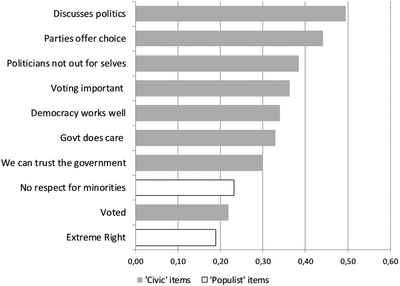
The greater impact of civic values is shown in Figure 3, which displays the degree to which the effect of a significant variable deviates from the random value of 1.0 regardless of its direction. Discussing politics with people you know, an active and informal means of political participation not dependent on the agenda set by elite institutions, has the biggest impact. Second and third in impact are perceptions of democratic responsiveness; parties being seen as offering voters a choice, and representatives acting in the public interest and not just their self‐interest. By contrast, populist indicators have little impact. The effect of having an extreme right‐wing ideology is the weakest of all ten significant influences and the effect of having no respect for minority rights is the third from the bottom.
Impact of significant variables on referendum support. The comparable measure of impact of a variable has been calculated by standardizing odds ratios, transforming odds ratios higher than 1 by dividing 1 by the odds ratio, and subtracting these odds ratios from 1. Deviation from 1 indicates the strength of the impact, not the direction.

A single survey leaves open whether support for referendums is long‐standing. The Citizenship Survey asked this question not only in 2014 but also in 2004, well before the 2008 economic crisis and immigration became big issues. Fifteen European countries were included in both studies. In the 2004 round, 62 per cent endorsed holding referendums on important issues, an insignificant one percentage‐point difference from the 2014 result. The correlation of the percentage of national respondents favouring referendums a decade apart was 0.91 with a Duncan index of dissimilarity of 4.6. This evidence indicates that popular support for direct as well as representative democracy is long‐standing.
By global standards, our European analysis of referendums focuses on most similar cases, since all respondents live in democratic political systems. While referendums are a global phenomenon, democratic political systems are not (cf. Qvortrup Reference Qvortrup2018; Freedom House 2018). Cross‐continental comparisons face the difficulty that the many Latin American referendums are divided between democratic ballots and undemocratic plebiscites (Ruth, Welp and Whitehead Reference Ruth, Welp and Whitehead2017, chapters 7–8). The starting point for global comparison is to explain under what circumstances countries hold democratic referendums or undemocratic plebiscites (cf. Ulieri Reference Ulieri and Rose2000). The explanation may well be due to variations in political context rather than to attributes inherent in referendums.
Implications for democratic elections
The importance of civic values in support for referendums indicates that citizens see referendums as a means of making democracy better. The support does not come from populist anti‐elitism, but from the perceived shortcomings of elites in meeting the assumptions of democratic theory. If civic‐minded citizens perceive unresponsive political elites to be paying more attention to each other than to what they think about and care about, then they welcome referendums as offering a direct democracy means to compensate for shortcomings of their elected representatives.
A referendum vote does not guarantee that the majority verdict will produce the outcome promised by its proponents. The same is true of manifesto pledges that the governing party enacts because it has won a parliamentary election. A national referendum on a major policy issue, such as a country joining or leaving the European Union, raises issues that have multiple and uncertain second‐ and third‐order consequences. This is no more an argument against having a referendum than it is an argument against allowing elected representatives to make a major policy decision with uncertain and unintended consequences. Nor are referendums suitable for dealing with urgent problems, given the time involved in calling a referendum. Moreover, if referendums are held on issues of little general interest, the turnout can fall to well under half the electorate; this happens not infrequently in Switzerland (Serdült Reference Serdült and Qvortrup2018).
Awareness of popular support for referendums can have an effect even without a referendum being held. The prospect of having to fight a referendum can encourage ‘anticipatory responsiveness’, that is, governors modifying or removing those features of a policy that would risk a referendum being called and lost (Rose Reference Rose2015: 153ff; Oppermann Reference Oppermann2013; Stojanović Reference Stojanović2018). If a referendum is held and a government's policy wins an absolute majority, this does not mean the effort of mobilising popular approval was wasted. It is evidence that their representatives do care about what citizens think. If a referendum rejects the government's recommended position, defeat provides a democratic corrective. It is a warning shot by ordinary citizens to elected representatives to be more responsive to what people like themselves think.
Acknowledgements
The authors are grateful to three anonymous reviewers for raising major issues that have led to the improvement of this paper, and to the individuals and institutions that conducted the Citizenship Survey of the International Social Survey Programme.
Online Appendix
Additional supporting informationmay be found in theOnlineAppendix section at the end of the article:
Supplementary Material
Appendix

Notes **Means refer to standardised variables. All variables have been standardised to a range from 0 for the lowest to 1 for the highest value. Number of scale points are represented in the last column. Missing values have been replaced by sample specific means. The cross country mean of missing values for variables with missing values is on average 5.0 per cent and for none higher than 10 per cent. Number of cases: 24,872; 17 European countries, minimum sample 899, mean sample 1,463. Question numbers refer to the following questionnaire: ISSP MODULE 2014, CITIZENSHIP II, Version April 30, 2013, available at https://dbk.gesis.org/dbksearch/download.asp?db=E&id=58833


 Open access

