

Introduction
The Upper Palaeolithic of the Levant (45 000–22 000 BP) represents the full establishment of modern human behavior in this region following the existence of both modern humans and Neanderthals during the Middle Palaeolithic. The Levantine Upper Palaeolithic shares some similarities to its European counterpart but otherwise is quite different.
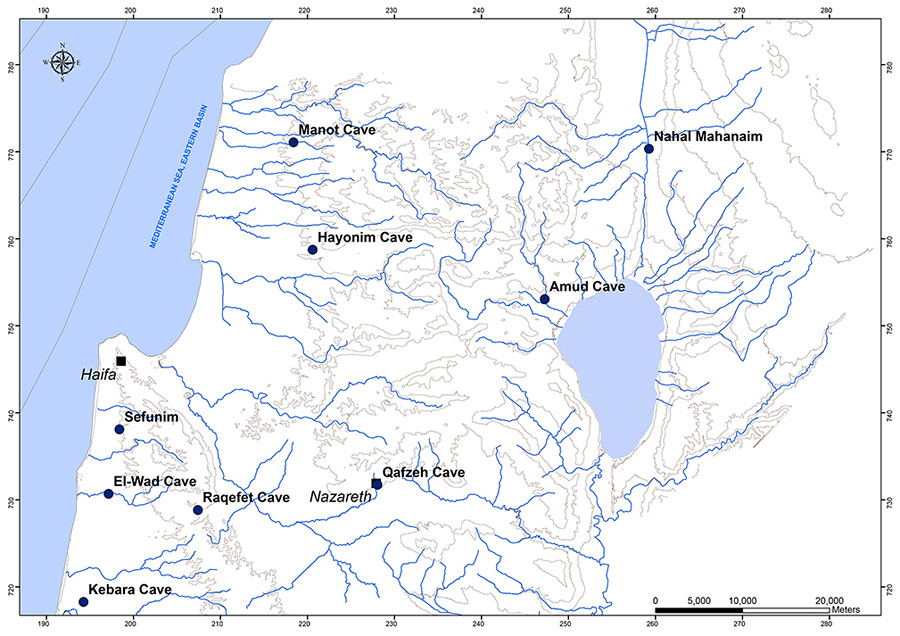
Location of Manot Cave and Upper Palaeolithic sites in northern Israel.

The Upper Palaeolithic of the Levant was initially divided into six chronological phases following European cultural terminology (Neuville 1934; Garrod 1951). This linear division was based on the correlation between diagnostic chipped stone tool types and cave stratigraphy in Mount Carmel and the Judaean Desert. During the 1970–80s, as a result of intensive field work in the arid regions of the southern Levant (e.g. Bar-Yosef and Phillips 1977; Marks 1983), a new chrono-cultural framework was proposed. It was suggested that at least two cultures traditions, the Ahmarian and the Levantine Aurignacian, co-existed contemporarily (Gilead 1981; Marks 1981). The Ahmarian is characterised by blade/bladelet production and typologically by the high frequency of blade tools including el-Wad points. The Levantine Aurignacian is typologically marked by nosed and carinated items, retouched bladelets ('Dufour') and a rich bone and antler industry (Belfer-Cohen and Bar-Yosef 1999). In addition, el-Wad points have been found associated with the Levantine Aurignacian. Later, this model was refined and split further into several cultural entities (e.g. Goring-Morris & Belfer-Cohen 2003). The study of human subsistence in this period is hampered by the rarity of well-preserved faunal and botanical assemblages originating in modern excavations with systematic retrieval methods (Rabinovich 2003). In general, the questions relating to cultural diversity and subsistence suffer from the lack of modern field research in the southern Levant devoted to the Upper Palaeolithic. Our new project in Manot cave addresses some of these problems.
Preliminary results
Manot is a nearly-sealed, active karstic cave, located in a hilly landscape in the western Galilee, Israel (Figure 1). In 2010, a pilot excavation season uncovered rich archaeological accumulations attributed to the Upper Palaeolithic period as well as a few scattered Middle Palaeolithic and Epipalaeolithic artefacts (Barzilai et al. 2012).
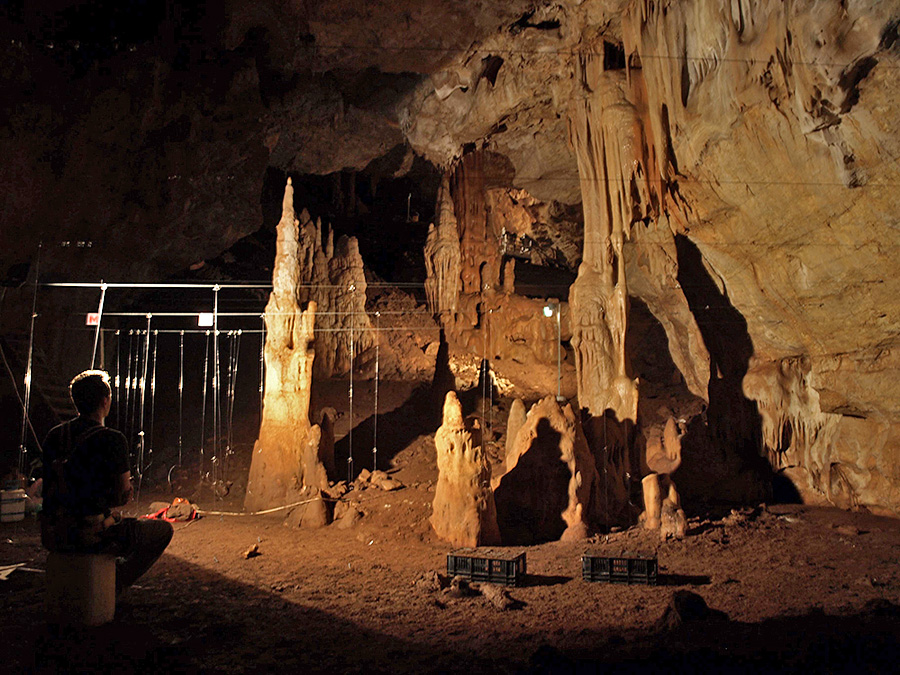
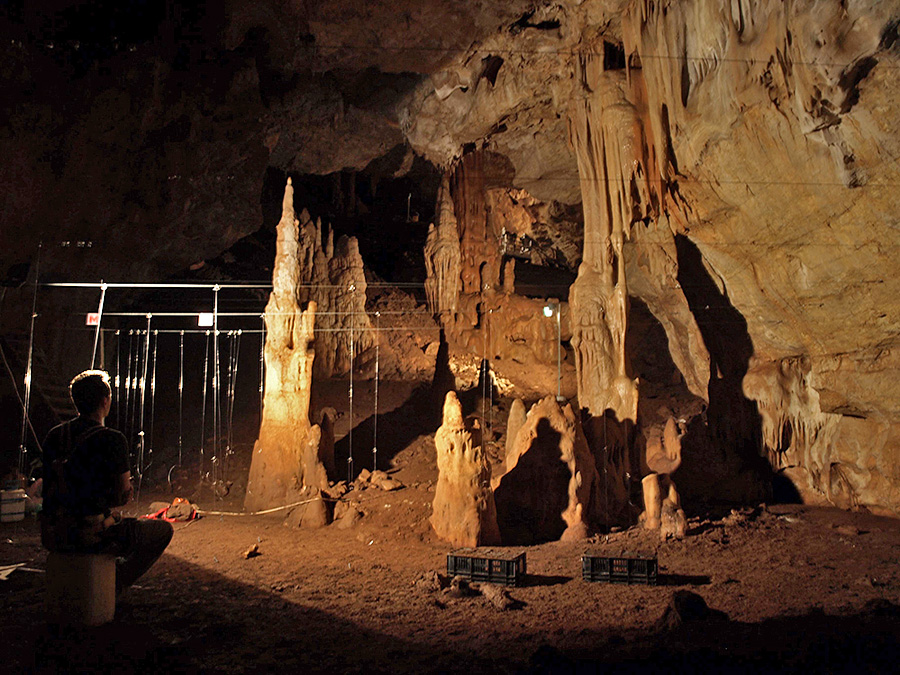
The cave consists of an elongated main hall (80m long, 10–25m wide) with two lower chambers connected from the north and the south. Rock falls and colluvium apparently blocked the original entrance to the cave between 30 000 to 15 000 years ago (Figures 2–3).
General view, looking to the west on Area A. Photo M. Ullman.
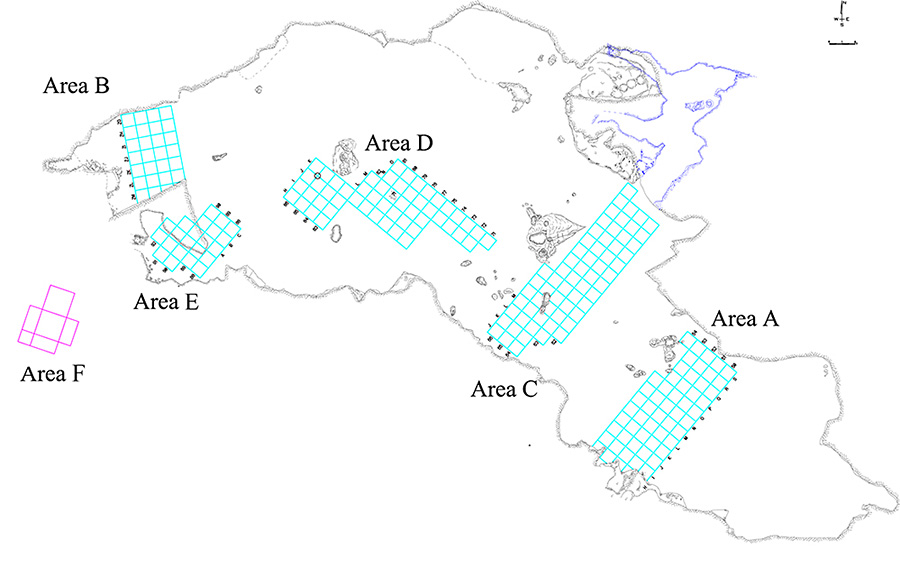
Cave plan, showing the areas of excavation. Drawing V. Asman.

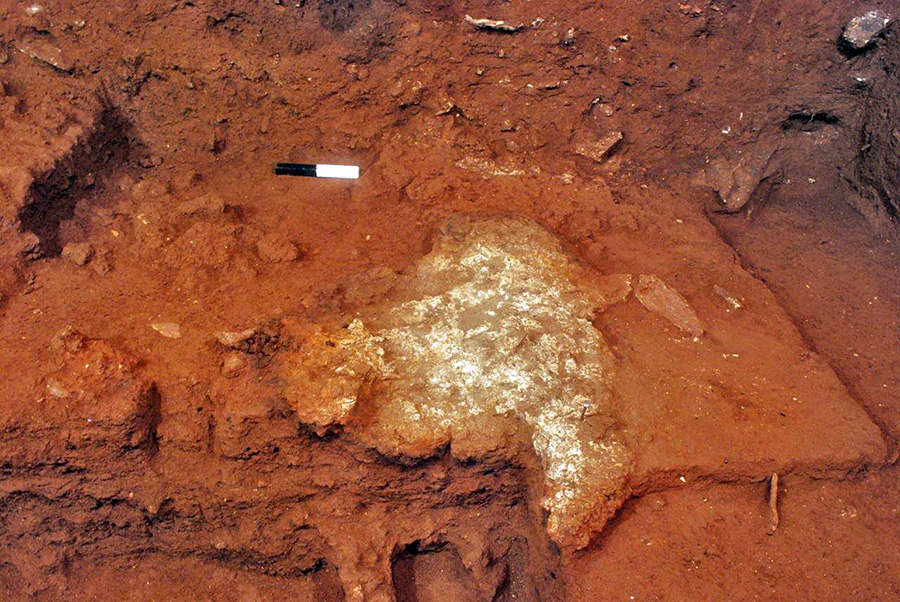
Area E: Hearth L500, sq. A-92, looking west. Photo R. Lavi.

In three seasons of excavations (2010–12), six areas were opened (labelled A to F). Areas C and E were the best preserved. Area E is located at the western end of the cave, on top of the talus. Micromorphology shows that the cave deposit consists of colluvium composed of reworked terra rossa, eboulis, charcoals, bones, and archaeological artefacts. In Area E, in the proximity of one putative entrance to the cave, a thin living surface (c. 50mm) including charcoal remains, flint artefacts, animal bones and two in situ combustion features was excavated. One of the latter is a hearth of c. 0.6m in diameter with white calcified wood ash at its centre, surrounded by a layer of burnt clay (Figure 4). The lithics of Area E include artefacts characteristic of the Upper Palaeolithic period such as endscrapers, burins and partially retouched twisted bladelets ('Dufour').
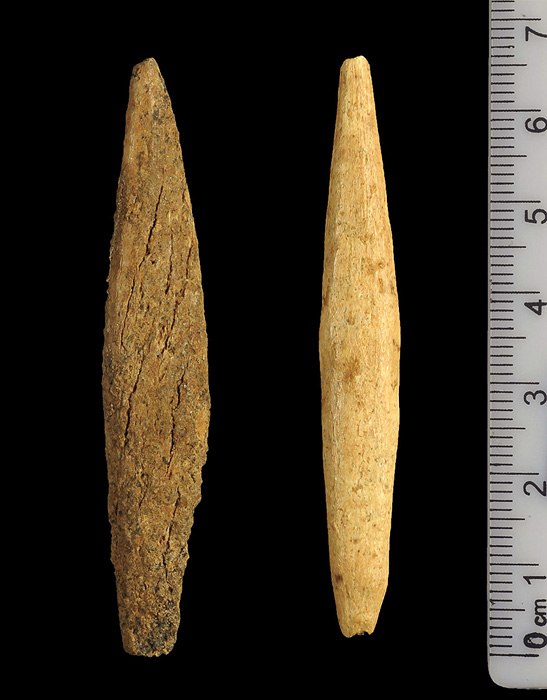
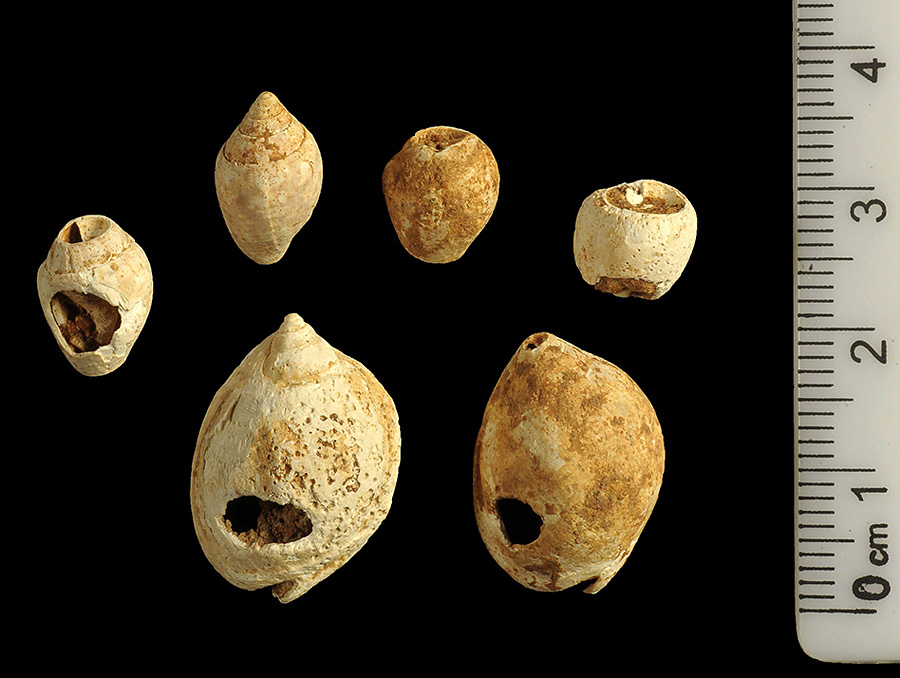
The stratigraphy of Area C located in the lower end of the western talus, consists of at least two archaeological layers and seven sedimentological sub-units. The finds from Area C include flint artefacts, groundstone items, shells, animal bones, charcoal pieces and ochre. This area contains Early Upper Palaeolithic lithic remains and a few scattered Middle Palaeolithic artefacts. The varied lithic assemblages exhibit nosed and Aurignacian endscrapers, carinated items all typical of Aurignacian assemblages. Blades and blade tools as well as el-Wad points are also common. The bone artefacts include bi-points made of antler, one of the fossil guides of the Aurignacian tradition (Figure 5). The shell assemblage includes Columbella rustica and Nassarius gibbosulus (Figure 6), used for personal ornamentation, and Pattela sp., the latter likely consumed as food.
Aurignacian bone tools from areas C–D. Photo K. Amit.

Shells from Area C; top row: Columbella rustica; bottom row: Nassarius gibbosulus. Photo K. Amit.

The faunal record demonstrates an exploitation of larger prey (ungulates) and small game (birds, tortoises and snakes) by humans. Among the ungulates, mountain gazelle (Gazella gazella) and Mesopotamian fallow deer (Dama mesopotamica) are dominant. In between human occupations, the cave was also used by carnivores, as attested by carnivore gnawing marks on some of bones which were recorded as surface accumulations within the cave. This observation was confirmed by the recovery of abundance of coprolites and remains of spotted hyena (Crocuta crocuta) in the upper parts of Area D. Botanical remains were identified as Prunus sp. and Quercus ithaburensis, which possibly indicate the remains of open park Mediterranean forest environment.
Preliminary radiocarbon dating of charcoals from Area C provides a time range between 31 000 and 40 000 cal BP. Several uranium-thorium dates retrieved from flowstone layers that seal the archaeological horizons in Area C range between approximately 33 000 and 41 000 BP, coarsely corresponding with the radiocarbon dates. These two dating methods securely place the archaeological layers from Area C in the Early Upper Palaeolithic period (Bar-Yosef & Belfer-Cohen 2010).
Conclusion
Our ongoing research has revealed that Manot Cave was intensively occupied during the Upper Palaeolithic period. Located within the Mediterranean woodland region and with its multi-layered units and thick archaeological accumulations, Manot Cave has the potential of refining the Levantine Upper Palaeolithic cultural sequence. This is especially true in light of the few Upper Palaeolithic excavations that have been conducted in this region in the last two decades (e.g. Kuhn et al. 2009).
Acknowledgements
Excavations at Manot Cave, Israel are supported by grants from the Dan David Foundation, Irene Levi-Sala CARE Foundation and Case Western Reserve University. We are grateful to Sam Wolff and Steve Rosen for their editorial comments.