


Introduction
On the night of September 26, 2024, Hurricane Helene made landfall along Florida’s Big Bend region as a Category 4 storm before tracking northward through the southeastern United States. As the system moved inland, extreme flash and river flooding occurred across Southern Appalachia, where mountainous terrain amplified precipitation and funneled runoff into narrow valleys, transportation corridors, and populated communities. 1 The Southern Appalachian region experienced the highest concentration of storm-related fatalities, with more than 170 confirmed fatalities, along with prolonged power outages, communication failures, and severe disruptions to transportation, health care delivery, and access to food and potable water. Notably, counties included in federally declared disaster zones had higher proportions of older adults, individuals with disabilities, and lower-income residents than counties outside disaster areas, underscoring the concentration of socially and functionally vulnerable populations in the most severely affected regions. 2
The current study presents preliminary findings on post-disaster physical and mental health outcomes among older adults (N = 233, age 55 and older) living in Helene-affected counties in Southern Appalachia. By examining post-disaster health symptom prevalence, health symptom profiles, and associated exposure and vulnerability factors approximately 5 months after Hurricane Helene, this brief report aims to provide initial insights into the post-disaster health needs of older adults. Findings are intended to inform future research and disaster recovery strategies in flood-prone communities that address the diverse needs of older adults, while recognizing that older adults are not a homogeneous population and may experience disaster impacts in markedly different ways. Guided by this objective, the study addresses the following research questions:
RQ1: What physical and mental health symptoms are reported approximately 5 months after Hurricane Helene by older adults living in Southern Appalachia?
RQ2: What distinct post-disaster physical and mental health symptom profiles are identified among older adults, and how do disaster exposure, post-flood stressors, and social vulnerability characteristics vary across these profiles?
Methods
Data Collection Methods
The present analyses focus on a subset of older adults (N = 233) drawn from a larger survey examining health impacts of Hurricane Helene’s flooding among adult residents of Southern Appalachia (N = 700). All study procedures were reviewed and deemed exempt by the [University Name] Institutional Review Board (IRB) prior to data collection. Survey participants were recruited through an online survey panel company (Marketing Systems Group), which maintains a database of individuals who voluntarily register to participate in research. Recruitment targeted residents of Southern Appalachian counties that experienced the highest Hurricane Helene–related precipitation (e.g., greater than 15 inches of precipitation). Prior to participation, respondents reviewed an electronic informed consent form detailing the study purpose, potential risks, confidentiality protections, and their right to withdraw or skip questions at any time. All responses were collected anonymously and stored securely in accordance with institutional and IRB data protection protocols. Survey data were collected between March 2 and March 15, 2025, approximately 5 months following Hurricane Helene. The survey included quantitative measures adapted from prior flooding and disaster research examining disaster exposure and health impacts detailed below.Reference First and Houston 3 , Reference Flores, Collins and Grineski 4
Measures
Physical Health Symptoms were assessed using 15 binary (yes/no) items capturing physical health problems experienced during or at any time following Hurricane Helene, including respiratory, gastrointestinal, dermatitis, and other symptoms, with affirmative responses summed to create a total physical health symptom count representing overall physical health burden.
Mental Health Symptoms were assessed using the Post Traumatic Stress Disorder (PTSD) Checklist–Civilian Version (PCL-C),Reference Weathers, Litz and Herman 5 a 17-item measure with total scores ranging from 0 to 80, with symptom severity categorized as minimal (0-17), mild (18-29), or moderate to severe (≥30), and scores of 30 or higher indicating probable PTSD; depressive symptom severity was assessed using the Patient Health Questionnaire–2 (PHQ-2),Reference Kroenke, Spitzer and Williams 6 a 2-item measure with scores ranging from 0 to 6, categorized as minimal (0-1), mild (2), or moderate to severe (≥3), with scores of 3 or higher indicating probable major depressive disorder.
Contaminant Exposure was assessed using 4 binary (yes/no) items asking respondents whether they experienced exposure to sewage, debris, dirty or contaminated floodwater, or visible mold during the first month following Hurricane Helene flooding. Affirmative responses were summed to create a contaminant exposure index, with higher scores indicating greater exposure to environmental contaminants.
Flood Event Exposure was assessed using four binary (yes/no) items capturing respondents’ direct experiences during or shortly after Hurricane Helene, reflecting common flood-related events such as home flooding, evacuation, and infrastructure disruptions. Responses were summed to create an overall flood event exposure index, with higher scores indicating greater exposure severity.
Post-Flood Stressors were measured using 13 binary (yes/no) items assessing recovery-related stressors experienced during or soon after Hurricane Helene, including housing instability, financial strain, and service disruptions, with responses summed to create a cumulative post-flood stressor index.
Demographic Characteristics collected included gender, race, ethnicity, employment status, age, income, disability or chronic illness status.
Analyses
First, to answer RQ1 and report descriptive results for post-disaster health outcomes among older adults, frequencies and percentages were calculated for individual physical health symptom indicators. PTSD and depressive symptom measures were subsequently totaled and compared with established clinical cutoff scores to assess moderate and severe symptom levels among respondents.
Next, to answer RQ2 and identify post-Helene health symptom profiles among older adults, a two-step clustering approach was employed. Continuous survey measures capturing physical health symptom scores, PTSD, and depression symptom severity were standardized using Z-score transformation to place all variables on a common scale and prevent differential weighting. These standardized measures were then analyzed using K-means cluster analysis to group older adults based on similarity across the multivariate decision space.Reference Meyers, Gamst and Guarino 7 To identify the appropriate number of clusters, we estimated K-means solutions ranging from three to eight clusters, with final solutions evaluated based on convergence behavior, stability across multiple random starting seeds, interpretability of cluster profiles, and minimum cluster size thresholds. Univariate analyses of variance (ANOVAs) were then conducted to examine differences across clusters in flood exposure, contaminant exposure, and post-flood stressors. Games–Howell post-hoc tests were used for pairwise comparisons and effect sizes were assessed using eta-squared (η 2). Finally, cluster symptom profiles among older adults were examined using chi-square tests of independence and cross-tabulations with key socio-demographic variables to examine differences across income, age group, and disability/chronic illness status.
Results
Descriptive statistics found many participants reported post-flood physical health symptoms including headaches (22.3%), respiratory, eye, nose, and skin irritations (13-22%), and gastrointestinal issues. Mental health assessments indicated that 24.4% of participants scored in the moderate to severe range for PTSD symptoms, while 10.3% had moderate to severe depression symptoms. See Table 1 for descriptive statistics.
Descriptive Statistics for Survey

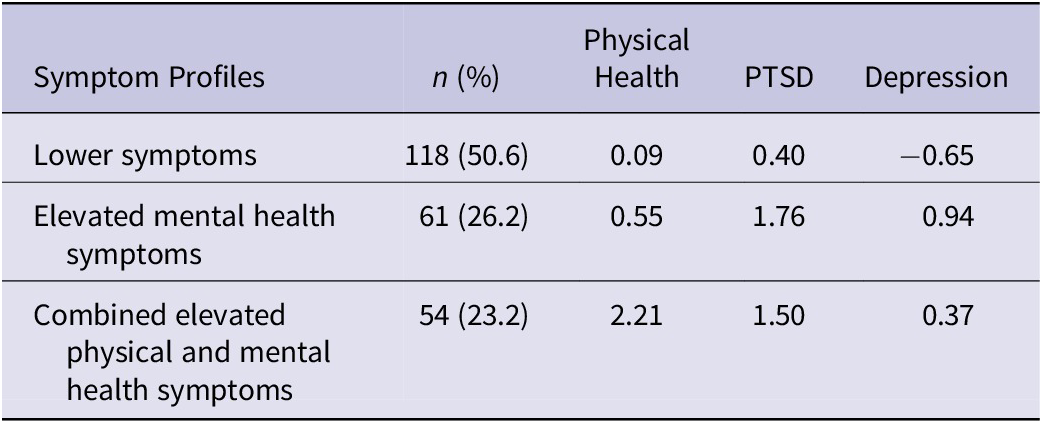
Next, post-disaster physical and mental health symptom profiles among older adults and corresponding differences in disaster exposure, post-flood stressors, and social vulnerability characteristics were examined. Cluster analysis identified three distinct health symptom profiles among older adults approximately five months after Hurricane Helene: a lower symptom burden profile, an elevated mental health symptom profile, and a combined elevated physical and mental health symptom profile (Table 2a). The lower symptom burden cluster (n = 118; 50.6%) was characterized by comparatively low levels of both physical and mental health symptoms, with older adults in this group reporting fewer overall health-related impacts at the time of assessment. The elevated mental health symptom cluster (n = 61; 26.2%) exhibited moderate to high psychological symptom burden, characterized by elevated PTSD and depressive symptom severity alongside modest elevations in physical health symptoms. Older adults in this cluster reported substantial psychological distress despite relatively limited physical symptom burden. The combined elevated physical and mental health symptom cluster (n = 54; 23.2%) was characterized by high co-occurring symptom burden across domains, including elevated PTSD and depressive symptom severity and elevated adverse physical health symptoms.
Older Adult Health Symptom Profiles Following Hurricane Helene

Note. Symptom profiles were identified using k-means cluster analysis based on standardized (z scores) physical health, PTSD, and depressive symptom scores.
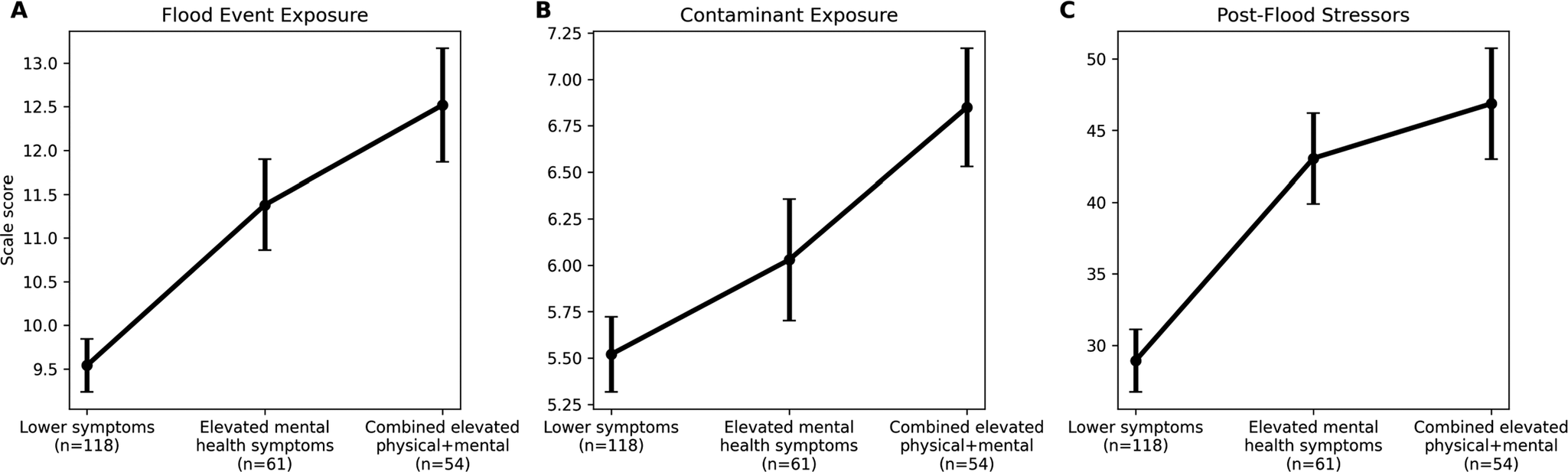
One-way ANOVA results indicated that Hurricane Helene–related flood exposure, contaminant exposure, and post-flood stressors differed significantly across the 3 symptom profiles. As shown in Figure 1, flood event exposure, contaminant exposure, and post-flood stressors increased in a graded manner across older adult symptom profiles, with the lowest levels observed among older adults in the lower symptom burden cluster and the highest levels among those in the combined elevated physical and mental health symptom cluster. Flood event exposure differed significantly by symptom profile, F(2, 230) = 48.36, p < .001, η2 = .30, reflecting a large effect size. Flood exposure was highest among older adults in the combined elevated symptom cluster (M = 12.52, SD = 2.39), intermediate among those in the elevated mental health symptom cluster (M = 11.38, SD = 2.02), and lowest in the lower symptom burden cluster (M = 9.54, SD = 1.66), with all pairwise comparisons reaching statistical significance. Contaminant exposure also differed significantly across clusters, F(2, 230) = 24.32, p <.001, η2 = .18, indicating a moderate effect size. Older adults in the combined elevated symptom cluster reported the highest contaminant exposure (M = 6.85, SD = 1.17), followed by those in the elevated mental health symptom cluster (M = 6.03, SD = 1.28), with the lowest exposure observed in the lower symptom burden cluster (M = 5.52, SD = 1.11); all pairwise comparisons were statistically significant. Post-flood stressors likewise varied substantially by symptom profile, F(2, 230) = 47.71, p <.001, η2 = .29, also reflecting a large effect size. Older adults in both the combined elevated physical and mental health symptom cluster (M = 46.87, SD = 14.25) and the elevated mental health symptom cluster (M = 43.05, SD = 12.34) reported significantly greater post-flood stressors than those in the lower symptom burden cluster (M = 28.92, SD = 11.95). One-way ANOVA results examining disaster exposure and post-flood stressors across symptom profiles are presented in Table 2b.
Older adults and Helene-related flood exposure and post-flood stressors by symptom profile.
Note. Panels A–C display mean scores (± 95% confidence intervals) for flood event exposure (A), environmental contaminant exposure (B), and post-flood stressors (C) across post-disaster physical and mental health symptom profiles identified via cluster analysis. The x-axis represents symptom profile membership—lower symptom burden (n = 118), elevated mental health symptoms (n = 61), and combined elevated physical and mental health symptoms (n = 54). The y-axis represents mean scale scores, with higher values indicating greater exposure severity or post-flood stressor burden. Group differences were examined using one-way ANOVA.

Disaster Exposure and Post-flood Stressors Across Older Adult Health Symptom Profiles

Note. Values are means (standard deviations). Group differences were assessed using one-way ANOVA with Games–Howell post hoc tests. sizes are reported as eta squared (η2). Higher values indicate greater flood and contaminant exposure and post-flood stressors, ***p <.001.
Finally, chi-square analyses indicated significant differences across older adult symptom profiles for disability or chronic illness status, χ2(2, N = 233) = 14.04, p = .007, and age group, χ2(4, N = 233) = 21.16, p = .048. Disability or chronic illness was more prevalent among older adults in the combined elevated physical and mental health symptom cluster (37.0%) and the elevated mental health symptom cluster (31.1%) compared with those in the lower symptom burden cluster (16.9%). Age group distributions also differed significantly across clusters, with adults aged 65-74 disproportionately represented in both higher symptom burden clusters, whereas adults aged 55-64 were more frequently represented in the lower symptom burden cluster. Adults aged 75 and older were less consistently represented across clusters, likely reflecting smaller sample sizes within this age group. In contrast, household income, categorized as low (<$25,000), medium ($25,000-$74,999), and high income levels (>$75,000) did not differ significantly across symptom profiles, χ2(4, N = 233) = 2.14, p = .710, indicating that variation in post-disaster physical and mental health symptom burden among older adults was more strongly associated with age group and disability or chronic illness status than with income.
Discussion and Conclusion
This brief report provides preliminary evidence of post-disaster physical and mental health symptoms among older adults approximately five months after Hurricane Helene in Southern Appalachia. Findings indicate that older adults reported moderate to severe PTSD, depression, and physical health symptom profiles were differentially associated with disaster exposure, environmental contamination, and post-flood stressors. The graded pattern observed across symptom profiles supports dose–response frameworks of disaster-related health impacts and highlights the salient impacts of event-specific exposure and post-disaster stressors months after the event.Reference First, Yu and Houston 8 Differences by disability status/chronic illness and age group further underscore the importance of identifying subgroups of older adults facing compounding vulnerabilities and tailoring recovery strategies to address co-occurring physical and mental health needs during the extended recovery period.Reference Aggarwal, Hu and Sullivan 9 , Reference Bell, Fiffer and Martindale 10 Future studies should adopt longitudinal, integrated approaches to examine co-occurring physical and mental health trajectories among older adults following disasters, with particular attention to chronic illness, disability, and cumulative post-disaster stressors during extended recovery periods.
Author contribution
All authors contributed to the study conception and design. Material preparation, data collection, and analysis were performed by the listed authors. The first draft of the manuscript was written by the first author and all authors commented on previous versions of the manuscript. All authors read and approved the final manuscript.
Funding statement
This research is based on work supported by NSF Award #1635593 at the Natural Hazards Center, University of Colorado; and NSF Award #2501470 at the University of Missouri.
Competing interests
The authors declare that they have no conflicts of interest.
Ethical standard
All study procedures were reviewed and approved by the University of Missouri Institutional Review Board (IRB #2125709)



 Open access

