

Government responsiveness to citizens’ preferences has been considered a sign of a well-functioning representative democracy. As underlined by Robert Dahl (Reference Dahl1971: 1), ‘A key characteristic of democracy is the continued responsiveness of the government to the preferences of its citizens, considered as political equals’. This is in line with Hanna Pitkin’s claim (Reference Pitkin1967: 232) that ‘representative government must be responsive to the people’. Scholars have thus devoted a lot of attention to the policy–opinion nexus and provided considerable evidence that governments are generally responsive to shifts in citizens’ preferences whether in adjusting their policies (Page and Shapiro Reference Page and Shapiro1983; Stimson et al. Reference Stimson, MacKuen and Erikson1995), their issue priorities (Hobolt and Klemmensen Reference Hobolt and Klemmensen2005, Reference Hobolt and Klemmensen2008) or public spending (Brooks and Manza Reference Brooks and Manza2006; Hobolt and Klemmensen Reference Hobolt and Klemmensen2008; Soroka and Wlezien Reference Soroka and Wlezien2010). Moreover, while the first studies on responsiveness mostly examined the American context (Erikson et al. Reference Erikson, Wright and McIver1989; Page and Shapiro Reference Page and Shapiro1983; Stimson et al. Reference Stimson, MacKuen and Erikson1995), more recent studies have considered government responsiveness from a cross-national perspective and the role and influence of political institutions in this process (Brooks and Manza Reference Brooks and Manza2006; Hobolt and Klemmensen Reference Hobolt and Klemmensen2008; Kang and Powell Reference Kang and Powell2010; Soroka and Wlezien Reference Soroka and Wlezien2010).
While the empirical literature has grown significantly, scholars have given less scrutiny to the conceptualization of government responsiveness and especially its relationship to the concepts of policy/ideological congruence. ‘Policy/ideological congruence’ refers to a static state where scholars examine the distance between a government policy/position and citizens’ preferences on this policy/position. A smaller (greater) distance between both positions implies more (less) congruence and, consequently, good (bad) representation. Even if policy/ideological congruence and government responsiveness are two distinct aspects of representation, the latter concept is highly connected to the former. The reason is that perfect congruence is unlikely to occur often because, as indicated by the literature on citizen–government ideological congruence, governments are generally to the left or right of their median citizen after elections (Blais and Bodet Reference Blais and Bodet2006; Golder and Stramski Reference Golder and Stramski2010; Powell Reference Powell2000). Consequently, ‘government responsiveness’ represents the dynamic changes from governments in order to improve policy/ideological congruence.
As we detail in the next section, our definition of government responsiveness has significant implications for scholars who have examined government responsiveness to citizens’ ideological preferences. The existing literature on ideological responsiveness, which we label the ‘standard approach’ for the sake of simplicity, claims that governments (or parties) are responsive whenever they move in the same direction as the median citizen (e.g. see the following studies: Adams Reference Adams2012; Adams et al. Reference Adams, Clark, Ezrow and Glascow2006, Reference Adams, Haupt and Stoll2009; Kang and Powell Reference Kang and Powell2010; McDonald and Budge Reference McDonald and Budge2005). This is that a government is responsive to its citizens whenever it moves to the right when the citizens move to the right and it moves to the left whenever the citizens move to the left. We show, however, that this basic claim is problematic given that these adjustments will not always bring the government policy closer to the position of the median citizen. Our conceptualization of responsiveness and its relationship to congruence thus refines the mechanisms of responsiveness put forward in these studies.
This article also contributes to a better understanding of how political institutions, and especially electoral systems, influence levels of government responsiveness. Importantly, we argue that electoral systems influence governments’ incentives to be responsive as well as their capacity to be responsive. By ‘incentives’, we mean the factors that may increase or decrease governments’ likelihood of getting re-elected. In particular, we consider how electoral systems influence voters’ capacity to sanction (reward) unresponsive (responsive) governments affecting, therefore, governments’ incentives to be responsive. By ‘capacity’, we mean the factors that facilitate or impede governments to act on these incentives and allow them to be responsive (or not) in the first place.
This article builds on George Tsebelis’s veto player approach (Reference Tsebelis2002). We argue that as the number of veto players increases in a government, this undermines the government’s capacity to change its policies/spending accordingly with shifts in citizens’ preferences. Moreover, as the number of veto players increases in a government, this decreases voters’ ability to identify the (un-)responsive parties in the cabinet, which decreases therefore their ability to (sanction) reward the (un-)responsive parties with the implication of decreasing governments’ incentives to be responsive. Our theory leads us to expect greater levels of government responsiveness under majoritarian electoral systems than proportional representation (PR) electoral systems, given that the number of parties in cabinet is generally greater under PR systems (formation of coalition governments most of the time) than under majoritarian systems (formation of single-party majority governments most of the time). Our theory also leads us to expect some variations in government responsiveness within PR electoral systems. In particular, we expect governments with fewer veto players to be more responsive than governments with several veto players.
We test our theory by examining advanced democracies over the post-war period. Following previous studies on government responsiveness (Brooks and Manza Reference Brooks and Manza2006; Kang and Powell Reference Kang and Powell2010; McDonald and Budge Reference McDonald and Budge2005), we test our claims with respect to the area of social spending. Especially, we examine whether governments adjust social spending accordingly with changes in citizens’ ideological preferences, as measured with survey data from the Comparative Study of Electoral Systems (CSES) and several national election studies. With regard to the impact of electoral systems, our results show, as expected, that governments adjust their spending accordingly with citizens’ ideological preferences only under majoritarian systems or under PR systems that produce single-party governments. As predicted, but contrary to the claim in the literature, these responsive governments only follow movements of the median citizen that are away from their position – not otherwise. The results of the article thus contribute to the debate about which electoral system fosters government responsiveness between government policies and citizens’ preferences. Overall, we provide significant evidence of the advantages of majoritarian systems in making government outputs respond to citizens’ preferences.
Conceptualizing government responsiveness to and congruence with citizens’ preferences
‘Perfect congruence’ between a government policy and citizens’ preferences represents a static state where the government policy/position perfectly matches the preference of the median citizen (see Figure 1a). Following the existing literature, we take the preference of the median citizen as the indication of citizens’ preferences (Cox Reference Cox1997; Huber and Powell Reference Huber and Powell1994). Perfect congruence is generally conceived as one of the core objectives of the democratic policymaking process (Dalton et al. Reference Dalton, Farrell and McAllister2011; Powell Reference Powell2004; Przeworski et al. Reference Przeworski, Stokes and Manin1999). Importantly, scholars claimed that politicians face significant electoral incentives to implement policies close to citizens’ preferences (Erikson et al. Reference Erikson, MacKuen and Stimson2002; Mansbridge Reference Mansbridge2003; Mayhew Reference Mayhew1974; Soroka and Wlezien Reference Soroka and Wlezien2010; Stimson et al. Reference Stimson, MacKuen and Erikson1995), especially mainstream parties (Adams et al. Reference Adams, Clark, Ezrow and Glascow2006; Ezrow et al. Reference Ezrow, De Vries, Steenbergen and Edwards2011).
Conceptualizing (In)Congruence and Responsiveness
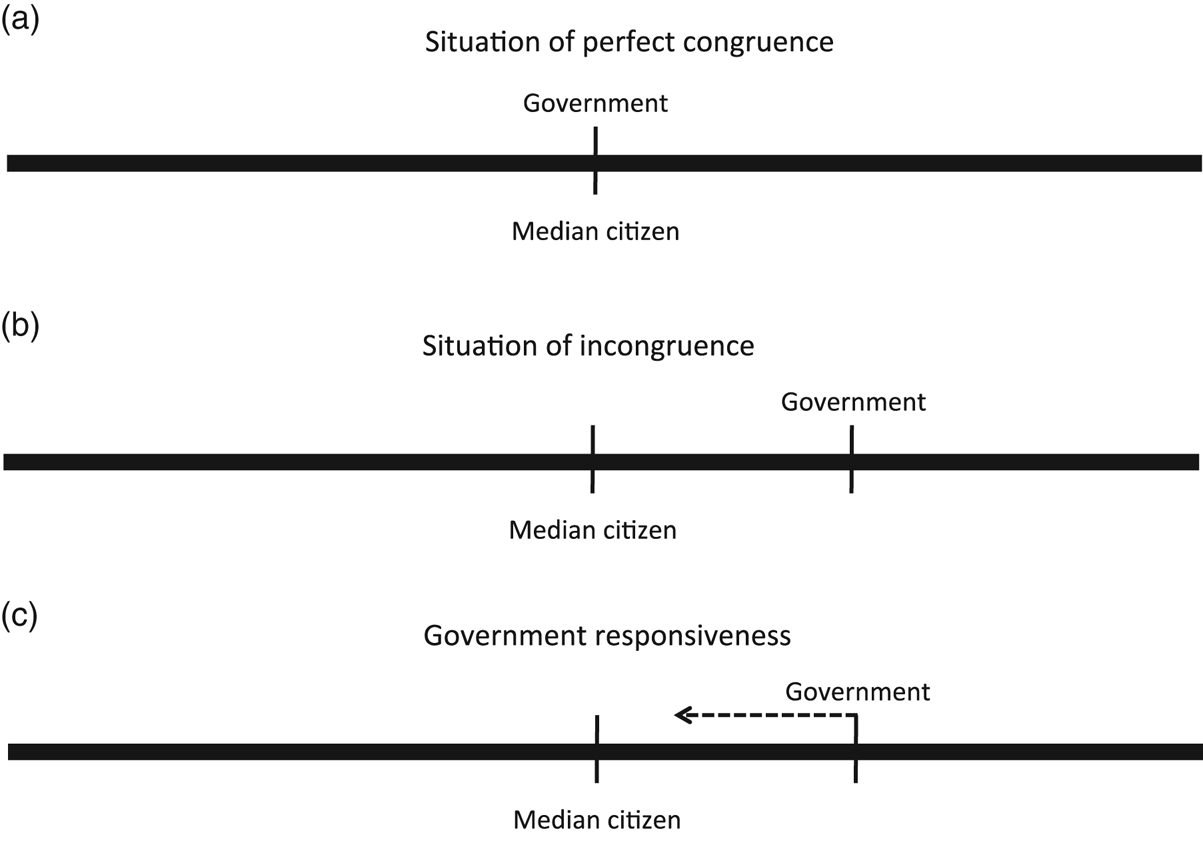
Conversely, a situation of incongruence is displayed in Figure 1b, which indicates a mismatch between the position of the median citizen and the government policy (see Golder and Stramski Reference Golder and Stramski2010 for different conceptualizations of congruence). Given a situation of incongruence, government responsiveness represents an action taken by the government to foster congruence between the government policy and the preference of the median citizen as shown by the dashed arrow in Figure 1c. Congruence is thus a static state where we examine the distance between a government policy and the preference of the median citizen on a policy (as in Figure 1b), while responsiveness involves a dynamic change from the government in order to foster congruence (as in Figure 1c) and which could ultimately lead to perfect congruence (as in Figure 1a).
Situations of perfect congruence, however, are rare (Blais and Bodet Reference Blais and Bodet2006; Golder and Stramski Reference Golder and Stramski2010; Powell Reference Powell2000) and citizens may change as well their preferences (Durr Reference Durr1993; Soroka and Wlezien Reference Soroka and Wlezien2010). Therefore, the question is, given a situation of incongruence, does a government change its policy in a way that makes it more congruent with the preference of the median citizen and thus responsive? There are two possibilities to consider with respect to possible changes in the preference of the median citizen. First, the preference of the median citizen may move away from the government policy, with the consequence of decreasing congruence. Second, the preference of the median citizen may move towards the government policy, with the consequence of increasing congruence.Footnote 1
According to the existing literature on government responsiveness to citizens’ ideological preferences (Adams et al. Reference Adams, Clark, Ezrow and Glascow2006, Reference Adams, Haupt and Stoll2009; Kang and Powell Reference Kang and Powell2010; McDonald and Budge Reference McDonald and Budge2005), responsive governments should always move (their policy position and public spending) in the same direction that the median citizen moves: if the median citizen moves left, the government should move left, while if the median citizen moves right, the government should move right.
A shortcoming of the standard approach, however, is that not all government responses lead to an increase in congruence. As displayed in Figure 1 (b or c), if the median citizen moves left, the government should move left and this movement will increase congruence. However, if the median citizen moves right towards the government and the government also moves right, this movement will not increase congruence with the median citizen. The problem is that the standard approach omits to consider whether the preference of the median citizen is initially to the left or right of the government and, therefore, whether the median citizen moves towards or away from the government.
Conversely, our predictions all lead to an improvement in congruence. This is that government responsiveness implies a dynamic change from the government in order to foster congruence. First, if the preference of the median citizen is moving to the left away from the government, the government is responsive to citizens’ preferences if it changes its policy to the left towards the preference of the median citizen. The more the government changes its policy close to the new position of the median citizen, the more responsive the government. This prediction is consistent with the prediction of the standard approach. Second, if the preference of the median citizen is moving to the right towards the government policy, the government is responsive to citizens’ preferences if it changes its policy to the left towards the preference of the median citizen. This prediction is different from the prediction of the standard approach (see the online appendix for details and several figures supporting these predictions).
Two key points appear from our predictions. First, the direction of a government’s movement to be responsive depends on whether the median citizen is to the left or right of the government. If the median citizen is to the left and moves left, the government should move left, but if the median citizen is to the right and moves left, the government should move right – and vice versa.Footnote 2 Second, a situation where the preference of the median citizen is moving away from the government policy is detrimental to congruence while a situation where the preference of the median citizen is moving towards the government policy is beneficial. Governments may view beneficial or harmful movements by the median citizen in different ways. In effect, it is potentially costly for a government not to answer a change in the position of the median citizen away from its position, while this is not necessarily the case when the median citizen is moving towards its position – actually a change from the median citizen towards the government position might be electorally beneficial. Consequently, the magnitude and the likelihood of the change in policy should be significantly greater when the median citizen is moving away from the government than when the median citizen is moving towards the government. We thus propose the following hypotheses:
Hypothesis 1: (The moving-away hypothesis) When the position of the median citizen is moving to the left (right) away from the position of the government to her right (left), the government will adjust – significantly – its spending upwards (downwards).
Hypothesis 2: (The moving-closer hypothesis) When the position of the median citizen is moving to the left (right) towards the position of the government to her left (right), the government will adjust its spending downwards (upwards).
These hypotheses are also consistent with spatial models of party competition that predict convergence on the median voter for parties that have vote-seeking motivations (Downs Reference Downs1957; Enelow and Hinich Reference Enelow and Hinich1984). We acknowledge, however, that alternative models which incorporate policy-seeking motivations indicate that parties do not always converge on the median voter and may even move away from the median citizen (Wittman Reference Wittman1977, Reference Wittman1983). While this is a possibility, we note that parties forming governments are generally mainstream parties that place greater emphasis on vote-seeking than policy-seeking objectives (D’Alimonte Reference D’Alimonte1999; Kitschelt Reference Kitschelt1994). On the other hand, the prediction that some parties will not converge on the median voter is more suited to the behaviour of niche parties (seldom in government) that have been characterized as mostly policy-oriented and not inclined to be responsive to the median voter (Ezrow et al. Reference Ezrow, De Vries, Steenbergen and Edwards2011). For these reasons, we assume that our hypotheses are mostly supported by predictions of spatial models of party competition given the type of parties that generally form governments. Importantly, we will distinguish in the next analyses whether governments move closer or away from the median citizen and thus confirm (or not) these predictions.
Government responsiveness and the impact of electoral systems
Scholars have recently begun examining the impact of electoral systems on government responsiveness to citizens’ preferences. Until now, they offered contradictory expectations about whether government responsiveness should be greater under majoritarian or PR electoral systems in considering mostly the electoral incentives provided by each electoral system. For example, Sara Hobolt and Robert Klemmensen (Reference Hobolt and Klemmensen2008) assume that governments under majoritarian systems have more incentives to be responsive to local interests and pivotal districts than to the median voter, whereas governments under PR systems have more incentives to be responsive to the wider public. Hobolt and Klemmensen (Reference Hobolt and Klemmensen2008) found that government responsiveness (at least in respect of governments’ annual speeches outlining the government’s policy priorities) is greater in Denmark (PR system) than in Britain (majoritarian system). Shin-Goo Kang and G. Bingham Powell (2010) also expect government responsiveness to be greater under PR systems than majoritarian systems but for a different reason. According to Kang and Powell (Reference Kang and Powell2010), government responsiveness to citizens’ preferences should be greater under PR systems than majoritarian systems due to the greater citizen–government ideological congruence observed in PR systems for their period of study. In examining advanced democracies over the post-war period, they show that governments adjust their welfare spending accordingly with shifts in the position of the median voter – shifts to the left (right) influence welfare spending upwards (downwards) – but they found similar levels of government responsiveness under majoritarian and PR systems (Kang and Powell Reference Kang and Powell2010).
In disagreement with Kang and Powell (Reference Kang and Powell2010) and Hobolt and Klemmensen (Reference Hobolt and Klemmensen2008), Christopher Wlezien and Stuart Soroka (Reference Wlezien and Soroka2012) expect governments in majoritarian systems to be more responsive since it is easier for a single-party government to react to changes in public opinion and because the electoral incentives are greater due to a greater seats–votes elasticity. They also provided some evidence of greater government responsiveness under majoritarian systems. Wlezien and Soroka (Reference Wlezien and Soroka2015) detailed afterwards their expectations in considering the electoral and organizational mechanisms of dynamic representation (i.e. representation between elections). Wlezien and Soroka (Reference Wlezien and Soroka2015) emphasized the distinction between coalition governments (PR systems) and single-party majority governments (majoritarian systems), which have different incentives to be responsive but also differ in terms of the coordination cost that confronts them in the face of a changing public opinion. Consistent with their prior work, they expected better dynamic representation under majoritarian systems than proportional electoral systems but did not directly test this expectation.
Overall, evidence about the impact of electoral systems on government responsiveness is mixed while the expectations are mostly contradictory. Importantly, scholars – except Wlezien and Soroka (Reference Wlezien and Soroka2015) – did not distinguish how electoral systems affect governments’ incentives to be responsive from their capacity to be responsive. This shortcoming is problematic given that in order to take advantage of the electoral incentives to be responsive, governments must have the capacity to act on these incentives in the first place. It is thus important to consider both types of factors when examining the impact of electoral systems on government responsiveness. In the next section, we address these shortcomings.
Veto players and government responsiveness
Building on the work of Wlezien and Soroka (Reference Wlezien and Soroka2015), we assume that two conditions are necessary for government responsiveness to occur. First, a government must have the capacity to change the status quo – that is, the actual policy. Second, a government must have the incentives to change the status quo in accordance with citizens’ preferences. In order to understand the impact of electoral systems on government responsiveness we must, therefore, examine how electoral systems influence each of these factors. We believe that Tsebelis’s theory of veto players (Reference Tsebelis2002) is a useful theoretical approach for developing our expectations regarding the impact of electoral systems on government responsiveness since it relates to these two conditions. Tsebelis (Reference Tsebelis2002: 37) defines a veto player as an individual or a collective group whose agreement is necessary in the decision-making process for changing policy outcomes. Tsebelis shows that as the number of veto players increases, policy stability is enhanced – or at least is not weakened (first condition). Following previous studies (Bawn Reference Bawn1999; Ha Reference Ha2008; Tsebelis Reference Tsebelis2002; Tsebelis and Chang Reference Tsebelis and Chang2004), we assume that each party in a government represents a partisan veto player. This is reasonable given that, ultimately, a party in government always has at its disposal the threat of leaving the coalition in order to turn down a proposed policy change. Consequently, as the number of parties increases in cabinet, it reduces the government’s capacity to change the status quo and consequently to be responsive to citizens’ preferences. This is that governments’ capacity to be responsive declines as the number of parties increases in cabinet.
In addition, a veto player framework has some implications for the electoral incentives that governments have to be responsive (second condition). This is because the number of veto players in cabinet also affects the extent to which governments are accountable to voters and consequently their incentives to be responsive. The underlying assumption in studies of government responsiveness is that responsive governments might be rewarded electorally while unresponsive governments might be harmed electorally. For that to occur, however, voters must have the ability to identify the (un-)responsive parties in cabinet in order to (punish) reward them accordingly. If voters are unable to do so this decreases government incentives to be responsive. Government responsiveness should thus be greater when clarity of responsibility is maximized – that is, politicians have greater electoral incentives to be responsive when the political system makes them clearly accountable for their actions. In effect, the number of parties in government affects negatively the clarity of responsibility among the coalition partners and the extent to which, therefore, these parties are accountable to voters (Fisher and Hobolt Reference Fisher and Hobolt2010; Powell and Whitten Reference Powell and Whitten1993). Indeed, the fact that a coalition of parties is responsible for the overall government direction makes it difficult for voters to assign the responsibility of each party separately – parties that are held accountable separately at election time. The veto player approach thus indicates that, as the number of veto players increases in a cabinet, governments have fewer incentives to be responsive because the threat (benefit) of being sanctioned (rewarded) for unresponsive (responsive) actions declines.
Overall, the veto player approach provides clear expectations about the conditions under which governments have the capacity and the incentives to change the status quo in accordance with changes in citizens’ preferences. Given that governments involve a greater number of veto players under PR electoral systems (coalition governments generally) than under majoritarian systems (single-party majority governments generally), it should be harder for these governments to respond to changes in citizens’ preferences. In addition, the veto player approach is useful in making predictions about how government responsiveness varies within PR systems. Under PR systems, we assume that governments having more parties should be less responsive to changes in citizens’ preferences than cabinets with a smaller number of parties. Overall, we expect the following hypotheses:Footnote 3
Hypothesis 3: (The majoritarian hypothesis) Government responsiveness is greater under majoritarian systems than under PR systems.
Hypothesis 4: (The number-of-parties hypothesis) Under PR systems, government responsiveness decreases as the number of parties in government increases.
Data and measurement
In order to test the previous hypotheses, we need data that provide the positions of citizens and governments on a policy dimension, over time and across countries. The CSES meets this objective given that it gathers citizens’ preferences on the left–right ideological scale as well as their perception of each party position over the 1996–2016 period in several countries (modules 1 to 4). One of the advantages of the CSES data is also that the surveys are implemented approximately at the same time, after national elections, which allows us to examine government responsiveness from approximately the same starting point – that is, when governments are formed. In order to increase the number of consecutive elections for measuring changes in citizens’ preferences we also gather for each country all the national election studies where it was possible to locate citizens’ and parties’ positions on a left–right ideological scale.
Testing our hypotheses with respect to the left–right ideological scale is interesting given that the left–right cleavage has represented a meaningful political dimension in advanced industrial democracies throughout the post-war period (Dalton et al. Reference Dalton, Farrell and McAllister2011; McDonald and Budge Reference McDonald and Budge2005; Powell Reference Powell2000). We recognize that new dimensions of political competition have arisen in recent years (Bakker et al. Reference Bakker, Jolly and Polk2012; Kriesi et al. Reference Kriesi, Grande, Frey, Lachat, Dolezal and Bornschier2008) but the left–right ideological dimension remains an important dimension that still structures party systems and vote choice in advanced democracies (Dalton et al. Reference Dalton, Farrell and McAllister2011; Jessee Reference Jessee2012; Joesten and Stone Reference Joesten and Stone2014). In particular, the left–right scale has been shown to be one of the most compelling measures for summarizing citizens’ preferences on different welfare/social policy issues (Dalton et al. Reference Dalton, Farrell and McAllister2011; Huber Reference Huber1989) which is directly associated to the government policies that we analyse – social spending. In the next empirical analyses, we thus follow previous studies (Kang and Powell Reference Kang and Powell2010; McDonald and Budge Reference McDonald and Budge2005) which showed that changes in citizen preferences as measured on a left–right ideological dimension are generally correlated to the adjustments that governments make to their social spending.Footnote 4
Overall, the study includes 16 advanced democracies over the 1980–2016 period. The countries under majoritarian systems are: Australia, Canada, France, New Zealand (pre-1996) and the UK. The countries under PR systems are: Austria, Denmark, Finland, Germany, Iceland, Ireland, the Netherlands, New Zealand (post-1995), Norway, Spain, Sweden and Switzerland (see Table A in the online appendix for the list of elections).Footnote 5
Measuring change in social spending
The social expenditure database provided by the OECD is used to measure shifts in government spending. Social spending includes different policy domains such as unemployment, housing, family, old age, etc. The dependent variable is the change in public social expenditure as a percentage of a country GDP between two elections – that is, between the year at the beginning of a government mandate and the year at the end of a government mandate (electiont-1 and electiont).Footnote 6 The rationale for this interval is discussed in the next section and relates to the period when citizens’ and governments’ positions are measured. Overall, it appears that the average absolute change in social spending over the lifetime of governments is slightly greater under PR systems (1.66 points of percentage of GDP) than under majoritarian systems (1.03 points of percentage of GDP) – a difference-in-means test indicates that the difference is statistically significant at the 0.1 level.
Measuring change in the position of the median citizen
In order to locate the positions of the median citizen and government for each country, we use data from the CSES project. The question used in the CSES data set to locate respondents’ left–right position is: ‘In politics people sometimes talk of left and right. Where would you place yourself on a scale from 0 to 10 where 0 means the left and 10 means the right?’ For each election survey we compute the median position of all respondents.Footnote 7 Respondents were also asked to locate each party on a 0–10 left–right scale. We thus compute the government position based on each party’s median position weighted by its share of cabinet portfolios. We use the European Journal of Political Research Political Data Yearbook to determine each party’s share of cabinet portfolios. For the pre-1991 period, we use Swank’s data set (Swank Reference Swank2006).Footnote 8 Note that we exclude governments when there was a change in cabinet during the government mandate (a change in the coalition members) as it is not possible to assess whether the median citizen is moving towards or away from these new governments given our research design.Footnote 9 In order to increase the number of consecutive elections, we also include all national election studies that asked respondents to locate themselves and each party on a 0–10 left–right scale. Overall, we have 15 pairs of consecutive elections under majoritarian systems and 40 under PR systems.Footnote 10
The argument to be tested is that government responsiveness is contingent on whether the median citizen is moving towards or away from a government to her left (right). Accordingly, two variables are needed to capture changes in the position of the median citizen: closer Δ median citizen (changes towards governments) and away Δ median citizen (changes away from governments). To compute these variables, we need first to compute Δ median citizen, which is the difference between the position of the median citizen at the end of a government mandate (t) and the beginning of a government mandate (t−1). Our empirical strategy is thus to examine whether governments adjust their social spending over their mandate – that is, between the beginning and the end of their term in office – in response to changes in the position of the median citizen over the same period. We recognize that a better research design would be to examine the effect of ∆ median citizen on ∆ social spending at the year level but, to our knowledge, there are no data that provide the position of the median citizen annually and cross-nationally.
Closer Δ median citizen and away Δ median citizen are computed as follows: $Away{\rm{ }}\Delta {\rm{ }}{\mkern 1mu} median{\mkern 1mu} citizen = \Delta {\rm{ }}{\mkern 1mu} median{\mkern 1mu} citizen{\rm{ }} \times {\rm{ }}disadvantageous$ $Closer{\rm{ }}\Delta {\rm{ }}{\mkern 1mu} median{\mkern 1mu} citizen = \Delta {\rm{ }}{\mkern 1mu} median{\mkern 1mu} citizen \times \left( {1 - disadvantageous} \right)$
where disadvantageous is a dummy variable that indicates whether Δ median citizen is away from the government (coded 1) – when the median citizen to the right (left) of the government moves to the right (left) – or towards the government (coded 0) – when the median citizen to the right (left) of the government moves to the left (right). It is important to underline that closer and away Δ median citizen are minor modifications of the variable Δ median citizen and that they encompass all the information provided in the latter.
Our expectation is that the coefficient of closer Δ median citizen will be positive, indicating that when the median citizen is moving to the left (right) towards a government to her left (right), the government decreases (increases) its social spending.Footnote 11 On the other hand, the estimated coefficient of away Δ median citizen should have a negative sign indicating that when the median citizen is moving to the left (right) away from a government to her right (left), the government increases (decreases) its social spending.
Overall, governments under majoritarian and PR systems are facing similar demands from their citizens with respect to shifts in the position of the median citizen. The latter are generally disadvantageous to governments (67% and 73% of the cases under majoritarian and PR systems, respectively) and of moderate magnitude. However, we note that changes in the position of median citizen away from governments in PR systems are generally more disadvantageous to governments (1.71 points) than under majoritarian systems (0.71 points) – the difference is statistically significant at the 0.1 level. The difference in the average change towards the government under majoritarian (0.53) and PR (0.53) systems is not statistically significant.
Control variables
A number of factors that may be correlated with our independent variables and Δ social spending must be controlled for. For example, it is necessary to include variables such as Δ unemployment and Δ proportion of the population over 65 years old since they directly affect social spending (Franzese Reference Franzese2002: 76) and they may affect citizens’ preferences on social spending. Moreover, given that Δ social spending is expressed as a proportion of GDP, we also control for a country’s GDP at the beginning of the mandate and the Δ GDP between elections. The data for these control variables come from the OECD statistics database.Footnote 12 We also control for the level of social spending at the beginning of the mandate as it may influence citizens’ preferences on social spending as well as governments’ capacity to change social spending. For example, high levels of social spending may induce citizens to express a preference for a decrease in social spending – as predicted by the thermostatic model (Soroka and Wlezien Reference Soroka and Wlezien2010) – while it may also hamper governments’ capacity to increase social spending even further. We also include the positions of the median citizen and government at the beginning of the mandate because these variables may also influence Δ social spending and we want to assure that the impact of closer and away Δ median citizen holds wherever the median citizen and government are at the beginning of the mandate.
Testing the moving-away and moving-towards hypotheses
In Table 1, we present the results of OLS regressions with fixed-effects for each country: the within regression estimator. Country fixed-effects control for the omission of time-invariant variables (essentially country-specific variables) such as federalism and bicameralism. It is important to control for these types of variables with fixed-effects given that not doing so may bias the impact of the independent variables. The introduction of country fixed-effects also relaxes the assumption that a government/median citizen position on the left–right ideological scale represents exactly the same substantive position cross-nationally. However, it does not affect the assumption that a one-unit change on the left–right scale represents the same distance across countries. Note that country fixed-effects may be problematic for testing the majoritarian hypothesis – we discuss this issue below.
The Impact of Closer/Away ∆ Median Citizen on ∆ Social Spending

Notes: Robust standard errors in parentheses.
* p <0.10
** p <0.05
*** p <0.01. The dependent variable is the change in social spending between two elections as a percentage of a country GDP. The analysis includes 16 countries over the 1980–2016 period. Controls are not displayed. See Table B in the online appendix for the full table including control variables.
In Table 1, we test the moving-away and moving-towards hypotheses and examine the impact of closer and away Δ median citizen on Δ social spending. We estimate the following specification:Footnote 13 $\Delta {\rm{ }}{\mkern 1mu} social{\mkern 1mu} spending = {{\rm{b}}_1} + {{\rm{b}}_2}\left[ {closer{\rm{ }}\Delta {\rm{ }}{\mkern 1mu} median{\mkern 1mu} citizen} \right] + {{\rm{b}}_3}\left[ {away{\rm{ }}\Delta {\rm{ }}{\mkern 1mu} median{\mkern 1mu} citizen} \right] + {{\rm{b}}_4}\left[ {disadvantageous} \right] + controls$
To support our hypotheses, recall that closer Δ median citizen and away Δ median citizen should have a positive and negative impact, respectively. Given that our hypotheses are in opposition with the claim of the standard approach that governments must adjust their spending upwards (downwards) whenever the median citizen is moving to the left (right), we also compare the impacts of our variables of interest with the impact of Δ median citizen. If the standard approach is accurate Δ median citizen will have a negative effect on Δ social spending.
In column (1) of Table 1, we present the results of the impact of Δ median citizen. The coefficient of Δ median citizen is negative (−0.08) as predicted by the standard approach but the impact is not statistically significant at the 0.1 level. The second step is to examine the impact of closer and away Δ median citizen on Δ social spending. The results are presented in column (2) and do not support our Hypotheses 1 and 2. The coefficients of closer (−0.12) and away Δ median citizen (−0.04) are both negative and they do not reach the conventional level of statistical significance. These initial results run against our main hypotheses but they may, however, mask effects heterogeneity across majoritarian and PR electoral systems. We address this possibility and test the majoritarian hypothesis in the next section.
Testing the majoritarian hypothesis
In Table 2, we test the majoritarian hypothesis. Recall that we expect government responsiveness to be greater under majoritarian systems than PR systems. To be consistent with our hypothesis, the impact of closer and away Δ median citizen should be, respectively, positive and negative under both electoral systems but the magnitude of these effects should be greater under majoritarian systems than PR systems. To test the majoritarian responsiveness hypothesis we estimate the following specification: $\Delta {\rm{ }}{\mkern 1mu} social{\rm{ }}spending = {{\rm{b}}_1} + {{\rm{b}}_2}\left[ {closer{\rm{ }}\Delta {\rm{ }}{\mkern 1mu} median{\mkern 1mu} {\rm{ }}citizen \times PR} \right] + {{\rm{b}}_3}\left[ {away{\rm{ }}\Delta {\rm{ }}{\mkern 1mu} median{\rm{ }}citizen \times PR} \right] + {{\rm{b}}_4}\left[ {closer{\rm{ }}\Delta {\rm{ }}{\mkern 1mu} median{\rm{ }}citizen \times MAJ} \right] + {{\rm{b}}_5}\left[ {away{\rm{ }}\Delta {\rm{ }}{\mkern 1mu} median{\rm{ }}citizen \times MAJ} \right] + {{\rm{b}}_6}\left[ {disadvantageous} \right] + {{\rm{b}}_7}\left[ {disadvantageous \times PR} \right] + {{\rm{b}}_8}[PR] + controls,$
where PR is a dummy variable coded 1 for PR electoral systems and 0 for majoritarian systems while MAJ is a dummy variable coded 0 for PR electoral systems and 1 for majoritarian systems. Given that disadvantageous is a constitutive term of closer and away Δ median citizen it is also necessary to interact disadvantageous with PR. Footnote 14
The Conditioning Impact of Electoral Systems

Notes: Robust standard errors in parentheses.
* p <0.10
** p <0.05
*** p <0.01. The dependent variable is the change in social spending between two elections as a percentage of a country GDP. The analysis includes 16 countries over the 1980–2016 period. Controls are not displayed. See Table C in the online appendix for the full table including control variables.
Note that this specification follows Thomas Brambor et al.’s (Reference Brambor, Roberts Clark and Golder2006: see equation 7, 69–70) alternative specification when dealing with a discrete modifying variable (see also Wright Reference Wright1976). The main advantage of this specification is to ease the interpretation of the results (see Ferland Reference Ferland2017a for a more detailed discussion of the two approaches). In Table 2, the impact of closer and away Δ median citizen on Δ social spending under majoritarian and PR electoral systems, respectively, are provided directly from the coefficients displayed in columns (2) and (4). In particular, closer Δ median citizen × MAJ indicates the effect of a change in the position of the median citizen towards the government position under majoritarian systems; closer Δ median citizen × PR indicates the effect of a change in the position of the median citizen towards the government position under PR systems; away Δ median citizen × MAJ indicates the effect of a change in the position of the median citizen away from the government position under majoritarian systems; and away Δ median citizen × PR indicates the effect of a change in the position of the median citizen away from the government position under PR systems. To get these corresponding effects in the ‘standard approach’ to interaction models, we would need to add up several coefficients. Importantly, the results of both approaches are statistically the same (see Tables E and F in the appendix for the replication of the results with the standard approach).
In column (1) of Table 2, we first test the claim of the standard approach and present the impacts of Δ median citizen on Δ social spending under majoritarian (Δ median citizen) and PR systems (Δ median citizen × PR). It appears that Δ median citizen has a negative impact on Δ social spending under majoritarian systems. This is indicated by the coefficient of Δ median citizen in column (1), which equals −0.17 and is statistically significant at the 0.1 level. This is consistent with predictions of scholars claiming that governments must increase (decrease) spending whenever the median citizen is moving to the left (right). However, this relationship does not appear under PR systems. In column (1), the effect of Δ median citizen in PR systems is given by the sum of the coefficients of Δ median citizen (−0.17) and Δ median citizen × PR (0.11) which equals −0.06 and is not statistically significant at the 0.1 level as indicated by a Wald test. The results in column (1) – at least with respect to governments under majoritarian systems – are thus consistent with the predictions of the standard approach, which claims that governments should increase (decrease) social spending whenever the median citizen is moving to the left (right).
Note that even if the results in column (1) of Table 2 are in line with the standard approach we must keep in mind that the impact of Δ median citizen in column (1) actually blurs the impact of closer and away Δ median citizen on Δ social spending. In column (2), we distinguish these impacts, respectively, under majoritarian and PR systems. In column (2), the results support the majoritarian hypothesis when it comes to the impact of away Δ median citizen: away Δ median citizen × MAJ has a negative impact (−0.49) on Δ social spending which is statistically significant at the 0.01 level while the impact of away Δ median citizen × PR is close to zero and not statistically significant (−0.04). This indicates, as predicted, that as the median citizen is moving to the right (left) by one unit on the left–right scale away from the government position, under majoritarian systems social spending decreases (increases) by 0.49 points of percentage of a country’s GDP. Conversely, the fact that the coefficient of away Δ median citizen × PR (−0.04) is not statistically different from 0 indicates that governments under PR systems do not respond to changes in the position of the median citizen that are away from government positions. Moreover, a Wald test confirms that the difference of 0.45 points between the coefficients of away Δ median citizen × MAJ (−0.49) and away Δ median citizen × PR (−0.04) is statistically significant at the 0.01 level.
In column (2) it appears, however, that governments under majoritarian systems are not more responsive than governments under PR systems when the median citizen is moving towards the government position. While closer Δ median citizen × MAJ (0.33) is positive and in the expected direction in column (2), it fails to reach the conventional level of statistical significance. Moreover, closer Δ median citizen × PR (−0.12) is negative and not statistically significant at the 0.1 level. The difference between these two coefficients is not statistically significant, as indicated by a Wald test. Against our expectation, these results indicate that governments under majoritarian and PR systems do not adjust their social spending downwards (upwards) when the median citizen to the right (left) of the government is moving to the left (right) towards the government.
Even if these results associated with closer Δ median citizen do not support our expectations they add some nuance to the validity of the standard approach in column (1). In effect, if governments were adjusting their social spending as predicted by the standard approach, both the coefficients of away Δ median citizen × MAJ and closer Δ median citizen × MAJ in column (2) would have been negative and statistically significant. This would have been consistent with the negative impact of Δ median citizen displayed in column (1). The fact, therefore, that only away Δ median citizen × MAJ is negative and statistically significant while not closer Δ median citizen × MAJ indicates that governments under majoritarian systems do not adjust their social spending in the manner predicted by the standard approach. The negative impact of Δ median citizen in column (1) appears to be driven mostly by those governments under majoritarian systems that are being responsive to shifts in the position of the median citizen that are away from their position.
We must also underline that the results associated with the impact of closer Δ median citizen – even if not directly consistent with the moving-closer hypothesis – are actually more consistent with our framework of government responsiveness than with the standard approach. As noted above, changes in the position of the median citizen towards governments are beneficial to governments. The fact that governments are not responsive to these changes (in keeping social spending at about the same level) is, therefore, more beneficial to congruence than if governments were moving social spending in the same direction of the median citizen as predicted by the standard approach.
To validate these results further, we replicate the results of columns (1) and (2) with a random-effects model in columns (3) and (4) and find substantively similar results. Overall, the results displayed in Table 2 support the majoritarian hypothesis with respect to the impact of away Δ median citizen and indicate that governments under majoritarian systems are more responsive to changes in the position of the median citizen than governments under PR systems when these changes are away from the government position.
Government responsiveness within PR systems
The previous results indicate that governments under PR systems are not responsive to shifts in the position of the median citizen whether these changes are towards or away from the government position. As we argued above, however, it is still possible that government responsiveness occurs under certain types of governments in PR systems. In particular, we argued that government responsiveness under PR systems should decrease as the number of parties in government increases (Hypothesis 4). In order to test this hypothesis under PR systems, we estimate the following specifications (the model number corresponds to the column in Table 3). Note that we test our hypotheses in two separate models because of the small number of observations that we have in PR systems (40) and the several interaction effects which reduce significantly the degrees of freedom.
 $$\matrix{
{(model{\rm{ 2}}){\rm{ }}\Delta {\rm{ }}social{\rm{ }}spending = {{\rm{b}}_1} + {{\rm{b}}_2}[closer{\rm{ }}\Delta {\rm{ }}median{\rm{ }}citizen] + {{\rm{b}}_3}[closer{\rm{ }}\Delta {\rm{ }}median{\rm{ }}citizen{\rm{ }} \times {\rm{ \# }}of{\rm{ }}parties] + {{\rm{b}}_4}[\# {\rm{ }}of{\rm{ }}parties] + {{\rm{b}}_5}[away{\rm{ }}\Delta {\rm{ }}median{\rm{ }}citizen] + {{\rm{b}}_6}[disadvantageous] + {{\rm{b}}_7}[disadvantageous] + controls} \cr
{(model{\rm{ 3}}){\rm{ }}\Delta {\rm{ }}social{\rm{ }}spending = {{\rm{b}}_1} + {{\rm{b}}_2}[away{\rm{ }}\Delta {\rm{ }}median{\rm{ }}citizen] + {{\rm{b}}_3}[away{\rm{ }}\Delta {\rm{ }}median{\rm{ }}citizen{\rm{ }} \times {\rm{ \# }}of{\rm{ }}parties] + {{\rm{b}}_4}[\# {\rm{ }}of{\rm{ }}parties] + {{\rm{b}}_5}[closer{\rm{ }}\Delta {\rm{ }}median{\rm{ }}citizen] + {{\rm{b}}_6}[disadvantageous] + {{\rm{b}}_7}[disadvantageous \times {\rm{ \# }}of{\rm{ }}parties] + controls} \cr
} $$
$$\matrix{
{(model{\rm{ 2}}){\rm{ }}\Delta {\rm{ }}social{\rm{ }}spending = {{\rm{b}}_1} + {{\rm{b}}_2}[closer{\rm{ }}\Delta {\rm{ }}median{\rm{ }}citizen] + {{\rm{b}}_3}[closer{\rm{ }}\Delta {\rm{ }}median{\rm{ }}citizen{\rm{ }} \times {\rm{ \# }}of{\rm{ }}parties] + {{\rm{b}}_4}[\# {\rm{ }}of{\rm{ }}parties] + {{\rm{b}}_5}[away{\rm{ }}\Delta {\rm{ }}median{\rm{ }}citizen] + {{\rm{b}}_6}[disadvantageous] + {{\rm{b}}_7}[disadvantageous] + controls} \cr
{(model{\rm{ 3}}){\rm{ }}\Delta {\rm{ }}social{\rm{ }}spending = {{\rm{b}}_1} + {{\rm{b}}_2}[away{\rm{ }}\Delta {\rm{ }}median{\rm{ }}citizen] + {{\rm{b}}_3}[away{\rm{ }}\Delta {\rm{ }}median{\rm{ }}citizen{\rm{ }} \times {\rm{ \# }}of{\rm{ }}parties] + {{\rm{b}}_4}[\# {\rm{ }}of{\rm{ }}parties] + {{\rm{b}}_5}[closer{\rm{ }}\Delta {\rm{ }}median{\rm{ }}citizen] + {{\rm{b}}_6}[disadvantageous] + {{\rm{b}}_7}[disadvantageous \times {\rm{ \# }}of{\rm{ }}parties] + controls} \cr
} $$
where # of parties is the number of parties in cabinet. We expect the marginal effect of away Δ median citizen (closer Δ median citizen) to be negative (positive) and statistically significant when # of parties is at its minimum value (one). As # of parties increases, the marginal effect of away Δ median citizen (closer Δ median citizen) should decrease in magnitude and become not different from 0 approximately at the maximum value of # of parties.
The Impact of Closer/Away ∆ Median Citizen on ∆ Social Spending under PR Systems

Notes: Robust standard errors in parentheses.
* p <0.10
** p <0.05
*** p <0.01. The dependent variable is the change in social spending between two elections as a percentage of a country GDP. The analysis includes 12 countries over the 1980–2016 period. Controls are not displayed. See Table D in the online appendix for the full table including control variables.
In Table 3, we test the number-of-parties hypothesis (columns 2 and 3) and present the results of OLS regressions with fixed-effects for each country. In column (1), we also present the results of the standard approach with the interaction between Δ median citizen and # of parties. It appears in column (1) that none of the variables has a statistically significant impact on Δ social spending. In column (2), the coefficient of closer Δ median citizen is negative (−0.89) while its interaction effect with # of parties has a positive effect (0.59) – statistically significant at the 0.1 level – which is against our hypothesis. However, the examination of the marginal effects of closer Δ median citizen in column (2) reveals no statistically significant impact as # of parties increases in cabinet (the graphical results are not displayed).
The results in column (3), however, support our expectations associated with the number-of-parties hypothesis. As predicted, away Δ median citizen has a negative effect (−0.44) while its interaction with # of parties has a positive impact (0.21) on Δ social spending – both effects are statistically significant at the 0.05 level. In order to get a better understanding of this impact we present in Figure 2 the corresponding marginal effect plot. As expected, Figure 2 shows that the marginal effect of away Δ median citizen is negative (−0.23) and statistically significant at the 0.05 level when # of parties equals 1. This indicates that if the median citizen is moving to the right (left) by one unit on the left–right scale away from a single-party government to her left (right), social spending is adjusted downwards (upwards) by 0.23 points of percentage of a country GDP. However, the marginal effect of away Δ median citizen is not statistically different from 0 when # of parties equals 2 or 3. In these cases, coalition governments under PR systems do not adjust their spending in respect of a shift of the median citizen away from their position. Figure 2 also displays the distribution of the # of parties under PR systems. Overall, about 33% of the cabinets in PR systems are single-party governments.
Marginal Effect of Away Δ Median Citizen on Δ in Social Spending as # of Parties Changes under PR Systems

On the other hand, it appears in Figure 2 that when # of parties in government equals 4 (about 12% of PR governments) the marginal effect of away Δ median citizen is positive (0.39) and statistically significant at the 0.05 level. In terms of government responsiveness, this represents the worst answer that governments may provide to changes in citizens’ ideological preferences. In effect, this is that governments are unresponsive to shifts in the position of the median citizen because they are changing their social spending in the opposite direction from what is expected. A reason that may explain this unexpected result relates to the finding in the political economy literature that public spending is generally pushed upwards as the number of parties in cabinet increases (Bawn and Rosenbluth Reference Bawn and Rosenbluth2006; Persson et al. Reference Persson, Roland and Tabellini2007). As spending increases under these multiparty governments it is possible that citizens thermostatically adjust their position to the right as they prefer then a decrease in spending (Soroka and Wlezien Reference Soroka and Wlezien2010). As these two dynamics work simultaneously – spending is pushed upwards and citizens move to the right – it would produce the unexpected result found in Figure 2.
Conclusion
The empirical literature on government responsiveness to citizens’ preferences has grown significantly over the last decade. Scholars, however, have omitted to clarify the concept of government responsiveness and its relationship to government congruence with citizens’ preferences. This lack of conceptualization has meaningful implications for our expectations about whether governments are responsive to citizens’ ideological preferences. In line with the claim of previous scholars (Adams et al. Reference Adams, Clark, Ezrow and Glascow2006, Reference Adams, Haupt and Stoll2009; Kang and Powell Reference Kang and Powell2010; McDonald and Budge Reference McDonald and Budge2005), we argued that when the median citizen is moving to the left (right) away from the government to her right (left), social spending should be adjusted upwards (downwards). Importantly, however, and in opposition with the claim of what we labelled the ‘standard approach’, we argued that when the median citizen is moving to the left (right) towards the government to her left (right), social spending should be adjusted downwards (upwards).
Interestingly, we showed that governments under majoritarian systems appear to adjust their social spending according to changes in the position of the median citizen that are away from governments, while this is less often the case on average under PR systems. With regard to government responsiveness under PR systems, we showed that only single-party governments respond to shifts in the position of the median citizen away from government positions. Otherwise, coalition governments are unresponsive to such changes. On the other hand, all types of governments do not adjust their social spending in accordance with changes in the position of the median citizen that are towards their position. On this account, governments under majoritarian and PR systems appear to be as much ‘unresponsive’. This result is interesting given that it supports a view of parties as balancing vote-seeking and policy-seeking motivations while in office (Müller and Strøm Reference Müller and Strøm1999). We acknowledge above that we build our expectations on the assumption that parties – especially those forming governments – are mostly vote-oriented. A pure vote-seeking party, however, would be converging on the median citizen even if the latter moves towards the party position. Our results suggest instead that other motivations may influence governments’ decisions to be responsive (or not) and that policy objectives are likely one of them. Consequently, future work may want to integrate vote-seeking and policy-seeking motivations in mechanisms of party and government responsiveness.
Another factor that would be important to consider in future studies relates to the role of economic crises, and in particular the recent great recession, in conditioning government responses to public opinion. To our knowledge, no study has examined whether difficult economic times affect government responsiveness to public opinion. Given the thermostatic model of representation (Soroka and Wlezien Reference Soroka and Wlezien2010), we may expect public opinion to favour greater public spending as governments make cuts in the latter due to austerity measures. We might thus expect governments to be less responsive in these economic circumstances. This unresponsiveness could also have meaningful consequences on how citizens perceive their political system and how far they are satisfied with the way democracy works (Esaiasson et al. Reference Esaiasson, Gilljam and Persson2017; Ferland Reference Ferland2017b; Mayne and Hakhverdian Reference Mayne and Hakhverdian2017; Stecker and Tausendpfund Reference Stecker and Tausendpfund2016). These are important issues to consider in future work.
Overall, our conclusion about the impact of electoral systems is thus consistent with Soroka and Wlezien (2012), who show that governments under majoritarian systems are more responsive to changes in public opinion with respect to public spending. Taken together, our results based on different approaches to government responsiveness provide significant evidence of the advantages of majoritarian systems in making government outputs respond to citizens’ preferences. In recent decades, many studies have argued for the superiority of PR systems for maximizing the citizen–elite connection through better representation of citizens in legislatures (Carey and Hix Reference Carey and Hix2011; Golder and Stramski Reference Golder and Stramski2010; Lijphart Reference Lijphart1984, Reference Lijphart1999; Powell Reference Powell2000). Our results cast a shadow over this optimistic picture. Even if citizens have a greater voice electorally under proportional electoral systems, our results indicate that these voices do not influence government policies to the same extent as under majoritarian systems.
Supplementary information
To view the supplementary material for this article, please visit https://doi.org/10.1017/gov.2018.47.
Acknowledgements
I wish to thank Elisabeth Gidengil, Stuart Soroka, André Blais, Matt Golder and the journal’s reviewers for their helpful comments. I also thank the Canada’s Social Sciences and Humanities Research Council (SSHRC) for its financial support.



