Book contents
- Frontmatter
- Contents
- Acknowledgments
- Abbreviations
- Introduction
- 1 Adolescence in Vermont
- 2 Schooling, Learning, and Passing the Bar
- 3 Family Influences, Stress, and Bonds
- 4 Democratic Prodigy in Illinois
- 5 Constitutionalism, Part I
- 6 Constitutionalism, Part II
- 7 The 1860 Campaign and the Code Against Campaigning
- 8 In Lincoln’s Shadow
- 9 Douglas’s Mississippi Slaves
- Appendix Douglas’s Campaign Itinerary, 1860: June 23 to November 6
- Index
- References
6 - Constitutionalism, Part II
Slavery in the Territories
Published online by Cambridge University Press: 05 October 2012

Book contents
- Frontmatter
- Contents
- Acknowledgments
- Abbreviations
- Introduction
- 1 Adolescence in Vermont
- 2 Schooling, Learning, and Passing the Bar
- 3 Family Influences, Stress, and Bonds
- 4 Democratic Prodigy in Illinois
- 5 Constitutionalism, Part I
- 6 Constitutionalism, Part II
- 7 The 1860 Campaign and the Code Against Campaigning
- 8 In Lincoln’s Shadow
- 9 Douglas’s Mississippi Slaves
- Appendix Douglas’s Campaign Itinerary, 1860: June 23 to November 6
- Index
- References
Summary
In the absence of any express opinions on the subject with reference to the Territories, the fair inference would be that the same principles that applied to the States applied to the Territories.
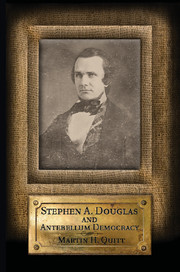
Stephen A, Douglas (1860)Douglas shaped territorial policy as chair of the Committee on Territories, first during his sophomore term in the House of Representatives (December 1845 to March 1847), then for a decade in the Senate (December 1847 to December 1858). He was replaced at the beginning of the second session of the Thirty-Fifth Congress, mainly because of his widely disseminated contention during his Freeport debate with Lincoln that popular sovereignty could trump the Dred Scott decision of the Supreme Court and his equally publicized opposition to the proslavery constitution for Kansas that his party’s president supported.
That he was chosen chair at the beginning of his second term in the House reflected his standing already as a sectional mediator, an expansionist, a knowledgeable constitutionalist, and a localist. He wanted Congress to be minimally intrusive. Here his intellectual challenge was greater than it was in defending state prerogatives, because the Constitution was straightforward about congressional authority over territories. The framers did not spend much time on the matter, because they did not foresee the expansion that would take place in the nineteenth century. The main concern in the 1780s about western lands was their implication for equality among the original states, and this had been addressed when the oldest ones ceded their claims to the central government under the Confederation. The Constitution simply granted Congress in Article IV, Section 3, §2 “power to dispose of and make all needful rules and regulations respecting the territory or other property belonging to the United States.” Congress read this clause to mean that it possessed an absolute power to govern the territories as it chose.
Information
- Type
- Chapter
- Information
- Stephen A. Douglas and Antebellum Democracy , pp. 107 - 133Publisher: Cambridge University PressPrint publication year: 2012
References
1858
The Origins of the Federal Republic: Jurisdictional Controversies in the United States, 1775–1787Philadelphia 1983Google Scholar
Documents of American HistoryNew York 1963
The Records of the Federal Convention of 1787New Haven, CT 1966
1833
A Slaveholders’ Union: Slavery, Politics, and the Constitution in the Early American RepublicChicago 2010CrossRefGoogle Scholar
Spreading the News: The American Postal System from Franklin to MorseCambridge, MA 1995Google Scholar
1848
Oregon Democracy: Asahel Bush, Slavery, and the Statehood DebateOregon Historical Quarterly 110:2 2009 202Google Scholar
The Seeds of Popular Sovereignty: Governor Lewis Cass and Michigan TerritoryMichigan Historical Review 17:1 1991 64CrossRefGoogle Scholar
Interpreting Popular Sovereignty: A Historiographical EssayCivil War History 57:1 2011Google Scholar
The Pennsylvania Origins of Pennsylvania Magazine of History and Biography 98:3 1974 339Google Scholar
The Young America Movement and the Transformation of the Democratic Party, 1828–1861New York 2007CrossRefGoogle Scholar
1993
2009
Damaging Detours: Routes, Racism, and New PhiladelphiaHistorical Archaeology 44:1 2010 138CrossRefGoogle Scholar
Popular Sovereignty and Constitutional Change in the United States and Illinois ConstitutionsIllinois Historical Journal 80:4 1987 228Google Scholar
Seventy-Eighty Three: The Turning Point in the Law of Slavery and Freedom in MassachusettsNew England Quarterly 75:1 2002 24CrossRefGoogle Scholar
Disowning Slavery: Gradual Emancipation and “Race” in New England, 1780–1865Ithaca, NY 1998Google Scholar
Was Stephen A. Douglas Antislavery?Journal of the Abraham Lincoln Association 26:2 2005 1Google Scholar
Democracy by Scripture versus Democracy by Process: A Reflection on Stephen A. Douglas and Popular SovereigntyCivil War History 43:3 1997 189CrossRefGoogle Scholar
At the Edge of the Precipice: Henry Clay and the Compromise that Saved the UnionNew York 2010Google Scholar
1964
1850
1850
1854
The Kansas–Nebraska Act: A Century of HistoriographyMississippi Valley Historical Review 43:2 1956 196Google Scholar
2001
The Rise and Fall of the American Whig Party: Jacksonian Politics and the Onset of the Civil WarNew York 1999Google Scholar
Abraham Lincoln, Owen Lovejoy, and the Emergence of the Republican Party in IllinoisJournal of the Abraham Lincoln Association 22:1 2001 82Google Scholar
A Brief Treatise Upon Constitutional and Party Questions, and the History of Political Parties, As I Received It Orally from the Late Senator Stephen A. Douglas of IllinoisNew York 1866Google Scholar
Slavery and the American West: The Eclipse of Manifest Destiny and the Coming of the Civil WarChapel Hill, NC 1997Google Scholar
Stephen A. Douglas, and the Northern Democratic Origins of the Kansas–Nebraska ActIllinois History Teacher 10 2003 2Google Scholar
The Declaration of Independence and International LawWilliam and Mary Quarterly 59:1 2002 44Google Scholar
2004
The Age of the Democratic Revolution: A Political History of Europe and America, 1760–1800Princeton, NJ 1959Google Scholar
American Sovereigns: The People and America’s Constitutional Tradition before the Civil WarNew York 2008Google Scholar
Inventing the People: The Rise of Popular Sovereignty in England and AmericaNew York 1988Google Scholar
‘A Living, Creeping Lie’: Abraham Lincoln on Popular SovereigntyJournal of the Abraham Lincoln Association 29:2 2008 1Google Scholar
Terrorism and the American Experience: A State of the FieldJournal of American History 98:1 2011 73CrossRefGoogle Scholar
Origins of the Buchanan–Douglas Feud ReconsideredJournal of the Illinois State Historical Society 67:2 1974 154Google Scholar
Lincoln and Chief Justice Taney: Slavery, Secession, and the President’s War PowersNew York 2006Google Scholar
The Black Laws of IllinoisJournal of the Illinois State Historical Society 56:3 1963 454Google Scholar
‘Black Bill’ and the Privileges of Whiteness in Antebellum IllinoisJournal of Illinois History 12:1 2009 8Google Scholar
Affairs of Party: The Political Culture of Northern Democrats in the Mid-Nineteenth-CenturyIthaca, NY 1983Google Scholar
2010
Lincoln Emancipated: Then President and the Politics of RaceDe Kalb, IL 2007
2010
Law and Politics Reconsidered: A New Constitutional History of Dred ScottLaw and Social Inquiry 34 2009 747CrossRefGoogle Scholar
Kansas, Utah, and the Dred Scott Decision: Remarks of the Hon. Stephen A. Douglas Delivered at Springfield, Illinois, June 12, 1857Chicago 1857Google Scholar
1969
1859
The Dividing Line between Federal and Local Authority: Popular Sovereignty in the TerritoriesNew York 1859Google Scholar
The Great Principle of Self-Government: Popular Sovereignty and Bleeding KansasKansas History 27 2004 25Google Scholar
2007
2008
1995
Before Cooper Union: Abraham Lincoln’s 1859 Cincinnati Speech and Its Impact on His NominationJournal of the Abraham Lincoln Association 30:1 2009 1Google Scholar
2009
The Slaveholding Republic: An Account of the United States Government’s Relations to SlaveryNew York 2001Google Scholar
Lincoln for President: An Underdog’s Path to the 1860 Republican NominationJefferson, NC 2009Google Scholar
New State Equality: The Ambiguous History of a Constitutional PrinciplePublius: The Journal of Fderalism 18 1988 53Google Scholar
Accessibility standard: Unknown
Why this information is here
This section outlines the accessibility features of this content - including support for screen readers, full keyboard navigation and high-contrast display options. This may not be relevant for you.Accessibility Information
Accessibility compliance for the PDF of this chapter is currently unknown
and may be updated in the future.