

1. Introduction
It is widely accepted that extraction, ascent and emplacement of granite magmas and regional tectonics may be coeval and interdependent processes (e.g., Brown & Solar, Reference Brown and Solar1999; Vigneresse, Reference Vigneresse1999; Vigneresse & Clemens, Reference Vigneresse and Clemens2000; Petford & Clemens, Reference Petford and Clemens2000; Demartis et al., Reference Demartis, Pinotti, Coniglio, D’Eramo, Tubía, Aragón and Insúa2011; Brown, Reference Brown2013; Cruden & Weinberg, Reference Cruden, Weinberg and Burchardt2018). Valuable information on the regional strain field can be stored in the structure of granitoid rocks, from map to the microscopic scale. Fabric investigations represent, therefore, a necessary step in the study of the relationships between pluton emplacement and regional tectonics (e.g., Bouchez & Diot, Reference Bouchez and Diot1990; Schulmann et al., Reference Schulmann, Mlčoch and Melka1996; Zibra et al., Reference Zibra, Kruhl, Montanini and Tribuzio2012; Žák et al., Reference Žák, Verner, Holub, Kabele, Chlupáčová and Halodová2012; Fazio et al., Reference Fazio, Fiannacca, Russo and Cirrincione2020; Fiannacca et al., Reference Fiannacca, Russo, Fazio, Cirrincione and Mamtani2021).
In southern Europe, the convergence between Gondwana, Gondwana-derived terranes and Laurussia led to the amalgamation of Pangea at ca. 300 Ma (Behr et al., Reference Behr, Engel, Franke, Giese and Weber1984; Matte, Reference Matte1986; Burg et al., Reference Burg, Bale, Brun and Girardeau1987; von Raumer et al., Reference Von Raumer, Stampfli, Borel and Bussy2002, Reference Von Raumer, Stampfli and Busy2003, Reference Von Raumer, Bussy, Schaltegger, Schulz and Stampfli2013). The latest Variscan stages (ca. 320–280 Ma) were characterized by coeval transpressional and transtensional tectonics, producing a complex pattern of large-scale shear zones, with associated extensive crustal melting and granitoid magmatism in the southern Variscides (Elter et al., Reference Elter, Gaggero, Mantovani, Pandeli and Costamagna2020; and references therein). One such shear zones was the East Variscan Shear Zone (EVSZ; Carosi et al., Reference Carosi, Petroccia, Iaccarino, Simonetti, Langone and Montomoli2020; Corsini & Rolland, Reference Corsini and Rolland2009; Padovano et al., Reference Padovano, Elter, Pandeli and Franceschelli2012, Reference Padovano, Dörr, Elter and Gerdes2014), considered as the western boundary between the peri-Gondwana microcontinents and Gondwana (e.g., Elter et al., Reference Elter, Gaggero, Mantovani, Pandeli and Costamagna2020), which involved various Variscan massifs dispersed throughout the western Mediterranean region. The Calabria-Peloritani Orogen (CPO; Cirrincione et al., Reference Cirrincione, Fazio, Fiannacca, Ortolano, Pezzino and Punturo2015, and references therein; Fig. 1a and 1b), in southern Italy, was also involved in the EVSZ, whose activity led to the development of regional mylonitic foliations, locally associated with exhumation of deep-middle crust and syn- to late-tectonic emplacement of large volumes of granitoids (Padovano et al., Reference Padovano, Elter, Pandeli and Franceschelli2012, Reference Padovano, Dörr, Elter and Gerdes2014).
(a) Location of the Calabria-Peloritani Orogen (CPO) in Italy. (b) Distribution of Alpine and pre-Alpine (Variscan and/or pre-Variscan) basements in the CPO and main tectonic lineaments (modified after Angì et al., Reference Angì, Cirrincione, Fazio, Fiannacca, Ortolano and Pezzino2010).

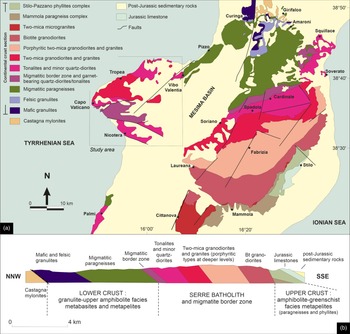
Remnants of the European Variscan Belt and evidence of such late Variscan crustal dynamics are well preserved in the CPO, which represents an arcuate Alpine mountain belt in southern Italy. In particular, within the CPO, the Serre Batholith (ca. 297–292 Ma; Fiannacca et al., Reference Fiannacca, Williams and Cirrincione2017, and references therein), in southern Calabria (Fig. 2a), is a ca. 13 km-thick composite and zoned batholith, forming the intermediate portion of a nearly complete and continuous cross-section of late Paleozoic continental crust (Fig. 2b). In this region, therefore, it is possible to investigate the regional processes and dynamics involved in the structuring of such outstanding Variscan crustal section.
(a) Geological sketch map of the Serre Massif and Capo Vaticano Promontory area (modified after Russo et al., Reference Russo, Fiannacca, Fazio, Cirrincione and Mamtani2023 and references therein); (b) Simplified lithological cross-section of the Serre Massif (modified after Fiannacca et al., Reference Fiannacca, Cirrincione, Bonanno and Carciotto2015 and references therein).

Specifically, this study focuses on the relationships between solidification-cooling and deformation of the granitoids that make up the deepest levels of the Serre Batholith, by investigating quartz diorites-tonalites and porphyritic two-mica granodiorites-granites exposed in the Capo Vaticano Promontory (CVP). In this framework, a detailed field survey was first carried out in order to map the different granitoid units, distinguishing their specific petrographic and structural features, and investigate the relationships between them, highlighting the architecture of the granitoid complex. In addition, field studies allowed realizing the first detailed geological map of the magmatic units from the CVP. Finally, this work presents a study of the microstructural evolution from magmatic to low-temperature subsolidus conditions of the studied rocks, able, for the first time, to depict the late Variscan deformation history of this sector of the Serre Batholith.
2. Geological setting
2.a. The Serre Massif
The Serre Massif (Fig. 2a) is a natural laboratory where a ca. 25 km-thick cross-section of late Paleozoic continental crust is exposed with continuity from upper crustal phyllites to deep crustal granulites (Schenk, Reference Schenk1981, Reference Schenk1990; Caggianelli et al., Reference Caggianelli, Liotta, Prosser and Ranalli2007; Angì et al., Reference Angì, Cirrincione, Fazio, Fiannacca, Ortolano and Pezzino2010). Mafic granulites including layered metagabbros make up the lowermost crustal levels (ca. 3 km-thick) together with minor felsic granulites, fine-grained metapelites and metacarbonates, and are overlain by a metapelitic migmatitic complex (ca. 4 km-thick) mostly consisting of migmatitic paragneisses, and minor intercalated metabasites and metacarbonates (Schenk, Reference Schenk1980, Reference Schenk1984). The mafic granulites from the base of the crustal section experienced peak PT conditions of at least 1.1 GPa at 900°C (Fornelli et al., Reference Fornelli, Pascazio and Piccarreta2012; and references therein). Thickening-related peak P conditions up to 0.9 GPa at ∼ 650°C, followed by prolonged nearly isobaric heating up to peak temperatures of ∼ 700°C, have been indicated by the same authors for the migmatitic metapelites from the top of the lower crust.
The intermediate crustal segment is represented by the Serre Batholith, a ca. 13 km-thick composite and zoned batholith (e.g., Rottura et al., Reference Rottura, Bargossi, Caironi, Del Moro, Maccarrone, Macera, Paglionico, Petrini, Piccareta and Poli1990; Caggianelli et al., Reference Caggianelli, Prosser and Rottura2000a, b; Fornelli et al., Reference Fornelli, Caggianelli, Del Moro, Bargossi, Paglionico, Piccarreta and Rottura1994; Fiannacca et al. Reference Fiannacca, Cirrincione, Bonanno and Carciotto2015, Reference Fiannacca, Williams and Cirrincione2017). Granitoids were produced by melting of different crustal magma sources (Fiannacca et al., Reference Fiannacca, Cirrincione, Bonanno and Carciotto2015; and references therein), and emplaced at depths between ∼23 and ∼6 km (Al-in-hornblende barometry, Caggianelli et al., Reference Caggianelli, Prosser and Di Battista1997). The batholith is built up through an incremental over-accretion mechanism, with the magmas emplaced at progressively decreasing depths (Fiannacca et al., Reference Fiannacca, Williams and Cirrincione2017; and references therein). Strongly to moderately foliated tonalites and quartz diorites were emplaced first, at lower-crustal levels (ca. 297 Ma, at ca. 6.5 kbar) forming the batholith floor; they were followed upward by intermediate-seated weakly foliated to non-foliated porphyritic two mica granodiorites and granites (ca. 296-295 Ma) and, finally, by locally foliated equigranular two mica granodiorites and granites (ca. 294 Ma) and biotite ± amphibole granodiorites (ca. 292 Ma, at ca. 1.7 kbar), the latter forming the batholith roof. Taking into account the U-Pb zircon SHRIMP analytical errors, these results indicate that the Serre Batholith may have been formed over a relatively short period of ca 5 Ma and, anyway, not greater than 9 Ma (Fiannacca et al., Reference Fiannacca, Williams and Cirrincione2017).
The uppermost crustal segment is made up of two metamorphic complexes (ca. 2–3 km thick), the Mammola Paragneiss Complex and the overlying Stilo-Pazzano Complex, juxtaposed along a low angle tectonic detachment before the intrusion of the Serre Batholith granitoids (Colonna et al., Reference Colonna, Lorenzoni and Zanettin Lorenzoni1973; Angì et al., Reference Angì, Cirrincione, Fazio, Fiannacca, Ortolano and Pezzino2010; Festa et al., Reference Festa, Caggianelli, Langone and Prosser2013; Ortolano et al., Reference Ortolano, Pagano, Visalli, Angì, D’Agostino, Muto, Tripodi, Critelli and Cirrincione2022). The Mammola complex includes dominant upper greenschist to amphibolite-facies paragneisses with subordinate leucocratic gneisses and amphibolites. The Stilo-Pazzano complex is mainly represented by lower greenschist-facies phyllites with minor marbles, quartzites and metavolcanic layers, with protolith ages possibly ranging from the Cambro-Ordovician to the Carboniferous (Navas-Parejo et al., Reference Navas-Parejo, Somma, Rodríguez-Cañero, Martín-Algarra and Perrone2015; and references therein). Both complexes share the same static metamorphic overprint as a result of the emplacement of the late Variscan granitoids (Ortolano et al., Reference Ortolano, Pagano, Visalli, Angì, D’Agostino, Muto, Tripodi, Critelli and Cirrincione2022; and references therein). Before experiencing contact metamorphism, the upper crustal Mammola paragneisses underwent an initial deformational stage (D1), characterized by the formation of a penetrative and pervasive surface (S1). D1 was followed by a D2 crenulation stage producing a S2 crenulation cleavage. These two prograde stages, consistent with eo-Variscan crustal thickening stage, were followed by a near-isothermal decompression path, consistent with tectonic transport along a dominant extensional shear zone, leading to the development of a pervasive mylonitic foliation (S3) and likely assisting the emplacement of the granitoid magmas (Angì et al., Reference Angì, Cirrincione, Fazio, Fiannacca, Ortolano and Pezzino2010). In particular, according to the above authors, Mammola paragneisses were involved in collision-related crustal thickening together with the lower-crustal migmatitic paragneisses up to peak P–T values of 0.9 GPa at 530°C, but then rapidly detached from the lower-crustal rocks and uplifted to upper crustal levels (up to ∼ 0.3 GPa at 470°C) along the above-mentioned shear zone. In this framework, Fiannacca et al. (Reference Fiannacca, Williams and Cirrincione2017), based on the matching of the pressure values along the decompressional path of the Mammola paragneisses with the progressively younger intrusion ages of the granitoids emplaced at progressively lower depths, proposed that the Mammola paragneisses, during their shear-related uplift, accommodated the progressive emplacement of the late Variscan granitoid magmas; magma emplacement was associated with shear-zone activity up to the latest magmatic stages, as suggested by late-tectonic felsic dykes with clear evidence of mylonitic deformation (Angì et al., Reference Angì, Cirrincione, Fazio, Fiannacca, Ortolano and Pezzino2010). A tectonic event with a 30–40% simple shear component along a sub-horizontal plane was also suggested for the late Variscan evolution of the deep crustal metapelites (Festa et al., Reference Festa, Fornelli, Paglionico, Pascazio, Piccarreta and Spiess2012). Finally, both the granitoids and the upper crustal metamorphic rocks are locally intruded by late to post-Variscan felsic to mafic dykes (Romano et al., Reference Romano, Cirrincione, Fiannacca, Lustrino and Tranchina2011).
2.b. The Capo Vaticano Promontory
The Capo Vaticano Promontory (study area, Fig. 2a), along the coast of the Tyrrhenian Sea, represents a deep-intermediate portion of the Serre Batholith that, together with its lower crustal migmatitic host rocks, was separated from the Serre Massif by the opening of Miocene-Pleistocene Mesima graben, and further dismembered by Quaternary tectonics (Tortorici et al., Reference Tortorici, Bianca, de Guidi, Monaco and Tortorici2003; Conforti & Ietto, Reference Conforti and Ietto2020). Since the Middle Pleistocene, an intense ESE–WNW oriented regional extensional phase, as a consequence of the Ionian slab subduction beneath Calabria, has influenced the recent tectonic evolution of the region (Tortorici et al., Reference Tortorici, Bianca, de Guidi, Monaco and Tortorici2003, and references therein). In the CVP, this tectonic event led to the development of several normal faults with NE-SW and WNW-ESE dominant trends (Ghisetti & Vezzani, Reference Ghisetti and Vezzani1981; Monaco & Tortorici, Reference Monaco and Tortorici2000; Tortorici et al., Reference Tortorici, Bianca, de Guidi, Monaco and Tortorici2003; Perri et al., Reference Perri, Ietto, Le Pera and Apollaro2016). The post-Variscan tectonic events therefore led to a large disruption of the late Variscan architecture of the lower-intermediate crust now exposed in the CVP.
The CVP granitoids extend over an area of ca. 270 km2 (Rottura et al., Reference Rottura, Del Moro, Pinarelli, Petrini, Peccerillo, Caggianelli, Bargossi and Piccarreta1991; Lombardo et al., Reference Lombardo, Fiannacca and Cirrincione2020), cropping out discontinuously beneath a Miocene-Pliocene terrigenous and carbonate cover and upper Quaternary deposits (Burton, Reference Burton1971; Tortorici et al., Reference Tortorici, Bianca, de Guidi, Monaco and Tortorici2003; Bianca et al., Reference Bianca, Catalano, De Guidi, Gueli, Monaco, Ristuccia, Stella, Tortorici and Troja2011). The lower-crustal host rocks, mostly consisting of migmatitic paragneisses, crop out extensively in the north-eastern part of the CVP, in near continuity with the lower-crustal rocks extensively exposed in the northern Serre Massif, and, locally, in the south-western part, as a consequence of post-Variscan tectonics (Clarke & Rottura, Reference Clarke and Rottura1994; Fornelli et al., Reference Fornelli, Piccarreta, Del Moro and Acquafredda2002, Reference Fornelli, Piccarreta, Acquafredda, Micheletti and Paglionico2004).
The CVP granitoids consist of strongly to weakly foliated tonalites and minor quartz diorites, which account for ca. 65% of the exposed magmatic rocks, and weakly to non-foliated porphyritic granodiorites, with fewer granites (ca. 35%). According to Caggianelli et al. (Reference Caggianelli, Del Moro, Paglionico, Piccarreta, Pinarelli and Rottura1991) and Rottura et al. (Reference Rottura, Bargossi, Caironi, Del Moro, Maccarrone, Macera, Paglionico, Petrini, Piccareta and Poli1990, Reference Rottura, Del Moro, Pinarelli, Petrini, Peccerillo, Caggianelli, Bargossi and Piccarreta1991), strongly foliated tonalites and quartz diorites were intruded earlier into the lower-crustal gneisses, locally triggering extensive further partial melting in the already anatectic country rocks, with development of a migmatitic border zone (MBZ) (Clarke & Rottura, Reference Clarke and Rottura1994), while weakly foliated tonalites and granodiorites were intruded later, at progressively shallower crustal levels. Nevertheless, recent U-Pb SHRIMP zircon dating of strongly to weakly foliated tonalites and quartz diorites indicates a similar age of ca. 299–297 Ma for all the deepest granitoids (Lombardo, Reference Lombardo2020). According to Al-in-hornblende barometric estimates by Caggianelli et al. (Reference Caggianelli, Prosser and Di Battista1997, Reference Caggianelli, Prosser and Del Moro2000b), the CVP tonalites-quartz diorites were distinguished into intermediate crust granitoids, emplaced at depths ranging from ca. 17.5 to 20 km (Ioppolo, Santa Maria, Capo Vaticano), and lower crust granitoids, emplaced at depths greater than ca. 20 km (Briatico). In accordance with preliminary fabric investigations, the same authors suggested that these granitoids experienced prolonged deformation at temperature above the brittle- ductile transition, at which they resided for periods up to 100 Ma (Caggianelli et al., Reference Caggianelli, Prosser and Rottura2000a). Granitoids vary in composition from metaluminous/weakly peraluminous quartz-diorites and tonalites, cropping out in the north and in the south of the CVP, to strongly peraluminous porphyritic granodiorites and granites in the central sector of the CVP (Fiannacca et al., Reference Fiannacca, Cirrincione, Bonanno and Carciotto2015; and references therein). No barometric or geochronological data are available for the porphyritic granitoids, but field relationships and comparison with such data obtained in the Serre Massif (Caggianelli et al., Reference Caggianelli, Prosser and Del Moro2000b; Fiannacca et al., Reference Fiannacca, Williams and Cirrincione2017) indicate that the latter rocks are both younger and shallower, consistent with an over-accretion emplacement mechanism (Fiannacca et al., Reference Fiannacca, Williams and Cirrincione2017; and references therein).
Several petrogenetic interpretations have been proposed for the CVP granitoids. Tonalites and quartz diorites have been interpreted either as resulting from the interaction of mantle-derived magmas with crustal rocks (Rottura et al., Reference Rottura, Del Moro, Pinarelli, Petrini, Peccerillo, Caggianelli, Bargossi and Piccarreta1991) or as I-type granitoids derived from partial melting of a mafic lower-crustal source (Rottura et al., Reference Rottura, Bargossi, Caironi, Del Moro, Maccarrone, Macera, Paglionico, Petrini, Piccareta and Poli1990; Fiannacca et al., Reference Fiannacca, Cirrincione, Bonanno and Carciotto2015). The strongly peraluminous granitoids have been interpreted as the result of mixing between two distinct felsic melts, one of crustal origin and the other derived from the CVP tonalitic magma through fractional crystallization or assimilation-fractional crystallization (Rottura et al., Reference Rottura, Del Moro, Pinarelli, Petrini, Peccerillo, Caggianelli, Bargossi and Piccarreta1991), or as typical S-type granites (e.g., Rottura et al., Reference Rottura, Bargossi, Caironi, Del Moro, Maccarrone, Macera, Paglionico, Petrini, Piccareta and Poli1990; Fiannacca et al., Reference Fiannacca, Cirrincione, Bonanno and Carciotto2015). For both granitoid types, fractional crystallization has been proposed by Lombardo et al. (Reference Lombardo, Fiannacca and Cirrincione2020) as the main process responsible for magmatic evolution from quartz diorite to tonalite and from granodiorite to granite, respectively.
3. Materials and methods
Petro-structural studies were conducted on thin sections of 52 pre-existing samples (Fiannacca et al., Reference Fiannacca, Cirrincione, Bonanno and Carciotto2015; Lombardo, Reference Lombardo2020) and 30 newly acquired ones from the study area and analyzed with an Axioscope 2 optical microscope (Zeiss, Germany). Crossed polar images of entire thin sections of representative samples were acquired by using a flatbed scanner (Epson Perfection 3490 Photo; Seiko, Japan) at a resolution of 4800 dpi, together with several photomicrographs of deformed domains taken by a Leica ICC50W Camera (Leica Microsystems, Switzerland) mounted on the Leica DM750P Microscope, both hosted at the Department of Biological, Geological and Environmental Sciences, University of Catania. Abbreviations for the different mineral phases are after Whitney & Evans (Reference Whitney and Evans2010).
4. Geological mapping and design
A geological map of the magmatic units exposed in Capo Vaticano Promontory is presented for the first time in this study (Fig. 3). Mapping also included the MBZ developed at the contact between the deepest granitoids and the lower-crustal host rocks in the southern sector of the CVP. The surveyed area is approximately 150 km2, at a scale of 1:140,000. Geological survey has been performed using the 1:50,000 topographic maps of the Istituto Geografico Militare and digitalized by means of the ArcGIS® software. Field data and sampling locations were stored in a georeferenced geological database built in WGS 1984 UTM zone 33N reference system. A topographic dataset, available in vector format at ‘Geoportale della Regione Calabria’ website (http://geoportale.regione.calabria.it), has been employed as topographic base for the geological map. Final assemblage and graphical editing have been realized with CorelDRAW® software on a vector PDF file exported from ArcGIS®. The geological-structural map is the result of an accurate field survey integrated with mesoscopic and microscopic investigations, allowing us to delineate the main field and petrographic features of the Capo Vaticano Promontory granitoids. The official geological map of the area (Cassa per il Mezzogiorno - Servizio Geologico d’Italia, 1967), at a scale of 1:25,000, which is available online (http://geoportale.regione.calabria.it/opendata) as georeferenced TIFF files, was used as initial reference for the purposes of this study. However, the latter identifies a single plutonic unit, without compositional and structural distinctions between the different granitoids cropping out in the area. Other information on the spatial distribution of the mapped rocks appears in Rottura et al. (Reference Rottura, Del Moro, Pinarelli, Petrini, Peccerillo, Caggianelli, Bargossi and Piccarreta1991), although only consisting of a sketch map with no description of the field relationships between the depicted units. The widespread sedimentary rocks have been collectively represented as undifferentiated Miocene-Quaternary sedimentary cover.
Petro-structural map of the magmatic units exposed in the Capo Vaticano Promontory (southern Calabria, Italy). The displayed patterns represent the average foliation of the strongly to moderately foliated granitoids.

5. Granitoids from the Capo Vaticano Promontory
Granitoid outcrops in Capo Vaticano Promontory are better exposed in the coastal areas and along riverbeds; in the inland areas they mostly occur in sectors bounded by faults. Tonalites-quartz diorites are strongly or moderately foliated in the northern and southern part of the study area, while they are weakly to non-foliated in the central part, where they are intruded by the overlying porphyritic granitoids, and, locally in some areas of the southern sector. In this section, we report the main field and petrographic features of the granitoids units that make up the CVP, which, are reported following the criteria and terminology already used by Russo et al. (Reference Russo, Fiannacca, Fazio, Cirrincione and Mamtani2023; and references therein) for the north-eastern sector on the Serre Batholith, in the Serre Massif (Fig. 2). The main field features of the MBZ are also reported in this section; more details can be found in Fiannacca et al. (Reference Fiannacca, Russo, Fazio and Cirrincione2024; and references therein).
5.a. Migmatitic border zone (MBZ)
The MBZ is exposed in scattered areas of a few square kilometres each in the south-western sector of CVP. The unit represents a transition zone between the top of the metamorphic lower-crustal section and the earliest and deepest emplaced granitoids of the Serre Batholith, i.e., the tonalites/quartz diorites (hereafter ‘tonalites’ for brevity, since tonalites are the dominant rock type). The MBZ is characterized by: a) migmatitic paragneisses ranging from metatexites to diatexites with a highly irregular distribution and abundance of leucosomes and peritectic garnets, and b) medium-coarse-grained tonalites including abundant cm- to m-sized metapelitic enclaves, as well as large crystals of peritectic garnet. The latter, typically 1–2 cm in size, is mainly associated with the metapelitic enclaves, occurring in extremely variable amounts in cm- to m-sized leucosome patches, but also present as isolated crystals in tonalites far away from the enclaves. This peculiar multiscale commixture of tonalites, metapelitic enclaves and associated garnet-bearing leucosomes, also documented in the northern Serre Massif (Rottura et al., Reference Rottura, Bargossi, Caironi, Del Moro, Maccarrone, Macera, Paglionico, Petrini, Piccareta and Poli1990; Russo et al., Reference Russo, Fiannacca, Fazio, Cirrincione and Mamtani2023), resulted from the interaction between the intruding tonalite magma and the anatectic magmas produced by extensive further melting of the already migmatitic hosting paragneisses (Clarke & Rottura, Reference Clarke and Rottura1994). Typical features of the MBZ outcrops are illustrated in Fig. 4a–4e.
Interaction between tonalitic/quartz dioritic magma and the metapelitic basement in the Migmatitic Border Zone. (a) garnet-bearing quartz diorite; the largest garnet is 2.4 cm (38°35′29″ N 15°53′02″ E). (b) garnet-rich coalescing leucosome channels in migmatitic paragneiss (38°36′45″ N, 15°50′34″ E). (c) garnet-rich leucosomes bordering metapelitic enclaves rounded by consumption upon melting; the longest enclave is 15 cm long (38°36′45″ N, 15°50′34″ E). (d) typical garnet-rich anatectic rock from the MBZ (38°36′45″ N, 15°50′34″ E). (e) migmatite outcrop with metapelitic restites forming aligned enclaves in leucosomes variably enriched in large peritectic garnet (38°36′45″ N, 15°50′34″ E).

5.b. Amphibole-biotite tonalites (ABT)
Amphibole-biotite tonalites and quartz diorites (ABT) are mainly exposed in the southern sector of the CVP over a total area of ca. 17 km2, in a ca. 3 km2 body in the north-eastern sector, and in a ca. 2 km-long and ca. 80 m-wide band running along the northern coast of the CVP. They are medium-coarse-grained rocks, strongly to moderately foliated and rich in elongated mafic microgranular enclaves parallel to host rock foliation (Fig. 5a–5c). In some cases, mafic microgranular enclaves exhibit a monoclinic symmetry indicating that they have recorded a component of non-coaxial deformation (Fig. 5d). In the southwestern sector of the studied area, a compositional layering, represented by an alternation of cm-thick more felsic and more mafic layers, locally occurs. Cm- to m- thick pegmatitic and aplitic dykes are widespread. Texture is generally sub-hypidiomorphic and commonly cumulitic, defined by a compact framework of euhedral-subhedral plagioclase crystals with subhedral amphibole and interstitial biotite, quartz and epidote (Fig. 6a and 6b). Colour index is in the range 25–40. ABT is made up of unzoned to weakly zoned euhedral to subhedral plagioclase (ca. 50 vol. %), subhedral to anhedral biotite (ca. 28 vol. %) as isolated individuals or in clots, quartz (ca. 17 vol. %) in anhedral crystals and amphibole (ca. 5 vol. %) as subhedral to anhedral crystals, occasionally partly replaced by biotite. Epidote, titanite, allanite, apatite, ilmenite and zircon are the main accessories.
Characteristic field appearance of the amphibole-biotite tonalites and quartz diorites-biotite tonalites and minor quartz diorites (ABT-BT) from the Capo Vaticano Promontory area. (a) Moderately foliated ABT (38°43′38″ N, 16°01′45″ E). (b) Swarms of stretched mafic microgranular enclaves in ABT (38°36′23″ N 15°51′00″ E). (c) Sharp intrusive contact between the lower-crustal migmatitic paragneisses and the strongly foliated tonalites from the batholith floor (38°36′45″N 15°50′23″E). (d) Fish-shaped mafic microgranular enclaves in ABT (38°43′38″ N, 16°01′45″ E). (e) Moderately foliated BTs with flattened mafic microgranular enclaves (38°42′44″ N, 15°58′40″ E). (f) Unfoliated BTw with ellipsoidal MME (38°41′07″ N, 15°55′15″ E).

General petrographic features of the studied granitoids (crossed polars) from thin section scans (to the left) paired with microphotographs of representative microdomains (to the right). (a, b) ABT; (c, d) BTs; (e, f) BTw; (g, h) PMBG.

5.c. Biotite tonalites (BT)
Biotite tonalites and minor quartz diorites (BT) are the most widespread rock types in the CVP, outcropping mostly in the north and in the south of the mapped area and covering an area of ca. 29 km2. BTs are medium-coarse-grained rocks, strongly to moderately foliated (BTs; Figs. 5e, 6c and 6d) or weakly to non-foliated (BTw; Figs. 5f, 6e and 6f). Cm- to m-long mafic microgranular enclaves, from elongate (BTs) to globular (BTw) in shape, are frequently found within these rocks (Fig. 5e and 5f). Colour index is in the range 20–40. Texture is generally sub-hypidiomorphic and locally cumulitic. Colour index is in the range 20–35. All the BTs are composed of unzoned to weakly zoned euhedral to subhedral plagioclase (ca. 55 vol. %), biotite (ca. 23 vol. %), usually in clots but also as large individual crystals in the BTw and anhedral quartz (ca. 22 vol. %) (Fig. 6d and 6f). Biotite occurs in aggregates and isolated plates or, locally, as larger prismatic crystals, possibly pseudomorphic on pre-existing amphibole. Primary muscovite rarely occurs as small interstitial crystals, typically associated with biotite, in the more evolved rocks. Ilmenite, allanite, titanite, epidote, apatite, zircon are accessories. Pegmatitic and aplitic dykes are widespread and particularly abundant in the BTw.
5.d. Porphyritic muscovite-biotite granodiorites and granites (PMBG)
Porphyritic muscovite-biotite granodiorites and granites (PMBG) occupy the central sector of the CVP over an area of ca. 15 km2. They are porphyritic due to the presence of K-feldspar phenocrysts and megacrysts from 2 to 14 cm in length, in a medium- to coarse-grained matrix made of quartz, plagioclase, K-feldspar and biotite (Figs. 6g, 6h and 7a–7c). Locally, rough alignments of the K-feldspar megacrysts and biotite plates define a magmatic foliation. A direct relationship between depth and frequency of K-feldspar megacrysts has been registered, moving from the northernmost sector, representing the deepest levels of the unit, in primary contact with the underlying BT. K-feldspar crystals reach their maximum length of 14 cm near Parghelia village, but crystals up to 7 cm long have been found also near Daffinà village with an average length of 3–4 cm. In the southern area, the average K-feldspar phenocryst length is estimated at about 1–2 cm, with the maximum length (up to 4 cm) recorded close to Brattirò village. Furthermore, in accordance with the spatial density analysis of K-feldspar megacrysts in the Serre Massif by Russo et al. (Reference Russo, Fiannacca, Fazio, Cirrincione and Mamtani2023), megacrysts occurrence registers a gradual drop from the lower to the upper levels of the PMBG unit; the maximum density is measured in the northern sector where ca. 100–120 megacrysts/m2 occur; on the other hand, in the southern region a minimum of ca. 20–40 megacrysts/m2 is registered. Matrix is generally hypidiomorphic and consists of perthitic microcline and, more rarely, orthoclase (ca. 35 vol %), anhedral quartz (ca. 30 vol %), subhedral plagioclase (ca. 25 vol %), subhedral-anhedral biotite (ca. 5 vol %), and subhedral-anhedral muscovite (ca. 5 vol %), mainly bordering K-feldspar and quartz or intergrown with biotite (Fig. 6h). Apatite, zircon, ilmenite and monazite occur as accessory phases, frequently in association with biotite. Small poikilitic garnet is very locally found. Colour index is in the range 7–15. Cm- to m-thick aplitic and pegmatitic dykes occur locally.
Characteristic field appearance of porphyritic muscovite-biotite granodiorites and granites from the Capo Vaticano Promontory area (38°41′07″N, 15°55′15″E). (a) Euhedral K-feldspar megacryst exhibiting zoning. (b) Aligned K-feldspar megacrysts up to 6 cm long. (c) Accumulation of K-feldspar megacrysts dominantly showing simple twinning.

6. Field relationships between granitoids units
In the CVP, magmatic contacts are very rarely exposed and the relationships between granitoid units cannot be clearly defined, especially in the inland areas due to large sedimentary and anthropogenic cover, as well as to the extensive post-Variscan tectonisation and associated deterioration of the outcrops that prevent fruitful observations in these zones. However, coastal and fluvial areas expose very well-preserved outcrops, which have been crucial in defining the petro-mineralogical features of the contact zones between the various lithotypes, outlined in detail below. The great majority of the contacts are by fault, and only very rare sharp intrusive contacts have been observed and mapped in Fig. 3. In other cases, we have used the term ‘gradational’, where the contact between two magmatic units, or sub-units, is not sharp, but consisting in a progressive change in the composition or structure of the rocks over a certain distance. As for the BT, divided into the BTs and BTw sub-units, the change is only structural. In contrast, between MBZ and ABT, it is both structural and compositional.
6.a. MBZ-ABT
The relationships between the MBZ and the tonalites/quartz diorites forming the floor of the Serre Batholith in the CVP sector have only been observed in a few outcrops from the SW of the promontory (Figs. 4 and 5c) where the dominant rock types are quartz diorites to quartz-poor tonalites (Clarke & Rottura, Reference Clarke and Rottura1994; Caggianelli et al. Reference Caggianelli, Prosser, Festa, Langone and Spiess2013; Fiannacca et al., Reference Fiannacca, Russo, Fazio and Cirrincione2024). Basal tonalites exhibit varying stages of interaction with garnet-bearing or garnet-free anatectic magma produced by melting of the metapelitic migmatites after intrusion of the tonalites. The typical evidence of interaction between the anatectic magma and a crystal-poor tonalitic mush is provided by the occurrence of outstanding large peritectic garnets in apparently homogeneous tonalite (Fig. 4a). In the metapelites, on the other hand, it is possible to observe highly variable leucosome/protolith ratios reflecting different melting degrees of the metapelites. Lower melting degrees can be inferred for paragneiss-dominated migmatites with low volumes of garnet-rich leucosomes, occurring as thin layers and patches that locally connect one to each other (Fig. 4b). With increased melting, the metapelites were strongly consumed, now forming dm- to cm-sized globular enclaves, typically bordered by large peritectic garnet, in volumetrically dominant leucosome (Fig. 4c). The end-member result of the process was a garnet-rich anatectic granitoid rock (Fig. 4d) with no, or scarce and small-sized, paragneiss remnants. The amount and size of the peritectic garnet in such anatectic granitoids is also strongly variable, even at very short distances, as illustrated in Fig. 4e.
6.b. ABT-BT
The primary magmatic relationships between the ABT and BT were not directly observed in the field.
Both units typically display a medium-coarse grain size, with no observable differences close to the ABT-BT contact. Moreover, field observations reveal no direct evidence of interaction between different magmas. In most cases, the two magmatic units are juxtaposed by normal faults, related to the main tectonic lineaments of the area. However, in the very few areas of primary interaction between the two units not affected by faulting, the mesoscopic and microscopic evidence points to a gradual transition between amphibole-bearing and amphibole-free tonalites. This relationship is supported by local evidence of partial late-magmatic replacement of amphibole by biotite in the ABT (Fig. 8a and 8b). A complete replacement of the amphibole by biotite, generally preserving the shape of the original grain, is found in BT samples close to the ABT. On the other hand, biotite dominantly occurs throughout the BT unit as aggregates or single individuals with the typical tabular shape (Fig. 6c and 6e), thus suggesting a direct crystallization from the magma. These considerations would indicate an origin of the ABT and more mafic BT by fractional crystallization from mafic tonalitic magma, an interpretation which is supported by common cumulitic texture in such rocks and by geochemical modelling by Lombardo et al. (Reference Lombardo, Fiannacca and Cirrincione2020). BT tonalites with tabular biotite and devoid of cumulitic texture can instead represent the result of direct emplacement at shallower levels of less mafic tonalite.
Relationship between the Capo Vaticano Promontory magmatic units. (a) Weakly foliated amphibole-biotite tonalites and quartz diorites (ABT) sample with large amphibole-biotite aggregates. (b) Amphibole partly replaced by biotite in ABT sample. (c) Sharp contact between biotite tonalites and minor quartz diorites (BT) and porphyritic muscovite-biotite granodiorites and granites (38°41′07″ N, 15°55′15″ E). (d) Granodioritic melt intruding into partially solidified BT, dismembering the latter in m-sized rounded blocks. Note the K-feldspar megacrysts accumulation in a filter-press-like geometry (38°41′07″ N, 15°55′15″ E). (e) Sigmoid tonalitic blocks wrapped by anastomosing granodiorites with strong magmatic fabric marked by alignment of K-feldspar megacrysts (38°41′07″ N, 15°55′15″ E).

6.c. BT-PMBG
In the central sector of the promontory, weakly to unfoliated biotite tonalites are in contact, to the north and to the south, with the overlying PMBG unit. The granitoids from the top of the BT unit are mostly rather felsic tonalites with some samples also having leucotonalitic compositions representing crystallization from a residual tonalitic magma (Lombardo et al., Reference Lombardo, Fiannacca and Cirrincione2020). In the southern sector, the contact is marked by faults, as also highlighted by extreme rock fracturing and alteration, as well as by local slickenlines. On the other hand, in the northern sector, rare field evidence of sharp magmatic contacts between the two units is very well exposed (Fig. 8c). In more detail, at the roof of the tonalitic unit, emplacement of the overlying porphyritic granodioritic magma involved displacement of the tonalite, with local disaggregation in rounded blocks up to 1.5 meter in size (Fig. 8d). Such latter evidence indicates a rigid behaviour of the tonalites at the time of granodiorite emplacement, even though rare occurrence of hybrid rocks in the contact zone testifies for possible mixing processes also between the granodioritic magma and the mushy tonalite. Local shear bands, developed at the contact between MBPG and BT, are oriented in accordance with the magmatic fabric of the megacrystic granitoids (Fig. 8e). Finally, outstanding field evidence of the physical behaviour of mush systems is given by mechanical accumulation of K-feldspar megacrysts at places where the granodioritic magma was intruding the mushy tonalite, but only the liquid part of the magma was able to pass through, depicting a filter-press mechanism (Weinberg et al., Reference Weinberg, Vernon and Schmeling2021 and references therein; Fiannacca et al., Reference Fiannacca, Russo, Fazio and Cirrincione2024) (Fig. 8d).
7. Deformation microstructures
In the following paragraphs, we present the progressive deformation-induced microstructural evolution from supra- to sub-solidus high temperature (ca. 650°C > T > ca. 450°C) and, finally, low-temperature conditions (T < ca. 450°C) of the compositionally different CVP granitoids, in accordance with the guidelines proposed by Paterson et al. (Reference Paterson, Vernon and Tobisch1989), Bouchez et al. (Reference Bouchez, Delas, Gleizes, Nédélec and Cuney1992), Stipp et al. (Reference Stipp, Stünitz, Heilbronner and Schmid2002), Vernon (Reference Vernon2000, Reference Vernon2018), Passchier & Trouw, (Reference Passchier and Trouw2005) and Law (Reference Law2014).
7.a. Deformation microstructures in ABT
In general, the amphibole-biotite tonalites and quartz diorites show a strong to moderate planar fabric defined by preferential orientation of plagioclase, biotite and amphibole.
The magmatic texture is seldom preserved within low-strain domains and is characterized by euhedral to subhedral plagioclase and mostly subhedral biotite and amphibole.
Plagioclase is commonly affected by submagmatic microfractures, predominantly filled with quartz and occasionally also epidote, indicating deformation in the presence of melt at temperature conditions above ca. 700°C (Bouchez et al., Reference Bouchez, Delas, Gleizes, Nédélec and Cuney1992; Fig. 9a and 9b). Local occurrence of irregular and lobate boundaries, preferentially observed at the contact with other plagioclase grains, reflects grain boundary migration (GBM) recrystallization, which also indicates deformation at suprasolidus conditions. More frequent, on the other hand, are the examples of submillimetric bulges at the crystal boundaries, as evidence of dominating bulging (BLG) recrystallization mechanism occurring at ca. 450°–600°C (Passchier & Trouw, Reference Passchier and Trouw2005). Possible evidence for non-coaxial deformation comes from roundish and bent plagioclase crystals wrapped by biotite aggregates, appearing as porphyroclasts.
Deformation microstructures from suprasolidus to LT solid-state conditions in the amphibole-biotite tonalites and quartz diorites. (a) Submagmatic microfracture in plagioclase filled by quartz showing evidence of both high and low-temperature recrystallization (38°40′29″ N, 16°30′50″ E). (b) Plagioclase crystals surrounded by bent fish-like biotite individuals indicate high-temperature deformation. A submagmatic fracture filled by quartz, later affected by dynamic recrystallization, is also visible (38°43′36″ N, 16°02′21″ E). (c) Protomylonitic domain with quartz and plagioclase characterized by dynamic recrystallization along their borders. Quartz grains exhibit chessboard extinction overprinted by undulose extinction (38°36′23″ N, 15°51′01″ E). (d) High strain microdomain characterized by biotite fishes bordered by new grains of biotite and quartz dynamically recrystallized at HT subsolidus conditions (38°35′29″ N, 15°53′02″ E). (e) Strongly lobed edges in quartz represent examples of high-temperature recrystallization; smaller bulges at quartz boundaries are indicative of lower-temperature BLG recrystallization (38°36′23″ N, 15°52′24″ E). (f) SGR and BLG recrystallization of quartz crystals with undulose extinction (38°32′11″ N, 15°58′53″ E).

Deformation below ca. 500°C (Passchier & Trouw, Reference Passchier and Trouw2005) is documented by widespread examples of deformed polysynthetic twins and kinked grains (Fig. 9b).
Quartz commonly shows chessboard extinction as a result of combined activation of basal and prism slip systems at submagmatic conditions (Fig. 9c). Elongated aggregates, produced by strong grain size reduction and surrounding large biotite fishes, are indicative of HT subsolidus deformation (Fig. 9d). Grains with extremely lobate boundaries as a result of grain boundary migration (GBM) recrystallization indicate deformation above ca. 500°C (Passchier & Trouw, Reference Passchier and Trouw2005; Law, Reference Law2014; Fig. 9c and 9e). Core-and-mantle structures are rarely found (Fig. 9f). Subgrain rotation (SGR) recrystallization (Fig. 9f) and BLG recrystallization (Fig. 9e and 9f) largely occur, providing indications of continuous deformation down to the LT subsolidus regime, at T < ca. 400°C (Passchier & Trouw, Reference Passchier and Trouw2005). Finally, undulose extinction, as well as deformation bands, is very frequent.
Biotite occurs in foliated aggregates wrapping large plagioclase grains with a dominant brittle behaviour, providing evidence of low- to medium- to high-temperature subsolidus deformation. Fish-like crystals provide further evidence of non-coaxial deformation (Fig. 9d). Solid-state deformation at medium temperature conditions is represented by dynamic recrystallization to smaller new grains (Fig. 9d). Intracrystalline plastic deformation of biotite is also highlighted by widespread examples of kink bands, which can develop in a wide range of temperatures, starting from ca. 250°C (Passchier & Trouw, Reference Passchier and Trouw2005), thus not providing strong constraints.
Amphibole commonly shows evidence of brittle deformation (Fig. 9d) that indicates deformation below ca. 730°C (Passchier & Trouw, Reference Passchier and Trouw2005). No evidence of plastic behaviour or recrystallization at suprasolidus conditions has been found for this phase.
7.b. Deformation microstructures in BT
Biotite tonalites and minor quartz diorites can display either a strong to moderate fabric (BTs), or a weak to absent fabric (BTw). BTs share with ABT the same strongly foliated structure and very similar deformation microstructures, developed at supra- to subsolidus low-temperature conditions. BTw, on the other hand, despite exhibiting evidence of weak deformation, shows a more preserved magmatic texture. Magmatic microstructures are represented by sub-parallel alignment of euhedral and subhedral plagioclase crystals with regular polysynthetic twinning, subhedral-anhedral biotite plates and anhedral quartz.
Plagioclase is affected by quartz-filled microfractures indicating deformation at submagmatic conditions (T > ca. 700°C, Bouchez et al., Reference Bouchez, Delas, Gleizes, Nédélec and Cuney1992; Fig. 10a), common in the BTs and local in BTw. Rounded grains wrapped by biotite, indicating non-coaxial deformation at HT subsolidus conditions are often found, more commonly in the BTs (Fig. 10b). GBM recrystallization occurs in plagioclase from the BTs while no evidence has been detected in BTw (Fig. 10c). BLG recrystallization is frequently recorded in crystals from both BTs and BTw and indicates deformation below ca. 600°C (Passchier & Trouw, Reference Passchier and Trouw2005; Fig. 10d). Low-temperature deformation is evidenced by many examples of kink bands in euhedral crystals as well as by the occurrence of deformation twins or flame-shape twinning.
Deformation microstructures from submagmatic to solid-state domain in biotite tonalites and minor quartz diorites. (a) Thin submagmatic microfracture in a subhedral plagioclase surrounded by a deformed quartz aggregate showing recrystallised boundaries (38°34′48″ N, 15°54′37″ E). (b) Plastically deformed plagioclase with altered core bordered by stretched and fish-like biotite aggregates at its lower portion (38°41′18″ N, 15°59′56″ E). (c) Plagioclase crystals in a polygonal microdomain showing lobate boundaries (highlighted by white arrows), as result of grain boundary migration recrystallization (GBM) recrystallization (38°37′14″ N, 15°49′51″ E); (d) High strain zone highlighted by the presence of tiny biotite fishes (within the dashed yellow ellipse), deformed epidote crystals and quartz individuals with chessboard extinction. Bulging recrystallization at the boundary of a plagioclase crystals is indicated by the arrow (38°42′16″ N, 15°58′20″ E). (e) Undulose extinction in chessboard quartz with lobed edges indicating low-temperature deformation superimposing on submagmatic deformation (38°42′44″ N, 15°58′40″ E). (f) GBM recrystallization of quartz aggregates indicating deformation above ca. 500°C and widespread SGR developed at subsequent lower temperature (38°43′36″ N, 16°01′17″ E).

Quartz exhibits diffuse chessboard extinction representing evidence of deformation at submagmatic conditions (Fig. 10e). Extremely lobate boundaries at the contact with both plagioclase and other quartz crystals indicate GBM recrystallization, at HT subsolidus conditions (Fig. 10a, 10c and 10e). Fine-grained elongated aggregates with undulose extinction occur locally in BTs along deformed microdomains. Examples of solid-state lower temperature deformation come from subgrain rotation (SGR) recrystallization, represented by oriented polycrystalline aggregates (Fig. 10f). Very small bulges along the crystal boundaries, superimposing also on the new grains formed at higher temperature, testify ongoing deformation at temperature below ca. 400°C (Passchier & Trouw, Reference Passchier and Trouw2005; Law, Reference Law2014).
Biotite commonly occurs in strongly elongated aggregates bordering larger plagioclase crystals in BTs (Fig. 10b, 10d and 10f). In the same rocks, and more locally in the BTw, biotite often occurs as mica fish, suggestive of non-coaxial deformation (Fig. 10d). Deformation at low-temperature subsolidus conditions is also represented by widespread evidence of kink bands. Along highly deformed zones, submillimetric new grains nucleate at the boundaries of deformed crystals, as indication of solid-state deformation.
7.c. Deformation microstructures in PMBG
Porphyritic two-mica granitoids are weakly to mainly undeformed rocks, with a sporadic fabric mainly defined in the field by the preferred orientation of K-feldspar megacrysts while being mainly highlighted in thin section by iso-oriented fine-grained biotite-muscovite trails. Unlike the tonalites, the magmatic structure is typically well preserved and only slightly and locally reworked by deformation. The matrix consists of subhedral weakly zoned plagioclase usually with regular polysynthetic twinning, subhedral perthitic microcline and biotite plates often intergrown or surrounded by muscovite and anhedral quartz.
Plagioclase rarely shows quartz-filled microfractures providing evidence of deformation at submagmatic conditions (Fig. 11a). Asymmetric pressure shadows bordering rounded plagioclase grains in high strain zones are consistent with non-coaxial HT subsolidus deformation (Passchier & Trouw, Reference Passchier and Trouw2005; Fig. 11b). Myrmekitic intergrowths, in contact with K-feldspar crystals, may indicate deformation temperatures from ca. 450°C (Passchier & Trouw, Reference Passchier and Trouw2005). Frequently, BLG recrystallization, suggesting deformation below 600°C (Passchier & Trouw, Reference Passchier and Trouw2005), affects the boundaries of the grains in contact with other plagioclase crystals. Subsolidus lower temperature deformation twins occur widely. Rare kink bands are also observed.
Deformation microstructures from submagmatic to solid-state domain in muscovite-biotite porphyritic granodiorites and granites. (a) Deformation at submagmatic condition is marked by local occurrence of quartz-filled microfractures in plagioclase crystals (38°38′28″ N, 15°55′09″ E). (b) Incipient σ-type plagioclase porphyroclast with anastomosing muscovite/sillimanite folia is indicative of deformation at high-temperature conditions (38°38′35″ N, 15°53′35″ E). (c) Deformation below 450°C is indicated by kinked subhedral plagioclase crystal, deformed cross-hatched twinning in microcline and flame perthites (38°38′48″ N, 15°50′28″ E). (d) Quartz grain showing a chessboard extinction pattern indicative of deformation temperature above 650°C (38°41′05″ N, 15°55′13″ E). (e) Very lobate edges in quartz grains representing evidence of grain boundary migration recrystallization recrystallization (38°41′11″ N, 15°56′49″ E). (f) Bulging recrystallization along wavy edges of quartz grains represent, together with kinked muscovite sheets, examples of deformation at low-temperature conditions (38°40′50″ N, 15°55′39″ E).

Microcline commonly contains flame perthites, as a result of albite exsolution in K-feldspar that has undergone solid-state deformation (Pryer and Robin, Reference Pryer and Robin1995, Reference Pryer and Robin1996; Vernon, Reference Vernon2018), particularly found in large K-feldspar crystals, while being less common in smaller ones (Fig. 11c). Bent albite-pericline twinning, as well as BLG recrystallization along the boundaries, is locally found (Fig. 11c).
Quartz usually exhibits chessboard extinction pattern, documenting deformation at submagmatic conditions (T > 650°C, Passchier & Trouw, Reference Passchier and Trouw2005; Law, Reference Law2014), partially masked by widespread dominant undulose extinction (Fig. 11d). High-temperature subsolidus GBM recrystallization is common along crystals boundaries (Fig. 11e), while evidence of lower temperature SGR recrystallization, localized in fine-grained microdomains, is less common. BLG recrystallization, indicating deformation below 400°C (Passchier & Trouw, Reference Passchier and Trouw2005; Law, Reference Law2014), is widespread and develops at the contact with feldspar and, especially, quartz (Fig. 11f).
Biotite is locally elongated in a mica-fish geometry, suggesting non-coaxial deformation above ca. 250°C (Passchier & Trouw, Reference Passchier and Trouw2005). Kink bands frequently occur.
Muscovite shows deformation similar to biotite (Fig. 11b and f).
8. Discussion
8.a. Geology and structure of Capo Vaticano Promontory
Field observations coupled with microscopic investigations allowed the recognition of three compositionally and structurally different plutonic units in the Capo Vaticano Promontory. A discontinuous MBZ made of garnet-bearing migmatitic paragneisses and strongly to weakly foliated quartz-diorites and tonalites marks the passage from the lower-crustal metamorphic rocks to the deepest emplaced granitoids.
Primary contacts between the different magmatic units are rarely exposed in the whole study area. The transitional contact between the floor of the batholith and the high-grade metamorphic basement, observed in the MBZ, is characterized by widespread evidence of extensive crustal melting, triggered by the intrusion of the granitoid body in the already anatectic basement at an estimated depth of ca. 21 km (Caggianelli et al., Reference Caggianelli, Prosser and Di Battista1997). The main evidence of this interaction is represented by large volumes of anatectic melts interacting by mixing/mingling processes with the cooling tonalitic-quartz dioritic magma; the process is highlighted by the presence in the ABT of large peritectic garnet crystals produced by Bt-dehydration melting of the host paragneisses as a consequence of the heat released by the crystallizing magma (Clarke & Rottura, Reference Clarke and Rottura1994; Fiannacca et al., Reference Fiannacca, Russo, Fazio and Cirrincione2024). Relationships between ABT and BT were not directly observed but, based on our field and thin-section investigations, ABT occurs at the deepest batholith levels, transitioning upward to BTs and then to BTw, the latter therefore representing the top of the tonalitic unit of the Serre Batholith in the CVP area. This is also observed in the Serre Massif where, nevertheless, both ABT and BTs are in direct contact with the MBZ at the batholith floor (Russo et al., Reference Russo, Fiannacca, Fazio, Cirrincione and Mamtani2023). In both CVP and Serre Massif, a link by fractional crystallization between ABT and BT is supported by petrographic and geochemical evidence (Lombardo et al., Reference Lombardo, Fiannacca and Cirrincione2020; Russo et al., Reference Russo, Fiannacca, Fazio, Cirrincione and Mamtani2023). Sharp magmatic contacts have been observed between BTw and overlying PMBG, with clear evidence of the granodioritic magma intruding and locally dismembering the tonalites when the latter were mostly solidified.
Amphibole-biotite tonalites and biotite tonalites constitute, together with minor quartz-diorites, the majority of the exposed outcrops and occupy the most peripheral sectors of the study area. The central sector, on the other hand, is characterized by porphyritic muscovite-biotite granodiorites and granites, which pass to the underlying BT in the northern sector with a sharp magmatic contact, while in the southern sector, the two units come into contact through fault zones.
In addition, our field results reveal that the CVP is subdivided into two sectors by an inferred WNW-ESE tectonic lineament, roughly running along the Fiumara di Brattirò, from Torre Ruffa on the Tyrrhenian coast to, at least, north-east of Spilinga in the inland (Fig. 3). We name here this tectonic lineament Brattirò Fault. This new perspective is based on the occurrence, to the north of the fault, of a continuous exposure of the granitoids that make up the deep-intermediate levels of Serre Batholith, together with their lower-crustal migmatitic host rocks (Fig. 3). On the other hand, the CVP sector south of the fault is made up only of the lowermost batholith levels and MBZ, with a more chaotic arrangement, as a result of several recent faults that exerted in this sector a stronger control on the exposure and distribution of the outcrops (Fig. 3).
Fabric intensity shows a direct relationship with emplacement depth of the Capo Vaticano granitoids. In particular, fabric ranges from strong to moderate in the ABT and BTs rocks from the lowermost levels, from mostly weak to locally absent in the overlying BTw, and, finally, from locally weak to mainly absent in the PMBG, which represents the youngest and shallowest granitoids in the CVP. Among the ABT and BT, the strongest fabric is recorded in the Joppolo and Zambrone area, to the southwest and northeast of the promontory, respectively; in contrast, the weakest fabric is found in the central sector. No clear correlation between fabric intensity and geographical distribution of the outcrops can be defined in the southern CVP (south of Fiumara di Brattirò; Fig. 3), where post-Variscan tectonics caused a strong reworking of the original structural setting within and between the exposed magmatic units.
8.b. Emplacement and supra- to sub-solidus deformation of the Capo Vaticano granitoids
Granitoids from Capo Vaticano Promontory exhibit a wide variety of deformation microstructures developed during cooling from suprasolidus to progressively lower temperature subsolidus conditions, where the latter typically tend to obliterate the previous ones (Figs. 9–11).
It can be therefore reasonable to assume that also the fabric observed in the granitoids started to develop at supra-solidus conditions.
Clear examples of supra-solidus deformation are represented by quartz chessboard patterns partially obliterated by a dominant undulose extinction, or by evidence of low-T recrystallization of quartz filling submagmatic microfractures in feldspars.
The supra- to subsolidus evolution of the different granitoid rocks is illustrated in a microstructural scheme (Fig. 12) aimed to summarize and compare the deformation experienced during cooling of the magmatic bodies, as recorded by the different mineral phases in each magmatic unit.
Microstructural scheme of the deformation recorded by various minerals (feldspar, quartz, and mica) in the studied granitoid rocks and corresponding thermal ranges, from submagmatic to low-T solid state. Temperature range estimates after Passchier & Trouw (Reference Passchier and Trouw2005) and Vernon, Reference Vernon2018). BLG = bulging recrystallization; SGR = subgrain rotation recrystallization; GBM = grain boundary migration recrystallization; subm. = submagmatic; porphyr. = porphyroclast; ext. = extinction. Single, double and triple star indicate rare, common and very common occurrence, respectively.

Deformation microstructures developed at suprasolidus to LT subsolidus conditions have been observed both within the same thin section and across different thin sections throughout the whole study area; they occur with very similar frequency in both ABT and BTs. In contrast, BTw rocks, from the top of the BT unit, exhibit a degree and type of deformation more similar to that of the overlying PMBG.
Submagmatic microstructures, such as chessboard extinction in quartz and less common GBM and SGR recrystallization in plagioclase, are quite equally distributed in the ABT and BT. Quartz chessboard patterns are also present in PMBG, while no evidence of high-temperature recrystallization of feldspar has been found in the latter rocks (and BTw). This might be due to both the decreasing intensity of deformation during the emplacement of the megacrystic granodiorites-granites, consistent with the much stronger fabric in the older and deeper tonalites, and to the emplacement temperature of the PMBG, lower than that required to develop GBM in feldspars (ca. 850°C). This interpretation might also hold for the BTw, which is a more felsic tonalite emplaced at the top of the BT unit, because of their shorter residence time at high-temperature conditions; the latter is again a combined consequence of emplacement at relatively shallower depth and lower emplacement temperature compared to the deeper and more mafic tonalites-quartz diorite. Similar interpretations were already given by Caggianelli et al. (Reference Caggianelli, Prosser and Rottura2000a) to explain the stronger HT deformation recorded in the tonalites from the Serre Massif compared to the upper crustal Bt±Am granodiorites; the same authors did not investigate the PMBG. Submagmatic microfractures in plagioclase are more preserved in the deep ABT unit and they are gradually less common towards the shallower PMBG. Occurrence of submagmatic fractures and chessboard patterns in all three magmatic units suggests that all of them were affected by deformation at supra-solidus conditions, with the strongest fabric developed in the ABT from the deepest levels of the batholith.
Most of the high-temperature subsolidus deformation microstructures have a different distribution in the three granitoid units. High-temperature dynamic recrystallizations, such as feldspar bulging, GBM recrystallization in quartz and dynamic recrystallization in mica, occur with higher frequency in the ABT, consistently with the higher residence time at high temperature of such rocks. Myrmekites and flame perthites are frequently observed in K-feldspar crystals exclusively from PMBG, which are the only rock types containing this mineral. Mica kinking and mica fish are observed in all three units, with a distribution directly related to the emplacement depth of the studied granitoid units.
The most commonly observed structural features, in all the magmatic units, are subsolidus low-temperature deformation microstructures. Among these, kink bands in mica, quartz and feldspar as well as plagioclase porphyroclasts, and SGR recrystallization in quartz are gradually more abundant towards the deepest ABT, while deformation twins in plagioclase together with undulose extinction and BLG recrystallization in quartz occur with similar frequency in all the three magmatic units. This difference leads us to consider the first group of low-T deformation microstructures as more diagnostic in the study of the relationships between tectonics and emplacement-cooling of granitoid magmas in composite batholiths.
On the other hand, low-temperature subsolidus microstructures largely overprinting those developed under submagmatic and high-temperature subsolidus conditions, indicate continuous deformation during cooling of the granitoid magmas.
Figure 13 provides a geospatial view of the obtained microstructural data by means of semi-quantitative maps of the different types of microstructures recorded in the studied samples, across the whole CVP. Based on the extent of deformation observed in thin section, deformation microstructures occupy approximately 40% to 70% of the area in each investigated thin section. The contour maps (Fig. 13a–d) indicate regions that experienced more intense or specific types of deformation, with the PMBG from the central part of the whole study area representing the least deformed granitoids.
Spatial interpolation of the semi-quantitative analysis of the magmatic (a), submagmatic (b), subsolidus HT (c) and subsolidus HT (d) microstructures across the whole Capo Vaticano Promontory. The interpolation maps were obtained by applying the Empirical Bayesian Kriging tool to the available microstructural data in the ArcGIS® environment. The method applied was “Equal Interval”, giving an equal interval distribution in the selected classes, with the data range of each class held constant. Data were divided into five classes, resulting to provide the most informative outputs. The percentages in the legend represent the amount of the thin section area which is undeformed (Figure 13a) or recording deformation developed at submagmatic or subsolidus high temperature to low-temperature conditions (Figures 13b, 13c and 13d, respectively).

Submagmatic and HT subsolidus microstructures (Fig. 13b and 13c) are, in general, the least abundant microstructures and occur with higher frequency in the deeper granitoids in both the northern and southern CVP outcrops. LT subsolidus microstructures (Fig. 13d) are instead the main deformation-related features in all the studied granitoids, as they represent the last recorded deformation evidence, largely obliterating the higher temperature ones.
Notably, the maps confirm our field hypothesis of a continuous section from the deep to the intermediate levels of the Serre Batholith in the northern area. In particular, Fig. 13a reveals a decreasing strain gradient from the northern region to the central area with the granitoids gradually less deformed towards south-west, where the shallowest and youngest PMBG crop out, in accordance with the proposed existence of a continuous crustal section in that region. Additionally, the contour lines align with the geometry of the contacts in the same sector. In contrast, in the southern CVP sector, there is no clear relationship between location and type of preserved deformation microstructures, nor the contour lines are in accordance with the magmatic contacts (Fig. 3) as result of the recent fault systems activity, more pervasive in this sector.
All the above microstructural evidence implies that tectonic stress was active during the cooling history of the magmatic units, starting from suprasolidus conditions up to the latest evidence of deformation at low-temperature conditions, below 450°C. Furthermore, in the deepest levels of the ABT-BT units, a strong foliation is always recognizable in the field, while planar fabric is faint and sometimes absent in the shallower levels. Despite magmatic foliations can develop during ascent and emplacement of granitoid magmas also in absence of tectonic stress, the continuum between suprasolidus and high-temperature solid-state deformation processes during the development of the main foliation strongly suggests a syn-tectonic emplacement for the deep-emplaced granitoids (Paterson et al., Reference Paterson, Vernon and Tobisch1989; Vernon, Reference Vernon2000, Reference Vernon2018). A tectonically-controlled magma emplacement has been already suggested for the same deep crustal granitoids in the Serre Batholith (Rottura et al., Reference Rottura, Bargossi, Caironi, Del Moro, Maccarrone, Macera, Paglionico, Petrini, Piccareta and Poli1990; Caggianelli et al., Reference Caggianelli, Prosser and Del Moro2000b; Russo et al., Reference Russo, Fiannacca, Fazio, Cirrincione and Mamtani2023). Since no well-developed fabric is present in the PMBG unit, a strong correlation between tectonics and fabric cannot be clearly established for these deep-intermediate granitoids. Nevertheless, continuous supra- to LT subsolidus deformation during granitoid cooling has been identified in thin section, also for the shallower CPV granitoids. This would suggest that the shallower and younger PMBG also emplaced syntectonically, but during waning stages of late Variscan post-collisional tectonics.
9. Conclusions
This study has shed new light on the batholith architecture and on the possible relationships between tectonics and post-collisional granitoid magmatism at Capo Vaticano Promontory, a dislocated portion of the late Variscan Serre Batholith, through field and microstructural investigations.
A detailed field survey allowed us to realize the first detailed geological map of the outcropping magmatic units, at a scale of 1:140,000, as well as to define the relationships between the plutonic units. This allowed to separate the CVP into two sectors, a northern sector exposing a continuous cross-section of the batholith, from the deepest tonalites/quartz diorites to intermediate-seated porphyritic two-mica granitoids, and a southern sector only exposing the deepest levels, but with no regular arrangement due to strong post-Variscan tectonic disturbance.
A MBZ represents the transition between the metamorphic basement, mainly constituted by migmatitic paragneisses, and strongly to moderately foliated quartz diorites and tonalites (ABT and overlying BTs), which make up the lowermost levels of the exposed magmatic complex. The strongly to moderately foliated ABT-BTs pass upward to weakly foliated to nearly isotropic tonalites (BTw). The latter are overlain by means of sharp magmatic contacts, by porphyritic two-mica granodiorites and granites (PMBG), only locally foliated, which represent the intermediate levels of the Serre Batholith and the top of the exposed magmatic complex in the Capo Vaticano Promontory.
Microstructural investigations highlighted a wide range of deformation microstructures that indicate, for the strongly to moderately foliated rocks, a tectonic stress operating already at suprasolidus conditions, and continuing at progressively decreasing temperatures up to low-temperature subsolidus conditions (T < 450°C). A clear field fabric is rarely present in the weakly to non-foliated BTw and PMBG; for these latter rocks, we can only confidently state that at submagmatic conditions (T > 650°C), stress was already ongoing down to, progressively, low-temperature sub-solidus conditions (T < 450°C). A direct correlation between intensity of recorded deformation and emplacement depth and age, as well as composition, of the studied lithotypes was found in the northern CVP sector.
Continuous supra- to subsolidus deformation associated with development of the main foliation appears consistent with a syntectonic emplacement for the early and deep ABT and BT; in particular, field and microstructural evidence of deformation would suggest tectonically-controlled magma emplacement, as already proposed for the same deep crustal granitoids in the Serre Batholith.
Similar, though much less intense, deformation recorded in the shallower and younger PMBG suggests a similar emplacement scenario for the PMBG magma, yet during waning stages of tectonic activity associated with the post-collisional evolution of the Variscan Belt in south-western Europe.
Acknowledgements
We would like to thank the editor Oliver Lacombe for careful editorial handling, valuable feedback and remarkable patience. We also thank Laurent Jolivet, Koushik Sen and two anonymous referees for very constructive comments and suggestions.
Financial support
This study was carried out in the frame of the PhD thesis of Damiano Russo, supported by the University of Catania, Italy. Additional funds from University of Catania, (PIAno di inCEntivi per la RIcerca di Ateneo 2020/2022—Pia. Ce.Ri), Grant Number: 22722132153, within the project ‘GeoPetroMat’, are also acknowledged.
Competing interests
The authors declare none.



 Open access

