

THE NEED FOR AN OPTIONS BY CONTEXT APPROACH
Achieving the second United Nations sustainable development goal (SDG2) to end hunger by 2030 requires large numbers of smallholder farmers in the tropics to not only improve the performance of their farms but to do so while adapting to global change (Campbell et al., Reference Campbell, Beare, Bennett, Hall-Spencer, Ingram, Jaramillo, Ortiz, Ramankutty, Sayer and Shindell2017). Agricultural production can no longer be separated from its environmental impact and so appropriate performance metrics involve consideration of all ecological and social consequences of how food is produced rather than only focusing on yield (Willet et al., Reference Willett, Rockström, Loken, Springmann, Lang, Vermeulen, Garnett, Tilman, DeClerck, Wood, Jonell, Clark, Gordon, Fanzo, Hawkes, Zurayk, Rivera, De Vries, Sibanda, Afshin, Chaudhary, Herrero, Agustina, Branca, Lartey, Fan, Crona, Fox, Bignet, Troell, Lindahl, Singh, Cornell, Reddy, Narain, Nishtar and Murray2019). This creates an imperative to assess effects on regulating, supporting and cultural ecosystem services as well as production (van Noordwijk et al., Reference van Noordwijk, Duguma, Dewi, Leimona, Catacutan, Lusiana, Öborn, Hairiah and Minang2018). For many smallholders, agriculture is only part of a more complex livelihood, so that decisions about agronomic innovation are made in relation to broader livelihood components and goals (Sinclair, Reference Sinclair, Oborn, Vanlauwe, Phillips, Thomas, Brooijmans and Atta-Krah2017). This makes agricultural innovation complex because it needs to reconcile production with environmental sustainability, happen at a fast enough pace to keep abreast of adaptation needs, while embracing a large number of often sparsely distributed farmers, whose context and hence the nature of what innovations are appropriate, varies at a very fine scale (Kmoch et al., Reference Kmoch, Pagella, Palm and Sinclair2018).
Conventional agronomic approaches that were successful in increasing agricultural productivity in the green revolution but were often associated with negative environmental impacts, operated on a simplified agronomic model with food yield, expressed per unit of land, as the key metric and environmental externalities not generally taken into account (Conway, Reference Conway1997). This industrial agronomic model comprised inputs of seeds, labour, fertilisers, pesticides and management at field scale being converted to monoculture yield, but many smallholders manage more complex farming systems involving multiple cropping and interactions of staple food cropping with livestock, trees and other livelihood activities around a nexus of meeting their needs for food, energy and water simultaneously (Sinclair Reference Sinclair, Oborn, Vanlauwe, Phillips, Thomas, Brooijmans and Atta-Krah2017). The predominant scaling approach for conventional agronomic innovations has been to develop improved field scale technologies through research and then to widely disseminate these to large numbers of farmers through extension, with both the research and extension phases being more or less participatory (Coe et al., Reference Coe, Sinclair and Barrios2014). Linear scaling models like this have increasingly been found to be inappropriate where fine scale variation amongst smallholders operating complex farming systems makes the performance of technologies very different for different farmers (Coe et al., Reference Coe, Njoloma and Sinclair2019; Vanlauwe et al., Reference Vanlauwe, Coe and Giller2019), identifying the need for new ways to conduct agronomic research and scale up adoption of innovations.
This special issue establishes the emergence of an options by context (OxC) approach as a new agronomic paradigm that addresses these issues by recognising that many of the factors that affect the suitability of agronomic innovations, such as soils, climate, farming practices, household characteristics, markets, social capital and policy implementation, vary at a fine scale. Large-scale impact requires evidence-based innovations to be widely adopted, for which it is necessary to generate innovations suitable for the range of contexts that pertain across large geographies and to understand which innovations are suitable for which contexts. Articles in this issue focus on how an OxC approach can be implemented from initial stakeholder engagement to identify and target suitable options (Smith-Dumont et al., Reference Smith-Dumont, Bonhomme, Pagella and Sinclair2019; Descheemaeker et al., Reference Descheemaeker, Ronner, Ollenburger, Franke, Klapwijk, Falconnier, Wichern and Giller2019; Berre et al., Reference Berre, Baudron, Kassie, Craufurd and Lopez-ridaura2019) through information collection, analysis and sharing (Coe et al., Reference Coe, Njoloma and Sinclair2019; Vanlauwe et al., Reference Vanlauwe, Coe and Giller2019; Nelson et al., Reference Nelson, Coe and Haussmann2019) to scaling up adoption (Farrow et al., Reference Farrow, Ronner, van den Brand, Boahen, Leonardo, Wolde-Meskel, Adjei-Nsiah, Chikowo, Baijukya, Ebanyat, Sangodele, Sanginga, Kantengwa, Phiphira, Woomer, Ampadu-Boakye, Baars, Kanampiu, Vanlauwe and Giller2019). The prospects for incorporating both local knowledge (Lamond et al., Reference Lamond, Sandbrook, Gassner and Sinclair2019; van der Wolf et al., Reference van der Wolf, Jassogne, Gram and Vaast2019) and the latest advances in crowdsourcing data (van Etten et al., Reference van Etten, Beza, Calderer, van Duijvendijk, Fadda, Fantahun, Kidane, van de Gevel, Gupta, Mengistu, Kiambi, Mathur, Mercado, Mittra, Mollel, Rosas, Steinke, Suchini and Zimmerer2019) in implementing an OxC approach are considered. Examples of applying the approach to a range of crops and soils in contrasting farming systems across Africa and Latin America are included (Franke et al., Reference Franke, Baijukya, Kantengwa, Reckling, Vanlauwe and Giller2019; Mazon et al., Reference Mazon, Peralta, Murillo, Rivera, Guzmán, Pichazaca and Nicklin2019; Vanek and Drinkwater, Reference Vanek and Drinkwater2019; Miccolis et al., Reference Miccolis, Peneireiro, Vieira, Marques and Hoffmann2019). In this Editorial, lessons are drawn from across the diverse set of experiences documented in these individual articles and elsewhere, to arrive at a synthesis of where the OxC approach has reached in terms of being an operational approach to supporting agronomic innovation at scale.
THE OXC CONCEPT
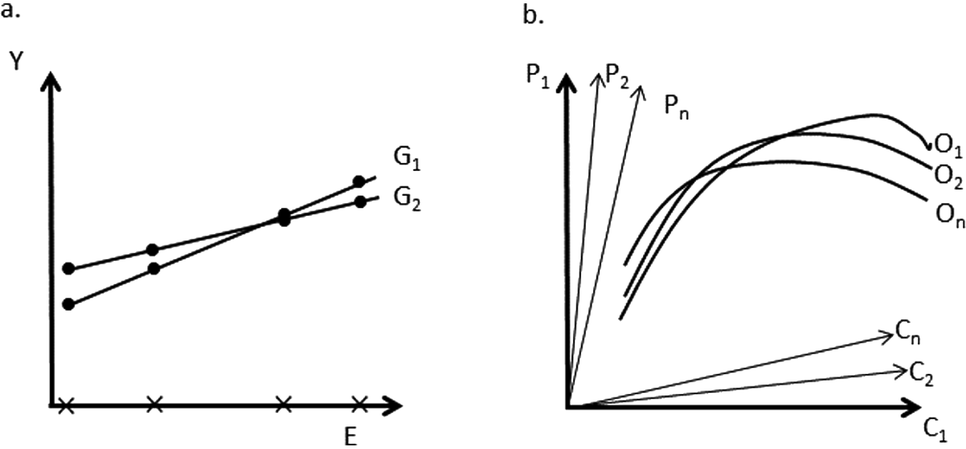
Crop breeders have long recognised the existence and importance of genotype by environment interactions (GxE). That environments influence the performance of the crop is clear. When searching for superior genotypes breeders note that the relative performance of different entries often depends on environment. Figure 1a is the archetypal illustration of this. Understanding the nature of these interactions is clearly important if, for example, there is a crossover, as in Figure 1, as then there is no single genotype superior in all environments studied. Breeders have developed methods to measure and explain GxE interactions because they are so important (Annicchiarico, Reference Annicchiarico2002).
(a) The GxE concept. The yields, Y, of two genotypes, G1 and G2, depend on the environment E. These responses could be assessed by experimenting in selected environments X, giving data ●. (b) The OxC concept. The performance, measured in multiple dimensions (P1,. . .Pn), of options for small holders (O1,. . .On) depend on the context defined by multiple factors (C1,. . .Cn).
When considering innovations for smallholders to address current adaptation challenges, there are many alternatives beyond germplasm. The same concept, that the performance of these options depends on environment, is still relevant. When ‘performance’ is expanded to include the farmer's perspective, embracing impacts on the total factor productivity of their livelihood and the acceptability of proposed change in relation to their objectives, then the dimensions of ‘environment’ that matter also have to be expanded to include social and economic as well as ecological conditions (Crossland et al., Reference Crossland, Winowiecki, Pagella, Hadgu and Sinclair2018). ‘Context’ is a general term that embraces the socio-ecological niche in which options need to be assessed and compared (Ojiem et al., Reference Ojiem, De Ridder, Vanlauwe and Giller2006)
Examples of OxC interactions are numerous. Almost any set of agronomic alternatives for farmers is likely to show different relative performance across contextual variation, and the contextual variables that matter, typically vary amongst farmers across geographies that development initiatives seek to impact. Examples in this special issue show that it is common for OxC interactions to be large enough to affect formal decision making across the sort of contextual variation that is experienced in research and development initiatives. Vanek and Drinkwater (Reference Vanek and Drinkwater2019) found interactions between fertilizer responses and soil types, including where soil types were defined by farmers. Franke et al. (Reference Franke, Baijukya, Kantengwa, Reckling, Vanlauwe and Giller2019) found strong effects of gender and household class not only on yield of climbing bean, but in the effect of an intervention (fertilizer application) on this. Mazon et al. (Reference Mazon, Peralta, Murillo, Rivera, Guzmán, Pichazaca and Nicklin2019) investigated a very different type of ‘option’, different ways for a research organisation to work with farmers, and found interactions between ways of working and types of farmers. Miccolis et al. (Reference Miccolis, Peneireiro, Vieira, Marques and Hoffmann2019) provide an analysis of the complex sets of social, economic and ecological context that drive the multiple options needed to implement policy on land rehabilitation in Brazil.
Other recent analyses reveal examples of OxC interaction. Tippe et al. (Reference Tippe, Rodenburg, Ast, Anten and Dieng2017) provide a complex example concerning interactions between planting date, variety, striga management and rainfall that illustrates how even a ‘conventional’ practice x biophysical environment interaction can be multi-faceted making any simplistic recommendations, for example on planting date, intractable. The contextual variation that matters for suitability of land restoration options includes fine scale variation in social factors (gender, livestock ownership), landscape niche and degradation status (Crossland et al., Reference Crossland, Winowiecki, Pagella, Hadgu and Sinclair2018; Kuria et al., Reference Kuria, Barrios, Pagella, Muthuri, Mukuralinda and Sinclair2018). Several authors identify typologies or classifications of farms within their domain of interest that interact with options. The variables that define these types are often based on farm resources and investment strategy (Hammond et al., Reference Hammond, Fravel, van Etten, Suchini, Mercado, Pagella, Frelat, Lannerstad, Douxchamps, Teufel, Valbuena and van Wijk2017; Ritzema et al., Reference Ritzema, Frelat, Douxchamps, Silvestri and Rufino2017) but are determined by the options being considered as well as the broader national or regional context, so that standardised approaches to farm typology development (Alvarez et al., Reference Alvarez, Paas, Descheemaeker, Tittonell and Groot2014) have to be adapted to local circumstances to be useful. Berre et al. (Reference Berre, Baudron, Kassie, Craufurd and Lopez-ridaura2019) demonstrate using expert opinion to address this as an alternative to methods that involve complex statistical methods employed on extensive datasets.
While the concepts of options, contexts and performance are useful in framing problems, their application requires care because factors may change their status when a problem is looked at from different perspectives. For example, in soil management, a slowly changing quantity such as soil organic matter defines a context variable in short term studies but might be a performance measure in the longer term. Depending on the scope and scale of a development initiative, policy could be seen as part of the fixed context within which options have to perform or, with larger scope, policy reform might be an option to engender change. When research aims to find and establish enabling environments in which farms can flourish the distinctions between the O, C and P can get fuzzy. Farrow et al. (Reference Farrow, Ronner, van den Brand, Boahen, Leonardo, Wolde-Meskel, Adjei-Nsiah, Chikowo, Baijukya, Ebanyat, Sangodele, Sanginga, Kantengwa, Phiphira, Woomer, Ampadu-Boakye, Baars, Kanampiu, Vanlauwe and Giller2019) find it useful to break down OxC conceptually into interactions between different genetic components, management and environment. This approach helps understand and structure the problem they are investigating and highlights the way OxC is most useful for framing thinking and planning, rather than as a rigidly defined quantity than can be measured and reported in the way a breeder might report results of a GxE analysis.
Researchers have long been aware of the environmental or contextual limits to new agricultural technologies and ‘recommendation domains’ have been part of the agricultural research and development vocabulary for a long time. The recommendation domain concept is still being used, often from a position of having a ‘ready technology’ and trying to predict where it will be useful or adaptable (Tesfaye et al., Reference Tesfaye, Jaleta, Jena and Mutenje2014). Recommendation domains are usually broadly defined and do not address the variation amongst farmers and niches within geographical zones. Pender et al. (Reference Pender, Place and Ehui1999) turned the analysis round, starting by identifying contextual factors predicted to influence changes in agricultural livelihoods and mapping the resulting ‘development domains’. These are valuable for predicting areas in which distinct development trajectories play out and hence the support needed but they don't help in distinguishing between closely related options, nor can they describe the fine scale variation that influences choices at farmer and farm level.
Precision agriculture is a response to variations in environment and a recognition that management options should respond to fine-scale variation, even within-field. The case for precision agriculture, together with supporting methods, have mainly been developed for soil fertility management of large mechanised farms in addition to some work on pest and disease management. Gassner et al. (Reference Gassner, Coe, Sinclair, Oliver, Bishop and Marchant2013) discuss how the same principles might be adapted to smallholder farming, through implementing the OxC concept. Combined with this is an increasing awareness of the potential value of databases that pull together results of separate small studies in the expectation of generating locally relevant results for any situation (Hyman et al., Reference Hyman, Espinosa, Camargo, Abreu, Devare, Arnaud, Porter, Mwanzia, Sonder and Traore2017). Such methods are useful in providing access to legacy data and reducing the need to repeat measurement but they are limited in scope because most options have neither been investigated in large numbers of contexts nor evaluated in respect of locally relevant performance measures.
METHODS REQUIRED TO IMPLEMENT OXC
For the first hundred years or more of organised agricultural research, most research designs were based on a small number of locations or contexts, carefully selected to be ‘representative’, and did not involve farmers. They occupied the lower left corner of Figure 2. Much of this research used experimental designs based on principles that have been known for a long time (Fisher, Reference Fisher1925) and they were clearly effective, generating much of what we know about agronomy today. The traditional framework for designing and analysing experiments has been one that focuses on estimating mean effects and trying to do this with precision. The option by context framework suggests that we need to focus on understanding variation not only means (Coe et al., Reference Coe, Njoloma and Sinclair2019; Vanlauwe et al., Reference Vanlauwe, Coe and Giller2019), but it has other consequences for research methods as well.
Characterisation of the space of approaches to research in agricultural development in terms of the number of distinct contexts, situations or people deliberately involved (N) and the level of participation (P).

In Figure 1(a), a research design is illustrated for investigating the response of genotypes (G) across a single environmental gradient (E). If there were two environmental gradients that were important then research locations would need to span both, with locations spread out in the plane defined by those two gradients. In typical OxC problems there are many context variables that might be important. Hence research must cover that space, sampling relevant variation at all scales – within and between farms, landscapes and communities. This contrasts with many current research approaches that aim to minimise variation in order to get precise estimates of means.
The number of contexts needed, N, can become very large. If there are C context factors to investigate and each one is considered only at two levels (high/low, or, yes/no) then there are N = 2C combinations to investigate. While some techniques from experimental design theory, such as fractional factorial designs (Mead et al., Reference Mead, Gilmour and Mead2012) can reduce this, real problems are likely to need investigation with more than just two levels, pointing to even larger N. Similar concerns arise whether using experimental or observational studies, with the reduced design choices in the latter meaning that the overall sample size required is likely to be larger. These requirements for larger N imply a need for prioritising which context factors and their interactions with options are most important to understand. The nature of the context factors selected will determine the design choices. Vanlauwe et al. (Reference Vanlauwe, Coe and Giller2019) explore some of the design options for investigating different types of factors via experiments. They and Coe et al. (Reference Coe, Njoloma and Sinclair2019) show why it is necessary to be able to estimate and report the residual or unexplained variation, which can often be interpreted as risk for farmers in adopting an innovation, with further consequences for the number of contexts, N, measured. The key point is that to understand OxC, N is going to be large, meaning that methods need to move to the right in Figure 2. The lower right space is labelled as ‘precision agricultural research’. Research of that type, enabled by information technology, has grown rapidly in recent years, for example, by the industrial agriculture sector producing maize varieties for specific locations (Gaffney et al., Reference Gaffney, Schussler, Löffler, Cai, Paszkiewicz, Messina, Groeteke, Keaschall and Cooper2015).
At the same time, addressing smallholder needs for innovation requires investigation of OxC interactions that involve participatory research methods capable of addressing the complexity of farmer livelihoods. Farmer participation is also desirable because of ethical considerations and the right of farmers to influence research done on their behalf. When researching OxC problems in smallholder agriculture there are also information-based reasons for involving farmers and using participatory methods. Some of the contextual factors needed cannot be simulated with researchers' experiments. In addition, some performance responses of interest, such as farmer preferences amongst alternatives, can only be measured by farmers after they have experienced the options being compared. Participatory research with smallholder farmers has been common since the late 1980’s but it has generally involved relatively small numbers of farmers and contexts (Ashby, Reference Ashby1990; Stroud, Reference Stroud1993), and for good reasons since it requires intensive engagement with farmers by skilled facilitators. In terms of the NxP space of Figure 2, the shift to a participatory research paradigm was a shift to the top left of the diagram.
Statistical, simulation and qualitative models allow exploration of some types of OxC interaction and their consequences but they can only be built on process knowledge and this is often not available for ecological interactions and is difficult to obtain for some social and economic interactions that determine farmer behaviour (Vanclay et al., Reference Vanclay, Prabhu and Sinclair2006). This means that research to understand and measure OxC interactions in ways that will provide information relevant to smallholders will require (i) empirical field investigation, (ii) that involves large numbers of farmers' situations, (iii) has some level of farmer participation and (iv) is integrated with appropriate use of models to generalise results (Descheemaeker et al., Reference Descheemaeker, Ronner, Ollenburger, Franke, Klapwijk, Falconnier, Wichern and Giller2019). This means operating towards the top right of Figure 2, an area which is novel. The implications for organising and conducting such research and its relationship with development praxis are covered in the next section.
IMPLICATIONS OF OXC FOR RECONFIGURING THE RELATIONSHIP BETWEEN RESEARCH AND DEVELOPMENT
Conducting research with smallholders that sufficiently samples contextual heterogeneity, while simultaneously meeting the needs of high-quality participation and of high-quality science is not easy or cheap. Various approaches have been proposed and trialled as evidenced in this special issue and can be classified into four broad categories of action as follows.
1. Participatory action research at scale. This uses participatory technology development or action research methods at a large scale, often organised through establishment of implementation platforms. This is not simple in practice, it is hard to maintain research quality and is expensive but it does not involve any novel conceptual challenges to participants and so is straightforward to implement where sufficient resources are available.
2. Crowdsourcing or citizen science. This approach is based on large numbers of farmers choosing to take part in trials which are very simple for each participant, though can result in a complex set of comparative data being collected overall. Information and communication technologies are used to aid data collection, aggregation, analysis and feedback to participants (van Etten, Reference van Etten2011; van Etten et al., Reference van Etten, Beza, Calderer, van Duijvendijk, Fadda, Fantahun, Kidane, van de Gevel, Gupta, Mengistu, Kiambi, Mathur, Mercado, Mittra, Mollel, Rosas, Steinke, Suchini and Zimmerer2019; van Etten et al., Reference van Etten, de Sousa, Aguilar, Barrios, Coto, Dell'Acqua, Fadda, Gebrehawaryat, van de Gevel, Gupta, Kiros, Madriz, Mathur, Mengistu, Mercado, Mohammed, Paliwal, Pè, Quirós, Rosas, Sharma, Singh, Solanki and Steinke2019). These examples implement a tightly defined research design so that data processing can use standardised software, though many adaptations on this theme are possible. The limited information generated by each participating farmer means that OxC interactions with fine scale variation may be hard to detect and the lack of horizontal connectivity of farmers may limit the development of mutually supportive co-learning (Altieri et al., Reference Altieri, Funes-Monzote and Petersen2012). A principle of citizen science is that both the professional scientists and the citizen scientists benefit from taking part (Hecker et al., Reference Hecker, Haklay, Bowser, Makuch, Vogel and Bonn2018). The extent to which smallholder farmers find it beneficial to engage in such a collective effort and their motivations for doing so is likely to depend strongly on the larger development process within which the research is embedded.
3. Farmer research networks. Nelson et al. (Reference Nelson, Coe and Haussmann2019) describe approaches based on using existing farmer organisations and networks to implement OxC research. The model appears to have potential for engaging farmers at scale but it is too early to see if it can also generate research results of high quality and that are generalisable beyond the context in which they were generated.
4. Research in development (RinD). Large-scale development projects often put in place infrastructure and expertise for working with large numbers of farmers. The RinD approach builds on this by encouraging and facilitating development organisations to incorporate farmers comparing alternative options in a planned way as scaling out progresses, rather than only implementing single best-bet options (Coe et al., Reference Coe, Sinclair and Barrios2014). This is coupled with facilitation of co-learning amongst farmers and with other actors (researchers, extension staff and the private sector). The approach embraces nested-scale innovation, not only in field level technology, but also market interventions as well as in policy and institutional reform that may be connected with one another (Coe et al., Reference Coe, Hughes, Sola and Sinclair2017). A challenge with the approach has been that the institutional cultures and staff of NGOs and government extension services implementing development projects do not always understand or accept the need for exploration and comparison of options and the attendant data collection required to do so.
While this list encompasses methods documented in this special issue, it is not exhaustive and there are overlaps and connections between the approaches described. It is likely that successful implementation of OxC will build on, adapt and integrate elements from several of these categories of action. What is important is that the documentation of their application to real-world problems in this special issue, supports the assertion that doing participatory research with large numbers of farmers and sampling sufficient heterogeneity of context to generate useful results, is feasible. It is also clear that whatever the organisational approach, there are some basic principles of research design that must be built in for useful results to be generated and for impact to be achieved for large numbers of farmers. When participatory research methods became widely used in African agriculture, other methods and quality aspects were often de-emphasised, leading to some backlash against the efficacy of participatory approaches (Gladwin et al., Reference Gladwin, Peterson and Mwale2002). There is a danger of something similar happening with the large N concept and so it is important for those developing and implementing OxC approaches to do so critically, realising the contribution they can make while understanding their limitations and the need to employ an integrated range of methods to tackle pressing needs for innovation in agronomy. This fits with the idea that research and rural advisory services influence innovation systems that comprise local actors and of innovation as a process through which these local actors adopt, adapt or generate change in their practice rather than only receiving new options from an external source (Kilelu et al., Reference Kilelu, Klerkx and Leeuwis2013). Key elements of innovation systems that can be influenced have been characterised as (i) hardware – technological options; (ii) software – knowledge about how, where and for whom, options will perform in different ways; and, (iii) orgware – the institutional structures and social capital amongst actors that govern flows of materials and knowledge and the nature of decision making (Klerkx and Leeuwis, Reference Klerkx and Leeuwis2009). Clearly, OxC approaches focus on supporting local actors to generate and use knowledge about the suitability of options that influences which options are used and has implications for the institutional structures required to integrate research and extension functions appropriately.
CONCLUSION
The papers in this special issue and other emerging literature show the ubiquity of important OxC interactions in agronomic innovation by smallholder farmers. They also demonstrate that feasible research approaches and methods for understanding and incorporating them into development practice exist. However, the challenges in shifting conventional research for development to address OxC interactions are not limited to choosing a means of generating data and understanding the results. The first requirement is that all those involved accept that a change is needed. There are many reasons why entrenched positions will make that difficult, not least because it requires accepting the weaknesses of some well-established modes of thought and operation, specifically the following.
• Giving simple messages to farmers when the reality is complex. Challenges remain in finding ways to navigate and communicate complex realities in easily understandable terms.
• Assuming researchers can find optimal solutions, rather than providing information and understanding that support extension staff and farmers in adapting innovations to local circumstances.
• That it is effective to scale up and out from small pilots without further iterative evaluation of the performance of options and their refinement as the application domain expands.
• That the use of conventional research methods and messages to farmers based on the mean performance of an option across contexts is useful to real farmers in specific contexts.
It is not only researchers that need to accept, adopt and adapt the new modes of thinking and action required to address OxC interactions, they also need to be taken up and further developed by extension and change agents in the public and private sector. It is only through co-development of methods involving both these constituencies, working closely with farmers that progress is likely to be made. It is clear that addressing OxC has large implications for the organisation of research and development and hence there are major implications for those influencing and implementing policy from local to global scales. It is also clear that the efforts to implement OxC approaches establish that a paradigm shift in agronomic innovation is well underway. Whether it will be sustained will largely depend on the demonstrable extent to which it is successful in accelerating development impact.
Acknowledgements
The development of this special issue was supported by the International Fund for Agricultural Development (IFAD), grant numbers 2000000520 and 2000000976, project titled, “Restoration of degraded land for food security and poverty reduction in East Africa and the Sahel: taking successes in land restoration to scale” under the auspices of the CGIAR Research Programme on Forests, Trees and Agroforestry (FTA). RC's involvement was also supported by the Collaborative Crop Research Program of the McKnight Foundation. The content of this special issue is the sole responsibility of the authors of each article and does not necessarily represent the views or endorsement of these funding bodies.


 Open access

