

Introduction
In 2023, the emphasis in Germany shifted significantly towards domestic issues, following a year marked by global challenges such as the Russian war on Ukraine, the subsequent energy crisis and a realignment of security policy (Angenendt & Kinski Reference Angenendt and Kinski2023). A pivotal event was the Federal Constitutional Court's ruling against reallocating COVID-19 relief funds to the Climate and Transformation Fund. This decision had profound implications for fiscal policy and exposed the challenges of budget management, as well as the difficulty of reconciling divergent economic policy philosophies within the ‘traffic light coalition’: The Free Democrats’/Freie Demokratische Partei (FDP) emphasis on fiscal austerity often clashed with the Social Democrats’/Sozialdemokratische Partei Deutschland (SPD) and Alliance 90/Greens’/Bündnis 90/Die Grünen willingness to incur more debt to tackle economic challenges, leading to intense tensions within the coalition. Conflicts also arose over the so-called Heating Act and Child Basic Security. These disputes within the governing coalition led to growing dissatisfaction among the population, reflected in the Land elections in Berlin, Bremen, Bavaria and Hesse, in which the governing parties partially experienced losses. The Alternative for Germany/Alternative für Deutschland (AfD) achieved significant electoral victories, while the future of the Left Party/Die Linke is more uncertain than ever after losing its parliamentary group status in the Bundestag due to a split.
Election report
Regional elections
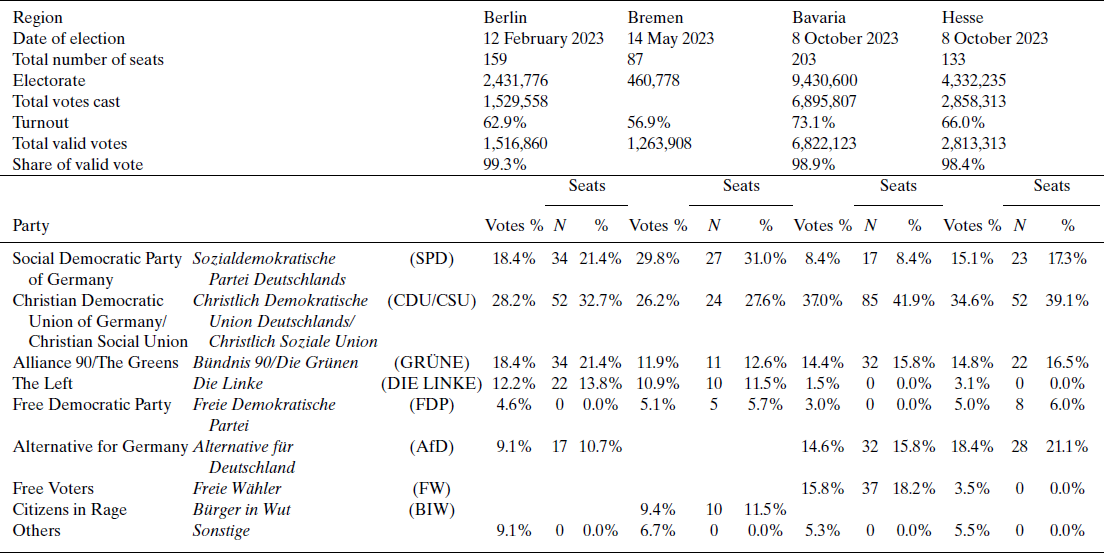
Land elections were held in Berlin (in February), Bremen (in May) and Bavaria and Hesse (both in October) (Table 1).
Results of regional (Berlin, Bremen, Bavaria, Hesse) elections in Germany in 2023

Notes:
1. In Bremen, every eligible voter has five votes, which can be distributed among the candidates of the lists in their respective electoral district. These five votes can be allocated by the voter in any manner either to candidates (personal vote) or to electoral proposals as a whole (list vote). Only the share of invalid ballots and not ‘valid vote’ available.
2. Total valid votes based on the second vote (proportional vote).
3. Citizens in Rage (BIW) only participates in regional elections in Bremen, the Christian Social Union (CSU) only in Bavaria (instead of the CDU).
On 12 February, the repeat election for the Berlin House of Representatives took place, which had been ordered by the State Constitutional Court after significant issues leading to long queues and a shortage of ballots during the regular election in 2021 (Angenendt & Kinski Reference Angenendt and Kinski2022). For the first time in over 20 years, the Christian Democratic Union/Christlich Demokratische Union (CDU) emerged as the strongest party, while the SPD achieved its historically worst result in Berlin. A grand coalition between CDU and SPD was formed with Kai Wegner (CDU) as the new Mayor of Berlin (Forschungsgruppe Wahlen 2023a).
The Bremen Bürgerschaft (state parliament) election took place on 14 May. The SPD won the election, followed by the CDU. The Greens saw significant losses by more than 5 percentage points, while the Left Party secured a notable share of the votes. The independent voter association Citizens in Rage/Bürger in Wut achieved a record increase, boosting their previous result by 7 percentage points. The FDP barely crossed the 5 per cent threshold. Due to internal disputes and the submission of competing electoral lists by two party factions, the AfD was excluded from the election. After four weeks of coalition negotiations, the SPD, Greens, and Left Party agreed to continue their previous coalition, with Andreas Bovenschulte (SPD) remaining head of government (Forschungsgruppe Wahlen 2023b).
A new state parliament was elected in Bavaria on 8 October, with the Christian Social Union/Christlich Soziale Union (CSU) maintaining its leading position, albeit with a historically low result, and Markus Söder (CSU) continuing as the head of government. The Free Voters/Freie Wähler were confirmed as coalition partners despite previous scandals involving party leader Hubert Aiwanger. He had to defend himself against accusations of having written an antisemitic pamphlet in his school days, which caused outrage beyond Bavaria. The FDP failed to re-enter the state parliament (Forschungsgruppe Wahlen 2023c).
The Hesse Land election also took place on 8 October, with the CDU improving its previous result by almost 8 percentage points, becoming the strongest party. The AfD also saw gains, achieving its best result in a Western German state to date. Other parties had already ruled out any cooperation with the AfD before the election. The SPD and Greens suffered losses, marking a historically poor result for the SPD. The FDP barely surpassed the 5 per cent threshold. Thus, all parties involved in the federal level ‘traffic light coalition’ experienced losses in this Land election. The Left Party failed to re-enter the state parliament. In December, the CDU reached a coalition agreement with the SPD, replacing the previous coalition of CDU and Greens, with Boris Rhein (CDU) remaining head of government (Forschungsgruppe Wahlen 2023d).
Cabinet report
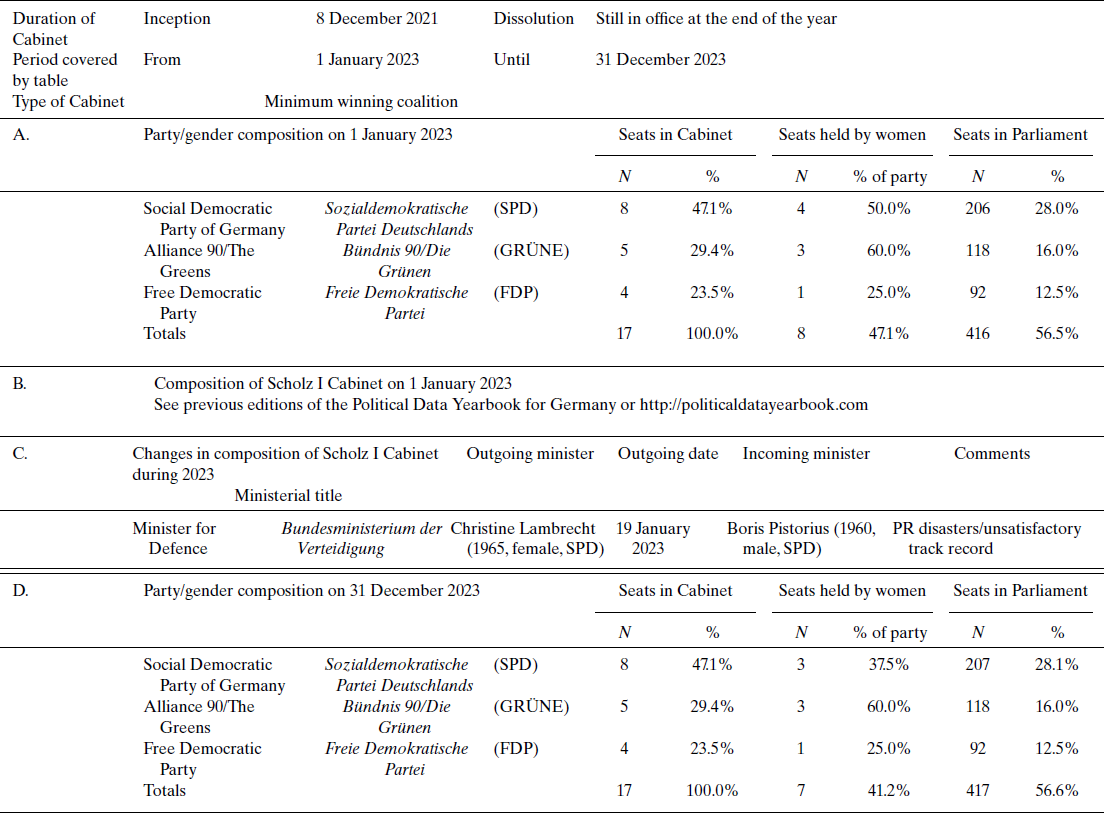
Table 2 shows the composition of the Federal Cabinet in 2023. On 16 January, the Federal Minister of Defense, Christine Lambrecht (SPD) resigned after several public relations mishaps and her inability to address the longstanding issue of under-equipped German armed forces (Hill Reference Hill2023). On 19 January, Lower Saxony's Minister of the Interior, Boris Pistorius (SPD), was appointed as her successor (Deutscher Bundestag 2023a).
Cabinet composition of Scholz I in Germany 2023

Sources: Angenendt and Kinski (Reference Angenendt and Kinski2023); Bundesregierung (2023a); Deutscher Bundestag (2023a, 2023c).
Parliament report
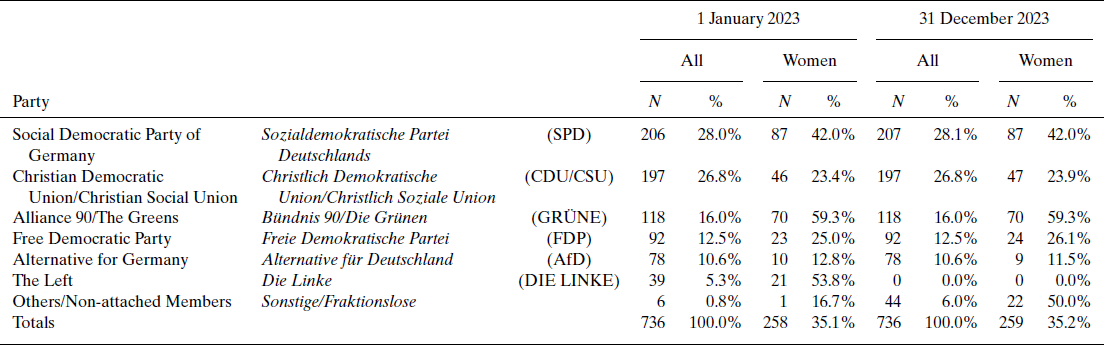
Prominent member of the Bundestag, Sahra Wagenknecht, departed from the Left Party in October, along with nine other members of the Left parliamentary party group (Zeit Online 2023a). They remained in the Bundestag as non-attached members. At the same time, Wagenknecht founded the association ‘Bündnis Sahra Wagenknecht’ (Alliance Sahra Wagenknecht) (BSW) with the aim of launching a new party under the same name in 2024 (Tagesschau 2023a). Before Sahra Wagenknecht's departure, Thomas Lutze (Die Linke) had already announced his resignation from the parliamentary group and his switch to the SPD (Frankfurter Allgemeine Zeitung 2023). As a result, the Left Party lost the necessary number of mandates to maintain its status as a parliamentary party group in the Bundestag, leading to the dissolution of the party group in December (Deutscher Bundestag 2023b) (see also Political Party Report section).
Information about the composition of parliament is summarised in Table 3.

Political party report
There were no changes in party leadership (party chairs, general secretaries) or parliamentary party group leadership for the AfD, CSU, the FDP, the Greens, and the SPD.
On 11 July, Carsten Linnemann (CDU) was nominated by party leader, Friedrich Merz, for the position of general secretary, succeeding Mario Czaja. On 12 July, he was provisionally elected as acting general secretary by the party's executive board (Handelsblatt 2023).
In August, the Left Party faced significant internal turmoil, prompting parliamentary party group leader Amira Mohamed Ali to resign in response to the party leadership distancing itself from Sahra Wagenknecht. Mohamed Ali had found it increasingly challenging to publicly defend the party leadership's positions, which often conflicted with her own political beliefs (Süddeutsche Zeitung 2023a). The underlying controversy revolved around the party leadership's progressive positions on socio-cultural issues and immigration, which clashed with Wagenknecht advocating for traditionally left-wing positions on economic issues but right-wing positions on immigration, and her pro-Russian views (see also Wagner et al. Reference Wagner, Wurthmann and Thomeczek2023). Her parliamentary party group co-chair, Dietmar Bartsch, chose to remain and continue to lead the party group on his own until it lost its status as a parliamentary party group on 6 December (Tagesschau 2023b).
Changes in political parties are summarised in Table 4.

Institutional change report
On 17 March, the Bundestag passed an electoral reform to reduce the number of its members elected with a majority vote. In future federal parliamentary elections, the existing number of 299 electoral districts will be maintained, but the number of parliamentarians will be limited to 630. Überhangmandate/overhang mandates/‘overhang seats’ and Ausgleichmandate/compensatory mandates/‘balance seats’, as well as the so-called Grundmandatsklausel/basic mandate clause, will be abolished (Deutscher Bundestag 2023e, 2023f).
Under the previous electoral system, when parties won more constituencies (direct mandates from the so-called ‘first vote’—Erststimme) than the number of seats in parliament they would have received based on the national party vote (the so-called ‘second vote’—Zweitstimme), these directly elected candidates would still take so-called ‘overhang seats’ in parliament. At the same time, the other parties would receive so-called compensatory mandates or ‘balance seats’ so that the proportion of seats received by each party matched the national party vote. In the current parliament, this practice had resulted in 138 extra seats (Deutsche Welle 2023).
Additionally, the basic mandate clause had enlarged the parliament further because it allowed parties that received three direct mandates to enter parliament and receive seats in proportion to their share of the national party vote, even if they did not pass the 5 per cent threshold. This had been the case for the Left Party in 2021, which won three constituencies directly but only had 4.9 per cent of the party vote (Deutsche Welle 2023).
The reform will reduce the size of parliament, but it also means that not all constituency winners will enter parliament. Based on the current parliament, the Left Party and CDU/CSU would lose most mandates as a result of the reform.
Issues in national politics
In 2023, the Russian war on Ukraine continued to be an important topic in domestic debate in Germany but was overall less salient than in the previous year in which the German Zeitenwende had dominated public discussions (Angenendt & Kinski Reference Angenendt and Kinski2023).
In reaction to the attacks on Israel by Hamas on 7 October 2023, Chancellor Olaf Scholz reiterated in a government declaration in parliament on 12 October: ‘At this moment, there is only one place for Germany: alongside Israel. This is what we mean when we say that Israel's security is a “reason of state” for Germany (deutsche Staatsräson)’ (Deutscher Bundestag 2023g, 15897D). Towards the end of the year, critical voices started emerging on Israel's reaction to the attack and the worsening humanitarian crisis in Gaza as Germany struggled to square its ‘special responsibility’ towards the state of Israel with growing criticism of Israel's retaliatory actions (Deutsche Welle 2024).
While inflation had still been quite an important topic at the beginning of the year, its salience decreased in the course of 2023, indicating that inflationary pressure had gone down. Other issues in domestic politics became more pressing: The amendment of the Buildings Energy Act, known as the Heating Act, sparked intense discussions. It aimed to promote the replacement of oil and gas heating systems with climate-friendly alternatives (Süddeutsche Zeitung 2023b). The FDP demanded significant changes to the original draft and opposed the swift implementation timeline, causing friction within the governing parties. In its original formulation, the law stipulated that, from 2024 onwards, every new heating system would need to be powered by 65 per cent renewable energy. The FDP insisted on relaxing this strict requirement, arguing the law was inefficient in reaching climate protection targets and put financial pressure on property owners and tenants. The debate reflected diverging views within the governing coalition on the appropriate balance between climate change mitigation and economic practicability (Tagesschau 2023c). Despite these challenges, the Bundestag passed the legislation after the Federal Constitutional Court had halted its enactment due to concerns over the tight legislative schedule.
In November, the Federal Constitutional Court ruled that reallocating funds initially intended for combating the COVID-19 pandemic to the Climate and Transformation Fund violated the constitutional debt brake (Bundesverfassungsgericht 2023). The government's decision, two years prior, to transfer unused credit authorisations of €60 billion for future fiscal years came under scrutiny. The Court criticised the lack of detailed justification for repurposing the funds and deemed the temporal separation of the emergency situation from the use of credit authorisations unconstitutional. The ruling, following a lawsuit by 197 members of the CDU/CSU faction in the Bundestag, created significant fiscal challenges, jeopardising projects funded by the Climate and Transformation Fund. After weeks of debate, the ‘traffic light coalition’ reached an agreement on an amended budget for 2023 and the 2024 budget, addressing a €17 billion shortfall created by the Court's decision (Bundesregierung 2023b).
The introduction of Child Basic Security was a central issue in the family policy of the ‘traffic light coalition’, aiming to lift children out of poverty by consolidating existing benefits. Despite broad support for the concept, its implementation faced criticism over potential administrative cost increases and the failure to raise the minimum subsistence level for children. After prolonged discussions, the government outlined key points for the new family benefit set to start in 2025. The debate underscored contrasting approaches within the coalition to combat child poverty: the FDP focuses on education and societal integration, while the Greens advocate for direct financial support to families (Zeit Online 2023b).
The government took various measures in migration policy. This included reaching an agreement with Iraq to facilitate the return of asylum seekers and simplifying the immigration procedures for skilled workers. In October, accompanied by criticism from the Greens, the federal government introduced stricter deportation rules granting enhanced authority to police and administrators (Tagesschau 2023d).
Acknowledgements
The authors thank Nico Bodden and Dana Shawky for their valuable support with the data collection.


 Open access

