


1. Introduction
Participatory design (PD for short) is increasingly recognized as a valuable design approach in various domains and disciplines. Teaching PD in engineering curricula prepares future designers, engineers, and decision makers to involve society in democratic and decentralized decision-making in development, including planning and design (Thoneick, 2023). By adopting a PD approach, students learn to build citizen engagement, a sense of community, group consensus, and social empowerment (Reference LuckLuck, 2003). The designer acts as a facilitator and mediator, triggering citizens to use their creativity to promote futures for their society based on human values (Reference Manzini and RizzoManzini & Rizzo, 2011).
Human values are considered the engine that drives design activities (Reference Iversen and LeongIversen et al., 2012). They are the core elements on which stakeholders need to agree before and during design. Value identification is of significant importance in designing inclusive systems (Reference Herzog, Gonçalves, Slingerland, Kleinhans, Prang, Brazier and VermaHerzog et al., 2024). Despite their recognized importance in PD (Smith at al., 2017), very little scientific literature on teaching PD mentions values. While scientific literature provides a rich repository of methods and practices for PD, there are no discussions on course concepts and teaching approaches for PD (Reference Örnekoğlu-Selçuk, Emmanouil, Hasirci, Grizioti and Van LangenhoveÖrnekoğlu-Selçuk et al., 2023). There is a gap regarding teaching value-based participatory design of inherently value-based (Kuvac & Stankov, 2011) systems, in particular complex socio-technical systems. Addressing this gap is the primary focus of this paper. It asserts that PD of complex socio-technical systems must be value-based. To fill the gap, this paper reports on how an academic course in value-based PD has been designed and conducted and discusses its results, strengths and weaknesses. The course is based on a novel approach presented in this paper called “value-based participatory design of complex socio-technical systems” (VPD-CSTS). Central to this approach are values and the role they play in PD. Students explore and investigate stakeholders’ needs and values for their system and link these to system requirements and the conceptual design of their system.
This paper is organized as follows. Section 2 summarizes related research on PD, teaching PD, and teaching value-based design and provides a summary of the lessons learnt from the literature. Section 3 presents our teaching approach VPD-CSTS and how it can be implemented in engineering curricula. Section 4 reports on the application of VPD-CSTS in a real-life academic course providing detailed information on the goals, organization, curriculum, conduct, and results of the course. Finally, Section 5 concludes this paper by summarizing its main take-aways.
2. Related research
This section includes a brief review of participatory design and the role of values, of literature on teaching participatory design and on value-based design, ending with a summary of the need and implications for teaching value-based participatory design.
2.1. Participatory design
In the last decade, participation has gained recognition across industry and public administration as a way to better connect with stakeholders (Reference Smith, Bossen and KanstrupSmith et al., 2017), as it has for the design community (Reference Gros and GazullaGros & Gazulla, 2020). PD researchers believe that involving stakeholders and users in the design process enhances the quality as well as the effective and efficient use of technology, as they have a better understanding of its requirements and functionalities (Reference Slingerland, Murray, Lukosch, McCarthy and BrazierSlingerland et al., 2022). This is particularly challenging for the design of socio-technical systems that are not limited to one person, one phase, or one solution (Reference Norman and StappersNorman & Stappers, 2015). In the role of mediator, designers (1) promote inclusive events and language, (2) build connections and trust between all stakeholders, (3) assure informed participation at one’s own will, (4) ensure an adequate power distribution for fair decision-making, (5) generate reciprocal exchanges, and (6) are transparent about all interests (Slingerland & Wang, 2024).
Stakeholder input is active and individual, as stakeholders participate in design meetings and share their opinions in a continuous, iterative discussion with designers (Reference Latortue, Minel, Pompidou, Perry and IonLatortue et al., 2015). It is their democratic right to be involved and exercise agency over a design (Reference Simonsen and RobertsonSimonsen & Robertson, 2013). As such, their engagement can lead to a better incorporation of stakeholder needs, desires, constraints, and ideas throughout the design process (Reference Brubaker, Jensen, Silungwe, Sheppard, Yang, Maier, Skec, Kim, Kokkolaras, Oehmen, Fadel, Salustri and van der LoosBrubaker et al., 2017) as reflections of the values involved. Reference Iversen and LeongIversen et al. (2012) argue that values should be elevated to the core of PD inquiries and considered as the engine that drives design. This is supported by Reference ObendorfObendorf (2009), who claims that a shared understanding of the importance allows the creation of systems that are valuable for the user. This means in practice that during a PD process, the main concern is not how to determine stakeholders’ needs and expectations or to strengthen stakeholders’ ownership; instead, the primary issue is how to identify and work with values (Reference Iversen and LeongIversen & Leong, 2012). PD approaches should thus facilitate the ultimate end of PD, which is a core engagement with values (Reference Iversen, Halskov and LeongIversen et al., 2010). A value represents a mental concept: a “transsituational objective” that changes in importance as a guiding principle “transcending personal, social, and institutional interests” (Reference Berzonsky, Cieciuch, Duriez and SoenensBerzonsky et al., 2011). Also, values are person-dependent as different people value things differently (Reber & Duffy, 2005).
As PD expands its focus from the public sphere to everyday life, researchers are now involving stakeholders in experimental, long-term approaches to innovation, encompassing technology development, social change, and envisioning the future (Reference Binder, De Michelis, Ehn, Jacucci and LindeBinder et al., 2011; Reference Björgvinsson, Ehn and HillgrenBjörgvinsson et al., 2012; Reference Ehn, Nilsson and TopgaardEhn et al., 2014). These approaches are giving the values and ideals of PD new meanings and forms (Reference Smith, Bossen and KanstrupSmith et al., 2017) within often contested private and public settings (Reference Andersen, Danholt, Halskov, Hansen and LauritsenAndersen et al., 2015).
2.2. Teaching participatory design
Participatory design is being taught in many different ways with different goals. Reference Weinberg and StephenWeinberg & Stephen (2002) report on an MSc. course for teaching HCI (human computer interaction) using PD, based on contextual design, covering human and technological aspects of interaction design, along with design methodologies and an interface design study. Course participants experienced and learned to appreciate the importance of user (student volunteers) input, in interviews and feedback sessions. In an MSc. elective for Computer Science students, Reference Hecht and MaassHecht & Maass (2008) focused on the use of PD methods in the software development lifecycle. In groups, students learn and experience the use of different PD methods (e.g., Scenario based design, Metaphors game, and CARD game) in a shared project (to develop an internet travel portal) in which they themselves take on the role of users. Students experienced the importance of user cooperation, social skills, and the ability to cope with a vast amount of information as part of software development. Reference D’Andrea and TeliD’Andrea & Teli (2010) took PD a step further in their MSc. elective course “participatory design for the sustainable use of information technologies” to overcome the power assymmetry in education. To this end, students designed their own course with teachers as facilitators. Students were responsible not only for defining their own curriculum (the course’s syllabus including course details, goals, exam requirements, etc.) but also for completing the programme once defined.
Reference Christiansson, Grönvall and YndigegnChristiansson et al. (2018) designed a curriculum for a mandatory BSc course on Co-Design and Qualitative Methods to include real “live” projects for a larger group, in line with Schön’s (1987) reflective practicum. Students are obliged to organise three encounters of which the content is to be discussed with teachers in advance. For the first encounter, students needed to recruit a small number of stakeholders with whom to jointly tackle a real challenge and to create a “magic circle” (Huizinga, 1955). This phase was the most challenging and important for the student experience. Identified areas for improvement included a better scaffolding, a focus on process rather than end results, and incorporating exercises to prepare students to conduct live projects.
2.3. Teaching value-based design
Value-based design (VBD) is a design approach that makes choices explicit for reasons of moral and social values throughout the entire design process (Turuel, 2021). In this approach, designers engage with the values of people and society, reflecting these values in material culture and technological innovations (Reference van den Hoven, Vermaas and van de Poelvan den Hoven et al., 2015). Reference Rocco, Thomas, Novas, Rocco, Thomas and Novas-FerradásRocco et al. (2022) emphasize the importance of identifying, interpreting, and implementing societal values in university education as an essential part of responsible innovation within equitable, inclusive, and sustainable societies. Reporting on three practical teaching cases in the built environment, they observed that students guided their re-design decisions more often by their personal values than by collective values and discovered the need to critically review their role of traditional values.
The objective of Magnier & Kobus (2022)’s BSc. course is to teach students to design products (not systems) for values and to disentangle how values influence a design process. They report that the way a design promotes or hinders particular values is a result of interaction between the design and the stakeholders, as also found by Reference Friedman and HendryFriedman & Hendry (2019). Magnier & Kobus (2022) affirm that getting designing for values ‘right’ must be done via a constant iterative interaction of conceptual, empirical, and technical investigations. Reference SuchmanSuchman (2002) emphasizes the need for designers and participating stakeholders to assume located accountability, as an individual’s vision of the world is inextricably based in a partial perspective, which makes this individual personally responsible for it.
Reference Barendregt, Nilsson, Yoo, Toft Nørgård, Bekker, Veldhuis, Eriksson, Pelegrín-Borondo, Arias-Oliva, Murata and PalmaBarendregt et al. (2020) observe that existing VBD approaches such as value-sensitive design, values in design, values at play, values-led participatory design, and worth-centred design have been developed for research purposes rather than for teaching purposes. They identify three pillars for teaching values in design: (1) ethics and human values, (2) people and stakeholders, and (3) technology and context. They state that teaching activities should allow students to engage in the curriculum through (1) coming to know, (2) becoming able to act, and (3) obtaining identity as a caring designer.
In line with Barendregt et al (2020), Eriksson et al. (2021) identify the need for resources to align learning objectives, teaching activities, and assessment criteria for VBD. They point out the need to consider attitudes, as they refer to affect, a concept that relates to values and emotions (Baartman et al., 2011). They present a teaching method called “Envisioning Future Scenarios” that combines VBD with inspiration from utopian and dystopian scenarios as seen in speculative and critical design (Reference AugerAuger, 2013). Steps in this method are: (1) exploration and analysis, (2) design and construction, and (3) evaluation and reflection. Reference AugerAuger (2013) claims that the shortcomings of teaching materials and systematized methods for teaching and assessing VBD approaches could be overcome using this method.
2.4. Conclusions on research into teaching value-based participatory design
In the approaches discussed above, students learn how to interact with stakeholders in a design process, each in their own way. By involving students in PD, they enhance their skills for future professional development, such as teamwork, critical reflection, and communication. Working on real-world projects keeps students’ motivation high and enhances their soft skills and performance, but a theoretical foundation is also needed. That is why a good balance should exist between learning the theory and obtaining practical experience. More research needs to be done on how to teach PD as it remains challenging due to the short course time and the unfamiliarity of students with PD. None of the studied papers about teaching PD mentions values or considers them as key components of PD.
In contrast, VBD is about values and their integration in a design process. It reflects on how stakeholders’ desires, needs, and values play an important role in design decisions. Designers’ values may differ, as may the values they deem important for the system they are designing. This may lead to complex interactions that manifest themselves between stakeholders: a challenge known to exist within PD.
Whilst the need for the combination of both PD and VBD in teaching is acknowledged, the authors are unaware of published research that embraces both in the same educational context. This is the focus of this paper.
3. A novel teaching approach for value-based participatory design of complex socio-technical systems
Designing a complex socio-technical system should take stakeholders’ values into consideration, from the very beginning of the design process. They are co-designers of a system, and they determine the worth of the system. Values form the basis for requirements (van de Poel, 2013). Being iterative by nature (Reference SimonSimon, 1969), the design process should incorporate stakeholders’ values correctly.
The central claim in this paper is that in a socio-technical systems engineering curriculum, teaching PD should be combined with teaching VBD. This paper proposes an approach to this purpose called VPD-CSTS: Value-Based Participatory Design of Complex Socio-Technical Systems. VPD-CSTS combines two premises concerning the design of a complex socio-technical system, namely participation of its stakeholders as designers during the design process and being based on stakeholders’ values (Reference MumfordMumford, 2000).
The foundation of VPD-CSTS is the set of values on which a system’s design is based. These values are derived from needs and desires of stakeholders. The students need to understand what the stakeholders expect (values) from the system to be designed. Different types of systems imply different expected values (see Figure 1), that often lead to different outcomes. In VPD-CSTS, values frame a system’s mission statement defining a purpose to guide the design process. It is characterised by: (1) focusing on the “why” of the system, (2) being value-based, (3) including a justification in relation to higher-level goals, and (4) without dictating a solution enhancing and sharpening through iterations.
System requirements describe capabilities that a system needs to have to achieve its value-based mission. There are two types of requirements: functional and non-functional. While the first type relates to the functions the system needs to perform to achieve its purpose, the second type relates to the behaviour a system is to display, the structure it needs to have, and the experience it should support (Reference Gero and KannengiesserGero & Kannengiesser, 2004). Each requirement must express a single capability and be verifiable, justifiable, and independent of implementation. In addition, all requirements should support the value-based mission of the system.
Example of connecting different types of systems to potential corresponding values

VPD-CSTS adopts the following definition of PD (Reference Simonsen and RobertsonSimonsen & Robertson, 2013): “Participatory design is a process of investigating, understanding, reflecting upon, establishing, developing, and supporting mutual learning between multiple participants in collective ‘‘reflection-in-action”.” This definition explains the role to be played by all participants and emphasizes the need for a collaborative effort between participants. Together they co-design, co-create. and co-produce. VPD-CSTS embraces the participatory design of participatory systems approach (PDPS) developed by Reference van Langen, Pijper, de Vries and Braziervan Langen et al. (2023), making it more concrete for educational purposes and explaining that there is never a single best system.
The next section reports on the operationalization of a VPD-CSTS based course offered in 2023-2024.
4. Experiment: teaching value-based participatory design
VPD-CSTS has been implemented in a ten-week real-life project-based MSc elective on Participatory Systems Design (SEN9115) provided by the Faculty of Technology, Policy and Management (TPM) at Delft University of Technology (TU Delft). Students from different programmes across the university participate. SEN9115 aligns with TPM’s focus on integrating values into design, reflecting a commitment to addressing societal and ethical considerations in system innovation (Reference van den Hoven, Vermaas and van de Poelvan den Hoven et al., 2015). This perspective is embraced by TU Delft researchers, supported by initiatives like the Design for Values Institute that connects researchers integrating values in all stages of technology development.
4.1. Setup
The ten-week SEN9115 course focuses on participatory systems: complex socio-technical systems that promote trust, engagement, and empowerment of people (Reference Brazier and NevejanBrazier & Nevejan, 2014). Providing a socio-technical infrastructure for stakeholder participation, participatory systems enable problem owners to take responsibility and act (Reference Brazier and NevejanBrazier & Nevejan, 2014). The learning objectives of SEN9115 are: (1) analyse a complex context (actors, roles, information needs, relations), (2) identify stakeholder values, (3) formulate a value-based mission statement, (4) determine requirements, and (5) explore potential designs, including explicitly considering requirements and structures for governance and coordination.
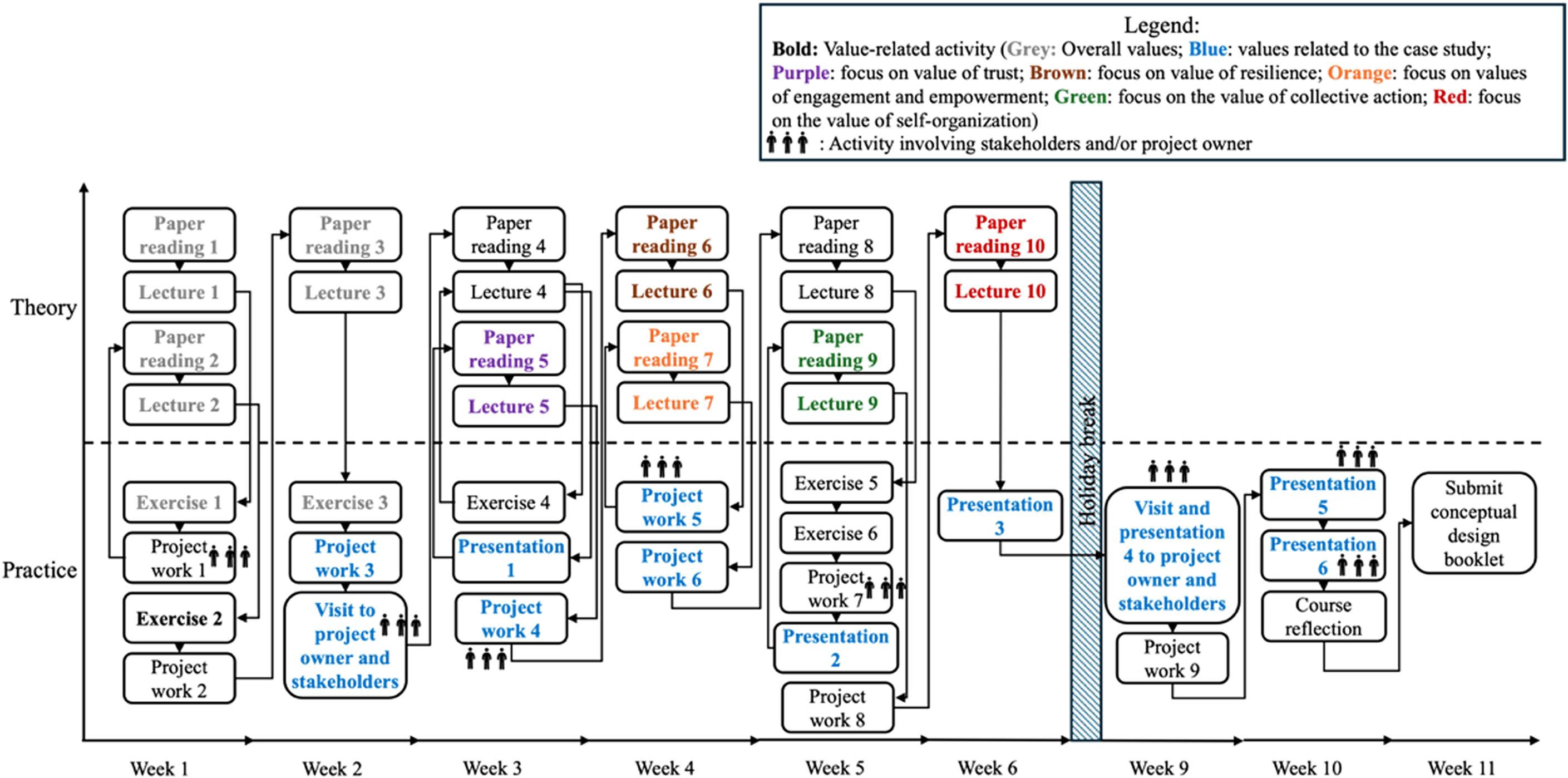
Following VPD-CSTS in a combination of theory and practice, including site visits and workshops, students learn the theory of value-based participatory design and put it into practice (see Figure 2). The course includes guest sessions on designing for specific values (such as trust) to highlight the importance of values in the design of complex socio-technical systems and to provide students with additional knowledge that can be applied to their project.
Implementation of VPD-CSTS in SEN9115
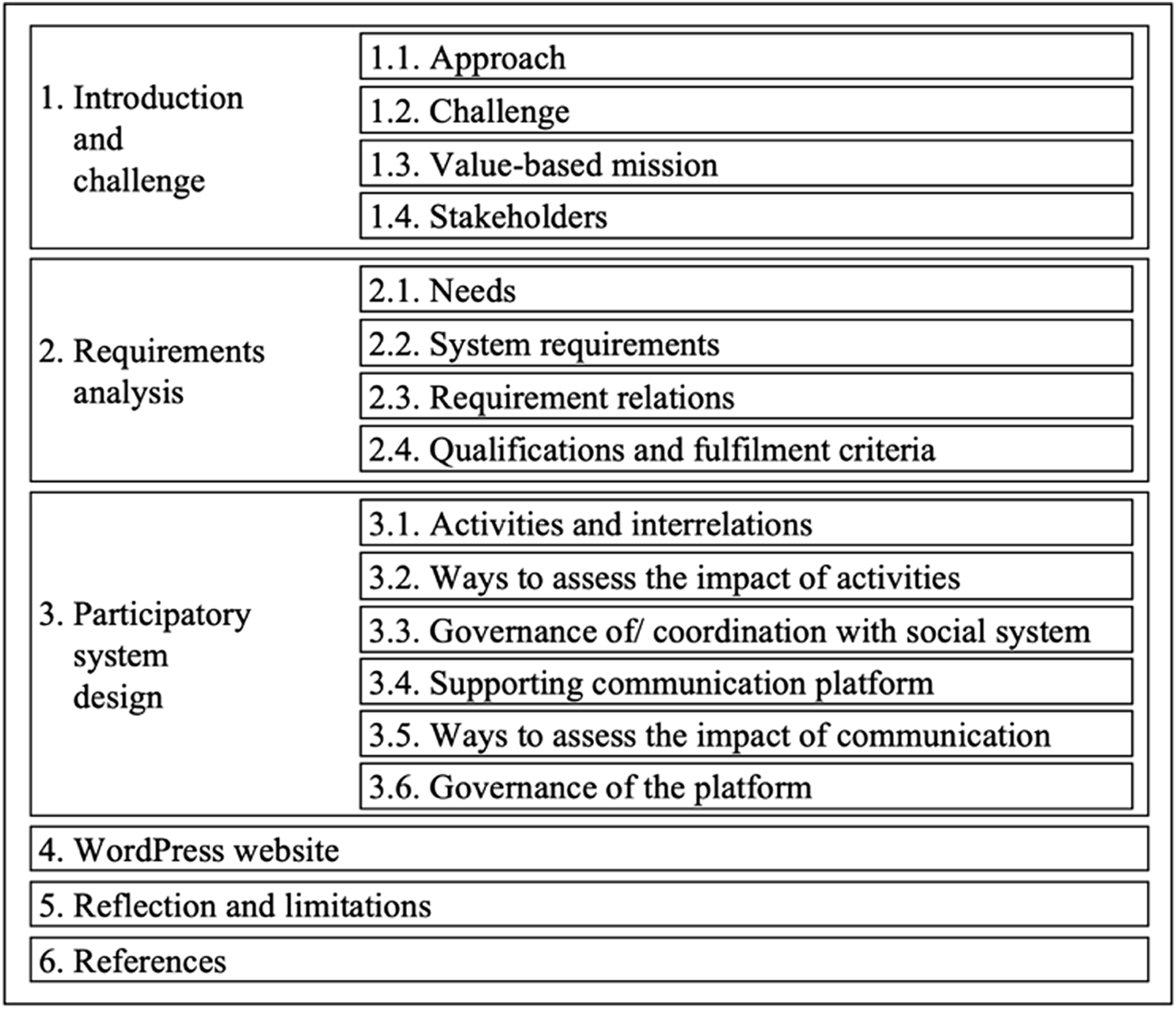
The project this year is facilitated by the Veldacademie (Field Academy in English): a Rotterdam-based independent Advisory for the City Council. As the problem owner, the VeldAcademie is tasked with improving links between residents, newly established Neighbourhood Councils, and the Municipality of Rotterdam. In teams of 4-5 members with various cultures and backgrounds, students are tasked with exploring stakeholder needs, values, and requirements to design a system supporting participation and social learning together with stakeholders that builds on existing systems within the neighbourhood and its networks. Well embedded in the city, the Veldacademie facilitates interaction with relevant stakeholders. The students’ assignment is to work with stakeholders to co-develop a conceptual design of their socio-technical system including governance and to design a mock-up of a website to support communication within the system. The conceptual design is to be documented in a report for which a predefined template is provided (see Figure 3). Every other week, students present their findings to receive feedback from all parties including teachers and their peers, allowing for more opportunities for iteration. The teams were assessed on the conceptual design of their system and the mock-up of a supporting website. The actual implementation of the website was outside the course’s scope. In this course, Group 1 focused on the relationship between the Municipality and Neighbourhood Councils, Group 2 on the relationship between Neighbourhood Councils and residents, and Group 3 on the relationships between residents and local governmental bodies of Rotterdam.
Conceptual design template for SEN9115

4.2. Results
SEN9115’s exam consists of a project assignment and an individual reflection on the course. Group 1’s results are used in this paper to illustrate the project assignment of conceptually designing a participatory system that supports participation and social learning in Rotterdam. This group focused on the lack of collaboration and interaction between the newly founded Neighbourhood Councils and the Municipality of Rotterdam. In interaction with representatives of a Neighbourhood Council and the Municipality, facilitated by the Veldacademie, the following values were identified: (1) community engagement, (2) inclusion, and (3) transparency. These values are included in their value-based mission statement: “to improve the communication between the Municipality of Rotterdam and Neighbourhood Councils of Rotterdam to enable transparency and effectively stimulate community engagement and inclusion”. This mission statement provided the basis for the system’s functional and non-functional requirements. Examples of functional requirements on which agreement was achieved included: “facilitate active communication” and “facilitate local initiatives”. Examples of non-functional requirements included “ensure ongoing contact” and “provide information in multiple languages”.
Group 1’s conceptual design identified different ways to facilitate communication and local initiatives, identifying activities, assessment criteria, and a division of responsibilities. The design of their website MuniLearn (see Figure 4) includes (1) a lessons-learned database for knowledge transfer between stakeholders, (2) a budget overview to support budgeting of events the Neighbourhood Council could organize, (3) a training panel to track and display the advancement of individuals or groups through training modules, providing insights on overall progress, areas that need attention, and completion rates, and (4) an activity overview providing a comprehensive view of ongoing and planned activities within the Neighbourhood Council and the Municipality, including schedules, participant lists, goals, and the status of various initiatives, offering a centralized point of reference for stakeholders to coordinate, participate, and monitor activities, extending an existing website developed by the VeldAcademie.
Prototype of MuniLearn communication tool made by group 1 (with permission from the students M. Aikawa, R. Dukker, D.G. de Jager, A.D Paulus Sudin, A. Aboutaleb, S. Shindikar)

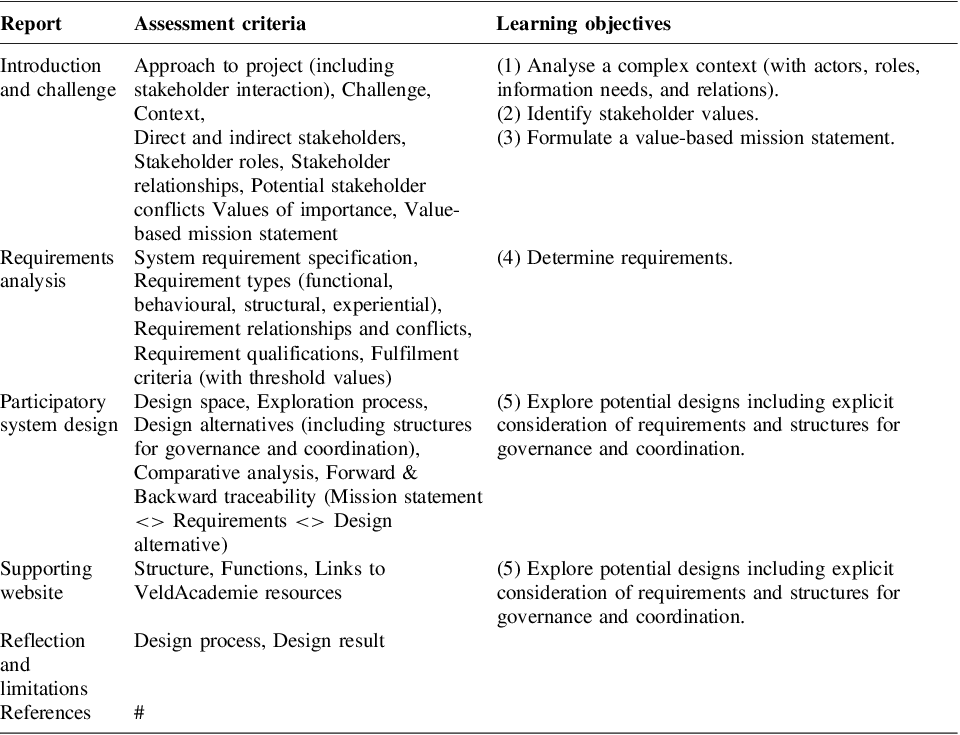
To evaluate the achievement of the learning objectives, a constructive alignment approach was used in this course (Reference BiggsBiggs, 1996), aligning learning objectives, learning activities, and the assessment. Each group submitted a final report describing the conceptual design of their system (including governance) and the design of a supporting website in line with the template provided above, which were graded following a checklist mirroring the learning objectives. Based on the assessment, the learning objectives of the course were met by all groups: the students were able to develop a value-based mission statement, system requirements, a conceptual design of a participatory system, and a design of a website to support communication (see Table 1).
At the end of the course, students reflected individually on their experience and learning journey by answering four questions: (1) For which types of complex social-technical systems do you consider participatory systems to be a relevant option? (2) Which challenges in the design of participatory systems have you encountered during this course, and can you imagine encountering in future situations when designing a participatory system (consider, for example, challenges related to coordination, governance, measurement of success, level of participation and others)? (3) Which dilemmas, trade-offs, and risks related to design choices have you encountered, and can you imagine encountering in future situations when designing a participatory system, in particular with respect to the following values: trust, engagement, and empowerment? (4) How would you describe this course with respect to content and process during the course?
The students described SEN9115 as a “highly interactive” course providing “an interesting first step into the world of participatory systems”. They considered it to be “educational and enjoyable, especially when engaging with a case like that provided by the Veldacademie.” They stressed that the collaborative work between students from different cultures and backgrounds contributed significantly to this experience. Furthermore, they argued that the dual structure of theory and practice significantly enhanced the overall learning experience. Challenges students reported included navigating diverging interests of residents, the Neighbourhood Councils, and the Municipality, managing contributions from participants with varying levels of expertise and interest, dealing with conflicting values, and coordination issues due to “a large number of participants [i.e., stakeholders] with varying levels of expertise and interest”. Students identified the benefit of determining values and formulating a value-based mission statement. They recognized the importance of stakeholders participating in the design process. They enjoyed working on real-life challenges rather than fictitious ones, allowing them to put theory into real practice. In their project, the groups initially struggled with focusing on the values of stakeholders rather than their own values. They faced some frustrations that are inherent to the iterative nature of the design process, namely having to rework results they thought were final. Once they realized that participatory design is not a single-person or mono-disciplinary endeavour and that a design evolves over time, they embraced the challenges involved. Almost all students noted the increase in intensity as the course progressed; some mentioned that they needed more time, knowledge and experience.
Alignment between learning objectives and assessment for SEN9115

5. Conclusions
Teaching value-based participatory design of complex socio-technical systems in engineering curricula enables students to create solutions that are aligned with the values of those who will use, manage, and govern these systems and those who will be affected by them. VPD-CSTS emphasizes the importance of actively involving stakeholders in the design process and tapping into their values from the very start of the design process. It supports teachers in making students: (1) understand the importance of identifying stakeholder values, formulate a value-based mission statement early on in the design process, and iterate when necessary; (2) acknowledge and handle the iterative nature of the design process; (3) work closely with stakeholders on systems to design what they need rather than what designers think are the best ones.
Focusing on stakeholder values also enhances critical thinking and reflection by all involved. Students are taught to assess how different values and priorities can influence a design process and the resulting designs. This sense of ownership and involvement promotes acceptance and sustainability of socio-technical systems, as people are more likely to trust and embrace solutions that align with their values.
The many years of applying, evaluating, and adapting VPD-CSTS in SEN9115 showed that students benefit from (1) real-life projects, (2) a problem/project owner willing and able to provide contextual information, (3) a problem/project owner willing and able to facilitate/support stakeholder participation, (4) incremental assignments that result in a conceptual design, (5) agreed deadlines for assignments, (6) alignment of theory and practical work/assignments, and (7) different types of feedback over time. Students’ course reflections provided valuable insights on student experiences.
Acknowledgments
The authors wish to thank all of the students who participated in the 2023-2024 SEN9115 course and have given us permission to publish their results. Our appreciation is also extended to the Veldacademie, in particular Otto Trienekens, for facilitating and supporting the real-life projects that made this experience possible, and the external stakeholders involved.




 Open access

