

1. Introduction
Not all World Bank loan conditions are created equal. Why do some borrowers receive relatively lenient conditions while others receive more stringent conditions? This question relates to a foundational debate in International Relations: do international organizations (IOs) primarily do the bidding of their most powerful member states or do they have a life of their own as organizations (Barnett and Finnemore, Reference Barnett and Finnemore1999)? Applied to the Bank, are loan conditions a function of powerful principals or bureaucratic tendencies?
A large literature finds powerful member states influence World Bank conditionality. Prominent studies, drawing on principal-agent (PA) theory, rely on the count of loan conditions to proxy how onerous loans are for borrowers (inter alia, Kilby, Reference Kilby2009; Clark and Dolan, Reference Clark and Dolan2021) and show that states aligned with powerful Bank principals in forums such as the UN receive fewer conditions. This study finds that important aspects of Bank conditionality other than count are not determined by powerful principals.
First, reviews of conditionality by Bank researchers submit that what is most impactful on a borrower is not the number of loan conditions, but their stringency—the degree to which loans require verifiable and costly reforms rather than vaguely defined changes of little consequence (Kapur and Webb, Reference Kapur and Webb2000; Koeberle, Reference Koeberle, Koeberle, Bedoya, Silarsky and Verheyen2005b). Studies of policy loans find that success depends on “substantive […] policy- and action-oriented” conditions or prior actions requiring “actionable” reforms that can “lead to tangible results” (Moll et al., Reference Moll, Geli and Saavedra2015, 9, 14). We define stringency based on this research, then operationalize and measure stringency by applying quantitative text analysis to a new dataset of Bank loan conditions. Second, using this new measure, we find that conditionality language is primarily determined by the Bank’s bureaucratic priorities, not the influence of powerful principals.
This yields two contributions. First, we document that across time and borrowers, the stringency of Bank conditionality is primarily associated with attributes of bureaucratic organizations. Despite the influence of principals, Bank staff obtain enough agency slack that these tendencies inform conditionality content more than principal interventions. This is new quantitative evidence supporting theories of Bank lending that draw on sociological insights (Barnett and Finnemore, Reference Barnett and Finnemore2004; Gutner, Reference Gutner2005; Weaver, Reference Weaver2008; Honig, Reference Honig2019; Kramarz, Reference Kramarz2020) and theories of informal governance by staff across international financial institutions (on the International Monetary Fund [IMF], see Chwieroth, Reference Chwieroth2013; Nelson, Reference Nelson2017).
We do not claim that principals have no influence on loan conditions. Rather, we refine studies of Bank lending by highlighting that (1) the language of conditionality text is at least as important as, if not more important than, the number of conditions and (2) variation in conditionality language is not associated with the same factors as variation in conditionality count. This does not rule out that principals will occasionally try to influence the content of conditions that borrowing countries receive, but indicates that such influence may be too rare, muted, or mediated by the Bank’s own bureaucracy to be discernible in standard statistical models. Moreover, when we replace our text-dependent variable with the count of conditions, our models replicate the common finding that powerful principals affect condition count. This suggests that theories of principal influence and theories of a bureaucratic Bank are complementary. Future research can study both aspects of conditionality and account for the empirical patterns we identify.
Second, to promote research on conditionality language, we provide a new dataset of 3,641 publicly available World Bank loan agreements from 1995 to 2021. Studies frequently rely on a dataset that began in 2004, the World Bank’s Development Policy Action Database (Clark and Dolan, Reference Clark and Dolan2021, 40). We thus add over a decade of empirical material and a new measure of conditionality stringency across all loans for future research. We hope that these data incentivize further analysis of conditionality content.
2. World Bank conditionality: theories and expectations
When explaining World Bank lending, many find evidence that loans reflect the preferences of powerful member states. The Bank, as a development agency, claims that it adjusts loan conditions based on borrowers’ institutional capacities and past loan performance. Finally, others emphasize how the Bank’s bureaucratic organization informs its lending.
2.1. Powerful principals and World Bank lending
A sizable literature positions IOs as agents of state principals. Principals impose constraints on agents to ensure they do not shirk mandates (Nielson and Tierney, Reference Nielson and Tierney2003; Hawkins and Jacoby, Reference Hawkins, Jacoby, Hawkins, Lake, Nielson and Tierney2006) and serve principals’ interests (Lall, Reference Lall2017). Many highlight that principal influence depends on their number and homogeneity (Copelovitch, Reference Copelovitch2010; Stone, Reference Stone2011). Single-principal frameworks argue that among Bank borrowers, “friends” of the US receive fewer and more-forgiving loan conditions (Kilby, Reference Kilby2009; Clark and Dolan, Reference Clark and Dolan2021). Collective-principal frameworks find similar constraints on Bank lending because coalitions of principals gain influence through Bank voting rules (Lyne et al., Reference Lyne, Nielson, Tierney, Hawkins, Lake, Nielson and Tierney2006, Reference Lyne, Nielson and Tierney2009). This leads to the proposition that countries with foreign policy affinity to the US or a coalition of powerful principals obtain fewer and less-stringent loan conditions.
2.2. Bank evaluation: policy, governance, and performance
Although principals try to ensure IOs follow their preferences, IOs inevitably gain some agency (Hawkins and Jacoby, Reference Hawkins, Jacoby, Hawkins, Lake, Nielson and Tierney2006). What do IOs do with their autonomy (Gutner, Reference Gutner2005; Kramarz, Reference Kramarz2020)? The Bank claims that it lends according to borrowers’ institutional quality and past performance. This claim has historical roots. The first generation of structural adjustment conditionality was designed to help borrowers with global market integration (Rodrik, Reference Rodrik2006, 973; Williamson, Reference Williamson and Williamson1990). In response to criticism, a second generation of conditionality emerged in the early 2000s. Reforms were now also supposed to focus on institutions and governance, ostensibly ensuring that the context for successful implementation of first-generation reforms was present (Koeberle, Reference Koeberle, Koeberle, Bedoya, Silarsky and Verheyen2005b; Rodrik, Reference Rodrik2006).
One desired consequence was more loans to countries with pre-existing institutional capacity. Since “more conditionality cannot compensate for weak government commitment or implementation capacity […] selectivity in favor of countries with favorable policy environments” became good practice, according to Bank insiders (Koeberle, Reference Koeberle, Koeberle, Bedoya, Silarsky and Verheyen2005b, 4, emphasis added), lending was also based on past performance: “A country’s track record is a better indicator of its determination and effectiveness in implementing a viable development strategy than elaborate promises for future efforts […] conditionality for good performers can be less prescriptive” (Koeberle, Reference Koeberle, Koeberle, Bedoya, Silarsky and Verheyen2005b, 4, emphasis added).
These reviews of conditionality suggest that it should be less stringent where institutions and past performance are strong, reflecting Bank efforts to emphasize borrower ownership (Best, Reference Best2014). But whether this occurs in practice is disputed: Buntaine et al. (Reference Buntaine, Parks and Buch2017) find that in the natural resources and environmental management sector, countries with relatively weaker institutions tend to receive comparatively “easy and shallow,” “form over function” targets. The effect of institutions on Bank loan conditions is thus an open question.
2.3. The World Bank as a bureaucracy
A third approach theorizes that IO behavior can be understood through the lens of specific bureaucratic traits (Barnett and Finnemore, Reference Barnett and Finnemore1999). Exemplifying Weber’s (Reference Weber1946) insights, IO bureaucracies shape internal decision-making by creating incentives that guide staff toward standardized behaviors and procedures (Weaver, Reference Weaver2008). As a mature bureaucracy, the Bank values predictability and measurability of outcomes (Honig, Reference Honig2018). If staff follow routines to pursue organization-wide targets, they reduce uncertainty (Eckhard and Parizek, Reference Eckhard and Parizek2022), if at the cost of development effectiveness (Honig, Reference Honig2018, Reference Honig2019).
The most important here is that such incentives lead to patterns in organizational outputs (such as loan conditions) despite staff having different preferences and working in different contexts (Park and Kramarz, Reference Park and Kramarz2019). For example, it is widely accepted that Bank staff have career incentives to extend loans (Weaver, Reference Weaver2007; Safarty, Reference Safarty2012; Briggs, Reference Briggs2021). At the same time, the Bank seeks to reduce the risk of loan failure. With policy loans specifically, failure arises if borrowers do not comply with conditions and funds are not used for the agreed goals. Bank emphasis on using conditionality to reduce this risk is codified in post-loan monitoring by the Bank’s internal Independent Evaluation Group (IEG). “Unsatisfactory” IEG scores indicating that loan failures have been linked to “weaker” prior actions and conditions that are not “substantive, viz. policy- and action-oriented […] that lack policy substance and are less action-oriented” (Moll et al., Reference Moll, Geli and Saavedra2015, 9). Successful policy loans, then, depend on “having reforms or policy measures that are actionable and that can indeed lead to tangible results” (Moll et al., Reference Moll, Geli and Saavedra2015, 14). Conditionality is thus a core tool for mitigating organization-wide loan risk while creating space for staff to meet the disbursement imperative.
If Weberian bureaucracy informs conditionality, then conditions should at least in part vary by how “risky” a loan is—that is, how likely the borrower is to not comply with loan aims or use funds in ways that do not meet the Bank’s development agenda. For example, borrowers who disagree with the Bank’s economic development prescriptions—and thus pose a greater threat of non-compliance—may face stricter conditionality. Similarly, funds for policy budget support loans are more fungible than for project loans, so may require stricter conditionality. Such links between perceived loan risk and variation in Bank loans have been identified elsewhere, if with different dependent variables. Winters (Reference Winters2010) finds that, given concern about the use of fungible funds, aid recipients with a poor governance record are more likely to receive less-fungible project loans than they are to receive budget support policy loans.
3. World Bank lending processes and effects on conditionality
We expect that when the stringency of Bank condition text is in question, bureaucratic theory explains Bank lending. In practice, loan agreements result from project cycles, which are organization-wide bureaucratic processes. Of course, it is not credible to claim that principal constraints are entirely absent. However, with sufficient agent slack, principal constraints may have a relatively small impact on conditionality content compared to the bureaucratic organization Bank staff face in their day-to-day work. Principals may also use their veto power only selectively, leaving bureaucratic factors to have a more common, generalizable effect on loan details than external politics (McLean and Schneider, Reference McLean and Schneider2014).
Bank loans are the output of a bureaucratic cycle in which projects are identified, appraised, negotiated, approved, implemented, and then evaluated. These cycles are managed by Task Team Leaders (TTLs), who have strong career incentives to make as many loans as possible (Briggs, Reference Briggs2021; World Bank IEG., 2016, 28). TTLs work with recipient governments through a lengthy preparation phase including economic, social, and environmental assessments. Before final approval, projects go through an appraisal stage, in which the Bank and borrower negotiate outcomes, timelines, and evaluation tools, including conditions (World Bank, 2022). Once agreed, both parties sign a loan agreement. Many studies highlight mechanisms through which powerful Bank principals might influence this process (Kilby, Reference Kilby2009). For example, “friends” of the US may have loans expedited, “losing conditions in the process” through a “pleasing” mechanism, where staff either seek to demonstrate that their work supports the US or unconsciously share an American worldview (Clark and Dolan, Reference Clark and Dolan2021, 37).
But the details of conditions are not typically a topic of executive board scrutiny. Principals only intervene in important cases (McLean and Schneider, Reference McLean and Schneider2014). The Bank’s biweekly board meetings provide more evidence of this. Most loans are not flagged for discussion but get approved on an “absence of objection basis” or “authorized to proceed on a streamlined basis.” As such, the majority of loans—let alone the details of conditionality language—are not the subject of the board meeting discussion.Footnote 1 To obtain such easy passes at the board level, staff have incentives to conform to standard operating procedures by submitting uncontroversial and predictable loan conditions (Weaver, Reference Weaver2008; Honig, Reference Honig2018).
From this, we expect a generalizable bureaucratic effect on the language of conditionality. To be sure, criticism of a lengthy loan preparation process (Ferranti, Reference Ferranti and Birdsall2007; Park and Vetterlein, Reference Park and Vetterlein2010), concerns about over-burdening government agendas (Smets and Knack, Reference Smets and Knack2014), and perhaps competition with Chinese flows (Hernandez, Reference Hernandez2017) led the Bank to explicitly reduce the target number of conditions in a loan from twelve to eight in 2012 (Swaroop, Reference Swaroop2016, 6). From a scholarly perspective, an organization-wide mandate to reduce condition count in all loans already calls into question using count measures to compare how onerous different loans are. From a practical perspective, the persistence of conditionality’s central role in Bank lending despite concerns about negative effects highlights how conditionality remains a core tool for risk mitigation while getting money out the door.
We focus on bureaucratic theory and studies of Bank operations to understand why loan language would be associated with factors other than powerful principals’ interests. To be sure, borrower preferences are also important to loan outcomes (Cormier, Reference Cormier2024), as are factors that may empower borrowers during negotiations—for example, access to other development lenders such as China (Hernandez, Reference Hernandez2017). To preview findings, we find mixed evidence of significant relationships in these areas. This does not mean that borrower interests do not affect final conditionality text in practice and evidence of such influence has been shown in certain instances (Gould and Winters, Reference Gould and Winters2007, 12). But as with selective principal influence over text details, such effects may be too inconsistent or moderated by Bank staff to be identifiable in quantitative models.
4. The stringency of World Bank conditionality
To test our theory regarding loan conditionality text, we first define stringency in loan agreement texts. We then illustrate the variation in stringency and show that it is not correlated with the number of conditions in a loan.
4.1. Stringency
Loan conditions are part of the legal terms of a Bank loan, negotiated between the Bank and borrower, that a borrower must fulfill to receive the entirety of funds. The length and complexity of a single condition can vary significantly: one demanding condition may require more adjustment than ten less-demanding conditions (Koeberle, Reference Koeberle, Koeberle, Bedoya, Silarsky and Verheyen2005b, 62–66).
To define stringency, we rely on analyses of conditionality language by Bank researchers and advisors. Some define stringency as the degree of “prescription” in a condition. Since the 1980s, the Bank has mixed highly demanding and specific “reform” measures alongside “nonbinding or [merely] desired” actions (Koeberle, Reference Koeberle, Koeberle, Bedoya, Silarsky and Verheyen2005b, 64–66). The former involves “measurable, objective indicators such as spending allocations” while the latter is “inherently subjective [as it] involves judging the relevance and effectiveness of a country’s policy choices” in response to a loan condition (Koeberle, Reference Koeberle, Koeberle, Bedoya, Silarsky and Verheyen2005b, 68 emphasis added).
Other studies of the Bank make similar distinctions between quantitative targets that are objectively identifiable and vague conditions that require subjective assessments about implementation (Kapur and Webb, Reference Kapur and Webb2000, 4). Less-prescriptive language includes governments merely needing to “assess, authorize, build upon, complete, continue, define, ensure, expand, establish, examine, fill, introduce, improve, increase commitment to, mobilize, organize, prepare, pursue, redefine, reform, streamline, strengthen, study, support, update, upgrade” or otherwise achieve some difficult-to-quantify aim (Kapur and Webb, Reference Kapur and Webb2000, 4). Such language “suffer[s] from definitional, strategic and operational ambiguities” where “a government may promise to do a, b, c, etc., but the consequences of not doing so are unclear […] are these conditionalities or simply banalities” (Kapur and Webb, Reference Kapur and Webb2000, 4, 8–10)? A variety of behaviors could be seen as meeting these conditions, increasing the space for borrowers to comply without consequential adjustment. In contrast, more-stringent conditions include precise and objective language that requires verifiable and consequential reform (for example: enacting a law, reallocating budget resources, or privatizing a sector).
These language distinctions remain relevant in later studies: “prior actions or ‘conditions’ agreed upon with the country authorities that are substantive, viz. policy- and action-oriented, are more likely to attain their expected goals […] prior actions that lack policy substance and are less action oriented are less likely to attain their goals. For example, focusing on process-oriented steps, such as setting up ‘task forces,’ doing studies, and issuing ‘plans’ for the future, may be less likely to attain tangible results” (Moll et al., Reference Moll, Geli and Saavedra2015, 9, emphasis added). Others give an example of how merely “establishing regional water boards” is a relatively easy-to-meet target, “while reducing the amount of water lost during distribution” is a quantifiable and thus more demanding target (Buntaine et al., Reference Buntaine, Parks and Buch2017, 472).Footnote 2
Across assessments by Bank insiders and scholars, then, there is consensus that not all conditionality is equally stringent. More-stringent conditions prescribe quantifiable, objectively identifiable, and consequential policy reforms. Less-stringent conditions prescribe unquantifiable, subjectively assessed aims that can be met with a variety of behaviors, reducing how consequential the condition is.
4.2. Condition count versus content
Examples of conditionality text illustrate (1) variation in stringency and (2) that the number of conditions does not necessarily capture the degree of adjustment required of a borrower.
For example, a 2017 loan to Serbia (P149751) included a single, yet stringent, condition prescribing a quantified privatization reform:
•
The borrower, through its privatization agency, issued public announcements for at least twenty (20) public bids for PA [privatization agency] companies that were not in restructuring as of August 13, 2014.
Decades before and in a different context, a 1994 loan to Burkina Faso (P035593) included only three conditions. Yet each required objectively identifiable adjustments with far-reaching and likely unpopular consequences:
•
Establish a national price list for essential and generic drugs.
•
Abolish the system of margin controls for all drugs.
•
Abolish price controls established after Jan. 12, 1994, except for petroleum products, utilities, and school supplies.
Conversely, the count of conditions may be inflated with comparatively vague prescriptions. A 2014 Argentina loan (P083982) included over 60 conditions,Footnote 3 but many did not specify objective actions with quantifiable adjustments:
•
Progress in strengthening the regulatory framework in the public service and infrastructure sectors in a manner that is consistent with the renegotiated concessions.
•
Increasing policy coordination at the executive level by designating the sub-secretariat of trade policy and management as a coordinating entity for foreign trade policies.
•
Increasing transparency in the judicial branch through the promulgation of a decree in June 2003 modifying the system of designating judges to the Supreme Court by allowing civil society to opine about the pre-selected candidates.
A variety of behaviors could be seen as meeting these conditions—the types of conditions that the studies cited above suggest are likely to be inconsequential. In short, neither a direct reading of conditions nor the Bank’s own studies suggest that the number of conditions indicates loan stringency as much as the text.
5. Empirical approach
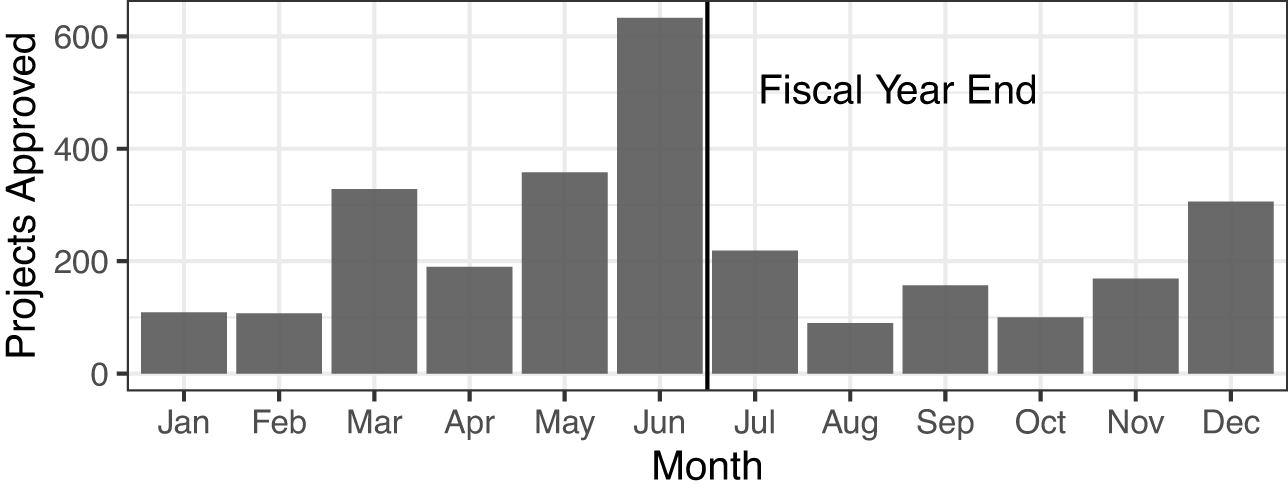
Even before statistical analysis, prima facie evidence of lending patterns is hard to square with a powerful principal explanation rather than bureaucratic tendencies. Considering project approval timing, the World Bank’s fiscal year ends on June 30. A common feature of organizations is that budgets need to be exhausted lest they be cut in the next funding round (Vaubel, Reference Vaubel2006, 131–32). We see a sharp increase in the number of Bank loans approved in the last quarter of the fiscal year, and a noticeable drop-off at the beginning of a new fiscal year (Figure 1). In the following, we explore this suggestive relationship further.
Project approvals over the fiscal cycle.

5.1. Operationalizing stringency: Latent Semantic Scaling
To operationalize conditionality stringency, we use a second-generation text scaling model. These models place a text along a continuum, allowing researchers to compare texts across user-defined dimensions. The most recent class of models, including Latent Semantic Scaling (LSS) (Watanabe, Reference Watanabe2021; Trubowitz and Watanabe Reference Trubowitz and Watanabe2021), combines the flexibility of unsupervised models with the benefit of pre-specifying theoretically relevant keywords (Gallagher et al., Reference Gallagher, Reing, Kale and Ver Steeg2017; Eshima et al., Reference Eshima, Imai and Sasaki2020). In the first (unsupervised) stage of LSS, we train a set of word embeddings. This encodes information about the context in which words are used. In the second (supervised) stage, we measure the distance of each term to a set of hand-coded “seed words.” We then use the relative distance, called the “polarity” of terms, to calculate document stringency along a continuum. See the online appendix for further details.
5.2. Text corpus
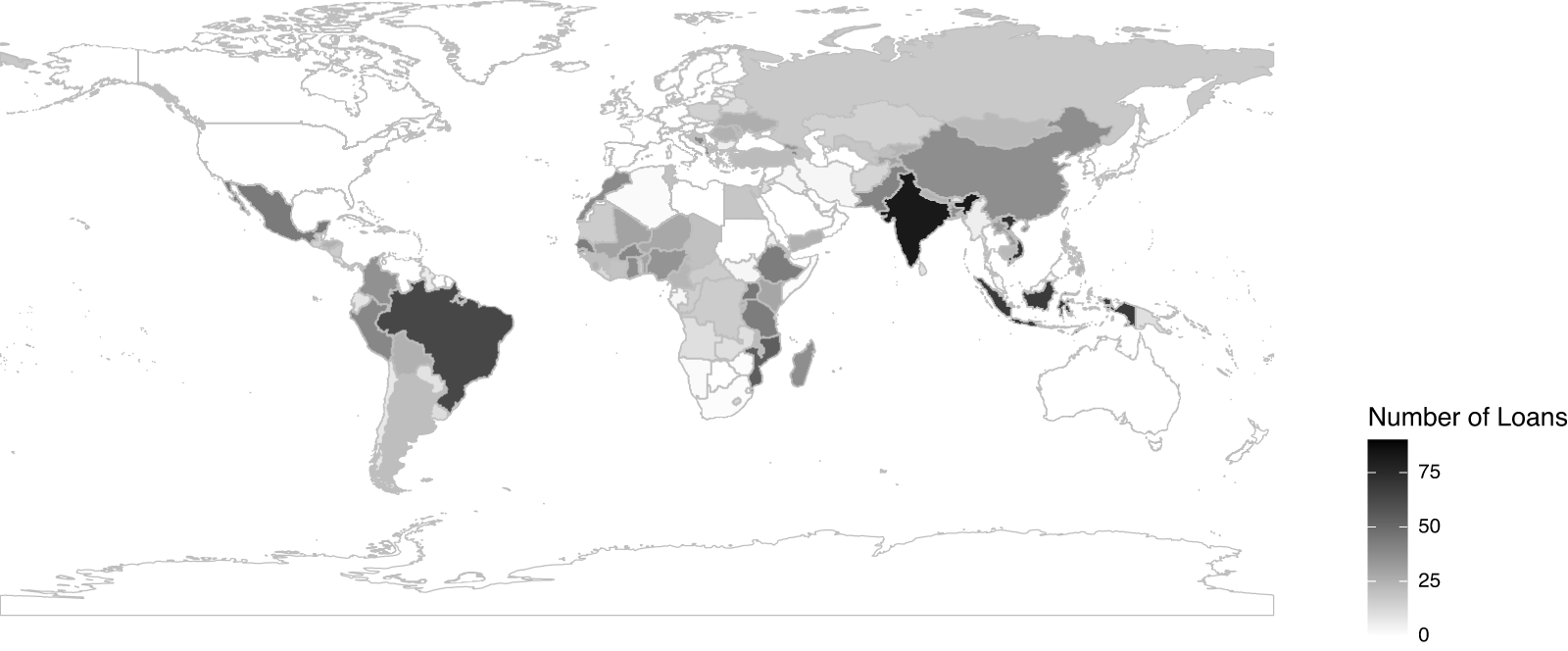
We extract conditionality texts from World Bank loan agreements, scraped using the Bank documents’ Application Programming Interface (API). The Bank classifies loans as investment project, policy, or program-for-results financing. Our analysis includes all of these, but to align with the existing literature, we also show separate results for policy lending only. Conditionality text in these documents uses a common format and terminology, allowing us to extract conditionality content from 3,641 loans going back to 1995, distributed across the Bank’s borrowers (Figure 2).
Loans per country, 1995-2021.

We draw seed words from frequently occurring terms in condition text, manually coding them as either stringent (1) or lenient (−1). Seed words were identified and coded based on the Bank’s own research. As detailed above, this body of research argues that conditionality is less stringent when a variety of behaviors could be interpreted as meeting the condition, making them easier to satisfy and thus less consequential. The complete seed word list is in the online appendix, with examples in Table 1. Terms like “facilitate” or “taking steps” exemplify conditions that can be satisfied without consequential adjustments. In contrast, stringent seed words were coded as such because they indicate that it is possible to make objective assessments about whether reforms were implemented or not, with clearer consequences than lenient terms.
Example seed words

Each non-seed term’s polarity is measured by the proximity between its embedding and the set of seed words. Proximity is measured as the cosine similarity between the non-seed and the seed word embeddings. These similarities are multiplied by the polarity of each term and then averaged. Terms used in similar contexts as stringent (lenient) seed words will have a positive (negative) polarity score. Of course, most terms communicate nothing about stringency—so have scores near zero. Figure 3 shows the polarity of several frequently occurring terms, with the words identified as most-polarizing in bold.
Term polarity, most polarizing words in bold.

5.3. Document scores
We then use the polarity of terms in loan conditions to measure overall loan stringency. We scale each sentence and average the term polarity of each sentence to identify each condition’s stringency. Table 2 shows an example sentence from each quintile of polarity. We then sum the polarity of all sentences in loan condition sections to identify the loan’s overall stringency. This is our dependent variable. In the appendix, we use alternative strategies for the stringency measure to ensure that our results do not depend on any particular choice about how to aggregate condition polarity.
Condition stringency examples

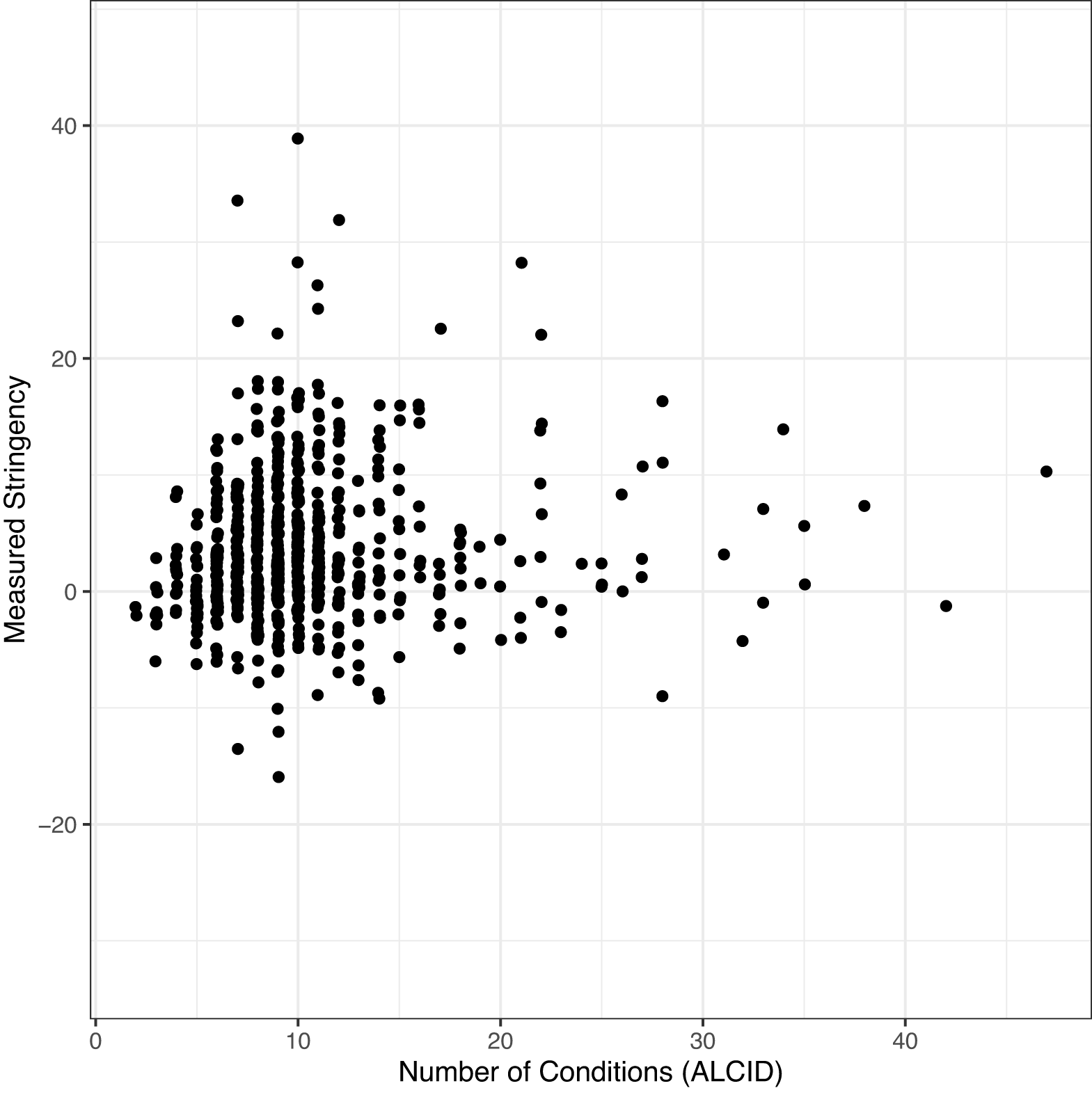
As a preliminary test, we visualize the correlation between the number of conditions reported in the Development Policy Action Database used in most previous studies and our measure of loan stringency, finding no systematic relationship between count and stringency (Figure 4).
Condition count versus stringency.

5.4. Data and specifications
Explanatory variables draw on the most commonly used variables in tests of principal influence and our own operationalization of bureaucratic behaviors.
5.4.1. Powerful principals
Many use UN voting to test whether countries close to the US receive fewer conditions, focusing on “important” votes on which Congress is briefed (Clark and Dolan, Reference Clark and Dolan2021). We include UNGA distance between borrowers and the US on important votes (Bailey et al., Reference Bailey, Strezhnev and Voeten2017). We alternatively include UNGA distance between borrowers and the G5 on important votes (US, UK, France, Germany, and Japan) to account for collective principal effects (Copelovitch, Reference Copelovitch2010). Greater voting distance should be associated with more stringency, insofar as “foes” are treated less favorably than “friends” (Clark and Dolan, Reference Clark and Dolan2021). As an alternative measure of UNGA alignment, we use UNGA agreement on all votes for both US and G5, rather than just important ones.
UN Security Council (UNSC) temporary members may also benefit from tit-for-tat relationships with permanent UNSC members and thus major Bank principals (Dreher et al., Reference Dreher, Sturm and Vreeland2009a, Reference Dreher, Sturm and Vreeland2009b). A dummy indicates whether a borrower held UNSC Membership the year a loan agreement was signed. The expectation is a negative coefficient (less stringency).
5.4.2. Staff and bureaucratic incentives
We operationalize bureaucracy with variables reflecting internal procedures and staff incentives. A dummy indicates whether a loan was approved in the Final Fiscal Quarter of the Bank’s fiscal year (April−June). We expect lenient conditions when staff are pressured to conclude projects before year-end (as suggested above in Figure 1). Staff may adjust conditionality to expedite negotiations or expedite board approval.
To control for country’s economic fundamentals, we include Economic Growth, Inflation, and GDP per capita. If a country is in or near economic crisis, we expect stricter conditions. A dummy indicates if the borrower was also drawing on conditional IMF resources via an IMF Program, given evidence of coordination between both institutions (Woods, Reference Woods2000). If a country’s Credit Rating is weak, we also expect stricter conditionality.
Staff may perceive borrowing governments as less likely to comply with conditions if their policies do not align with Bank preferences. Insofar as the Bank privileges liberal economic policy reforms, we expect borrowing governments supported by the working classes (Cormier, Reference Cormier2021, Reference Cormier2024) to receive stringent conditions. Using V-Party (Lindberg et al., Reference Lindberg, Düpont, Higashijima, Berker Kavasoglu, Marquardt, Bernhard and Döring2022), we code when borrowing governments depend on urban or rural Working Class Support.
Logged Total Loan Size captures larger projects, which carry more risk for staff. We include the number of loans a borrower received in the last five years (NumLoans5Yrs), as repeat clients may either represent less risk due to strong working relationships or represent recidivism and get stronger conditionality (Easterly, Reference Easterly2005, 4; Graham et al., Reference Bird, Hussain and Joyce2004). To preserve its role in the aid landscape, the Bank may be lenient with borrowers using other official creditors (Hernandez, Reference Hernandez2017), in particular where China is also lending (Humphrey and Michaelowa, Reference Humphrey and Michaelowa2019). Chinese Lending as a share of national GDP, averaged over the last three years, measures a borrower’s use of Chinese finance (Custer et al., Reference Custer, Dreher, Elston, Fuchs, Ghose, Lin and Malik2021; Dreher et al., Reference Dreher, Fuchs, Parks, Strange and Tierney2022; Cormier, Reference Cormier2023).
We account for different Bank lending operations. International Bank for Reconstruction and Development (IBRD) controls for loans rather than International Development Association (IDA) grants. Policy lending, including development policy loans (DPLs), sector loans, structural loans, and programmatic-structural adjustment loans likely increase risk due to questions about fund fungibility and “impact and fiduciary soundness” (Koeberle et al., Reference Koeberle, Walliser and Stavreski2006, 1). Since stringency might differ across substantive areas, we control for the loan sector by running a semi-supervised topic model over the condition text and assigning the loan to the sector with the highest probability (Cormier and Manger, Reference Cormier and Manger2022).Footnote 4
5.4.3. Effectiveness and past performance
Bank reviews suggest that conditionality should vary by past borrower performance. The Bank’s IEG measures performance in previous loans on a six-point scale (Highly satisfactory = 5, Unsatisfactory = 0). We use a borrower’s average score over IEG reports released in the three preceding years (IEG Evaluations).
Bank reviews also suggest that strong institutions affect loan success (Koeberle, Reference Koeberle2005a). We control for Democracy because, insofar as democracies are more transparent (Hollyer et al., Reference Hollyer, Rosendorff and Vreeland2011), staff may perceive democracies as less risky. We also control for Corruption since staff perceptions of loan risk may vary by how corrupt (or perceived to be) a regime is while corrupt borrowers may not perceive stringency in the same way as less-corrupt borrowers (Coppedge et al., Reference Coppedge, Gerring, Knutsen, Lindberg, Teorell, Alizada and Altman2022).
5.4.4. Bank policy shifts
We include a dummy for the period before 2005, when the Bank shifted from Structural Adjustment Lending to Development Project Financing, and a dummy for the period after 2012, when the Bank limited the number of conditions that should be in a loan.
5.4.5. Models
The unit of observation is a loan. In our first set of models, we use ordinary least squares (OLS) with fixed effects for the country and loan sector:
(1) Stringencyits = Intercept + PrincipalControlsits + BureaucracyControlsits + PerformanceControlsits + CountryEffectsi + SectorEffectss + Pre2005 + Post2012 + εits
Not all countries agree to Bank loans each year, leading to possible selection bias since stringency is only observable in years when countries receive loans. Accordingly, we next estimate a two-stage model in which the first stage models the hazard of obtaining a Bank loan in the first place (Stone, Reference Stone2008; Clark and Dolan, Reference Clark and Dolan2021) and include this estimated hazard in the second stage.
The two-stage approach requires an instrument that impacts the probability of selection (relevance) but not the dependent variable (excludability). Lang (Reference Lang2021) estimates IMF program effects with a shift-share approach, interacting the level of IMF liquidity with a country’s likelihood of receiving a loan. We adapt this to the World Bank. We use the volume of IDA replenishments as a constraining liquidity factor that may affect the probability of getting a loan. We interact IDA replenishment volume with the base probability of receiving Bank loans, defined as the proportion of years from a country’s independence until the observation year in which a country had received a loan.
Excludability is plausible because there is no direct path through which IDA replenishments or the number of past Bank projects could affect stringency except via the loan itself. We prefer this IDA instrument rather than using all Bank lending because the Bank can issue bonds to raise IBRD capital (Humphrey, Reference Humphrey2014). Even though IBRD lending is limited by capital adequacy considerations, access to bond markets means that the Bank’s IBRD capital stock is likely correlated with numerous global economic variables that also directly affect individual borrower economies and thus the conditions they receive. Regardless, we show results using IBRD replenishments, IBRD reserves, and the maximum funding envelope in the Country Partnership Framework as alternative instruments in the online appendix. Results are consistent.
The second question is relevance. The typical Heckman procedure is to use a likelihood ratio test to check if the first-stage coefficients are jointly zero. We follow a similar approach, but given the dependence of errors within countries and years, we bootstrap the standard errors clustered at the country-year level. The F-statistic that the shift-share variable coefficients (the base probability, IDA replenishment volume, and their interaction) are jointly zero is 166.5, much higher than conventional thresholds for instrument relevance.Footnote 5 This test is more demanding than merely assessing if the inverse Mills ratio in a two-stage model is statistically significant at the 95 percent level where the null hypothesis is that the hazard is equal to zero. First-stage model results are reported in the online appendix.
The selection specification is:
(2) SelectionHazardijt = Intercept + IDAReplenishmentXPastProjectYears + PastProjectYears + IDAReplenishment + TimeSplines + εits
(3) Stringencyits = Intercept + PrincipalControlsits + BureaucracyControlsits + PerformanceControlsits + SelectionHazardijt + CountryEffectsi + SectorEffectss + Pre2005 + Post2012 + εits
In the first stage, we use a cubic spline to account for temporal trends (Beck et al., Reference Beck, Katz and Tucker1998). In the second stage, we include fixed effects for the country and loan sector. Estimates are similar and inferences are unchanged across modeling strategies. To obtain standard errors clustered on country and years, we use a wild bootstrap resampling procedure.
6. Results
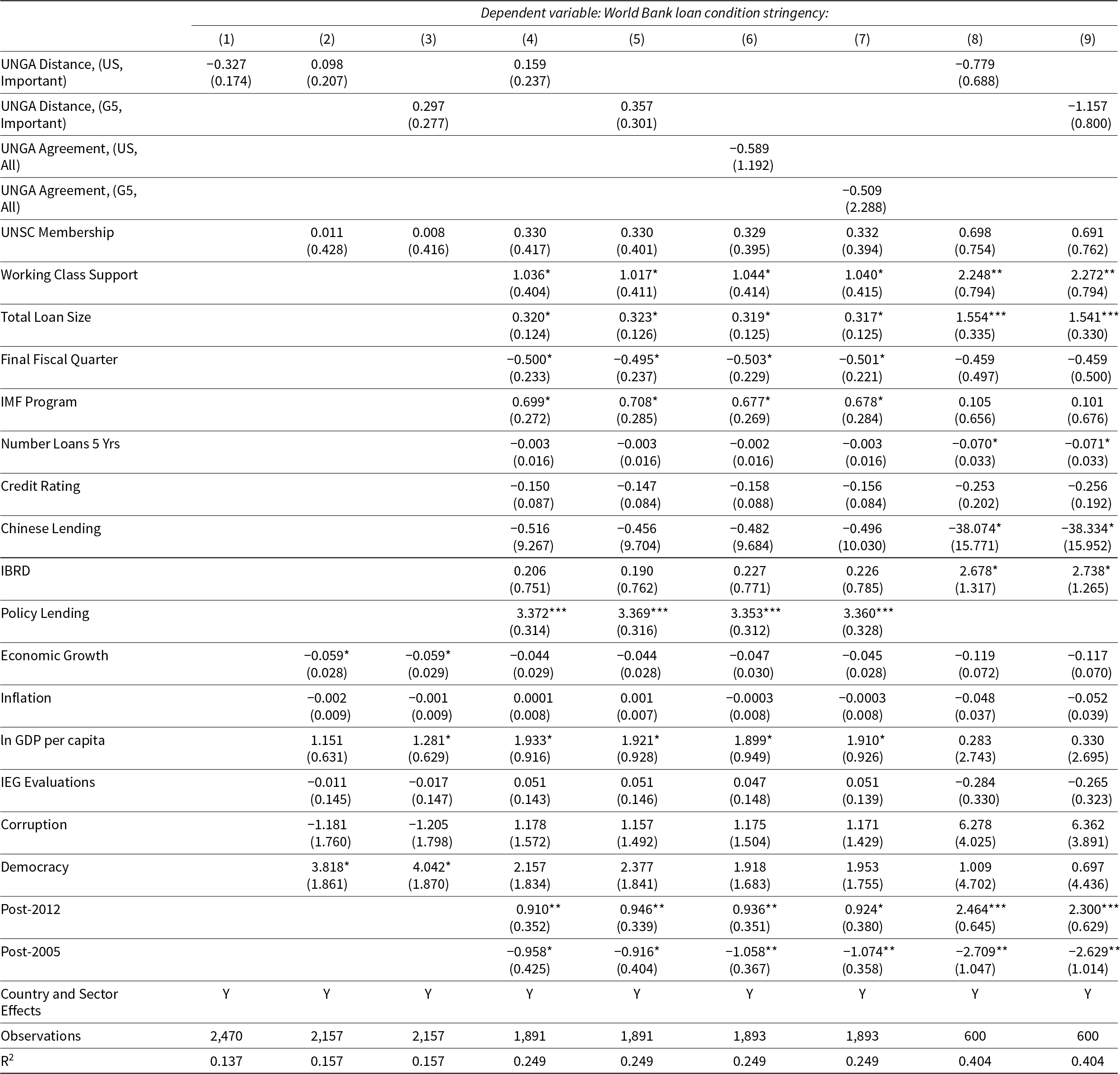
Table 3 reports initial OLS estimations. First is a bivariate model of borrower UN voting alignment to the US with only country fixed effects. Models 2−3 include other UN voting alignment measures, UNSC membership, and controls used in previous conditionality research. These measures of principal influence are not significantly associated with Bank loan stringency.
OLS models

Note: * p < 0.05, ** p < 0.01, *** p < 0.001.
Models 4−9 introduce organizational variables. Across models, these organizational measures are significantly associated with the stringency of Bank loan conditions, while various combinations of principal measures remain insignificant. Models 4−7 include various measures of borrower UN voting alignment with major Bank principals as well as UNSC membership. Models 10−11 restrict the sample to policy lending, which has been the narrower subject of many previous conditionality studies. Across specifications, borrower alignment with powerful principals is not statistically significant. In other words, we find no evidence that a borrower’s relationship with principals determines Bank conditionality when the stringency of loan condition text is the dependent variable.
Instead, we find evidence that concern for loan failure gives rise to some bureaucratic effects on Bank conditionality. Across all specifications, loans to working-class-supported governments and larger loans are more stringent. Meanwhile, policy budget support loans and the presence of a conditional IMF program are significantly associated with more stringent conditionality. These effects are only significant at conventional levels in the full sample, but the sign and magnitude are similar for the smaller sample of policy loans. For policy loans, repeat borrowers and those with high proportions of Chinese finance face less stringent conditionality. In addition, lending approved at the end of the fiscal year is less stringent, suggesting staff offer looser conditionality when they must get money out the door to exhaust annual budgets.
Stringency decreased after the Bank shifted to Development Policy Financing in 2005. Conversely, when the Bank decided to limit the number of conditions in each loan in 2012, it appears to have compensated with slightly more stringent conditions. But neither control undermines the finding that stringency is associated with bureaucratic traits rather than principal influence. Interestingly, despite Bank pronouncements about what effective conditionality would be, we do not find a significant association between stringency and borrower institutional quality (Corruption, Democracy) or past performance (IEG evaluations).
Table 4 shows the same specifications with the two-stage model. Inferences are unchanged. The selection parameter (inverse Mills ratio [IMR]) is not significant, but the value of the first-stage F-test discussed above indicates that the instrument is relevant.
Two-stage selection models

Note: * p < 0.05, ** p < 0.01, *** p < 0.001.
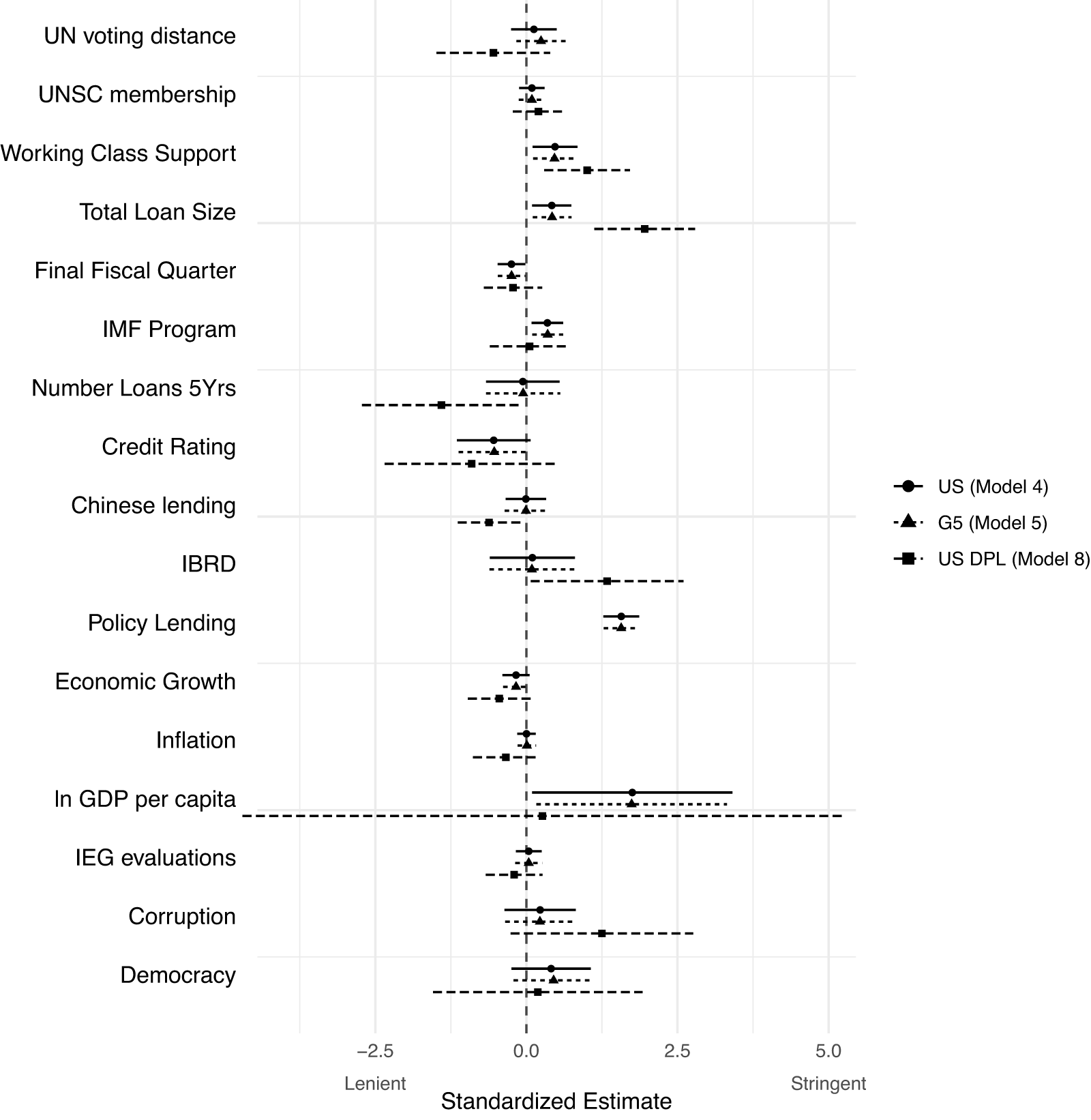
Figure 5 shows a standardized coefficient plot to facilitate the interpretation of the relative effect size in the US, G5, and DPL-only models (Table 3, models 4, 5, and 8, respectively).
Standardized coefficient plot (95% confidence intervals).

The online appendix includes dozens of additional tests. Most importantly, we replace the stringency-dependent variable with the count-of-condition variable used in most studies. We replicate findings that powerful principals do affect conditionality count using our models, as borrower alignment with the US and the G5 decreases the number of conditions in a loan. Evidently, arguments about powerful principal constraints on Bank lending appear to depend on using count measures of loan conditionality, but focusing on the content of loan conditions leads to different conclusions. We check the robustness of different methods of aggregating stringency of conditions, year fixed effects, and alternative measures of principal interests: all UN votes, UNGA movement toward US (Kilby, Reference Kilby2009), UNSC voting alignment, bilateral aid, foreign direct investment, and US troop presence (Allen et al., Reference Allen, Flynn and Martinez Machain2022). We add alternative controls (other corruption measures, current account balance, and total past loans) and sample subsets (post-2005 only). Results are consistent.
7. Conclusion
A large literature debates the politics of Bank lending, and a prominent finding is that conditionality reflects the preferences of its most powerful principals. We present evidence that reframes the debate. We first highlight the importance of scrutinizing the content of Bank conditionality rather than merely the count of conditions. We emphasize the variability of loan stringency: the degree to which conditions require quantifiable, objectively verifiable, and thus relatively demanding actions by the borrower vis-à-vis the degree to which conditions involve vague, subjective, and thus less-demanding actions by the borrower. We show that stringency is not correlated with the number of conditions in a loan. When stringency is the subject of analysis, Bank lending is not determined by powerful principals. Instead, the stringency of Bank loan conditions is primarily associated with loan risk and bureaucratic tendencies. Accordingly, future quantitative studies should use bureaucratic and risk measures to ensure they do not underplay the importance of organizational factors in World Bank lending.
As Bank insiders argue, what is most impactful on borrowers is stringency rather than the number of conditions (Kapur and Webb, Reference Kapur and Webb2000; Koeberle, Reference Koeberle, Koeberle, Bedoya, Silarsky and Verheyen2005b). Prioritizing the study of conditionality text is a policy-relevant path forward for researchers. To aid this effort, our replication data provide the largest dataset of Bank loan conditions available to date, covering the text of 3,641 World Bank loans since 1995. For comparison, the publicly available and frequently used Development Policy Action Database only goes back to 2004.
Lastly, our findings reframe the debate about principal control and agent autonomy in research on the World Bank, IMF, and IOs. We present evidence that findings about powerful principals appear to depend on the measures used. This study only hints at the reasons for this. Section 2 highlighted that Bank staff have incentives to minimize the risk of loan failure, and conditionality language is a core tool for managing risk while meeting the disbursement imperative. This may incentivize focus on the detail of conditionality text rather than the number of conditions. In contrast, there is some evidence that principals use count as a heuristic for risk management—as noted in Section 2, Bank-wide mandates are based on conditionality count rather than content. Carefully parsing which outcomes are subject to which theories and why, at the World Bank and other IOs, is another important path forward for future research.
Supplementary material
The supplementary material for this article can be found at https://doi.org/10.1017/psrm.2025.19. To obtain replication material for this article, https://doi.org/10.7910/DVN/AF3EZP.





 Open access

