


Introduction
Tardive dyskinesia (TD), a persistent and potentially irreversible movement disorder characterized by hyperkinetic movements in the face, head, trunk, and/or limbs, can emerge after prolonged exposure to antipsychotics or other dopamine receptor blocking agents (DRBAs).Reference Waln and Jankovic 1 –Reference Strassnig, Rosenfeld and Harvey 4 TD can have negative effects on a patient’s coordination and balance, daily functioning, social interactions, and overall quality of life.Reference Strassnig, Rosenfeld and Harvey 4 –Reference Ascher-Svanum, Zhu and Faries 7 Until the approval of valbenazine for TD in 2017, no therapies were available that had a strong level of evidence for efficacy.Reference Bhidayasiri, Fahn and Weiner 8
Both first- and second-generation antipsychotics pose some risk for TD, despite earlier hopes that newer antipsychotics would mitigate or eliminate such risk.Reference Caroff and Campbell 9 , Reference Remington 10 A meta-analysis of antipsychotic clinical trials estimated a TD prevalence of 30.0% among patients taking first-generation (or typical) antipsychotics, 20.7% for second-generation (or atypical) antipsychotics, and 7.2% for second-generation with no prior first-generation antipsychotic use.Reference Carbon, Hsieh and Kane 11 Additionally, a review of 12 antipsychotic studies found the annualized incidence rate for developing TD to be approximately 5% with both typical and atypical antipsychotics.Reference Correll and Schenk 12 Given the continued use of typical antipsychotics and the expanded use of atypical antipsychotics, especially in patients with mood disorders, regular screening for TD is recommended in all antipsychotic-treated patients.Reference Jain and Correll 13 , Reference Lehman, Lieberman and Dixon 14
While the pathophysiology of TD is not fully understood, it has been hypothesized that dysfunctional dopaminergic signaling in the striatum may contribute to the development of TD. Through prolonged blocking of dopamine receptors on postsynaptic neurons, antipsychotics may lead to compensatory and potentially irreversible dopamine (D2) receptor upregulation.Reference Citrome 15 , Reference Stahl 16 These changes, which may involve an increase in either the number or the sensitivity of postsynaptic dopamine receptors, can induce a state of dopamine hypersensitivity, in which normal synaptic levels of dopamine trigger excessive postsynaptic neuronal firing and lead to involuntary, hyperkinetic movements. Based on this pathophysiology, one treatment strategy is to inhibit the presynaptic release of dopamine via VMAT inhibition, which may reduce signaling from hypersensitive postsynaptic neurons and diminish hyperkinetic movements.Reference Jankovic 17
Valbenazine is a novel vesicular monoamine transporter 2 (VMAT2) inhibitor approved for the treatment of TD in adults. 18 Valbenazine was designed to selectively inhibit VMAT2 with negligible impact on monoaminergic receptors (eg, dopamine D2 and serotonin 5HT2) or transporters (eg, dopamine transporter [DAT], serotonin transporter [SERT]), thereby reducing the likelihood of “off-target” side effects.Reference Grigoriadis, Smith and Hoare 19 , Reference Harriott, Williams and Smith 20 The major metabolic pathways of valbenazine are hydrolysis and mono-oxidation, which result in the two major active metabolites ([+]‑α-dihydrotetrabenazine and NBI-136110, respectively). The gradual formation of these metabolites, coupled with half-lives that are similar to valbenazine itself (ie, 15-22 hoursReference Luo, Bozigian and Jimenez 21), contributes to a pharmacokinetic profile that yields low peak-to-trough ratios and allows for once-daily dosing.
Valbenazine efficacy and safety were demonstrated in several double-blind placebo-controlled studies (KINECT [NCT01688037], KINECT 2 [NCT01733121], and KINECT 3 [NCT02274558]) that allowed stable regimens of concomitant medications needed to maintain psychiatric stability (eg, antipsychotics, antidepressants, and anticholinergics) or to manage chronic medical conditions.Reference O’Brien, Jimenez and Hauser 22 – 24 The long-term effects of valbenazine on TD were evaluated in adults who received up to 48 weeks of once-daily treatment (40 or 80 mg/day) in the blinded KINECT 3 extension study or in the open-label KINECT 4 (NCT02405091) study.Reference Factor, Remington and Comella 25 , Reference Marder, Singer and Lindenmayer 26 The current open-label rollover study (NCT02736955), which allowed participants who completed the KINECT 3 or KINECT 4 studies to continue receiving valbenazine for up to 72 additional weeks (or until valbenazine became commercially available), was primarily designed to provide additional information about the long-term safety of valbenazine.
Methods
Study design
In the preceding studies, KINECT 3 and KINECT 4, participants received up to 48 weeks of treatment with valbenazine, followed by a 4-week valbenazine-free washout period (Figure 1). Approximately 50 participants in KINECT 4 had received up to an additional 12 weeks of valbenazine treatment in one of several phase 2 studies. One-third (33.5%) of participants in the current study were enrolled immediately after completing the 4-week washout period of KINECT 3 or KINECT 4. Since many participants completed KINECT 3 or KINECT 4 before the current study was initiated, approximately two-thirds (66.5%) had an additional valbenazine-free period following the protocol-specified 4-week washout (mean ± standard deviation [SD], 66.4 ± 83.5 days; range, 1-324 days).
Study design. Approximately 50 participants in KINECT 4 had completed a prior phase 2 trial. Fifty-four participants continued directly from the end of the preceding phase 3 study, while 107 had an additional valbenazine-free period between studies. aParticipants who had a dose reduction from 80 to 40 mg/day due to tolerability issues. Abbreviations: DBPC, double-blind placebo-controlled; PBO, placebo; VBZ, valbenazine.

Enrollment in the current study began in March 2016; study termination by the sponsor was in June 2017. It included 36 sites in the United States, and the protocol was approved by an Institutional Review Board at each study site. The study adhered to International Conference on Harmonization Guidelines for Good Clinical Practice standards and U.S. Code of Federal Regulations and Food and Drug Administration guidelines. All study participants had the capacity to provide consent, as assessed using the University of California, San Diego Brief Assessment of Capacity to ConsentReference Jeste, Palmer and Appelbaum 27; written and informed consent was obtained from all participants prior to any study procedures.
Participants
The study included adults 18 to 85 years of age who met the following criteria: (a) completed KINECT 3 or KINECT 4 and (b) had DRBA-induced TD and a Diagnostic and Statistical Manual of Mental Disorders (eg, DSM-IV 28) diagnosis of schizophrenia, schizoaffective disorder, or mood disorder. Participants were required to be clinically and psychiatrically stable and were excluded if they met any of the following criteria: (a) Brief Psychiatric Rating Scale (BPRSReference Overall and Gorham 29) total score ≥50 at screening; (b) clinically significant parkinsonism as assessed by the investigator; and (c) significant risk for active suicidality based on the Columbia-Suicide Severity Rating Scale (C-SSRSReference Posner, Brown and Stanley 30) or violent behavior. Other key exclusion criteria included: any active, clinically significant, unstable medical condition; known history of substance dependence or substance or alcohol abuse within 3 months prior to screening, as defined by the DSM (eg, DSM-IV); or history of severe hepatic impairment, neuroleptic malignant syndrome, or long QT syndrome or cardiac arrhythmia.
Treatment
Following washout of prior valbenazine treatment, participants restarted treatment at 40 mg/day for 4 weeks. At the end of week 4 (first postbaseline visit), the dosage was escalated to 80 mg/day based on investigator judgment of safety and tolerability and clinical impression of TD. If the participant was unable to tolerate the dose increase, a dose reduction to 40 mg/day was permitted at any time after dose escalation. Participants unable to tolerate 40 mg/day were discontinued from the study.
Participants were required to discontinue prohibited medications (eg, dopamine-blocking antiemetics, strong CYP3A4 inducers, dopamine agonists and precursors, monoamine oxidase inhibitors, and other VMAT2 inhibitors) for at least 30 days before screening. Concomitant medications for the treatment of psychiatric disorders and medical conditions were permitted if dosing was stable for ≥30 days prior to screening.
Assessments and analyses
Data were analyzed descriptively in participants who received ≥1 dose of valbenazine and had ≥1 available postbaseline safety or efficacy assessment. A schedule of assessments are presented in Supplementary Table S1. Duration of valbenazine exposure was based on the total amount of time that each participant received active treatment (including KINECT 3 or KINECT 4). Valbenazine-free periods (eg, 4-week washout in KINECT 3 or KINECT 4, or gap period before entry into current study) were not included in the analysis of mean valbenazine exposure.
Safety was the primary focus of this study, but site investigators or other trained personnel evaluated the long-term effects of valbenazine on TD using the Clinical Global Impression of Severity-TD (CGIS-TD: range, 1 “normal, not at all ill” to 7 “among the most extremely ill patients”).Reference Guy 31 CGIS-TD analyses by study visit (weeks 0 [baseline], 12, 24, 36, and 48) included mean scores, mean score changes from baseline, and percentage of participants with a score of 1 (“normal, not at all ill”) or 2 (“borderline ill”). Participants rated their satisfaction with prior and current valbenazine treatment using the Patient Satisfaction Questionnaire (PSQ: range, 1 “very satisfied” to 5 “very dissatisfied”). PSQ analyses by study visit included mean scores, mean score changes from baseline, and percentage of participants with a score of 1 (“very satisfied”) or 2 (“somewhat satisfied”). Safety assessments included treatment-emergent adverse events (TEAEs), clinical laboratory tests, vital sign measurements, electrocardiograms (ECGs), and the C-SSRS.
Results
Participants
Of the individuals who completed KINECT 3 (n = 121) or KINECT 4 (n = 103), 71.9% (161/224) elected to participate in the current study (71 from KINECT 3, 90 from KINECT 4). A total of 161 patients from 36 study sites participated in the study. Of these, 23 (14.3%) were discontinued prior to study termination; the most common reason was withdrawal of consent (n = 8) (Figure 2). Eight participants had a dose reduction from 80 to 40 mg/day during the study, seven for tolerability concerns, and one per a participant’s request.
Patient disposition. *Four participants discontinued at or prior to week 4 (sponsor/investigator decision, n = 2; adverse event [psychosis], n = 1; noncompliance with no postbaseline assessments [n = 1]). The 138 participants who completed the study represent the individuals who were still enrolled when the study was terminated by the sponsor due to commercial availability of valbenazine per the approved protocol.

At the time of study termination by the sponsor (due to commercial availability of valbenazine), 85.7% (138/161) of participants were active in the study and were therefore considered having “completed” the study. In these 138 participants, total time in the current study (not including previous studies) ranged from 106 to 468 days (mean, 271.7 ± 88.9 days) (Supplementary Figure S1). The numbers of participants who attended each 12-week visit for safety and efficacy assessments were as follows: week 12 (n = 154), week 24 (n = 125), week 36 (n = 91), week 48 (n = 56), week 60 (n = 4), and week 72 (n = 0). Few participants reached week 60, and none reached week 72 because the study was terminated before most participants reached those scheduled study visits. The conventional definition of study completion (ie, reaching the last planned visit) was not applicable since the study was terminated early per the approved protocol.
Analyses were conducted in 160 participants who received valbenazine 40 mg/day (n = 35), 80 mg/day (n = 117), or 80 mg/day with dose reduction (80/40 mg/day, n = 8); one participant without postbaseline data was excluded from the analyses. From initial study baseline (KINECT 3, phase 2/KINECT 4) through end of current study and excluding valbenazine-free periods, the mean total duration (±SD) of valbenazine exposure was 19.7 ± 3.4 months (range, 9.9-26.9 months).
Baseline characteristics were generally similar across treatment groups (Table 1); 50.6% of all participants were men, 69.4% were White, and the mean age (±SD) was 57.9 ± 8.8 years. The primary psychiatric diagnosis was schizophrenia/schizoaffective disorder in 65.0% and mood disorder in 35.0% of the overall study population. Antipsychotics and antidepressants were the most commonly used concomitant medications (82.5% and 69.4%, respectively); concomitant use of anticholinergics was reported in 27.5% of participants. Based on available data (N = 125), the mean chlorpromazine equivalent (±SD) for concomitant antipsychotics was 408.4 ± 393.0 mg/day. Based on the C-SSRS, 30.6% of participants had a lifetime history of suicidal ideation and 27.5% had a lifetime history of suicidal behavior. Per study requirements, however, individuals with any significant risk for suicide (based on the C-SSRS at baseline) were excluded from participation.
Baseline Characteristics.

a All participants underwent a 4-week washout period at the end of the previous trial (KINECT 3 or KINECT 4). Some participants had an additional valbenazine-free period before enrolling in the current trial.
b Based on any C-SSRS lifetime history score: suicidal ideation (range, 1–5); suicidal behavior (range, 6–10).
c Includes World Health Organization drug ATC categories (level 3) reported in ≥20% of all participants; level 2 categories were used if no applicable level 3 category was available.
d Excludes insulins (separate ATC category). Use of insulin and its analogues was reported in 5.6% of all participants.Abbreviations: ACE, angiotensin-converting enzyme; ATC, Anatomical Therapeutic Chemical; BPRS, Brief Psychiatric Rating Scale; CGIS-TD, Clinical Global Impression of Severity-Tardive Dyskinesia; C‑SSRS, Columbia-Suicide Severity Rating Scale; GERD, gastroesophageal reflux disease; SD, standard deviation.
Patient-reported medical histories indicated that in addition to their primary psychiatric diagnosis, the most common medical and psychiatric conditions (>40% of all participants) were hypertension (56.3%), insomnia (46.9%), anxiety (43.1%), and gastroesophageal reflux disease (GERD, 40.6%) (Supplementary Table S2). The most common prior medications (reported in ≥30% of all participants), defined as medications taken within 30 days prior to baseline, included antihypertensive drugs (angiotensin-converting enzyme [ACE] inhibitors [25.6%], beta-blocking agents [16.9%]), lipid modifying agents (41.9%), antiepileptics (35.6%), drugs for peptic ulcer and GERD (34.4%), and anxiolytics (33.8%) (Supplementary Table S2). Prior use of antipsychotics and antidepressants (81.9% and 68.8%, respectively) was very similar to concomitant use of these drugs during the study (82.5% and 69.4%, respectively). Medications that were taken >30 days prior to baseline were not documented, including antipsychotics.
Changes in TD global severity
At baseline (before re-initiation of valbenazine treatment), the CGIS-TD mean score (±SD) was 3.9 ± 1.2 in all participants (Table 1). Based on available assessments, CGIS-TD mean scores at baseline were slightly lower (less severe TD) in participants who enrolled immediately after completing the 4-week washout period in KINECT 3 or KINECT 4 (3.7 ± 1.3 [n = 53]) than in participants who had a longer valbenazine-free period (4.0 ± 1.2 [n = 106]). CGIS-TD mean scores by study visit indicated sustained global improvements throughout treatment with both doses of valbenazine (40 or 80 mg/day), as well as in the small group of participants who had a dose reduction from 80 to 40 mg/day (Figure 3). Mean CGIS-TD score changes (±SD) from baseline to week 48 were as follows: 40 mg/day, −1.3 ± 1.1; 80 mg/day, −1.9 ± 1.5; 80/40 mg/day, −1.4 ± 0.9; all participants, −1.8 ± 1.4.
CGIS-TD mean scores by visit. Data are not shown for participants who completed the week 60 visit (total n = 4) due to the small size of this group. *Baseline of current study, after prior long-term treatment followed by valbenazine-free period (≥4 weeks). Abbreviations: CGIS-TD, Clinical Global Impression of Severity-Tardive Dyskinesia; N, number of participants with an available assessment; SD, standard deviation.

The percentage of participants with a CGIS-TD score of 1 (“normal, not at all ill”) or 2 (“borderline ill”) increased from baseline to week 48 in all dosage groups (Figure 4) and the overall population (baseline, 14.5% [23/159]; week 48, 64.3% [36/56]).
Percentages of participants with CGIS-TD score of 1 (“normal, not at all ill”) or 2 (“borderline ill”) by visit. Data not shown for participants who completed the week 60 visit (total n = 4) due to the small size of this group. *Baseline of current study, after prior long-term treatment followed by valbenazine-free period (≥4 weeks). Abbreviations: CGIS-TD, Clinical Global Impression of Severity-Tardive Dyskinesia; n, number of participants that met this response threshold; N, number of participants with an available assessment.

A post hoc analysis of the CGIS-TD data indicated no significant differences between participants who were receiving concomitant antipsychotic treatment (n = 132) and those who were not (n = 28) at any study visit.
Patient satisfaction with treatment
At baseline, PSQ scores indicated satisfaction with previous valbenazine experience. In all participants, the mean score (±SD) was 1.2 ± 0.4, and 98.8% rated their prior valbenazine experience (ie, in KINECT 3 or KINECT 4) with a score of 1 (“very satisfied”) or 2 (“somewhat satisfied”). No notable changes in PSQ mean scores were found throughout the study. At week 48, the mean score change (±SD) from baseline was 0.0 ± 0.7 in all participants. The percentage of all participants with a PSQ score ≤2 remained high throughout the study, ranging from 96.7% (week 12) to 98.2% (week 48).
Safety
During the 4-week treatment initiation period with valbenazine 40 mg/day, 9.4% of all participants had at least one TEAE; no single TEAE was reported in >2% of all participants during this period (Table 2). After week 4, 49.0% of all participants had at least one TEAE, with back pain (4.5%) and urinary tract infection (4.5%) being the most common TEAEs during this period. TEAEs that led to a dose reduction (from 80 to 40 mg/day) were as follows: somnolence (n = 3), cognitive disorder, drooling, salivary hypersecretion, sedation, tremor (each, n = 1). Four deaths occurred during the study, but none of the events (chronic obstructive pulmonary disease, sepsis syndrome, alcohol-induced coma, and hypertensive heart disease) were judged as related to study drug. Serious TEAEs and TEAEs leading to discontinuation, reported in 16 and 9 participants, respectively, are listed in Supplementary Table S3.
Treatment-Emergent Adverse Events.
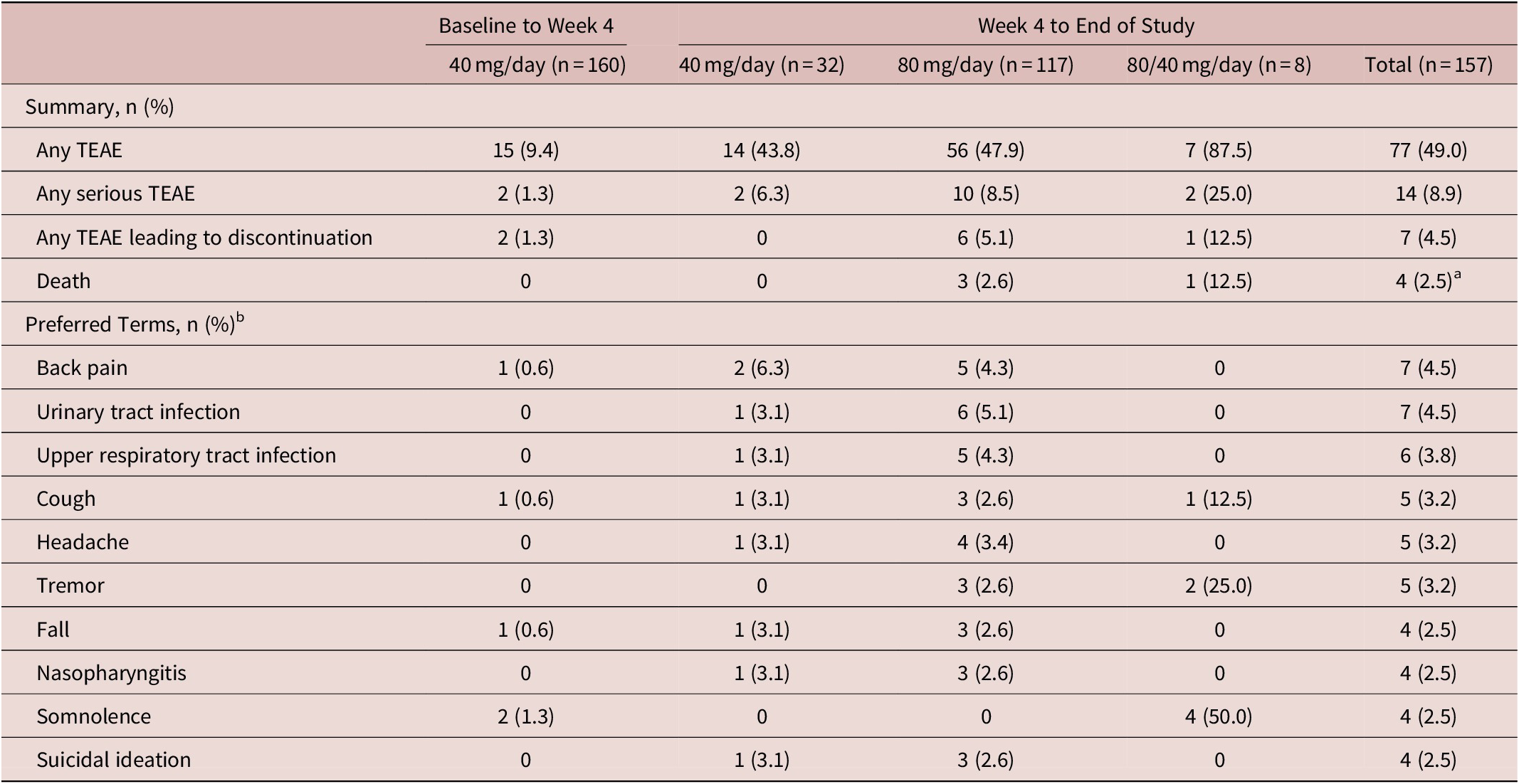
aDue to chronic obstructive pulmonary disease, sepsis syndrome, alcohol-induced coma, a hypertensive heart disease; all were judged by the investigator as unrelated to treatment. bTable lists all MedDRA preferred terms reported in >2% of all participants from Week 4 to the end of study.Abbreviation: TEAE, treatment-emergent adverse event.
Four participants had a TEAE of suicidal ideation, none of which resulted in discontinuation from the study or were judged by the investigator as either serious or related to study drug. Based on the C-SSRS, 156 participants had no suicidal ideation at baseline (score = 0), and 153 (98.1%) continued to have no emergence of suicidal ideation (score = 1-5) at any time during treatment. In four participants who had some C-SSRS suicidal ideation at baseline (score = 1-3), no worsening in ideation was observed during treatment. No suicidal behaviors (per TEAE reporting or C-SSRS monitoring) were observed during the study.
Mean changes from baseline in clinical laboratory values, vital signs (including body weight), and ECG parameters were generally small and not clinically significant (Supplementary Table S4). Median values for prolactin were within the normal range for men and women at baseline and week 48 (Supplementary Table S5). Few participants had a TEAE of hyperglycemia (n = 1), hyperlipidemia (n = 1), or hypercholesterolemia (n = 2); none had a TEAE of gynecomastia or galactorrhea. One participant had a TEAE of orthostatic hypotension, and none had a Fridericia-corrected QT interval > 500 milliseconds during treatment.
Discussion
Given the potentially irreversible and debilitating nature of TD, along with the fact that discontinuing antipsychotic treatment is often medically inadvisable, safe and effective long-term TD treatments are needed. In two long-term studies, KINECT 3 and KINECT 4,Reference Factor, Remington and Comella 25 , Reference Marder, Singer and Lindenmayer 26 treatment with once-daily valbenazine for up to 48 weeks was generally well-tolerated and resulted in sustained TD improvements. In total, 71.9% (161/224) of participants who completed those long-term studies chose to continue valbenazine treatment in the current study.
Of the 161 participants who enrolled in this study, 138 (85.7%) were active in the study when it was terminated by the sponsor due to valbenazine commercial availability. The total time of valbenazine exposure, from beginning of the first lead-in study to termination of this study (excluding valbenazine-free periods), ranged from 9.9 to 26.9 months. The decision by participants to continue receiving valbenazine suggested satisfaction with prior treatment, which was confirmed by PSQ results at the baseline of this study (score ≤ 2, 98.8%). Satisfaction was maintained throughout the study, with 98.2% of participants reporting being “somewhat satisfied” or “very satisfied” with valbenazine at week 48.
Safety and tolerability, the primary focus of this study, were consistent with results from previous valbenazine studies. Given the older age of this study population, the complicated medical histories, use of multiple concomitant medications, and the long overall exposure to valbenazine, the TEAE incidence after treatment re-initiation (baseline to week 4: 9.4%) and optional dose escalation (week 4 to end of study: 49.0%) was notably low. Median prolactin levels in this study were within the normal range after 48 weeks of valbenazine treatment (men, 12.7 μg/L; women, 14.9 μg/L). These results were comparable to prolactin levels seen in first-episode schizophrenic patients who received 12 months of treatment with an atypical antipsychotic, such as olanzapine (men, 13.1 μg/L; women, 28.9 μg/L) or quetiapine (men, 17.5 μg/L; women, 16.4 μg/L).Reference Matei, Purnichi and Mihailescu 32 Median changes from baseline indicate that some patients experienced an increase in prolactin levels during the study, which may have been due to the pharmacologic action of valbenazine (ie, blockade of presynaptic vesicular uptake and release of dopamine).Reference Grigoriadis, Smith and Hoare 19
Risk factors that have been associated with TD include older age, female sex, White or African descent, longer illness duration, intellectual disability or brain damage, negative symptoms in schizophrenia, and mood disorder.Reference Solmi, Pigato and Kane 33 The mean age of participants in this study was 57.9 years, which is greater than the 55-year threshold that has been used to define older age in TD patient populations (due to reduced life expectancy among patients with schizophrenia or other serious medical illness). 34 –Reference Laursen 36 Approximately, one-half (50.6%) of participants were male, but almost all (98.8%) were White or Black/African-American. The mean age at TD diagnosis was 48.0 years, suggesting that the duration of illness was >10 years in many participants. High antipsychotic dosing (mean chlorpromazine equivalent, 408.4 mg/day), mood disorder diagnosis (35.0%), and history of diabetes (18.1%) were also consistent with risk factors associated with TD.
CGIS-TD was the only measure of TD severity used in this study, which may be applicable to real-world settings, in which clinicians have limited time to examine patients with a more complex rating scale. Regular scheduled assessments with scales such as the Abnormal Involuntary Movement Scale (AIMS) can be used to monitor for TD on antipsychotic treatment,Reference Hauser and Truong 37 but less time-consuming measures such as the CGIS-TD may be easier to implement during all patient encounters. At baseline in this study, the mean CGIS-TD score in all participants was 3.9, which may have represented a reversal of TD improvement during the valbenazine-free period prior to re-initiation of treatment. Mean CGIS-TD scores indicated overall TD improvements with valbenazine 40 and 80 mg/day that were sustained throughout the study (Figure 3), with scores of 1 or 2 (ie, CGIS-TD rating of “normal, not at all ill” or “borderline ill”) reported in 64.3% of all participants at week 48 compared with 14.5% at baseline. Although participants appeared to fare better with the higher dose (80 mg/day) at later visits (weeks 24, 36, and 48), the results are limited by the relatively small number of participants who were taking the lower dose (40 mg/day) at these visits (n = 23, n = 18, and n = 12, respectively). Only eight participants required a dose reduction from 80 to 40 mg/day, reduction in TD severity in this small group was consistent with those who received 40 mg/day (no dose escalation) or 80 mg/day (no dose reduction). These results suggest that a dosing regimen of 40 mg/day or a dose reduction to 40 mg/day can be tried in some patients who do not wish to or cannot take valbenazine 80 mg/day due to tolerability or other reason.
By design, participants in this study received open-label treatment with dosage adjustments (increase at week 4, decrease after week 4) based on individual patient response and tolerability. Although this dosing method may be more representative of real-world clinical settings, interpretation of the results may be limited. However, long-term results based on blinded valbenazine dosing and use of blinded central AIMS video raters is available in the KINECT 3 report.Reference Factor, Remington and Comella 25 In terms of treatment duration, approximately 20% of participants did not reach the 24-week (6-month) visit in this study due to the early study termination. In addition, study results may not be generalizable to all TD patients due to entry criteria in the original lead-in studies (eg, psychiatric and medical stability at baseline, no discernible risk of suicidality). Also, the use of assessments in this study was limited. In contrast to earlier valbenazine trials, this study did not use the AIMS to measure changes in TD, nor did it use psychiatric symptom scales (eg, Positive and Negative Syndrome Scale and Young Mania Rating Scale) or other movement disorder scales (eg, Barnes Akathisia Scale and Simpson-Angus Scale). However, the effects of long-term valbenazine on these outcomes have been reported for KINECT 3 and KINECT 4.Reference Factor, Remington and Comella 25 , Reference Marder, Singer and Lindenmayer 26 , Reference Lindenmayer, Singer and Comella 38 Finally, because completion of a prior long-term study was required for eligibility, which may have enriched this study population, a post hoc analysis was conducted to better understand the participants who did not elect to enter into this study. In total, the majority of participants who completed KINECT 3 or KINECT 4 (71.9% [161/224]) chose to continue receiving valbenazine in the current study. As indicated in the post hoc analysis, robust clinician- and patient-reported improvements were generally found in all 224 completers from KINECT 3 and KINECT 4, including the 161 participants who continued into the current study and in the 63 participants who did not (Supplementary Table S6). However, there were significant differences in treatment outcomes between these two groups, suggesting that participants who enrolled in this study experienced greater clinical benefits with their prior valbenazine treatment.
Conclusion
Following completion of up to 48 weeks of valbenazine treatment for TD in a previous study, adults with TD participated in this long-term open-label valbenazine treatment study of safety and tolerability. Valbenazine was generally well tolerated and no new safety signals were observed. Clinician ratings of TD severity, patient reports of satisfaction with treatment, and a high proportion of retention in the study indicated that participants continued to experience TD improvements and perceived ongoing benefit with once-daily valbenazine throughout the course of this study.
Acknowledgments
Writing and editorial assistance was provided by Prescott Medical Communications Group, (Chicago, IL) with support from Neurocrine Biosciences, Inc.
Financial Support
This study was supported by Neurocrine Biosciences, Inc. (San Diego, CA).
Disclosures
Jean-Pierre Lindenmayer is a consultant for Lundbeck and has received research support from Janssen, Alkermes, FORUM, Neurocrine, Roche, Takeda, Astellas, and Avanir. Cherian Verghese is a speaker for Neurocrine and received grant funding from Neurocrine. He is a consultant for Sage Therapeutics and Indivior, as well as an Investigator for Teva, AbbVie, Eisai, Forest (Allergan), and Otsuka. Stephen R. Marder has received grant/research support from Boehringer Ingelheim, Takeda, and Neurocrine; he has served as a consultant to Lundbeck, Otsuka, Merck, Teva, and Allergan. Joshua Burke, Roland Jimenez, Scott Siegert, and Grace S. Liang are full-time employees of Neurocrine. Christopher F. O’Brien is an exclusive consultant to Neurocrine and a former full-time employee.
Supplementary Materials
To view supplementary material for this article, please visit https://doi.org/10.1017/S109285292000108X.


 Open access

