




In November 1916, during an exhibition of the Asociación de Artistas Vascos in Madrid, the writer Ramón del Valle-Inclán (1866–1936) gave an address remarking that the evolution of ‘Basque art’ was inseparable from the region’s economic boom.Footnote 1 Since the 1880s, this idea resonated within the small Basque artistic world, as many believed that industrial ‘prosperity’ and ‘wealth’ had enabled unprecedented development, placing the region on a path toward artistic centrality within Spain.Footnote 2 Yet this progress also had a political backdrop. After the fall of the Spanish Empire in 1898, a growing part of the Basque oligarchy, disillusioned by the central government’s corruption and policies, sought greater economic and political autonomy. Artistic modernisation, including the pursuit of a prestigious Basque national opera, was framed as an extension of this pragmatic ambition – even if that aspiration came at a cost.Footnote 3 In 1907, the music critic and patron Juan Carlos Gortázar y Manso de Velasco (1864–1926) confidently assured his friend, the priest, linguist and composer Resurrección María de Azkue (1864–1951), that necessary resources existed to undertake major operatic ventures: ‘there is money’, he noted.Footnote 4 But eight years later, the journalist and editor Gregorio Múgica (1882–1931) commiserated with Azkue over the financial failure of his Wagnerian operas Ortzuri (1911) and Urlo (1914). ‘It is a sad thing’, he observed, ‘that such intellectual efforts cost one’s entire capital as a reward.’Footnote 5 The contrast between Gortázar’s earlier optimism and Azkue’s flop points to a complex issue that was linked to centre–periphery tensions, bourgeois contradictions, the economics of high art, and identity-driven anxieties.
Emerging in the late nineteenth century, Basque opera was an artistic project led by a heterogeneous network of agents, aimed at articulating a collective identity framed in regionalist and nationalist terms.Footnote 6 As was common in other regions and countries in Europe and America, most operas shared a common focus on representing a community’s ‘cultural and political self-image’ through the staging of local history, customs and music.Footnote 7 Nevertheless, owing to limited funding and predominant amateurism, most productions did not meet critics’ expectations. By the 1910s, Basque lyrical works comprised an amalgam of costumbrista zarzuelas, musical comedies and short operas written in an Italianate fashion. Most of them, moreover, were seldom performed, modest in quality, and yielded poor financial results.Footnote 8 Conscious of the Basque Country’s secondary status in the international musical scene, Azkue, together with Gortázar and the music critic Francisco Gascue (1848–1920), tried to overcome this peripheral position by revitalising the operatic scene. They patronised young musicians such as José María Usandizaga (1887–1915) and Jesús Guridi (1886–1961), founded institutions (the Sociedad Filarmónica de Bilbao in 1896) and cultural journals (Revista musical in 1909), and fostered the adoption of alternative musical idioms for Basque opera, despite the challenges such innovations could entail in terms of funding and the audience’s musical culture.
A multifaceted figure to twentieth-century Basque culture, Azkue’s life and intellectual legacy have been extensively studied.Footnote 9 However, his musical activities remain largely underexplored, as do the cultural and economic implications of his aesthetic preferences. Azkue despised commercial music genres such as Spanish género chico zarzuela or Italian opera, for their artistic simplicity and trivial themes. By contrast, he idolised German music, which he considered aesthetically aligned with Basque music. As a fervent Wagnerian, rigorous folklorist and nationalist sympathiser, Azkue aspired to create a national opera modelled on Wagner’s Gesamtkunstwerk, integrating traditional music and Basque language. In Ortzuri and Urlo, his two main operas, he combined music, libretto (written by himself), language and staging to create a representative opera that balanced traditional culture with modern elements. However, his ambitions demanded substantial financial investment and artistic expertise, and they could potentially run counter to prevailing tastes.
This article presents a case study of Azkue’s operas, placing economic considerations at the centre of musical practice and interpreting Basque opera as a symbolic battleground shaped by perceptions and logics of money.Footnote 10 I emphasise the economic circumstances, challenges and consequences of the premieres of Ortzuri and Urlo. The article proposes a cultural history of their economic dimension, integrating monetary data with the aesthetic implications of the turn-of-the-century opera business. Within this framework, particular attention is paid to attitudes towards commercial logic, the commodification of music, and the influence of foreign trends on the early twentieth-century Basque region. In this way, this article complements the scarce literature on Basque opera, which has not focused on the gap between musical discourse and material reality.Footnote 11
Nonetheless, the objective of this article extends beyond analysing Azkue’s works or the economic landscape in which they emerged. It seeks to offer a hybrid perspective – both local and transnational – on narratives of Basque music and of the centre–periphery relations in music history.Footnote 12 Azkue’s prominence in Bilbao’s cultural scene, his network within Basque music, international education and nationalist ambition make him a pivotal figure for understanding the constraints of musical nationalism in a peripheral space. In fact, exploring the regional reality does not isolate Azkue and Basque opera from international cultural and aesthetic debates. The creation of a distinct operatic repertoire reflected elite efforts to protect (or build) their country’s political and musical identity, as a reaction to the threats industrialisation posed to demographic homogeneity and social order.Footnote 13 As a transnational phenomenon, national opera mirrored the inequalities between cultural centres and peripheries, and its cosmopolitan languages (mainly Italian opera and Wagnerism) shaped the horizons of modernity for nationalist movements across Europe and America.Footnote 14 Its impact was also felt in areas like the Basque provinces, where industrial growth empowered the local bourgeoisie to abandon their subordinate position as a periphery and challenge centrality through art.Footnote 15 In line with studies on musical interactions between (post-)imperial or regional centres and peripheries,Footnote 16 and drawing on press and archival sources, this article analyses how the modernisation of Basque opera was affected by the dichotomy between Italian opera and Wagnerism.Footnote 17
A musical paradox of industrialisation
As is well known, the nineteenth-century market economy played a crucial role in the commodification and homogenisation of musical practices. Popular music was commercialised as a consumer product, and the bourgeoisie established new aesthetic standards that elevated art music as a ‘distinctive expression’ and a marker of class.Footnote 18 The divide between popular and high art likewise shaped nationalist discourses. The rise of cosmopolitan styles and repertoires encouraged the protection and essentialisation of traditional music. Folklore was therefore understood as a symbol of collective identity, to be preserved in order to maintain or create the nation’s uniqueness.Footnote 19
This process also affected the Basque provinces. Largely regarded as a rural and exotic space – due to the Basque language and fueros or home rule – political centralisation and economic modernisation transformed the region during the second half of the nineteenth century.Footnote 20 Rural exodus, massive immigration and growing inequalities between the working-class majority and local bourgeoisie exacerbated social conflict and weakened traditional notions of Basque identity.Footnote 21 This metamorphosis exposed as well an ideological diversity within the local elite, revealing divisions between pro-Spanish, regionalist, and nascent Basque nationalist factions. In this context, culture – including music – became an instrument for creating political consensus. But it was also harnessed to readapt and disseminate a new collective identity, especially among Basque regionalist and nationalist segments, whose political agenda oscillated between the defence of autonomy or home rule within Spain, and separatism. Major projects such as national opera became the centrepiece of these aspirations.Footnote 22
The opinion of the aforementioned Francisco Gascue epitomises the complexity of this process. A friend of Azkue, Gascue was a mining engineer and an influential regionalist and republican politician from San Sebastián. A committed Wagnerian, Gascue became one of the main ideologues of Basque opera with the publication of a widely circulated booklet titled La ópera vascongada (1906). However, this text also revealed one of the defining contradictions of the lyrical project. Gascue wrote that those aspiring to compose Basque operas should leave the cities and seek ‘authentic Basque music’ in the ‘beautiful nature of our valleys and mountains’.Footnote 23 This antagonism between the urban and rural areas reflected a broader conflict between ‘economic industrialism’ and ‘cultural anti-industrialism’: a paradox in which the bourgeoisie praised the beauty of nature against the corrupted and industrialised city, but without ever giving up the material benefits of industry.Footnote 24 After all, Gascue could complain about the ‘furious march’ of trains passing near his villa on the outskirts of San Sebastián, but never mentioned how the railway served his mining company or the city’s touristic sector.Footnote 25 His insistence on linking Basque opera to the rural environment clashed with the exploitation of natural and human resources essential to industrialisation – which, ironically, was indispensable for the accumulation of the capital required for opera production.
Gascue’s definition of Basque opera was also marked by other problematic traits. As a political representative of the bourgeoisie (he held several positions in the provincial government) and a prominent advocate of Basque fiscal autonomy,Footnote 26 Gascue expressed concerns about growing urbanisation, immigration and social unrest in essays like El bizcaitarrismo (1904). For instance, he warned of flamenquismo, a set of social elements tied to bullfighting culture and to Andalusian flamenco, which some intellectuals viewed as signs of national backwardness.Footnote 27 The adoption of violent behaviours, coarse language and exotic social habits by young people was, in his opinion, symptomatic of a racial decline associated with Spanish political corruption, and therefore an ‘external danger’ that threatened ‘like leprosy’ to infiltrate Basque traditional life.Footnote 28 His rhetoric was aligned with the Regeneracionismo movement, sharing some of the preoccupations expressed by Valle-Inclán and other writers of the Generación del 98, a group that emerged after the 1898 national crisis.Footnote 29 Besides, Gascue’s argumentation resonated with the racial logic prevalent in intellectual circles of the time, including music criticism. This perspective classified musical cultures by assigning them essential characteristics. Consequently, as the term flamenquismo suggests, this view helped stigmatise groups and musical expressions related to the regions where many Basque Country migrants came from. For Gascue, purging Basque music of styles considered exotic was imperative, in accordance to ‘essential differences in race, climate, and customs’.Footnote 30 This outlook was shared by other musical commentators, such as Nemesio Otaño (1880–1956), who would become a central musical figure in early Francoist Spain. He believed that the ‘exotic, wild, desolating flood of hybrid songs and pestilential rhythms’ impeded the ‘regeneration’ of Basque music.Footnote 31
This purification extended beyond the supposedly damaging customs of the migrant population. It was also linked to a rejection of the commercial aspects of certain musical forms, both foreign and local, such as jazz, habaneras and the zortziko. Footnote 32 Much to the dismay of critics like Gascue, the zortziko – originally a rhythm in 5/8 time – had been privileged as the authentic expression of Basque music since the mid-nineteenth century and later appeared in the scores of early Basque operas. It was seen as representing the unique and ancient nature of Basque music, prompting local institutions to support its creation and spread through artistic competitions and political events. It became immensely popular, tied to symbols and figures of Basque identity such as the fueros, the regionalist anthem Gernikako arbola, and the songwriter José María Iparraguirre (1820–81).Footnote 33 It catalysed collective identity movements, especially during periods of heightened hostility with the central government in Madrid. But it also helped to define a collective image even outside the country, as internationally renowned musicians such as Pablo Sarasate (1844–1908) and Isaac Albéniz (1860–1909) evoked it in several widely circulated works like Caprice basque (1880) and Arbola-pian (1887).Footnote 34
Nevertheless, this fame also provoked scepticism. As early as 1890, the music critic Inocencio Soraluce, José María Usandizaga’s uncle, remarked that the zortziko had become ‘a vein cunningly hidden and exploited’.Footnote 35 Gascue agreed, and lamented that it had monopolised the concept of Basque music. He denied its alleged antiquity, arguing that its origins lay in contemporary conventions that had led to ‘the sad decline of Basque popular music’.Footnote 36 His critique reveals a friction between authenticity and popularity, or between traditional and popular music, exacerbated by the zortziko’s commercial potential. This rhythm featured prominently in the repertoires of beloved musicians like Iparraguirre,Footnote 37 whose enormous success Gascue deemed ‘harmful’ because it perpetuated the ‘dominant lyrical Italianism’, leading to what he called the ‘current effeminacy’ of Basque music.Footnote 38 Under his pseudonym ‘Ignacio de Zubialde’, Juan Carlos Gortázar, a friend of Gascue and member of a renowned aristocratic family, took a stronger stance when evaluating Iparraguirre’s legacy.Footnote 39 He accused him of limiting the expressive potential of Basque music and promoting a ‘false’ model.Footnote 40 Gortázar rejected his influence, and equated him with the ‘smugglers of art’ who satisfied the public’s ‘sentimentalism’ with the ‘merchandise of their abominations’.Footnote 41 By referring to these musical practices as ‘Made in Vascony’, he rejected the peripheral position to which local musicians like Iparraguirre had relegated Basque music.Footnote 42
Azkue embraced Gascue’s and Gortázar’s views. Not only did he subscribe to the idea that true Basque music could be found in the mountains, but he also echoed criticism against the urban degradation of tradition and the commodification of Basque music in some of his writings. For instance, in La música popular baskongada (1901) he lamented that, due to the audience’s limited musical culture, they appreciated ‘vulgar dance music’.Footnote 43 Years later, in Música popular vasca (1918), he still deplored the dominance of ‘habaneras, polkas, schottisches, waltzes, mazurkas, seguidillas, jotas, and zortziquitos’ in the country’s musical culture.Footnote 44 Regarding the zortziko, he agreed with Gascue in considering it neither particularly characteristic nor of great artistic quality. Moreover, he believed that its pervasive popularity, which normalised a mistaken perception of its authenticity, was intertwined with the success of foreign fashions like the habaneras. Consequently, the prevailing notion of Basque music was just a ‘cacophony of habanera-style zortzikos emerging from the prolific womb of vulgarity’.Footnote 45 By scorning the ‘southern inaction’ and emulating the ‘Northern countries’, he also shared the goal of purifying Basque music and creating ‘our musical nationality’.Footnote 46 As this opposition indicates, Southern Europe (identified with Andalusia and Italy, primarily) represented a cultural and civilisational backwardness that Azkue did not wish for his country.Footnote 47 In contrast, he strongly believed in the superiority of German culture. In musical terms, this preference implied viewing the persistence of Italian opera as a threat to the development of Basque national opera. This perspective aligns with the views of many musical agents who believed that Spanish opera’s failure was largely attributable to the overwhelming success of Italian opera in nineteenth-century Spain – a theory endorsed by the influential composer Felipe Pedrell (1841–1922), a friend of Azkue.Footnote 48
In parallel to their rejection of Italian opera, nationalist critics also disparaged the género chico as a ‘caricature of art’, incompatible with ‘Basque art’.Footnote 49 Azkue also regarded it as vulgar and harmful to Basque music, fearing that the popularisation of ‘foreign songs from some fashionable zarzuela’ could corrupt traditional music and hinder the establishment of a prestigious lyrical repertoire, not to mention interfering with local audiences’ habits.Footnote 50 Despite repeated efforts to eliminate the ‘shameful’ zarzuela repertoire from theatres, for being deemed ‘against morality and good customs’,Footnote 51 and warnings that its ‘swagger and insolence’ impeded the proper musical education of the public and the ‘regeneration’ of Basque music, the género chico remained in theatrical programming.Footnote 52 The perpetuation was due to its greater and more reliable profitability in a vulnerable theatrical context.Footnote 53 This helps to explain the musical policy of the theatres – whose capital was in the hands of the very social class to which the critics of the género chico belonged.Footnote 54
Industrialisation shaped Basque music and influenced the artistic and ideological context of Basque opera. It accelerated the region’s economic development, attracting thousands of workers from nearby rural areas and other parts of Spain. This growing demographic diversity, coupled with a more complex economic system, introduced new social and cultural patterns that impeded the preservation of a traditional or pre-industrial lifestyle. In this sense, cultural conservation became a priority for Basque regionalists and nationalists. As a consequence, the search for musical authenticity was central for them, as they realised modernisation increased the circulation of the género chico and Italian opera – forms perceived as potentially degrading to the development of Basque music as a unique and prestigious artistic expression. Gascue, Gortázar and Azkue defined Basque music – and Basque opera – as an inherently paradoxical art form. The preservation of cultural essence was a result of the economic structures it claimed to confront, revealing a contradiction. As will become clear in the following section, the ideals of cultural authenticity conflicted with commercial and aesthetic realities which Basque musical agents could not fully escape.
The reverse of rhetoric, or the precariousness of a developing repertoire
When Azkue, Gascue and Gortázar were defining the concept of Basque opera, nearly twenty works (mainly costumbrista musical comedies and plays) had already been premiered. However, very few met their ambitions. Gascue lamented that most works to date were ‘very acceptable little pieces, with musical excerpts worthy of applause, but that can by no means be classified as operas’; according to him, only three of these works could be labelled as such, and their overall quality was not yet satisfying: Pudente (1878), Chanton Piperri (1899) and Artzai mutila (1900).Footnote 55 Similarly, he and Gortázar placed their hopes in a new generation of composers (notably, Usandizaga and Guridi) who, surpassing popular costumbrismo and the Italianate fashion,Footnote 56 could create works that would represent the ‘spirit of the race’.Footnote 57 In addition to these qualitative shortcomings, there were logistical deficiencies. Of the twenty-five works projected between 1878 and 1909 – between the premiere of the first so-called Basque opera and the first opera campaign by the Sociedad Coral de Bilbao, a private choral society – eight never premiered, and another one was not performed until several decades after.Footnote 58 In other words, more than a third of the Basque opera repertoire composed before 1909 never reached the stage, and most of the works that were performed did not align with the critics’ aspirations. This observation compels a deeper understanding of the core issues affecting Basque opera, as they would determine the artistic outcome of Azkue’s works.
One could say Azkue was aware of the limitations of the small Basque musical world. He personally knew many composers and, judging by his extensive correspondence, was well informed of their personal circumstances. For instance, he acknowledged that very few could devote themselves entirely to music or opera. Among composers, only a handful, such as Aita Donostia (1886–1956) or the aforementioned José María Usandizaga, enjoyed sufficient material comfort to focus entirely on music.Footnote 59 Coming both from the comfortable rentier bourgeoisie of San Sebastián, their financial situation afforded them time and resources. In contrast, most composers had to combine composition with teaching, musical direction or other music-related assignments. The choir and wind band conductor Eduardo Mocoroa (1867–1959), a friend of Azkue, complained he had little more than ‘a few spare moments’ to compose.Footnote 60
The situation was similar for many librettists and singers. Most choristers were amateurs. Some belonged to choral societies such as the prestigious Orfeón Donostiarra and the Sociedad Coral de Bilbao, both symptomatic of the relevance and quality of the choral movement in Basque society.Footnote 61 However, on an individual level, few singers had extensive professional careers. As for librettists, most of them were journalists and writers, regular contributors to the daily press or cultural magazines. Some others had professions linked to literature, as well as occupations further removed from artistic activity. But only those with financial security could make art their job. Such was the case with Arturo Campión (1854–1937), an indispensable personality in the Basque cultural world, and well-connected with local institutions and influential figures in the musical scene. A friend of Azkue, and equally passionate about Wagner, he regularly attended the Bayreuth Festival accompanied by another mutual friend – Gascue.Footnote 62 Thanks to his rents, he had a long, diverse and erudite career as a writer, historian and critic.Footnote 63
Yet, in general, the availability of musical resources was restricted, which had a direct impact on the quality of many productions. Besides, the limited institutionalisation and lack of infrastructure complicated the development of Basque opera. Faced with inconsistent public support, the consolidation of a stable repertoire based on new works relied on private initiative, which was in most cases insufficient to cover the costs.Footnote 64 On top of that, the lack of appropriate venues for performances posed also obstacles. The rental fees for theatres increased production costs, and the idea of having a specific theatre for Basque opera performances, repeatedly discussed in the press, never materialised. The initiative by the Sociedad Coral de Bilbao to build a Palacio de la Música, emulating the models of the Bayreuth Festspielhaus or the Palau de la Música Catalana in Barcelona, could not be realised due to its high budget.Footnote 65 In fact, having a theatre of their own did not even seem to offer short-term solutions, given that self-financing through theatrical exploitation with Basque operas proved difficult, as the Sociedad Coral itself would find out during the 1909–10 and 1910–11 seasons.
In 1909, the Sociedad Coral de Bilbao launched an ambitious operatic campaign. At the centre of this project were productions such as Maitena (1909), composed by Charles Colin (1863–1950), as well as Mendi-Mendiyan (1910), by José María Usandizaga, and Mirentxu (1910), by Jesús Guridi. Artistically ambitious and fully financed by the Sociedad Coral, these works marked a qualitative leap in the evolution of Basque opera, even though the economic and musical balances did not align. Both the audience and the local press, even the non-nationalist papers, were ecstatic about the premieres of the rural-themed operas. Even Gascue and Gortázar seemed to be satisfied, especially with the latter composers. For their ‘modern’ use of traditional music, ‘breaking away from the motifs gathered in the various collections of Basque songs, replacing them with others from their fertile imagination’, both composers largely fulfilled the artistic hopes of the critics.Footnote 66 Their new operas followed a nationalist style that, unlike earlier works, used folklore more as a stylistic resource than as a direct reference, in line with the critics’ goals for artistic modernisation.Footnote 67 Nevertheless, as Gascue acknowledged, his satisfaction would have been complete had the ‘Italianate idioms’ in Maitena,Footnote 68 or the verismo style of Mirentxu and Mendi-Mendiyan, been avoided.Footnote 69
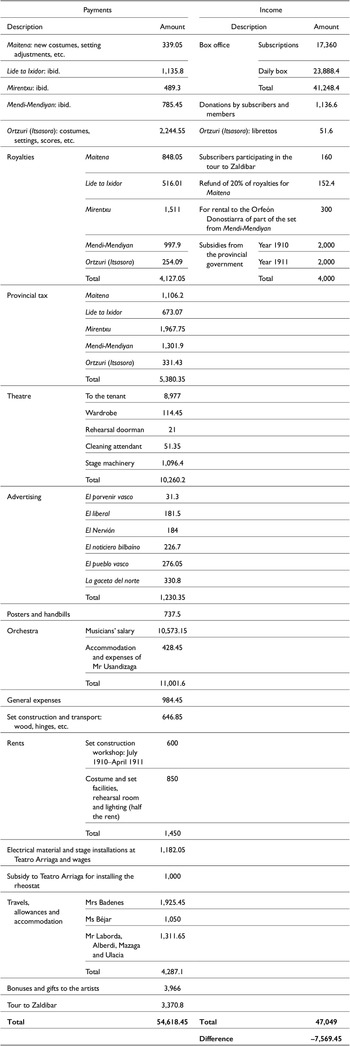
Nonetheless, the money obtained at the box office, with tickets priced similarly to ordinary performances, did not leave much margin for profit.Footnote 70 Among other factors, the expenses generated by the orchestra and the theatre rental skewed the balance. Even the royalties were burdensome due to the limited commercial potential of Basque operas. Unlike more popular works, such as the género chico zarzuelas that were distributed across Spain, Basque operas faced proportionally higher costs, as their profitability was practically restricted to the Basque provinces. Accordingly, the 1911 internal report from the Sociedad Coral concluded that producing a Basque opera was not an overly attractive option, as it would ‘remain localised, even in the most fortunate case and for a long time, to a single theatre and a single region’.Footnote 71 In short, having to face a considerable deficit, the Sociedad Coral admitted that Basque opera lacked economic incentives, and reduced the number of performances for the following years.
Even after an artistically remarkable season, Basque opera revealed socioeconomic, cultural and labour realities of precariousness. The absence of sustained public funding also forced dependence on private initiative, in a theatrical context where commercial logic hampered the possibilities for the sustainability of Basque opera. This was further intensified by the pressure from a demanding criticism, whose expectations and anti-Italianism clashed with the public’s tastes, thereby narrowing the commercial potential of the aesthetic they considered appropriate for Basque opera. In short, the anti-industrial rhetoric revealed its practical incoherence when artistic ideals collided with material reality, as Azkue would personally experience.
The Wagnerian risk: Ortzuri (1911)
Although born in Lekeitio, a small fishing village, Azkue spent most of his life in Bilbao. Well-educated, he was an avid traveller, and fully aware of the importance of promoting Basque culture in order to preserve it. He managed various initiatives such as dictionaries, journals and cultural centres. Socially active, he joined the Sociedad Euskalerria (1879), an influential Basque fuerista and later nationalist club, whose members included notable figures from Bilbao’s bourgeoisie, such as his friend Gortázar.Footnote 72 The shipowner and industrialist Ramón de la Sota (1857–1936) was also among them and served as the principal economic patron of the Basque Nationalist Party, as well as of some cultural projects – including the magazine Hermes and most of Azkue’s initiatives.Footnote 73 In parallel, Azkue used his position as a professor of Basque language, funded by the provincial government, to encourage the learning and dissemination of the language; hence, in 1919, the foundation of Euskaltzaindia, the Academy of the Basque Language.
Nevertheless, music and opera always held a central place in his work.Footnote 74 Like Guridi and Usandizaga, he trained musically at the Schola Cantorum in Paris with Vincent d’Indy (1851–1931), as well as in Brussels and Cologne. He established relationships with important experts in religious and traditional music, such as Charles Bordes (1863–1909) and Felipe Pedrell, and became a key academic figure in Basque folkloric music.Footnote 75 Indeed, as was common among other nationalist composers, he drew inspiration from folklore to compose several costumbrista zarzuelas, such as Vizcaytik Bizkaira (1895), Eguzkia nora (1896), Sasi-eskola (1898), Colonia inglesa (1898) and Pasa de chimbos (1898). Fully written and composed by himself, these works, modest in quality but applauded by ideologically sympathetic audiences, were notable for their nationalist moralism, offering explicit critiques of the negative effects of industrialisation and political centralism, such as the loss of local customs, the repression of the Basque language in schools, and immigration.Footnote 76 Years later, stimulated by the examples of certain sub-state European regions (mainly Bohemia and Norway), Azkue became convinced that a Basque national opera would provide the country with a prestigious musical identity. Actually, after attending a performance of Lohengrin in 1890, Azkue made Richard Wagner and his Gesamtkunstwerk concept a model for his own Basque nationalist project.Footnote 77 Furthermore, his Wagnerian enthusiasm led him to learn German and translate excerpts from the libretto of Parsifal into Basque.
As has been discussed in the previous section, Azkue was aware of the limitations of the Basque musical system. However, he pushed ahead with his first opera, knowing well that the financial situation of the Sociedad Coral de Bilbao was far from ideal. In January 1911, faced with the ‘near dissolution’ of the institution, he asked Gascue to intercede with the Orfeón Donostiarra, the main choral society in San Sebastián, for the production of Ortzuri. Footnote 78 The choir appears to have disregarded his request, and it was ultimately the financially strained Sociedad Coral that took on the production, though not in its entirety. Lack of time and elevated costs obliged them to stage only the first act, titled Itsasora. Footnote 79
Set in a fishing village, the opera follows the tragic love story between Ortzuri (soprano) and Ileder (tenor), thwarted by a sorceress, Minzorrotz (contralto). It was dedicated to the Urquijo brothers, members of an influential bourgeois family. The work premiered at the Teatro Arriaga in Bilbao and was performed entirely in Basque – a novelty, as Basque operas premiered in Bilbao were normally presented in a bilingual form due to the limited knowledge of the language in the city. The cast consisted of amateur or semi-professional performers, largely members of the Sociedad Coral, and the orchestra was conducted by Guridi.Footnote 80 Drawing on a Wagnerian aesthetic, Azkue combined a traditional setting with a historical-legendary imaginary – the most commonly used themes to represent Basque identity in the nineteenth century, and which Gascue privileged as the most appropriate for Basque opera.Footnote 81 In this regard, the work of the painter Manuel Losada (1865–1949) was significant, as the sets and staging received most of the praise.Footnote 82 Some observers believed they had witnessed the ‘art of the future’ as formulated by Wagner, noting the meticulous use of lighting and the installation of a cinematograph to simulate the movement of the sea.Footnote 83 Gortázar went further, remarking that the technical innovation had achieved the ‘intimate fusion of all the fine arts in the lyric drama that Wagner could only dream of’.Footnote 84
The Wagnerian influence was also evident in the music, though it did not generate as much enthusiasm. While no one denied Azkue’s stylistic sophistication, his experimentation with traditional music through Wagnerian textures and sonorities was not fully understood. He employed melodic themes associated with characters, emotions and ideas, but the presence of Basque traditional music was less apparent due to Azkue’s ‘severe’ style.Footnote 85 The premiere confirmed the prediction of composer and priest Vicente Goicoechea, who had pitied Azkue ahead of the first performance: ‘What a lot of trouble awaits poor Azkue in preparing [the opera]! His style seems quite complicated.’Footnote 86 His prediction came true eventually. According to the press, Azkue exhibited a highly academic style, probably due to his studies abroad. Gortázar, for example, argued that his academicism spared him from harmonic mistakes. Yet he acknowledged that this adherence to the rules dulled the ‘dramatic ardour’ of the work, so that, compounded by issues with instrumentation and dynamics, Azkue impeded the ‘sonic realisation of his imagination’.Footnote 87
Others, however, interpreted these same shortcomings not as innovations, but as alien procedures that detracted from the opera’s Basque character, especially when Ortzuri was compared to the operas that completed the 1911 lyric season. Given the brevity of Ortzuri’s performances, the Sociedad Coral scheduled double sessions. The first act of Ortzuri was performed on 13 and 14 June, following the performances of Maitena and Mirentxu respectively.Footnote 88 Audiences and critics were surprised when, after ‘enjoying a delightful time listening to those distinctly Basque melodies’, they heard Azkue’s music.Footnote 89 The reaction was cold, as the audience was confused. Even though they attended a Basque opera, many left the theatre under the impression that they had experienced something entirely different. Most critics even questioned whether the opera was truly Basque, as they had detected only one traditional song in the score. A well-versed critic, Gortázar confirmed this perception of Ortzuri. Most of the music was composed by Azkue, who had ‘absorbed so deeply the essence of our people that it unconsciously flows into whatever he creates’.Footnote 90 Gortázar was untroubled by this, as this process of ‘transforming, dissolving, and assimilating’ folklore aligned smoothly with his view of musical nationalism.Footnote 91 Others, on the contrary, were displeased. ‘The music of Itsasora has absolutely no Basque colour’, complained one critic.Footnote 92 A more moderate reviewer conceded some Basque identity to the score, though mixed with a ‘Germanic character’, as the music sometimes resembled Tristan und Isolde. Footnote 93 The broad consensus was that, in his attempt to avoid Italian formulas, Azkue had followed a Wagnerian language and, consequently, treated Basque music in a ‘German’ manner.Footnote 94
Despite the lukewarm reception, critics encouraged the Sociedad Coral to stage the work completely. But Ortzuri was never performed again, either in full or in part. In fact, the institution, facing a significant deficit (Table 1), opted for safer titles; only Maitena and Mirentxu returned to the stage in 1912 and 1913.Footnote 95 The reception of Ortzuri suggests, musically, a misunderstanding on the part of the audience regarding the use of folklore and its integration into a new musical framework. Azkue’s intention to offer a Wagnerian alternative stemmed from a desire for experimentation, to open new horizons for Basque opera by moving away from Italian aesthetics. However, this decision carried additional risks. As some critics pointed out, the Basque character of the music could suffer, and given the financial figures from the Sociedad Coral, it was clear that Basque opera was not especially profitable, even when the theatre season was packed with rural verismo-style works. Azkue’s innovation only increased the Sociedad Coral’s exposure to failure and financial deficit.
Balance of payments and income (in pesetas) for the 1911 Basque opera season of the Sociedad Coral de Bilbao
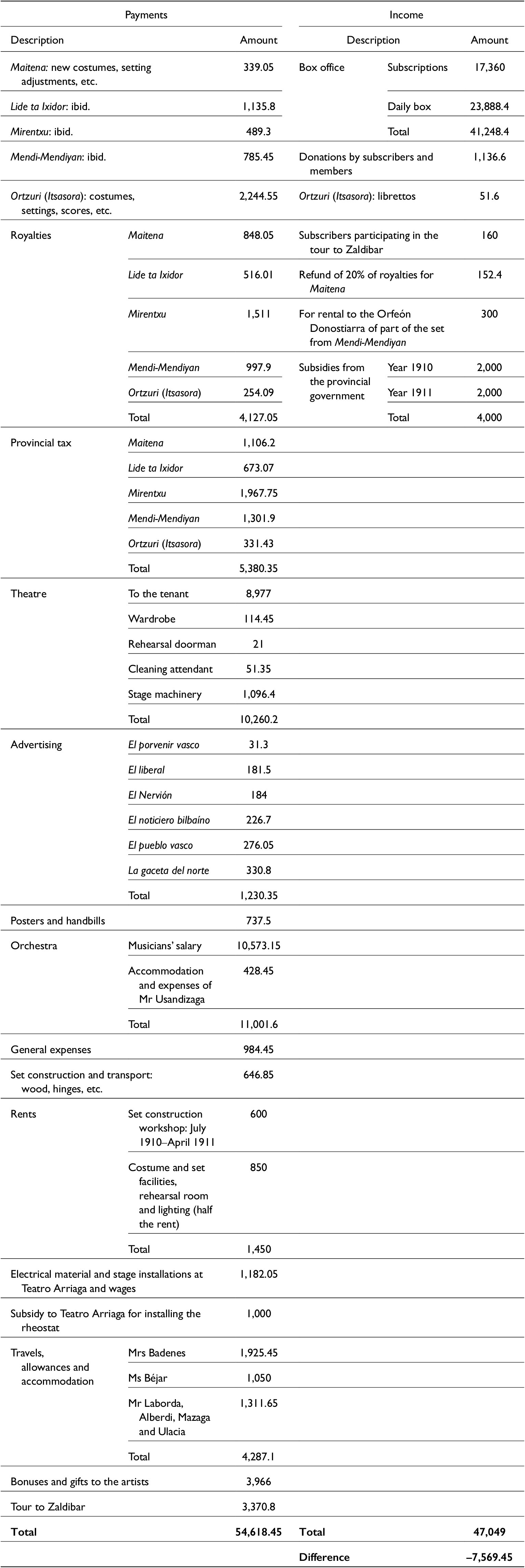
Source: Sociedad Coral de Bilbao, Memoria: ejercicio 1910–1911. AHFB, Música, Bilbao Aristegui, Música, 0438/005, 9.
The scandal and the failure: Urlo (1914)
Despite the setback following the premiere of Ortzuri, Azkue remained committed to his musical career, firmly believing in the importance of creating a national opera for the Basque Country. However, he soon realised that obstacles were multiplying. The Sociedad Coral was the only agent capable of producing an opera in proper conditions at the time. But his relationship with the choir was strained after the disappointing experience with Ortzuri. In 1912, the Sociedad Coral declined to stage Azkue’s symphonic-choral poem Andra Urraca, without providing a clear explanation. Disturbed, Azkue referred to a supposed prior arrangement, one that had been reaffirmed when they had ‘agreed to present my Ortzuri in a mutilated form’.Footnote 96 The incident suggests that the Sociedad Coral was no longer interested in producing more works by Azkue, particularly after the outcome of his last opera. But it also pointed to the financial difficulties in making Basque opera productions commercially viable. As one critic observed, exploiting such works within ‘the confines of the homeland’ was a complicated task, ‘from the perspective of art, always, and from the perspective of economics, almost always’.Footnote 97
These comments were made in reference to the triumphant premiere of José María Usandizaga’s zarzuela Las golondrinas (1914) in Madrid. The young composer, who had enjoyed great success in Bilbao in 1910 with his opera Mendi-Mendiyan, had moved to Madrid shortly after to work on his new piece. With a libretto by María Lejárraga (1874–1974), Las golondrinas shared clear parallels with Ruggero Leoncavallo’s Pagliacci (1892), as it told the tragic story of obsessive love within a circus troupe. Its premiere in February 1914 was a resounding success,Footnote 98 and critics in Madrid lavished it with praise, hailing it as a ‘masterpiece’ that revolutionised ‘Spanish lyric art’,Footnote 99 propelling Usandizaga into the ranks of the great zarzuela composers.Footnote 100
In contrast to the reactions in Madrid, Usandizaga’s accomplishment caused a scandal in his homeland, where his triumph was seen as a betrayal and a capitulation to the commercial interests of zarzuela. To regionalist and nationalist critics, the composer not only failed to meet the expectations raised by Mendi-Mendiyan,Footnote 101 but his venture into the ‘disreputable and dishonourable world of Spanish zarzuela’ marked a retreat from the ambition of elevating Basque opera to the level of the great European musical traditions.Footnote 102 Azkue’s circle was especially judgmental. Arturo Campión condemned Usandizaga’s vanity, accusing him of having ‘deserted the Basque sphere’ in pursuit of ‘fame’.Footnote 103 Gregorio Múgica argued that Usandizaga’s success was purely material, ‘the one that opens the doors to a life of comfort and glory’.Footnote 104 Aita Donostia accused him of having journeyed to Madrid ‘in search of money’.Footnote 105 Felipe Pedrell expressed his outrage at the composer, claiming he had committed a crime against art.Footnote 106 And even Gascue lamented that Usandizaga had been swayed by ‘the desire to win’.Footnote 107 Perhaps the greatest source of pain was not Usandizaga’s alleged disloyalty, but rather what his departure came to symbolise for Basque opera. His action revealed the flaws in a cultural enterprise that still followed the ‘exclusivist drive’ of regionalists and nationalists, moving away from the path of ‘true art’, according to a supporter of Usandizaga.Footnote 108
This view stood in contrast to Azkue’s more militant perspective, as he believed that ‘forming our musical nationality’ should always be a priority, even outside the bounds of commercial logic.Footnote 109 With his second opera, Urlo, premiered at the Teatro Campos Elíseos in Bilbao just three months after the presentation of Las golondrinas, Azkue reaffirmed his nationalist ambition. As with Ortzuri, he took on both the composition and the writing of the libretto, entirely in Basque, though he later translated it into Spanish and German, envisaging a possible international staging.Footnote 110 But his involvement in the new opera would be greater. Given the limited capacity (or apparent lack of interest) of the Sociedad Coral, Azkue decided to produce the opera independently.
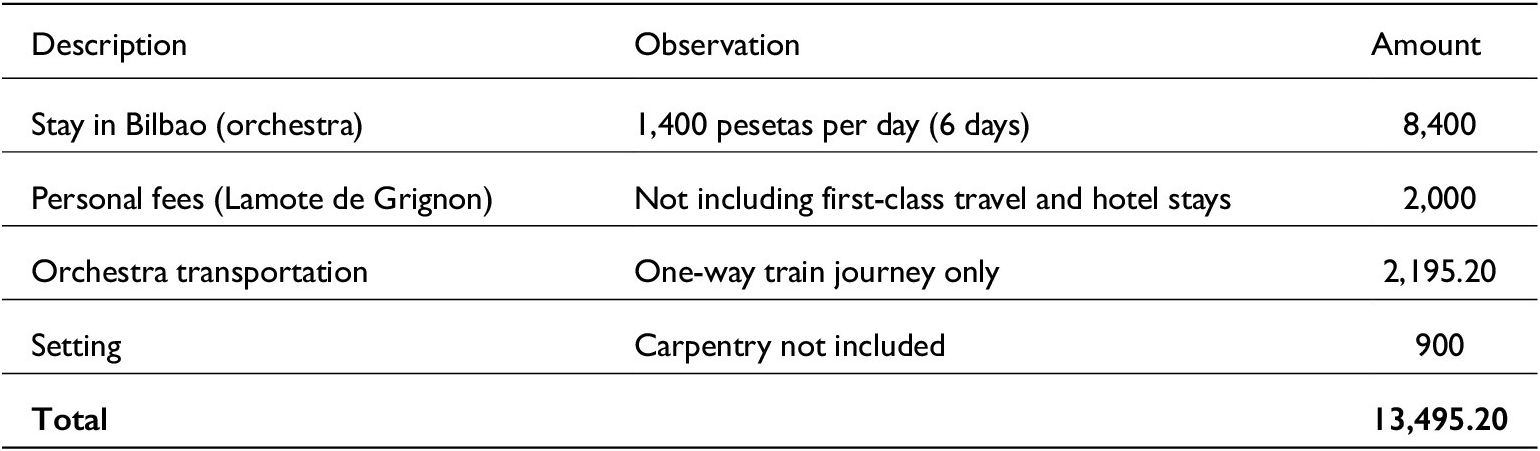
He composed the score between December 1911 and April 1912, completing the orchestration in the following months.Footnote 111 By mid-1913, he had made significant progress in arranging the staging, contacting singers and securing the participation of the Orfeón Euskeria, a nationalist and religious choir sponsored by Sota, to which Azkue himself belonged.Footnote 112 Additionally, between late 1913 and early 1914, he managed to involve the renowned Wagnerian conductor Joan Lamote de Grignon (1874–1949) and the Orquesta Sinfónica de Barcelona, fully aware of the substantial costs this decision entailed. In several letters sent to Azkue between November 1913 and April 1914, Lamote de Grignon outlined a number of artistic, logistical and financial conditions before signing the contract. He specified the composition of the orchestra, detailed the vocal requirements for the choir, set a rehearsal schedule and included a singer of his choice in the cast.Footnote 113 Moreover, in order to maximise the impact of the orchestra’s visit and lend greater prestige to ‘our music’, while distancing it from the ‘monstrosities of the género chico’, the musical programme was supplemented with two concerts featuring Beethoven’s Symphony No. 9 and the Grail Scene from Parsifal, both sung in Basque.Footnote 114 However, Lamote de Grignon also outlined demanding financial conditions, which amounted to at least 13,495.20 pesetas (Table 2). This sum did not include the accommodation for the 75 musicians of the orchestra and the singers, copyright fees, taxes or the cost of the musical scores. Furthermore, the precise financial details related to the opera’s production, such as the rental of the theatre, the printing of posters, and costume design, remain unknown. Nevertheless, despite the absence of complete documentation regarding production costs, it seems evident that the overall expenditure was substantial, particularly if Azkue was the sole contractor.Footnote 115
Partial estimate of production costs for Urlo (in pesetas)
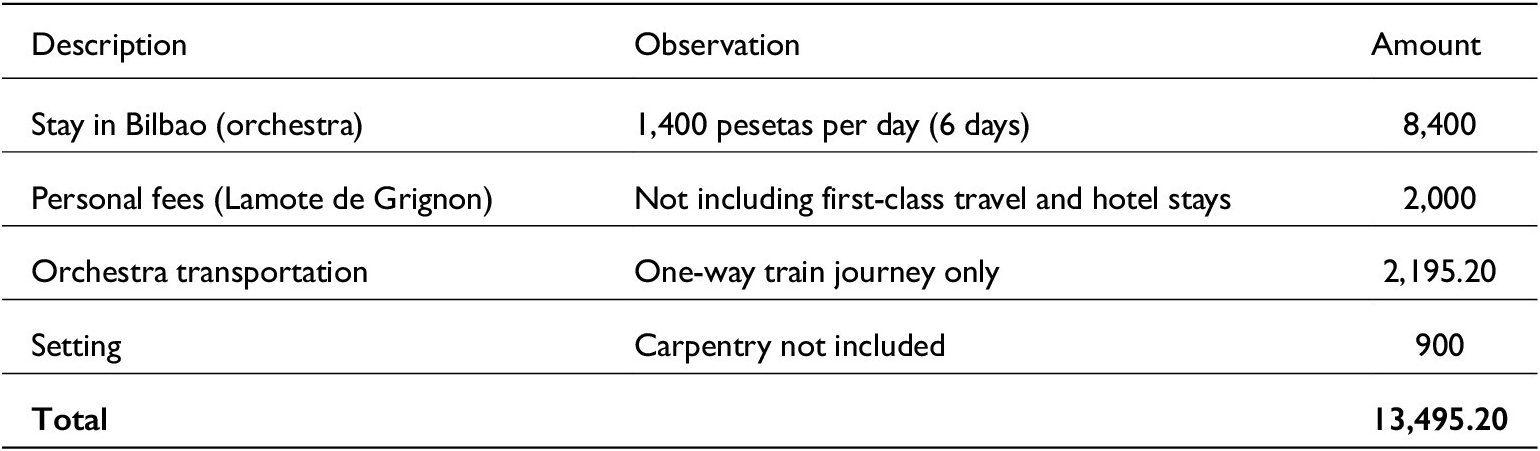
Source: Joan Lamote de Grignon, letters to R.M. Azkue. Euskaltzaindia, ABA-RMA-0115-640, ABA-RMA-0112-469.
The expenses of Urlo could compromise his personal finances. Although Azkue never faced significant deprivation, he did not come from a wealthy family, and his financial situation depended on personal incomes. For much of his life, he relied on a regular salary as a professor of the Basque language, earning around 1,500 pesetas per year between 1887 and 1913, and 3,000 pesetas thereafter, excluding some additional income from officiating at masses.Footnote 116 Starting in 1923, his salary increased to 4,000 pesetas per year when he became the director of Euskaltzaindia.Footnote 117 As a priest, Azkue never married or had children, and shared a rented home in the centre of Bilbao with his widowed mother and two unmarried sisters, Aurora (1860–1937) and Diana (1868–1934).Footnote 118 Although he received subventions for cultural projects such as the Diccionario vasco-español-francés (1906) and the Cancionero popular vasco (1921–25), he often had to co-fund most of his initiatives, even at a financial loss.Footnote 119 Urlo thus became part of this line of cultural entrepreneurship.
Premiering finally on 29 May 1914, Urlo failed to make a positive impression. Sung in Basque, and reflecting the traditional rural themes of Basque opera, Urlo was set in a fictional location in the mountains. It portrayed a love intrigue in a comedic light, where Tsomeka, a young innkeeper, tries to avoid marrying Urlo, a wealthy hunter, and instead seeks to unite with Anton, the forest guard. The negative reviews were not focused on the plot, but rather on the score, which, along with its performance, fell short of expectations. Before and after the premiere, several singers had to be replaced due to illness, and the poor performance of the substitutes led to the cancellation of the remaining shows.Footnote 120 Furthermore, little publicity was given to the premiere, and ticket sales were low – some suggested that the absence of subscribers was owing to ‘rivalries and petty village squabbles’.Footnote 121
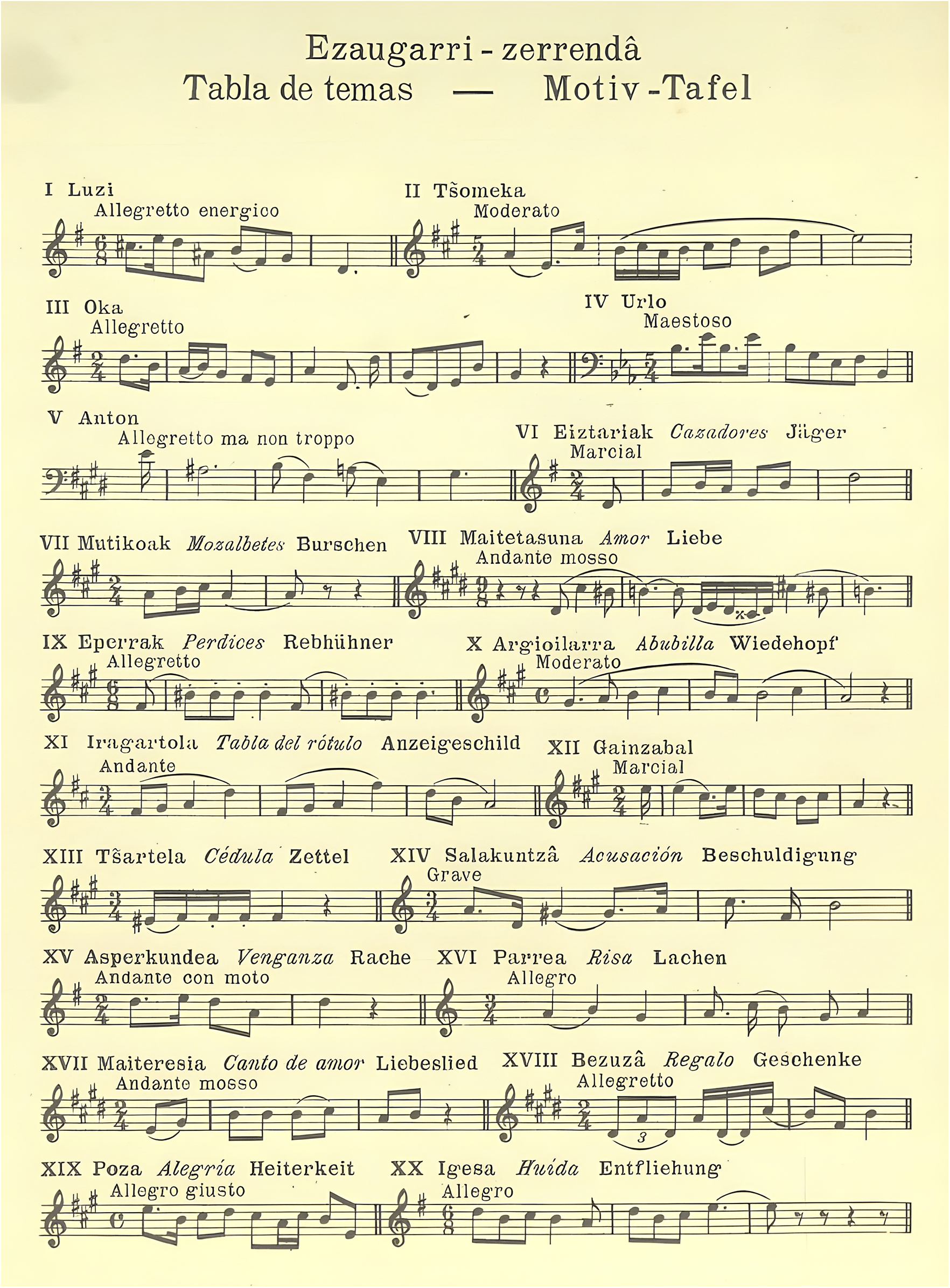
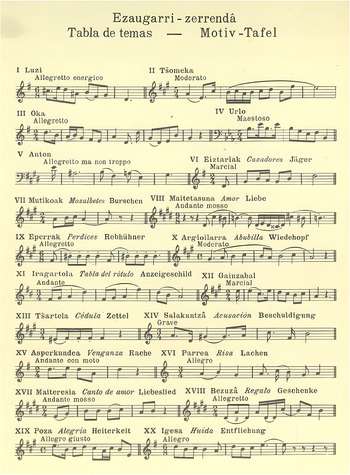
The music did not seem to appeal to anyone, owing to its excessive complexity and a perceived lack of authentic representation of the Basque character (Figure 1). Campión described the score as an ‘immense and compact grey mass’.Footnote 122 In the same vein, one critic referred to it as an ‘incomprehensible conglomerate of notes’, musing, ‘we do not know what Mr Azkue intended to achieve by writing the music for Urlo’.Footnote 123 The nationalist Manuel Aznar (1894–1975) believed the opera was ‘full of distant dissonances’, arguing that the composer had been swept up by a ‘romantic frenzy’ and had forgotten the ‘popular song’, causing the orchestra to become lost in a ‘musical labyrinth’.Footnote 124 Gregorio Múgica commented that the opera’s ‘orchestral audacities’ presented a challenge to an audience unaccustomed to musical experimentation: more time and attention were needed ‘to unravel in that somewhat tangled music the beauties that can be glimpsed but not fully understood’.Footnote 125 In fact, he affirmed that Urlo lacked ‘Basque flavour’.Footnote 126 Azkue was accused of creating ‘grotesque’ characters that did not align with the more dramatic nature of previous Basque operas.Footnote 127 Some even stated that the plot was ‘excessively silly’ for ‘so much music’.Footnote 128 The press insisted on the alleged incoherence between the score and the libretto, which was aggravated by the scale of the orchestration. In parallel, it was claimed that Urlo was ‘too scientific’, drowning out the few ‘pastoral and peasant’ themes that gave the work a ‘regional’ character, and that imitating Wagner was not the right path, as folklore should be ‘the basis of opera’.Footnote 129 As with Ortzuri, Azkue, already labelled as a ‘Germanised Basque’, apparently diluted Basque music in Wagnerian language, to the point of making it unrecognisable.Footnote 130
Chart of leitmotifs of Urlo, in Basque, Spanish and German. Source: R.M. Azkue, Urlo: iru ataletan euskeraz egindako opera (Bilbao, 1914), 1.
But the economic failure of Urlo was even more severe. Three years earlier, Ortzuri had been financed by the Sociedad Coral within a season that included more popular works, so the overall revenue helped cover the possible losses from an innovative opera. With Urlo, the starting situation was different. Not only was the opera performed in full, but the financing came from a single individual, not from an entity with over 1,000 members.Footnote 131 Additionally, the relative investment was larger, as an external orchestra and several professional singers were hired. Since the personal risk was greater, Azkue’s reaction to Urlo’s flop was more dramatic. He did not respond well to some of the criticisms, especially those from like-minded papers and individuals. Aznar and Múgica, for example, had to privately amend some of their remarks.Footnote 132 Although they did not fully retract, they sought to express solidarity with Azkue upon learning that the opera had caused him ‘great losses’.Footnote 133
The letters from Aznar and Múgica extend the analysis of Urlo’s reception into a more private arena, offering insight into the economic effects of the failure and Azkue’s efforts to deal with the debt. Even though the lack of an economic balance makes it difficult to quantify the opera’s expenses and revenues precisely, sources estimate the deficit at 20,000 or 25,000 pesetas – amounts far removed from Azkue’s regular incomes.Footnote 134 The private correspondence suggests that he turned to his family and social networks to settle the losses. While the exact quantity is unknown, Azkue admitted that his sisters had to sell their bank shares to cover the ‘costly premiere of my operas’.Footnote 135 And although he did not ask for money from his usual patrons, such as Sota, Azkue turned to Campión, requesting that he write a favourable review of Urlo in order to secure public funding for publishing the score. Despite repeatedly trying to avoid the issue (‘My God, how will I get out of this mess?’, he confided in a letter to Aita Donostia), Campión eventually wrote the article at Azkue’s insistence.Footnote 136 He crafted a study presented in conciliatory and ambiguous terms, stating that the sophistication of Urlo made its fair appreciation difficult.Footnote 137 But privately, he acknowledged that the text was a ‘tribute of my true friendship’.Footnote 138 It is unknown whether the article was ever published.Footnote 139
Although Urlo appeared to be overly innovative for the local audience’s taste and perhaps artistically imperfect, its premiere underscores the weaknesses of a cultural system reliant on the artistic and economic entrepreneurship of individuals or private corporations. Similarly, Urlo reveals certain internal dynamics within the local musical world. Azkue’s risky decisions, the Wagnerian ambition of Urlo, the misgiving from both the public and critics, and the activation of his family and social networks after the failure all underscore the financial and organisational precariousness of Basque opera. This is further evidenced by Azkue’s actions after Urlo’s debacle, trying to capitalise on Campión’s cultural and social influence. This behaviour reflects a political culture that normalised the use of informal practices to obtain public funds. But the fiasco of Urlo also exposed the vulnerabilities of a cultural enterprise unable to ensure sustained professional profiles, as shown by the scandal surrounding Usandizaga’s commercial success in Madrid. The contrast between the triumph of Las golondrinas and the failure of Urlo showcased the economic and aesthetic limits of Basque opera.
Conclusions
Basque opera embodied the economic and cultural tensions of a transforming region. Predominantly rural until the late nineteenth century, the rapid industrialisation provoked notable changes in its economic and cultural fabric. As a mark of social distinction, the musical plan fostered by the regionalist and nationalist bourgeoisie reflected this metamorphosis. Confronted with what was perceived as a commodification of local identity, caused by the industrialisation that this very bourgeoisie promoted, a new way of expressing Basque identity emerged, modernising and updating the traditional ruralist idealism in both form and meaning. Nevertheless, despite its essentialist rhetoric, this identity was in fact a contemporary cultural construct, and was used to convey political claims according to regionalist and nationalist agendas. Even so, regardless of these political variations, there was a common interest to overcome the region’s peripheral position and assert artistic centrality. Hence the ambition to modernise Basque opera, and standardise it according to an aesthetic deemed legitimate for such a project – namely, Wagnerism.
It is within this context that Azkue’s contribution should be situated. His artistic proposal expresses the strains and difficulties of the aspiration to modernise a folkloric tradition and to construct a lyrical repertoire of international prestige. In this sense, Basque opera was placed within a broader operatic context, where the polarity between Italian opera and Wagnerism still persisted. Aware of the European reality, Azkue’s goals and decisions, along with those of his circle, aligned with transnational dynamics while integrating local characteristics and issues. More specifically, Azkue’s Wagnerism functioned not only as an antidote to Italianism but also against commercial formulas that, like género chico, were perceived as threats to artistic and nationalist interests. However, the preference for Wagnerism as an alternative to prevailing Italianism deepened the contradiction which confronted anti-industrial and anti-commercial rhetoric against a material reality that was practically incompatible with elitist experimentation. After all, Basque opera had to compete in a theatrical environment governed by commercial rules, and Azkue’s modernising efforts pushed it out of a local market that already offered poor prospects even to more conventional Basque operas.
Moreover, his preference for the Wagnerian model could be counterproductive for musical and theatrical purposes. It challenged traditional representative formulas of Basqueness, reduced commercial possibilities, and imposed a series of material constraints that the local musical milieu could hardly sustain. Paradoxically, although he regarded it as the ideal model of modernity, one could wonder if his Wagnerian interpretation actually complicated the pursuit to surpass the region’s peripheral position, as the failure of Ortzuri and Urlo may suggest. Indeed, exacerbated by misfortune and a perhaps overly audacious personal style, Azkue’s productions illuminated the shortcomings of a cultural ecosystem unable to finance ambitious artistic projects, achieve internal consensus and attain profitability. Valle-Inclán may have been right to link industrialisation with Basque art – perhaps because art and economy constituted two sides of the same coin.
Acknowledgements
Research for this article was made possible by a postdoctoral fellowship granted by Hezkuntza, Hizkuntza Politika eta Kultura Saila, Eusko Jaurlaritza [POS_2022_1_0003], and supported by the research group ‘Nacionalización, Estado y violencias políticas. Estudios desde la historia social’ (IT-1531-22; IP Antonio Rivera). It contributes to the project ‘Desimperialización y procesos de construcción nacional en el Atlántico hispano’ funded by the Ministerio de Ciencia e Innovación. I am grateful to Jurgi Kintana Goiriena (Universidad del País Vasco-Euskal Herriko Unibertsitatea), Pruden Gartzia (Euskaltzaindia) and to those who reviewed the text, especially Cambridge Opera Journal editor Ellen Lockhart.

 Open access

