




In 1975, the acclaimed novelist Yaşar Kemal (1923–2015) undertook a series of journalistic interviews with working children and street children, who also were often migrants and extremely poor. In one such conversation with a group of boys, Kemal asked their opinions about “what would save them.” One boy said, “The revolution will save us.” As Kemal further enquired about the possible meaning of this “revolution,” one boy said: “The revolution is the equality of children and adults.”Footnote 1 Kemal's article series, published daily in the newspaper Cumhuriyet (Republic) in forty-one installments from 13 September to 26 October 1975, is strongly supportive of this young boy's criticism of adultism, or, in other words, age discrimination.Footnote 2 The serial is entitled “Children Are Human” (Çocuklar İnsandır), and Kemal wrote first and foremost about the equality of adults and children:
I don't treat children like kids. If I have a friendship, a relationship with a child, then he or she is my friend, not a child. I don't see them as children, I don't treat them like a different human species. Why? I never believed that children are like kids, in the way people treat them. They are fully-fledged (basbayağı) human beings.Footnote 3
Yaşar Kemal's significance as an author, as a force in cultural and intellectual life, and as a public political figure needs to be established from the outset. Kemal was a world famous writer, one who has been translated into multiple languages, who received dozens of literary awards during his lifetime, and who was considered for the Nobel Prize. An outspoken political figure, Kemal publicly affirmed his Kurdish identity in a country where it was forcefully denied and challenged official state policy. He was a civil and human rights activist who defended social justice and socialism, and who did not hesitate to speak about taboo issues, especially those concerning the genocide of Armenians, the oppression of the Kurdish people, and racism in Turkey. As Sibel Irzık notes, Yaşar Kemal “entered the canon of ‘world literature’ as a dissident author—one who ‘speaks for’ the nation in ‘speaking against’ it.”Footnote 4 In Fethi Naci's words, “revolt” was his main principle as a novelist.Footnote 5 According to Laurent Mignon, he has written “the epic of the subalterns.”Footnote 6
Born and raised in rural Adana in southeastern Turkey, Kemal could not complete secondary school and instead held down nearly forty jobs until 1950. He worked, among other things, as a shoemaker's apprentice, a petition writer (arzuhalci), a gas meter reader, an agricultural laborer, and a substitute teacher. In 1950, he served a short spell in prison for alleged communist activities. A year later, with the help and advice of several of Turkey's leading leftist intellectuals, especially Arif Dino and Orhan Kemal, he went to Istanbul and was given a job as a reporter for Cumhuriyet. He would mostly write serial articles in the genre of investigative journalism.Footnote 7 It was at this point that he adopted the pen name of Yaşar Kemal.Footnote 8 His short story collection Yellow Heat (Sarı Sıcak, 1952) and his first novel Memed, My Hawk (İnce Memed, 1955, vol. 1) also were serialized in Cumhuriyet.
Yaşar Kemal is well known both for the sociopolitical commitment of his narratives and for developing sophisticated written works based on oral traditions of folk literature and myths.Footnote 9 When he did this fieldwork with street children in 1975 he was a world famous novelist and part of an international socialist and literary network. To express the struggle for social justice as an investigative reporter, newspaper series were a natural extension of Kemal's writing. Kemal often emphasized the importance of journalistic reporting for his novels. In 1956, after winning the Novel Award of the established literary journal, Varlık (Presence), for Memed, My Hawk, he stressed in an interview that “good reporting is done by good artists” and that “reporting is a branch of literature.”Footnote 10 In August 1975, he again underlined the importance of his journalism to his novels in an art and literature periodical, Milliyet Sanat (Nationhood Art [supplement]). He said, “the world's greatest reportage writers are also great novelists,” as in the examples of “Hemingway, Ehrenburg, Sholokhov, Simonov, Kessler . . . Malaparte.”Footnote 11
As the author himself often remarked, children and older characters, especially women, were always quite central in his oeuvre. In a number of his novels, young children feature as the protagonists, and their coming-of-age is at the center of the plot. The life stories of some interviewed children later also became the core of some of his novels. The parallels are the most clear in his three-volume saga published as The Saga of the Seagull (Al Gözüm Seyreyle Salih, 1976); The Birds Have Also Gone (Kuşlar da Gitti, 1978), and The Sea-Crossed Fisherman (Deniz Küstü, 1978).Footnote 12 In an essay from 1962, “Anatolian Child” (Anadolu Çocuğu), Yaşar Kemal asserted for the first time that “children and adults are equal.” Focusing on the lives of rural children, Kemal noted that adults and children lived identical lives in the circumstances of the village.Footnote 13 Later, in his interview with Alain Bosquet, which was conducted in the form of translated letter exchanges in the 1980s, Kemal once again underscored the infantilization of children within urban bourgeois structures:
Nobody treated me like a child in the village. Or other children for that matter. . . . I realized that children were children when I left the village and came down to the city. Of course, we were children too. . . . But no one treated us in a degrading (küçültücü) way. In our village, children were also human. They did not separate us from the adults in many things. We used to listen to the great story-tellers (destancı) together with the adults until the morning. No one would tell us that these are children, they cannot understand these great epics.Footnote 14
Yaşar Kemal's discussion of the equality of children and adults needs to be situated vis-à-vis the limits imposed on children's agency in modern, urban, nuclear family settings from the late 19th century onward. Scholarship on children and agency underlines how children often are not considered fully human and as less than adults.Footnote 15 They are seen in a state of becoming; they are not considered complete and definable individuals until they come of age.Footnote 16 As the novelist stressed, the idea that children could not be considered full-fledged human beings also was quite established in Turkey at the time.Footnote 17 Kemal, in that sense, wrote against a certain social environment, in which children were either oppressed, mistreated, and beaten, or else drowned with compassion and care. In both cases, he argued, they were treated as “a different species” (ayrı bir yaratık) and not as equal human beings.Footnote 18
The mainstream representation of children's public engagements and political agency in 1970s Turkey delineates the boundaries of childhood and the boundaries of politics in Turkey. The stereotypical public discourse produced by mainstream journalists, politicians, and prosecutors portrayed politics as an adult sphere in which children had no legitimate place.Footnote 19 Therefore, the construction of children and politics in Turkey was based on at least two denials. The first mechanism of children's exclusion from politics was the denial of their political agency, based on an essentialized conception of childhood as a phase of innocence, subordination, and victimhood.Footnote 20 Children's rational standpoint was constantly undermined by discussing them without giving them the voice to speak.Footnote 21 Different versions and examples of politicization are simply overlooked, and children's actions are infantilized or crippled by an overemphasis on adult and parental manipulations. Second, from the other extreme, the exercise of political rights and exhibition of any act of political agency leads to what Nadera Shalhoub-Kevorkian defines as “unchilding.”Footnote 22 These children are simply expelled from their own childhoods, and their children's rights are denied. Portrayed most often as overly politicized “terrorists,” criminals, or delinquents, they are then tortured, imprisoned, convicted, and killed with no regrets.Footnote 23
Recent research in childhood studies, on the other hand, repeatedly demonstrates that children have the skills and capacities to freely exercise their right of participation, that their actions may be deeply political and that there is a definite need to reconsider children's political agency in general.Footnote 24 Yaşar Kemal's ethnographic research with street children also needs to be seen as a bold attempt to bend the boundaries of childhood and the boundaries of politics in Turkey. Kemal not only put the children in the center of the narrative, making them the main actors of their own lives, speaking with their own voices; he also acknowledged their humanity, their human rights, and their political agency. Even before the declaration of the UN Convention on the Rights of the Child (1989), he stressed the humanity of children and that children's rights were human rights. Furthermore, his interviews were a political intervention challenging both victimizing and unchilding discourses about street children, migration, poverty, and juvenile crime in Turkey. Together with delineating intersectional layers of their subordination and suffering, Kemal did not represent these children as disempowered victims. Instead, he emphasized that their political agency, protest, and resilience were deeply rooted in their miseries, dreams, and hopes.
As a social and cultural historian of the late Ottoman Empire and early republican Turkey, my primary sources have for the most part been written documents from the state archives; missionary archives, publications, and reports; court records; ego-documents and, to a certain extent, literature. Admittedly, unearthing source material on children and youth from the past is an arduous task. It is especially hard to trace children's own views on their life experiences, work, school, play, and their own childhoods. The interpretation of politics, political subjectivity, and agency also are rather elusive categories in the history of children and youth, especially for researchers focusing on the previous centuries. The discovery of Yaşar Kemal's ethnographic research on children in 1975 has been for me an archival treasure, in which the voices of children are recorded and preserved.
In this respect, the methodological contribution of this research to the history of children and youth is its engagement with ethnography as historical source. Recourse to the tools of the ethnographer to reconstruct an account of the past has been underscored since the 1970s by social and cultural historians.Footnote 25 The methodological reciprocity between the disciplines of history and anthropology also has taken the form of historical ethnography, in which researchers conduct ethnographic research within the archives, and with archival material.Footnote 26 Approaching ethnographic data—of others, and from earlier periods—as historical sources, on the other hand, is still marginal, despite their richness and their great potential. Yaşar Kemal's fieldwork notes and transcribed interviews provide a detailed and vibrant account of the lives of children: a tailor-made archive for a historian of children who is primarily interested in recovering children's political agency.
I define political agency not only as participation in social and political movements or institutional political processes, such as rights activism, political demonstrations, and public declarations. The political part is more broadly conceived to include the private or semiprivate spheres surrounding children in school, at work, and at home. The agency aspect goes beyond the liberal definition, which presumes a capacity to bring progressive change. Following the example of Judith Butler's “paradox of subjectivation” and Saba Mahmood's “docile agent,” I stress that the possibility of resistance is located within the structure of power itself, that intersectional subjectivities lead to multiple forms of subordination (and so multiple types of agency), and that agency mostly constitutes the capacity to endure and suffer.Footnote 27 The children that Yaşar Kemal speaks with appear as politically aware individuals, each realizing that their plight is not a personal tragedy, but a structural issue. Kaya, for example, says that his story is worth telling (and being listened to) since he is not just any individual, but a “victim of the society.”Footnote 28 This nine-year-old son of a factory worker knows all about unionization and a labor strike that cost his father his job, causing his family to face starvation and forcing the boy to start selling balloons to children his own age to improve economic circumstances.Footnote 29 Sait, whose father is in the sanatorium in Heybeliada with an advanced lung disease, maintains his family by catching birds in Florya plain (later to be freed for a fee in Taksim, Sirkeci, or Eyüp Camii).Footnote 30 As a bird-catcher, he has great sympathy for the animals and for nature, and so is very critical of the huge construction project in the area, which will damage the birds’ natural habitat.Footnote 31 Metin, one of the mystery boys who refuses to tell his story to Yaşar Kemal, speaks sensibly and knowledgeably about the lives and dignity of the sex workers he often encounters on the streets.Footnote 32
For his serial article, Yaşar Kemal spent more than three months during the summer of 1975 with dozens of street children in the hubs of Istanbul, on both the Asian and the European sides. He met them on trains and ferries, in parks and squares, in Harem (the main harbor and the central bus station), in front of the New Mosque (Yeni Camii) in Eminönü, in Sirkeci (the main train station with a harbor), in Kumkapı and Yenikapı along the old city walls by the sea, in Beyoğlu, in the central vegetable market (hal), and in the Children's Bureau, the juvenile division of the Istanbul Police Department. His interest in recovering the voices of street children had already developed by the 1960s, when he approached the Children's Bureau of the Istanbul Police Department about conducting interviews there.Footnote 33
The author did not simply interview children; he “became friends with children” (dost, arkadaş oldum onlarla) and met other children through their friends. Talking to them about their families, their daily routines, and their dreams, Kemal was interested in providing an empowering account of the lives of street children, which did not infantilize or victimize them. He became truly “involved in their lives” (yaşamlarına karıştım), such that they would welcome him into their daily activities, be it in the form of catching birds, looking for treasures under the water, or selling balloons.Footnote 34 In other words, he undertook a truly ethnographic project, in which he observed and interacted with the participants of his study in their real-life, daily circumstances. Even the most scared child would establish bonds of trust with him. His subjects were not afraid to show him the money they made, to open to him the gates of their hidden “treasures,” and to tell him their most intimate stories. He listened to (and recorded) these stories, comprising about 250 pages and hours of cassette recordings.
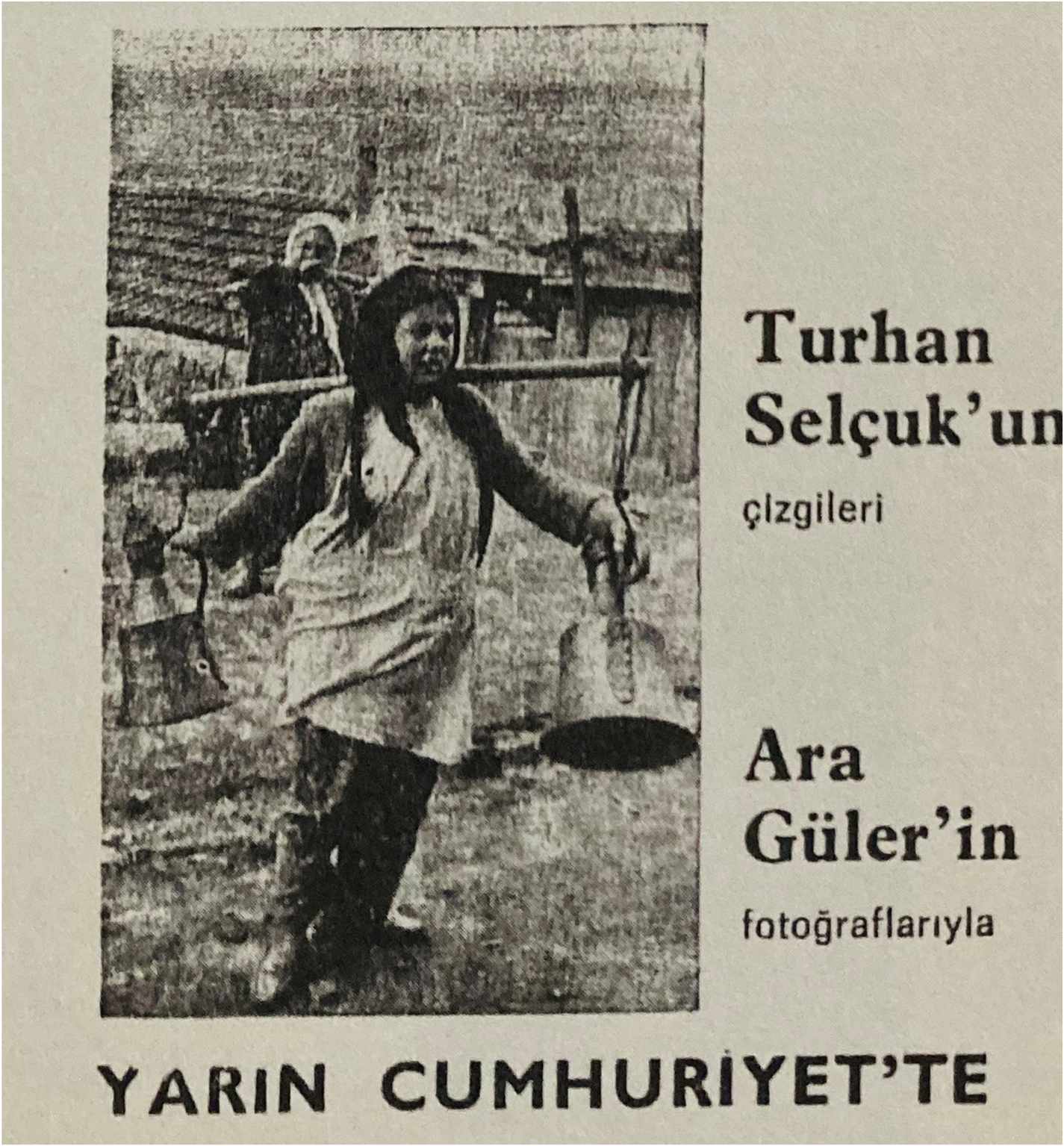
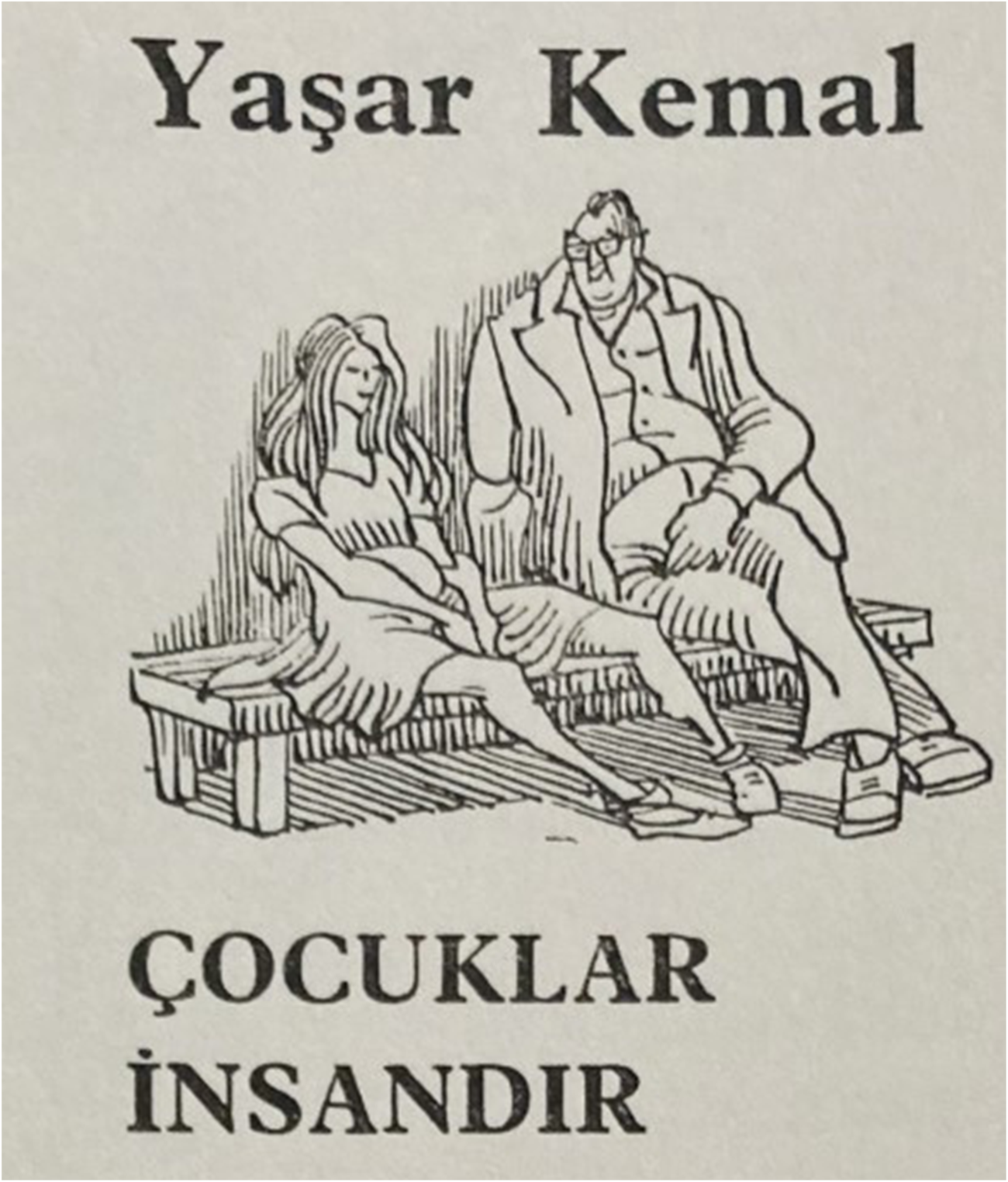
His interviews were published daily in the center-left Kemalist newspaper Cumhuriyet as forty-one installments between 13 September and 26 October 1975, regularly on page 4, the typical placement for serial articles.Footnote 35 Daily installments, often filling up the entire page, were separated into several subsections with dramatic subtitles and were accompanied by the illustrations of the well-known cartoonist Turhan Selçuk (1922–2010) and photographs by the world famous photographer Ara Güler (1928–2018). Advertisements for the series, also featuring illustrations and photographs, appeared several days prior (Figs. 1 and 2). The first installment, entitled “Why Are Children Human?” (Neden çocuklar insandır?), was actually the introduction to the series in the form of an interview with Kemal conducted by the poet and the literary editor of Cumhuriyet at the time, Kemal Özer (1935–2009). The following installments sometimes focused on one child, sometimes a small group of children, tracing their stories in a number of episodes.Footnote 36 As to literary style, the series reflected Kemal's “childlike, fairytale-like narration, as if the narrator and the narrated were all people of the same world.”Footnote 37 Kemal was a "wordsmith", and proved his mastery in dialogue writing, incorporating children's street lingo and turns of phrase into written literature.Footnote 38
Advertisement for the series “Çocuklar İnsandır” (Children Are Human): “Yaşar Kemal has written the real-life stories of destitute children.” Illustration by Turhan Selçuk. Cumhuriyet, 13 September 1975.

Advertisement for the series “Çocuklar İnsandır” (Children Are Human) noting Turhan Selçuk as illustrator and Ara Güler as photographer. Cumhuriyet, 13 September 1975.
My analysis of Kemal's treatment of street children underscores children's involvement in matters of political and social change, either through outright rebellion, silent endurance, or playful ignorance. The first section dwells on discourses on children's public presence in urban spaces, discussions on juvenile delinquency, and deserving and undeserving children. The following four sections, each with a child protagonist at its center, focus on street children's interpretations of their own lives as viewed through four critical political issues. The section on Zilo, the only girl that Kemal interviewed, sheds light upon gendered layers of subordination at home, in the streets, and in all sorts of encounters. The next section about Oğuz brings to light issues of maltreatment and abuse within institutional care mechanisms, as well as stressing individual and collective acts of resistance and solidarity, with both rational and affective motives. Muhterem Yoğuntaş's story discusses different forms of child labor in which poor and destitute children were employed and the extent and mechanisms of their exploitation. The last section on Selim engages with ethnic violence and forced migration in the form of the “evacuation” of Kurdish villages by the Turkish armed forces. As common stories, certain representative issues, such as poverty, urban-rural migration, police brutality, and sexual harassment, arise in all four sections. Yaşar Kemal's fieldwork with children provides an intersectional analysis of age, labor, ethnicity, migration, and gender that I pursue and highlight.
“There is an Army of Destitute Children in Istanbul”Footnote 39
The “child question” in Turkey, that is, the prevalence of poor and destitute children, living and working on the streets of urban centers like Istanbul, took the attention of journalists, scholars, private and public philanthropists, and the state from the 1920s and 1930s onward.Footnote 40 While discursively stressing the significance of children for the future of the nation, Kemalist-nationalist elites also differentiated between the deserving (objects of love and care) and undeserving (dangerous) children. As the Minister of Education Reşit Galip stated in a speech addressing children in 1933, the Turkish nation had no place for “lazy” or “immoral” children.Footnote 41 In the Turkish Penal Code of 1926 (Law no. 765), which was in force until 2004, all those under the age of 18 were considered children, yet the minimum age of criminal responsibility was as low as 11.Footnote 42
The presence of unaccompanied children in public spaces was severely criticized in the discourse of the mainstream media, politicians, and jurists, using terms such as “moral abandonment,” “neglect,” and “vagrancy.”Footnote 43 Furthermore, children who engaged in any activity on the streets were readily seen as delinquents and denied statutory protection as minors. The 1949 “Law of Children in Need of Protection” (no. 5387) abandoned “delinquent/criminal children” (suçlu çocuk) to the jurisdiction of the severe penal code and excluded them from the definition of “children in need of protection” (korunma ihtiyacı olan çocuk). This meant that those in the first category had to take care of themselves in the prisons where they were incarcerated or else survive in the streets, whereas deserving children were placed with a foster family or in an institution to receive care, protection, education, and financial assistance. The reformed 1957 law (no. 6972) expanded the definition of need to include “neglect by parents,” but children who committed a crime would lose their right to state protection as minors on the grounds of their criminality.Footnote 44
Manuel Lopez-Rey, the United Nations advisor on legal policy for the government of Turkey in the mid-1960s, noted the absence of specific children's courts and children's prisons in the country. He also was surprised that in the opinion of the public as well as the government juvenile delinquency was relatively unimportant.Footnote 45 What he missed was that children like the ones interviewed by Yaşar Kemal were almost non-children in the eyes of the police, courts, and social workers. Their status as children was jeopardized by their lives in the streets. With this perception of crime, social inequality and poverty were not problematized as causes, and “criminal children” were defined as “morally weak and psychologically imbalanced characters.”Footnote 46
In her cultural analysis of the literary representation of “poor but honorable” children in the melodramatic and bestselling novels of Kemalettin Tuğcu (1902–96) from the 1950s and 1960s, Nurdan Gürbilek stresses that, in these plots, children's poverty, labor, and homelessness are not told with reference to social injustice, but as a personal misfortune that the child will overcome by hard work, good character, and virtue—without getting involved in crime or violence, without losing dignity and childhood.Footnote 47 Another novelist of the period and a friend and mentor of Yaşar Kemal, Orhan Kemal, on the other hand, told a different story, in which the poor child could not easily grow up unstained. In the face of great social transformations caused by the rural-urban migration and the strengthening of capitalist relations in the country, it was not that simple to be poor and not fall from grace.Footnote 48 In the early 1960s, Yaşar Kemal followed the footsteps of Orhan Kemal and was among those intellectuals and artists with socialist sensibilities who provided an alternative analysis of children, poverty, and crime. The May 1962 issue of the arts, literature, and theory journal Yeni Ufuklar (New Horizons) focused on “children inclined to crime” and suggested a structural analysis of juvenile delinquency.Footnote 49 The opening of the Children's Bureau (Çocuk Bürosu), the juvenile division of the Istanbul Police Department, in 1962 can be considered part of the same interest in social causes of crime.Footnote 50 The research of anthropologist Nephan Saran, conducted with 3,700 children brought to the bureau in 1962–63, stressed poverty and migration as major socioeconomic determinants.Footnote 51
Yet, in the 1970s, sweeping generalizations were still employed by those reflecting on these children's past lives and future prospects. Media articles speculated about the number of street children in Istanbul with a threatening tone and easily stigmatized them as “stray children” (başıboş çocuklar) and “destitute children” (kimsesiz çocuk), who were collected from the streets as if they were stray animals.Footnote 52 Yaşar Kemal noted that the most recurrent prejudice was that these children were “beyond redemption”:
I asked the children themselves, I asked the police, and they would all say nothing but, “They're corrupt (bozulmuşlar), they are incorrigible (adam olmaz).” They [the children] would all say nothing but “we are no good” (bizden hayır yok).Footnote 53
In his approach to children, the writer stood apart from the hegemonic discourse that expelled street children from their childhood. Kemal harshly criticized these arguments as “against humanity” (insanlığa karşı). Formulating the problem from a human rights perspective, he thought that the incorrigibility discourse was “against the essence of humankind” (insan soyuna aykırı bir düşüncedir).Footnote 54
From a global perspective, Yaşar Kemal's ethnographic serials are rooted in an earlier history of media muckraking that transcended Turkey. Locally, Kemal followed the footsteps of Sabiha Sertel and Suad Derviş, who approached children's rights and particularly street children from a class perspective in their journalism in the 1930s.Footnote 55 Apparently interview journalism was a tactic for revealing and critiquing social inequalities while bypassing state censors. The distinctiveness of Kemal's work also lies in his attention to children as political subjects and to such sensitive issues as Kurdish identity, child labor, and gendered violence. Kemal's contributions to his intellectual milieu, along with those of other contemporary members of the intelligentsia and activists of his time, notably Füruzan and Ece Ayhan, can be considered in the context of public criticism of the political and social construction of childhood and social policy.Footnote 56
“The Child is an Uncomfortable Person in Our World”: Gendered Layers of SubordinationFootnote 57
There was an obvious gender imbalance among children living and working in the streets.Footnote 58 Zilo was the only girl who Yaşar Kemal included in his series (Fig. 3).Footnote 59 She was the twelve-year-old daughter of a Kurdish migrant, “speaking half Arabic, half Kurdish,” (dili yarı Arap, yarı Kürtçeye çalan) who had been working as a porter for the past twenty-five years around Eminönü, a trade and business hub on the shore of Ottoman walled city. Kemal met Zilo in the Children's Bureau, where she was being held after being apprehended by the police and spending a few nights at the police station. She told him that she had been living in the streets for a while now, ever since she escaped home because of her stepmother's cruelty. The stepmother would not give her food, would beat her really hard, and sometimes would not even allow her in the house. The incidents that she recounts explaining her rejection by her stepmother, the violence that she had endured, and her daily existence as a girl on the streets provide a rare gendered dimension of childhood.
Advertisement for the series “Çocuklar İnsandır” (Children Are Human) depicting Zilo and Yaşar Kemal. Illustration by Turhan Selçuk. Cumhuriyet, 12 September 1975.
One day Zilo met a group of Roma people in Dolapdere. Apparently Zilo was aware of the stereotypical discourse and discrimination against them, for she insisted that “God created them as Gypsies” (çingene), but they “became human” (insan olmuşlar).Footnote 60 Amazed with their music and dance, Zilo thought that they were so “overflown with joy” (sevinç taşınca) that this pure elation would make everything else unimportant. She was fascinated and sure that she had never before met such good people in her life.Footnote 61 With such good feelings toward them, she danced with them for a long time. When she thought about her sympathy for them, she realized that “there is no adulthood and no childhood among the Gypsies, everyone is equal. Everyone is like an adult.”Footnote 62 Yet, dancing publicly for hours with Gypsies in Dolapdere was unacceptable in the eyes of her stepmother, and Zilo was brutally beaten. She also ordered Zilo to leave the house and not come back.
Zilo started sleeping in empty lots, parks, and sometimes her aunt's cellar. To make money, she sold bird food in the courtyard of the New Mosque. Passersby would buy fodder from her to toss to the birds as a good deed.Footnote 63 Kemal thought the tiny girl had a velvet voice, the voice of a woman's warmth and affability. Soon after she had regular customers, young and old men who would sit on the stairs of the mosque, stare at her, and sigh from morning to evening. She did not mind if they simply looked at her, but she was disturbed if they harassed her or insistently made indecent proposals. Some men would come every day, offer her serious amounts of money, and promise other gifts and jewelry. Zilo interpreted this constant unwanted attention as an attack on her freedom; she finally decided that picking pockets and collecting scraps was safer.Footnote 64
As she openly elaborated, “It is hard to be a girl, hard in this life. Being a girl is hard everywhere.”Footnote 65 Zilo would suffer, just like the boys on the street, from hunger, cold, and police violence. Yet, her subordination was twofold, as she lacked the solidarity of male counterparts. She knew that the street boys were not her friends, that they were threats to her as well. The main train station in Sirkeci and the train coaches were considered by children as relatively safe and warm. However, Zilo would not dare to go inside them. In the coaches, she risked harassment and molestation by the boys, if not worse. She would instead hide and sleep under the train cars, directly on the railroad tracks, between the rails. For a while, however, Zilo's sleeping corner had been under the door curtain of the New Mosque. She was discovered there early one morning by a bald-headed, angry man, supposedly a faithful believer, who chased her all around Eminönü, shouting, “You have defiled my mosque, you wretched bitch, oh you wretched bitch!”Footnote 66 Even though the man declared Zilo an unchaste intruder and presented himself as the protector of a holy place, Zilo ran away from him, fearing that he would rape her. The scene between Zilo and the supposed believer reveals the moral threat that defined the public presence of destitute and vagrant girls. The major concern of the Istanbul Police Department about “street girls,” for example, was related to sexuality and girls’ possible engagement in prostitution.Footnote 67 The girls were considered in danger because of their sexuality; on the other hand, that same sexuality posed a moral danger to society.
The worst happened after Zilo confessed to her stepmother that she had been raped. One day, two girls that she knew from the streets made her drink some alcohol and took her to a movie theater.Footnote 68 There, the girls suddenly disappeared, and Zilo was left alone with two men sitting right behind her. She decided to leave the theater, but the men followed her to her aunt's cellar, where she sometimes slept at night, and raped her. As if being betrayed—sold—by friends and being raped as a ten-year-old child was not cruel enough, Zilo also was tortured by her stepmother, who seared her vagina with an iron skewer heated on the stove.Footnote 69 Zilo recounted this incident a number of times for clarification, but her accounts varied with regard to her age, the friends who accompanied her, and the aftermath. Yaşar Kemal noted the significance of these silences and broken pieces of information while revisiting a traumatic experience. One thing, however, was clear enough: she had suffered from additional gendered layers of oppression and subordination that greatly differentiated her political subjectivity from that of the boys that Yaşar Kemal interviewed.
“Children are Desperately Longing People”: Resistance and Solidarity in InstitutionsFootnote 70
Ferenc Molnár's novel, The Children of Paul Street, was translated into Turkish from its Hungarian original for the first time in 1944. The book became popular in Turkey after its publication in 1970 by a commercial publishing house. As noted earlier, literary works with child protagonists were popular at the time. One might also refer to adaptations of several novels of Kemalettin Tuğcu and Orhan Kemal to movies with child actors and actresses.Footnote 71 In Molnár's novel, a gang of teenage boys are trying to protect their playground from the rival gang, the Redshirts. Possession of and playing with marbles is central to these children's lives and a significant part of the story. The novel starts when one of the leading characters, Nemecsek, tells the rest of the group that the Redshirts stole all the marbles from the boys who were playing in Paul Street. The solidarities, struggles, and enigmatic power of play among children is best reflected in the narrative of Oğuz, one of Yaşar Kemal's interlocutors.Footnote 72
When Oğuz was seven years old, his father returned one day to their home in Mecidiyeköy, an early squatter neighborhood, stark naked. The man was a habitual gambler and this became the last straw, leading Oğuz's mother to leave him. The mother and son moved to Ankara, where Oğuz started to live with an unofficial foster family, as arranged by his mother, and went to primary school. His mother took a job as a “hotel clerk” in Tuna Palas. In the account of that period, Oğuz sometimes says that his mother was simply working, and at other times he hints that she was a sex worker.Footnote 73 At one time, explaining why a child would steal, as if talking about someone else, he says: “[For instance] the boy's mother has become a prostitute, of course, she was doing things with other men in hotels, but the mother would not want her seven- or eight–year-old son . . . to see her . . . doing things with men. So she gives him to that woman.”Footnote 74
Suddenly, having lost not only the familiarity of his neighborhood and home, but also both parents, Oğuz felt very unhappy. He often ran away from his foster home and school, spending his entire day in an amusement park at the famous Youth Park (Gençlik Parkı), and he began to engage in petty theft in the form of sandwiches (the invention of the day), sweets, and toys. After he discovered a shooting booth, he was mesmerized by the prizes, especially a soft giraffe toy and a bag of shiny marbles that he stared at from morning till evening. One day he tried to steal them, but was caught and taken to the police station.Footnote 75 After this incident, he had spent his whole life in different orphans’ asylums in Istanbul, mainly in Yeldeğirmeni (Kadıköy) and Mevlanakapı (Fatih).
The anecdotes of his childhood in such institutions make it clear that children in institutional settings had better chances of finding solidarity among their peers, which allowed them to act and resist authority. Escape, as Oğuz's narrative emphasizes, appears to be the most common form of resistance for orphans in institutions. Despite the imbalance of power between the orphanage administration and the children, children also devised other forms of resistance, disobedience, and opposition. Oğuz recounted how he would often speak up during meals and complain that the children were dying of hunger. Others would also join him and cry out that the teachers and the director were eating much better food.Footnote 76
Notwithstanding the grim details of the daily life in orphanages, Oğuz’s account also reserved a place for describing everyday activities, highlighting the importance of friendship, play, and fun in their lives. Oğuz said he used to hang out with five or six friends, with whom he established a bond when they were looting the kitchen or the food pantry. Because of ongoing hunger, petty theft was a common crime in orphanages. Children would usually band together to break into the pantry. Oğuz also confessed that they would steal meat from the kitchen or notebooks from the inventory to sell them in the market and make some money.Footnote 77 These adventures were narrated as a form of achievement that disrupted the monotony and gloominess of orphanage life. As he put it, however, his best days were those spent playing marbles on grounds close to the Yeldeğirmeni orphanage.
In his dreamy account of these games, marbles were the most beautiful things; there was nothing better to do in the world.Footnote 78 During his very first month in Yeldeğirmeni orphanage, he discovered “the field,” where dozens of children were immersed in their play, only to argue and fight, and then resume play with the utmost concentration. Oğuz was so fascinated by the game that he forgot the time, the orphanage, even to eat or drink. The next day, then every day for weeks, he would do nothing but watch the boys playing marbles. Soon enough, according to his narrative, he became the best player in the field, defeating all the other boys, winning hundreds of marbles a day. He would then sell the marbles back to their original owners and win them back again, sometimes for three rounds in the same day. He also would bring his shiny marbles to the orphanage and exchange them for extra food from his fellow orphans.
Marbles were for Oğuz a dream world, where he felt like a king, like he was “Atatürk's son” (Atatürkün oğlu), since he was the best player and extremely proud of himself.Footnote 79 Oğuz said, “If marbles were not just a children's game, I would easily earn a living until the day I die. I might have cars and apartments by now.”Footnote 80 The playing field was his escape, marbles were his protective shield against pain and sadness and a life of abandonment and destitution, in the orphanage and in the streets. His later exclusion from the game as an older boy was a tragedy in Oğuz's life. He did not specify any age limit, but noted that no one plays with a big boy, since children always play the game with their peers (taydaş).
Children are “the Rebellion Within Humanity”: Child Labor and ExploitationFootnote 81
The institutional infrastructures for unattended children remained rather scarce in Turkey. In 1978, the combined capacity of all the orphanages in the country was only 1,694 places.Footnote 82 Orphans were mostly cared for through private means, taking the form of informal adoption (of mostly girls) and employment of boys in farms and workshops, where food and accommodation also were provided. Several of the boys that Yaşar Kemal interviewed had experiences of apprenticeship in different trades. Ten-year-old Muhterem Yoğuntaş, the only child with a surname, whom the writer met when he was working as a waiter in a coffeehouse, had tried his chances with many trade masters and journeymen.Footnote 83 His stories of employment and exploitation in these workshops reveal rich details about the working circumstances of migrant, poor, and destitute children in urban centers.Footnote 84
Muhterem lived with his parents in a rented shanty house by the city walls in Edirnekapı. They also had a stable and two horses, as his father was a cart driver, who was said to be earning well. His life changed suddenly when his father brutally murdered his mother and her supposed lover by beheading them.Footnote 85 Muhterem witnessed the killing from a corner of the stable, where he stayed glued, as stiff as a stone, for two days. Nobody looked for him, and he found himself suddenly on the streets, constantly hungry and looking for food. Muhterem first lived with some petty thieves in Sirkeci (Sirkeci bitirimleri), but he did not like that they usually robbed the poor and were always swearing. He started working at a vegetable market as a porter. One day, he saw the man that hired him, Fahri Abi, moaning and covered in blood presumably due to an assault. Remembering the murder of his mother, he fled the market. Muhterem then started working as an apprentice for man who sold grilled fish, sleeping in his taka (small fishing boat) on the Golden Horn. He was quite content—he had food to eat and a place to stay—until the man tried to rape him one night. As a result, he returned to the streets.Footnote 86
At a moment when he was starving and in total despair, Muhterem met a certain Hamdi, who offered him an apprentice job in the docks in Ayvansaray to make and repair small fishing boats. The master liked Muhterem's work and regularly increased his weekly allowance. Hamdi's part was no act of charity, as he would appropriate half of the weekly wages Muhterem received from the master.Footnote 87 But Muhterem did not mind, as he believed Hamdi naturally deserved something in return for finding him a job and a place to stay. However, a wave of labor consciousness and revolt built up in the workshop. A hard-working, experienced apprentice named Dursun organized all the other apprentices for collective action against Hamdi. Despite his attempts to awaken the boys, Dursun realized that Muhterem and many others did not have the courage to stand up to Hamdi. To end this exploitative bond, Dursun threatened Hamdi, ordering him to stop appropriating the wages of the apprentices. Hamdi responded by pulling out his knife and stabbing Dursun in the hand. Muhterem, escaping once again from bloodshed, found himself again homeless, jobless, and penniless.
Like many other children in Kemal's series, Muhterem was collected from the streets and spent a few days in the Children's Bureau, where he was brutally beaten by the director. The author harshly criticizes the extent of violence inherent to the disciplinary methods of the social services in the country. He was highly critical of the chief of the bureau, Hüseyin Bey, who had a reputation for violence. He called Hüseyin “wild faced” (azgın suratlı) and “a man like a concentration camp director” (temerküz kampı müdürü olacak bir adam).Footnote 88 Without any clear motive, Muhterem was then dropped in the courtyard of Şehzade Mosque, where he slept inside a few days until he woke up with a dream of becoming apprentice to an ironsmith.Footnote 89 Master Zahit became an obsession for him and he stalked the man morning and night. He watched him from outside of his shop, fascinated by the skill with which he bent and shaped the iron. He also secretly observed Master Zahit from outside his shanty house, as he roasted meat for himself, made a tomato salad, and poured a glass of rakı. The master then played the baglama, singing and dancing, while Muhterem listened from outside and also danced to the music. After several such days, the master stopped him and angrily asked why Muhterem was following him. When Muhterem told him that he wanted to become his apprentice, the master discouraged him, telling him that he hated apprentices—just like his own master. He told him that one cannot work with a master who does not like apprentices. It would ruin his life and eat up his soul.Footnote 90
Despite his warning, Master Zahit took on Muhterem as an apprentice, and literally tortured the child. Always repeating the same words, that his master “would also do it like that,” he slapped him without reason; he did not give him food for several days; or he locked him inside the shop at night such that he was in terrible pain by morning for holding his pee all night. The so-called master also did not really teach Muhterem anything, he only let him polish some scrap metal. Then one day he ordered Muhterem to turn a piece of iron into an anchor in three days. The boy struggled for two days, fighting with the iron and the foundry work without making progress. On the last day, Zahit finished the work himself, while Muhterem sat watching, as if hypnotized. That night he did not sleep and shaped a beautiful anchor. In the morning his master arrived, looked at the anchor, but then set about his own work, unaffected. He then delivered the most unexpected speech:
Muhterem Yoğuntas, if I were you . . . I would kill myself. This world is not worth this much effort, such mastery, and skill. If I had known that this world is such an empty, useless place, I would have killed myself at your age.Footnote 91
Muhterem learned day by day and became a skillful ironsmith. Still, his master repeated the same words each time he finished something. “Aaaaah, if I were at your age, I would kill myself. One should kill himself during his childhood so that he should not suffer so much. Oooooh, how good it is to kill oneself during childhood.”Footnote 92 Muhterem tried hard to ignore these words. Yet, one day after finishing a piece and looking at his work with happiness, he could no longer stomach the same speech from Zahit. He hit the man with the hammer he was holding and left the workshop with his the master lying there.
Unlike children in institutional settings, poor and destitute apprentices in workshops did not have opportunities for solidarity and resistance. Muhterem was completely alone in Master Zahit's workshop, where he was constantly mistreated, if not tortured. As Yaşar Kemal stresses in his first article introducing the series, orphan asylums of the state were usually filthier than children's “sleeping places” in Sirkeci and job opportunities as an apprentice brought nothing but exploitation and trouble.Footnote 93 Still, Muhterem had found fellow apprentices in the boat repair workshop allowing a dynamic of acting together, and he managed to rebel on his own when necessary.
“Could Humans be Afraid of Humans, Would Humans Ever Eat Humans”: Ethnic Violence and Forced MigrationFootnote 94
From early in his writing career, Yaşar Kemal, as a Kurd himself, was one of the first intellectuals in Turkey to question the treatment of the Kurds in the country. In an article published in the German magazine Der Spiegel in 1995, Kemal lamented their persecution, openly writing that the Turkish state has not only tried to kill their language and culture, but also was committing a crime against humanity with its war on the civil population, villages, and even forests in the region.Footnote 95 Among his interviews with street children, the story of Selim is particularly enlightening about the plight of Kurdish people and the brutality of the so-called “village evacuations” (köy boşaltma).Footnote 96 Selim tells how his village was burnt down and the inhabitants forced by the Turkish gendarmes to evacuate. In dreamlike flashbacks, he describes a large pit full of dead bodies, crying women pulling their hair out, and faces covered in blood:
Gazelles have been all burned. The plain has been coal-black, burnt and devastated . . . the earth, the sky, everywhere is coal-black. It smells of burnt fat, burnt meat, burnt grass, burnt soil. Everything is burnt. . . . the village is also smoking. Everything in the village has been burnt, people, cows, horses, everything. The village has been surrounded by the gendarmes. They let fly bullets.Footnote 97
With some men of his village and some twenty to thirty children, Selim escaped and lived for a time in the mountains. Even though the men gave most of their scarce food to the children, they still got very hungry and cold on the rocky hills. For fear of the gendarmes, they dared not come down and go into the villages on the plain.Footnote 98 In the middle of his nightmarish narrative, often broken with interruptions and confused details, he remembered himself getting off a truck in a big city that he soon learned was Adana. Selim's story is the story of the displacement of thousands of Kurds to the metropolitan areas of Turkey, especially Adana.Footnote 99 Similar to many Kurdish peasants who had been forcefully displaced, Selim began working as a cotton picker. He went to the field with a nice Kurdish family from Adıyaman who let him stay in their tent. They worked hard, but Selim had no complaints since the family also spoke Kurdish and offered him lentil soup every morning and evening. His idyllic Çukurova days, also the setting for Yaşar Kemal's childhood and youth and his most famous work, Memed, My Hawk, ended when he witnessed the rape of the young girl in their tent and her brutal murder by decapitation. No longer able to stay in the cotton fields, Selim returned to the city center of Adana.
Hanging out around the main rail station, he became good friends with another boy, Süleyman, who took him under his wing and introduced him to the world of petty theft and smuggling.Footnote 100 The duo then took a train to Istanbul, where Selim became “a keen thief” (keskin bir hırsız), a master pickpocket and robber, even though he remained in a constant state of fear. In his own narrative, and in what his friends Ali and Metin related about him, this fear was central to Selim's existence. His fear almost cost him his life, when his body stiffened in the winter cold by a street lamp that he chose to sleep under for fear of the dark in children's hidden shelters.Footnote 101 On the other hand, Selim could easily storm into a coffeehouse or an apartment building and blatantly steal electronics or other valuables—while at the same time being dead scared of the waiter or the doorman, whom he took for a serial killer.Footnote 102
The trauma of the attack on their village, seeing his family members and relatives slaughtered and the villagers’ painful exodus, in Selim's mind turned into a huge man with a big moustache trying to strangle him both when he was asleep and awake, in the city and on the road, day and night.Footnote 103 Even though his friends knew Selim's heartbreaking story, many of them took it with a grain of salt. As Yaşar Kemal came to understand with time, Selim narrated his adventures almost in the genre of an epic, as a mixture of the truth with dreams (or nightmares), sometimes telling the truth as a dream, and a dream as the truth.Footnote 104 Having written several adaptations of Turkish folk literature and epic novels himself, Kemal was convinced that all narration blended reality with imagination and that humans were living in two intertwined worlds at the same time.Footnote 105 In the 1970s, literary critiques wrote that his poetic language and approach and the epic dimensions of his fusion of folkloric elements and social history were a precursor to magical realism.Footnote 106
Conclusion
The 1970s in Turkey was a decade of extremes, swinging wildly between hope and disenchantment. Squeezed between two military interventions, shaped by social polarization and political violence, impoverished by rampant inflation, redefined through migration and urban marginalization, the political and social atmosphere of Turkey still promised hope. Widespread workers’ strikes of 15–16 June 1970; the awareness of ethnic violence against Kurds; the embracement of second-wave feminism; an active and organized youth; the creation of artistic forms of resistance; and the emergence of urban politics as a specific arena of political struggle also were part of the 1970s in Turkey. It is notable that many babies born in the 1970s were named Devrim (revolution) or Umut (hope), affirming the optimism of their revolutionary parents.
Yaşar Kemal's ethnographic fieldwork with street children in Istanbul in 1975 also was connected to that revolutionary spirit of hope. Reflecting the world-famous author's rebellious attitude, the series was both visionary and revolutionary. This would translate into a double revolution in the experiences and lives of children. First of all, Kemal argued against the exclusion of children from life as it is and their demotion to a less-than-human status when present among adults. Second, Kemal approached children's rights from a human rights perspective, stressing the humanity of children and that children's rights were human rights at a pivotal moment before the passage of the Law on Juvenile Courts in Turkey (no. 2253, 1979), the adoption of the Law on Social Services and Child Protection Agency (no. 2828, 1983), and the UN Convention on the Rights of the Child (1989). Despite institutional and legal improvement on paper, the implementation of children's rights in Turkey was quite slow and discontinuous. The first juvenile courts were established in two cities toward the end of 1987, and only six courts were established before 2005.Footnote 107 The UN Convention was only ratified in 1994, with reservations on three specific articles (17, 29, and 30), which addressed issues of children's rights to assert an ethnic or cultural heritage.Footnote 108
Situating Yaşar Kemal's “Children Are Human” within the larger context of the 1970s in Turkey, I hope to contribute to childhood studies as related to the political agency of children, as well as to the history of public intellectuals and newspapers in Turkey and to progressive representations of urban marginalization. As a champion of human rights, Yaşar Kemal understood and emphasized that children's political agency and political protest were deeply rooted in their subordination and misery, but also in their dreams and hopes. Ending the series with Muhterem's story, he emphasized his “celebration of individual rebellion” and the possibility of resistance located within the structure of power itself.Footnote 109 By having an honest conversation with poor and destitute street children about their daily lives and their childhood, Kemal provided them the opportunity to express their political subjectivities and everyday interactions with politics in the country. His interviews with children bring to light immense injustices within an intersectional framework of age, class, ethnicity, and gender; frequent sexual abuse and maltreatment of women and children; physical violence and brutality that children suffered at police stations, the Children's Bureau, state orphanages, and in private households; and the inhumane living and working conditions of destitute children in Istanbul. This article's methodological contribution to the study of the history of children and youth is its approach to available sources and its incorporation of ethnography as a historical source. Yaşar Kemal's fieldwork notes and transcribed interviews open channels through which we can begin to appreciate children's understanding of the major political questions of the time, specifically social justice, (in)equality, poverty, and ethnic violence.
“Children Are Human” also marked Yaşar Kemal's return to Cumhuriyet in 1975, twelve years after he had been fired for political reasons in 1963.Footnote 110 The serial articles both reflected and inspired a certain reformist discourse on children's rights and welfare that developed in the 1960s and flourished in the 1970s. However, they also appeared at a point in time when revolutionary hope was becoming bitter and turning into disenchantment. Ironically, shortly after the serialization of “Children Are Human,” the author left the country to spend the rest of the decade in exile (from 1976 to 1980), as if he also sensed that his hope was misplaced.Footnote 111 Without doubt, Yaşar Kemal's interest in children continued after this series. Not only did the life stories of some interviewed children become the core of several of his novels, but he also continued to advocate the value and significance of treating children equally throughout his life.Footnote 112 Nonetheless, his visionary attitude of children's political agency remains unfulfilled to this day.
Acknowledgments
I would like to express my gratitude to Chiara Diana, Leyla Neyzi, Sevengül Sönmez, Rober Koptaş, Nazan Çiçek, Burcu Alkan, Hilal Alkan, Deniz Yonucu, and Kathryn Libal for theoretical and source-related directions and helpful comments in preparing this article. I also would like to sincerely thank the Editor of IJMES, Joel Gordon, for his invaluable suggestions, as well as the anonymous reviewers of the journal for their feedback.


 Open access

