


1. Introduction
The healthcare sector is challenged by the growing need to mitigate negative environmental and social impacts while improving the quality of patients’ care. The sector accounts for around 8% of France’s national greenhouse gas (GHG) emissions, with 21% linked to medical imaging equipment, according to the Shift Project (2025). Indeed, medical devices (MDs), particularly imaging systems, are resource-intensive products with significant environmental and economic impacts throughout their life cycles. Circular economy (CE) strategies such as lifetime extension, upgrade, reuse, refurbishment, remanufacture, and recycling offers promising paths to improve sustainability, as it reduces material demand, mitigate environmental impacts and lower overall costs (Reference Eze, Ijomah and WongEze et al., 2019; Reference Horn, Turunen, Saukkonen, Nylén and SorvariHorn et al., 2025).
Despite this growing interest, the successful implementation of CE strategies in healthcare settings remains limited. A key challenge lies not only in technical feasibility or regulatory compliance, but also in user adoption, defined as the degree to which consumers accept, trust, and integrate a technology into their daily practice (Reference Capacho-Alfonso, Soto-Durán and Jimenez-BuilesCapacho-Alfonso et al., 2025). Adoption is closely related to acceptability, which reflects healthcare professionals’ willingness and confidence to use an intervention, shaped by perception of risk, benefit, usability, and alignment with professional values and workflows (Reference Sekhon, Cartwright and FrancisSekhon et al., 2017). This relationship is essential in circular medical devices, where sustainability-oriented innovations may affect established practices and require organizational and behavioral change. Evidence shows that many clinically validated technologies fail to achieve sustained use, underscoring adoption as a key determinant of real-world impact rather than a secondary concern (Reference Warty, Smith, Salih, Fox, Mcarthur and MolWarty et al., 2021). Poor adoption can undermine sustainability efforts by leading to underutilization of refurbished devices, resistance from users, reduced trust in diagnostic quality, and the failure of CE initiatives to deliver their intended environmental benefits (Reference Evangelista, Leone, Scaletti and BernhardEvangelista et al., 2025).
Existing research identifies barriers to the adoption of circular models in medical devices, including safety risks, regulatory hurdles, product quality, and social aversion (Reference Akano, Ijomah and WindmillAkano et al., 2021; Reference Hoveling, Svindland Nijdam, Monincx, Faludi and BakkerHoveling et al., 2024; Reference Kaill and BibbKaill & Bibb, 2025). However, these studies reflect the perspectives of experts, manufacturers, and policymakers, and focus on low-complexity devices, with limited attention to direct users in hospital settings. As a result, healthcare professionals’ perceptions of refurbished medical devices, particularly complex systems such as medical imaging scanners, remain underexplored, despite their central role in clinical workflows and the importance of perceived reliability and performance for acceptance. This gap points to further broader sustainability research. Reference Montesinos, Checa Rifá, Rifá Fabregat, Maldonado-Romo, Capacci, Maccaro and PiaggioMontesinos et al. (2024) note that studies focus on design, manufacturing, and use, while end-of-life management and social dimensions are rarely addressed. From a design perspective, this exposes the need to move beyond initial product development toward the re-design and adaptation of existing technologies for extended use. In this context, sustainability depends not only on environmental and economic performance, but also on users’ willingness to adopt refurbished equipment. Incorporating user-centered perspectives into CE strategies is therefore essential to ensure that refurbishment initiatives are successful in clinical settings.
This study addresses the gap by identifying and examining the factors that influence the adoption and use of refurbished medical imaging equipment through a perception-based survey of healthcare professionals. By analyzing key acceptance drivers, attitudes, and familiarity, it provides design-oriented insights to enhance social acceptance of second-hand machines and support the integration of circular solutions in hospital settings. The research is part of a broader project aimed at developing a methodological framework to assess the sustainability of refurbished and upgraded complex medical systems from a CE perspective, and to propose decision-support models for healthcare organizations and industry.
The research was conducted at Rennes University Hospital Center (CHUR), located in France. The hospital receives around half a million patients each year and is ranked among the top ten French university hospitals. The CHUR is also strongly engaged in environmental transition through responsible purchasing, energy efficiency, waste reduction and life cycle assessments of its equipment. As a result, within a renewal contract with GE Healthcare, the hospital acquired a second-hand Revolution Apex CT Scanner (i.e., seven years of prior use) that was refurbished and upgraded (Figure 1). In line with the ISO circular economy terminology (ISO 59004, 2024), refurbishing refers to “process by which an item, during its expected service life, is restored to a useful condition for the same purpose with at least similar quality and performance characteristics”.
In this case, the system was not only refurbished but also upgraded, as both software and hardware were updated, enabling access to spectral imaging technology and functionalities of a new-generation scanner platform. This modular high-end system combines fast gantry rotation, wide detector coverage, and deep learning-based image reconstruction with spectral imaging capabilities. This case helps to investigate the perceptions and acceptance among healthcare professionals when purchasing and using the equipment in real clinical settings. From this point on, the term refurbished will refer to equipment that has been both refurbished and upgraded.
Illustration of a refurbished and upgraded medical imaging system

The paper is organized as follows: Section 2 details the participatory methodology, Section 3 presents the results and criteria for social acceptability, Section 4 discusses the findings, and Section 5 concludes with key findings and future perspectives.
2. Methodology
The proposed method consists of (1) defining the different criteria that could affect the adoption of refurbished medical devices in a hospital environment, and (2) prioritizing these criteria through a participatory approach with involved stakeholder groups.
2.1. Defining criteria for acquiring refurbished medical devices
A literature review is conducted to gain insights into the key influencing factors for the adoption of refurbished medical devices. Prior studies on the acceptance and motivations for the acquisition of refurbished and remanufactured products identify factors such as quality, environmental impact, information provision, OEM’s brand reputation, price, technology, warranty, value-added services, unique design, product appearance, and familiarity as factors shaping perceived risks and benefits (Reference Vafadarnikjoo, Mishra, Govindan and ChalvatzisVafadarnikjoo et al., 2018; Reference Van Weelden, Mugge and BakkerVan Weelden et al., 2016; Reference Akano, Ijomah and WindmillAkano et al., 2021). Given that these studies ranked performance quality as the most important factor, it is important to include a criterion for technical reliability.
In addition to literature, hospital decision-makers are consulted to understand the drivers behind the decision to choose the refurbished system: access to new technology at a lower cost, combined with a reduced environmental footprint. This support includes access to new technologies, reduced costs, and environmental impact among the criteria. Long-term reliability is particularly relevant in France, where financial reimbursements covering depreciation and operating costs are reduced after seven years of equipment use, creating a strong incentive to replace scanners before they reach this age (IRSN, 2018). As a result, acquiring a second-hand system that has already reached this age raises concerns about whether the equipment will remain reliable beyond the period traditionally recognized for its depreciation, making long-term reliability a key acceptance factor. Finally, physical appearance is included, as the hospital held discussions prior to installation to determine the acceptable aesthetic conditions of the refurbished scanner. Given the nature of the device (i.e., large and visible to users), signs of deterioration could influence perceptions of quality and trust; hence, it is also considered relevant to add this criterion.
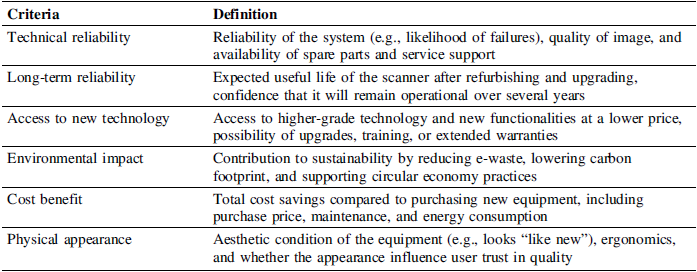
Based on the findings from previous studies on remanufactured products and the specific contextual factors identified through consultation with hospital stakeholders, the seven criteria presented in Table 1 are selected as the most relevant for imaging medical devices. Together, they ensure that the ranking exercise reflects a balanced combination of theoretical background and field applicability.
Definition of criteria for acquiring refurbished medical devices

2.2. Prioritizing criteria through a perception survey
Building on previously defined acquisition criteria, this study uses a participatory approach to identify factors and barriers influencing the adoption and use of refurbished imaging systems in hospitals. It examines healthcare professionals’ knowledge, expectations, and concerns, and how these vary across user groups. This step includes (i) identifying relevant stakeholders to be consulted, and (ii) designing a perception survey to gather opinions and experiences on the acquisition and use of a refurbished scanner.
Stakeholders are identified through a site visit that enables observation of imaging workflows and interactions with equipment. Direct users of the medical device are hence identified, including physicians, radiologists, biomedical engineers, and imaging technicians; patients are excluded because the survey is conducted prior to the installation of the refurbished scanner.
The survey design includes a consultation and validation phase involving a radiologist and a biomedical engineer to ensure contextual relevance and appropriate targeting. To assess acquisition priorities, respondents ranked predefined criteria from most to least important. Closed-ended questions, including single- and multiple-choice and Likert-scale, are used to capture levels of knowledge and perceptions. Finally, one open-ended question is included to complement the quantitative data. The questionnaire is structured around respondent profiles, familiarity with imaging equipment, perceptions of acquisition and use, perceived impacts on care quality, and environmental aspects, enabling comparisons of knowledge levels, expectations, and concerns across user groups. The survey was administered online between May and June 2025, with 41 healthcare professionals from CHU Rennes Hospital. Results from the survey and ranking of the criteria are further presented and discussed in Sections 3 and 4.
3. Results
The results of the survey are presented according to the thematic structure described in Section 2.2: respondent profile and interactions with imaging equipment, perceptions on acquisition, use, and care quality, perceptions of environmental impacts, and acceptability criteria.
3.1. Respondent profile and interactions with imaging equipment
Forty-one healthcare professionals participated in the perception survey, including 13 physicians, 12 radiologists, 8 imaging technicians, 5 biomedical engineers, 1 hospital administrator, and 2 additional profiles classified as “others” (i.e., medical biologist and radiation protection adviser).
Overall, most respondents have limited knowledge of refurbished medical imaging equipment: 41% have only heard of it, 39% have a general idea, 15% have no knowledge, and just 5% are well-informed. Experience is similarly low: 61% have never worked with refurbished equipment, 24% are unsure, 15% have had occasional experience, and none have regular use. The survey results reveal differences in stakeholders’ interaction with medical scanners. Radiologists and imaging technicians report daily use, while physicians indicate frequent use (i.e., several times per week). In contrast, biomedical engineers interact only occasionally (i.e., less than once per week), reflecting on a technical or support-oriented role rather than direct operation. Meanwhile, respondents like hospital administrators, medical biologists, and radiation protection advisers have minimal contact with scanners.
3.2. Perception of acquisition, use, and care quality
Respondents express a favorable perception toward purchasing refurbished scanners (Figure 2a). Most participants have positive or neutral attitudes, indicating general willingness to acquire second-hand equipment within their department. Regarding daily clinical practice, the majority believe that it would not alter their routine (Figure 2b). A smaller group expresses uncertainty or anticipates minor changes, mainly related to potential increases in equipment failures and the integration of advanced functionalities that could require adaptation or training.
Perceptions of the impact of second-hand machines on the quality of patient care are predominantly neutral or positive (Figure 2c). While most respondents did not expect any negative effects on care quality, a notable proportion expressed uncertainty, and a small minority expected potential negative impacts (i.e., two imaging technicians). Regarding patient sensitivity (Figure 2d), the majority believe that patients would probably not notice that the scanner is refurbished. However, some anticipate negative reactions, notably imaging technicians, radiologists, and physicians. An equivalent proportion expects positive reactions, mainly among biomedical engineers and administrative staff. A small number of respondents are unsure about patient sensitivity.
Results from the survey (N=41) on the perception of acquisition, use, and care quality

Figure 2 Long description
The image contains four pie charts labeled a, b, c, and d, each representing different survey questions about the perception and impact of using refurbished scanners in a healthcare setting. Panel A: The pie chart shows the perception of acquiring a refurbished scanner within the department. The chart is divided into four segments: 46.3 percent very favorably, 31.7 percent rather favorably, 17.1 percent indifferent, and 4.9 percent rather unfavorably. Panel B: The pie chart illustrates whether using a refurbished scanner could change daily work routines. The segments are 70.7 percent no, not at all, 24.4 percent I don't know, and 4.9 percent yes, slightly. Panel C: The pie chart depicts the perceived impact of using a refurbished scanner on the quality of care provided to patients. The segments are 56.1 percent no, no impact, 26.8 percent I don't know, 12.2 percent yes, positively, and 4.9 percent yes, negatively. Panel D: The pie chart shows whether patients would be sensitive to the fact that the scanner used is refurbished. The segments are 61 percent no, they won't notice, 17.1 percent yes, in a positive way, 17.1 percent yes, negatively, and 4.9 percent I don't know.
3.3. Perception of environmental impacts
Environmental considerations emerged as a key dimension in users’ perceptions of refurbished medical devices. As illustrated in Figure 3a, most participants consider purchasing second-hand machines to have a positive environmental effect, while a smaller proportion express uncertainty about these benefits. Only a small number of respondents perceive a limited benefit. Regarding institutional practices, the idea that hospitals should favor the acquisition of refurbished equipment for environmental reasons was questioned (Figure 3b). While most respondents’ express agreement, either unconditionally or on the condition that the quality of patient care is not compromised, a minority preferred new equipment.
Perceptions of transparency and communication also offer valuable insights for sustainable design strategies (Figure 3c). While many respondents believed that revealing the refurbished origin of scanners could raise awareness among both staff and patients about environmental responsibility, others feared that such communication could provoke concerns about reliability, and some reported indifference.
Results from the survey (N=41) on the perception of environmental impacts

3.4. Acceptability through acquisition criteria
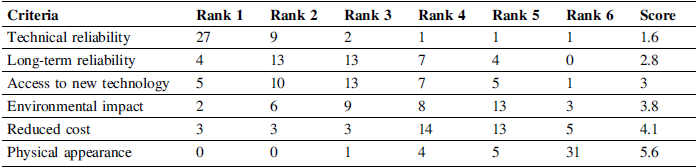
For the ranking of acquisition criteria, respondents assigned a position from 1 (most important) to 6 (least important) to each criterion. Rankings were converted into weighted mean scores using Equation (1), where lower values indicate higher priority. In this formulation,
 $${v_n}$$
represents the number of votes a criterion received at rank
$${v_n}$$
represents the number of votes a criterion received at rank
 $$n$$
, and
$$n$$
, and
 $$N$$
denotes the total number of participants. The results by criterion and their corresponding calculated score are presented in Table 2.
$$N$$
denotes the total number of participants. The results by criterion and their corresponding calculated score are presented in Table 2.

Results from the ranking acquisition criteria and their calculated score for each criterion

Additionally, Figure 4 illustrates the overall prioritization of acquisition criteria by healthcare professionals. For each criterion, the position attributed by respondents is shown (i.e., choice 1 to 6). Results underscore that respondents mainly prioritize technical performance, followed by long-term reliability and access to new technologies. In contrast, environmental impact and reduced costs for the hospital are perceived as secondary criteria, while physical appearance is constantly ranked as least important. This distribution demonstrates that users’ acceptance of second-hand equipment is primarily conditioned by its technical reliability and capacity to ensure diagnostic quality.
Ranking of acquisition criteria (choice 1 to choice 6) of second-hand medical equipment by healthcare professionals (N=41)

When disaggregated by stakeholder profile (Figure 5), similar overall patterns were observed, with technical reliability as the universal top priority, especially among imaging technicians, who unanimously selected it as their first choice (Figure 5d). However, differences appear in the second tier of priorities. Physicians and biomedical engineers (Figures 5a, b) place greater emphasis on long-term reliability, whereas radiologists and imaging technicians (Figures 5c, d) assigned relatively higher importance to access to new technology.
Mid-level priorities also vary across groups. Physicians and radiologists consistently rank reduced cost above environmental impact, indicating that financial considerations remain more influential than ecological ones for these clinically oriented users. Biomedical engineers show opposite patterns, ranking environmental impact ahead of cost. Among imaging technicians, reduced costs are the least important criteria, a result that aligns with their limited involvement in budgetary decisions. Only in this group, physical appearance moves slightly upward from the absolute last position observed in all other profiles.
Ranking (choice 1 to choice 6) of acquisition criteria of second-hand medical equipment per user profile, i.e., physicians (a), biomedical engineers (b), radiologists (c), and imaging technicians (d), with a total number of respondents N=41

4. Discussion
In this section, results of the present study are discussed in view of the existing literature on the adoption and use of refurbished equipment. Building on these findings, recommendations are made to enable user-centered insights into the design of more sustainable medical imaging devices.
4.1. User perspectives on the adoption of refurbished devices
Results highlight limited familiarity and a lack of practical experience with refurbished equipment across respondent groups. This may act as a barrier to adoption by increasing perceived risks and uncertainty, even when technical performance is expected to be comparable to that of new systems. Health technology adoption research underlines prior experience, technological confidence, and perceived ease of use, as key determinants of acceptance, with limited familiarity contributing to resistance to adoption (Reference Capacho-Alfonso, Soto-Durán and Jimenez-BuilesCapacho-Alfonso et al., 2025). Beyond direct experience, as Reference Hoveling, Svindland Nijdam, Monincx, Faludi and BakkerHoveling et al. (2024) point out, confusion surrounding the meaning of circular economy terms such as “refurbished” or “remanufactured” can also hinder acceptance. In addition, a small group of participants expected minor changes in their daily work because of potential increases in system failures and the integration of advanced functionalities, which may require adjustments in clinical practice (Figure 2b). Hence, targeted training and support can foster acceptance and sustained use, especially among daily users such as radiologists and imaging technicians, which strongly influences the effective integration of second-hand equipment into routine practice.
Although most respondents did not anticipate a negative impact of refurbished equipment on the quality of patient care, a substantial proportion expressed uncertainty regarding potential implications for clinical outcomes (Figure 2c). These findings are consistent with those of Reference Hoveling, Svindland Nijdam, Monincx, Faludi and BakkerHoveling et al. (2024), showing that safety and clinical outcomes may conflict with the circularity of medical devices. Such uncertainty reflects an underlying tension between the general acceptance of refurbished machines and professional responsibility for diagnostic accuracy and patient safety. Healthcare settings are naturally risk-averse, and even a little uncertainty about clinical performance can slow adoption and lead people to prefer established solutions (Reference Warty, Smith, Salih, Fox, Mcarthur and MolWarty et al., 2021). Therefore, uncertainty itself can be a barrier to adoption, even in the absence of explicit concerns about poor-quality care.
While most participants believed that patients would not notice the origin of the scanner (Figure 2d), some clinical profiles (e.g., imaging technicians, radiologists, and physicians) anticipated negative reactions, associating patient mistrust with perceived risks to diagnostic quality. In contrast, administrative profiles perceive communication of second-hand machines as an opportunity to highlight environmental awareness and institutional commitment to sustainability. Environmental considerations were indeed widely recognized as a positive aspect of refurbishment strategies (Figure 3a), reflecting growing environmental consciousness among healthcare professionals. However, support for environmentally motivated procurement remained conditional (Figure 3b), as respondents consistently emphasized that sustainability benefits should not compromise technical reliability or quality of care. These findings suggest that sustainability acts as an enabling rather than decisive factor in acceptance, underlying a key challenge for sustainable design and implementation: how to communicate circular practices in ways that enhance trust rather than mistrust in clinical performance.
Results on the acquisition criteria emphasize technical reliability as an essential requirement across all groups. Concerns related to diagnostic stability, system longevity, and lifecycle management are observed across physicians’ and biomedical engineers’ perspectives, with both groups placing greater importance on long-term reliability (Figure 5a, b). Similarly, Reference Evangelista, Leone, Scaletti and BernhardEvangelista et al. (2025) found that clinicians and engineers have positive attitudes toward sustainable innovation, but condition their willingness to adopt on the availability of solid evidence of its performance over time. Conversely, daily users, like radiologists and imaging technicians, rank access to new technologies as the second criterion, reflecting their interest in imaging capabilities, innovation, and workflow performance (Figure 5c, d). Environmental impact was generally ranked higher by radiologists and biomedical engineers than by physicians and imaging technicians, suggesting that professionals more involved in justifying equipment purchases and managing systems may be more sensitive to the broader sustainability implications.
These differentiated priorities underscore the importance of recognizing stakeholder diversity when designing and implementing refurbishment strategies. Such findings are consistent with those from Reference Akano, Ijomah and WindmillAkano et al. (2021), who identified quality and reliability as the most influential criteria on the acceptance of remanufactured medical devices. Also, the study of Reference Kaill and BibbKaill & Bibb (2025), attributed greater importance to price, warranty, brand reputation, and logistics as potential barriers to CE. However, the present study emphasizes access to new technologies, in line with the clinical interests of direct users, unlike previous expert-oriented studies. All three analyses ranked environmental impact relatively low, suggesting that, although sustainability is recognized, it is not yet a decisive criterion in acquisition decisions. This result may be influenced by limited information (seen in Section 3.1) or insufficient research on the tangible environmental benefits of CE strategies. Moreover, although available information (e.g., from previous use) was not included as a criterion for acquisition, as in previous studies, it is relevant when considering the acceptability of second-hand equipment, since transparency of prior use may affect users’ trust and perceived risk.
4.2. User-centered insights for sustainable design
The findings offer several insights to guide sustainable, user-centered design strategies for refurbished medical imaging equipment. Technical reliability emerged as the dominant criterion across all user groups, confirming the need for design services approaches that ensure diagnostic performance, stable operation, transparent performance guarantees, and reliable maintenance pathways throughout the system’s second life. Long-term reliability was also essential, especially in the French context, where reimbursement mechanisms incentivize scanner replacement after seven years of use. This makes durability beyond that threshold a critical design challenge, suggesting the need for extended warranties, modular upgrade options, and service plans to ensure sustained performance for users. Access to new technology is found to be a strong driver of acceptance among radiologists and imaging technicians, indicating that circular solutions must not only reduce environmental and economic costs but also deliver technological value.
Although environmental impact and economic benefits were secondary considerations, their relevance is acknowledged. Users support circular practices when patient care quality is maintained, which calls for transparent communication and reliability indicators to ensure sustainability does not compromise performance. Physical appearance, consistently ranked last, suggests that aesthetic refurbishment has minimal influence on acceptance. Design efforts should therefore prioritize functional reliability and user support over physical improvements, redirecting resources toward features that enhance trust and usability. The survey highlighted a lack of familiarity and workflow adjustments required by advanced functionalities as potential barriers to adoption. To mitigate these concerns, sustainable design strategies should incorporate training on refurbished systems and a support program when new technologies are added, ensuring user adaptation into clinical routines. Including this criterion in procurement and design frameworks would strengthen user confidence and operational continuity. Taken together, these ideas highlight that sustainable design of second-life medical devices must balance technical reliability, durability, and user experience, incorporating transparent communication, training, and stakeholder involvement. These elements collectively foster social acceptability and ensure that circular solutions align with clinical priorities.
5. Conclusion and perspectives
This study identifies and examines influencing criteria for adopting and using refurbished medical imaging equipment. It explores healthcare professionals’ perceptions through a participatory approach, addressing a key gap in research on CE strategies for complex medical devices.
While existing literature has largely focused on expert or industry viewpoints, our survey-based approach highlights how direct users in clinical settings, such as physicians, radiologists, imaging technicians, and biomedical engineers, perceive second-hand imaging equipment in terms of performance, reliability, and sustainability. The findings indicate that, although healthcare professionals generally express favorable attitudes toward refurbished imaging systems, adoption remains strongly conditioned by technical, operational, and organizational considerations rather than environmental or economic motivations alone. Technical reliability, long-term performance, and access to advanced functionalities dominate decision-making, whereas environmental and cost benefits are secondary. At the same time limited familiarity and the absence of structured training emerge as important barriers to integration, pointing to the need to incorporate technical knowledge transfer and skills development into design and procurement strategies.
From a design perspective, sustainable adoption of refurbished medical devices requires participatory approaches that address stakeholder priorities while emphasizing reliability, modular upgrades, and structured user training. Transparent communication about refurbishment processes and environmental benefits is essential to build trust and dispel concerns about performance. At the same time, hospitals must manage trade-offs between ecological and financial gains and the social imperative of ensuring clinical quality and long-term reliability. Understanding and integrating these dimensions into design and procurement strategies is key to maximizing the benefits of circular solutions without compromising patient care or operational continuity. Future work should expand the analysis to include patients, maintenance engineers, and designers, enabling a more comprehensive assessment of potential barriers to the adoption of refurbished medical imaging equipment throughout its life cycle.





 Open access

