

Recent research has emphasized the role of political parties in implementing gender quota laws. Working within the theoretical framework of feminist institutionalism, which examines the gendered dimensions of institutional design and practices, scholars have examined how quotas – as new formal rules – interact with informal practices to shape the recruitment, nomination and election of female candidates (Kenny and Verge Reference Kenny and Verge2013; Krook Reference Krook2009; Verge and de la Fuente Reference Verge and de la Fuente2014). Scholars have demonstrated that informal practices undercut on-paper mandates: quota laws require that political parties nominate women, but party elites – who are usually men – preserve their dominance by exploiting loopholes (Baldez Reference Baldez2007; Hinojosa Reference Hinojosa2012; Murray Reference Murray2010), running women in losing districts (Langston and Aparicio Reference Langston and Aparicio2011), allocating few campaign resources (Sacchet Reference Sacchet2008) and maintaining control of leadership positions within the party and the legislature (Franceschet and Piscopo Reference Franceschet and Piscopo2014; Roza Reference Roza2010; Schwindt-Bayer Reference Schwindt-Bayer2010). Consequently, research on quota laws’ implementation at the party level has shaped theories about informality as disadvantageous for women, who remain excluded from the informal networks that determine when and how members advance within the party (Bjarnegård and Kenny Reference Bjarnegård and Kenny2016, in this issue).
This article explores this proposition in the Mexican case, finding support for the notion that informality harms women, but also finding that male party leaders do not have a monopoly on informality. In Mexico, female party members developed informal networks and informal practices of their own, collaborating across parties and with state regulators to end their exclusion from the choicest candidacies. Though scholars have recognized that women lobbied for quota laws in Mexico and elsewhere in Latin America (Crocker Reference Crocker2011; Krook Reference Krook2009), few have studied the formation, strategies and actions of these networks in depth or over time. Most case studies from the region have focused on the laws’ initial adoption (Baldez Reference Baldez2004), though tracing sequential quota reforms can reveal important shifts in the configuration of key actors and institutions (Krook Reference Krook2009: 222–4). The Mexican case illustrates these shifts: female party members in the quota’s first generation expanded their network to include state regulators in the second generation. In this latter phase, female party members and state regulators cooperated to write formal rules that foreclosed upon party leaders’ informal practices of denying women viable candidate nominations. This collaboration occurred as actors’ incentives aligned: party women have a shared interest in advancing their political careers, and electoral regulators can reinforce their image as democratizers, independent guardians of transparent and fair elections.
This case study thus contributes to scholars’ ongoing efforts to theorize the ‘secret garden’ of candidate selection, which thus far has emphasized men’s long-standing dominance of political parties and their resultant ability to control the rules of the game (Lovenduski Reference Lovenduski2005). The Mexican case affirms this insight, but also illuminates how women leverage informality to challenge these rules and change the game. To illustrate, I process-trace Mexico’s sequential quota reforms by drawing on 38 interviews with female politicians, civil society activists and state regulators conducted between 2009 and 2015, in combination with primary source documents such as court decisions, locally published activists’ narratives and media reports.Footnote 1 Process-tracing allows researchers to determine causality by focusing on the decisions of individuals and the importance of events (Collier Reference Collier2011; Tansey Reference Tansey2007). Elite interviews constitute an important tool within process-tracing, especially when studying informality: while formal documents – that is, party statutes or electoral laws – stipulate what should happen, insider narratives reveal what does happen, yielding information about the otherwise hidden aspects of actors’ behaviour (Bjarnegård and Kenny Reference Bjarnegård and Kenny2016, in this issue; Kenny Reference Kenny2014). Consequently, I am able to document shifts over time in the institutions, actors, formal rules and informal practices that shaped quota adoption and implementation. As quotas’ formal rules evolved, party elites drew more heavily on informal practices in candidate selection (Bjarnegård and Kenny Reference Bjarnegård and Kenny2016, in this issue), but female party members designed their own informal practices in response.
The article proceeds as follows. Firstly, I discuss how political parties’ resistance to quota laws has contributed to theories about informality in candidate selection, namely the insight that male-dominant recruitment networks significantly disadvantage women. Secondly, I show how Mexico’s political institutions structure career ambitions and create incentives for female politicians to form counter-networks – ‘quota networks’ – that guarantee their electoral opportunities. I then briefly review the first generation of Mexico’s quota law, from 1996 to 2007, positioning these reforms within the context of Mexico’s democratic opening. Most centrally, I provide an in-depth analysis of the second-generation quota, beginning with the 2008 reform and concluding with the 2013 adoption of parity (an analysis that also significantly updates the story of quotas in Mexico). I explain how female politicians’ informal network, and its collaborative practices both across parties and with state regulators, proved instrumental in eliminating parties’ placement of women in non-viable candidacies. Throughout, this story reveals how actors’ informal strategies can leverage changes to formal rules that enhance, rather than undermine, women’s chances to become candidates and to win elections.
FORMALITY AND INFORMALITY: POLITICAL PARTIES AND GENDER QUOTAS IN LATIN AMERICA
As of January 2015, all but two Latin American countries (Venezuela and Guatemala) had adopted gender quota laws, mandating that political parties nominate specified percentages of women to the national legislature. Studies have linked electoral laws to electoral outcomes, concluding that effectively designed quotas – those with placement mandates for candidate lists and enforcement mechanisms – remain the best method for raising women’s numerical representation in the legislature (Jones Reference Jones2009; Schwindt-Bayer Reference Schwindt-Bayer2009). Fewer analyses have examined the meso-level interaction between quotas’ formal mandates and political parties’ candidate selection procedures, though scholars typically concur that parties’ unstated preference for male candidates undermines quotas’ effectiveness, both in Latin America (Baldez Reference Baldez2004; Hinojosa Reference Hinojosa2012; Johnson Reference Johnson2016, in this issue) and in Western Europe (Murray Reference Murray2010; Verge and de la Fuente Reference Verge and de la Fuente2014; Verge and Espírito-Santo Reference Verge and Espírito-Santo2016, in this issue).Footnote 2
Scholars thus have emphasized the distinction between formal rules, meaning the procedures for candidate selection established in electoral codes and party statutes, and informal practices, meaning the procedures actually used to nominate contenders. Party leaders’ reliance on informal practices especially increases when outside forces – such as the implementation of quotas – threatens the status quo of male dominance (Bjarnegård and Kenny Reference Bjarnegård and Kenny2016, in this issue). Importantly, informal means unwritten, but unwritten does not mean invisible. The two informal practices most highlighted by scholars – the use of candidate selection networks closed to women and their resultant concentration of women in unwinnable candidacies – are widely recognized by political actors, and have substantive and noticeable effects on the distribution of power within the party. Further, informal emphasizes underlying procedures or decisions, which can have formal results: for instance, unwritten procedures may guide candidate selection, but these candidates become ‘official’ once registered with the electoral regulatory body.
Underlying the formal outcomes of candidate selection, then, are informal networks clearly dominated by men. This dominance results in the association of leadership with masculine traits (such as competitiveness and aggression); consequently, being male becomes a qualification in and of itself, one that leads ‘more reliably to power and rewards’ (Lovenduski Reference Lovenduski1998: 347). For example, even under quota regimes, women remain excluded from the positions that would allow them to accumulate status and resources, such as executive posts that control clientelism in Argentina (Franceschet and Piscopo Reference Franceschet and Piscopo2014) or incumbencies that attract private campaign donations in Brazil (Sacchet Reference Sacchet2008). In Mexico, female aspirants face poor prospects in internal party primaries because male aspirants are better connected, more affluent and thus more likely to triumph (Baldez Reference Baldez2004: 239). As more Mexican parties adopted primaries during the 2000s – for reasons discussed below – women became more disadvantaged.
Hinojosa’s comparison of Mexico and Chile finds that male-dominated recruitment networks can advantage women, but only in limited circumstances. Women may benefit from direct nominations, because gender norms discourage women from self-promoting; however, women only receive nominations if male party leaders adopt less parochial, more democratic attitudes (Hinojosa Reference Hinojosa2012: 54, 116). Women thus remain dependent on male party leaders. Interviewees in Mexico concurred, with two women from different parties using the exact same expression: ‘The politics of groups [local networks] is exclusively dominated by men’. One added, ‘Yes, I had the skills and the qualifications, but the men still had to choose me’.Footnote 3
Further, when party leaders do choose women, they concentrate their candidacies in the least viable races. In Mexico, parties will not send female candidates to safe or competitive single-member districts (SMDs): they either run women in the losing districts (Langston and Aparicio Reference Langston and Aparicio2011) or, as one interviewee explained, place them on the proportional representation (PR) lists.Footnote 4 With the viable single-member districts closed to them, female aspirants compete amongst each other for the higher-ranked places on the proportional representation lists.Footnote 5 Party leaders may also run token women, nominating female relatives or other confidantes, in the hopes that these quiescent women will not challenge the status quo (Franceschet and Piscopo Reference Franceschet and Piscopo2008; Sagot Reference Sagot2010).Footnote 6 Throughout Latin America, women have been pressured or compelled to resign their seats in favour of their male alternates (Hinojosa Reference Hinojosa2012: 141). Parties have even practised outright fraud: in the Dominican Republic, parties altered candidacies after the electoral institute certified the list (Roza Reference Roza2010: 190) and in Bolivia, parties entered male names as female names (Llanos and Sample Reference Llanos and Sample2008: 21). These practices, none formally permitted by party statutes, aim to preserve the status quo of male dominance. As Mexican interviewees explained, ‘Men fight the quota by crying that we will take their place’, and ‘discrimination against women has increased in recent years, because the more women participate in the party, the more men fear them’.Footnote 7
Consequently, female actors across Latin America have pushed for more effective quota laws, ones that would guarantee their access to viable candidacies. Yet studies have infrequently examined how quota reforms came about, instead asking whether the revisions increased women’s numerical representation in the legislature (Crocker Reference Crocker2011; Schwindt-Bayer Reference Schwindt-Bayer2009). Importantly, many of Latin America’s quota reforms were strengthened only after party women appealed to their country’s electoral institutions (Piscopo Reference Piscopo2015), suggesting that the lobbying networks formed to win quotas’ initial adoption persist well into the implementation phase. Like the male-dominated candidate recruitment networks, these female-dominated ‘quota networks’ are neither constituted through nor governed by written rules. However, their existence and their practices are visible, recognized by other actors and capable of attaining concrete outcomes. Quota networks use informality to change the formal rules governing candidate selection.
WOMEN’S SHARED INTEREST IN GENDER QUOTAS
Mexico employs a mixed electoral system. The Chamber of Deputies renews every three years, with 300 deputies selected from single-member districts and 200 deputies selected from five multi-state districts employing closed-list proportional representation. The Senate renews every six years, using closed-list proportional representation, with 32 members chosen from a single nationwide district and 96 members chosen from state-wide districts. Below the federal level, Mexico’s states have bicameral assemblies, and municipalities elect their own councillors.Footnote 8 Prior to the December 2013 constitutional reforms, Mexico prohibited independent candidacies and immediate re-election to the same legislative post.Footnote 9 Though these latter provisions were unique to Mexico, the Mexican system and its effects mirror those found throughout Latin America: closed-list proportional representation predominates and immediate re-election rates are generally low, giving legislators few incentives to seek personal votes and cementing party leaders’ control over legislators’ political careers (Saiegh Reference Saiegh2010: 61–3).
In Mexico, the three major political parties are the left-leaning Partido de la Revolución Democrática (PRD – Party of the Democratic Revolution), the internally heterogeneous but still left-sympathizing Partido Revolucionario Institucional (PRI – Institutional Revolutionary Party) and the right-leaning Partido Acción Nacional (PAN – National Action Party). Parties’ organizations mirror the federal system of government: party leaders form a collegial leadership body, the national executive committee. The national executive committee oversees state-level committees, which in turn oversee municipal committees. Each party leader manages a thematic area akin to a ministerial portfolio (for example, secretary of public relations). Committee posts are full-time remunerated roles and are highly prized: secretaries are key ideological referents, shaping members’ allegiances and managing candidate selection. Exiting legislators will seek committee or executive-branch posts (if their party controls the executive at the federal, state or municipal level), and these posts become available as the previous occupants enter the municipal, state or federal legislature. In Mexico as elsewhere in Latin America, a system of rotation in office exists, wherein ‘the route to power is a series of jumps among different elected, leadership, and government posts’ (Langston Reference Langston2008: 160; also Saiegh Reference Saiegh2010).
Female interviewees confirmed that rotation enhances aspirants’ dependency on party leaders’ largesse. A longtime female PRI member (priísta) explained, ‘To reenter the Congress, it is necessary to complete further service to the party and accumulate merit; it is a question of leaving and remaining an active participant in politics, in order to receive the party’s nomination in the future’.Footnote 10 Though the formal, on-paper candidate selection rules stipulate primaries, interviewees noted that, in practice, primary winners were determined not by members casting votes, but by party leaders evaluating evidence of aspirants’ popularity.Footnote 11 A female ex-legislator from the PRD said, ‘We do not have primaries so much as we have signatures’; her party colleague observed that ‘to arrive at the national assembly is the party leaders’ decision’.Footnote 12 Similarly, many interviewees described their candidacy, however attained, with phrases such as ‘me invitaron’ (they invited me) and ‘me tocaron’ (my turn came). These quotes describe how party leaders stage-manage politicians’ careers, basing their decisions on aspirants’ demonstrated support bases. Occasionally, party leaders recruit well-known outsiders for the Chamber of Deputies’ proportional representation lists, but the overwhelming majority of legislative candidates come from within the party organization.Footnote 13
Although this system may heighten intraparty competition as women (and men) seek to accumulate backing, it also raises the value of formal rules – namely quotas – that reserve certain percentages of electoral opportunities and leadership posts for women. Rotation in office, both in Mexico and elsewhere in Latin America, creates a constant supply of and demand for candidate nominations and party posts. Further, this rotation means that each electoral cycle reveals male dominance anew. Female party members in Mexico consistently describe frustration and stalled progress, noting ‘how women worked for all the political campaigns but never got to be the candidates’ (PRD), ‘each time, we fight and we fight for women to be candidates’ (PAN), and ‘since we aren’t capable of ensuring that a critical number of women arrive [naturally], we need quotas’ (PRI).Footnote 14 Interviewees concurred that women face shared incentives to improve their electoral opportunities as a group. Women from the left and the right noted that women are ‘natural allies’ on political rights.Footnote 15 One PRD senator explained the rationale clearly: ‘Each woman thinks, fundamentally, that if there is more space for women in politics, then there is more space for me’.Footnote 16
THE FIRST GENERATION OF QUOTAS
In Mexico, democratization occurred via the ballot box (Schedler Reference Schedler2005). The longtime hegemonic PRI lost its iron grip on municipalities and states in the 1980s, its super-majority in congress in 1994, its majority in 1997, and the presidency in 2000. The onset of electoral competition raised the value of legislative posts, bringing women’s exclusion from informal recruitment networks into further evidence. A female PAN leader recalled that women ascended the party hierarchies rapidly when the PAN was perennially losing; however, as the party became more successful and more influential, the party became more male-dominated.Footnote 17 As democratization unfolded, women across the political spectrum realized that male leaders would yield few electoral opportunities (Rodríguez Reference Rodríguez2003: 170). Yet democratization also offered rhetorical leverage: even if party leaders’ professed democratic commitments were cynical or insincere, savvy female actors could shame as ‘dinosaurs’ those elites who discriminated against women while ushering in modernity (Baldez Reference Baldez2004).
Further, the transition to multiparty democracy entailed sweeping reforms, with six electoral laws passed between 1987 and 2002 (Schedler Reference Schedler2005). This near-constant electoral engineering created windows of opportunity wherein female actors could fold quotas into broader reform packages, rather than negotiate standalone legislation. The reforms also proved propitious for enforcing all new rules, as parties were gradually transferring control to independent regulators: the 1987 reform created an electoral court to resolve inter- and intraparty disputes, and the 1990 reform created the Instituto Federal Electoral (IFE – Federal Electoral Institute) to manage elections.Footnote 18 Each successive reform ceded more authority to the IFE, and the 1996 reform strengthened the court, known since then as the Tribunal Electoral del Poder Judicial de la Federación (TEPJF – Electoral Tribunal of the Federal Judicial Branch). The creation of independent electoral institutions to guarantee and legitimize democratic transitions was commonplace throughout Latin America, but Mexico particularly invested in making the IFE and the TEPJF autonomous and credible. By the late 1990s and early 2000s, the agencies reliably enforced regulations governing party behaviour, party finance and candidate selection (Eisenstadt Reference Eisenstadt2003; Estévez et al. Reference Estévez, Magar and Rosas2008; Reyes Reference Reyes2012).
Initial Pressure for Quotas
Women came together early in the democratization process to demand quotas. Bruhn (Reference Bruhn2003: 112) explains, ‘Women party activists from all of the major parties as well as non-party feminists had been meeting regularly during the 1991–1997 period to exchange strategies and opinions about a variety of topics, including how to advance women candidates’. Female party members and female legislators from different parties realized that they ‘coincided’ in wanting more women in decision-making posts.Footnote 19 They formed cross-party working groups, as in the 1992 PRI–PRD campaign for political equity entitled ‘From A to Z’, and organized multiparty conventions, such as the 1996 National Assembly for Women for the Democratic Transition (Tarrés Reference Tarrés2006). Women wanted their party’s national conventions to adopt party-level quotas for candidacies and committee posts, but they also sought other affirmative action measures (Bruhn Reference Bruhn2003; Ortiz Ortega and Scherer Castillo Reference Ortiz Ortega and Scherer Castillo2014: 69–84). For example, in the 1980s, PRI women extracted party leaders’ agreement to use all-women shortlists for selecting committee members and alternate candidates.Footnote 20 The PRD adopted – but failed to implement – quotas for candidacies in 1991 and 1993 (Bruhn Reference Bruhn2003: 109–11). National executive committee members in the PAN and the PRD created programmes to identify and train female operatives at the grassroots level.Footnote 21 As the debates unfolded within the parties, female actors were clear protagonists: a female PRI leader recalled countering her male colleagues’ protests of ‘we cannot have so many women in important positions’ with the retort ‘but then why have so many men in important positions?’.Footnote 22
In 1993, as the Mexican congress negotiated the third electoral reform since 1987, female party leaders from the PRD and the PRI – now serving as legislators – introduced quotas to the chamber debate. It was here that the women finally united in a cross-party network. As then-legislator María Elena Chapa recalled: ‘We realized we would not advance unless we were together . . . we understood that there was a common cause above party ideology . . . My first lesson in the Chamber of Deputies was working across parties’ (Ortiz Ortega and Scherer Castillo Reference Ortiz Ortega and Scherer Castillo2014: 78). Though PAN women chose not to support quotas publicly, they supported the PRD–PRI coalition ‘as best they could’ – by not blocking the measure (Ortiz Ortega and Scherer Castillo Reference Ortiz Ortega and Scherer Castillo2014: 9). This early alliance did not succeed during the 1993 reforms, but in the 1996 reforms, the women successfully introduced a recommendation that parties nominate 30 per cent women.
Yet this change did not translate into large gains for women in either the 1997 or the 2000 congressional elections, as shown in Table 1. Women actually lost seats in 2000, despite the fact that the IFE – exercising its independent regulatory role – enforced the 30 per cent recommendation for these elections. Since the IFE did not specify how parties should select or allocate candidacies for women, party leaders took advantage of the gap in the formal rules: women found themselves clustered at the bottom of the proportional representation lists, nominated as alternates rather than primary candidates and shuffled to unwinnable single-member districts. Nonetheless, party women had learned that they could work together effectively, and that they could rely on federal regulators to exhort compliance with the electoral code.
Women in the Mexican Congress

Note: The Mexican Senate began renewing every six years in 2000.
Source: Medina Espino (Reference Medina Espino2010); CEAMEG (2012).
From Recommendations to Mandates
The women elected in 1997 and 2000 made a stronger, mandatory quota law a priority. In a 1997 conference, female legislators from all parties articulated a shared legislative agenda that included women’s political equality (Tarrés Reference Tarrés2006); in order to advance their goals, they demanded – and won – the creation of a bicameral Gender and Equity Committee (CEG). Before the 2000 congress was seated, female legislators-elect from the PRI and PRD signed a pact to demand mandatory quotas as part of the session’s anticipated electoral reforms.Footnote 23 Though panista women did not sign, they supported these goals once in congress: in the plenary, a female PAN leader said the party would ‘endorse all efforts made by women to work in favour of their greater development and equal integration into national life’.Footnote 24Panista women joined their PRD and PRI colleagues as they realized that mandatory quotas represented the only way to guarantee their election within an ‘increasingly machista [sexist] party’.Footnote 25 The CEG, which comprised women of all parties, decided that success depended on presenting a unified front: though the formal rules allowed the committee to advance legislation with a majority vote, the members decided only to endorse measures that enjoyed unanimous support.Footnote 26 This strategy included the bill that would elevate the 30 per cent quota recommendation to law.Footnote 27
To win the quota, female legislators – including women from the PAN – met with feminist civil society groups ‘for a series of talks to think together how to proceed . . . how to have an interparty negotiation’.Footnote 28 The collaborators developed informal, but clear strategies to demand quotas without jeopardizing their rotation in office. First, female legislators compiled lists identifying men within their parties who opposed quotas. Then, they paired each opponent with a specific proponent: each woman would meet individually with a man outside her party, but with whom she shared some affinity, such as membership in a legislative commission or agreement in another policy area.Footnote 29 A then PRD deputy explained, ‘We wanted men to never get angry with women from their own party . . . and men listen more carefully to women from other parties’.Footnote 30
Other developments made the proponents’ case more persuasive. The PAN, in government at the time, was the most divided over quotas.Footnote 31 Yet when the Mexican Supreme Court rejected the party’s contestation that a state-level quota law was unconstitutional, the embarrassed PAN reversed its opposition (Baldez Reference Baldez2004). In the PRD and the PRI, meanwhile, male party leaders faced demands for 50 per cent quotas for national executive committee posts and candidate nominations – a manoeuvre from PRI and PRD women that made the quota law, with its lower threshold, seem more appealing.
Party women thus successfully leveraged external events, party-level debates and the broader democratic opening to compel – and even shame – male party leaders into recognizing the political discrimination that women faced (Baldez Reference Baldez2004; Ortiz Ortega and Scherer Castillo Reference Ortiz Ortega and Scherer Castillo2014: 93). Thus, Mexico’s 2002 electoral reform elevated the 30 per cent quota from recommendation to mandate, with specific provisions designed to minimize evasions: the quota applied to all lower house and senate candidacies, mandated the rank-ordering of women’s names in every three slots on the proportional representation lists and prohibited parties from counting alternate candidates as part of the quota. The first-generation quota law resulted from clear, regularized and sustained practices devised by female leaders in the parties and in the legislature. Although never formally constituted as a caucus, party women set ground rules for deliberation and decision-making and devised strategies for policy advocacy. Women used their own informal networks to confront male dominance within their parties.
ADVANCES AND SETBACKS IN THE SECOND GENERATION
Under the 30 per cent quota law, women’s representation climbed to over 20 per cent in the Chamber of Deputies, but remained below 20 per cent in the Senate, as shown in Table 1. The shortfall occurred as parties remained reluctant to send female candidates to safe or competitive single-member districts, and complied minimally with the quotas’ placement mandate for proportional representation lists. The placement of women in the lowest possible list positions proved especially problematic in the upper chamber. The 96 senate seats elected via proportional representation at the state level use a majority-minority formula: parties run two-person lists, and the winning party elects both senators while the runner-up elects the first one. Typically ranked second, women only entered the Senate if their party won the state.
The shortfall also occurred because the 2002 quota law contained a significant loophole: Article 175-C of the revised electoral code specifically exempted parties from meeting the quota in the single-member districts if they chose single-member district candidates via ‘direct vote’. This provision encouraged parties to rapidly adopt primaries (Baldez Reference Baldez2007: 81). Further, the IFE’s formal rules – the regulatory decree that governs each electoral cycle – did not go beyond the electoral code as written, meaning that the IFE never specified what practices constituted a primary. When certifying candidate lists, the IFE regulators simply accepted parties’ claims that primaries occurred, resulting in broad quota exemptions throughout the 2000s. IFE officials defended this practice, explaining, ‘We had no way of verifying what parties did internally’ and ‘we respected parties’ internal autonomy’.Footnote 32 The IFE thus gave parties carte blanche in candidate selection. In Mexico as elsewhere, this ‘textual’ manner of applying the law created significant gaps between what parties were technically required to do, and what they actually could do.
The CEG in the 2006–9 congress thus sought more reforms. Female actors redeployed their three-pronged approach of: (1) signing pacts that presented shared demands (Tarrés Reference Tarrés2006); (2) demanding party quotas at higher thresholds than the statutory quota; and (3) strategically sending individual women to apply pressure on party and congressional leaders (Ortiz Ortega and Scherer Castillo Reference Ortiz Ortega and Scherer Castillo2014: 94–8). The women first ensured their united front. Though they all agreed on striking the primary exemption, they could not agree on how high to raise the quota’s threshold. PRI and PRD women preferred parity, but PAN women disagreed; the final bill compromised on ‘a 40 per cent quota with the goal of reaching parity’.Footnote 33 The bill also applied the 40 per cent quota to party leadership posts at the federal, state and municipal level, and reserved 2 per cent of parties’ annual budgets for female leadership training. This latter measure deliberately courted PAN legislators, who feared that quotas undermined meritocratic candidate selection.Footnote 34 Yet the ‘quota network’ could not persuade party leaders to accept the portion of the bill that would eliminate Article 175-C. The women ultimately conceded the primary exemption in order to win their other demands. However, they did negotiate their male colleagues into a small change in language: the exemption would apply in cases of nomination via a ‘democratic process’ rather than a ‘direct vote’. In theory, a ‘democratic process’ would require that parties manifest some transparency in candidate selection (Ortiz Ortega and Scherer Castillo Reference Ortiz Ortega and Scherer Castillo2014: 96–7).
These negotiations unfolded in congress as the TEPJF issued a series of rulings that protected women’s political rights. Democratic consolidation had reduced the chances that future reforms would eliminate the tribunal: thus, over the late 1990s and early 2000s, increasingly confident electoral judges transformed the institution into ‘a maximum regulator of the internal life of the political parties’ (Reyes Reference Reyes2012: 133). The TEPJF would act where the IFE baulked: between 2005 and 2007, the TEPJF ruled that parties must fill the quota punctually; that parties must rapidly correct errors detected by the IFE; and, most importantly, that reordering candidate lists to fill the quota did not violate democratic principles.Footnote 35 With these judicial decisions as a backdrop, the 40 per cent quota for candidacies and party posts, and the 2 per cent financing rule, passed as part of the 2008 electoral reforms.
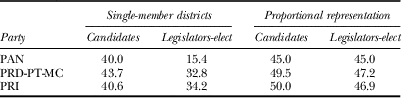
This victory occurred partly because neither the 40 per cent quota nor the 2 per cent budgeting provision challenged parties’ informal means of preserving the best candidacies for men. First, even though Article 175-C (now Article 219) changed from ‘direct vote’ to ‘democratic process’, parties simply claimed that primaries were democratic. Second, parties could still send female candidates to losing single-member districts. In the 2009 elections, the IFE’s written rules again applied the law ‘in a textual manner’: that is, the institute interpreted ‘democratic process’ to mean primaries, and again accepted parties’ word that primaries occurred.Footnote 36 Consequently, as shown in Table 2, the country’s three major political parties, particularly the PRD, frequently over-complied with the quota on proportional representation lists. Yet no party nominated 40 per cent women to the single-member districts, and women lost these races at lower rates than they lost proportional representation races. In the PAN, for instance, women made up 36 per cent of single-member district candidates but only 22.9 per cent of single-member district victors. Overall, women’s numerical representation in the Chamber of Deputies increased to only 27.6 per cent in 2009 (see Table 1), despite the higher quota threshold.
Proportion of Female Candidates and Legislators-Elect in Mexico’s Lower House, 2009 (%)

Source: Aparicio (Reference Aparicio2011).
Thus, as the formal rules tightened, parties relied on unwritten practices that preserved the choicest candidacies for men. The 2009 scandal of the Juanitas especially showed the power male-dominated recruitment networks held over party women: in addition to allocating women the least viable candidacies, parties paired male alternates with female candidates, and the women then resigned immediately after the election. This practice was not new, and such defectors (usually low-ranked party women or female relatives) had long been known as ‘Juanitas’.Footnote 37 However, that 16 women from multiple parties yielded their seats to male alternates following a high-profile quota reform sparked widespread outrage. A PAN senator lambasted the ‘fraudulent violation of the quota’; a PRD leader called the situation ‘embarrassing’ and a ‘step backwards’.Footnote 38 Media commentators described the Juanitas as ‘fraud’, ‘cheating’ and an ‘undignified trick’ (Camil Reference Camil2009; Torres Reference Torres2009).
The quota network mobilized informally, contacting the Juanitas to inform them that the parties could not legally force their resignation. As the new congress convened and several cases remained in dispute, female legislators placed placards that read ‘this seat reserved for a woman’ on chairs in the plenary. Yet the support from female legislators of all parties could not persuade most Juanitas to alienate their party’s male power-brokers. All save one ultimately resigned as promised, and the remaining Juanita found herself powerless: ‘They [the party] isolated her and shut all future doors for her’.Footnote 39 As a female priísta explained, the Juanitas show how women’s political careers depend on concessions from men (Sauri Riancho Reference Sauri Riancho2010). Male dominance persists even as the formal rules allocate more candidacies to women.
CROSS-PARTY COLLABORATION AND STATE REGULATORS
The Juanitas scandal drew the public’s attention to the unwritten – and highly sexist – practices of candidate selection used by Mexico’s political parties. Immediately, prominent female party leaders, female legislators and feminist activists came together to ‘talk about what to do’ (Ortiz Ortega and Scherer Castillo Reference Ortiz Ortega and Scherer Castillo2014: 105). Previously, party women and female legislators had led the ‘quota network’, but the Juanitas scandal drew other prominent, politically active women – private consultants, academics and journalists – into the discussion.Footnote 40 Network participants named themselves ‘Mujeres en Plural’ (Women as Multiple) to communicate their unity across party lines. As feminist academic Margarita Dalton explained, Mujeres en Plural ‘joined and harmonized women of different ideologies on a common basis, their political participation’ (Ortiz Ortega and Scherer Castillo Reference Ortiz Ortega and Scherer Castillo2014: 106).
Yet Mujeres en Plural now faced the limits of quota reform via congress. Female legislators, again working within the CEG, pushed a measure mandating same-sex pairings of primary and alternate candidates through the lower house in April 2011, but it died in the senate. Party leaders would change candidate selection no further: leaders lacked the ‘political will’ to make further changes, and so ‘looking for legal solutions was no longer possible’.Footnote 41 Moreover, any legislative reform – even if successful – would not affect the now-rapidly-approaching 2012 elections.Footnote 42 Mujeres en Plural needed a new approach, one that would bypass congress.
Transforming Political Practices
Mujeres en Plural set the immediate goals of eliminating loopholes (the primary exemption and the mixed-sex candidate pairings), and the long-term goals of achieving parity and ending gender discrimination in the political parties.Footnote 43 The network sought to transform the rules of the candidate selection game completely, deciding to appeal to the constitution rather than the electoral code (Ortiz Ortega and Scherer Castillo Reference Ortiz Ortega and Scherer Castillo2014: 108). In 2011, revisions to Article 1 of the Mexican Constitution had elevated all international treaties ratified by the Mexican government to the status of constitutional law – including the 1979 Convention on the Elimination of all Forms of Discrimination against Women, which delineated women’s right to participate in politics on equal terms with men. Mujeres en Plural decided to leverage this constitutional change to demand that the IFE’s rule-writing process eliminate the quota exemptions, and to publicly monitor and shame those parties that neglected their constitutional obligations to protect women’s political rights.Footnote 44
The network built on its earlier, informal understandings to establish unwritten guidelines for decision-making and lobbying: they would work collectively, and they would exercise discretion. They met in private, in members’ homes, and made decisions only when a critical mass of members attended.Footnote 45Panista Pilar Ortega explained, ‘We began talking to women in all the parties, one by one, in small groups, because if we explained this [these rules] to everyone, we would get enough participants’ (Ortiz Ortega and Scherer Castillo Reference Ortiz Ortega and Scherer Castillo2014: 107). These operating procedures presented women as a unified front, which prevented party leaders from exacting retribution on a particular woman. As such, all press releases and other statements were redacted and signed by the network, and individual women did not identify themselves as network members in the press or in public. Women only became associated with Mujeres en Plural by attending meetings with IFE officials, but even then informal practices preserved women’s collective voice: meeting announcements were shared via email or text message, and no meeting occurred unless several network members from different parties committed to attend.Footnote 46 Mujeres en Plural thus kept its lobbying targets from associating the campaign with any particular politician or party, focusing regulators’ attention on the cause, not the protagonists.Footnote 47
Yet despite meeting with the IFE’s senior staff over a period of months, Mujeres en Plural could not persuade regulators to write rules that overturned the primary exemption or mandated same-sex candidate pairings. The network made two unsuccessful arguments. Firstly, an internal process of candidate selection could not be ‘democratic’ when it prevented 52 per cent of the population (women) from standing for election, a clear violation of women’s political rights. Secondly, recognizing parties for selecting some candidates via a ‘democratic process’ implied that they selected other candidates using a non-democratic process – which would disqualify the parties as democratic agents and thus exclude them from competing in the election (Ortiz Ortega and Scherer Castillo Reference Ortiz Ortega and Scherer Castillo2014: 112–14). The IFE disagreed, arguing that its interpretation of ‘democratic process’ as primaries was correct.Footnote 48 Yet the institute’s top officials – called counsellors – remained sympathetic: they suggested that Mujeres en Plural try its argument before the TEPJF and genuinely ‘wished them lots of luck’.Footnote 49 A network member recalled, ‘They [IFE leaders] told us to come back with a court order’.Footnote 50
Promoting Democracy, Running Women
Mujeres en Plural then strategized on how to approach the case. Whereas previous judgements before the TEPJF had involved violations of individual rights, Mujeres en Plural decided to petition on behalf of women as a group.Footnote 51 María Elena Chapa, from the smaller Citizens’ Movement party, agreed to lead the petition. Mujeres en Plural then recruited nine high-ranking female leaders of the PRD, PRI and other leftist parties to add their names: this action constituted Mujeres en Plural’s first formal move, but one that reflected its unwritten commitment to presenting women as a unified front. Mujeres en Plural presented the case and an amicus curiae brief, both designed to establish jurisprudence that would give women permanent guarantees in respect of their political rights.Footnote 52 TEPJF magistrates agreed to hear this unique case ‘for interest’, ‘because we knew what was happening within the parties; we knew about the Juanitas’.Footnote 53
As the case underwent review, Mujeres en Plural met with the TEPJF judges as they had previously met with IFE staff, ‘demonstrating to the magistrates that women across the political parties were united in demanding this reform’.Footnote 54 These meetings operated according to the network’s informal rules of speaking collectively in order to diffuse responsibility: Mujeres en Plural always met with magistrates in groups, but with different configurations of prominent women each time. In this way, the magistrates – and the media – would focus on the group’s claims and not its protagonists (Ortiz Ortega and Scherer Castillo Reference Ortiz Ortega and Scherer Castillo2014: 119–22). The strategy proved effective: one judge recalled, ‘We were very moved by this collection of women’.Footnote 55
Mujeres en Plural had asked the TEPJF to balance Mexico’s constitutional commitments to human rights and women’s rights with its commitment to respecting political parties’ internal autonomy. The tribunal’s sole female magistrate, María del Carmen Alanís, explained the court’s ultimate conclusion:
The highest chamber of the TEPJF resolved the matter by applying a gender perspective for the first time. It considered that, in the country’s current normative system, gender equality is a constitutional principle equal to other constitutional principles, such as the principle of majority rules in choosing candidates. Thus, it is not possible to relegate to second-class status the legal norms established to achieve gender equality simply by appealing to other constitutional principles . . . Each political party [must ensure that] men and women, in equality of conditions, are put forth as candidates for popular election. (Alanís Figueroa Reference Alanís Figueroa2013: 87)
The TEPJF found that political parties must ensure gender equality within their candidate selection procedures: parties could still choose candidates in whichever way they wanted, but they could not violate the quota when doing so. Stated more plainly, the tribunal’s unanimous decision contained this sweeping declaration: Mexico’s quota law must be respected ‘without any exception’.Footnote 56 The ruling, issued on 30 November 2011, surprised even Mujeres en Plural: the TEPJF had eliminated not only the primary exemption, but also the mixed-sex candidate pairings that had facilitated the Juanitas.Footnote 57 As Mujeres en Plural had wished – but not wholly anticipated – the tribunal’s decision covered all the informal practices that had previously disadvantaged women in attaining candidacies. Mujeres en Plural had succeeded in rewriting the formal rules of the game.
The decision underscored the TEPJF’s ability to make elections credible, resolve party disputes, and regulate party life (Reyes Reference Reyes2012). The decision further linked the court to gender equality and just outcomes (Alanís Figueroa Reference Alanís Figueroa2013: 95). Indeed, the IFE immediately revised its written rules for the 2012 elections, finally going beyond the electoral code to eliminate the primary exemption and demand same-sex candidate pairings.Footnote 58
Party leaders objected vigorously, and opted to test the institute’s resolve. As one counsellor recalled, ‘Thus began our game of chicken’.Footnote 59 Party leaders’ central claim was ‘there are no women’.Footnote 60 Mujeres en Plural responded by publishing in El Universal (a leading daily newspaper) a list of eligible women from all 32 subnational jurisdictions – 1,000 names in total.Footnote 61 Nonetheless, when the March 2012 deadline for registering candidates arrived, only one party – a smaller, newer competitor – submitted single-member district candidate lists composed of 40 per cent women. Footnote 62 Yet Mujeres en Plural knew something that party leaders did not: the IFE never went beyond the law, but always enforced it. As Mujeres en Plural leader Silvia Hernández scoffed, ‘They [party leaders] thought no one would touch the candidates they had already chosen, but they were wrong’ (Ortiz Ortega and Scherer Castillo Reference Ortiz Ortega and Scherer Castillo2014: 139). In the game of chicken, the IFE did not blink: the counsellors gave parties 48 hours to revise their lists, and party leaders spent two days scrambling for women candidates – but largely ignoring the suggestions published in El Universal.Footnote 63 Nonetheless, parties did find women: after the deadline, women’s share of the single-member district candidacies rose from the 28 per cent presented initially to 41.5 per cent. Women’s share of the proportional representation candidacies also rose from 40 per cent to 49.5 per cent (ONU Mujeres 2013: 16).
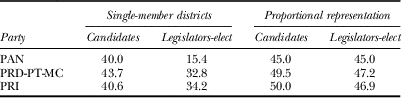
Thus, as shown in Table 3, Mexico’s major political parties met or exceeded the quota in 2012 (even though only the PRD-led coalition nominated more than 40 per cent women for both single-member district and proportional representation candidacies). Women ultimately won 38.6 per cent of the chamber seats and 32.6 per cent of senate seats. The remaining gap between the proportion of female candidates and proportion of women elected comes from single-member district candidates’ assignment to non-competitive races (especially in the PAN) and their relegation to the second slot in the state-level senate races. Though these informal practices of quota evasion remained in place following the TEPJF’s historic ruling, the strategic organizing of Mujeres en Plural, the tribunal’s willingness to protect women’s political rights and the IFE’s enforcement of electoral rules did significantly transform candidate selection in Mexico. After two decades of manoeuvre and counter-manoeuvre, the ‘quota network’ had prevailed.
CONCLUSIONS
The TEPJF’s historic ruling – coupled with a subsequent decision stipulating alternation for men’s and women’s names on the proportional representation lists – accelerated Mexico’s adoption of parity. The constitutional reforms of December 2013 mandated gender balance in candidate nominations for the federal congress and state assemblies. The February 2014 law on political parties closed the final quota loophole related to candidate selection in the single-member districts: Article 232 requires that ‘none of the genders may be assigned exclusively to those districts where the party received the lowest percentage of votes in the previous election’.
Process-tracing Mexico’s sequential quota reforms thus nuances the conventional wisdom in feminist institutionalism: while political parties’ male-dominated recruitment networks slyly shuffle women into the least viable candidacies, women counter this informality by creating lobbying networks of their own. Party women in Mexico, including current and former female legislators, in alliance with their feminist allies in civil society, established a robust ‘quota network’ that, while far from invisible, relied on unwritten rules of collective action, procedures cleverly designed to maximize their chances of success. One leader commented that the network deliberately decided not to formalize itself by establishing an executive committee, because then individual agendas could come to dominate the collective cause.Footnote 64 Informality thus benefited women enormously. In the quota law’s first generation, women manoeuvred to pressure male leaders without risking their own careers, and, in the second generation, women spoke in a plural voice to both diffuse individual responsibility and focus regulators’ attention on their group rights. Electoral officials responded because doing so deepened their institutions’ reputations as guarantors of fair elections (Estévez et al. Reference Estévez, Magar and Rosas2008) and the rule of law (Reyes Reference Reyes2012).
The Mexican case study signals that future research should explore the interplay between informal networks that exclude women, and the counter-networks that women build to attain inclusion. As women enter political parties in greater numbers, their collective action can provide a counterweight that challenges men’s traditional party dominance. In Latin America, studies have noted the role of women’s lobbies in securing quota laws’ adoption and reform (Crocker Reference Crocker2011; Krook Reference Krook2009; Piscopo Reference Piscopo2015), but few scholars have unpacked how women’s lobbies have succeeded in persuading or forcing male party leaders to follow more inclusive candidate selection rules. The role of electoral institutions in this process also remains woefully understudied, though the Mexican case suggests that relationships between quota networks and electoral officials may prove central to explaining when and why formal rules finally change. Future work should thus take the central theoretical insight from this case study – that women also leverage informality to their advantage – and explore the formation, practices and achievements of quota networks in cases from Latin America and beyond.
Acknowledgements
I would like to thank Francesca Jensenius, Meryl Kenny, Melody Ellis Valdini, Tània Verge, anonymous reviewers, and participants at the 2014 ECPR Joint Sessions for their helpful feedback on earlier drafts. Andrea Bravo and Malena Ernani provided invaluable research assistance. Travel to Mexico was supported by the University of California, San Diego and Occidental College.