


Introduction
At the base of an ice sheet there is generally a layer of dirty ice several meters in thickness (Reference Hansen and LangwayHansen and Langway, 1966) which contains 0.000 04 to 0.6 volume fraction debris (Reference HookeHooke, 1970, p. 306). The rheological properties of such ice have not been investigated at the relatively low deviatoric stress levels found in glaciers.
Procedure
The present experiments were conducted in uniaxial compression with the use of the apparatus shown in Figure 1. Samples were immersed in a bath of 2-2-4 trimethyl pentane (iso-octane) in which ice is insoluble. The bath temperature was controlled with a “Neslab” circulating bath and “Neslab” PBC-2 bath cooler, and generally fluctuated less than 0.2 deg during a run (Table I). At the temperatures used, increasing the temperature by 0.1 deg will increase the creep rate about 1%.


Deformation measurements were made with a drum micrometer (Fig. 1) which could be read directly to 10 μm and interpolated to 1 μm. When the micrometer touched the insulated plate shown in Figure 1, a small current passed between the two and activated a Schmitt trigger (Reference SchmittSchmitt, 1938) which caused an ammeter to read full scale. With this system, micrometer readings were reproducible to ±2 μm. A movement of 2 μm at the micrometer corresponded to compression of the sample of about 0.4 μm. However, because the aluminum frame and stainless steel piston have different coefficients of thermal expansion, random changes in room temperature resulted in a random error which reduced the final accuracy of measurement on the samples to about ±2 μm.
Samples were prepared by placing a porous mixture of natural snow and sand in a thick-walled lucite cylinder, 1.95 cm in diameter and 10 cm long, de-aerating the cylinder, and then admitting de-aerated water at 0° C. Samples were virtually free of air bubbles and appeared to have a uniform distribution of sand. A 3 cm section was cut from the most uniform part of the sample, and ends of this section were carefully faced perpendicular to the axis of the sample. The sample diameter was measured at eight to twelve points with a micrometer which could be read to ±1 μm. The sample length was measured with a steel tape to the nearest 0.2 mm. After the compression test, the sample was cut in half, and sediment concentrations in the two halves were determined independently by melting the ice and weighing the sand residue. Sand concentrations were reduced to volume percent sand assuming a density of 0.9 Mg/m3 for ice and 2.7 Mg/m3 for sand. Sand concentrations in the two halves of the same sample varied by less than 10% of the amount present. In thin sections cut from the samples, c-axis orientations appeared to be random, and ice crystals averaged 300 μm to 500 μm in diameter.
The sand recovered from the samples was combined and sieved after all tests had been completed. The geometric mean grain size was 180 μm, and the geometric standard deviation was 1.57. The sieve data were used to estimate the number of particles in a cubic millimeter of sand without pore space (1 750), the average particle diameter (64 μm), and the diameter of the particle with the average volume (102 μm).
During a test, the drum micrometer, bath temperature, and room temperature were read at intervals of one to three or four hours from early morning to late evening. There was usually a gap of 6 to 8 h in the readings between about midnight and 6 a.m. Total strain versus time curves were plotted (Fig. 2), and the slope of the curve in the region of secondary creep was determined by least-squares methods. The time interval used for this calculation generally started more than 20 h after stress was applied, thus allowing for transient creep. This time interval usually lasted more than 20 h, and included no systematic changes in bath temperature (Table I).

Reference WeertmanWeertman (1969) suggested that it is necessary to obtain the creep rate over a total strain of approximately 10% to be sure that transient creep is not contributing to the observed strain rate. In the present experiments the total strain was on the order of 1%, so some transient creep may be included. To test for this, a least-squares procedure was used to fit a curve

(Reference GlenGlen, 1955, p. 530) to the total strain versus time curve over the time interval defined above. In this equation β is the transient creep rate, κ is the secondary creep rate, ϵ 0 is a constant resulting from the curve-fitting procedure, ϵ is the total strain, and t is time since the beginning of the run. In general the secondary creep rate determined by this method differed from the slope of a straight line through the data by less than 0.02 year−1. Furthermore, in a few instances the creep rate increased slightly over the time interval involved, resulting in a positive β. Therefore it is assumed that the slope of a straight line through the data provides an accurate measure of the secondary creep rate.
Because there were slight differences in temperature and stress between runs, all strain-rates were normalized to a stress of 5.6 bar and a temperature of −9.1° C (263.06 K) by the use of the relationship

which is based on Glen’s flow law and the Arrhenius equation (Reference GlenGlen, 1955).  is the normalized secondary creep rate,
  , σ, and T are the observed strain rate, stress, and temperature in kelvins during the run, Q is the effective activation energy for creep, R is the gas constant, and the value of the exponent, 3.2, is that determined by Reference GlenGlen (1955) in similar uniaxial tests on fine-grained ice.
Reference Mellor and TestaMellor and Testa (1969, p. 135, 141) have shown that the Arrhenius equation is invalid above −10°C, possibly because the creep rate is increased by grain-boundary melting. However for small changes in 1/T, an equation of the form of the Arrhenius equation can be used to estimate the change in  if the true activation energy is replaced by a somewhat higher effective activation energy. The effective activation energy at −9° C was determined graphically from figure 3 of Reference Mellor and TestaMellor and Testa (1969) and is about 87.6 kJ/mol. The temperature normalization generally changed the creep rate by less than 0.02 year−1 so results are not sensitive to the exact value of Q used.

Results
Results of the experiments are presented in Figure 3. The first three tests were done on clean ice. Run 1 was too short; hence the large error bar. During run 3 there were some unexplained discontinuities in the total strain versus time curve, so the strain rate obtained from this run is not as reliable as that from run 4.
Reference Mellor and TestaMellor and Testa (1969) ran a sample of clean ice at 11.8 bar and −9.9° C, and Goughnour and Reference Goughnour and AnderslandAndersland (1968) ran one at 6.8 bar and −7.6° C. When normalized to 5.6 bar and −9.1°C with the use of Equation (2), these runs give strain rates of 0.94 year−1 and 1.00 year−1 respectively. These strain rates are not significantly higher than our strain rates on clean ice (Fig. 3). Thus our procedure gives reasonably reproducible results which are consistent with results obtained by others.
Creep rates measured on ice with low sand concentrations scatter somewhat more than expected. Particularly surprising was an abrupt increase in creep rate after about 206 h in run 13 (Table I). These results suggest that the creep rate of ice with low sand concentrations is sensitive to factors which were not closely controlled during the experiments. Among these factors are crystal size, exact size distribution of sand particles, exact spacing of sand particles in the ice, positions of sand particles relative to crystal boundaries, and concentration of chemical impurities in the ice. (See Reference Jones and GlenJones and Glen (1969) for laboratory data on the latter.)
The high creep rate for ice with 0.021 volume fraction sand is consistent with qualitative field observations in the TUTO ice tunnel, and with experimental observations of Reference Goughnour and AnderslandGoughnour and Andersland (1968). Reference Butkovich and LandauerButkovich and Landauer (1959) and Reference SwinzowSwinzow (1962) found that closure rates in the TUTO tunnel were faster in slightly dirty ice than in clean ice, and slower in very dirty ice than in clean ice. From Butkovich and Landauer’s photograph and Swinzow’s description of the slightly dirty ice, it is apparently comparable to the banded ice in which Reference HookeHooke (1970, p. 306) measured sediment concentrations of 0.011 to 0.024 volume fraction sand. Reference Goughnour and AnderslandGoughnour and Andersland (1968) found that the peak strength of ice with 0.03 volume fraction sand was 11 % less than for clean ice. Such a decrease in strength would increase the creep rate.
Discussion
The problem of the decrease in creep rate of ice with increasing volume fraction sand is analogous to the problem of dispersion hardening of metals with large (> ≈ 1 μm), widely spaced particles which are much harder than the matrix. Reference OrowanOrowan (1948) suggested that a dislocation moving through a crystal and encountering one of these particles, would bow around it, close behind it, and pass on, leaving a dislocation loop around the particle. The stress increment Δσ required to bow a dislocation between adjacent particles is

where G is the shear modulus, b the Burgers vector, λ the distance between particle centers, and Δσ the difference between the stress required to bow a dislocation between two particles and that required to move a dislocation through the pure matrix. The right side of the equation has been multiplied by √3 to express the result in terms of the normal stress, rather than the shear stress (Reference NyeNye, 1953, p. 486). For large particles λ should be replaced by λ−d where d is the particle diameter (Reference Meiklejohn and SkodaMeiklejohn and Skoda, 1960, p. 775). In ice G = 3 × 10¹⁰ dyn/cm2 (3 × 10⁹ N/m2) (Weertman, 1963) and b = 4.5 × 10⁻¹⁰ m (Reference Kuroiwa, Hamilton and KingeryKuroiwa and Hamilton, 1963, p. 44), so for λ − d on the order of 0.1 mm (Table I) Equation (3) yields Δσ = 0.24 bar.
The Orowan stress is the stress required to bow the first dislocation that reaches the particles. As dislocation loops accumulate around a particle, the critical stress required to bow each subsequent loop increases, thus resulting in work hardening. The stress increases until the inner loop is able to bypass the particle by dislocation climb. At this time steady-state or secondary creep begins (Reference HartHart, in press; Reference McLeanMcLean, 1962, p. 312, 321).
In the case of ice we take the yield strength to be proportional to the parameter B in Reference GlenGlen’s (1955) flow law, 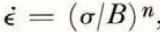 , because
  is small when the normal stress σ is appreciably less than B and increases rapidly as σ increases above B. Rewriting we obtain

where σ y is the yield strength and α is a constant of proportionality. In clean ice at the pressure melting point the yield strength is about 1 bar (Reference NyeNye, 1951, p. 559), and B is about 2 bar year1/n . (Reference GlenGlen, 1955), so α is approximately 2 year1/n . Experimental values of σ y (Table I) are calculated assuming a value of 3.2 for n. The increase in yield strength due to the dispersed particles, (σ y−σ ym), is typically 1 to 2 bars, where σ ym is the yield strength of the pure matrix (runs 1, 3, and 4). As expected, these values are substantially larger than the stress increment Δσ required to bow the first dislocation loop.
A metallurgical study which is comparable to ours in terms of temperature (relative to the melting point) and particle size was conducted by Reference Meiklejohn and SkodaMeiklejohn and Skoda (1960), who studied the effect of Fe particles, 50 to 770 μm in diameter, on the strength of Hg at 77 K. They found as did we, that (σ y−σ ym) increased linearly with 1/(λ−d). However, the rate of increase varied with particle size, which is contrary to the prediction of the Orowan model. Meiklejohn and Skoda concluded that (σ y−σ ym) was primarily a function of the volume fraction of Fe in the Hg. Recent theoretical analyses of work hardening by Reference AshbyAshby (1966, Reference Ashby1970) and Reference HartHart (in press) reach the same conclusion.
Hart considers the work hardening resulting from the accumulation of a number of Orowan dislocation loops around each particle. These loops produce an ordered back-stress field which inhibits passage of normal glide dislocations. Hart’s theory predicts

where a is the total strain, f is the volume fraction of impurities, and the coefficient has been adjusted to give the result in terms of normal stress and strain rather than unresolved shear stress (Reference NyeNye, 1953, p. 487). We will take a to be the total strain at which secondary creep begins, or about 0.01. Substituting appropriate values for ice then yields:

Graphically B does increase linearly with f for f > 0.05, but the slope of the line is 14 rather than 25. Thus Hart’s model overestimates the influence of sand on the creep of ice.
Reference AshbyAshby (1966, Reference Ashby1970) suggested that secondary slip occurs around each particle as the matrix undergoes shear deformation. As a result, secondary dislocation loops are generated at the particle-matrix interface and migrate outward, eventually forming a dense tangle of dislocations around the particle. The tangle inhibits normal movement of primary glide dislocations past the particle, and is thus responsible for decreasing the creep rate. For application to the present experiments, this model is conceptually better than the Orowan model because λ−d is comparable to the ice crystal diameter. Thus sand grains are likely to be on crystal boundaries, and dislocations moving through crystals are not likely to form loops around the sand grains. If we assume that recovery effects are negligible during transient creep, we can use Reference AshbyAshby’s (1970, equation (4.4)) model to estimate an upper bound for (σ y—σ ym). The appropriate equation in the notation used in this paper is

For comparison the inclined line in Figure 4 has a slope of about 12. In view of the uncertainties in the theories (oral communication from M. F. Ashby, November 1971) and the assumptions made in their application to the present problem, the close agreement between theory and experiment is in part fortuitous. Agreement within a factor of 2 would be acceptable.

The Orowan, Hart, and Ashby theories all assume that the matrix is well below the melting point so that recovery effects such as dislocation climb and cross slip may be neglected. Furthermore these theories deal with particles which are an order of magnitude smaller and closer together than those with which we are concerned (personal communication from E. W. Hart, July 1971). For these reasons some metallurgists have questioned the applicability of the theories to the present problem.
An alternative approach might be to consider the ice as a non-Newtonian viscous fluid containing solid spheres. However this procedure has disadvantages on conceptual as well as practical grounds. Conceptually, in contrast to the situation in a fluid, ice is a crystalline substance deforming by dislocation glide and climb mechanisms, and the sand particles are tightly bound to the matrix. Practically, theories of flow of Newtonian fluids with solid inclusions (Reference NielsenNielsen, 1967) underestimate the effect of sand on the creep of ice by about an order of magnitude, and the authors are not aware of any treatments of the non-Newtonian problem.
Concluding statement
Reference AshbyAshby (1966, Reference Ashby1970) and Reference HartHart (in press) both suggest that each particle in a dispersion-hardened metal is surrounded by a tangle of dislocations which impedes movement of primary glide dislocations. The differences between the theories are due to differences in the presumed origin of dislocations in the tangle; Ashby assumes that they were generated at the particle–matrix interface, whereas Hart assumes that they moved to the particle and were trapped by it. The general agreement between our observations and the predictions of these theories suggests that sand grains in deforming ice may also be surrounded by clouds of dislocations which impede passage of primary glide dislocations. Reference Kuroiwa, Hamilton and KingeryKuroiwa and Hamilton (1963) found that a sand grain in Mendenhall glacier ice was surrounded by such a cloud (Fig. 5).

If we assume that each sand grain is at the center of an hypothetical rigid sphere of ice, while ice outside these spheres deforms normally, the diameters of the rigid spheres can be calculated. For ice with 0.05 to 0.15 volume fraction sand this diameter is on the order of twice the diameter of the included sand particle, or about 200 μm. At higher volume fractions the diameter decreases, perhaps reflecting overlap of the spheres of influence of adjacent particles. This diameter is comparable to the diameter of the cloud in Figure 5, but the particle in Figure 5 is substantially smaller than our average particle.
The erratic results of experiments with low sand concentrations may indicate the existence of processes which tend to increase the creep rate. For instance sand may decrease the ice crystal size (Reference HookeHooke, 1970, p. 316), thus promoting grain boundary slip (Reference McLeanMcLean, 1962, p. 307), or individual sand grains may act as sources for primary dislocations. D. F. Stein (oral communication, May 1971) suggested that the line of dislocation etch pits running diagonally across Figure 5 indicates that the sand grain is acting as such a source. The increase in spacing of the etch pits is due to elimination of adjacent dislocations of opposite sign as the dislocations move outward from the source.
Acknowledgements
D. F. Stein, formerly of the Metallurgy Department at the University of Minnesota, directed us to pertinent references in metallurgy and gave valuable suggestions during preparation of the manuscript. M. F. Ashby, E. W. Hart, and J. Weertman kindly reviewed the manuscript. D. Kuroiwa contributed the photograph in Figure 5. The Neslab temperature bath was loaned for the study by R. F. Roy. V. R. Murthy, E. C. Perry, and F. M. Swain also loaned essential laboratory equipment. The study was supported financially by the National Science Foundation.



