




Introduction
Continuous permafrost is present from the near-surface to ~800 m depth across the McMurdo Dry Valleys (MDV; ~77–78°S, 160–164°E), the largest region of the terrestrial Antarctic that is not currently covered in ice sheets (Cartwright & Harris Reference Cartwright, Harris and McGinnis1981, Harris & Cartwright Reference Harris and Cartwright1981, Bockheim et al. Reference Bockheim, Campbell and McLeod2007). Active layers form seasonally in most coastal and mid-elevation sites located within a few tens of kilometres of the coast in the coastal thaw and intermediate mixed microclimate zones (Bockheim et al. Reference Bockheim, Campbell and McLeod2007, Marchant & Head Reference Marchant and Head2007, Vieira et al. Reference Vieira, Bockheim, Guglielmin, Balks, Abramov and Boelhouwers2010, Fountain et al. Reference Fountain, Levy, Gooseff and Van Horn2014, Hrbáček et al. Reference Hrbáček, Vieira, Oliva, Balks, Guglielmin and de Pablo2021). Active layers form as summer soil temperatures rise from winter cold values of ~ -30°C to -50°C to peak summer temperatures of 5–10°C or more (Doran et al. Reference Doran, McKay, Clow, Dana, Fountain, Nylen and Lyons2002, Fountain et al. Reference Fountain, Levy, Gooseff and Van Horn2014, Obryk et al. Reference Obryk, Doran, Fountain, Myers and McKay2020). Given the extreme winter cold and the limited summertime warmth (both in terms of the short thaw season in November through February and the modest summertime surface temperatures), Antarctic permafrost is not widely considered to be imminently at risk for thaw in response to climate change (Chadburn et al. Reference Chadburn, Burke, Cox, Friedlingstein, Hugelius and Westermann2017).
Indeed, most studies of Antarctic permafrost and active-layer processes focus on summertime thaw and active-layer properties, monitoring circum-Antarctic active layers for evidence of warming and resulting enhancement of seasonal melting (e.g. Bockheim Reference Bockheim1995, Guglielmin et al. Reference Guglielmin, Balks, Paetzold, Phillips, Springman and Arenson2003, Vieira et al. Reference Vieira, Bockheim, Guglielmin, Balks, Abramov and Boelhouwers2010). Active-layer thicknesses are variable across the MDV and are generally greater near the coast (45–70 cm), thinner inland (20–45 cm) and thin to vanishing along the edge of the polar plateau (< 20 cm; Bockheim et al. Reference Bockheim, Campbell and McLeod2007). Where active-layer thickness has been monitored over time, MDV active layers show seasonal variability; for example, deeper thaw during the 2001–2002 ‘melt year’ (Doran et al. Reference Doran, McKay, Fountain, Nylen, McKnight, Jaros and Barrett2008, Adlam et al. Reference Adlam, Balks, Seybold and Campbell2010). Active layers also show spatial heterogeneity, with thickening towards the north and towards the coast (Adlam et al. Reference Adlam, Balks, Seybold and Campbell2010, Hrbáček et al. Reference Hrbáček, Oliva, Hansen, Balks, O'Neill and de Pablo2023). MDV active layers show fine-scale spatial trends, with deeper thaw in seasonally wetted soils (Levy et al. Reference Levy, Fountain, Gooseff, Welch and Lyons2011), within stream channels (Wlostowski et al. Reference Wlostowski, Gooseff and Adams2018) and even across small hydrological features such as water tracks (Levy et al. Reference Levy, Andrews, Guller, Johnson, King and Pfaff2024) and across small patterned ground geomorphic features (Hrbáček et al. Reference Hrbáček, Vieira, Oliva, Balks, Guglielmin and de Pablo2021). Importantly, despite this spatial and temporal variability in active-layer thickness, no clear pattern of active-layer thickening over time has been detected at any MDV site, although thickening of 0.3 cm/year is reported in northern Victoria Land (Adlam et al. Reference Adlam, Balks, Seybold and Campbell2010, Guglielmin et al. Reference Guglielmin, Fratte and Cannone2014, Carshalton et al. Reference Carshalton, Balks, O'Neill, Bryan and Seybold2022, Hrbáček et al. Reference Hrbáček, Oliva, Hansen, Balks, O'Neill and de Pablo2023).
In the Arctic, summer warming, combined with reduced winter cooling, has thickened Northern Hemisphere active layers and warmed Northern Hemisphere permafrost (Smith et al. Reference Smith, O'Neill, Isaksen, Noetzli and Romanovsky2022); however, the extent to which Antarctic permafrost is warming beneath the active layer is not fully clear. Permafrost temperatures in boreholes measured during the 2007–2008 International Polar Year ranged from -13.3°C in northern Victoria Land, to -17.4°C to -22.5°C in the MDV, to -23.6°C at high-elevation sites such as Mount Fleming (Vieira et al. Reference Vieira, Bockheim, Guglielmin, Balks, Abramov and Boelhouwers2010). In places where both active-layer and deeper permafrost temperatures have been monitored, the active-layer thickness does not always increase in step with the temperatures of the underlying permafrost, with active-layer thickness and near-surface temperature tracking much more closely with end-of-summer shortwave insolation and air temperature than with top-of-permafrost temperatures (Guglielmin & Cannone Reference Guglielmin and Cannone2012, Guglielmin et al. Reference Guglielmin, Fratte and Cannone2014). Indeed, permafrost and active layers can even change out of phase, with localized surface cooling (e.g. Doran et al. Reference Doran, McKay, Clow, Dana, Fountain, Nylen and Lyons2002) occurring alongside modest, 0.1°C/year warming of permafrost at depth (Guglielmin & Cannone Reference Guglielmin and Cannone2012).
This potential mismatch between summertime active-layer conditions and the deeper temperature structure of underlying permafrost raises questions about the roles of air temperature, radiation and wind on the wintertime thermal regime of Antarctic permafrost and active layers. Is it possible that changes to Antarctic active layers and permafrost are occurring not during the well-monitored summer but during winter? Recent observations suggest winter weather events can lead to short-lived periods of extreme warmth (Barrett et al. Reference Barrett, Adams, Doran, Dugan, Myers and Salvatore2024). During austral winter (i.e. April through September), ground surface temperatures are commonly colder than the air at monitoring sites in Beacon and University valleys in the upland stable zone of the MDV (Lacelle et al. Reference Lacelle, Lapalme, Davila, Pollard, Marinova, Heldmann and McKay2016), consistent with radiative and conductive cooling of the soil surface. However, heat can be delivered to MDV surfaces, even in winter, by sensible heat flux from regionally warming air (Obryk et al. Reference Obryk, Doran, Fountain, Myers and McKay2020), via sensible heat from compressively warmed katabatic/Foehn winds (Nylen & Fountain Reference Nylen and Fountain2004, Speirs et al. Reference Speirs, Steinhoff, McGowan, Bromwich and Monaghan2010) and from incident longwave radiation from changing cloud cover. Winter clouds dramatically change incident longwave flux (e.g. Walsh & Chapman Reference Walsh and Chapman1998), typically increasing it over clear-sky conditions by 20–30 w/m2 (Curry et al. Reference Curry, Schramm, Rossow and Randall1996), but in some cases nearly doubling incident longwave and increasing flux by 100 W/m2 or more (Yamanouchi Reference Yamanouchi2019). Is it possible that winter warming is occurring in the MDV, and that this warming could have implications for the long-term stability of MDV permafrost?
Here, we use a ~30 year record of soil and air temperature data, in conjunction with wind and longwave flux measurements from the McMurdo Dry Valleys Long Term Ecological Research (MCM-LTER) Long-Term Automatic Weather Network (LAWN), to understand the changing state of Antarctic active-layer soils during the winter freezing season. We address the following research questions: RQ1) Are Antarctic soils and air experiencing changes in wintertime temperature over time? RQ2) Is wintertime soil temperature correlated with other environmental variables that control surface energy balance, including wind run, air temperature and incident longwave radiation? RQ3) Are these environmental controls on winter surface energy balance changing over time? RQ4) Ultimately, is there a long-term climate trajectory in which refreezing no longer occurs at some sites during Antarctic winter?
Methods
All meteorological data analysed in this project were collected at MCM-LTER LAWN (Doran et al. Reference Doran, Dana, Hastings and Wharton1995, Reference Doran, McKay, Clow, Dana, Fountain, Nylen and Lyons2002) stations in the MDV (Fig. 1) between 1993 and 2023 and are available for download at mcm.lternet.edu. The Lake Bonney, Lake Hoare and Commonwealth Glacier stations were installed in 1993; the Lake Fryxell, Taylor Glacier and Lake Vanda stations were installed in 1994; the Lake Vida and Explorer's Cove stations were installed in 1995; Lake Brownworth in 1996; Mount Fleming in 2006; Friis Hills in 2010; and Miers Valley in 2011. Lake Fryxell is at 25 m above sea level (a.s.l.), Lake Bonney is at 69 m a.s.l., Explorer's Cove is at 79 m a.s.l., Lake Hoare is at 81 m a.s.l., Lake Vanda is at 97 m a.s.l., Miers Valley is at 231 m a.s.l., Lake Brownworth is at 279 m a.s.l., Lake Vida is at 351 m a.s.l, Friis Hills is at 1591 m a.s.l. and Mount Fleming is at 1870 m a.s.l.
Location of the McMurdo Dry Valleys Long Term Ecological Research (MCM-LTER) Long-Term Automatic Weather Network (LAWN) automatic weather stations used in this study. Stations are located between ~77–78°S and 160–164°E in the McMurdo Dry Valleys. Base map is Landsat 7 image data (Bindschadler et al. Reference Bindschadler, Vornberger, Fleming, Fox, Mullins and Binnie2008).

In our analyses (described below), we used average daily measurements for air temperature, soil temperature at 0, 5 and 10 cm depth and incident longwave radiation, coupled with 15 min observations of wind speed and direction. Some stations collect both soil and air measurements: Lake Vida, Lake Vanda, Lake Brownworth, Lake Bonney, Lake Hoare, Lake Fryxell and Explorer's Cove. Other stations, including Friis Hills, Mount Fleming and Miers Valley, only collect air measurements (air temperature and wind speed and direction), in addition to other ecological variables not explored here (e.g. photosynthetically active radiation).
Data analysis methods
All MCM-LTER meteorological datasets used in this study were downloaded directly from the Environmental Data Initiative (EDI), using standard EDI Data Portal dataset ingestion scripts. We analysed daily average data from stations at Explorer's Cove, Lake Fryxell, Lake Hoare, Lake Bonney, Miers Valley, Lake Vida, Lake Brownworth, Lake Vanda, Friis Hills and Mount Fleming (Doran & Fountain Reference Doran and Fountain2023b–Reference Doran and Fountaink). High-frequency, 15 min-resolution datasets were used for computations related to wind speed and direction (Doran & Fountain Reference Doran and Fountain2023l–Reference Doran and Fountaint). Our full data analysis script can be found at our github repository: https://github.com/jslevy/mdvwinterwarming.
We analysed daily mean values of air temperature at 3 m, soil temperature at 0, 5 and 10 cm depth and incident longwave radiation (available from Lake Bonney and Commonwealth Glacier - the latter sited near the Lake Fryxell and Explorer's Cove stations; Doran & Fountain Reference Doran and Fountain2023a). The Lake Bonney longwave radiation data were used in the analysis of Lake Vanda, Lake Vida, Friis Hills, Mount Fleming and Miers Valley because these stations are close to the Lake Bonney station and reflect upland/inland sites, while the Commonwealth Glacier longwave radiation data were used in the analysis of Explorer's Cove, Lake Fryxell, Lake Hoare and Lake Brownworth, which are located closer to the Commonwealth Glacier station, and which are low-elevation/coastal sites.
Several dataset quality checks were applied to ensure compatibility between measurements at different locations and collected over different timeframes. Days with no measurements or incomplete measurements of air and soil temperature, wind speed and direction and incident longwave radiation were removed. Data were then filtered to include only winter months - here, days that fall between the 121st and 273rd days of the year (1 May through 30 September, or 29 April through 29 September on leap years). MDV winter was defined by Obryk et al. (Reference Obryk, Doran, Fountain, Myers and McKay2020) as April through September, but we exclude April data, during which latent heat could be released into soil by late-season freezing, especially in seasonal wetlands that can remain unfrozen through at least March (Kuentz et al. Reference Kuentz, Levy and Salvatore2022). The winter data were then checked to ensure that over 90% of the days during the winter season were present for each year. If the year did not have data for more than 90% of the winter days, that year was removed from the analysis, following the approach in Obryk et al. (Reference Obryk, Doran, Fountain, Myers and McKay2020), to avoid comparison between years with differing numbers of measurements (this is especially important for calculations of freezing degree-days (FDDs), which are summative). Across all datasets and measurements, only ~2% of the data records (30 data records out of 1443) that reach the 90% wintertime daily measurement threshold do not have measurements for every single day during the winter months.
Using the verified datasets, annual summations of wintertime daily average values were calculated for each year and each dataset to determine changes in soil and air temperatures over time and to evaluate the role of environmental forcing variables (wind and longwave radiation). These wintertime yearly summations for the temperature, wind and longwave radiation data are referred to as air or soil freezing indices after Riseborough (Reference Riseborough, Phillips, Springman and Arenson2003) and Klene et al. (Reference Klene, Nelson, Shiklomanov and Hinkel2001), wind run and radiation days, respectively. Freezing index is the sum of average daily temperatures during the winter, making it similar to FDDs, but differing in that it is not annualized. More negative freezing index values indicate colder winter temperatures. Soil freezing index is calculated for all soil depths (0, 5 and 10 cm), but only data from 0 cm are compared to air freezing index, wind run and longwave insolation, and only 0 cm data linear model statistics (P and R) are reported. Wind run (wind velocity multiplied by duration, summed over the winter months) is a measure of integrated windiness, while radiation days (mean daily longwave flux summed over winter months) is a measure of integrated infrared energy arriving at the soil surface.
In order to compute the number of days each winter in which down-valley winds (Foehn/katabatics) were present, we used high-frequency (15 min) wind data and processed them to identify candidate down-valley wind events. The first classification step was to identify wind records where the wind direction was broadly ‘down-valley’ - here, defined as winds blowing from between 150° and 360°. This overlaps with the wind direction range used by Nylen & Fountain (2014), expanding it slightly to include strong drainage winds resulting from southerly flows of air off of local plateaus and mountain peaks. In order to only capture down-valley wind events characterized by fast drainage/Foehn events, we filtered our dataset to only accept winds > 5 m/s, after Nylen & Fountain (Reference Nylen and Fountain2004). Every measurement record with down-valley direction and high speed was flagged as a candidate down-valley wind data record. In order to estimate the number of days per winter that down-valley winds were blowing, we classified a day as being a down-valley wind event if the percentage of down-valley wind records in that day exceeded 25% of the day, following the Speirs et al. (Reference Speirs, Steinhoff, McGowan, Bromwich and Monaghan2010) 6 h threshold for classification of a MDV Foehn wind event.
The complement to the down-valley wind day dataset is a version of our temperature datasets for which the down-valley wind days have been removed. The freezing indices for air and for soil with the drainage wind days removed were calculated by summing all of the daily average temperatures on days that do not exceed the 25% threshold. The average daily temperature was then calculated by dividing this adjusted freezing index by the number of days not classified as down-valley wind days.
For each environmental variable (e.g. soil freezing index, air freezing index, total windiness, etc.), we evaluated change over time and correlation between variables using simple linear regression analysis. All results are reported as the slope of those analyses, as well as the P-value of the slope and the correlation coefficient (R). P-values < 0.05 are considered significant. While it is possible to generate multiple linear regression models to explain a phenomenon such as winter soil freezing index, our goal was to evaluate the possible forcing processes that could have an effect on soil freezing index over time, not to generate an optimized statistical model for fitting soil freezing index.
Finally, we generated a pair of comparator/prediction calculations. The slope and y-intercept values from the linear regressions versus time created for the air and soil index data were used to calculate the predicted year of zero wintertime freezing for the study sites. In addition, while summer conditions are not the focus of this study due to their more complex thermal processes, including variable insolation and active-layer thickening, we also computed surface thawing degree-days (TDDs) measured at the soil sites. TDDs were computed using surface soil daily average temperatures from the same time period as the winter soil data. TDDs were summed from November through February, following the summer definition from Obryk et al. (Reference Obryk, Doran, Fountain, Myers and McKay2020). We report both net TDDs and gross TDDs: net TDDs are the summed daily temperatures from November through February, including days with sub-zero temperatures, while gross TDDs are the total positive degree-days from the summer.
Results
The plots shown below provide one example of the data series or correlation calculated, typically a high-correlation, highly significant example.
Change over time at measurement stations
Total wintertime FDDs decreased significantly (P < 0.05) over time at all soil study sites except for Lake Vanda, which showed a non-significant (P = 0.28) decrease in freezing index (Fig. 2 & Table I). Here, and throughout the Results section, colder temperatures are reported as more negative freezing index values and warmer temperatures are shown as less negative values. This results in plots that show cold conditions at the base of the y-axis and warming temperatures over time rising on the y-axis, comparable to representations of measured temperature over time.
Soil freezing index over time at Lake Hoare. Soil freezing indices (total wintertime summed freezing degree-days (FDDs)) show a decrease in FDDs over time at all measured soil depths. Soil warming is ~36 fewer FDDs per year. Wintertime warming of soils is a robust signal at Lake Hoare (R = 0.43, P < 0.002).

Rates of freezing index change at soil sites (0 cm). Slope is the number of freezing degree-days lost per year.

a Data plotted in Fig. 2.
Rates of change of calculated soil freezing index at the study sites ranged from rapid warming of ~36 fewer FDDs per year on average (Lake Hoare) to ~18 fewer FDDs per year at Lake Bonney. Correlation between freezing index and time is general strong, ranging from 0.66 at Lake Hoare to 0.45 at Lake Vida. In general, subsurface freezing indices for soils at 5 and 10 cm depths follow the same trend as surface freezing indices, showing fewer total wintertime FDDs over the measured record.
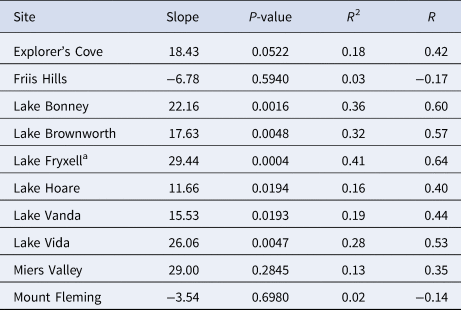
Concurrent with wintertime soil warming, wintertime air freezing index decreased significantly (P < 0.05) at all study sites except for Friis Hills, Mount Fleming, and Miers Valley; air warming at Explorer's Cove is marginally significant (P = 0.0522; Fig. 3 & Table II). At Friis Hills and Mount Fleming, linear fits to air freezing indices over time show a small but statistically non-significant increase in FDDs, while at Miers Valley, air FDDs are decreasing, but not significantly. Rates of change of calculated air freezing index at the study sites ranged from ~29 fewer air FDDs per year on average at Lake Fryxell and Miers Valley to ~12 fewer air FDDs per year at Lake Hoare.
Air freezing index over time at Lake Fryxell. Air freezing indices (total summed wintertime freezing degree-days (FDDs)) show a decrease in FDDs over time. Air warming is ~29 fewer FDDs per year. Wintertime warming of soils is a robust signal at Lake Fryxell (R = 0.64, P < 0.001).

Rates of air freezing index change at air temperature monitoring sites. Slope is the number of freezing degree-days lost per year.
a Data plotted in Fig. 3.
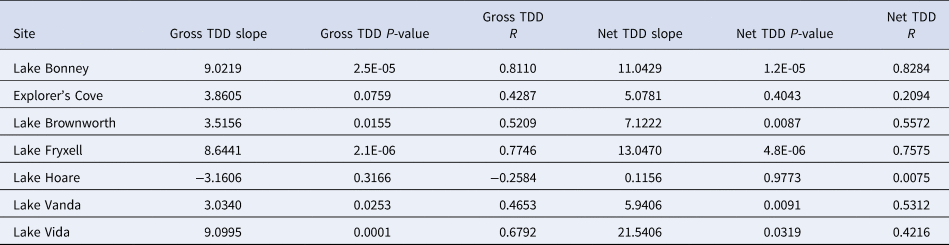
Likewise, summer TDDs are increasing at most soil sites (Fig. 4 & Table III). Summer TDD increase is significant at all stations except Explorer's Cove, and summer TDDs are decreasing only at Lake Hoare (although the linear fit to the data is not significant). Soils are gaining between 3 and 9 TDDs per year (significant values only) when counted as gross increase in positive-temperature days, or between 6 and 21 TDDs (significant values only) when counted as net TDDs that include a reduction in the number of days with temperatures below 0°C or an increase in temperatures near 0°C.
Thawing degree-days (TDDs) at soil monitoring sites. Soil TDDs are rising at all sites other than Lake Hoare in terms of both total positive degree-days (gross TDDs) as well as positive degree-days offset by days below freezing during summer (net TDDs). The steeper slopes of the net TDD lines may suggest a reduction in summer freezing days in the McMurdo Dry Valleys over time.

Summer thawing degree-day (TDD) trends over time. Summer TDD slopes indicate the change in TDDs per year.
In contrast to generally rising air and soil temperatures during winter, overall windiness, measured as wind run, is only increasing in the MDV significantly at Lake Fryxell and Lake Hoare (Fig. 5 & Table IV). At all other sites, wintertime total windiness is increasing over time, but not significantly.
Total windiness over time at Lake Fryxell. Wind run is increasing significantly, by 8.71 m/s⋅day per year (R = 0.73, P < 0.0001).

Rates of change of wind run at air monitoring sites. Slope is the rate of change in wind run per year (km/year).

a Data plotted in Fig. 5.
The number of down-valley wind days are mostly increasing over time; however, the increase is not significant at all sites (Fig. 6 & Table V). Down-valley wind days determined by our algorithm are increasing significantly by ~0.3–0.6 days per year at Lake Fryxell, Lake Hoare and Lake Vida. All other sites, except Mount Fleming, show increases in down-valley wind days, though the trends are not statistically significant.
Down-valley wind days over time at Lake Fryxell. Down-valley wind days are increasing at Lake Fryxell (0.59 more down-valley wind days per year, P < 0.002, R = 0.67), counting wind days as those that meet our criteria for > 25% of the day.

Rates of change in number of down-valley wind days per year at wind monitoring sites based on a 25% fractional day threshold. Slope is the change in the number of down-valley wind days per year.

a Data plotted in Fig. 6.
Measured wintertime incoming longwave radiation is increasing at Lake Bonney and Commonwealth Glacier, but the trend is not significant at either longwave measurement station. At Commonwealth Glacier, incoming longwave radiation is increasing during winter at a rate of 39 W/m2⋅day per year (P = 0.1036, R = 0.33), while at Lake Bonney it is increasing 20.96 W/m2⋅day per year (P = 0.6875, R = 0.11).
Relationships between soil temperature, air temperature and possible environmental forcing variables
Wintertime air and soil surface freezing index values are strongly and significantly correlated at all sites (Fig. 7 & Table VI). Across all years of data collection, linear fits between air and soil surface freezing indices have slopes that range between 0.64 (Lake Vida) and 1.12 (Lake Hoare). Some sites regularly record air temperatures that warm faster than soil temperatures (slopes < 1), including Explorer's Cove, Lake Bonney, Lake Fryxell, Lake Vanda and Lake Vida, while other sites have soil temperatures that warm faster than air temperatures (slopes > 1), including Lake Brownworth and Lake Hoare (Table VI). At most stations, soil freezing index and air freezing index are strongly correlated, with R-values in excess of 0.96 at all sites except Explorer's Cove and Lake Vida.
Soil and air freezing indices at Lake Brownworth. Air and soil freezing indices (summed freezing degree-days (FDDs)) are strongly and significantly correlated. At Lake Brownworth, warmer years reflect reduced freezing in soils.

Relationship between air and soil freezing indices (0 cm) at all soil monitoring sites. Slope indicates the slope of the regression line between soil and air freezing index.

a Data plotted in Fig. 7.
Across soil monitoring sites, increased wintertime windiness is correlated with warmer soil temperatures (Fig. 8 & Table VII). The magnitude of soil freezing index decreases at all sites as wintertime total wind increases, a trend that is significant at all sites except Explorer's Cove and Lake Vida. Soil freezing index sensitivity to total windiness is variable across the study sites, with correlation R-values ranging from a high of 0.74 at Lake Hoare to 0.50 at Lake Bonney and Lake Vanda. At Explorer's Cove and Lake Vida, where the relationship between total windiness and soil freezing index is not statistically significant, R-values are also lower, at 0.37 and 0.21, respectively.
Soil freezing index and total windiness at Lake Hoare. Soil freezing index (summed winter freezing degree-days (FDDs)) and total windiness (wind run) are significantly correlated at both sites. Windier winters lead to winters with warmer soils.

Relationship between soil freezing index (0 cm) and wind run at all soil monitoring sites. Slope indicates the slope of the regression line between soil freezing index and summed windiness.

a Data plotted in Fig. 8.
Air freezing index is strongly and significantly correlated with wintertime total windiness at valley-bottom air temperature monitoring sites but not at higher-elevation monitoring sites (Fig. 9 & Table VIII). Warmer air temperatures are correlated with greater total windiness at all sites other than Friis Hills and Mount Fleming. The correlation between warmer air temperature and windier winter conditions is strong, ranging from R-values of 0.57 at Explorer's Cove to 0.89 in Miers Valley.
Air freezing index and total windiness at Miers Valley. Air freezing index (summed freezing degree-days (FDDs)) and wind run are significantly correlated. Windier years are years with warmer air temperatures.

Relationship between air freezing index and wind run at all air monitoring sites. Slope indicates the slope of the regression line between air freezing index and wind run.

a Data plotted in Fig. 9.
In particular, larger numbers of down-valley wind days in a winter are correlated with warmer winter soil temperatures at most sites (Fig. 10 & Table IX). The magnitude of soil freezing index decreases significantly with increasing down-valley wind days at Lake Bonney, Lake Fryxell, Lake Hoare and Lake Brownworth. Down-valley winds are correlated with warmer soil temperatures at Explorer's Cove and Lake Vida, although the correlation is not significant.
Soil freezing index and number of down-valley wind days (25% threshold) at Lake Hoare. Soil freezing index is strongly and significantly correlated with the number of down-valley wind days. Across the McMurdo Dry Valleys, all sites show warmer winter soils during years with more down-valley wind events, although the trend is not significant at all sites. FDD = freezing degree-days.

Relationship between soil freezing index and number of down-valley wind days (25% threshold) at soil monitoring sites. Slope indicates the slope of the regression line between soil freezing index and number of down-valley wind days.

a Data plotted in Fig. 10.
As with total windiness, air freezing index is strongly and significantly correlated with the number of down-valley wind days at valley-bottom air monitoring stations (Explorer's Cove, Lake Bonney, Lake Brownworth, Lake Fryxell, Lake Hoare, Lake Vanda, Lake Vida and Miers Valley), while at higher-elevation sites (Friis Hills and Mount Fleming), the relationship is absent. As with soil freezing index, the magnitude of air freezing index decreases in years with more down-valley wind days, although the distribution is not uniform within the MDV (Fig. 11 & Table X). The correlation is strongest in Miers Valley and at Lake Hoare and Lake Fryxell, while further down Taylor Valley at Explorer's Cove the correlation is weaker.
Air freezing index and number of down-valley wind days at Lake Hoare. Air freezing index is strongly and significantly correlated with the number of down-valley wind days. Across the McMurdo Dry Valleys, all sites show warmer winter air temperatures during years with more down-valley wind days, although the trend is not significant at all sites. FDD = freezing degree-days.

Relationship between air freezing index and number of down-valley wind days at air monitoring sites. Slope indicates the slope of the regression line between air freezing index and number of down-valley wind days.

a Data plotted in Fig. 11.
Finally, downwelling (incident) longwave radiation strongly and significantly correlates with wintertime soil temperature at sites proximal to the Commonwealth Glacier longwave sensor, while sites compared to the Lake Bonney longwave sensor show correlations that are not significant. At all sites, years with greater wintertime incident longwave radiation are years with warmer wintertime soil temperatures (Fig. 12 & Table XI). Correlations between incident longwave radiation and soil freezing index are strong, ranging between 0.69 and 0.74 at sites with significant relationships.
Soil freezing index and incident longwave radiation at Lake Hoare. Soil freezing index is strongly and significantly correlated with the total incident longwave. Across the McMurdo Dry Valleys, all sites show warmer winter soil temperatures during years with more longwave radiation, although the trend is not significant at all sites. FDD = freezing degree-days.

Relationship between soil freezing index and indecent longwave radiation. Slope indicates the slope of the regression line between soil freezing index and summed longwave radiation.

a Data plotted in Fig. 12.
The relationship between incident longwave radiation and wintertime air freezing index persists at stations proximal to the Commonwealth Glacier longwave station, although the strength of the correlation between air freezing index and summed longwave radiation is generally less than for the relationship between soil freezing index and summed longwave radiation (Fig. 13 & Table XII). Air is warmer in winter at all stations in years with greater total longwave radiation flux; however, the trends are only significant at Explorer's Cove, Lake Fryxell and Lake Hoare (and are marginally significant at Miers Valley and Lake Brownworth).
Air freezing index and incident longwave radiation at Lake Fryxell. Air freezing index is strongly and significantly correlated with the total incident longwave radiation. Across the McMurdo Dry Valleys, all sites show warmer winter air temperatures during years with more longwave radiation, although the trend is not significant at all sites. FDD = freezing degree-days.

Relationship between air freezing index and indecent longwave radiation. Slope indicates the slope of the regression line between air freezing index and summed longwave radiation.

a Data plotted in Fig. 13.
At all stations, there is no relationship between the number of down-valley wind days in a year and the total incident longwave radiation that winter (Fig. 14 & Table XIII). Across measurement sites, some locations show an increase in longwave radiation in windier years, while others show a decrease (Fig. 14).
Incident longwave radiation and number of down-valley wind days at Lake Fryxell. Correlations between number of down-valley wind days and longwave radiation are generally positive; however, they are not significant at any site.

Relationship between incident longwave radiation and the number of down-valley wind days in a year. Slope indicates the slope of the regression line between longwave radiation and down-valley wind days.

a Data plotted in Fig. 14.
Discussion
Are Antarctic soils and air experiencing a change in wintertime temperature over time (RQ1)? Across all soil monitoring sites, wintertime soil surface temperatures are increasing with time, and at all but one soil site (Lake Vanda) linear fits to that warming are statistically significant (P < 0.05). Interestingly, summer TDDs are also increasing at most soil sites; however, the rate at which summer TDDs are increasing is less than the rate at which winter FDDs are decreasing. It is for that reason that we are focused on exploring potential drivers of winter warming to MDV soils.
What are the correlative relationships between wintertime soil temperature and other environmental variables that control surface energy balance - in other words, what could be driving soil warming (RQ2)? Soil temperatures and air temperatures are strongly coupled at MDV monitoring sites; however, some differences exist. At some sites, winter soil temperatures are slightly colder than air temperatures (e.g. Lake Brownworth), while at other sites, air temperatures are slightly colder than soil temperatures (e.g. Lake Vida). At all soil sites other than Lake Brownworth and Lake Hoare, the slope of the air-soil temperature correlation is < 1, meaning that winter warming (loss of FDDs over time) is greater in air than in the soil. At Lake Hoare and Lake Brownworth, the slope is > 1, suggesting that soils there respond faster to warming than the air. One possibility is that, at these two sites, additional heat might also be entering the soil not through the mechanisms measured by our meteorological sensors (e.g. by secular lake level rise; Bomblies et al. Reference Bomblies, McKnight and Andrews2001, Doran et al. Reference Doran, McKay, Fountain, Nylen, McKnight, Jaros and Barrett2008), adding latent heat of fusion or increasing soil heat capacity.
Wintertime windiness is clearly a key mechanism for transferring atmospheric heat into MDV soils from Foehn/katabatic wind compression during down-valley wind events, but is all warming due to down-valley wind events (e.g. Nylen & Fountain Reference Nylen and Fountain2004, Speirs et al. Reference Speirs, Steinhoff, McGowan, Bromwich and Monaghan2010), or are there multiple drivers of warming? Soil freezing index is strongly correlated with total wintertime windiness as well as number of down-valley wind events. At some stations, this relationship is clear and significant (e.g. Lake Hoare), while at others (e.g. Lake Brownworth), the slope of the relationship and the correlation coefficient are both lower, suggesting that at some sites drainage wind frequency is less deterministic of wintertime soil temperatures.
Accordingly, this raises the question of how important down-valley wind events are to soil warming. When down-valley wind days are removed from the datasets, there is no significant correlation at any station between soil freezing index and total wintertime windiness (Table XIV). Wintertime soil temperatures become invariant to total windiness. This suggests that it is the down-valley wind events that are advecting heat into soils during winter, and that winters with more down-valley winds transfer more heat into the soils. This conjecture is supported by the fact that when down-valley wind days are removed from the air temperature record, there is also no significant correlation between air freezing index and total wintertime windiness at any station other than Lake Vida, where the effect is comparatively small (P = 0.02, R = 0.44; Table XV). Part of the persistence of the correlation between winter air temperature and total windiness at Lake Vida may be that Lake Vida experiences some strong winds from out of the south-east, potentially related to air drainage off of Victoria Lower Glacier. If these south-easterly winds warm during descent and compression off the glacier, they may raise winter air temperatures while not being fully filtered out by our general down-valley wind flagging system, which is only designed to remove the strongest drainage winds from off the polar plateau from the west.
Relationship between soil freezing index and total wintertime windiness when days with down-valley wind events are removed.

Relationship between air freezing index and total wintertime windiness when days with down-valley wind events are removed.

a Data plotted in Fig. 16.
Other stations may also be undergoing changing winter wind regimes. Nylen & Fountain (Reference Nylen and Fountain2004) noted that the complex, curving and bifurcating terrain of many of the Dry Valleys can cause winds to ‘skip’ stations via hydraulic jumps (Doran et al. Reference Doran, McKay, Clow, Dana, Fountain, Nylen and Lyons2002), particularly in the mouths of the valleys, which are broad and open, affecting some stations but not others. Stations such as Lake Fryxell may be experiencing notably high rates of winter warming, and notably statistically significant changes over time, due to that station having the highest (statistically significant) rate of change in the number of down-valley wind days recorded at the station over time (0.59 per year). If more wind events are affecting the broad, open mouths of the valleys, these stations may be particularly susceptible to winter soil warming.
But are down-valley wind events the only driver of winter warming in the MDV? Clearly, there is a limit on the amount of warming that down-valley wind events can cause owing to the limited number of wind events that can occur in a single winter season. Interestingly, despite the strong relationship between wintertime air/soil temperatures and the number and intensity of down-valley wind days, winter soil and air temperatures continue to show increases over time, even when down-valley wind days are removed from the dataset (Figs 15 & 16 & Tables XVI & XVII). This suggests that there is also wintertime warming in the MDV that is being driven by other heat sources, including incident longwave radiation or sensible heat from regional air warming. So, while down-valley wind events do warm the soil and air, they are not the only causes of winter soil and air warming over time.
Air freezing index over time at Lake Fryxell when down-valley wind days are removed. Down-valley wind days are not the only cause of warming over time in the McMurdo Dry Valleys during winter.

Soil freezing index at Lake Hoare when down-valley wind days are removed. Down-valley wind days are not the only cause of warming over time in the McMurdo Dry Valleys during winter.

Air freezing index over time when down-valley wind days are removed. Slope indicates the slope of the linear model.

a Data plotted in Fig. 15.
Soil freezing index over time when down-valley wind days are removed. Slope indicates decrease in freezing degree-days per year.

a Data plotted in Fig. 16.
What about snow - how might it be influencing our analysis of the instrumental record? Snow is a key insulator in Arctic soils, reducing wintertime freezing in soils despite cold overlying air temperatures (Klene et al. Reference Klene, Nelson, Shiklomanov and Hinkel2001, French Reference French2007). Snow cover is notoriously difficult to measure in the MDV, particularly during winter, when it is blown as sediment over the land surface, producing drifts (Fountain et al. Reference Fountain, Nylen, Monaghan, Basagic and Bromwich2009). Snow is more aerially extensive in the mouths of the MDV than higher up in the valleys (Kuentz et al. Reference Kuentz, Levy and Salvatore2022) - where the valleys widen at their mouths, wind velocities drop and snow can be deposited in winter. These two processes may in part explain the poor correlations between number of down-valley wind events and air/soil freezing indices at Explorer's Cove. This station may be simultaneously thermally insulated by comparatively thick winter snow drifts in some years while also experiencing less dramatic input of heat from down-valley wind events as they dissipate near the widening valley mouth.
If down-valley wind events, regional warming and increased longwave emission are all leading to winter warming of air and soil in the MDV, how do they interact - is there a trade-off between warming from wind vs warming from longwave radiation? We inferred that down-valley wind events and cloud cover leading to enhanced infrared might trade off, such that windy conditions would result in low ground-level relative humidity (Nylen & Fountain Reference Nylen and Fountain2004) and potentially fewer clouds aloft. However, in fact, we observed a positive correlation between the number of down-valley wind days in a winter and the total incident longwave radiation at some sites (Fig. 14). This suggests that cloudier winters in the MDV may be winters in which more down-valley wind events occur. This is consistent with the interpretation of Speirs et al. (Reference Speirs, Steinhoff, McGowan, Bromwich and Monaghan2010) that Ross Sea region winter cyclones are the driving factor in determining when down-valley wind events are triggered: large storms may bring winter clouds into the MDV, and the pressure differential from these storms could trigger Foehn-like down-valley wind events, potentially leading to enhanced incident longwave radiation during times of regional cloud cover.
Are the environmental controls on winter surface energy balance changing over time (RQ3)? Across all air temperature monitoring sites, wintertime air temperatures are rising significantly, except at Miers Valley, where the air warming is not statistically significant, and at the high alpine sites of Friis Hills and Mount Fleming, where non-significant cooling is observed. One possible explanation for the non-significant warming at Miers Valley and non-significant apparent cooling at Friis Hills and Mount Fleming could be that these stations were installed later than the valley-bottom stations (2010–2012 vs 1987–1995). Warming in the MDV after a decadal cooling trend began in earnest c. 2005 (Obryk et al. Reference Obryk, Doran, Fountain, Myers and McKay2020), meaning these newer stations have missed part of the warming record. The exposed, mountain-top positions of the Mount Fleming and Friis Hills stations may also expose them to fewer down-valley wind events, reducing warming from that driver. At Lake Bonney and Commonwealth Glacier, incident longwave radiation is increasing over time, although the trend is not statistically significant. Intriguingly, wintertime down-valley wind events are increasing at most low-elevation sites, with statistically significant increases in the number of wind events per winter at Lake Hoare, Lake Fryxell and Lake Vanda and non-significant increases at all other sites except Mount Fleming. Together, these observations suggest that MDV active layers, and potentially underlying permafrost, are undergoing winter warming with fewer winter FDDs in the soil, while, concurrently, wintertime air temperatures are rising and wind events are becoming more common, perhaps in conjunction with increased longwave warming associated with cloudier winter sky conditions.
Ultimately, is there a long-term climate trajectory in which refreezing no longer occurs in soils during Antarctic winter (RQ4)? Taking the soil freezing index observations over time at face value (Table I) and extrapolating into the future - bearing in mind that there is a limit to which down-valley wind events can continue to drive warming, while also recognizing that regional air warming and potentially increased winter longwave radiation could continue to drive warming - it is possible to predict when freezing index values will reach zero, indicating an end to even seasonally frozen conditions in the MDV. Zero annual wintertime soil FDDs will be reached based on these extrapolations in 2133 for Lake Hoare, in 2148 for Explorer's Cove, in 2213 for Lake Fryxell, in 2255 for Lake Bonney and Lake Brownworth, in 2314 for Lake Vida and in 2433 for Lake Vanda. In order for permafrost to begin thawing, winter FDDs need not reach zero. TDDs in the MDV typically average < 500 for the warmest coastal sites (Fig. 4), rising only to ~600 at Lake Bonney, and then only very recently (Fig. 4). If soil FDDs are decreasing at a rate of 20–30 per year (Table I), this suggests that a transition to seasonally frozen conditions rather than permafrost conditions could occur ~20 years earlier than the linear model would predict. Together, these extrapolations suggest that permafrost in the MDV may be threatened with thaw over the long term, from thickening active layers during summer, but also from incomplete and waning wintertime freezing.
Conclusions
Analysis of wintertime air and soil surface/near-surface temperature records show that winter FDDs are generally decreasing in the MDV by 17.58–33.77 FDDs per year in soils (at statistically significantly changing stations), while summer TDDs are increasing only at a rate of 3–9 TDDs per year. Statistically significant winter soil warming was detected at all soil monitoring stations except Lake Vanda. Concurrently, winter air FDDs are also decreasing significantly at all air monitoring stations except Friis Hills, Miers Valley and Mount Fleming. Concurrently, wintertime incident longwave radiation measured at Commonwealth Glacier and Lake Bonney are increasing, but not significantly, and wintertime windiness (wind run and number of down-valley wind days) is generally increasing at the valley-bottom wind monitoring stations. Air and soil temperatures are strongly and significantly correlated. Likewise, windier years, especially years with more down-valley wind events, produce warmer winter soil and air temperatures.
However, winter warming of soils and air in the MDV over time cannot be explained entirely by an increase in the number, duration and/or intensity of down-valley wind events. When down-valley wind days are excluded from the temperature record, soils still show a reduction in FDDs over time. This suggests that MDV soils are experiencing winter warming from a combination of regional air temperature change, an increase in winter longwave flux, a combination of the two or from exogenous thermal inputs not measured by these meteorological stations.
Together, these observations suggest that, in concert with deepening of summer active layers, some MDV coastal permafrost may be at risk of thaw due to diminished winter cooling. Linear projections of winter freezing suggest that zero winter freezing could occur as soon as the early 2130s for Lake Hoare, and that near-surface freezing parity with TDDs could occur up to several decades earlier. It is possible that some MDV permafrost is on a trajectory to begin the transition from regionally continuous permafrost to discontinuous permafrost.
Acknowledgements
We thank Ian Andrews, Jane Carskaddan, Katia Childs, Juan Gomez, Aidan Guller, Drew Hindall and Katie Victor, who piloted preliminary versions of these analyses, and Dr Maciej Obryk and two anonymous reviewers for their thoughtful and constructive comments. Data were generously provided by the NSF-supported McMurdo Dry Valleys Long Term Ecological Research program (OPP-2224760).
Author contributions
GF conducted data analysis, results interpretation and principal coding, as well as contributed to writing the manuscript. JL conceived of the project, conducted data analysis, results interpretation and contributed writing to the manuscript.
Financial support
This work was supported in part by NSF award OPP-1847067 to JL and by Publication Expense Grant from the Colgate University Research Council.
Competing interests
The authors declare none.


 Open access

