

This paper presents new data and a multifocal perspective on the question of crafting and, particularly, the manufacture of artifacts from animal products. In a combined analysis of worked animal remains and lithic use wear, we correlate the products, debitage, and implements of bone/shell-artifact manufacture in a detailed distributional analysis from elite Late Classic (a.d. 600–830) households in the core of Aguateca, Guatemala.
Worked archaeological bone and shell materials can provide us with important data for the reconstruction of social, political, and economic variability. Few studies, though, describe the mechanics of artifact production and the distribution of these activities within or among ancient Maya communities. Collections of worked zooarchaeological materials and production debris are consistently small and dispersed at Maya sites, and their association with specific residences or the tools of their manufacture is often unclear.
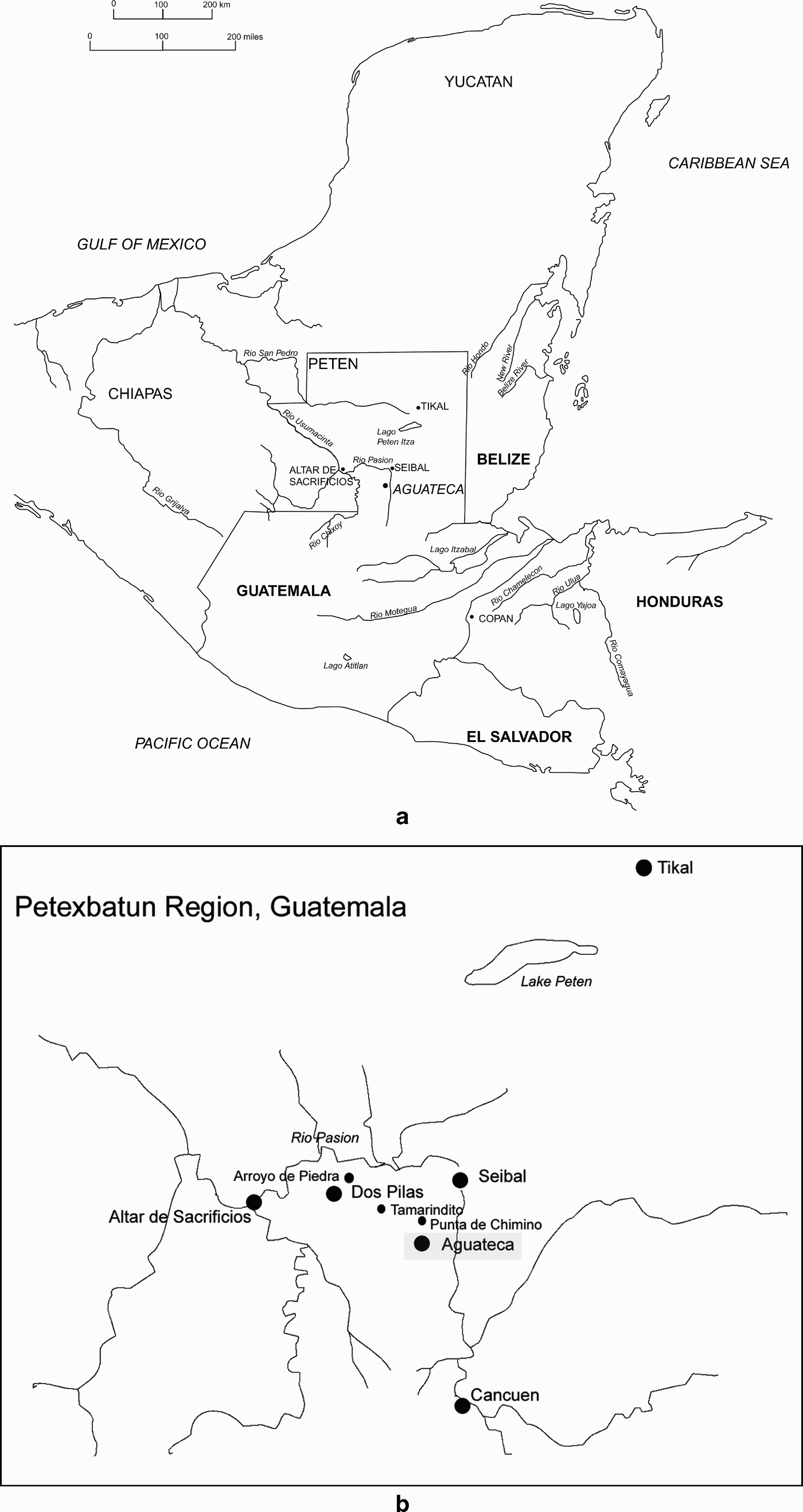
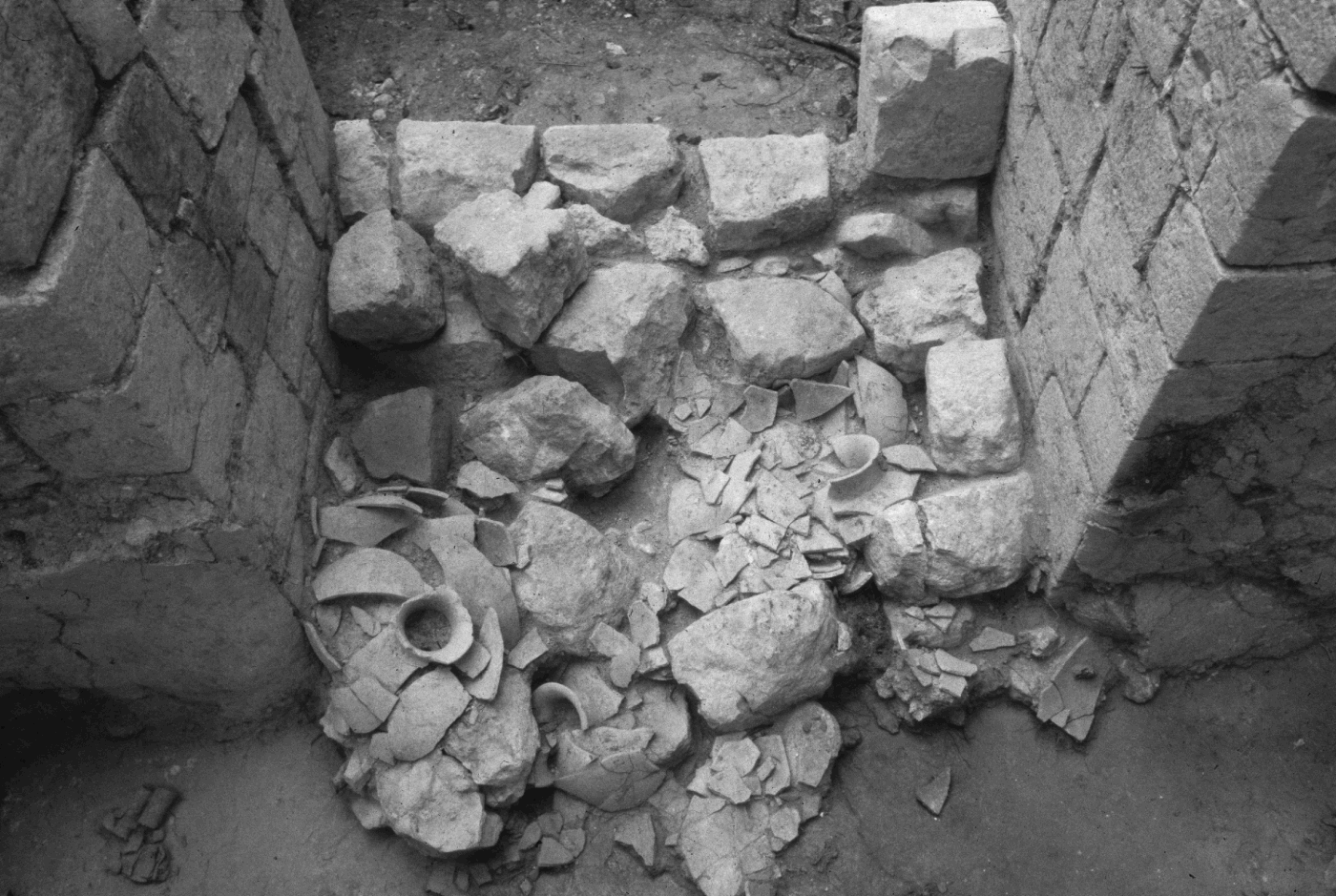
The site of Aguateca, located in the Petén region of the southern Maya Lowlands (Figure 1), has provided a unique assemblage of faunal and lithic artifacts and distribution data (Inomata Reference Inomata1997, Reference Inomata, Webb and Inomata2000, Reference Inomata, Inomata and Houston2001a, Reference Inomata2001b, Reference Inomata, Inomata and Webb2003; Inomata and Houston Reference Inomata and Houston2001; Inomata and Stiver Reference Inomata and Stiver1998; Inomata and Triadan Reference Inomata and Triadan2000, Reference Inomata, Triadan and Christie2003; Inomata et al. Reference Inomata, Triadan, Ponciano, Terry and Beaubien2001; Inomata et al. Reference Inomata, Triadan, Ponciano, Pinto, Terry and Eberl2002). Here, an attack by invaders at the end of the site's occupation was so sudden that the residents of the elite core abandoned their belongings and fled, leaving their homes to be burned by the intruders. The rapid abandonment and immediate burning and collapse of many of the elite homes provide archaeologists with an encapsulated record of activities on the last day of occupation. Detailed horizontal excavations by the team led by Takeshi Inomata and Daniela Triadan have recorded exact placement of all material types across the household floors for many of the rapidly abandoned elite structures (Figure 2). The correlation of faunal- and lithic-artifact distribution provides household-level use-based patterning of both bone/shell-working debitage and final products and the lithic tools used in the processing of bone, shell, meat, and hide—and an opportunity to answer pivotal questions about bone-tool crafting with stone implements.
(a) Map of the Maya area with locations of sites mentioned in the text; (b) detailed map of the Petexbatun region including location of Aguateca and other Petexbatun sites. Maps by Kitty F. Emery.
Structure M7-22, distribution of artifact assemblage on the floor of the eastern-most room. Note the in situ complete vessels. Photograph by Takeshi Inomata.
This paper will therefore address the questions of how, where, and by whom bone and shell tools were manufactured within elite households. Specifically, we ask where and how bone/shell-artifact production occurred spatially within each elite household and across the elite core of the site. The answers to these questions provide a basis for the discussion of both the organization of craft production at Aguateca and the role of the Aguateca elite community in this crafting.
QUESTIONS OF CRAFTING IN THE MAYA WORLD
Who were the craft producers in the ancient Maya world? How did they ply their crafts, and where? What are the implications of craft production for ancient Maya economics? These questions have recently been the center of controversy in Maya archaeology, and the evidence from sites such as Aguateca has promoted a reevaluation of our understanding of ancient Maya crafting and artifact production.
Of particular importance to this investigation is the question of the role of the elite and nobility in craft production. The recognition of attached or independent craft production is fundamental to understanding the organization of production and the political economy of any culture. Who produced the elaborate and beautiful status adornments used by the Maya nobility? And to what extent was this crafting done by attached or independent producers, those who created luxury items for the elite versus those who created utilitarian goods for a broader distribution (Brumfiel and Earle Reference Brumfiel, Earle, Brumfiel and Earle1987; Costin Reference Costin1991)?
Recent ethnohistoric, iconographic, and epigraphic research has suggested that the ancient Maya nobility were also scribes, crafters, and artisans actively involved in the production of artifacts and texts as attached producers creating high-status goods commissioned by their rulers (Coe Reference Coe, Houston, Mazariegos and Stuart2001; Coe and Kerr Reference Coe and Kerr1997; Fash Reference Fash1991; Reents-Budet Reference Reents–Budet1994; Stuart Reference Stuart, Sabloff and Henderson1993). This hypothesis is being tested by archaeological work in the elite residences and courts of sites such as Aguateca (Inomata Reference Inomata2001b). But many questions remain to be answered. To what extent was a domestic economy, characterized by independent craft production of utilitarian goods for household use, also part of Maya elite crafting? Which members of the ancient elite community were actually involved in craft production? Were there, as is suggested by other archaeological evidence at Aguateca, occupational differences among elite households within the elite core? Equally intriguing are questions of gender. Were men and women equally involved in craft production and the creation of the arts in ancient Maya society (as argued in Ardren Reference Ardren2002; Hendon Reference Hendon1996; Joyce Reference Joyce2000), or were women primarily involved in the production only of household goods and subsistence items?
The answers to these questions are not easily approached in Maya archaeology as a result of use, abandonment, and post-abandonment biases. Preservation in the Maya Lowlands is typically poor, and most craft items and production implements (including wood products, textiles, many animal products, and other perishables) are preserved only in special circumstances. The combination of these factors, together with the low production output that typically accompanies the creation and modification of craft goods, means that samples of their remains and of the tools that were used in their production are small and often unrepresentative of the original materials.
Many questions about craft activities are best answered at the household level. Although midden materials can be compared for site-level comparisons, in the Maya area the abandonment process impedes distribution analyses of activity areas because the surfaces of most structures are cleaned before abandonment and materials are either discarded or, in the case of valuable and durable materials, curated and removed by the residents (Inomata Reference Inomata2001b; Inomata and Triadan Reference Inomata and Triadan2000). Buildings are sometimes then reoccupied by squatters, which further distorts the patterning evidence (Demarest Reference Demarest1997; Harrison Reference Harrison1999:192–199).
However, at the site of Aguateca, the effect of rapid site-core abandonment, immediate wholesale burning, and lack of secondary looting significantly improves the odds of recovering high-quality data on activities within ancient elite Maya households. In many of the households, artifacts remained in their approximate discard position from the moment of attack until the moment of excavation by the Inomata team. It is most likely that they reflect activities at or near the moment of abandonment. The clear relationship between structures and artifact assemblages has allowed Inomata to define the status of the household residents (on the basis of architectural and archaeological markers) as among the highest-status or elite members of the Aguateca occupants and, likely, members of the nobility and ruling family, including the king, immediate family, and extended family (Inomata and Triadan Reference Inomata, Triadan and Christie2003; Inomata et al. Reference Inomata, Triadan, Ponciano, Pinto, Terry and Eberl2002:318–320).
AGUATECA: THE STUDY SITE
The Aguateca project was carried out in several phases under the direction, first, of Inomata as part of the larger Petexbatun Regional Archaeology Project directed by Arthur Demarest (Vanderbilt University), and later of Inomata and Daniela Triadan as the Aguateca Archaeology Project (Inomata Reference Inomata1995, Reference Inomata1997; Inomata and Triadan Reference Inomata, Triadan and Christie2003; Inomata et al. Reference Inomata, Triadan, Ponciano, Terry and Beaubien2001; Inomata et al. Reference Inomata, Triadan, Ponciano, Pinto, Terry and Eberl2002). The main research impetus has been the specific reconstruction of the details of courtly life in the Late Classic Maya world.
Located at the southern end of the Petexbatun escarpment, Aguateca was a medium-size center compared with sites in the Maya world as a whole, but it was one of the largest and politically most important sites of the Petexbatun region. The site was occupied from the Preclassic to the end of the Late Classic period, but most of the construction found at the site dates to between a.d. 600 and 830. During the late eighth century, Ruler 5 (Tahn Te'K'inich) of the Dos Pilas/Aguateca dynasty used Aguateca as the seat of power (Demarest Reference Demarest1997; Houston Reference Houston1993; Inomata Reference Inomata1995, Reference Inomata1997; Inomata and Stiver Reference Inomata and Stiver1998; Martin and Grube Reference Martin and Grube2000). This final ruler constructed palisaded stone walls to protect against invasion. Aguateca was also defended by the steep escarpment slope on which it is located and by the grieta, a deep natural limestone crevasse. Despite this protection, occupation at the site ended in a final and devastating attack on the elite core in a.d. 810. Although the ruling family had time to escape with some of its belongings, the rest of the elite residents abandoned their goods and fled. The attackers then burned the residences and, as walls and roofs collapsed inward in many structures, created “Pompeii-style” collections that preserve a clearly defined elite court encapsulated in sealed deposits (Inomata Reference Inomata, Webb and Inomata2000, Reference Inomata2001b; Inomata and Houston Reference Inomata and Houston2001; Inomata and Triadan Reference Inomata and Triadan2000, Reference Inomata, Triadan and Christie2003; Inomata et al. Reference Inomata, Triadan, Ponciano, Terry and Beaubien2001; Inomata et al. Reference Inomata, Triadan, Ponciano, Pinto, Terry and Eberl2002).
Investigations by Inomata, Triadan, and their crew have revealed three roughly concentric zones of habitation (Figure 3). At Aguateca's epicenter are the heavily defended elite and ceremonial core, including the Palace Group, or residences of the royal family; the causeway residences to the south of the main palace residences; the main plaza with which it connects; and the secondary causeway and terminal group of Granada.
Aguateca site map showing locations of central elite core (lower image with structures labeled), Granada Group, and the Barranca Escondida. Maps modified from originals by Takeshi Inomata.

The causeway likely served as a public space connecting the Palace Group (Structures M7-22 and M7-32 are studied here) and the main plaza. Along its edges are a series of rapidly abandoned elite residences (Structures M8-10, M8-13, M8-8, and M8-4 are discussed here) and nonresidential structures (M7-34, M8-2, M8-3, M7-91, and M7-92 are discussed here). Most of the structures have multiple rooms and are well constructed, with plastered floors and central room benches. Their floor assemblages include finely carved shell and bone ornaments, greenstone beads, and high-quality polychrome ceramics, indicating the wealth and nobility of the residents and allowing them to be defined as elite members of the Aguateca society (Inomata and Triadan Reference Inomata, Triadan and Christie2003; Inomata et al. Reference Inomata, Triadan, Ponciano, Pinto, Terry and Eberl2002:318–320). However, one of these residences, M8-13, is apparently of somewhat lower status, since it is impoverished in both architecture and artifacts (Inomata Reference Inomata1997; Inomata and Triadan Reference Inomata, Triadan and Christie2003). The humble appearance of this residence and its assemblage of artifacts suggest that residents of lower rank may have lived and worked in this area, although it is always possible that the archaeological and architectural markers do not accurately reflect the status of the building's inhabitants.
Several of the causeway structures are not readily confirmed as residences. Two of them (M8-2 and M8-3) may be either special manufacturing loci or residences of low-status individuals, based on their artifact assemblages and construction form (Inomata and Triadan Reference Inomata, Triadan and Christie2003; Inomata et al. Reference Inomata, Triadan, Ponciano, Pinto, Terry and Eberl2002). Structure M7-34, or the “House of the Metates,” may have played a role as a communal house (Inomata and Triadan Reference Inomata, Triadan and Christie2003). In front of its walls, excavators found lines of stones surrounding two small areas that may have been foundations for small, perishable huts (Structures M7-91 and M7-92) constructed late in the site's occupation.
At the farthest end of the causeway is the “Barranca Escondida,” a portion of the grieta containing Early and early Late Classic stelae fragments. Traversing west from the main plaza is a possible causeway ending in the Granada Group, another important elite residential zone (Structures L8-70 and L8-62 are discussed here). These areas were test-pitted rather than horizontally excavated, so our evidence includes not structure contents but, rather, midden material associated with the group.
STUDY METHODS
The Aguateca faunal and lithic assemblages recovered and examined here are entirely from residences of the upper echelon of society, although M8-13 may have been slightly lower in status than the other clearly elite and noble households along the causeway. Status assignments have been based on evaluations made by Inomata and crew. We and they feel confident that, at this site, architecture and archaeological assemblages accurately reflect the status of the household occupants. This issue is discussed in greater detail by the excavators of the site (Inomata and Triadan Reference Inomata, Triadan and Christie2003). With the exception of the Granada Group and Barranca Escondida, all excavations were horizontally extensive and included detailed artifact distribution-point plotting and post-excavation artifact reconstruction. Each of us reviewed our materials separately and according to best practice in our fields. We then correlated the remains at the level of rooms within structures to provide a view of bone/shell-artifact production at both the activity area/household and community/site level. We use only artifacts found in final occupation layers (levels 1–3) to ensure that all remains are roughly contemporaneous and likely associated with final occupation of the structures. Following Patrick Vaughan (Reference Vaughan1985), we counted each portion of a lithic artifact with interpretable use wear as an independent use zone (IUZ). All calculations rely on relative faunal NISP (number of identified specimens) and lithic IUZ frequencies to counteract variability in sample size between subassemblages.
Zooarchaeological identifications were completed by Kitty Emery using comparative materials from the Royal Ontario Museum and the Florida Museum of Natural History. Basic identification procedures included the full taxonomic, element, sex/age, and modification analysis, although only the modified remains are presented here. (For full taxonomic details of the Aguateca assemblage, see Emery Reference Emery, Inomata, Ponciano and Triadan1998, Reference Emery, Ponciano, Inomata and Triadan1999, Reference Emery2002, Reference Emery2008b).
The artifactually modified bone and shell remains from Aguateca were described according to production stage, method of manufacture, and artifact type. The production-stage classification used to define the Aguateca worked materials is based on a descriptive taxonomy derived in the analysis of almost 10,000 worked bone and shell remains from a household group at the neighboring site of Dos Pilas, Petexbatun. This original Dos Pilas study, completed in 1997, presented a framework for the classification of bone/shell-working debitage and a reduction hierarchy to describe the process of bone/shell-artifact production. The descriptive taxonomy of artifactual alterations compiled information on modification type, location on the skeletal element, and modification activity that would have produced each alteration. This alteration taxonomy was then combined with a species taxonomy to create a model of the sequence of activities involved in the reduction of each bony element of each species into the several artifact varieties. This sequence was presented as a linear reduction hierarchy that could be applied to any assemblage of bone or shell debitage. The details of this foundation study are presented elsewhere (Emery Reference Emery1997, Reference Emery, Choyke and Bartosiewicz2001, Reference Emery2008a, Reference Emery2008b).
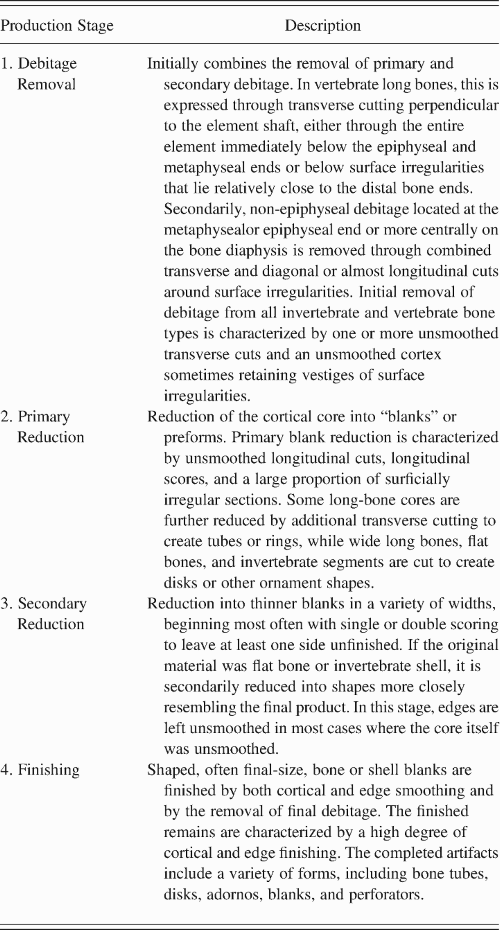
The classification system used for the more limited Aguateca sample followed the reduction hierarchy defined in the 1997 study. It was verified through a similar process of compilation artifact and species taxonomies, because several new species and artifact types were introduced to the hierarchy with the Aguateca materials. The Aguateca reduction sequence simplifies several of the original hierarchy definitions into a four-stage reduction process, beginning with early stages (1 and 2) of debitage removal and primary reduction, and late stages (3 and 4) of secondary reduction and finishing (Figure 4). This production sequence is described in Table 1.
(a) An idealized reduction hierarchy for the Aguateca assemblage using an Artiodactyl humerus as an example; (b) Aguateca bone remains including a juvenile Artiodactyl humerus (Stage 1 epiphyseal debitage removal), an adult Artiodactyl tibia (Stage 1 secondary debitage removal), and two examples of mammalian long-bone diaphysis fragments (Stage 2 reduction and Stage 3 secondary reduction); (c) Aguateca shell remains, including three Olividae tinklers in Stage 1 debitage removal (of spire).

Classification of bone/shell-production sequence
Only a small number of researchers have conducted detailed analysis of stone-tool use in Maya archaeology, and very few have used the high-power-microscopy approach developed by Lawrence Keeley (Reference Keeley1980). This technique has great potential for answering important questions regarding craft production, as well as the domestic and ritual lives of the ancient Maya (Aldenderfer Reference Aldenderfer1991; Aldenderfer et al. Reference Aldenderfer, Kimball and Sievert1989; Aoyama Reference Aoyama1995, Reference Aoyama1999, Reference Aoyama2001b, Reference Aoyama2005, Reference Aoyama2007; Lewenstein Reference Lewenstein1987, Reference Lewenstein, Hester and Shafer1991; Sievert Reference Sievert1992; Stemp Reference Stemp2001). In 1987, Kazuo Aoyama conducted an intensive experimental study of use wear on obsidian and chert in Honduras to establish a framework for interpreting Maya stone-tool use (Aoyama Reference Aoyama1989). The results of 267 replication experiments conducted with a range of worked materials (including Gramineae [grasses], wood, meat, hide, leather, bone, antler, shell, soil, and stone) permitted the identification of use-wear patterns based on the high-power-microscopy approach. Aoyama controlled independently three variables: (1) motion of use (sawing, cutting, grooving, scraping, whittling, boring, and chopping); (2) worked material; and (3) number of strokes.
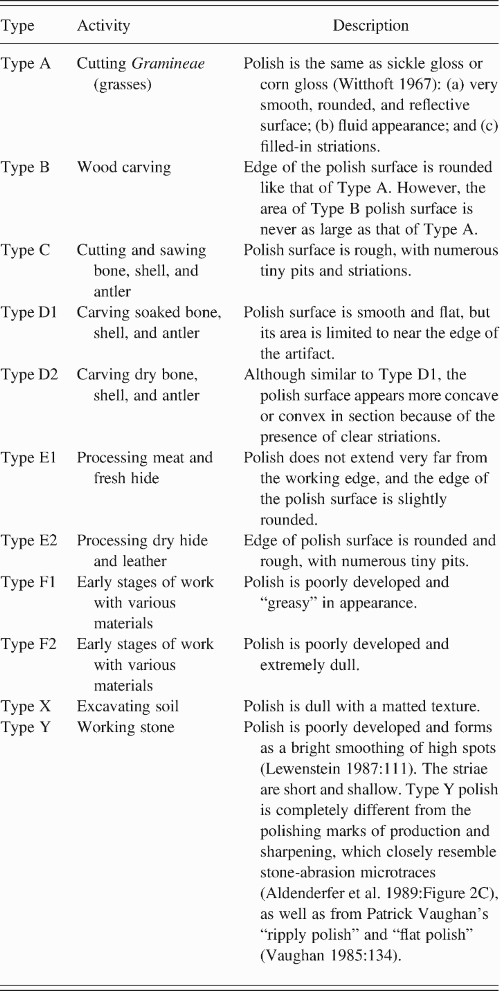
Recent studies run counter to Keeley's statement that there is an absolute correlation between polish type and contact material (e.g., bone polish, hide polish, meat polish). They demonstrate that both the type of motion and number of strokes can influence the formation of polish (Kajiwara and Akoshima Reference Kajiwara and Akoshima1981; Vaughan Reference Vaughan1985). In the face of such difficulties, following Hiroshi Kajiwara and Kaoru Akoshima (Reference Kajiwara and Akoshima1981), Aoyama identified 11 basic types of polish on chert artifacts that are principally (but not absolutely) the result of the material worked (Table 2). The polish types include Types F1 and F2, which often appear at early stages of work that culminates in more diagnostic polish Types A, B, C, D, or E that became distinguishable after 500 strokes in our experiments (Aoyama Reference Aoyama1999:38). Because different polish types frequently can be observed on the same edge, a complex of different polish types is described as a combination of a principal type and a secondary type, such as BF1, D2C, and E1F2.
Polish types on chert artifacts
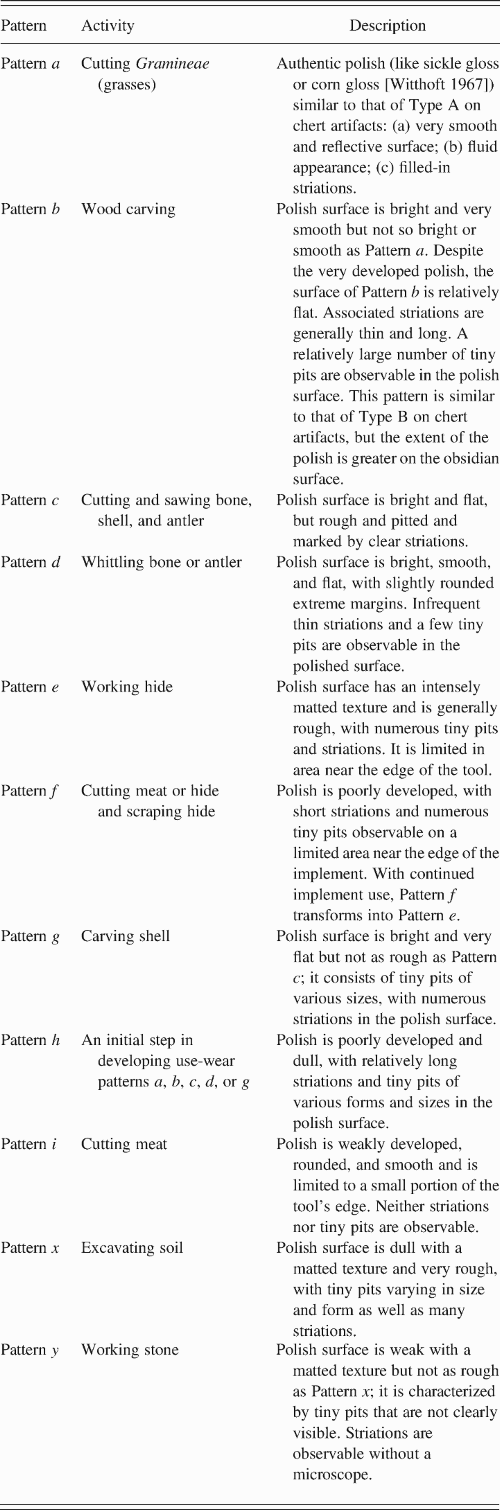
Because obsidian is a natural, volcanic glass, and its surface is usually more vulnerable than that of chert, striations form more readily on the surface of obsidian than on chert. Furthermore, not all types of obsidian polish are very similar to those on chert. Consequently, Aoyama classified use wear on the obsidian tools into 11 patterns, based on combined observation of the striations, polish, and tiny pits on their surface (Table 3; for a detailed description of the use experiments and more examples of photomicrographs, see Aoyama Reference Aoyama1989, Reference Aoyama1995, Reference Aoyama1999:39–47). Aoyama then analyzed microwear on a total of 3,232 chipped-stone artifacts from the Copan Valley and the region of La Entrada, Honduras (Aoyama Reference Aoyama1995, Reference Aoyama1999). This framework was used as the basis for the use-wear studies of the lithic artifacts from Aguateca (Aoyama Reference Aoyama2005, Reference Aoyama2007). The instrument used in the study was a metallurgical microscope of 50–500× magnification (used most frequently at 200 × ) with an incident-light attachment (Olympus BX60M). Use-wear patterns were documented with an Olympus photomicrographic system PM-10M attached to a camera (Olympus C-35DA-2).
Use-wear patterns on obsidian artifacts
STUDY RESULTS
Between 1993 and 2003, we independently identified and analyzed the complete Aguateca zooarchaeological and lithic assemblages (Table 4). The lithic assemblage includes 10,845 remains classified by Aoyama from 1998 to 2003 according to their raw material. Of these, 8,322 artifacts were from a chipped-stone industry, and the remaining pieces were polished stone and other kinds of stone artifacts. Most chipped-stone artifacts were manufactured from chert; the rest were manufactured from obsidian. Aoyama analyzed microwear on a subsample of 2,961 of the Aguateca lithic artifacts using high-power microscopy to study stone-tool use. This subsample was chosen randomly from floors and other final occupation layers. Of these, 2,922 pieces were obsidian (N = 1,151) and chert (N = 1,771) chipped-stone artifacts. These samples, making up 35.1 % of the total chipped-stone artifacts collected by the Aguateca Archaeological Project First Phase, provided the basis for a statistically controlled estimate of proportions of activities performed with chipped-stone artifacts. Microwear was identifiable on approximately half of the unburned artifacts, on more than 80% of the obsidian artifacts, and on almost a third of the chert artifacts.
Material and category counts for the Aguateca lithic and faunal assemblages
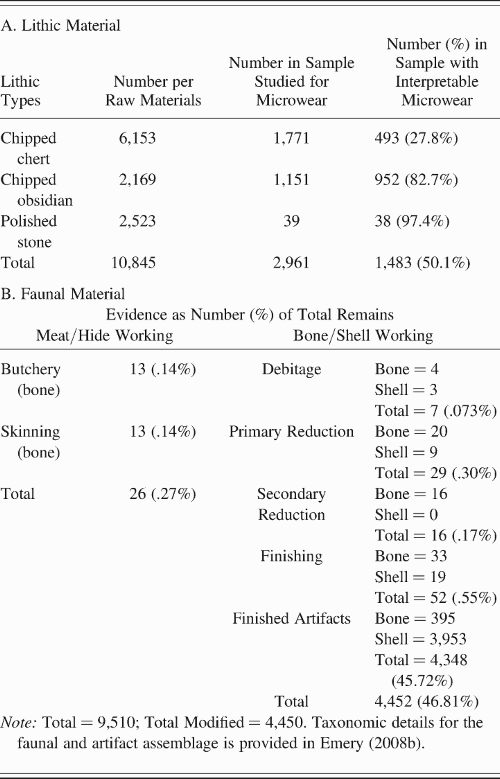
The Aguateca faunal assemblage analyzed by Emery and presented here included 9,510 bone and shell remains. The 4,452 worked remains represent 46.81% of the total faunal assemblage of the Aguateca Archaeological Project First Phase, while evidence for butchering, skinning, or other bone marking is found on only .27% of all remains. The remains included various invertebrates (gastropods, bivalves, and coral, all classified as shell) and skeletal elements from all vertebrate classes (including bones, teeth, and antlers, all classified as bone). Most of the worked faunal remains were finished artifacts, including perforators (awls, needles, pins, and unidentified pointed objects) and spatulae, disks, plaques and carved-bone segments, beads, and flutes, tubes, rasps, and paintbrush holders. A few bone hooks and shell bowls and grinders rounded out the collection (Emery Reference Emery, Ponciano, Inomata and Triadan1999). Only 104 examples of production debitage from the working of bone and shell materials were recovered, representing a total of 2.34% of the modified assemblage and only 1.09% of the total analyzed sample. However, this is a large assemblage compared with those found at other sites in the region (Emery Reference Coe and Kerr1997). Seven of the modified remains are debitage from primary removal of surface irregularities, including epiphyses and metaphysis muscle attachments and foramena, while 29 are the remains of primary reduction of the bone or shell into unsmoothed segments. The remaining examples are of secondary reduction and finishing, representing thfe shaping, smoothing, or decoration of artifacts.
Artifact-Production Methods
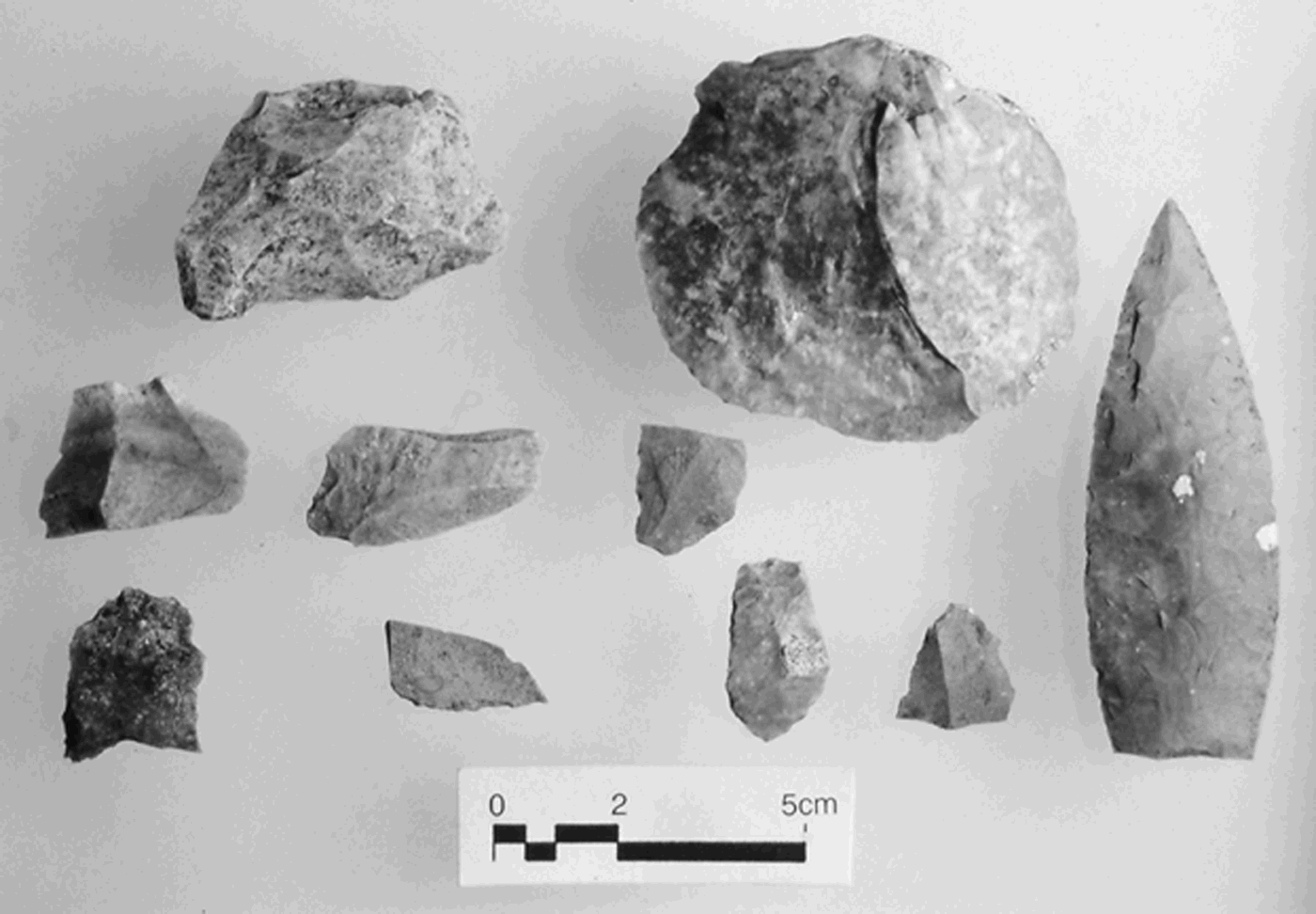
Aoyama identified IUZs associated with bone or shell working in the creation of artifacts on different types of chipped-stone artifacts (Table 5). However, the distribution of use wear on these tools indicates that bone and shell working was not the primary activity for any lithic-artifact type and that a diverse range of tools was used for this craft. Obsidian prismatic blades were used occasionally for cutting and whittling bone and shell; most of this work was done with chert artifacts. In contrast, at Copan (where obsidian was more abundant), some prismatic blades, as well as macroblades, prismatic blade points, and bifacial points. were used for bone and shell working (Aoyama Reference Aoyama1995:Table 3). At Aguateca, all chert tools except denticulates were used to some degree for cutting bone (Figure 5). Unretouched chert flakes, bifacial thinning flakes, bifacial points, a scraper, and even chunks were used for grooving; unretouched flakes, bifacial thinning flakes, scrapers, a bifacial point, a denticulate, and a chunk were used for whittling; and only bifacial points and drills were used for boring.
Production methods and evidence for use-wear patterns on lithic and faunal materials from the Aguateca assemblage
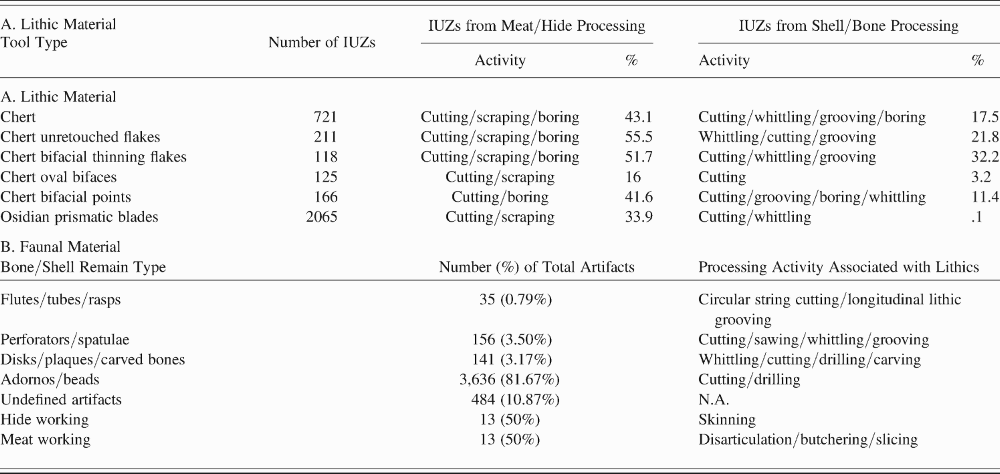
Note: IUZ = independent use zone; N.A. = not applicable; hide and meat working are assumed from marks on bones.
Chert artifacts (unretouched flakes, bifacial thinning flakes, a bifacial point, a scraper, and a denticulate) used for bone and shell working, Aguateca, Late Classic period.
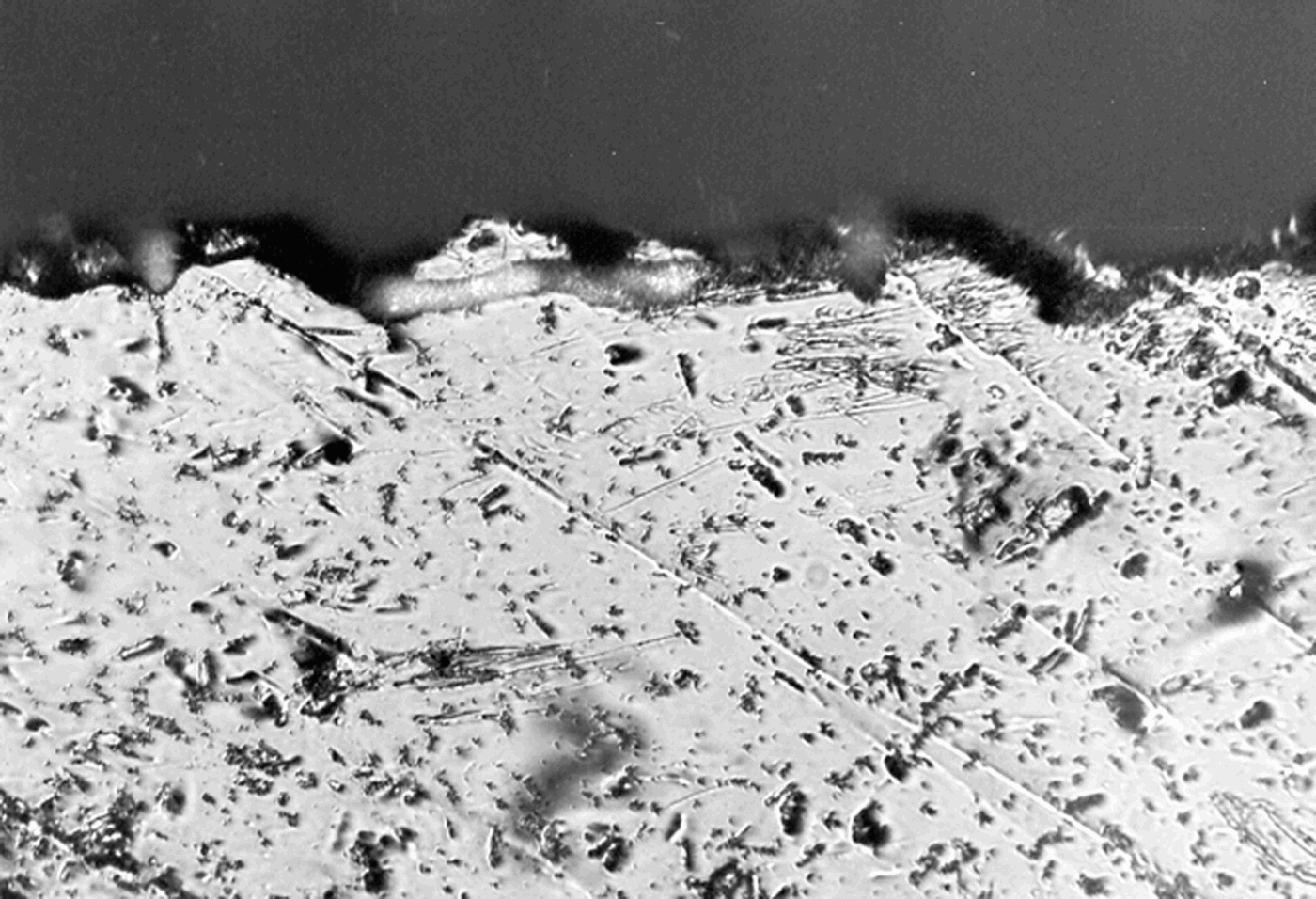
The Aguateca bone and shell artifacts show evidence of working with lithic tools in a variety of ways, including percussion for both fracturing and flaking; sawing to cut segments; abrasion for grinding, smoothing, and polishing; and chipping for whittling or carving (Figure 6). Other polishing agents and cutting materials such as abrasives and string were likely also used (Moholy-Nagy Reference Moholy–Nagy1994, Reference Moholy–Nagy2003; Wake Reference Wake1999). The virtual absence of spiral fracture debitage and bone or shell chips resulting from flaking or whittling suggests that these were less common reduction methods.
D2 type polish and parallel striations on a lateral edge of chert tertiary flake used to cut shell or bone, from Structure M8-4, Aguateca, Late Classic period (200× magnification). The polish surface of Type D2 appears convex in section because of the presence of clear striations.

In addition to the production debris in the faunal assemblage, 26 examples of marks from meat/hide working were found on the faunal remains, including skinning and butchery (disarticulation/cutting marks). These marks suggest butchering activities and the production of leather and textiles. Use-wear evidence for meat and hide working were also recovered from the Aguateca lithic assemblage (Figure 7). Meat and hide working were the primary activities for most tools. This is in contrast to bone and shell working, for which most tools were used only occasionally. All lithic artifacts except drills and a flake core used in meat or hide working were used for cutting. Obsidian prismatic blades and a flake, as well as chert bifacial thinning flakes, casual flakes, scrapers, a denticulate, a flake core, and an oval biface, were used for scraping hide. But only one obsidian prismatic blade point, chert bifacial points, casual flakes, and drills were used for boring hide.
Use-wear pattern f and parallel striations on obsidian prismatic blade proximal segment used to cut meat or hide from Structure M8-2, Aguateca, Late Classic period (200× magnification). The polish is poorly developed, with short striations and numerous tiny pits observable on a limited area near a lateral edge.
Site-Level Spatial Analysis of Animal and Lithic Use Wear
Lithic evidence for bone and shell carving was detected in seven of the extensively excavated structures. Most of the lithics used in these activities were recovered from Structures M8-10/M8-13 and M8-4 (Table 6). Most of the faunal artifacts and production debitage came from Structures M7-22, M7-32, M8-8, and M8-4. Most structures with any bone or shell artifact assemblage had some evidence of production debris, and most structures had remains from both the early (debitage removal and primary reduction) and late (secondary reduction and finishing) stages of bone/shell-artifact production. The exceptions are the Granada Group (test pits near Structures L8-70 and L8-62), and the excavations around the stela in the Barranca Escondida, which contained no production debris. However, with the exception of Structure M8-10/M8-13, the proportion of finished bone/shell artifacts to production debris in each structure is high. Most of the production debris in each structure is from secondary reduction and finishing (final stages of artifact production), except at M8-10/M8-13, M7-34, and M7-32, where early-phase reduction is predominant. With the exception of M7-34, these are also the only loci with evidence of primary production debitage. In fact, only in M8-10/M8-13 is primary debitage a significant component of the modified assemblage, and here early-phase production debris represents half of the modified assemblage. Unfortunately, this sample is fairly small compared with others across the site.
Distribution of faunal and lithic evidence for bone/shell and meat/hide working at the various structures of Aguateca
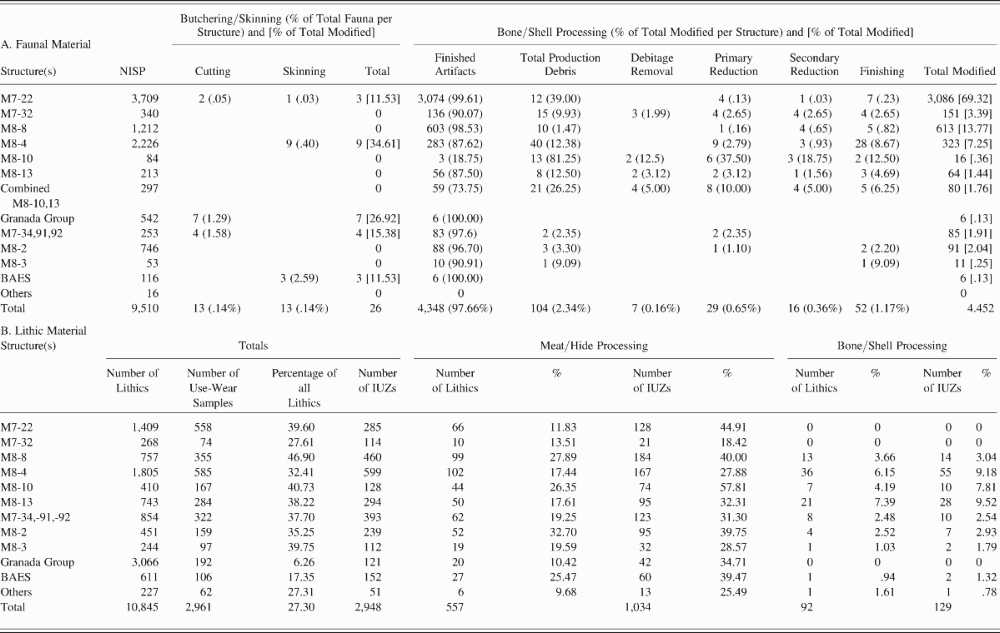
This table includes both residential and non-residential structures; BAES = Barranca Escondida; IUZ = independent use zone; NISP = number of identified specimens.
Spatial evidence for meat/hide working among the faunal remains was significantly different from the distribution of bone/shell working. Three of the Aguateca skinning marks were found associated with the Barranca Escondida; the other was associated with the Palace (M7-22). Most of the skinning marks were found in and around Structure M8-4, which is also where most of the remains of bone-artifact production were found. Butchery marks were found in the palace (disarticulation of felines), in middens close to Structures L8-62 and L8-70 of the Granada Group, and in the M7-91 and M7-92 structures fronting the communal House of the Metates (Structure M7-34). Meat and hide processing was identified by use-wear analysis on lithics from all 10 extensively excavated structures. Most of the lithics used for these activities were found in Structures M7-22, M8-8, and M8-2.
Household Distributions of Artifacts and Lithic Use Wear
Structure M7-22 (House of the masks)
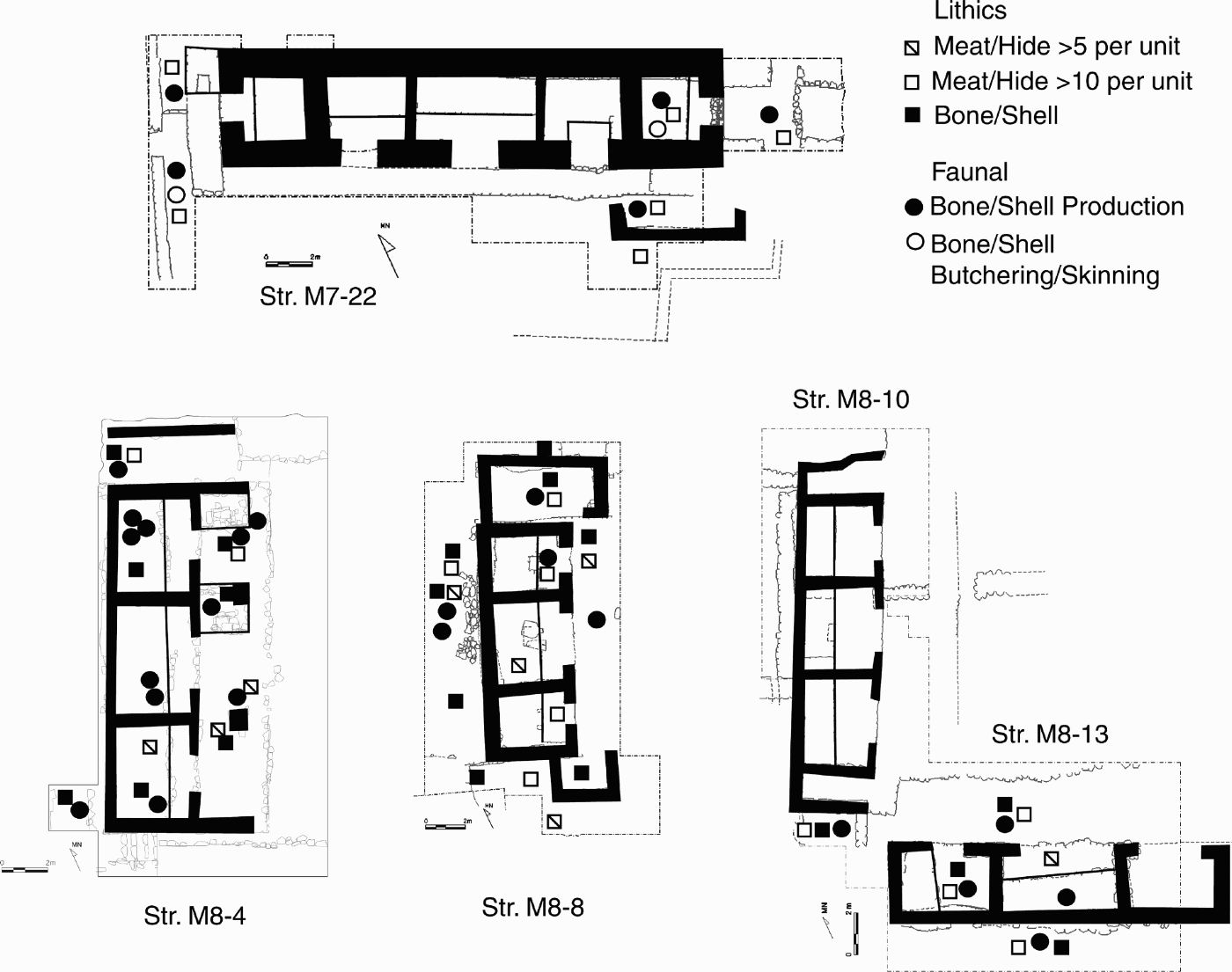
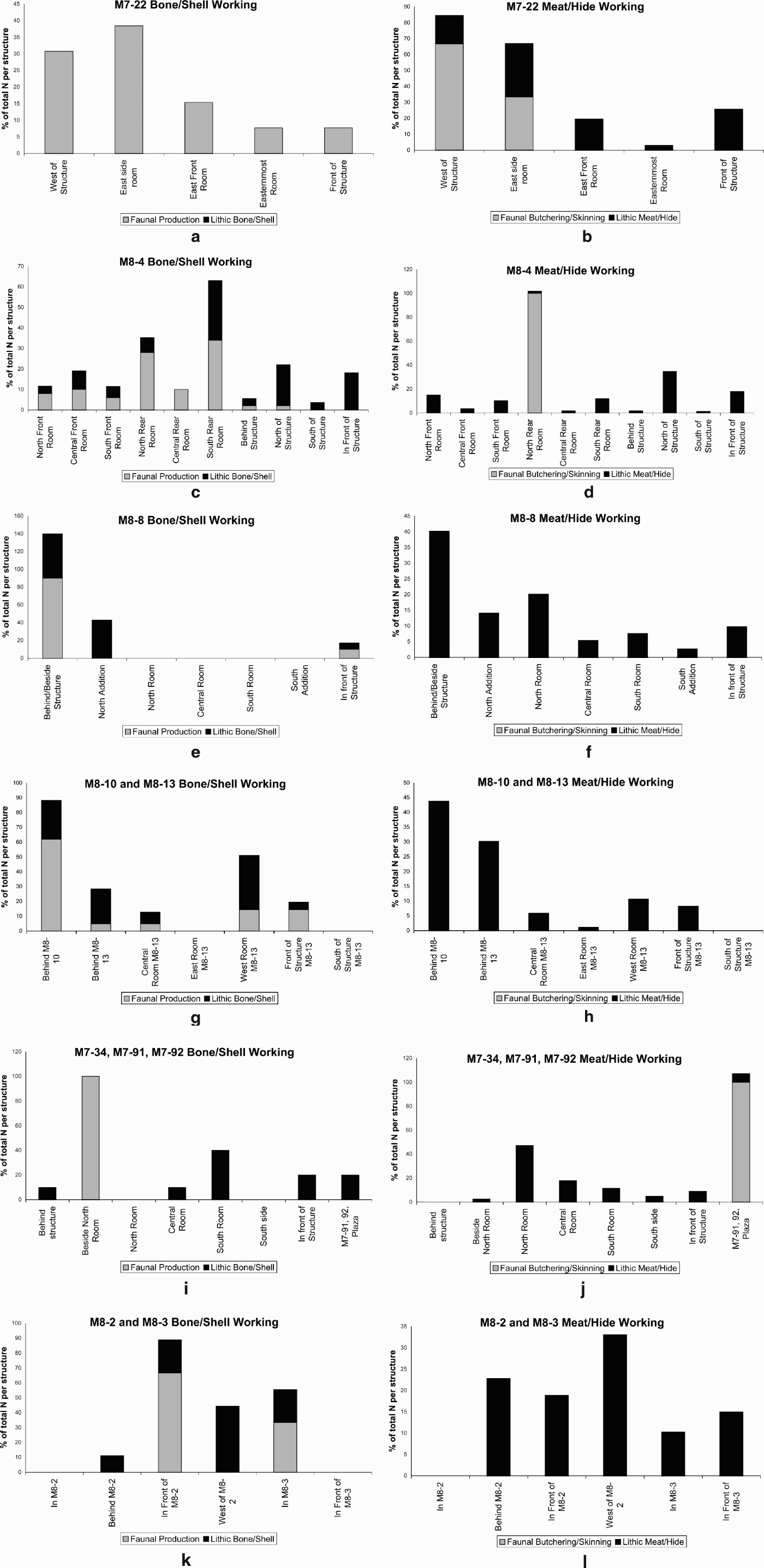
Structure M7-22 was the royal palace and administrative complex and was the largest residential complex at Aguateca (Inomata and Triadan Reference Inomata, Triadan and Christie2003; Inomata et al. Reference Inomata, Triadan, Ponciano, Terry and Beaubien2001). The structure was vaulted (one of only two such structures at the site) and had five rooms (Figure 8). The Palace Group was abandoned gradually, and most of the property was removed before the attack. However, the easternmost room of this structure was sealed with many rich remains inside (including the masks for which the building is named, made of a thin ceramic complex and likely part of the theatrical regalia of Tahn Te'K'inich), many of which seem to have spilled out into the east room during the attack (Inomata Reference Inomata, Inomata and Webb2003; Inomata et al. Reference Inomata, Triadan, Ponciano, Terry and Beaubien2001:294). The lithics recovered from this easternmost room, from east of the structure, and from in front of the eastern rooms included blades used in processing meat or hide, as well as those used in wood carving, but no evidence for shell or bone carving was recovered (Figure 9a–b). More such blades, again used in processing meat and hide, were found to the west of the structure.
Residential structures of the Aguateca elite core showing distributions of lithic and faunal evidence for meat/hide and bone/shell working. All structures are presented at approximate northward orientation and at the same scale. Structure walls are interpreted from drawings by Takeshi Inomata; structure maps are by Kitty F. Emery, based on original field drawings by Inomata.
Histograms of distributions of faunal and lithic evidence for bone/shell and meat/hide working from each excavated structure at Aguateca. The Y axis represents the number of remains of each material type found in each location, expressed as a percentge of the total for the structure. The chart includes all structures, both residential and nonresidential, for which horizontal excavation data are available. The Barranca Escondida and Granada Group structures were test pitted only, so distributions are not available.
In the easternmost room, a deer bone was found with several skinning marks that correlate well with the lithic evidence for meat and hide cutting, as well as both secondary reduction and reworking of perforators possibly used in hide processing (along with 23 finished perforators). Shell disks in the final stages of production and unmodified dog teeth were found east of the sealed room and in front of the easternmost room. Other butchering marks, this time from disarticulation, were found on two feline elements west of the structure; several more shell adornments, both unmodified and in the process of finishing, were found in the same general location. The material west of the structure may represent midden trash or termination-ritual accumulations unassociated with the original residents of the structure, so their original placement cannot be confirmed.
Structure M8-4 (House of the mirrors)
Structure M8-4 is located adjacent to the Palace Group and was occupied by an elite courtier/scribe and the nuclear family (Inomata et al. Reference Inomata, Triadan, Ponciano, Pinto, Terry and Eberl2002:310–318). The structure includes three main rooms and a north addition (Figure 8). In the south room, more than 300 pyrite mosaic mirror pieces were found with bone plaques and an alabaster Jester God diadem that were likely parts of a composite royal adornment that Ruler 5 is depicted as wearing on many of the standing monuments around the site (Inomata et al. Reference Inomata, Triadan, Ponciano, Pinto, Terry and Eberl2002:315). This find, along with several bone artifacts carved with the Aguateca emblem glyph, suggests that the residents of this structure were involved in the creation of the royal regalia and were trusted members of the court.
The House of the Mirrors offers an excellent sample of bone/shell-production material in correlation with lithics used for bone/shell and meat/hide working (Figure 9c–d). A total of 599 IUZs were found in the structure, of which 9.2% were from shell/bone carving and 28% were from meat/hide cutting (most were from wood carving).
The percentage of lithic microwear indicating shell or bone working from the south room (26.7%) is the highest registered for the site (Aoyama Reference Aoyama2007). The artisan probably used chert bifacial points, bifacial thinning flakes, and other flakes for their work here. Use-wear analysis provides evidence of bone/shell whittling and cutting in the front of the room and of whittling, cutting, and grooving on the room bench itself. Consistent with this evidence are the remains of shell-adornment finishing (in front) and bone-plaque reduction and finishing (primarily on the bench itself). Shell-production and -finishing debitage is also found in combination with lithics used for cutting bone/shell behind the south part of the structure. It is possible that, before abandoning the structure, the artisan was in the process of finishing the plaques to adorn the diadem regalia in this southern room.
Obsidian prismatic blades and polyhedral core fragments found in the north room were used for craft production of wood, while chert bifacial thinning flakes, a drill, bifacial picks, and casual flakes served for carving shell or bone objects. Complementary faunal evidence of shell production in the front of the room, and antler and bone reduction in the rear of the room, are found along with evidence of butchering of a large mammal. Other lithics used for cutting and whittling bone/shell, together with bone-reduction debris, were found to the north of the structure.
The central room has much less evidence for bone and shell production, but in the front of the room, both lithic evidence for cutting, whittling, and grooving bone/shell and faunal evidence for the production of shell adornments were found. In the rear of the room, there are several faunal examples of bone reduction and finishing, although no lithic evidence was found for such working.
Evidence for meat and hide processing is extremely abundant in this structure, and examples of lithics with use wear from these activities were found in almost every unit. However, this ubiquity does not extend to the center of the structure, where only four of the 10 units had such evidence. The greatest amount of evidence of meat and hide processing was found in the front north room and the area north of the rear north room. Intriguingly, good faunal evidence for the skinning of animals was found in the rear north room, suggesting hide production in this northern rear section of the structure. Less evidence of meat/hide working was found in the southern room, and it is possible that the crafting activities carried out in this location included leather cutting.
Structure M8-8 (House of the Axes)
The House of the Axes was also the residence of an elite noble, likely a scribe and artisan (Inomata and Triadan Reference Inomata, Triadan and Christie2003; Inomata et al. Reference Inomata, Triadan, Ponciano, Pinto, Terry and Eberl2002). There is limited evidence for bone and shell working in this structure but considerable evidence for meat/hide processing (Figures 8, 9e–f). Interestingly, neither bone/shell nor lithic remains associated with animal-related artifact production shows up in any of the three main rooms of the structure. However, several lithics used to cut and whittle shell/bone are found in the addition north of the structure and in front of the north room. One example of a shell in production was also found in front of the north room, suggesting that, although the northern addition was used primarily for storage and not for actual production, some production may have occurred just outside the room in front. Interestingly, several examples of unmodified shell tinklers were recovered in the northern addition and north room, further suggesting the role of these rooms as storage locations. The unmodified shells may have been in the process of perforation for stringing but were possibly part of an already finished artifact belt or other adornment. For the purpose of numeric analysis, they are included with the finished artifacts (following the recommendation of Inomata, personal communication 2001).
Most of the information comes from the rear and south of the building. Multiple examples of lithics used for whittling shell/bone were found behind the southern addition and southern end of the structure. Again, there were no corroborating bone remains to suggest actual production here, so perhaps this area was also used for storage of lithic tools. Behind the central and northern rooms, however, were found both lithics used for cutting shell/bone and remains of secondary production and finishing of bone (mainly of bone-perforator production), a possible example of antler-tool production, and one unmodified shell tinkler. Again, this area's function is not certain, and if it is interpreted as midden, it may indicate that all bone detritus was discarded behind the structure prior to abandonment. However, the more likely explanation for the area is as a work space, suggesting that actual bone working was carried out behind the north room.
This structure, like Structure M8-4, was literally littered with lithics showing evidence of meat and hide cutting, as well as of hide scraping and boring. Although these were found in almost every area of the structure, most examples were found in the northern addition, in front of the north and south rooms, and behind the northern and southern ends of the structure. Again, there are no exemplars of animal bones bearing skinning or butchering marks, so it is likely that, regardless of whether these use-wear marks were made during food production or hide processing, the original bony remains were discarded elsewhere previous to the abandonment of the structure.
Structures M8-10 (House of the scribe) and M8-13
Structure M8-10 was the residence of an elite scribe and nuclear family (Inomata and Stiver Reference Inomata and Stiver1998:441; Figure 8). That the residents here were of high status is attested by the rich artifacts found in the home, many of which were the implements of a scribe, and several artifacts confirming a strong connection to the royal family (Inomata and Stiver Reference Inomata and Stiver1998; Inomata and Triadan Reference Inomata, Triadan and Christie2003). Structure M8-13 forms a patio group with the larger M8-10 and was likely associated with it, although M8-13 is smaller and more poorly constructed than any of the other causeway residences (Figure 8). Inomata has described M8-13 as the lower-status elite residence of a “separate co-residential group, not an ancillary building of M8-10” (Inomata et al. Reference Inomata, Triadan, Ponciano, Pinto, Terry and Eberl2002:321). The artifacts found within M8-13 are similar to those found in other structures, but most relate to essential domestic activities, and the structure lacked almost all types of prestige goods, strongly indicating a lower status and not a special function for the building or symbolic meaning for the assemblage, which might indicate an intentional “humbling” of the occupant's status (Inomata, personal communication 2006). Although they undoubtedly represented two separate domiciles, M8-10 and M8-13 are considered together because the majority of the remains associated with the structures come from a rear midden that is not clearly distinguished as belonging to either building.
Although no remains were found within Structure M8-10 that relate to bone and shell working, the rich midden beside (south of) it contained six chert bifacial thinning flakes used for bone/shell cutting and whittling and a scraper for bone/shell cutting (Figure 9g–h). Associated with this was a large assemblage of faunal remains from the production of bone perforators. It is remarkable that all of the bone-working remains and two of the shell remains were production debris. This debris includes all four production stages, although only the first three stages are well represented (again, an unusual distribution compared with the other structures, where finishing and secondary reduction are the predominant categories).
Even more intriguing is the fact that all of the bone-production debris is from the primary creation of perforators. (The shell remains are the finishing stages of shell-tinkler creation.) Since most other structures have large proportions of finished and finishing stages of perforator production (secondary reduction and finishing), it is tempting to suggest that the crafter in this residence was responsible for the primary production of bone-perforator blanks for final finishing and reduction in other households. Interestingly, there are no examples of butchering or skinning marks on any of the bones found associated with this structure, despite the large assemblage of lithics with meat/hide-working use wear on them.
A total of 264 IUZs were found within Structure M8-13, indicating the use of lithics for meat or hide processing (32.3%), wood carving (30.3%), bone or shell carving (9.5%), and subsistence activities that included cutting Graminaea and excavating soil (Figure 9g–h). The lithic distribution indicates that bone and shell working was carried out in the west room and in front of the structure. Other bone/shell-working tools found behind the structure may indicate another activity area or discard. Intriguingly, the animal remains correlate exactly to this distribution pattern.
Bone-working remains in the form of both primary reduction and secondary reduction and finishing (mainly of perforators and blanks) were found in the west room, in front of the structure, and behind it. Only one example of production of a shell adornment was found in the central room, suggesting that, if any production activities did occur in this central room, they were associated not with bone-tool production but, perhaps, with shells.
Overall, this correlated distribution suggests strongly that the residents of Structure M8-13, and possibly of M8-10, were involved in bone-tool production from the early stages of reduction through to finishing. However, no evidence of bones with butcher or skinning marks was found in either structure, despite large numbers of lithics indicating meat and hide working. It is tempting to suggest that both the production of perforators for hide working and the hide working itself were done in this area but that the initial butchering of animals to obtain hide or bones was not done here.
Structures L8-70 and L8-62 (Granada Group)
Excavations in the Granada Group included only test pits in middens near Structures L8-70 and L8-62 and were not horizontally extensive, but their evidence is an interesting counterpoint to that provided by the elite causeway structures. Here, the only evidence for animal-product use are those of primary butchering marks on various mammalian animal bones (primarily deer), likely for meat production. There is lithic evidence of meat and hide processing and none for bone/shell working. This combination is most likely the signature of domestic meat processing and, given the proportion of the butchering marks to total assemblage, possibly of butchering on a larger scale by a hunter or specialized meat processor.
Distributions of Artifacts and Lithic Use Wear in Nonresidential Structures
Structures M7-34 (House of the metates), M7-91, and M7-92
M7-34 is a nonresidential structure whose function is not clear. This large, multiroom structure is characterized by a different floor plan from the others (room partitions are found only in the rear of the building, and the front areas are divided by thin walls running parallel to the front walls) and a different artifact assemblage (including seven large basin-shaped metates found in the central and south rooms and in front of the building). Inomata has hypothesized that this was a communal house (Inomata and Triadan Reference Inomata, Triadan and Christie2003). In front of this structure, the two small structures M7-91 and M7-92 also have unusual assemblages: four basin-shaped metates were associated with Structure M7-91 and one with M7-92 (Inomata et al. Reference Inomata, Triadan, Ponciano, Pinto, Terry and Eberl2002).
There is little correlation here between the lithic and faunal evidence for bone/shell or meat/hide working (Figure 9i–j). The only fragment of worked animal material was found north of the structure and is an antler segment recently removed from the cranium, possibly for finishing into a tool (or for use in costuming). But evidence of use wear on lithic tools from shell and bone working is abundant and scattered around the structure. The lithic concentrations are in front of the structure and, to a more limited extent, behind it to the south. Lithic evidence of meat and hide processing, again ubiquitous, is concentrated in the northern and central front rooms and in front of the structure to the south. Assuming that the antler did not result from animal butchering, there is no direct faunal evidence of any animal butchering in this structure.
Interestingly, though, the small structures M7-91 and M7-92, which are quite late in date, do have assemblages with evidence of primary butchering (remains of mammal long bones with butchering cut marks on them) and use wear from both bone/shell production and meat/hide working. It is possible that these structures, if contemporaneous with the House of the Metates, were the site of the butchering that is implied by the lithic evidence of meat/hide cutting found throughout the main structure.
Structures M8-2 and M8-3
Inomata hypothesizes that Structures M8-2 and M8-3, small one-room buildings, were used for manufacturing activities, based on their artifact assemblages and architecture and the fact that these structures formed residential units together with other dwellings (Inomata and Triadan Reference Inomata, Triadan and Christie2003). However, he also suggests that they could have been residences of low-status individuals (Inomata et al. Reference Inomata, Triadan, Ponciano, Pinto, Terry and Eberl2002). In these structures, lithic evidence for bone and shell production is more limited (found around all exterior sides of M8-2 and not at all at M8-3), but the correlation between this evidence and that for bone and shell working is excellent (Figure 9k–l). Evidence for shell finishing is found both inside Structure M8-3 and behind M8-2. Evidence of the finishing and reduction of bone tools (probably perforators or possibly plaques) is found in front of Structure M8-2.
Evidence of meat and hide working is more frequent in the lithic assemblage, predominantly behind Structure M8-2 and in front of both structures. There is no corroborating bone evidence of butchering or skinning, so the likelihood is that this is evidence of hide working rather than food production. It is possible, however, as always, that the bone remains from butchering were discarded at a locale distant from the structures.
Barranca Escondida
There is no evidence of a residential function around this locus or of any other activities except those associated with the stela recovered there. Most of the lithic use-wear evidence indicates meat and hide processing, and an almost complete jaguar skeleton recovered here, with several bones (particularly metapodials) marked by skinning, suggests hide removal. It is intriguing to suggest that this animal was sacrificed and skinned at the site of this dedicatory monument (and perhaps coincident with its placement).
DISCUSSION
The combined data from faunal and lithic analysis at Aguateca allow us to approach a variety of questions surrounding the issue of elite crafting in ancient Maya cities. We have defined bone/shell-artifact-production methods and the lithic tools used in manufacture and described the spatial distribution of such production across and between households. These descriptions provide the foundation for broader discussions about crafting, craft specialization, and agency in crafting activities.
Craft Production and Community-Level Distributions
Elite crafters
The first question we have asked is whether the elite residents of this site were indeed crafters. The faunal and lithic use-wear study suggests that the Aguateca elite were indeed crafters. We suggest that the elite Maya residents of the site were involved in the production of bone artifacts, hide and other textiles, and shell adornments. It is also possible that nonresidential crafters worked in the homes of the elite and under their control, but we feel that the coincident evidence in these elite structures of raw materials, debitage, unfinished and finished artifacts, and the tools required to produce those artifacts (sometimes in apparent storage locations) lends greater support to the hypothesis of residential crafters. Our evidence does not stand alone in suggesting residential elite crafters. Many painted vessels from the Maya world depict elite artisans writing, carving, and painting (e.g., Reents-Budet Reference Reents–Budet1994), and many signed artworks indicate that the artisans were literate and probably therefore elite (Stuart Reference Stuart and Kerr1989). Other archaeological data also support the view of elite creation of both domestic and craft products. Obsidian data from Aguateca are consonant with the interpretation of Mesoamerican obsidian core-blade technology as under elite control (e.g., Aoyama Reference Aoyama1994, Reference Aoyama2001a; Clark Reference Clark, Johnson and Morrow1987; Sheets Reference Sheets and Sheets1983; Spence Reference Spence and Hirth1984) and indicate that at least some nobles were stone knappers who manufactured mainly utilitarian tools on a part-time basis. At Copan, a dump for a marine-shell-ornament production workshop was found in the royal West Court in front of Structure 10L-16 (a.d. 763–820; Aoyama Reference Aoyama1995). The results of microwear analysis on the chipped-stone artifacts from Copan suggest skilled low-volume, part-time production of marine-shell ornaments, wood carving, and hide working by high-ranking courtiers or members of the royal family.
At Aguateca, detailed information on the relative status of the various elite residents of the site core also allows us to ask whether crafting was done by only some elite (the lesser elite, for example) or by all the elite members of the Aguateca court. We feel that the bone and lithic evidence strongly supports a conclusion that all members of the elite court were involved in some sort of crafting—it is possible that residents of even the primary residence of the king were involved in hide production, sewing, and decorating. Was the king's family also involved in crafting? We believe so, on the basis of correlations between tools, debitage, and final products. However, it is also possible that apprentices or attached specialists worked in and around the palaces of the king's family on valuable raw materials and in creating high-status goods. However, evidence of non-elite production using high-status materials in low-status workshops at the site of Cancuen suggests that such attached production was not carried out in the king's residence (Kovacevich et al. Reference Kovacevich, Barrientos, Callaghan, Pereira, Laporte, Escobedo and Arroyo2001). Finally, cross-cultural comparison supports the notion of crafting by the highest elite and, in fact, the importance of that crafting as a symbolically and politically charged activity (see Inomata Reference Inomata, Hruby and Flad2007 for a detailed discussion).
If, however, we ask the same question about all residents of the site, the answer is not as clear. Although there is good evidence for animal butchering at or near the smaller structures (L8-62, L8-70, M7-91, M7-92, and M8-2, M8-3), there is much less evidence for craft production elsewhere on the site outside the elite core. This lack, however, may result from preservational or abandonment bias, since many materials may have been discarded away from the residences, or from sampling bias, since most of the excavations of this phase of the Aguateca investigations focused on the elite households. Future studies based on Aguateca Project Second Phase excavations will help to answer this question.
Occupational specialists
We have also asked whether these crafters were specialists, each producing specific goods for use by the king or the community. Other archaeological evidence from Aguateca indicates that most households did have a specialty, including such activities as wood working, stela carving, or scribing, but that these sometimes also overlapped among households (Inomata Reference Inomata2001b). Our evidence suggests that, regardless of their other specialties, most residents at the site were involved in some stage of bone/shell-artifact crafting. Most structures examined had some lithics that showed shell and bone use wear. Most structures with any bone/shell-artifact assemblage did have evidence of bone/shell crafting, and production debris generally included at least one example of all but the first stage of artifact reduction.
The exception is faunal evidence for the first stage of debitage removal. This only occurred with any frequency at M8-10/M8-13, which may suggest a focus on the early stage of artifact production for the residents of these two structures or, at least, of M8-13. It is possible that the residents of these structures were specifically involved in the initial production of bone artifacts but not the secondary reduction or finishing of them. Were these initial “roughs” provided to other community members for final shaping according to their needs for different tasks? Interestingly, there is also no faunal evidence for animal butchering at this complex, suggesting that primary bone reduction was an activity separate from animal butchery. However, it should be cautioned that the M8-10/M8-13 debitage assemblage is still small, and it is possible that the material remains for butchering were discarded elsewhere.
The assemblage from Structure M8-8 includes considerable evidence for secondary reduction and finishing of perforators and some shell-adornment finishing. This evidence, combined with the lack of faunal evidence for butchering, suggests that crafters in this household were involved in hide and textile production and decorating. Bone perforators were secondarily finished in ways suitable for the task at hand but were not created from raw bone cores. Lithics were used for this secondary reduction and to finish shell adornments for attachment to the textiles and hides. Interestingly, the assemblages from the palace residences also suggest hide working, and although it is difficult to associate these disturbed assemblages with the original residents of the structures, the fact that evidence for skinning and perforator reduction and finishing, and shell-adornment debitage, were found in the sealed easternmost room of Structure M7-22 suggests that hide working was carried out in this structure. What is less clear, because the materials cannot be easily associated with various structure rooms, is the identity of the crafters in this situation. It is possible that the materials were stored for use either by the residents of the structure or by non-resident crafters working on-site.
The M8-4 assemblage suggests a more specific activity that required multiple crafting skills, since the noble M8-4 artisan was likely creating or repairing the royal regalia. Here we find the greatest evidence for bone/shell production and corroborating lithics indicating shell adornment and bone-plaque production, as well as evidence for skinning animals. These remains may represent the production of multi-component regalia, involving hide skinning and working, the production of bone/shell adornments, and other non-faunal crafting activities.
Our evidence also suggests that skinning and butchering animals should be considered in light of specialized craft activities rather than simply as a domestic activity carried out by all householders. Evidence for butchering is found primarily in the midden test pits near the Granada Group structures and in the small M7-91 and M7-92 structures fronting M7-34. Evidence for skinning is found associated not only with the hide-processing structures, but also with the special-function Barranca Escondida. However, our sample of butchering and skinning evidence on bone is small, and future research should focus on the question of specialized butchering and/or skinning.
Independent or attached crafting
A more difficult question is that of the nature of production at the site and whether these elite crafters were independent or attached specialists and part-time or full-time specialists. Combined research from Aguateca lithics, ceramics, and other goods indicates that, despite occupational specialties, crafting by the Aguateca elite was part time and probably low volume. Compared with the quantity of debitage remains found in a bone-tool production workshop at Dos Pilas (Emery n.d.-a), and in other areas of the world where mass-production is suggested, the production rate at Aguateca was small indeed (see Costin Reference Costin1991 and Moholy-Nagy Reference Moholy–Nagy1990 for a full discussion of large-scale production).
Was that production independent or attached? Our evidence suggests that, although these modes of production are often dichotomized, at Aguateca it is possible that luxury goods were produced in a hierarchical attached system while domestic goods were simultaneously produced by nonspecialists. In this work (and in Aoyama 2007), lithic research has shown that Aguateca elite artists/craft producers worked in both attached and independent contexts and manufactured not only luxury goods and weaponry but also utilitarian items for intrahousehold and extrahousehold consumption at the epicenter of Aguateca. This conclusion is supported by the bone and shell data, since household production often included both utilitarian bone perforators and shell and bone adornments. While householders perhaps produced some bone tools for domestic use, they simultaneously produced shell and bone ornaments, and leather and textile ornamentation, for use by the ruling nobility and for community consumption. The overlap of production spheres is further emphasized by the domestic function of the elite residences that is implied by the presence of meat/hide use wear on lithics from every structure. Daniela Triadan has noted that the causeway structures all have large storage jars and grinding stones, suggesting that food was stored and prepared in the same structures (Triadan Reference Triadan2000) and that domestic activities were independent at each residence (Inomata and Triadan Reference Inomata and Triadan2000:64). This intriguing overlap of domestic and specialist spheres deserves further research and attention, since the results of this study can only highlight the complexity of the organization of craft production at the site.
Defining the Crafters within Households
These conclusions lead to our second set of questions, which are asked at the level of the individual. Who was the individual crafter, and where did he or she do his or her work?
Craft activity areas
The Aguateca elite structures are generally multichambered, with three main rooms and two or three annexes or side/back rooms. Based on broad distributional analyses, Inomata suggests that these rooms were used by multiple residents who formed a single-family group, and that the activities were segregated between rooms (although understandably with considerable overlap). He suggests that the central room, characterized by smaller quantities of remains, was used for ceremony and political meetings and, possibly, for some crafting. The other main rooms flanking the center one were likely used for various domestic activities, crafting, and resting. In each structure, one of the two main rooms flanking the central chamber generally housed elevated concentrations of craft materials, including scribal implements and specialized tools, suggesting craft activities and possibly resting. The second flanking main room housed numerous domestic objects, including large storage jars, manos and metates, and utilitarian vessels, and was probably associated with storage and food preparation (Inomata and Triadan Reference Inomata, Triadan and Christie2003), although spindle whorls found in these rooms also suggest textile production (Inomata et al. Reference Inomata, Triadan, Ponciano, Terry and Beaubien2001:298). The smaller annexed rooms usually did not have benches and possibly were used for storage, food preparation, and craft production (Inomata and Triadan Reference Inomata, Triadan and Christie2003).
The distribution of lithics and animal remains reveals additional patterns. In Structure M8-4, most of the evidence for skinning and antler and bone reduction was found in the north room and outside the north and rear sides of the building. These spaces would be to the left of the central room for an inhabitant sitting on the central room's bench and correspond to the rooms Inomata suggests were used for food storage and preparation and textile production. The southern room and rear of the southern part of the structure revealed significant bone/shell-crafting evidence, including the reduction and finishing of the bone plaques for the royal headdress and the finishing of various shell adornments. This area would be to the right of the center room for a centrally located inhabitant and corresponds to the room identified by Inomata for fine crafting and resting.
Structure M8-8 shows a similar pattern of activity areas. Both lithic and animal evidence point to meat/hide working and bone/shell reduction in the north addition, behind and north of the structure, and in front of the north room. Again, these areas are left of center, and again other artifacts suggest that the north/left room was used for food storage and preparation, while the north addition served for storage and working space. In the south (right-of-center) room, lithics with evidence of both bone/shell and meat/hide working were found without corresponding faunal evidence, suggesting that this area was used for storage and/or waste disposal rather than for production activities. Other artifact evidence from Inomata (Inomata and Triadan Reference Inomata, Triadan and Christie2003) indicates that the south room was a sleeping space, while the south addition appears to have served as storage.
Intriguingly, this pattern of room use appears consistent through the rest of the causeway structures. In M8-13, all remains of meat/hide and bone/shell working are either in the front or back or to the west (left of center). It is interesting that, although debitage is found behind the building (presumably in the midden), secondary reduction was done in front of the structure (as it was in M8-4 and M8-8), and finishing was done in the west (left-of-center) room. Although M7-22 was abandoned more gradually and was subjected to disturbance after abandonment, it is perhaps significant that evidence of skinning, hide processing, and decorating was recovered in the room and areas to the left of center and that materials were stored in the easternmost room of the structure. Discarded perforators and meat/hide-cutting tools were found outside the structure, to the right of center in each case.
It may be possible to suggest, therefore, that most of the early stages of animal-product crafting (skinning, initial bone-tool production, hide production) were carried out to the left of the center room, with storage and some production in the left-of-center annex or room and production in front of the structure (and perhaps behind, although this is more likely a discard zone). This early-stage animal-product crafting was likely done in the room most often associated with food production. Further discard and perhaps storage occurred to the right of center, either outside the structure or in the farthest annex. Fine crafting may have occurred in the room at the right of center—a room generally associated with resting and storage and presumably kept relatively clean.
Women as crafters
With these details of activity area, is it possible to assign gender to the crafters themselves? Ethnographic and ethnohistoric literature documents an association between Maya women and both food preparation and textile production (Clark and Houston Reference Clark, Houston, Costin and Wright1998; McCafferty and McCafferty Reference McCafferty and McCafferty2000; Redfield and Rojas Reference Redfield and Rojas1934; Tozzer Reference Tozzer1941; Vail and Stone Reference Vail, Stone and Ardren2002) and is supported by archaeological studies (Beaudry-Corbett and McCafferty Reference Beaudry–Corbett, McCafferty and Ardren2002; Hendon Reference Hendon, Claassen and Joyce1997, Reference Hendon and Robb1999). It may be a reasonable suggestion that the early stages of animal-product crafting, such as butchering, skinning, initial hide production, and, perhaps, the removal of initial bone-tool debitage, were carried out by those who were also involved in food preparation and textile production (generally women, according to other evidence). The multiple lines of evidence from Aguateca materials indicate that all of these activities were carried out in areas to the left of center in the elite households. Ethnographic studies have shown that in the Maya world, the left side of any animate object (and buildings are considered animate) is associated with women (Brown Reference Brown2004; Carlsen and Prechtel Reference Carlsen, Prechtel, Seaman and Day1994). Were these, then, the areas most commonly associated with women's work?
Aoyama's (Reference Aoyama2007) research suggests an even wider sphere of crafting based on the association of other remains with these food-preparation and textile-production loci. His lithic evidence suggests that female household members may have engaged in a variety of crafting activities, many of them previously ascribed to men, including bone/shell crafting, pottery making, chert knapping, wood crafting, and possibly stone carving. In M8-8, the north room may have been associated closely with the female householder, because it included objects related to food storage and preparation and textile production (Inomata et al. Reference Inomata, Triadan, Ponciano, Pinto, Terry and Eberl2002:318–319). The lithic artifacts found in the north room were diverse, and if we assume this was the work area of a female member of the household, she may have used them for meat or hide processing, food preparation, wood carving, and manufacturing stone tools. However, although it is tempting to suggest dichotomized male–female activity areas based on the separation of evidence for food production and early-stage animal-product crafting, it is also possible that the male and female members of the household shared domestic space and craft activities. These questions will form the basis of future research on the Aguateca archaeological materials.
CONCLUSIONS
For the first time, conjunctive faunal and lithic evidence provides insight into animal-artifact crafting using lithic tools in the ancient Maya world. Of particular interest is the evidence to support recent suggestions that the ancient Maya nobility were also artisans—and that at Aguateca, they produced artifacts and other goods from animal products for the community and their rulers. The Aguateca evidence further indicates that all members of the elite community were involved in animal-related craft production, but that some aspects of crafting were carried out only in certain households, suggesting they were more specialized activities. Craft production of different types was carried out in separate areas in each structure, but the evidence suggests that early-stage animal-product crafting (meat/hide production, initial bone-tool production, and so on) was conducted in the rooms that other artifact assemblages have suggested were also used for food and textile production. Most intriguing, our evidence indicates that Maya women were equally involved in crafting, particularly with those animal-based crafts associated with food production and textile areas but possibly also with crafts previously attributed only to men.
Acknowledgments
We thank Takeshi Inomata, Estela Pinto, Erick Ponciano, and Daniela Triadan for their valuable assistance and support of our research with the Aguateca Project. We also thank the Instituto de Antropología e Historia and the Museo Nacional de Arqueología e Etnología for permission to conduct our investigations in Guatemala and at the Florida Museum of Natural History. Emery's zooarchaeological research at Aguateca was supported financially by funding to Inomata and Triadan from the National Science Foundation, National Geographic Society, and Foundation for the Advancement of Mesoamerican Sciences, Inc. (FAMSI), as well as funding to Emery from the State University of New York, Potsdam, and the Florida Museum of Natural History. Research on bone-working at Dos Pilas that formed the foundation for the artifact study was funded by Wenner Gren and Sigma Xi. Funding for Aoyama's research in Guatemala (1998–2007) has been provided by the Japan Society for the Promotion of Science (Grants-in-Aid for Scientific Research nos. 11710209, 13571033, and 17401024), FAMSI, Mitsubishi Foundation, and Takanashi Foundation. We thank Vilma Aoyama for her help with the Spanish translation of the abstract and the reviewers of this document and the journal's editor for their insightful comments and suggestions.


 Open access

