





Plain language summary
Existing computational approaches to literary characters typically aggregate all available textual evidence into a single representation, without distinguishing between what kind of information each piece conveys. This article argues that keeping these dimensions separate matters. A character’s emotional profile, social position and physical behavior are not equivalent, and collapsing them obscures both the structure of individual characters and the nature of similarity between them. The proposed ontology addresses this by organizing character attributes into 17 interpretable categories grounded in narratological theory. The key finding is that character similarity is facet-dependent: small, well-chosen combinations of ontological dimensions outperform fully aggregated representations and better align with expert literary judgments. This has a theoretical implication beyond the computational results. Beyond an intrinsic property of the characters, resemblance between fictional figures varies with the aspects of characterization a reader chooses to foreground.
Introduction
Who does not still feel a pang when thinking of Emma Bovary, Anna Karenina or Elizabeth Bennet? Long after the details of the plot have faded, characters linger in memory, embodying desires, fears and ideals. Narratologists have long debated whether these figures are mere “beings of paper” (Barthes Reference Barthes1970) or the illusion of persons (Jouve Reference Jouve1992). What remains clear is their power: characters are the hinge between text and reader. But how can this power be captured in a form that computers, too, can process and compare?
Over the last decade, computational approaches have sought to represent literary characters via roles, personas, embeddings or social networks (Bamman, Underwood, and Smith Reference Bamman, Underwood and Smith2014; Labatut and Bost Reference Labatut and Bost2019; Yang and Anderson Reference Yang and Anderson2024). Despite the interesting findings and visualizations that led to large-scale studies, these representations also have their shortcomings: noisy representation, shallow categories, low interpretability and limited dialogue with narratology. Meanwhile, within narrative theory, characterization is modeled as a complex process of attributing properties to agents in a storyworld (Jannidis Reference Jannidis and Hühn2013; Margolin Reference Margolin1983; Ryan Reference Ryan1992). The challenge, then, is clear: to design an interpretable representation of fictional characters that is both theoretically grounded and computationally operational.
We propose an ontological representation of fictional characters that organizes textual evidence into 17 semantically grounded classes of attributes (e.g., actions, emotions, personality traits, relations and possessions), yielding a computational definition of character that is no longer merely syntactic but explicitly semantic.
Our framework is designed to: (i) operationalize character-space (Woloch Reference Woloch2003) via coreference chains, supporting scalable extraction through aggregation of mentions and distributional profiling of modifiers, possessives and verbs, to yield per-character attention profiles at scale (Barré et al. Reference Barré, Ramírez, Mélanie and Galleron2023); (ii) formalize characterization by mapping heterogeneous textual cues to 17 narratology-grounded classes; and (iii) enable downstream evaluation in French fiction through CharaSim-fr, a character-similarity benchmark integrating Bamman, Underwood, and Smith (Reference Bamman, Underwood and Smith2014) protocols with new French items, showing how ontology-based representations align with human judgments.
The article is organized as follows: the “Related works” section reviews related approaches to character modeling in literary theory and NLP. The “An ontology for computational characterization” section presents our ontological framework, from its narratological foundations to its automatic classification pipeline. The “Character similarity task” section introduces the CharaSim-fr benchmark and evaluates our ontology-based representations on character similarity tasks. Finally, the “Discussion” section reflects on the implications for narratology and computational literary studies, outlining future directions for large-scale, theory-grounded character analysis.
Related works
Narratology
Debate over the centrality of character to narrative is as old as poetics. In Poetics I.VI, Aristotle subordinates character to plot: “The Plot, then, is the first principle […] Character holds the second place” (Aristotle 1996, 335 BCE). Yet modern dramaturgy and screenwriting famously invert this hierarchy: “What the reader wants is fascinating, complex characters” (McKee Reference McKee1997, 100). This tension has framed subsequent theorizing.
A durable heuristic is Forster’s (Reference Forster1988) opposition between flat and round characters (constructed around a single idea vs. capable of convincing surprise). But across the 20th century, narratology diversified the very definition of character. Formalist and structuralist perspectives treat the figure as a textual/functional unit: a “being of paper” (Barthes Reference Barthes1966) or a role in an action grammar, from Propp’s (Reference Propp1928) dramatis personae to Greimas’s actantial schema (Greimas Reference Greimas1966). Barthes’s S/Z radicalizes this by replacing the person with a web of semes tied to a proper name (Barthes Reference Barthes1970). French poetics of description (Hamon) makes this operational: descriptive cues (prosopographie, éthopée, topographie and chronographie) distribute traits across a novel’s personnel, scripting recognizability and difference (Hamon Reference Hamon1998, Reference Hamon1993).
Reception-oriented and cognitive approaches shift emphasis from what a character is to how readers construct one. For Jouve (Reference Jouve1992), character is an effet-personnage: an emergent construct at the intersection of textual cues and readerly activity, addressed to an implicit reader and invested by a real reader. Margolin (Reference Margolin1983) offers a precise account of the inferential process: characterization (ascription of properties from actions, descriptions and setting) builds up to character-building (stabilizing a constellation of traits through classification, hierarchization and temporal scope).
Possible-worlds narratology further insists that characters are processed as entities in structured storyworlds rather than mere bundles of signifiers (Ryan Reference Ryan1992). Syntheses, such as Jannidis (Reference Jannidis and Hühn2013) (and Jannidis Reference Jannidis2008), align these strands by defining characterization as direct/indirect attribution of properties to referential anchors, articulating mimetic (human-likeness), thematic (symbolic roles) and synthetic (constructedness) dimensions. Three knowledge sources drive reader inferences: (a) a basic type for sentient beings (inside/outside and theory of mind), (b) character models/types (e.g., femme fatale and hard-boiled detective), and (c) encyclopedic knowledge (world/genre conventions) (Jannidis Reference Jannidis and Hühn2013). Texts ascribe not only psychological or social attributes but also physiological and spatiotemporal properties; characterization may be explicit or implicit, local or global, and is constrained by the level of narration and the cues available to the reader (Jannidis Reference Jannidis and Hühn2013; Margolin Reference Margolin1983).
Computational narratology
Over the past decade, a significant share of computational narratology research has focused on the question of characters. Most notably Bamman, Underwood, and Smith (Reference Bamman, Underwood and Smith2014), who propose a Bayesian mixed-effects model to infer latent character types from a large corpus of English novels. Their study demonstrates that computational methods can identify underlying character personas by analyzing linguistic patterns associated with character actions, descriptions or possessions. Following this seminal approach, the computational literary studies community has developed specialized tools to automate the extraction of character information. Notable examples include BookNLP for English (Bamman, Lewke, and Mansoor Reference Bamman, Lewke and Mansoor2020; Bamman Reference Bamman2021), as well as its counterparts adapted to other languages, such as French (Mélanie-Becquet et al. Reference Mélanie-Becquet, Barré, Seminck, Plancq, Naguib, Pastor and Poibeau2024), German (Ehrmanntraut, Konle, and Jannidis Reference Ehrmanntraut, Konle and Jannidis2023) and Dutch (van Zundert, van Cranenburgh, and Smeets Reference van Zundert, van Cranenburgh and Smeets2023).
These pipelines have significantly advanced the automatic extraction of character-related information across multiple stages. They enable more accurate identification of character mentions, offer improved coreference resolution tailored to long literary texts (Bourgois and Poibeau Reference Bourgois and Poibeau2025) and enable the extraction of various character-related linguistic features, such as speech acts, verbs and adjectives. In addition, they provide computational representations of characters that can be leveraged for a wide range of applications.
Various methods have been proposed for extracting information and constructing representations of characters. Attribute extraction methods are most commonly syntax-based, as implemented in pipelines, such as BookNLP or FanfictionNLP (Yoder et al. Reference Yoder, Khosla, Shen, Naik, Jin, Muralidharan and Rosé2021). These approaches often rely on hand-crafted rules over part of speech tags and parsing trees to identify features, such as verbs for which a character is the subject/object, possessive dependents and predicatives.
Regarding the aggregation of extracted attributes into computational character representations, different strategies have been explored. A common approach is to merge all extracted features into a single representation for each character, either by constructing a frequency-based vector or by averaging the embeddings of individual attributes (e.g., bitstring (Bamman, Underwood, and Smith Reference Bamman, Underwood and Smith2014), GloVe (Flekova and Gurevych Reference Flekova and Gurevych2015) or BERT-like models (Barré et al. Reference Barré, Seminck, Bourgois and Poibeau2025)).
While such aggregation provides a compact summary of character attributes, it also comes with important limitations. By collapsing heterogeneous information into a single unified representation, much of the nuance of individual attributes is lost, and the resulting vectors can prove difficult to interpret. Not all attribute types are equally informative, and certain syntactic classes may be more relevant depending on the downstream task.
To address this issue, Yang and Anderson (Reference Yang and Anderson2024) propose maintaining separate representations for each class of attributes. By averaging attribute embeddings from a large encoder–decoder transformer Language Model (T5-11B), they represent each character as a set of five high-dimensional vectors. This design encompasses the intuition that some feature types may be more useful than others for specific applications, such as similarity assessment. In their work, they also suggest that concatenating these complementary vectors into a single representation could be a direction for future works. This approach represents a promising step forward in capturing richer character information. However, syntactic classes, while convenient for attribute extraction, still bundle together very heterogeneous types of attributes. For instance, the possessive category may indiscriminately group clothing (hat and coat), vehicles (car and train), human relations (their children) or more abstract notions, such as dreams, power or homeland. Such diversity makes the resulting representations more difficult to interpret and limits their usefulness for fine-grained analyses. From the perspective of cultural studies or computational humanities, where research often targets specific kinds of attributes, this lack of granularity constitutes a significant limitation.
Along similar lines, Mian et al. (Reference Mian, Subbiah, Marcus, Shaalan and McKeown2026) argue that character importance itself should not be treated as a single scalar notion. Drawing on narratological theory, they model character significance as a composition of distinct narrative dimensions (e.g., action, speech, interiority, narration and being talked about by others), and show that different definitions of centrality yield markedly different character rankings. Their work highlights that collapsing heterogeneous narrative evidence into a single score obscures the internal structure of character prominence.
Another line of research leverages generative large language models to construct character representations, either in the form of paragraph-style summaries (Brahman et al. Reference Brahman, Huang, Tafjord, Zhao, Sachan and Chaturvedi2021) or as structured “character sheets.” These methods typically proceed in one of two ways: either by directly prompting the LLM to produce the desired character representation, or, as proposed by Gurung and Lapata (Reference Gurung and Lapata2024), by adopting a question–answer framework that incrementally gathers information about a character across different dimensions, such as dialogue, personality and physical attributes, knowledge, plot role and motivations.
While these representations tend to be rich and readily interpretable by human readers and researchers, they are also computationally expensive to generate and do not easily scale to large-scale computational literary studies involving thousands of full-length books.
Evaluating character representations remains inherently complex. Unlike standard machine-learning evaluations that rely on held-out gold standards, defining what makes a “good” representation of a literary character is difficult because such representations are multidimensional and involve a certain degree of subjectivity. Consequently, evaluation is necessarily approximate, capturing only certain aspects of the representation. Some evaluation protocols are explicit about the dimension they target (e.g., narrative role, social rank and psychological profile), whereas others offer broader assessments against expert judgment without clearly specified criteria.
A first family of approaches relies on supervised evaluation, where representations are tested by training a downstream model to predict predefined classes. The nature of these classes varies across studies. For instance, Flekova and Gurevych (Reference Flekova and Gurevych2015) frame the task as personality prediction, distinguishing extraverted from introverted characters. Srinivasan and Power (Reference Srinivasan and Power2022) propose a role-based ternary system, labeling characters as protagonist, antagonist or supporting figures. Likewise, Chen, Chen, and Chen (Reference Chen, Chen and Chen2019) classify characters into core, secondary and peripheral categories derived from character networks, while Jahan, Mittal, and Finlayson (Reference Jahan, Mittal and Finlayson2021) focus on identifying character roles from Vladimir Propp’s morphology of the folktale (Propp Reference Propp1928).
Another evaluation approach is masked-character identification, which tests whether a human reader (or a generative LLM) can recover the identity of a character from an anonymized description generated by the character representation pipeline (Brahman et al. Reference Brahman, Huang, Tafjord, Zhao, Sachan and Chaturvedi2021; Gurung and Lapata Reference Gurung and Lapata2024).
Some studies adopt unsupervised similarity-based evaluation, which does not require training a classification model. One approach is triplet-based comparisons, in which literary experts annotate triples of characters indicating that character A is more similar to character B than either A or B is to C. Representations are then evaluated on how well they reflect these expert-defined similarity judgments (Bamman, Underwood, and Smith Reference Bamman, Underwood and Smith2014).
Yang and Anderson (Reference Yang and Anderson2024) proposed the AustenAlike benchmark, which evaluates character representations along three notions of similarity: structural, social and expert-defined. Characters are grouped by narrative role, social rank or literary expert judgment, and character representations are compared against these groupings. The conclusions from this work illustrate the current state of character-centered research in computational narratology. While feature-based representations have improved, they still do not fully capture the richness of literary characters: even recent models have difficulty matching expert judgments or representing the multidimensional nature of character similarity.
The gap is conceptual as much as technical. Most feature-based representations remain syntactic or latently lexical: they can say that two figures are close in a vector space, but not along which dimensions of characterization they are. Similarity between characters is not a single dimension; it is a bundle of relations that cut across actions, affect, cognition, social roles, physical description, possessions and more. Without a shared inventory of attribute types, these dimensions get muddled and similarity becomes opaque.
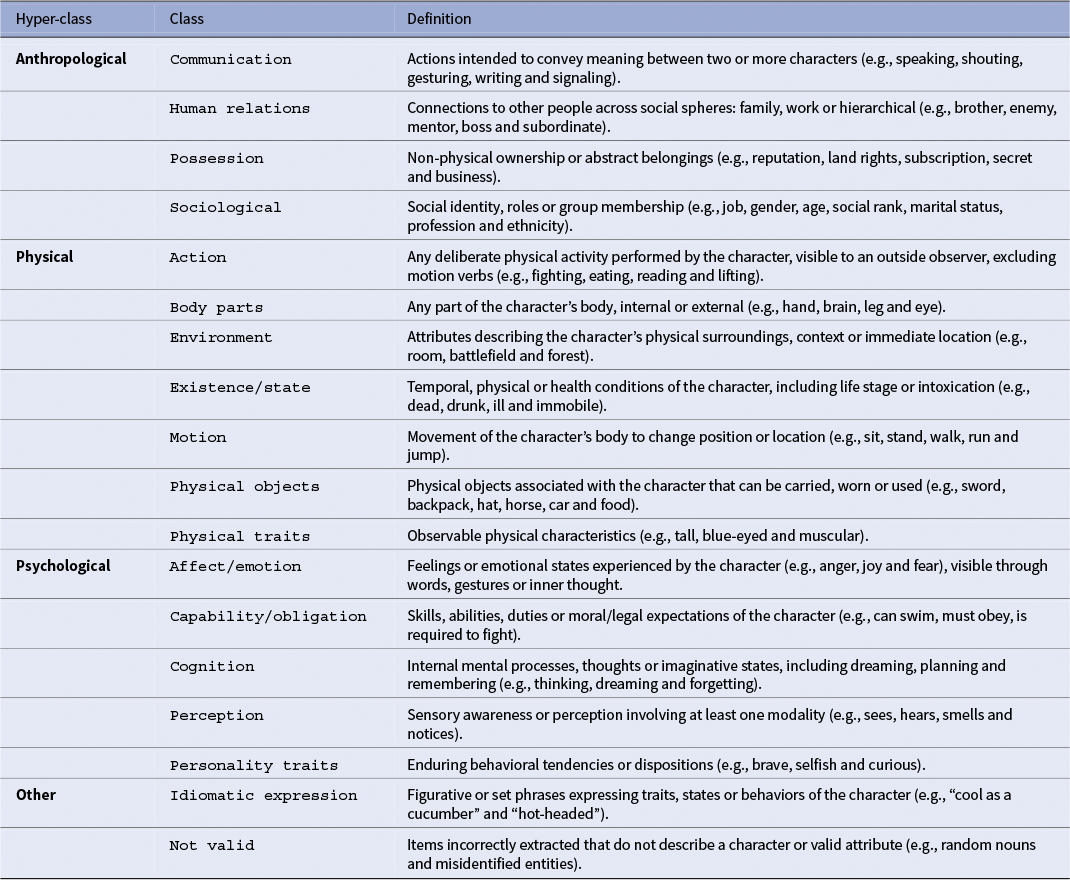
Our response is to move from syntactic proxies to semantic classes. We introduce an explicit ontology based on the work of Jannidis (Reference Jannidis and Hühn2013) using the three theoretic axes that define characters: anthropological, biological and psychological. Each of these three hyper-class axes is further divided into fine-grained subclasses, resulting in a total of 18 interpretable categories for character description. The result is a structured, multi-granular profile for each character: comparable within and across classes, scalable over large corpora and meaningful from a narratological perspective.
An ontology for computational characterization
Ontology definition
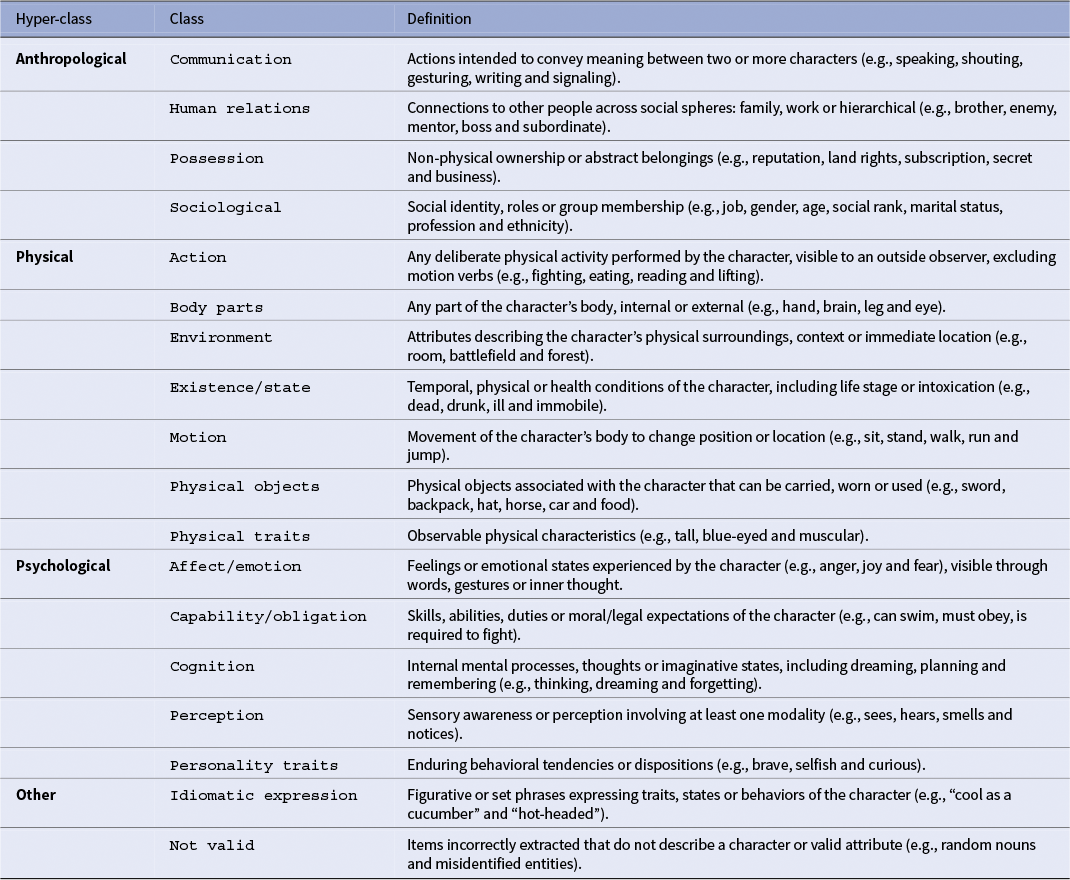
Our ontology is informed by narratology and designed for computational literary studies. Following syntheses, such as Margolin (Reference Margolin1983) and Jannidis (Reference Jannidis and Hühn2013), we assume that characterization proceeds by attributing properties to referential anchors, and that these properties cluster along three macro-domains commonly mobilized in analysis: physical/bodily description and states (Hamon’s prosopographie and descriptive scaffolding), psychological/mental life (affects, cognition and dispositions) and anthropological positioning (roles, relations and identity markers). To make these operational, we articulate this three macro-classes into 18 mutually exclusive and collectively exhaustive fine-grained categories. Two principles guide the design of our ontology: clarity and distinctness. This means that each class has a precise definition to minimize overlap and that adjacent classes are separated by concrete decision rules. For example, there is a difference between physical objects and body parts: the first is part of the character’s body, whether the second is an object that can be carried by it.
Our ontology can capture a large spectrum of attribute types that covers the descriptive surface exploited by readers while remaining legible for large-scale computation.
Table 1 presents the 18 classes and their working definitions used for the manual annotation.
Ontology of character attributes grouped into four macro-classes
Operationalizing
Our aim is the automatic, ontology-aware classification of character attributes. The first step toward this goal is to identify characters and extract their attributes. As noted earlier, several pipelines already exist for this purpose. For this work, we build upon the off-the-shelf Propp-fr pipeline (https://github.com/lattice-8094/propp), designed to process full-length novels. It allows us to extract character mentions (pronouns, proper nouns and noun phrases), coreference chains and attributes derived from syntactic dependency rules.
To operationalize our ontology for large-scale computational studies, we must reclassify those syntactic-based attributes into our fine-grained ontology classes. Exhaustive manual annotation is unrealistic given the scale of the task involving thousands of books and millions of attributes.
One possible approach would be to construct an exhaustive dictionary of attributes for each class (e.g., all words referring to body parts). To accelerate this process, one could leverage existing semantic resources, such as WordNet or VerbNet, as done by Flekova and Gurevych (Reference Flekova and Gurevych2015), who assign the most frequent sense to each word. This approach has the limitation of being unable to account for polysemy, as each word is assigned a fixed class, whereas in reality, words often have radically different senses depending on their context, especially in fictional writing.
For example, in French, the verb filer can have many meanings:
-
• Il file de la laine.
(He spins wool.)
-
• En voyant la police, elle a filé.
(When she saw the police, she ran away.)
-
• Elle m’a filé un coup de main pour tondre la pelouse.
(She gave me a hand mowing the lawn.)
-
• Ce garçon file un mauvais coton.
(That boy is headed for trouble.)
To overcome this issue, models that incorporate contextual information are required. Neural classifiers based on contextual embeddings provide a particularly suitable solution (Huang et al. Reference Huang, Sun, Qiu and Huang2019). These models generate dynamic representations of words conditioned on their surrounding context, thereby capturing polysemy and subtle usage patterns that static embeddings or hand-curated lexicons cannot.
We therefore adopt a contextual neural classification approach. To enable ontology-based labeling of extracted attributes, the classifier must first be trained. This necessitates a gold-standard dataset: a manually annotated collection of attribute instances, each assigned to the appropriate class within our ontology. Such a resource provides the supervision required for the model to learn robust, context-sensitive mappings between character attributes and fine-grained ontological categories.
Gold dataset
To ensure that the classifier will be able to generalise effectively, and be useful for downstream computational literary studies, the gold dataset must contain a representative pool of character attributes drawn from diverse texts.
For this purpose, we apply the Propp-fr pipeline to the full Chapitres corpus (Leblond Reference Leblond2022), which contains 2,960 full-length French novels published between 1811 and 2020. This corpus provides diversity across authors, periods, literary subgenres, narrative perspectives and representation of the literary canon.
The corpus contains 234M tokens, from which 25M attributes were extracted (10.83%). (This ratio of approximately 1:10 between character attributes and total tokens further underscores the character-centric nature of narratives, providing additional justification for the approach adopted in this work). The distribution of attribute types is as follows: agents 49.5 percent, patients 12.0 percent, possessives 27.3 percent and modifiers 11.2 percent.
Annotation pool construction
We adopt a strategy specifically designed to maximize the diversity and generalization potential of the annotated attributes.
We begin with the 25M attributes extracted from the Chapitres corpus. Each attribute is represented as a 1,024-dimensional CamemBERTLARGE vector (Martin et al. Reference Martin, Muller, Suárez, Dupont, Romary, de la Clergerie, Seddah and Sagot2020), obtained by embedding the full novels using overlapping rolling windows. This ensures that the embedding for each attribute captures maximum context.
To construct the annotation pool, we employ a maximal diversity sampling strategy:
-
1. Random seed selection: We begin by randomly selecting the first attribute from the 25M-attribute pool. This serves as the initial seed for the annotation pool.
-
2. Compute cosine distances: For each remaining attribute in the 25M pool, we compute its cosine distance to every attribute already included in the annotation pool.
-
3. Determine minimum distances: For each candidate attribute, we retain the minimum cosine distance to any attribute in the current annotation pool. This ensures that each candidate’s similarity to the existing pool is quantified by its closest neighbor.
-
4. Select the next attribute: We select the attribute with the maximum of these minimum distances, that is, the attribute that is farthest from all attributes in the annotation pool.
-
5. Repeat steps 2–4: We continue iteratively computing distances and selecting the attribute with maximal minimum distance until the pool reaches the desired size (1,000 attributes).
This procedure guarantees that the final annotation pool is highly diverse, avoiding redundancy and over-representation of common attributes (e.g., to say, to have, young and to watch), which the final model is likely to already capture.
The next step is to have human annotators assign ontology labels to each attribute in this pool, providing the gold standard for supervised training of our classifier.
Manual annotation procedure
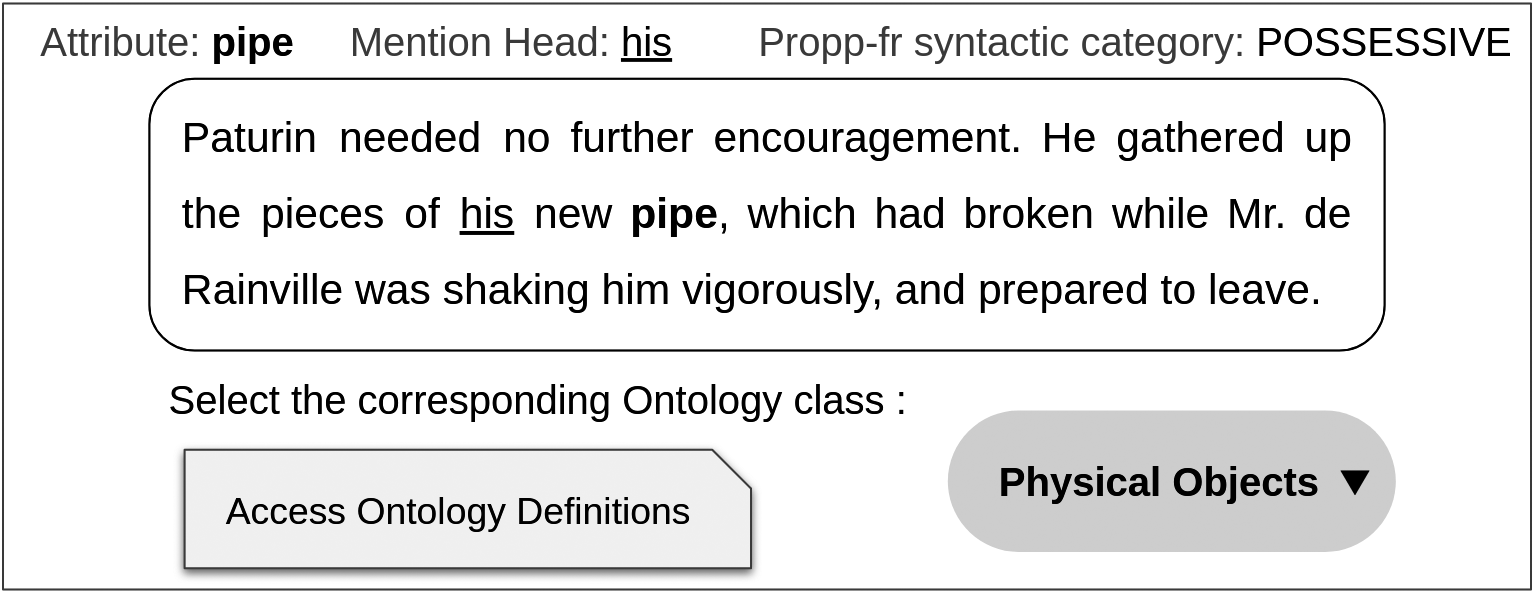
Before beginning the task, annotators are asked to carefully read the ontology definitions in order to familiarize themselves with all the classes. During the process, the definitions remain accessible at all times for reference.
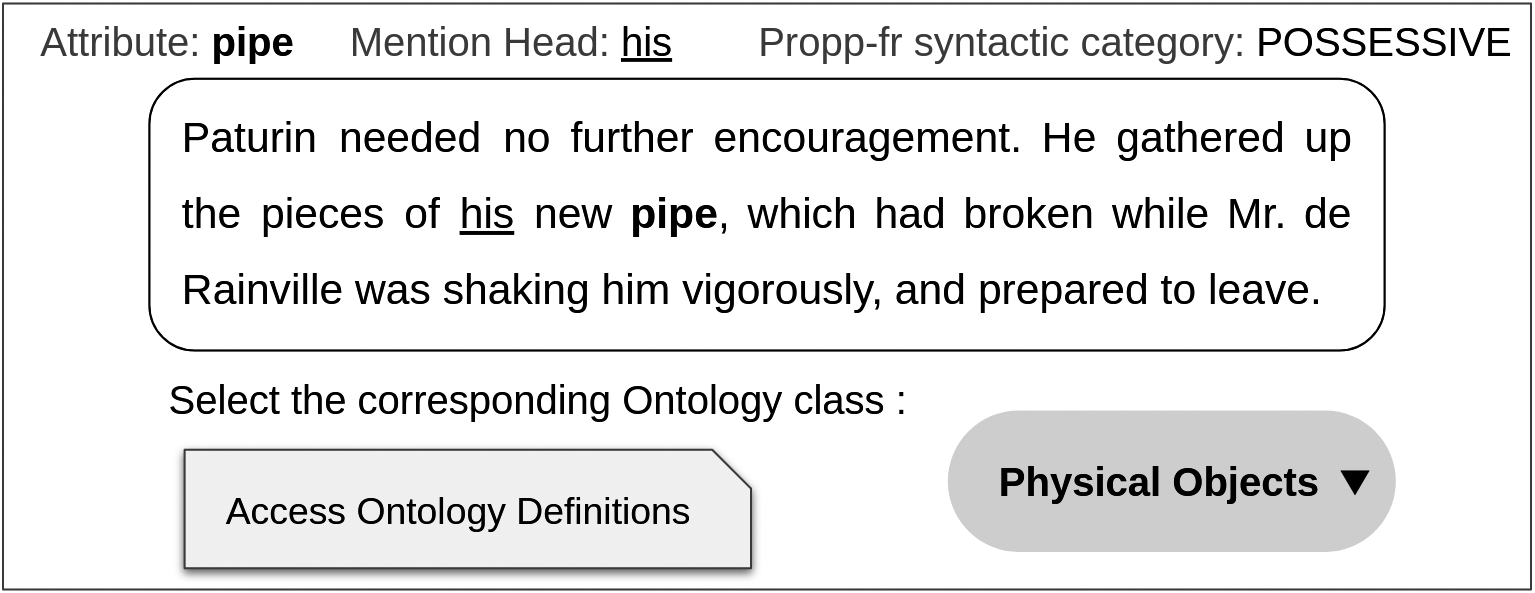
For each annotation, the annotator is presented with:
-
• the in-context attribute to be labeled;
-
• the character mention serving as the head of the attribute (i.e., the entity to which the attribute refers);
-
• the syntactic category assigned by the Propp-fr pipeline.
The annotator must then select the single ontology class to which the attribute belongs. Additionally, the annotation interface provides an open comment field, where annotators may:
-
• justify their decision;
-
• indicate alternative categories that were considered;
-
• flag cases they find difficult or ambiguous.
The annotation interface is shown in Appendix A.
Inter-annotator agreement and adjudication
To assess the reliability of the annotation scheme, we conducted a double annotation on a subset of 406 attributes, with each attribute independently annotated by two annotators (in total four annotators participated).
Inter-annotator agreement yielded an observed accuracy of 0.79 and Cohen’s $\kappa = 0.77$
, which falls within the “substantial agreement” range (0.61–0.80) defined by Landis and Koch (Reference Landis J. and Koch1977). This level of agreement is particularly encouraging given the difficulty of the task and the relatively large number of categories (18 classes in total). Agreement was particularly strong for frequent and concrete categories, such as body parts, physical objects, communication, human relations and motion. By contrast, it decreased for less frequent or more abstract categories, including existence state, possession and capability/obligation.
$\kappa = 0.77$
, which falls within the “substantial agreement” range (0.61–0.80) defined by Landis and Koch (Reference Landis J. and Koch1977). This level of agreement is particularly encouraging given the difficulty of the task and the relatively large number of categories (18 classes in total). Agreement was particularly strong for frequent and concrete categories, such as body parts, physical objects, communication, human relations and motion. By contrast, it decreased for less frequent or more abstract categories, including existence state, possession and capability/obligation.
Following this phase, annotators participated in an adjudication round, reviewing all cases of disagreement. In this process, they agreed on the final label for each contested attribute, discussed edge cases and proposed refinements to the ontology definitions. As part of this review, the category idiomatic expression was merged into not a valid character attribute, reflecting a consensus that such cases fall outside the scope of our ontology.
At the end of this process, we obtained a consolidated set of 406 gold annotations. To increase the dataset size, a single annotator then labeled an additional 194 attributes from the annotation pool. The result is a gold dataset of 600 attributes, each labeled with one of the 17 ontology categories, which serves as the basis for following training and evaluating our classifier for automatic attribute classification.
Neural classifier training and evaluation
The following section presents the training setup and evaluation of a neural classifier for automatic attribute categorization.
Input representation
As described in the “Annotation pool construction” section, each attribute is represented by a 1,024-dimensional CamemBERTLARGE embedding. To this vector, we concatenate a four-dimensional binary feature encoding the syntactic role predicted by the Propp-fr pipeline (agent, patient, modifier and possessive). The resulting 1,028-dimensional vector serves as input to the model, while the output is the ontology label, defined either at the coarse-grained (4 classes) or fine-grained (17 classes) level.
Classifier architecture
To evaluate whether contextual embeddings can be automatically mapped to our ontological categories, we trained a feed-forward neural network on the manually annotated dataset. The architecture consisted of two hidden layers (512 and 64 units, ReLU activation and dropout 0.6), followed by a softmax classification head. The model was trained with the Adam optimizer (learning rate $10^{-3}$
, weight decay
$10^{-3}$
, weight decay $10^{-4}$
), using cross-entropy loss and early stopping based on validation loss (patience = 5, maximum 100 epochs).
$10^{-4}$
), using cross-entropy loss and early stopping based on validation loss (patience = 5, maximum 100 epochs).
All experiments were conducted with stratified k-fold cross-validation ( $k=25$
) to reduce variance due to dataset imbalance.
$k=25$
) to reduce variance due to dataset imbalance.
Classification results
Performance was evaluated both at the level of the full ontology (17 fine-grained classes) and at the higher level of abstraction (coarse-grained superclasses). Fine-grained classification: On the 600 annotated attributes, 25-fold cross-validationyielded an overall accuracy of 0.647. In the 17-class setting, random baseline accuracy is below 0.06, while the majority-class baseline (70/600 instances) is 0.116. The classifier therefore achieves a clear improvement over both baselines, indicating that contextual embeddings provide effective discriminative information.
Coarse-grained classification: Collapsing the ontology into four superclasses (anthropological, physical, psychological and not-valid) further improved performance: 20-fold cross-validation yielded an accuracy of 0.737. This gain is consistent with the reduced label space (4 vs. 17) and should primarily be attributed to task difficulty rather than stronger intrinsic separability of the categories.
Interpretation
These first results highlight both the feasibility and the challenges of automatically mapping character attributes to ontology classes. The classifier performs best for clear and concrete categories, while abstract or underrepresented classes remain more difficult to predict. These trends closely mirror inter-annotator agreement, suggesting that categories which are inherently harder for humans to classify also present greater challenges for the model.
Expanding the gold dataset with additional manually annotated examples could be explored in future work to potentially improve performance on the more difficult, low-frequency categories. However, this may not be critical for downstream applications, as the majority of classification errors occur in rare attributes. In the remainder of this study, we focus on evaluating the usefulness of our ontological classification for practical tasks in the field of computational literary studies.
Next, we leverage these annotated attributes to construct semantically informed character representations.
Character representation vectors
Following Margolin’s (Reference Margolin1983) approach to character conceptualization, we aggregate classified attributes into unified, vectorial representations of characters. For each ontological category (17 fine-grained and 4 coarse-grained), in-class attribute embeddings are aggregated and averaged to produce a single 1,024-dimensional vector per category.
The average vectors are then processed through the following steps:
-
1. Normalization: Each mean vector is L2-normalized to unit length. This ensures that subsequent operations, such as PCA, are insensitive to the overall magnitude of the embeddings, while preserving directional information on a unit hypersphere.
-
2. Principal component removal: To reduce dominant, non-informative directions shared across characters, the first principal component (PC) of all non-zero normalized vectors for a given attribute class is computed. Each vector is then projected orthogonally to this component, highlighting unique, discriminative characteristics for each character.
-
3. PCA-based dimensionality reduction: For each attribute class, PCA is applied to all non-zero vectors after PC removal. The top K PCs (e.g., $K=15$
) are retained, and each vector is projected onto this reduced subspace.
$K=15$
) are retained, and each vector is projected onto this reduced subspace.

The resulting centered and reduced vectors provide a compact, discriminative representation of a character for each attribute class, suitable for downstream tasks, such as clustering, similarity analysis or classification.
To enable comparison, we also consider two simpler baselines. The first, following Yang and Anderson (Reference Yang and Anderson2024), computes separate average embeddings for each syntactic category extracted by the Propp-fr pipeline (agent, patient, modifier and possessive), yielding four additional vectors per character. The second baseline collapses all attributes into a single undifferentiated vector by averaging embeddings across all attribute instances, regardless of category. For both baselines, the resulting vectors are centered and reduced following the same post-processing steps described above, ensuring comparability across methods.
Character similarity task
To evaluate the quality of our character representations, we rely on character similarity benchmarks inspired by prior work mentioned in the “Computational narratology” section. We use two different benchmarks:
-
1. Bamman, Underwood, and Smith (Reference Bamman, Underwood and Smith2014)-derived triplets: We used the French translations of the literary works present in this dataset and tested the same hypothesis.
-
2. CharaSim-fr: We propose a new benchmark, following the same principles as Bamman, Underwood, and Smith (Reference Bamman, Underwood and Smith2014) but this time built upon well-known characters from French literature.
Each triplet $(A, B, C)$
expresses a similarity hypothesis: character A is more similar to B than either A or B is to C. For example:
$(A, B, C)$
expresses a similarity hypothesis: character A is more similar to B than either A or B is to C. For example:
Julien Sorel (A) from Stendhal’s Le Rouge et le Noir resembles Lucien de Rubempré (B) from Honoré de Balzac’s Illusions perdues more than either character resembles Gilliatt (C) From Victor Hugo’s Les Travailleurs de la mer.
To evaluate a model, we compute the cosine similarity between each pair of characters (AB, BC, AC) and check whether $\text {sim}(A,B)> \text {sim}(A,C)$
and
$\text {sim}(A,B)> \text {sim}(A,C)$
and $\text {sim}(A,B)> \text {sim}(B,C)$
. A triplet is considered correctly predicted if both conditions hold, meaning the model aligns with the gold-standard similarity judgment.
$\text {sim}(A,B)> \text {sim}(B,C)$
. A triplet is considered correctly predicted if both conditions hold, meaning the model aligns with the gold-standard similarity judgment.
Following Bamman, Underwood, and Smith (Reference Bamman, Underwood and Smith2014), triplets are organized by difficulty into four classes:
-
• Class A: Sanity checks. Characters A and B are more similar to each other in every respect than to character C.
-
• Class B: Intra-author similarity. Two characters from the same author are more similar to each other than to a closely related character from a different author.
-
• Class C: Cross-author similarity. Characters A and B from two different authors are more similar to each other than to a third character C from the same author as A.
-
• Class D: Exploratory/challenging hypotheses. These triplets test more subtle distinctions, such as point-of-view differences or temporal distance.
For both benchmarks, we perform the triplet similarity evaluation using each of the 26 character vectors (4 syntactic, 1 overall average, 4 coarse-grained ontology and 17 fine-grained ontology) to systematically compare the performance of the different representation types.
Bamman, Underwood, and Smith (Reference Bamman, Underwood and Smith2014) French benchmark
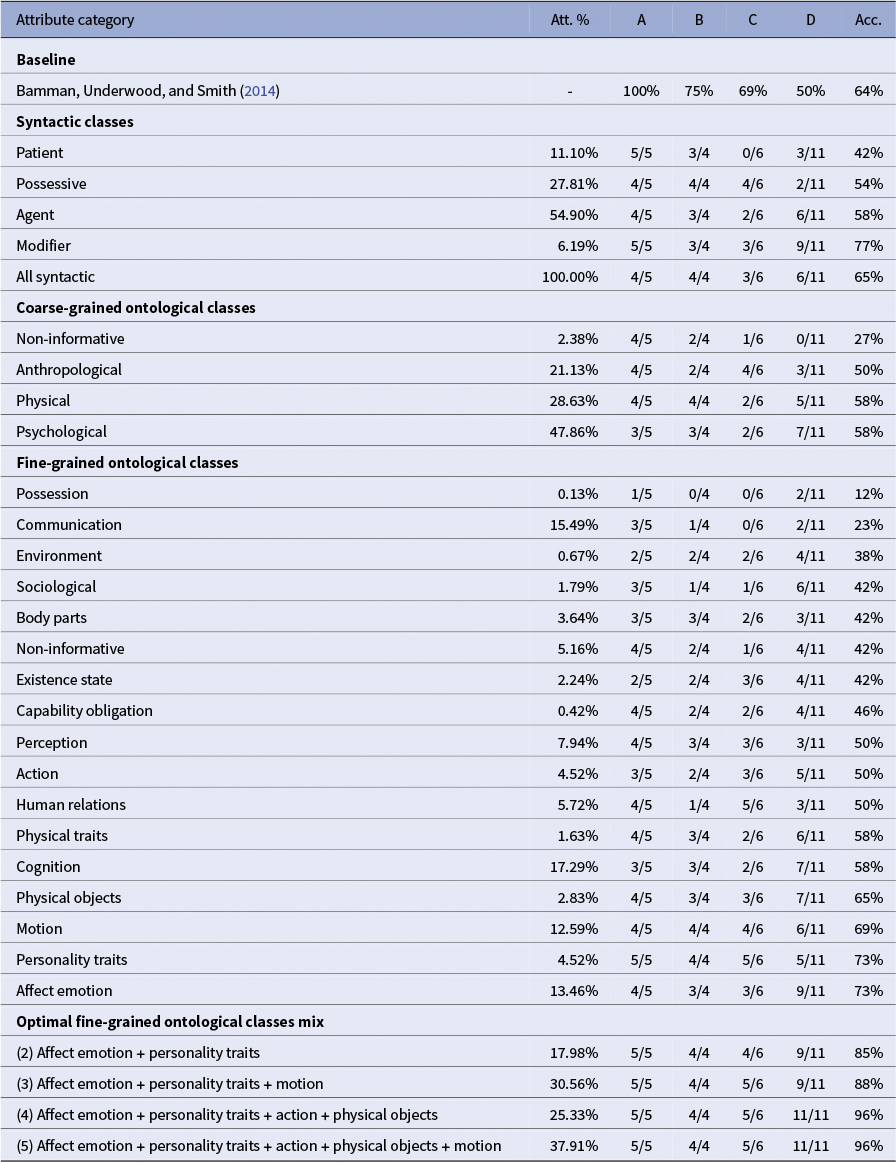
The Bamman, Underwood, and Smith (Reference Bamman, Underwood and Smith2014) baseline performance steadily decreases from Class A to Class D, reflecting the increasing difficulty of the triplets. Despite this decline, overall performance remains strong, with an overall accuracy of 64 percent (where random choice would yield $\approx $
0.33). This provides a meaningful reference for evaluating our character representations (see Table 2).
$\approx $
0.33). This provides a meaningful reference for evaluating our character representations (see Table 2).
Accuracy results on the French adaptation of the Bamman, Underwood, and Smith (Reference Bamman, Underwood and Smith2014) similarity benchmark
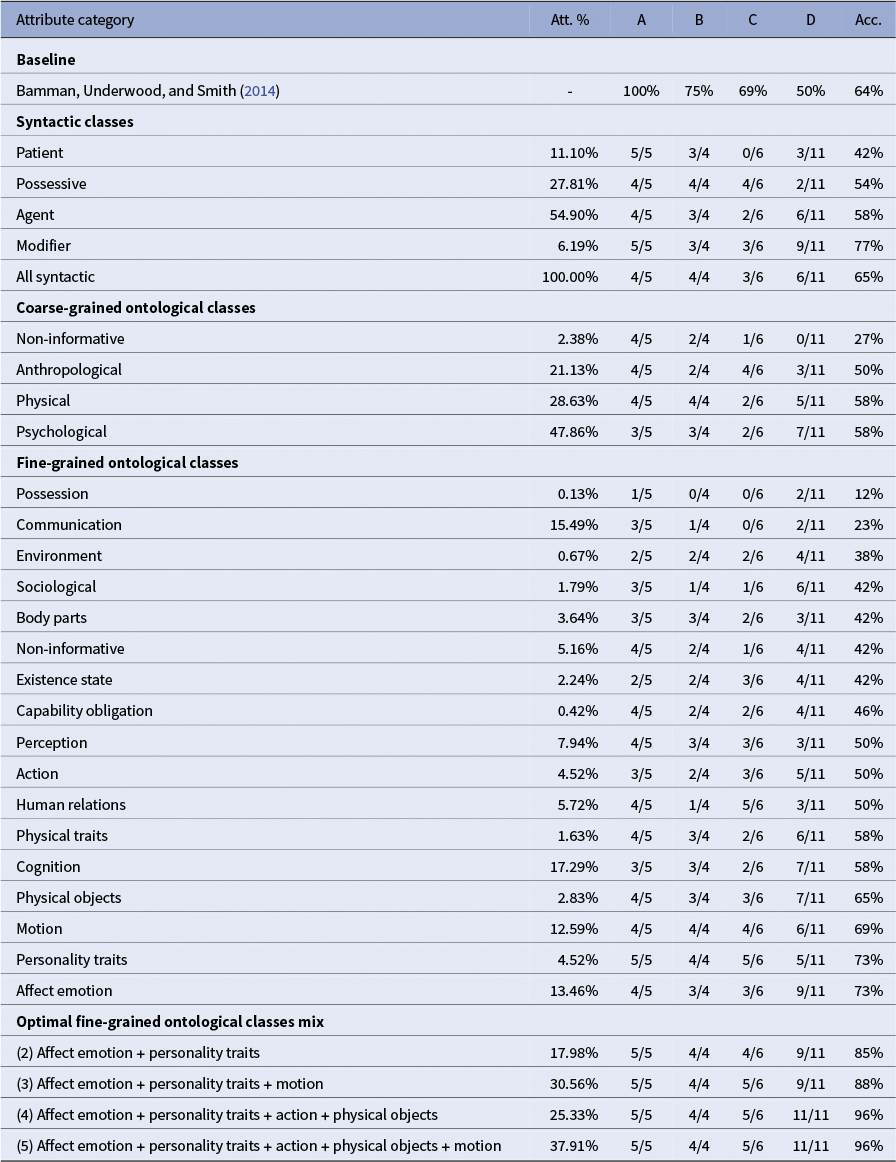
Note: We display the original baseline results alongside our evaluations. The reported baseline is computed as the weighted average of the best-performing model for each class, selected from the three models presented in Bamman, Underwood, and Smith (Reference Bamman, Underwood and Smith2014). For each attribute group, we also report the average ratio of all character attributes used in constructing the corresponding vector. Per-class performance (A–D) and overall accuracy are shown.
Turning to the syntactic attribute classes, performance is mixed. The modifiers class performs particularly well (77% accuracy), while patient lags behind (42%). Interestingly, when all attributes from Propp-fr are aggregated into a single vector (all syntactic), performance rises to 65 percent, surpassing most individual syntactic classes and slightly above the baseline.
For the coarse-grained ontological classes, overall accuracy is relatively consistent (50%–58%) but remains lower than for some of the syntactic-based categories, suggesting that broad semantic categories do not capture character similarity as effectively. Notably, the non-informative class behaves as intended: aggregating attributes labeled as non-informative yields very low accuracy (27%), even below random chance ( $\approx $
0.33). This confirms that these attributes contribute little to character discrimination, and removing them helps focus on more meaningful semantic signals.
$\approx $
0.33). This confirms that these attributes contribute little to character discrimination, and removing them helps focus on more meaningful semantic signals.
In contrast, the fine-grained ontological classes exhibit a highly diverse pattern. Some classes, such as possession (12%) and communication (23%), perform poorly, while others, like motion, personality traits and affect emotion, achieve high overall accuracy (69%–73%), in some cases surpassing the baseline, but not quite reaching the best performing syntactic-based vector from modifiers attributes.
Combining fine-grained ontological vectors
Individual fine-grained ontological vectors capture specific dimensions of character similarity, but human judgments often integrate multiple, distinct aspects simultaneously. A human annotator might consider personality, actions, social relations and other traits together when assessing which characters are most alike.
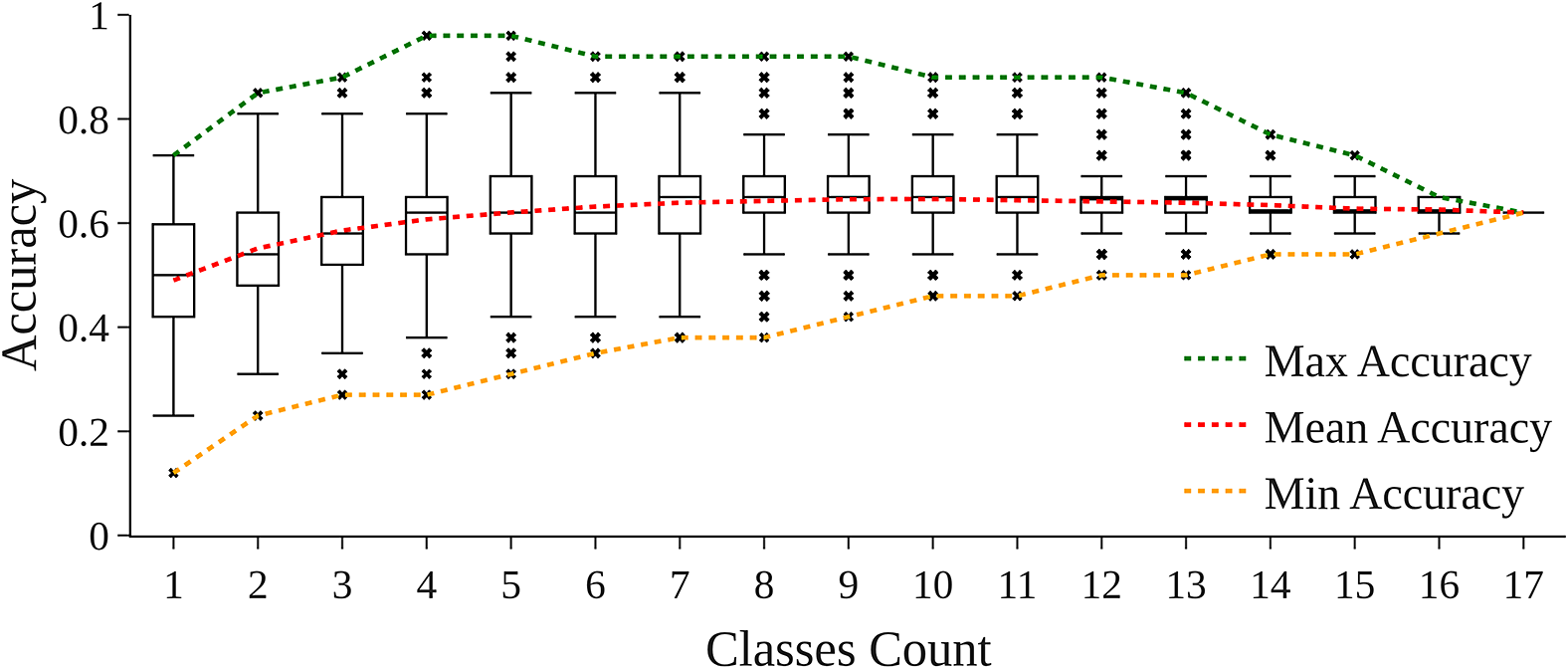
To model this multi-dimensional perspective, we exhaustively explored all combinations of the 17 fine-grained ontological classes (from pairs to the full set). The total number of combinations is
 $$\begin{align*}\sum_{k=2}^{17} \binom{17}{k} = 131{,}054. \end{align*}$$
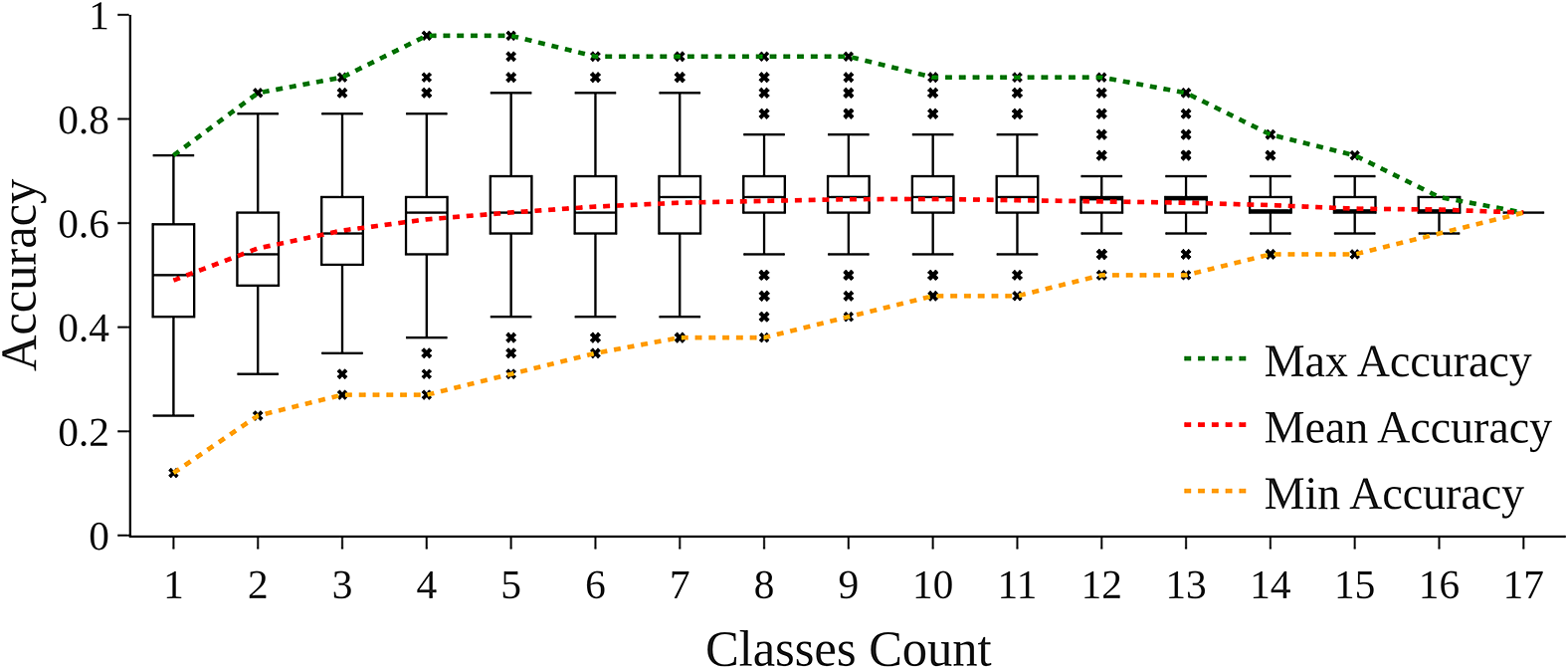
For each combination, we concatenate all vectors and similarity scores were recomputed on our benchmark triplets. We then grouped the results by the number of classes included and computed the distribution of accuracy scores, as well as average, minimum and maximum accuracy for each number of classes (1–17).
The full results of this experiment are displayed in Appendix B. Mean accuracy steadily increases as more classes are combined, rising from 0.49 for single-class vectors to a peak of approximately 0.646 around 9–10 classes. Beyond this point, adding additional classes yields diminishing returns and a slight decrease in mean accuracy, reflecting the inclusion of lower-performing or noisy attributes.
Maximum accuracy is achieved with carefully selected small combinations of 3–5 classes, reaching up to 0.96 on the French adaptation of the Bamman, Underwood, and Smith (Reference Bamman, Underwood and Smith2014) similarity benchmark.
As shown in Table 2, the optimal combinations of fine-grained ontological classes confirm the value of selective mixing. For example, pairing affect emotion + personality traits already yields 85 percent accuracy, surpassing any individual class. Adding a third class (motion) increases accuracy to 88 percent, while carefully chosen four- and five-class mixes (affect emotion + personality traits + action + physical objects and affect emotion + personality traits + action + motion + physical objects) reach 96 percent.
This result highlights that a judicious mixture of complementary ontological dimensions can strongly enhance character similarity predictions, approaching multi-dimensional human-like judgment. In contrast, including all possible classes does not further improve performance, as lower-quality attributes can dilute the signal.
Finally, the correlation between attribute usage ratio (frequency of appearance in character vectors) and accuracy is weak. Some infrequent attributes, such as personality traits (4.52%), are highly informative, achieving 73 percent accuracy, whereas more common attributes, like agent (54.9%), perform relatively poorly; the same pattern is observed for coarse-grained ontological classes. This indicates that informativeness is not proportional to frequency and underscores the importance of careful attribute selection when constructing effective character representations.
CharaSim-fr benchmark
Benchmark dataset construction
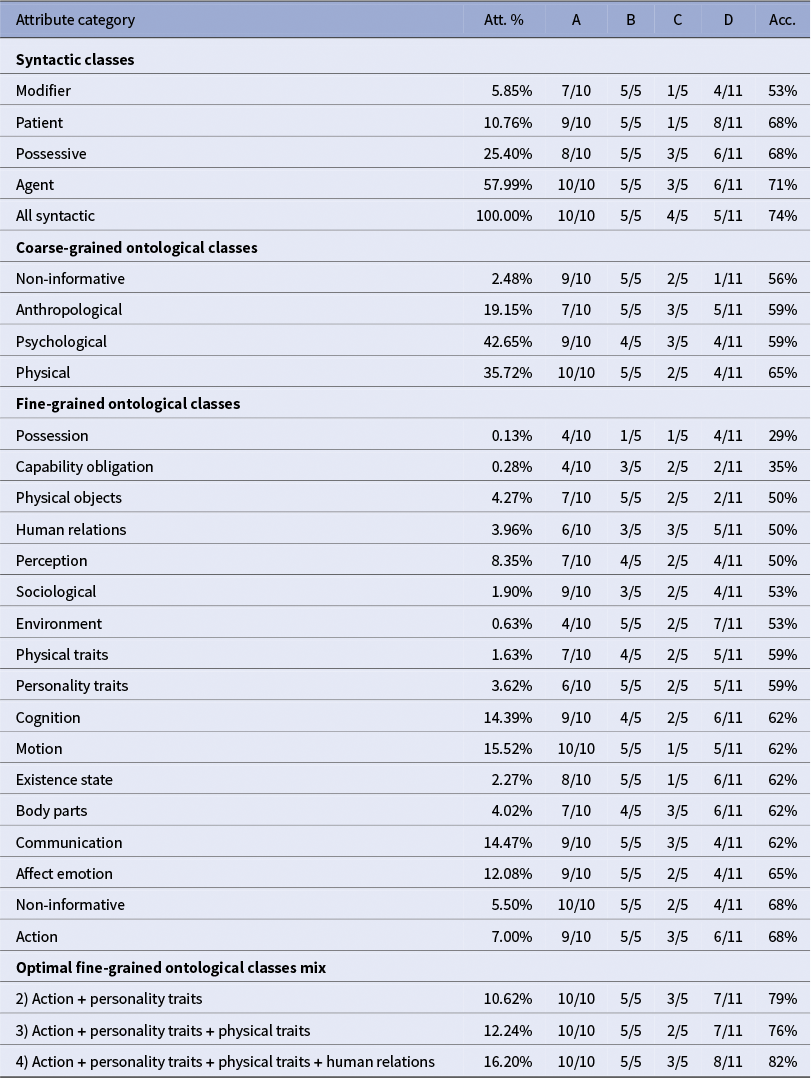
Our newly introduced CharaSim-fr benchmark comprises 31 gold-standard triplets created by a panel of French literature experts. Each triplet follows the same formulation used above (X is more similar to Y than X and Y are to Z) with examples sampled at varying degrees of difficulty across the four classes (10 Class A, 5 Class B, 5 Class C and 11 Class D). In total, the benchmark covers 63 distinct characters drawn from 165 books from the Chapitres corpus, published between 1830 and 1988.
A key design choice that distinguishes CharaSim-fr from the first benchmark is how repeated appearances of the same fictional persona are handled. Whereas they evaluate the similarity of the same character sampled from two different books (Hypothesis 5: “Sherlock Holmes, in The Adventures of Sherlock Holmes, resembles Sherlock Holmes in The Sign of Four (Conan Doyle) more than either version of Holmes resembles Watson in The Adventures”(Bamman, Underwood, and Smith Reference Bamman, Underwood and Smith2013)), CharaSim-fr builds a single representation across multiple works: for any character that appears in several books, we aggregate all extracted attributes from every occurrence to produce that character’s vector. For instance, Rocambole (Pierre Ponson du Terrail) and Arsène Lupin (Maurice Leblanc) each appear in eight different books in our dataset.
Evaluation and results
The evaluation on CharaSim-fr broadly confirms the tendencies observed in the first benchmark, while also revealing notable differences.
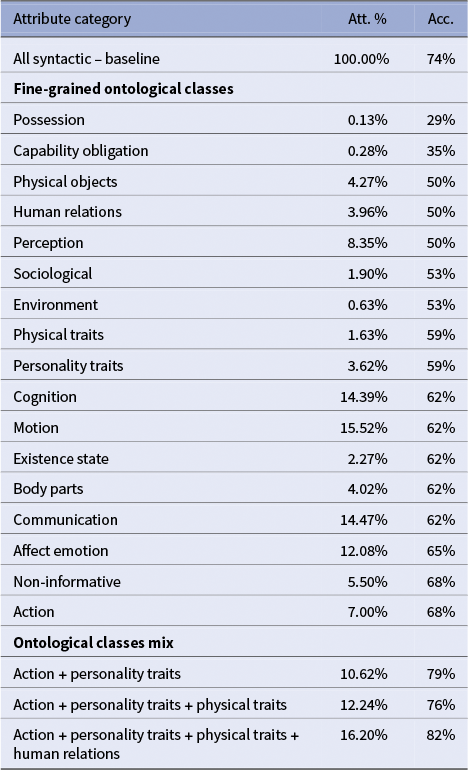
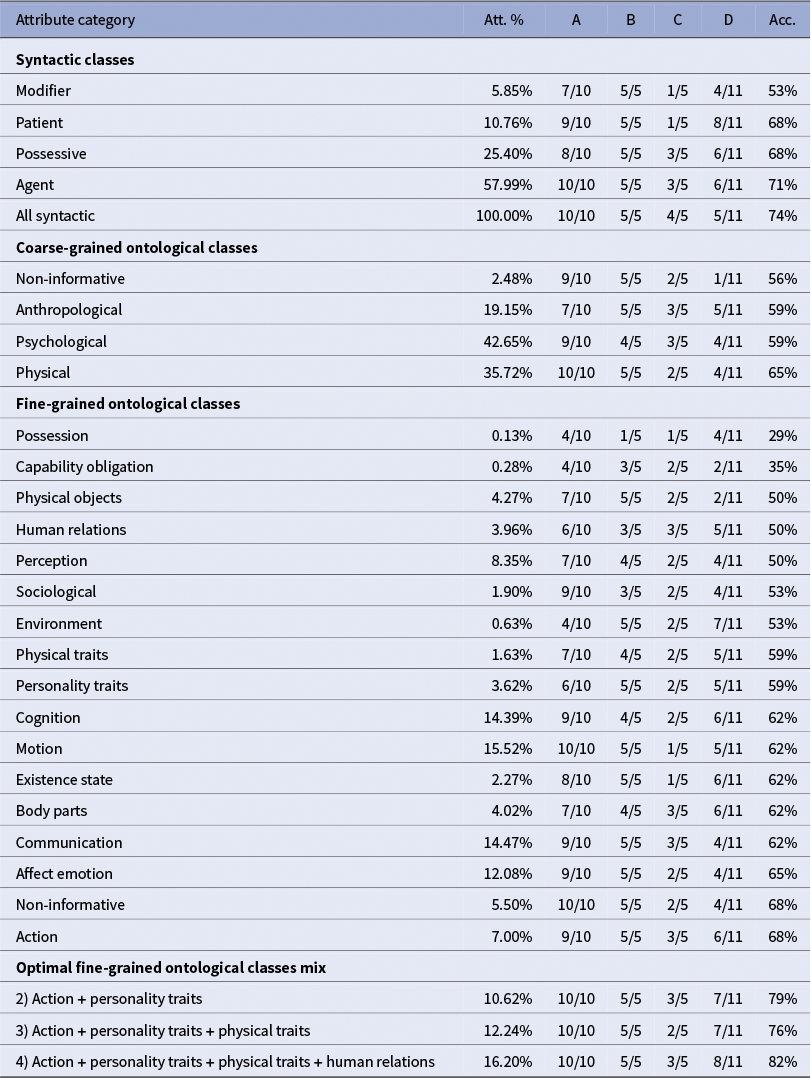
Syntactic-based vectors again provide a strong signal, with accuracies ranging from 53 percent to 71 percent. As shown in Table 3, the aggregated syntactic vector achieves 74 percent, outperforming all individual categories. Among the fine-grained ontological classes, results are more heterogeneous: possession (29%) and capability/obligation (35%) perform poorly, while action, affect emotion, communication and body parts reach 62 percent to 68 percent. Interestingly, the strongest ontological classes here are not the same as in the previous benchmark. Moreover, the vector built from attributes labeled as non-informative unexpectedly reaches 68 percent, suggesting that some of these features may still capture relevant signals in this context.
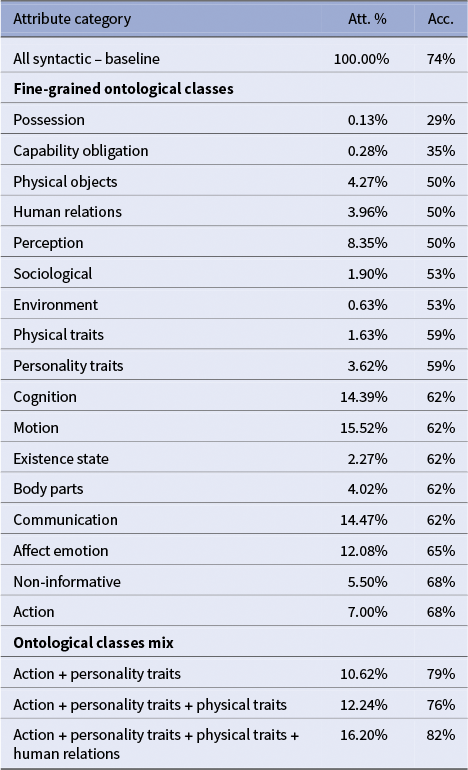
Combining ontological classes again improves performance, though the optimal mixes differ from those observed previously. In CharaSim-fr, the best combination (action + personality traits + physical traits + human relations) yields 82 percent accuracy, whereas in Bamman, the most effective mixes were centered on emotional attributes. This divergence may reflect cultural or corpus-specific differences, or differences in how literary experts conceive the notion of similarity between characters.
Qualitative analysis
Unpacking the model behavior, we look closely at per-dimension similarities for each triplet. For each ontological class $k,$
we retrieve pairwise similarities
$k,$
we retrieve pairwise similarities $s_{AB}^k, s_{AC}^k, s_{BC}^k$
(cosine on k-restricted vectors). We call the dimension-wise outsider the character whose average similarity to the other two is minimal in class k.
$s_{AB}^k, s_{AC}^k, s_{BC}^k$
(cosine on k-restricted vectors). We call the dimension-wise outsider the character whose average similarity to the other two is minimal in class k.
Easy case
Triplet: A = Julien Sorel (Stendhal), B = Lucien Leuwen (Stendhal), C = Emma Bovary (Flaubert)
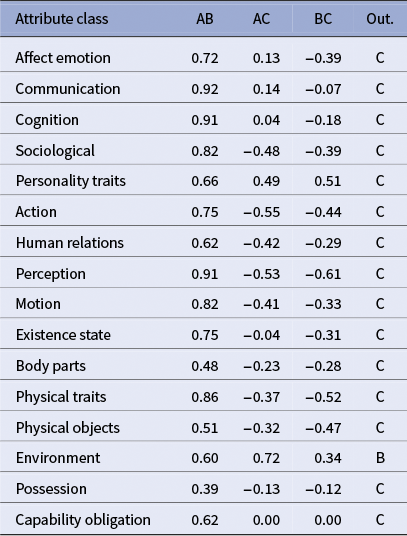
Predicted outsider: C = 16, B = 1
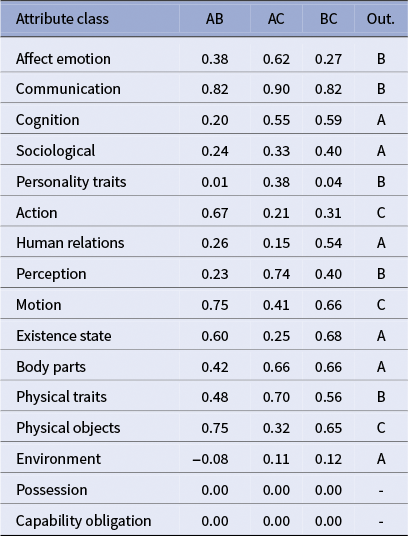
Table 4 shows that $s_{AB}^k$
dominates across 16/17 classes, while both
$s_{AB}^k$
dominates across 16/17 classes, while both $s_{AC}^k$
and
$s_{AC}^k$
and $s_{BC}^k$
are markedly lower or negative-leaning, yielding C as the outsider in almost every dimension. The strongest margins occur in sociological, action, perception, motion and physical traits, which coheres with narratological expectations: Julien and Lucien are Stendhalian ambitieux (male aspirants in Restoration/July Monarchy France) with comparable social roles and activity patterns, whereas Emma’s profile diverges along gendered social constraints and affective-aesthetic desire.
$s_{BC}^k$
are markedly lower or negative-leaning, yielding C as the outsider in almost every dimension. The strongest margins occur in sociological, action, perception, motion and physical traits, which coheres with narratological expectations: Julien and Lucien are Stendhalian ambitieux (male aspirants in Restoration/July Monarchy France) with comparable social roles and activity patterns, whereas Emma’s profile diverges along gendered social constraints and affective-aesthetic desire.
Cosine similarities over fine-grained ontological classes
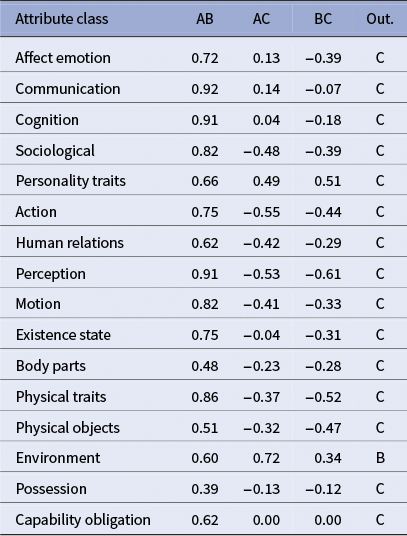
Note: A: Julien Sorel from Stendhal — B: Lucien Leuwen from Stendhal — C: Emma Bovary from Gustave Flaubert.
The lone dimension favoring B (environment) is driven almost entirely by the feature salon: Lucien is the only one of the three who regularly attends “the salon,” which situates him sociologically within the Parisian grand monde (upper bourgeoisie). By contrast, Emma Bovary is excluded from that world (and suffers for it), and Julien Sorel remains a provincial outsider.
Harder case
Triplet: A = Rosanette (Flaubert), B = Mme Arnoux (Flaubert), C = Mme Dambreuse (Flaubert)
Predicted outsider: A = 7, B = 5, C = 3
Table 5 shows that the harder triplet exhibits a fractured signal across classes, mirroring the interpretive subtlety of L’Éducation sentimentale. Dimension-wise outsiders alternate: some classes push A (Rosanette) out (cognition, sociological, existence state and body parts), others isolate B (Mme Arnoux) (affect emotion, communication, perception and physical traits) and others C (Mme Dambreuse) (action, motion and physical objects). This non-convergence is informative: Flaubert distributes Frédéric’s field of desire across three poles, sensuality (Rosanette), ideal (Mme Arnoux) and ambition/social power (Dambreuse), so that similarity depends on which facet is foregrounded. Our ontology’s facets capture these shifting alignments, producing a pattern of partial agreements rather than a single majority outsider.
Cosine similarities over fine-grained ontological classes
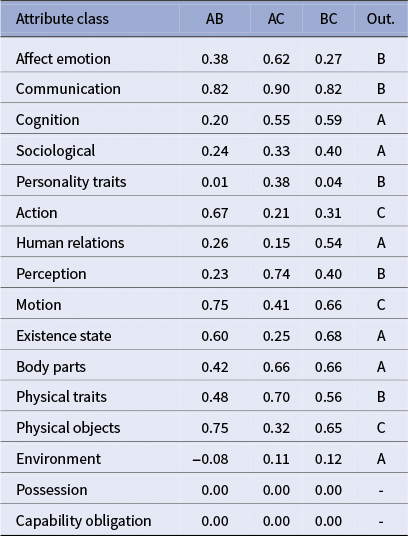
Note: A: Rosanette from Gustave Flaubert $|$
B: Mme Arnoux from Gustave Flaubert
$|$
B: Mme Arnoux from Gustave Flaubert $|$
C: Mme Dambreuse from Gustave Flaubert.
$|$
C: Mme Dambreuse from Gustave Flaubert.
The dispersion of votes reflects genuinely competing interpretive frames in L’Éducation sentimentale: each woman anchors a distinct pole of Frédéric’s sentimental and social field, so the “outsider” depends on which facet of characterization the reader foregrounds. Expert feedback articulates three defensible choices for the outsider:
-
• Rosanette is less refined, more eroticized and far more present in dialogue. In human relations/sociological, her lexicon skews to demi-monde ties (friend, lover and miss), vs. Mme Arnoux’s domestic roles and Mme Dambreuse’s status/kinship network. Weighting communication+affect/body cleanly isolates A.
-
• On affect emotion/perception/traits, Mme Arnoux concentrates idealized feeling and inwardness (peaks on to love, fear, with evaluatives like good, heart and poor). Rosanette reads more performative/interactional; Mme Dambreuse cooler and milieu-coded. If one foregrounds affect/ideality, B emerges as the outsider.
-
• Mme Dambreuse is more effaced, enters late and functions mainly as access to a milieu. Empirically, she is less mobile (0 occurrence on to go/to come/to do) and clusters on postural/possessional verbs and salon props, while the others show higher locomotion/transactions. Emphasizing action+motion+physical objects makes C the outsider.
Read this way, the dispersion of expert judgments is structured: distinct facet mixes, sociological+body (Rosanette), affect+ personality (Mme Arnoux) and action+motion+objects (Mme Dambreuse), each license a defensible outsider. This also explains our results: selective bundles beat using all classes (weak facets dilute signal), while targeted mixes approximate scholars’ multi-dimensional reasoning and argue for expert-aligned facet weighting.
Discussion
Our permutations procedure, steered by researchers’ choices, foregrounds the salient ontological classes for a given similarity judgment and shows that a well-curated subset of attributes can outperform undifferentiated concatenation. In practice, selecting the “right” classes is task-dependent: hypotheses about what drives a comparison (e.g., affect vs. action vs. sociological milieu) should guide facet inclusion, which we then validate empirically. This facet selection is not merely a tuning trick; it renders explicit the interpretive lens through which similarity is constructed and explains why targeted bundles approach multi-dimensional, human-like judgments while lower-quality attributes dilute the signal.
Conceptually, the framework does not “solve” character similarity; rather, it operationalizes the idea that characters do not exist as fixed entities with stable, intrinsic properties, but as interpretive constructs whose salience depends on which dimensions are foregrounded. In this respect, the approach aligns with Margolin’s view of characterization as property ascription and with Jannidis’s emphasis on the interplay between textual cues and readerly inference: profiles correspond to distributions of cues, and facet weights to interpretive emphases. More broadly, the facet-dependent nature of similarity suggests that resemblance is not a stable relation, but varies with the aspects of characterization prioritized by a reader or critic. Our results may therefore tell us at least as much about readers’ and scholars’ representations as about the characters themselves. By making the dimensions of character explicit and manipulable, the ontology shifts the analytical focus from uncovering an essential “true” character profile to examining how different regimes of attention construct character resemblance. Beyond comparison, computational similarity becomes a tool for probing the cognitive and cultural lenses through which fictional figures are perceived, not merely for comparing them.
Limitations
While the ontology itself is grounded in broad narratological theory rather than corpus-specific regularities, its current operationalization and evaluation are limited to French-language fiction. The experiments reported here therefore do not assess how well the proposed categories transfer across languages, literary traditions or genres. Evaluating the robustness and portability of the ontology in such settings remains an important direction for future research.
A second important limitation concerns the static nature of the proposed character representations. In the current framework, attributes are aggregated over an entire text into a single profile per character and per ontological class. This abstraction is deliberately adopted as a first step beyond purely syntactic representations, but it necessarily overlooks the dynamic and sometimes contradictory process of characterization emphasized in narratology, whereby readers continuously revise their understanding of a character as the narrative unfolds. The development of dynamic character representations and appropriate evaluation protocols for them is a promising and exciting avenue for future work, but is beyond the scope of this study.
We do not yet model negation, gradation or modality with sufficient precision, which can attenuate or invert traits and distort character profiles. Contextual embeddings should encode these shifts in polarity and degree, but in practice, it is hard to know how the model takes this into account.
Attributions about a character’s properties may come from the narrator or from other characters (including antagonists, unreliable voices or situationally biased observers). In our current setup, we take such statements for granted, without systematically modeling who speaks and how credible they are, even though narratology warns that explicit ascriptions can be invalid or purely subjective when sourced to a fellow-character or unreliable narrator.
Perspectives
From a methodological perspective, an immediate extension of this work consists of expanding the manually annotated dataset and iteratively retraining the attribute classifier as new data become available. Increasing the size and diversity of the annotated pool would improve robustness, particularly for rare or abstract ontological classes. To facilitate reuse and replication, trained models will be released as part of a Python library for computational narrative analysis. Beyond French, we plan to investigate cross-linguistic extensions through annotation transfer and natively multilingual classification models, enabling tests of whether similar dimensions of characterization operate across literary traditions.
By aligning narratological insights with computational methods, we move toward representing fictional characters as structured, comparable entities that can be analyzed across large corpora. Building on this foundation, our next step is a diachronic exploration of characterization over two centuries of French fiction. We will trace the semantic trajectory of the primary figure in each novel, asking which pathways of our ontology are most activated at different historical moments and how these correlate with the rise and decline of subgenres.
This perspective opens broader possibilities. On the narratological side, it allows us to test theories of character-space and character-systems at scale, observing how the balance of roles and voices evolves over time. On the computational side, it provides a benchmark for refining character representations, moving from high-dimensional blur vectors toward semantically interpretable dimensions.
Acknowledgements
The authors would like to thank the anonymous reviewers who helped them improve this article.
Data availability statement
All code and data used in this study are publicly available at github.com/lattice-8094/fictional-character-ontology.
The repository includes the complete codebase required to reproduce the experiments reported in the article, as well as the gold-standard annotated dataset of character attributes and the two character similarity triplet datasets. The trained model for semantic classification of character attributes is readily usable in downstream applications via the open-source propp Python library.
Author contributions
Conceptualization: A.B. and J.B.; Data curation: A.B., J.B., O.S. and T.P.; Funding acquisition: T.P.; Software: A.B.; Supervision: T.P.; Writing – original draft: A.B. and J.B.; Writing – review and editing: O.S. Writing - Review & Editing,
Funding statement
This research was funded in part by PRAIRIE-PSAI (Paris Artificial Intelligence Research Institute–Paris School of Artificial Intelligence, reference ANR-22-CMAS-0008). This work has received support under the Major Research Program of PSL Research University “CultureLab” launched by PSL Research University and implemented by ANR with the reference ANR-10-IDEX-0001.
Competing interests
The authors declare no competing interests regarding this article.
A. Annotation Interface
Character attributes annotation interface.
B. Optimization algorithm
In order to assess the impact of the number of attributes classes considered on the overall similarity prediction task, we exhaustively explored all combinations of the 17 fine-grained ontological classes (from pairs to the full set). Maximum accuracy is achieved with carefully selected small combinations of 4–5 classes, reaching up to 0.96.
Accuracy by classes count for our exhaustive combination search. Results on the French adaptation of the Bamman et al. Reference Bamman, Underwood and Smith2014; similarity benchmark.
C. CharaSim complete results
CharaSim-fr benchmark detailed results

 Open access


Rapid Responses
No Rapid Responses have been published for this article.