


Introduction
In all societies around the world, social networks influence individual reproductive behaviour. The decision to have a child is not only an individual choice but also one that is shaped by interactions with other members of the community. Couples’ reproductive choices can be influenced by the social group to which they belong (Sylla and Platteau, Reference Sylla and Platteau2008; Rossier and Bernardi, Reference Rossier and Bernardi2009; Smith, Reference Smith2011; Bernardi and Klaerner, Reference Bernardi and Klaerner2014). In this context, the influence of social networks on the reproductive behaviour of individuals follows a normative logic. For example, fertility norms in many African societies require couples to have children immediately after marriage. Women who wish to postpone their first birth may find themselves in a difficult situation if the spouse or family expects them to become mothers (Bajos et al., Reference Bajos, Teixeira, Adjamagbo, Ferrand, Guillaume and Rossier2013). This pressure can lead the woman to give birth in order to avoid any conflict with her family circle. In addition to the normative effects, the impact of social networks on fertility can also be driven by a logic of survival (Bernardi and Klaerner, Reference Bernardi and Klaerner2014). For example, the limited development of old-age insurance in Africa may lead some couples to have several children as a prelude to create future support networks that will sustain them in old age. In Ouagadougou, this strategy seems to be widely shared, because Bougma et al. (2023) observed that 79.1% of women in the northern periphery neighbourhoods rely on their offspring for support in old age.
The demographic literature recognises the importance of considering social interactions in studies of reproductive decisions (Montgomery and Casterline, Reference Montgomery and Casterline1996; Rossier and Bernardi, Reference Rossier and Bernardi2009; Bernardi and Klaerner, Reference Bernardi and Klaerner2014). The importance of studying the effects of social networks on fertility is twofold. First, at the theoretical level, where these effects constitute an intermediate explanation of individual reproductive behaviour as a form of social action, and second, at the empirical level, where they contribute to the improvement of statistical models and the explanation of fertility outcomes, whether at the individual or macro level (Bernardi and Klaerner, Reference Bernardi and Klaerner2014). While there are quite a few theoretical contributions to understanding the effects of social networks on fertility, empirical research on the issue is scarce. The reasons for the low number of empirical studies lie in the scarcity of individual-level data on social networks, combined with data on women’s reproductive history (Bernardi and Klaerner, Reference Bernardi and Klaerner2014; Kavas and De Jong, Reference Kavas and De Jong2020; Bougma and Rossier, 2024).
In sub-Saharan Africa in particular, fertility studies have paid little empirical attention to the relationship between social networks and fertility. Indeed, the most widely used data sources for demographic research in Africa remain the Demographic and Health Surveys (DHS). ‘What demographer today, working on Africa, has not at least once exploited one or more DHS or MICS?’ ask Kobiané and Pilon (Reference Kobiané and Pilon2021, p. 338). However, the DHS collect little information on social networks and the transfer of resources between the different members of the network. In DHS-type surveys, ‘the family is reduced to the household level and only the family ties of the resident members to the head of household are collected. Individuals who have family ties with the head of household (parents, siblings, children, etc.) and who do not live in the same household are ignored, even though the latter may also have exchanges ‘with household members on several aspects of life, including fertility decisions’ (Bougma and Rossier, 2024, p. 193).
Using data unique on women’s social networks and on their reproductive histories collected in Ouagadougou in 2021, this study aims to assess the effects of the configuration, size, and density of family and personal networks on women’s fertility in Ouagadougou. The data used come from the quantitative survey on ‘modes of production, family ideals, the costs and benefits of the child and solidarity networks’ conducted among women aged 15 to 59 years in Ouagadougou. The analysis is used on Poisson regression, which is suitable for count data and allows for the estimation of incidence rate ratios (IRRs). The study estimates age-specific fertility rates and examines the effects of the configuration, size, and density of women’s family and personal networks on fertility. Research has shown that the composition of social networks influences fertility decisions and intentions (Madhavan et al., Reference Madhavan, Adams and Simon2003; Frini, Reference Frini2014; Bougma and Rossier, Reference Bougma and Rossier2022). The presence of guarantors of social values such as mothers-in-law, mothers, aunts, and spouses within the network can play a role in promoting conservative fertility norms. In such a network, the woman is more likely to behave according to the dictates of the promoters of accepted social norms in order to avoid conflicts with her family circle and gain the approval of her relatives (Madhavan et al., Reference Madhavan, Adams and Simon2003). Thus, the influence of the network on fertility can vary according to its configuration. Regarding the size and density of the network, the literature shows that dense and homogeneous networks exert considerable pressure on members to conform to normative behavioural patterns (Kohler et al., Reference Kohler, Behrman and Watkins2001; Bidart, Reference Bidart2008). According to Kohler et al. (Reference Kohler, Behrman and Watkins2001), the extent to which a social network offers opportunities and constraints depends in part on its structure.
This study complements the previous work by examining the following two research questions: do women who are part of networks centred on both their own and their partner’s families have higher current fertility than others? Similarly, do women with dense or large networks have higher current fertility than those with less dense or small networks? Very few studies have examined these issues in the African context. Previous studies that have addressed the relationship between social networks and women’s fertility in Africa have focused more on the number of children born alive or the number of surviving children (Kohler et al., Reference Kohler, Behrman and Watkins2001; Frini, Reference Frini2014). Since social networks are not static, their effects on the actual number of children are subject to bias due to the fact that births may have occurred before the characteristics of the network were measured at the time of the survey. This study minimises such bias by focusing on births in the last three years preceding the survey, an accepted timeframe used to measure current fertility.
Studying the relationship between social networks and fertility can greatly improve understanding of fertility trends in sub-Saharan Africa, an area that remains little explored. In sub-Saharan Africa, social networks play a key role in the spread of social norms and reproductive behaviours, which vary widely from region to region. Prior research has shown that women living in denser networks or with interconnected members may be influenced by stronger social expectations about childbearing (Boujija, 2023). However, existing studies tend to focus on specific relationships, neglecting the overall dynamics of the networks (Madhavan et al., Reference Madhavan, Adams and Simon2003). An integrated approach, taking into account the structure and composition of networks, could provide a more complete picture of the factors influencing fertility. By adopting this perspective, it would be possible to better understand fertility disparities and the persistence of relatively high fertility, even in cities, and to develop reproductive health policies adapted to the social realities of African communities.
Examining the relationship between social networks and women’s fertility is relevant in the context of the city of Ouagadougou. In fact, the level of fertility is relatively high compared to the replacement level, which is about two births per woman. The total fertility rate (TFR) for the city of Ouagadougou was 3.1 children per woman in 2021. Overall, the fertility level in Burkina Faso’s capital city has remained stable since the 2000s. Between 2003 and 2010, the TFR rose from 3.1 to 3.4 children per woman and then stabilised at 3.1 children per woman in 2017–2018 and 2021 (INSD and ICF, 2012, 2022). This relatively high and stable fertility rate is not without consequences for the development efforts of the municipality of Ouagadougou, as it contributes to the mismatch between the available resources and the size of the population. Since 1985, the city of Ouagadougou has experienced rapid population growth. The number of inhabitants increased from 441,514 in 1985 to 1,475,839 in 2006, reaching 2,415,266 in 2019. This sustained population growth is reflected in a rapid expansion of the peri-urban environment, resulting in a social structure characterised by an opposition between formal neighbourhoods (subdivided areas) and informal settlements (undeveloped areas), particularly in terms of access to basic social services (education, health, housing, sanitation, etc.). Formal neighbourhoods are planned, legally recognised, and equipped with basic infrastructure (water, electricity, schools, and health), while informal neighbourhoods develop spontaneously with limited access to services and increased land tenure insecurity. This duality accentuates socio-economic inequalities and poses challenges in terms of urban planning and access to essential resources. With the adoption of family planning in the 1980s, Burkina Faso made a clear statement in terms of fertility control. This is a priority for the municipality of Ouagadougou, which is working to strengthen family planning in the city. Thus, this research will contribute reliable information at the socio-political level by providing political decision-makers a better orientation of actions to be taken in the field of fertility.
Literature review
Explanatory approaches to fertility: are social networks taken into account?
Since the birth of the social sciences in the nineteenth century, several theories of fertility have followed one another, each trying to compensate for previous shortcomings. The literature distinguishes between two groups: materialist approaches and sociological approaches (Koné, Reference Koné2007; Leridon, Reference Leridon2015). The former, known as economic theories of fertility, bring together macroeconomic theories (structural-functionalist, rural development theory, Marxist theory, and feminist theories) and microeconomic theories (Becker’s theory, Leibenstein’s theory, and Easterlin’s theory). As for sociological approaches, the most commonly mentioned in the literature to explain human reproductive behaviour are the culturalist approach and the theory of the intergenerational flow of wealth.
All these theoretical approaches do not address the role of social networks in explaining fertility (Bougma and Rossier, Reference Bougma and Rossier2022). For example, macroeconomic approaches do not pay enough attention to traditional family structures. They focus much more on the macro-structural transformations that can influence a change in behaviour in individuals (Koné, Reference Koné2007; Piché and Poirier, Reference Piché and Poirier1990). As for microeconomic approaches, they are based on the rationality of the behaviour of families in the selection of descendants, taking into account their income. According to these theories, the need for children is linked to opportunity costs, in which case couples make choices on the number of children they will have by arbitrating between the costs and the benefits they can have (Kyriazis, Reference Kyriazis1987).
The relationship between social networks and fertility seems to be somewhat more extensive in sociological approaches (Bougma and Rossier, Reference Bougma and Rossier2022). For example, the theory of the intergenerational flow of wealth developed by Caldwell (1976) addresses the persistence of pro-natalist values often used to explain high fertility in sub-Saharan African countries. According to this theory, fertility is high in societies where wealth flows are more advantageous for parents than children; that is to say, the children, by contributing to the family’s resources, bring in more to the parents than they cost. This situation can only occur because of the management mechanisms of the traditional extended family (Koné, Reference Koné2007), which may include the influence of social networks. Moreover, the relationship between social networks and fertility is also apparent in the culturalist approach, which emphasises sociocultural values and norms. According to the culturalist approach, women’s reproductive behaviour reflects the norms of the society in which they live. This brief review shows that social networks are not sufficiently and explicitly taken into account in explanatory theories of fertility.
Social networks and fertility: theoretical and empirical considerations
The ‘social network’ is a concept that emerged in the 1950s. It refers to a set of individuals or social groups interconnected with each other (Charbonneau and Turcotte, Reference Charbonneau and Turcotte2005). For the proponents of social network analysis, relationships take precedence when trying to define social actors. Three postulates are stated: 1) individuals are characterised by their relationships; 2) practices take on meaning in a system of relations and give meaning to this system of relations; and 3) relationships determine social practices and representations (Pannier, Reference Pannier2008). From this perspective, the social network is seen as ‘a set of relationships between a set of actors’ (Boenisch, Reference Boenisch2011, p. 1). Bidart (Reference Bidart2008) defines it as a relational system grouping together a set of relations. For the defenders of the ‘social networks’ approach, the behaviour of individuals depends above all on their position in relational structures. This position also explains the inequalities in access to resources that are observed between individuals (Lazega, Reference Lazega1998; Pannier, Reference Pannier2008; Bidart, Reference Bidart2008).
The work of Bernardi and Klaerner (Reference Bernardi and Klaerner2014) on the influence of social networks on fertility sheds light on the way in which social networks influence individuals’ reproductive behaviours. According to these authors, reproductive decisions are not only the product of personal choices or individual intentions but are deeply rooted in social interactions within networks. They identified several key mechanisms by which social networks influence fertility: social learning, social pressure, social contagion, and social support. First, social learning plays a crucial role, as individuals acquire new reproductive behaviours by observing those of other members of their network, such as observing reproduction in their immediate surroundings, which can influence their reproduction. In addition, this dynamic is reinforced by social pressure, which pushes individuals to conform to collective expectations, for example, when family or community members exert explicit or implicit pressure to have more children. This pressure may be linked to shared social norms that value procreation. In addition, social contagion accentuates this influence, as reproductive behaviours spread within the network. Thus, when one member decides to have a child, other members of the network may be encouraged to do the same, creating a mimicry effect. Finally, social support is a decisive factor, as a network that offers emotional and material support can make parenthood more accessible, allowing an individual to more confidently consider the idea of having several children. Thus, these mechanisms intertwine, creating an environment where reproductive choices are profoundly influenced by social interactions and dynamics within networks.
The work of Bidart (Reference Bidart2008) confirms that these mechanisms influence individual reproductive choices through the information they convey, the norms they impose, and the social control they exercise. In other words, social networks shape reproductive behaviours by creating dynamics where the influence of others is omnipresent. This influence varies according to the composition of the network, particularly between the nuclear family and the extended family (Bongaarts and Watkins, Reference Bongaarts and Watkins1996). In a nuclear family, influence is mainly based on vertical (parent–child) ties, where reproductive decisions are shaped by parental expectations and the resources available within the household (Behrman et al., Reference Behrman, Kohler and Watkins2002). In contrast, in an extended family, interactions are more horizontal, involving brothers, sisters, uncles, aunts, and co-wives, which promotes more diffuse social control and a wider influence of local fertility norms (Montgomery and Casterline, Reference Montgomery and Casterline1996). Thus, family network’s structure reproductive behaviours according to the nature and intensity of relationships: dense and horizontal networks facilitate the dissemination of common patterns, while restricted and vertical networks reinforce more individualised family strategies (Bernardi and Klärner, 2014).
The social network approach allows for a better understanding of the relationship between the composition (family configuration) and structure (size and density) of the network and the reproductive behaviours of individuals, in particular by analysing the number of children. In Africa, several studies have explored these dynamics, with a focus on variables measuring the composition of the network. For example, in southern Mali, Madhavan et al. (Reference Madhavan, Adams and Simon2003) found that the presence of a spouse in the network, as well as that of older women outside the family, had positive effects on the parity of women aged 15 to 45 years. A similar result was observed in Tunisia by Frini (Reference Frini2014), where the presence of these same members was positively associated with the number of live children among married women aged 15 to 49 years. In addition, Madhavan et al. (Reference Madhavan, Adams and Simon2003) found that a higher percentage of network members living outside the study area were positively associated with fertility, although the presence of the couple’s children had a negative effect on parity achieved. This observation is in line with the work of Bernardi and Klaerner (Reference Bernardi and Klaerner2014), who underline the importance of network composition in influencing fertility, in particular through the mechanisms of socialisation and the diffusion of social norms within family and community networks.
However, these studies mainly focus on simple variables, such as the presence of certain network members, without taking into account the complex and interdependent relationships between network members. Indeed, influences within the network can be contradictory: while some members, such as the mother-in-law, may exert pressure to have more children, other members, such as friends or the mother’s own, may encourage birth control. This shows that a more holistic approach is needed to fully understand the impact of network composition on fertility, going beyond mere kinship relationships. This complexity has been highlighted by Bidart (Reference Bidart2008) and Pannier (Reference Pannier2008), who insist on the fact that interactions within the social network can lead to contradictory and dynamic effects that are not limited to unidirectional influences.
In more recent studies, such as those by Boujija (2023) on migrants in Dakar, the composition and structure of networks are significantly associated with ideational fertility, as a function of the origin of migrants and the interconnected density of their networks. The density of relationships within the network, as shown in Boujija’s study, promotes information exchange and social contagion, where the reproductive behaviours of other members of the network influence personal reproductive decisions. The contagion effect is also described by Bernardi and Klaerner (Reference Bernardi and Klaerner2014), who explain that reproductive behaviours can spread within a network, especially in contexts where social expectations are high. In Côte d’Ivoire, Talnan and Vimard (Reference Talnan, Vimard, Vignikin and Vimard2003) found that women living in polygamous households had lower fertility than those living in monogamous nuclear households.
Thus, it is crucial to take into account the interdependence of relationships within social networks for a more comprehensive analysis of their influence on fertility, by integrating the complex dynamics between different members of the network and their potentially contradictory effects. The approach to network configuration, which takes into account these interrelationships, therefore seems more suitable for exploring these mechanisms. This approach not only makes it possible to go beyond descriptions based on a single kinship but also to take into account the diversity of roles that each member of the network plays in the fertility decision-making process.
In this study, the work of Kaboré and Bougma (Reference Kaboré and Bougma2024) is extended, drawing on the configurational approach to analyse women’s family and personal networks in Ouagadougou. These authors identified three family configurations: ‘Restricted’, ‘Kinship’, and ‘Siblings’, each of which can have a different influence on women’s fertility. The ‘Kinship’ configuration, centred on blood and alliance relationships, can exert a stronger normative pressure on reproduction, because of the density of the network and the social expectations that may be associated with it. In contrast, in the ‘Restricted’ configuration, centred on children and close friends, reproductive choices may be more individualistic and less subject to social pressures. The ‘Sibling’ configuration, which emphasises relationships with siblings, may offer a different support, more focused on sibling solidarity, influencing reproductive decisions in distinct ways.
Hypotheses
This study tests two main hypotheses on the influence of the family and personal network on the fertility of women in union in Ouagadougou. The first hypothesis addresses the family configuration. In traditional African societies, women’s prestige is often associated with the number of children they bring into the world (Hugon, Reference Hugon2005; Leridon, Reference Leridon2015). This social expectation is likely reinforced by family structures that privilege extended kinship ties, providing both material support and normative pressure for high fertility. Therefore, it is postulated that women belonging to a ‘Kinship’ family configuration, characterised by a strong presence of blood and alliance family members, have a higher fertility than those from the ‘Restricted’ (child- and friend-centred) or ‘Sibling’ (sibling-centred) configurations.
The second hypothesis addresses the structure of the social network and its impact on fertility. In accordance with the literature on networks (Bidart, Reference Bidart2008), it is postulated that women living in dense networks have a higher birth occurrence rate due to reinforced social control and a more effective dissemination of pro-natalist norms. However, several nuances must be made to this relationship. On the one hand, the nature of the links within the network is essential: a high density in an exclusively family network can exert greater pressure than a diversified network integrating friends or colleagues. On the other hand, while network density promotes social control, it can also facilitate access to resources and information, including on contraception, which could in some cases limit fertility.
Data and methods
Data and target population
In this research, the data used come from the survey on ‘Modes of production, ideals in terms of the family, the costs and benefits of the child and networks of solidarity’ (EMIRCB) carried out in 2021 on the Ouagadougou Health and Demographic Surveillance site (HDSS). This survey was carried out as part of the capacity building programme, the production and dissemination of knowledge on the Burkinabe population funded by the European Union. It was implemented by the Institut Supérieur des Sciences de la Population (ISSP), Joseph Ki-Zerbo University. The general objective of the EMIRCB was to contribute to a better understanding of the interrelationships between modes of production, family ideals, the costs and benefits of the child, solidarity networks, and fertility with a view to strengthening population and development policies and programmes in Burkina Faso (Bougma et al., 2023).
The survey targeted men and women aged 15 to 59 years living in five neighbourhoods on the northern outskirts of Ouagadougou, including three informal (Polesgo, Nioko 2, and Nonghin) and two formal (Kilwin and Tanghin). To be eligible, participants had to have at least one living child. Using data from round 11 of the Ouagadougou HDSS (2019), a sample of 2500 men and 2500 women was selected in a balanced manner between subdivided and unsubdivided areas. The databases were then cross-referenced in order to identify the couples, which made it possible to optimise the collection of information by reducing duplication and improving the organisation of fieldwork. The spouses of the selected women and men were also surveyed. Among women, the attrition rate was 10.29% (9.88% emigration and 0.41% deaths), while 87.69% were successfully interviewed.
The questionnaire address to women consisted of several modules, including one on their family and personal network. Two essential questions made it possible to identify this network: the first asked the respondents to list the surname and first name(s) of the members of their biological family who were still alive (father, mother, brothers, sisters, spouse, and adult children living in the household or elsewhere). The second question invited the mention, in addition to the biological family members already listed, of the surname and first name(s) of other significant or important persons for them, whether they were members of the extended family or not. The grouping of the family and personal networks provides an overview of social support, which is particularly relevant in African societies where solidarity goes beyond the family setting. However, this approach can blur the distinction between the specific roles of family and non-family relationships, making the analysis more complex.
The present study focuses on women of childbearing age. The fertility analysis is based on a sample of 1855 women aged 20–49 years, for whom complete information on all analysis variables is available. Women aged 15–19 years with at least one child represent only 0.50% of the sample (i.e. 9 women), a number too small for robust statistical analyses.
Variables used in the analysis
Number of children born in the three years preceding the survey: This refers to the woman’s live births that occurred in the three years preceding the survey, regardless of whether the child was alive or deceased at the time of the survey. This variable is used to measure women’s current fertility. It is the dependent variable of the study.
Type of family configuration: It is used to assess the composition of the woman’s family and personal network. The family network was captured by asking the surveyed women to list their close relatives (father, mother, brothers, sisters, spouse, and adult children living outside the household) who were still alive as well as some of their individual characteristics. As for the personal network, it was identified by asking women to name, in addition to their close relatives, the people they considered important (significant) to them. The type of family configuration is constructed by a hierarchical ascending classification analysis using the information on the relationship. For each woman, every family relationship mentioned in her network was counted. The top 13 family ties (out of 37 cited in the survey) that were mentioned the most (representing 96.8%) were retained for a principal component analysis (PCA). The first six factors, with eigenvalues greater than 1, were extracted after a ‘varimax’ rotation. These six principal components, which explain 56.46% of the total inertia, were used in the classification analysis to obtain three groups of women. The scores of the 13 relationships used in the PCA were subjected to a one-way ANOVA analysis of variance. This analysis made it possible to compare the average scores of each family relationship for the three groups of women in order to identify family configurations. Thus, the standard variable of family configuration has three modalities: ‘Restricted’, ‘Kinship’, and ‘Siblings’.
Network size: It is obtained from the short list of close family (father, mother, siblings, spouse, and adult children residing outside the household) still alive at the time of the survey and the people the woman considered important to her.
Network density: This is calculated from the following question asked the respondent about each member of her network: ‘Who among the people mentioned, including yourself, would give material support or small services to [NAME] in times of difficulty (need for money, childcare, daily expenses, family ceremonies, parties, etc.)?’ Density measures the number of material exchanges between the members of the network compared to the number of possible dyadic exchanges. Varying from 0 to 1, it provides information on the degree of connectivity of the network.
Other characteristics of respondents: They consist of type of neighbourhood (formal and informal), religion (muslim, catholic, and protestant), ethnic group (mossi and other ethnicities), level of education (none, primary, post-primary, or more), age group (20–24 years, 25–29 years, 30–34 years, 35–39 years, 40–44 years, and 45–49 years), modern contraceptive use after last pregnancy (yes and no), and economic well-being quintile (living standards). The latter variable, constructed from the characteristics of the household’s dwelling, durable capital goods, water supplies, and garbage and wastewater management systems, is a proxy for the household’s level of wealth. It has five categories of households: households with a very low socio-economic status (quintile 1), households with a low status (quintile 2), those with a medium status (quintile 3), those with a high status (quintile 4), and finally households with a very high status (quintile 5).
Method of statistical analysis
The statistical analysis method used in this study is based on Poisson regression which is suitable for analysing count data, such as the number of births that occurred among women during a given period. The article by Schoumaker (Reference Schoumaker2004) describes the use of Poisson regression to analyse fertility data. The advantage of this method is that it allows us to consider explanatory variables whose effects are expressed in the form of a rate ratio and whose significance can be tested. The Poisson regression approach allows descriptive and explanatory analyses of fertility rates to be carried out using a common method.
Using Poisson regression, the effects of network composition and structure on fertility rates have been estimated. The results are presented in the form of IRRs. Incidence ratios are coefficients that reflect the rate at which births occur in a category of women compared to a reference category. They are obtained by taking the exponential of the β coefficients provided by the log-linear model. The results are interpreted in relation to the reference category whose incidence ratio value is equal to 1. An IRR value greater than 1 in a category indicates that births occur at a faster rate among women in that category compared to the reference category. An IRR value of less than 1 means that the rate at which births in the category in question take place is slower than the reference category.
Results
Composition and structure of women’s family and personal networks
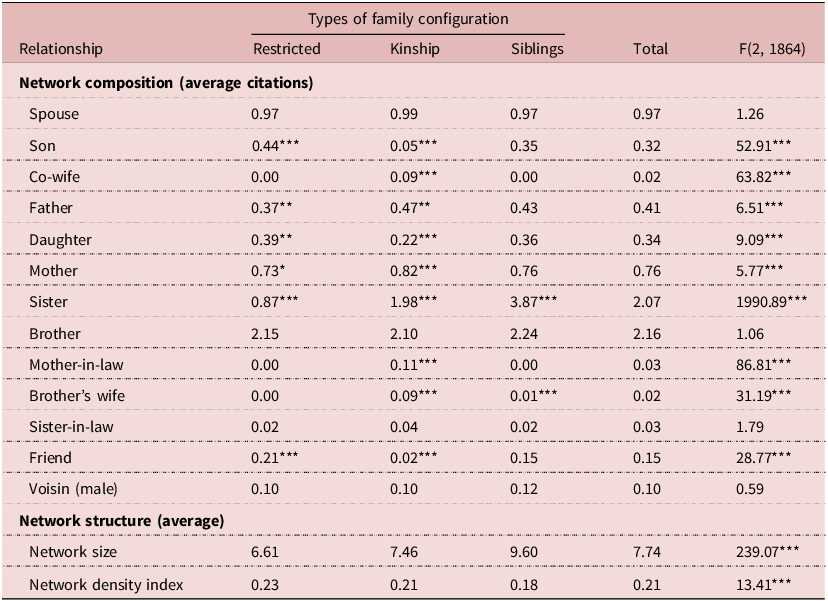
The composition of the three types of familial and personal networks is described by the frequency with which each kinship tie is mentioned – that is, the average number of citations for each kinship category (Table 1). The various means reflect the relative weight of each type of relationship cited by women within a given configuration compared to the overall sample mean. In any given configuration, the higher the mean number of citations for a specific kinship term – especially when it exceeds the total mean – the more that term characterises the configuration. The combination of the most frequently cited kinship ties in each family configuration allows for the identification of its distinct features and the definition of its specific profile (Girardin, Reference Girardin2021; Cissé et al., Reference Cissé, Rossier and Sauvain-Dugerdil2022; Kaboré and Bougma, Reference Kaboré and Bougma2024). Mean comparison tests (t-tests) are used to retain, for each configuration, the ties that differ significantly from the overall mean.
Composition and structure of the network according to the types of family configuration

Note: F=Fisher Statistic; * p < 0.1; ** p < 0.05; p < 0.01.
For network composition, the stars in columns 2, 3, and 4 indicate the level of significance of the difference between the sample mean and the configuration type mean for each relationship.
Source: EMIRCB 2021, Authors’ calculation.
The results show that 44.5% of women of childbearing age belong to a ‘Restricted’ network that focuses on children and friends. In this type of network, the biological parents (father and mother) of the respondent and the sisters are less present. The ‘Siblings’ configuration comes in second place. It represents 31.3% of all women’s family and personal networks. The sisters are particularly present in this type of network. Women belonging to the last type of ‘Kinship’ network (24.1%) cite several members of their kinship, blood, or alliance. This type of network focuses on the biological parents, the in-laws, and the co-wife. The children, the sister, and friends are less present.
Regarding the structure of the network, the analyses indicate that the size of women’s family and personal networks varies from 1 to 23 with an average of 7.74 people per network. Half of the women (50.1%) have networks of smaller than this average size and less than 2% of the women have networks of more than 15 people. The ‘Sibling’ type network is on average larger (9.60 members) than the ‘Kinship’ (7.46) and ‘Restricted’ (6.61) type networks. As for the density of the network, its average is estimated at 0.21 and more than 72% of women have networks with a density index of less than 0.5. This suggests that women’s family and personal networks in Ouagadougou appear to be little connected in terms of material support.
Sociodemographic profiles of women by family configuration
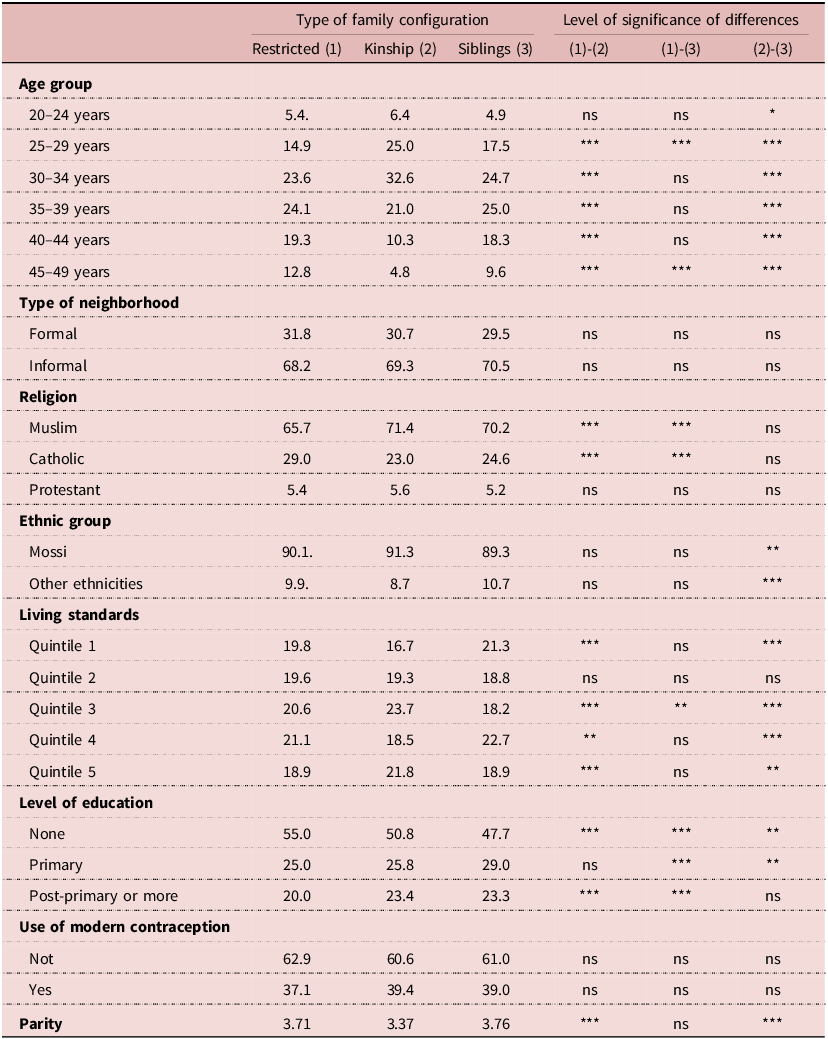
The results in Table 2 show significant differences between family configurations in terms of socio-demographic variables. In terms of age, the ‘Restricted’ family configuration is more associated with older women, particularly in the 35–39 age group (24.1%) and 40–44 year group (19.3%), while the ‘Kinship’ and ‘Sibling’ configurations are more represented among young women, especially between 25 and 34 years old, with 25.0% and 32.6%, respectively, for 25–29 year olds, and 32.6% and 24.7% for 30–34 year olds. In terms of religion, the ‘Kinship’ (71.4%) and ‘Sibling’ (70.2%) configurations have higher proportions of Muslim women compared to the ‘Restricted’ family configuration (65.7%). Differences are also observed at the level of ethnicity, although the mossi largely dominate all family configurations, with proportions of 90.1%, 91.3%, and 89.3%, respectively. In terms of household living standards, the ‘Restricted’ configuration is more frequently associated with lower living standards, especially in quintile 1 (19.8%), while the ‘Kinship’ configuration has a higher proportion of people in quintile 3 (23.7%) and quintile 4 (21.8%). Differences in educational attainment reveal that the ‘Restricted’ family configuration is associated with a greater proportion of women with no education (55.0%), while the ‘Kinship’ configuration has a higher proportion of those with post-primary education (23.4%). The results concerning the use of modern contraceptive methods show a relative stability between the three family configurations, with similar proportions of non-users: 62.9% for the ‘Restricted’ configuration, 60.6% for the ‘Kinship’ configuration, and 61.0% for the ‘Sibling’ configuration. Finally, the results indicate that women in the ‘Restricted’ and ‘Sibling’ configurations have on average more children (3.71 and 3.76 children per woman, respectively) than those in the ‘Kinship’ configuration.
Socio-demographic profile of women by type of family configuration
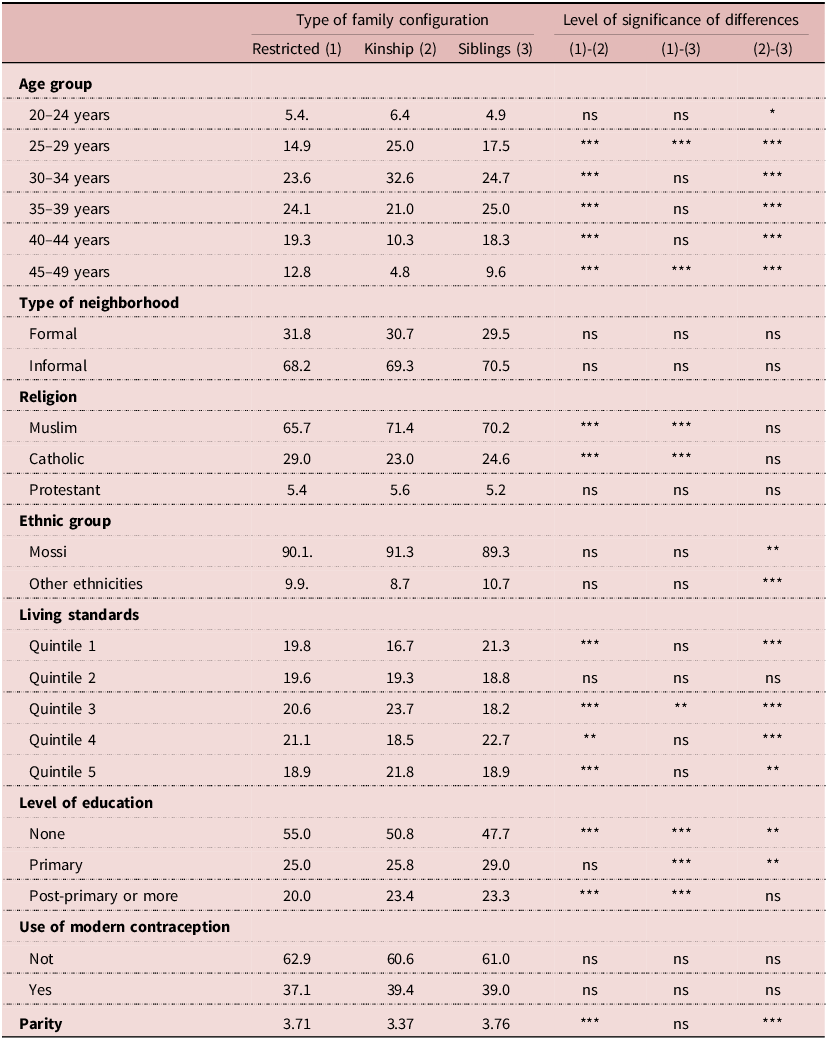
Note: ns=not significant; * p < 0.1; ** p < 0.05; *** p < 0.01.
Source: EMIRCB 2021, Authors’ calculation.
Crude effects of network composition and structure on women’s current fertility
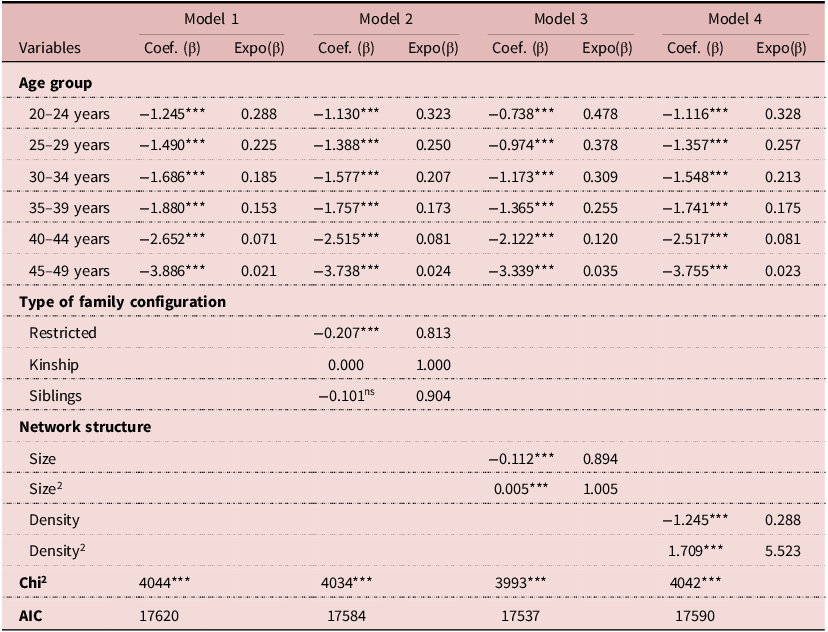
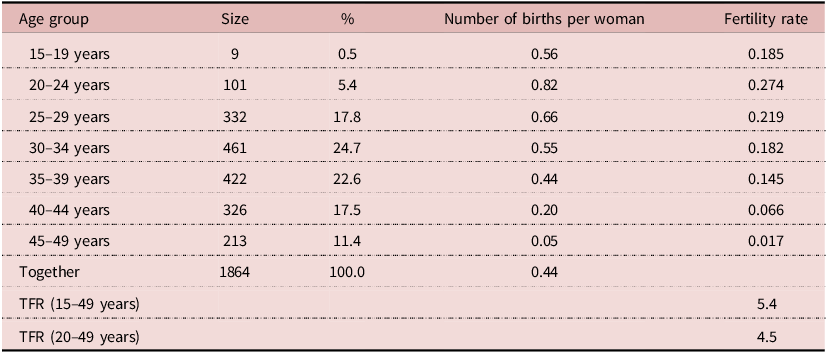
Table 3 presents the results of the Poisson regressions on individual data for women aged 20 to 49 years. Model 1 estimates fertility rates in the three years preceding the survey for all women. These rates are very close to those calculated with the raw data (Table 4). Models 2, 3, and 4 estimate the respective gross effects of family configuration type, network size, and network density as rate ratios. The results show that the type of family configuration, the size of the network, and the density of material support are associated, at the bivariate level, with current fertility. Women in the ‘Restricted’ family configuration have significantly lower recent fertility rates than the ‘Kinship’ configuration taken as a reference category. There were no significant differences between women in the ‘Kinship’ configuration and those in the ‘Sibling’ configuration. Regarding the structure of the network, the results show that the size and density of the network are negatively associated with the current fertility. In other words, increases in the size and density of the network are associated with a decrease in fertility rates. However, the quadratic effects of these two variables are positive and significant (size2: β = 0.005, p < 0.01; density²: β = 1.709, p < 0.01), indicating nonlinear relationships. These results suggest U-shaped curves, where the effects of size and density become less negative, or even positive for higher values. These bivariate analyses are not sufficient to understand the relationship between current fertility and the variables measuring the composition and structure of family and personal networks. Indeed, the number of children born in the three years preceding the survey can be correlated with other characteristics of the woman that need to be controlled.
Poisson regressions estimating fertility rates in the three years preceding the survey (Incidence rate ratio)
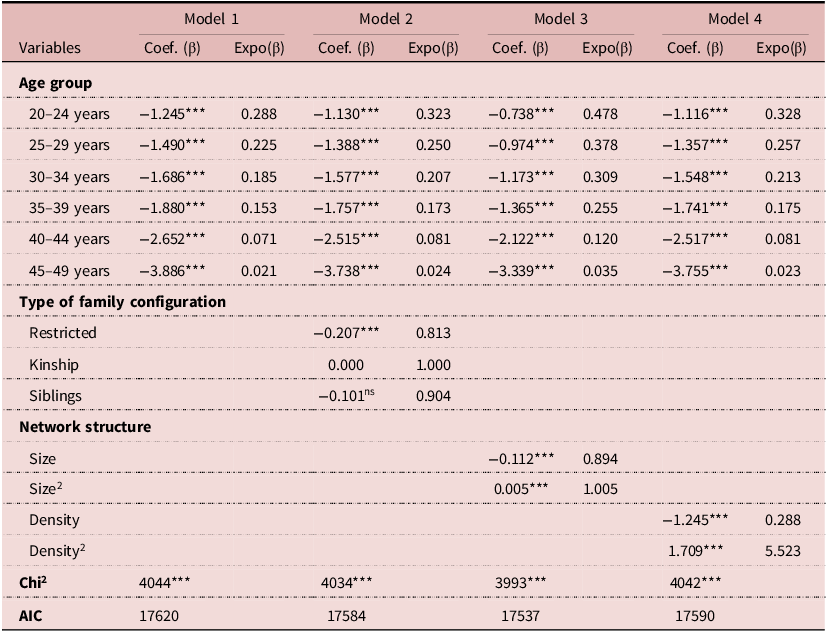
Note: ns=not significant; * p < 0.1; ** p < 0.05; *** p < 0.01.
Source: EMIRCB 2021, Authors’ calculation.
Net effects of network composition and structure on women’s current fertility
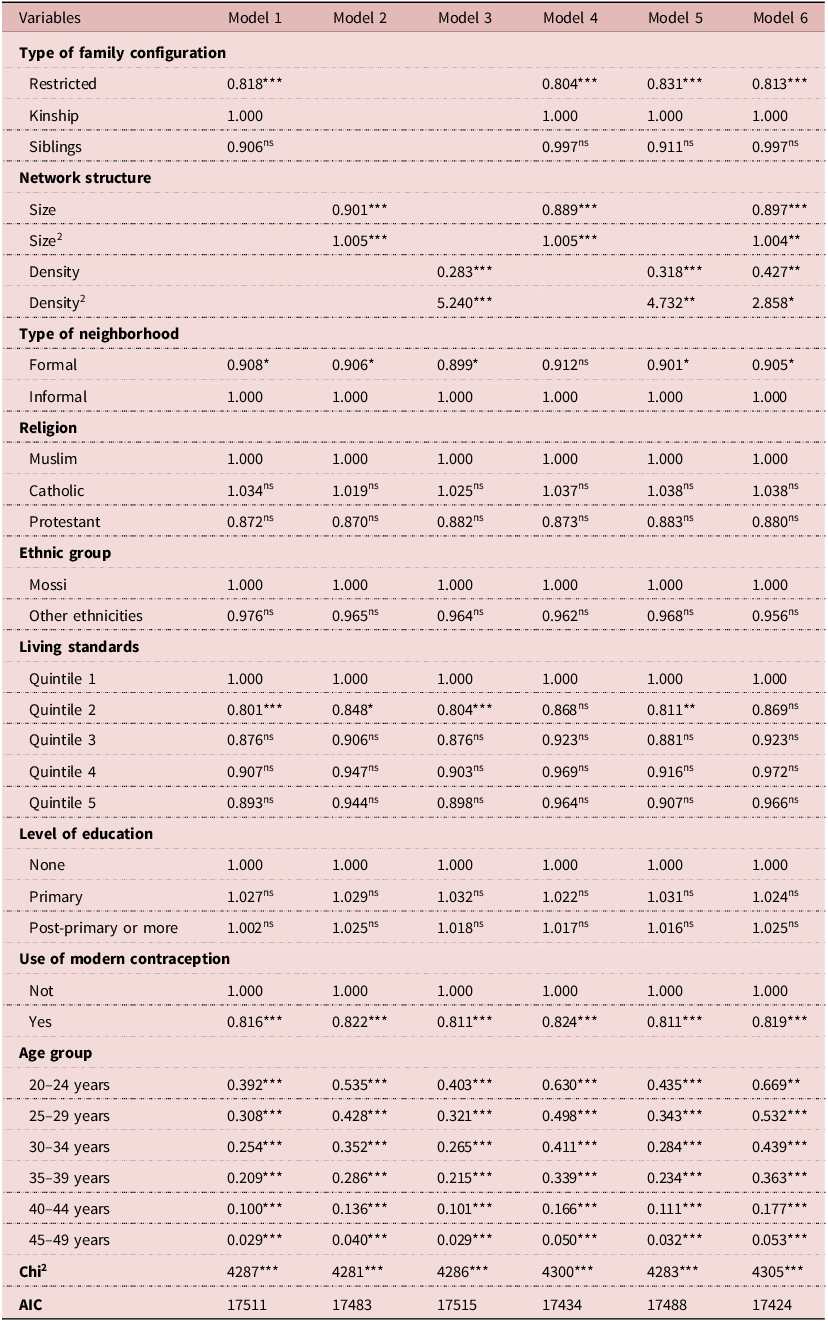
In this section, Poisson regression models are applied to predict fertility rates in the last three years prior to the survey for women aged 20–49 years. The results of the different models are presented in Table 5. Taking into account the sociodemographic characteristics of women, models 1, 2, and 3 assess the respective effects of the type of family configuration, the size of the network, and the density of the network. Then, by controlling for the sociodemographic characteristics and composition of the network, models 4 and 5 examine whether the effects of network size and density are sustained. The last model (6) takes into account all the variables of the study.
Sample size and current fertility by age group of women
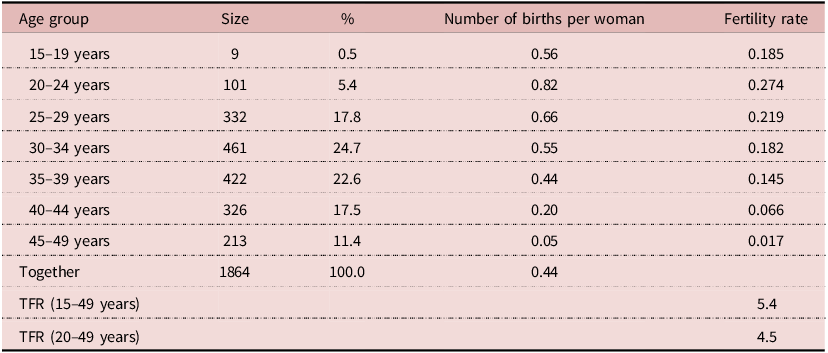
Note: Unweighted data.
Source: EMIRCB 2021, Authors’ calculation.
Poisson regression on the number of children of women born in the three years preceding the survey (Incidence rate ratio)
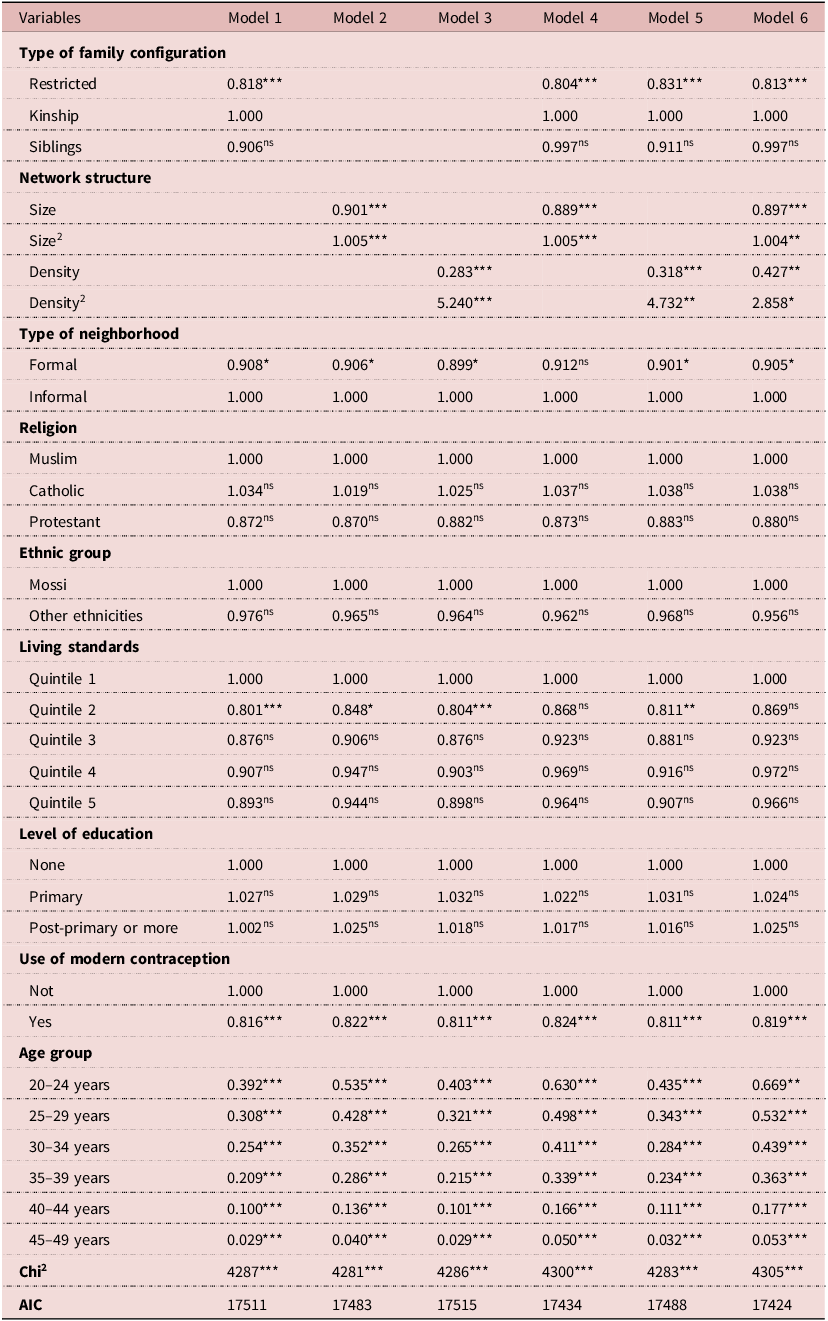
Note: ns: Not significant; * p < 0.1; ** p < 0.05; *** p < 0.01.
Source: EMIRCB 2021, Authors’ calculation.
The results show that the composition of the network is correlated with current fertility. Regardless of the model considered, women belonging to the ‘Restricted’ family configuration have significantly lower current fertility (model 6: IRR = 0.81; p < 0.01) than those belonging to the ‘Kinship’ family configuration. Consistent with the results of the bivariate analysis, blood and alliance family-based networks are associated with higher current fertility. However, no statistically significant difference was observed between the ‘Kinship’ and ‘Sibling’ configurations, suggesting that networks in which sisters predominate are also associated with high current fertility. Therefore, the first hypothesis is partially verified.
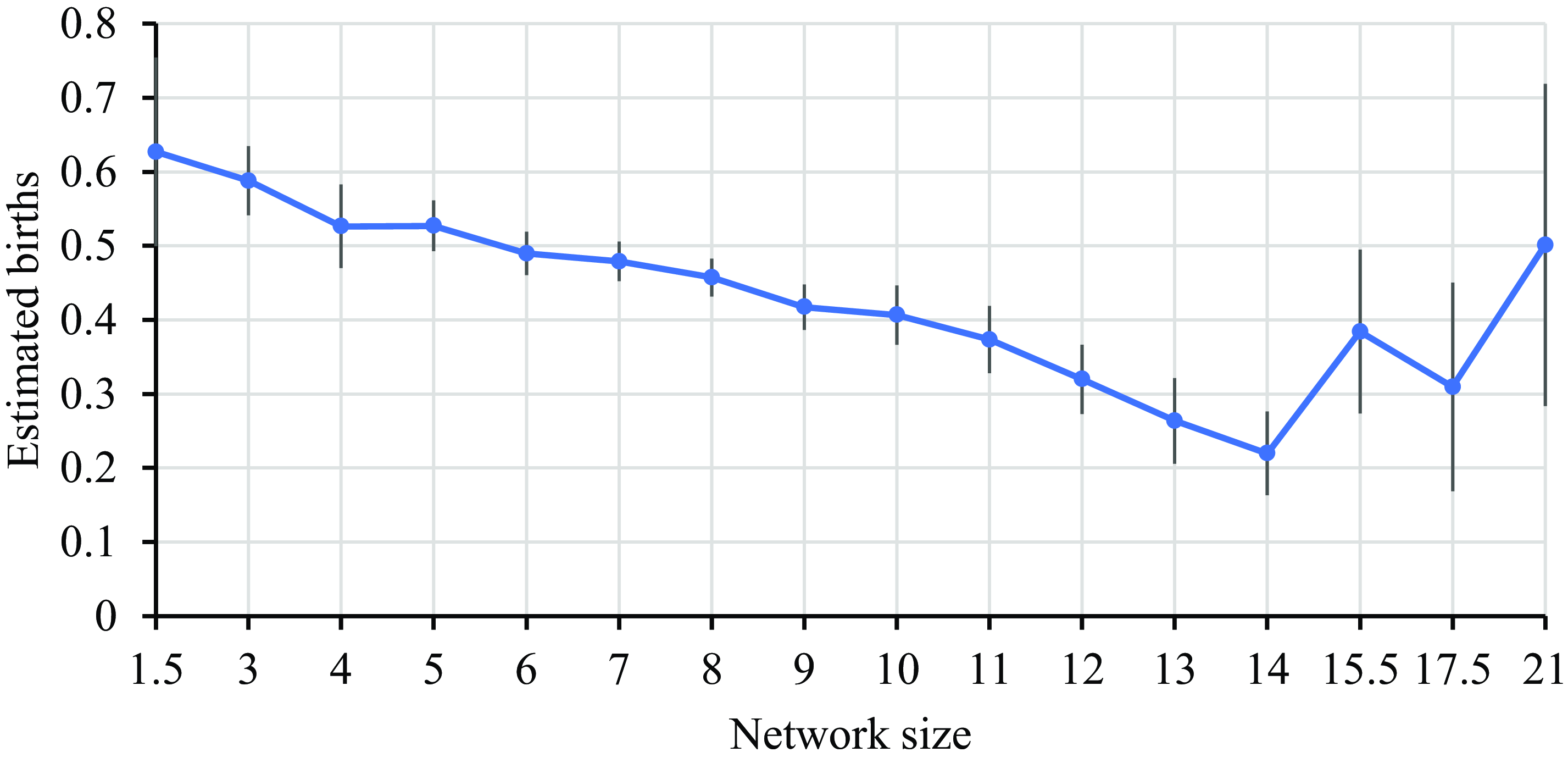
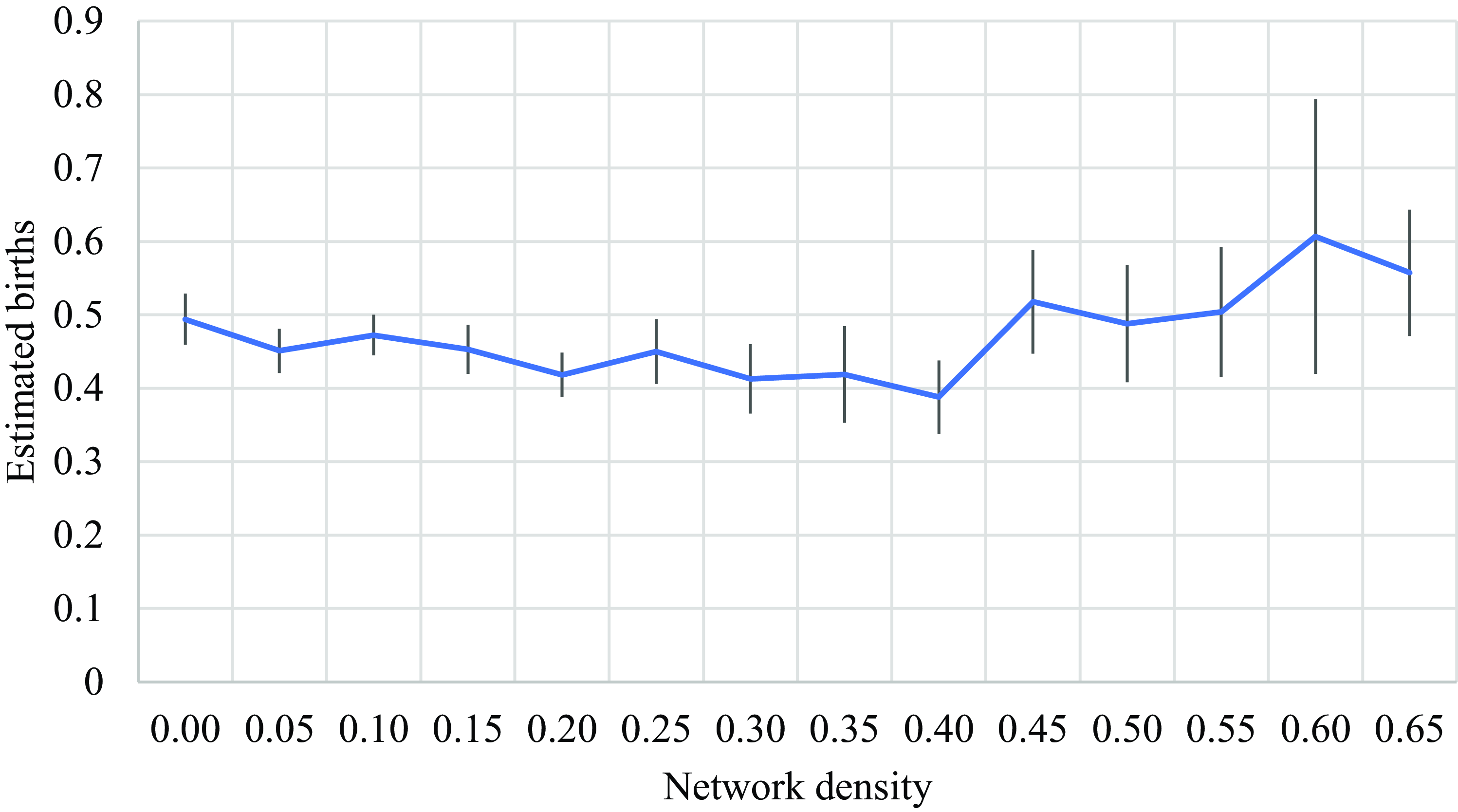
The analyses also show that the size and density of the network also have an effect on the number of children born in the three years preceding the survey. As in the bivariate analysis, the size and density of the network are negatively associated with the current fertility. Indeed, increasing the size of the network by one unit leads to a reduction in fertility rates of 10.3%. Similarly, increasing the density of a unit’s network leads to a reduction in fertility rates of 57.3%. These results mean that women with large or dense family and personal networks are the least likely to have high current fertility. However, the results indicate that the effects of network size and density are not simply linear. The quadratic effects of these two variables remain positive (size²: IRR = 1.004, p < 0.05; density²: IRR = 2.86, p < 0.1), after controlling for women’s sociodemographic characteristics. These results suggest that network size and density have negative effects initially, but these effects decrease as size and density increase (Figures 1 and 2). In view of the above, the assumption that the rate of birth occurrence in the last three years prior to the survey increases with the size and density of the network is therefore not confirmed by the data.
Average number of predicted births according to network size.

Average number of predicted births according to network density.

Other factors associated with current fertility
The results indicate that the other factors associated with current fertility are area of residence and use of modern contraception after the last pregnancy. Model 6 shows that women living in formal neighbourhoods have lower fertility rates (IRR = 0.91; p < 0.1) than those living in informal neighbourhoods. However, the level of significance of the area of residence remains low in all models. Regarding the use of modern contraception after the last pregnancy, the results show that it is also associated with low current fertility. Women who used a modern contraceptive method after their last pregnancy had fertility rates reduced by 18% compared to their counterparts who did not use modern contraception.
Combined effects of network composition and structure on current fertility
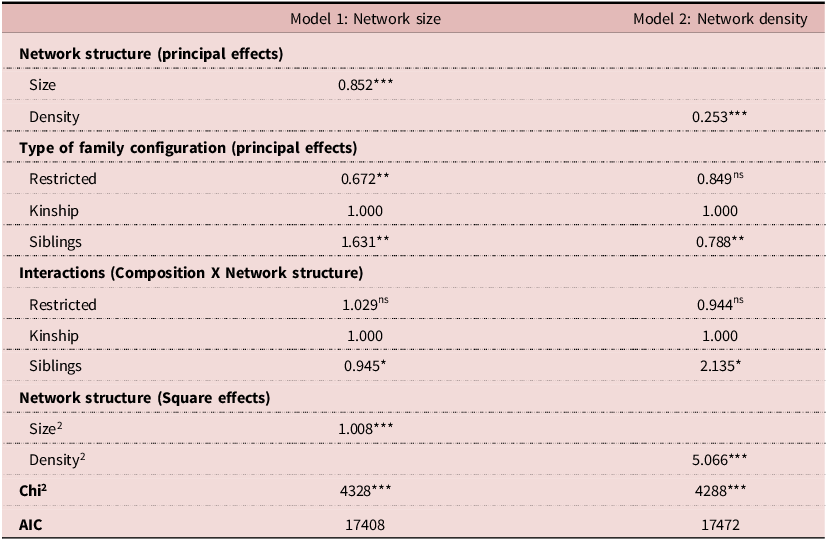
Table 6 shows the combined effects of network composition and size (Model 1) and network composition and density (Model 2). The results in this table were obtained by including interactions between network composition and structure in models 4 and 5 in Table 5. These results show that the effects of network size and density are maintained among women who belong to the ‘Kinship’ family configuration. In this configuration, a one-unit increase in network size is associated with a 14.8% decrease in fertility, and a one-unit increase in network density is associated with a 74.7% decrease in fertility. In addition, the results indicate that for the same height, women belonging to the ‘Restricted’ family configuration have lower fertility rates (IRR = 0.67; p < 0.05) than those belonging to the ‘Kinship’ family configuration. On the other hand, women in the ‘Sibling’ family configuration have higher fertility rates (IRR = 1.63; p < 0.05) than those in the ‘Kinship’ family configuration. Furthermore, the results show that for the same density, women in the ‘Sibling’ family configuration have lower fertility rates (IRR = 0.79; p < 0.05) than those in the ‘Kinship’ family configuration.
Interaction between the composition and structure of the network on moment fertility

Note: Combined effects were estimated from Models 4 and 5.
ns: Not significant; * p < 0.1; ** p < 0.05; *** p < 0.01.
Source: EMIRCB 2021, Authors’ calculation.
The interactions show how the effects of network size and density vary depending on the type of family configuration. These interactions show that the effects of network size and density on fertility do not change significantly among women in the ‘Restricted’ family configuration. These results mean that the influence of the network structure on fertility remains relatively stable in this family configuration. On the other hand, among women in the ‘Sibling’ family configuration, the size (IRR = 0.95; p < 0.1) and density (IRR = 2.14; p < 0.1) of the network have significant, but small, effects on fertility. These results nevertheless suggest that an increase in the size of the network has a slightly greater impact on the reduction in fertility rates among women in the ‘Sibling’ configuration compared to those in the ‘Restricted’ or ‘Kinship’ configuration. On the other hand, a densification of the network has a slightly more pronounced effect on the increase in fertility rates among women in the ‘Sibling’ configuration, compared to those in the ‘Restricted’ or ‘Kinship’ configurations.
Discussions and conclusion
The objective of this study was to assess the effects of the composition and structure of family and personal networks on women’s current fertility. The analysis of EMIRCB data carried out in 2021 on the Ouagadougou Health and Demographic Surveillance site made it possible to achieve this objective by using Poisson regression models.
The results show that women belonging to networks composed of blood and alliance family members (Kinship) have higher current fertility than women with networks based on offspring and friends (Restricted). These results corroborate those of Madhavan et al. (Reference Madhavan, Adams and Simon2003) and Frini (Reference Frini2014) who showed that the particular composition of the network (presence of a specific link) had an effect on women’s fertility in Mali and Tunisia, respectively. In the context of Ouagadougou, these results can be understood as an effective influence of the network on women’s fertility through social interaction where the biological parents, co-wives, and mother-in-law who make up the ‘Kinship’ type networks would play a role in promoting high fertility. Another possible explanation for this result is related to the marital status of women belonging to the ‘Kinship’ family configuration. Kaboré and Bougma (Reference Kaboré and Bougma2024) found in the same context that women in polygamous unions were about twice as likely to belong to a ‘Kinship’ configuration compared to their counterparts in monogamous unions. However, polygamy seems to be associated with higher fertility intentions in the current West African landscape according to the work of Millogo et al. (Reference Millogo, Labité and Greenbaum2022). These authors showed that women in polygamous unions had higher fertility intentions and were less likely to use family planning than women in monogamous unions.
The results also show that the current fertility of women belonging to the ‘Kinship’ family configuration does not differ from that of women belonging to the ‘Sibling’ configuration. This finding suggests that women embedded in networks characterised by a strong presence of siblings – especially sisters – have a current fertility level as high as those whose networks include members of both their own family and their in-laws. This result is in line with that of Buyukkececi et al. (2020), who showed that in the Netherlands, fertility decisions were distributed among siblings. These authors observed significant effects of sibling fertility on the transition to parenthood.
The results of this study show that the size and density of the network have significant effects on the fertility of women in union in Ouagadougou, but these effects are not linear. Contrary to expectations, the increase in the size and density of the network is associated with a reduction in the rate of births in the last three years prior to the survey. However, positive quadratic effects indicate that this relationship is not strictly decreasing: after a certain threshold, the negative effect diminishes or even reverses. These results deviate from what was observed in the work of Talnan and Vimard (Reference Talnan, Vimard, Vignikin and Vimard2003) and Boujija (2023). Talnan and Vimard (Reference Talnan, Vimard, Vignikin and Vimard2003) observed that household size, which can be a proxy for the size of the family network, was positively associated with current fertility in Côte d’Ivoire. In a comparative study between migrants and non-migrants in Dakar, Senegal, Boujija (2023) observed that transitivity or network density was positively associated with the ideal number of children, for both migrants and non-migrants.
The literature emphasises that the structure of social networks can both promote and restrict fertility behaviours and preferences (Montgomery and Casterline, Reference Montgomery and Casterline1996; Valente et al., Reference Valente, Watkins, Jato, Van Der Straten and Tsitsol1997; Kohler et al., Reference Kohler, Behrman and Watkins2001). In Ouagadougou, the structure of family and personal networks seems to play a key role in the diffusion of innovation. Kohler et al. (Reference Kohler, Behrman and Watkins2001) showed that in areas with high market activity, social learning is an effective mechanism for contraceptive uptake. Thus, larger networks could expose women to a diversity of influences and discourses on family planning, thereby promoting the adoption of contraceptive practices (Behrman et al., Reference Behrman, Kohler and Watkins2002). Women in large networks are more likely to be in contact with individuals who are better informed or have access to modern resources, which may encourage a reduction in fertility (Montgomery and Casterline, Reference Montgomery and Casterline1996). In addition, dense networks can also facilitate the dissemination of information on contraception and improve access to family planning services. Indeed, in the city of Ouagadougou, where economic and educational opportunities are more numerous, women from very dense family and personal networks may be more exposed to norms that value birth control or the spacing of pregnancies. High density can also mean greater economic interdependence among network members, which could lead women to limit their fertility in order to better manage family resources.
Thus, far from only promoting social pressure in favour of high fertility, the structure of family and personal networks in Ouagadougou seems to favour a transition towards more controlled fertility. This can be linked to the efforts made by the municipality of Ouagadougou, which, through initiatives such as the policy of free health services and The Challenge Initiative (TCI), has been working for several years to improve access to and use of contraception, particularly in peripheral neighbourhoods.
The quadratic effects of network size and density, observed in this study, suggest that beyond a certain threshold, a larger and denser family and personal network promotes fertility. Three mechanisms can explain this: (1) increased support (material, financial, and domestic) facilitating the care of children; (2) a normalisation of births, where pro-natalist social pressures influence reproductive behaviours; (3) a strengthening of traditional values, valuing motherhood, and the role of motherhood. Thus, after an initial phase of slowdown, a dense network can create an environment conducive to births, especially in a context such as that of Ouagadougou.
The present study has some limitations that should be considered in assessing the results. Indeed, the EMIRCB targeted women who have given birth to at least one child, which automatically excludes women who have not yet experienced motherhood, whether or not they are of childbearing age. The survey also concerned the northern peripheries of the city of Ouagadougou, which are characterised by a population that is generally vulnerable. The results are therefore not generalisable to the entire population of the city of Ouagadougou. Another limitation of this study may be related to the fact that confounding factors can influence the results, such as the ‘Kinship’ configuration which could reflect a woman with a more family-oriented orientation, seeking to maintain strong ties with her relatives. On the other hand, a more restricted configuration could indicate a woman with a more individualistic tendency, favouring more selective relationships that are less dependent on family dynamics. These differences in personal orientation can affect reproductive perceptions and behaviours, making it difficult to interpret the effects of network composition on fertility without taking into account these individual characteristics.
Funding statement
The authors acknowledge the European Union’s programme for capacity building, production, and dissemination of knowledge on the Burkinabe population for access to data.
Competing interests
The authors have no conflicts of interest to declare.
Ethical standard
The authors assert that all procedures contributing to this work comply with the ethical standards of the relevant national and institutional committees on human experimentation and with the Helsinki Declaration of 1975, as revised in 2008.

 Open access

