





Introduction
Community-based initiatives (CBIs) are groups of citizens working as a community to tackle local problems and provide public goods or services. Examples are repair cafés, housing cooperatives, or community gardens. While CBIs more recently have their own stream of literature (Edelenbos et al., Reference Edelenbos, Molenveld and Meerkerk2020), such initiatives have long been studied through concepts such as civic enterprise (Wagenaar et al., Reference Wagenaar, Healey, Laino, Healey, Vigar, Riutort Isern, Honeck, Beunderman, van der Heijden and Wagenaar2015), community self-organization (Edelenbos et al., Reference Edelenbos, van Meerkerk and Schenk2018), citizens’ initiatives (Igalla et al., Reference Igalla, Edelenbos and van Meerkerk2019), social cooperatives (Defourny & Nyssens, Reference Defourny and Nyssens2017), institutes of collective action (Ostrom, Reference Ostrom2014), and grassroots innovations (Seyfang & Smith, Reference Seyfang and Smith2007). CBIs also receive increasing policy attention: in 2019, the European Union adopted legislation that gives official status to energy communities.
One of the reasons for this attention is that CBIs are seen as contributing to social changes to address persistent public problems. This can take the form of alternative public service provision (Healey, Reference Healey2015; Shier & Handy, Reference Shier and Handy2015), adopting sustainable socio-technical practices of energy or other resources (Seyfang & Smith, Reference Seyfang and Smith2007), or creating new ways of practicing democracy (Hendriks, Reference Hendriks2019). This increased (foreseen) role of CBIs brings into question how they relate to the state. In this article, we define state from a broad governance perspective, referring to a “dynamic apparatus” of “institutions and organizations whose socially accepted function is to define and enforce collectively binding decisions” (Jessop, Reference Jessop1990, p. 341). Consequently, the concept of state includes multiple layers of government, ranging from the national to the local level.
Studies show that the state can be both facilitative and empowering of CBIs, as well as constraining and cooptative (Hoppe et al., Reference Hoppe, Graf, Warbroek, Lammers and Lepping2015; cf. Laforge et al., Reference Laforge, Anderson and McLachlan2017). In turn, CBIs contribute to public goals but are also not immune to self-interest, bias, and exclusion (Denters, Reference Denters, Edelenbos and Van Meerkerk2016; Hanke et al., Reference Hanke, Guyet and Feenstra2021). A recent international comparison of CBI studies concludes that state–CBI relationships “are dynamic and […] evolve due to interdependency, changing circumstances, and learning” (Van Meerkerk et al., Reference Van Meerkerk, Edelenbos, Molenveld, Edelenbos, Molenveld and Van Meerkerk2020, p. 254). Indeed, it seems that a “Janus-faced” (Swyngedouw, Reference Swyngedouw2005, p. 1993), “ambivalent” (Celata & Coletti, Reference Celata and Coletti2018, p. 1), and “paradoxical” (Visser et al., Reference Visser, van Popering-Verkerk, Minkman and van Buuren2023, p. 1) polysemy of state–CBI relationships remains to be explored.
To help unpack and navigate this polysemy, the aim of this paper is to provide a broad conceptualization of how CBIs and the state relate. To this end, we outline a relational perspective of state and CBI as part of a democratic and contested public sphere in which social change is shaped, drawing on community development (Bhattacharyya, Reference Bhattacharyya2004; Shaw, Reference Shaw2008), political theory (Jessop, Reference Jessop2016; Mouffe, Reference Mouffe2002), and transition studies (Avelino et al., Reference Avelino, Wittmayer, Pel, Weaver, Dumitru, Haxeltine, Kemp, Jørgensen, Bauler, Ruijsink and O’Riordan2019). Building on this, we propose the construct of ‘state–CBI encounter’ as a relational perspective to embrace a broad spectrum of dynamics by which the state and CBIs relate, overcoming a state- or society-centered view. Following this, we answer the research question how can we understand state–CBI encounters in the context of social change? through an integrative literature review using an in-depth iterative coding analysis.
Based on this, we construct a typology of the nature of state–CBI encounters into functional, transformational, confrontational, and cohabitative, with different implications for the role of CBIs in social change. Furthermore, we identify possibilities of shifts between these types based on the modes of encounter: the contingent formats, spaces, and structures in the public sphere through which the encounter unfolds. These two provide a two-step heuristic to dynamically organize state–CBI encounters.
This study contributes a broader perspective on state–CBI relations to a literature that focuses mainly on formal accounts of how states and CBIs can fruitfully work toward common goals (Igalla et al., Reference Igalla, Edelenbos and van Meerkerk2020; Molenveld et al., Reference Molenveld, Popering-Verkerk, Buuren, Duijn, Edelenbos, Molenveld and Van Meerkerk2020). It aligns with previous research that emphasizes the role of diverse relations, including conflicts and tensions, in public participation to generate change (Chilvers & Longhurst, Reference Chilvers and Longhurst2016; de Looze & Cuppen, Reference de Looze and Cuppen2023). Furthermore, it offers a modular, multi-step conceptual lens to observe and make sense of state–CBI interaction as a possible driver of change, while providing a bridge to the wider debate on state–society relations (Brandsen et al., Reference Brandsen, Trommel and Verschuere2017; Jessop, Reference Jessop2020). Lastly, the heuristic complements existing frameworks of state–CBI relations, which focus on a municipal context (de Wilde et al., Reference de Wilde, Hurenkamp and Tonkens2014; Visser et al., Reference Visser, van Popering-Verkerk, Minkman and van Buuren2023) or take an actor-based approach (Edelenbos et al., Reference Edelenbos, van Meerkerk and Schenk2018; Laforge et al., Reference Laforge, Anderson and McLachlan2017; McMullin, Reference McMullin2025). We aim to understand the effects of a scattered, fragmented, and ever-changing landscape of state–CBI interactions in shaping a currently precarious public sphere, rather than trying to solve it. In the remainder of this paper, we first outline our conceptual framework, then present the method of our review studies, then the results, and finally discuss them before summarizing some conclusions.
Conceptual framework
Conceptualizing community-based initiatives
CBIs can be seen as intermediate organisations that are situated between the public and private spheres, and between fully individualized and collectivized service provision (Brandsen et al., Reference Brandsen, van de Donk and Putters2005; Wagner, Reference Wagner2012). Such organizations can be studied from a third sector perspective with a focus on administrative decentralization, or a civil society perspective with a focus on the public sphere (Wagner, Reference Wagner2012). The third sector perspective is prevalent in the CBI literature, with a strong focus on CBIs’ local orientation, their self-organized manner of service provision, and comparative advantages and disadvantages with provision arrangements at different scales (Boonstra & Boelens, Reference Boonstra and Boelens2011; Healey, Reference Healey2015; Igalla et al., Reference Igalla, Edelenbos and van Meerkerk2019; Seyfang & Smith, Reference Seyfang and Smith2007). CBIs are ‘community-based’ because they respond to community needs (Igalla et al., Reference Igalla, Edelenbos and van Meerkerk2019) or their interests and values (Boonstra & Boelens, Reference Boonstra and Boelens2011; Seyfang & Smith, Reference Seyfang and Smith2007). While it is not explicated what ‘community’ means, it resembles a classical sociological understanding of community as the natural, local gemeinschaft based on informal norms, existing in parallel to the abstracted, large-scale gesellschaft based on formal rules (Tonnies, Reference Tonnies2017, in Shaw, Reference Shaw2008).
However, part of CBIs’ role in social change manifests beyond the local level, connecting their local actions to broader challenges (Wagenaar et al., Reference Wagenaar, Healey, Laino, Healey, Vigar, Riutort Isern, Honeck, Beunderman, van der Heijden and Wagenaar2015) and ‘translocally’ diffusing similar practices and values in different places (Loorbach et al., Reference Loorbach, Wittmayer, Avelino, von Wirth and Frantzeskaki2020). We therefore adopt a different understanding of community beyond the local, as a “democratic alternative to, and invariably a critique of, the existing social order” (Shaw, Reference Shaw2008, p. 25). Community is then seen as “a shared identity and a code for conduct or norms” (Bhattacharyya, Reference Bhattacharyya2004, p. 12). Community involves a value-oriented and ‘unreflexive’ rationality (Jessop, Reference Jessop2020), where community members coordinate through some minimal level of unconditional commitment. Concretely, we understand community as Bhattacharyya’s (Reference Bhattacharyya2004) three principles of community action: self-help, felt needs, and participation, understanding CBIs as groups of citizens working as a community—meaning a social configuration based on self-help, felt needs, and participation—to provide public goods or services.
A relational approach to CBIs and the state in the public sphere
Seen in this way, CBIs are not operating in a separate community realm, but are part of a public domain, where they interrelate with other parts of society (Cohen & Arato, Reference Cohen and Arato1992; Wagner, Reference Wagner2012), contributing to the production of the public sphere. We understand the public sphere with Mouffe (Reference Mouffe2002) as a democratic, contested space, in which different publics participate by bringing a diversity of values and interests, in both discursive and material actions and decisions (see also Fraser, Reference Fraser1990). This public sphere is not a Habermasian utopia of ideal deliberation, but an unequal space of inherent conflicts and tensions where different possibilities for social change play out, including the (un)making of the public sphere itself (Robinson & Tormey, Reference Robinson, Tormey, Little and Lloyd2008). As such, CBIs are not a panacea for public problems nor a standalone alternative to other forms of social organization. Rather, CBI’s role in social change is inherently relational to other parts of the public domain, including the state. This resembles scholarship in transitions studies that argues against hard distinctions between actors and processes that do or do not generate change. Rather, change emerges as a co-evolutionary process at different levels (Avelino et al., Reference Avelino, Wittmayer, Pel, Weaver, Dumitru, Haxeltine, Kemp, Jørgensen, Bauler, Ruijsink and O’Riordan2019), and through continuous development along different dimensions of change: depth (within existing frames or altering those frames), scope (specific elements or system-wide), and speed (gradual or discontinuous) (Termeer et al., Reference Termeer, Dewulf and Biesbroek2017).
From this entry point of a radical democratic perspective of the public sphere, we understand not only CBIs but also the state in relational terms. As such, the state represents the “balance of forces that [act] inside, through, and against the state system” (Jessop, Reference Jessop2016, p. 54). This balance, which is constantly renegotiated by the dynamics of the public sphere, creates a ‘core state apparatus’ of “institutions and organizations whose socially accepted function is to define and enforce collectively binding decisions” (Jessop, Reference Jessop1990, p. 341). Simultaneously, the state apparatus is not a passive outcome of this balance, but is predisposed to empower particular actors and actions based on its (capitalist) history, thereby shaping and changing the public sphere in the co-evolutionary but also unequal ways discussed before (Jessop, Reference Jessop2020; Meiksins Wood, Reference Meiksins Wood1995).
State-CBI encounters as a concept to explore relationality
Our understanding of CBIs, the public sphere, change, and the state described above shares a relational perspective that can be captured in three features. First, it departs from an “insistence on treating social phenomena in terms of social relations” (Jessop, Reference Jessop2001, p. 1223). Relations, rather than the individual entities, are the ontological building blocks by which to understand social phenomena (Bartels & Turnbull, Reference Bartels and Turnbull2020; Stout & Love, Reference Stout and Love2015). Second, it epistemologically focuses on relationships as the unit of analysis, because “the emergent properties, meaning, and value of social exchange […] are irreducible to individuals and structures” (Bartels & Turnbull, Reference Bartels and Turnbull2020, p. 1331). Third, by treating relations “as concrete as everything else,” it urges research to be reflexive about the influence that describing relations might have on them, taking seriously the normative implications of this influence (Klenk & Meehan, Reference Klenk and Meehan2017; Savransky, Reference Savransky2016, p. 9).
Building on this perspective, we propose the term ‘state–CBI encounter’ to embrace a broad spectrum of dynamics by which the state and CBIs relate in co-producing the public sphere. The term is inspired by public administration scholarship on the ‘public encounter’ between bureaucrats and citizens, which argues that such encounters are “not simply a communicative void for the neutral transmission of information but, instead, a multifaceted process of interwoven situated performances” (Bartels, Reference Bartels2013, p. 476; Stout & Love, Reference Stout and Love2017). In addition, we look beyond communicative processes as processes of social change also encompass material practices and routines (Avelino et al., Reference Avelino, Wittmayer, Pel, Weaver, Dumitru, Haxeltine, Kemp, Jørgensen, Bauler, Ruijsink and O’Riordan2019; Chilvers & Longhurst, Reference Chilvers and Longhurst2016). Rather than one unified state–CBI relationship, the concept of encounter helps to see their relationality as multiple and contingent dynamics, including unintentional, unexpected, and contradictory interactions (Bartels, Reference Bartels2015; Klenk & Meehan, Reference Klenk and Meehan2017). To sum up, we understand state–CBI encounters as the interwoven relationalities in which state and CBI co-produce, intentionally or unintentionally, the public sphere materially and discursively. In the concept, we adhere to the general term ‘state’ because, as outlined previously, its relational and dynamic nature in which any specific organization or institutional level cannot be seen as a standalone entity. This is not to deny that, empirically, the encounter will rarely encompass the state in its entirety but play out through specific entry points at particular levels.
This conceptualization strives to overcome current approaches to the state in the CBI literature, which, in different ways, depart from a dichotomous understanding of state and society. One strand employs a society-centered approach, with state institutions such as local governments (Bakker et al., Reference Bakker, Denters, Oude Vrielink and Klok2012; de Wilde et al., Reference de Wilde, Hurenkamp and Tonkens2014; Hoppe et al., Reference Hoppe, Graf, Warbroek, Lammers and Lepping2015) or policies and regulations (Celata & Coletti, Reference Celata and Coletti2018) heavily influencing CBIs, but remaining essentially separate from a self-organizing society that forms CBIs. Another strand takes a state-centered approach, with CBIs as part of the state’s tools of legitimacy, subjectivity, and self-regulation (Rosol, Reference Rosol2012; Swyngedouw, Reference Swyngedouw2005; Taylor Aiken, Reference Taylor Aiken2014). A third strand approaches state and society dialectically, in which processes of societal self-organization and governmentality by the state are in tension with each other (Shaw, Reference Shaw2008; Taylor, Reference Taylor2007; Visser et al., Reference Visser, van Popering-Verkerk, Minkman and van Buuren2023).
Review scope and method
To explore state–CBI encounters in the context of social change, we conducted a literature review that combines elements of a systematic and integrative approach (Snyder, Reference Snyder2019). The initial search and the subsequent selection process use the PRISMA approach (Page et al., Reference Page, McKenzie, Bossuyt, Boutron, Hoffmann, Mulrow, Shamseer, Tetzlaff, Akl, Brennan, Chou, Glanville, Grimshaw, Hróbjartsson, Lalu, Li, Loder, Mayo-Wilson, McDonald and Moher2021). Continuing along the path of Igalla et al.’s (Reference Igalla, Edelenbos and van Meerkerk2019) multidisciplinary review, the article search included title words for different terms used for CBIs: “community-based initiatives,” “citizen collectives,” “self-organization,” and “citizen initiatives.” Furthermore, it included title words regarding interactions between states and society that relate to the broader notion of state–CBI encounters. These can be divided into terms about interactions regarding public goods and services (“public encounters,” “co-production,” “collaborative governance,” “interactive governance,” “commons governance,” and “environmental governance”) and regarding change (“living labs,” “grassroots innovations,” “democratic innovations,” “experimental governance,” and “sustainability initiatives”). These title words do not mean to be exhaustive of the relevant scholarship on state–CBI encounters, but to mirror the diversity regarding the key themes for the concept. We also added nonexclusive keywords to specify the actors we are interested in (“government” and “community OR citizens”). Given our conceptual aim, we added keywords foregrounding conceptualizations to the search query while not excluding empirical papers.
The goal of the selection process was to gather articles with the relationship as their unit of analysis (see Supplementary Material Appendix 1). The analysis of the final sample (n = 23) of articles follows an integrative approach, which aims “to assess, critique, and synthesize the literature on a research topic in a way that enables new theoretical frameworks and perspectives to emerge” (Snyder, Reference Snyder2019, p. 335). We argue that such an approach best fits our aim of developing a different conceptualization of state–CBI relations as encounters. An integrative review thus trades off scope for depth in order to go beyond descriptive analysis. We deliberately chose this in-depth, manual, qualitative, and interpretive literature review analysis as an alternative to the increasingly frequent AI-based automated analytical tools.
The final sample was subjected to qualitative, open, and iterative coding in which each article was analyzed by two coders. The initial round consisted of open coding on the encounter, using sensitizing categories based on the familiarity with the articles that was gained throughout the selection process. After a joint review in which the first and second coders compared their codes and discussed inconsistencies, the sensitizing categories were reduced into two main categories focusing on the encounter itself, and six auxiliary categories focusing on important contextual elements to the encounter (Table 1). A third coder then applied these categories critically, evaluating the categories for thematic completeness and alignment with the research goals.
Final coding categories

Table 1. Long description
The table is structured with two main header groups in the top row. The first group, Auxiliary categories, spans the first six columns. The second group, Main categories, spans the final two columns.
Under the Auxiliary categories header, the specific categories from left to right are:
* Geography
* Public role
* Community boundary
* Community identity
* Initiator
* Scale
Under the Main categories header, the specific categories from left to right are:
* Mode of encounter
* Nature of encounter
Afterwards, all three authors reviewed the code-book, cleaning up redundancy across analytical dimensions and making the language sharper and more consistent. Based on this set of codes, the final analysis of the sample was conducted to identify the main categories of encounters as defined within the sample. The following section presents the results of this analysis, focusing on the main categories, and builds on them to propose a heuristic to navigate state–CBI encounters in the context of social change. The coding of the auxiliary categories can be found in Supplementary Material Appendix 2.
Findings
The encounters in the sample are situated in many different contexts. The articles show some geographic diversity, but mostly cover Europe, North America, and South America, while leaving Asia, Africa, and Oceania underrepresented. Five articles do not specify a particular location. Encounters occur both in the public context of policy and decision-making and implementation and public service provision. Within the context of service provision, some articles put special emphasis on the role of individual frontline professionals in the encounter rather than organizations (e.g., Brandsen & Honingh, Reference Brandsen and Honingh2016). In terms of community, about half of the articles clearly demarcate a community (e.g., all members of a particular association), while the other half provides a more blurred picture of who constitutes the community. Communities can form around four types of identity: place, such as a city district (Metzger et al., Reference Metzger, Soneryd and Linke2017); issue, such as children’s rights (Magalhães et al., Reference Magalhães, Andion and Alperstedt2020); practice, such as water management (Goodwin, Reference Goodwin2022); and value, such as pluralistic environmentalism (Coletta & Raftopoulos, Reference Coletta and Raftopoulos2018). Within our sampled articles, state and CBI roughly equally initiate encounters; within another third of the articles, no clear initiator is listed. Most encounters take place on the local scale, but also on regional, national, and multiple scales. Against this backdrop, we broke state–CBI encounters down into two main analytical categories: the mode of encounter and the nature of encounter. The section concludes with a two-step heuristic to understand state–CBI encounters.
The mode of encounter
The mode of encounter refers to the contingent formats, spaces, and structures in the public sphere through which the encounter unfolds. It can be seen as the ‘how’ of the encounter: how do state and CBI come into contact? Modes of encountering can be discursive, including highly prescriptive and structured conversations (Koebele, Reference Koebele2019; Metzger et al., Reference Metzger, Soneryd and Linke2017), to more open and exploratory but nevertheless planned conversations (Ansell & Gash, Reference Ansell and Gash2008; Godwin, Reference Godwin2018), informal conversations that emerge as an “alternative route” to procedural interactions (Bennett et al., Reference Bennett, Escobar, O’Connor, Plotnikova and Steiner2022), and indirect contestation of guiding narratives (Boillat et al., Reference Boillat, Gerber, Oberlack, Zaehringer, Speranza and Rist2018). Other modes are more institutional and procedural, such as legal and administrative guidelines and reporting processes by which CBIs have to apply for funding (Bennett et al., Reference Bennett, Escobar, O’Connor, Plotnikova and Steiner2022), states obligations to inform and consult communities (Denny & Fanning, Reference Denny and Fanning2016), or agenda-setting and participation selection preceding deliberation (Brisbois & de Loë, Reference Brisbois and de Loë2016; Purdy, Reference Purdy2012). Other modes are more action-oriented, such as the co-production of public services (Brandsen & Honingh, Reference Brandsen and Honingh2016; Goodwin et al., Reference Goodwin, O’Hare, Sheild Johansson and Alderman2022) and the concrete development of innovative social practices (Magalhães et al., Reference Magalhães, Andion and Alperstedt2020; Ostanel, Reference Ostanel2023).
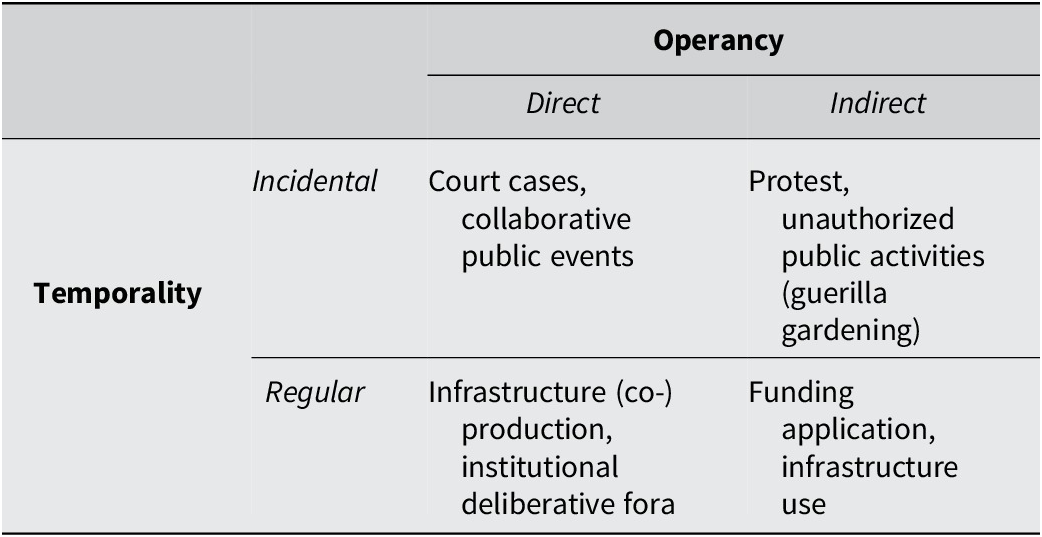
Modes are not exclusive of each other but co-occur and overlap within the analyzed encounters. Therefore, rather than classifying encounters into groups of certain modes, we identify temporality and operancy as two recurring dimensions by which different modes within the state–CBI encounter can be disentangled. Our intention is not to reduce our analysis of the mode to these two dimensions, but to use them as guidance. Temporality refers to the different rhythms of a mode, which can be more incidental, occurring only at one moment after which that mode ends, or regular, (re-)occurring continuously over time. Operancy refers to the way the mode organizes the (virtual or physical) moment of encounter. This can be a direct, synchronous encounter or an indirect, asynchronous encounter.
Table 2 provides illustrative examples of modes with different temporality and operancy from our analysis. For instance, the concrete co-production of infrastructure creates a direct moment in which CBI and state meet continuously over time (Goodwin, Reference Goodwin2022), whereas funding applications are also recurring but create an encounter that is more dispersed between different moments (Bennett et al., Reference Bennett, Escobar, O’Connor, Plotnikova and Steiner2022).
Examples of modes of encounter with different operancy and temporality
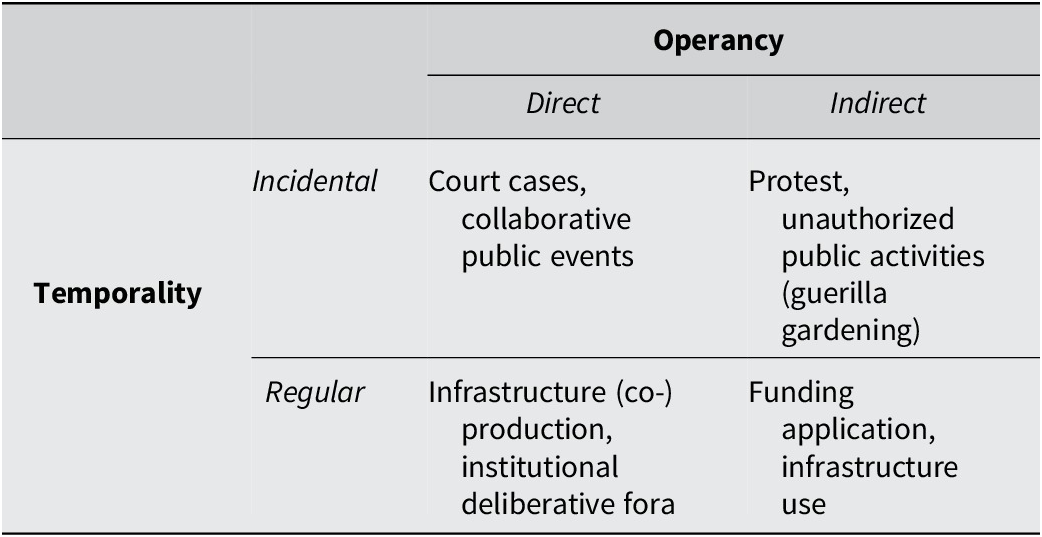
Table 2. Long description
The table is organized with Operancy as the horizontal header and Temporality as the vertical header.
* For Incidental Temporality:
- Direct Operancy includes court cases and collaborative public events.
- Indirect Operancy includes protest and unauthorized public activities such as guerilla gardening.
* For Regular Temporality:
- Direct Operancy includes infrastructure co-production and institutional deliberative fora.
- Indirect Operancy includes funding applications and infrastructure use.
The nature of encounter
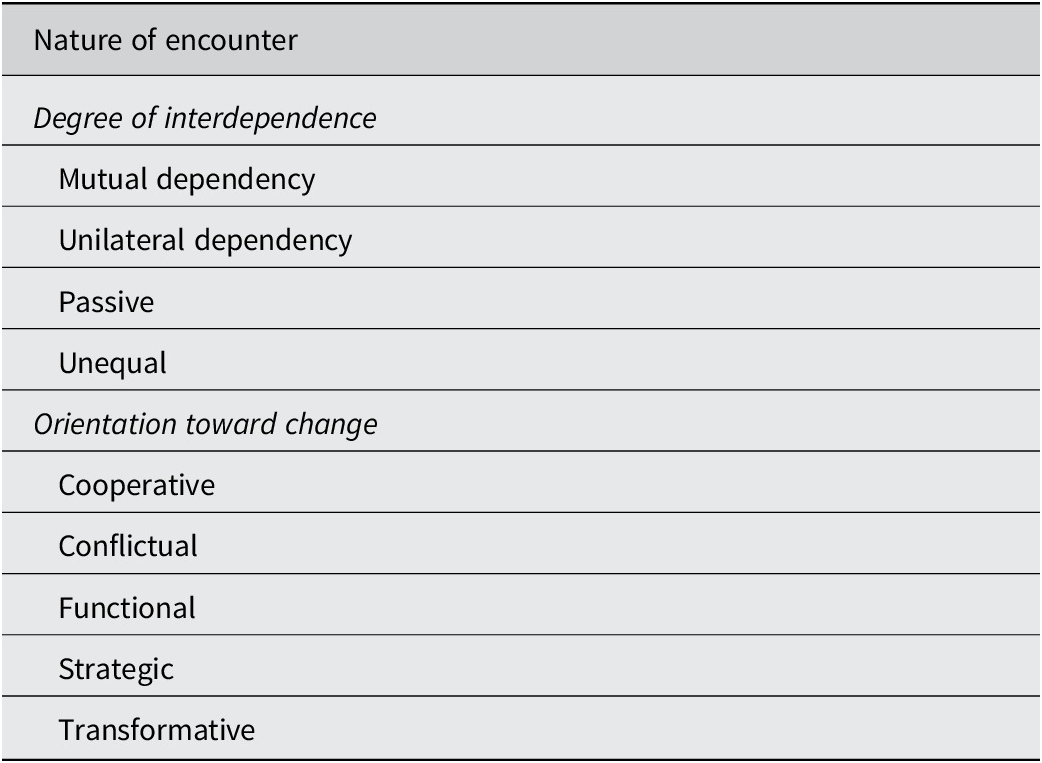
The nature of encounter refers to the underpinning entanglement of factors that drive and shape the encounter. The nature can be seen as the ‘what’ of the encounter: what sort of relationality does the encounter represent? Our analysis revealed nine natures along two dimensions, the degree of interdependency and motivation for change (Table 3). On the one hand, the natures represent varying degrees of interdependence between the state and CBIs. There is strong mutual dependency where “public service provision […] cannot happen without both the involvement of [state] and [community]” (Gazley & Cheng, Reference Gazley and Cheng2020, pp. 29–30). There are also encounters with unilateral dependency, where “community groups require knowledge of the public service reform discourse [… and] familiarity with local policy making processes and organizational practices” (Bennett et al., Reference Bennett, Escobar, O’Connor, Plotnikova and Steiner2022, p. 618). Less interdependent are passive encounters such as CBIs developing autonomy rather than aiming at engaging with the state, “carv[ing] out space for the control of land and water, develop[ing] alternative political practices and relations” (Goodwin, Reference Goodwin2022, p. 117). Across these levels of interdependence, the distribution of dependence is often not equal but generally higher for CBIs (Ansell & Gash, Reference Ansell and Gash2008; Purdy, Reference Purdy2012), although there is also a case of a higher dependence by the state (Gazley et al., Reference Gazley, Cheng and Lafontant2018).
Coding results for the nature of encounter
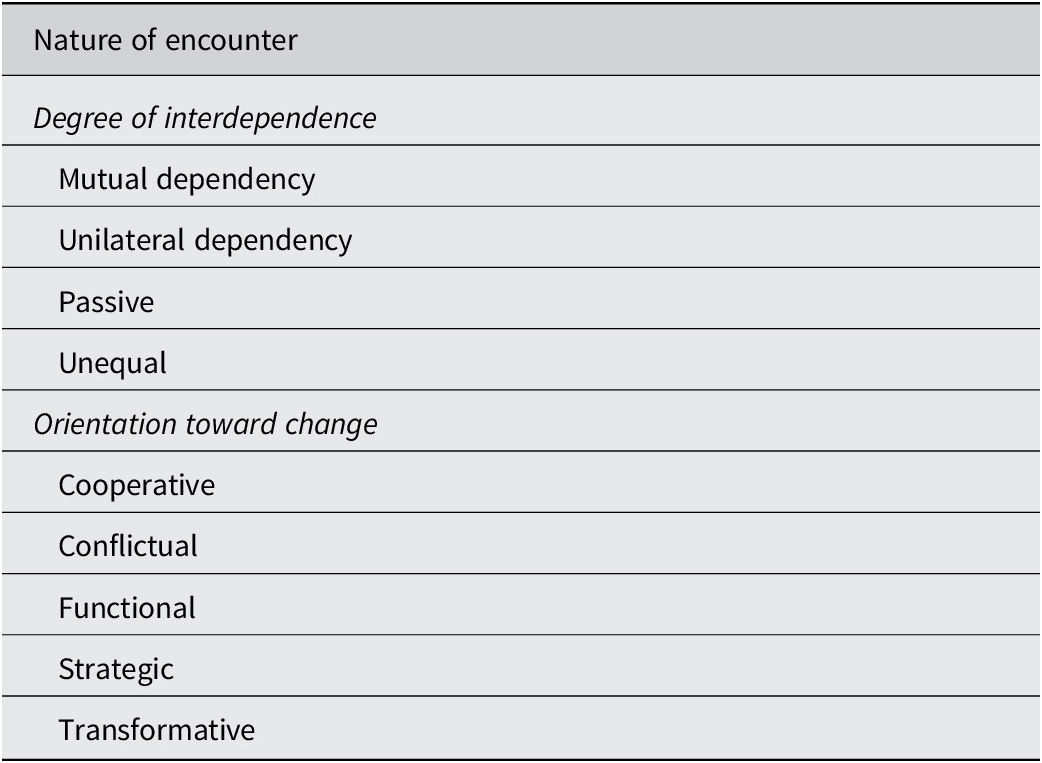
Table 3. Long description
The table consists of a single column titled Nature of encounter. It is organized into two primary thematic categories.
1. Degree of interdependence. This category includes four sub-items:
- Mutual dependency
- Unilateral dependency
- Passive
- Unequal
2. Orientation toward change. This category includes five sub-items:
- Cooperative
- Conflictual
- Functional
- Strategic
- Transformative
On the other hand, the codes of the nature of the encounter represent different orientations toward change. Encounters can be explicitly cooperative (Bixler et al., Reference Bixler, Coudert, Richter, Jones, Pulido, Akhavan, Bartos, Passalacqua and Niyogi2022), as well as a site of conflict, tension, and struggle (Goodwin et al., Reference Goodwin, O’Hare, Sheild Johansson and Alderman2022; Magalhães et al., Reference Magalhães, Andion and Alperstedt2020; Metzger et al., Reference Metzger, Soneryd and Linke2017). Furthermore, some encounters are functionally oriented to make the status quo work (Orenstein & Shach-Pinsley, Reference Orenstein and Shach-Pinsley2017). Others are strategically oriented toward particular goals or interests (Koebele, Reference Koebele2019), and yet others are transformatively oriented toward systemic change of the status quo (Coletta & Raftopoulos, Reference Coletta and Raftopoulos2018; Hasanov & Zuidema, Reference Hasanov and Zuidema2018).
A heuristic of state–CBI encounters
In order to understand state–CBI encounters as vehicles of social change, we develop a two-step heuristic from our coding analysis to organize and navigate how state–CBI encounters relate to social change.
Step 1: Characterizing the encounter
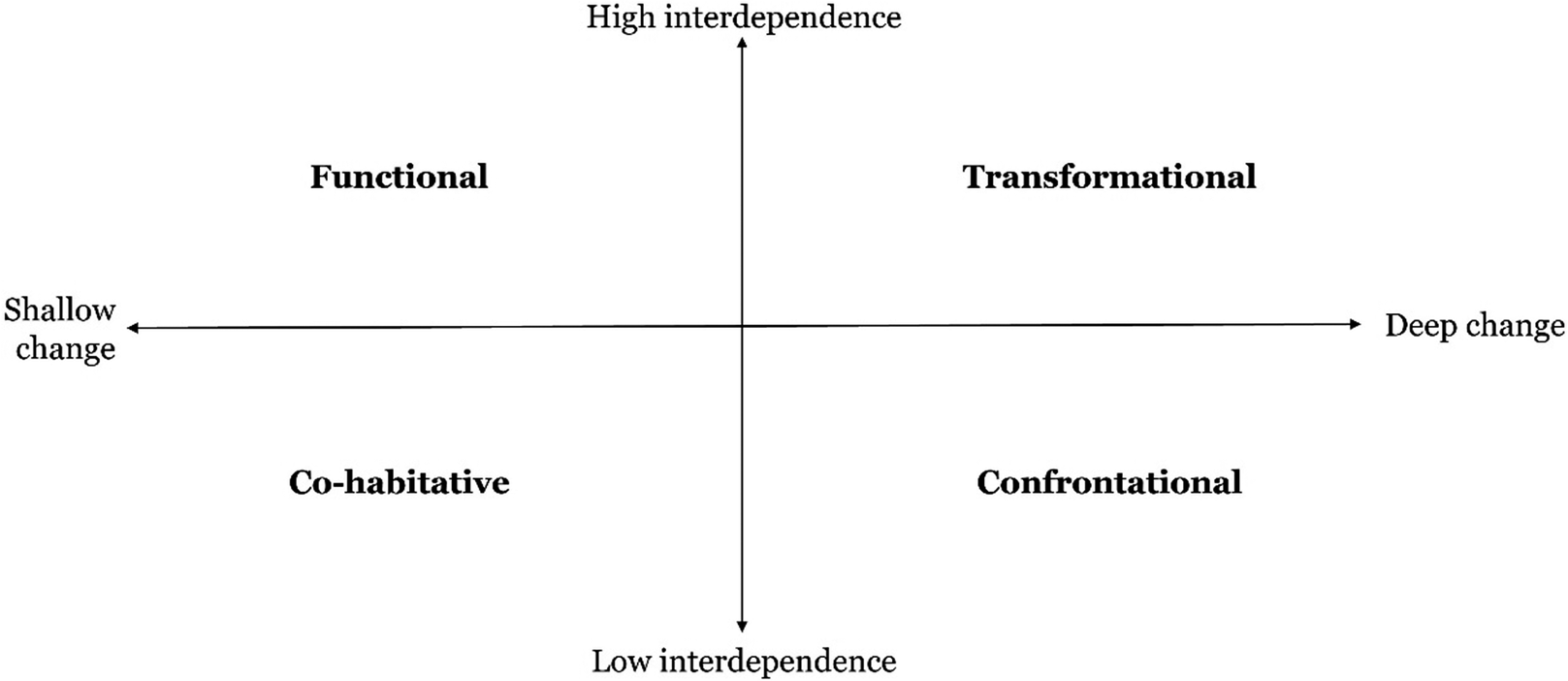
The first step is a typology of functional, transformational, confrontational, and cohabitative encounters, building on the two dimensions of interdependence and orientation toward change in the nature of encounters (Figure 1). The horizontal axis shows depth of change, from shallow change focused on improving current practices, to deep change focusing on underlying values, norms, and logics (Termeer et al., Reference Termeer, Dewulf and Biesbroek2017), as our codes primarily revealed this dimension of change, rather than the speed or scope.
Typology of state–CBI encounters in social change.

Functional encounters are characterized by a combination of shallow change and high interdependence. Functional encounters focus on practical and workable aspects, staying within the current practices and structures. Functional encounters provide changes that adjust, for example, through discovering overlapping objectives (Ansell & Gash, Reference Ansell and Gash2008) or finding complementary resources (Orenstein & Shach-Pinsley, Reference Orenstein and Shach-Pinsley2017).
Transformational encounters are characterized by deep change and high interdependence. Transformational encounters concern a questioning of the underlying norms, values, and logics in the public sphere, which is internalized into the encounter. Transformational encounters relate to change that reconfigures, for example, by reallocating public legitimacy to CBIs (Goodwin et al., Reference Goodwin, O’Hare, Sheild Johansson and Alderman2022) or validating their value system (Coletta & Raftopoulos, Reference Coletta and Raftopoulos2018).
Confrontational encounters are characterized by deep change and low interdependence. Confrontational encounters also question underlying factors, but with a more adversarial dynamic that distinguishes them from the more productive process of transformational encounters. In confrontational encounters, change is of the kind that challenges, for example, as repeated transgression calls laws and regulations into question (Boillat et al., Reference Boillat, Gerber, Oberlack, Zaehringer, Speranza and Rist2018; Boonstra & Boelens, Reference Boonstra and Boelens2011).
Cohabitative encounters are characterized by shallow change and low interdependence. Cohabitative encounters are passive, with little—intentional or unintentional—interest to engage in the public sphere whose directions they may envision in very different ways. Rather, the focus is on unilaterally pursuing changes. Within cohabitative encounters, changes are avoided, for example, by closing down access to resources and other support (Bennett et al., Reference Bennett, Escobar, O’Connor, Plotnikova and Steiner2022).
The first step of our heuristic provides four types of state–CBI encounters that can differently shape social change. In our sample, these types rarely remained stable over time but were fluid. For example, encounters in collaborative planning were deliberately designed to be of low interdependence in order to bring high interdependence down, which begs the question if this high interdependence actually underlies the encounter (Ostanel, Reference Ostanel2023; Purdy, Reference Purdy2012). Similarly, deep changes can be latent in shallow encounters, such as when co-producing daily tasks creates the basis for an overhaul of the way a public service is financed (Gazley et al., Reference Gazley, Cheng and Lafontant2018).
Step 2: Understanding fluidity
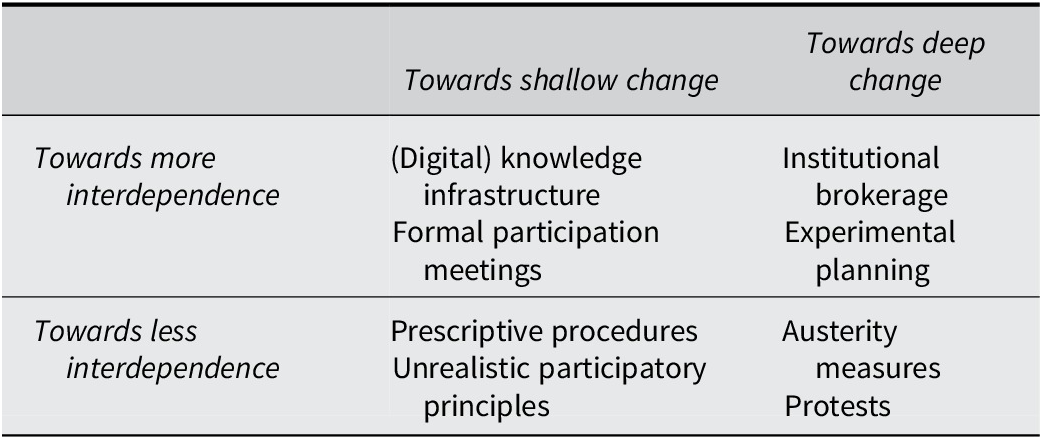
To better understand these shifts, we propose a second step to our heuristic in which the modes of encounter provide a starting point to understand shifts toward each quadrant of the typology, illustrated by four shifting encounters in our sample (Table 4).
Modes of encounter’s connection to shifts in the nature of encounter
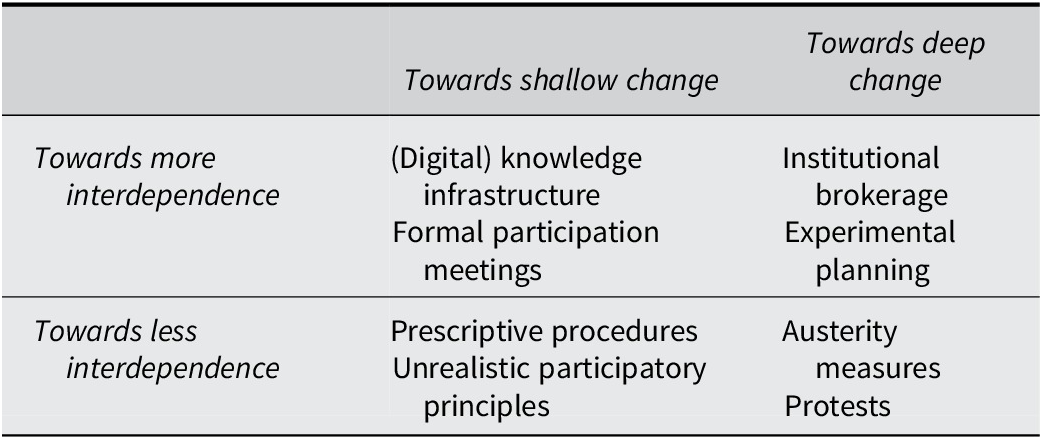
Table 4. Long description
The table consists of two columns representing the nature of change and two rows representing the level of interdependence.
Column Headers:
* Towards shallow change
* Towards deep change
Row 1: Towards more interdependence
* Intersection with shallow change: (Digital) knowledge infrastructure and Formal participation meetings.
* Intersection with deep change: Institutional brokerage and Experimental planning.
Row 2: Towards less interdependence
* Intersection with shallow change: Prescriptive procedures and Unrealistic participatory principles.
* Intersection with deep change: Austerity measures and Protests.
The shift toward functional encounters occurred in the context of children’s rights protection in a Brazilian city (Magalhães et al., Reference Magalhães, Andion and Alperstedt2020). The encounter is initiated through a process of politicization in which CBIs go from “a private perspective to building a perspective of public interest and engagement” (p. 684), around regular challenges between CBIs and the state on problem framing and public responsibilities. From this, the encounter becomes solution-oriented and centers around supporting and facilitating public action, culminating in a “city fund to support initiatives protecting the rights of children” (p. 689). This shift relates to two modes of encounter. First, the creation of a digital platform and a recurring municipal conference to share knowledge led to “reciprocal adjustments” and consolidation in the encounter (p. 693). While starting off experimentally, this becomes stable over time and remains within its context-based, pragmatic application, while not bringing forward radical practices, able to trigger deep changes. Second, the formal participation meetings recalibrate the role of CBIs from new actors with alternative (democratic) practices to regular participants in the democratic process. This also reaffirms the role of the state as coordinator of public services.
A shift toward transformational encounters is illustrated by the development of energy communities in the Netherlands (Hasanov & Zuidema, Reference Hasanov and Zuidema2018, pp. 90–91). Here, the alternative practices, values and beliefs of CBIs “could be observed not only in the initiative itself, but also in the institutional context, and more importantly, in the interaction between the two, reinforcing the emergence of new governance practices.” What started as more functional encounters to make energy production and consumption on a local scale work, became a “clear sign that society, values, and intentions associated with local initiatives are also starting to be reshaped.” Two modes can shed light on this transformational shift. One of these was the presence of institutional brokers: organizations that could “offer strategic advice and negotiate between the initiative and public entities.” This allowed the alternative practices and governance approaches to penetrate the institutional context. Second, the transformational encounter was facilitated by experimental planning practices through which the encounter could escape conventional policies, and “inspired institutional actors and other local communities to experiment with [transformative] practices in different localities.”
A shift toward confrontational encounters is illustrated by co-produced water services in Ecuador (Goodwin, Reference Goodwin2022). After a period of austerity and structural adjustments in which “the state made fewer contributions” and CBIs had to increasingly provide water services autonomously, a new administration “effectively formalized coproduced water services” into the state bureaucracy, which led to “political tensions and struggles” over this formalization (pp. 113–114). Two modes can help explain this shift: the first being austerity measures that reduced state contributions to water services. Because of this, CBIs had to increase their own organizational capacity and make connections with nonstate support such as NGOs. When the state wanted ‘back in’, this gave CBIs the ability to challenge these plans and remain in a lower interdependence with the state. Second, the encounter coincided with broader social movements in the country that aimed to influence a planned constitutional reform through manifestations and protests. These movements and protests also gave the geographically fragmented CBIs a focal point for organizing a confrontation with the state.
The shift toward cohabitative encounters is illustrated by CBIs’ participation in decision-making in Scotland (Bennett et al., Reference Bennett, Escobar, O’Connor, Plotnikova and Steiner2022). What started as an expansion of state–CBI encounters became a “last resort rather than a new and additional participation mechanism” (p. 620). This created demotivation and frustration among some CBIs, who then shunned participation altogether. Two modes of encounter help to understand this cohabitative shift. First, the highly prescriptive process led to “self-selection bias and participation of the most vocal, motivated, resourced, and well-organized” CBIs (p. 615). Second, the participation mechanism resulted from national legislation that failed to connect with the local reality of public services. At the abstract policy level, this mode aims for transformational encounters, seeking “to expand community involvement in local decisions and community ownership of land and buildings” (p. 610), but in the implementation, this does not translate to the routines and processes of local state agencies and gives them no basis to change their encounter with CBIs.
The temporality and operancy of the mode in these four shifts differ. In the functional and confrontational shift, modes with a more regular temporality were introduced, combined with direct operancy in the functional shift and more indirect operancy in the confrontational shift. In the transformational shift, the indirect mode of working through intermediate organizations helped the encounter spur changes at a broader scale. Lastly, the cohabitative shift featured the dissonance between the indirect national legislation and the direct participation procedure. At the same time, these observations do not provide a clear pattern between modes with particular temporalities and operancies and particular shifts in the encounter.
Discussion
The complex challenges of contemporary societies stem from an overarching ‘polycrisis’ (Albert, Reference Albert2025), which does not fit within state, community, market, and third sector realms but manifests across society at large. This demands new ontologies as well as new tools that show these connections. Focusing on the encounter between the state and CBIs as our unit of analysis, we aimed at overcoming such boundaries while developing a heuristic to navigate their relationality in terms of social change. Our relational approach, as a shared ontological and epistemological position, can act as a bridge between disciplines (Haxeltine et al., Reference Haxeltine, Pel, Wittmayer, Dumitru, Kemp and Avelino2017). This contributes to broadening the state-society encounter, as Hupe (Reference Hupe and Hupe2022) puts it, from a ‘focus’ on a very specific kind of state–society interaction to a ‘locus’ where different kinds of relationalities can be situated. Simultaneously, this warrants vigilance against conceptually overstretching the term encounter, akin to the development of how ‘co-production’ is used (Sorrentino et al., Reference Sorrentino, Sicilia and Howlett2018).
The typology classifies encounters into different natures representing a different orientation toward change. Approached relationally, the nature of the encounter is not static but an ever-changing process, mobilized by multiple factors and vectors. We understand the contingent modes through which the encounter unfolds as an entry point into this dynamic. Therefore, as a second step of our heuristic, we proposed a matrix (Table 4) that shows the fluidity: possibilities to shift from one nature to the other, based on different modes. The cells of Table 4 aim to illustrate the potential application of the heuristic rather than provide a turnkey explanation or action plan for changing state–CBI encounters, as the way in which the modes and nature of encounters relate is highly complex. The heuristic is a reflexive tool, in-the-making, to support further exploration of the way CBIs and state relate.
Our framework has both practical and conceptual relevance. Practically, the heuristic can help steer the multiform landscape of state–CBI encounters, which calls for new institutional logics and democratic considerations (de Moor et al., Reference de Moor, Czischke, Eijk, Groep-Foncke, Held, Horlings, Jans, Kleinhans and Meerkerk2025), as exemplified by European debates on legislation supporting energy communities while simultaneously preventing them from becoming elite groups with privileged access to public funds (de Bakker et al., Reference de Bakker, Lagendijk and Wiering2020). The heuristic helps both scholars and practitioners navigate the complexity of such state–CBI encounters, valuing their different natures and acknowledging multiple fruitful forms of encountering. Here, the reflexive part of our relational approach remains important as unpacking state–CBI encounters can also facilitate legibility of the community sphere, hampering rather than generating social change through disciplining, standardizing, and instrumentalizing (Nickel & Eikenberry, Reference Nickel and Eikenberry2016; Scott, Reference Scott1998).
Conceptually, by providing a relational perspective, the heuristic complements existing typologies of state–CBI relationships that are actor-focused (Edelenbos et al., Reference Edelenbos, van Meerkerk and Schenk2018; Laforge et al., Reference Laforge, Anderson and McLachlan2017; Runhaar et al., Reference Runhaar, van Doorm, Cartagena, de Graaff, Offringa, van Oers, Pustilnik, Remorie, Lageweg and Raven2025), which becomes difficult when CBIs and state actors display different attitudes about the same interaction (Blok et al., Reference Blok, van Buuren and Fenger2023; Visser et al., Reference Visser, van Popering-Verkerk and van Buuren2021). By thinking of multiple relationalities and degrees of interdependence instead of one relationship, our approach can help illuminate differences.
Conclusion
This paper has sought to develop a relational state–CBI perspective, proposing the concept of state–CBI encounter to enable a broader and more dynamic understanding of a relationship that increasingly features in research and policy, but has so far been investigated in terms of collaborations and from a state or society perspective. Using a literature review, we provide a heuristic to understand state–CBI encounters in the context of social change. We distinguish between functional, transformative, confrontational, and cohabitative encounters, with different implications for social change. These types are in practice not siloed and can shift over time. We illustrate these shifts through an exploration of the modes in which these encounters take form, emphasizing differences in temporality and operancy.
To develop this perspective further, we propose three research avenues. First, the concept of state–CBI encounter can be further specified for different forms of state organization. Is the heuristic relevant only for liberal democracies, or also for illiberal regimes? Second, it can be interesting to study how encounters manifest at different levels of change, such as the product, process, and social level that informed previous nonprofit research (Shier & Handy, Reference Shier and Handy2015). Third, future research can focus on the implications of state–CBI encounters at the actor and the systemic level. If and how do actors in state–CBI encounters perceive their relationality, including boundary spanner roles (Williams, Reference Williams2012)? What is the role of boundary spanners? Systemically, how do economic structures and positions of power intertwine with the state–CBI encounter in shaping social change (Avelino et al., Reference Avelino, Grin, Pel and Jhagroe2016)? Bridging relational perspectives from different disciplines, this study offers a starting point to enter these research challenges.
Supplementary material
To view supplementary material for this article, please visit http://doi.org/10.1017/S0957876526000367.
Data availability statement
The coding data of this study are available at https://doi.org/10.34894/JXTLEI.
Acknowledgments
The authors would like to thank Prof. Dr. Sarah Giest for her input at various stages of the research process.
Funding statement
This research was funded by Leiden University.
Competing interests
The authors declare that they have no conflict of interest.
Ethical standard
This research does not involve Human Participants and/or Animals, and therefore does not relate to informed consent.



 Open access

