

A mature comprehension of emotions is significant for children to guide their own emotional behaviours and establish interpersonal relationships in the course of social interaction. Existing studies have highlighted that emotion-understanding ability plays an important role in children's social-emotional competence, as it enables children to express their own feeling states, understand others’ emotional reactions and expressions, and infer the causes and consequences of emotion-eliciting situations in socially and culturally appropriate ways (e.g., Denham et al., Reference Denham, Blair, Demulder, Levitas, Sawyer, Auerbach- Major and Queenan2003; Kårstad, Wichstrøm, Reinfjell, Belsky, & Berg-Nielsen, Reference Kårstad, Wichstrøm, Reinfjell, Belsky and Berg-Nielsen2015). Through the preschool years, children make impressive gains in their understanding of emotions, along with significant development in language skills, theory of mind, self-understanding, and so on (Ontai & Thompson, Reference Ontai and Thompson2002). Emotion socialisation starts within the family, where parents’ emotion-related behaviours greatly contribute to preschool children's development of emotion understanding ability. Although early studies have underscored the influential role of parenting in children's emotional outcomes (e.g., Nelson et al., Reference Nelson, O'Brien, Calkins, Leerkes, Marcovitch and Blankson2012; Roth and Assor, Reference Roth and Assor2010), little research has examined the relationship between children's own behaviours in the course of interaction and children's emotion understanding. The primary purpose of the current study was to investigate the relation of both parents’ and children's interaction behaviours to young children's emotion understanding.
As the most fundamental part of emotional competence, emotion understanding generally refers to the ability to label emotional expressions, discern emotion-eliciting situations, and give causal explanations of emotions based on contextual information (Saarni, Reference Saarni1999). One area of emotion understanding that has attracted great attention is young children's recognition of facial expressions. Facial expression recognition reflects children's capability for predicting others’ inner states through identifying emotional expressions (Nelson, Reference Nelson1979). Young children are better at recognising positive expressions than negative ones, especially fear that is usually conveyed by complex facial movements and is rarely experienced by children in everyday life (Denham, Reference Denham1998). Around age 5 to 6, children are more adept at identifying different negative facial expressions accurately (Saarni, Reference Saarni1999). A more recent review suggested that children's understanding of facial expressions gradually develops from broad categories to more differentiated categories (Widen, Reference Widen2013).
Children's developmental progress in understanding emotion-eliciting situations is in line with their facial expression recognition ability. Similar to the identification of facial expressions, it is easier for young children to make a distinction between happy or not happy situations than to differentiate between negative situations (Fabes, Eisenberg, Nyman, & Michealieu, Reference Fabes, Eisenberg, Nyman and Michealieu1991). Through associating emotional states with particular situations, children gradually develop their understanding of various emotions. During the preschool years, children can infer emotions from situations by using different methods, such as reflecting on their own feelings to similar situations and thinking about possible emotional reactions of people in general (Gnepp, Reference Gnepp, Saarni and Harris1989). In addition to children's understanding of emotion-eliciting situations, preschoolers gradually understand the causes and consequences of their own and others’ basic emotions (Denham, Reference Denham1986), and how external events can evoke emotions (Thompson & Lagattuta, Reference Thompson, Lagattuta, McCartney and Phillips2006). Researchers found that preschoolers as young as 4 years old can provide reasonable explanations for emotions experienced by themselves and others (Dunn & Hughes, Reference Dunn and Hughes1998), and identify causes of emotions for themselves earlier than they can understand causes of emotions for others (Weimer & Guajardo, Reference Weimer and Guajardo2005).
Children's interactions with others are the primary means to acquire emotion-understanding skills (Kårstad et al., Reference Kårstad, Wichstrøm, Reinfjell, Belsky and Berg-Nielsen2015). For preschool children, in particular, before they are exposed to a wider social world, their development of emotion understanding is greatly influenced by their social interactions with parents. Previous research has indicated the link between parental emotional expressiveness and children's emotion understanding. For example, parents showing more positive affects have children who are more competent in comprehending emotional expressions and situations and taking others’ perspectives (e.g., Garner, Jones, & Miner, Reference Garner, Jones and Miner1994; Halberstadt, Crisp, & Eaton, Reference Halberstadt, Crisp, Eaton, Philippot, Philippot and Coats1999; Laible & Song, Reference Laible and Song2006). Attachment theory also provides explanations for the relationship between parental positive emotion-related behaviours and children's understanding of emotions. The formation of ‘internal working models’, on the basis of caregivers’ nurturant communications, allows children to develop an understanding of the self, the primary caregiver, and interpersonal relationships, which has long-term influences on children's socio-emotional competence (Bowlby, Reference Bowlby1988; Eisenberg et al., Reference Eisenberg, Fabes, Shepard, Guthrie, Murphy and Reiser1999).
Many studies have also highlighted the significance of parental reactions to children's emotions. For instance, parental negative and dismissive reactions to children's emotions were associated with a high frequency of children's negative emotional displays, poor understanding of negative emotions, and low levels of emotion regulation abilities (Morris, Silk, Steinberg, Myers, & Rovinson, Reference Morris, Silk, Steinberg, Myers and Robinson2007), and were also related to children's low levels of empathy toward others’ negative emotions and use of inappropriate coping strategies when children experience negative emotions themselves (Eisenberg et al., Reference Eisenberg, Fabes, Shepard, Guthrie, Murphy and Reiser1999). Furthermore, Roth and Assor (Reference Roth and Assor2010) suggested that parental conditional regard — that is, how the parent provides more affection than usual when the child meets the parent's expectations and provides less affection when the child does not — was negatively associated with children's recognition of sadness, awareness of sadness, and empathy.
In addition to parental factors, children's own behaviours also play an important role in their emotion understanding. During daily parent-child interactions, children's behaviours have unique effects on their parents’ reactions and associations with their emotional outcomes. Eisenberg and Fabes (Reference Eisenberg and Fabes1994) found that mothers’ self-reported punitive responses and distress reactions were linked with maternal perceptions of children's high negative affect, while encouragement was correlated with ratings of children's high attentional control. Eisenberg et al. (Reference Eisenberg, Fabes, Shepard, Guthrie, Murphy and Reiser1999) provided clear evidence for the bidirectional relationship between parental punitive reactions to children's negative emotions. On the one hand, parents’ emotion-related behaviours guide children's comprehension, expression, and regulation of emotions. On the other hand, children's behaviours have an impact on parental reactions during daily interactions.
There is limited evidence that child gender has an effect on parental reactions to children. According to a review by Eisenberg, Cumberland, and Spinrad (Reference Eisenberg, Cumberland and Spinrad1998), mothers tend to display their emotions differently when interacting with boys and girls. Mothers are more emotionally expressive with daughters (Garner, Robertson, & Smith, Reference Garner, Robertson and Smith1997) and make more references to anger and disgust when talking to sons than daughters (Kuebli, Butler, & Fivush, Reference Kuebli, Butler and Fivush1995). Research examining paternal behaviours showed that fathers attended more to daughters’ submissive emotion than to sons’ during the preschool period (Chaplin, Cole, & Zahn-Waxler, Reference Chaplin, Cole and Zahn-Waxler2005). Most studies have focused on how parents’ emotion-related reactions are different to boys and girls, whereas scant research has examined whether the association between parenting behaviours and children's emotional outcomes differs by child gender. An interesting study by Cunningham, Kliewer, and Garner (Reference Cunningham, Kliewer and Garner2009) revealed gender differences in the relationships between maternal emotional socialisation, emotion understanding, and psychosocial adjustment, suggesting that emotion understanding mediated the relationship between emotional socialisation and boys’ internalising behaviours, and between emotional socialisation and girls’ social skills. This study has underscored that parental practices may influence boys and girls differently.
The past three decades have seen an increasing body of Western research examining the relationship between parent-child interaction and children's emotional development, whereas limited research has been conducted in the Chinese context. Confucian philosophy, which highlights the significance of self-discipline, parental control, and filial piety, has considerable influences on family interaction and parent-child relationship (Lin & Fu, Reference Lin and Fu1990). Influenced by cultural and philosophical beliefs deeply embedded in Chinese societies, during memory sharing and story telling, Chinese mothers paid greater attention to discipline and proper conduct, compared to European-American mothers, who more frequently employed an elaborative style to provide explanations for the cause of children's feeling states (Wang & Fivush, Reference Wang and Fivush2005). Another study showed similar evidence that Chinese mothers made more references to behaviours than American mothers who commented more on thoughts and emotions (Doan & Wang, Reference Doan and Wang2010). American children were more elaborative in conversations than were Chinese children (Wang & Fivush, Reference Wang and Fivush2005). Cultural values that have an impact on parents’ practices contribute to children's emotional development.
In the literature, most studies have explored the effects of parental socialisation behaviours but overlooked the role of children's own behaviours. Moreover, existing research has identified the importance of parents’ verbal expressions to children's emotion understanding, while non-verbal behaviours presented during interactions, such as facial expressions and tone of voice, have not been paid enough attention. Although non-verbal behaviours may not provide emotional information as directly as emotional verbal expressions do, they can convey rich emotional cues for children to observe and develop emotional skills. Lastly, the role of family interaction in children's emotion understanding in the Chinese context still remains unclear due to the predominance of Western participants in the literature.
The present study had two main purposes. The first was to examine the relationship between parent-child interactions and children's emotion understanding by adopting a dual focus on parent-to-child interactions with a focus on parent behaviours, and child-to-parent interactions with a focus on child behaviours. Given previous studies identifying the contributions of parents’ behaviours and children's behaviours to children's emotional outcomes (e.g. Eisenberg & Fabes, Reference Eisenberg and Fabes1994; Morris et al., Reference Morris, Silk, Steinberg, Myers and Robinson2007), it was hypothesised that children's emotion understanding would show independent correlations with the quality of parent-to-child interactions and child-to-parent interactions. The second purpose of the study was to investigate gender differences in the average levels of interaction measures as well as in the strength of associations between parent-child interaction measures and children's emotion understanding. According to existing evidence showing that boys’ negative affects are more evocative for mothers during interaction (Eisenberg et al., Reference Eisenberg, Fabes, Shepard, Guthrie, Murphy and Reiser1999), it was hypothesised that boys’ emotion understanding would be more related to mothers’ interaction behaviours than girls. Given the absence of decisive data, an exploratory approach was adopted to examine the relationships between parent-child interactions and emotion understanding.
Method
Participants
The participants were 51 Chinese children — 26 girls and 25 boys (M = 39.55 months, SD = 1.98 months, age range = 36–42 months) — and their mothers (M = 33.9 years, SD = 4.17 years, age range = 24–44 years), who were recruited from a kindergarten in Beijing, China. None of the children had siblings. Two of the mothers had high school diplomas, 34 had college degrees, and 15 had masters’ degrees or above. All the children and their mother speak Mandarin as their first language.
Procedure
The behavioural observation approach was used in this study to capture characteristics of mother-child interactions. Children and mothers were asked to engage in three video-recorded interaction tasks comprising 10 minutes of free play (with a train track and doll set), a 5-minute tidy-up (with two plastic boxes for children to arrange two sets of toys), and a 10-minute structured play (with blocks and puzzles). The three interaction tasks, adapted from a study by Ensor, Spencer, and Hughes (Reference Ensor, Spencer and Hughes2011), were used to examine mothers and children's interaction behaviours. The researcher (the author) asked the mothers to interact with their children as they normally would at home. Following the mother-child interaction tasks, each child was asked to complete three individually administered tasks, that is, a facial expression recognition task, an emotion-perspective taking task, and an emotion reason understanding task, to assess their emotion understanding ability. The three emotion understanding tasks took approximately 15 minutes in total. At the end of the study, each child received a set of toys as a reward for participation.
Measures
Mother-child interaction
The Parent-Child Interaction System (PARCHISY; Deater-Deckard, Pylas, & Petrill, Reference Deater-Deckard, Pylas and Petrill1997) was used to code mothers' and children's interaction behaviours in the three tasks. Ten coding items were focused on in the current study, including five items of mother behaviour and five items of child behaviour. Each aspect of interaction behaviours was rated on a 7-point Likert rating scale from 1 (no evidence shown from interaction) to 7 (constant instances shown throughout the task). The ten coding items are as follows:
1. Mother positive content: use of praise, explanation, and open-ended questions;
2. Mother negative content: use of physical control of toys or child's hand/arm/body, use of criticism;
3. Mother positive affect: smiling, laughing, warm tone of voice (includes affectionate nick-names, hugs, kisses);
4. Mother negative affect: frowning, cold/harsh voice;
5. Mother responsiveness to child's questions, comments, and behaviours;
6. Child positive affect: smiling, laughing;
7. Child negative affect: frowning, cold/harsh voice;
8. Child responsiveness to parent's questions, comments, and behaviours;
9. Child non-compliance;
10. Child autonomy/independence: child leads and controls task; does not include off-task behaviours.
Twenty percent of videos were randomly selected and coded by the researcher and another trained coder with a psychology background. Mothers and children's behaviours shown in the three tasks were double coded respectively for reliability assessment. Interrater reliability was established using Cohen's kappa. The average kappa coefficients across mother and child codes ranged from 0.73 to 0.94, which showed good to excellent agreement between the researcher and the second coder.
Emotion understanding
Children's emotion understanding was assessed using three tasks, that is, the facial expression recognition task, emotion-perspective taking task, and emotion reason understanding task. The facial expression recognition task, adapted from Denham's (Reference Denham1986) affective labelling task, has been used in Chinese studies to test toddlers’ understanding of emotional expressions (e.g., Pan & Su, Reference Pan and Su2007; Yao, Chen, & Zhao, Reference Yao, Chen and Zhao2004). Four pictures of cartoon faces showing happy, sad, angry, and scared expressions were shown to the child. Then the researcher asked each child two questions. First, the researcher asked the child to identify the expressions expressively: ‘How is the little boy/girl feeling now?’ Then the researcher randomised the order of the four pictures and asked the child to identify the expressions: ‘Now I am going to tell you how the little boy/girl is feeling and I would like you to point out the right face that shows his/her feeling: The little boy/girl is feeling happy/sad/angry/scared. Which face shows his/her feeling?’ For this task, the child received 2 points for correctly answering each question and 1 point for identifying positive-negative dimensions. For example, when asked to identify the ‘sad’ expression, if the child identifies it as ‘angry’ or answered that ‘He feels bad’, the child would receive 1 point. Therefore, the possible range of scores on this task was from 0 to 16 points.
In order to assess children's ability to discern relations between emotions and emotion-eliciting situations, the emotion situation knowledge task adapted from Wang (Reference Wang2003) was used in the study. Eight stories (selected among the original 20 stories to shorten the task; two for each type of emotions) in which a protagonist child would feel happy, sad, angry, and scared were told in randomised order to the child. All the stories were unambiguous and developmentally and culturally appropriate, such as the child protagonist playing with his best friend (happy), losing his favourite toy (sad), being forced to wear a hat he does not like (angry), and getting lost in a store (scared). When listening to each story, the child was shown a cartoon-like picture. Depending on the gender of the child, pictures of cartoon boys and girls were presented to participant boys and girls respectively. On each picture, the child figure appeared at the back so that the participant could not guess the answer according to the picture. The researcher repeated or explained to the child when the child did not fully understand the stories. Following each story, the researcher asked the child how the figure feels in the story. The child received 2 points for fully correct answers and 1 point for correctly identifying the positive-negative dimension (e.g., answering ‘sad’ when the protagonist child feels ‘angry’ or answering ‘He feels good/bad’). Possible scores on this task ranged from 0 to 16 points.
The emotion reason understanding task adopted by Yao et al. (Reference Yao, Chen and Zhao2004) was used to assess children's ability to give causal explanations for emotions. The researcher showed the four pictures of cartoon faces portraying feelings of happiness, sadness, anger, and fear to the child again in this task. The researcher told the child that the cartoon character on the picture feels happy, sad, angry, or scared and then asked the child to give a reason that made the cartoon character experience the given emotion. For this task, the child received 2 points for fully appropriate answers, 1 point for partially logical answers, and 0 points for non-logical answers. Thus possible scores on this task ranged from 0–8 points.
Results
Preliminary Analyses
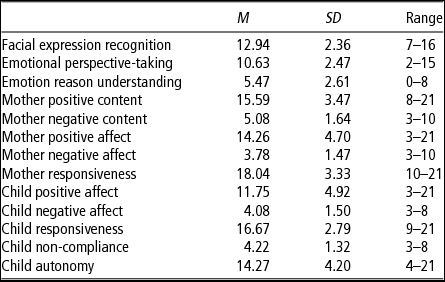
Preliminary analyses for data reduction were conducted first. Table 1 presents the means, standard deviations, possible range, and range for all raw scores of parent-child interaction and emotion understanding measures. Data reduction was then conducted to create aggregate measures for the main analyses due to the constraints on the number of predictors for achieving the desired statistical power.
Descriptive Statistics for Raw Scores of Parent-Child Interaction and Emotion Understanding
Partial correlations, controlling for children's age, were conducted to examine the relations between children's performance on the three emotion understanding tasks. The results of correlations suggested the raw scores on the three emotion understanding tasks were significantly correlated with each other at the p < .05 level (range = .41–.52), which supported the creation of an aggregate score of emotion understanding. Because possible scores for the facial expression recognition task, emotion perspective-taking task, and emotion reason-understanding task were not equal (16 points, 16 points, and 8 points respectively), children's scores on the three tasks were converted into t scores and summed to create an aggregate score of emotion understanding. Cronbach's alpha for the aggregate scale was .73, indicating acceptable internal consistency.
Ratings of mother positive content, mother positive affect, and mother responsiveness were averaged to create an aggregate score of mother positive behaviour (Cronbach's alpha = .80). Ratings of mother negative content and negative affect were averaged to create an aggregate of mother negative behaviour (Cronbach's alpha = .81). Positive coding items of child behaviour, including positive affect, responsiveness, and autonomy were averaged to create an aggregate of child positive behaviour (Cronbach's alpha =. 72); child negative affect and non-compliance were averaged to create an aggregate of child negative behaviour (Cronbach's alpha = .78). In summary, four new aggregate measures were created as mother positive behaviour, mother negative behaviour, child positive behaviour, and child negative behaviour.
Preliminary analyses were also conducted to test whether demographic measures had effects on parent-child interaction and children's emotion understanding measures. Results showed that child age was significantly correlated with mother positive behaviour (r = .48, p < .001) and child positive behaviour (r = .34, p < .01). Mothers’ age and education were not related to any of the interaction and emotion understanding measures. Gender differences are reported later in the main analysis in order to address the second research question.
Relation of Parent-Child Interaction to Children's Emotion Understanding
The first purpose of the study was to investigate the relationships between parent-child interaction measures and children's emotion understanding ability. Parent-to-child interaction measures with a focus on mother behaviour and child-to-parent interaction measures with a focus on child behaviour were checked respectively for their association with children's emotion understanding. Partial correlation analyses were conducted to examine the relationships between parent-child interaction and children's emotion understanding, controlling for child age. In addition, child measures were controlled when the relation between mother measures and emotion understanding was tested, and mother measures were controlled when the relation between child measures and emotion understanding was tested. As shown in Table 2, children's emotion understanding was significantly correlated with mother positive behaviour, r = .42, p < .01, mother negative behaviour, r = -. 43, p < .01, and child positive behaviour, r = .34, p < .05. There was no strong correlation between child negative behaviour and emotion understanding.
Partial Correlations Between Parent-Child Interaction Measures and Child Emotion Understanding (Controlling for Child Measures When Testing the Relation Between Mother Measures and Emotion Understanding; Controlling for Mother Measures when Testing the Relation between Child Measures and Emotion Understanding; Controlling for Child Age)
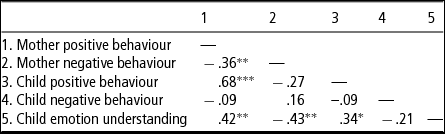
Note: *p < .05, **p < .01, ***p < .001.
Gender Differences
The study examined gender differences from two perspectives. First, the independent t test was conducted to compare boys and girls’ average levels of parent-child interaction measures. However, the results of the t test showed no significant gender difference in any of the parent-child interaction measures. Second, the extent to which parent-child interaction measures were associated with children's emotion understanding was assessed for boys and girls respectively. Partial correlations with age effects controlled were conducted. As presented in Table 3, both boys and girls’ emotion understanding was significantly correlated with mother positive behaviour. Boys’ emotion understanding was also related to mother negative behaviour, r = -.51, p < .01, while girls’ emotion understanding was related to child positive behaviour, r = .59, p <. 01. Fisher's r-to-z transformation was used to assess the significance of the difference between correlation coefficients for boys and girls. Correlation coefficients between child positive behaviour and emotion understanding for boys and girls were significantly different, z = 2.14, p < .05, two-tailed.
Partial Correlations Between Parent-Child Interactions and Children's Emotion Understanding for Boys and Girls (Controlling for Child Age)
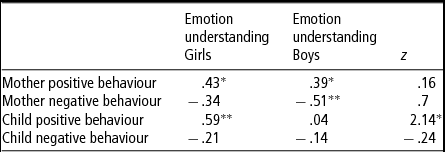
Note: *p < .05, **p < .01.
Discussion
The results of this study provided support for the two hypotheses. First, children's emotion understanding was independently related to both parent-to-child interaction measures and child-to-parent interaction measures. Second, boys’ emotion understanding was significantly correlated with mother negative behaviour. In contrast, girls’ emotion understanding was significantly correlated with child positive behaviour. The correlations between child positive behaviour and emotion understanding for boys and girls were significantly different.
Parent-Child Interaction and Children's Emotion Understanding
Parent-to-child interactions and children's emotion understanding
The results demonstrated that children's emotion understanding had independent correlations with mothers’ behaviours and children's behaviours during parent-child interactions. Specifically, mothers’ positive behaviours in terms of positive content, positive affect, and responsiveness were related to children's emotion understanding. Prior studies have consistently shown that parental warmth characterised by positive affects such as smiling, laughing, and intimate physical behaviours promote children's emotion understanding ability (Denham et al., Reference Denham, Mitchell-Coperland, Strandberg, Auerbach and Blair1997; Laible & Song, Reference Laible and Song2006). Furthermore, Laible and Thompson (Reference Laible and Thompson1998) found that a high-quality parent-child relationship was particularly influential for children's understanding of negative emotions. Indirect evidence can be found from the perspective of attachment theory. Based on early accessibility and responsiveness of attachment figures, young children construct ‘internal working models’ that underlines their understanding of themselves, relationships with others, and various other features of social and emotional understanding (Thompson, Laible, & Ontai, Reference Thompson, Laible and Ontai2003). Securely attached children with mothers who make more references to emotions and have richer discourse styles during daily interaction are able to explore a wide range of emotions in an environment of warmth and affection, thereby having an advanced understanding of emotions (Ontai & Thompson, Reference Ontai and Thompson2002).
In line with previous studies (e.g. Denham, Zoller, & Couchoud, Reference Denham, Zoller and Couchoud1994; Eisenberg & Fabes, Reference Eisenberg and Fabes1994), the results showed an inverse correlation between mother negative behaviour in terms of negative content and negative affect, and children's emotion understanding. An intervention study by Wilson, Havighurst, and Harley (Reference Wilson, Havighurst and Harley2012) has also underscored the importance of reducing emotionally negative practices for children's socio-emotional wellbeing. In addition, children who are often exposed to parental negative expressions are likely to become distressed in emotion-evoking situations, which can distract children's attention from observing and encoding emotional cues (Denham, Reference Denham1998). However, in contrast to extremely low levels of parental negative expressiveness that may limit opportunities to develop emotion regulation skills and high levels of negative expressiveness that may hinder emotional development (Wong, McElwain, & Halberstadt, Reference Wong, McElwain and Halberstadt2009), a moderate degree of negative emotions demonstrated by parents in appropriate situations enables children to access information regarding emotional expressions and situations. The influences of frequency, intensity, and clarity of parental negative expressions on children's emotion understanding remain to be explored in future research.
Child to parent interactions and children's emotion understanding
The results showed that children's positive behaviours in terms of positive affect, autonomy, and responsiveness were related to children's emotion understanding. Unlike most prior studies investigating how children's attributes influence parents’ emotional expressiveness or how children's attributes moderate the effects of parental behaviours on children's emotional competence, the current study focused on the association between children's behaviours during parent-child interactions and children's emotion understanding. The results are in part consistent with previous research by Denham, Renwick, and Holt (Reference Denham, Renwick and Holt1991), which demonstrated that maternal interaction behaviour is not the only variable related to children's social-emotional competence, and children's optimal involvement in dyadic interaction characterised by positive affects, autonomous behaviours, and lack of avoidance predict children's social-emotional strength. Very few studies have directly examined the relation of children's positive interaction behaviours to emotion understanding. However, it is reasonable to infer that children who positively interact with their mothers in shared tasks are more competent and willing to actively observe and grasp others’ emotional cues during daily life. Also, because parent-child interactions are reciprocal, children's positive behaviours may encourage parents to make more explanations for emotion-related behaviours, so that children have a variety of opportunities to enhance their understanding of emotions through exploring the emotional import of parental emotional expressiveness.
Gender Differences
Gender differences in parents' and children's interaction behaviours
In order to investigate whether mothers' and children's interaction behaviours would vary depending upon children's gender, gender differences in the average levels of parent-child interaction measures were first examined. However, in contrast to previous studies suggesting that parents show different emotion-related behaviours when interacting with boys and girls (e.g., Adams, Kuebli, Boyle, & Fivush, Reference Adams, Kuebli, Boyle and Fivush1995; Fivush, Brotman, Buckner, & Goodman, Reference Fivush, Brotman, Buckner and Goodman2000), the present study did not identify any parental sex-differentiated reactions towards children. Moreover, boys' and girls’ behaviours during the interaction did not differ from each other. This finding might be caused by the small sample size of this exploratory study. Another possible explanation is that the implementation of the one-child policy in China may reduce the influences of gender stereotype on parental reactions toward young children (Yao et al., Reference Yao, Chen and Zhao2004). Because the one-child policy was introduced in 1979 and began to be phased out in 2015 in China (Liang et al., Reference Liang, Mu, Li, Tang, Wang, Liu and Dai2018), children involved in the present study were born before 2015 when the policy was still in effect. It is possible that when children are at younger ages that Chinese parents tend to place great emphasis on whether children are well-behaved rather than on gender-appropriate behaviour. Parents may interact with preschool boys and girls in similar ways, which leads to the absence of salient gender differences in parents’ behaviours toward children's behaviours.
Gender differences in relationships between parent-child interaction and emotion understanding
The results demonstrated that boys' and girls’ emotion understanding ability were associated with mothers’ negative behaviour and children's positive behaviour respectively. Although the correlations between mothers’ negative beahviours to boys and girls were not significantly different in the study, mothers’ negative behaviours had significant relations with boys’ but not girls’ emotion understanding. Denham et al. (Reference Denham, Zoller and Couchoud1994) offered support for the results, suggesting that maternal negative responsiveness negatively predicted boys’ but not girls’ emotion understanding. Also, the findings were partially consistent with a study by Hughes, Deater-Deckard, and Cutting (Reference Hughes, Deater-Deckard and Cutting1999), which examined the relation between parenting and children's understanding of mind, and found that parental discipline was more salient for boys than girls. In spite of no difference found in boys' and girls’ negative behaviours in this study, boys generally expressed externalising negative behaviours with greater intensity compared to girls, given the observation of the interaction tasks. Therefore, boys’ negative expressions might be more overt for mothers. Possibly because of boys’ observable negative behaviours, mothers’ negative reactions toward boys were expressed with greater intensity in order to regulate their behaviours. As indicated in a heuristic model of the emotion socialisation process (Eisenberg et al., Reference Eisenberg, Cumberland and Spinrad1998), besides parental and child characteristics, specific contextual aspects such as the degree to which the child's behaviour was inappropriate influences parental emotion-related socialisation behaviours. Emotional intensity in the course of dyadic interaction deserves to be assessed in future research.
It is interesting that girls’ emotion understanding was strongly related to their own positive behaviours in terms of positive affect, autonomy, and responsiveness. Compared to boys whose negative behaviours were more salient for mothers, girls’ positive behaviours, such as interacting with their mother in a very autonomous way and frequently responding to their mother to express their own feelings and ideas might influence mothers’ reactions. Because the process of emotional socialisation is bidirectional (Eisenberg et al., Reference Eisenberg, Fabes, Shepard, Guthrie, Murphy and Reiser1999), girls’ positive behaviours might elicit more positive maternal behaviours, which would be expected to promote children's willingness and competence to absorb emotional cues and information expressed by adults in everyday life, thereby enhancing children's emotion understanding abilities. Due to the lack of supporting evidence, the reason for gender differences in the strength of the relation between children's positive behaviours and emotion understanding remains unclear. Additional work with a large sample size is needed to further test the effect of child gender.
Conclusions
This study showed that both mothers' and children's interaction behaviours were associated with children's emotion understanding and identified gender differences in the relationships between interaction behaviours and emotion understanding. However, due to the small sample size and the exploratory nature of the study, the findings need to be considered preliminary and tentative. Only correlation analyses were conducted, and issues of causality cannot be addressed. Longitudinal studies with a large sample size would allow for a compelling test of the relationships between parents’ behaviours, children's behaviours, and emotion understanding. Another limitation concerns the absence of data of father-child interaction. Given fathers’ important role in family life, it is worthwhile to compare maternal and paternal interaction behaviours and explore their unique contributions to children's emotion-understanding ability. Moreover, most of the adult participants had a college education. An educationally diverse sample would allow researchers to test the effect of parental education on interaction behaviours.
Despite the limitations, the present study provides a fresh perspective on the relationships between parent-child interaction and young children's emotion understanding. The main strength of the study is the dual focus on both mothers' and children's interaction behaviours, which reveals that not only mothers’ behaviours but also children's behaviours are linked with emotion understanding. This contributes to the possibility that the process of emotional socialisation is bidirectional, and provides a useful starting point for further exploration of parenting and children's emotional outcomes in the Chinese context. The study also generates practical insights and advice for parents and educational practitioners that both adults' and children's behaviours during interactions deserve attention. A full awareness of children's emotional reactions and provision of appropriate responses are crucial to emotional development. The use of the behavioural observation methods can be transferred to parent education programs, which can help educational practitioners and parents observe, identify, and improve the quality of parent-child interaction.


 Open access

