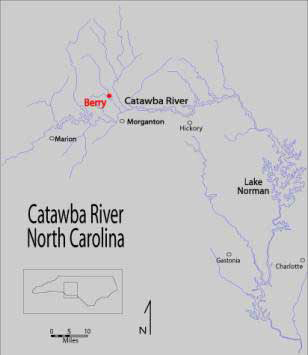


The Berry site is located on Upper Creek, a tributary of the Catawba River, about twelve km north of Morganton in Burke County, North Carolina (Figure 1). The site covers about 5 ha and is situated on the extreme north-east margin of a 75 ha alluvial bottomland. Archaeological research indicates that it was one of the largest native towns in North Carolina during the mid-sixteenth century (Beck & Reference MooreMoore 2002; Reference MooreMoore 2002). The site was identified in Cyrus Thomas' 1891 report on mound explorations for the Smithsonian Institution, where it is described as a "Mound on the west Bank of Upper Creek 8 miles north of Morganton (about 15 feet high and unexplored)" (1891:151). Our research indicates that the Berry site is the native town of Joara, visited by the Spanish expeditions of Hernando de Soto in 1540 and Juan Pardo from 1567-1568. Pardo's Fort San Juan, constructed at Joara, is the earliest European settlement in the interior of what is now the United States.
Berry Site location

Joara was the political centre of a Mississippian chiefdom, one of many that dotted the cultural landscape of south-eastern North America from c. A.D. 1000 - 1600 (Reference AndersonAnderson 1994; Beck 2003; Beck & Reference MooreMoore 2002; Reference HallyHally 1994; Reference MullerMuller 1997; Reference SmithSmith 2000). During the mid-sixteenth century, Joara sat at the north-eastern edge of the Mississippian cultural world and at the north-western edge of the Spanish colonial frontier. Our research into the long-forgotten episode of Fort San Juan's founding and subsequent fiery destruction promises to help re-write the history of European exploration and settlement in eastern North America, offering a new and deeper appreciation of Spain's early presence in this colonial borderland and of the subsequent transformation of native societies.
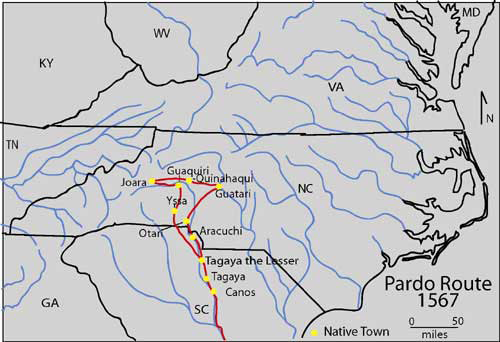
On December 1, 1566, Captain Juan Pardo departed from Santa Elena, the capital of Spanish La Florida (located on modern Parris Island, South Carolina), with a company of 125 men (DePratter et al. 1983; Reference HudsonHudson 1990). Governor Pedro Menéndez de Aviles commissioned Pardo to explore the interior, to claim the land for Spain while pacifying local Indians, and to forge a route from Santa Elena to Spanish silver mines in northern Mexico. In January 1567, Pardo arrived at Joara, a large native town located at the foot of the Appalachian Mountains (Figure 2). Pardo renamed this town Cuenca, after his own native city in Spain, and built Fort San Juan de Joara, leaving thirty men to defend the fort and occupy the town. In so doing, he founded the earliest European settlement in the interior of what is now the United States. Earlier expeditions into the interior had erected short-term, seasonal camps. Pardo, however, intended for Cuenca and Fort San Juan to permanently expand the colony of Santa Elena into the northern frontiers of La Florida. Pardo's soldiers occupied Fort San Juan for nearly eighteen months, until shortly after May 1568, when news reached Santa Elena that the people of Joara had destroyed Fort San Juan during a surprise attack (Reference HudsonHudson 1990:173-177), rebuffing Pardo's effort to extend Spanish colonial ambitions into their domain. With this disaster ended Spain's only effort to colonise the northern interior of La Florida.
Route of Juan Pardo's first expedition through the Carolinas, 1567.

Much of our previous research has focused on identifying the material correlates of Fort San Juan. Documents from the Pardo expeditions record two kinds of structures that the Spaniards used at Joara: the fort itself, and the buildings that quartered Pardo's soldiers. Neither Pardo nor Bandera, his scribe, specifically described Fort San Juan in their accounts, but Bandera did describe the construction of Fort Santiago, built at another native town called Guatari (Bandera 1990:284; Reference HudsonHudson 1990:151). Fort Santiago's construction involved a considerable amount of earth and wood, including bastions and a tall palisade. Bandera also described houses that native people built for the Spaniards. During his first expedition, Pardo told the leaders of several native towns, including Joara, to build houses and to lay up stores of grain for the soldiers. Bandera noted that the structures Pardo ordered built at several of the native towns were large, and one suspects that they were considered large in comparison with the Indians' own houses. We expect these houses to reflect native construction techniques and technologies, but it is likely that Pardo's soldiers contributed their labour and experience, as well.
Bandera also listed the supplies that Pardo left at each of the interior forts. Most of the artefact classes on these lists never entered into Spanish-native trade networks, so their presence on archaeological sites is strong evidence of extended Spanish occupation, rather than ephemeral contact or trade. During his expeditions, Pardo left the following supplies for Fort San Juan: 235 lbs of arquebus powder; 201 lbs of matchcord; 235 lbs of lead; 4 crossbows; 240 crossbow bolts; 34 lbs of nails; 42 chisels; 6 shovels; 4 mattocks; 4 picks; 2 socketed axes; and 4 iron wedges (Reference HudsonHudson 1990:148, 150). In addition to these supplies left at the fort, Pardo carried 72 litres of wine, which was almost certainly carried in the ceramic vessels usually referred to as Olive Jars - the typical containers that colonial Spaniards used for transport and storage. We therefore expect the archaeological sites of Fort San Juan and Joara to include artefact classes that did not enter Spanish-native trade networks and that are very uncommon, or altogether absent, from other 16th century sites - especially lead shot, nails, iron tools, and Spanish ceramics.
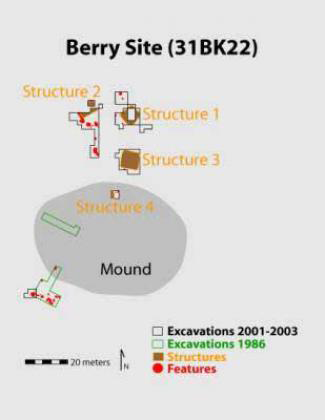
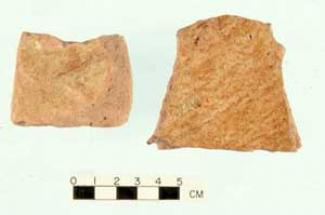
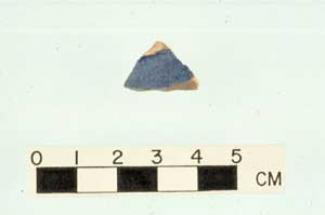
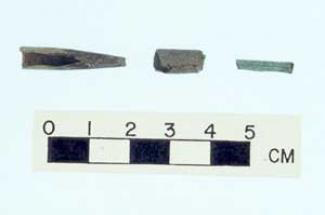
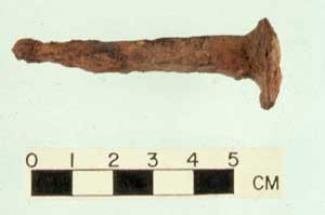
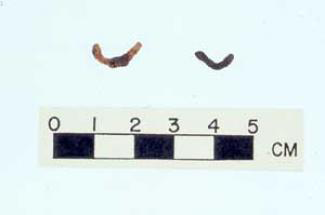
Archaeological and documentary evidence (Beck 1997b; Reference WorthWorth 1994) indicate that the Berry site is the location of Joara and Pardo's Fort San Juan. Surface artefact collection and gradiometer surveys have been conducted over the entire 5 ha site (Beck 1997a, Hargrove & Beck 2001; Schroedl & Reference MooreMoore 2002). Excavations - totalling some 825 m_ to date - have been limited to a 0.5-ha area (Figure 3) adjacent to the earthen mound (Beck & Reference MooreMoore 2002; Reference MooreMoore 2002). Since 1986, we have discovered numerous sixteenth-century Spanish artefacts at the site, including Olive Jar (Figure 4) and majolica fragments (Figure 5), Mexican Aztec Red ceramics, lead shot, brass lacing tips (Figure 6), wrought iron nails (Figure 7), chain mail fragments (Figure 8), and a handful of glass beads (Beck 2002; Moore & Beck 1994; Reference MooreMoore 2002; Reference WorthWorth 1994).
Plan view, Berry Site excavations.

Olive Jar fragments, Berry Site.

Caparra Blue Majolica (1492-1600), Berry Site.

Brass aglets from Berry Site.

Barrote-type nail, Berry Site.

Chain mail fragments, Structure 1, Berry Site Our Upper Catawba Valley Archaeology Project URL link is: www.warren-wilson.edu/~arch.

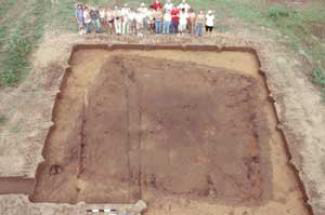
Although the Berry site (i.e., Joara) covers more than 5 ha, the Spanish artefacts are restricted to a small area on the northern end of the site. Our excavations in this area have revealed the well-preserved remains of four burned structures (between 65 and 80 m2 each) that form a distinct compound around a possible central plaza (Figure 9). Pit features in the plaza contain glass beads and brass lacing tips from Spanish clothing, and a line of burned posts near one of the buildings suggests that a wooden stockade may have enclosed the compound (Best & Rodning 2003). This compound, we believe, constitutes the burned remains of Fort San Juan.
Plan view of Structure 3, looking north, following plowzone removal (structure measures 8.5 m by 8.5 m).

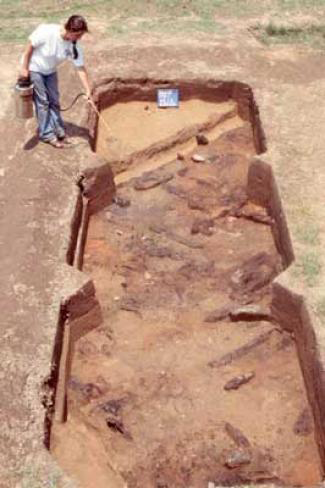
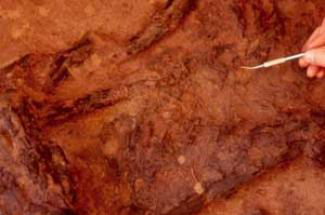
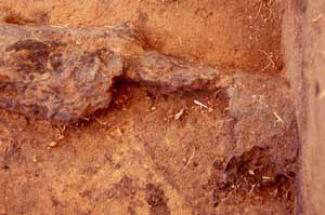
Our work inside one of the burned buildings, Structure 1 (Figure 10), has revealed an extraordinary degree of architectural preservation, including intact features such as carbonised wooden posts that still remain upright and fallen roof timbers that still retain their bark; we have found burned sections of wooden wall benches made of split oak, with split cane mats (Figure 11) still attached to the benches (Beck & Ketron 2003). Artefacts inside the building were laying in place where they fell or were left on the day that Fort San Juan was destroyed - decorated ceramic pots, a clay smoking pipe, and possible wood-handled tools. We discovered fragments of chain mail armour on the floor of this structure, and some of its well-preserved wooden timbers were apparently notched with metal tools in a European style of construction (Figure 12). We believe that this was one of the buildings that quartered the soldiers stationed at Fort San Juan, and what is more, we have yet to enter the other burned buildings in this area. We have every reason to believe that they are just as remarkable in their contents and preservation. That all four were burned serves as a chilling testament to how relations between the Spaniards and the people of Joara ended tumultuously in the spring of 1568.
Excavation trench across Structure 1, looking north, revealing intact architectural remains (excavation trench measures 2 m by 6 m).

Structure 1, collapsed and burned remains of wooden wall bench with attached split cane matting.

Structure 1, roofing timber with square-cut notch, possibly cut with metal tools (notch measures 12 cm long by 5 cm deep).

Acknowledgements
This project has been supported by Warren Wilson College, Western Piedmont Community College, an Historic Preservation Fund grant from the National Park Service (U.S. Department of the Interior), the Historic Burke Foundation, the Burke Historical Society and numerous individuals. We would also like to recognize the late Thomas Hargrove and the late Charles Carey whose efforts were responsible for the magnetometer study that first identified the burned buildings at Berry.